
RESPONSIVE | ENGINEERING | SOLUTIONS SUMMARY OF











Description: RESPONSIVE ENGINEERING SOLUTIONS SUMMARY OF DIRECT TESTIMONY OF RANDY PARMLEY, P.E., DISORBO CONSULTING, LLC, ON BEHALF OF XTO ENERGY INC. IN SUPPORT OF PERMIT NUMBERS 7877M1 (COWBOY), 8152M1 (JAYHAWK), 8349M2 (LONGHORN), 8153M1
Related Topics
Download Presentation
"RESPONSIVE | ENGINEERING | SOLUTIONS SUMMARY OF" is the property of its rightful owner. Permission is granted to download and print the materials on this website for personal, non-commercial use only, and to display it on your personal computer provided you do not modify the materials and that you retain all copyright notices contained in the materials. By downloading content from our website, you accept the terms of this agreement.
Presentation Transcript
slide1. RESPONSIVE | ENGINEERING | SOLUTIONS<br>
slide2. SUMMARY OF DIRECT TESTIMONY OF RANDY PARMLEY, P.E., DISORBO CONSULTING, LLC, ON BEHALF OF XTO ENERGY INC. IN SUPPORT OF PERMIT NUMBERS 7877M1 (COWBOY), 8152M1 (JAYHAWK), 8349M2 (LONGHORN), 8153M1 (BULLDOG), 7681M2 (SPARTAN), 7565M2 (MAVERICK),7623M2 (TIGER), AND 7474M2 (WILDCAT)<br>
slide3. Agenda Background
Overview Of XTO Compressor Stations And Cowboy CDP Operations
XTO Permit Revision Applications
Toxic Air Pollutants
Enforceability Of Start Up, Shutdown, Maintenance (SSM)
Site Aggregation, Completeness Of Emission Source List
Dispersion Modeling
Environmental Justice
Facility Compliance
Conclusions<br>
slide4. BACKGROUND<br>
slide5. Background for Permits Subject to this Matter In general, an oil and gas permit authorizes the initial construction, operation, or modification of the facility to treat, process, store and/or transport gases and liquids associated with the production of oil and gas.
The initial permits for these facilities were issued between 2017 and 2019. XTO is revising these permits to account for modifications to several existing facilities.
The permit establishes the terms and conditions governing compliance with the permit.
Prior approval by the agency is required prior to start of construction for significant revisions to an issued permit.<br>
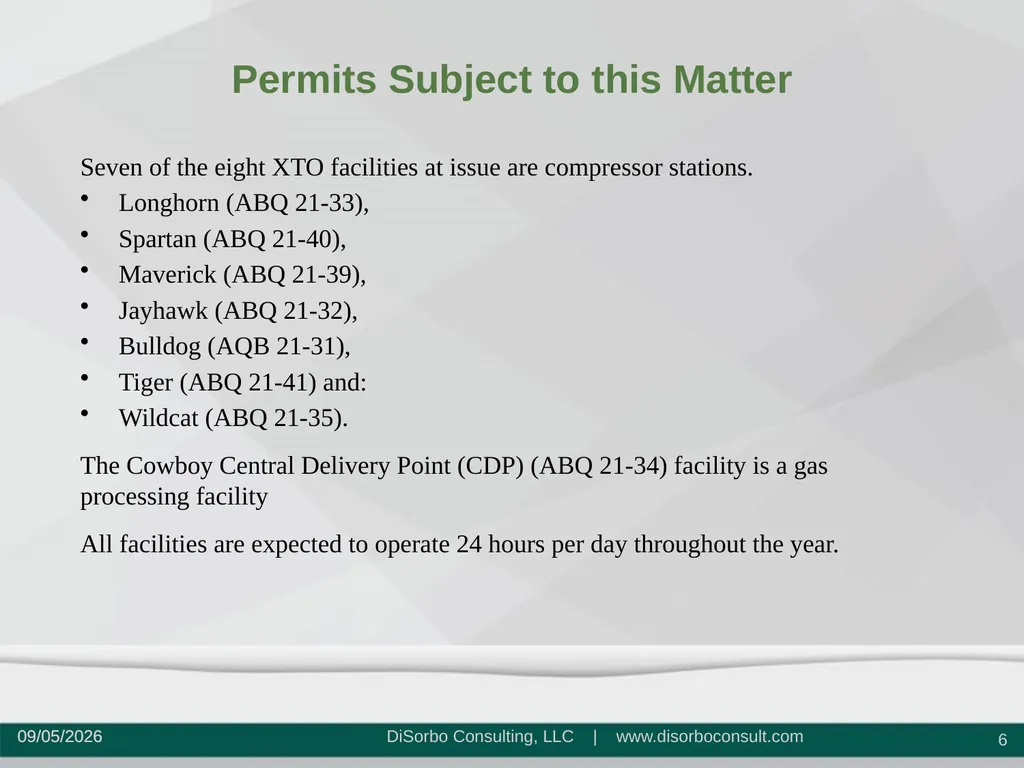
slide6. Permits Subject to this Matter Seven of the eight XTO facilities at issue are compressor stations.
Longhorn (ABQ 21-33),
Spartan (ABQ 21-40),
Maverick (ABQ 21-39),
Jayhawk (ABQ 21-32),
Bulldog (AQB 21-31),
Tiger (ABQ 21-41) and:
Wildcat (ABQ 21-35).
The Cowboy Central Delivery Point (CDP) (ABQ 21-34) facility is a gas processing facility
All facilities are expected to operate 24 hours per day throughout the year.<br>
slide7. XTO Operations<br>
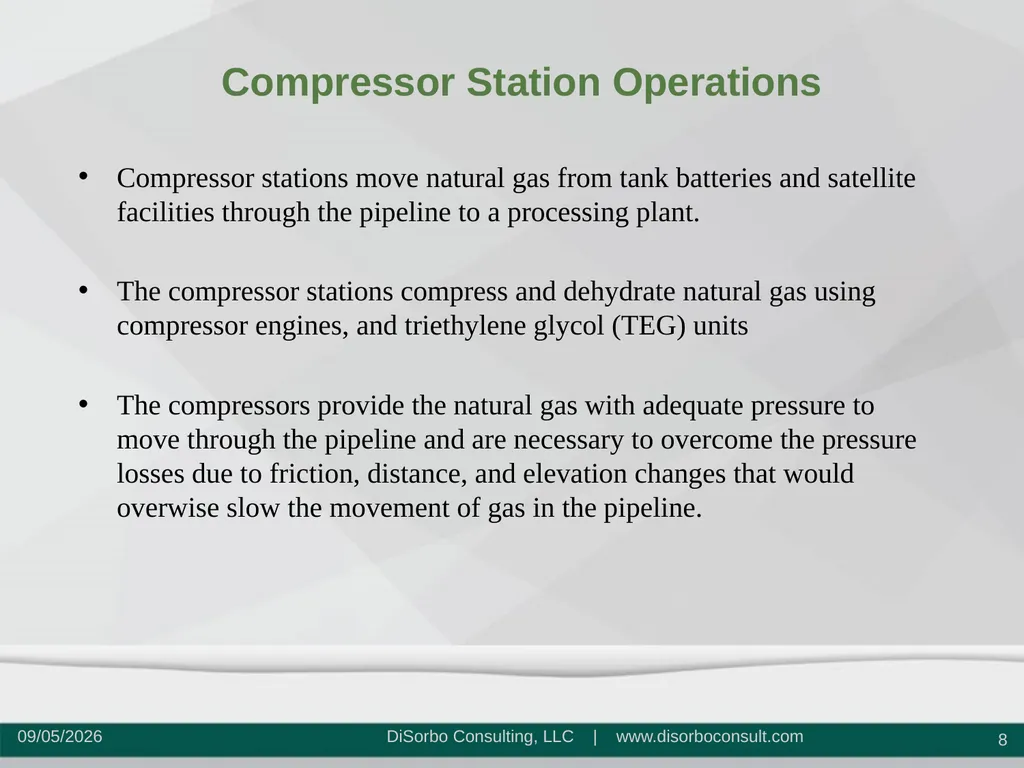
slide8. Compressor Station Operations Compressor stations move natural gas from tank batteries and satellite facilities through the pipeline to a processing plant.
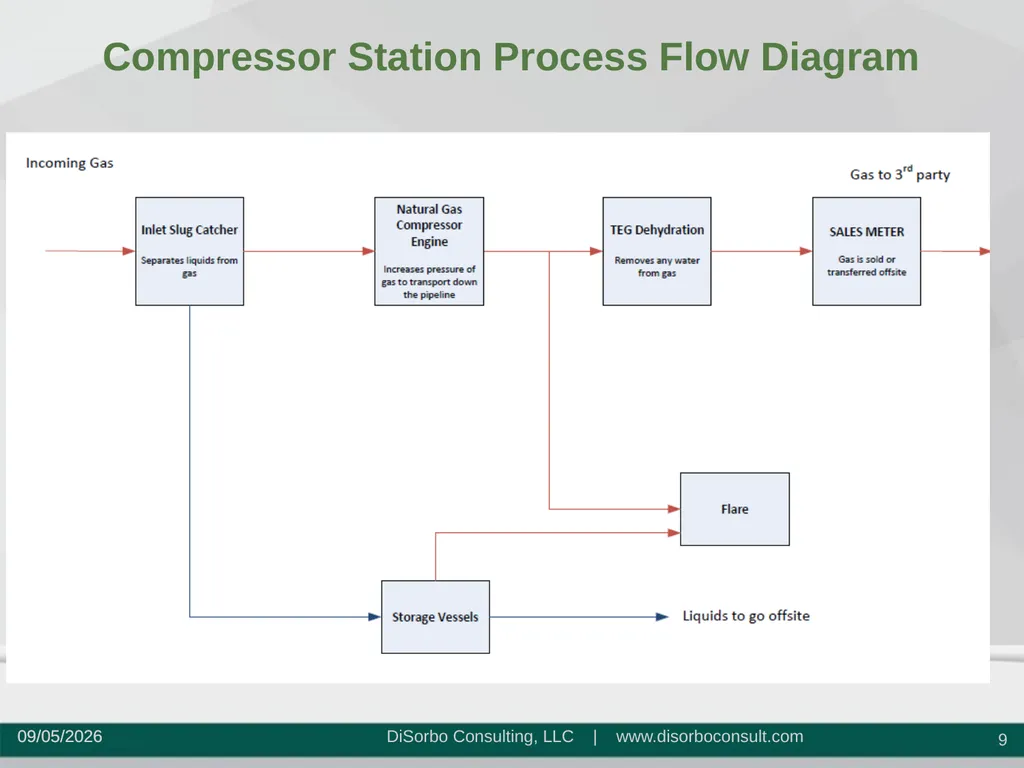
The compressor stations compress and dehydrate natural gas using compressor engines, and triethylene glycol (TEG) units
The compressors provide the natural gas with adequate pressure to move through the pipeline and are necessary to overcome the pressure losses due to friction, distance, and elevation changes that would overwise slow the movement of gas in the pipeline.<br>
slide9. Compressor Station Process Flow Diagram<br>
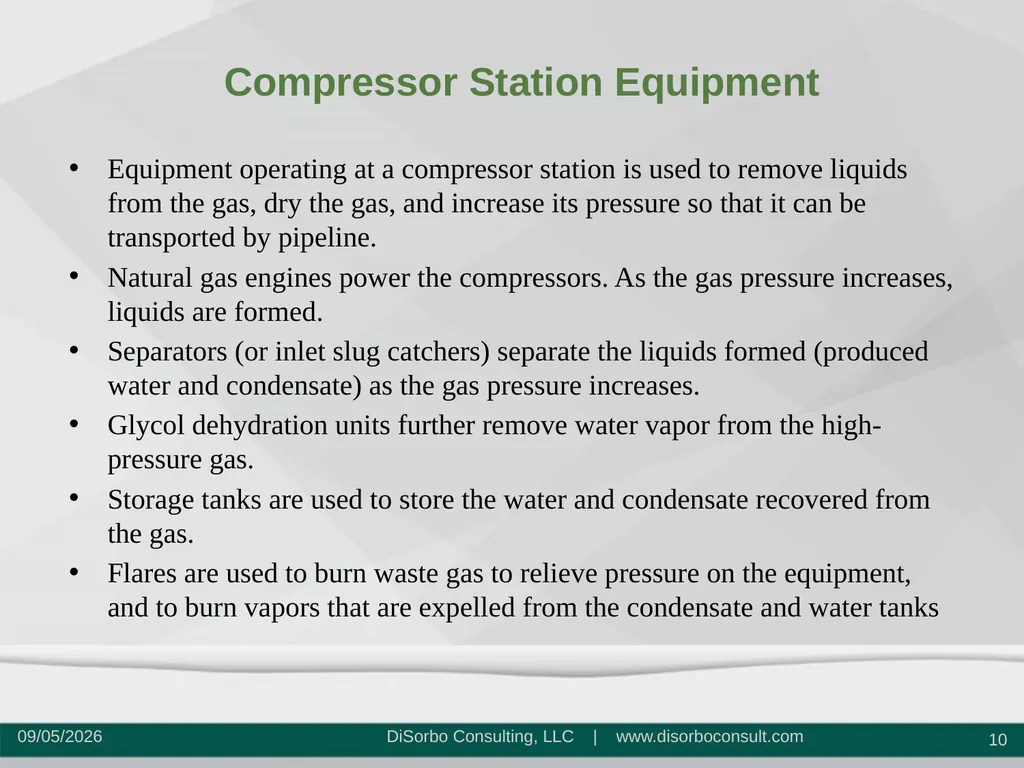
slide10. Compressor Station Equipment Equipment operating at a compressor station is used to remove liquids from the gas, dry the gas, and increase its pressure so that it can be transported by pipeline.
Natural gas engines power the compressors. As the gas pressure increases, liquids are formed.
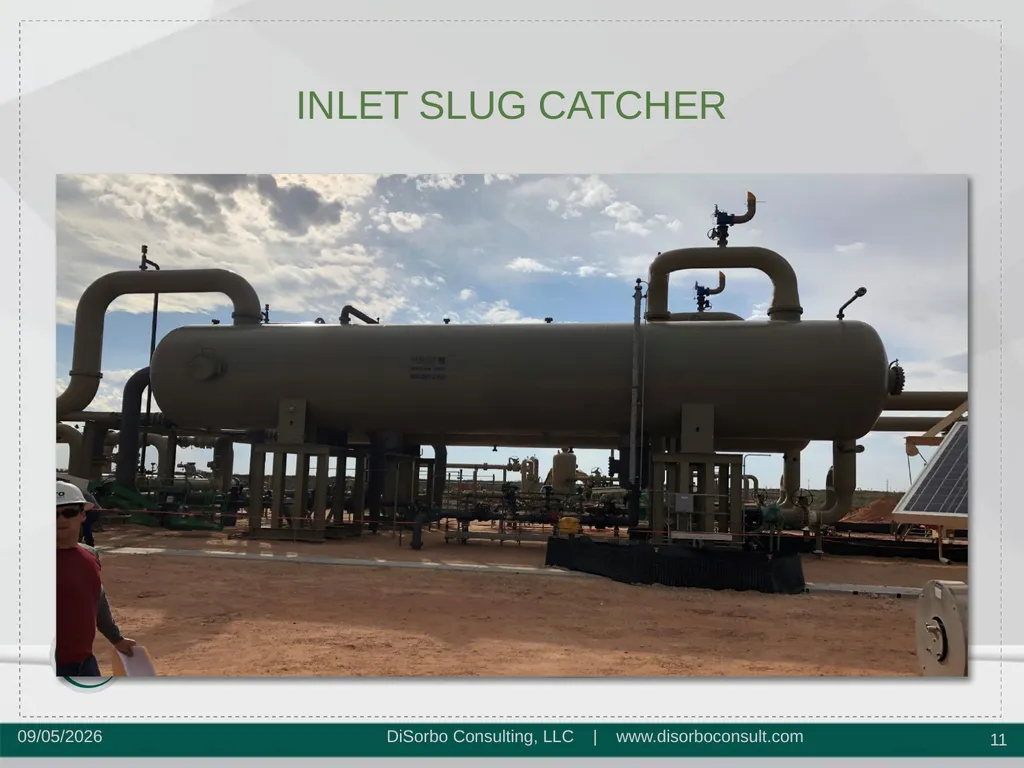
Separators (or inlet slug catchers) separate the liquids formed (produced water and condensate) as the gas pressure increases.
Glycol dehydration units further remove water vapor from the high-pressure gas.
Storage tanks are used to store the water and condensate recovered from the gas.
Flares are used to burn waste gas to relieve pressure on the equipment, and to burn vapors that are expelled from the condensate and water tanks<br>
slide11. Inlet Slug Catcher<br>
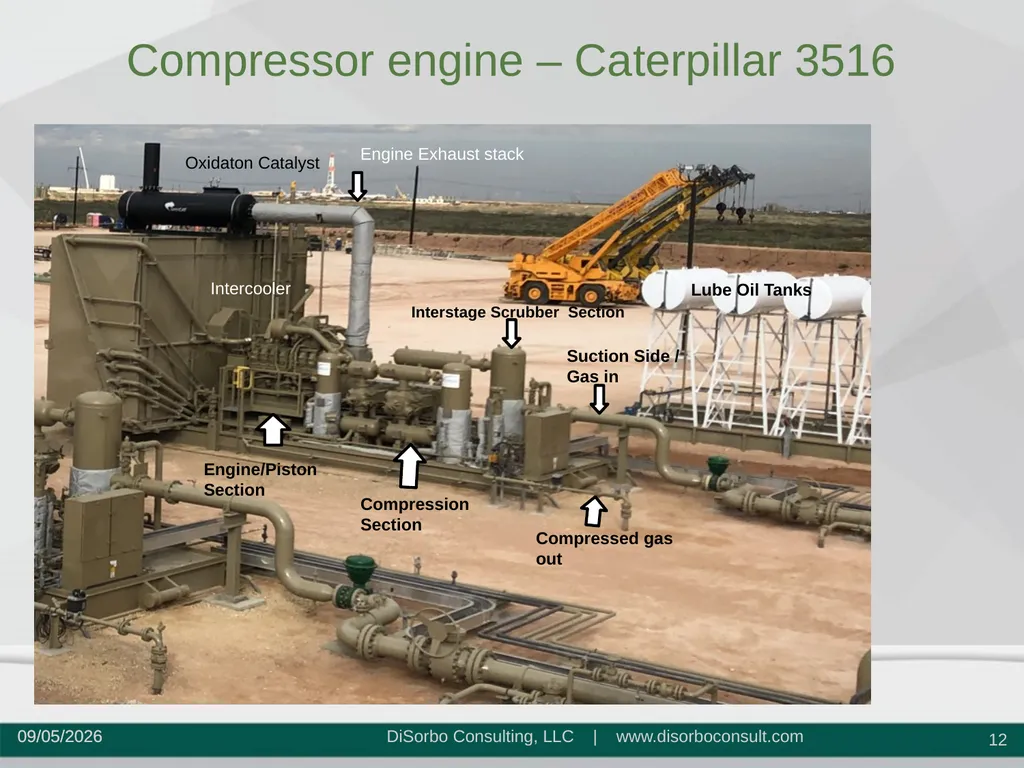
slide12. Compressor engine – Caterpillar 3516 Intercooler Engine/Piston Section Interstage Scrubber Section Compressed gas out Engine Exhaust stack Suction Side / Gas in Compression Section Lube Oil Tanks Oxidaton Catalyst<br>
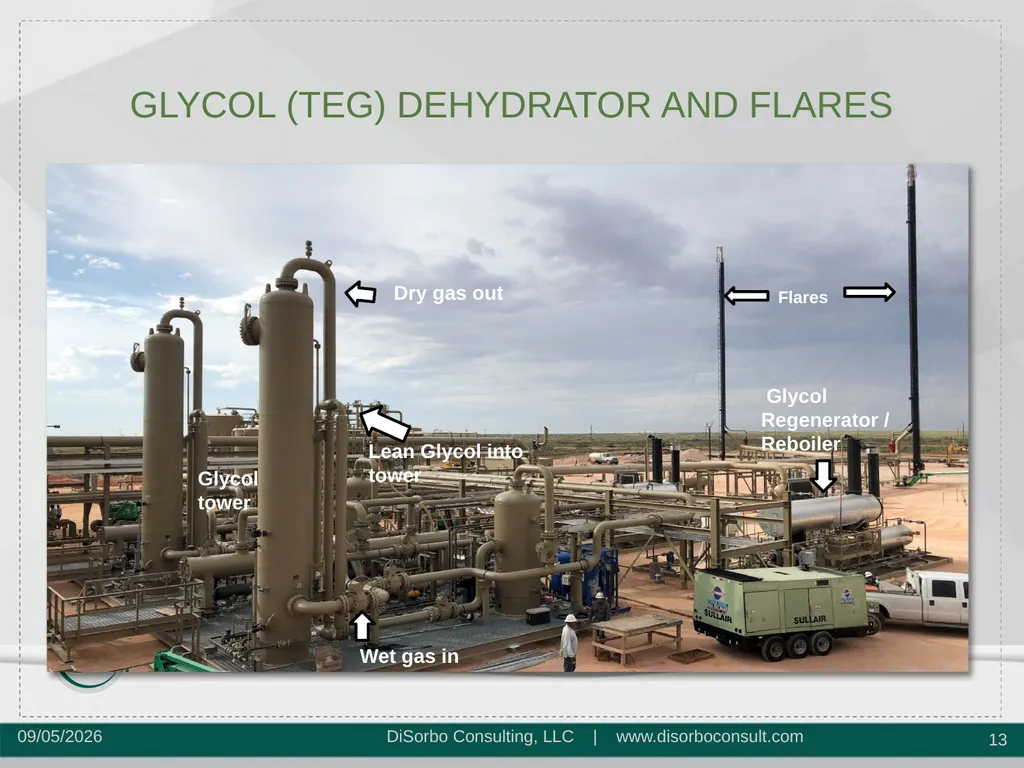
slide13. Glycol (TEG) Dehydrator and Flares Glycol Regenerator / Reboiler Glycol tower Flares Wet gas in Dry gas out Lean Glycol into tower<br>
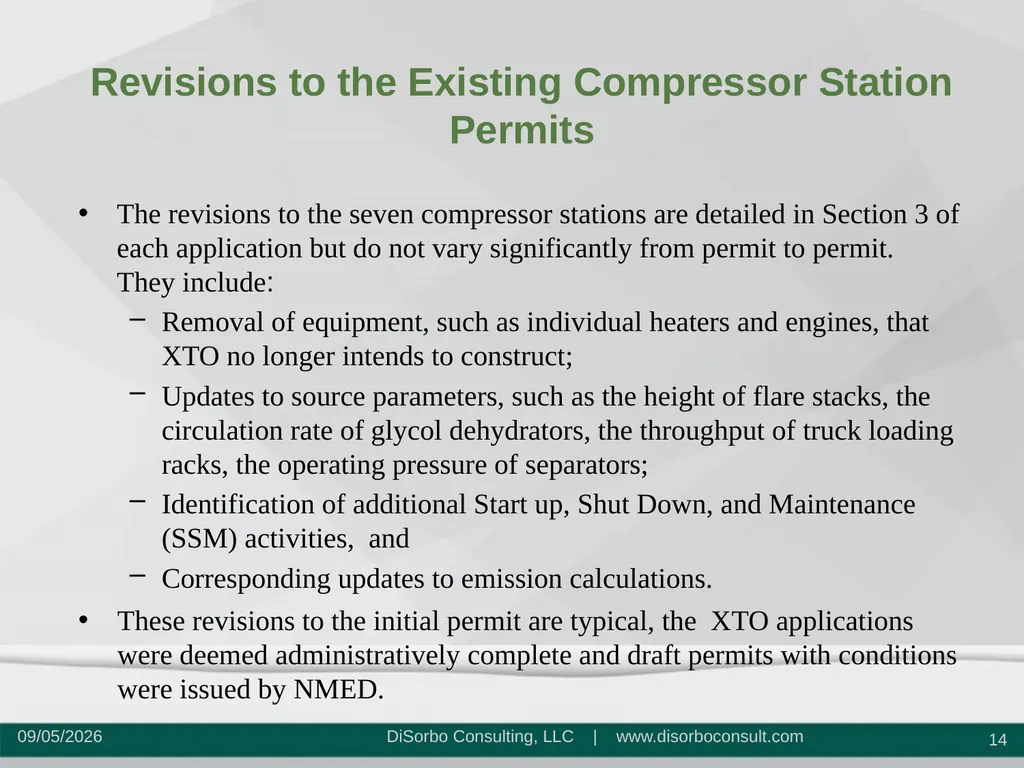
slide14. Revisions to the Existing Compressor Station Permits The revisions to the seven compressor stations are detailed in Section 3 of each application but do not vary significantly from permit to permit. They include:
Removal of equipment, such as individual heaters and engines, that XTO no longer intends to construct;
Updates to source parameters, such as the height of flare stacks, the circulation rate of glycol dehydrators, the throughput of truck loading racks, the operating pressure of separators;
Identification of additional Start up, Shut Down, and Maintenance (SSM) activities, and
Corresponding updates to emission calculations.
These revisions to the initial permit are typical, the XTO applications were deemed administratively complete and draft permits with conditions were issued by NMED.<br>
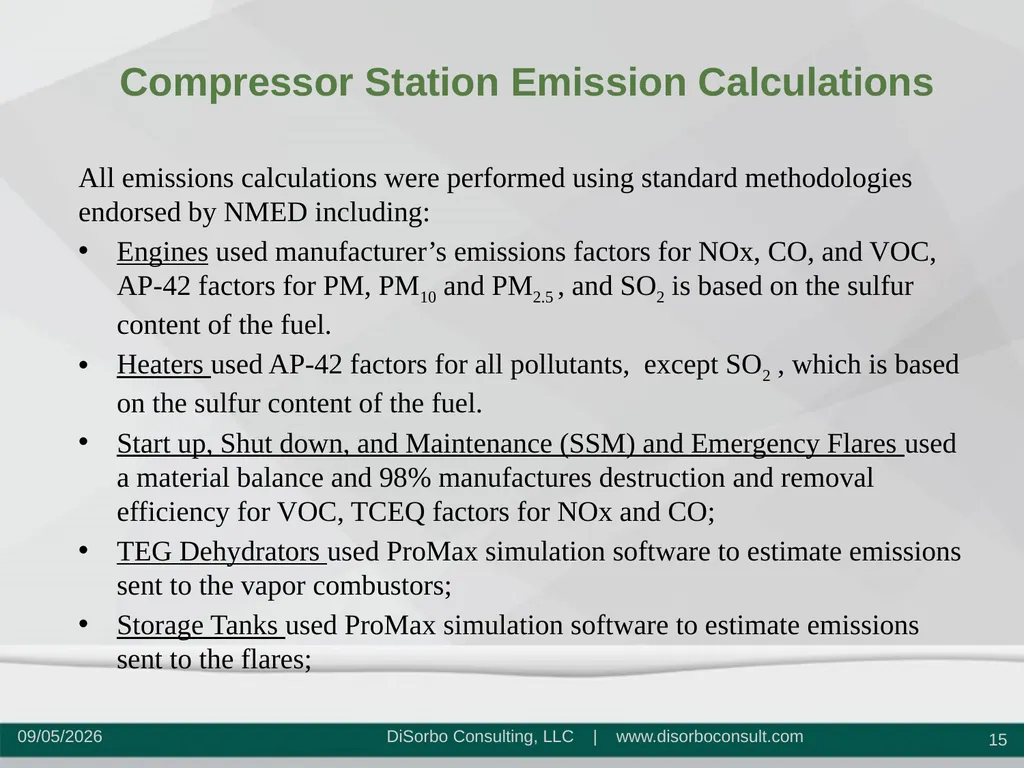
slide15. Compressor Station Emission Calculations All emissions calculations were performed using standard methodologies endorsed by NMED including:
Engines used manufacturer’s emissions factors for NOx, CO, and VOC, AP-42 factors for PM, PM10 and PM2.5 , and SO2 is based on the sulfur content of the fuel.
Heaters used AP-42 factors for all pollutants, except SO2 , which is based on the sulfur content of the fuel.
Start up, Shut down, and Maintenance (SSM) and Emergency Flares used a material balance and 98% manufactures destruction and removal efficiency for VOC, TCEQ factors for NOx and CO;
TEG Dehydrators used ProMax simulation software to estimate emissions sent to the vapor combustors;
Storage Tanks used ProMax simulation software to estimate emissions sent to the flares;
These revisions to the initial permit are typical, the XTO applications were deemed administratively complete and draft permits with conditions were issued by NMED.<br>
slide16. Compressor Station Emission Calculations continued Truck Loading used AP-42 emission factors for oil loading;
Piping Component Fugitives were calculated using TCEQ factors and conservative equipment count information;
SSM emissions routed to flare were based on 10 tpy per State guidance;
Haul Road emissions were based on AP-42 factors;
Malfunction emissions were based on 10 tpy per State guidance;
Greenhouse Gas emissions were based on EPA Global Warming Factors
These emissions calculations methodologies are well documented and accepted techniques for calculating air emissions for permitting purposes.<br>
slide17. Cowboy CDP Operations The Cowboy Central Delivery Point (CDP) is a gas processing facility
The facility receives natural gas, natural gas liquids, and oil via different incoming pipelines.
Natural gas is processed to remove CO2, H2S, and moisture prior to separating the dry natural gas from the natural gas liquids.
Natural gas is compressed prior to going to pipeline.
Natural gas liquid is pressurized prior to being shipped by pipeline;
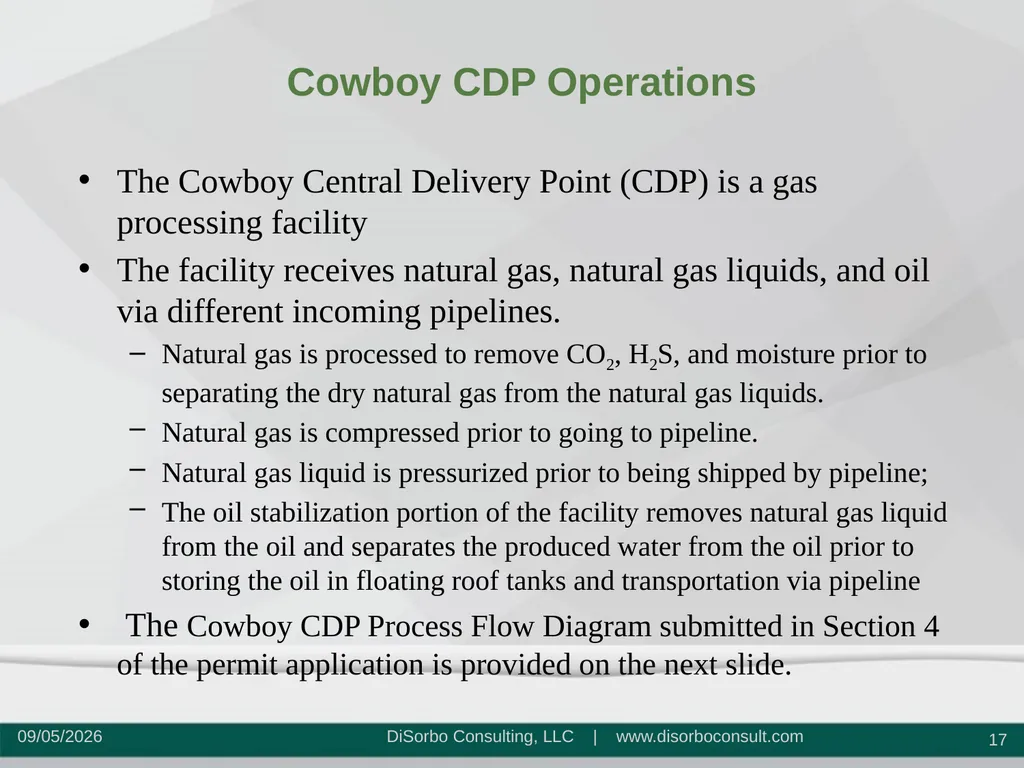
The oil stabilization portion of the facility removes natural gas liquid from the oil and separates the produced water from the oil prior to storing the oil in floating roof tanks and transportation via pipeline
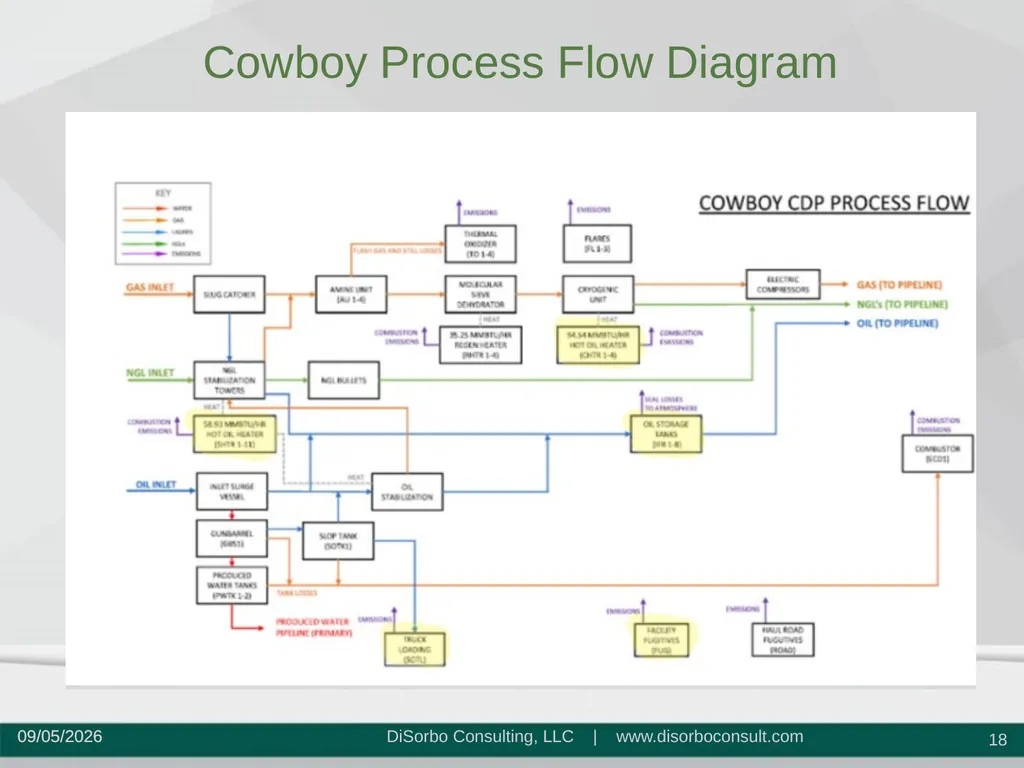
The Cowboy CDP Process Flow Diagram submitted in Section 4 of the permit application is provided on the next slide.<br>
slide18. Cowboy Process Flow Diagram<br>
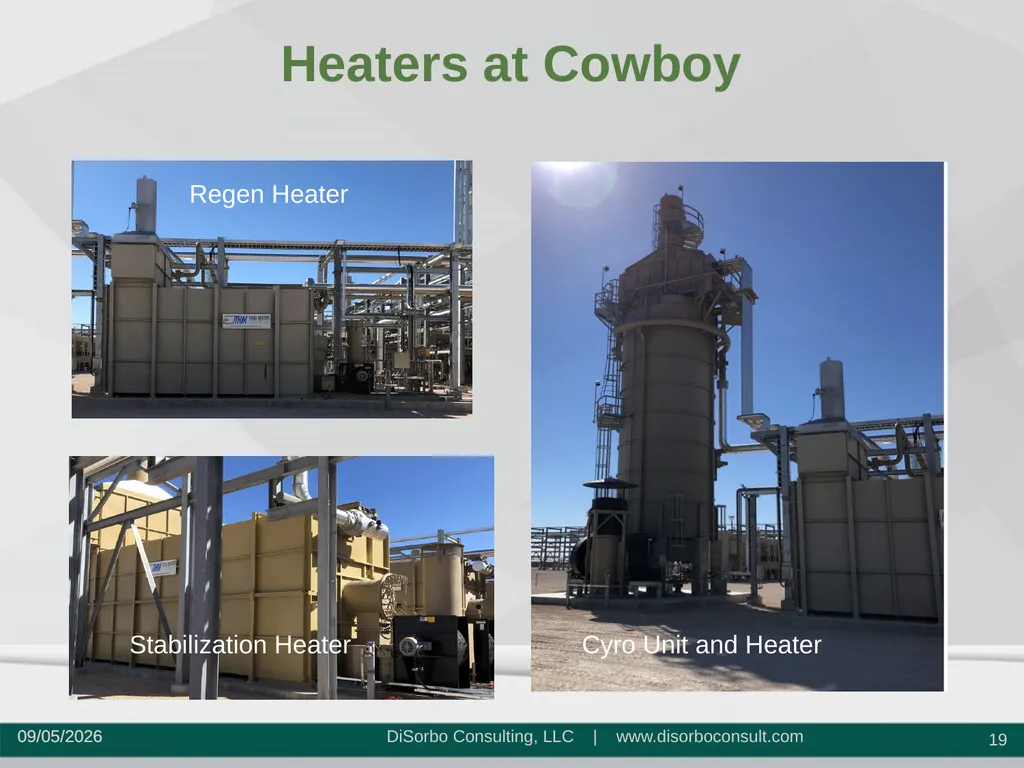
slide19. Heaters at Cowboy Regen Heater Stabilization Heater Cyro Unit and Heater<br>
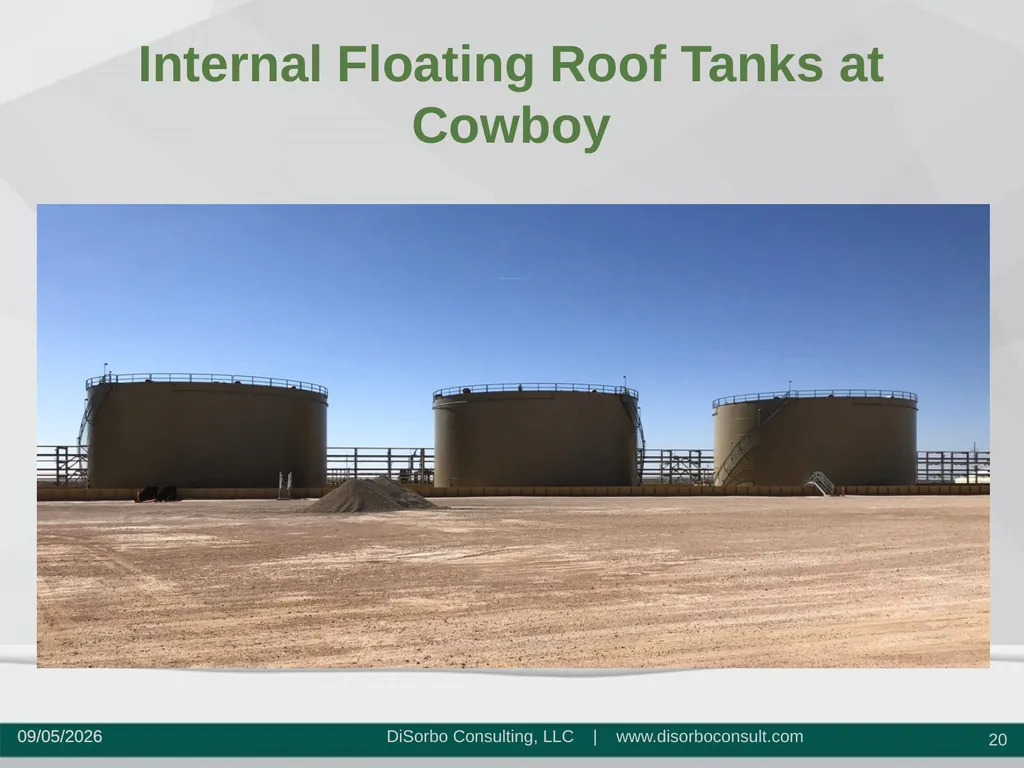
slide20. Internal Floating Roof Tanks at Cowboy<br>
slide21. Cowboy CDP Revision to NSR Permit 7877 XTO application is a revision to the existing permit issued on November 16, 2018 and, as indicated in Section 3 of the application, includes:
Additional NOX controls to two stabilization heaters and two cryogenic heaters;
Removal of two stabilization heaters;
Correction to shell capacity of four floating roof tanks;
New truck slop oil loading facilities;
New emergency generators;
Misc. throughput and flowrate updates;
Revised calculations to reflect these changes; and
These revisions to the initial Cowboy permit are typical, the XTO application was deemed administratively complete and draft permit with conditions was issued by NMED<br>
slide22. Toxic Air Pollutant Permitting<br>
slide23. Toxic Air Pollutant Permitting Requirements WEG commented that there was no compliance demonstration with regard toxic air pollutant permitting requirements at 20.2.72.400-499 NMAC FOR to the Jayhawk, Longhorn, Bulldog, Spartan, Maverick and Tiger compressor stations.
The Jayhawk, Longhorn, Bulldog, Spartan, Maverick and Tiger compressor stations are Oil and Gas production facilities and are exempt due to their SIC code from the permitting requirements for toxic air pollutants per 20.2.72.402.C(5).
The definition of Oil and Gas production facilities, includes major SIC group 13 (20.2.72.401.F).
Each of the facilities in question is classified under SIC Code 1311 and are therefore exempt (as indicated in Section 13 of the application).<br>
slide24. Enforceability of Startup, Shutdown, Maintenance (SSM) and Malfunction Emission Limits<br>
slide25. Enforceability of Annual SSM and Malfunction Limits WEG commented that a number of Emission Limits Contained in the Draft Permits were not enforceable as a practical matter. These include:
Annual SSM VOC Emissions from Floating Roof Tank Landings at Cowboy;
Annual VOC and SO2 SSM limits for routing Dehydrator emissions to the reboiler at Spartan, Maverick, and Tiger
Annual SSM VOC Emissions for Miscellaneous Maintenance Activities like Compressor Blowdowns, Pigging Equipment Blowdowns at all sites ;
10 ton per year Malfunction Emissions for 5 Sites Due to Venting of Gas;
Annual SSM flaring at 5 Sites; and
However, this is simply not the case. For SSM activities like these, the VOC emissions are easily calculated based on the gas composition, the volume of the gas released during an activity, and, for the annual emissions the number of activities per year.
The draft permits contain adequate monitoring and recordkeeping requirements including the date, the start time, the end time, a description of the event, records for the volume of gas vented during SSM and Malfunctions, the most recent gas analysis and flare flowmeter records (A206) that make each of these activities enforceable as a practical matter.<br>
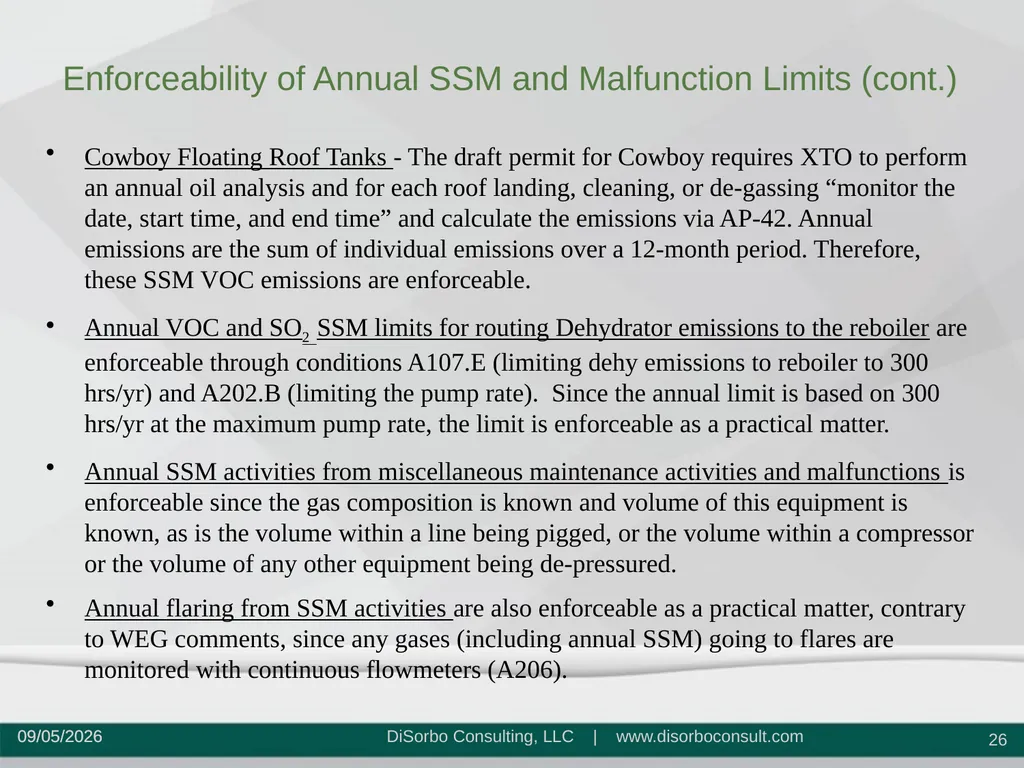
slide26. Enforceability of Annual SSM and Malfunction Limits (cont.) Cowboy Floating Roof Tanks - The draft permit for Cowboy requires XTO to perform an annual oil analysis and for each roof landing, cleaning, or de-gassing “monitor the date, start time, and end time” and calculate the emissions via AP-42. Annual emissions are the sum of individual emissions over a 12-month period. Therefore, these SSM VOC emissions are enforceable.
Annual VOC and SO2 SSM limits for routing Dehydrator emissions to the reboiler are enforceable through conditions A107.E (limiting dehy emissions to reboiler to 300 hrs/yr) and A202.B (limiting the pump rate). Since the annual limit is based on 300 hrs/yr at the maximum pump rate, the limit is enforceable as a practical matter.
Annual SSM activities from miscellaneous maintenance activities and malfunctions is enforceable since the gas composition is known and volume of this equipment is known, as is the volume within a line being pigged, or the volume within a compressor or the volume of any other equipment being de-pressured.
Annual flaring from SSM activities are also enforceable as a practical matter, contrary to WEG comments, since any gases (including annual SSM) going to flares are monitored with continuous flowmeters (A206).<br>
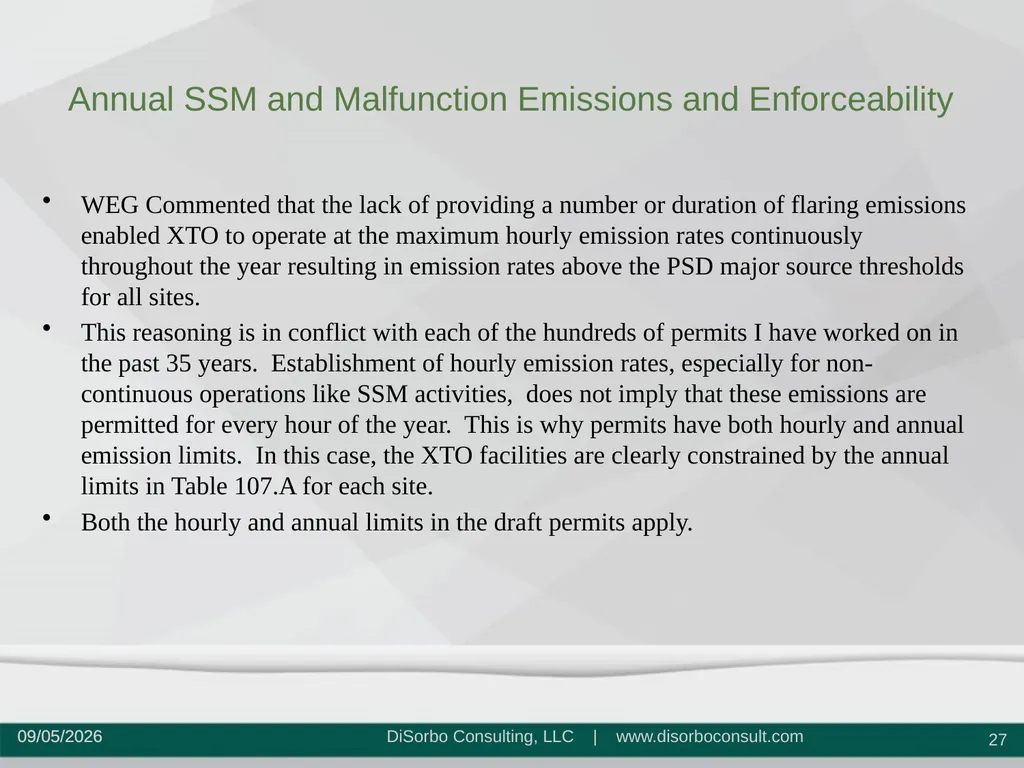
slide27. Annual SSM and Malfunction Emissions and Enforceability WEG Commented that the lack of providing a number or duration of flaring emissions enabled XTO to operate at the maximum hourly emission rates continuously throughout the year resulting in emission rates above the PSD major source thresholds for all sites.
This reasoning is in conflict with each of the hundreds of permits I have worked on in the past 35 years. Establishment of hourly emission rates, especially for non-continuous operations like SSM activities, does not imply that these emissions are permitted for every hour of the year. This is why permits have both hourly and annual emission limits. In this case, the XTO facilities are clearly constrained by the annual limits in Table 107.A for each site.
Both the hourly and annual limits in the draft permits apply.<br>
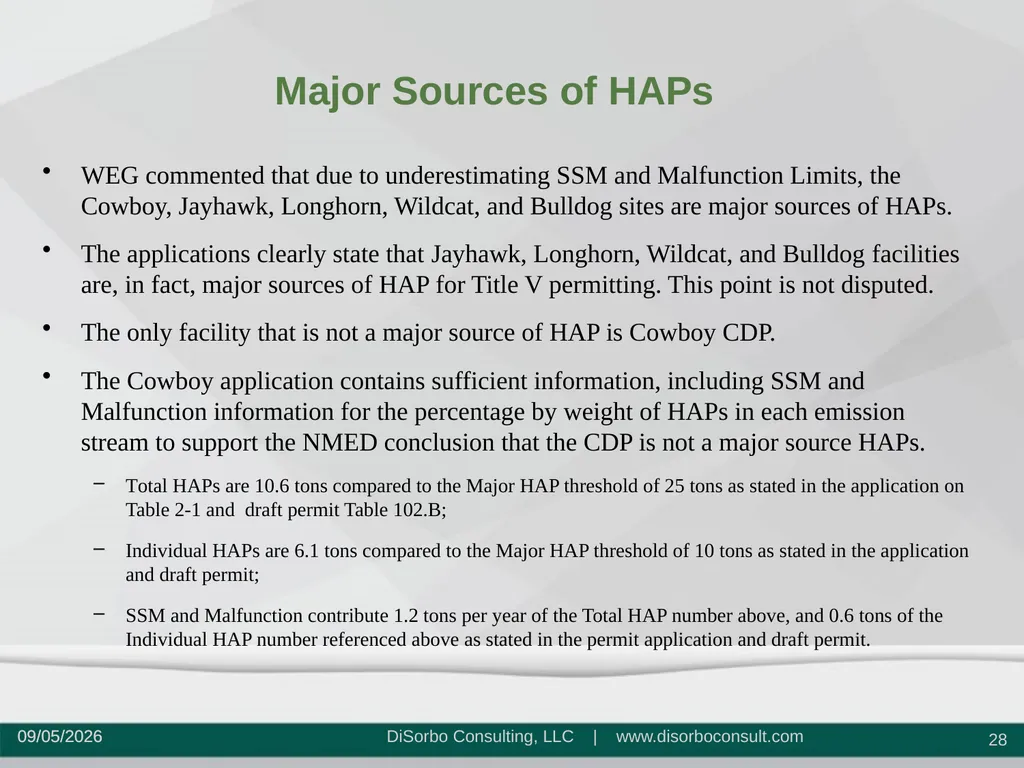
slide28. Major Sources of HAPs WEG commented that due to underestimating SSM and Malfunction Limits, the Cowboy, Jayhawk, Longhorn, Wildcat, and Bulldog sites are major sources of HAPs.
The applications clearly state that Jayhawk, Longhorn, Wildcat, and Bulldog facilities are, in fact, major sources of HAP for Title V permitting. This point is not disputed.
The only facility that is not a major source of HAP is Cowboy CDP.
The Cowboy application contains sufficient information, including SSM and Malfunction information for the percentage by weight of HAPs in each emission stream to support the NMED conclusion that the CDP is not a major source HAPs.
Total HAPs are 10.6 tons compared to the Major HAP threshold of 25 tons as stated in the application on Table 2-1 and draft permit Table 102.B;
Individual HAPs are 6.1 tons compared to the Major HAP threshold of 10 tons as stated in the application and draft permit;
SSM and Malfunction contribute 1.2 tons per year of the Total HAP number above, and 0.6 tons of the Individual HAP number referenced above as stated in the permit application and draft permit.<br>
slide29. Site Aggregation and Completeness of Emission Source Lists<br>
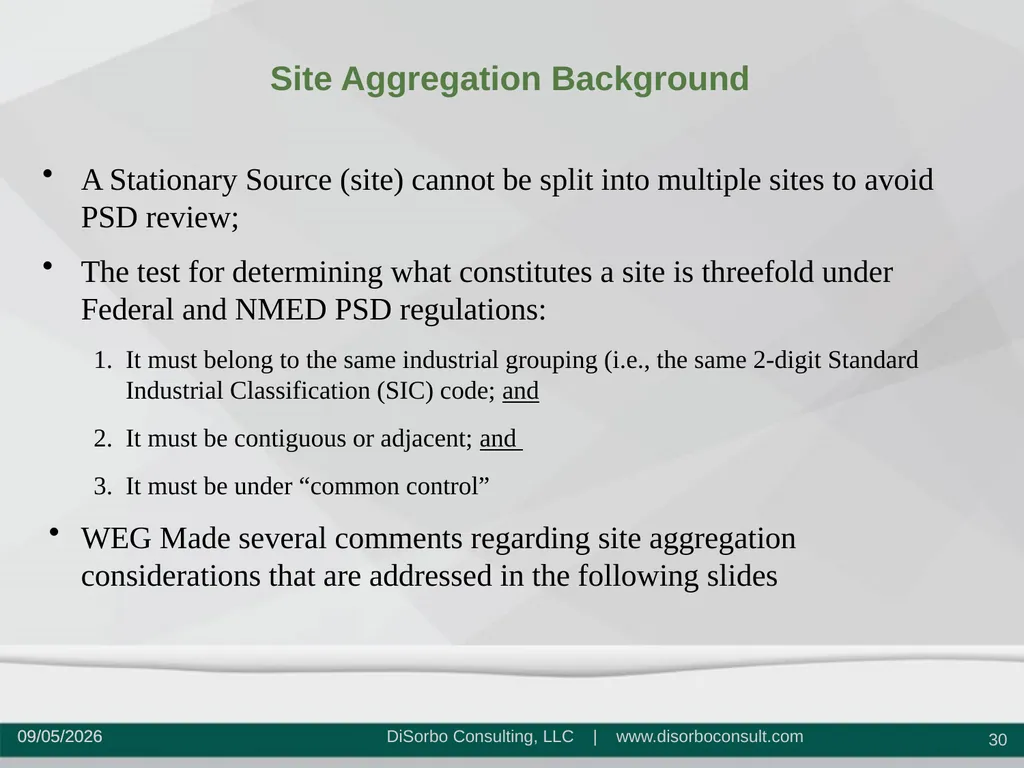
slide30. Site Aggregation Background A stationary Source (site) cannot be split into multiple sites to avoid PSD review;
The test for determining what constitutes a site is threefold under Federal and NMED PSD regulations:
It must belong to the same industrial grouping (i.e., the same 2-digit Standard Industrial Classification (SIC) code; and
It must be contiguous or adjacent; and
It must be under “common control”
WEG Made several comments regarding site aggregation considerations that are addressed in the following slides<br>
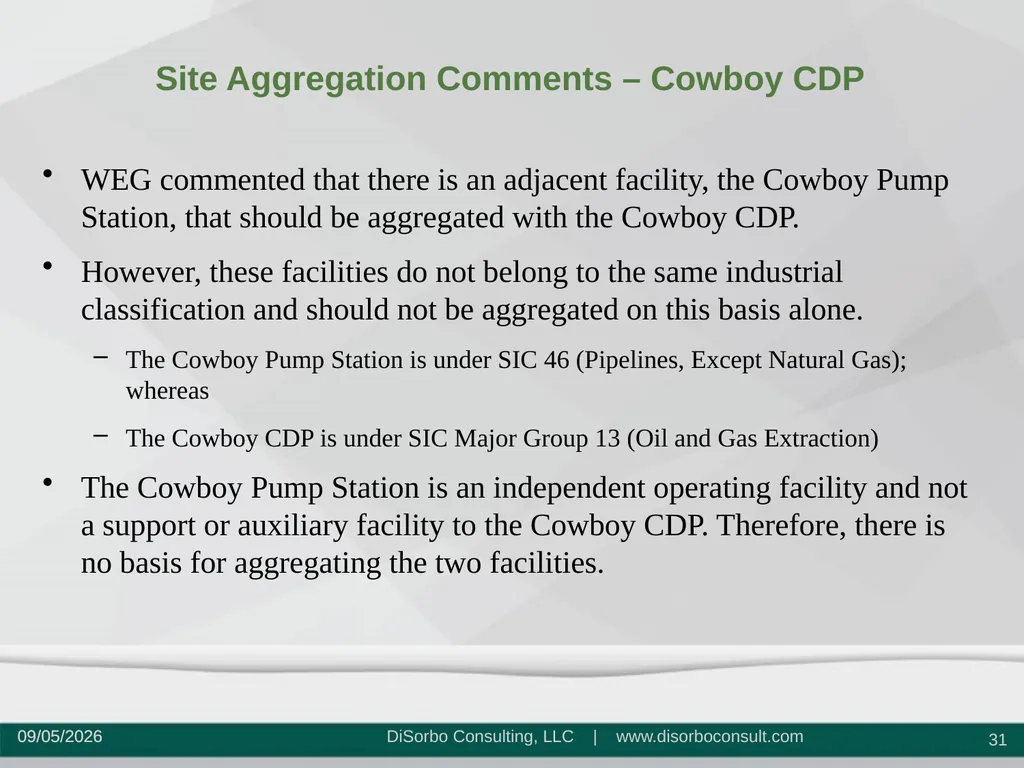
slide31. Site Aggregation Comments – Cowboy CDP WEG commented that there is an adjacent facility, the Cowboy Pump Station, that should be aggregated with the Cowboy CDP.
However, these facilities do not belong to the same industrial classification and should not be aggregated on this basis alone.
The Cowboy Pump Station is under SIC 46 (Pipelines, Except Natural Gas); whereas
The Cowboy CDP is under SIC Major Group 13 (Oil and Gas Extraction)
The Cowboy Pump Station is an independent operating facility and not a support or auxiliary facility to the Cowboy CDP. Therefore, there is no basis for aggregating the two facilities.<br>
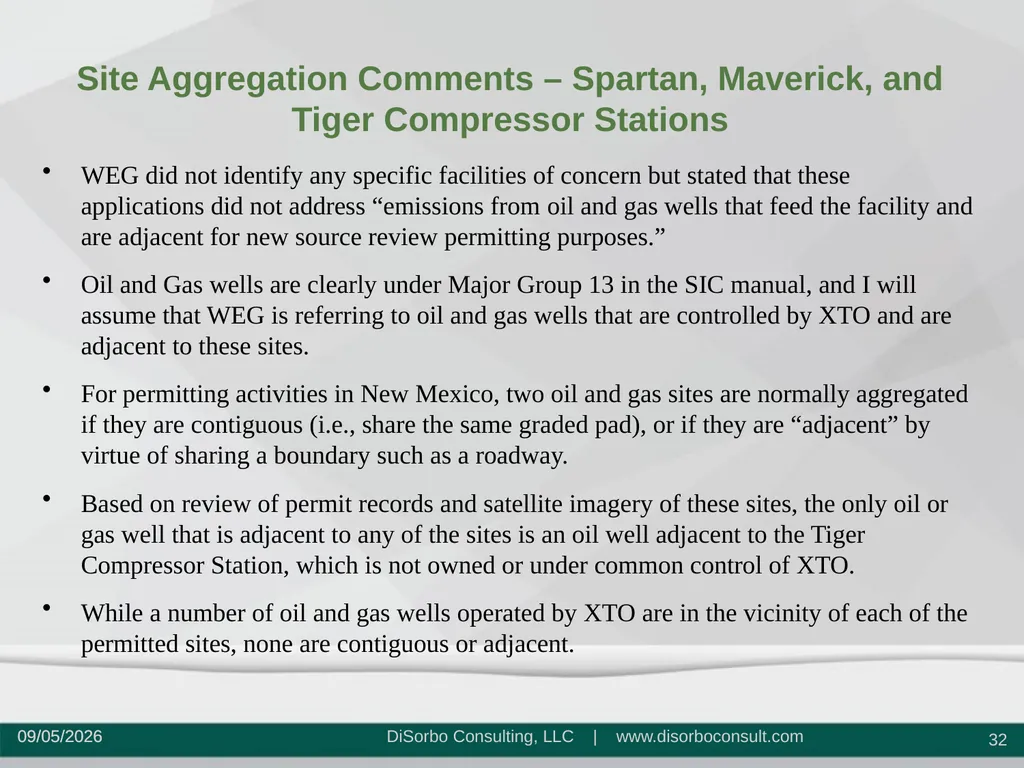
slide32. Site Aggregation Comments – Spartan, Maverick, and Tiger Compressor Stations WEG did not identify any specific facilities of concern but stated that these applications did not address “emissions from oil and gas wells that feed the facility and are adjacent for new source review permitting purposes.”
Oil and Gas wells are clearly under Major Group 13 in the SIC manual, and I will assume that WEG is referring to oil and gas wells that are controlled by XTO and are adjacent to these sites.
For permitting activities in New Mexico, two oil and gas sites are normally aggregated if they are contiguous (i.e., share the same graded pad), or if they are “adjacent” by virtue of sharing a boundary such as a roadway.
Based on review of permit records and satellite imagery of these sites, the only oil or gas well that is adjacent to any of the sites is an oil well adjacent to the Tiger Compressor Station, which is not owned or under common control of XTO.
While a number of oil and gas wells operated by XTO are in the vicinity of each of the permitted sites, none are contiguous or adjacent.<br>
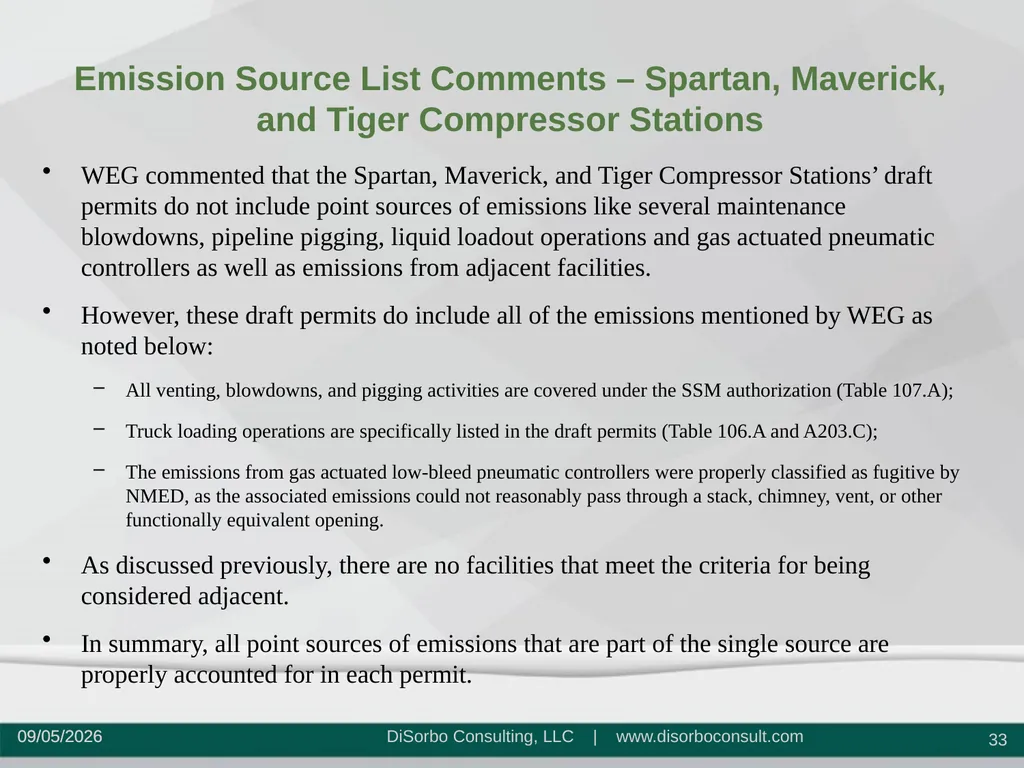
slide33. Emission Source List Comments – Spartan, Maverick, and Tiger Compressor Stations WEG commented that the Spartan, Maverick, and Tiger Compressor Stations’ draft permits do not include point sources of emissions like several maintenance blowdowns, pipeline pigging, liquid loadout operations and gas actuated pneumatic controllers as well as emissions from adjacent facilities.
However, these draft permits do include all of the emissions mentioned by WEG as noted below:
All venting, blowdowns, and pigging activities are covered under the SSM authorization (Table 107.A);
Truck loading operations are specifically listed in the draft permits (Table 106.A and A203.C);
The emissions from gas actuated low-bleed pneumatic controllers were properly classified as fugitive by NMED, as the associated emissions could not reasonably pass through a stack, chimney, vent, or other functionally equivalent opening.
As discussed previously, there are no facilities that meet the criteria for being considered adjacent.
In summary, all point sources of emissions that are part of the single source are properly accounted for in each permit.<br>
slide34. Emission Source Comments – Fugitive Emission Reduction Factor NMED has a SIP-approved NSR program and the approval of emissions calculations and emission factors is fundamental in the implementation of the permitting program
The 75% reduction factor was based on a quarterly leak detection and repair (“LDAR”) programs, but the draft permit conditions in A.209.D require XTO to conduct monthly inspections of fugitive emissions components in VOC service using EPA reference method 21 and to conduct weekly Audio, Visual, and Olfactory (“AVO”) inspections of all fugitive components in VOC service.
These more frequent inspection requirements will make the 75% reduction factor conservative. In other words, the use of a 75% reduction factor with the monitoring stringency specified in the draft provisions A209.D will tend to overestimate VOC emissions at Cowboy.<br>
slide35. Emission Source Comments – Flare Emission Factors The use of published emission factors is a widespread and appropriate practice for sources where direct sampling is not appropriate or feasible, such as emissions from flare stacks.
NMED’s calculation form for the Oil and Gas General Construction Permit, for example, allows for these TCEQ emission factors to be used.<br>
slide36. Air Dispersion Modeling Analyses<br>
slide37. Modeling – Use of Maximum Potential Emission Rates Maximum potential emissions rates were modeled for NO2 at all sites.
All modeling was conducted to ensure that the maximum concentrations were obtained for each operating scenario that could occur simultaneously. The scenario including SSM emissions was modeled continuously (8760 hours per year) for each site, although the SSM will only occur a small percentage of the time and is therefore conservative.
All modeling was done consistent with NMED modeling guidelines and was audited and approved by NMED modeling staff.<br>
slide38. Modeling – Use of Monitored NO2 Background Concentrations The NO2 modeling included the addition of a background monitoring concentration to account for off-property facilities and truck and heavy machinery traffic for comparison to the NAAQS consistent with NMED guidance.
NMED guidance in Table 16 of the NMED modeling guidelines provides for the use of two background monitored values (Carlsbad and Hobbs).
An analysis using the 2018-2020 Carlsbad and Hobbs NO2 monitoring data instead of the NMED recommended background would also show compliance with the NAAQS<br>
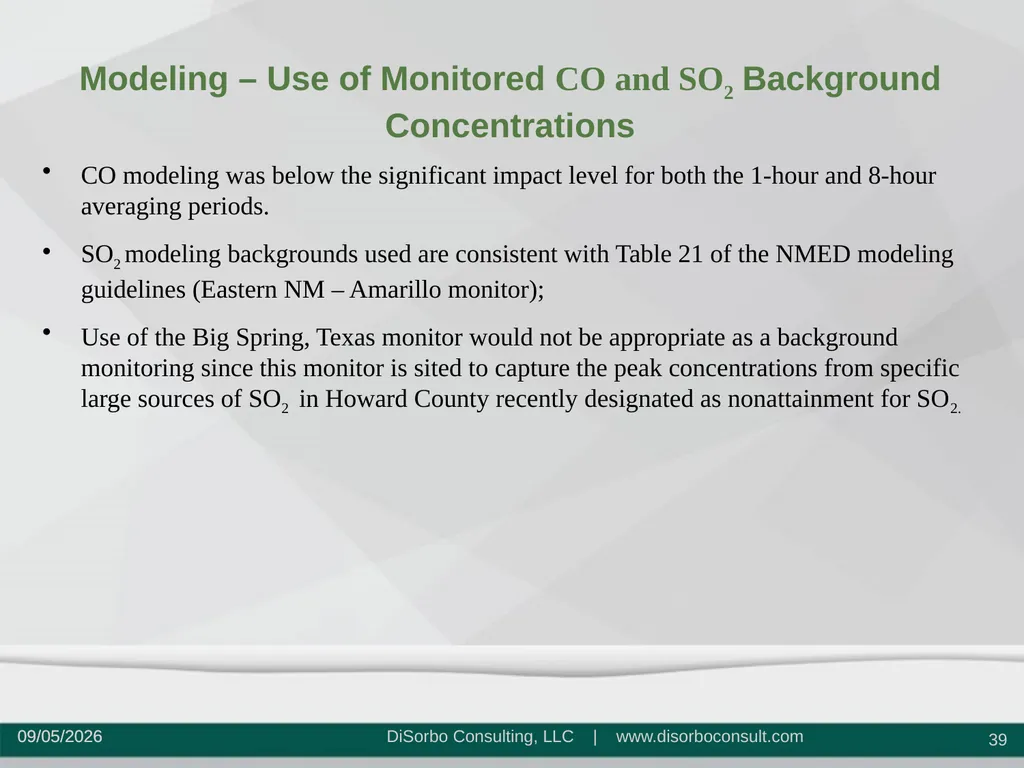
slide39. Modeling – Use of Monitored CO and SO2 Background Concentrations CO modeling was below the significant impact level for both the 1-hour and 8-hour averaging periods.
SO2 modeling backgrounds used are consistent with Table 21 of the NMED modeling guidelines (Eastern NM – Amarillo monitor);
Use of the Big Spring, Texas monitor would not be appropriate as a background monitoring since this monitor is sited to capture the peak concentrations from specific large sources of SO2 in Howard County recently designated as nonattainment for SO2.<br>
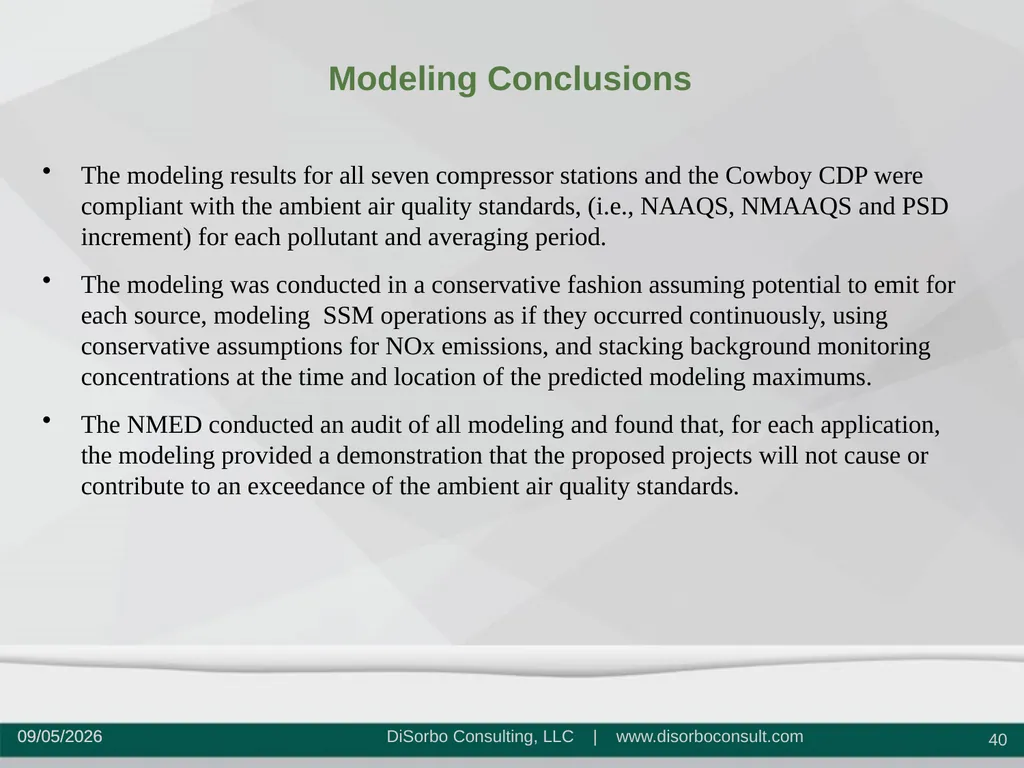
slide40. Modeling Conclusions The modeling results for all seven compressor stations and the Cowboy CDP were compliant with the ambient air quality standards, (i.e., NAAQS, NMAAQS and PSD increment) for each pollutant and averaging period.
The modeling was conducted in a conservative fashion assuming potential to emit for each source, modeling SSM operations as if they occurred continuously, using conservative assumptions for NOx emissions, and stacking background monitoring concentrations at the time and location of the predicted modeling maximums.
The NMED conducted an audit of all modeling and found that, for each application, the modeling provided a demonstration that the proposed projects will not cause or contribute to an exceedance of the ambient air quality standards.<br>
slide41. Environmental Justice and Impacts on Disadvantaged Communities<br>
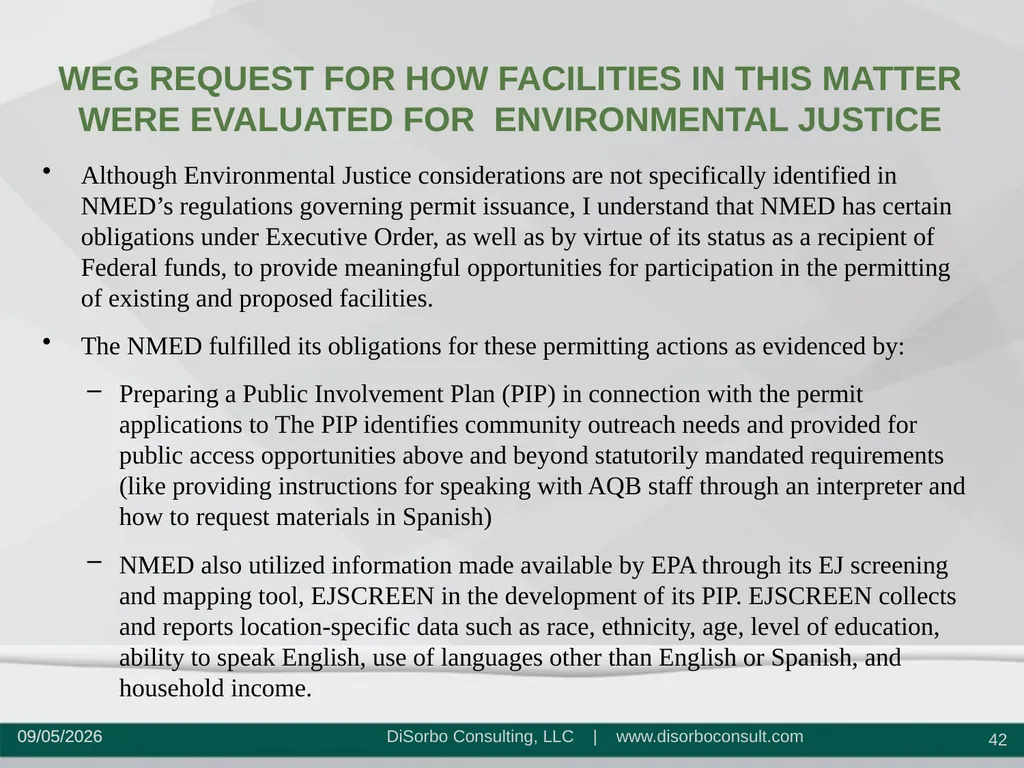
slide42. WEG REQUEST FOR HOW FACILITIES IN THIS MATTER WERE EVALUATED FOR ENVIRONMENTAL JUSTICE Although Environmental Justice considerations are not specifically identified in NMED’s regulations governing permit issuance, I understand that NMED has certain obligations under Executive Order, as well as by virtue of its status as a recipient of Federal funds, to provide meaningful opportunities for participation in the permitting of existing and proposed facilities.
The NMED fulfilled its obligations for these permitting actions as evidenced by:
Preparing a Public Involvement Plan (PIP) in connection with the permit applications to The PIP identifies community outreach needs and provided for public access opportunities above and beyond statutorily mandated requirements (like providing instructions for speaking with AQB staff through an interpreter and how to request materials in Spanish)
NMED also utilized information made available by EPA through its EJ screening and mapping tool, EJSCREEN in the development of its PIP. EJSCREEN collects and reports location-specific data such as race, ethnicity, age, level of education, ability to speak English, use of languages other than English or Spanish, and household income.<br>
slide43. Facility Compliance With Title V<br>
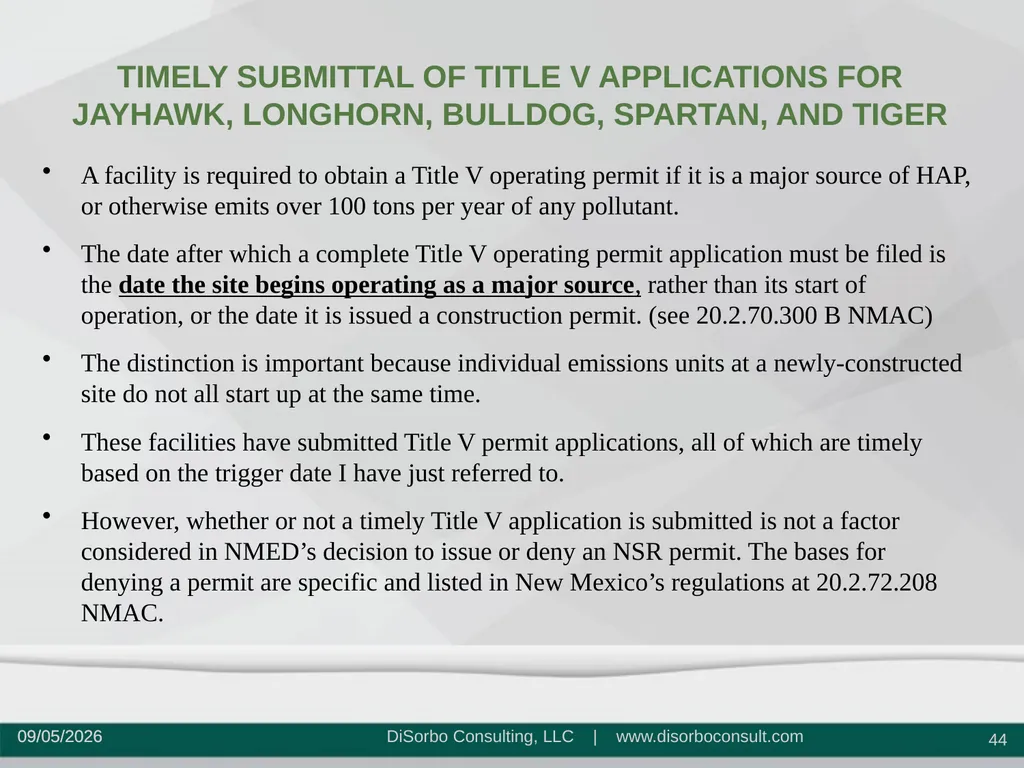
slide44. TIMELY SUBMITTAL OF TITLE V APPLICATIONS FOR JAYHAWK, LONGHORN, BULLDOG, SPARTAN, AND TIGER A facility is required to obtain a Title V operating permit if it is a major source of HAP, or otherwise emits over 100 tons per year of any pollutant.
The date after which a complete Title V operating permit application must be filed is the date the site begins operating as a major source, rather than its start of operation, or the date it is issued a construction permit. (see 20.2.70.300 B NMAC)
The distinction is important because individual emissions units at a newly-constructed site do not all start up at the same time.
These facilities have submitted Title V permit applications, all of which are timely based on the trigger date I have just referred to.
However, whether or not a timely Title V application is submitted is not a factor considered in NMED’s decision to issue or deny an NSR permit. The bases for denying a permit are specific and listed in New Mexico’s regulations at 20.2.72.208 NMAC.<br>
slide45. Conclusions<br>
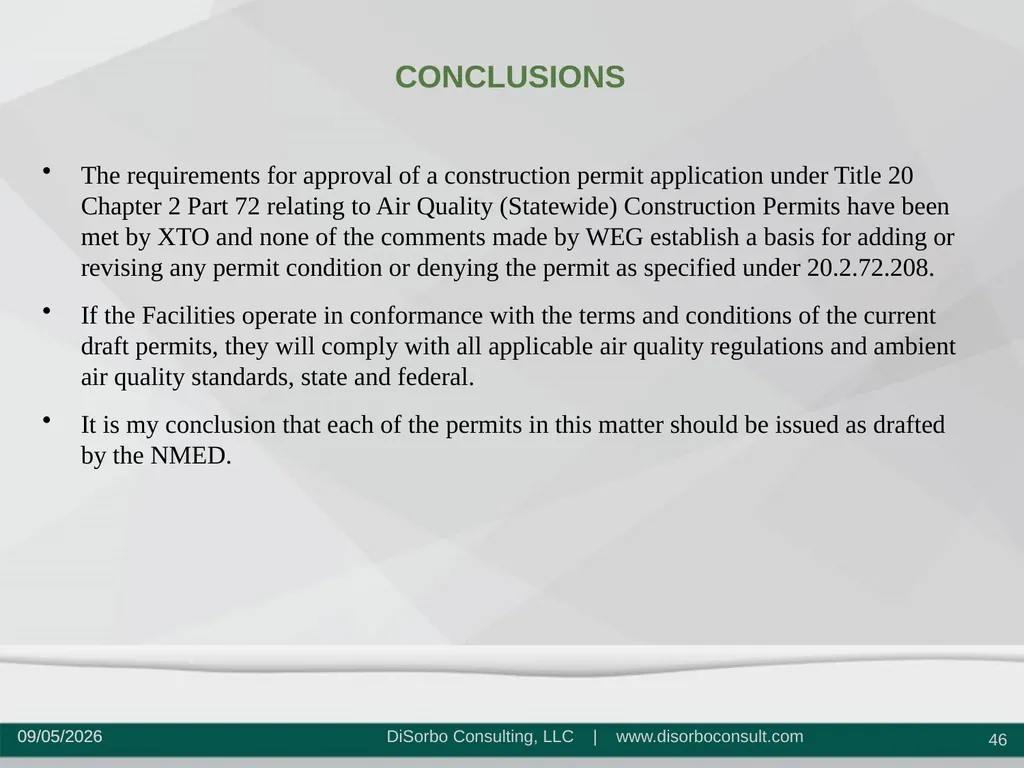
slide46. CONCLUSIONS The requirements for approval of a construction permit application under Title 20 Chapter 2 Part 72 relating to Air Quality (Statewide) Construction Permits have been met by XTO and none of the comments made by WEG establish a basis for adding or revising any permit condition or denying the permit as specified under 20.2.72.208.
If the Facilities operate in conformance with the terms and conditions of the current draft permits, they will comply with all applicable air quality regulations and ambient air quality standards, state and federal.
It is my conclusion that each of the permits in this matter should be issued as drafted by the NMED.<br>
slide47. Thank you Randy Parmley, P.E.
Vice President / Principal
DiSorbo Environmental Consulting Firm
rparmley@disorboconsult.com
(832) 715-3339 DiSorbo Consulting, LLC | disorboconsult.com 47<br>
slide2. SUMMARY OF DIRECT TESTIMONY OF RANDY PARMLEY, P.E., DISORBO CONSULTING, LLC, ON BEHALF OF XTO ENERGY INC. IN SUPPORT OF PERMIT NUMBERS 7877M1 (COWBOY), 8152M1 (JAYHAWK), 8349M2 (LONGHORN), 8153M1 (BULLDOG), 7681M2 (SPARTAN), 7565M2 (MAVERICK),7623M2 (TIGER), AND 7474M2 (WILDCAT)<br>
slide3. Agenda Background
Overview Of XTO Compressor Stations And Cowboy CDP Operations
XTO Permit Revision Applications
Toxic Air Pollutants
Enforceability Of Start Up, Shutdown, Maintenance (SSM)
Site Aggregation, Completeness Of Emission Source List
Dispersion Modeling
Environmental Justice
Facility Compliance
Conclusions<br>
slide4. BACKGROUND<br>
slide5. Background for Permits Subject to this Matter In general, an oil and gas permit authorizes the initial construction, operation, or modification of the facility to treat, process, store and/or transport gases and liquids associated with the production of oil and gas.
The initial permits for these facilities were issued between 2017 and 2019. XTO is revising these permits to account for modifications to several existing facilities.
The permit establishes the terms and conditions governing compliance with the permit.
Prior approval by the agency is required prior to start of construction for significant revisions to an issued permit.<br>
slide6. Permits Subject to this Matter Seven of the eight XTO facilities at issue are compressor stations.
Longhorn (ABQ 21-33),
Spartan (ABQ 21-40),
Maverick (ABQ 21-39),
Jayhawk (ABQ 21-32),
Bulldog (AQB 21-31),
Tiger (ABQ 21-41) and:
Wildcat (ABQ 21-35).
The Cowboy Central Delivery Point (CDP) (ABQ 21-34) facility is a gas processing facility
All facilities are expected to operate 24 hours per day throughout the year.<br>
slide7. XTO Operations<br>
slide8. Compressor Station Operations Compressor stations move natural gas from tank batteries and satellite facilities through the pipeline to a processing plant.
The compressor stations compress and dehydrate natural gas using compressor engines, and triethylene glycol (TEG) units
The compressors provide the natural gas with adequate pressure to move through the pipeline and are necessary to overcome the pressure losses due to friction, distance, and elevation changes that would overwise slow the movement of gas in the pipeline.<br>
slide9. Compressor Station Process Flow Diagram<br>
slide10. Compressor Station Equipment Equipment operating at a compressor station is used to remove liquids from the gas, dry the gas, and increase its pressure so that it can be transported by pipeline.
Natural gas engines power the compressors. As the gas pressure increases, liquids are formed.
Separators (or inlet slug catchers) separate the liquids formed (produced water and condensate) as the gas pressure increases.
Glycol dehydration units further remove water vapor from the high-pressure gas.
Storage tanks are used to store the water and condensate recovered from the gas.
Flares are used to burn waste gas to relieve pressure on the equipment, and to burn vapors that are expelled from the condensate and water tanks<br>
slide11. Inlet Slug Catcher<br>
slide12. Compressor engine – Caterpillar 3516 Intercooler Engine/Piston Section Interstage Scrubber Section Compressed gas out Engine Exhaust stack Suction Side / Gas in Compression Section Lube Oil Tanks Oxidaton Catalyst<br>
slide13. Glycol (TEG) Dehydrator and Flares Glycol Regenerator / Reboiler Glycol tower Flares Wet gas in Dry gas out Lean Glycol into tower<br>
slide14. Revisions to the Existing Compressor Station Permits The revisions to the seven compressor stations are detailed in Section 3 of each application but do not vary significantly from permit to permit. They include:
Removal of equipment, such as individual heaters and engines, that XTO no longer intends to construct;
Updates to source parameters, such as the height of flare stacks, the circulation rate of glycol dehydrators, the throughput of truck loading racks, the operating pressure of separators;
Identification of additional Start up, Shut Down, and Maintenance (SSM) activities, and
Corresponding updates to emission calculations.
These revisions to the initial permit are typical, the XTO applications were deemed administratively complete and draft permits with conditions were issued by NMED.<br>
slide15. Compressor Station Emission Calculations All emissions calculations were performed using standard methodologies endorsed by NMED including:
Engines used manufacturer’s emissions factors for NOx, CO, and VOC, AP-42 factors for PM, PM10 and PM2.5 , and SO2 is based on the sulfur content of the fuel.
Heaters used AP-42 factors for all pollutants, except SO2 , which is based on the sulfur content of the fuel.
Start up, Shut down, and Maintenance (SSM) and Emergency Flares used a material balance and 98% manufactures destruction and removal efficiency for VOC, TCEQ factors for NOx and CO;
TEG Dehydrators used ProMax simulation software to estimate emissions sent to the vapor combustors;
Storage Tanks used ProMax simulation software to estimate emissions sent to the flares;
These revisions to the initial permit are typical, the XTO applications were deemed administratively complete and draft permits with conditions were issued by NMED.<br>
slide16. Compressor Station Emission Calculations continued Truck Loading used AP-42 emission factors for oil loading;
Piping Component Fugitives were calculated using TCEQ factors and conservative equipment count information;
SSM emissions routed to flare were based on 10 tpy per State guidance;
Haul Road emissions were based on AP-42 factors;
Malfunction emissions were based on 10 tpy per State guidance;
Greenhouse Gas emissions were based on EPA Global Warming Factors
These emissions calculations methodologies are well documented and accepted techniques for calculating air emissions for permitting purposes.<br>
slide17. Cowboy CDP Operations The Cowboy Central Delivery Point (CDP) is a gas processing facility
The facility receives natural gas, natural gas liquids, and oil via different incoming pipelines.
Natural gas is processed to remove CO2, H2S, and moisture prior to separating the dry natural gas from the natural gas liquids.
Natural gas is compressed prior to going to pipeline.
Natural gas liquid is pressurized prior to being shipped by pipeline;
The oil stabilization portion of the facility removes natural gas liquid from the oil and separates the produced water from the oil prior to storing the oil in floating roof tanks and transportation via pipeline
The Cowboy CDP Process Flow Diagram submitted in Section 4 of the permit application is provided on the next slide.<br>
slide18. Cowboy Process Flow Diagram<br>
slide19. Heaters at Cowboy Regen Heater Stabilization Heater Cyro Unit and Heater<br>
slide20. Internal Floating Roof Tanks at Cowboy<br>
slide21. Cowboy CDP Revision to NSR Permit 7877 XTO application is a revision to the existing permit issued on November 16, 2018 and, as indicated in Section 3 of the application, includes:
Additional NOX controls to two stabilization heaters and two cryogenic heaters;
Removal of two stabilization heaters;
Correction to shell capacity of four floating roof tanks;
New truck slop oil loading facilities;
New emergency generators;
Misc. throughput and flowrate updates;
Revised calculations to reflect these changes; and
These revisions to the initial Cowboy permit are typical, the XTO application was deemed administratively complete and draft permit with conditions was issued by NMED<br>
slide22. Toxic Air Pollutant Permitting<br>
slide23. Toxic Air Pollutant Permitting Requirements WEG commented that there was no compliance demonstration with regard toxic air pollutant permitting requirements at 20.2.72.400-499 NMAC FOR to the Jayhawk, Longhorn, Bulldog, Spartan, Maverick and Tiger compressor stations.
The Jayhawk, Longhorn, Bulldog, Spartan, Maverick and Tiger compressor stations are Oil and Gas production facilities and are exempt due to their SIC code from the permitting requirements for toxic air pollutants per 20.2.72.402.C(5).
The definition of Oil and Gas production facilities, includes major SIC group 13 (20.2.72.401.F).
Each of the facilities in question is classified under SIC Code 1311 and are therefore exempt (as indicated in Section 13 of the application).<br>
slide24. Enforceability of Startup, Shutdown, Maintenance (SSM) and Malfunction Emission Limits<br>
slide25. Enforceability of Annual SSM and Malfunction Limits WEG commented that a number of Emission Limits Contained in the Draft Permits were not enforceable as a practical matter. These include:
Annual SSM VOC Emissions from Floating Roof Tank Landings at Cowboy;
Annual VOC and SO2 SSM limits for routing Dehydrator emissions to the reboiler at Spartan, Maverick, and Tiger
Annual SSM VOC Emissions for Miscellaneous Maintenance Activities like Compressor Blowdowns, Pigging Equipment Blowdowns at all sites ;
10 ton per year Malfunction Emissions for 5 Sites Due to Venting of Gas;
Annual SSM flaring at 5 Sites; and
However, this is simply not the case. For SSM activities like these, the VOC emissions are easily calculated based on the gas composition, the volume of the gas released during an activity, and, for the annual emissions the number of activities per year.
The draft permits contain adequate monitoring and recordkeeping requirements including the date, the start time, the end time, a description of the event, records for the volume of gas vented during SSM and Malfunctions, the most recent gas analysis and flare flowmeter records (A206) that make each of these activities enforceable as a practical matter.<br>
slide26. Enforceability of Annual SSM and Malfunction Limits (cont.) Cowboy Floating Roof Tanks - The draft permit for Cowboy requires XTO to perform an annual oil analysis and for each roof landing, cleaning, or de-gassing “monitor the date, start time, and end time” and calculate the emissions via AP-42. Annual emissions are the sum of individual emissions over a 12-month period. Therefore, these SSM VOC emissions are enforceable.
Annual VOC and SO2 SSM limits for routing Dehydrator emissions to the reboiler are enforceable through conditions A107.E (limiting dehy emissions to reboiler to 300 hrs/yr) and A202.B (limiting the pump rate). Since the annual limit is based on 300 hrs/yr at the maximum pump rate, the limit is enforceable as a practical matter.
Annual SSM activities from miscellaneous maintenance activities and malfunctions is enforceable since the gas composition is known and volume of this equipment is known, as is the volume within a line being pigged, or the volume within a compressor or the volume of any other equipment being de-pressured.
Annual flaring from SSM activities are also enforceable as a practical matter, contrary to WEG comments, since any gases (including annual SSM) going to flares are monitored with continuous flowmeters (A206).<br>
slide27. Annual SSM and Malfunction Emissions and Enforceability WEG Commented that the lack of providing a number or duration of flaring emissions enabled XTO to operate at the maximum hourly emission rates continuously throughout the year resulting in emission rates above the PSD major source thresholds for all sites.
This reasoning is in conflict with each of the hundreds of permits I have worked on in the past 35 years. Establishment of hourly emission rates, especially for non-continuous operations like SSM activities, does not imply that these emissions are permitted for every hour of the year. This is why permits have both hourly and annual emission limits. In this case, the XTO facilities are clearly constrained by the annual limits in Table 107.A for each site.
Both the hourly and annual limits in the draft permits apply.<br>
slide28. Major Sources of HAPs WEG commented that due to underestimating SSM and Malfunction Limits, the Cowboy, Jayhawk, Longhorn, Wildcat, and Bulldog sites are major sources of HAPs.
The applications clearly state that Jayhawk, Longhorn, Wildcat, and Bulldog facilities are, in fact, major sources of HAP for Title V permitting. This point is not disputed.
The only facility that is not a major source of HAP is Cowboy CDP.
The Cowboy application contains sufficient information, including SSM and Malfunction information for the percentage by weight of HAPs in each emission stream to support the NMED conclusion that the CDP is not a major source HAPs.
Total HAPs are 10.6 tons compared to the Major HAP threshold of 25 tons as stated in the application on Table 2-1 and draft permit Table 102.B;
Individual HAPs are 6.1 tons compared to the Major HAP threshold of 10 tons as stated in the application and draft permit;
SSM and Malfunction contribute 1.2 tons per year of the Total HAP number above, and 0.6 tons of the Individual HAP number referenced above as stated in the permit application and draft permit.<br>
slide29. Site Aggregation and Completeness of Emission Source Lists<br>
slide30. Site Aggregation Background A stationary Source (site) cannot be split into multiple sites to avoid PSD review;
The test for determining what constitutes a site is threefold under Federal and NMED PSD regulations:
It must belong to the same industrial grouping (i.e., the same 2-digit Standard Industrial Classification (SIC) code; and
It must be contiguous or adjacent; and
It must be under “common control”
WEG Made several comments regarding site aggregation considerations that are addressed in the following slides<br>
slide31. Site Aggregation Comments – Cowboy CDP WEG commented that there is an adjacent facility, the Cowboy Pump Station, that should be aggregated with the Cowboy CDP.
However, these facilities do not belong to the same industrial classification and should not be aggregated on this basis alone.
The Cowboy Pump Station is under SIC 46 (Pipelines, Except Natural Gas); whereas
The Cowboy CDP is under SIC Major Group 13 (Oil and Gas Extraction)
The Cowboy Pump Station is an independent operating facility and not a support or auxiliary facility to the Cowboy CDP. Therefore, there is no basis for aggregating the two facilities.<br>
slide32. Site Aggregation Comments – Spartan, Maverick, and Tiger Compressor Stations WEG did not identify any specific facilities of concern but stated that these applications did not address “emissions from oil and gas wells that feed the facility and are adjacent for new source review permitting purposes.”
Oil and Gas wells are clearly under Major Group 13 in the SIC manual, and I will assume that WEG is referring to oil and gas wells that are controlled by XTO and are adjacent to these sites.
For permitting activities in New Mexico, two oil and gas sites are normally aggregated if they are contiguous (i.e., share the same graded pad), or if they are “adjacent” by virtue of sharing a boundary such as a roadway.
Based on review of permit records and satellite imagery of these sites, the only oil or gas well that is adjacent to any of the sites is an oil well adjacent to the Tiger Compressor Station, which is not owned or under common control of XTO.
While a number of oil and gas wells operated by XTO are in the vicinity of each of the permitted sites, none are contiguous or adjacent.<br>
slide33. Emission Source List Comments – Spartan, Maverick, and Tiger Compressor Stations WEG commented that the Spartan, Maverick, and Tiger Compressor Stations’ draft permits do not include point sources of emissions like several maintenance blowdowns, pipeline pigging, liquid loadout operations and gas actuated pneumatic controllers as well as emissions from adjacent facilities.
However, these draft permits do include all of the emissions mentioned by WEG as noted below:
All venting, blowdowns, and pigging activities are covered under the SSM authorization (Table 107.A);
Truck loading operations are specifically listed in the draft permits (Table 106.A and A203.C);
The emissions from gas actuated low-bleed pneumatic controllers were properly classified as fugitive by NMED, as the associated emissions could not reasonably pass through a stack, chimney, vent, or other functionally equivalent opening.
As discussed previously, there are no facilities that meet the criteria for being considered adjacent.
In summary, all point sources of emissions that are part of the single source are properly accounted for in each permit.<br>
slide34. Emission Source Comments – Fugitive Emission Reduction Factor NMED has a SIP-approved NSR program and the approval of emissions calculations and emission factors is fundamental in the implementation of the permitting program
The 75% reduction factor was based on a quarterly leak detection and repair (“LDAR”) programs, but the draft permit conditions in A.209.D require XTO to conduct monthly inspections of fugitive emissions components in VOC service using EPA reference method 21 and to conduct weekly Audio, Visual, and Olfactory (“AVO”) inspections of all fugitive components in VOC service.
These more frequent inspection requirements will make the 75% reduction factor conservative. In other words, the use of a 75% reduction factor with the monitoring stringency specified in the draft provisions A209.D will tend to overestimate VOC emissions at Cowboy.<br>
slide35. Emission Source Comments – Flare Emission Factors The use of published emission factors is a widespread and appropriate practice for sources where direct sampling is not appropriate or feasible, such as emissions from flare stacks.
NMED’s calculation form for the Oil and Gas General Construction Permit, for example, allows for these TCEQ emission factors to be used.<br>
slide36. Air Dispersion Modeling Analyses<br>
slide37. Modeling – Use of Maximum Potential Emission Rates Maximum potential emissions rates were modeled for NO2 at all sites.
All modeling was conducted to ensure that the maximum concentrations were obtained for each operating scenario that could occur simultaneously. The scenario including SSM emissions was modeled continuously (8760 hours per year) for each site, although the SSM will only occur a small percentage of the time and is therefore conservative.
All modeling was done consistent with NMED modeling guidelines and was audited and approved by NMED modeling staff.<br>
slide38. Modeling – Use of Monitored NO2 Background Concentrations The NO2 modeling included the addition of a background monitoring concentration to account for off-property facilities and truck and heavy machinery traffic for comparison to the NAAQS consistent with NMED guidance.
NMED guidance in Table 16 of the NMED modeling guidelines provides for the use of two background monitored values (Carlsbad and Hobbs).
An analysis using the 2018-2020 Carlsbad and Hobbs NO2 monitoring data instead of the NMED recommended background would also show compliance with the NAAQS<br>
slide39. Modeling – Use of Monitored CO and SO2 Background Concentrations CO modeling was below the significant impact level for both the 1-hour and 8-hour averaging periods.
SO2 modeling backgrounds used are consistent with Table 21 of the NMED modeling guidelines (Eastern NM – Amarillo monitor);
Use of the Big Spring, Texas monitor would not be appropriate as a background monitoring since this monitor is sited to capture the peak concentrations from specific large sources of SO2 in Howard County recently designated as nonattainment for SO2.<br>
slide40. Modeling Conclusions The modeling results for all seven compressor stations and the Cowboy CDP were compliant with the ambient air quality standards, (i.e., NAAQS, NMAAQS and PSD increment) for each pollutant and averaging period.
The modeling was conducted in a conservative fashion assuming potential to emit for each source, modeling SSM operations as if they occurred continuously, using conservative assumptions for NOx emissions, and stacking background monitoring concentrations at the time and location of the predicted modeling maximums.
The NMED conducted an audit of all modeling and found that, for each application, the modeling provided a demonstration that the proposed projects will not cause or contribute to an exceedance of the ambient air quality standards.<br>
slide41. Environmental Justice and Impacts on Disadvantaged Communities<br>
slide42. WEG REQUEST FOR HOW FACILITIES IN THIS MATTER WERE EVALUATED FOR ENVIRONMENTAL JUSTICE Although Environmental Justice considerations are not specifically identified in NMED’s regulations governing permit issuance, I understand that NMED has certain obligations under Executive Order, as well as by virtue of its status as a recipient of Federal funds, to provide meaningful opportunities for participation in the permitting of existing and proposed facilities.
The NMED fulfilled its obligations for these permitting actions as evidenced by:
Preparing a Public Involvement Plan (PIP) in connection with the permit applications to The PIP identifies community outreach needs and provided for public access opportunities above and beyond statutorily mandated requirements (like providing instructions for speaking with AQB staff through an interpreter and how to request materials in Spanish)
NMED also utilized information made available by EPA through its EJ screening and mapping tool, EJSCREEN in the development of its PIP. EJSCREEN collects and reports location-specific data such as race, ethnicity, age, level of education, ability to speak English, use of languages other than English or Spanish, and household income.<br>
slide43. Facility Compliance With Title V<br>
slide44. TIMELY SUBMITTAL OF TITLE V APPLICATIONS FOR JAYHAWK, LONGHORN, BULLDOG, SPARTAN, AND TIGER A facility is required to obtain a Title V operating permit if it is a major source of HAP, or otherwise emits over 100 tons per year of any pollutant.
The date after which a complete Title V operating permit application must be filed is the date the site begins operating as a major source, rather than its start of operation, or the date it is issued a construction permit. (see 20.2.70.300 B NMAC)
The distinction is important because individual emissions units at a newly-constructed site do not all start up at the same time.
These facilities have submitted Title V permit applications, all of which are timely based on the trigger date I have just referred to.
However, whether or not a timely Title V application is submitted is not a factor considered in NMED’s decision to issue or deny an NSR permit. The bases for denying a permit are specific and listed in New Mexico’s regulations at 20.2.72.208 NMAC.<br>
slide45. Conclusions<br>
slide46. CONCLUSIONS The requirements for approval of a construction permit application under Title 20 Chapter 2 Part 72 relating to Air Quality (Statewide) Construction Permits have been met by XTO and none of the comments made by WEG establish a basis for adding or revising any permit condition or denying the permit as specified under 20.2.72.208.
If the Facilities operate in conformance with the terms and conditions of the current draft permits, they will comply with all applicable air quality regulations and ambient air quality standards, state and federal.
It is my conclusion that each of the permits in this matter should be issued as drafted by the NMED.<br>
slide47. Thank you Randy Parmley, P.E.
Vice President / Principal
DiSorbo Environmental Consulting Firm
rparmley@disorboconsult.com
(832) 715-3339 DiSorbo Consulting, LLC | disorboconsult.com 47<br>