Retirement Plans in the Regulated Sector 2016 NASUCA Annual Meeting La Quinta, CA David G. Pitts, FSA, MAAA Independent Actuarial Services November, 2016 www.indactuary.com Retirement Plans Two main types Defined Benefit (DB): employer
"Retirement Plans in the Regulated Sector 2016" is the property of its rightful owner. Permission is granted to
download and print the materials on this website for personal, non-commercial use only, and to display it
on your personal computer provided you do not modify the materials and that you retain all copyright
notices contained in the materials. By downloading content from our website, you accept the terms of this
agreement.
Presentation Transcript
01
Retirement Plans in the Regulated Sector 2016 NASUCA Annual Meeting La Quinta, CA David G. Pitts, FSA, MAAA
Independent Actuarial Services
November, 2016 www.indactuary.com<br>
02
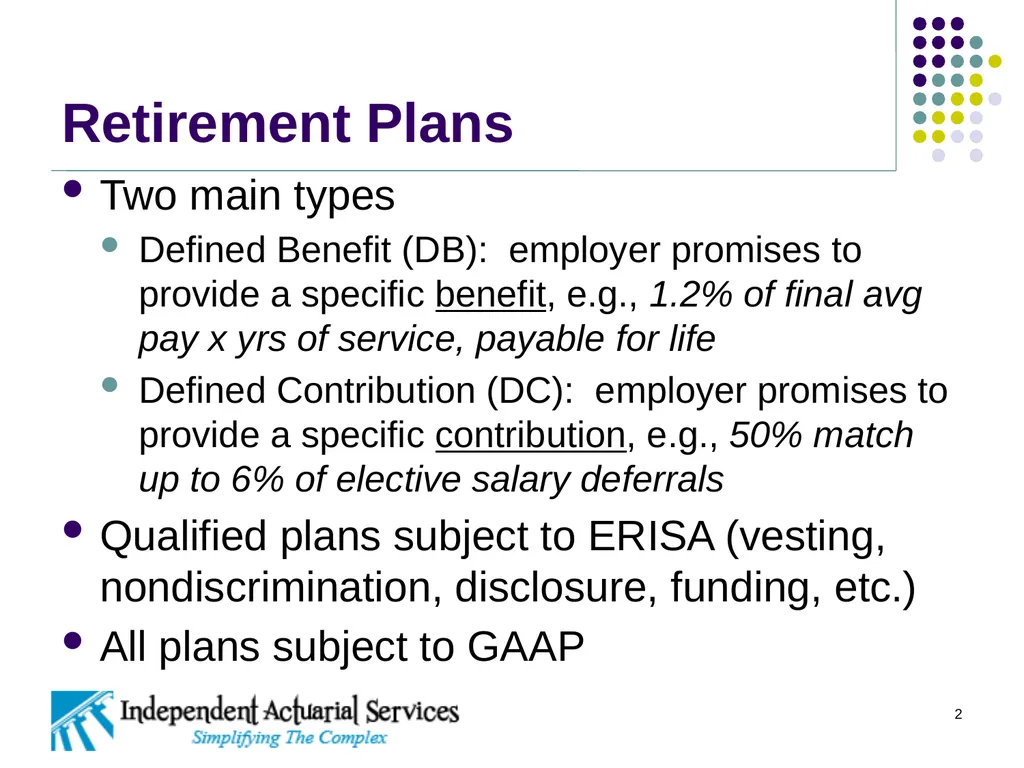
Retirement Plans Two main types
Defined Benefit (DB): employer promises to provide a specific benefit, e.g., 1.2% of final avg pay x yrs of service, payable for life
Defined Contribution (DC): employer promises to provide a specific contribution, e.g., 50% match up to 6% of elective salary deferrals
Qualified plans subject to ERISA (vesting, nondiscrimination, disclosure, funding, etc.)
All plans subject to GAAP 2<br>
03
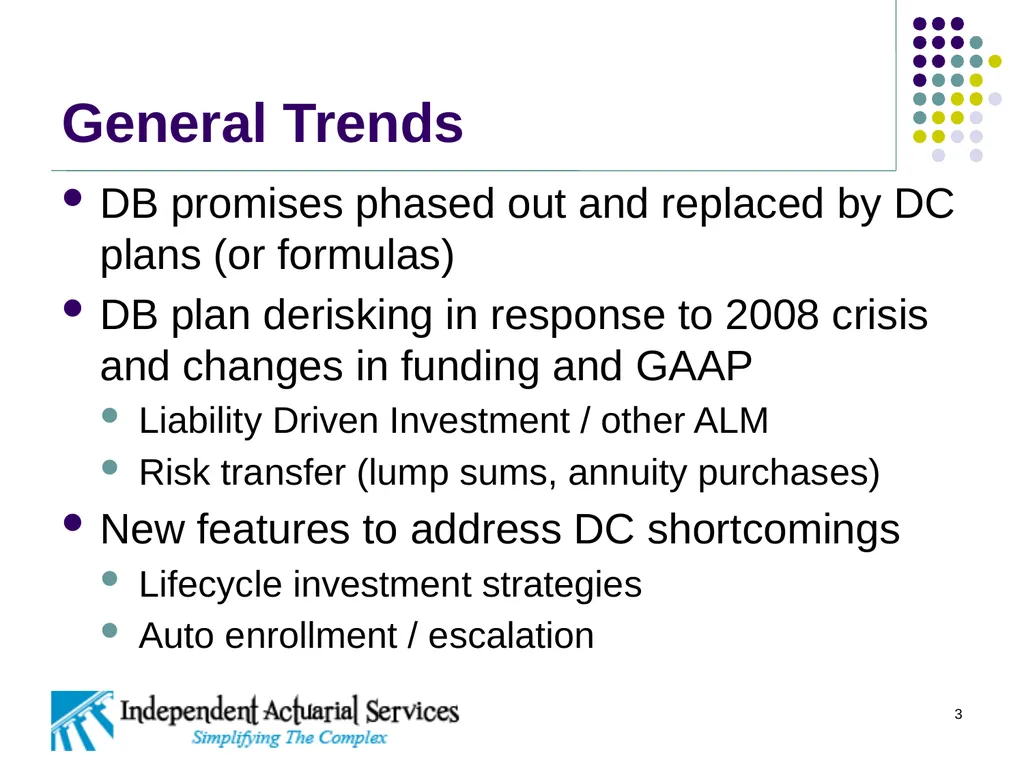
General Trends DB promises phased out and replaced by DC plans (or formulas)
DB plan derisking in response to 2008 crisis and changes in funding and GAAP
Liability Driven Investment / other ALM
Risk transfer (lump sums, annuity purchases)
New features to address DC shortcomings
Lifecycle investment strategies
Auto enrollment / escalation 3<br>
04
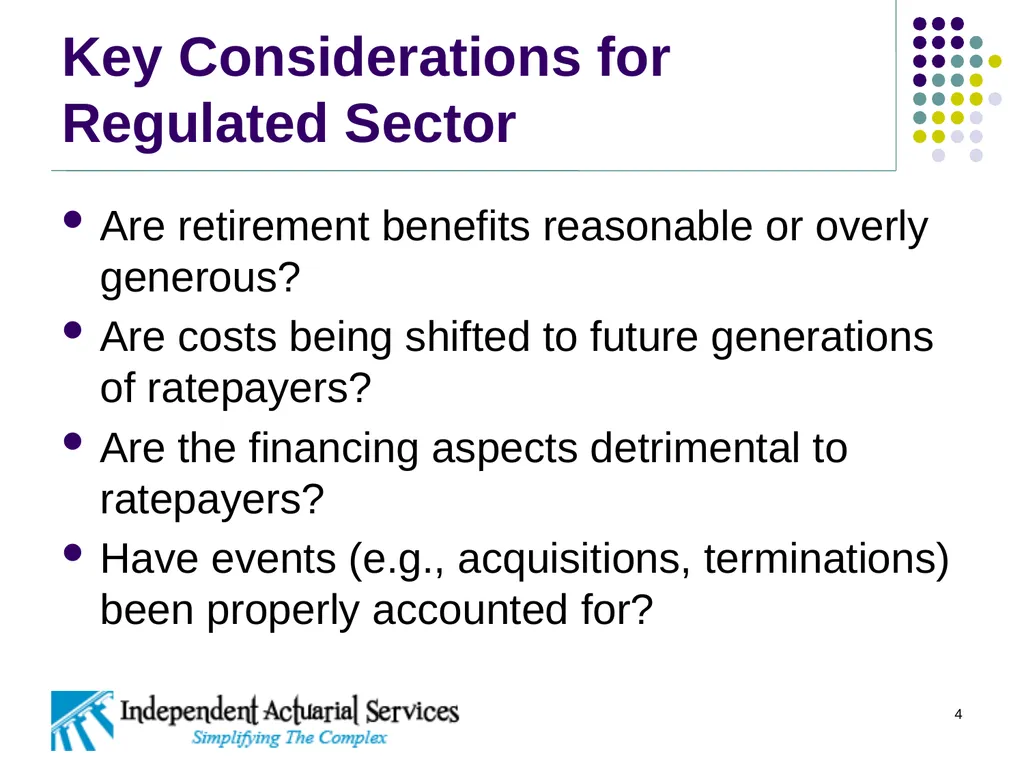
Key Considerations for Regulated Sector Are retirement benefits reasonable or overly generous?
Are costs being shifted to future generations of ratepayers?
Are the financing aspects detrimental to ratepayers?
Have events (e.g., acquisitions, terminations) been properly accounted for? 4<br>
05
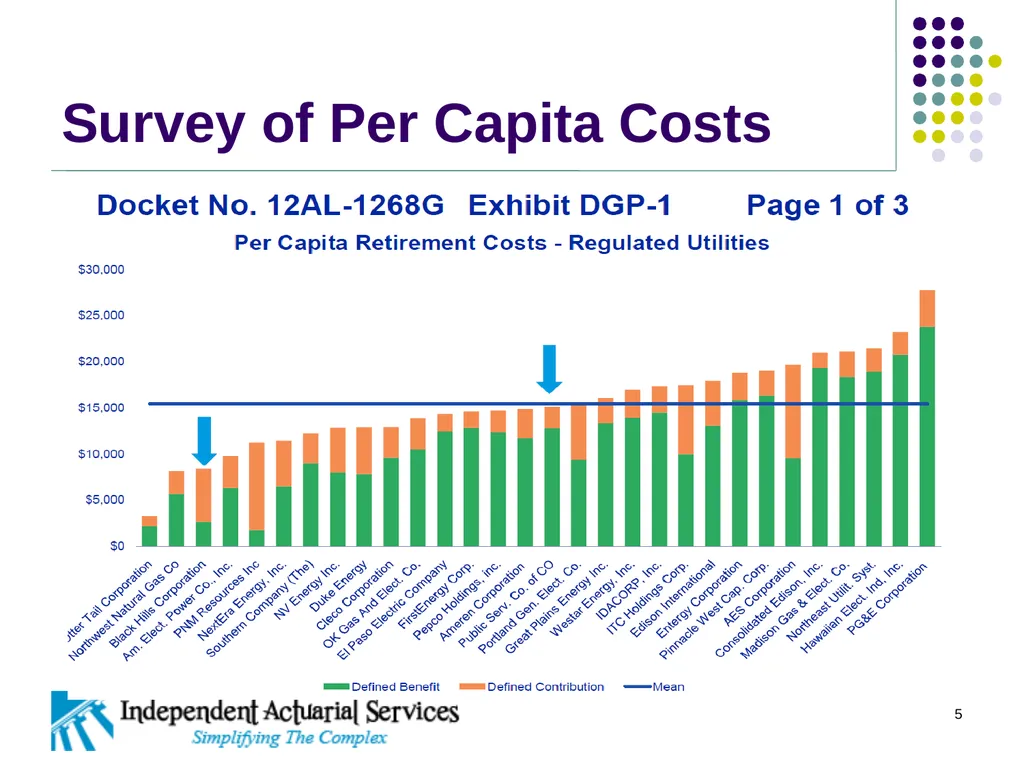
Survey of Per Capita Costs 5<br>
06
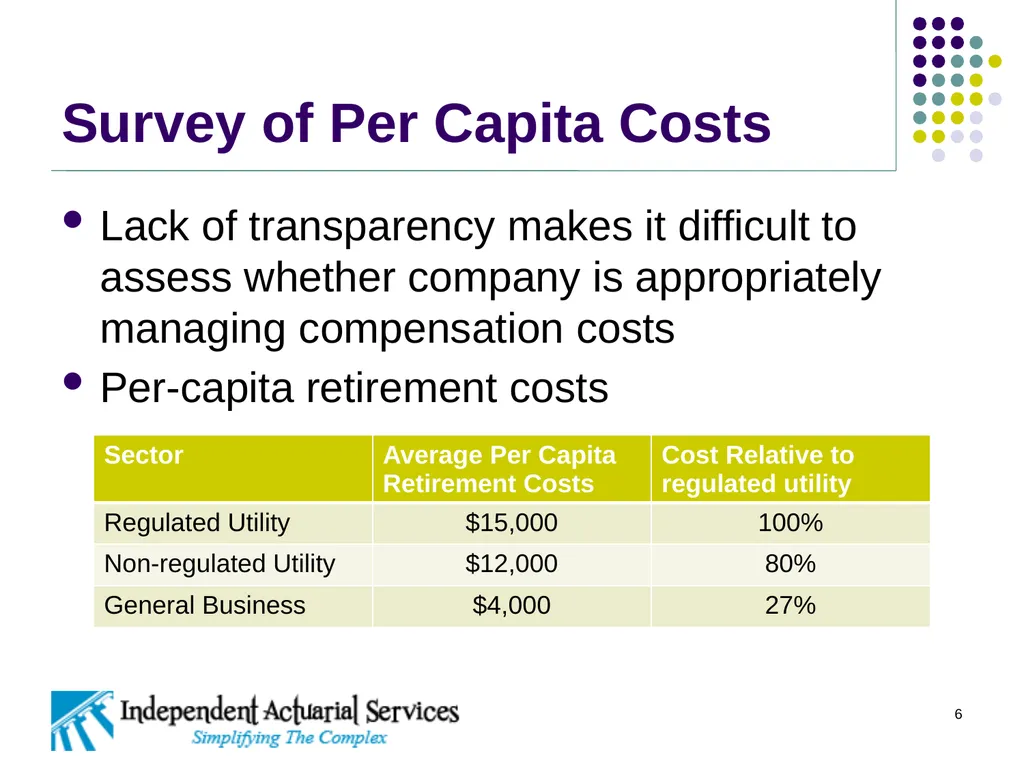
Survey of Per Capita Costs Lack of transparency makes it difficult to assess whether company is appropriately managing compensation costs
Per-capita retirement costs 6<br>
07
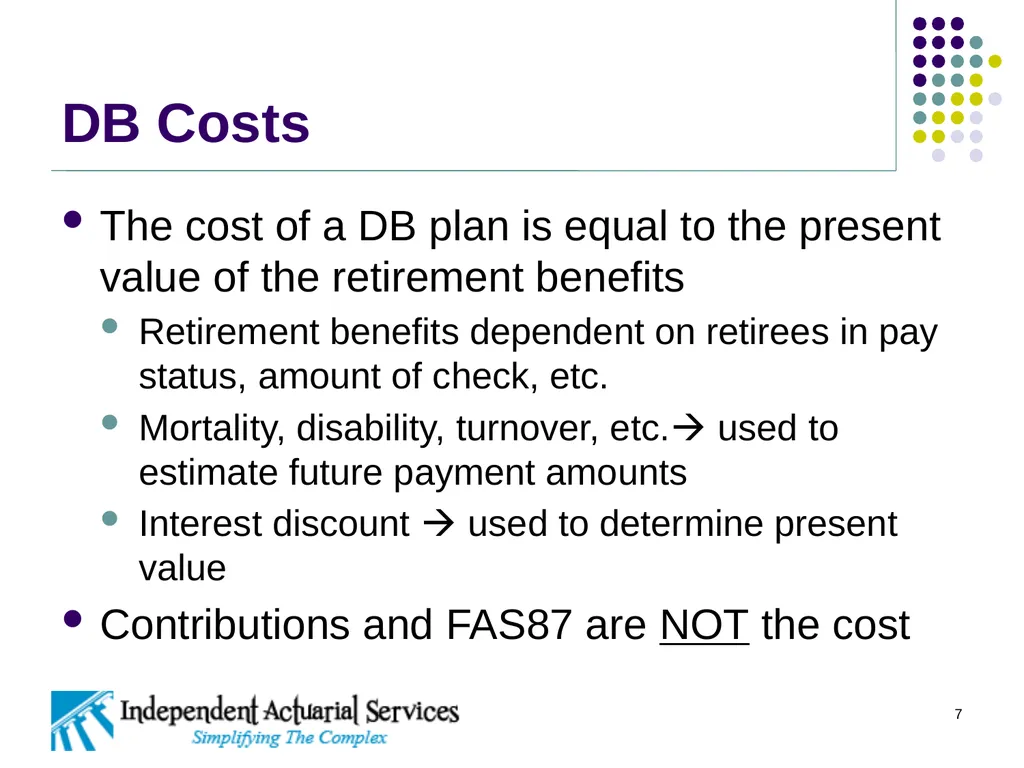
DB Costs The cost of a DB plan is equal to the present value of the retirement benefits
Retirement benefits dependent on retirees in pay status, amount of check, etc.
Mortality, disability, turnover, etc. used to estimate future payment amounts
Interest discount used to determine present value
Contributions and FAS87 are NOT the cost 7<br>
08
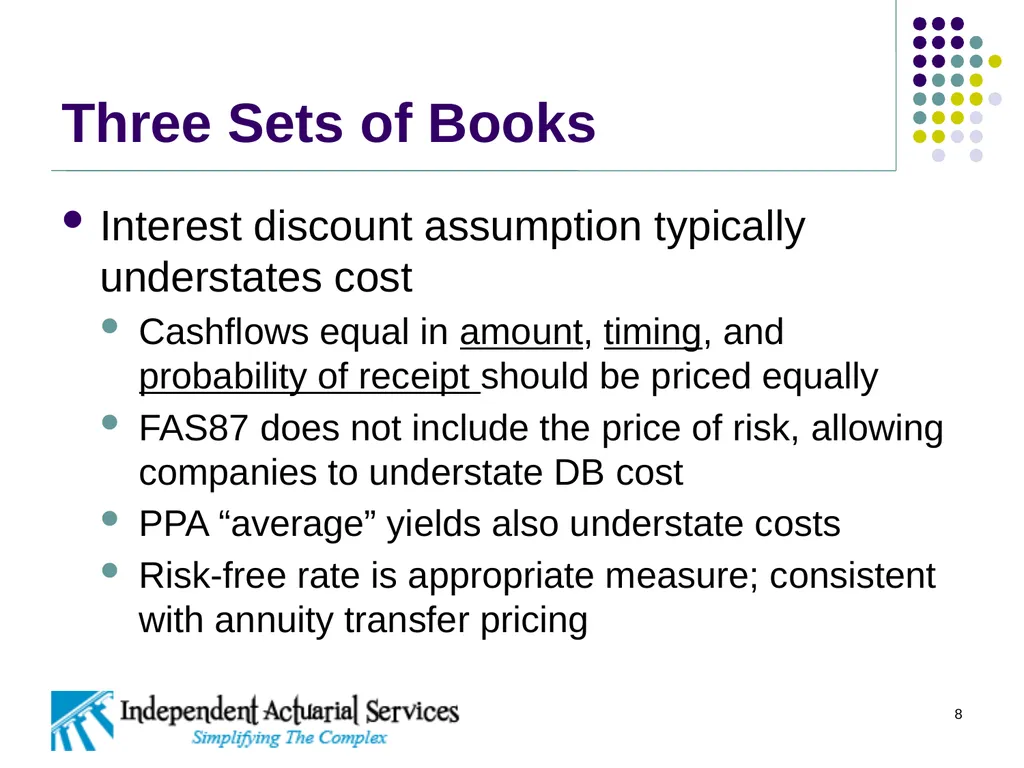
Three Sets of Books Interest discount assumption typically understates cost
Cashflows equal in amount, timing, and probability of receipt should be priced equally
FAS87 does not include the price of risk, allowing companies to understate DB cost
PPA “average” yields also understate costs
Risk-free rate is appropriate measure; consistent with annuity transfer pricing 8<br>
09
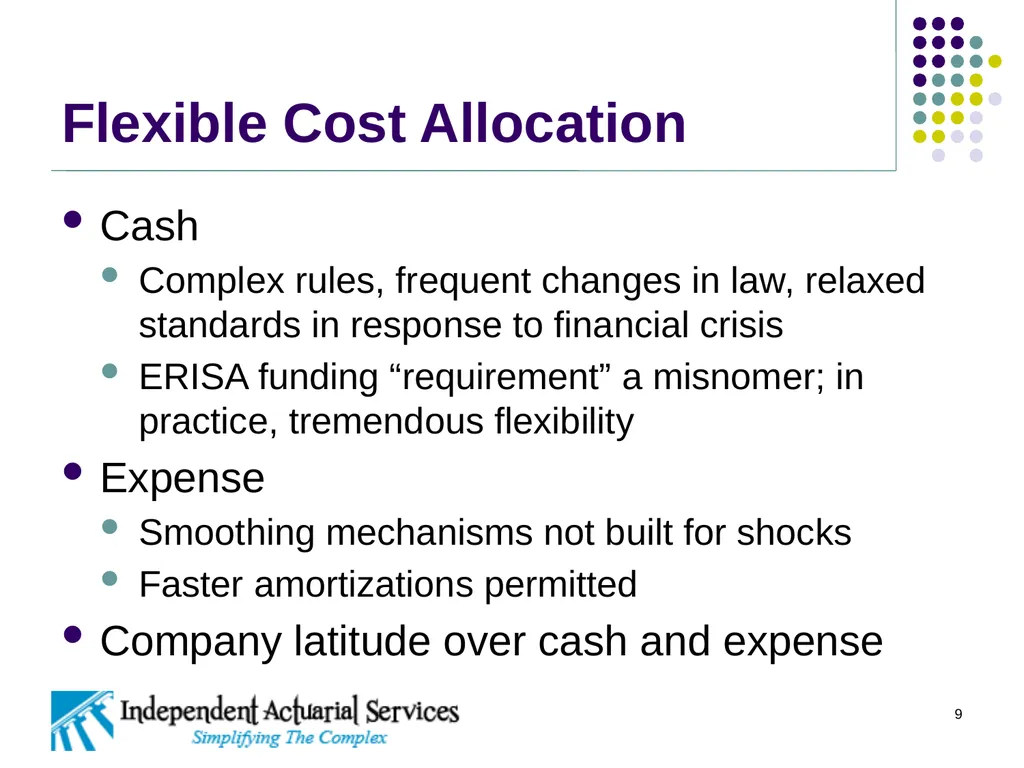
Flexible Cost Allocation Cash
Complex rules, frequent changes in law, relaxed standards in response to financial crisis
ERISA funding “requirement” a misnomer; in practice, tremendous flexibility
Expense
Smoothing mechanisms not built for shocks
Faster amortizations permitted
Company latitude over cash and expense 9<br>
10
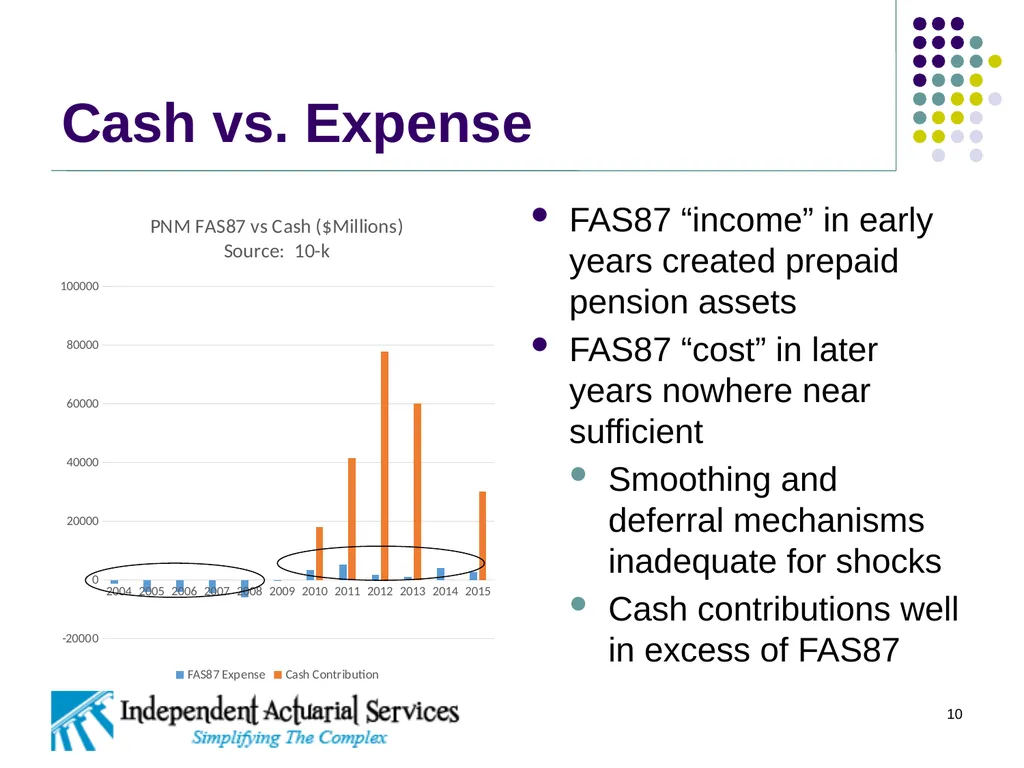
Cash vs. Expense FAS87 “income” in early years created prepaid pension assets
FAS87 “cost” in later years nowhere near sufficient
Smoothing and deferral mechanisms inadequate for shocks
Cash contributions well in excess of FAS87 10<br>
11
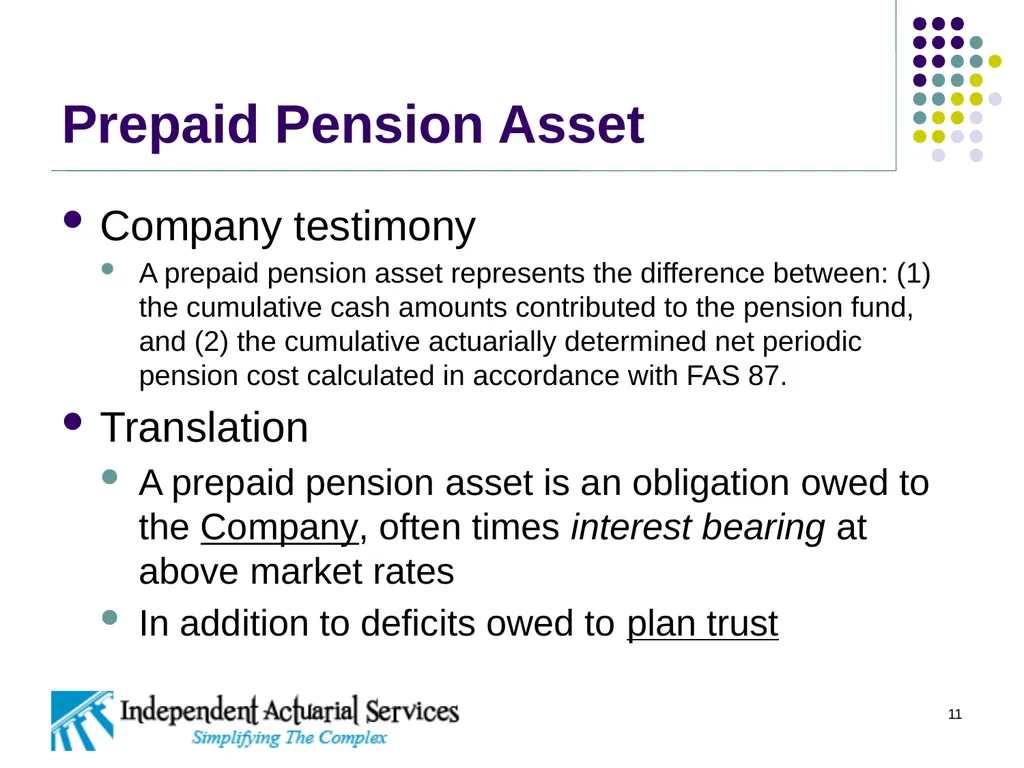
Prepaid Pension Asset Company testimony
A prepaid pension asset represents the difference between: (1) the cumulative cash amounts contributed to the pension fund, and (2) the cumulative actuarially determined net periodic pension cost calculated in accordance with FAS 87.
Translation
A prepaid pension asset is an obligation owed to the Company, often times interest bearing at above market rates
In addition to deficits owed to plan trust 11<br>
12
Why Should I Care Prepaid pension assets:
Have grown exponentially since 2007
Will persist for decades under current accounting and funding regimes
Locked in source of risk-free profits for company
Represents growing intergenerational inequity
Pervasive and hotly contested
Recent “wins” in Colorado electric and gas jurisdictions (PSCo) 12<br>
13
Underlying Economics Company can earn spread on prepaid pension asset
Can borrow at cost-of-debt, with tax deductible interest charges
And earn an after-tax return of WACC for the shareholder “investment”
Ratepayers are captive borrowers
Forced to borrow at rates > 10%
Penalty rates compared to credit worthiness 13<br>
14
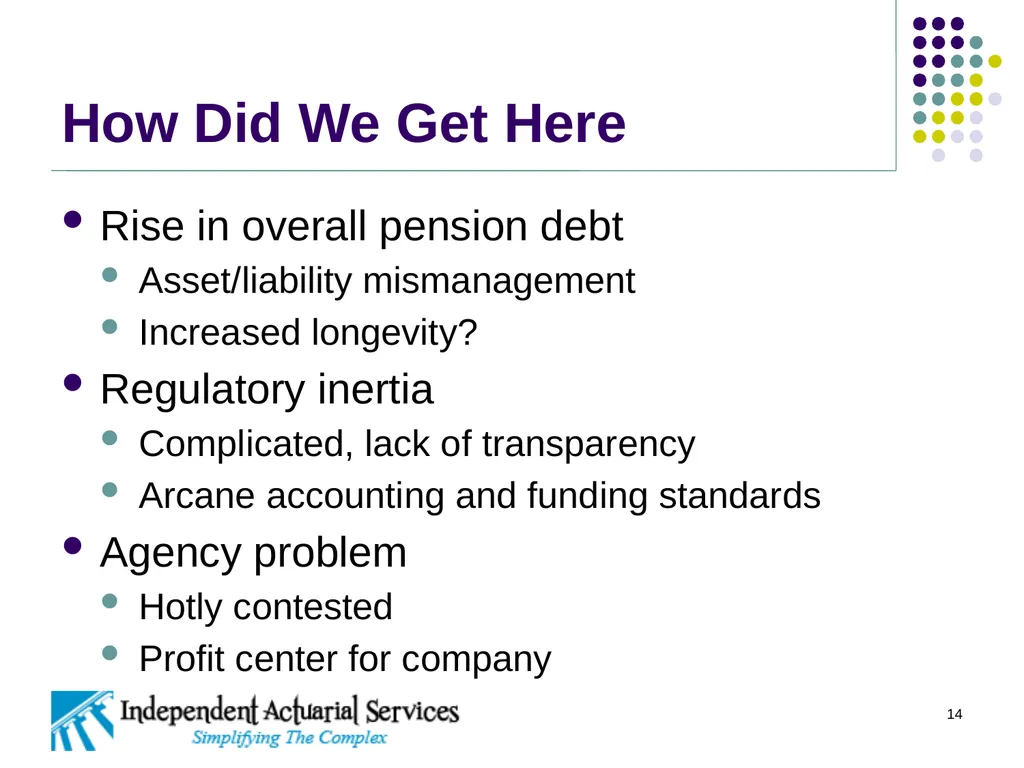
How Did We Get Here Rise in overall pension debt
Asset/liability mismanagement
Increased longevity?
Regulatory inertia
Complicated, lack of transparency
Arcane accounting and funding standards
Agency problem
Hotly contested
Profit center for company 14<br>
15
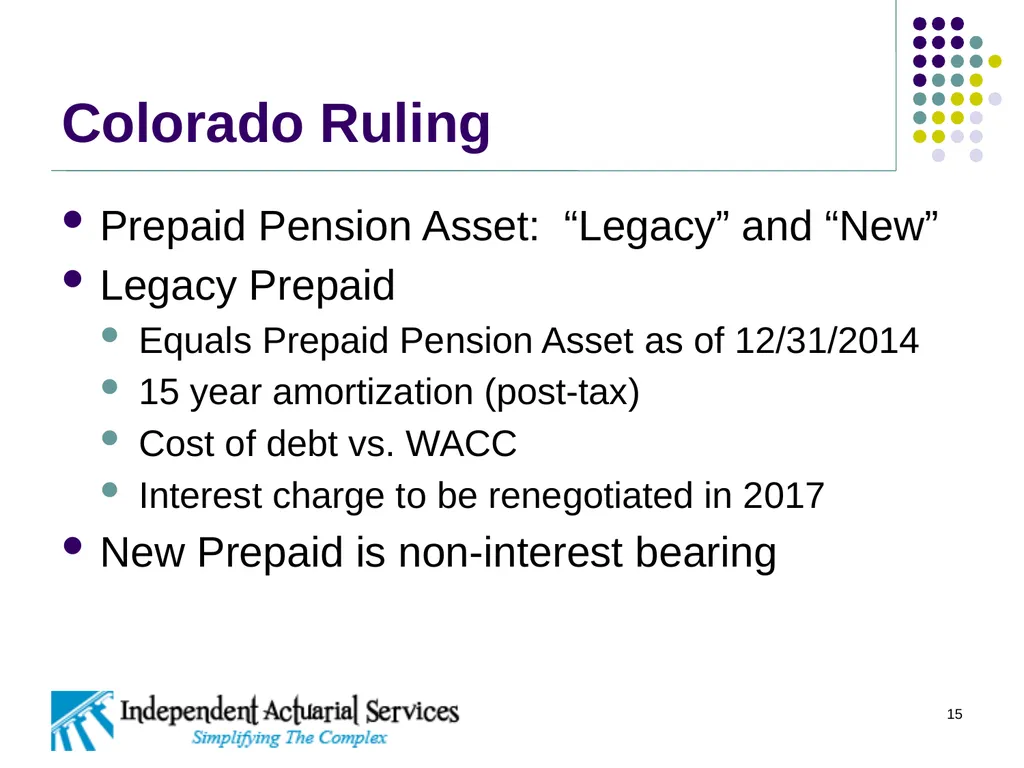
Colorado Ruling Prepaid Pension Asset: “Legacy” and “New”
Legacy Prepaid
Equals Prepaid Pension Asset as of 12/31/2014
15 year amortization (post-tax)
Cost of debt vs. WACC
Interest charge to be renegotiated in 2017
New Prepaid is non-interest bearing 15<br>
16
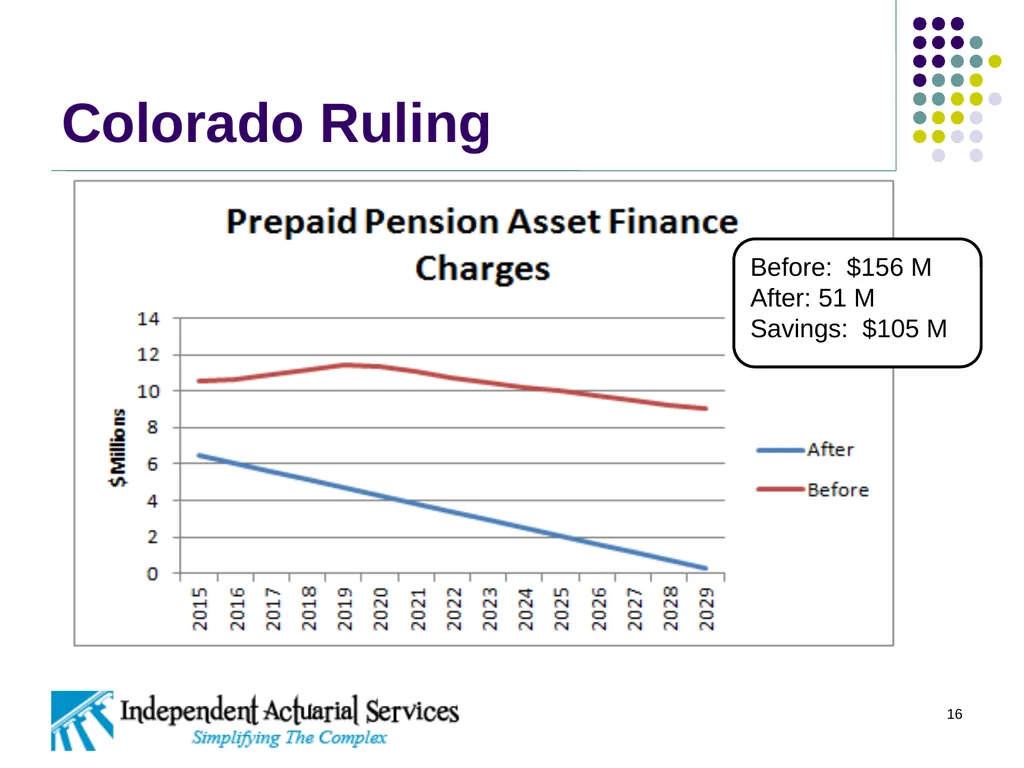
Colorado Ruling 16 Before: $156 M
After: 51 M
Savings: $105 M<br>
17
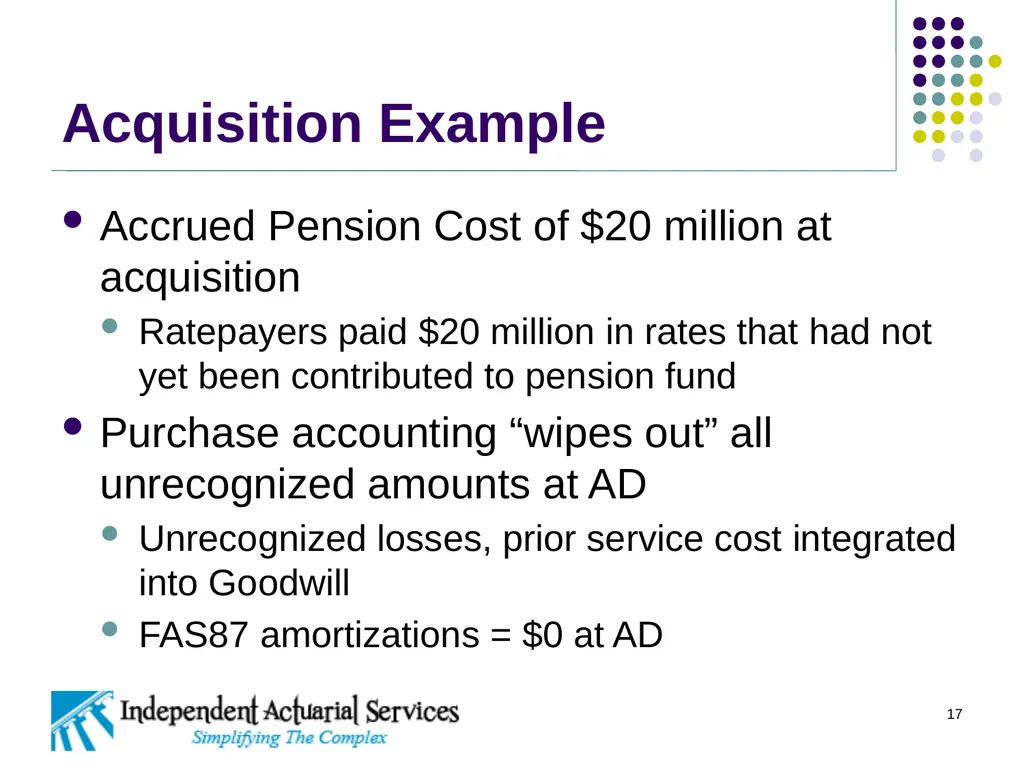
Acquisition Example Accrued Pension Cost of $20 million at acquisition
Ratepayers paid $20 million in rates that had not yet been contributed to pension fund
Purchase accounting “wipes out” all unrecognized amounts at AD
Unrecognized losses, prior service cost integrated into Goodwill
FAS87 amortizations = $0 at AD 17<br>
18
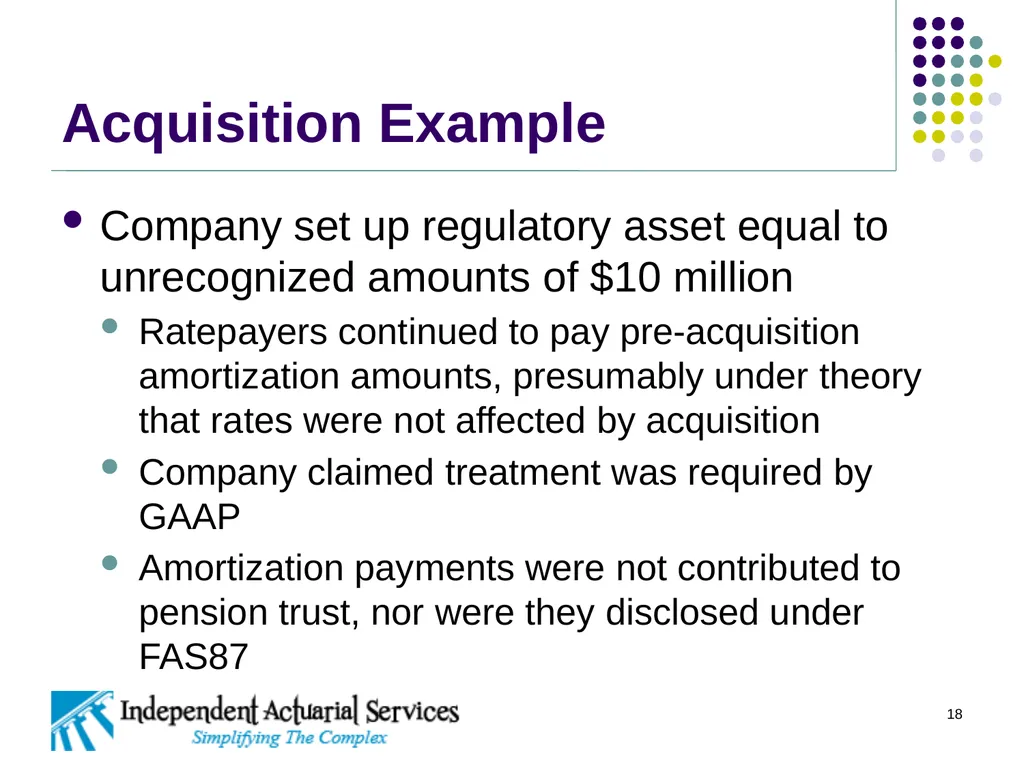
Acquisition Example Company set up regulatory asset equal to unrecognized amounts of $10 million
Ratepayers continued to pay pre-acquisition amortization amounts, presumably under theory that rates were not affected by acquisition
Company claimed treatment was required by GAAP
Amortization payments were not contributed to pension trust, nor were they disclosed under FAS87 18<br>
19
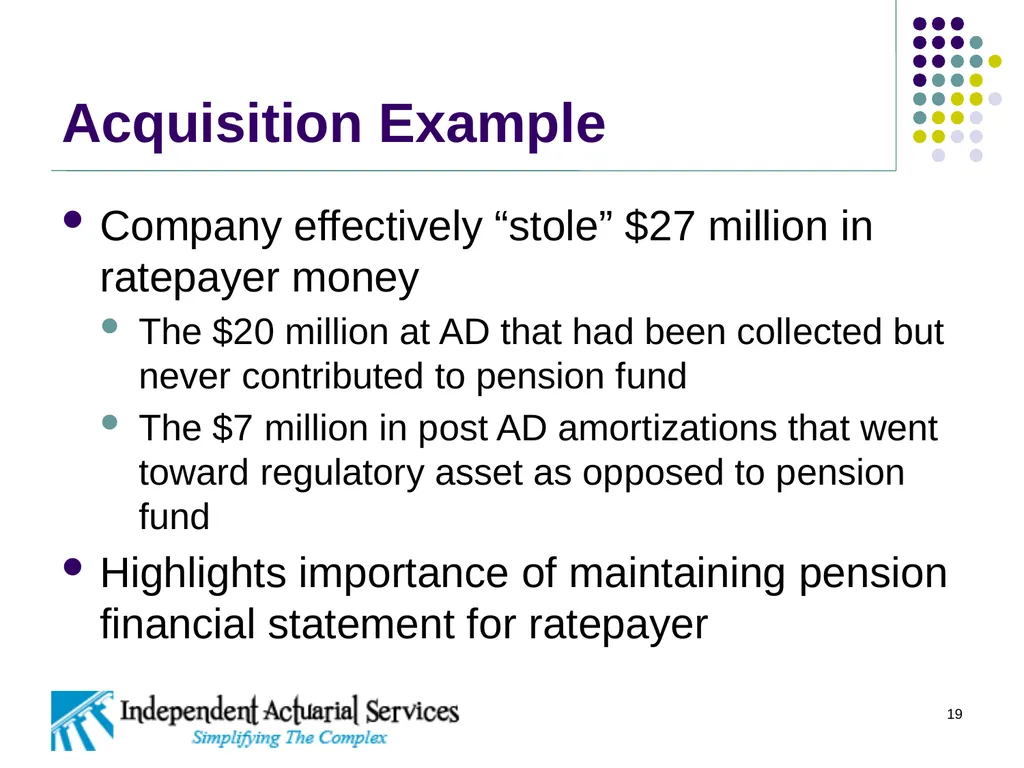
Acquisition Example Company effectively “stole” $27 million in ratepayer money
The $20 million at AD that had been collected but never contributed to pension fund
The $7 million in post AD amortizations that went toward regulatory asset as opposed to pension fund
Highlights importance of maintaining pension financial statement for ratepayer 19<br>
20
David G. Pitts, FSA David Pitts has provided actuarial consulting services to Fortune 500 companies for more than 25 years, assisting the Human Resource and Finance functions in the design, pricing, risk management, communication and administration of pension and other compensation programs.
In 2010, David launched Independent Actuarial Services, focusing primarily on the actuarial needs of the legal community. In this role, David has served as a consultant and expert witness representing utility ratepayers in both Colorado and New Mexico, and has served as a forensic economist in civil matters ranging from wrongful termination to personal injury claims. David received his BS in Mathematics from Tufts University, and is a Fellow in the Society of Actuaries.
David is a regular speaker at actuarial conferences, and has served on the Pension Finance Task Force – a sponsored committee whose primary mission is to strengthen retirement systems, by incorporating the teachings of financial economics into traditional retirement actuarial practice. David also serves as the retirement expert for the SOA curriculum committee on enterprise risk management. www.indactuary.com 917-371-3154<br>