
Revision Exam skills 2 mark questions- Definition
TF
Published · 57 slides · 0 views

1 / 1







Description
Revision Exam skills 2 mark questions- Definition of a key term 5 mark question- DESCRIBE a belief, teaching or practice(approx. 2 paragraphs) 8 mark questions- EXPLAIN with reasoning andor evidence (approx. 4 paragraphs) 15 mark questions
Related Topics
Share
Embed code
Download this presentation From Below
"Revision Exam skills 2 mark questions- Definition" is the property of its rightful owner. Permission is granted to download and print the materials on this website for personal, non-commercial use only, and to display it on your personal computer provided you do not modify the materials and that you retain all copyright notices contained in the materials. By downloading content from our website, you accept the terms of this agreement.
Presentation Transcript
01
Revision<br>
02
Exam skills 2 mark questions- Definition of a key term
5 mark question- DESCRIBE a belief, teaching or practice(approx. 2 paragraphs)
8 mark questions- EXPLAIN with reasoning and/or evidence (approx. 4 paragraphs)<br>
5 mark question- DESCRIBE a belief, teaching or practice(approx. 2 paragraphs)
8 mark questions- EXPLAIN with reasoning and/or evidence (approx. 4 paragraphs)<br>
03
15 mark questions 15 mark questions- EVALUATION:
This means that you must consider two different points of view
Remember to back up your points with evidence or examples (Bible quotes, encyclicals, teachings from the Pope, Ten Commandments etc.)
Plan your answer before your start writing
It would not be a bad idea to answer the 15 mark questions first!<br>
This means that you must consider two different points of view
Remember to back up your points with evidence or examples (Bible quotes, encyclicals, teachings from the Pope, Ten Commandments etc.)
Plan your answer before your start writing
It would not be a bad idea to answer the 15 mark questions first!<br>
04
Revision: Life After Death<br>
05
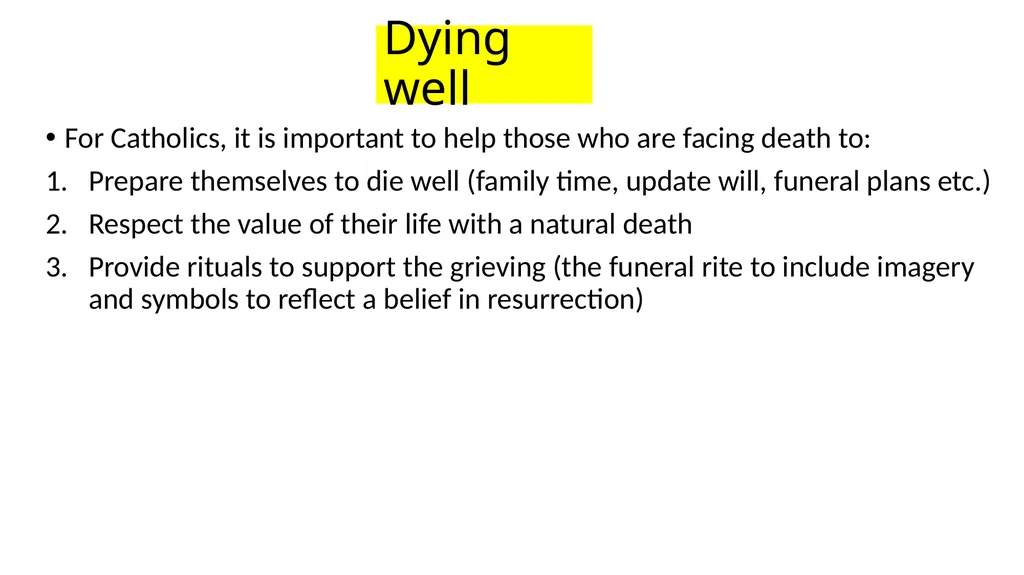
Dying well For Catholics, it is important to help those who are facing death to:
Prepare themselves to die well (family time, update will, funeral plans etc.)
Respect the value of their life with a natural death
Provide rituals to support the grieving (the funeral rite to include imagery and symbols to reflect a belief in resurrection)<br>
Prepare themselves to die well (family time, update will, funeral plans etc.)
Respect the value of their life with a natural death
Provide rituals to support the grieving (the funeral rite to include imagery and symbols to reflect a belief in resurrection)<br>
06
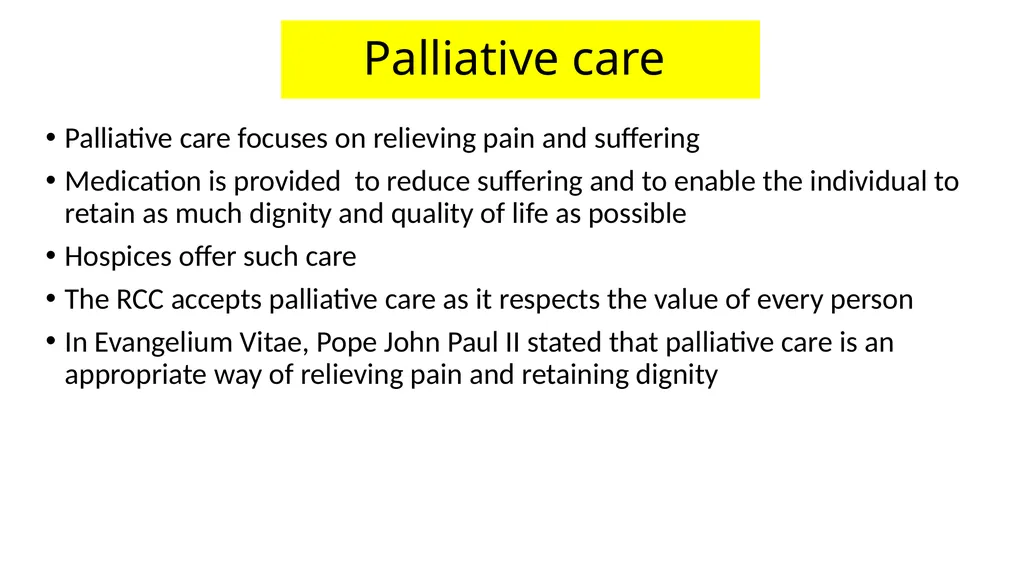
Palliative care Palliative care focuses on relieving pain and suffering
Medication is provided to reduce suffering and to enable the individual to retain as much dignity and quality of life as possible
Hospices offer such care
The RCC accepts palliative care as it respects the value of every person
In Evangelium Vitae, Pope John Paul II stated that palliative care is an appropriate way of relieving pain and retaining dignity<br>
Medication is provided to reduce suffering and to enable the individual to retain as much dignity and quality of life as possible
Hospices offer such care
The RCC accepts palliative care as it respects the value of every person
In Evangelium Vitae, Pope John Paul II stated that palliative care is an appropriate way of relieving pain and retaining dignity<br>
07
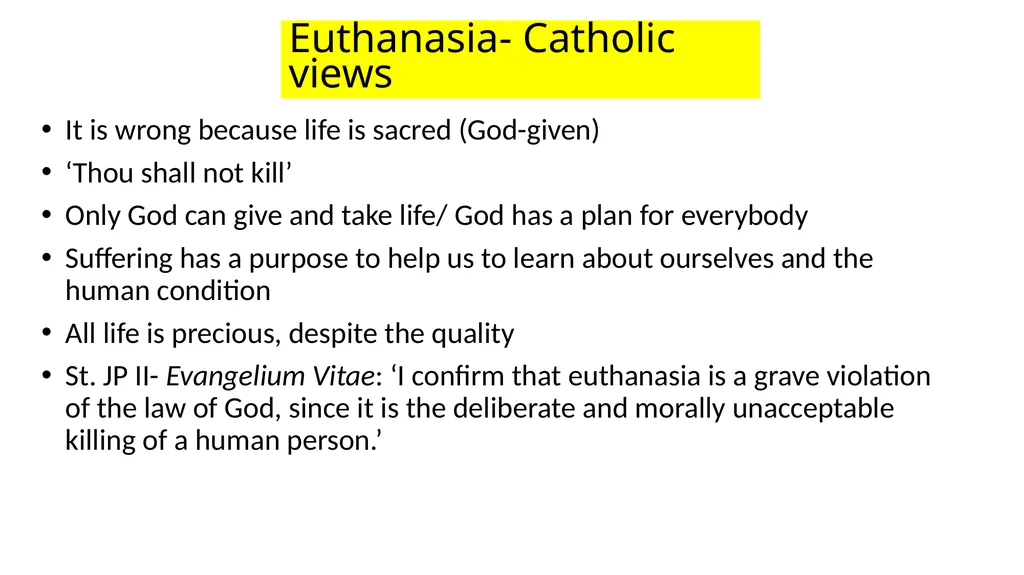
Euthanasia- Catholic views It is wrong because life is sacred (God-given)
‘Thou shall not kill’
Only God can give and take life/ God has a plan for everybody
Suffering has a purpose to help us to learn about ourselves and the human condition
All life is precious, despite the quality
St. JP II- Evangelium Vitae: ‘I confirm that euthanasia is a grave violation of the law of God, since it is the deliberate and morally unacceptable killing of a human person.’<br>
‘Thou shall not kill’
Only God can give and take life/ God has a plan for everybody
Suffering has a purpose to help us to learn about ourselves and the human condition
All life is precious, despite the quality
St. JP II- Evangelium Vitae: ‘I confirm that euthanasia is a grave violation of the law of God, since it is the deliberate and morally unacceptable killing of a human person.’<br>
08
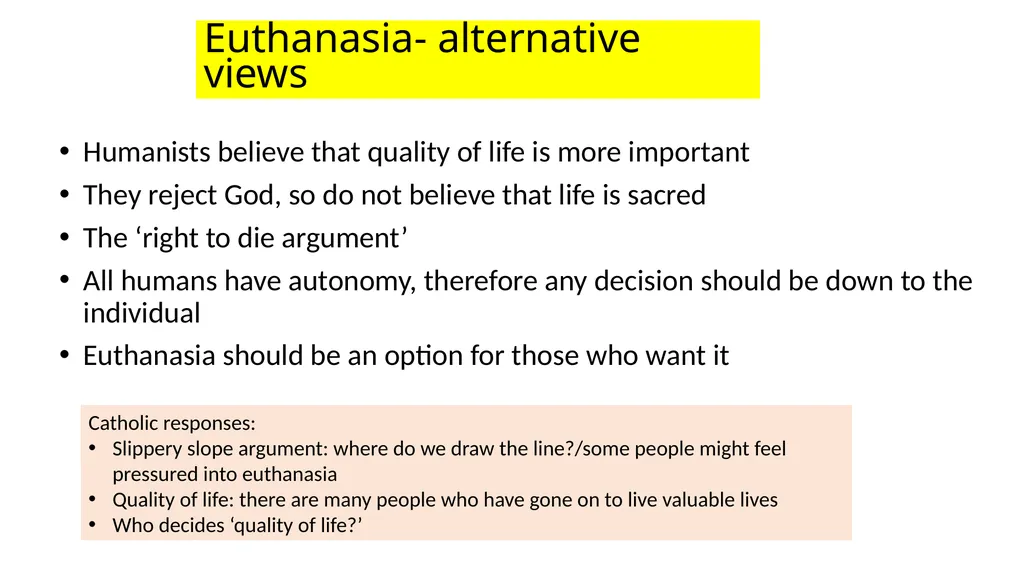
Euthanasia- alternative views Humanists believe that quality of life is more important
They reject God, so do not believe that life is sacred
The ‘right to die argument’
All humans have autonomy, therefore any decision should be down to the individual
Euthanasia should be an option for those who want it Catholic responses:
Slippery slope argument: where do we draw the line?/some people might feel pressured into euthanasia
Quality of life: there are many people who have gone on to live valuable lives
Who decides ‘quality of life?’<br>
They reject God, so do not believe that life is sacred
The ‘right to die argument’
All humans have autonomy, therefore any decision should be down to the individual
Euthanasia should be an option for those who want it Catholic responses:
Slippery slope argument: where do we draw the line?/some people might feel pressured into euthanasia
Quality of life: there are many people who have gone on to live valuable lives
Who decides ‘quality of life?’<br>
09
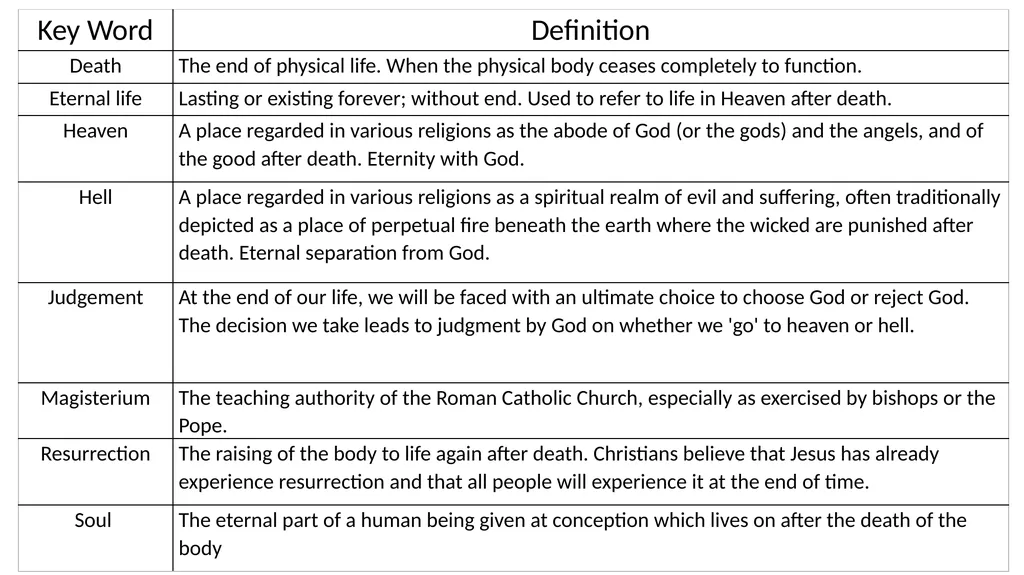
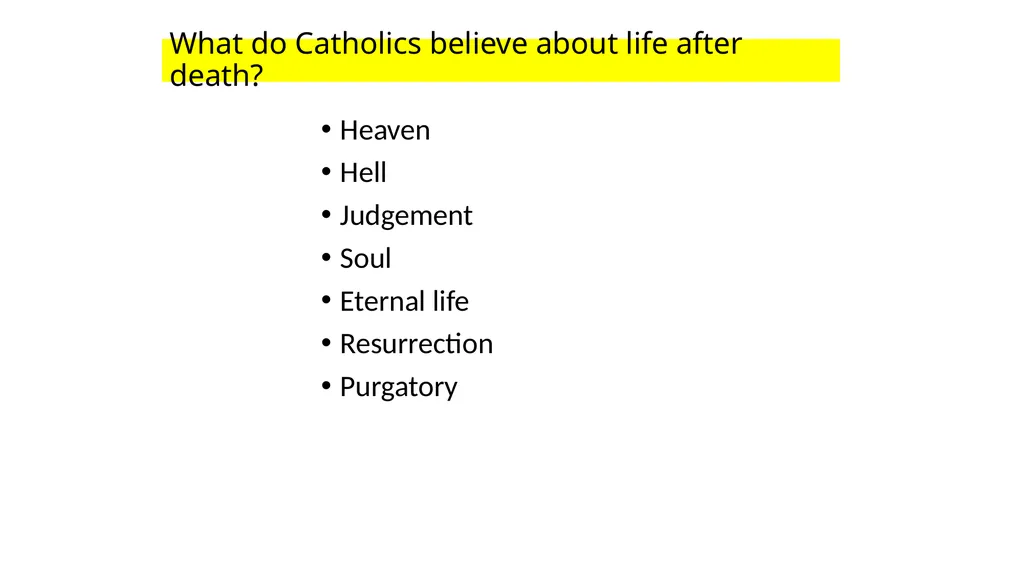
What do Catholics believe about life after death? Heaven
Hell
Judgement
Soul
Eternal life
Resurrection
Purgatory<br>
Hell
Judgement
Soul
Eternal life
Resurrection
Purgatory<br>
10
Catholic beliefs on resurrection and the soul St. Paul = says earthly, physical bodies and heavenly, spiritual bodies
Catholics therefore believe in a bodily resurrection based on the teachings of St. Paul
Jesus’ resurrection is evidence for Catholics
St. Paul rejected the idea that humans were merely physical beings
He understood the soul to be something that gives us our identity<br>
Catholics therefore believe in a bodily resurrection based on the teachings of St. Paul
Jesus’ resurrection is evidence for Catholics
St. Paul rejected the idea that humans were merely physical beings
He understood the soul to be something that gives us our identity<br>
11
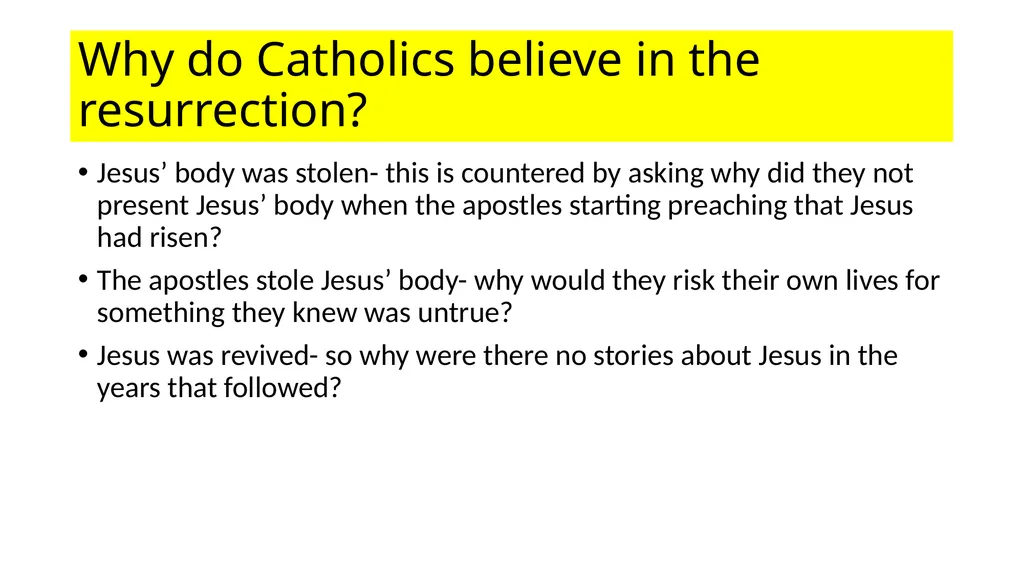
Why do Catholics believe in the resurrection? Jesus’ body was stolen- this is countered by asking why did they not present Jesus’ body when the apostles starting preaching that Jesus had risen?
The apostles stole Jesus’ body- why would they risk their own lives for something they knew was untrue?
Jesus was revived- so why were there no stories about Jesus in the years that followed?<br>
The apostles stole Jesus’ body- why would they risk their own lives for something they knew was untrue?
Jesus was revived- so why were there no stories about Jesus in the years that followed?<br>
12
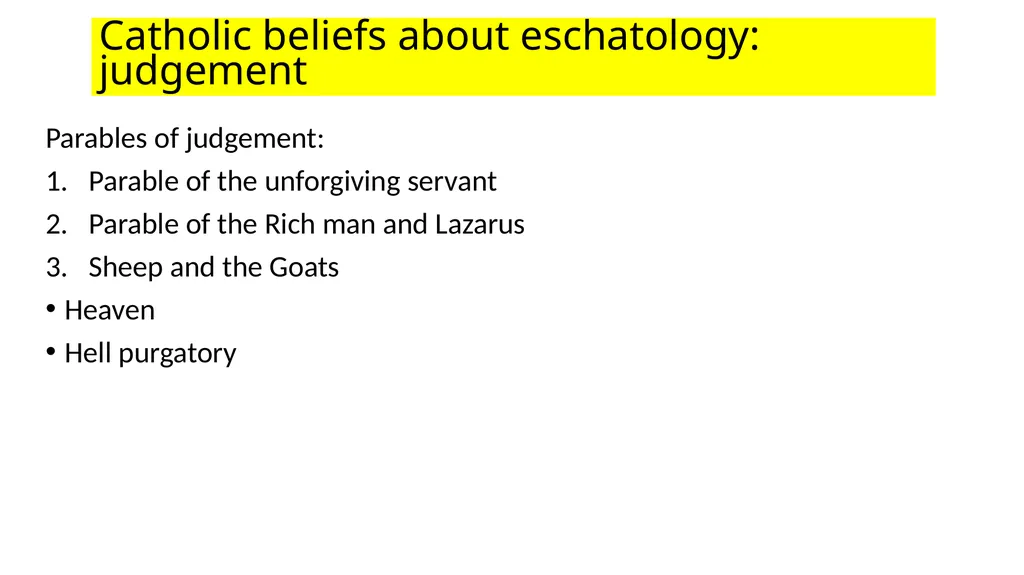
Catholic beliefs about eschatology: judgement Parables of judgement:
Parable of the unforgiving servant
Parable of the Rich man and Lazarus
Sheep and the Goats
Heaven
Hell purgatory<br>
Parable of the unforgiving servant
Parable of the Rich man and Lazarus
Sheep and the Goats
Heaven
Hell purgatory<br>
13
The Magisterium Ordinary Magisterium
Popes and Bishops regularly preach in homilies and letters
These are often to encourage faith and devotion
The most well known are encyclicals (written by the Pope) Extraordinary Magisterium
General council
The task is to explore matters of significance to the life of the church
Pontifical Magisterium
Rare declarations made by the Pope
The Pope has authority to make the final decisions on disputed matters of faith and morals (ex cathedra declarations)
The Pope in infallible = teaching authority of the Church
The function is to present Catholic teaching in a modern context<br>
Popes and Bishops regularly preach in homilies and letters
These are often to encourage faith and devotion
The most well known are encyclicals (written by the Pope) Extraordinary Magisterium
General council
The task is to explore matters of significance to the life of the church
Pontifical Magisterium
Rare declarations made by the Pope
The Pope has authority to make the final decisions on disputed matters of faith and morals (ex cathedra declarations)
The Pope in infallible = teaching authority of the Church
The function is to present Catholic teaching in a modern context<br>
14
Second Vatican council- 4 key documents Dei Verbum:
Emphasised the importance of the relationship between the Bible, Magisterium and Tradition
Sacrosanctum Concilium-
Mass was conducted in the local language (formerly Latin)
Priest faced the congregation
Music and singing during Mass
Women were allowed roles e.g. as readers and Eucharistic ministers
Jews were considered brothers and sisters under the same God<br>
Emphasised the importance of the relationship between the Bible, Magisterium and Tradition
Sacrosanctum Concilium-
Mass was conducted in the local language (formerly Latin)
Priest faced the congregation
Music and singing during Mass
Women were allowed roles e.g. as readers and Eucharistic ministers
Jews were considered brothers and sisters under the same God<br>
15
Second Vatican council- 4 key documents Lumen Gentium
Focused on raising the profile of all people of the church
Gaudium et Spes
A desire for the church to be a source of joy and hope
Focused on addressing issues in society e.g. poverty and social justice
Parishes set up justice and peace groups
CAFOD later responded to these needs<br>
Focused on raising the profile of all people of the church
Gaudium et Spes
A desire for the church to be a source of joy and hope
Focused on addressing issues in society e.g. poverty and social justice
Parishes set up justice and peace groups
CAFOD later responded to these needs<br>
16
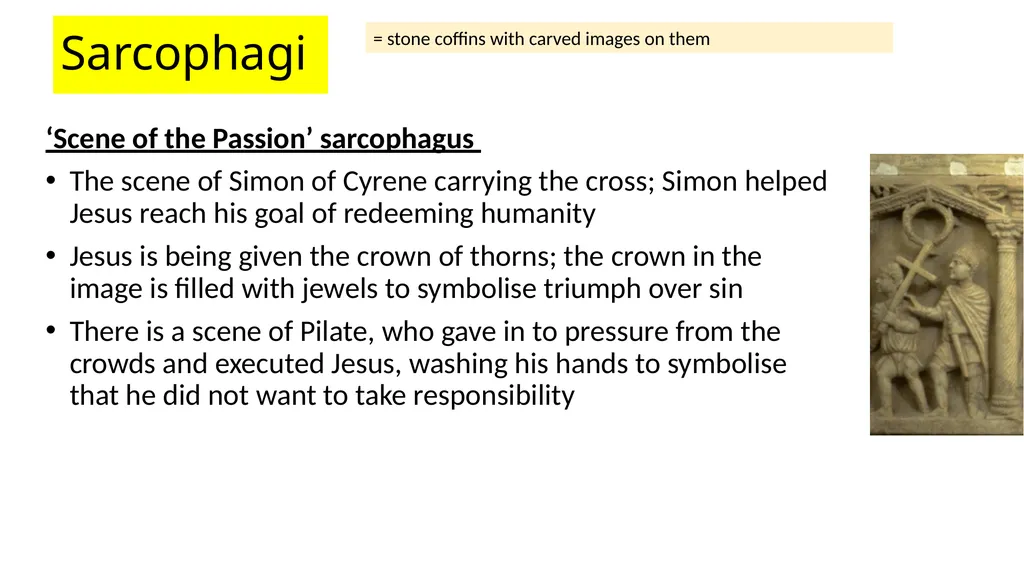
Sarcophagi ‘Scene of the Passion’ sarcophagus
The scene of Simon of Cyrene carrying the cross; Simon helped Jesus reach his goal of redeeming humanity
Jesus is being given the crown of thorns; the crown in the image is filled with jewels to symbolise triumph over sin
There is a scene of Pilate, who gave in to pressure from the crowds and executed Jesus, washing his hands to symbolise that he did not want to take responsibility = stone coffins with carved images on them<br>
The scene of Simon of Cyrene carrying the cross; Simon helped Jesus reach his goal of redeeming humanity
Jesus is being given the crown of thorns; the crown in the image is filled with jewels to symbolise triumph over sin
There is a scene of Pilate, who gave in to pressure from the crowds and executed Jesus, washing his hands to symbolise that he did not want to take responsibility = stone coffins with carved images on them<br>
17
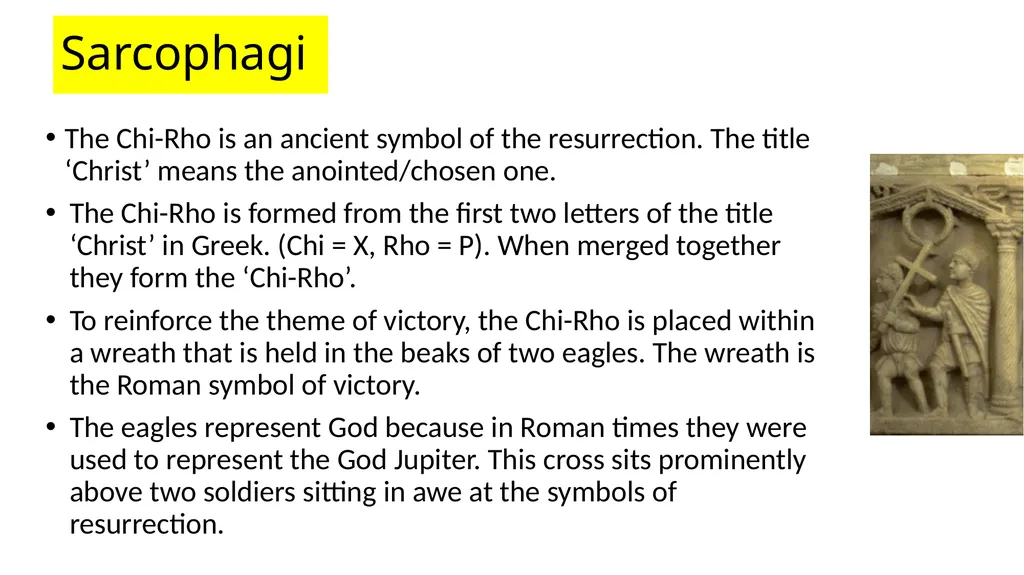
Sarcophagi The Chi-Rho is an ancient symbol of the resurrection. The title ‘Christ’ means the anointed/chosen one.
The Chi-Rho is formed from the first two letters of the title ‘Christ’ in Greek. (Chi = X, Rho = P). When merged together they form the ‘Chi-Rho’.
To reinforce the theme of victory, the Chi-Rho is placed within a wreath that is held in the beaks of two eagles. The wreath is the Roman symbol of victory.
The eagles represent God because in Roman times they were used to represent the God Jupiter. This cross sits prominently above two soldiers sitting in awe at the symbols of resurrection.<br>
The Chi-Rho is formed from the first two letters of the title ‘Christ’ in Greek. (Chi = X, Rho = P). When merged together they form the ‘Chi-Rho’.
To reinforce the theme of victory, the Chi-Rho is placed within a wreath that is held in the beaks of two eagles. The wreath is the Roman symbol of victory.
The eagles represent God because in Roman times they were used to represent the God Jupiter. This cross sits prominently above two soldiers sitting in awe at the symbols of resurrection.<br>
18
Paschal Candle: Easter Special candle that is used during Easter; it symbolises Jesus’ resurrection as a triumph over death
The Easter Vigil remembers the resurrection
At the beginning the church is in darkness
A fire is lit outside
The Paschal candle is lit from the fire and processed into the church
This symbolises the ‘light of Christ’ overcoming the ‘darkness of sin’
The procession finishes with a hymn called the ‘Exultet’, which proclaims Jesus’ triumph over sin<br>
The Easter Vigil remembers the resurrection
At the beginning the church is in darkness
A fire is lit outside
The Paschal candle is lit from the fire and processed into the church
This symbolises the ‘light of Christ’ overcoming the ‘darkness of sin’
The procession finishes with a hymn called the ‘Exultet’, which proclaims Jesus’ triumph over sin<br>
19
Paschal Candle- symbolism The ‘Alpha’ & ‘Omega’: These are the first and last letters in the Greek alphabet. They symbolise Christ as the ‘first’ and the ‘last’; the ‘beginning ‘of all things and the ‘end’ of all things.
The Cross: This is the symbol of Christian faith because it is due to the crucifixion of Christ that the resurrection was possible.
The Five Wounds: to represent the five wounds Jesus received during his crucifixion.
The year: reminds people that Jesus is the same for all time and that the salvation earned by Jesus is as real now as it was in the past.<br>
The Cross: This is the symbol of Christian faith because it is due to the crucifixion of Christ that the resurrection was possible.
The Five Wounds: to represent the five wounds Jesus received during his crucifixion.
The year: reminds people that Jesus is the same for all time and that the salvation earned by Jesus is as real now as it was in the past.<br>
20
Paschal Candle- baptism Water is used at baptism to represent the washing away of sin
The water used at Easter baptisms is blessed using the Easter candle
To remind people of the resurrection, it is lit and placed near the font
A smaller baptismal candle is lit from the flame of the Paschal candle and is given to the family to remind them of the ‘light of Christ’<br>
The water used at Easter baptisms is blessed using the Easter candle
To remind people of the resurrection, it is lit and placed near the font
A smaller baptismal candle is lit from the flame of the Paschal candle and is given to the family to remind them of the ‘light of Christ’<br>
21
Music and worship Psalms:
Ancient collections of prayers and hymns to God
Express emotions such as joy, praise, anxiety and despair
Have been sources of prayer since the time of Christ
At Mass, the Liturgy of the Word includes a Psalm
Music in the Liturgy:
Alleluia- welcoming the Gospel
Eucharistic acclamations – to give thanksgiving at which the bread and wine become the body and blood
The Gloria- song of praise
Hymns - start and end of Mass/ distribution of communion<br>
Ancient collections of prayers and hymns to God
Express emotions such as joy, praise, anxiety and despair
Have been sources of prayer since the time of Christ
At Mass, the Liturgy of the Word includes a Psalm
Music in the Liturgy:
Alleluia- welcoming the Gospel
Eucharistic acclamations – to give thanksgiving at which the bread and wine become the body and blood
The Gloria- song of praise
Hymns - start and end of Mass/ distribution of communion<br>
22
Faure’s Requiem Brings a sense of serenity, calm, peace, hope and comfort
Acknowledges grief within the context of eternal life
Does not allow the natural sadness of grief to override the faith in the resurrection
He did not want to express a fear of death
He uses harps, violins and the sound of angels to focus on the aspiration of heaven
Faure’s Paradisum asks for the deceased to be welcomed into paradise
The choir sings at a higher pace, sounding like angels in heaven<br>
Acknowledges grief within the context of eternal life
Does not allow the natural sadness of grief to override the faith in the resurrection
He did not want to express a fear of death
He uses harps, violins and the sound of angels to focus on the aspiration of heaven
Faure’s Paradisum asks for the deceased to be welcomed into paradise
The choir sings at a higher pace, sounding like angels in heaven<br>
23
Catholic funeral rites- symbols on the coffin The coffin is covered in a white cloth (pall) as a reminder of baptism/ all are equal in the eyes of God
The Book of the Gospels is sometimes placed on the coffin as a reminder that the person lived by Jesus’ teachings
A cross is often placed on the coffin; it is through Jesus’ crucifixion that he defeated death
The coffin is placed by the Paschal candle as a reminder of resurrection<br>
The Book of the Gospels is sometimes placed on the coffin as a reminder that the person lived by Jesus’ teachings
A cross is often placed on the coffin; it is through Jesus’ crucifixion that he defeated death
The coffin is placed by the Paschal candle as a reminder of resurrection<br>
24
Symbolic actions The coffin is sprinkled with holy water as a reminder of baptism
At the end, the coffin is incensed as a sign of honouring the person and a sign of prayers rising to heaven
The coffin is carried out of the church in a solemn procession
Liturgical colour-
Priest will wear white, the colour of the resurrection, or purpe which is a sign of mourning<br>
At the end, the coffin is incensed as a sign of honouring the person and a sign of prayers rising to heaven
The coffin is carried out of the church in a solemn procession
Liturgical colour-
Priest will wear white, the colour of the resurrection, or purpe which is a sign of mourning<br>
25
Prayers and readings Readings from scripture will remind mourners of the promise of eternal life
The prayers will refer to baptism, Easter, the resurrection and Jesus’ sacrifice
The priest will use their homily to explain the Christian belief that Jesus defeated death through resurrection
The prayers of intercession will include prayers for the dead
The priest will wear white to represent resurrection<br>
The prayers will refer to baptism, Easter, the resurrection and Jesus’ sacrifice
The priest will use their homily to explain the Christian belief that Jesus defeated death through resurrection
The prayers of intercession will include prayers for the dead
The priest will wear white to represent resurrection<br>
26
Types of prayer Formulaic prayer
Set prayers that have been said by Christians for centuries
Many Christians use these because they believe they have come from people who are close to God
The same words are said each time e.g. the Lord’s Prayer
Extempore prayer
Christians use their own words to speak with God
It is possible for people to use their own words to raise their ‘hearts and mind to God’ in a more spontaneous way<br>
Set prayers that have been said by Christians for centuries
Many Christians use these because they believe they have come from people who are close to God
The same words are said each time e.g. the Lord’s Prayer
Extempore prayer
Christians use their own words to speak with God
It is possible for people to use their own words to raise their ‘hearts and mind to God’ in a more spontaneous way<br>
27
Why do people pray? Adoration
Thanksgiving
Repentance
Intercession
Petitions<br>
Thanksgiving
Repentance
Intercession
Petitions<br>
28
Our Father, Who art in heaven
Hallowed be Thy Name;
Thy kingdom come,
Thy will be done,
on earth as it is in heaven.
Give us this day our daily bread,
and forgive us our trespasses,
as we forgive those who trespass against us;
and lead us not into temptation,
but deliver us from evil. Amen. Adoration: To give hallows is to ‘make holy’ Thanksgiving: it is a privilege to be able to call God ‘Father’. It suggests an intimacy in the relationship with God. Petition: We ask God for the things we need Repentance: there is an acknowledgement of falling short of perfection. It invites Christians to repent and forgive others. Intercession: may the world be transformed into that state of perfection that is understood as the Kingdom of God. May life on earth be a s wonderful as being in the presence of God. May there be more peace, justice, equality etc.<br>
29
Praying for the dead Support the grieving and are consistent with beliefs about salvation, purgatory and the promise of eternal life in heaven.
These prayers are intercessions on behalf of the person who has died, asking God to welcome them into His presence.
Eternal rest prayer is the most common
Catholics will also ask the priest to offer a mass for a relative or friend who has died. On such occasions, the priest will remember that person in his own prayers during the Mass.<br>
These prayers are intercessions on behalf of the person who has died, asking God to welcome them into His presence.
Eternal rest prayer is the most common
Catholics will also ask the priest to offer a mass for a relative or friend who has died. On such occasions, the priest will remember that person in his own prayers during the Mass.<br>
30
Revision: Sin and Forgiveness<br>
31
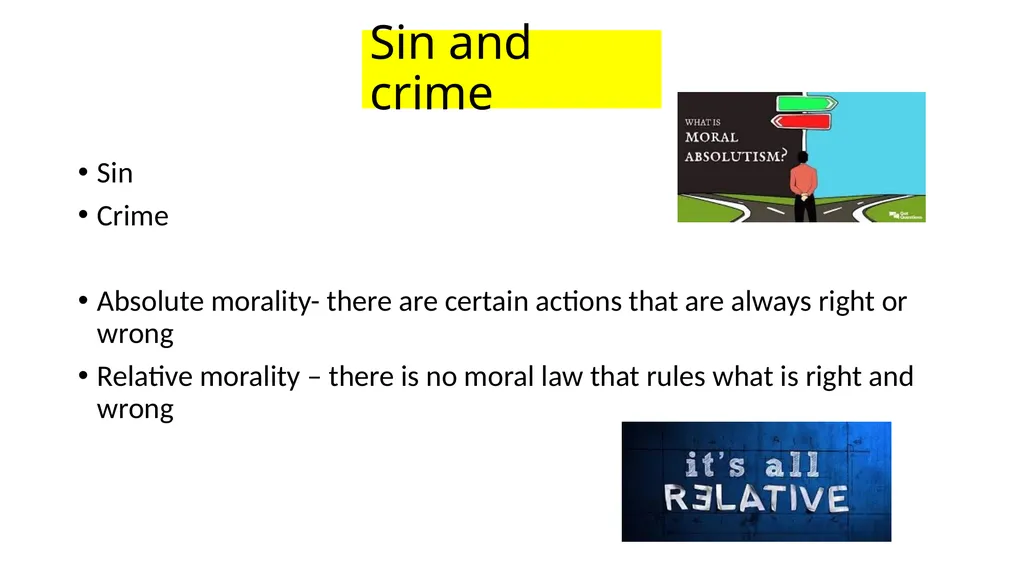
Sin and crime Sin
Crime
Absolute morality- there are certain actions that are always right or wrong
Relative morality – there is no moral law that rules what is right and wrong<br>
Crime
Absolute morality- there are certain actions that are always right or wrong
Relative morality – there is no moral law that rules what is right and wrong<br>
32
Aims of punishment Protection
Retribution
Deterrence
Rehabilitation<br>
Retribution
Deterrence
Rehabilitation<br>
33
Protection – to protect society from the criminal and to also protect the criminal from causing further harm
Retribution – criminals pay for what they have done. (e.g. revenge/’an eye for an eye’). Most Catholics would not accept OT teachings on retribution but follow Jesus’ teachings from the NT.
Deterrence – punishment designed to stop criminals committing crimes
Reformation – to reform criminals, so they no longer commit crimes<br>
Retribution – criminals pay for what they have done. (e.g. revenge/’an eye for an eye’). Most Catholics would not accept OT teachings on retribution but follow Jesus’ teachings from the NT.
Deterrence – punishment designed to stop criminals committing crimes
Reformation – to reform criminals, so they no longer commit crimes<br>
34
Forgiveness At the heart of the Gospel message
The parable of the unmerciful servant
The parable of the prodigal son
The Lord’s Prayer (‘Forgive us our trespasses, as we forgive those who trespass against us.’)
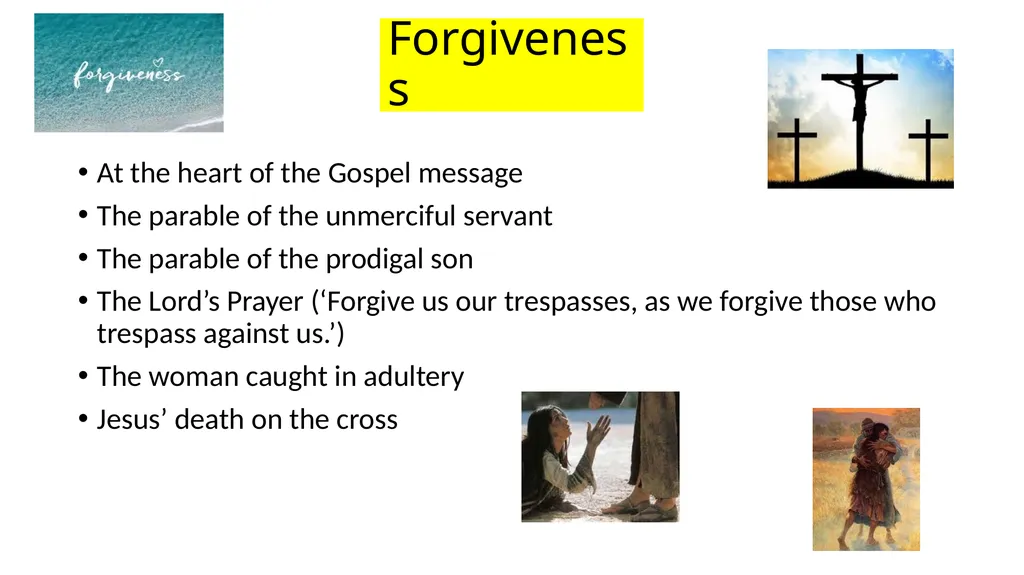
The woman caught in adultery
Jesus’ death on the cross<br>
The parable of the unmerciful servant
The parable of the prodigal son
The Lord’s Prayer (‘Forgive us our trespasses, as we forgive those who trespass against us.’)
The woman caught in adultery
Jesus’ death on the cross<br>
35
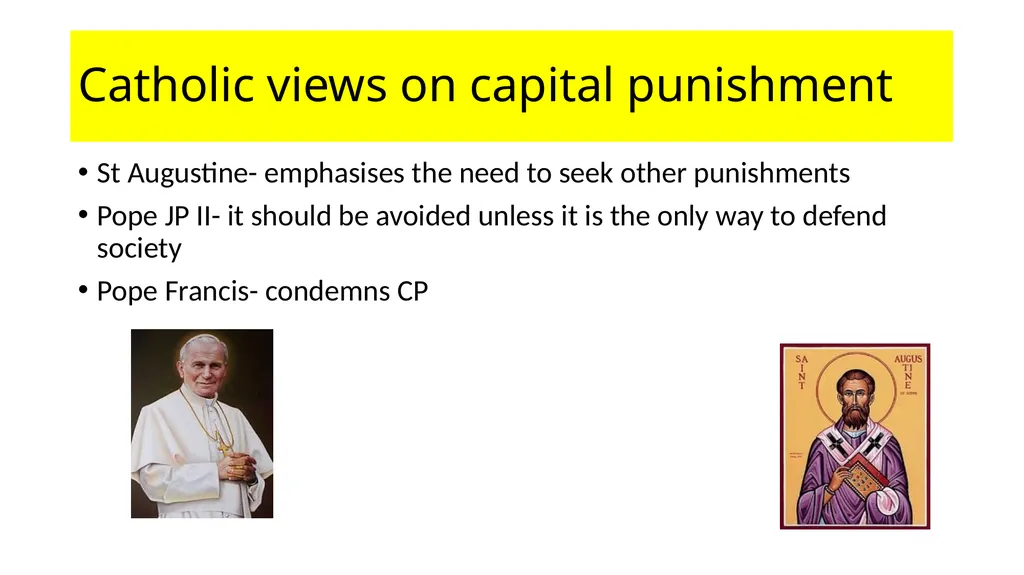
Catholic views on capital punishment St Augustine- emphasises the need to seek other punishments
Pope JP II- it should be avoided unless it is the only way to defend society
Pope Francis- condemns CP<br>
Pope JP II- it should be avoided unless it is the only way to defend society
Pope Francis- condemns CP<br>
36
Christian arguments against Jesus came to save (reform) sinners, but you cannot reform a dead person.
The commandment says, “Do not kill.”
Jesus said that revenge is wrong. Matthew 5:38 “You have heard that it was said, ‘Eye for eye, and tooth for tooth.’ But I tell you, do not resist an evil person. If anyone slaps you on the right cheek, turn to them the other cheek also.”
Christianity teaches that all life is sacred and that humans are made in God's image.
The overall message of Christianity is love and forgiveness
There is always a risk that the wrong person is executed<br>
The commandment says, “Do not kill.”
Jesus said that revenge is wrong. Matthew 5:38 “You have heard that it was said, ‘Eye for eye, and tooth for tooth.’ But I tell you, do not resist an evil person. If anyone slaps you on the right cheek, turn to them the other cheek also.”
Christianity teaches that all life is sacred and that humans are made in God's image.
The overall message of Christianity is love and forgiveness
There is always a risk that the wrong person is executed<br>
37
Christian arguments in support Jesus never taught the death penalty was wrong.
The Old Testament teaches that the death penalty should be used for some crimes:
‘An eye for an eye, a tooth for a tooth’
Upholds the commandment “thou shalt not kill” by showing the seriousness of murder as a crime.
St. Paul teaches that Christians should accept and obey the laws of their country, which might include the death penalty.
Some crimes are so dreadful that the most extreme form of punishment is justified. They might also argue that it is wrong to spend money on keeping someone in prison long term, when that money is needed by others in society.<br>
The Old Testament teaches that the death penalty should be used for some crimes:
‘An eye for an eye, a tooth for a tooth’
Upholds the commandment “thou shalt not kill” by showing the seriousness of murder as a crime.
St. Paul teaches that Christians should accept and obey the laws of their country, which might include the death penalty.
Some crimes are so dreadful that the most extreme form of punishment is justified. They might also argue that it is wrong to spend money on keeping someone in prison long term, when that money is needed by others in society.<br>
38
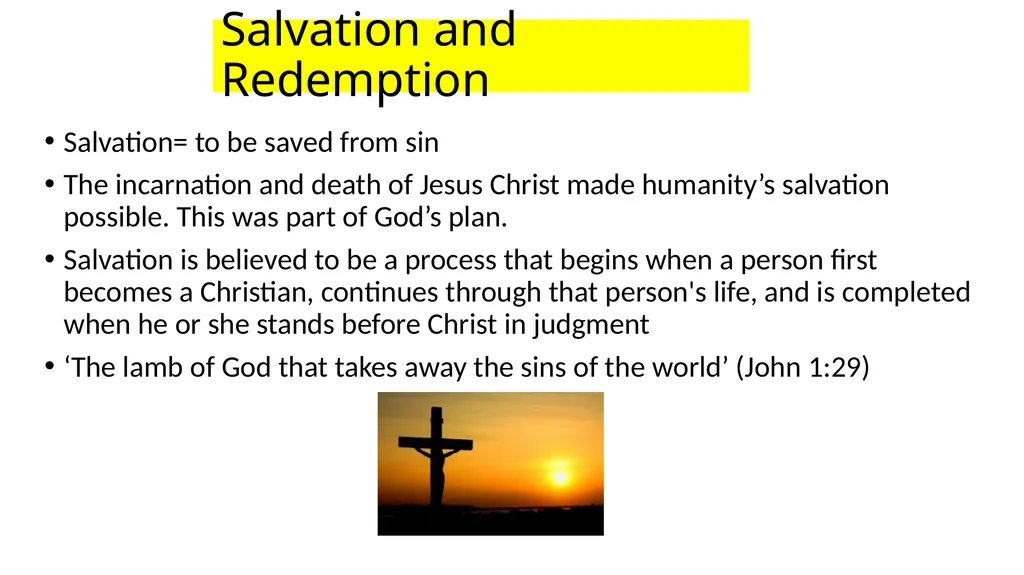
Salvation and Redemption Salvation= to be saved from sin
The incarnation and death of Jesus Christ made humanity’s salvation possible. This was part of God’s plan.
Salvation is believed to be a process that begins when a person first becomes a Christian, continues through that person's life, and is completed when he or she stands before Christ in judgment
‘The lamb of God that takes away the sins of the world’ (John 1:29)<br>
The incarnation and death of Jesus Christ made humanity’s salvation possible. This was part of God’s plan.
Salvation is believed to be a process that begins when a person first becomes a Christian, continues through that person's life, and is completed when he or she stands before Christ in judgment
‘The lamb of God that takes away the sins of the world’ (John 1:29)<br>
39
Grace Grace is the love and mercy shown by God because God wants them to have it
A free, generous, undeserved gift from God
If Christians repent of their sins, they are truly sorry and this makes them children of God
Grace comes about in a special way through the sacraments, which Catholics believe are encounters with God Salvation is important because without it, a person’s sin will stop them from having a relationship with God, and might mean hell or purgatory
The salvation of humankind as the purpose of Jesus’ life, death and resurrection
God created humans with free will and they can choose to accept of reject God<br>
A free, generous, undeserved gift from God
If Christians repent of their sins, they are truly sorry and this makes them children of God
Grace comes about in a special way through the sacraments, which Catholics believe are encounters with God Salvation is important because without it, a person’s sin will stop them from having a relationship with God, and might mean hell or purgatory
The salvation of humankind as the purpose of Jesus’ life, death and resurrection
God created humans with free will and they can choose to accept of reject God<br>
40
Salvation outside of the Church St. Cyprian- only Catholics can get into heaven
The Church teaches that everybody can be saved through Christ’s death and resurrection- whether they know it or not
The most surest way of receiving salvation is through baptism and being a practising member of the church
Those who are not followers can still be saved by Gods power
People who have not heard the Gospel of Jesus but who live good lives can be saved because it is not their fault (anonymous Christians)<br>
The Church teaches that everybody can be saved through Christ’s death and resurrection- whether they know it or not
The most surest way of receiving salvation is through baptism and being a practising member of the church
Those who are not followers can still be saved by Gods power
People who have not heard the Gospel of Jesus but who live good lives can be saved because it is not their fault (anonymous Christians)<br>
41
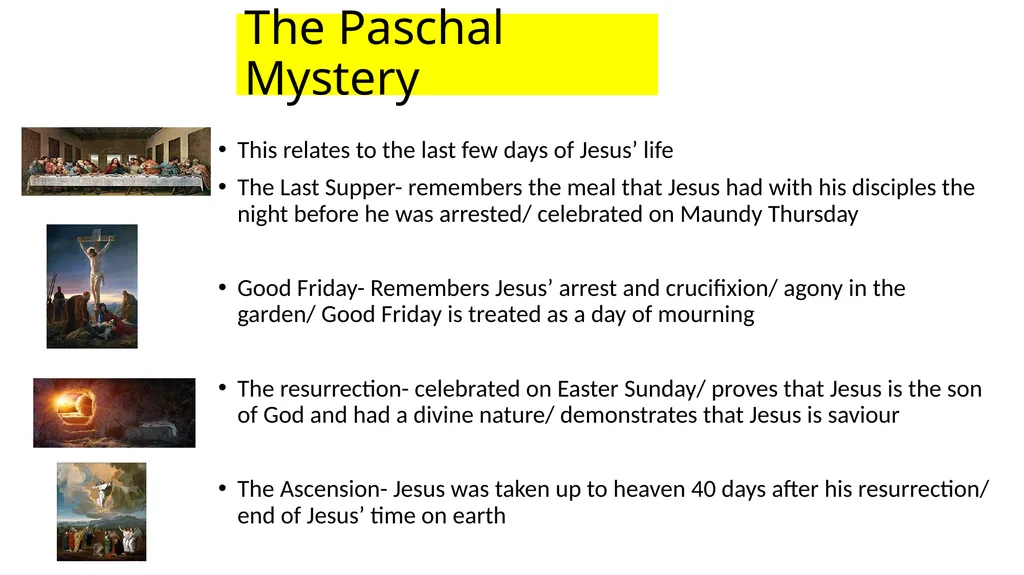
The Paschal Mystery This relates to the last few days of Jesus’ life
The Last Supper- remembers the meal that Jesus had with his disciples the night before he was arrested/ celebrated on Maundy Thursday
Good Friday- Remembers Jesus’ arrest and crucifixion/ agony in the garden/ Good Friday is treated as a day of mourning
The resurrection- celebrated on Easter Sunday/ proves that Jesus is the son of God and had a divine nature/ demonstrates that Jesus is saviour
The Ascension- Jesus was taken up to heaven 40 days after his resurrection/ end of Jesus’ time on earth<br>
The Last Supper- remembers the meal that Jesus had with his disciples the night before he was arrested/ celebrated on Maundy Thursday
Good Friday- Remembers Jesus’ arrest and crucifixion/ agony in the garden/ Good Friday is treated as a day of mourning
The resurrection- celebrated on Easter Sunday/ proves that Jesus is the son of God and had a divine nature/ demonstrates that Jesus is saviour
The Ascension- Jesus was taken up to heaven 40 days after his resurrection/ end of Jesus’ time on earth<br>
42
The 4 marks of the Church One- because of its soul (the Hoy Spirit) who lives in the souls of all Catholics and unites them, because of the Trinity and because Jesus came to reconcile all of humankind
Holy- Jesus is the source of all holiness and the Church makes its people holy through prayer, worship and good works
Catholic- meaning universal or whole/ Christ is universally present
Apostolic- Jesus gave his authority to his apostles and the faith has been handed down<br>
Holy- Jesus is the source of all holiness and the Church makes its people holy through prayer, worship and good works
Catholic- meaning universal or whole/ Christ is universally present
Apostolic- Jesus gave his authority to his apostles and the faith has been handed down<br>
43
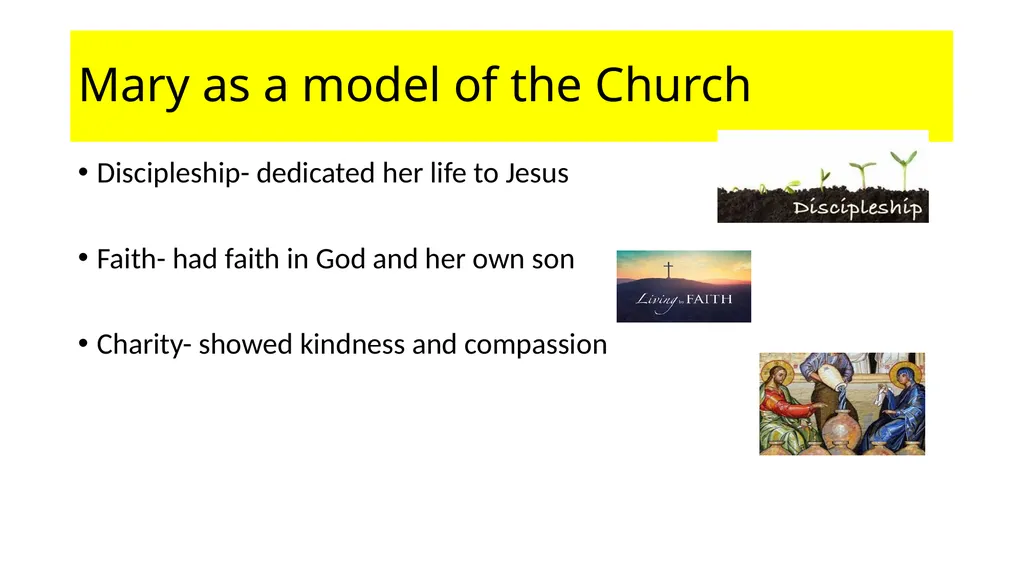
Mary as a model of the Church Discipleship- dedicated her life to Jesus
Faith- had faith in God and her own son
Charity- showed kindness and compassion<br>
Faith- had faith in God and her own son
Charity- showed kindness and compassion<br>
44
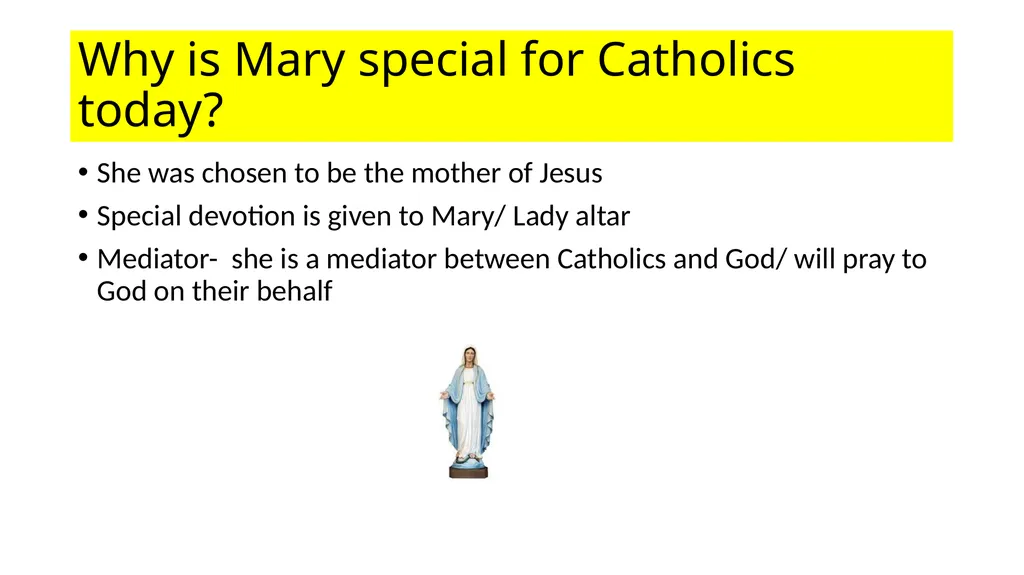
Why is Mary special for Catholics today? She was chosen to be the mother of Jesus
Special devotion is given to Mary/ Lady altar
Mediator- she is a mediator between Catholics and God/ will pray to God on their behalf<br>
Special devotion is given to Mary/ Lady altar
Mediator- she is a mediator between Catholics and God/ will pray to God on their behalf<br>
45
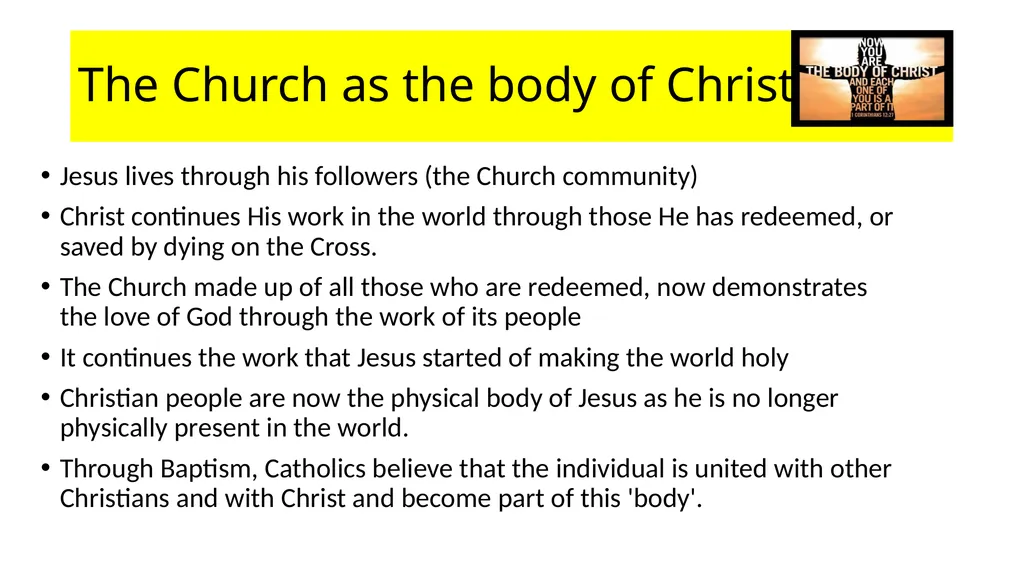
The Church as the body of Christ Jesus lives through his followers (the Church community)
Christ continues His work in the world through those He has redeemed, or saved by dying on the Cross.
The Church made up of all those who are redeemed, now demonstrates the love of God through the work of its people
It continues the work that Jesus started of making the world holy
Christian people are now the physical body of Jesus as he is no longer physically present in the world.
Through Baptism, Catholics believe that the individual is united with other Christians and with Christ and become part of this 'body'.<br>
Christ continues His work in the world through those He has redeemed, or saved by dying on the Cross.
The Church made up of all those who are redeemed, now demonstrates the love of God through the work of its people
It continues the work that Jesus started of making the world holy
Christian people are now the physical body of Jesus as he is no longer physically present in the world.
Through Baptism, Catholics believe that the individual is united with other Christians and with Christ and become part of this 'body'.<br>
46
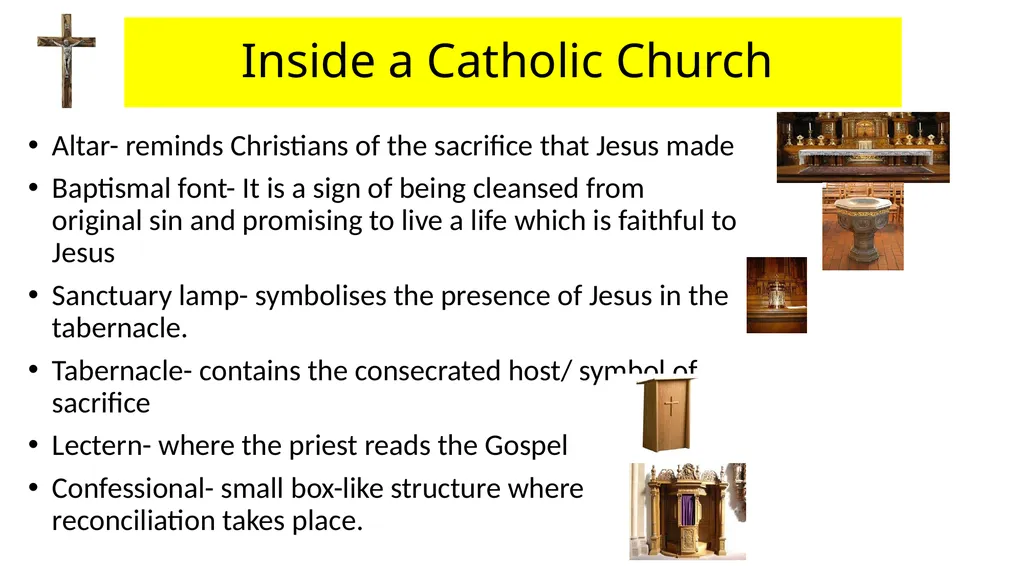
Inside a Catholic Church Altar- reminds Christians of the sacrifice that Jesus made
Baptismal font- It is a sign of being cleansed from original sin and promising to live a life which is faithful to Jesus
Sanctuary lamp- symbolises the presence of Jesus in the tabernacle.
Tabernacle- contains the consecrated host/ symbol of sacrifice
Lectern- where the priest reads the Gospel
Confessional- small box-like structure where reconciliation takes place.<br>
Baptismal font- It is a sign of being cleansed from original sin and promising to live a life which is faithful to Jesus
Sanctuary lamp- symbolises the presence of Jesus in the tabernacle.
Tabernacle- contains the consecrated host/ symbol of sacrifice
Lectern- where the priest reads the Gospel
Confessional- small box-like structure where reconciliation takes place.<br>
47
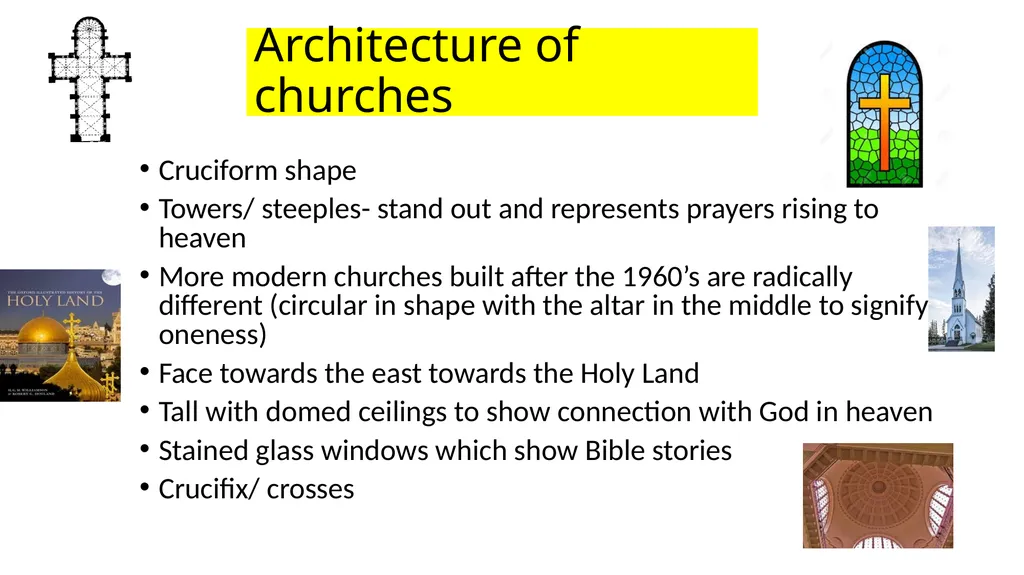
Architecture of churches Cruciform shape
Towers/ steeples- stand out and represents prayers rising to heaven
More modern churches built after the 1960’s are radically different (circular in shape with the altar in the middle to signify oneness)
Face towards the east towards the Holy Land
Tall with domed ceilings to show connection with God in heaven
Stained glass windows which show Bible stories
Crucifix/ crosses<br>
Towers/ steeples- stand out and represents prayers rising to heaven
More modern churches built after the 1960’s are radically different (circular in shape with the altar in the middle to signify oneness)
Face towards the east towards the Holy Land
Tall with domed ceilings to show connection with God in heaven
Stained glass windows which show Bible stories
Crucifix/ crosses<br>
48
Sacraments Baptism
Holy Communion
Confirmation
Reconciliation (confession)
Marriage
Holy Orders (man becomes a priest)
Sacrament of the sick (last rites/ special Eucharist)<br>
Holy Communion
Confirmation
Reconciliation (confession)
Marriage
Holy Orders (man becomes a priest)
Sacrament of the sick (last rites/ special Eucharist)<br>
49
Importance of the Eucharist Where Catholics remember the Last Supper
Transubstantiation
Said to be the ‘source and summit’ of all Christian life because being unified with God is the most important thing
Christ’s body and blood spiritually sustain the believer
It makes individuals part of the body of Christ<br>
Transubstantiation
Said to be the ‘source and summit’ of all Christian life because being unified with God is the most important thing
Christ’s body and blood spiritually sustain the believer
It makes individuals part of the body of Christ<br>
50
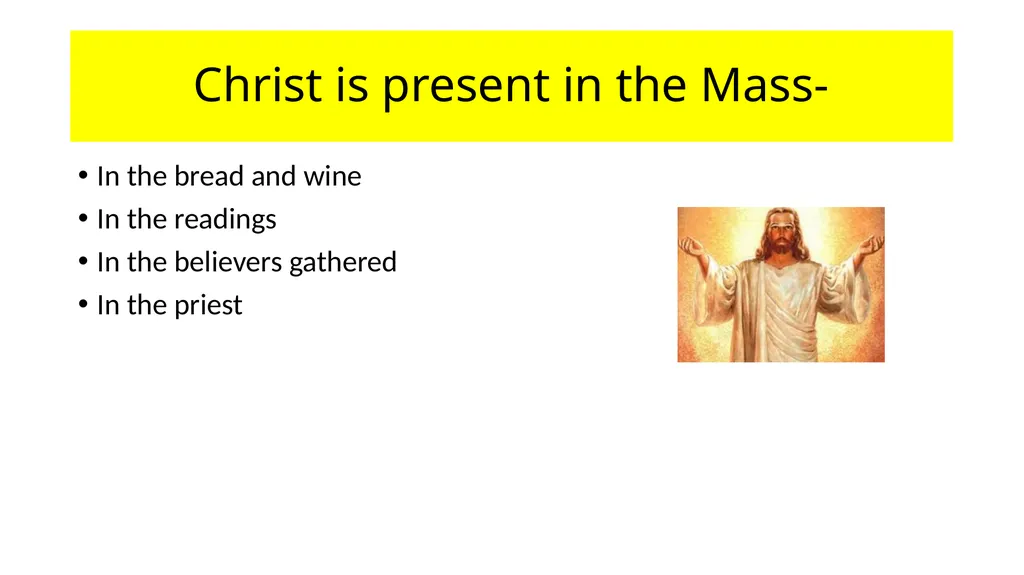
Christ is present in the Mass- In the bread and wine
In the readings
In the believers gathered
In the priest<br>
In the readings
In the believers gathered
In the priest<br>
51
Evangelisation Evangelisation- literally means spreading the “good news”
‘Go out and make disciples of all nations....' (Matt 28:19)
The mission of the Church is to go out into the world:
to go out to the ends of the earth
to baptise people into the Church
to teach the teachings of Christ<br>
‘Go out and make disciples of all nations....' (Matt 28:19)
The mission of the Church is to go out into the world:
to go out to the ends of the earth
to baptise people into the Church
to teach the teachings of Christ<br>
52
How does the Church evangelise?
Locally- passed on by the Church parish/ Mass/ schools
Nationally- Bishop’s conference in the UK
Globally – global figure of the Pope/ Vatican radio and TV station/ international charities such as CAFOD, organizations such as Missio, which is concerned with overseas evangelisation<br>
Locally- passed on by the Church parish/ Mass/ schools
Nationally- Bishop’s conference in the UK
Globally – global figure of the Pope/ Vatican radio and TV station/ international charities such as CAFOD, organizations such as Missio, which is concerned with overseas evangelisation<br>
53
UK laws, festivals and traditions Traditions-
‘Keep the Sabbath day holy- traditionally Christians go to church on a Sunday and it was regarded as a day of rest/ trade hours are restricted
UK court of law- witnesses are asked to swear they are telling the truth on the Bible
Christian hymns are often played at national events, e.g. services of Remembrance
Important life events e.g. marriage happen in church<br>
‘Keep the Sabbath day holy- traditionally Christians go to church on a Sunday and it was regarded as a day of rest/ trade hours are restricted
UK court of law- witnesses are asked to swear they are telling the truth on the Bible
Christian hymns are often played at national events, e.g. services of Remembrance
Important life events e.g. marriage happen in church<br>
54
UK laws, festivals and traditions Laws-
The house of Lords has members of two types: those appointed by the monarch and the most senior church of England Bishops
For laws to be passed they must be approved by both
Meetings in the houses of parliament start with prayers
Many laws are based on commandments<br>
The house of Lords has members of two types: those appointed by the monarch and the most senior church of England Bishops
For laws to be passed they must be approved by both
Meetings in the houses of parliament start with prayers
Many laws are based on commandments<br>
55
UK laws, festivals and traditions Festivals-
The Christian calendar influences public holidays
Christmas and Easter are widely celebrated in the UK
School holidays are based on these
The 2011 census showed that many religions are practiced in the UK
There are also non-religious celebrations e.g. world humanist day and human rights day<br>
The Christian calendar influences public holidays
Christmas and Easter are widely celebrated in the UK
School holidays are based on these
The 2011 census showed that many religions are practiced in the UK
There are also non-religious celebrations e.g. world humanist day and human rights day<br>