rhino impact Bond changing the conservation landscape Social Finance is authorized and regulated by the Financial Conduct Authority FCA No: 497568 With thanks to: the CONSERVATION movement needs to change 2 Realistic global funding levels
"rhino impact Bond changing the conservation" is the property of its rightful owner. Permission is granted to
download and print the materials on this website for personal, non-commercial use only, and to display it
on your personal computer provided you do not modify the materials and that you retain all copyright
notices contained in the materials. By downloading content from our website, you accept the terms of this
agreement.
Presentation Transcript
01
rhino impact Bond changing the conservation landscape Social Finance is authorized and regulated by the Financial Conduct Authority FCA No: 497568 With thanks to:<br>
02
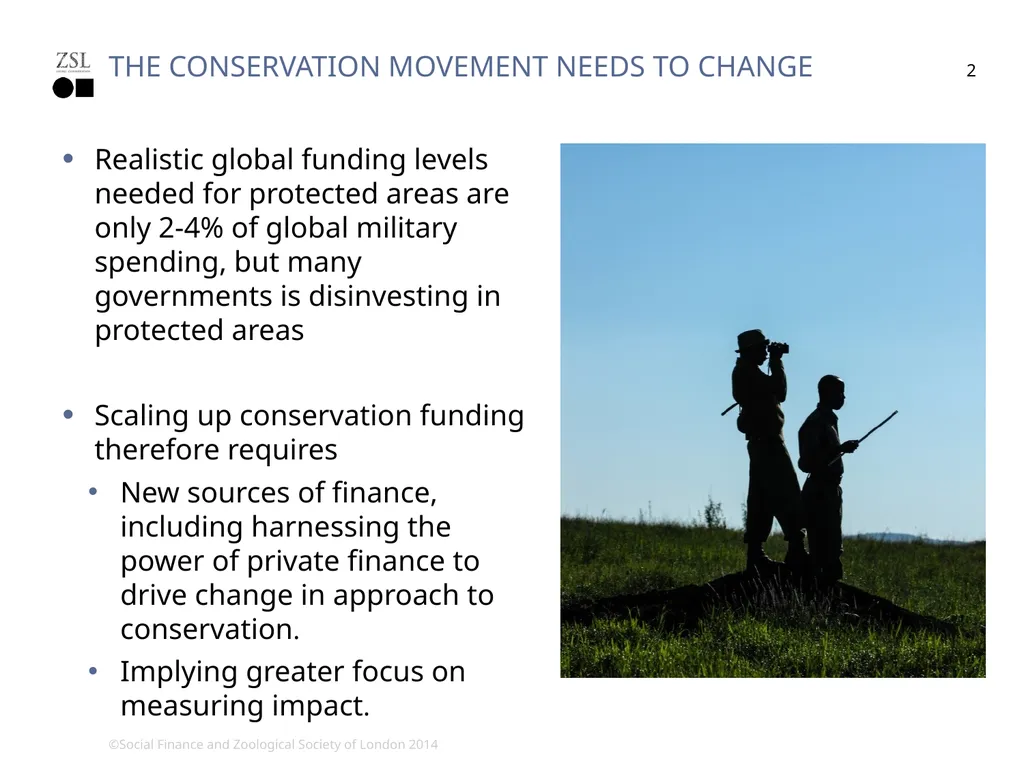
the CONSERVATION movement needs to change 2 Realistic global funding levels needed for protected areas are only 2-4% of global military spending, but many governments is disinvesting in protected areas
Scaling up conservation funding therefore requires
New sources of finance, including harnessing the power of private finance to drive change in approach to conservation.
Implying greater focus on measuring impact.<br>
03
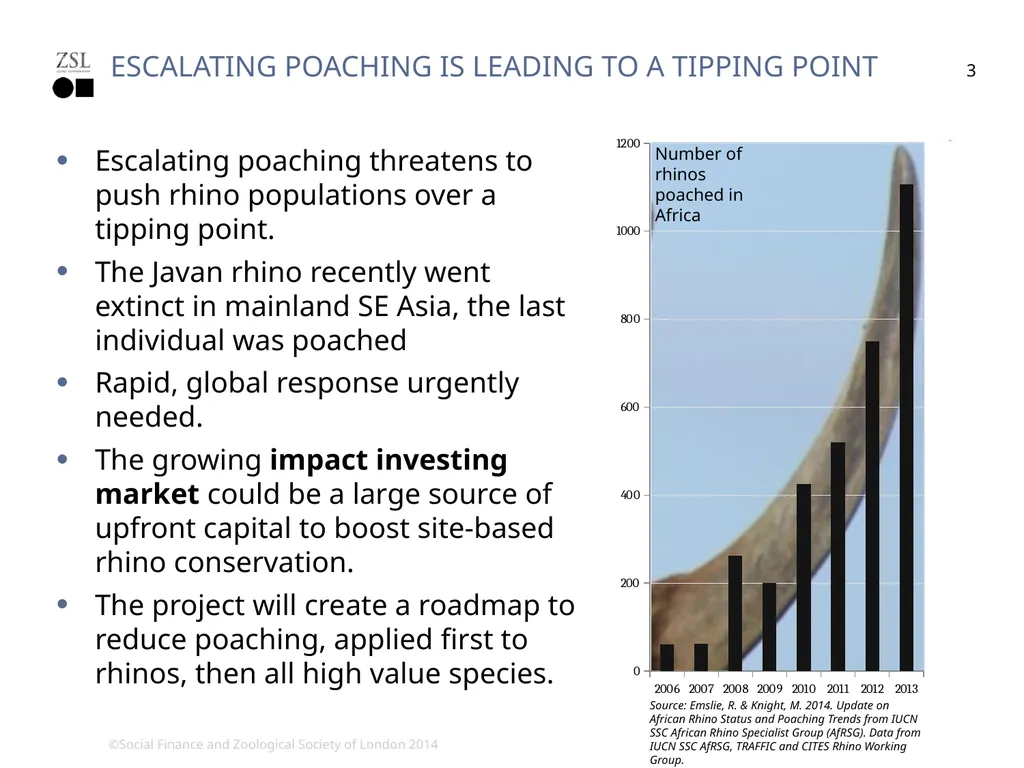
Number of rhinos poached in Africa 3 escalating poaching is leading to a tipping point Escalating poaching threatens to push rhino populations over a tipping point.
The Javan rhino recently went extinct in mainland SE Asia, the last individual was poached
Rapid, global response urgently needed.
The growing impact investing market could be a large source of upfront capital to boost site-based rhino conservation.
The project will create a roadmap to reduce poaching, applied first to rhinos, then all high value species. Source: Emslie, R. & Knight, M. 2014. Update on African Rhino Status and Poaching Trends from IUCN SSC African Rhino Specialist Group (AfRSG). Data from IUCN SSC AfRSG, TRAFFIC and CITES Rhino Working Group.<br>
04
4<br>
05
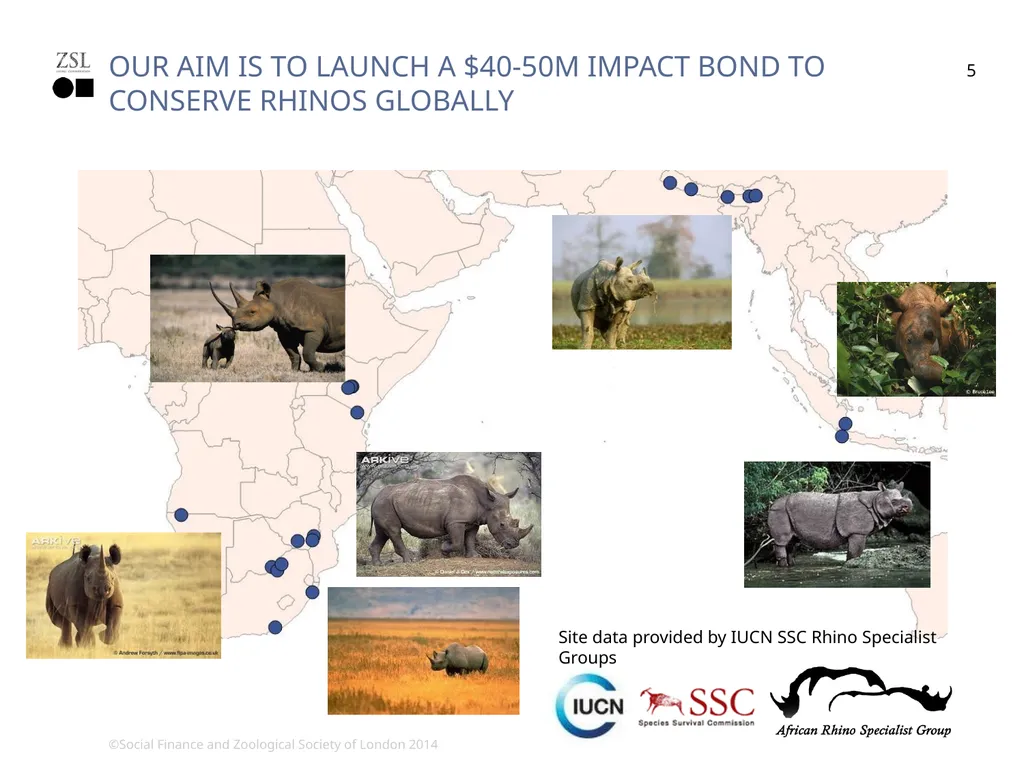
Our Aim is to launch a $40-50m impact bond to conserve rhinos globally 5 Site data provided by IUCN SSC Rhino Specialist Groups<br>
06
The rhino impact bond in a nutshell 6 Impact bonds are not traditional bonds or trust funds
They are equity investments where return is pegged more to social returns than maximum profits
The rhino impact bond represents a collaboration between investors and donors, such that investors risk their profits and some of their capital to ensure that donor contributions are only used for successful projects<br>
07
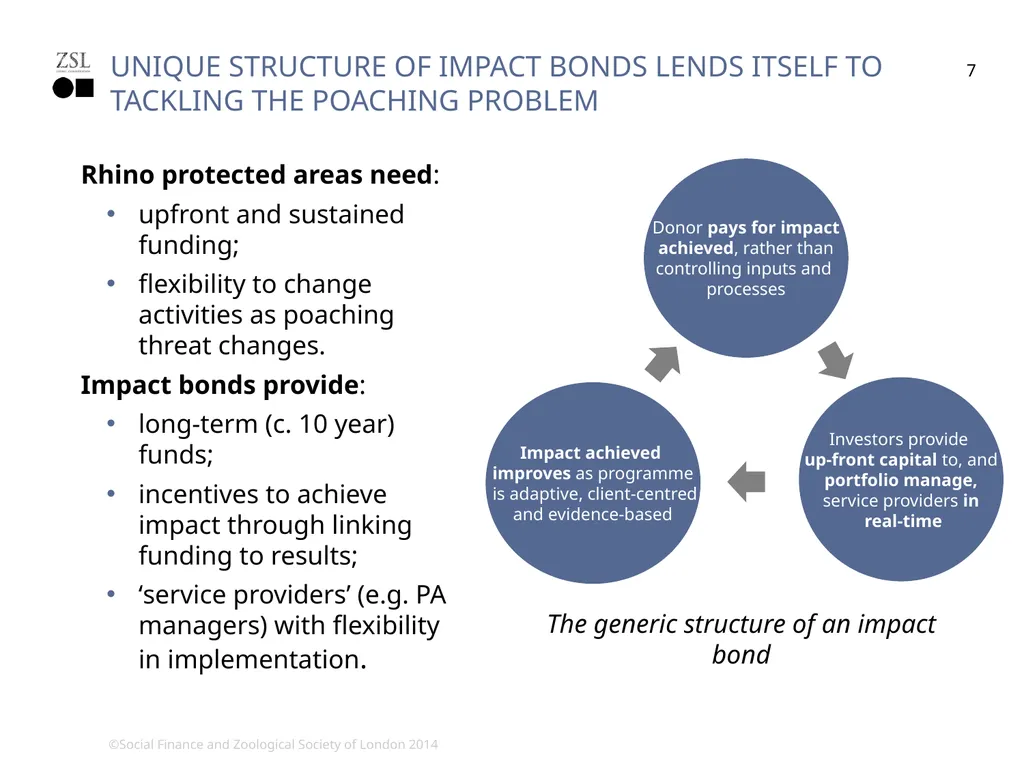
unique structure of IMPACT bonds lends itself to tackling the poaching problem 7 Rhino protected areas need:
upfront and sustained funding;
flexibility to change activities as poaching threat changes.
Impact bonds provide:
long-term (c. 10 year) funds;
incentives to achieve impact through linking funding to results;
‘service providers’ (e.g. PA managers) with flexibility in implementation. The generic structure of an impact bond<br>
08
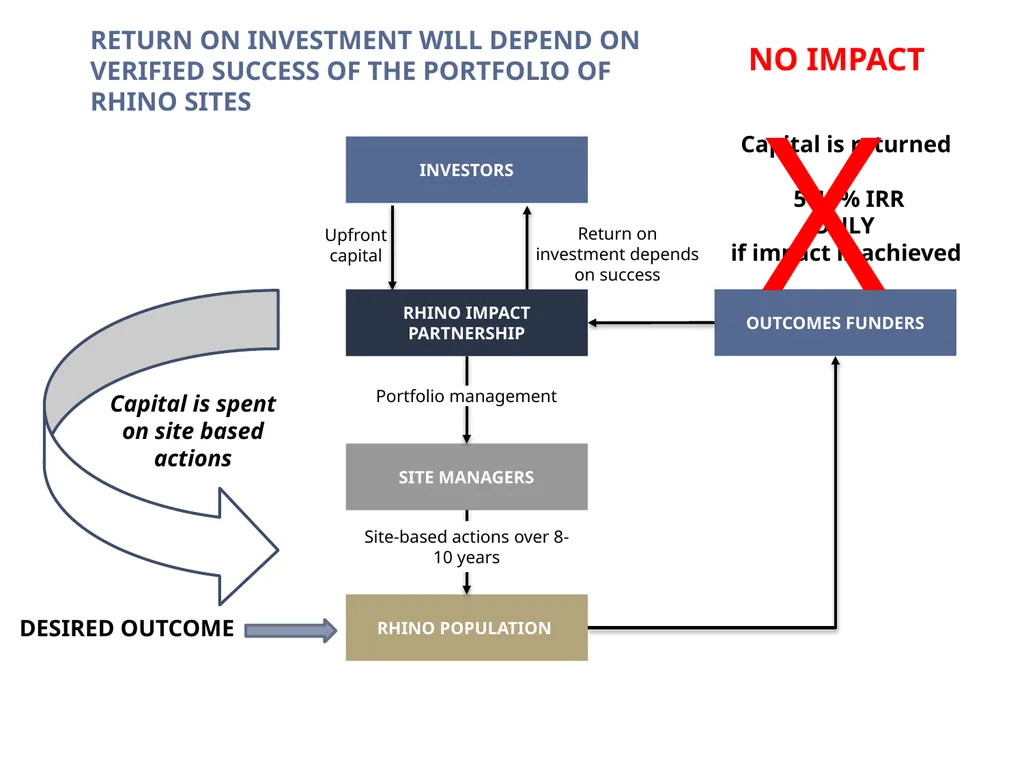
INVESTORS Upfront capital RHINO POPULATION OUTCOMES FUNDERS SITE MANAGERS Return on investment depends on success RHINO IMPACT PARTNERSHIP Site-based actions over 8-10 years Portfolio management Capital is returned
+
5-10% IRR
ONLY
if impact is achieved NO IMPACT
X DESIRED OUTCOME Return on investment will depend on verified success of the portfolio of rhino sites<br>
09
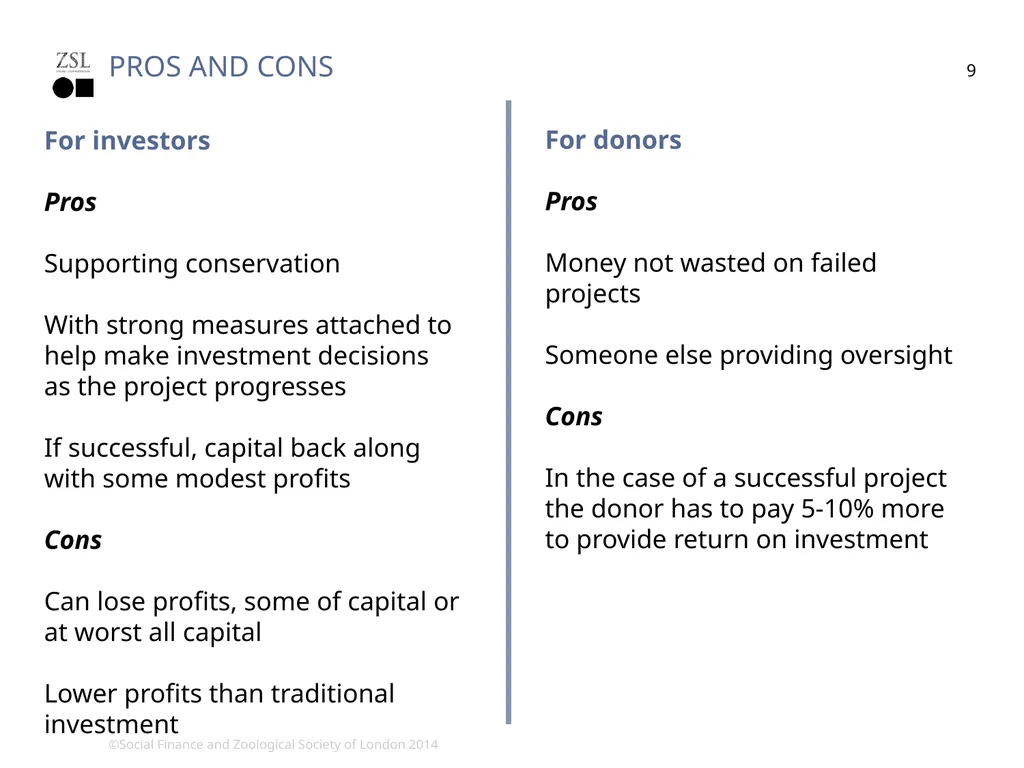
Pros and cons 9 For investors
Pros
Supporting conservation
With strong measures attached to help make investment decisions as the project progresses
If successful, capital back along with some modest profits
Cons
Can lose profits, some of capital or at worst all capital
Lower profits than traditional investment For donors
Pros
Money not wasted on failed projects
Someone else providing oversight
Cons
In the case of a successful project the donor has to pay 5-10% more to provide return on investment<br>
10
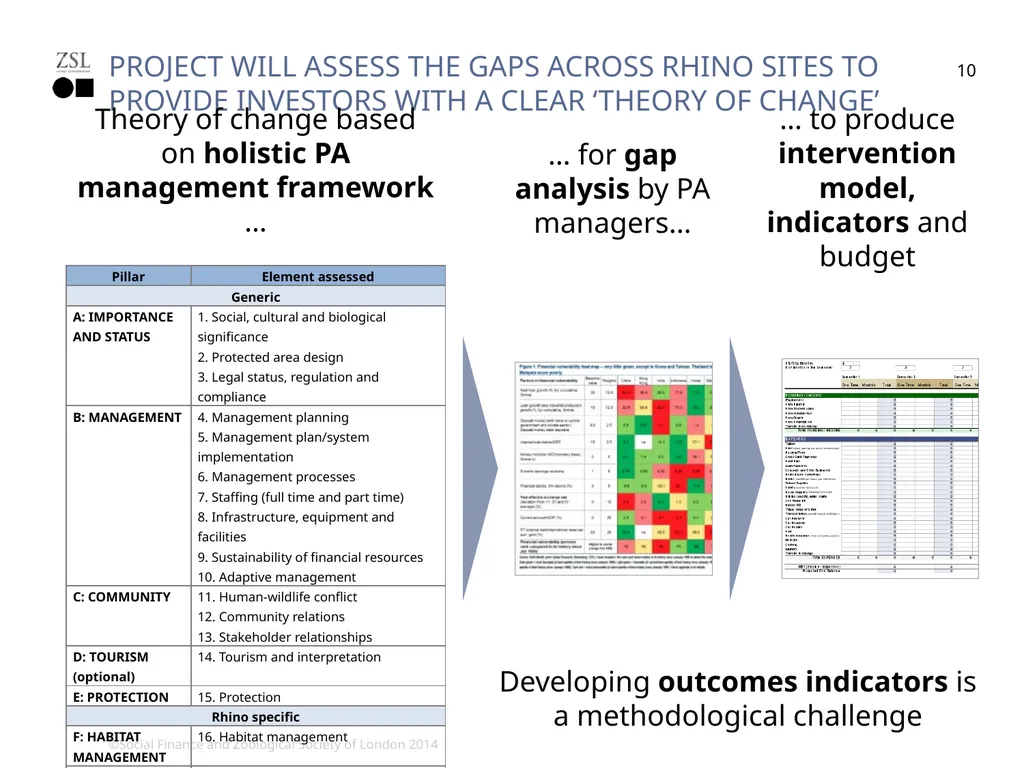
project will assess the gaps across rhino sites to provide investors with a clear ‘theory of change’ 10 Theory of change based on holistic PA management framework … … for gap analysis by PA managers… … to produce intervention model, indicators and budget Developing outcomes indicators is a methodological challenge<br>
11
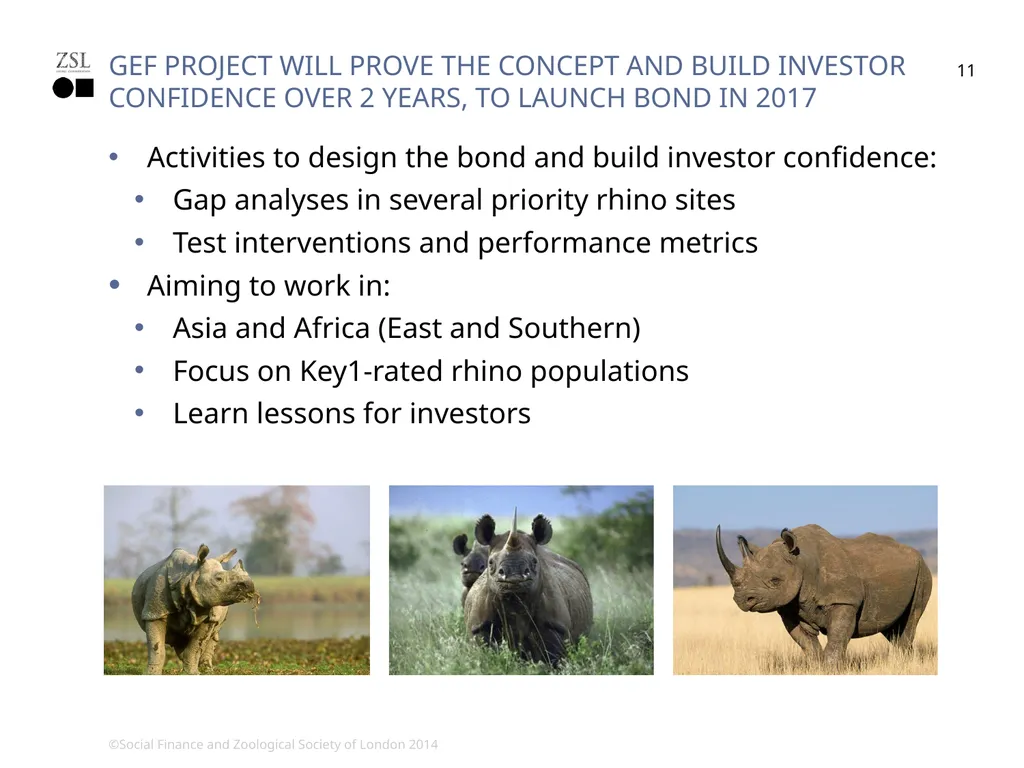
GEF Project will Prove the concept and build investor confidence over 2 years, to launch bond in 2017 11 Activities to design the bond and build investor confidence:
Gap analyses in several priority rhino sites
Test interventions and performance metrics
Aiming to work in:
Asia and Africa (East and Southern)
Focus on Key1-rated rhino populations
Learn lessons for investors<br>
12
13 Thank you For more information: Katherine Secoy,
Zoological Society of London
Katherine.Secoy@zsl.org "Impact Bonds stand to improve the efficiency of development assistance in the coming years“
Elizabeth Littlefield, president of overseas private investment corporation<br>