Risk Aversion and Capital Allocation to Risky Assets P.V. Viswanath For a First Course in INvestments Learning Goals 2 How do we characterize individuals preferences for taking risk? How do we use utility functions over asset returns? How
"Risk Aversion and Capital Allocation to Risky" is the property of its rightful owner. Permission is granted to
download and print the materials on this website for personal, non-commercial use only, and to display it
on your personal computer provided you do not modify the materials and that you retain all copyright
notices contained in the materials. By downloading content from our website, you accept the terms of this
agreement.
Presentation Transcript
01
Risk Aversion and Capital Allocation to Risky Assets P.V. Viswanath
For a First Course in INvestments<br>
02
Learning Goals 2 How do we characterize individuals’ preferences for taking risk?
How do we use utility functions over asset returns?
How do we evaluate investors’ risk preferences?
How do we allocate capital across risky and risk-free portfolios?<br>
03
Individual Risk Preferences 3 Individuals have differing preferences for risk. Therefore, what is a desirable set of investments for one individual may not be desirable for another. A utility function is a convenient way of describing individual’s preferences for risk.
In economics, a utility function is described over quantities of goods. That works when we know the consumption of a good with precision.
However, if we are to describe preferences over what are called lotteries, i.e. uncertain quantities of goods, then we use a concept invented by von Neumann, called Expected Utility, which can be used provided individuals’ preferences satisfy some basic conditions, such as transitivity, i.e. if an individual prefers a choice A to B and B to C, then he must prefer A to C.<br>
04
Utility functions over asset returns 4 In order not to have to worry about how individuals choose combinations of goods, often in finance, we use what is called a derived utility function.
Even though individuals actually consume goods, nevertheless because wealth can be used to acquire goods, it is possible to define a utility function for wealth, conditional on the prices of goods.
Similarly, conditional on initial wealth, it is possible to define a utility function on rates of return.<br>
05
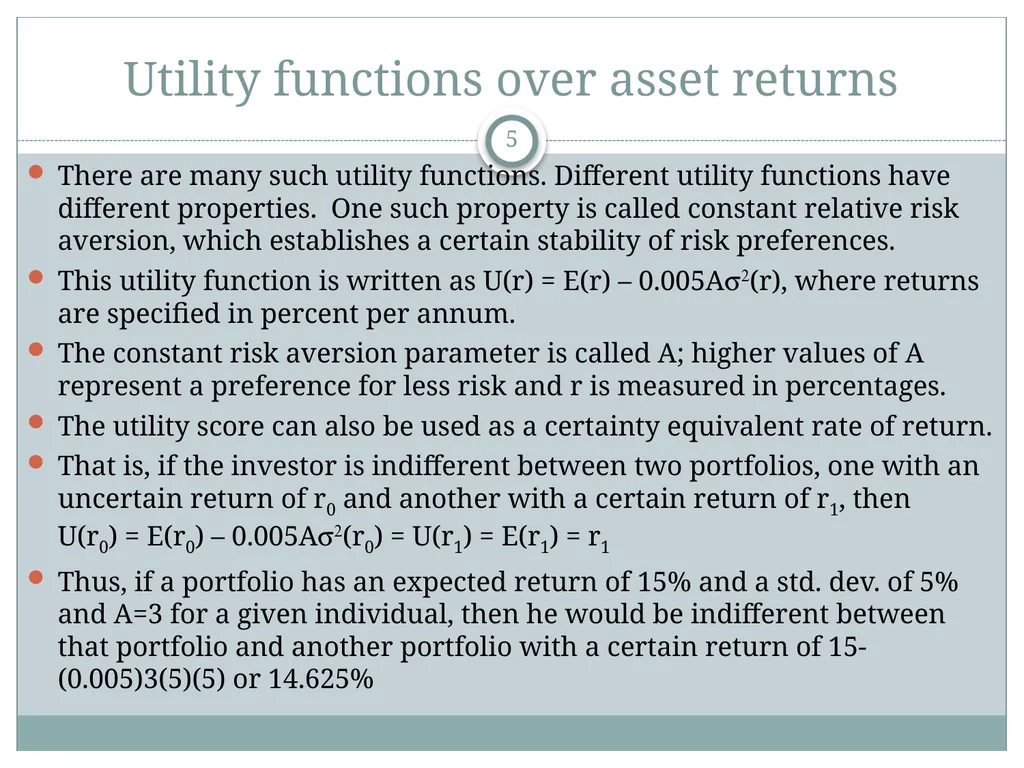
Utility functions over asset returns 5 There are many such utility functions. Different utility functions have different properties. One such property is called constant relative risk aversion, which establishes a certain stability of risk preferences.
This utility function is written as U(r) = E(r) – 0.005As2(r), where returns are specified in percent per annum.
The constant risk aversion parameter is called A; higher values of A represent a preference for less risk and r is measured in percentages.
The utility score can also be used as a certainty equivalent rate of return.
That is, if the investor is indifferent between two portfolios, one with an uncertain return of r0 and another with a certain return of r1, then U(r0) = E(r0) – 0.005As2(r0) = U(r1) = E(r1) = r1
Thus, if a portfolio has an expected return of 15% and a std. dev. of 5% and A=3 for a given individual, then he would be indifferent between that portfolio and another portfolio with a certain return of 15-(0.005)3(5)(5) or 14.625%<br>
06
Mean Variance Utility functions 6 The utility function U is a good way of describing investors’ preferences under two conditions – one that return distributions are normal (i.e. that only mean and standard deviation of returns are necessary to describe the distribution) – or – that investor preferences are quadratic.
While some individuals might have approximately quadratic utility functions, it still represents a strong restriction on individual preferences.
We know now (particularly post the 2008 mortgage crisis) that return distributions probably are not normal. Hence we must be careful in using our utility function.
However, it still represents a very powerful way of describing risk preferences and we can derive a lot of useful results with that assumption.<br>
07
Evaluating Investors’ Risk Preferences 7 Investment Advisors might find it useful to associate investors with utility functions.
If we decide that a mean-variance utility function is appropriate, then what we need for this is to figure out the investor’s A-number.
One way to do this is by using questionnaires, asking investors which one of a pair of investment choices they would prefer.
This can then be used to construct indifference curves and finally these indifference curves can be used to figure out the investor’s A value.
Alternatively, we could observe individuals’ decisions when confronted with risk.
Finally, we could observe how much people are willing to pay to avoid risk.<br>
08
Basic Asset Allocation 8 We start with a top-down allocation, first.
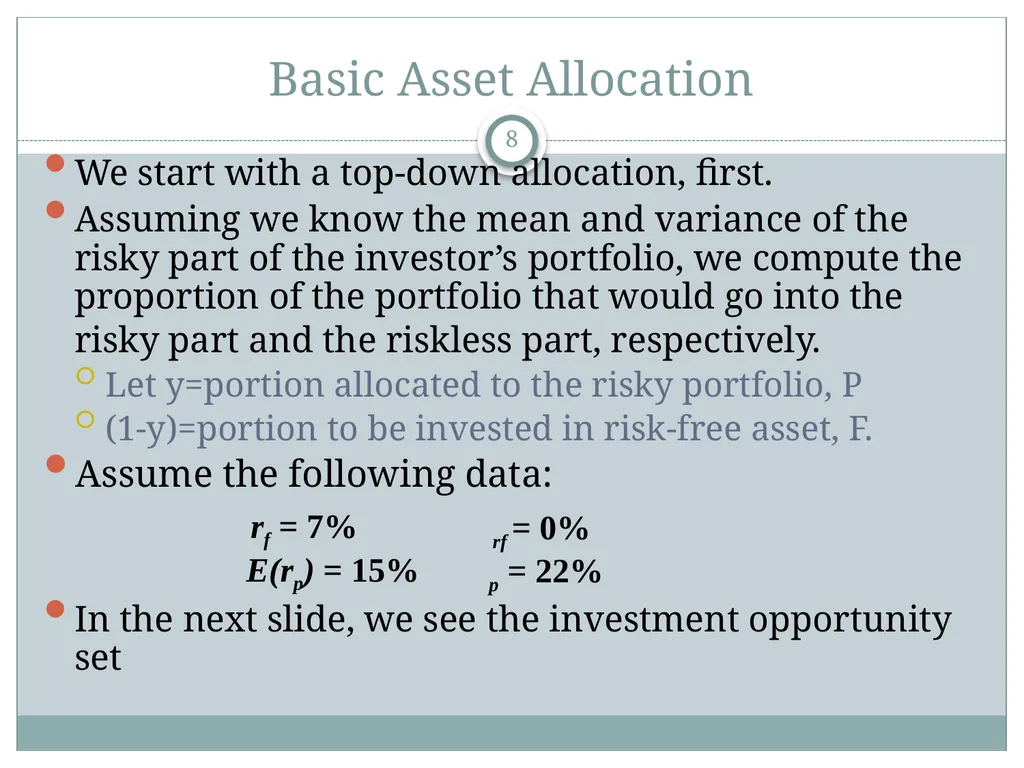
Assuming we know the mean and variance of the risky part of the investor’s portfolio, we compute the proportion of the portfolio that would go into the risky part and the riskless part, respectively.
Let y=portion allocated to the risky portfolio, P
(1-y)=portion to be invested in risk-free asset, F.
Assume the following data:
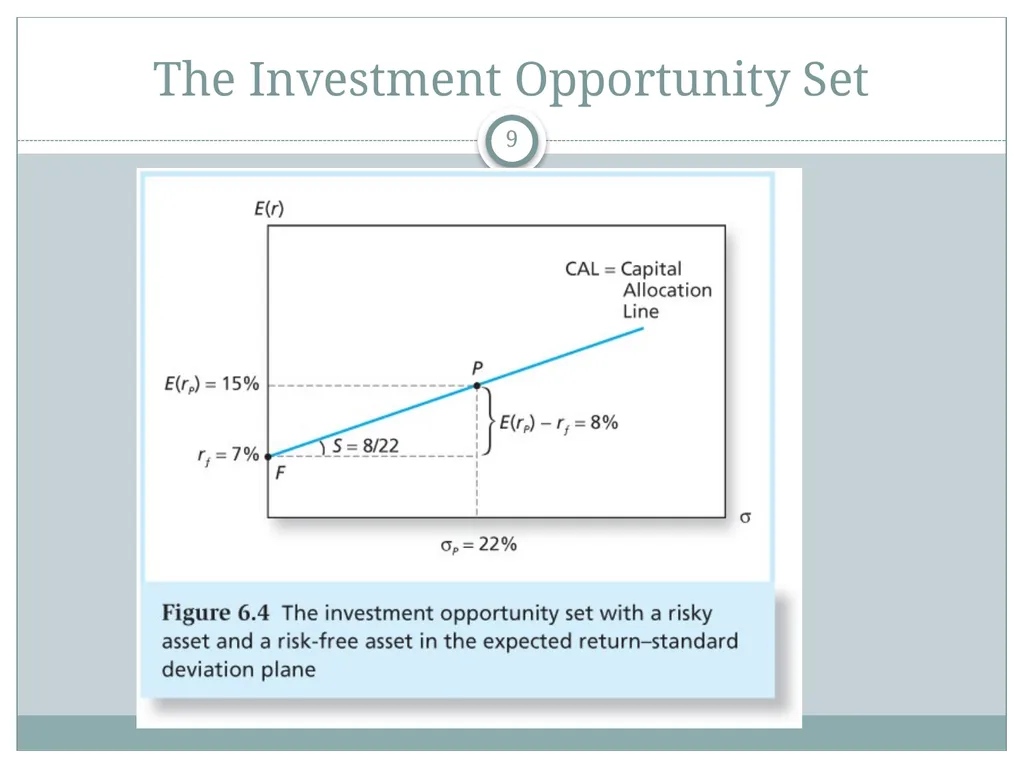
In the next slide, we see the investment opportunity set<br>
09
The Investment Opportunity Set 9<br>
10
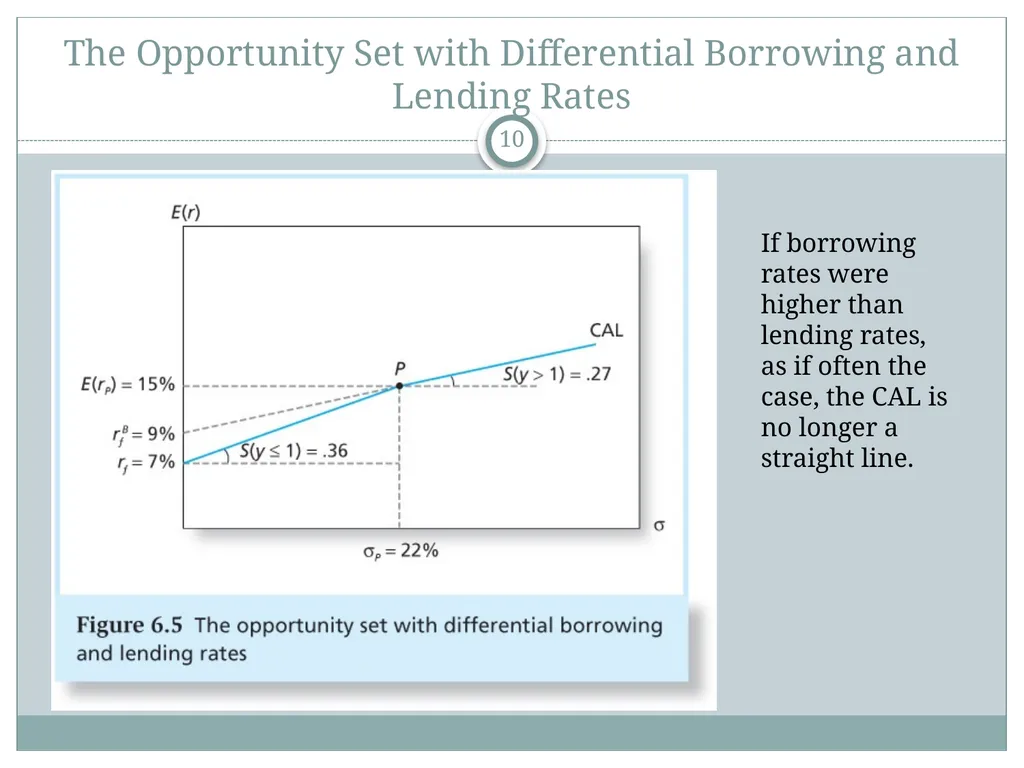
The Opportunity Set with Differential Borrowing and Lending Rates 10 If borrowing rates were higher than lending rates, as if often the case, the CAL is no longer a straight line.<br>
11
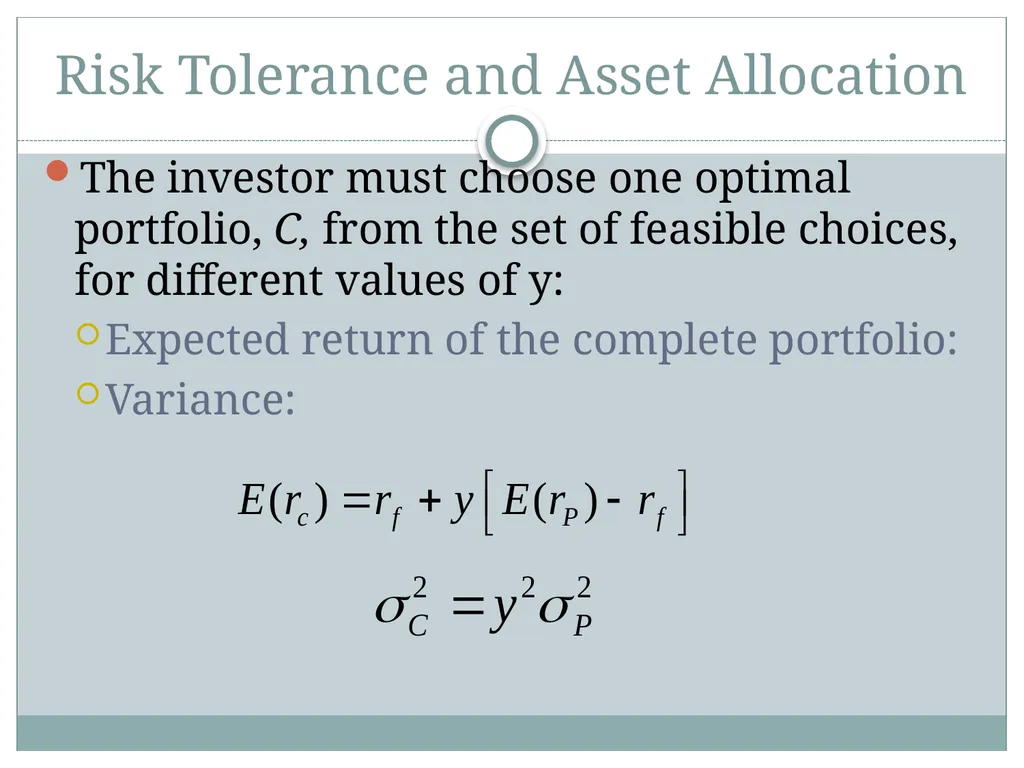
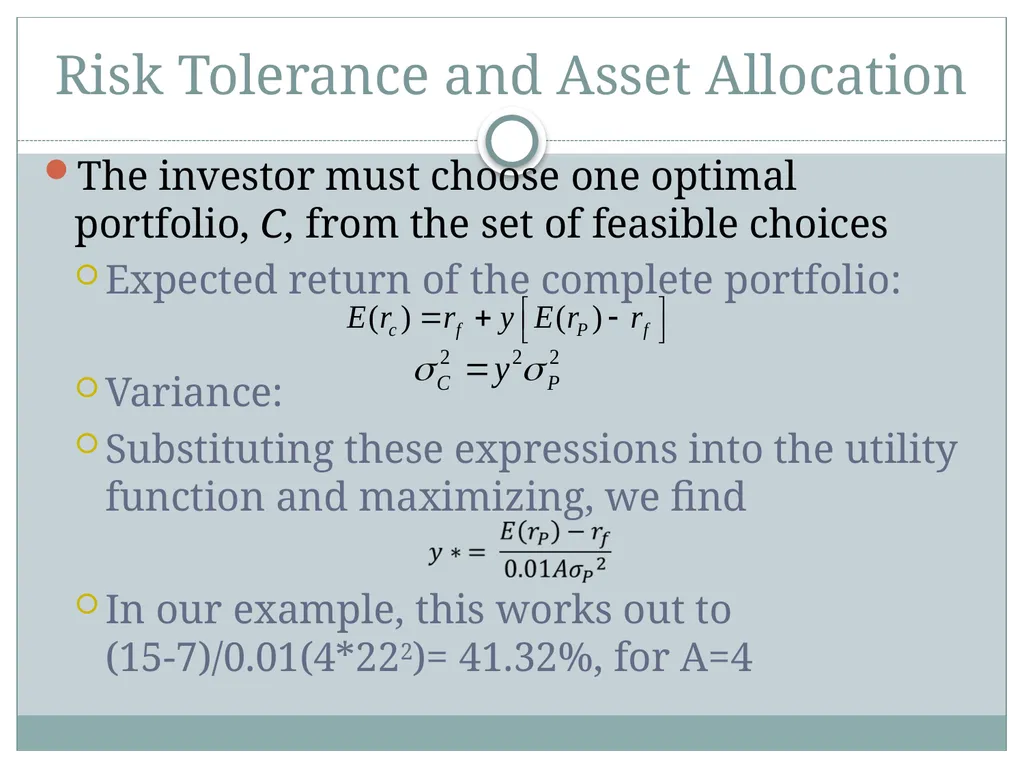
Risk Tolerance and Asset Allocation The investor must choose one optimal portfolio, C, from the set of feasible choices, for different values of y:
Expected return of the complete portfolio:
Variance:<br>
12
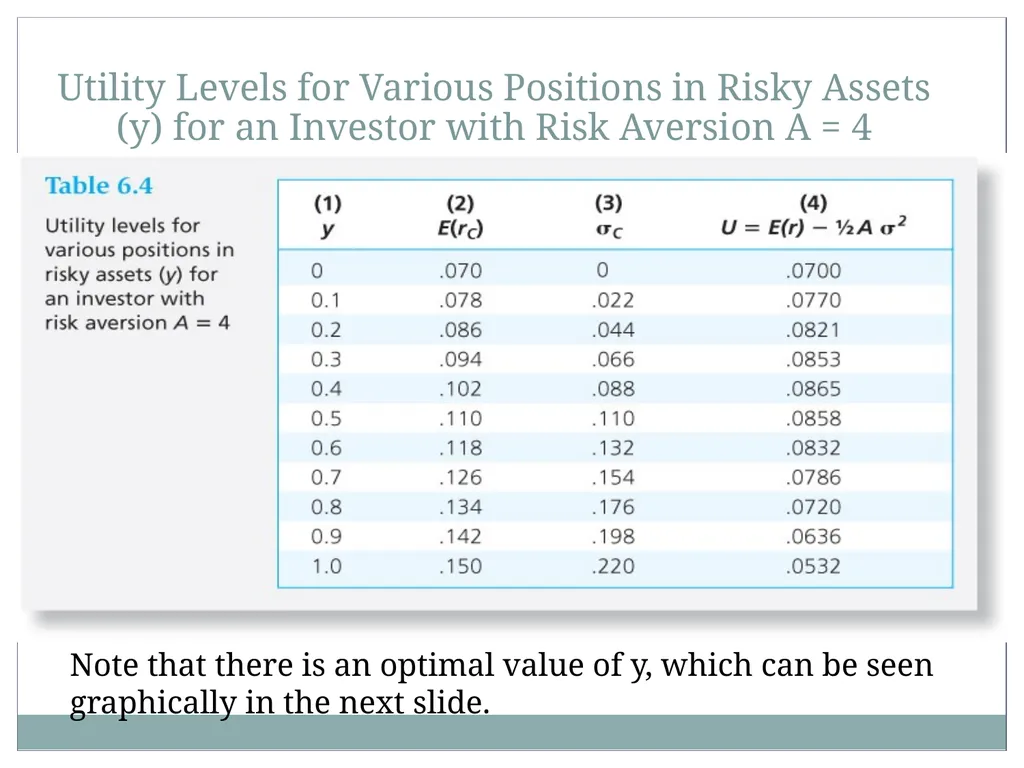
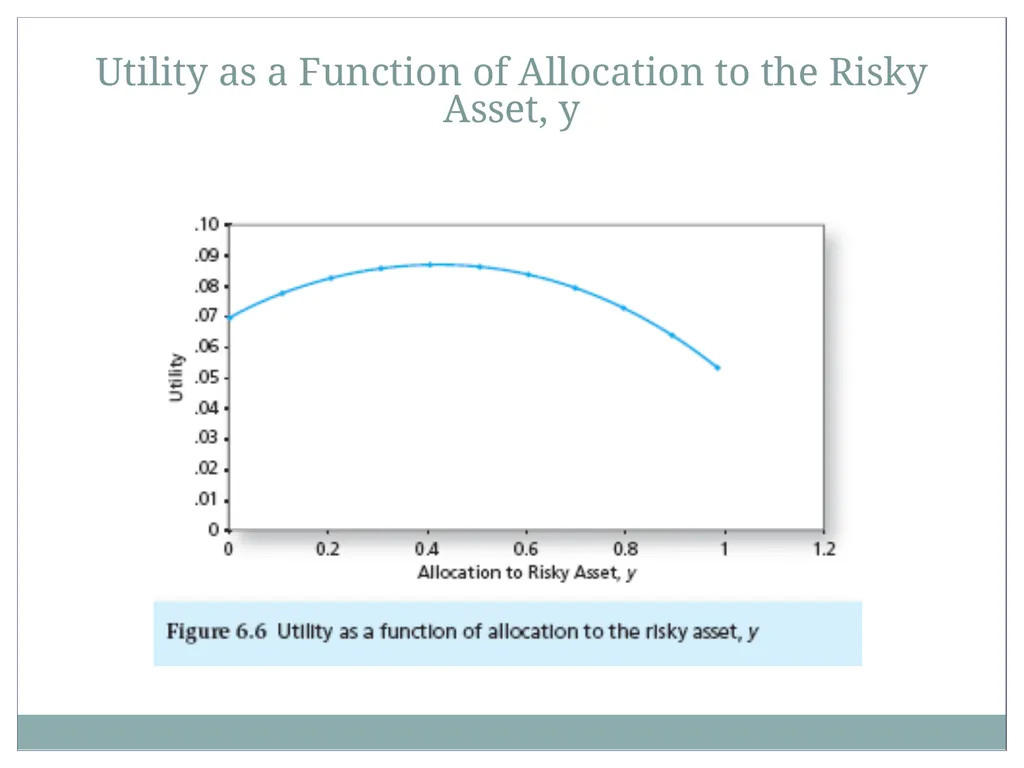
Utility Levels for Various Positions in Risky Assets (y) for an Investor with Risk Aversion A = 4 Note that there is an optimal value of y, which can be seen graphically in the next slide.<br>
13
Utility as a Function of Allocation to the Risky Asset, y<br>
14
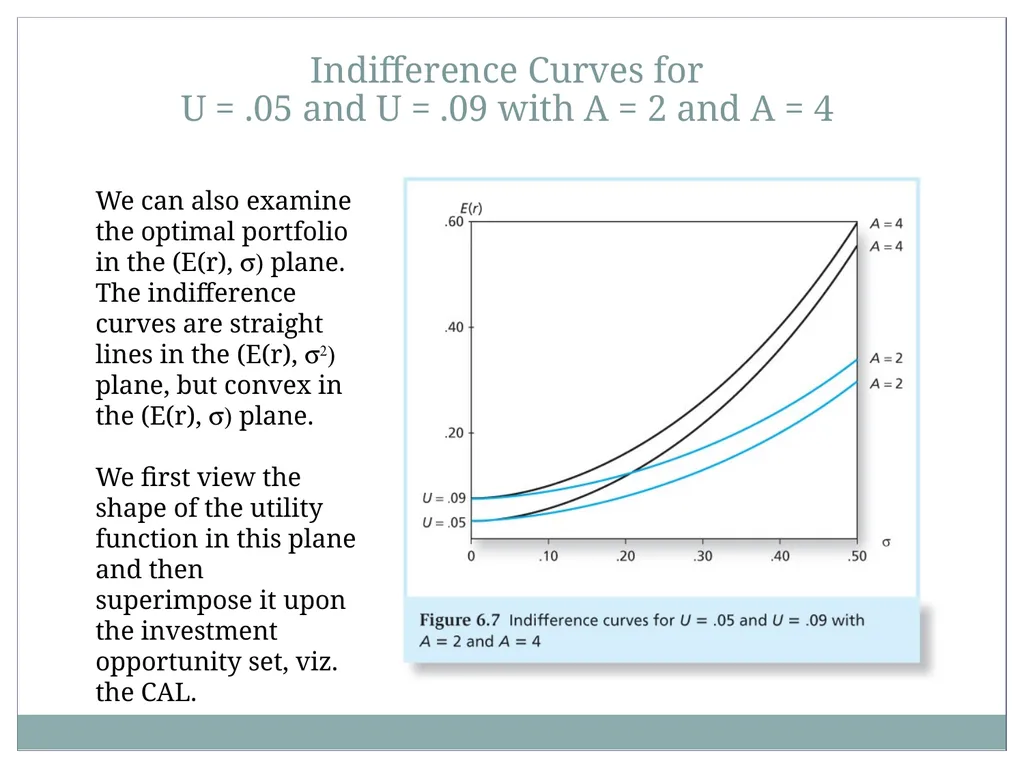
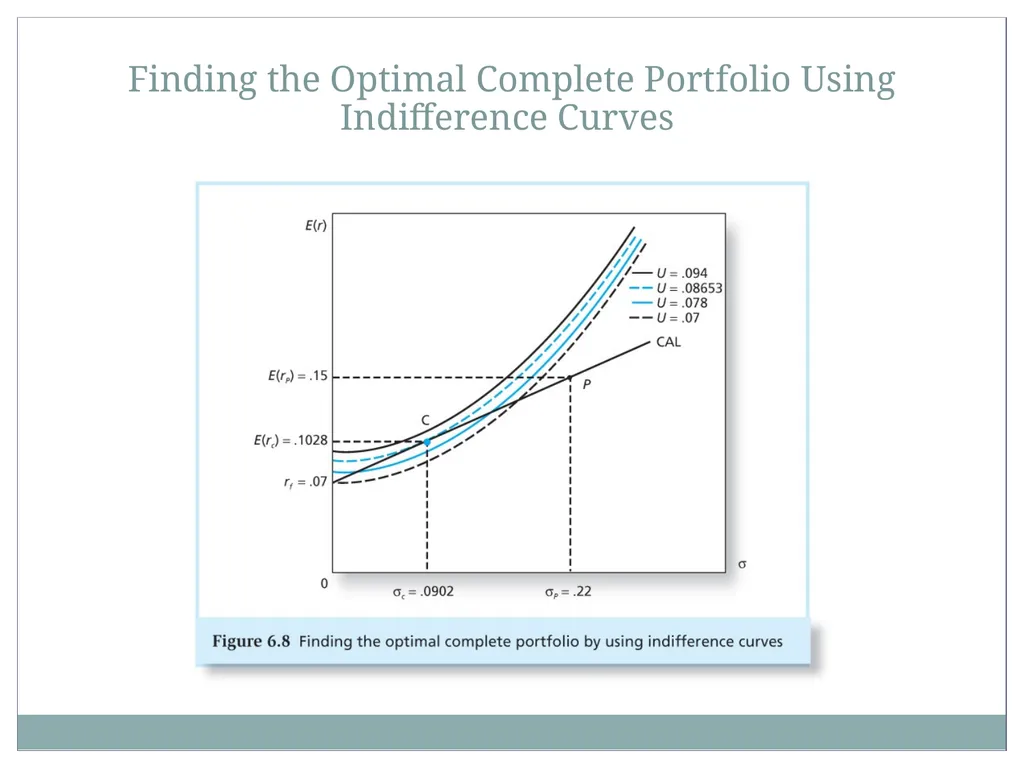
Indifference Curves for U = .05 and U = .09 with A = 2 and A = 4 We can also examine the optimal portfolio in the (E(r), s) plane.
The indifference curves are straight lines in the (E(r), s2) plane, but convex in the (E(r), s) plane.
We first view the shape of the utility function in this plane and then superimpose it upon the investment opportunity set, viz. the CAL.<br>
15
Finding the Optimal Complete Portfolio Using Indifference Curves<br>
16
Risk Tolerance and Asset Allocation The investor must choose one optimal portfolio, C, from the set of feasible choices
Expected return of the complete portfolio:
Variance:
Substituting these expressions into the utility function and maximizing, we find
In our example, this works out to (15-7)/0.01(4*222)= 41.32%, for A=4<br>
17
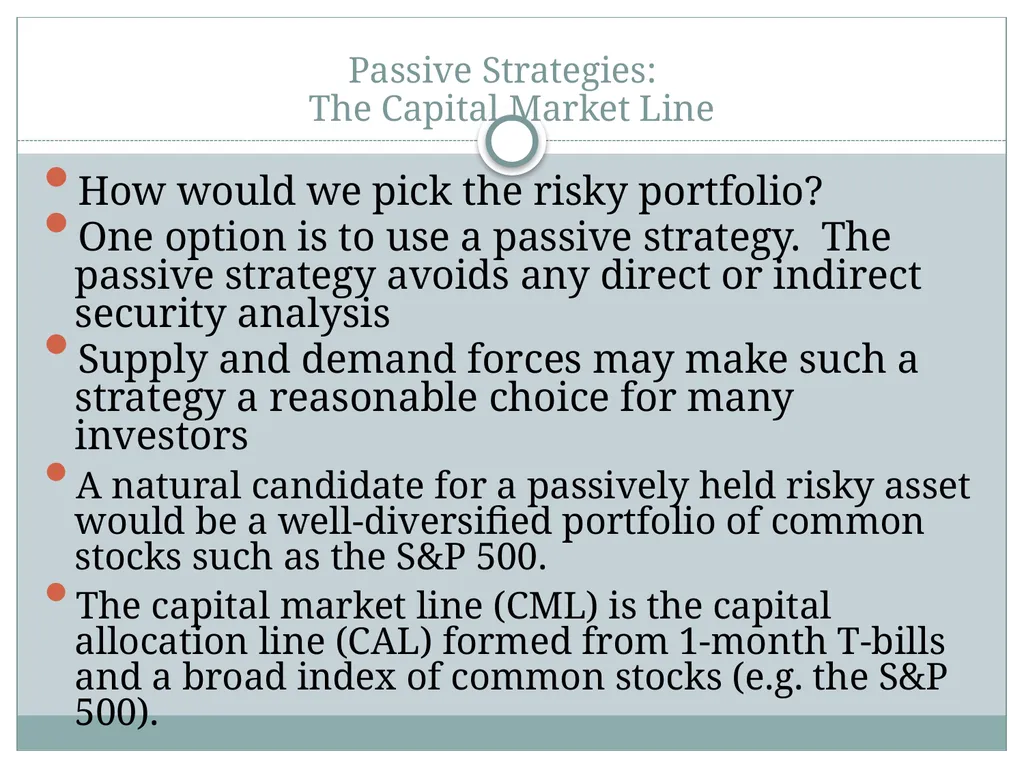
Passive Strategies: The Capital Market Line How would we pick the risky portfolio?
One option is to use a passive strategy. The passive strategy avoids any direct or indirect security analysis
Supply and demand forces may make such a strategy a reasonable choice for many investors
A natural candidate for a passively held risky asset would be a well-diversified portfolio of common stocks such as the S&P 500.
The capital market line (CML) is the capital allocation line (CAL) formed from 1-month T-bills and a broad index of common stocks (e.g. the S&P 500).<br>
18
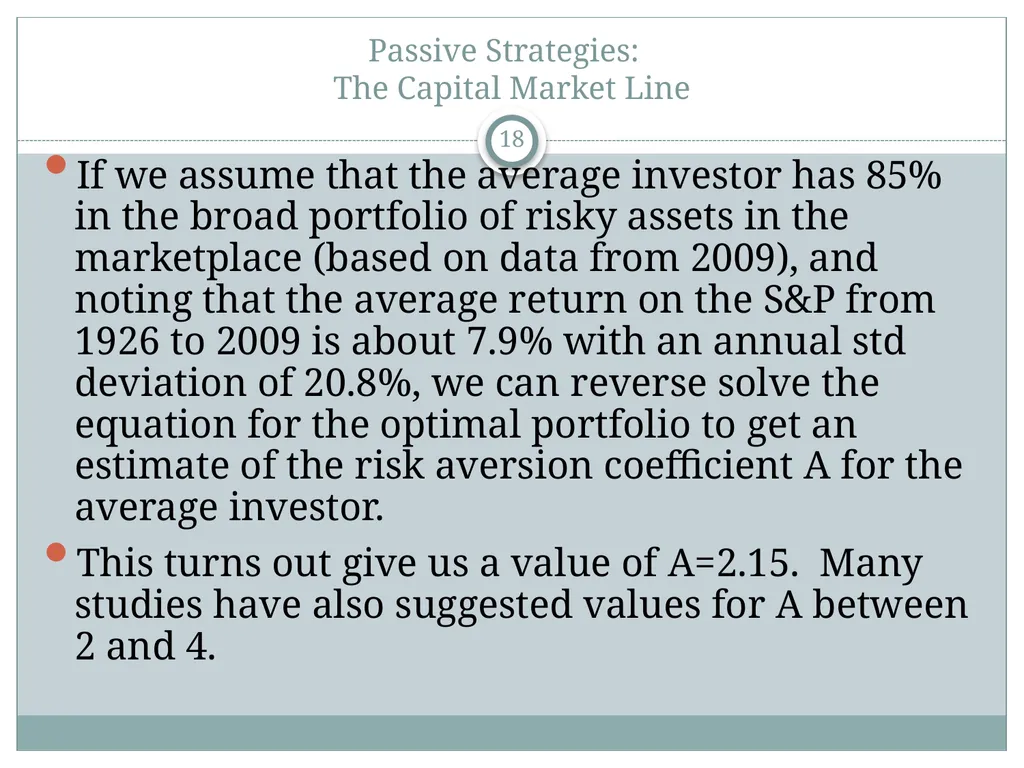
Passive Strategies: The Capital Market Line 18 If we assume that the average investor has 85% in the broad portfolio of risky assets in the marketplace (based on data from 2009), and noting that the average return on the S&P from 1926 to 2009 is about 7.9% with an annual std deviation of 20.8%, we can reverse solve the equation for the optimal portfolio to get an estimate of the risk aversion coefficient A for the average investor.
This turns out give us a value of A=2.15. Many studies have also suggested values for A between 2 and 4.<br>