Risk Perception How past experiences determine future decisions and actions. What is Perception? Perceive: to become aware of, know, or identify by means of the senses (dictionary.com) Perception: an interpretation or impression; an
"Risk Perception How past experiences determine" is the property of its rightful owner. Permission is granted to
download and print the materials on this website for personal, non-commercial use only, and to display it
on your personal computer provided you do not modify the materials and that you retain all copyright
notices contained in the materials. By downloading content from our website, you accept the terms of this
agreement.
Presentation Transcript
01
Risk Perception How past experiences determine future decisions and actions.<br>
02
What is Perception? Perceive: “to become aware of, know, or identify by means of the senses” (dictionary.com)
Perception: “an interpretation or impression; an opinion or belief” (yourdictionary.com)<br>
03
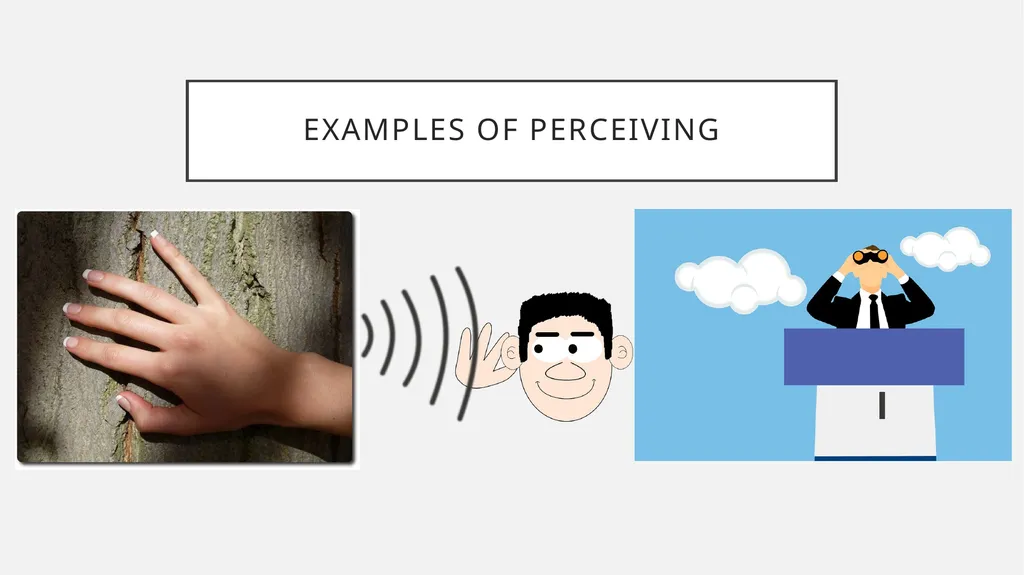
Examples of Perceiving<br>
04
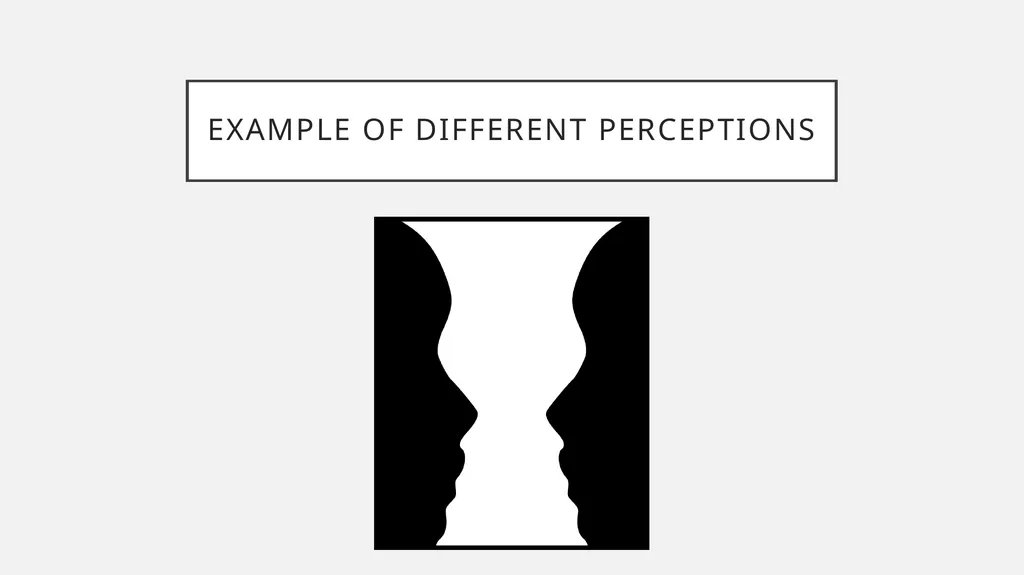
Example of Different Perceptions<br>
05
Defining Risk Perception “Risk perception is a judgment of the adverse consequences of a particular hazard and can be made by an individual, a group of people, or society”
(Janmaimool and Watanabe, 2014)<br>
06
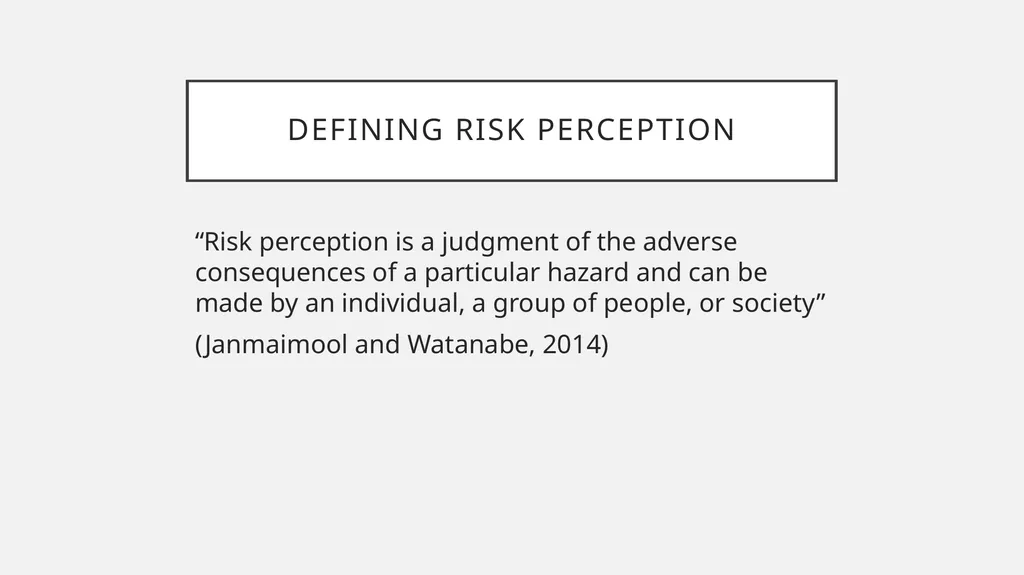
Importance of Risk Perception “Some find certain events or situations unacceptably risky and will do their utmost to avoid being involved, while to others the same events may offer exhilaration and thrills that stimulate their whole purpose in living. There may even be others to whom the particular event is a non-issue, something to be totally ignored.”
(Young, 1998)<br>
07
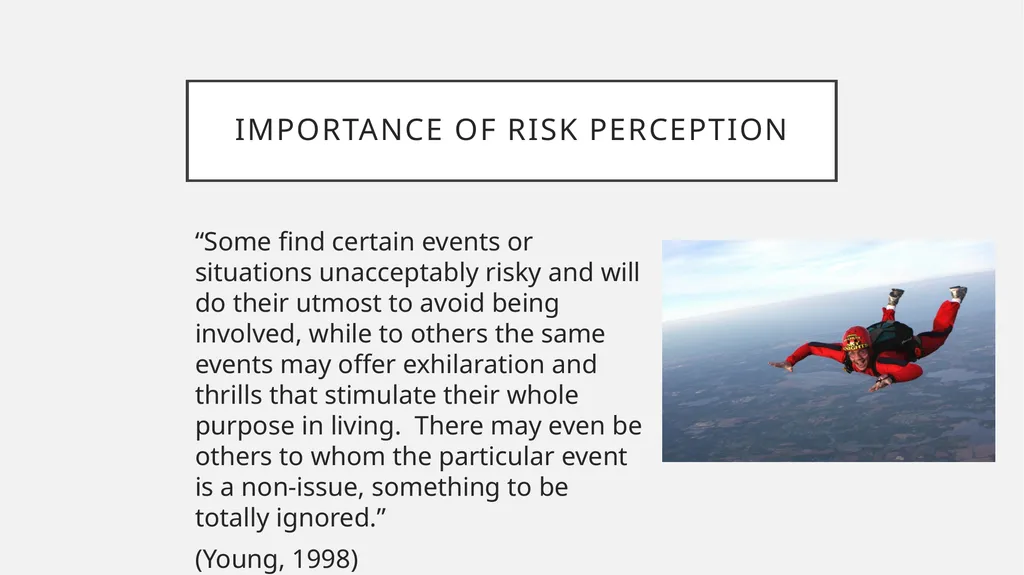
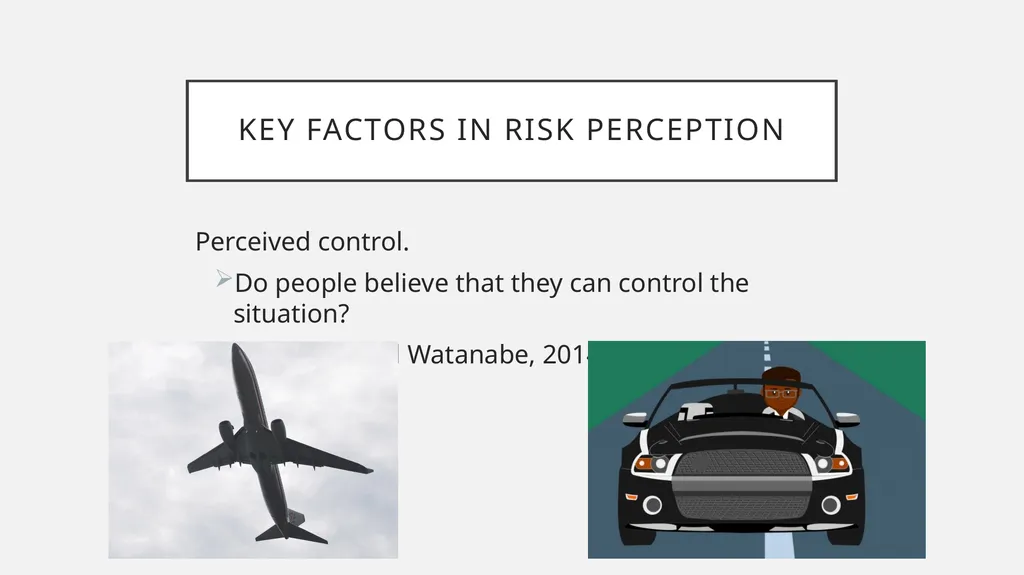
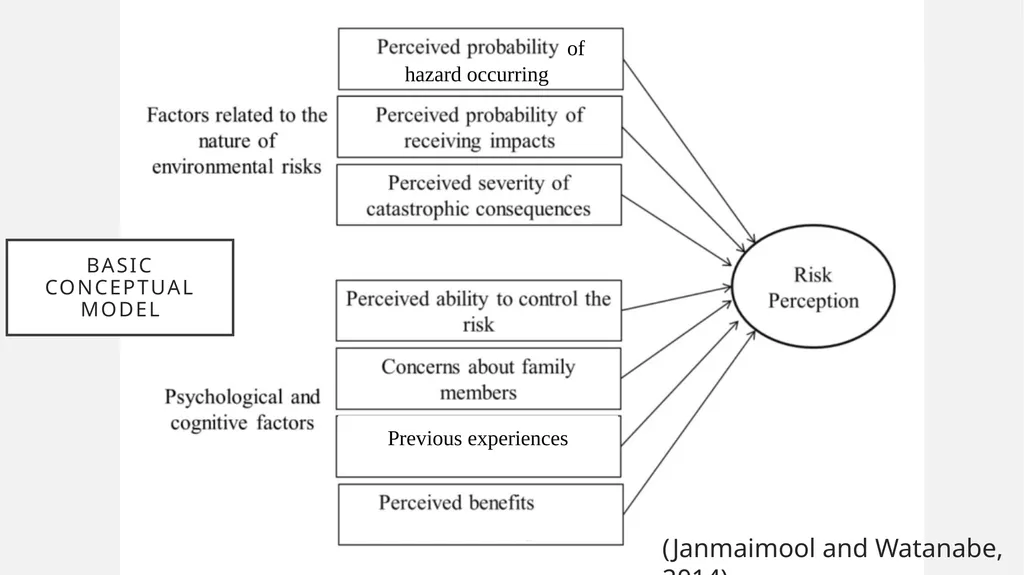
Key Factors in Risk Perception Perceived control.
Do people believe that they can control the situation?
(Janmaimool and Watanabe, 2014)<br>
08
Key Factors in Risk Perception Previous experiences.
Have people handled similar risks in the past?
(Janmaimool and Watanabe, 2014)<br>
09
Key Factors in Risk Perception Family concerns.
People in larger families usually consider the risk of harmful impacts to be higher due to their concern for familial safety
(Janmaimool and Watanabe, 2014)<br>
10
Key Factors in Risk Perception Analytical way of thinking.
As individuals or as a group, people will have their own judgements of the probability of a hazard occurring, probability of negative impacts, severity of the impacts.
(Janmaimool and Watanabe, 2014)<br>
11
Key Factors in Risk Perception Trust.
People’s sense of trust in their government, hazard experts, and family affects the way they receive risk messages and the decisions made.
(Bronfman et al., 2015)<br>
12
Key Factors in Risk Perception The type of hazard
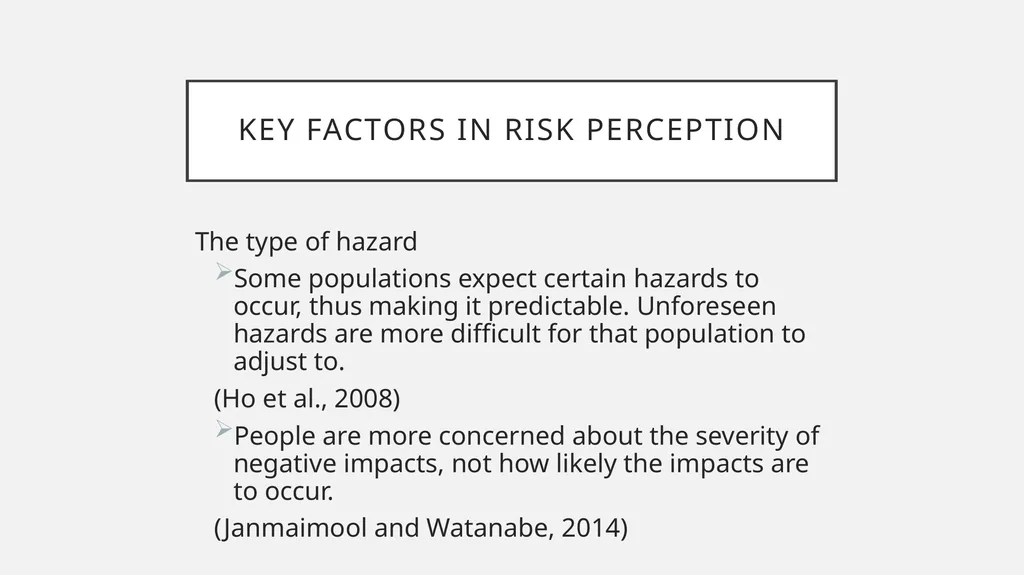
Some populations expect certain hazards to occur, thus making it predictable. Unforeseen hazards are more difficult for that population to adjust to.
(Ho et al., 2008)
People are more concerned about the severity of negative impacts, not how likely the impacts are to occur.
(Janmaimool and Watanabe, 2014)<br>
13
Basic Conceptual Model (Janmaimool and Watanabe, 2014) Previous experiences hazard occurring of<br>
14
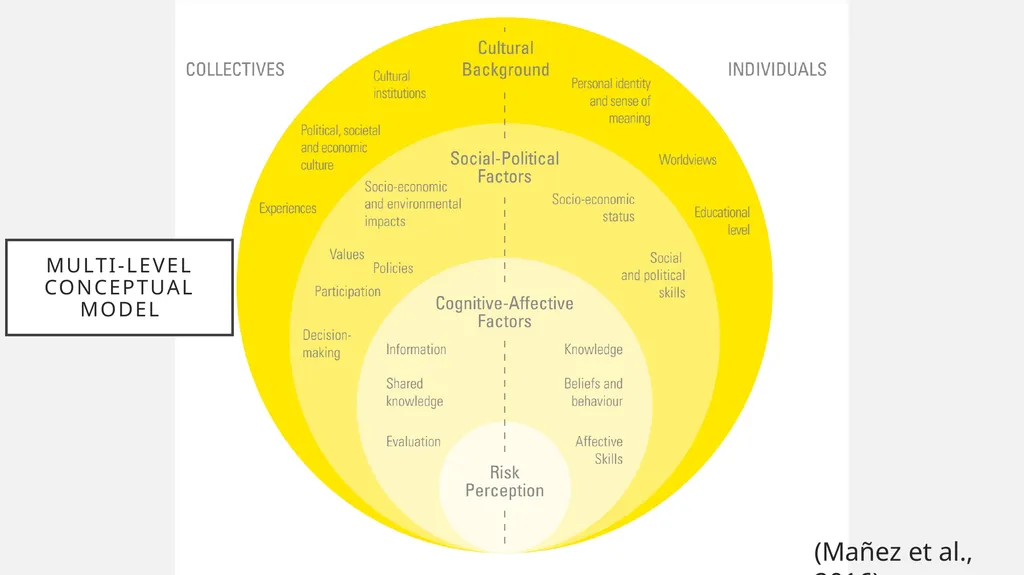
(Mañez et al., 2016) Multi-Level Conceptual Model<br>
15
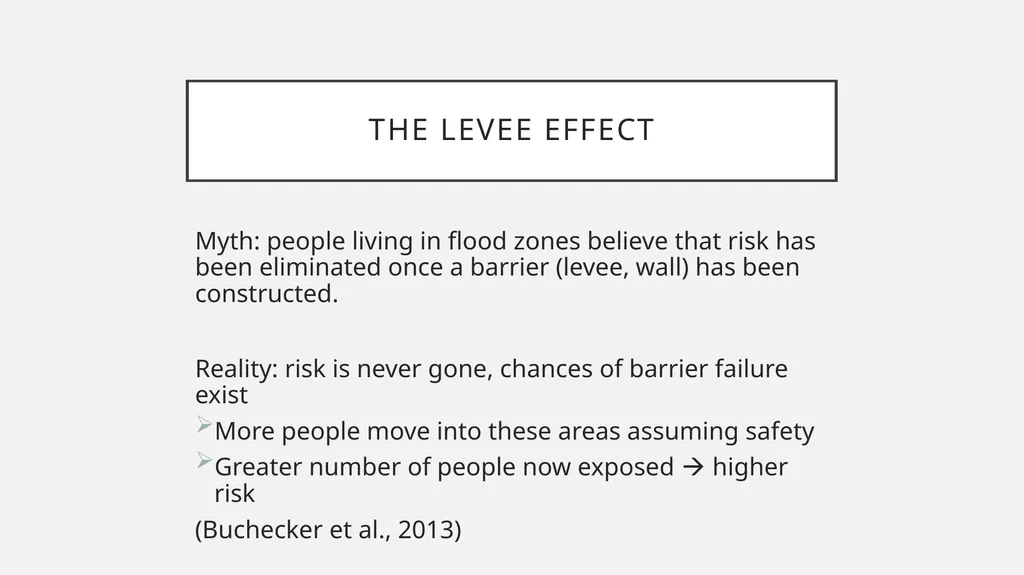
The Levee Effect Myth: people living in flood zones believe that risk has been eliminated once a barrier (levee, wall) has been constructed.
Reality: risk is never gone, chances of barrier failure exist
More people move into these areas assuming safety
Greater number of people now exposed higher risk
(Buchecker et al., 2013)<br>
16
Why Risk Perception Matters Understanding risk perception
effective risk communication
better risk mitigation strategies
(Plapp and Werner, 2006)<br>