04
Introduction GSR Part 7, Requirement 2: “The government shall make provisions to ensure that roles and responsibilities for preparedness and response for a nuclear or radiological emergency are clearly specified and assigned”<br>
05
Government – responsible to: Ensure that an integrated and coordinated emergency management system for preparedness and response for a nuclear or radiological emergency is established and maintained
Enact legislation and regulations for EPR in line with international requirements
Provide funds and human resources for an efficient response<br>
06
National Coordinating Mechanism A coordinating mechanism should be established at national level
Appointed by the Government
Responsible to coordinate the preparedness activities at national level
One single national authority
e.g. Disaster Management Organization
or
An inter-agency mechanism composed by national authorities
e.g. a committee consisting of representatives from different organizations<br>
07
Discussion Who in your country plays the role of National Coordinating Mechanism?<br>
08
National officials Governmental authorities responsible for planning and response at national (or regional) level
Usually perform tasks such as:
long term protective actions
support of local officials in the event that their capabilities are exceeded
In some cases they may have role also in the urgent phase of an emergency<br>
09
Local officials Governmental authorities and support agencies responsible for:
Immediate support to the operator and
Prompt protection of the public
Include:
Civil emergency services
Police
Fire fighting and
Medical personnel
It may include officials from different States, if the facility is near the border (EPC V)<br>
10
National and local officials Establish and maintain arrangements for preparedness and response
Demonstrate effectiveness of emergency arrangements
Coordinate the off-site response with the on-site response, ensure harmonization of response within the national system<br>
11
Dual role of the Regulatory Body (RB) As REGULATOR
To regulate, authorize and control facilities and activities in the nuclear field
As RESPONSE ORGANIZATION
To provide advice and expert services on EPR at national level
To coordinate preparedness with the National Coordinating Mechanism<br>
12
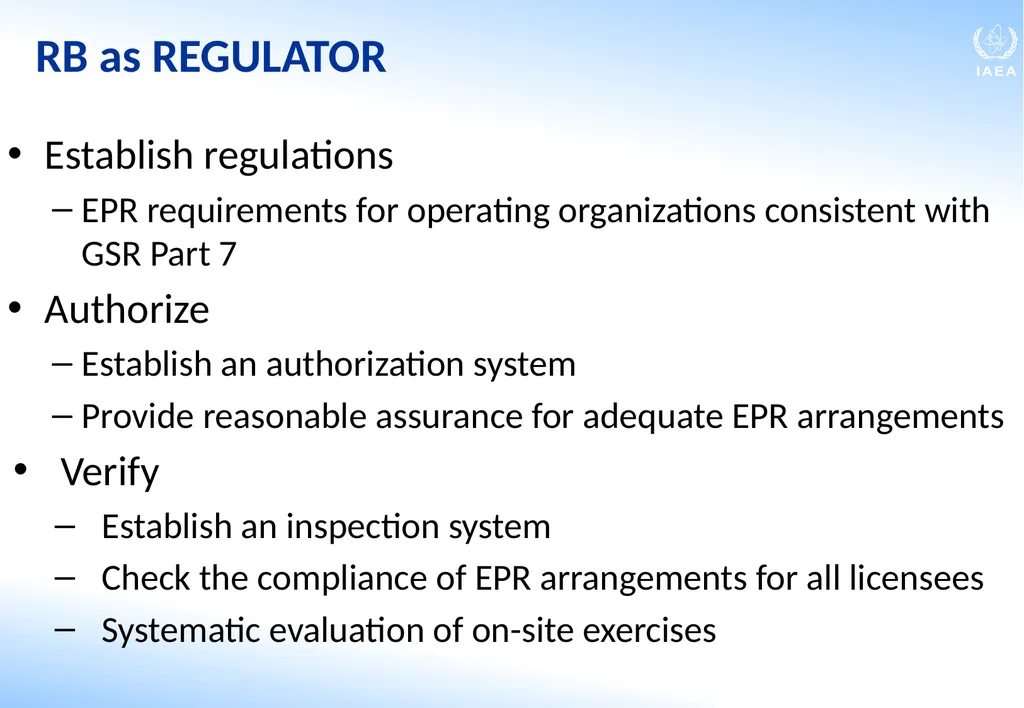
RB as REGULATOR Establish regulations
EPR requirements for operating organizations consistent with GSR Part 7
Authorize
Establish an authorization system
Provide reasonable assurance for adequate EPR arrangements
Verify
Establish an inspection system
Check the compliance of EPR arrangements for all licensees
Systematic evaluation of on-site exercises<br>
13
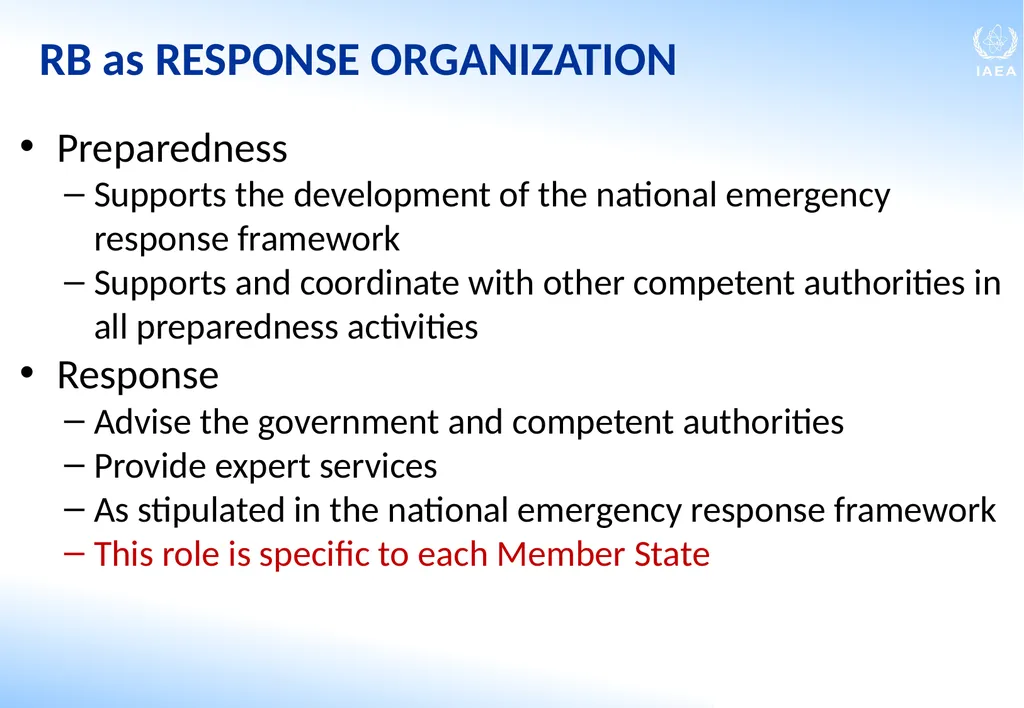
RB as RESPONSE ORGANIZATION Preparedness
Supports the development of the national emergency response framework
Supports and coordinate with other competent authorities in all preparedness activities
Response
Advise the government and competent authorities
Provide expert services
As stipulated in the national emergency response framework
This role is specific to each Member State<br>
14
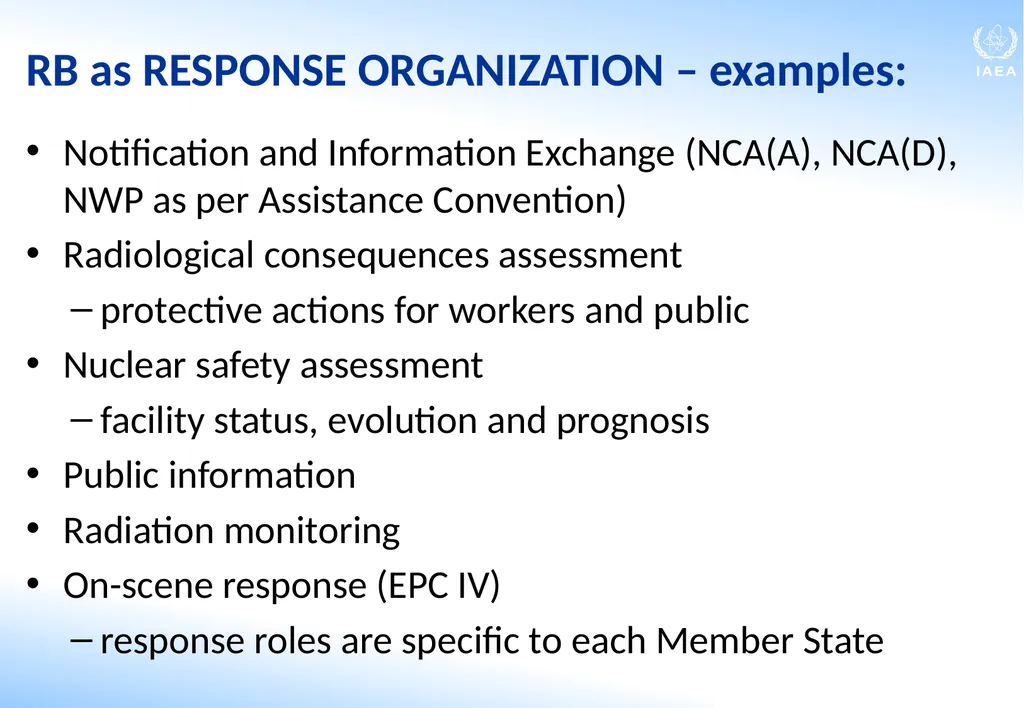
RB as RESPONSE ORGANIZATION – examples: Notification and Information Exchange (NCA(A), NCA(D), NWP as per Assistance Convention)
Radiological consequences assessment
protective actions for workers and public
Nuclear safety assessment
facility status, evolution and prognosis
Public information
Radiation monitoring
On-scene response (EPC IV)
response roles are specific to each Member State<br>
15
Discussion What roles has the RB in your country for emergency preparedness and response?<br>
16
Operating organizations: �responsibilities for preparedness Establish and maintain arrangements
On-site preparedness and response for facilities or activities under their responsibility, in line with regulatory requirements
Demonstrate that emergency arrangements are in place for an effective response on the site
Co-ordinate and integrate the on-site arrangements
With the off-site arrangements existing at local and national level<br>
17
Operating organizations:�responsibilities during response phase taking immediate actions to mitigate the emergency;
protecting people on the site;
notifying off-site officials and providing them with recommendations on protective actions and technical assistance;
warning the public within the emergency planning zones (EPC I and EPC II)
providing initial radiological monitoring
keeping the public informed<br>
18
Coordination at national level Coordinate planning and preparedness activities
Coordinate emergency arrangements:
arrangements and protocols for operational interfaces
arrangements to develop and harmonize tools, procedures or criteria for use in the response to nuclear or radiological emergency
arrangements to harmonize radiation monitoring
arrangements to harmonize assessments of contamination, doses and radiation induced health effects
Coordinate building infrastructure to support the response functions<br>
19
Incident Command System (ICS) Is a standardized, on-scene, all-hazards incident management structure
Based on unified command and control concept
Allows for the integration of facilities, equipment, personnel, procedures and communications within a structure
Enables a coordinated response among various jurisdictions and functional agencies
Establishes common processes for planning and managing resources<br>
20
An ICS is used for all types of emergencies Radiological / Nuclear
Fires
Earthquakes
Flooding
Wind
Terrorist attacks<br>
21
ICS includes all stakeholders All levels
Operating organizations
Local and national governments
Non-governmental organizations
All necessary specialists
Radiological assessors
Social services
Law-enforcement
Other elements of the response<br>
22
ICS uses: Common terminology
Modular organization
Integrated communications
Designated facilities/locations
Uses unity of command<br>
23
Coordination at international level Arrangements and protocols with other States to
Coordinate early notification, data and information exchange
Public information
Protective actions
Special arrangements for States with areas in category V
Early notification and information exchange
Radiation monitoring
Protective actions<br>
24
Summary Roles and responsibilities for EPR have to be clearly defined into the national legislation for all stakeholders in a State: national coordinating mechanism, local and national authorities, regulatory body, operating organizations
All response organizations have to establish and maintain arrangements for EPR and coordinate them within national system and at international level
Integration and coordination of emergency arrangements and capabilities have to be established at the preparedness stage<br>
25
Key Points A National Coordinating Mechanism should be established
Responsible for emergency preparedness activities at national level
Regulatory Body has dual role in relation to EPR:
As regulator
As response organization
An ICS is a standardized, on-scene, all-hazards incident management structure for response coordination
Based on unified command and control concept<br>
26
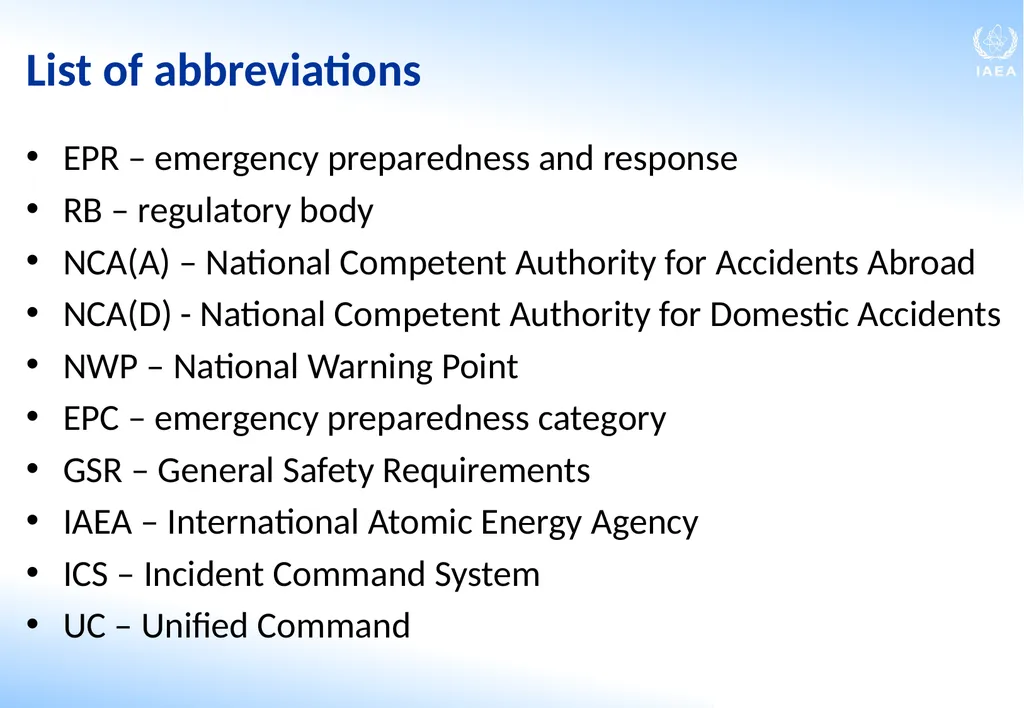
List of abbreviations EPR – emergency preparedness and response
RB – regulatory body
NCA(A) – National Competent Authority for Accidents Abroad
NCA(D) - National Competent Authority for Domestic Accidents
NWP – National Warning Point
EPC – emergency preparedness category
GSR – General Safety Requirements
IAEA – International Atomic Energy Agency
ICS – Incident Command System
UC – Unified Command<br>
27
References IAEA GSR Part 7
IAEA GS-G-2.1 (2007)
IAEA EPR-Method (2003)
IAEA EPR-First Responders (2006)<br>
28
Thank you! Any questions?<br>