
ROTARY INSTRUMENTS IN OPERATIVE DETISTRY SIBAR










Description: ROTARY INSTRUMENTS IN OPERATIVE DETISTRY SIBAR INSTITUTE OF DENTAL SCIENCES,GUNTUR DEPARTMENT OF CONSERVATIVE DENTISTRY AND ENDODONTICS Dr. V. SUJANA PROFESSOR Contents: Introduction Definition History Handpieces -Parts -Classification
Related Topics
Download Presentation
"ROTARY INSTRUMENTS IN OPERATIVE DETISTRY SIBAR" is the property of its rightful owner. Permission is granted to download and print the materials on this website for personal, non-commercial use only, and to display it on your personal computer provided you do not modify the materials and that you retain all copyright notices contained in the materials. By downloading content from our website, you accept the terms of this agreement.
Presentation Transcript
slide1. ROTARY INSTRUMENTS IN OPERATIVE DETISTRY SIBAR INSTITUTE OF DENTAL SCIENCES,GUNTUR DEPARTMENT OF CONSERVATIVE
DENTISTRY AND ENDODONTICS Dr. V. SUJANA
PROFESSOR<br>
slide2. Contents: Introduction
Definition
History
Handpieces
-Parts
-Classification
-Criteria to evaluate hand pieces
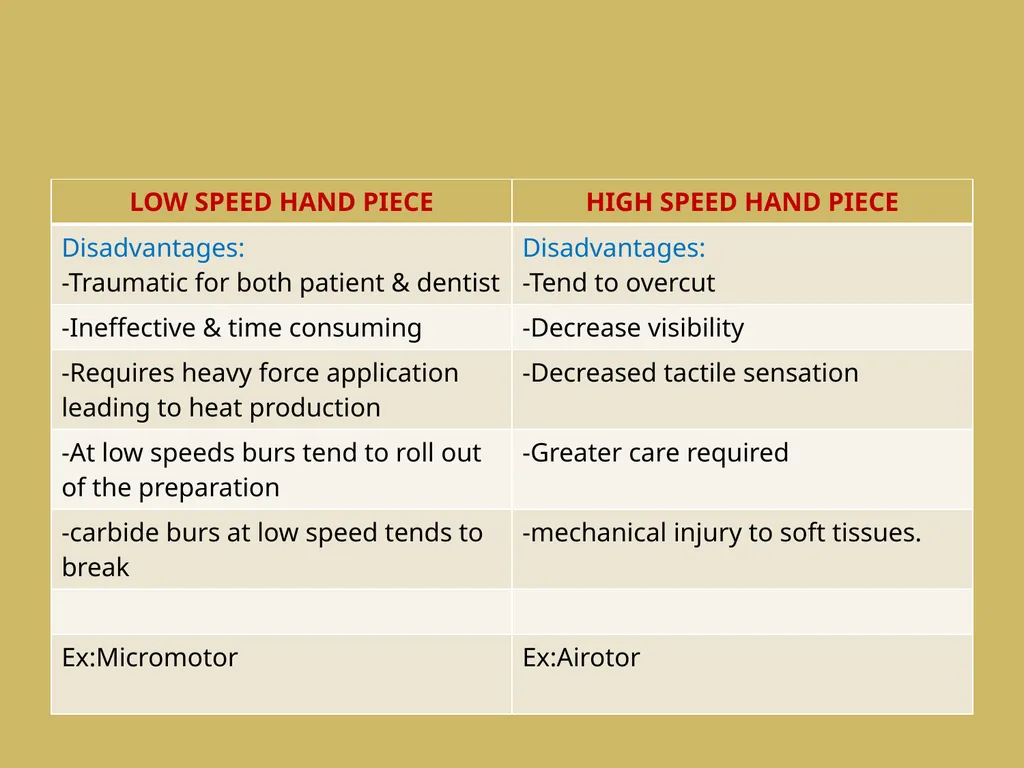
-High speed and low speed hand pieces (advs,disadvs)
-Coolant spray systems
-Sterilization<br>
slide3. Dental burs
-Parts
-Classification
-Modifications in bur design
-Design of dental bur
-Significance of bur design
-Cutting mechanism of dental bur
Diamond abrasives
-Parts
-Classification
-Cutting mechanism of diamond abrasives
Recommendations for cutting(dental burs and abrasives)<br>
slide4. Hazards with rotary cutting instruments
Care with rotary cutting instruments
Various speeds in cavity preparation<br>
slide5. Introduction Most cavity preparations require the use of both rotary and hand instruments.
Rotary burs or diamond points are used for cavity preparation and fine refinement of cavity while hand cutting instruments are used to produce intricate details in the cavity preparation and to insert and finish the restorative material.<br>
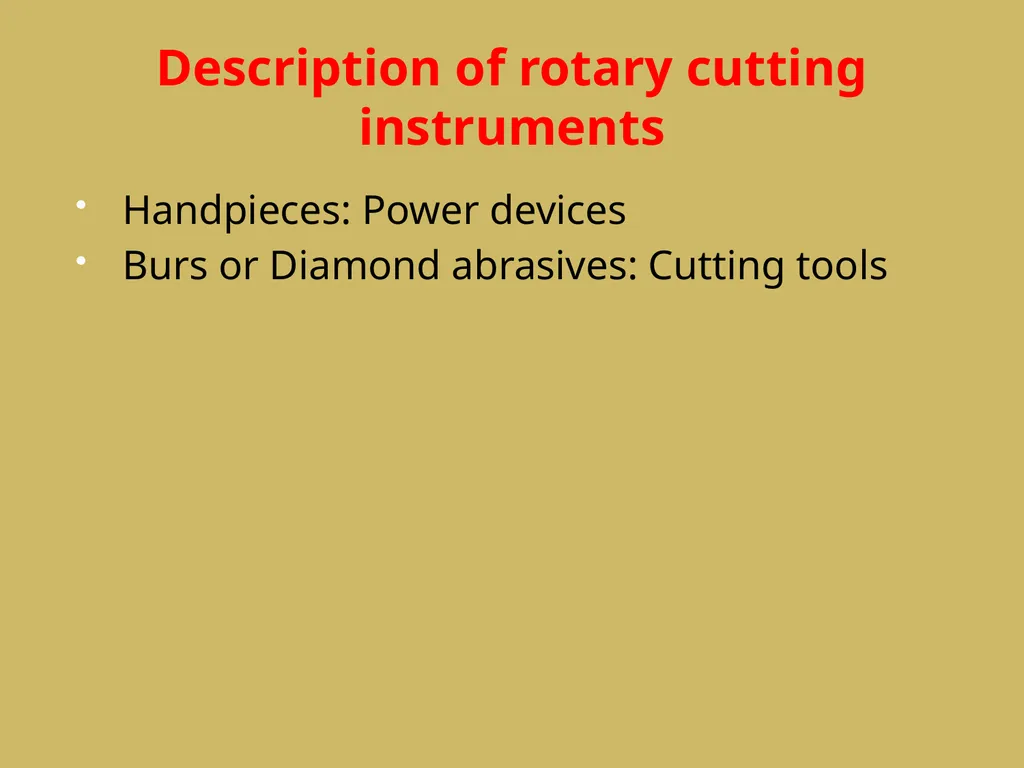
slide6. Definition The term rotary instruments in dentistry refers to a group of instruments that turn on an axis to perform work such as cutting, abrading, finishing or polishing tooth or restorative materials.<br>
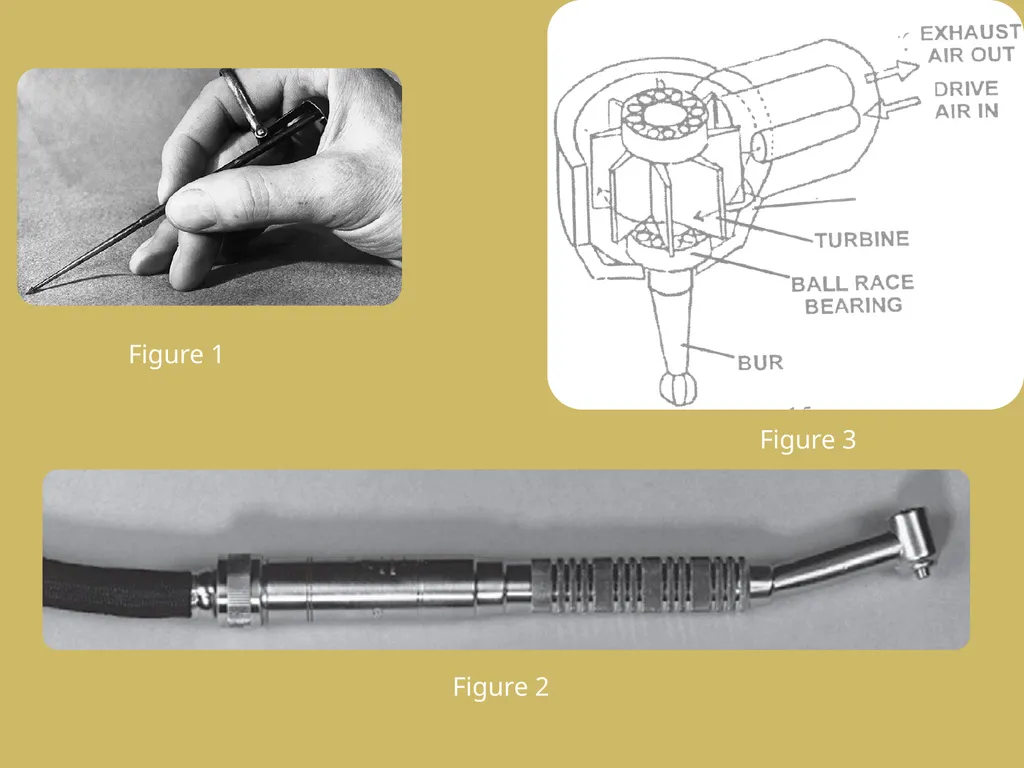
slide7. Figure 1 Figure 2 Figure 3<br>
slide8. Description of rotary cutting instruments Handpieces: Power devices
Burs or Diamond abrasives: Cutting tools<br>
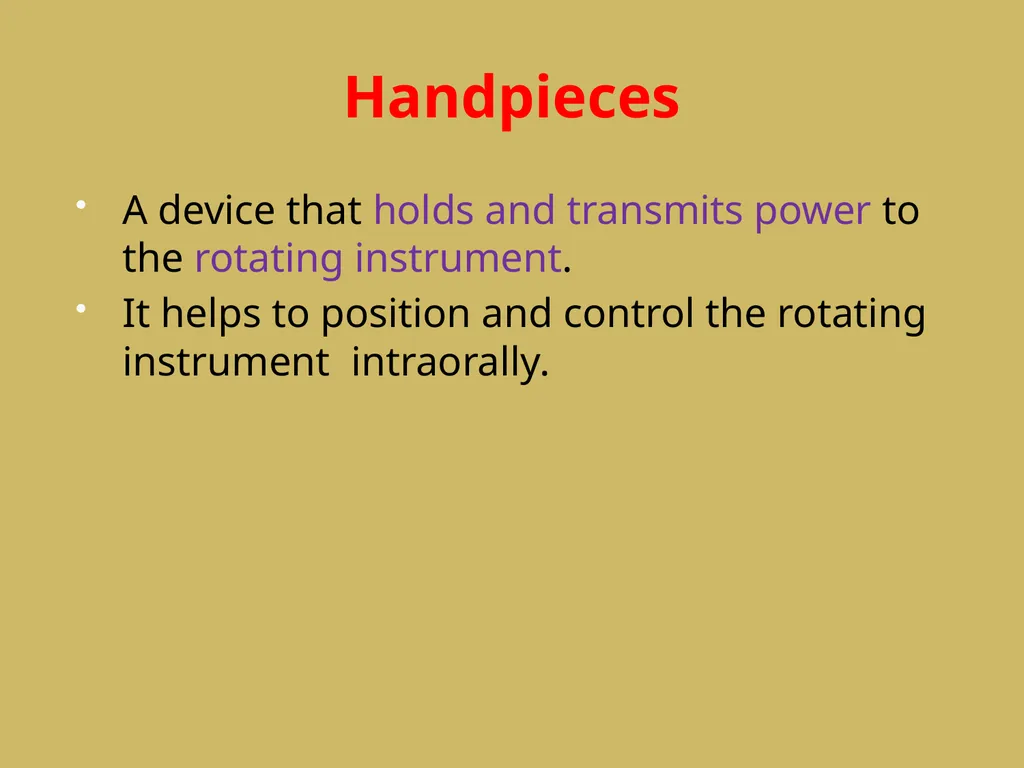
slide9. Handpieces A device that holds and transmits power to the rotating instrument.
It helps to position and control the rotating instrument intraorally.<br>
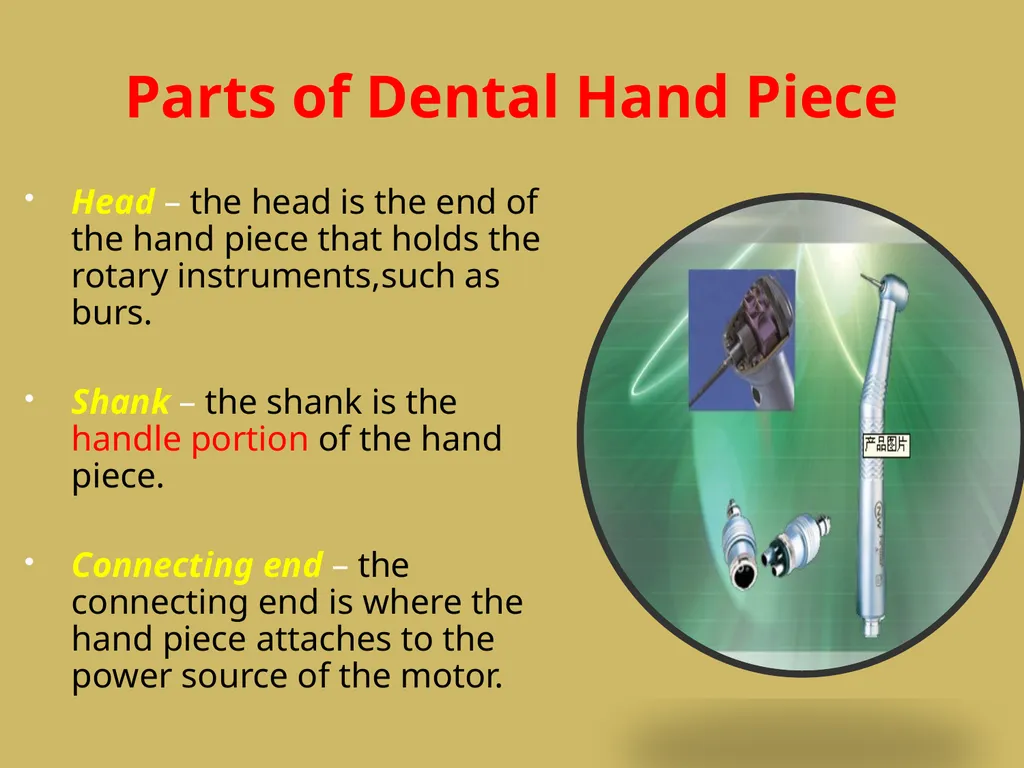
slide10. Parts of Dental Hand Piece Head – the head is the end of the hand piece that holds the rotary instruments,such as burs.
Shank – the shank is the handle portion of the hand piece.
Connecting end – the connecting end is where the hand piece attaches to the power source of the motor.<br>
slide11. Classification of Handpieces 1)According to Driving mechanism
Gear driven hand piece
Water driven hand piece
Belt driven hand piece
Air driven hand piece
2) Depending upon Angulations
Straight hand piece
Contra angled hand piece<br>
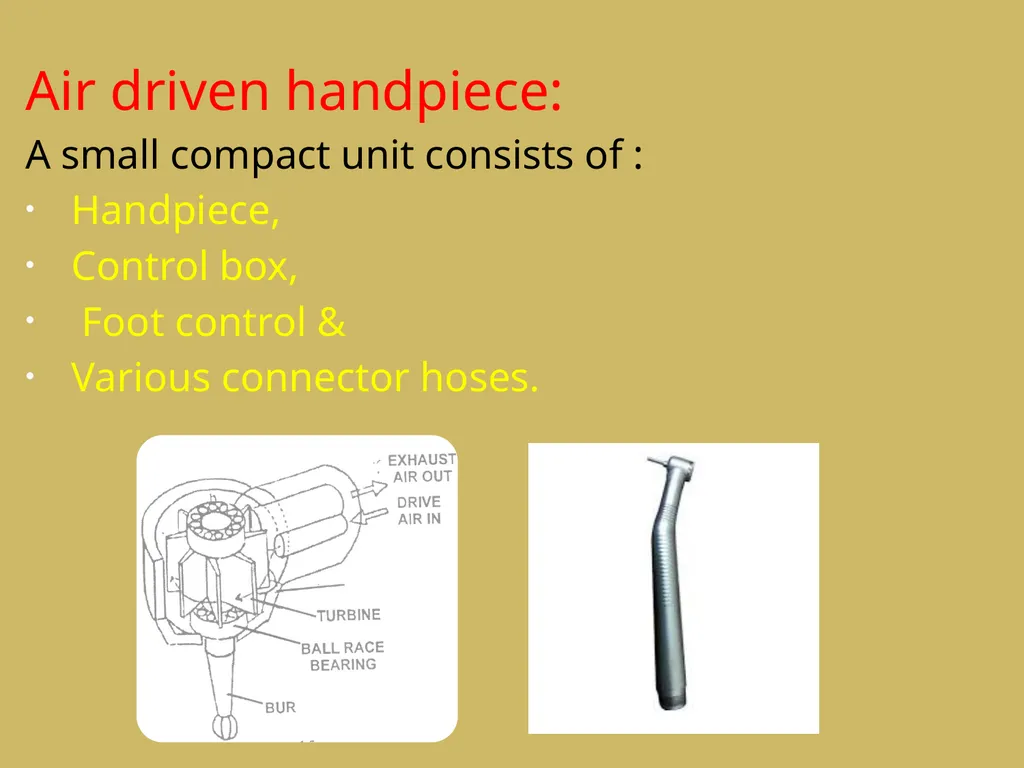
slide12. Air driven handpiece:
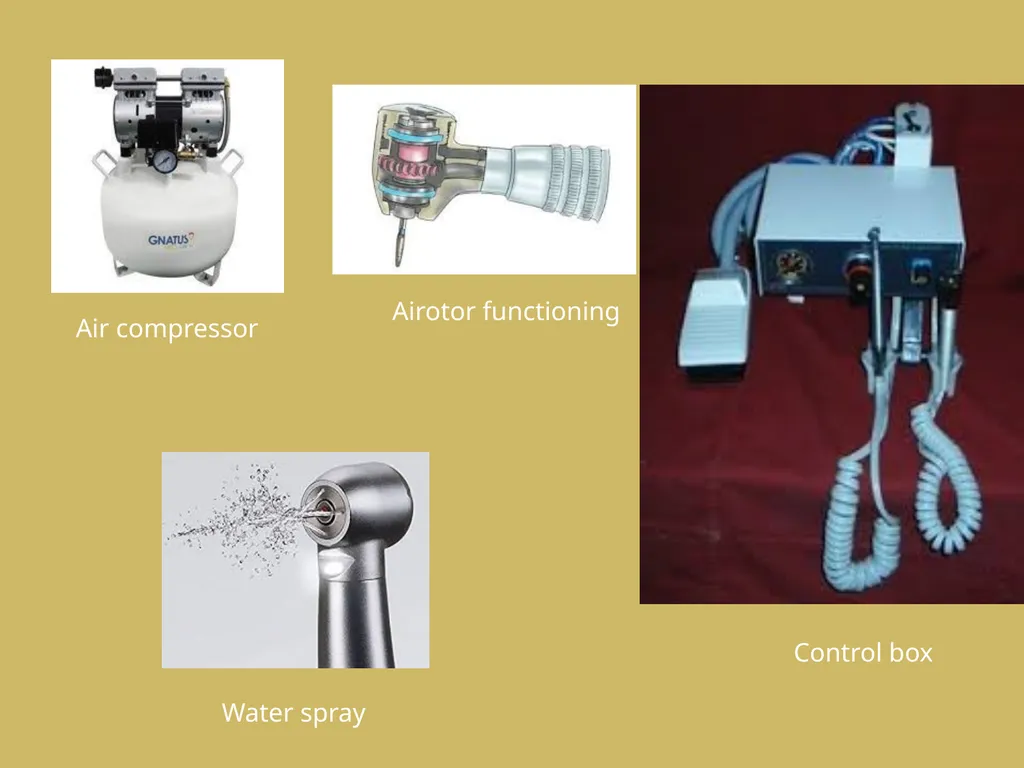
A small compact unit consists of :
Handpiece,
Control box,
Foot control &
Various connector hoses.<br>
slide13. Air compressor Airotor functioning Water spray Control box<br>
slide14. Depending upon Angulations:
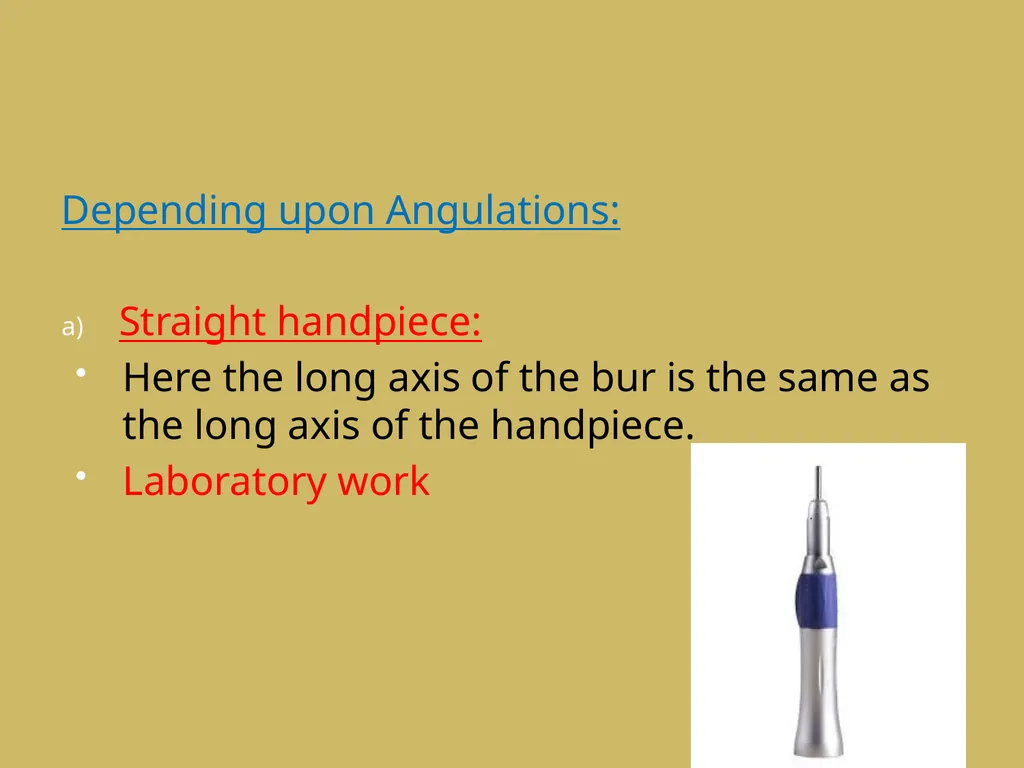
Straight handpiece:
Here the long axis of the bur is the same as the long axis of the handpiece.
Laboratory work<br>
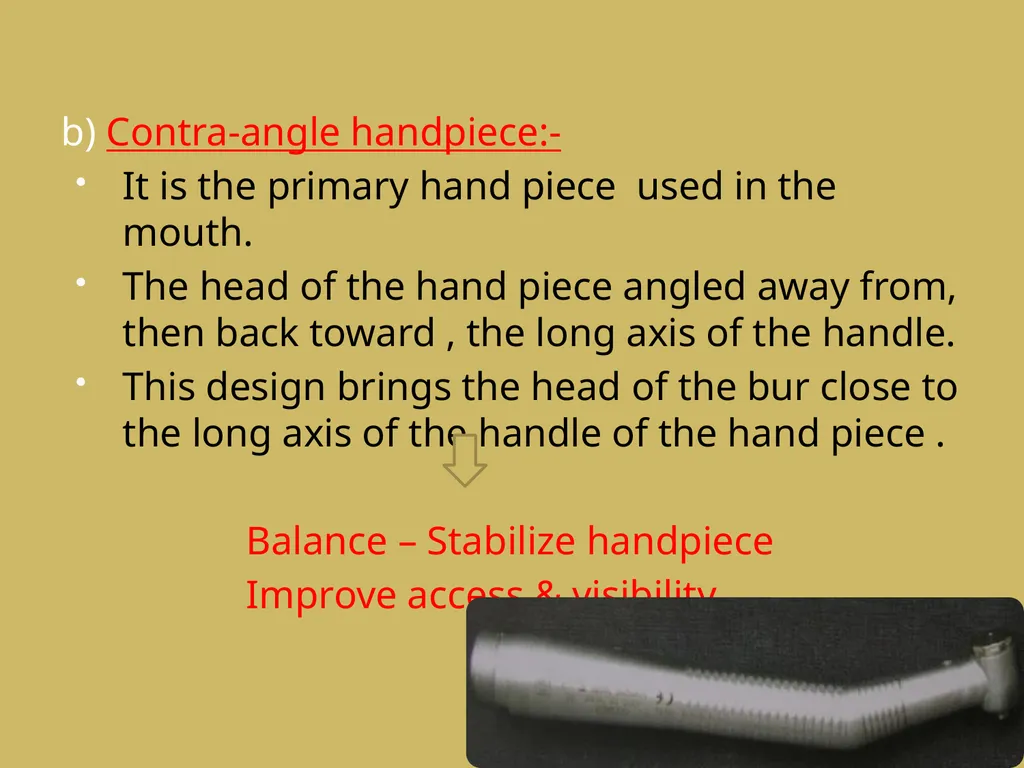
slide15. b) Contra-angle handpiece:-
It is the primary hand piece used in the mouth.
The head of the hand piece angled away from, then back toward , the long axis of the handle.
This design brings the head of the bur close to the long axis of the handle of the hand piece .
Balance – Stabilize handpiece
Improve access & visibility<br>
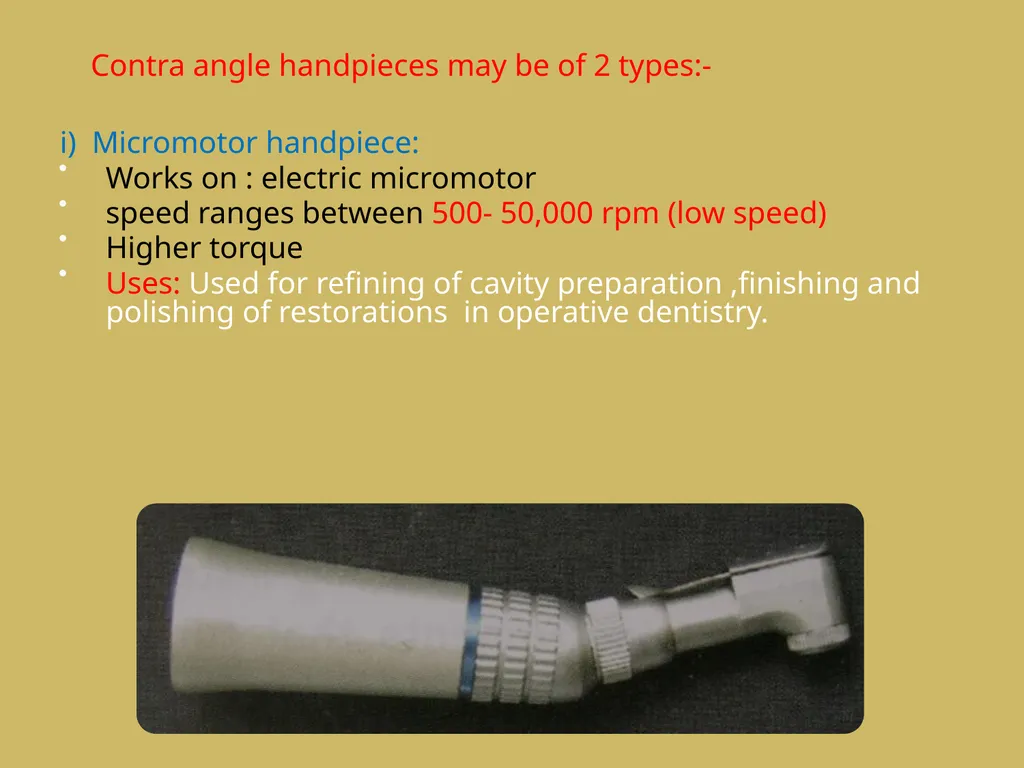
slide16. Contra angle handpieces may be of 2 types:-
i) Micromotor handpiece:
Works on : electric micromotor
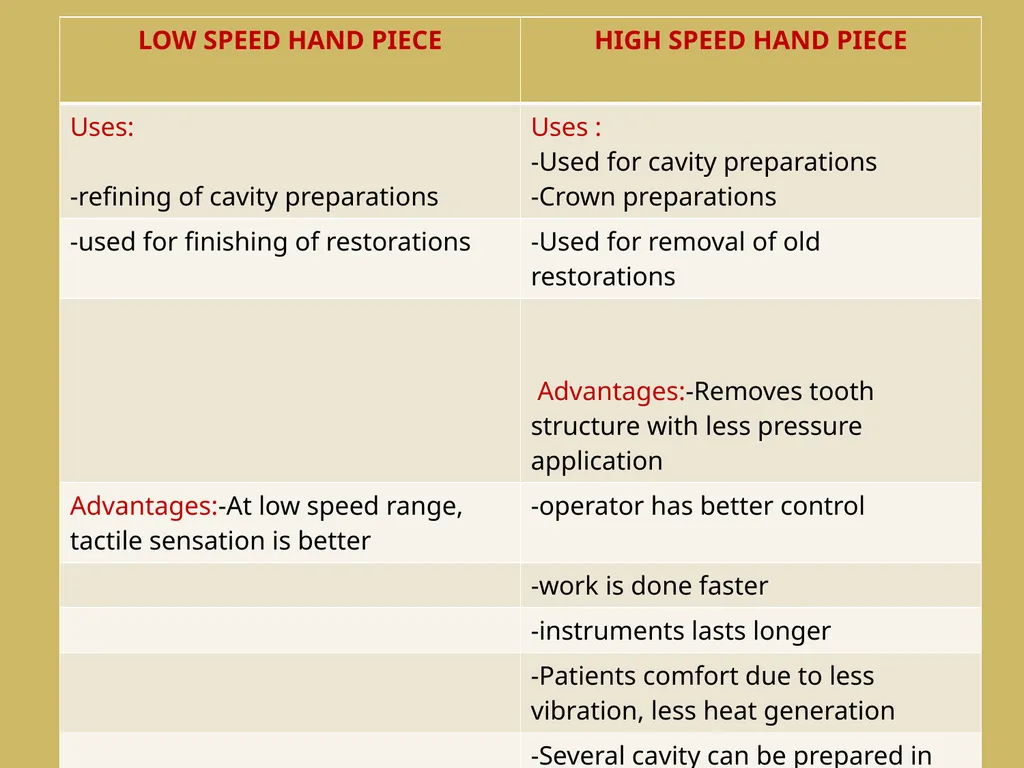
speed ranges between 500- 50,000 rpm (low speed)
Higher torque
Uses: Used for refining of cavity preparation ,finishing and polishing of restorations in operative dentistry.<br>
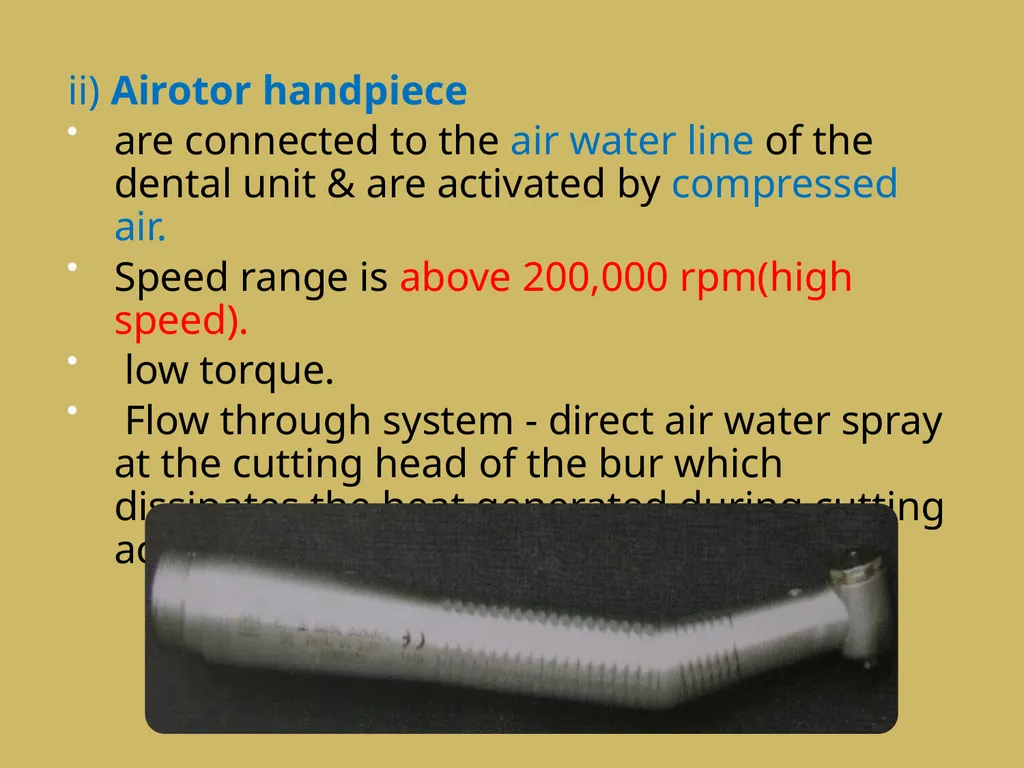
slide17. ii) Airotor handpiece
are connected to the air water line of the dental unit & are activated by compressed air.
Speed range is above 200,000 rpm(high speed).
low torque.
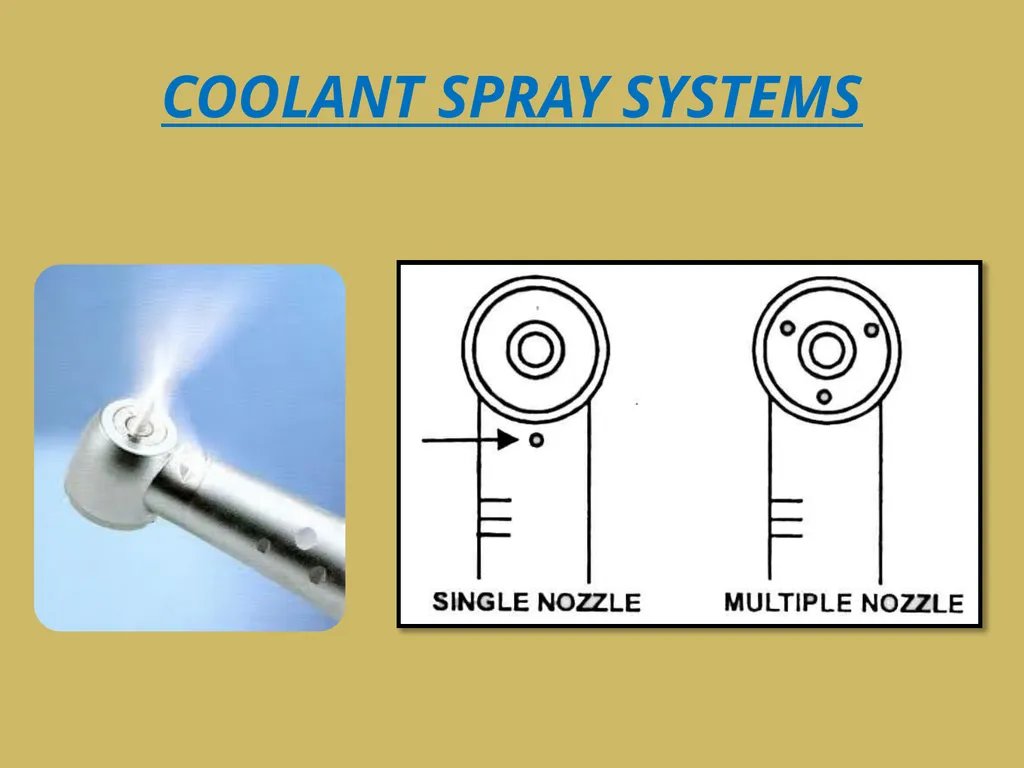
Flow through system - direct air water spray at the cutting head of the bur which dissipates the heat generated during cutting action.<br>
slide18. COOLANT SPRAY SYSTEMS<br>
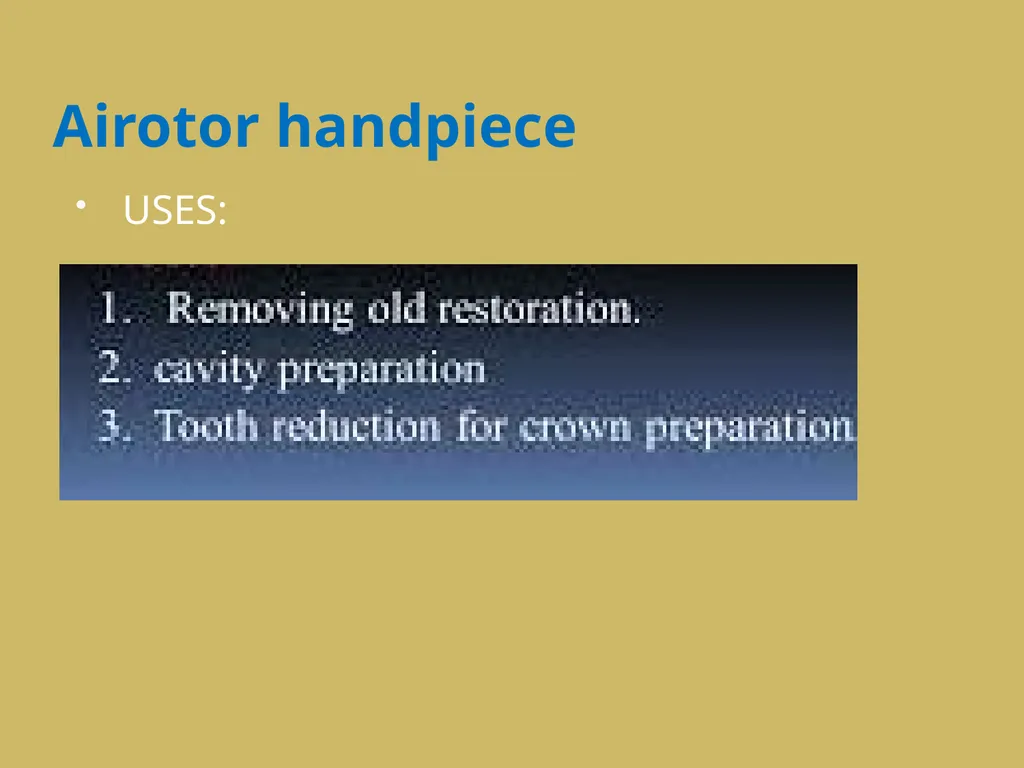
slide19. Airotor handpiece USES:<br>
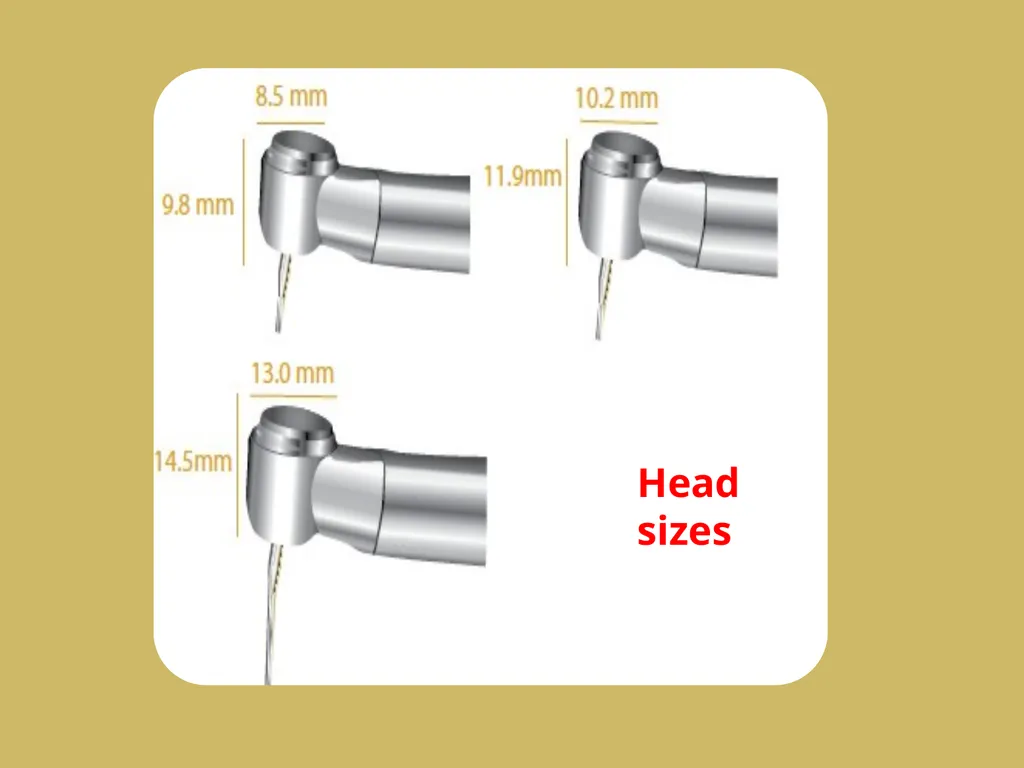
slide20. Head sizes<br>
slide21. Criteria to evaluate the handpiece Friction
Speed and Torque
Vibration<br>
slide22. FRICTION
Will occur in the moving parts of a hand piece especially the turbine.
If the heat from friction is not prevented ,the hand piece will not be suitable for dental use.
For this reason bearings are used: ball bearings, needle bearings, glass and resin bearings etc.<br>
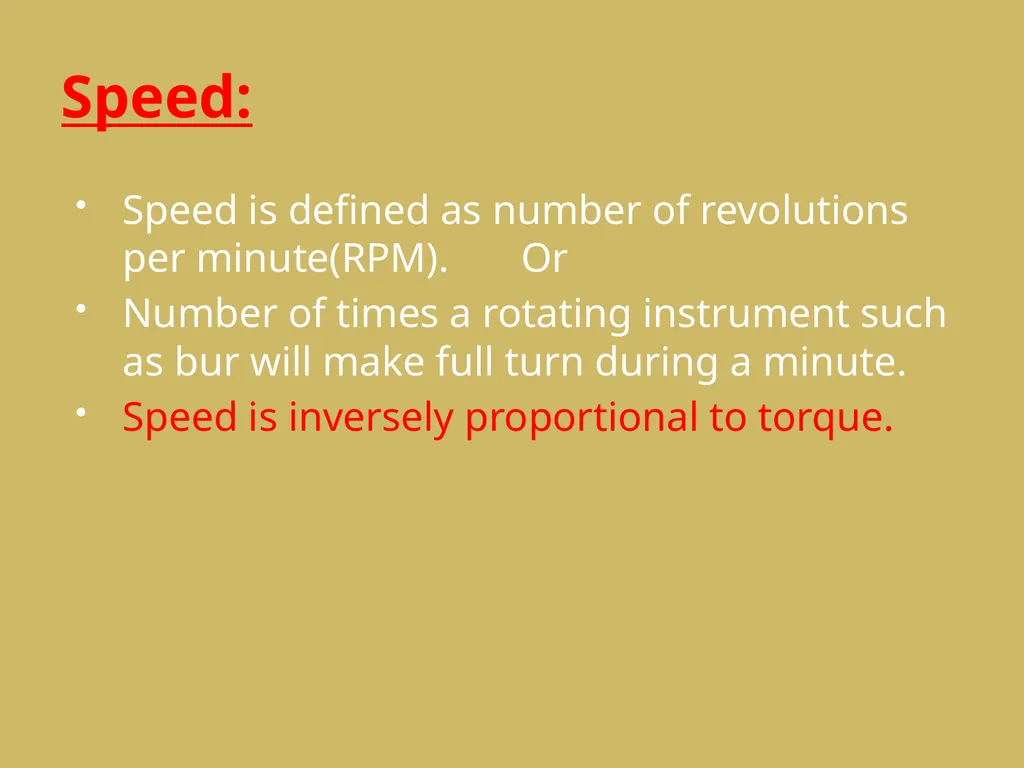
slide23. Speed: Speed is defined as number of revolutions per minute(RPM). Or
Number of times a rotating instrument such as bur will make full turn during a minute.
Speed is inversely proportional to torque.<br>
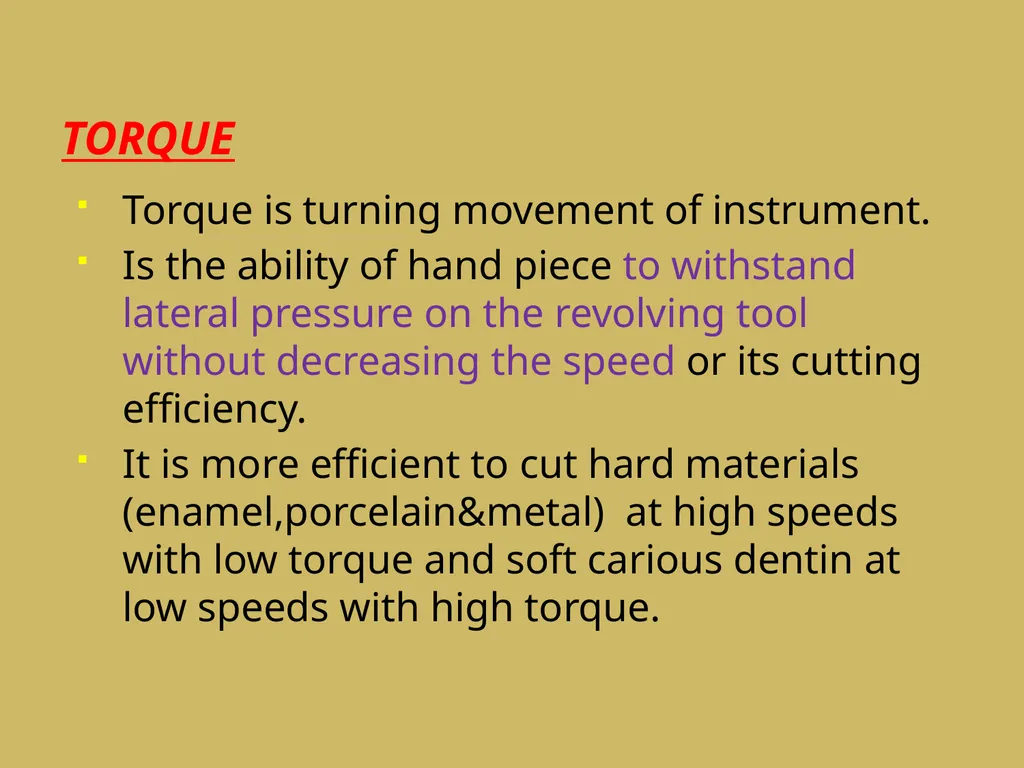
slide24. TORQUE Torque is turning movement of instrument.
Is the ability of hand piece to withstand lateral pressure on the revolving tool without decreasing the speed or its cutting efficiency.
It is more efficient to cut hard materials (enamel,porcelain&metal) at high speeds with low torque and soft carious dentin at low speeds with high torque.<br>
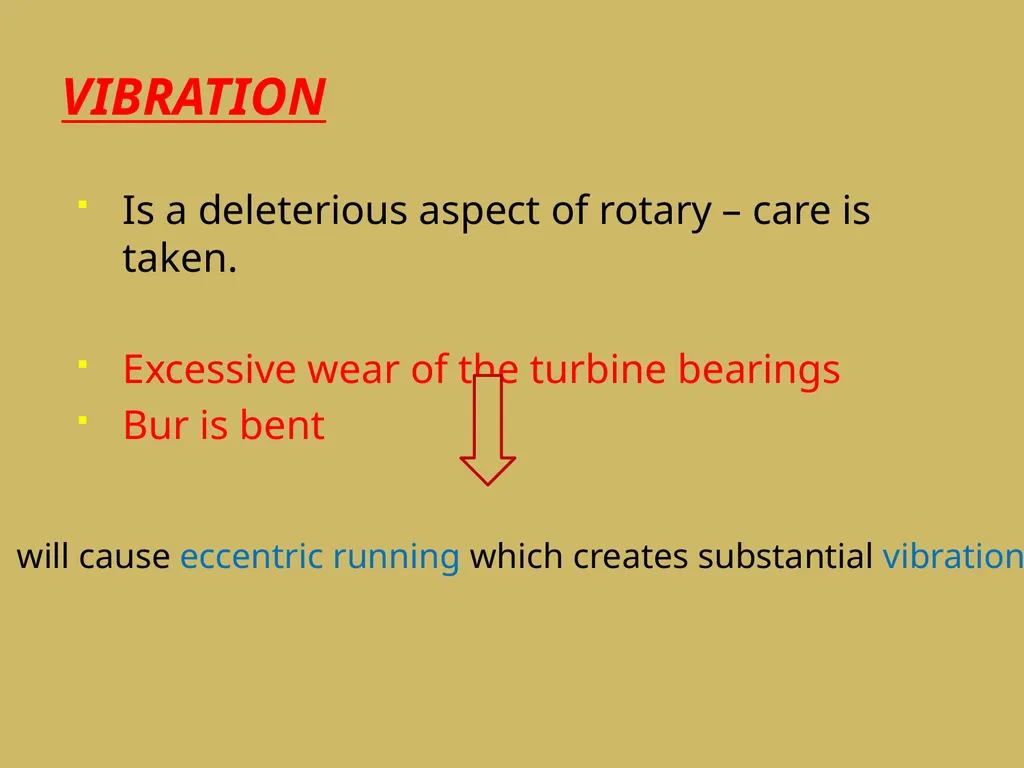
slide25. VIBRATION Is a deleterious aspect of rotary – care is taken.
Excessive wear of the turbine bearings
Bur is bent will cause eccentric running which creates substantial vibration.<br>
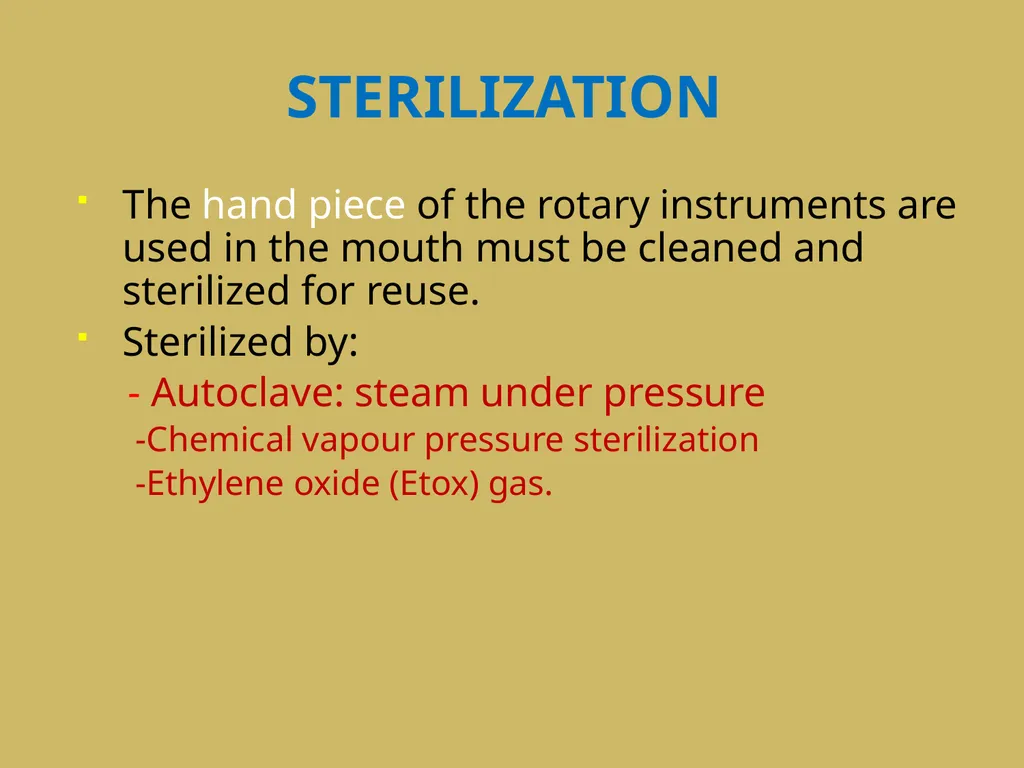
slide28. STERILIZATION The hand piece of the rotary instruments are used in the mouth must be cleaned and sterilized for reuse.
Sterilized by:
- Autoclave: steam under pressure
-Chemical vapour pressure sterilization
-Ethylene oxide (Etox) gas.<br>
slide29. Steam pressure sterilization (Autoclave) Sterilization cycle of autoclave:
High pressure saturated steam
121·c, 15 lbs,15 minutes : steam autoclave
132·c, 30 lbs,8-10 minutes: Wrapped instruments
132·c, 30 lbs,3 minutes: Unwrapped instruments<br>
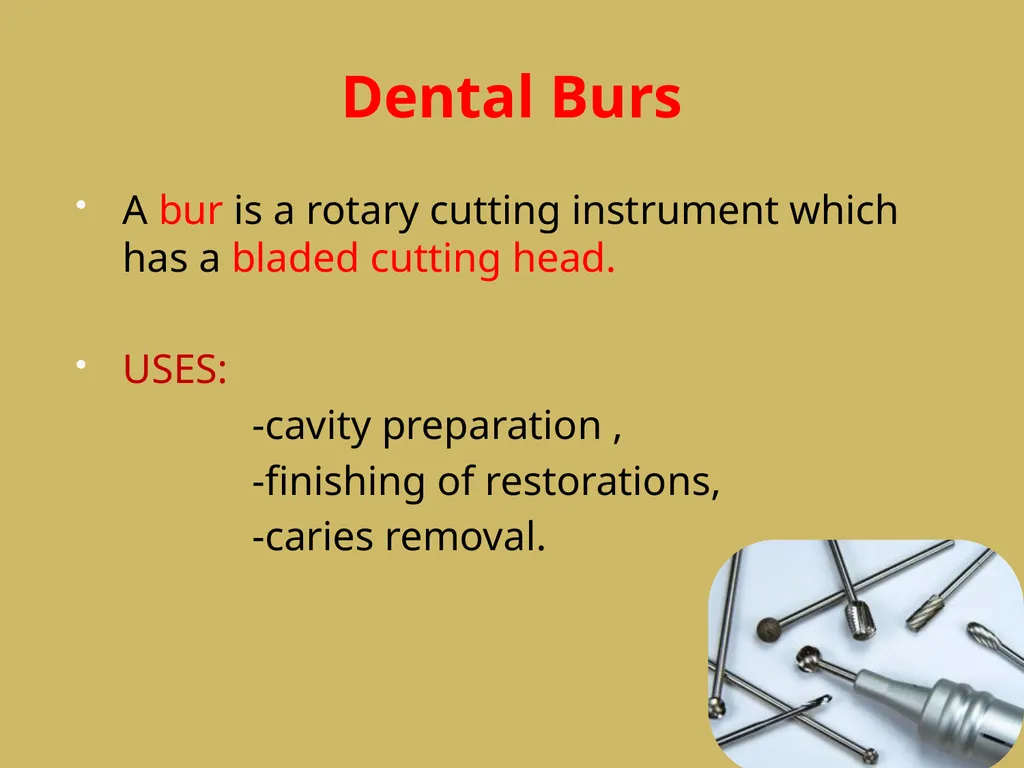
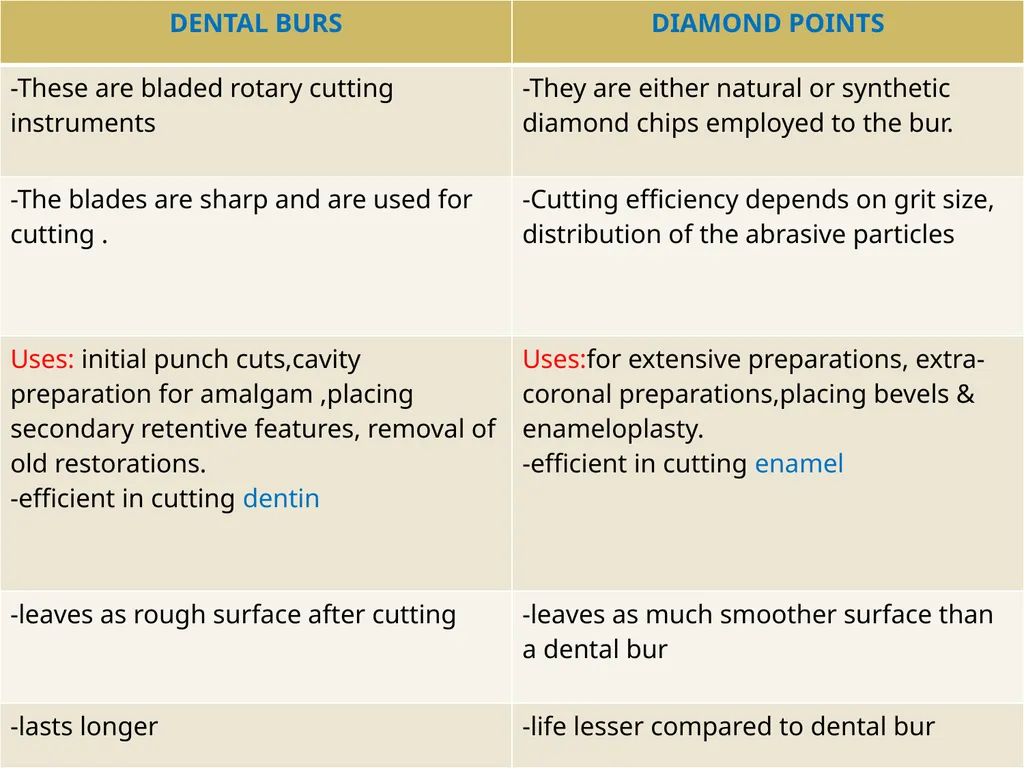
slide30. Dental Burs A bur is a rotary cutting instrument which has a bladed cutting head.
USES:
-cavity preparation ,
-finishing of restorations,
-caries removal.<br>
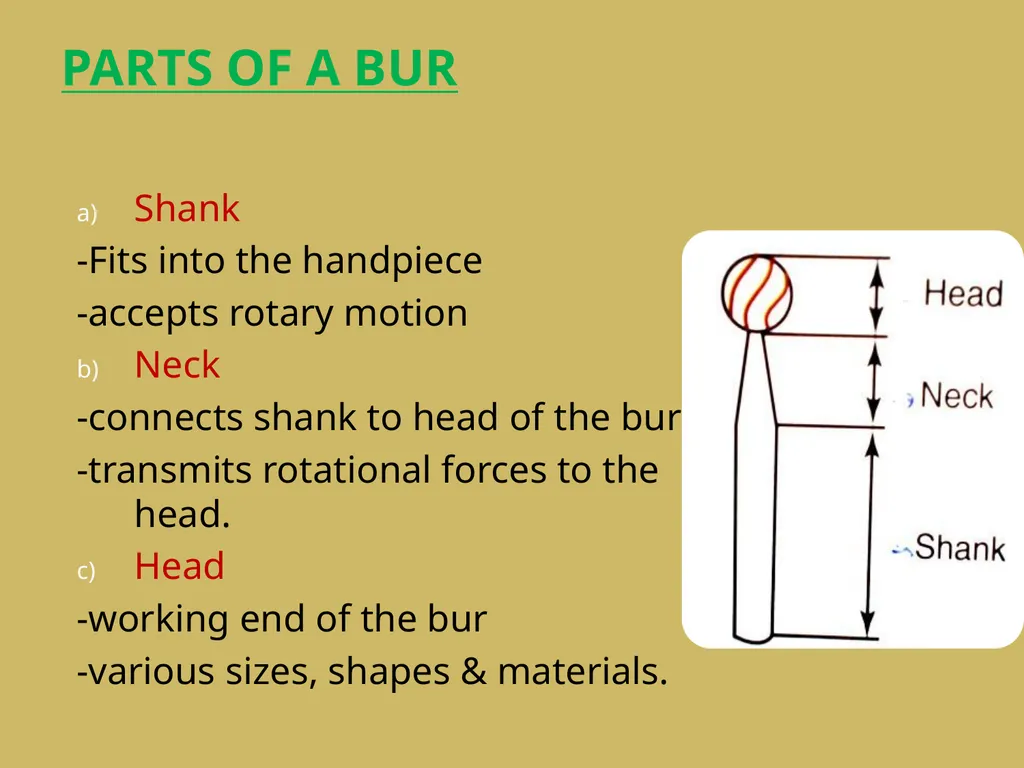
slide31. PARTS OF A BUR Shank
-Fits into the handpiece
-accepts rotary motion
Neck
-connects shank to head of the bur
-transmits rotational forces to the head.
Head
-working end of the bur
-various sizes, shapes & materials.<br>
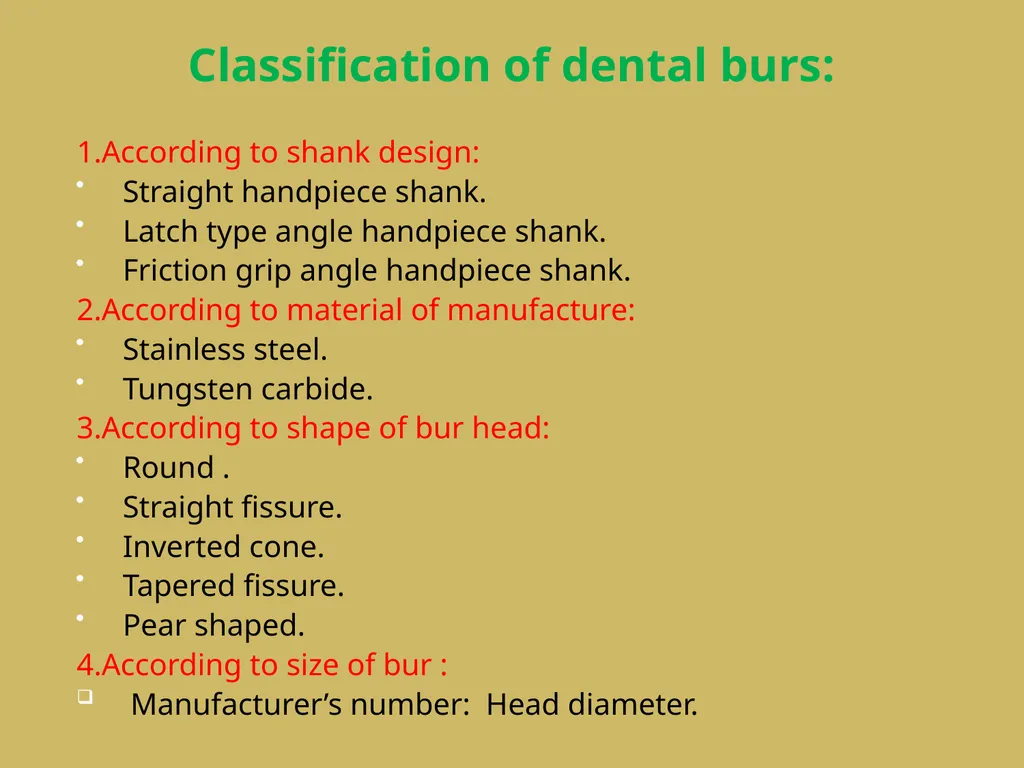
slide32. Classification of dental burs: 1.According to shank design:
Straight handpiece shank.
Latch type angle handpiece shank.
Friction grip angle handpiece shank.
2.According to material of manufacture:
Stainless steel.
Tungsten carbide.
3.According to shape of bur head:
Round .
Straight fissure.
Inverted cone.
Tapered fissure.
Pear shaped.
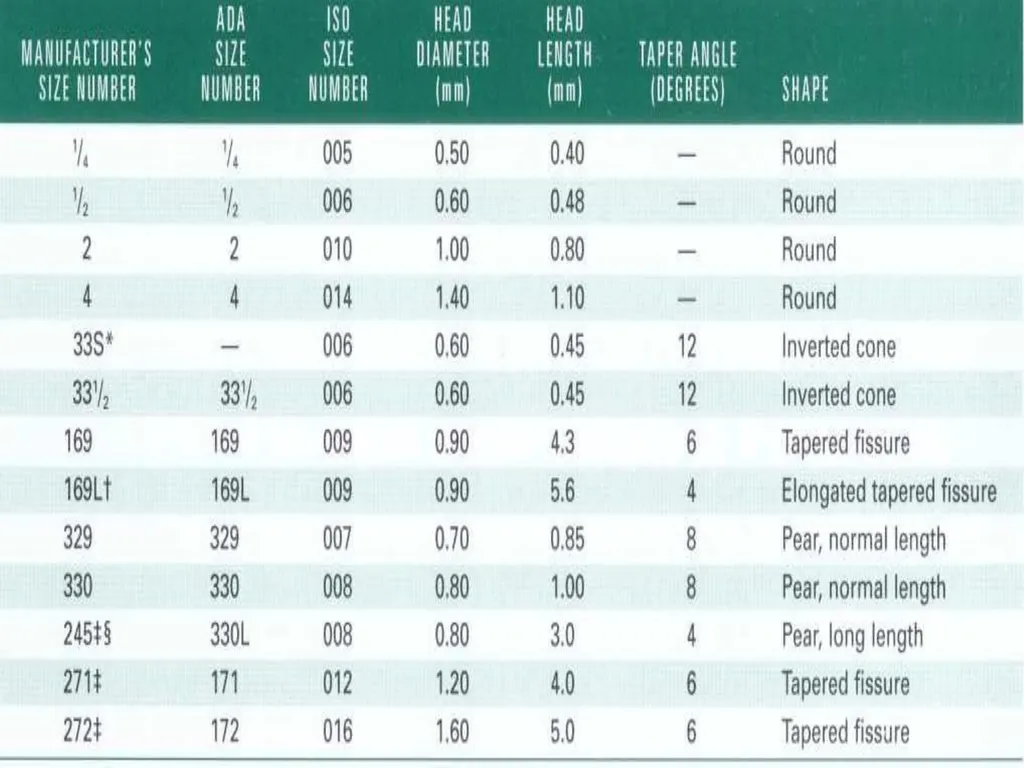
4.According to size of bur :
Manufacturer’s number: Head diameter.<br>
slide33. 5.According to their use:
a) Cutting burs
b) Finishing & polishing burs<br>
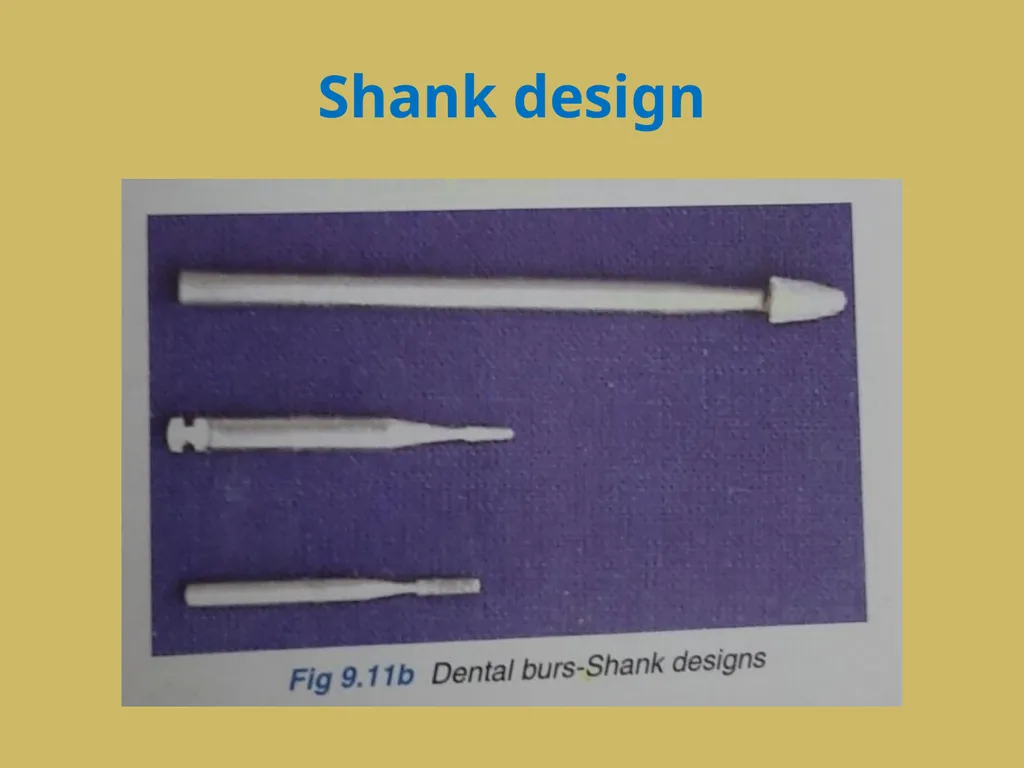
slide34. Shank design<br>
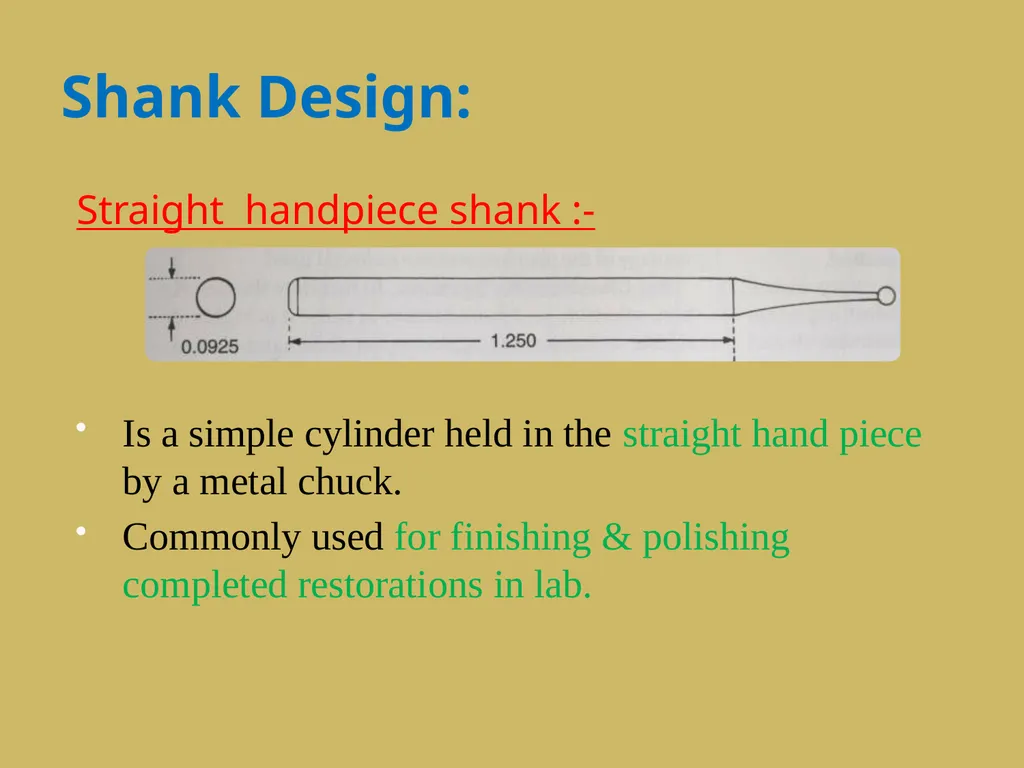
slide35. Shank Design: Straight handpiece shank :-
Is a simple cylinder held in the straight hand piece by a metal chuck.
Commonly used for finishing & polishing completed restorations in lab.<br>
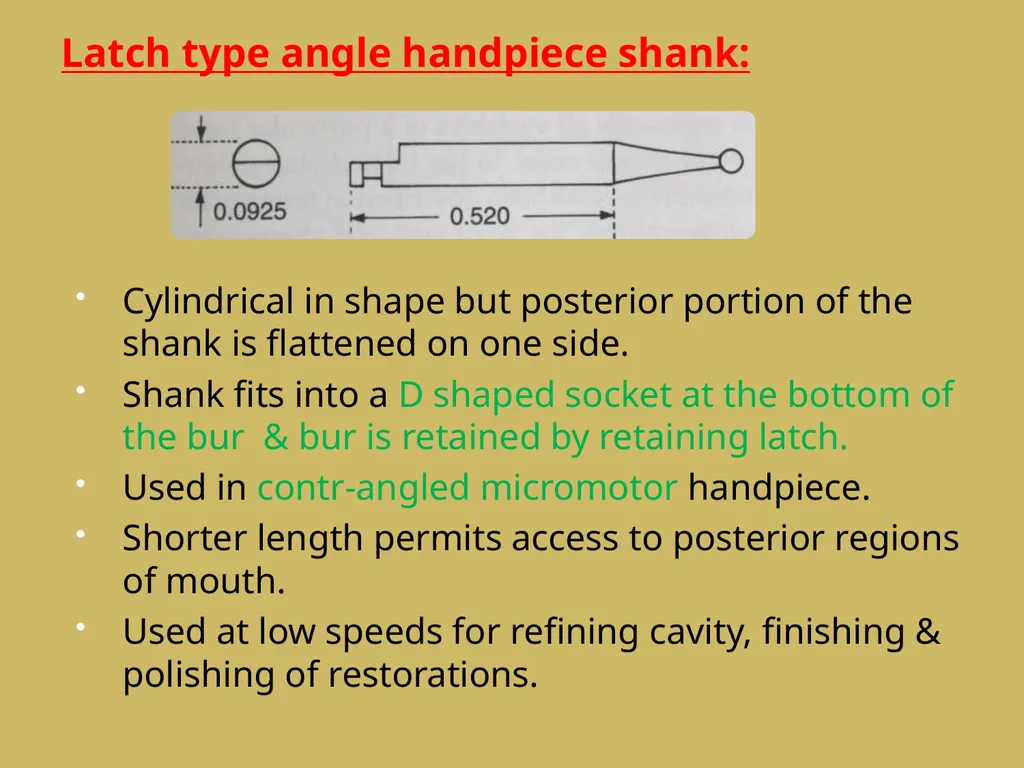
slide36. Latch type angle handpiece shank: Cylindrical in shape but posterior portion of the shank is flattened on one side.
Shank fits into a D shaped socket at the bottom of the bur & bur is retained by retaining latch.
Used in contr-angled micromotor handpiece.
Shorter length permits access to posterior regions of mouth.
Used at low speeds for refining cavity, finishing & polishing of restorations.<br>
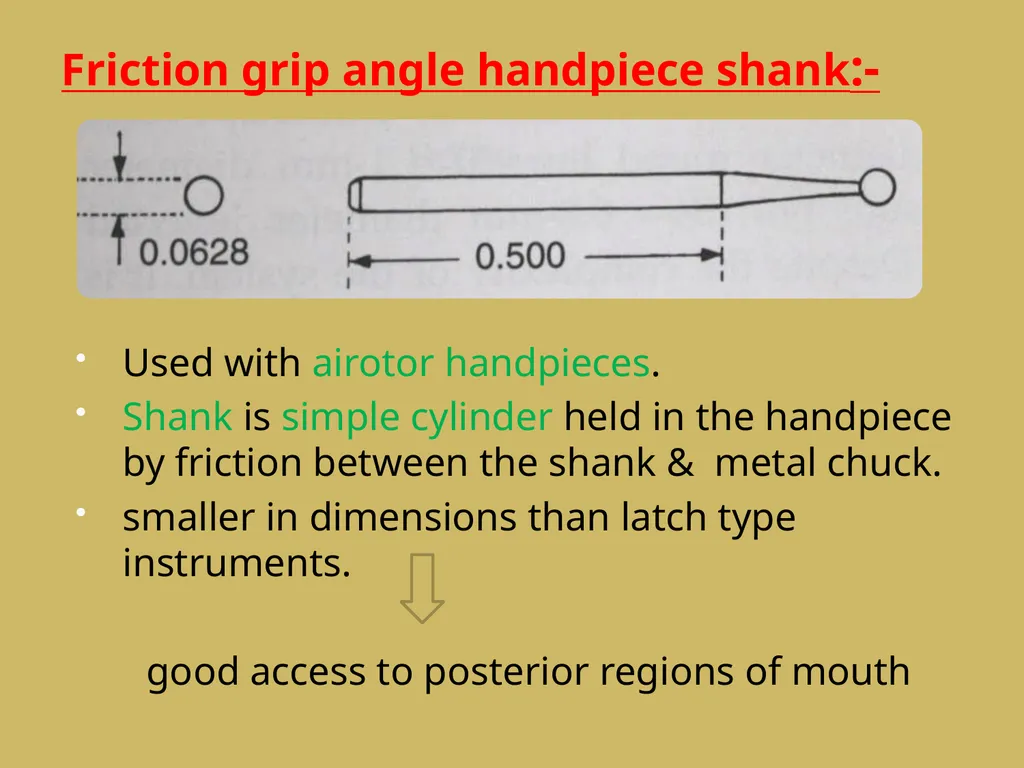
slide37. Friction grip angle handpiece shank:- Used with airotor handpieces.
Shank is simple cylinder held in the handpiece by friction between the shank & metal chuck.
smaller in dimensions than latch type instruments.
good access to posterior regions of mouth<br>
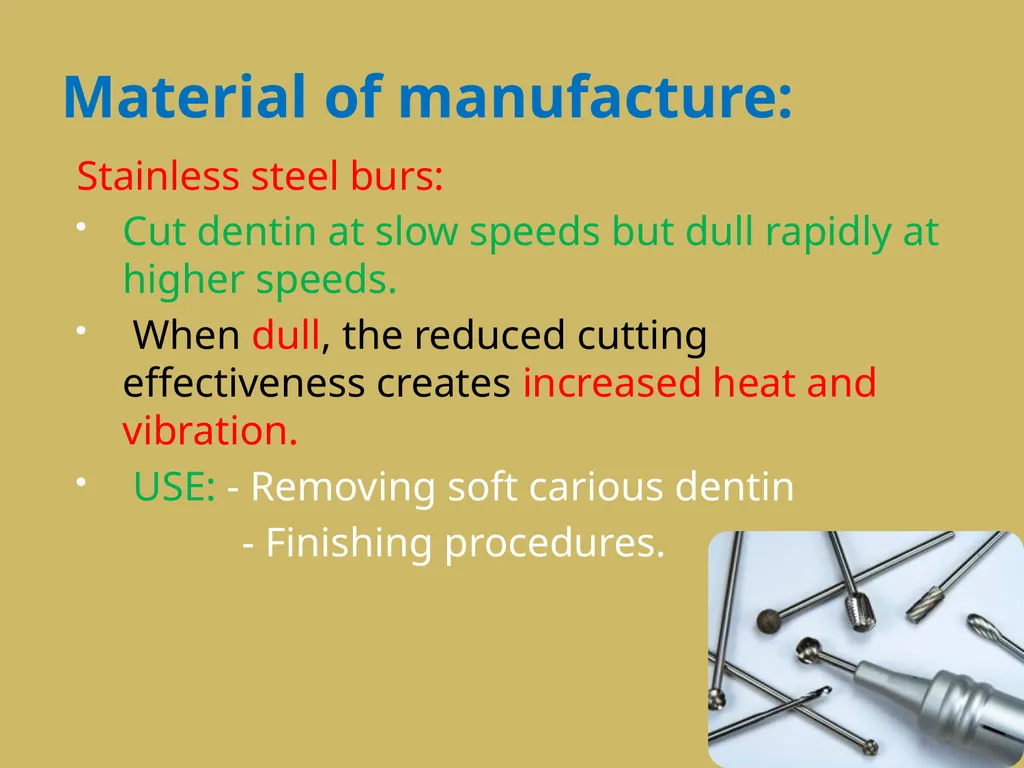
slide38. Material of manufacture: Stainless steel burs:
Cut dentin at slow speeds but dull rapidly at higher speeds.
When dull, the reduced cutting effectiveness creates increased heat and vibration.
USE: - Removing soft carious dentin
- Finishing procedures.<br>
slide39. Tungsten Carbide burs:-
Perform better at all speeds & their superiority is greatest at high speeds.
Carbide is stiffer & harder than steel therefore does not dull rapidly
But more brittle & susceptible to fracture when subjected to sudden blow or shock.<br>
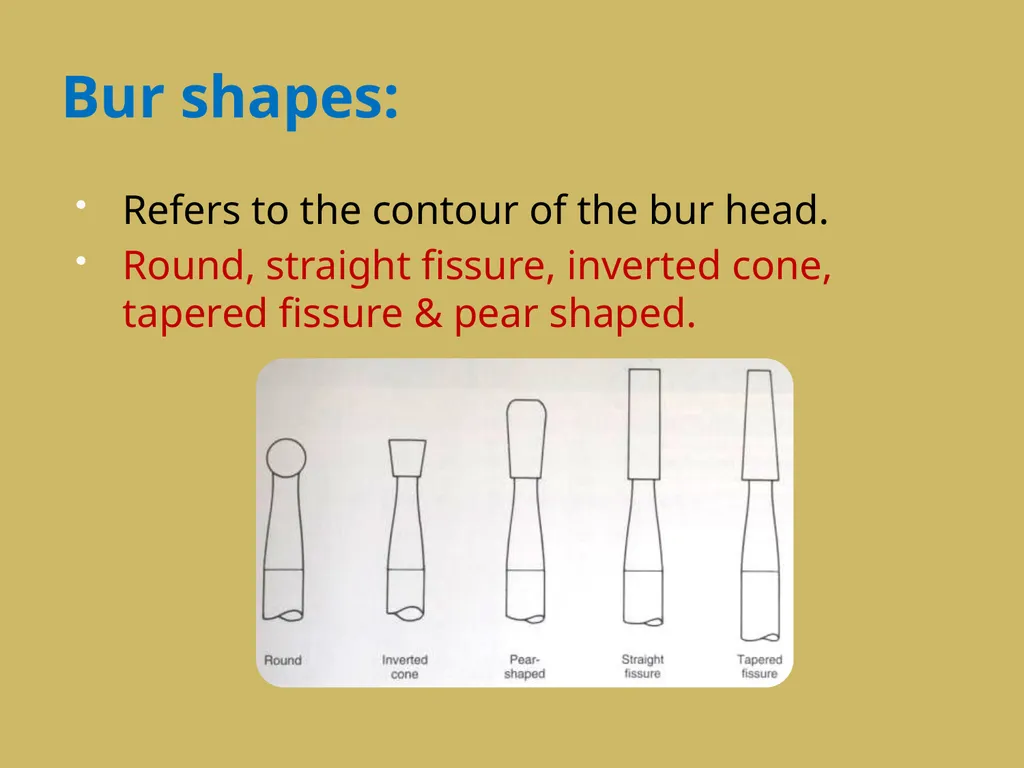
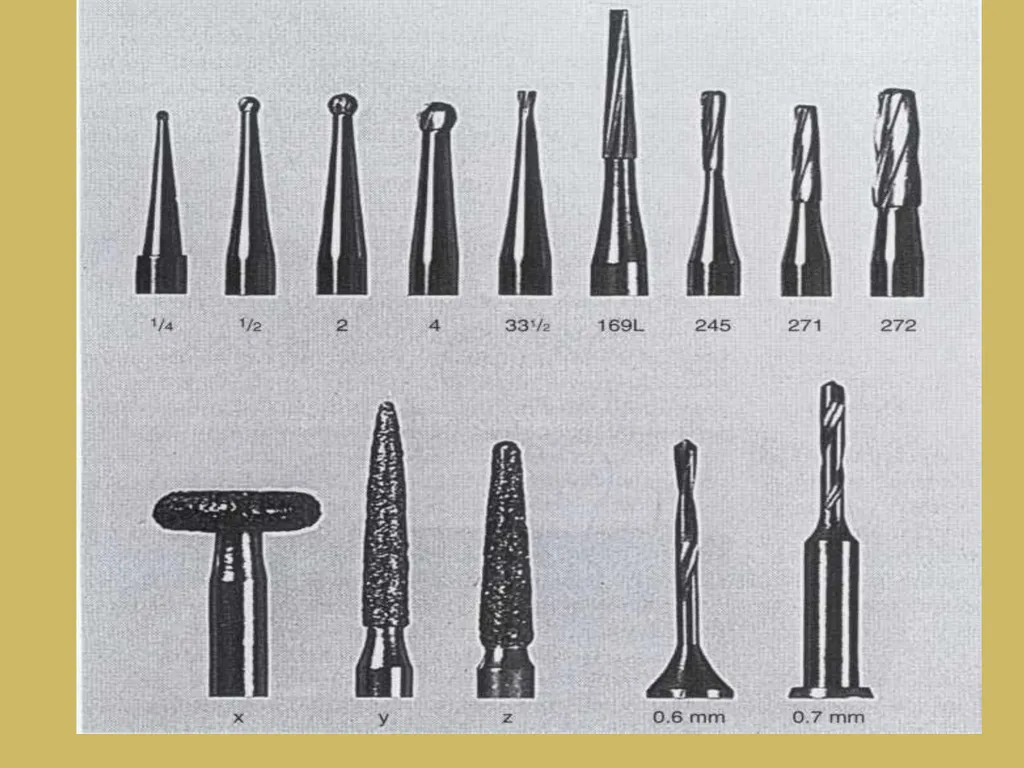
slide40. Bur shapes: Refers to the contour of the bur head.
Round, straight fissure, inverted cone, tapered fissure & pear shaped.<br>
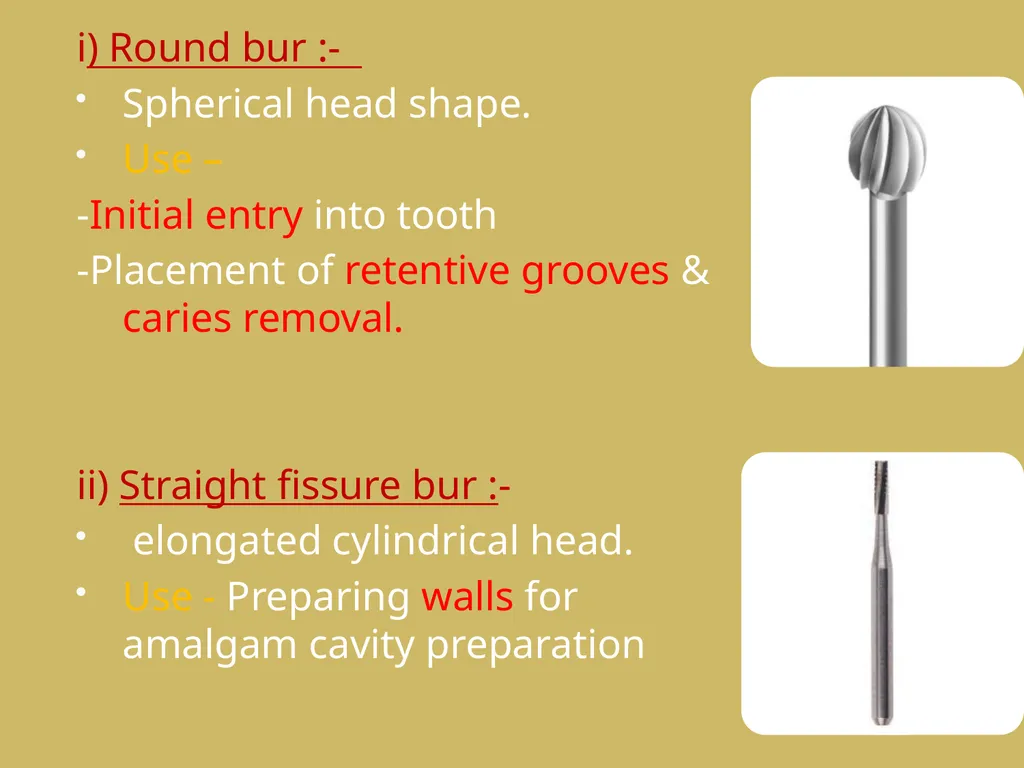
slide41. i) Round bur :-
Spherical head shape.
Use –
-Initial entry into tooth
-Placement of retentive grooves & caries removal.
ii) Straight fissure bur :-
elongated cylindrical head.
Use - Preparing walls for amalgam cavity preparation<br>
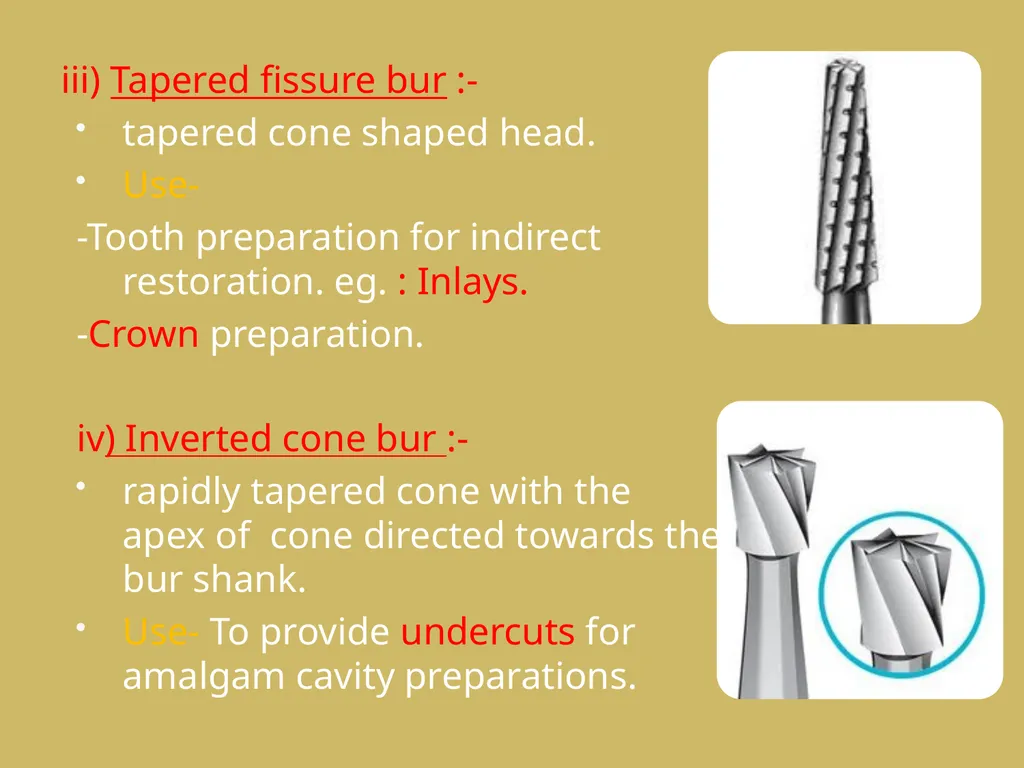
slide42. iii) Tapered fissure bur :-
tapered cone shaped head.
Use-
-Tooth preparation for indirect restoration. eg. : Inlays.
-Crown preparation.
iv) Inverted cone bur :-
rapidly tapered cone with the apex of cone directed towards the bur shank.
Use- To provide undercuts for amalgam cavity preparations.<br>
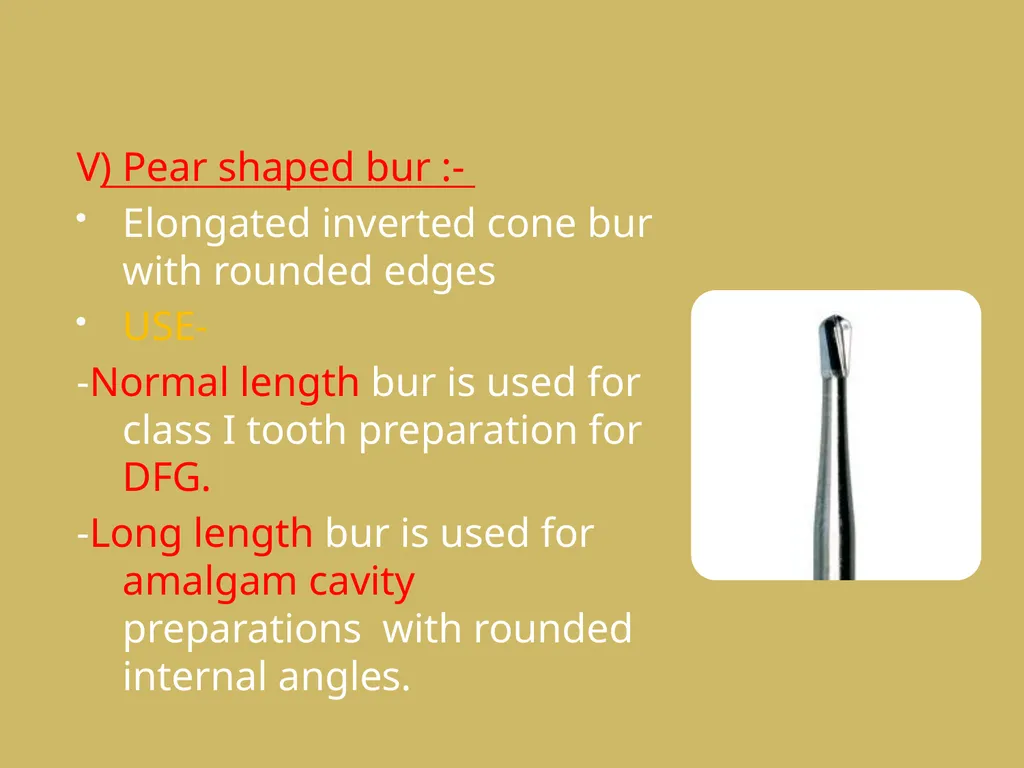
slide43. V) Pear shaped bur :-
Elongated inverted cone bur with rounded edges
USE-
-Normal length bur is used for class I tooth preparation for DFG.
-Long length bur is used for amalgam cavity preparations with rounded internal angles.<br>
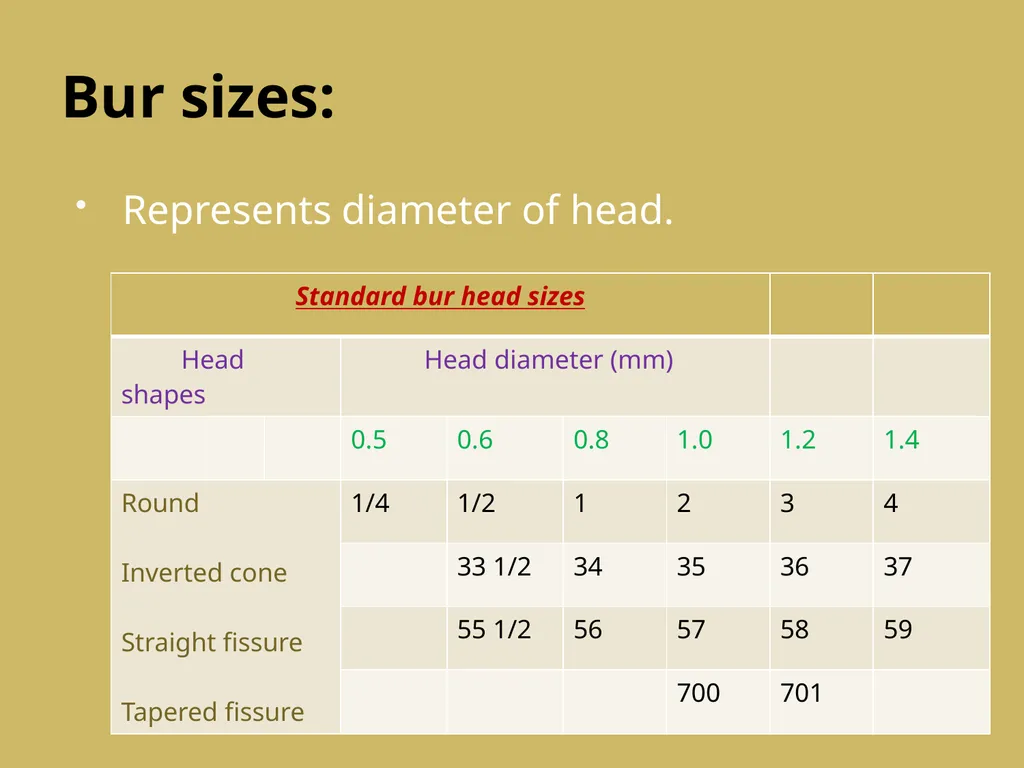
slide44. Bur sizes: Represents diameter of head.<br>
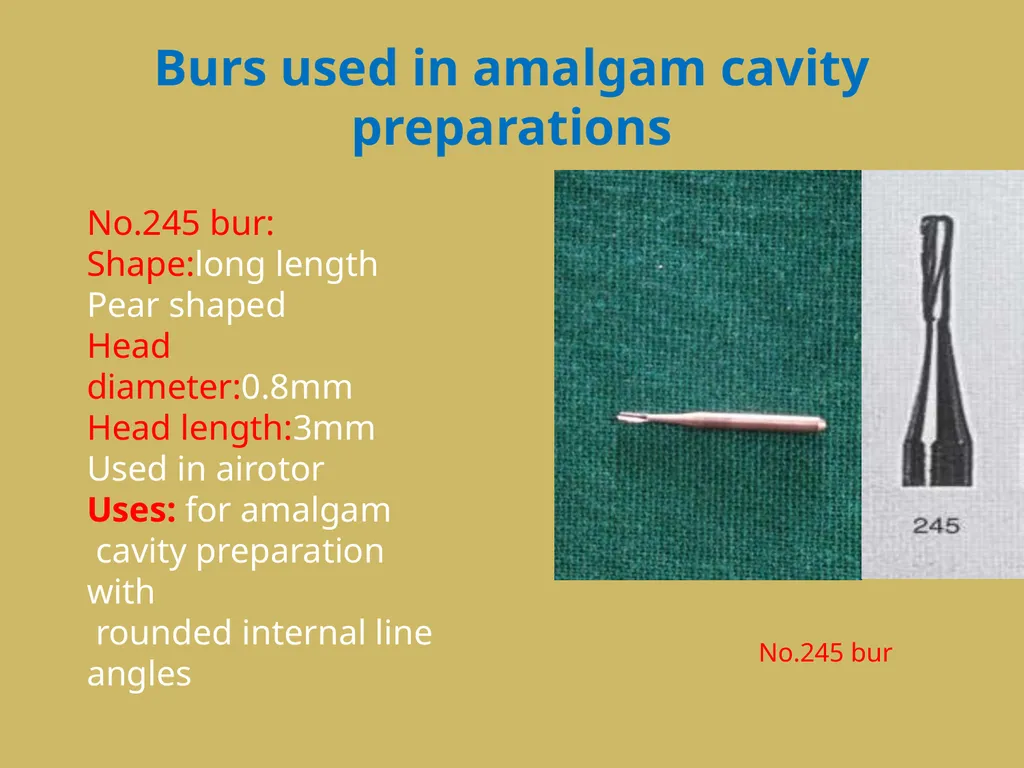
slide47. Burs used in amalgam cavity preparations No.245 bur No.245 bur:
Shape:long length Pear shaped
Head diameter:0.8mm
Head length:3mm
Used in airotor
Uses: for amalgam
cavity preparation with
rounded internal line angles<br>
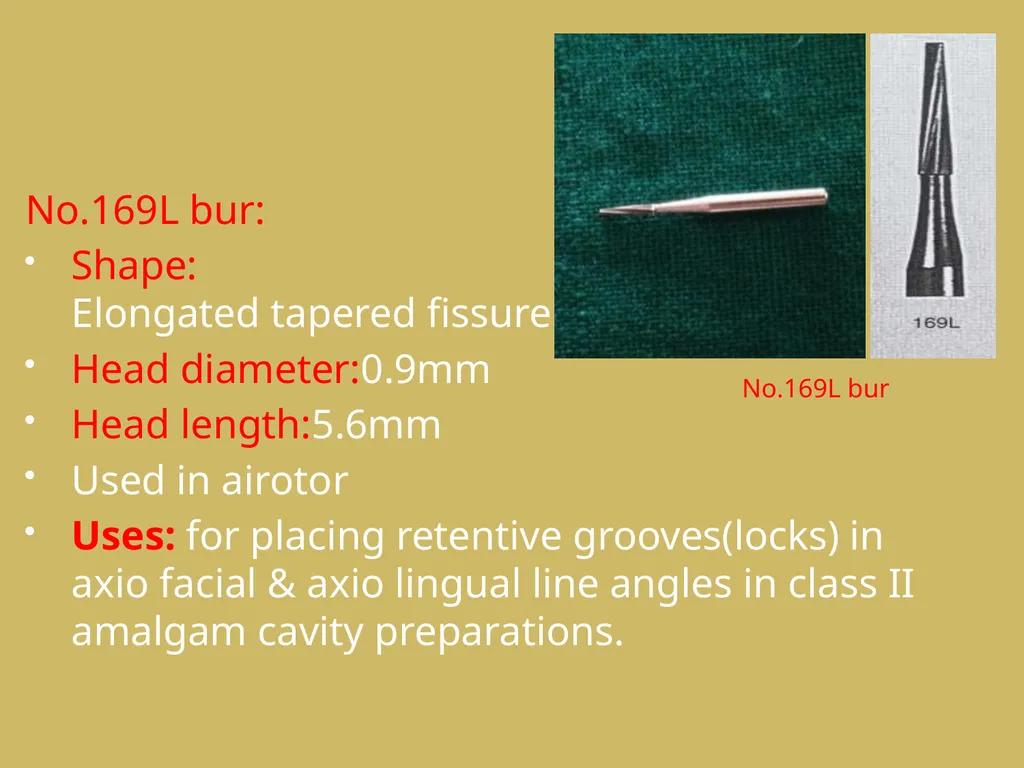
slide48. No.169L bur:
Shape: Elongated tapered fissure
Head diameter:0.9mm
Head length:5.6mm
Used in airotor
Uses: for placing retentive grooves(locks) in axio facial & axio lingual line angles in class II amalgam cavity preparations. No.169L bur<br>
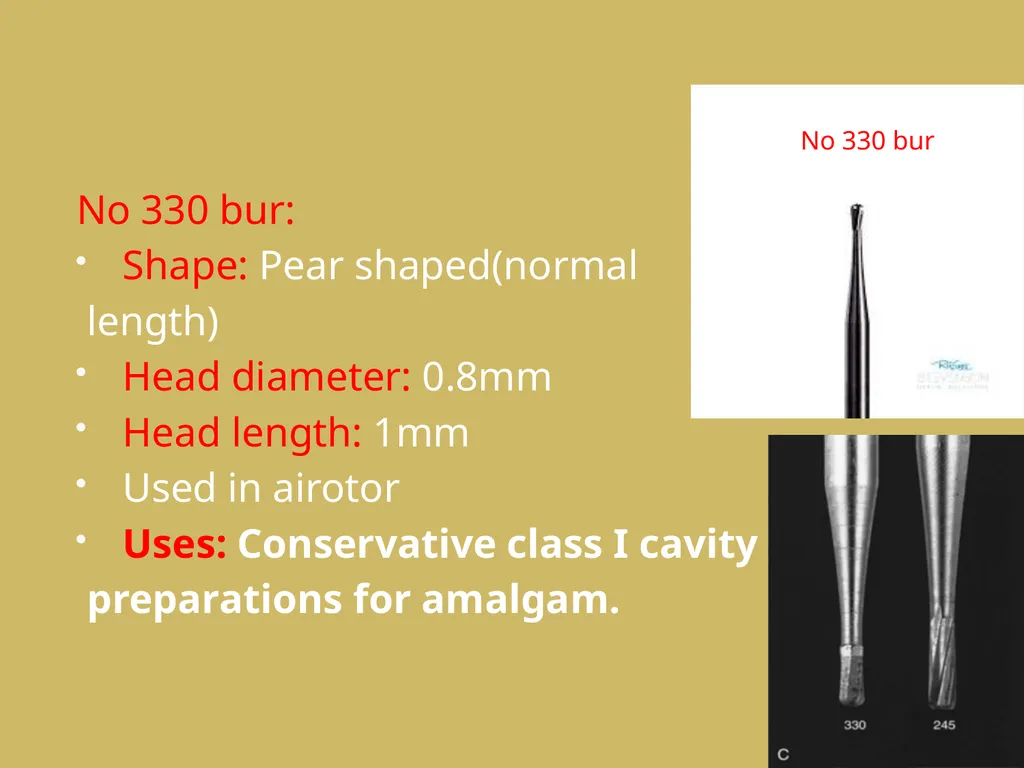
slide49. No 330 bur:
Shape: Pear shaped(normal
length)
Head diameter: 0.8mm
Head length: 1mm
Used in airotor
Uses: Conservative class I cavity
preparations for amalgam. No 330 bur<br>
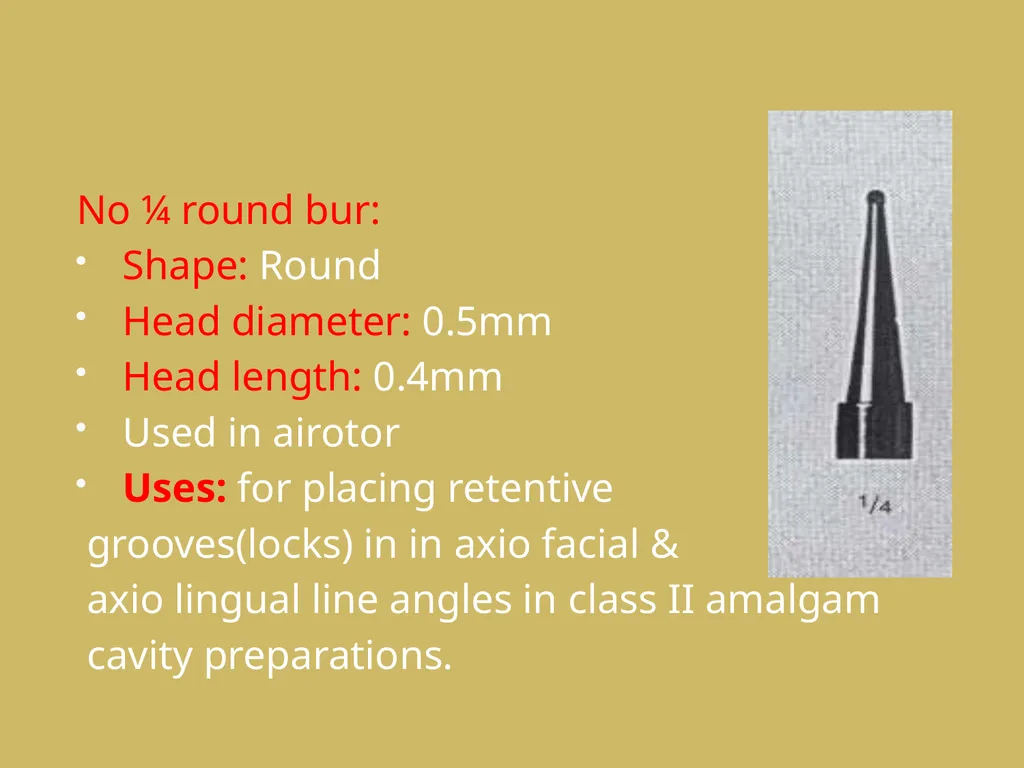
slide50. No ¼ round bur:
Shape: Round
Head diameter: 0.5mm
Head length: 0.4mm
Used in airotor
Uses: for placing retentive
grooves(locks) in in axio facial &
axio lingual line angles in class II amalgam
cavity preparations.<br>
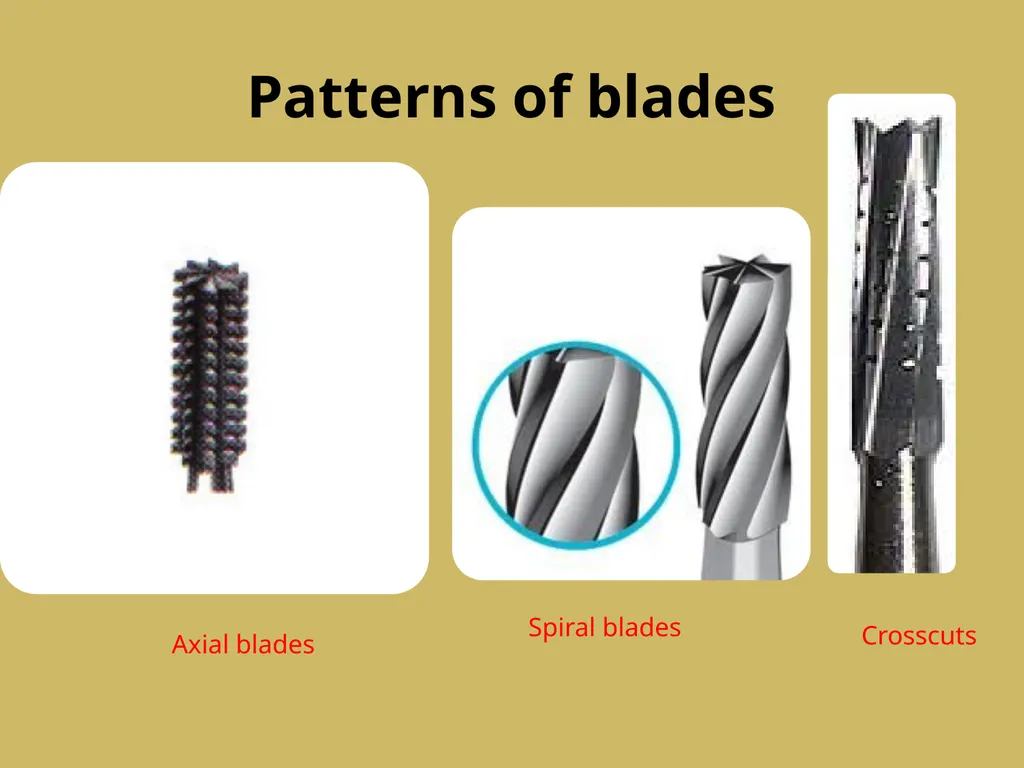
slide51. Patterns of blades Axial blades Spiral blades Crosscuts<br>
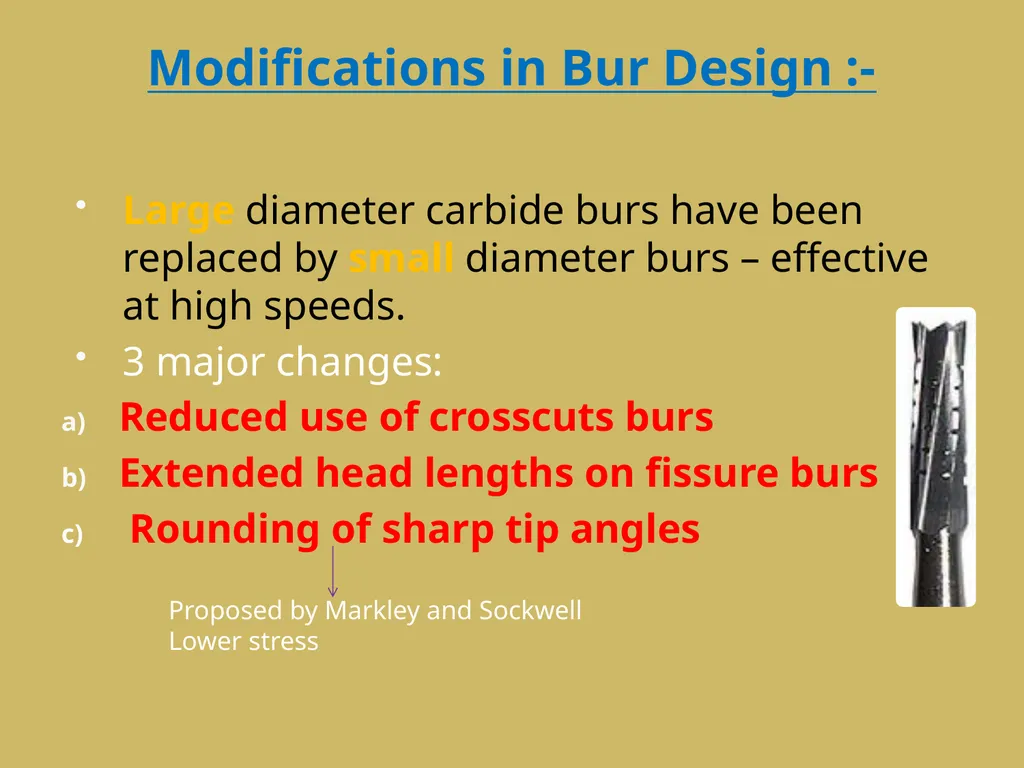
slide52. Modifications in Bur Design :- Large diameter carbide burs have been replaced by small diameter burs – effective at high speeds.
3 major changes:
Reduced use of crosscuts burs
Extended head lengths on fissure burs
c) Rounding of sharp tip angles Proposed by Markley and Sockwell
Lower stress<br>
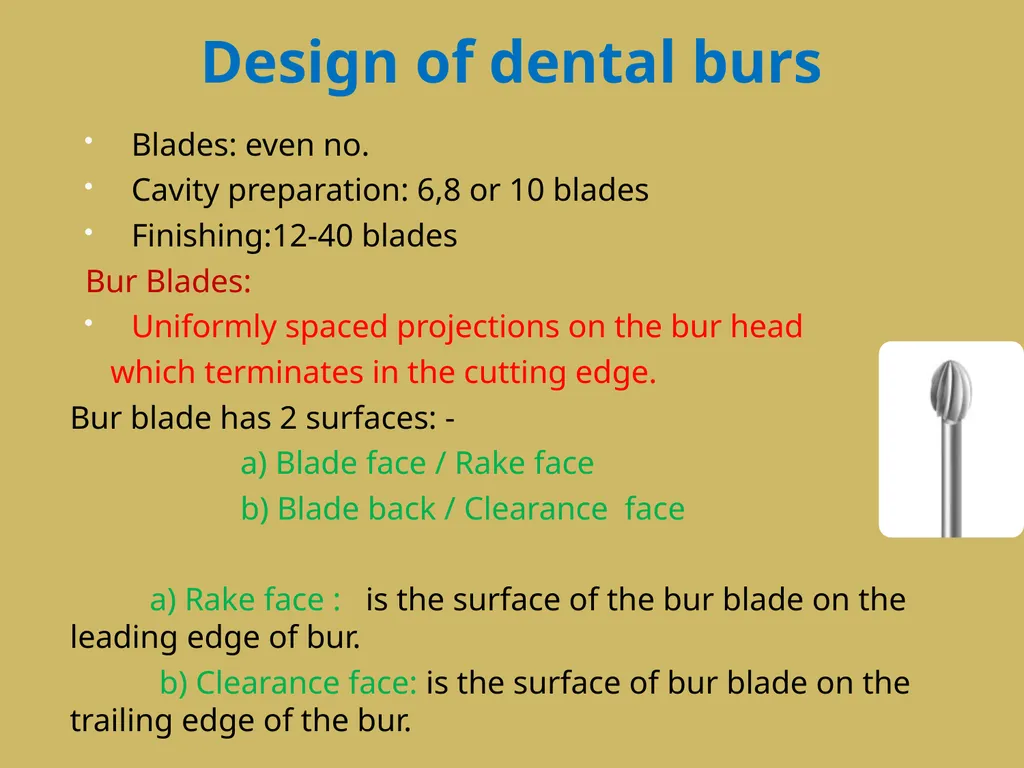
slide53. Design of dental burs Blades: even no.
Cavity preparation: 6,8 or 10 blades
Finishing:12-40 blades
Bur Blades:
Uniformly spaced projections on the bur head
which terminates in the cutting edge.
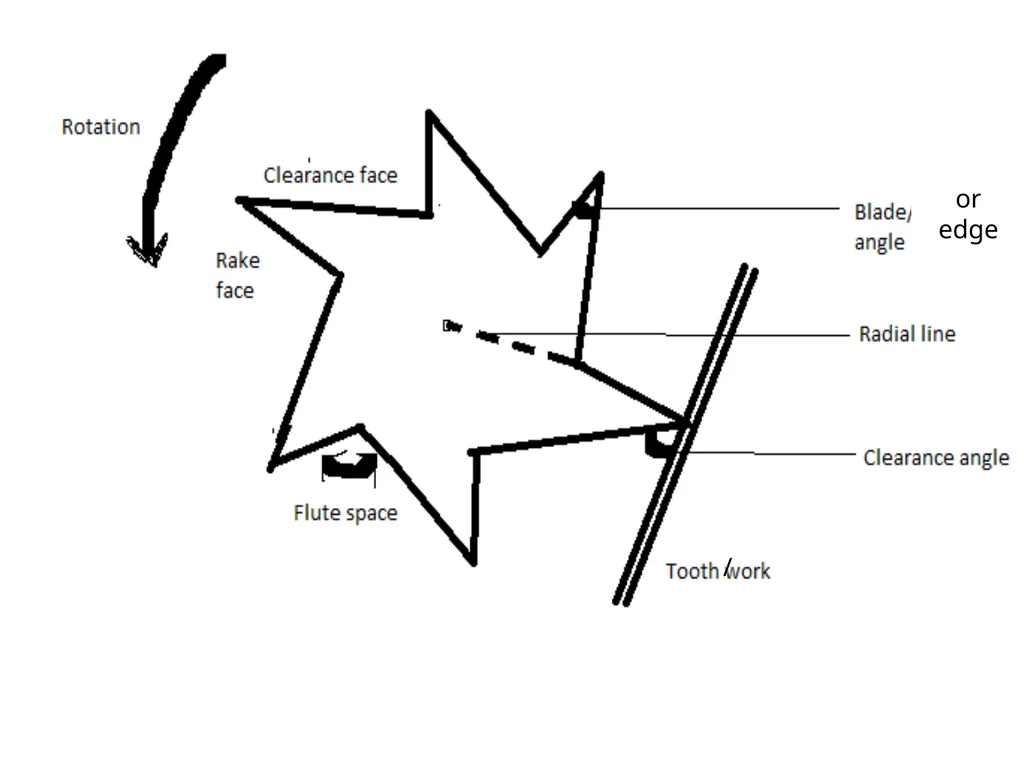
Bur blade has 2 surfaces: -
a) Blade face / Rake face
b) Blade back / Clearance face
a) Rake face : is the surface of the bur blade on the leading edge of bur.
b) Clearance face: is the surface of bur blade on the trailing edge of the bur.<br>
slide54. / or edge<br>
slide56. Flute space:-
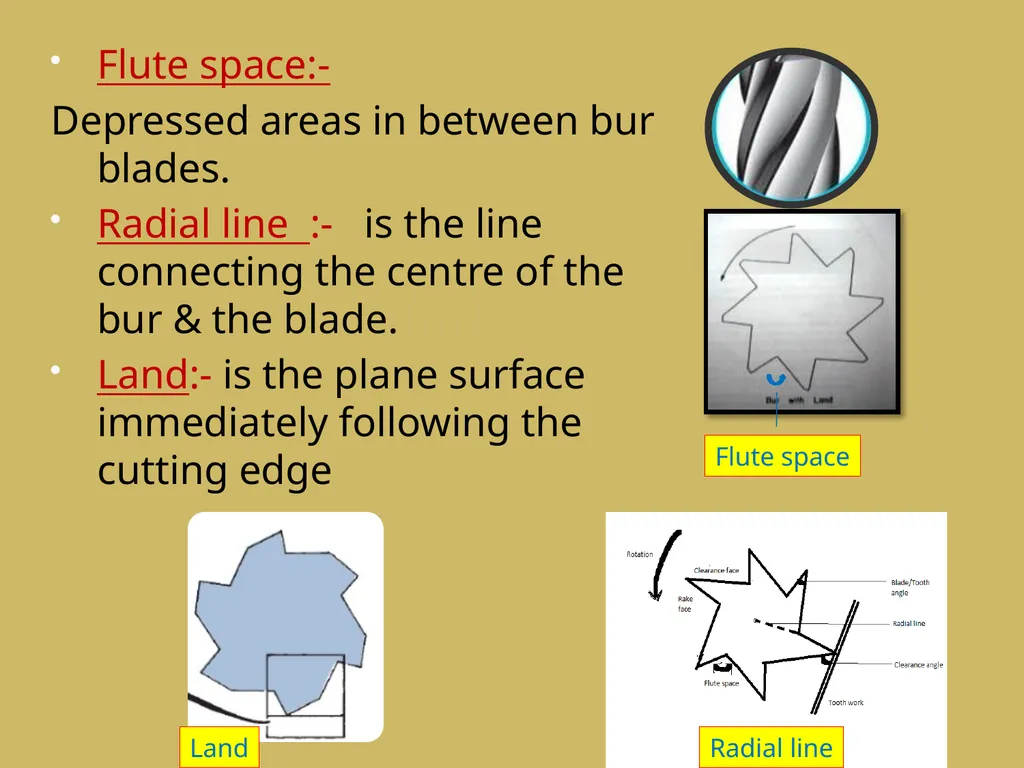
Depressed areas in between bur blades.
Radial line :- is the line connecting the centre of the bur & the blade.
Land:- is the plane surface immediately following the cutting edge Flute space Land Radial line<br>
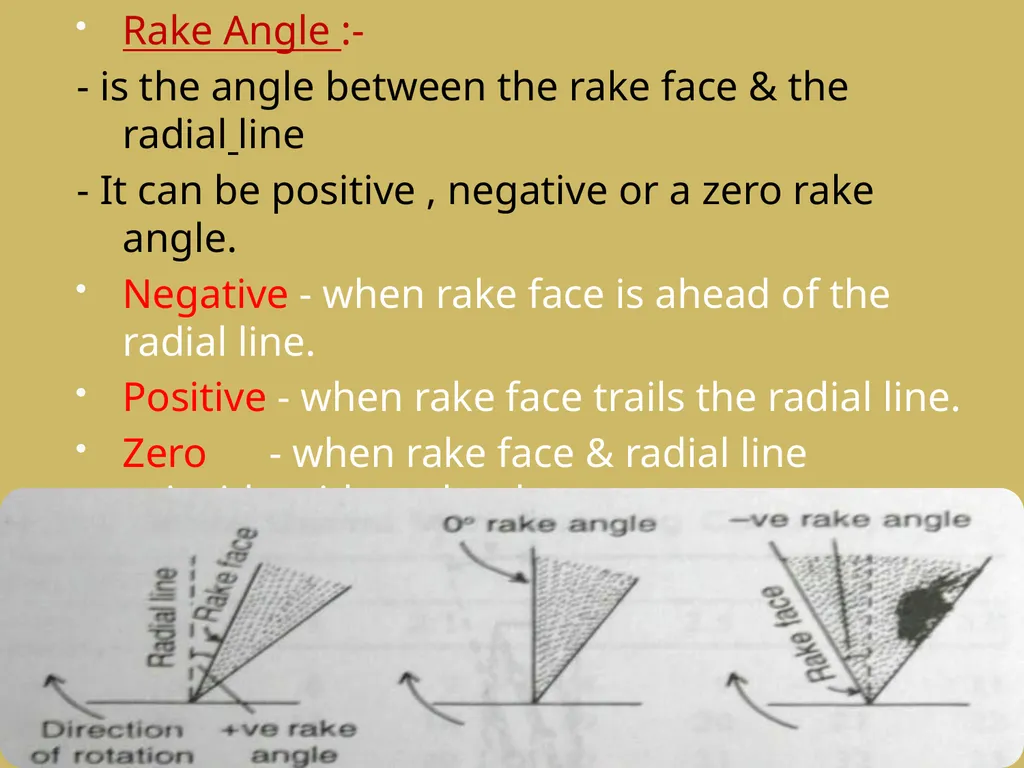
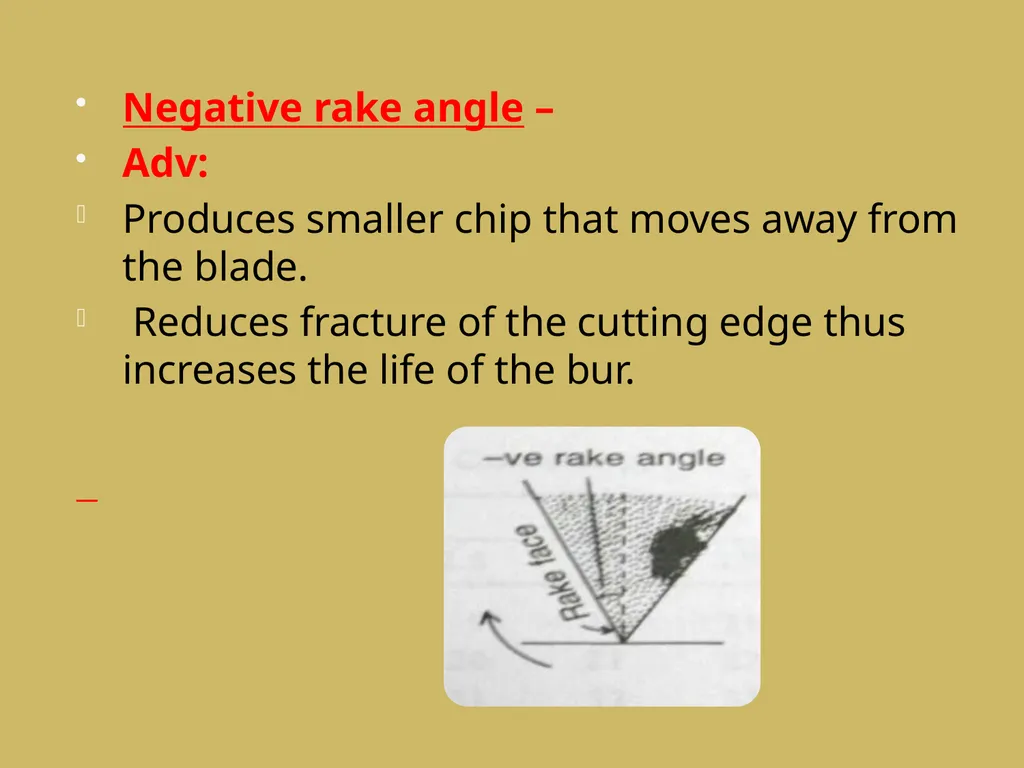
slide57. Rake Angle :-
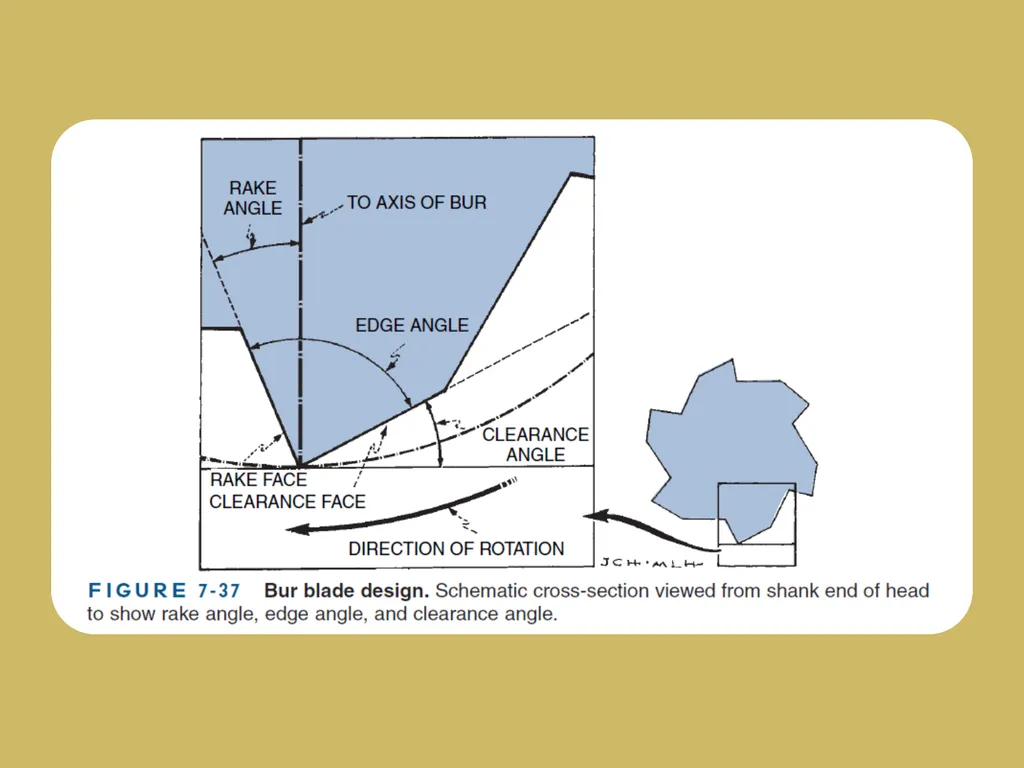
- is the angle between the rake face & the radial line
- It can be positive , negative or a zero rake angle.
Negative - when rake face is ahead of the radial line.
Positive - when rake face trails the radial line.
Zero - when rake face & radial line coincide with each other.<br>
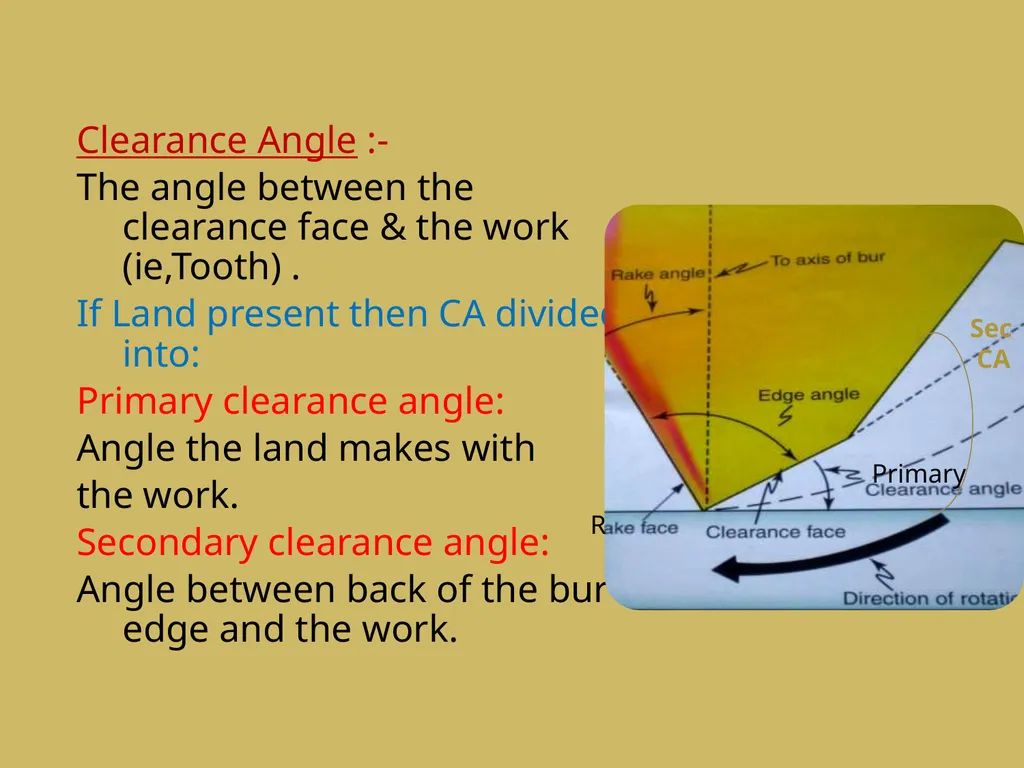
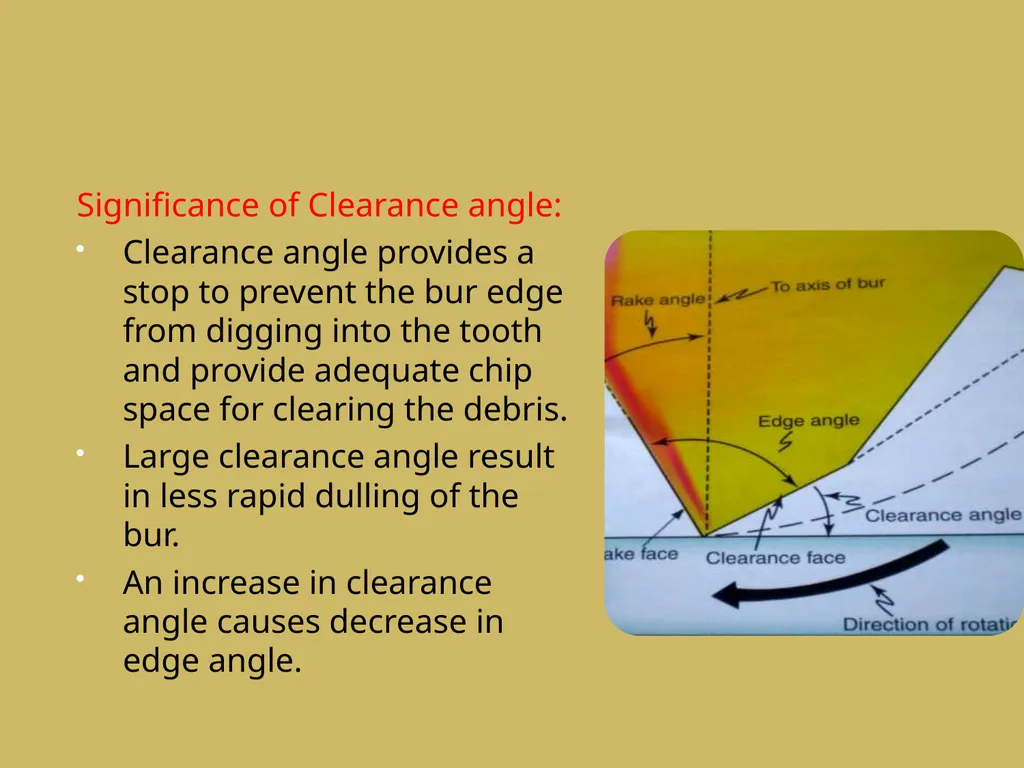
slide58. Clearance Angle :-
The angle between the clearance face & the work (ie,Tooth) .
If Land present then CA divided into:
Primary clearance angle:
Angle the land makes with
the work.
Secondary clearance angle:
Angle between back of the bur edge and the work. R Primary Sec
CA<br>
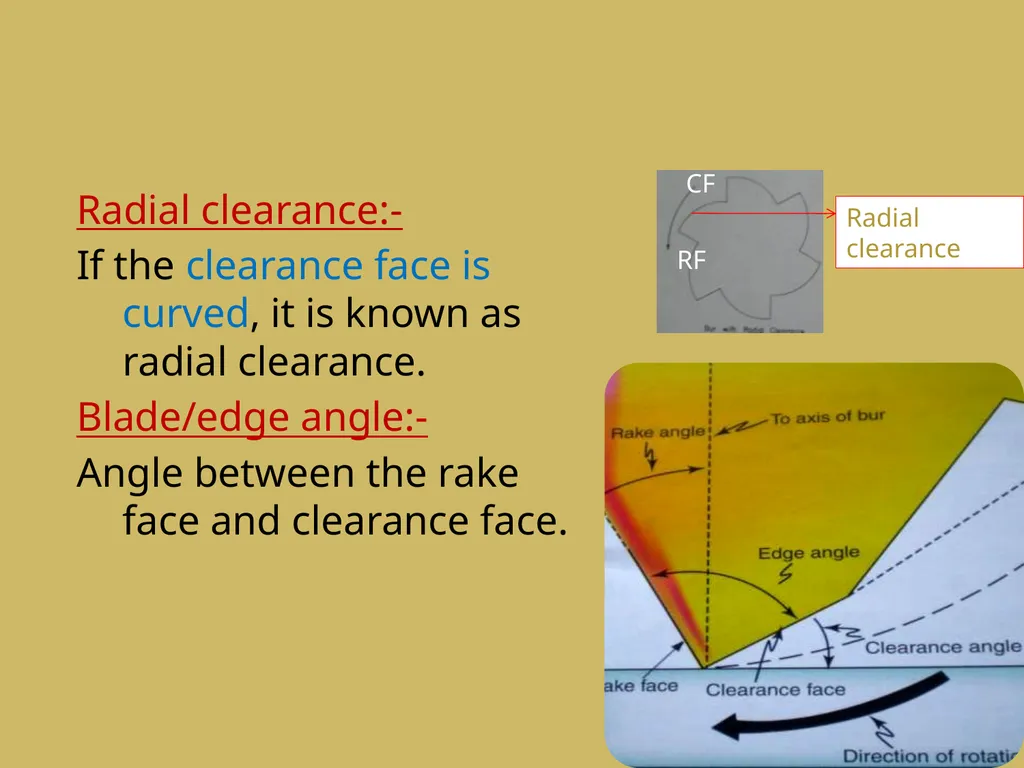
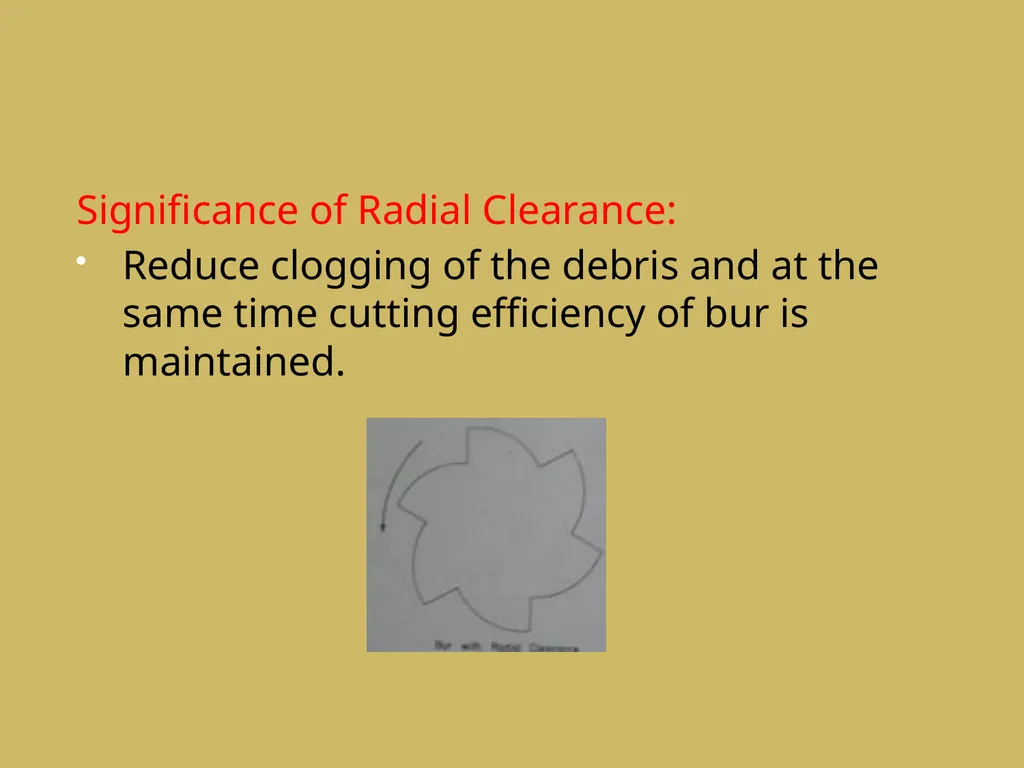
slide59. Radial clearance:-
If the clearance face is curved, it is known as radial clearance.
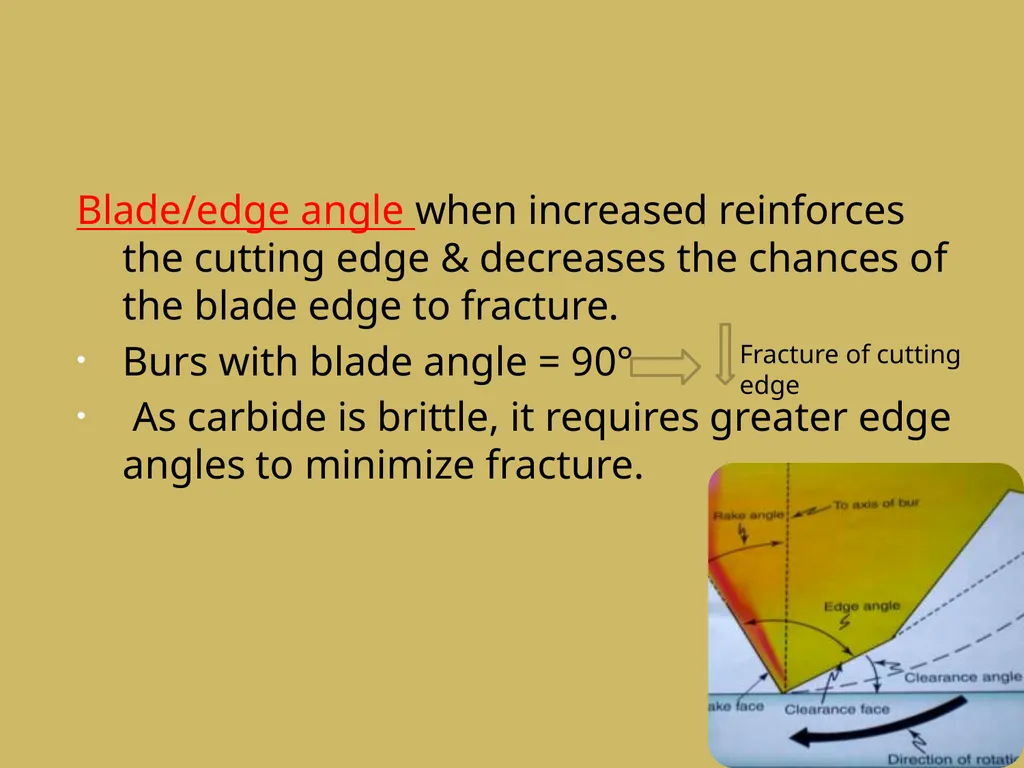
Blade/edge angle:-
Angle between the rake face and clearance face. Radial clearance CF RF<br>
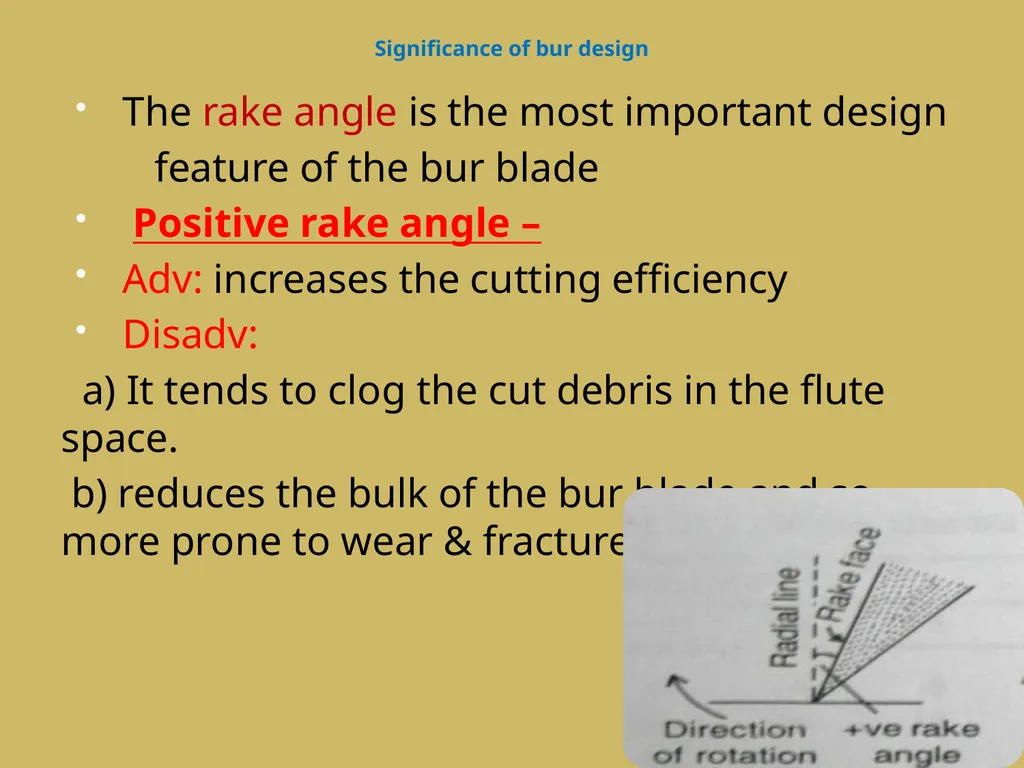
slide60. Significance of bur design The rake angle is the most important design
feature of the bur blade
Positive rake angle –
Adv: increases the cutting efficiency
Disadv:
a) It tends to clog the cut debris in the flute space.
b) reduces the bulk of the bur blade and so more prone to wear & fracture.<br>
slide61. Negative rake angle –
Adv:
Produces smaller chip that moves away from the blade.
Reduces fracture of the cutting edge thus increases the life of the bur.<br>
slide62. Significance of Clearance angle:
Clearance angle provides a stop to prevent the bur edge from digging into the tooth and provide adequate chip space for clearing the debris.
Large clearance angle result in less rapid dulling of the bur.
An increase in clearance angle causes decrease in edge angle.<br>
slide63. Significance of Radial Clearance:
Reduce clogging of the debris and at the same time cutting efficiency of bur is maintained.<br>
slide64. Blade/edge angle when increased reinforces the cutting edge & decreases the chances of the blade edge to fracture.
Burs with blade angle = 90°
As carbide is brittle, it requires greater edge angles to minimize fracture. Fracture of cutting edge<br>
slide65. Neck diameter should be adequate.
-good visibility
-resist lateral forces.<br>
slide66. Concentricity and Run-out Concentricity:
-Symmetry of bur head ( bur is static).
-indicates blades are uniform or not.
Run-out:
-Maximum displacement of bur head from its axis of rotation (bur is in motion).
-occurs when neck is bent or bur head is not in line with axis of bur or bur is not held straight in handpiece chuck.
-it increases vibrations of bur, more heat, excessive removal of tooth structure. Note: Average clinically accepted Run out is :0.023 mm<br>
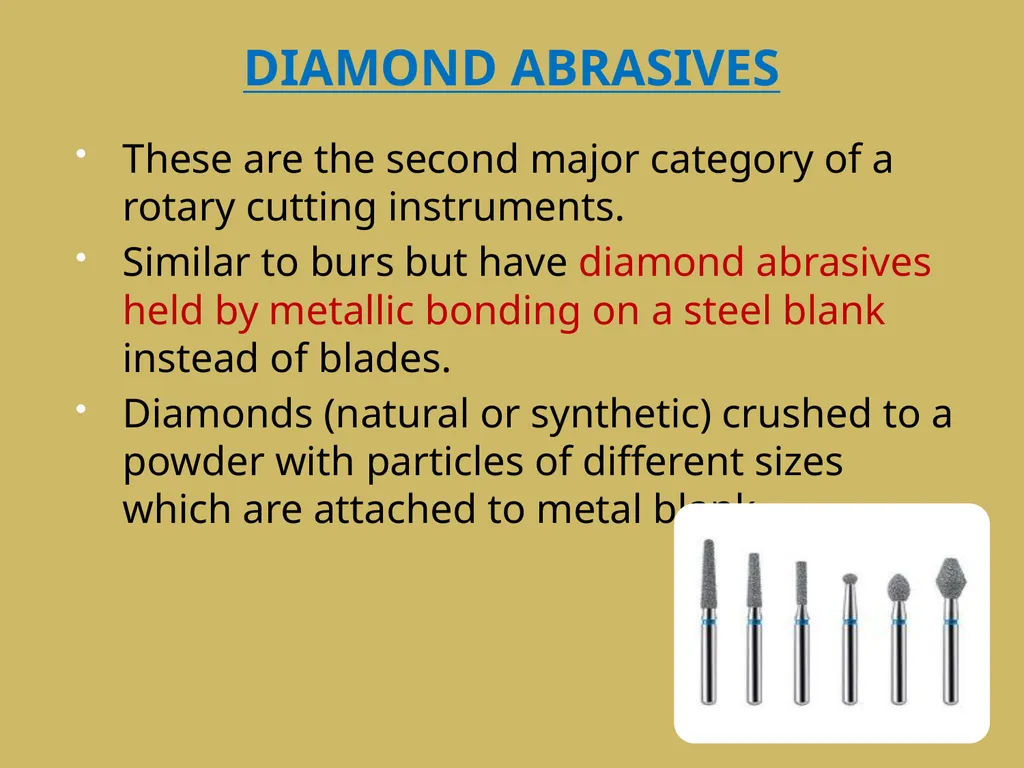
slide67. DIAMOND ABRASIVES These are the second major category of a rotary cutting instruments.
Similar to burs but have diamond abrasives held by metallic bonding on a steel blank instead of blades.
Diamonds (natural or synthetic) crushed to a powder with particles of different sizes which are attached to metal blank.<br>
slide68. Parts:
-Shank
-Neck
-Head
Advantages:
-Greater resistance to abrasion
-lesser heat generation
-more efficient in cutting enamel .<br>
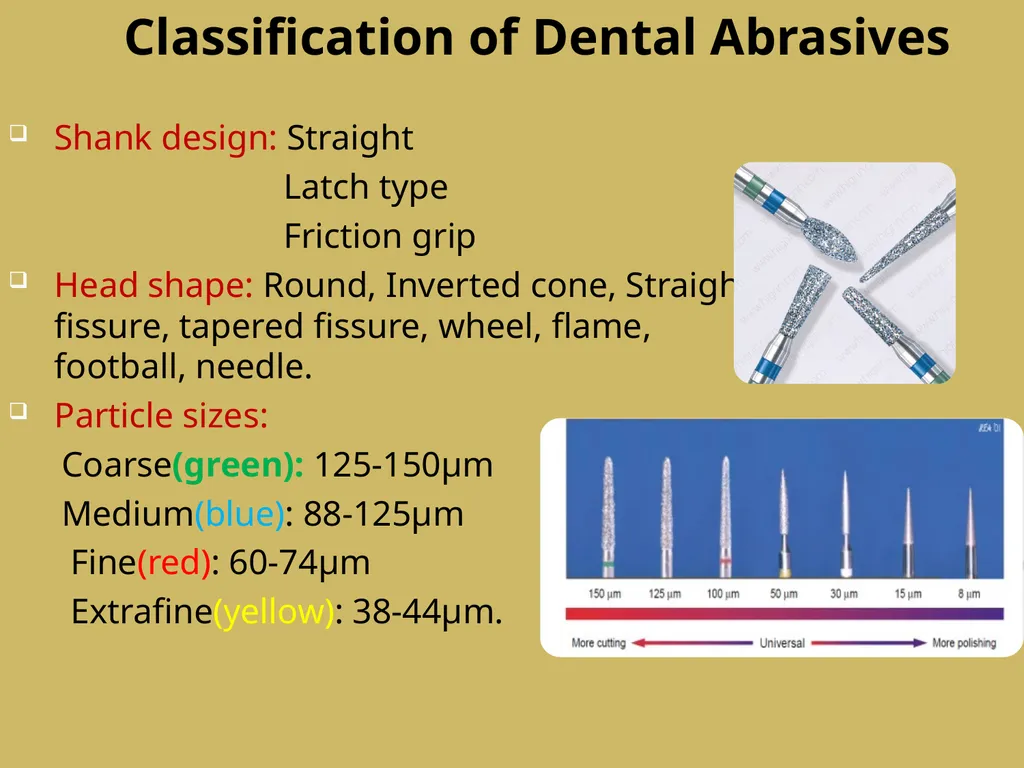
slide69. Classification of Dental Abrasives Shank design: Straight
Latch type
Friction grip
Head shape: Round, Inverted cone, Straight fissure, tapered fissure, wheel, flame, football, needle.
Particle sizes:
Coarse(green): 125-150µm
Medium(blue): 88-125µm
Fine(red): 60-74µm
Extrafine(yellow): 38-44µm.<br>
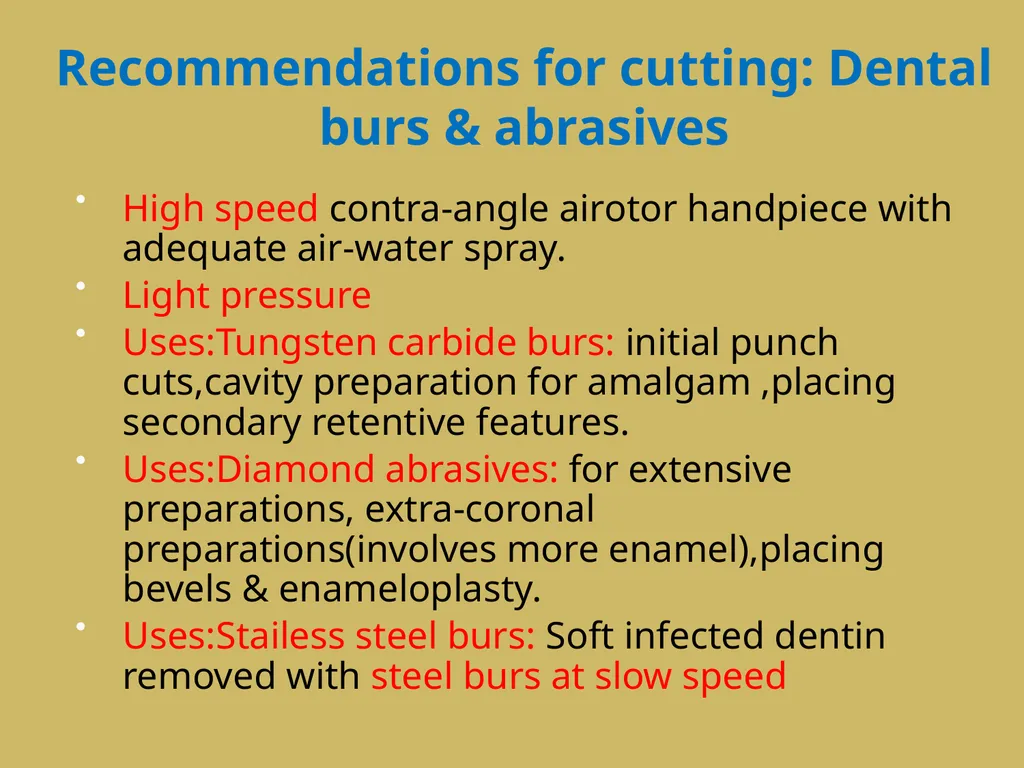
slide70. Recommendations for cutting: Dental burs & abrasives High speed contra-angle airotor handpiece with adequate air-water spray.
Light pressure
Uses:Tungsten carbide burs: initial punch cuts,cavity preparation for amalgam ,placing secondary retentive features.
Uses:Diamond abrasives: for extensive preparations, extra-coronal preparations(involves more enamel),placing bevels & enameloplasty.
Uses:Stailess steel burs: Soft infected dentin removed with steel burs at slow speed<br>
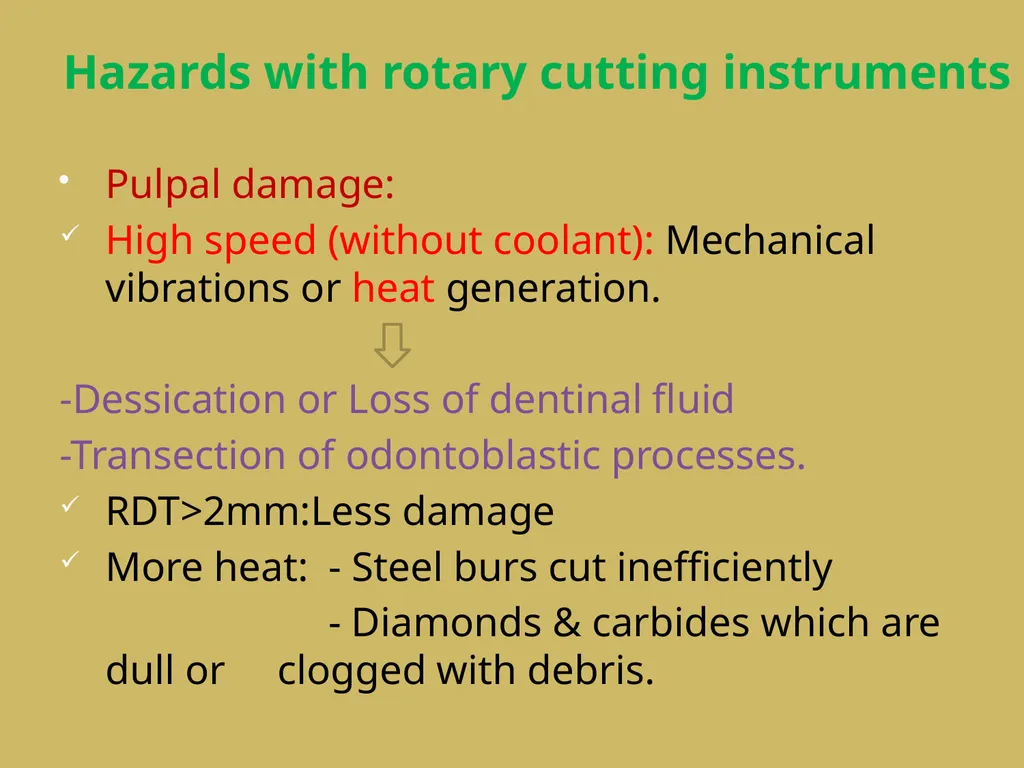
slide72. Hazards with rotary cutting instruments Pulpal damage:
High speed (without coolant): Mechanical vibrations or heat generation.
-Dessication or Loss of dentinal fluid
-Transection of odontoblastic processes.
RDT>2mm:Less damage
More heat: - Steel burs cut inefficiently
- Diamonds & carbides which are dull or clogged with debris.<br>
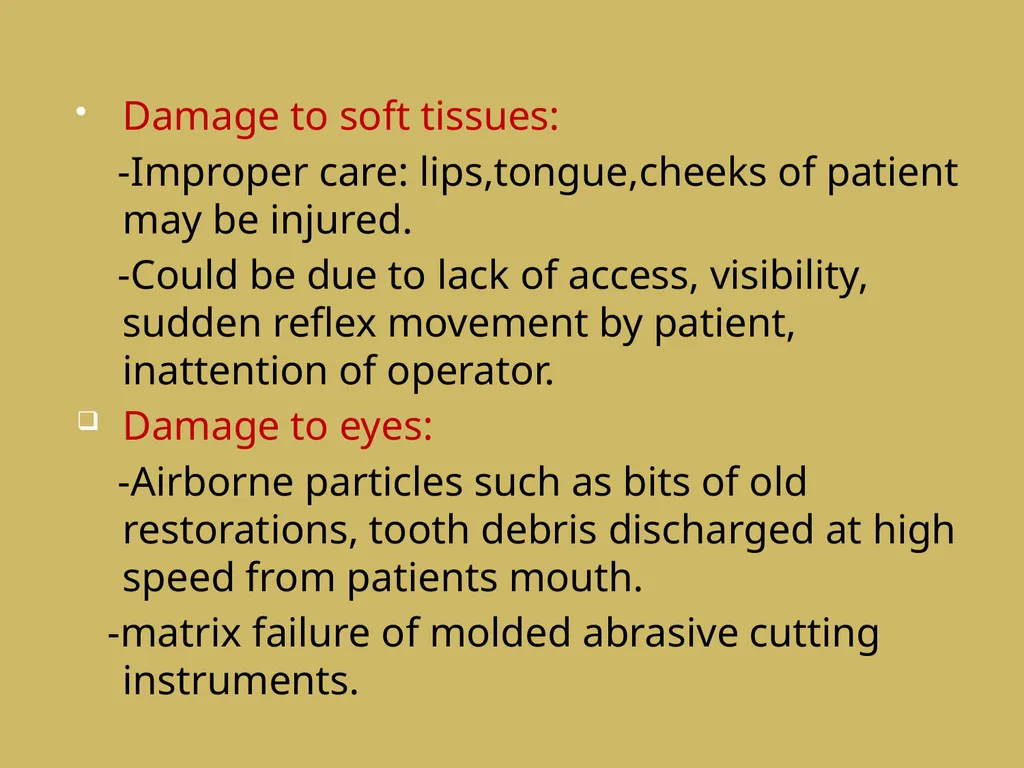
slide73. Damage to soft tissues:
-Improper care: lips,tongue,cheeks of patient may be injured.
-Could be due to lack of access, visibility, sudden reflex movement by patient, inattention of operator.
Damage to eyes:
-Airborne particles such as bits of old restorations, tooth debris discharged at high speed from patients mouth.
-matrix failure of molded abrasive cutting instruments.<br>
slide74. Ear dangers:
-Handpiece wear and eccentric rotating instruments cause increased noise.
-Noise level beyond 75db- hearing damage<br>
slide75. Inhalation dangers:
-Aerosols ,vapours(mercury vapours) , tooth debris, micro organisms & restorative materials created by cutting instruments can be inhaled by patient or dentist.
-Irritation and tissue reaction in lungs.<br>
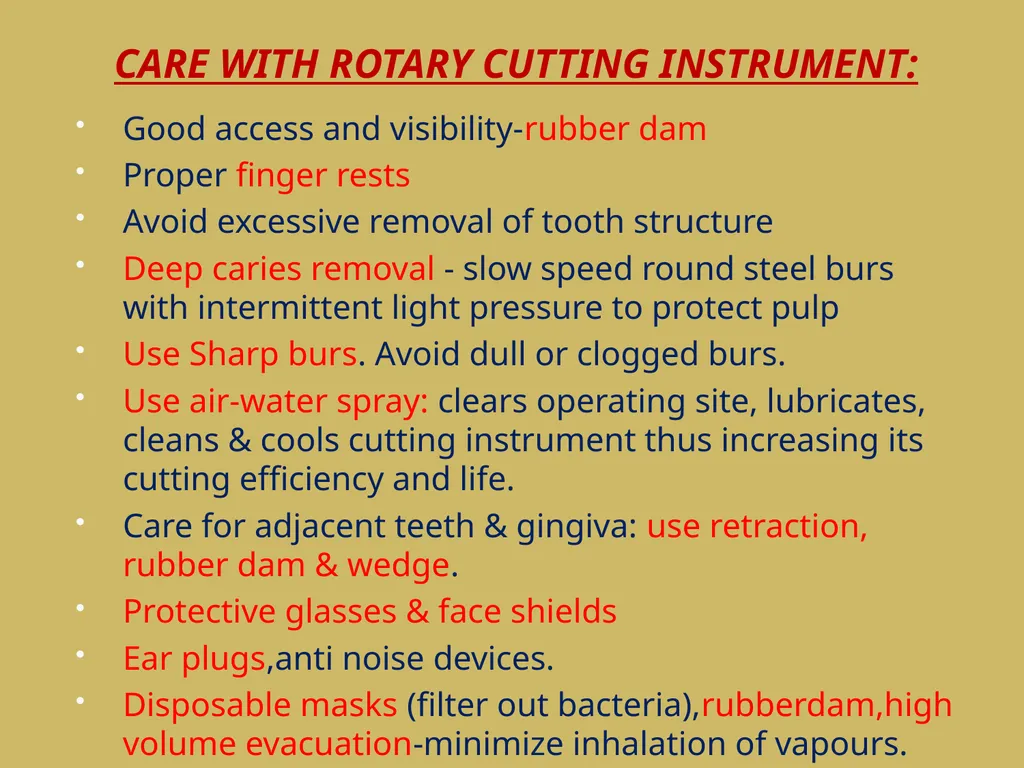
slide76. CARE WITH ROTARY CUTTING INSTRUMENT: Good access and visibility-rubber dam
Proper finger rests
Avoid excessive removal of tooth structure
Deep caries removal - slow speed round steel burs with intermittent light pressure to protect pulp
Use Sharp burs. Avoid dull or clogged burs.
Use air-water spray: clears operating site, lubricates, cleans & cools cutting instrument thus increasing its cutting efficiency and life.
Care for adjacent teeth & gingiva: use retraction, rubber dam & wedge.
Protective glasses & face shields
Ear plugs,anti noise devices.
Disposable masks (filter out bacteria),rubberdam,high volume evacuation-minimize inhalation of vapours.<br>
slide77. Various speeds in cavity preparation SPEED:
- It is defined as the distance traveled by an object during an unit time.
Unit: rpm<br>
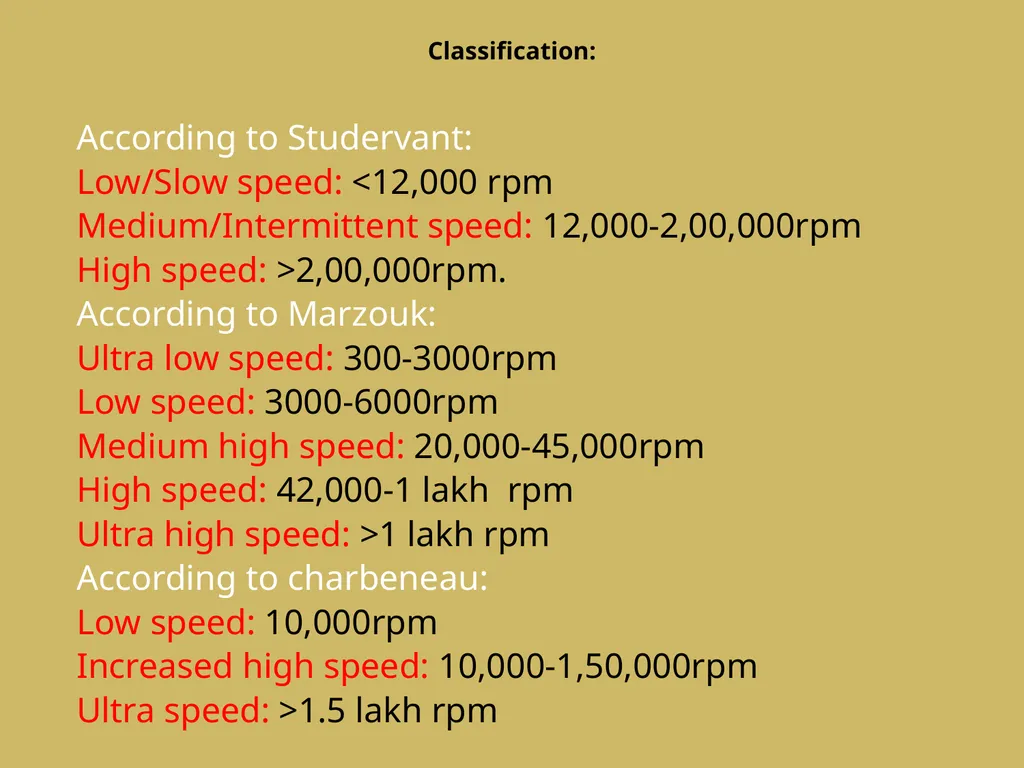
slide78. Classification: According to Studervant:
Low/Slow speed: <12,000 rpm
Medium/Intermittent speed: 12,000-2,00,000rpm
High speed: >2,00,000rpm.
According to Marzouk:
Ultra low speed: 300-3000rpm
Low speed: 3000-6000rpm
Medium high speed: 20,000-45,000rpm
High speed: 42,000-1 lakh rpm
Ultra high speed: >1 lakh rpm
According to charbeneau:
Low speed: 10,000rpm
Increased high speed: 10,000-1,50,000rpm
Ultra speed: >1.5 lakh rpm<br>
slide79. Low speed (<12,000rpm) USES:
Caries excavation
Refining cavity preparation
Finishing and polishing restoration
ADVANTAGE:
Good tactile sense
DISADVANTAGES:
Cutting is inefficient
Time consuming
Needs heavy pressure-heat generation & vibrations
Bur life is reduced
Increased patient discomfort
Operator fatigue<br>
slide80. Medium speed: 12,000-2,00,000rpm USES:
Cavity preparation
Placing retentive grooves and bevels
Areas of limited visibility
ADVANTAGES:
Positive tactile sense
Controlled cutting of tooth structure
DISADVANTAGES:
Slower cavity preparation-Increases operator fatigue & patient discomfort
More heat production<br>
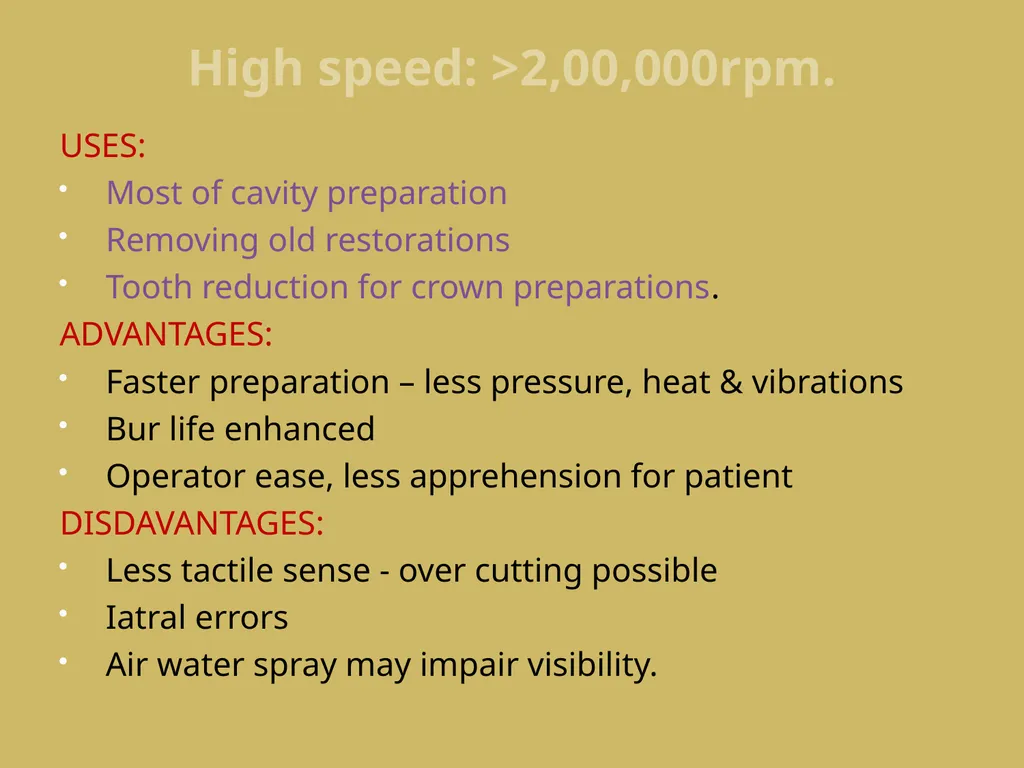
slide81. High speed: >2,00,000rpm. USES:
Most of cavity preparation
Removing old restorations
Tooth reduction for crown preparations.
ADVANTAGES:
Faster preparation – less pressure, heat & vibrations
Bur life enhanced
Operator ease, less apprehension for patient
DISDAVANTAGES:
Less tactile sense - over cutting possible
Iatral errors
Air water spray may impair visibility.<br>
slide82. References: Art & science of operative dentistry – Sturdevant’s
Textbook of operative dentistry – Vimal K Sikri
Textbook of operative dentistry – Ramya Raghu
Textbook of operative dentistry – Nisha Garg<br>
slide83. THANK YOU<br>
DENTISTRY AND ENDODONTICS Dr. V. SUJANA
PROFESSOR<br>
slide2. Contents: Introduction
Definition
History
Handpieces
-Parts
-Classification
-Criteria to evaluate hand pieces
-High speed and low speed hand pieces (advs,disadvs)
-Coolant spray systems
-Sterilization<br>
slide3. Dental burs
-Parts
-Classification
-Modifications in bur design
-Design of dental bur
-Significance of bur design
-Cutting mechanism of dental bur
Diamond abrasives
-Parts
-Classification
-Cutting mechanism of diamond abrasives
Recommendations for cutting(dental burs and abrasives)<br>
slide4. Hazards with rotary cutting instruments
Care with rotary cutting instruments
Various speeds in cavity preparation<br>
slide5. Introduction Most cavity preparations require the use of both rotary and hand instruments.
Rotary burs or diamond points are used for cavity preparation and fine refinement of cavity while hand cutting instruments are used to produce intricate details in the cavity preparation and to insert and finish the restorative material.<br>
slide6. Definition The term rotary instruments in dentistry refers to a group of instruments that turn on an axis to perform work such as cutting, abrading, finishing or polishing tooth or restorative materials.<br>
slide7. Figure 1 Figure 2 Figure 3<br>
slide8. Description of rotary cutting instruments Handpieces: Power devices
Burs or Diamond abrasives: Cutting tools<br>
slide9. Handpieces A device that holds and transmits power to the rotating instrument.
It helps to position and control the rotating instrument intraorally.<br>
slide10. Parts of Dental Hand Piece Head – the head is the end of the hand piece that holds the rotary instruments,such as burs.
Shank – the shank is the handle portion of the hand piece.
Connecting end – the connecting end is where the hand piece attaches to the power source of the motor.<br>
slide11. Classification of Handpieces 1)According to Driving mechanism
Gear driven hand piece
Water driven hand piece
Belt driven hand piece
Air driven hand piece
2) Depending upon Angulations
Straight hand piece
Contra angled hand piece<br>
slide12. Air driven handpiece:
A small compact unit consists of :
Handpiece,
Control box,
Foot control &
Various connector hoses.<br>
slide13. Air compressor Airotor functioning Water spray Control box<br>
slide14. Depending upon Angulations:
Straight handpiece:
Here the long axis of the bur is the same as the long axis of the handpiece.
Laboratory work<br>
slide15. b) Contra-angle handpiece:-
It is the primary hand piece used in the mouth.
The head of the hand piece angled away from, then back toward , the long axis of the handle.
This design brings the head of the bur close to the long axis of the handle of the hand piece .
Balance – Stabilize handpiece
Improve access & visibility<br>
slide16. Contra angle handpieces may be of 2 types:-
i) Micromotor handpiece:
Works on : electric micromotor
speed ranges between 500- 50,000 rpm (low speed)
Higher torque
Uses: Used for refining of cavity preparation ,finishing and polishing of restorations in operative dentistry.<br>
slide17. ii) Airotor handpiece
are connected to the air water line of the dental unit & are activated by compressed air.
Speed range is above 200,000 rpm(high speed).
low torque.
Flow through system - direct air water spray at the cutting head of the bur which dissipates the heat generated during cutting action.<br>
slide18. COOLANT SPRAY SYSTEMS<br>
slide19. Airotor handpiece USES:<br>
slide20. Head sizes<br>
slide21. Criteria to evaluate the handpiece Friction
Speed and Torque
Vibration<br>
slide22. FRICTION
Will occur in the moving parts of a hand piece especially the turbine.
If the heat from friction is not prevented ,the hand piece will not be suitable for dental use.
For this reason bearings are used: ball bearings, needle bearings, glass and resin bearings etc.<br>
slide23. Speed: Speed is defined as number of revolutions per minute(RPM). Or
Number of times a rotating instrument such as bur will make full turn during a minute.
Speed is inversely proportional to torque.<br>
slide24. TORQUE Torque is turning movement of instrument.
Is the ability of hand piece to withstand lateral pressure on the revolving tool without decreasing the speed or its cutting efficiency.
It is more efficient to cut hard materials (enamel,porcelain&metal) at high speeds with low torque and soft carious dentin at low speeds with high torque.<br>
slide25. VIBRATION Is a deleterious aspect of rotary – care is taken.
Excessive wear of the turbine bearings
Bur is bent will cause eccentric running which creates substantial vibration.<br>
slide28. STERILIZATION The hand piece of the rotary instruments are used in the mouth must be cleaned and sterilized for reuse.
Sterilized by:
- Autoclave: steam under pressure
-Chemical vapour pressure sterilization
-Ethylene oxide (Etox) gas.<br>
slide29. Steam pressure sterilization (Autoclave) Sterilization cycle of autoclave:
High pressure saturated steam
121·c, 15 lbs,15 minutes : steam autoclave
132·c, 30 lbs,8-10 minutes: Wrapped instruments
132·c, 30 lbs,3 minutes: Unwrapped instruments<br>
slide30. Dental Burs A bur is a rotary cutting instrument which has a bladed cutting head.
USES:
-cavity preparation ,
-finishing of restorations,
-caries removal.<br>
slide31. PARTS OF A BUR Shank
-Fits into the handpiece
-accepts rotary motion
Neck
-connects shank to head of the bur
-transmits rotational forces to the head.
Head
-working end of the bur
-various sizes, shapes & materials.<br>
slide32. Classification of dental burs: 1.According to shank design:
Straight handpiece shank.
Latch type angle handpiece shank.
Friction grip angle handpiece shank.
2.According to material of manufacture:
Stainless steel.
Tungsten carbide.
3.According to shape of bur head:
Round .
Straight fissure.
Inverted cone.
Tapered fissure.
Pear shaped.
4.According to size of bur :
Manufacturer’s number: Head diameter.<br>
slide33. 5.According to their use:
a) Cutting burs
b) Finishing & polishing burs<br>
slide34. Shank design<br>
slide35. Shank Design: Straight handpiece shank :-
Is a simple cylinder held in the straight hand piece by a metal chuck.
Commonly used for finishing & polishing completed restorations in lab.<br>
slide36. Latch type angle handpiece shank: Cylindrical in shape but posterior portion of the shank is flattened on one side.
Shank fits into a D shaped socket at the bottom of the bur & bur is retained by retaining latch.
Used in contr-angled micromotor handpiece.
Shorter length permits access to posterior regions of mouth.
Used at low speeds for refining cavity, finishing & polishing of restorations.<br>
slide37. Friction grip angle handpiece shank:- Used with airotor handpieces.
Shank is simple cylinder held in the handpiece by friction between the shank & metal chuck.
smaller in dimensions than latch type instruments.
good access to posterior regions of mouth<br>
slide38. Material of manufacture: Stainless steel burs:
Cut dentin at slow speeds but dull rapidly at higher speeds.
When dull, the reduced cutting effectiveness creates increased heat and vibration.
USE: - Removing soft carious dentin
- Finishing procedures.<br>
slide39. Tungsten Carbide burs:-
Perform better at all speeds & their superiority is greatest at high speeds.
Carbide is stiffer & harder than steel therefore does not dull rapidly
But more brittle & susceptible to fracture when subjected to sudden blow or shock.<br>
slide40. Bur shapes: Refers to the contour of the bur head.
Round, straight fissure, inverted cone, tapered fissure & pear shaped.<br>
slide41. i) Round bur :-
Spherical head shape.
Use –
-Initial entry into tooth
-Placement of retentive grooves & caries removal.
ii) Straight fissure bur :-
elongated cylindrical head.
Use - Preparing walls for amalgam cavity preparation<br>
slide42. iii) Tapered fissure bur :-
tapered cone shaped head.
Use-
-Tooth preparation for indirect restoration. eg. : Inlays.
-Crown preparation.
iv) Inverted cone bur :-
rapidly tapered cone with the apex of cone directed towards the bur shank.
Use- To provide undercuts for amalgam cavity preparations.<br>
slide43. V) Pear shaped bur :-
Elongated inverted cone bur with rounded edges
USE-
-Normal length bur is used for class I tooth preparation for DFG.
-Long length bur is used for amalgam cavity preparations with rounded internal angles.<br>
slide44. Bur sizes: Represents diameter of head.<br>
slide47. Burs used in amalgam cavity preparations No.245 bur No.245 bur:
Shape:long length Pear shaped
Head diameter:0.8mm
Head length:3mm
Used in airotor
Uses: for amalgam
cavity preparation with
rounded internal line angles<br>
slide48. No.169L bur:
Shape: Elongated tapered fissure
Head diameter:0.9mm
Head length:5.6mm
Used in airotor
Uses: for placing retentive grooves(locks) in axio facial & axio lingual line angles in class II amalgam cavity preparations. No.169L bur<br>
slide49. No 330 bur:
Shape: Pear shaped(normal
length)
Head diameter: 0.8mm
Head length: 1mm
Used in airotor
Uses: Conservative class I cavity
preparations for amalgam. No 330 bur<br>
slide50. No ¼ round bur:
Shape: Round
Head diameter: 0.5mm
Head length: 0.4mm
Used in airotor
Uses: for placing retentive
grooves(locks) in in axio facial &
axio lingual line angles in class II amalgam
cavity preparations.<br>
slide51. Patterns of blades Axial blades Spiral blades Crosscuts<br>
slide52. Modifications in Bur Design :- Large diameter carbide burs have been replaced by small diameter burs – effective at high speeds.
3 major changes:
Reduced use of crosscuts burs
Extended head lengths on fissure burs
c) Rounding of sharp tip angles Proposed by Markley and Sockwell
Lower stress<br>
slide53. Design of dental burs Blades: even no.
Cavity preparation: 6,8 or 10 blades
Finishing:12-40 blades
Bur Blades:
Uniformly spaced projections on the bur head
which terminates in the cutting edge.
Bur blade has 2 surfaces: -
a) Blade face / Rake face
b) Blade back / Clearance face
a) Rake face : is the surface of the bur blade on the leading edge of bur.
b) Clearance face: is the surface of bur blade on the trailing edge of the bur.<br>
slide54. / or edge<br>
slide56. Flute space:-
Depressed areas in between bur blades.
Radial line :- is the line connecting the centre of the bur & the blade.
Land:- is the plane surface immediately following the cutting edge Flute space Land Radial line<br>
slide57. Rake Angle :-
- is the angle between the rake face & the radial line
- It can be positive , negative or a zero rake angle.
Negative - when rake face is ahead of the radial line.
Positive - when rake face trails the radial line.
Zero - when rake face & radial line coincide with each other.<br>
slide58. Clearance Angle :-
The angle between the clearance face & the work (ie,Tooth) .
If Land present then CA divided into:
Primary clearance angle:
Angle the land makes with
the work.
Secondary clearance angle:
Angle between back of the bur edge and the work. R Primary Sec
CA<br>
slide59. Radial clearance:-
If the clearance face is curved, it is known as radial clearance.
Blade/edge angle:-
Angle between the rake face and clearance face. Radial clearance CF RF<br>
slide60. Significance of bur design The rake angle is the most important design
feature of the bur blade
Positive rake angle –
Adv: increases the cutting efficiency
Disadv:
a) It tends to clog the cut debris in the flute space.
b) reduces the bulk of the bur blade and so more prone to wear & fracture.<br>
slide61. Negative rake angle –
Adv:
Produces smaller chip that moves away from the blade.
Reduces fracture of the cutting edge thus increases the life of the bur.<br>
slide62. Significance of Clearance angle:
Clearance angle provides a stop to prevent the bur edge from digging into the tooth and provide adequate chip space for clearing the debris.
Large clearance angle result in less rapid dulling of the bur.
An increase in clearance angle causes decrease in edge angle.<br>
slide63. Significance of Radial Clearance:
Reduce clogging of the debris and at the same time cutting efficiency of bur is maintained.<br>
slide64. Blade/edge angle when increased reinforces the cutting edge & decreases the chances of the blade edge to fracture.
Burs with blade angle = 90°
As carbide is brittle, it requires greater edge angles to minimize fracture. Fracture of cutting edge<br>
slide65. Neck diameter should be adequate.
-good visibility
-resist lateral forces.<br>
slide66. Concentricity and Run-out Concentricity:
-Symmetry of bur head ( bur is static).
-indicates blades are uniform or not.
Run-out:
-Maximum displacement of bur head from its axis of rotation (bur is in motion).
-occurs when neck is bent or bur head is not in line with axis of bur or bur is not held straight in handpiece chuck.
-it increases vibrations of bur, more heat, excessive removal of tooth structure. Note: Average clinically accepted Run out is :0.023 mm<br>
slide67. DIAMOND ABRASIVES These are the second major category of a rotary cutting instruments.
Similar to burs but have diamond abrasives held by metallic bonding on a steel blank instead of blades.
Diamonds (natural or synthetic) crushed to a powder with particles of different sizes which are attached to metal blank.<br>
slide68. Parts:
-Shank
-Neck
-Head
Advantages:
-Greater resistance to abrasion
-lesser heat generation
-more efficient in cutting enamel .<br>
slide69. Classification of Dental Abrasives Shank design: Straight
Latch type
Friction grip
Head shape: Round, Inverted cone, Straight fissure, tapered fissure, wheel, flame, football, needle.
Particle sizes:
Coarse(green): 125-150µm
Medium(blue): 88-125µm
Fine(red): 60-74µm
Extrafine(yellow): 38-44µm.<br>
slide70. Recommendations for cutting: Dental burs & abrasives High speed contra-angle airotor handpiece with adequate air-water spray.
Light pressure
Uses:Tungsten carbide burs: initial punch cuts,cavity preparation for amalgam ,placing secondary retentive features.
Uses:Diamond abrasives: for extensive preparations, extra-coronal preparations(involves more enamel),placing bevels & enameloplasty.
Uses:Stailess steel burs: Soft infected dentin removed with steel burs at slow speed<br>
slide72. Hazards with rotary cutting instruments Pulpal damage:
High speed (without coolant): Mechanical vibrations or heat generation.
-Dessication or Loss of dentinal fluid
-Transection of odontoblastic processes.
RDT>2mm:Less damage
More heat: - Steel burs cut inefficiently
- Diamonds & carbides which are dull or clogged with debris.<br>
slide73. Damage to soft tissues:
-Improper care: lips,tongue,cheeks of patient may be injured.
-Could be due to lack of access, visibility, sudden reflex movement by patient, inattention of operator.
Damage to eyes:
-Airborne particles such as bits of old restorations, tooth debris discharged at high speed from patients mouth.
-matrix failure of molded abrasive cutting instruments.<br>
slide74. Ear dangers:
-Handpiece wear and eccentric rotating instruments cause increased noise.
-Noise level beyond 75db- hearing damage<br>
slide75. Inhalation dangers:
-Aerosols ,vapours(mercury vapours) , tooth debris, micro organisms & restorative materials created by cutting instruments can be inhaled by patient or dentist.
-Irritation and tissue reaction in lungs.<br>
slide76. CARE WITH ROTARY CUTTING INSTRUMENT: Good access and visibility-rubber dam
Proper finger rests
Avoid excessive removal of tooth structure
Deep caries removal - slow speed round steel burs with intermittent light pressure to protect pulp
Use Sharp burs. Avoid dull or clogged burs.
Use air-water spray: clears operating site, lubricates, cleans & cools cutting instrument thus increasing its cutting efficiency and life.
Care for adjacent teeth & gingiva: use retraction, rubber dam & wedge.
Protective glasses & face shields
Ear plugs,anti noise devices.
Disposable masks (filter out bacteria),rubberdam,high volume evacuation-minimize inhalation of vapours.<br>
slide77. Various speeds in cavity preparation SPEED:
- It is defined as the distance traveled by an object during an unit time.
Unit: rpm<br>
slide78. Classification: According to Studervant:
Low/Slow speed: <12,000 rpm
Medium/Intermittent speed: 12,000-2,00,000rpm
High speed: >2,00,000rpm.
According to Marzouk:
Ultra low speed: 300-3000rpm
Low speed: 3000-6000rpm
Medium high speed: 20,000-45,000rpm
High speed: 42,000-1 lakh rpm
Ultra high speed: >1 lakh rpm
According to charbeneau:
Low speed: 10,000rpm
Increased high speed: 10,000-1,50,000rpm
Ultra speed: >1.5 lakh rpm<br>
slide79. Low speed (<12,000rpm) USES:
Caries excavation
Refining cavity preparation
Finishing and polishing restoration
ADVANTAGE:
Good tactile sense
DISADVANTAGES:
Cutting is inefficient
Time consuming
Needs heavy pressure-heat generation & vibrations
Bur life is reduced
Increased patient discomfort
Operator fatigue<br>
slide80. Medium speed: 12,000-2,00,000rpm USES:
Cavity preparation
Placing retentive grooves and bevels
Areas of limited visibility
ADVANTAGES:
Positive tactile sense
Controlled cutting of tooth structure
DISADVANTAGES:
Slower cavity preparation-Increases operator fatigue & patient discomfort
More heat production<br>
slide81. High speed: >2,00,000rpm. USES:
Most of cavity preparation
Removing old restorations
Tooth reduction for crown preparations.
ADVANTAGES:
Faster preparation – less pressure, heat & vibrations
Bur life enhanced
Operator ease, less apprehension for patient
DISDAVANTAGES:
Less tactile sense - over cutting possible
Iatral errors
Air water spray may impair visibility.<br>
slide82. References: Art & science of operative dentistry – Sturdevant’s
Textbook of operative dentistry – Vimal K Sikri
Textbook of operative dentistry – Ramya Raghu
Textbook of operative dentistry – Nisha Garg<br>
slide83. THANK YOU<br>