
Rotary NiTi File Systems Prof. Dr. Biland MS
LS
Published · 41 slides · 0 views

1 / 1





Description
Rotary NiTi File Systems Prof. Dr. Biland MS Shukri Introduction Effective cleaning and shaping of the root canal system is essential for achieving the biological and mechanical objectives of root canal treatment. The objectives are to
Related Topics
Share
Embed code
Download this presentation From Below
"Rotary NiTi File Systems Prof. Dr. Biland MS" is the property of its rightful owner. Permission is granted to download and print the materials on this website for personal, non-commercial use only, and to display it on your personal computer provided you do not modify the materials and that you retain all copyright notices contained in the materials. By downloading content from our website, you accept the terms of this agreement.
Presentation Transcript
01
Rotary NiTi File Systems Prof. Dr. Biland MS Shukri<br>
02
Introduction Effective cleaning and shaping of the root canal system is essential for achieving the biological and mechanical objectives of root canal treatment.
The objectives are to remove all the pulp tissue, bacteria and their byproducts while providing adequate canal shape to fill the canal.<br>
The objectives are to remove all the pulp tissue, bacteria and their byproducts while providing adequate canal shape to fill the canal.<br>
03
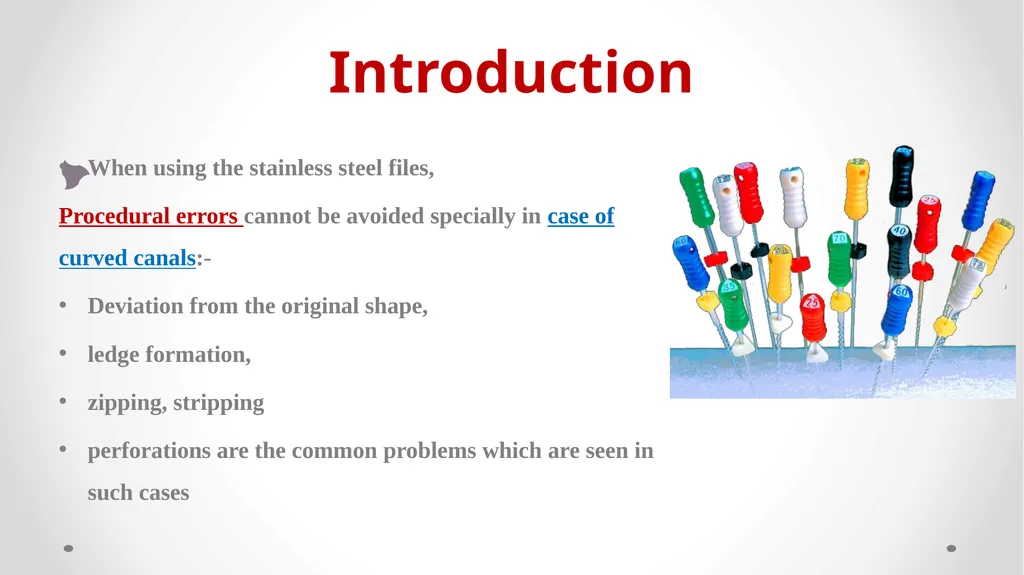
Introduction When using the stainless steel files,
Procedural errors cannot be avoided specially in case of curved canals:-
Deviation from the original shape,
ledge formation,
zipping, stripping
perforations are the common problems which are seen in such cases<br>
Procedural errors cannot be avoided specially in case of curved canals:-
Deviation from the original shape,
ledge formation,
zipping, stripping
perforations are the common problems which are seen in such cases<br>
04
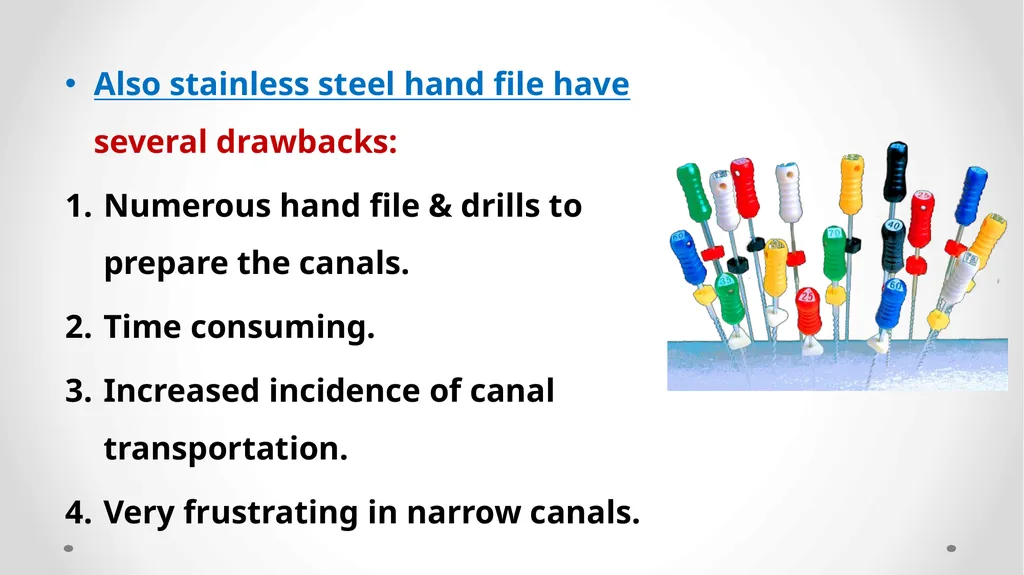
Also stainless steel hand file have several drawbacks:
Numerous hand file & drills to prepare the canals.
Time consuming.
Increased incidence of canal transportation.
Very frustrating in narrow canals.<br>
Numerous hand file & drills to prepare the canals.
Time consuming.
Increased incidence of canal transportation.
Very frustrating in narrow canals.<br>
05
NiTi was developed by Buchler about 40 years ago.
NiTi is also known as the NiTinol (NiTi Navol Ordinance Laboratory in US).
In endodontic NiTi alloys called:
55 NiTinol (55% weight Ni and 45% Ti) OR
60 NiTinol (60% weight of Ni, 40% Ti).
First use of NiTi in endodontic was reported in 1988, by Walia et al when a 15 No. NiTi file was made from orthodontic wire and it showed superior flexibility and resistance to torsional fracture.
2-3 times more flexible, in the same file sizes, compared to stainless steel. This suggested the use of NiTi files in curved canals<br>
NiTi is also known as the NiTinol (NiTi Navol Ordinance Laboratory in US).
In endodontic NiTi alloys called:
55 NiTinol (55% weight Ni and 45% Ti) OR
60 NiTinol (60% weight of Ni, 40% Ti).
First use of NiTi in endodontic was reported in 1988, by Walia et al when a 15 No. NiTi file was made from orthodontic wire and it showed superior flexibility and resistance to torsional fracture.
2-3 times more flexible, in the same file sizes, compared to stainless steel. This suggested the use of NiTi files in curved canals<br>
06
NiTi Alloys Properties of NiTi Alloys:
1-Shape memory.
2-Super elasticity.
3-Low modulus of elasticity.
4-Good resiliency.
5-Corrosion resistance.
6-Softer than stainless steel.<br>
1-Shape memory.
2-Super elasticity.
3-Low modulus of elasticity.
4-Good resiliency.
5-Corrosion resistance.
6-Softer than stainless steel.<br>
07
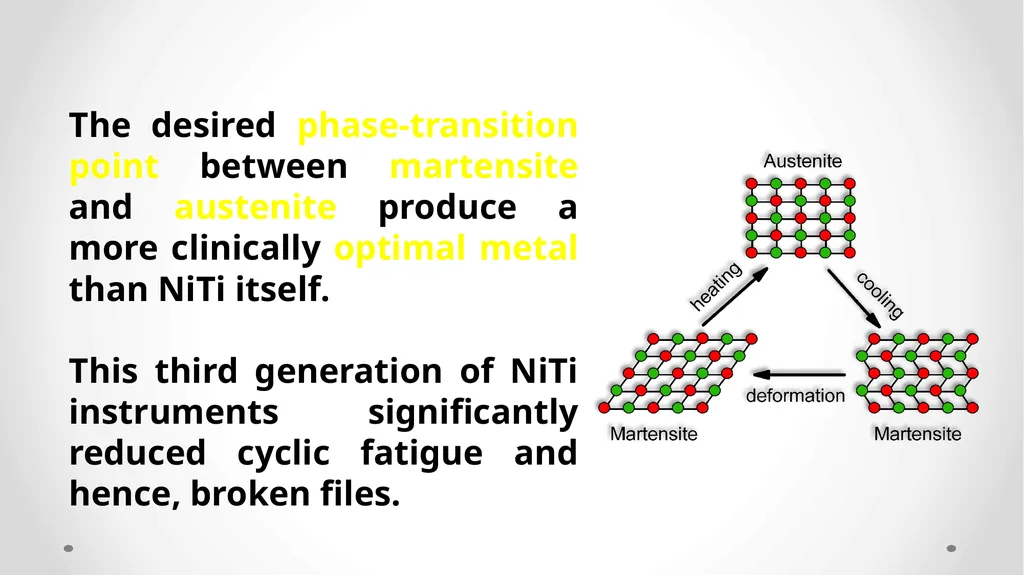
NiTi can have three different forms: martensite, stress-induced martensite (super elastic), and austenite
Martensite: is soft and can be easily deformed
Austenite: is non-elastic and hard
The super elasticity of NiTi is related to the crystalline structure of the material When NiTi treated with heat and cooled transform the alloy from the stronger, high temperature form (Austenite) to the weaker low temperature form (Martensite).
The austenite phase transforms into the martensite phase on stressing.
This requires light force for bending.
After release of stresses, the metal returns to the austensitic phase and the file regains its original shape<br>
Martensite: is soft and can be easily deformed
Austenite: is non-elastic and hard
The super elasticity of NiTi is related to the crystalline structure of the material When NiTi treated with heat and cooled transform the alloy from the stronger, high temperature form (Austenite) to the weaker low temperature form (Martensite).
The austenite phase transforms into the martensite phase on stressing.
This requires light force for bending.
After release of stresses, the metal returns to the austensitic phase and the file regains its original shape<br>
08
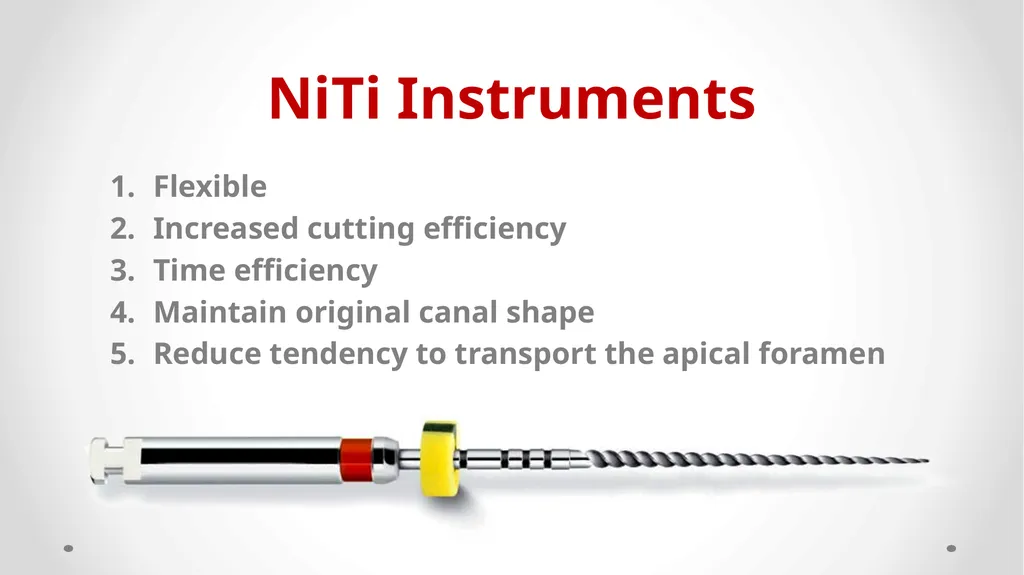
NiTi Instruments Flexible
Increased cutting efficiency
Time efficiency
Maintain original canal shape
Reduce tendency to transport the apical foramen<br>
Increased cutting efficiency
Time efficiency
Maintain original canal shape
Reduce tendency to transport the apical foramen<br>
09
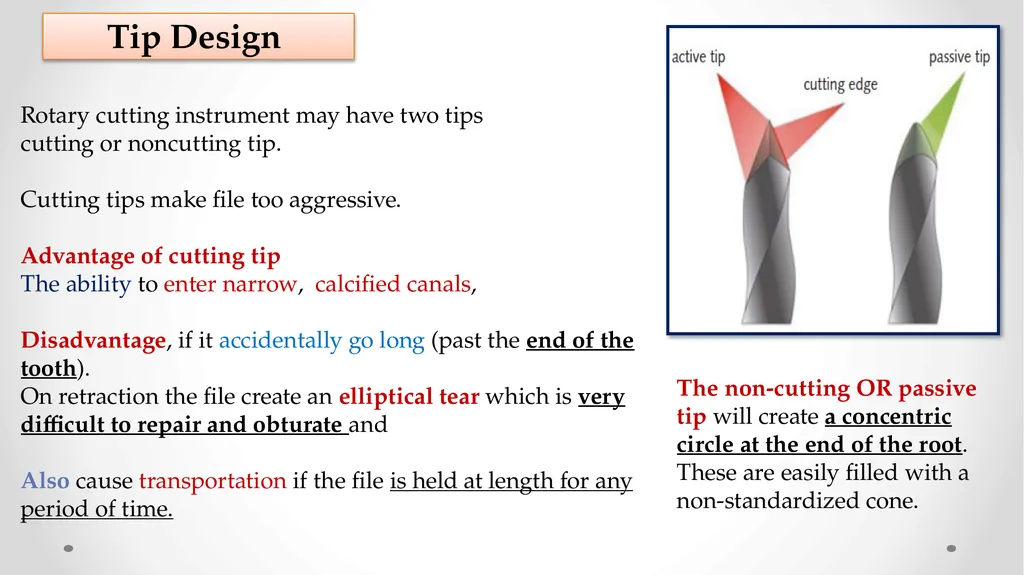
Tip Design Rotary cutting instrument may have two tips
cutting or noncutting tip.
Cutting tips make file too aggressive.
Advantage of cutting tip
The ability to enter narrow, calcified canals,
Disadvantage, if it accidentally go long (past the end of the tooth).
On retraction the file create an elliptical tear which is very difficult to repair and obturate and
Also cause transportation if the file is held at length for any period of time. The non-cutting OR passive tip will create a concentric circle at the end of the root.
These are easily filled with a non-standardized cone.<br>
cutting or noncutting tip.
Cutting tips make file too aggressive.
Advantage of cutting tip
The ability to enter narrow, calcified canals,
Disadvantage, if it accidentally go long (past the end of the tooth).
On retraction the file create an elliptical tear which is very difficult to repair and obturate and
Also cause transportation if the file is held at length for any period of time. The non-cutting OR passive tip will create a concentric circle at the end of the root.
These are easily filled with a non-standardized cone.<br>
10
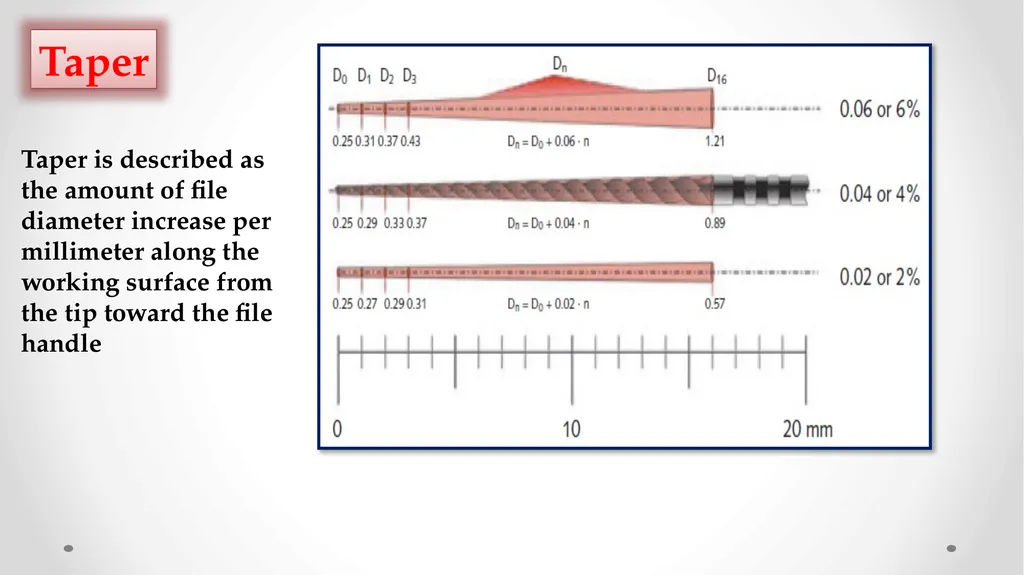
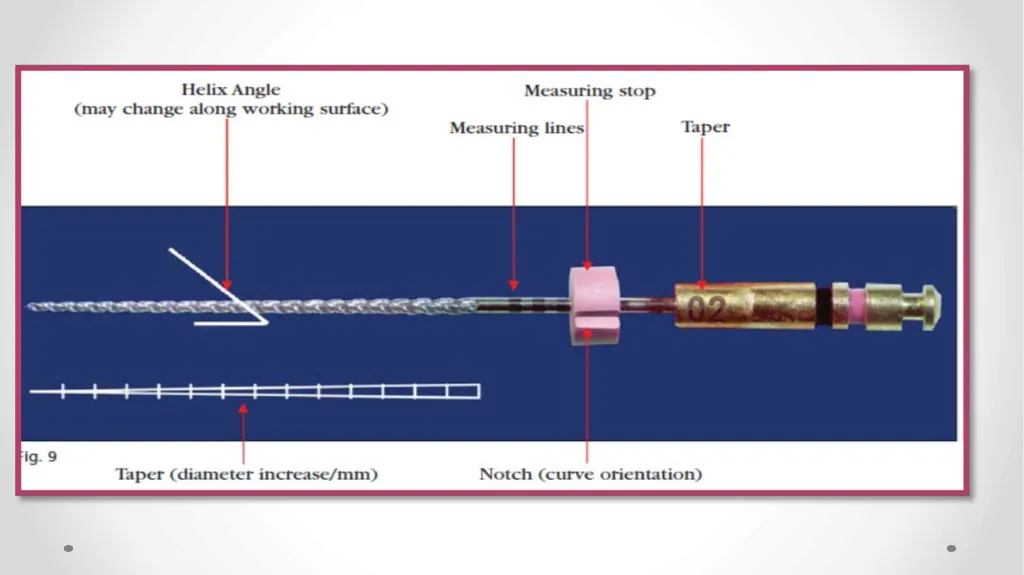
Taper Taper is described as the amount of file diameter increase per millimeter along the working surface from the tip toward the file handle<br>
11
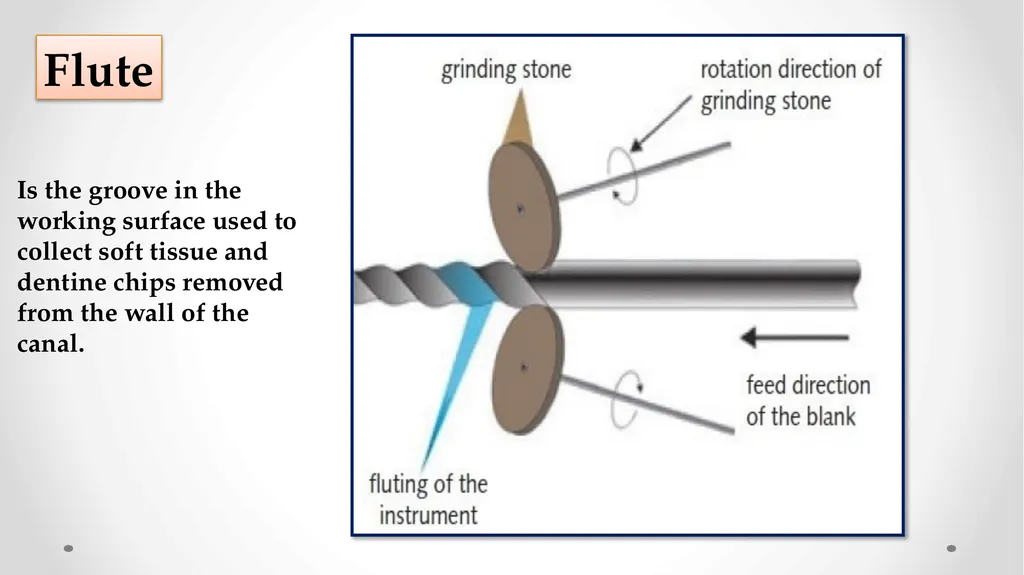
Flute Is the groove in the working surface used to collect soft tissue and dentine chips removed from the wall of the canal.<br>
12
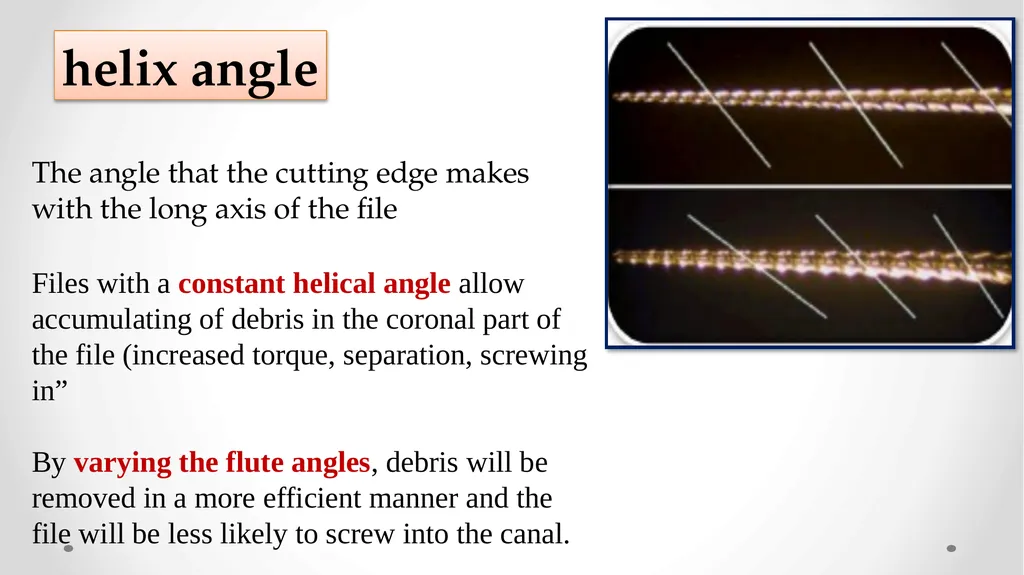
helix angle The angle that the cutting edge makes with the long axis of the file Files with a constant helical angle allow accumulating of debris in the coronal part of the file (increased torque, separation, screwing in”
By varying the flute angles, debris will be removed in a more efficient manner and the file will be less likely to screw into the canal.<br>
By varying the flute angles, debris will be removed in a more efficient manner and the file will be less likely to screw into the canal.<br>
13
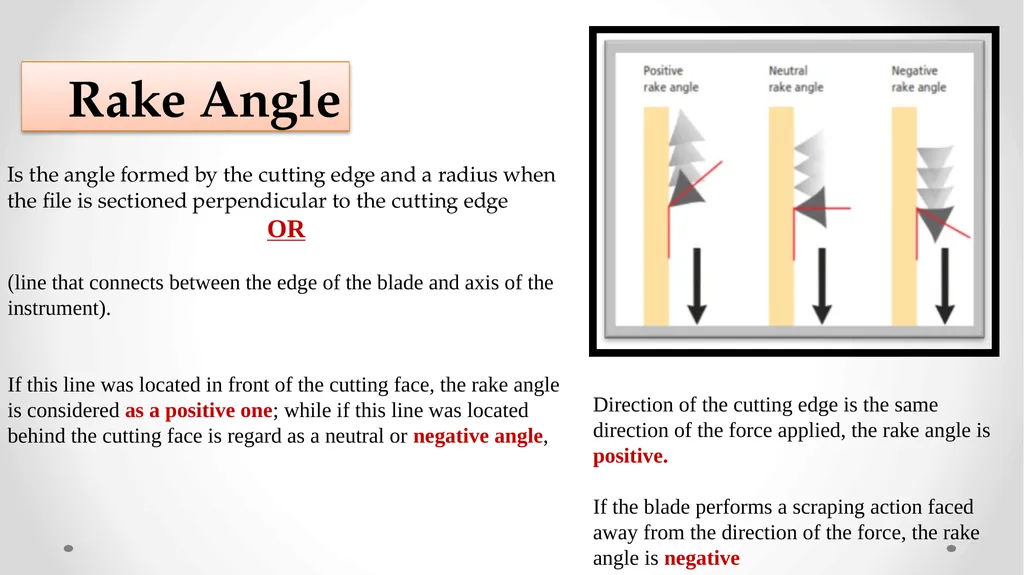
Rake Angle Is the angle formed by the cutting edge and a radius when the file is sectioned perpendicular to the cutting edge
OR
(line that connects between the edge of the blade and axis of the instrument).
If this line was located in front of the cutting face, the rake angle is considered as a positive one; while if this line was located behind the cutting face is regard as a neutral or negative angle, Direction of the cutting edge is the same direction of the force applied, the rake angle is positive.
If the blade performs a scraping action faced away from the direction of the force, the rake angle is negative<br>
OR
(line that connects between the edge of the blade and axis of the instrument).
If this line was located in front of the cutting face, the rake angle is considered as a positive one; while if this line was located behind the cutting face is regard as a neutral or negative angle, Direction of the cutting edge is the same direction of the force applied, the rake angle is positive.
If the blade performs a scraping action faced away from the direction of the force, the rake angle is negative<br>
14
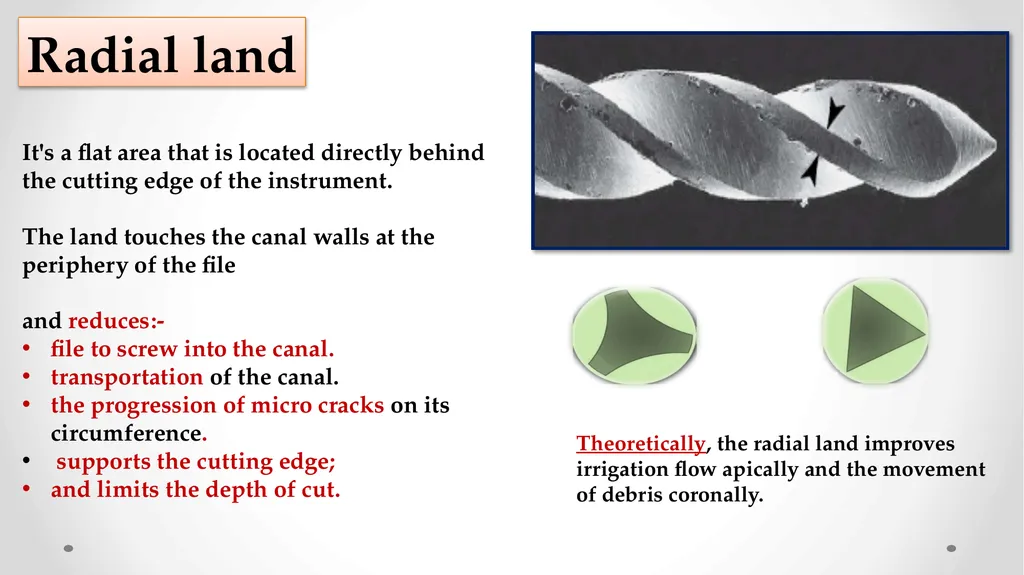
Radial land It's a flat area that is located directly behind the cutting edge of the instrument.
The land touches the canal walls at the periphery of the file
and reduces:-
file to screw into the canal.
transportation of the canal.
the progression of micro cracks on its circumference.
supports the cutting edge;
and limits the depth of cut. Theoretically, the radial land improves irrigation flow apically and the movement of debris coronally.<br>
The land touches the canal walls at the periphery of the file
and reduces:-
file to screw into the canal.
transportation of the canal.
the progression of micro cracks on its circumference.
supports the cutting edge;
and limits the depth of cut. Theoretically, the radial land improves irrigation flow apically and the movement of debris coronally.<br>
15
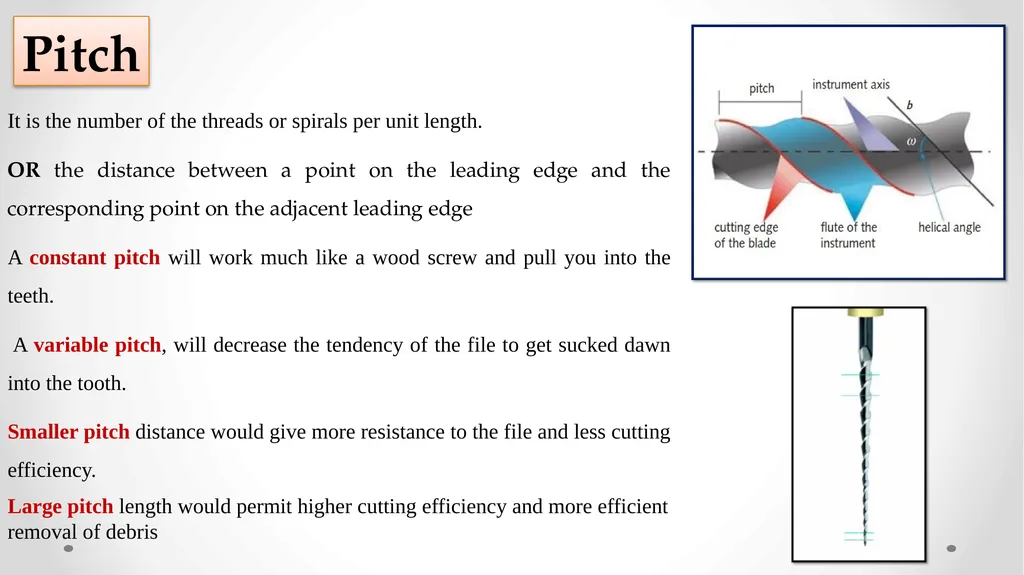
Pitch It is the number of the threads or spirals per unit length.
OR the distance between a point on the leading edge and the corresponding point on the adjacent leading edge
A constant pitch will work much like a wood screw and pull you into the teeth.
A variable pitch, will decrease the tendency of the file to get sucked dawn into the tooth.
Smaller pitch distance would give more resistance to the file and less cutting efficiency.
Large pitch length would permit higher cutting efficiency and more efficient removal of debris<br>
OR the distance between a point on the leading edge and the corresponding point on the adjacent leading edge
A constant pitch will work much like a wood screw and pull you into the teeth.
A variable pitch, will decrease the tendency of the file to get sucked dawn into the tooth.
Smaller pitch distance would give more resistance to the file and less cutting efficiency.
Large pitch length would permit higher cutting efficiency and more efficient removal of debris<br>
16
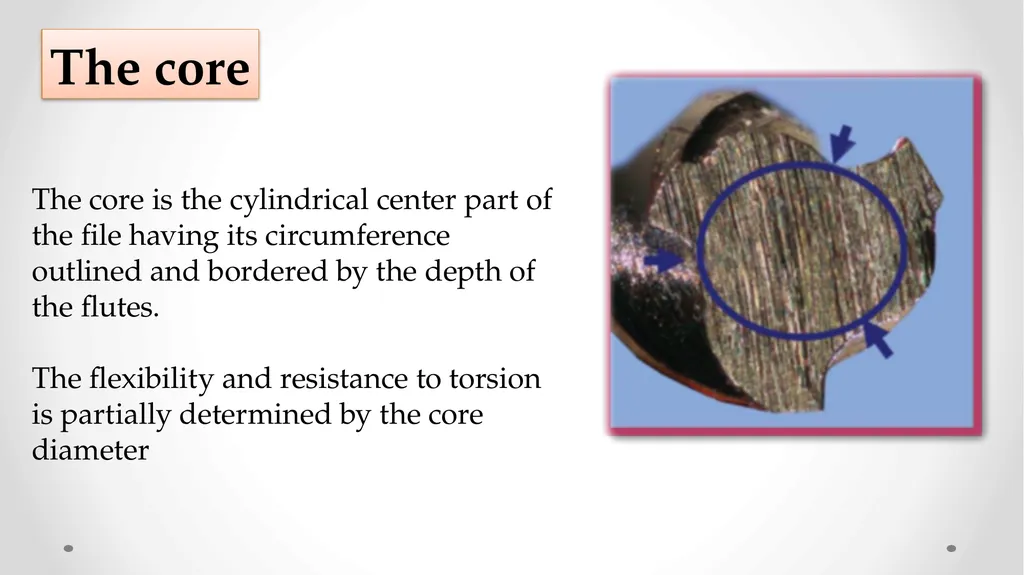
The core The core is the cylindrical center part of the file having its circumference outlined and bordered by the depth of the flutes.
The flexibility and resistance to torsion is partially determined by the core diameter<br>
The flexibility and resistance to torsion is partially determined by the core diameter<br>
17
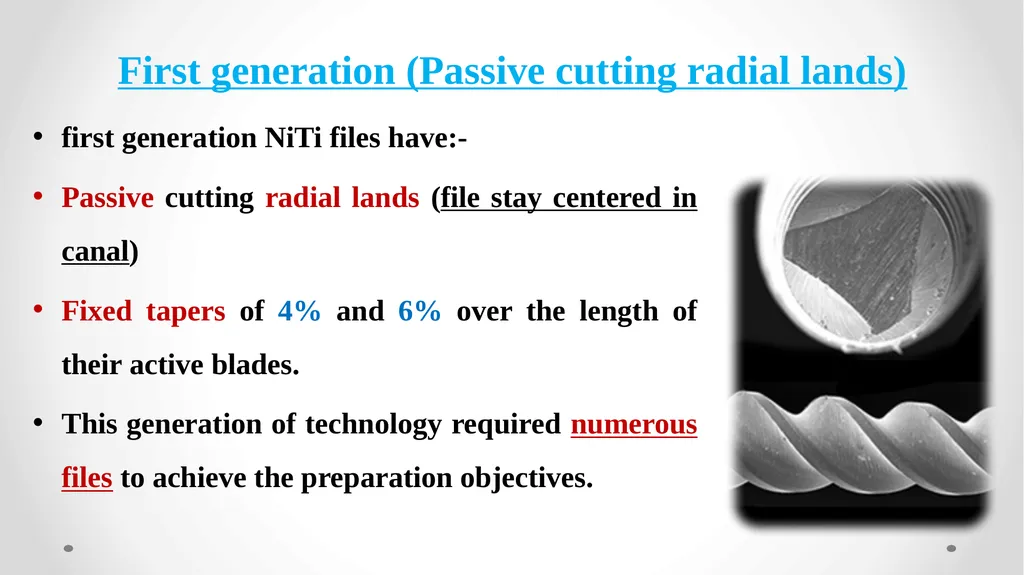
First generation (Passive cutting radial lands) first generation NiTi files have:-
Passive cutting radial lands (file stay centered in canal)
Fixed tapers of 4% and 6% over the length of their active blades.
This generation of technology required numerous files to achieve the preparation objectives.<br>
Passive cutting radial lands (file stay centered in canal)
Fixed tapers of 4% and 6% over the length of their active blades.
This generation of technology required numerous files to achieve the preparation objectives.<br>
18
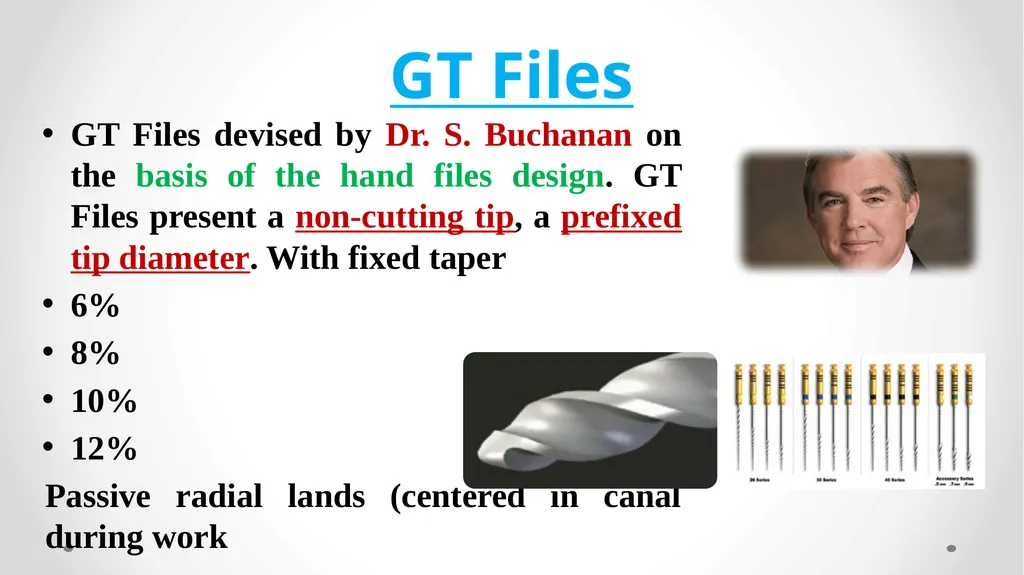
GT Files GT Files devised by Dr. S. Buchanan on the basis of the hand files design. GT Files present a non-cutting tip, a prefixed tip diameter. With fixed taper
6%
8%
10%
12%
Passive radial lands (centered in canal during work<br>
6%
8%
10%
12%
Passive radial lands (centered in canal during work<br>
19
Second generation (Active cutting edges) The second generation of NiTi rotary files came market in 2001. The critical distinction of this generation of instruments is they have active cutting edges – fixed taper and require fewer instruments to fully prepare a canal.
To over come taper lock – screw effect
The file provide with alternation contact points.<br>
To over come taper lock – screw effect
The file provide with alternation contact points.<br>
20
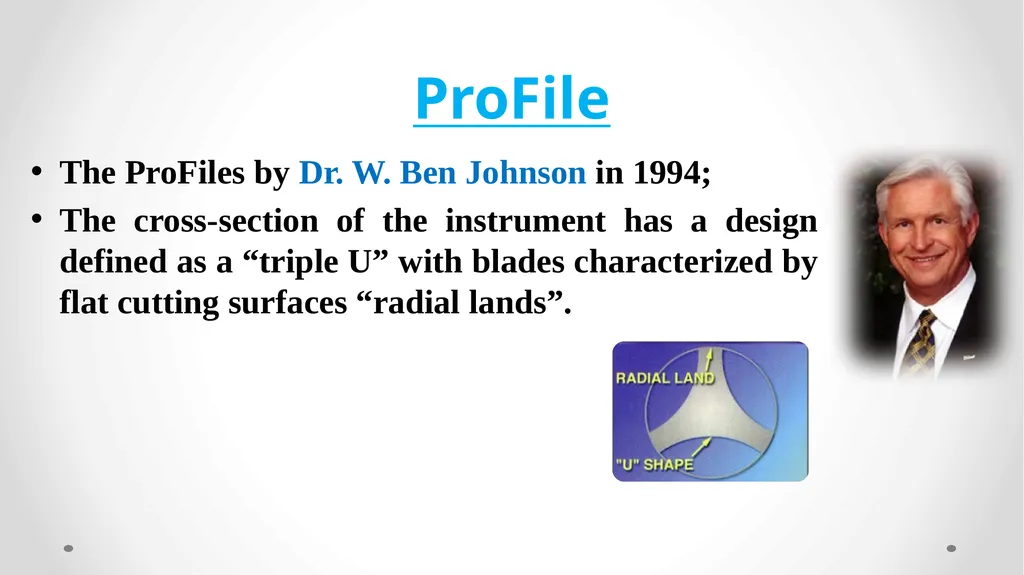
ProFile The ProFiles by Dr. W. Ben Johnson in 1994;
The cross-section of the instrument has a design defined as a “triple U” with blades characterized by flat cutting surfaces “radial lands”.<br>
The cross-section of the instrument has a design defined as a “triple U” with blades characterized by flat cutting surfaces “radial lands”.<br>
21
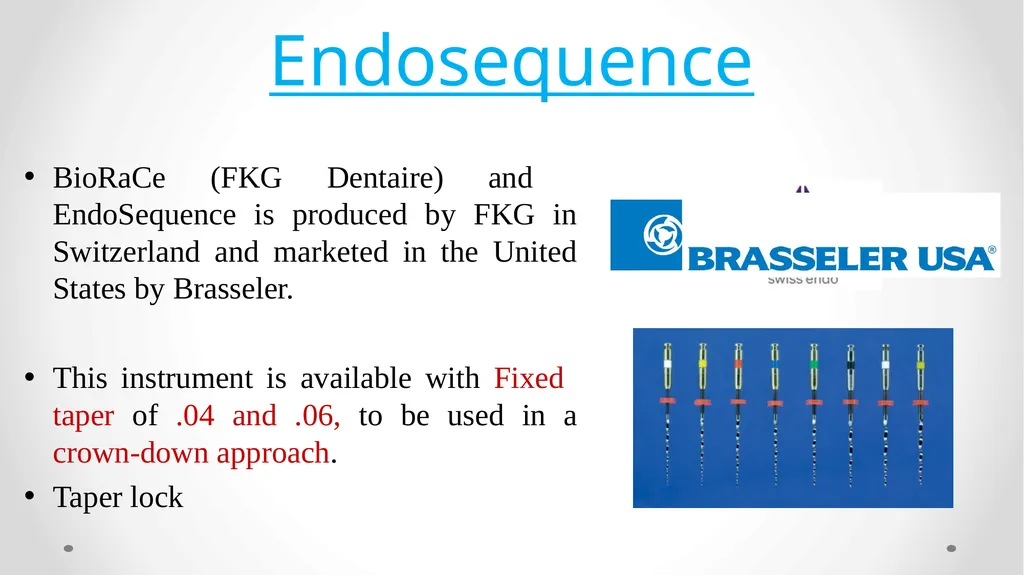
Endosequence BioRaCe (FKG Dentaire) and EndoSequence is produced by FKG in Switzerland and marketed in the United States by Brasseler.
This instrument is available with Fixed taper of .04 and .06, to be used in a crown-down approach.
Taper lock<br>
This instrument is available with Fixed taper of .04 and .06, to be used in a crown-down approach.
Taper lock<br>
22
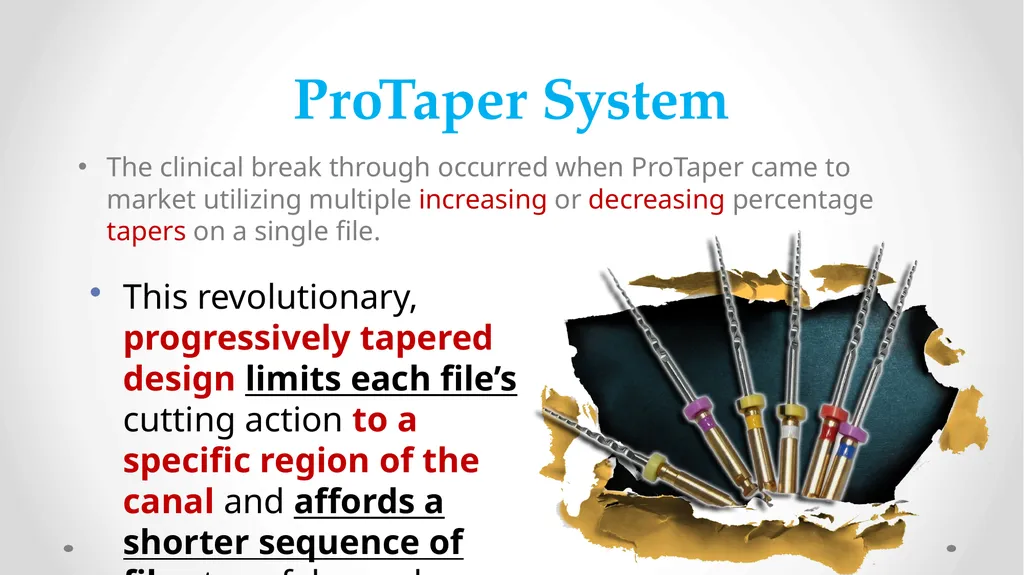
ProTaper System The clinical break through occurred when ProTaper came to market utilizing multiple increasing or decreasing percentage tapers on a single file. This revolutionary, progressively tapered design limits each file’s cutting action to a specific region of the canal and affords a shorter sequence of files to safely produce deep Schilderian shapes<br>
23
During this period, manufacturers began to focus on other methods to increase the resistance to file separation.
Some manufacturers Electropolished their files to remove surface irregularities result from grinding process. But clinically observed or reported that:-
1- Electropolishing dulls the sharp cutting edges.
2- More undesirable inward pressure required to advance a file to length.
3- Excessive inward pressure with fixed tapered, lead to taper lock, the screw effect, excessive torque on a rotary file during work.
To decrease the outcome of electropolishing:-
more cross-sectional designs have become available and increased, yet more dangerous, rotational speeds are advocated.<br>
Some manufacturers Electropolished their files to remove surface irregularities result from grinding process. But clinically observed or reported that:-
1- Electropolishing dulls the sharp cutting edges.
2- More undesirable inward pressure required to advance a file to length.
3- Excessive inward pressure with fixed tapered, lead to taper lock, the screw effect, excessive torque on a rotary file during work.
To decrease the outcome of electropolishing:-
more cross-sectional designs have become available and increased, yet more dangerous, rotational speeds are advocated.<br>
24
Third Generation (Metallurgy of NiTi metal) In 2007, manufacturers began to focus on utilizing heating and cooling methods to reduce cyclic fatigue and improve safety when rotary NiTi instruments work in more curved canals.
Improvements in NiTi metallurgy became the hallmark of 3rd generation of mechanical shaping files<br>
Improvements in NiTi metallurgy became the hallmark of 3rd generation of mechanical shaping files<br>
25
The desired phase-transition point between martensite and austenite produce a more clinically optimal metal than NiTi itself.
This third generation of NiTi instruments significantly reduced cyclic fatigue and hence, broken files.<br>
This third generation of NiTi instruments significantly reduced cyclic fatigue and hence, broken files.<br>
26
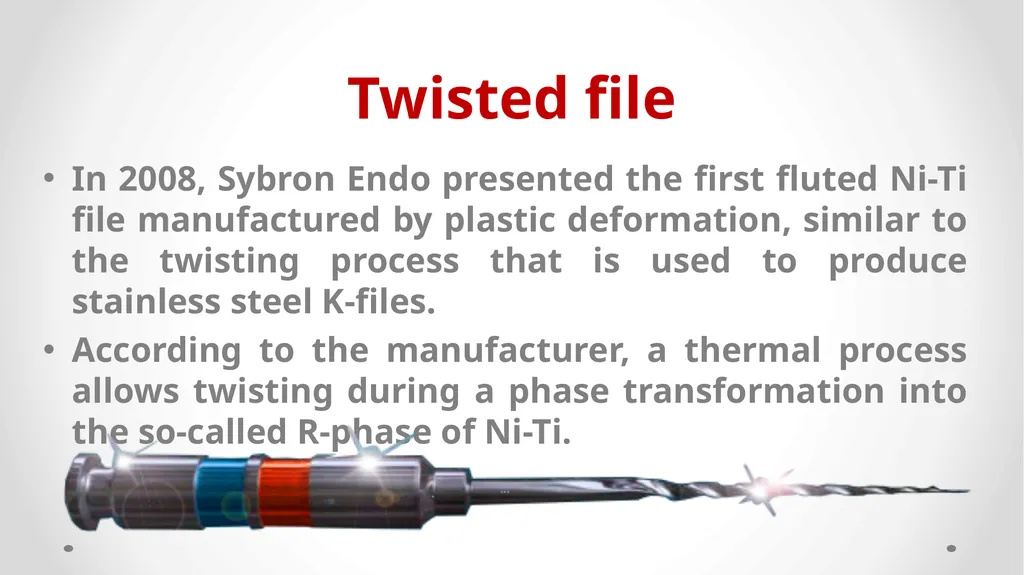
Twisted file In 2008, Sybron Endo presented the first fluted Ni-Ti file manufactured by plastic deformation, similar to the twisting process that is used to produce stainless steel K-files.
According to the manufacturer, a thermal process allows twisting during a phase transformation into the so-called R-phase of Ni-Ti.<br>
According to the manufacturer, a thermal process allows twisting during a phase transformation into the so-called R-phase of Ni-Ti.<br>
27
Hyflex HyFlex instruments made from CM Wire were in 2011.
They exhibit a lower percent in weight of nickel (52 Ni %wt) than the common 54.5–57 Ni %wt of the great majority of commercially available NiTi rotary instruments.<br>
They exhibit a lower percent in weight of nickel (52 Ni %wt) than the common 54.5–57 Ni %wt of the great majority of commercially available NiTi rotary instruments.<br>
28
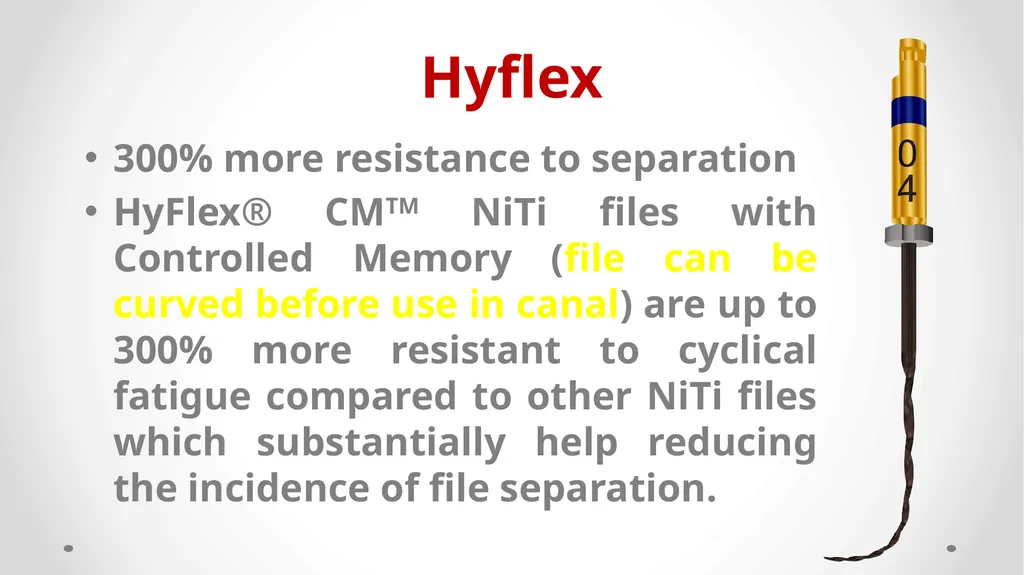
Hyflex 300% more resistance to separation
HyFlex® CMTM NiTi files with Controlled Memory (file can be curved before use in canal) are up to 300% more resistant to cyclical fatigue compared to other NiTi files which substantially help reducing the incidence of file separation.<br>
HyFlex® CMTM NiTi files with Controlled Memory (file can be curved before use in canal) are up to 300% more resistant to cyclical fatigue compared to other NiTi files which substantially help reducing the incidence of file separation.<br>
29
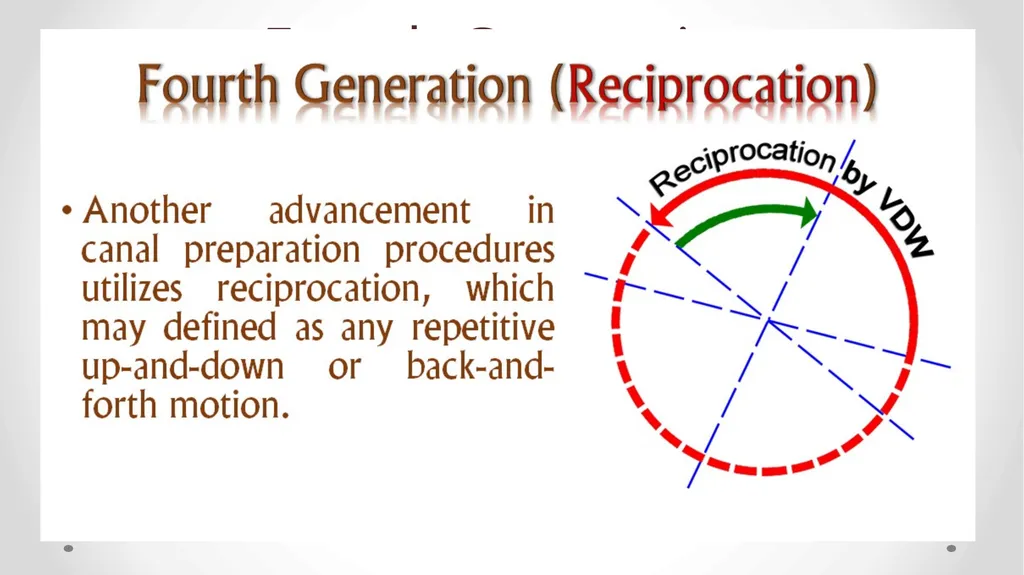
Fourth Generation (Reciprocation) Another advancement in canal preparation procedures utilizes reciprocation, which may defined as any repetitive up-and-down or back-and-forth motion.<br>
30
First introduced in the late 1950s by the French dentist, Blanc.
Systems like M4 (SybronEndo), Endo Express (Essential Dental Systems), and Endo-Eze (Ultradent) are examples With clockwise (CW) and counterclockwise (CCW) degrees of rotation are equal.
This require
- more inward pressure and not cut as efficiently as the same size rotary file.
- more limited for removing debries out of canal.
The reciprocation technology led to a 4th generation of instruments that related to fulfilled the single-file technique
As compared of bidirectional movements to full rotation,
1- a reciprocating file requires more inward pressure to progress.
2- not cut as efficiently as a same-size rotary file.
3- more limited in auguring debris out of the canal.<br>
Systems like M4 (SybronEndo), Endo Express (Essential Dental Systems), and Endo-Eze (Ultradent) are examples With clockwise (CW) and counterclockwise (CCW) degrees of rotation are equal.
This require
- more inward pressure and not cut as efficiently as the same size rotary file.
- more limited for removing debries out of canal.
The reciprocation technology led to a 4th generation of instruments that related to fulfilled the single-file technique
As compared of bidirectional movements to full rotation,
1- a reciprocating file requires more inward pressure to progress.
2- not cut as efficiently as a same-size rotary file.
3- more limited in auguring debris out of the canal.<br>
31
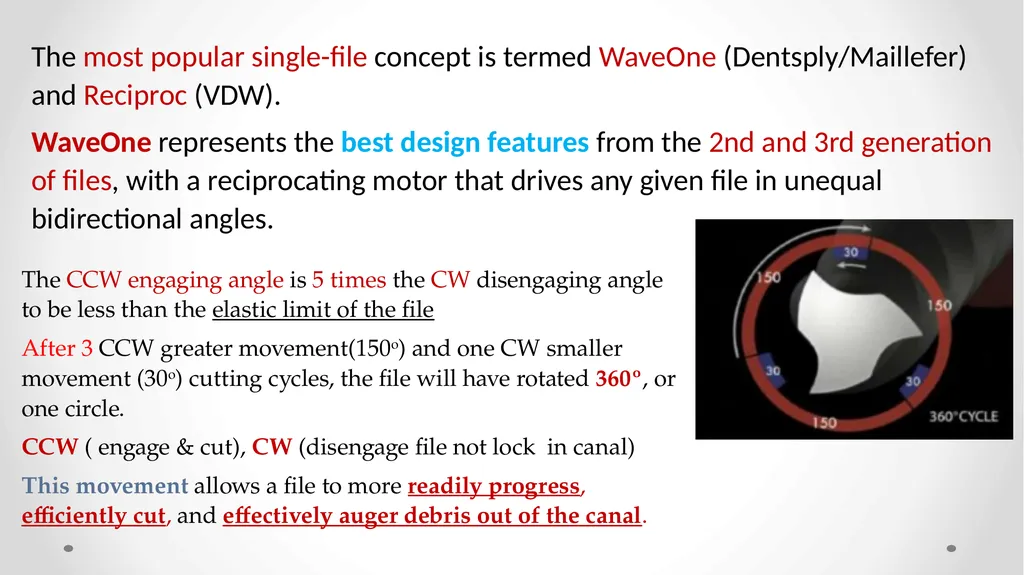
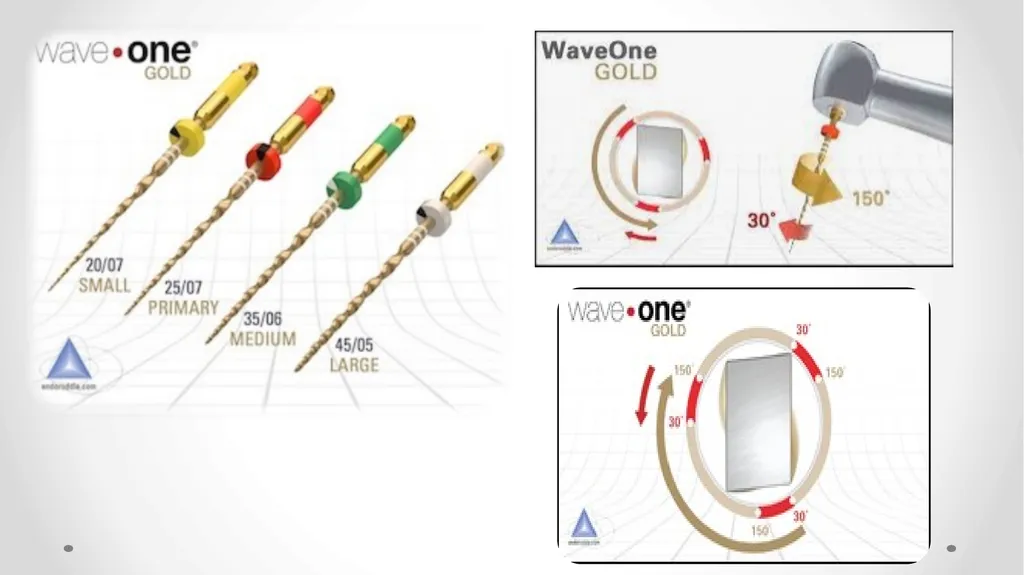
The most popular single-file concept is termed WaveOne (Dentsply/Maillefer) and Reciproc (VDW).
WaveOne represents the best design features from the 2nd and 3rd generation of files, with a reciprocating motor that drives any given file in unequal bidirectional angles. The CCW engaging angle is 5 times the CW disengaging angle to be less than the elastic limit of the file
After 3 CCW greater movement(150o) and one CW smaller movement (30o) cutting cycles, the file will have rotated 360º, or one circle.
CCW ( engage & cut), CW (disengage file not lock in canal)
This movement allows a file to more readily progress, efficiently cut, and effectively auger debris out of the canal.<br>
WaveOne represents the best design features from the 2nd and 3rd generation of files, with a reciprocating motor that drives any given file in unequal bidirectional angles. The CCW engaging angle is 5 times the CW disengaging angle to be less than the elastic limit of the file
After 3 CCW greater movement(150o) and one CW smaller movement (30o) cutting cycles, the file will have rotated 360º, or one circle.
CCW ( engage & cut), CW (disengage file not lock in canal)
This movement allows a file to more readily progress, efficiently cut, and effectively auger debris out of the canal.<br>
32
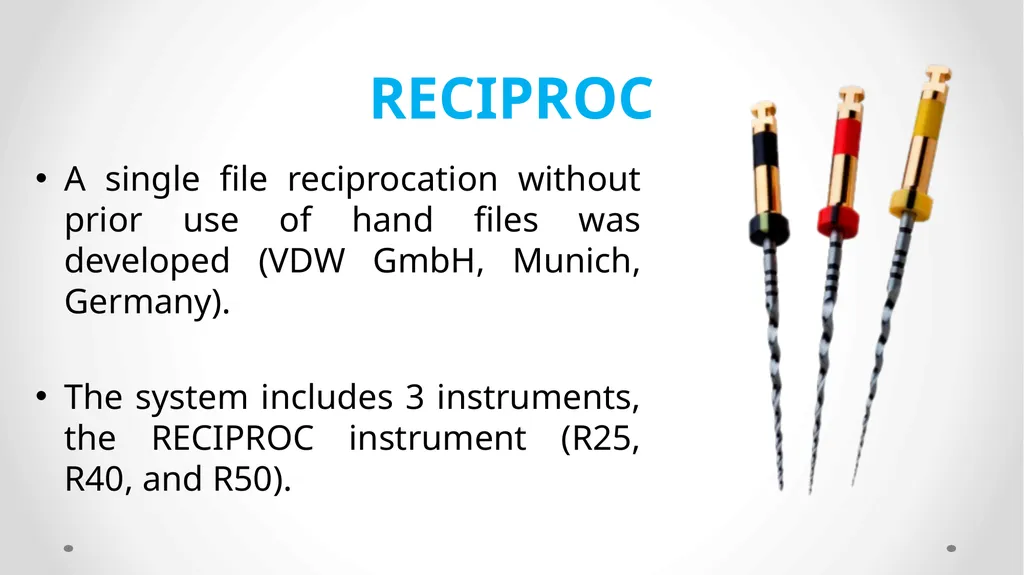
RECIPROC A single file reciprocation without prior use of hand files was developed (VDW GmbH, Munich, Germany).
The system includes 3 instruments, the RECIPROC instrument (R25, R40, and R50).<br>
The system includes 3 instruments, the RECIPROC instrument (R25, R40, and R50).<br>
33
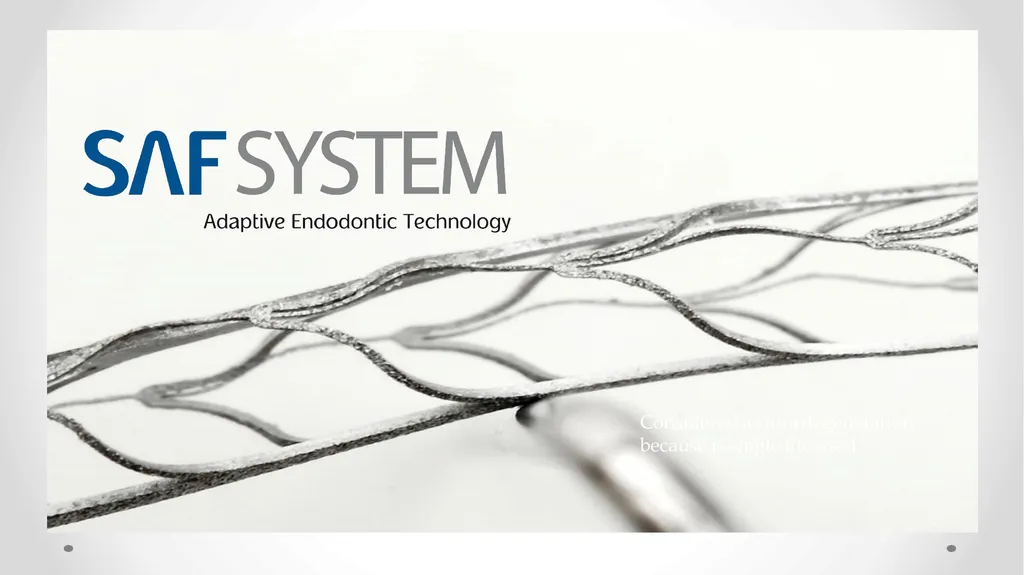
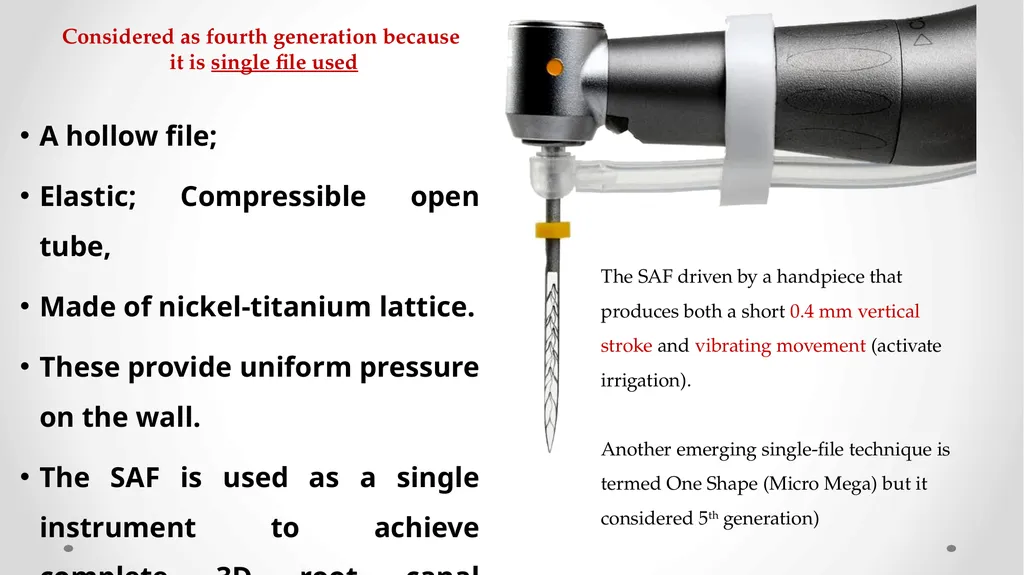
SAF Considered as fourth generation because is single file used<br>
34
A hollow file;
Elastic; Compressible open tube,
Made of nickel-titanium lattice.
These provide uniform pressure on the wall.
The SAF is used as a single instrument to achieve complete 3D root canal shaping, cleaning and Irrigation. The SAF driven by a handpiece that produces both a short 0.4 mm vertical stroke and vibrating movement (activate irrigation).
Another emerging single-file technique is termed One Shape (Micro Mega) but it considered 5th generation) Considered as fourth generation because
it is single file used<br>
Elastic; Compressible open tube,
Made of nickel-titanium lattice.
These provide uniform pressure on the wall.
The SAF is used as a single instrument to achieve complete 3D root canal shaping, cleaning and Irrigation. The SAF driven by a handpiece that produces both a short 0.4 mm vertical stroke and vibrating movement (activate irrigation).
Another emerging single-file technique is termed One Shape (Micro Mega) but it considered 5th generation) Considered as fourth generation because
it is single file used<br>
35
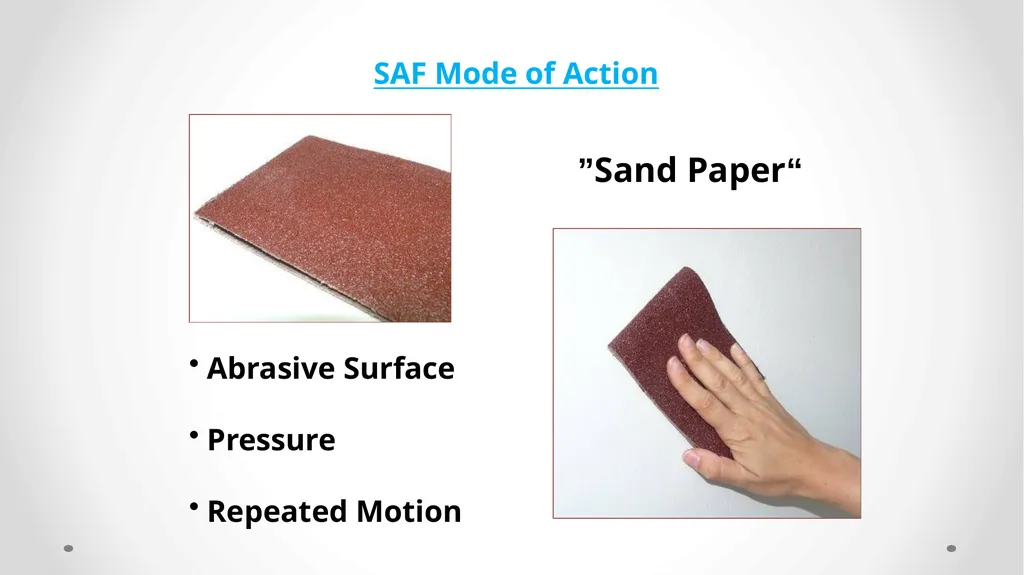
“Sand Paper” Abrasive Surface
Pressure
Repeated Motion SAF Mode of Action<br>
Pressure
Repeated Motion SAF Mode of Action<br>
36
Fifth generation (The center of mass is offset) The fifth generation of shaping files has been designed such that the center of mass and/or the center of rotation are offset.
Produce mechanical wave motion. Offset design serves to further minimize the engagement between the file and the dentin.
In addition, an offset design enhances removing debris out of the canal and improves flexibility along the active portion of a PTN file.<br>
Produce mechanical wave motion. Offset design serves to further minimize the engagement between the file and the dentin.
In addition, an offset design enhances removing debris out of the canal and improves flexibility along the active portion of a PTN file.<br>
37
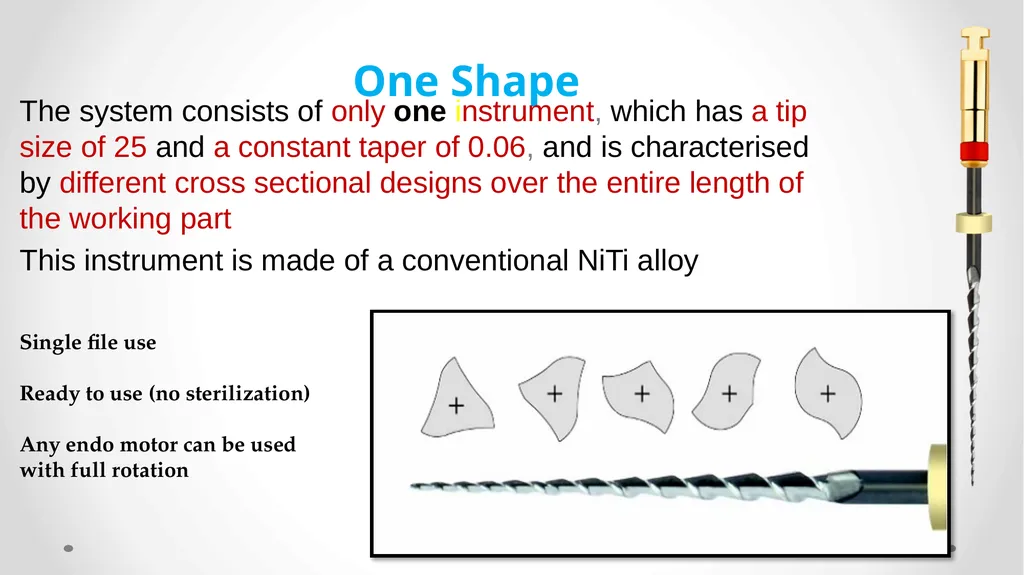
One Shape The system consists of only one instrument, which has a tip size of 25 and a constant taper of 0.06, and is characterised by different cross sectional designs over the entire length of the working part
This instrument is made of a conventional NiTi alloy Single file use
Ready to use (no sterilization)
Any endo motor can be used with full rotation<br>
This instrument is made of a conventional NiTi alloy Single file use
Ready to use (no sterilization)
Any endo motor can be used with full rotation<br>
38
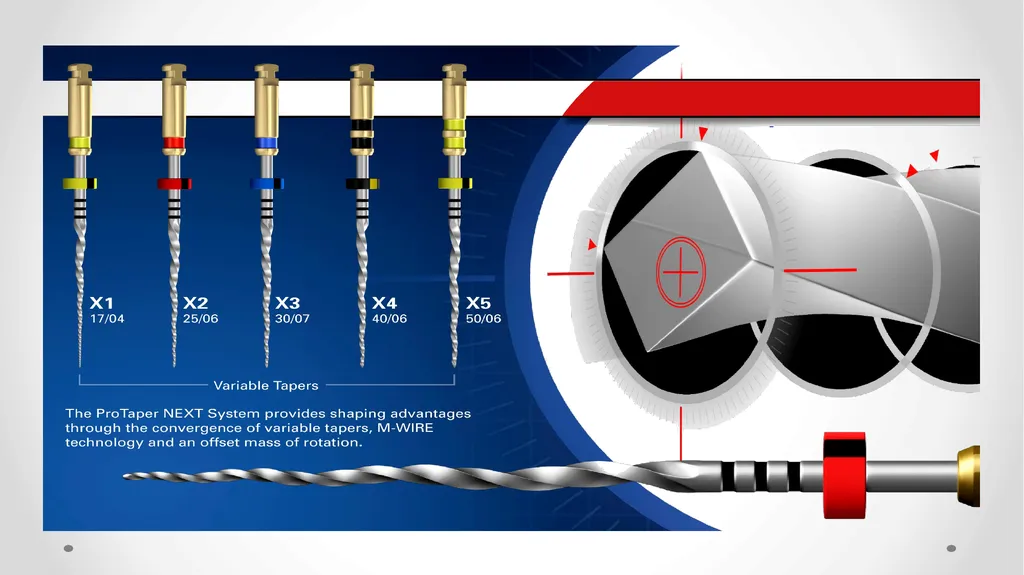
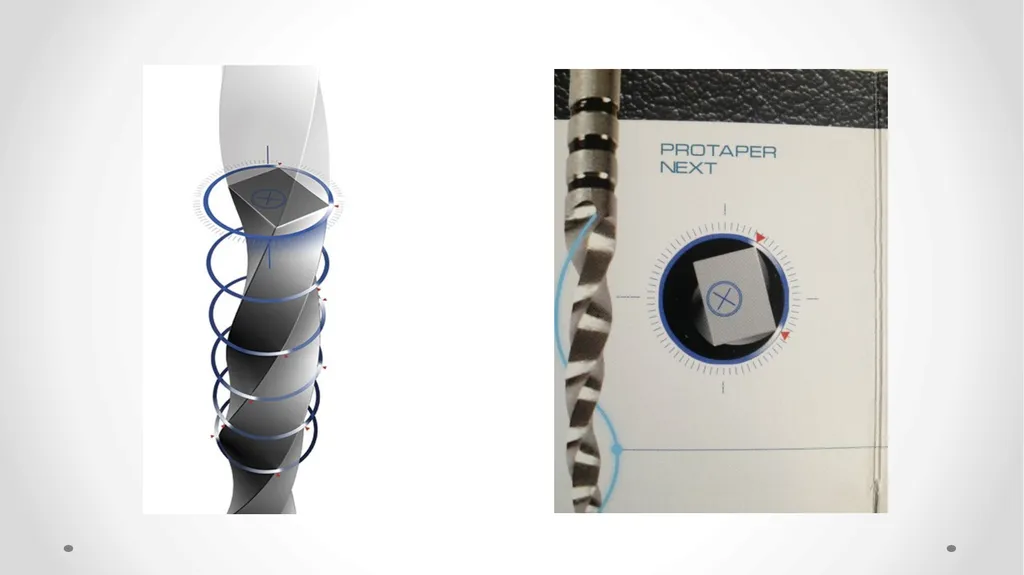
ProTaper Next<br>