
SABC PRESENTATION TO THE PORTFOLIO COMMITTEE ON
CM
Published · 28 slides · 0 views

1 / 1




Description
SABC PRESENTATION TO THE PORTFOLIO COMMITTEE ON COMMUNICATIONS 21 August 2018 2 Table of Contents INTRODUCTION BROADCASTING OF SPORTS CASH FLOW AND PAYMENT OF CREDITORS GOVERNANCE MATTERS RAISED WITH THE COMMITTEE Introduction The SABC is
Related Topics
Share
Embed code
Download this presentation From Below
"SABC PRESENTATION TO THE PORTFOLIO COMMITTEE ON" is the property of its rightful owner. Permission is granted to download and print the materials on this website for personal, non-commercial use only, and to display it on your personal computer provided you do not modify the materials and that you retain all copyright notices contained in the materials. By downloading content from our website, you accept the terms of this agreement.
Presentation Transcript
01
SABC PRESENTATION TO THE PORTFOLIO COMMITTEE ON COMMUNICATIONS
21 August 2018<br>
21 August 2018<br>
02
2 Table of Contents INTRODUCTION
BROADCASTING OF SPORTS
CASH FLOW AND PAYMENT OF CREDITORS
GOVERNANCE
MATTERS RAISED WITH THE COMMITTEE<br>
BROADCASTING OF SPORTS
CASH FLOW AND PAYMENT OF CREDITORS
GOVERNANCE
MATTERS RAISED WITH THE COMMITTEE<br>
03
Introduction The SABC is in a process of rehabilitation and renewal - must be carefully managed and restored to ensure fulfilment of its unique public mandate.
Good progress made in stabilising the SABC, strengthening governance and regaining integrity. However, current financial position remains dire.
Developed a new strategic Roadmap. Is aimed at ensuring that the SABC operates competitively in evolving media and digital landscape and provide informative, educational and entertaining content to all South Africans. Main objective is to ensure financial sustainability.
Focus is also on reducing operating costs. Review of the SABC’s operating model will assist to ensure that the organisation is properly aligned for future operations and is fit for purpose. 3<br>
Good progress made in stabilising the SABC, strengthening governance and regaining integrity. However, current financial position remains dire.
Developed a new strategic Roadmap. Is aimed at ensuring that the SABC operates competitively in evolving media and digital landscape and provide informative, educational and entertaining content to all South Africans. Main objective is to ensure financial sustainability.
Focus is also on reducing operating costs. Review of the SABC’s operating model will assist to ensure that the organisation is properly aligned for future operations and is fit for purpose. 3<br>
04
Introduction (cont) 4 Profitable growth is critical for long-term financial sustainability. In order to achieve this the SABC will have to address the challenges with its funding model, cost base and operational inefficiencies.
Negotiations with third parties to ensure that maximum value is obtained, maintaining and monitoring capital utilisation, identification of and investment into new revenue growth areas, and driving cost-efficiencies throughout all operations are crucial elements to reach profitability levels in the current competitive landscape and economic climate.
The SABC will work hard to ensure that the organisation is run efficiently and effectively, and to redirect spending and simplify procedures in a way that supports a more sustainable and creative public broadcaster.<br>
Negotiations with third parties to ensure that maximum value is obtained, maintaining and monitoring capital utilisation, identification of and investment into new revenue growth areas, and driving cost-efficiencies throughout all operations are crucial elements to reach profitability levels in the current competitive landscape and economic climate.
The SABC will work hard to ensure that the organisation is run efficiently and effectively, and to redirect spending and simplify procedures in a way that supports a more sustainable and creative public broadcaster.<br>
05
5 BROADCASTING OF SPORTS<br>
06
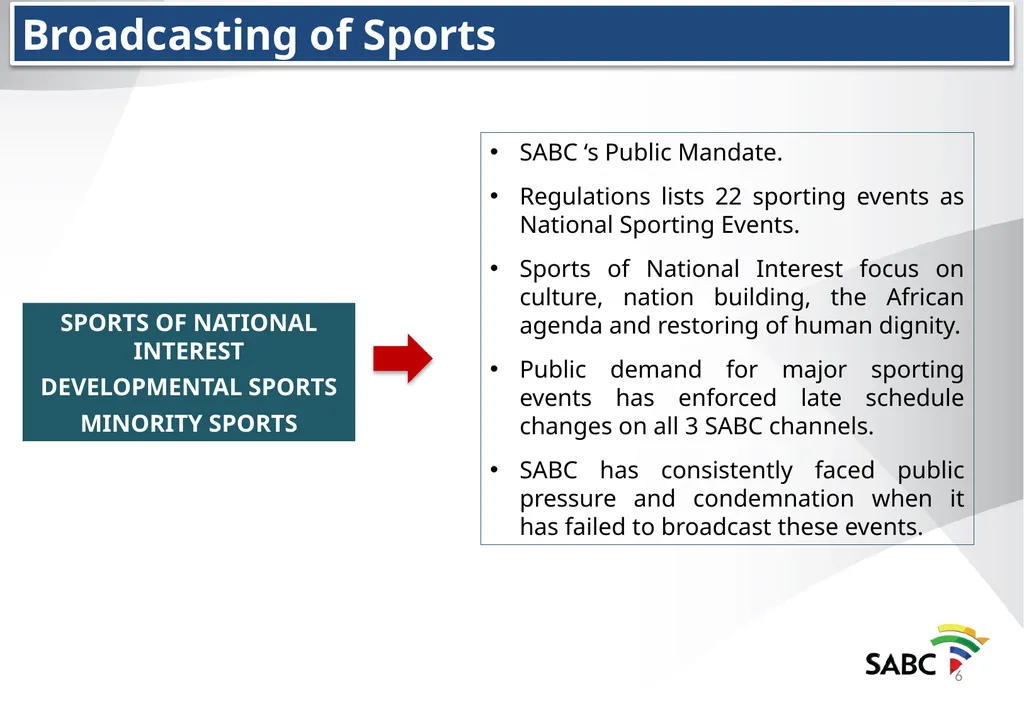
Broadcasting of Sports SPORTS OF NATIONAL INTEREST
DEVELOPMENTAL SPORTS
MINORITY SPORTS SABC ‘s Public Mandate.
Regulations lists 22 sporting events as National Sporting Events.
Sports of National Interest focus on culture, nation building, the African agenda and restoring of human dignity.
Public demand for major sporting events has enforced late schedule changes on all 3 SABC channels.
SABC has consistently faced public pressure and condemnation when it has failed to broadcast these events. 6<br>
DEVELOPMENTAL SPORTS
MINORITY SPORTS SABC ‘s Public Mandate.
Regulations lists 22 sporting events as National Sporting Events.
Sports of National Interest focus on culture, nation building, the African agenda and restoring of human dignity.
Public demand for major sporting events has enforced late schedule changes on all 3 SABC channels.
SABC has consistently faced public pressure and condemnation when it has failed to broadcast these events. 6<br>
07
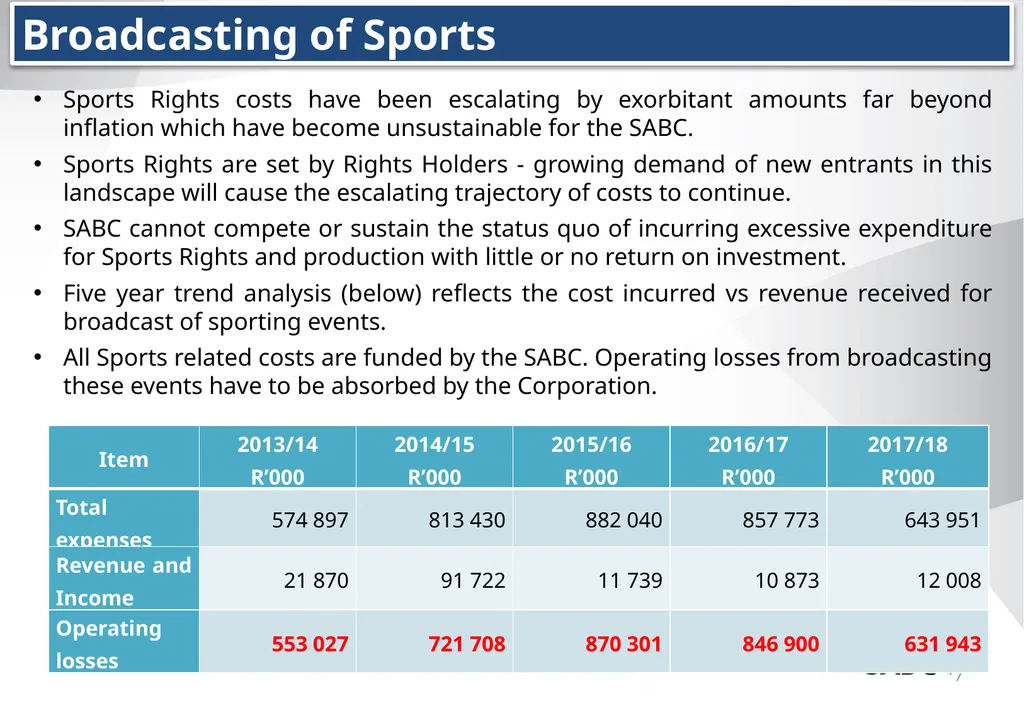
Broadcasting of Sports Sports Rights costs have been escalating by exorbitant amounts far beyond inflation which have become unsustainable for the SABC.
Sports Rights are set by Rights Holders - growing demand of new entrants in this landscape will cause the escalating trajectory of costs to continue.
SABC cannot compete or sustain the status quo of incurring excessive expenditure for Sports Rights and production with little or no return on investment.
Five year trend analysis (below) reflects the cost incurred vs revenue received for broadcast of sporting events.
All Sports related costs are funded by the SABC. Operating losses from broadcasting these events have to be absorbed by the Corporation. 7<br>
Sports Rights are set by Rights Holders - growing demand of new entrants in this landscape will cause the escalating trajectory of costs to continue.
SABC cannot compete or sustain the status quo of incurring excessive expenditure for Sports Rights and production with little or no return on investment.
Five year trend analysis (below) reflects the cost incurred vs revenue received for broadcast of sporting events.
All Sports related costs are funded by the SABC. Operating losses from broadcasting these events have to be absorbed by the Corporation. 7<br>
08
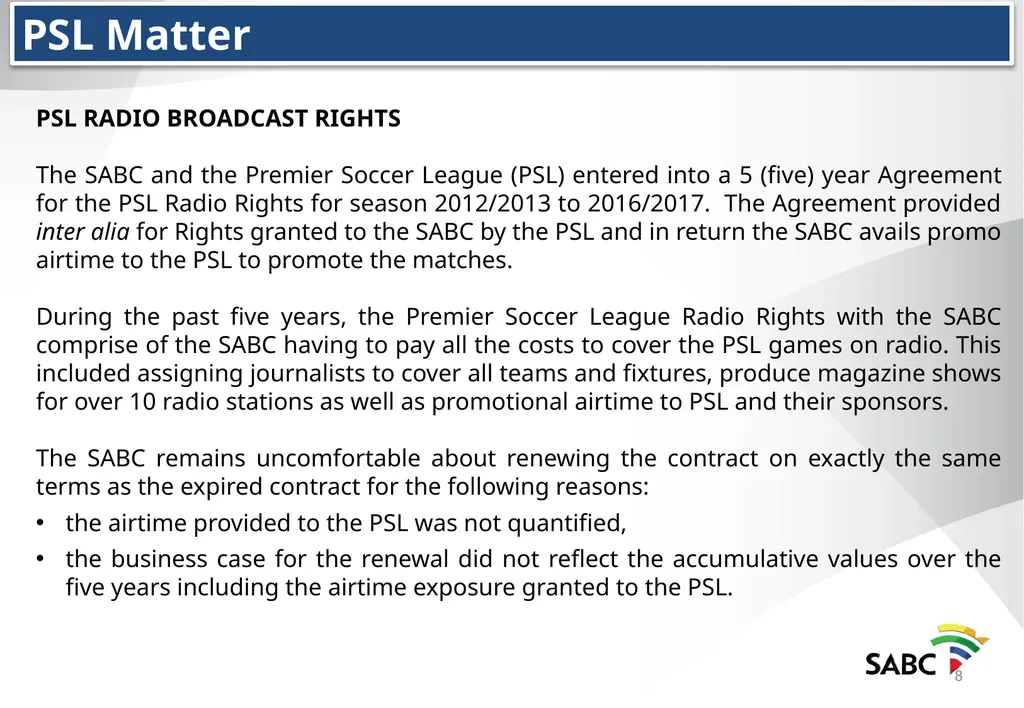
PSL Matter PSL RADIO BROADCAST RIGHTS
The SABC and the Premier Soccer League (PSL) entered into a 5 (five) year Agreement for the PSL Radio Rights for season 2012/2013 to 2016/2017. The Agreement provided inter alia for Rights granted to the SABC by the PSL and in return the SABC avails promo airtime to the PSL to promote the matches.
During the past five years, the Premier Soccer League Radio Rights with the SABC comprise of the SABC having to pay all the costs to cover the PSL games on radio. This included assigning journalists to cover all teams and fixtures, produce magazine shows for over 10 radio stations as well as promotional airtime to PSL and their sponsors.
The SABC remains uncomfortable about renewing the contract on exactly the same terms as the expired contract for the following reasons:
the airtime provided to the PSL was not quantified,
the business case for the renewal did not reflect the accumulative values over the five years including the airtime exposure granted to the PSL. 8<br>
The SABC and the Premier Soccer League (PSL) entered into a 5 (five) year Agreement for the PSL Radio Rights for season 2012/2013 to 2016/2017. The Agreement provided inter alia for Rights granted to the SABC by the PSL and in return the SABC avails promo airtime to the PSL to promote the matches.
During the past five years, the Premier Soccer League Radio Rights with the SABC comprise of the SABC having to pay all the costs to cover the PSL games on radio. This included assigning journalists to cover all teams and fixtures, produce magazine shows for over 10 radio stations as well as promotional airtime to PSL and their sponsors.
The SABC remains uncomfortable about renewing the contract on exactly the same terms as the expired contract for the following reasons:
the airtime provided to the PSL was not quantified,
the business case for the renewal did not reflect the accumulative values over the five years including the airtime exposure granted to the PSL. 8<br>
09
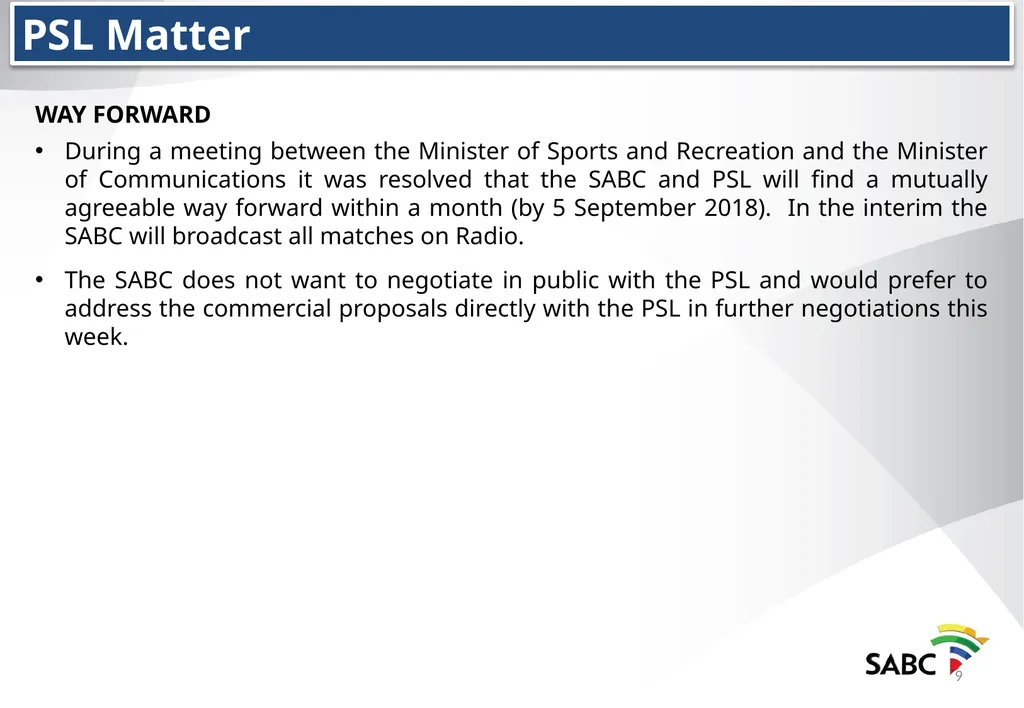
PSL Matter WAY FORWARD
During a meeting between the Minister of Sports and Recreation and the Minister of Communications it was resolved that the SABC and PSL will find a mutually agreeable way forward within a month (by 5 September 2018). In the interim the SABC will broadcast all matches on Radio.
The SABC does not want to negotiate in public with the PSL and would prefer to address the commercial proposals directly with the PSL in further negotiations this week. 9<br>
During a meeting between the Minister of Sports and Recreation and the Minister of Communications it was resolved that the SABC and PSL will find a mutually agreeable way forward within a month (by 5 September 2018). In the interim the SABC will broadcast all matches on Radio.
The SABC does not want to negotiate in public with the PSL and would prefer to address the commercial proposals directly with the PSL in further negotiations this week. 9<br>
10
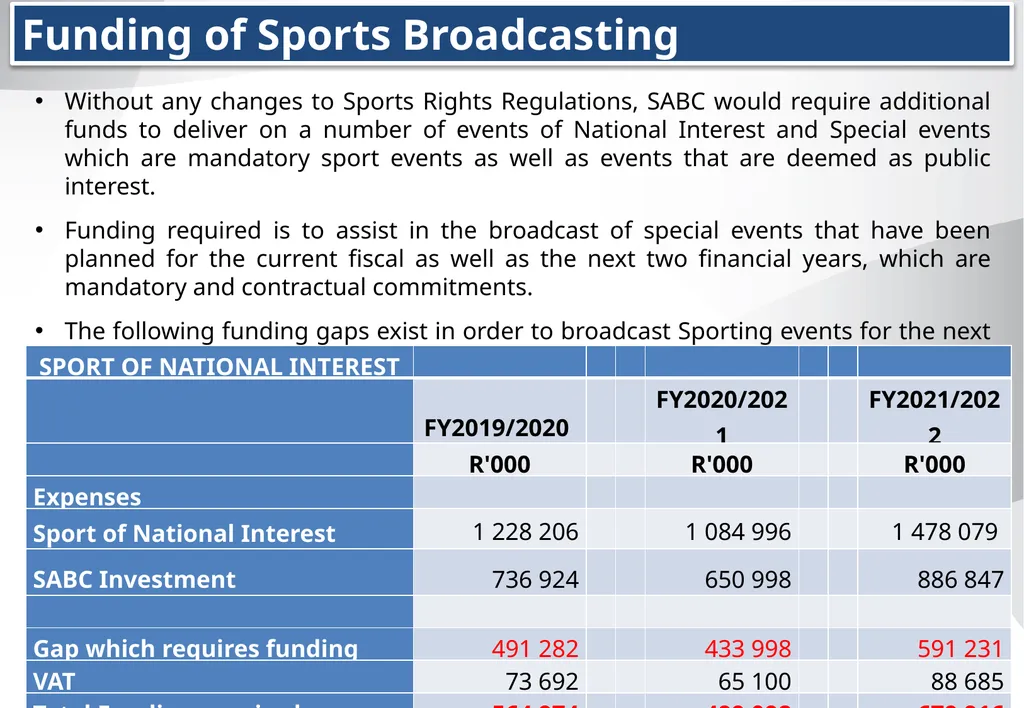
Funding of Sports Broadcasting Without any changes to Sports Rights Regulations, SABC would require additional funds to deliver on a number of events of National Interest and Special events which are mandatory sport events as well as events that are deemed as public interest.
Funding required is to assist in the broadcast of special events that have been planned for the current fiscal as well as the next two financial years, which are mandatory and contractual commitments.
The following funding gaps exist in order to broadcast Sporting events for the next three years: 10<br>
Funding required is to assist in the broadcast of special events that have been planned for the current fiscal as well as the next two financial years, which are mandatory and contractual commitments.
The following funding gaps exist in order to broadcast Sporting events for the next three years: 10<br>
11
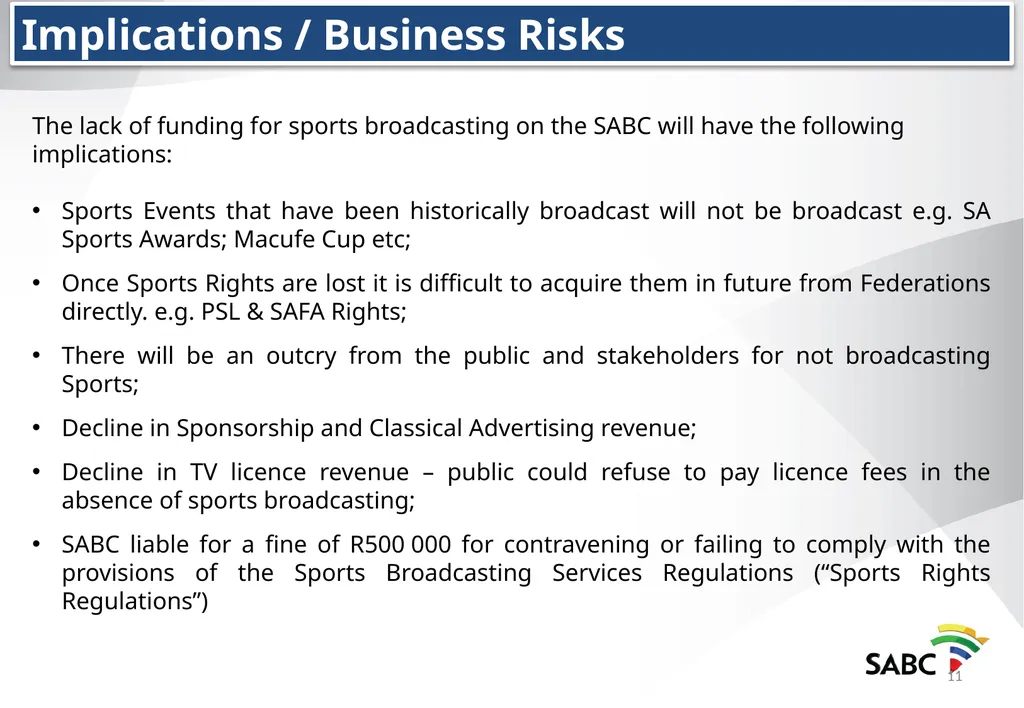
Implications / Business Risks The lack of funding for sports broadcasting on the SABC will have the following implications:
Sports Events that have been historically broadcast will not be broadcast e.g. SA Sports Awards; Macufe Cup etc;
Once Sports Rights are lost it is difficult to acquire them in future from Federations directly. e.g. PSL & SAFA Rights;
There will be an outcry from the public and stakeholders for not broadcasting Sports;
Decline in Sponsorship and Classical Advertising revenue;
Decline in TV licence revenue – public could refuse to pay licence fees in the absence of sports broadcasting;
SABC liable for a fine of R500 000 for contravening or failing to comply with the provisions of the Sports Broadcasting Services Regulations (“Sports Rights Regulations”) 11<br>
Sports Events that have been historically broadcast will not be broadcast e.g. SA Sports Awards; Macufe Cup etc;
Once Sports Rights are lost it is difficult to acquire them in future from Federations directly. e.g. PSL & SAFA Rights;
There will be an outcry from the public and stakeholders for not broadcasting Sports;
Decline in Sponsorship and Classical Advertising revenue;
Decline in TV licence revenue – public could refuse to pay licence fees in the absence of sports broadcasting;
SABC liable for a fine of R500 000 for contravening or failing to comply with the provisions of the Sports Broadcasting Services Regulations (“Sports Rights Regulations”) 11<br>
12
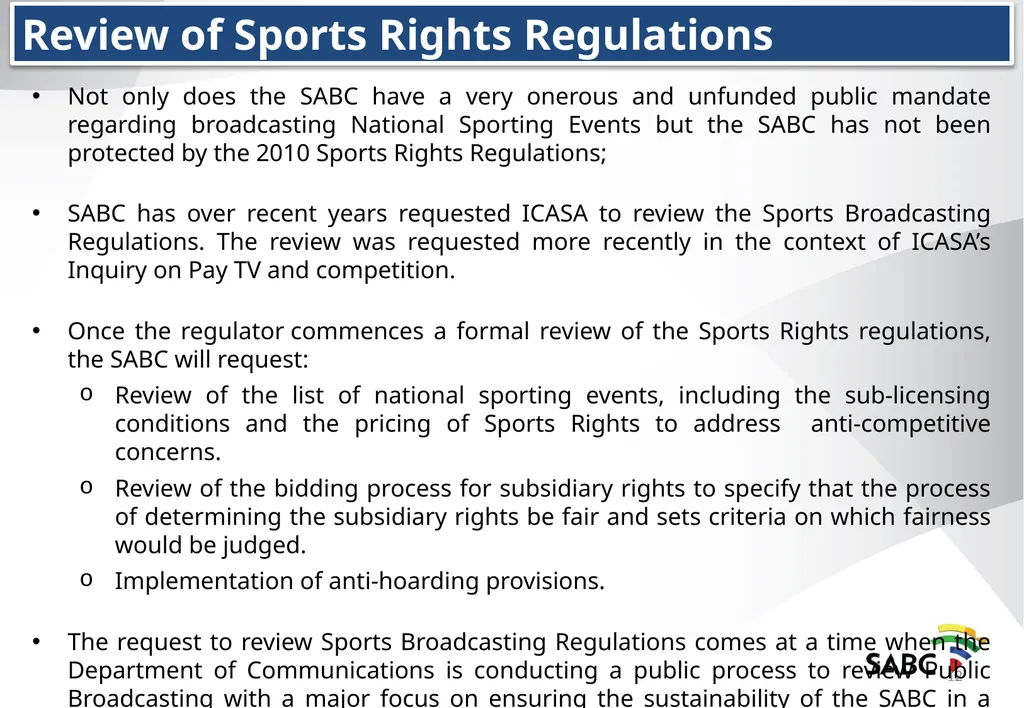
Review of Sports Rights Regulations Not only does the SABC have a very onerous and unfunded public mandate regarding broadcasting National Sporting Events but the SABC has not been protected by the 2010 Sports Rights Regulations;
SABC has over recent years requested ICASA to review the Sports Broadcasting Regulations. The review was requested more recently in the context of ICASA’s Inquiry on Pay TV and competition.
Once the regulator commences a formal review of the Sports Rights regulations, the SABC will request:
Review of the list of national sporting events, including the sub-licensing conditions and the pricing of Sports Rights to address anti-competitive concerns.
Review of the bidding process for subsidiary rights to specify that the process of determining the subsidiary rights be fair and sets criteria on which fairness would be judged.
Implementation of anti-hoarding provisions.
The request to review Sports Broadcasting Regulations comes at a time when the Department of Communications is conducting a public process to review Public Broadcasting with a major focus on ensuring the sustainability of the SABC in a digitised multichannel environment. The issue of how Sports Rights are regulated will also be discussed in that policy context. 12<br>
SABC has over recent years requested ICASA to review the Sports Broadcasting Regulations. The review was requested more recently in the context of ICASA’s Inquiry on Pay TV and competition.
Once the regulator commences a formal review of the Sports Rights regulations, the SABC will request:
Review of the list of national sporting events, including the sub-licensing conditions and the pricing of Sports Rights to address anti-competitive concerns.
Review of the bidding process for subsidiary rights to specify that the process of determining the subsidiary rights be fair and sets criteria on which fairness would be judged.
Implementation of anti-hoarding provisions.
The request to review Sports Broadcasting Regulations comes at a time when the Department of Communications is conducting a public process to review Public Broadcasting with a major focus on ensuring the sustainability of the SABC in a digitised multichannel environment. The issue of how Sports Rights are regulated will also be discussed in that policy context. 12<br>
13
13 CASH FLOW AND PAYMENT OF CREDITORS<br>
14
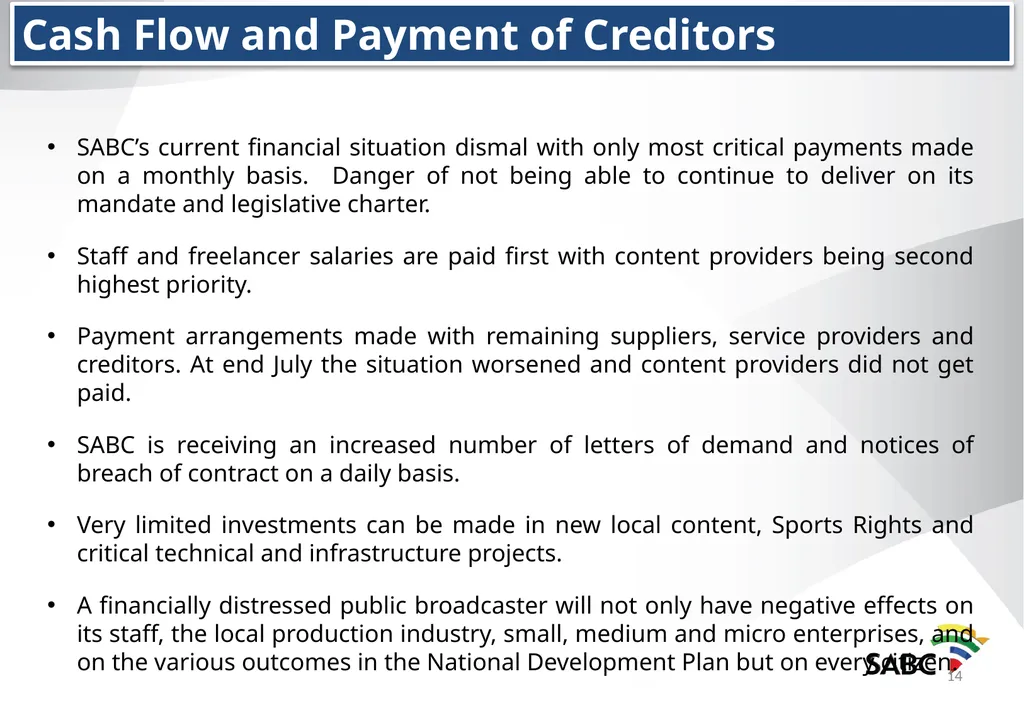
Cash Flow and Payment of Creditors SABC’s current financial situation dismal with only most critical payments made on a monthly basis. Danger of not being able to continue to deliver on its mandate and legislative charter.
Staff and freelancer salaries are paid first with content providers being second highest priority.
Payment arrangements made with remaining suppliers, service providers and creditors. At end July the situation worsened and content providers did not get paid.
SABC is receiving an increased number of letters of demand and notices of breach of contract on a daily basis.
Very limited investments can be made in new local content, Sports Rights and critical technical and infrastructure projects.
A financially distressed public broadcaster will not only have negative effects on its staff, the local production industry, small, medium and micro enterprises, and on the various outcomes in the National Development Plan but on every citizen. 14<br>
Staff and freelancer salaries are paid first with content providers being second highest priority.
Payment arrangements made with remaining suppliers, service providers and creditors. At end July the situation worsened and content providers did not get paid.
SABC is receiving an increased number of letters of demand and notices of breach of contract on a daily basis.
Very limited investments can be made in new local content, Sports Rights and critical technical and infrastructure projects.
A financially distressed public broadcaster will not only have negative effects on its staff, the local production industry, small, medium and micro enterprises, and on the various outcomes in the National Development Plan but on every citizen. 14<br>
15
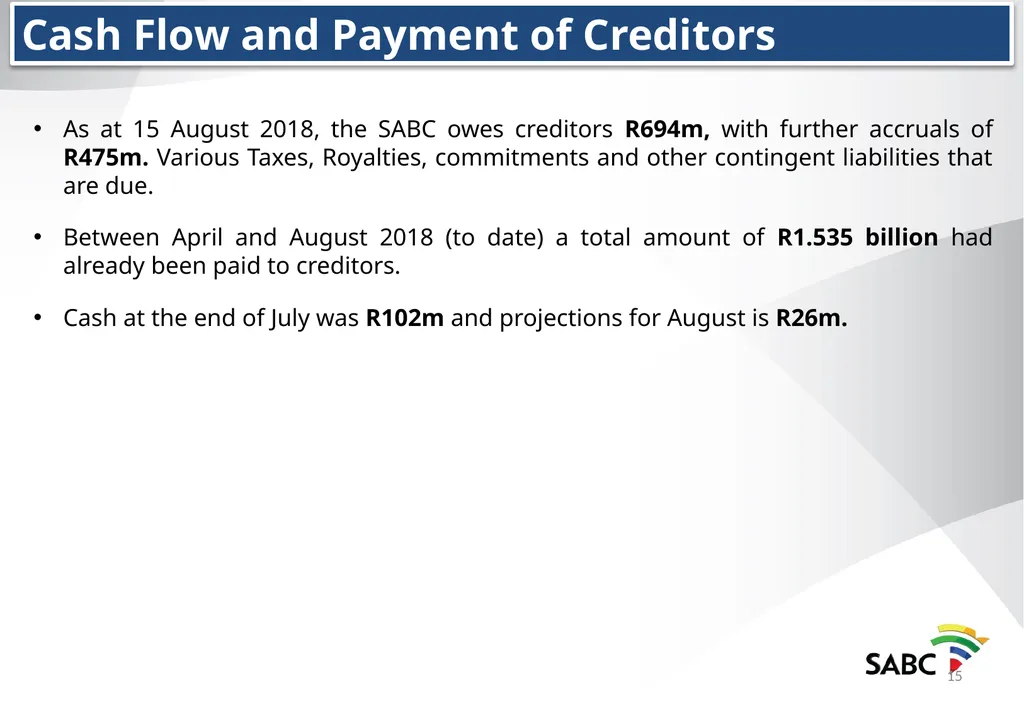
Cash Flow and Payment of Creditors As at 15 August 2018, the SABC owes creditors R694m, with further accruals of R475m. Various Taxes, Royalties, commitments and other contingent liabilities that are due.
Between April and August 2018 (to date) a total amount of R1.535 billion had already been paid to creditors.
Cash at the end of July was R102m and projections for August is R26m. 15<br>
Between April and August 2018 (to date) a total amount of R1.535 billion had already been paid to creditors.
Cash at the end of July was R102m and projections for August is R26m. 15<br>
16
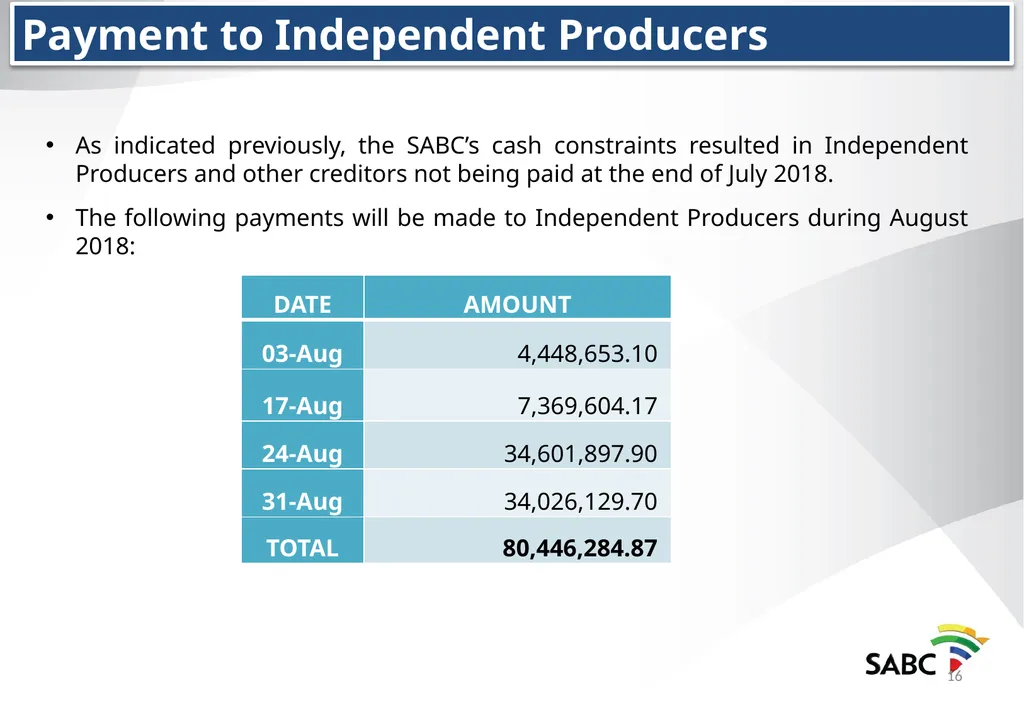
Payment to Independent Producers As indicated previously, the SABC’s cash constraints resulted in Independent Producers and other creditors not being paid at the end of July 2018.
The following payments will be made to Independent Producers during August 2018: 16<br>
The following payments will be made to Independent Producers during August 2018: 16<br>
17
17 GOVERNANCE<br>
18
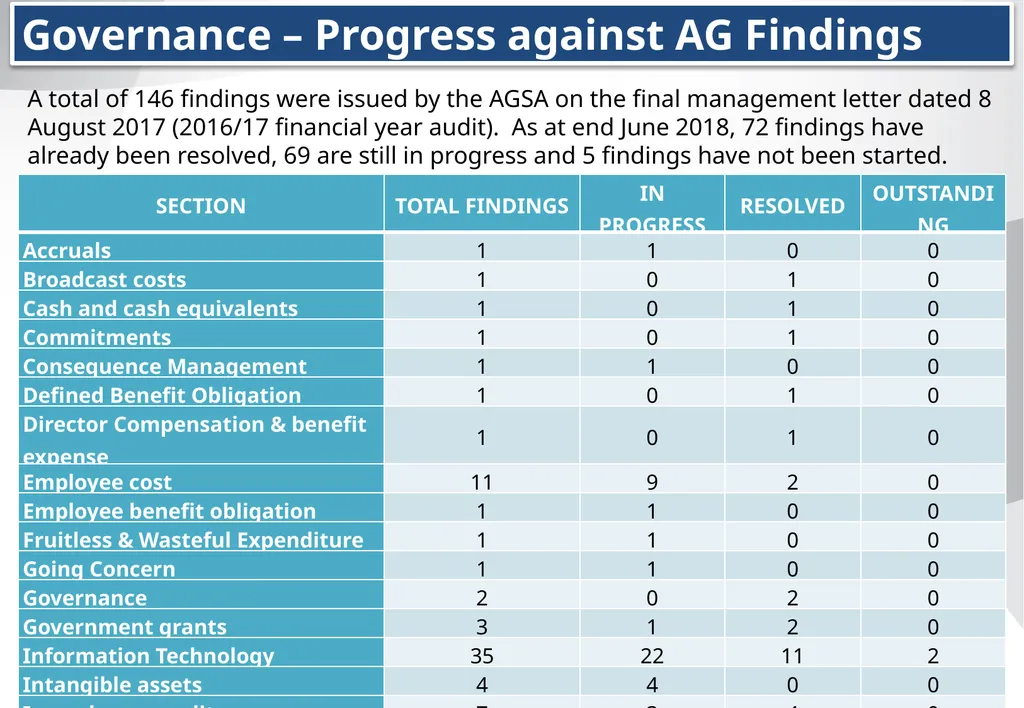
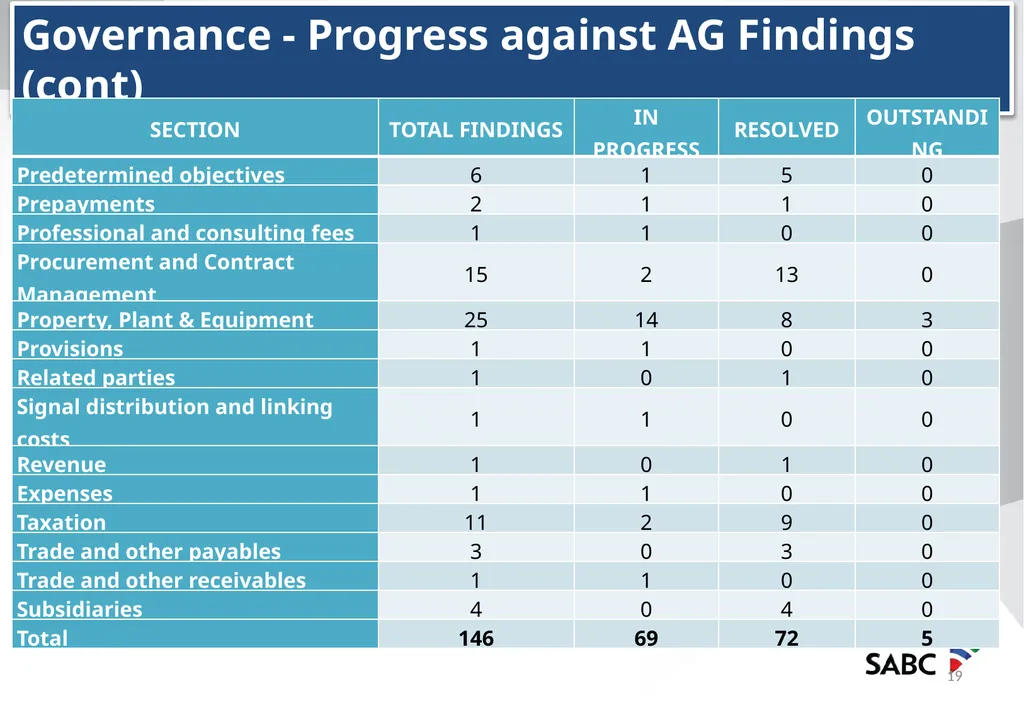
Governance – Progress against AG Findings A total of 146 findings were issued by the AGSA on the final management letter dated 8 August 2017 (2016/17 financial year audit). As at end June 2018, 72 findings have already been resolved, 69 are still in progress and 5 findings have not been started. 18<br>
19
Governance - Progress against AG Findings (cont) 19<br>
20
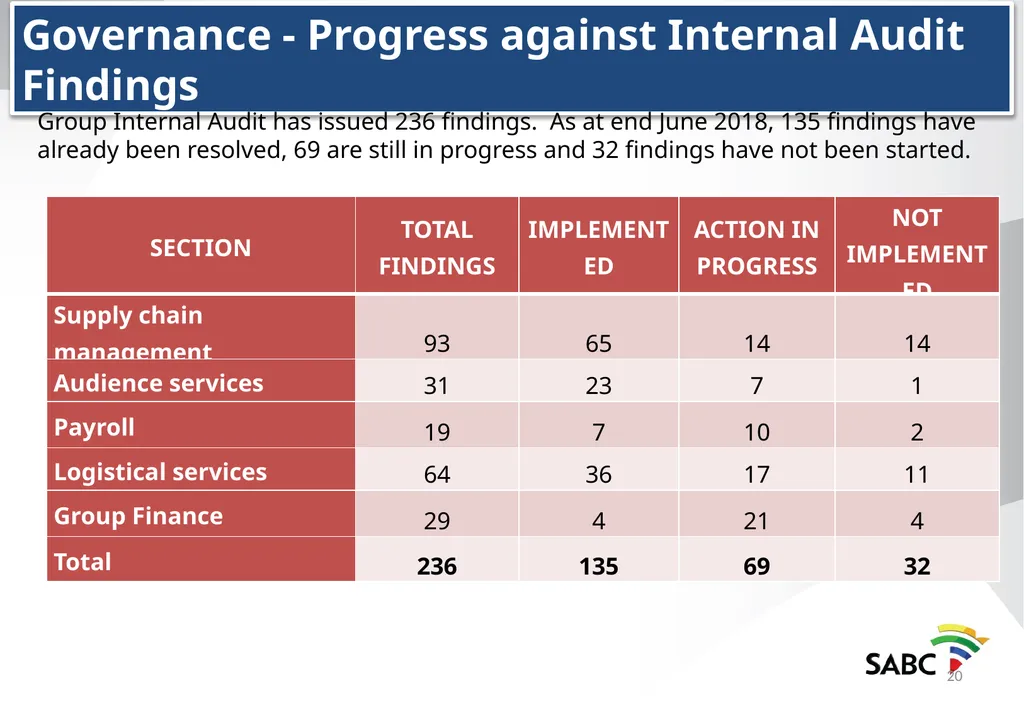
Governance - Progress against Internal Audit Findings Group Internal Audit has issued 236 findings. As at end June 2018, 135 findings have already been resolved, 69 are still in progress and 32 findings have not been started. 20<br>
21
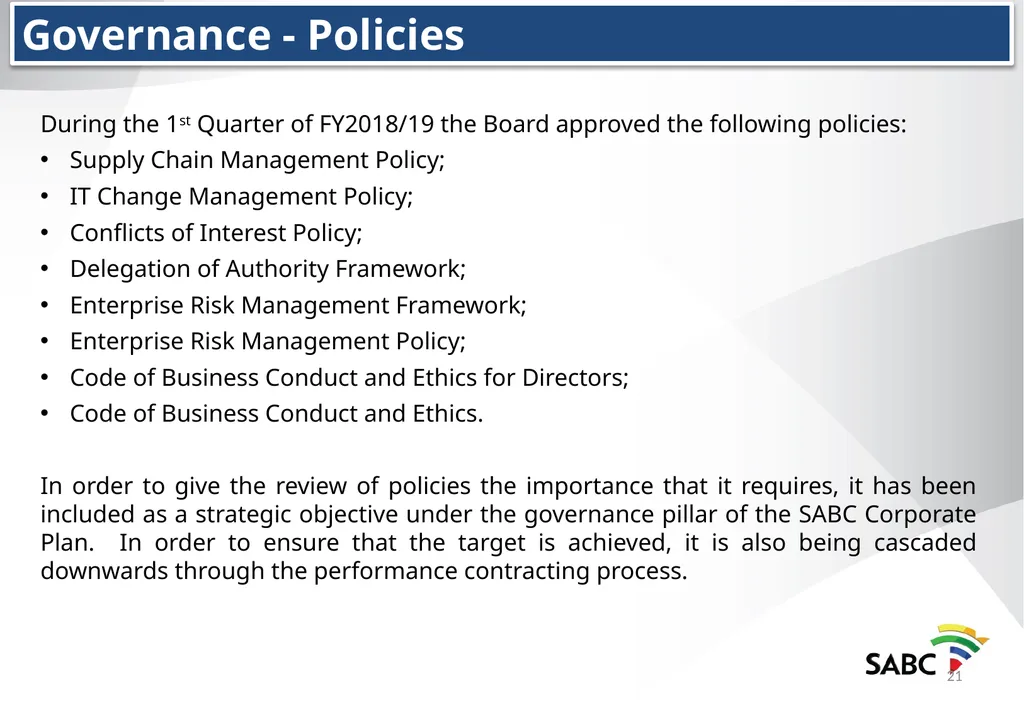
Governance - Policies During the 1st Quarter of FY2018/19 the Board approved the following policies:
Supply Chain Management Policy;
IT Change Management Policy;
Conflicts of Interest Policy;
Delegation of Authority Framework;
Enterprise Risk Management Framework;
Enterprise Risk Management Policy;
Code of Business Conduct and Ethics for Directors;
Code of Business Conduct and Ethics.
In order to give the review of policies the importance that it requires, it has been included as a strategic objective under the governance pillar of the SABC Corporate Plan. In order to ensure that the target is achieved, it is also being cascaded downwards through the performance contracting process. 21<br>
Supply Chain Management Policy;
IT Change Management Policy;
Conflicts of Interest Policy;
Delegation of Authority Framework;
Enterprise Risk Management Framework;
Enterprise Risk Management Policy;
Code of Business Conduct and Ethics for Directors;
Code of Business Conduct and Ethics.
In order to give the review of policies the importance that it requires, it has been included as a strategic objective under the governance pillar of the SABC Corporate Plan. In order to ensure that the target is achieved, it is also being cascaded downwards through the performance contracting process. 21<br>
22
22 MATTERS RAISED WITH THE COMMITTEE<br>
23
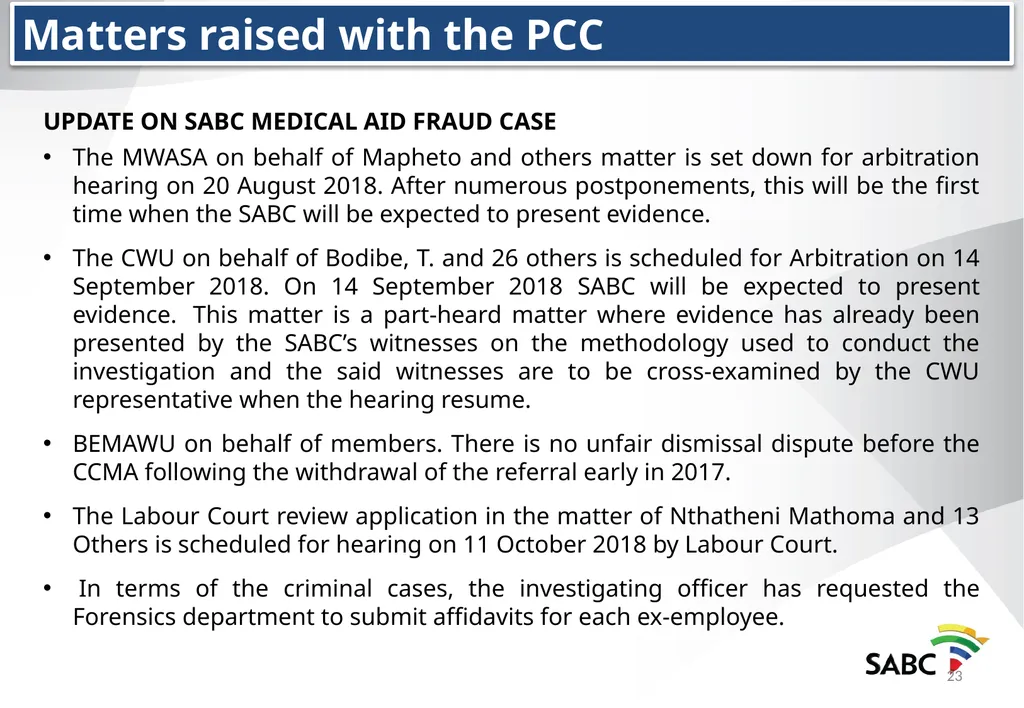
Matters raised with the PCC UPDATE ON SABC MEDICAL AID FRAUD CASE
The MWASA on behalf of Mapheto and others matter is set down for arbitration hearing on 20 August 2018. After numerous postponements, this will be the first time when the SABC will be expected to present evidence.
The CWU on behalf of Bodibe, T. and 26 others is scheduled for Arbitration on 14 September 2018. On 14 September 2018 SABC will be expected to present evidence. This matter is a part-heard matter where evidence has already been presented by the SABC’s witnesses on the methodology used to conduct the investigation and the said witnesses are to be cross-examined by the CWU representative when the hearing resume.
BEMAWU on behalf of members. There is no unfair dismissal dispute before the CCMA following the withdrawal of the referral early in 2017.
The Labour Court review application in the matter of Nthatheni Mathoma and 13 Others is scheduled for hearing on 11 October 2018 by Labour Court.
In terms of the criminal cases, the investigating officer has requested the Forensics department to submit affidavits for each ex-employee. 23<br>
The MWASA on behalf of Mapheto and others matter is set down for arbitration hearing on 20 August 2018. After numerous postponements, this will be the first time when the SABC will be expected to present evidence.
The CWU on behalf of Bodibe, T. and 26 others is scheduled for Arbitration on 14 September 2018. On 14 September 2018 SABC will be expected to present evidence. This matter is a part-heard matter where evidence has already been presented by the SABC’s witnesses on the methodology used to conduct the investigation and the said witnesses are to be cross-examined by the CWU representative when the hearing resume.
BEMAWU on behalf of members. There is no unfair dismissal dispute before the CCMA following the withdrawal of the referral early in 2017.
The Labour Court review application in the matter of Nthatheni Mathoma and 13 Others is scheduled for hearing on 11 October 2018 by Labour Court.
In terms of the criminal cases, the investigating officer has requested the Forensics department to submit affidavits for each ex-employee. 23<br>
24
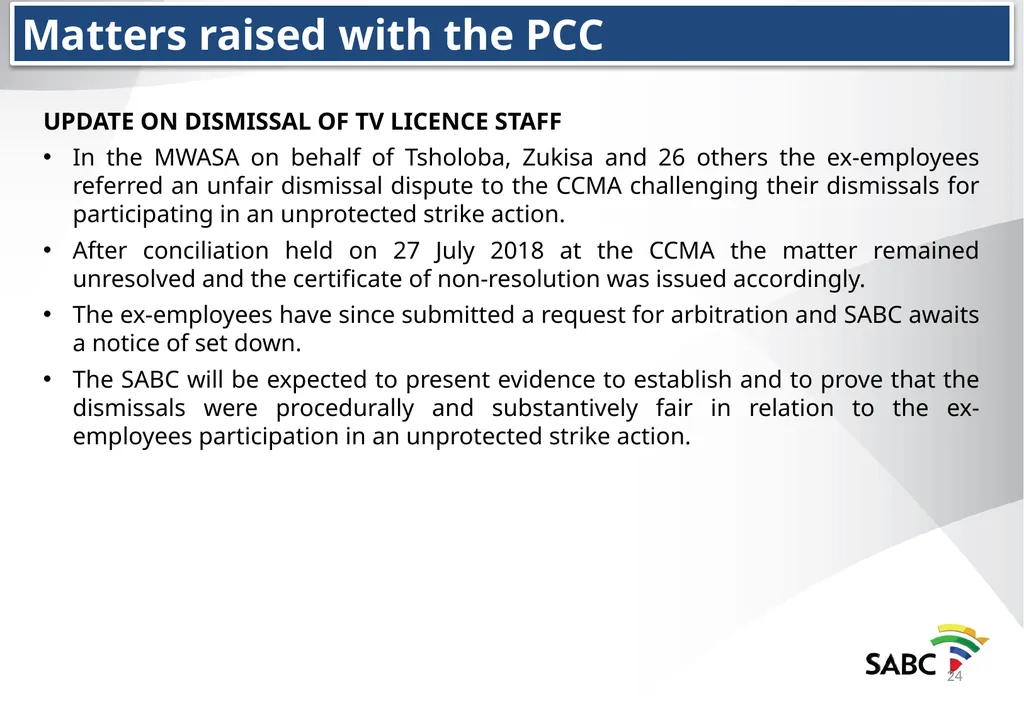
Matters raised with the PCC UPDATE ON DISMISSAL OF TV LICENCE STAFF
In the MWASA on behalf of Tsholoba, Zukisa and 26 others the ex-employees referred an unfair dismissal dispute to the CCMA challenging their dismissals for participating in an unprotected strike action.
After conciliation held on 27 July 2018 at the CCMA the matter remained unresolved and the certificate of non-resolution was issued accordingly.
The ex-employees have since submitted a request for arbitration and SABC awaits a notice of set down.
The SABC will be expected to present evidence to establish and to prove that the dismissals were procedurally and substantively fair in relation to the ex-employees participation in an unprotected strike action. 24<br>
In the MWASA on behalf of Tsholoba, Zukisa and 26 others the ex-employees referred an unfair dismissal dispute to the CCMA challenging their dismissals for participating in an unprotected strike action.
After conciliation held on 27 July 2018 at the CCMA the matter remained unresolved and the certificate of non-resolution was issued accordingly.
The ex-employees have since submitted a request for arbitration and SABC awaits a notice of set down.
The SABC will be expected to present evidence to establish and to prove that the dismissals were procedurally and substantively fair in relation to the ex-employees participation in an unprotected strike action. 24<br>
25
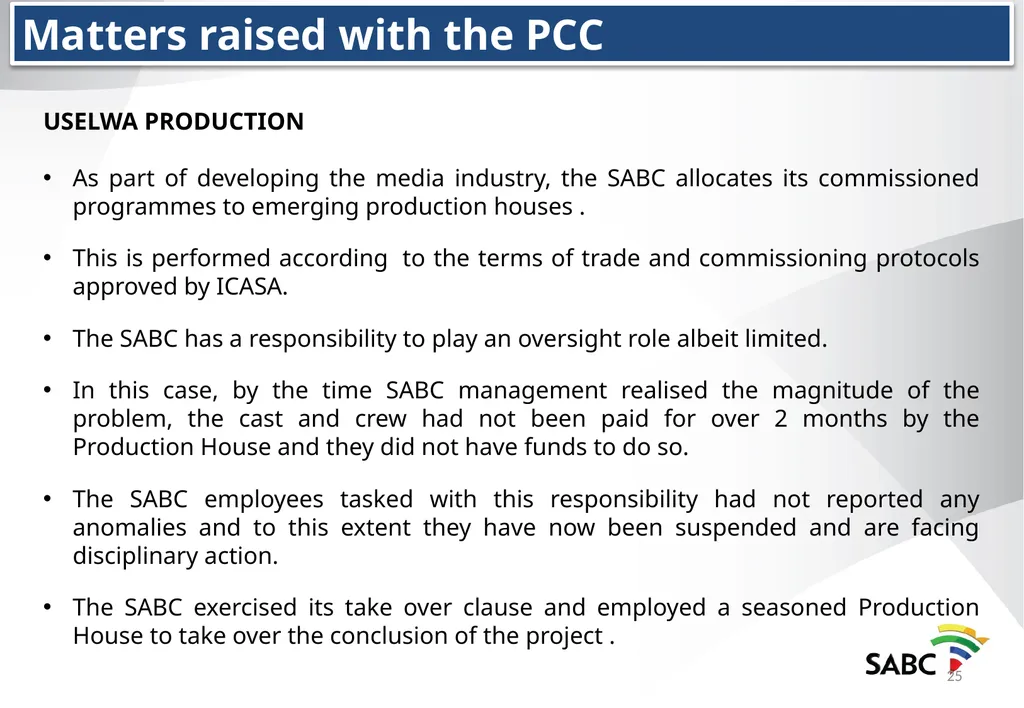
Matters raised with the PCC USELWA PRODUCTION
As part of developing the media industry, the SABC allocates its commissioned programmes to emerging production houses .
This is performed according to the terms of trade and commissioning protocols approved by ICASA.
The SABC has a responsibility to play an oversight role albeit limited.
In this case, by the time SABC management realised the magnitude of the problem, the cast and crew had not been paid for over 2 months by the Production House and they did not have funds to do so.
The SABC employees tasked with this responsibility had not reported any anomalies and to this extent they have now been suspended and are facing disciplinary action.
The SABC exercised its take over clause and employed a seasoned Production House to take over the conclusion of the project . 25<br>
As part of developing the media industry, the SABC allocates its commissioned programmes to emerging production houses .
This is performed according to the terms of trade and commissioning protocols approved by ICASA.
The SABC has a responsibility to play an oversight role albeit limited.
In this case, by the time SABC management realised the magnitude of the problem, the cast and crew had not been paid for over 2 months by the Production House and they did not have funds to do so.
The SABC employees tasked with this responsibility had not reported any anomalies and to this extent they have now been suspended and are facing disciplinary action.
The SABC exercised its take over clause and employed a seasoned Production House to take over the conclusion of the project . 25<br>
26
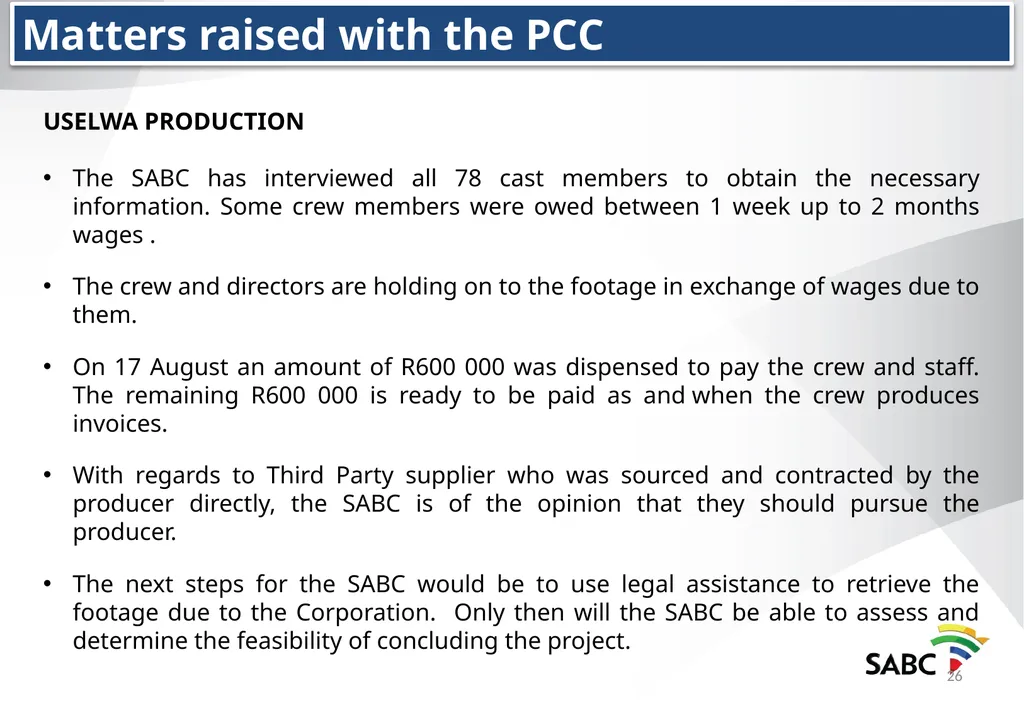
Matters raised with the PCC USELWA PRODUCTION
The SABC has interviewed all 78 cast members to obtain the necessary information. Some crew members were owed between 1 week up to 2 months wages .
The crew and directors are holding on to the footage in exchange of wages due to them.
On 17 August an amount of R600 000 was dispensed to pay the crew and staff. The remaining R600 000 is ready to be paid as and when the crew produces invoices.
With regards to Third Party supplier who was sourced and contracted by the producer directly, the SABC is of the opinion that they should pursue the producer.
The next steps for the SABC would be to use legal assistance to retrieve the footage due to the Corporation. Only then will the SABC be able to assess and determine the feasibility of concluding the project. 26<br>
The SABC has interviewed all 78 cast members to obtain the necessary information. Some crew members were owed between 1 week up to 2 months wages .
The crew and directors are holding on to the footage in exchange of wages due to them.
On 17 August an amount of R600 000 was dispensed to pay the crew and staff. The remaining R600 000 is ready to be paid as and when the crew produces invoices.
With regards to Third Party supplier who was sourced and contracted by the producer directly, the SABC is of the opinion that they should pursue the producer.
The next steps for the SABC would be to use legal assistance to retrieve the footage due to the Corporation. Only then will the SABC be able to assess and determine the feasibility of concluding the project. 26<br>
27
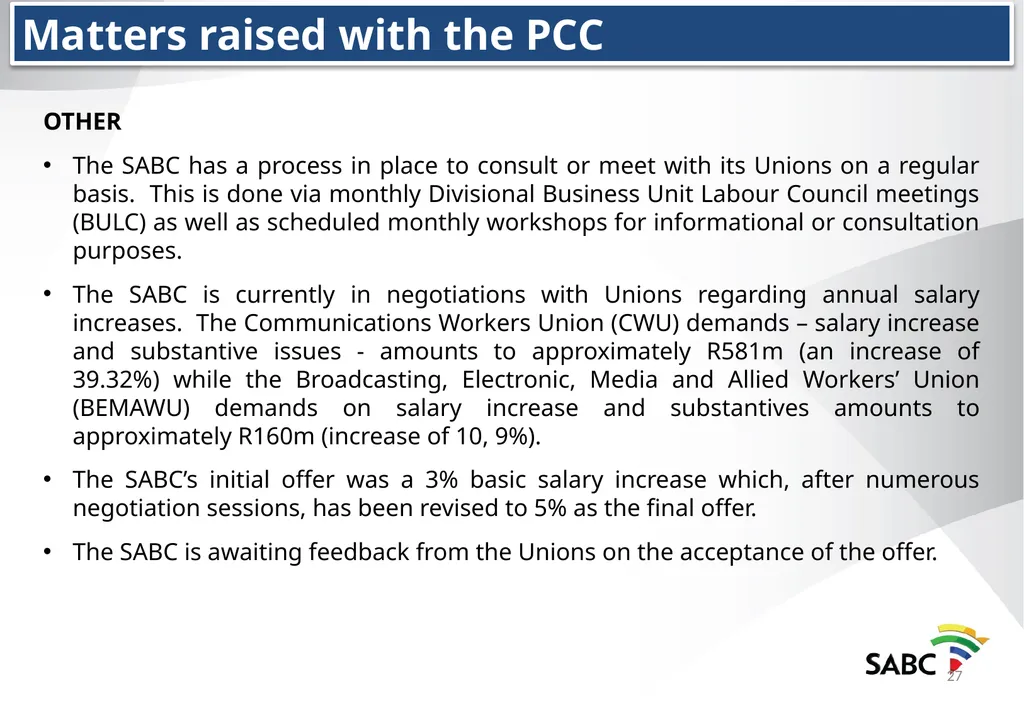
Matters raised with the PCC OTHER
The SABC has a process in place to consult or meet with its Unions on a regular basis. This is done via monthly Divisional Business Unit Labour Council meetings (BULC) as well as scheduled monthly workshops for informational or consultation purposes.
The SABC is currently in negotiations with Unions regarding annual salary increases. The Communications Workers Union (CWU) demands – salary increase and substantive issues - amounts to approximately R581m (an increase of 39.32%) while the Broadcasting, Electronic, Media and Allied Workers’ Union (BEMAWU) demands on salary increase and substantives amounts to approximately R160m (increase of 10, 9%).
The SABC’s initial offer was a 3% basic salary increase which, after numerous negotiation sessions, has been revised to 5% as the final offer.
The SABC is awaiting feedback from the Unions on the acceptance of the offer. 27<br>
The SABC has a process in place to consult or meet with its Unions on a regular basis. This is done via monthly Divisional Business Unit Labour Council meetings (BULC) as well as scheduled monthly workshops for informational or consultation purposes.
The SABC is currently in negotiations with Unions regarding annual salary increases. The Communications Workers Union (CWU) demands – salary increase and substantive issues - amounts to approximately R581m (an increase of 39.32%) while the Broadcasting, Electronic, Media and Allied Workers’ Union (BEMAWU) demands on salary increase and substantives amounts to approximately R160m (increase of 10, 9%).
The SABC’s initial offer was a 3% basic salary increase which, after numerous negotiation sessions, has been revised to 5% as the final offer.
The SABC is awaiting feedback from the Unions on the acceptance of the offer. 27<br>
28
28 THANK YOU<br>