Safe Lab Practices A research laboratory is a complex environment. Good laboratory practices are essential for laboratories to be safe places in which to work. Engineering controls can limit exposure to hazards and PPE can protect a
"Safe Lab Practices A research laboratory is a" is the property of its rightful owner. Permission is granted to
download and print the materials on this website for personal, non-commercial use only, and to display it
on your personal computer provided you do not modify the materials and that you retain all copyright
notices contained in the materials. By downloading content from our website, you accept the terms of this
agreement.
Presentation Transcript
01
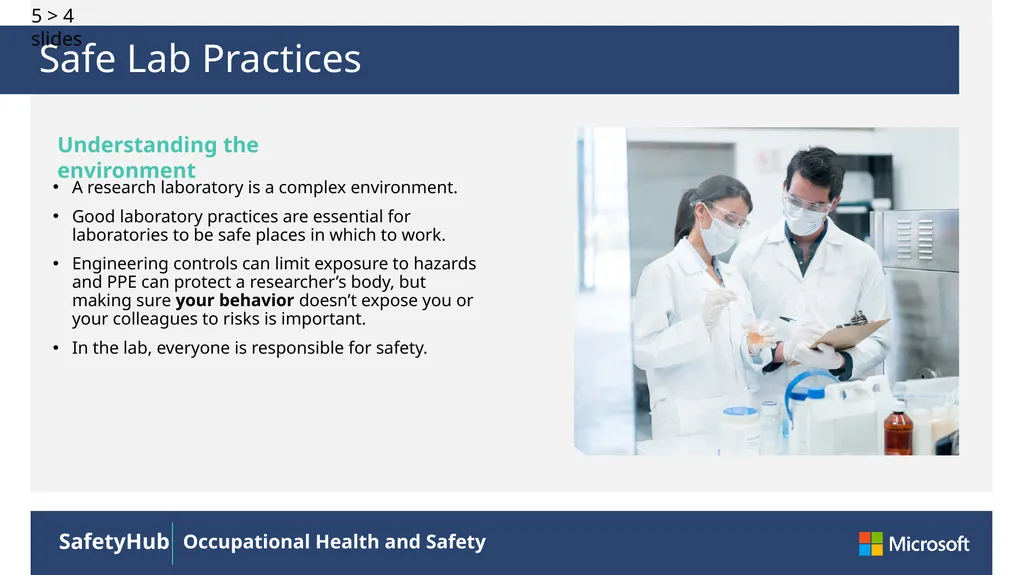
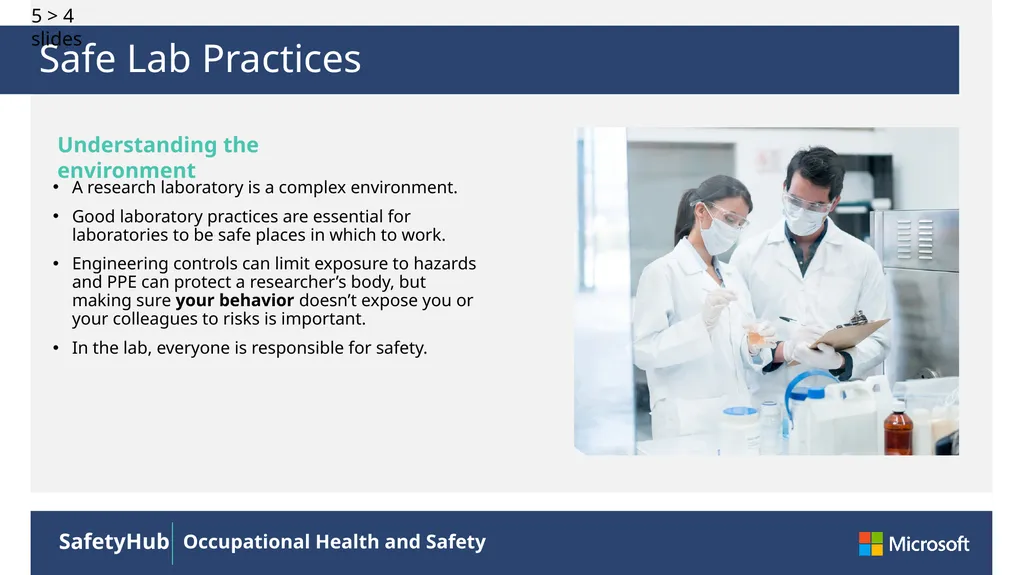
Safe Lab Practices A research laboratory is a complex environment.
Good laboratory practices are essential for laboratories to be safe places in which to work.
Engineering controls can limit exposure to hazards and PPE can protect a researcher’s body, but making sure your behavior doesn’t expose you or your colleagues to risks is important.
In the lab, everyone is responsible for safety. Understanding the environment 5 > 4 slides<br>
02
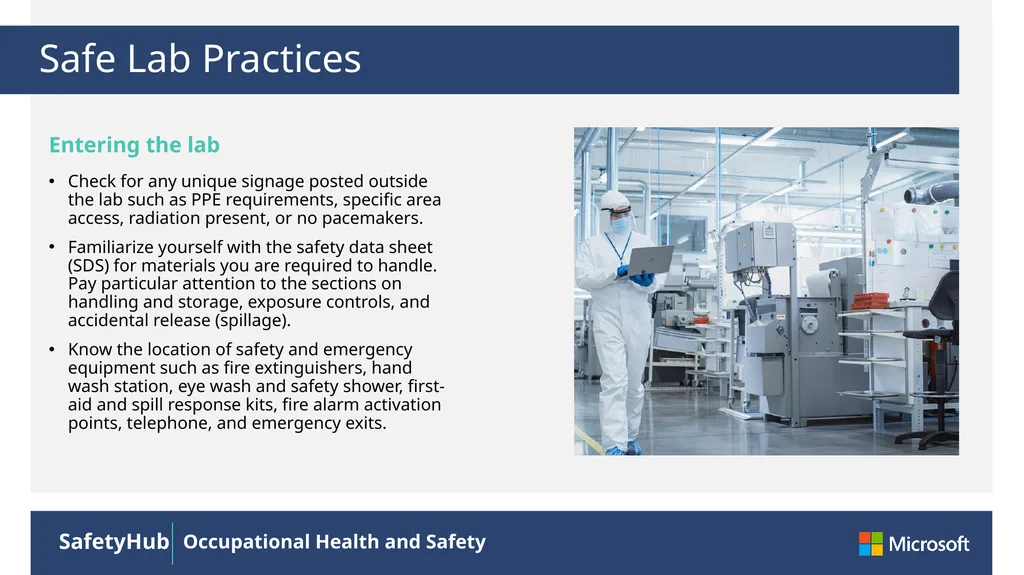
Check for any unique signage posted outside the lab such as PPE requirements, specific area access, radiation present, or no pacemakers.
Familiarize yourself with the safety data sheet (SDS) for materials you are required to handle. Pay particular attention to the sections on handling and storage, exposure controls, and accidental release (spillage).
Know the location of safety and emergency equipment such as fire extinguishers, hand wash station, eye wash and safety shower, first-aid and spill response kits, fire alarm activation points, telephone, and emergency exits. Safe Lab Practices Entering the lab<br>
03
Safe Lab Practices 3 Eating or drinking in the lab can increase your risk of exposure to hazardous materials.
Food or drink can increase the risk of contaminating your experiment. No food or drink Long pants and shoes completely covering the top of the foot should always be worn when working in the lab.
Safety glasses or goggles can protect your eyes from physical or chemical harm.
Gloves protect your skin from hazardous materials your hands may encounter. PPE and lab attire Wash hands after handling any hazardous materials, before and after eating, and before leaving the lab.
Keeping personal items separate from lab work. This will prevent spread of hazardous reagents and cut off a potential exposure route.
Do not apply cosmetics while in the lab. Applying anything to your face, especially around your mouth or eyes, poses a significant risk of exposure. Good hygiene<br>
04
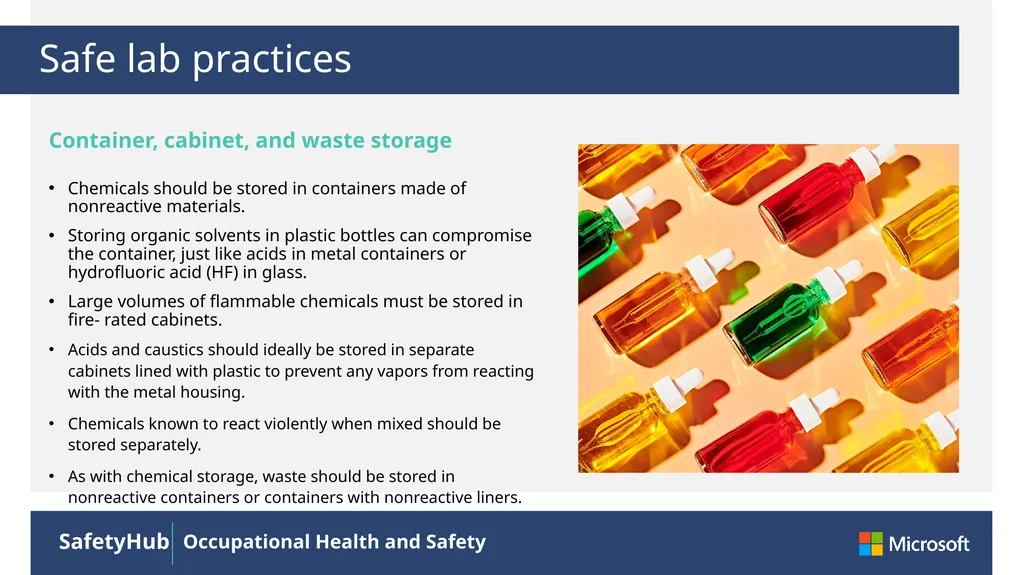
Safe lab practices Container, cabinet, and waste storage Acids and caustics should ideally be stored in separate cabinets lined with plastic to prevent any vapors from reacting with the metal housing.
Chemicals known to react violently when mixed should be stored separately.
As with chemical storage, waste should be stored in nonreactive containers or containers with nonreactive liners. Chemicals should be stored in containers made of nonreactive materials.
Storing organic solvents in plastic bottles can compromise the container, just like acids in metal containers or hydrofluoric acid (HF) in glass.
Large volumes of flammable chemicals must be stored in fire- rated cabinets.<br>