
SAFE LIFTING/MATERIAL HANDLING 1 PPT-025-03 Bureau

Description: SAFE LIFTINGMATERIAL HANDLING 1 PPT-025-03 Bureau of Workers Compensation PA Training for Health Safety (PATHS) What well talk About Material Handling Tips Proper Lifting Considerations Tips for Safe Lifting Exercises for Work and Home
Related Topics
Download Presentation
"SAFE LIFTING/MATERIAL HANDLING 1 PPT-025-03 Bureau" is the property of its rightful owner. Permission is granted to download and print the materials on this website for personal, non-commercial use only, and to display it on your personal computer provided you do not modify the materials and that you retain all copyright notices contained in the materials. By downloading content from our website, you accept the terms of this agreement.
Presentation Transcript
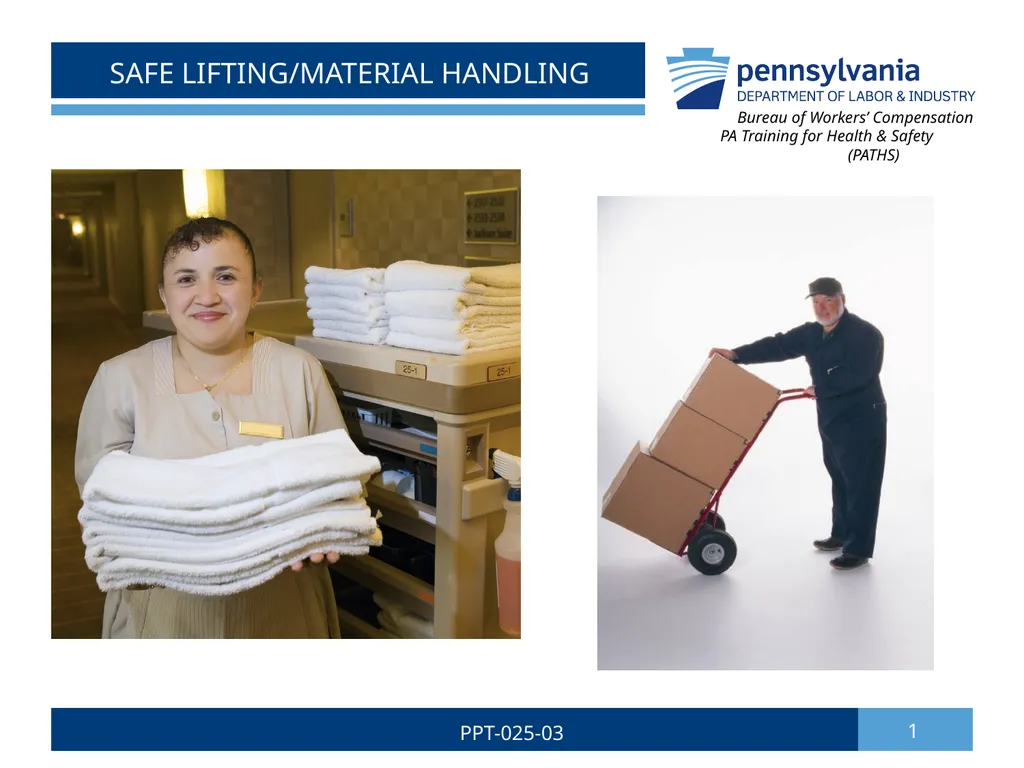
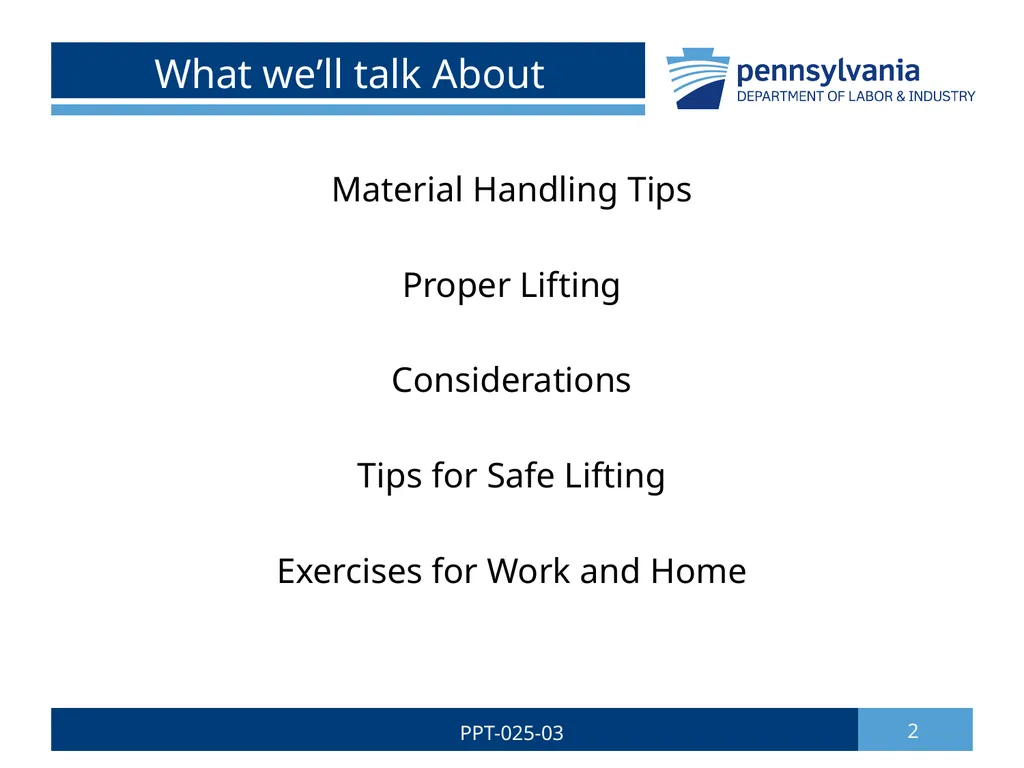
slide1. SAFE LIFTING/MATERIAL HANDLING 1 PPT-025-03 Bureau of Workers’ Compensation
PA Training for Health & Safety (PATHS)<br>
slide2. What we’ll talk About Material Handling Tips
Proper Lifting
Considerations
Tips for Safe Lifting
Exercises for Work and Home 2 PPT-025-03<br>
slide3. Material Handling Tips Check the object before you attempt to lift it.
Test every load before lifting = pushing object lightly with hands or feet to see how easily it moves (good indication as to how heavy it is).
Remember, a small size does not always mean a light load!
Make sure the load you are lifting is packed correctly.
Employees packing boxes should make sure weight is balanced and packed so it won’t move around.
Loose pieces inside a box can cause accidents if the box becomes unbalanced. 3 PPT-025-03<br>
slide4. More Tips Make sure the load is easy to reach.
Don’t arch your back when lifting a load over your head.
Use a ladder instead of lifting something over your head.
Here’s the best way to pick up an object:
Use slow and smooth movements (hurried, jerky movements can strain the muscles in your back).
Keep your body facing the object while you lift it (twisting while lifting can injure your back). 4 PPT-025-03<br>
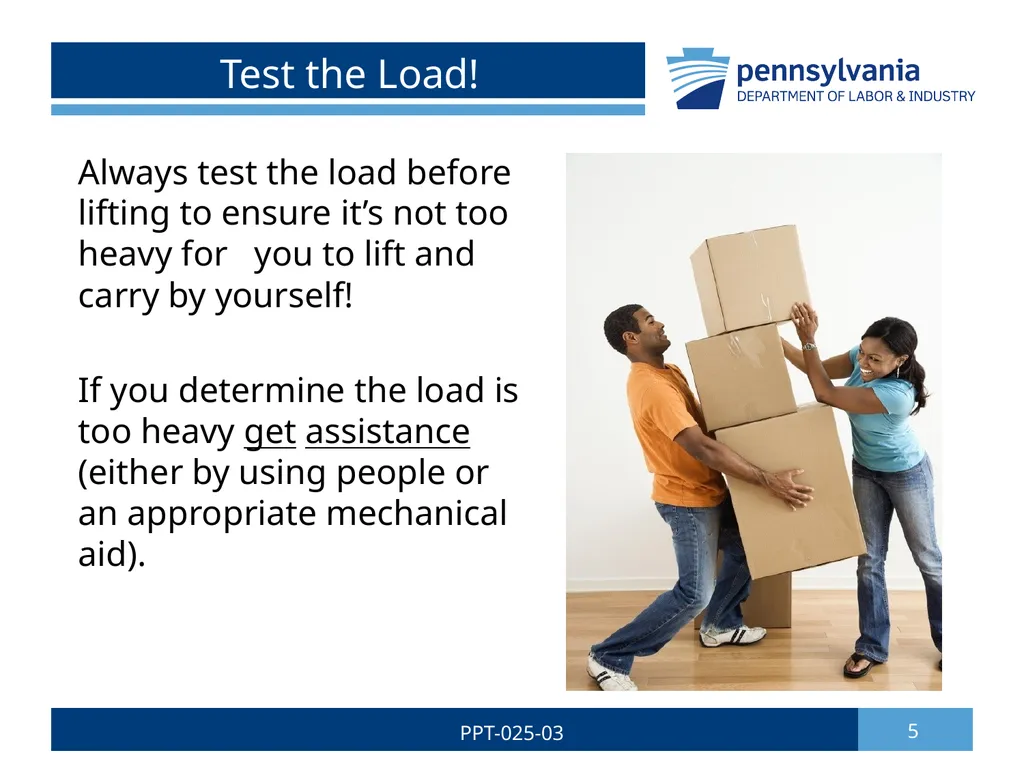
slide5. Test the Load! Always test the load before lifting to ensure it’s not too heavy for you to lift and carry by yourself!
If you determine the load is too heavy get assistance (either by using people or an appropriate mechanical aid). 5 PPT-025-03<br>
slide6. Planning Ahead Before moving a load plan both the load and the route (allows you to evaluate hazards, limitations, route safety, and final placement).
Evaluate the weight and shape of the load and also what material is made of.
Some items to check:
→ Is PPE or other safety gear necessary?
→ Size/shape/weight within your limits?
→ Can you get a firm hand hold?
→ Will you be able to see over the load?
→ Will you need assistance (people, cart,
forklift)? 6 PPT-025-03<br>
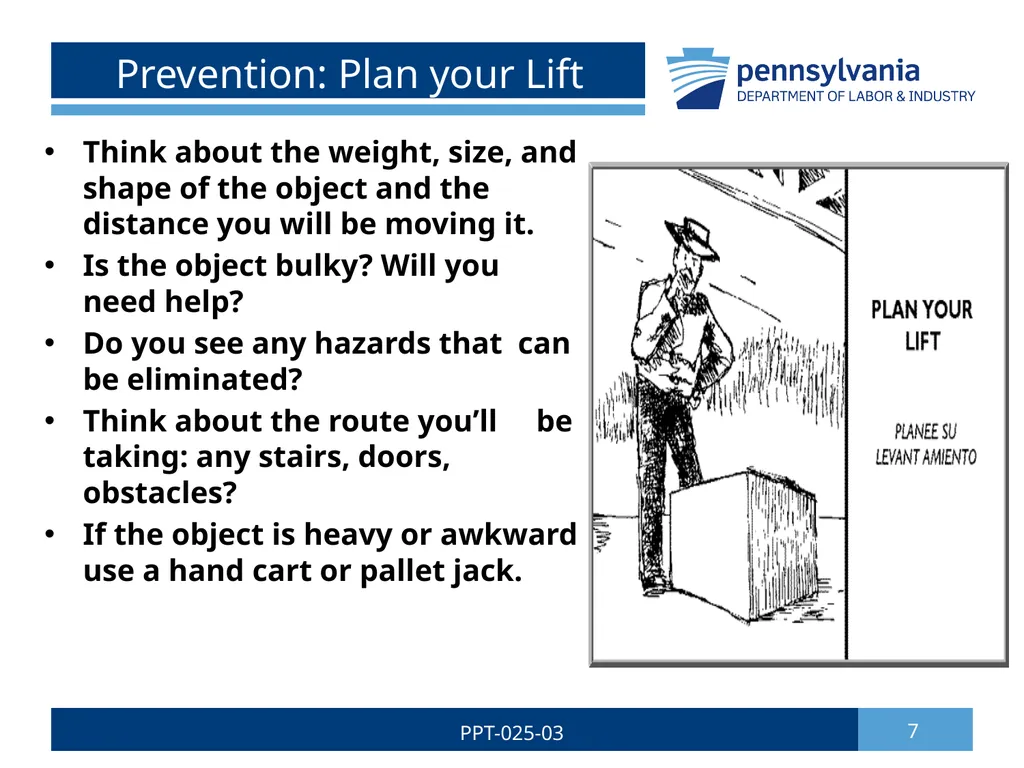
slide7. Prevention: Plan your Lift Think about the weight, size, and shape of the object and the distance you will be moving it.
Is the object bulky? Will you need help?
Do you see any hazards that can be eliminated?
Think about the route you’ll be taking: any stairs, doors, obstacles?
If the object is heavy or awkward use a hand cart or pallet jack. 7 PPT-025-03<br>
slide8. Plan Ahead – The Route Check the route you will take and place where you will put the load down.
Injuries and property damage can occur when unexpected problems happen during the move.
Considerations for the route:
- Are there steps, tripping hazards, closed
doors, tight doorways or passageways?
- Are there blind corners or wet/slippery floors?
- What is the traffic situation (people, vehicles,
etc.)? 8 PPT-025-03<br>
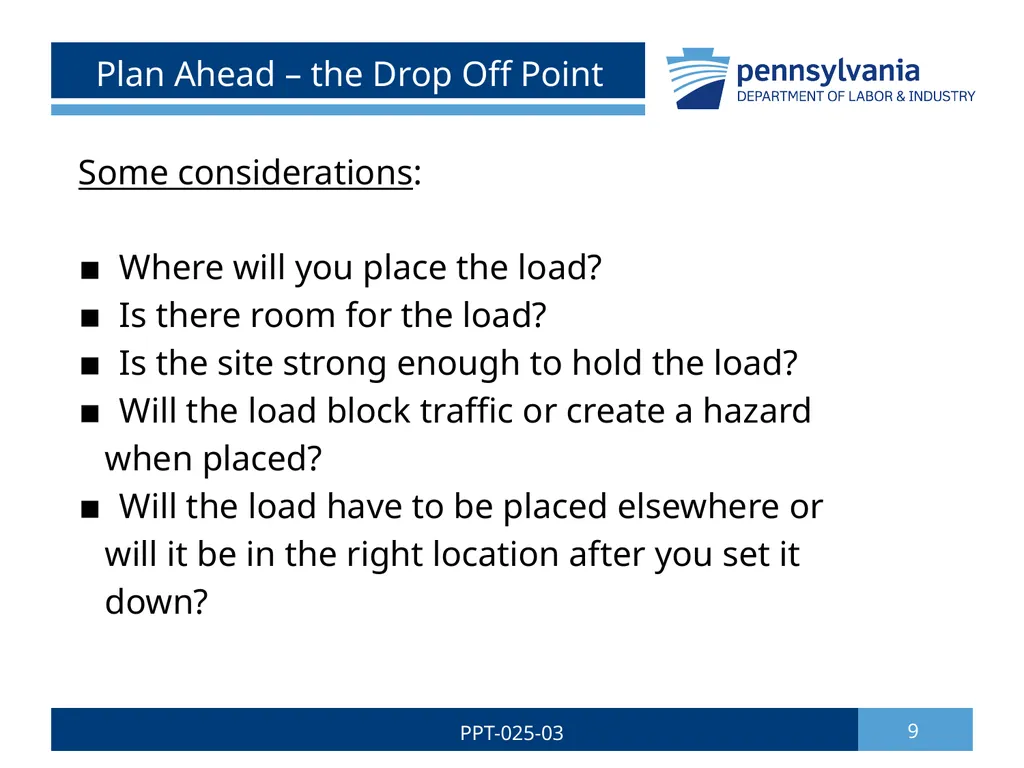
slide9. Plan Ahead – the Drop Off Point Some considerations:
▪ Where will you place the load?
▪ Is there room for the load?
▪ Is the site strong enough to hold the load?
▪ Will the load block traffic or create a hazard
when placed?
▪ Will the load have to be placed elsewhere or
will it be in the right location after you set it
down? 9 PPT-025-03<br>
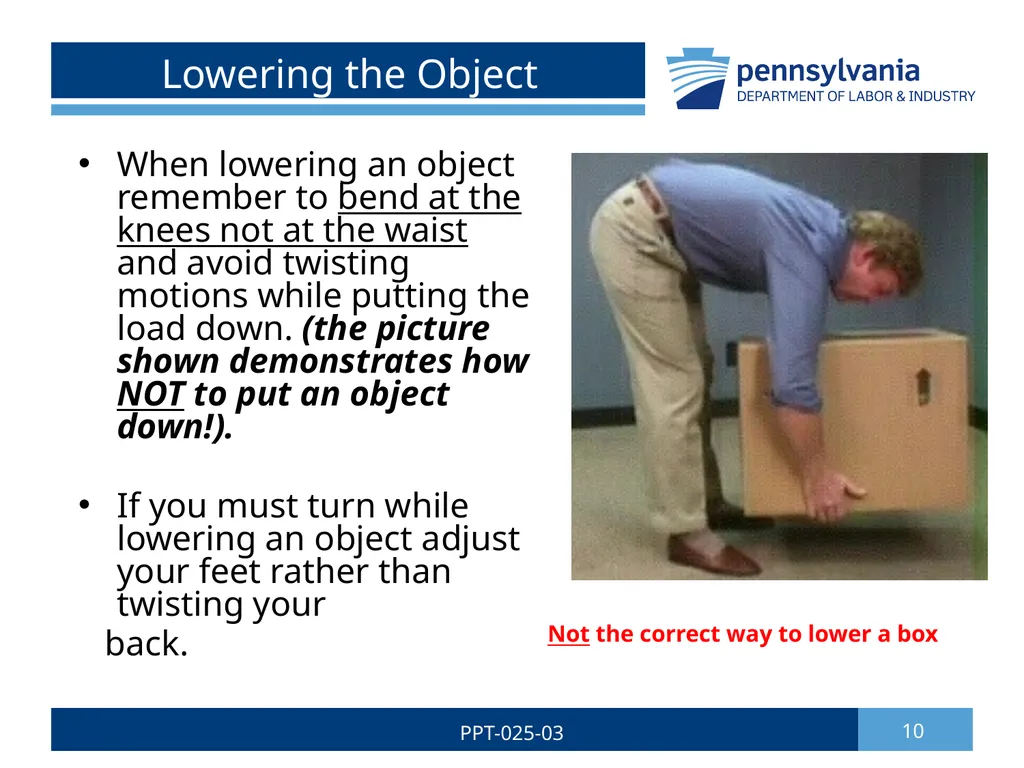
slide10. Lowering the Object When lowering an object remember to bend at the knees not at the waist and avoid twisting motions while putting the load down. (the picture shown demonstrates how NOT to put an object down!).
If you must turn while lowering an object adjust your feet rather than twisting your
back. 10 PPT-025-03 Not the correct way to lower a box<br>
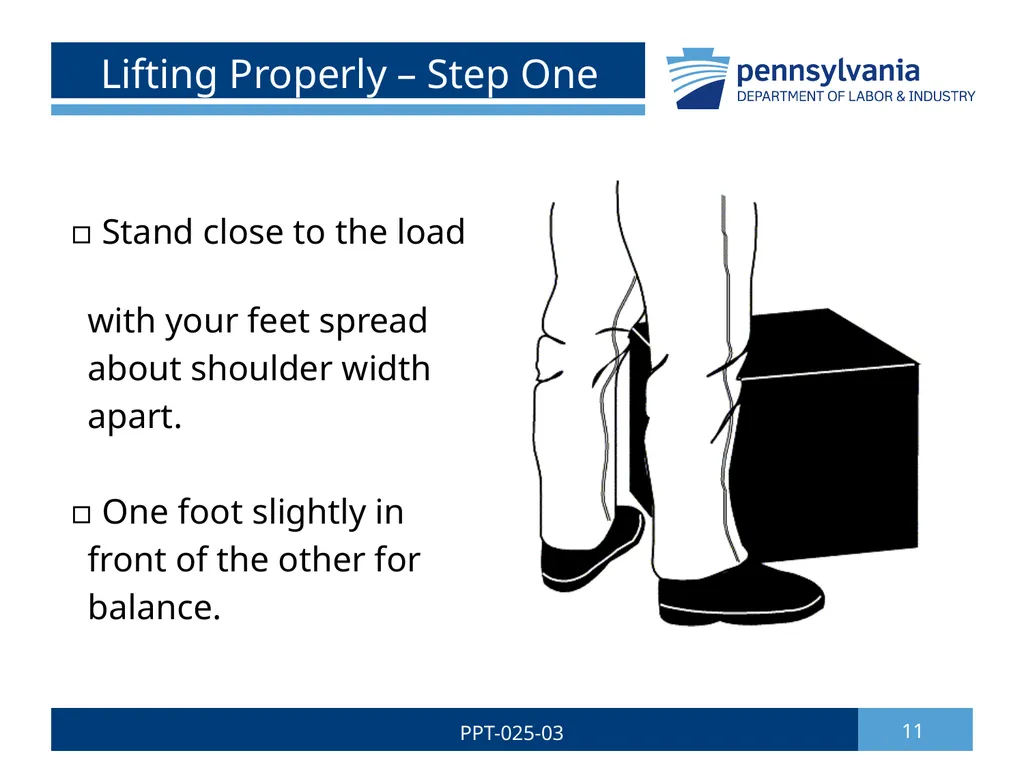
slide11. Lifting Properly – Step One ▫ Stand close to the load
with your feet spread
about shoulder width
apart.
▫ One foot slightly in
front of the other for
balance. 11 PPT-025-03<br>
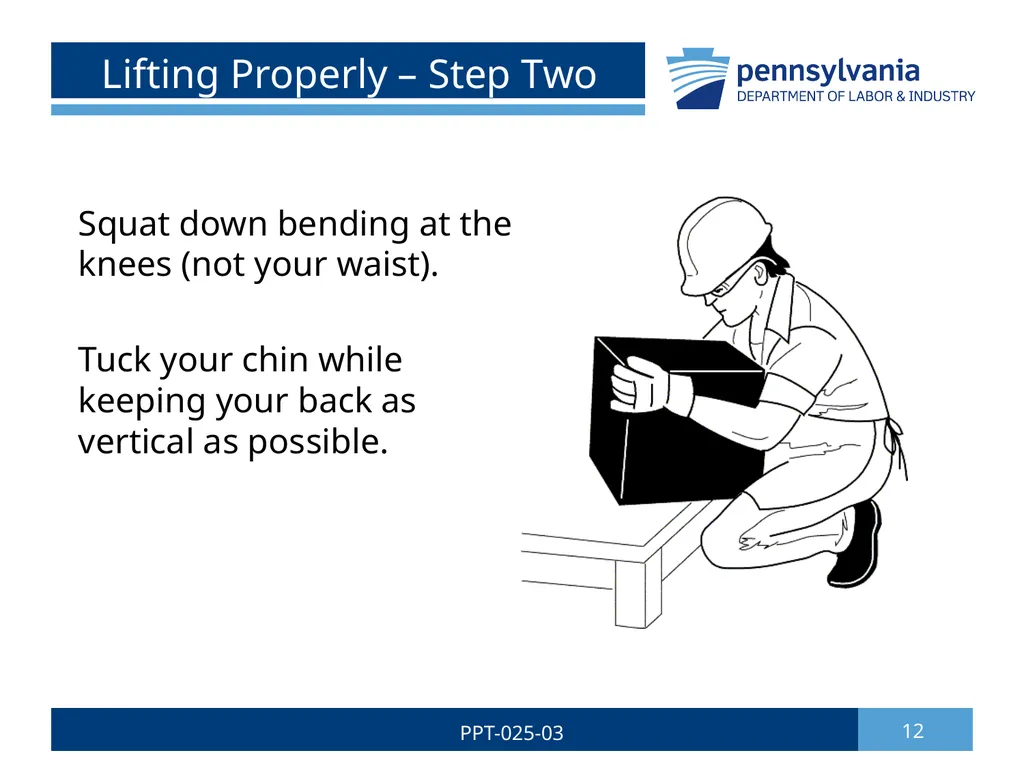
slide12. Lifting Properly – Step Two Squat down bending at the knees (not your waist).
Tuck your chin while keeping your back as vertical as possible. 12 PPT-025-03<br>
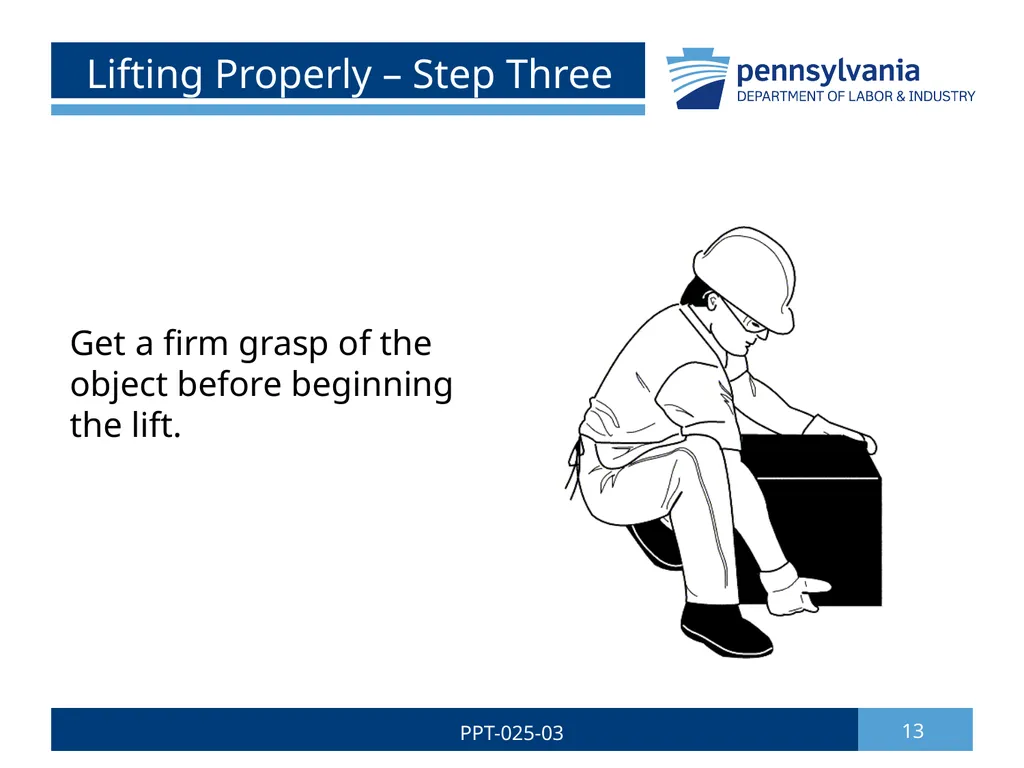
slide13. Lifting Properly – Step Three Get a firm grasp of the object before beginning the lift. 13 PPT-025-03<br>
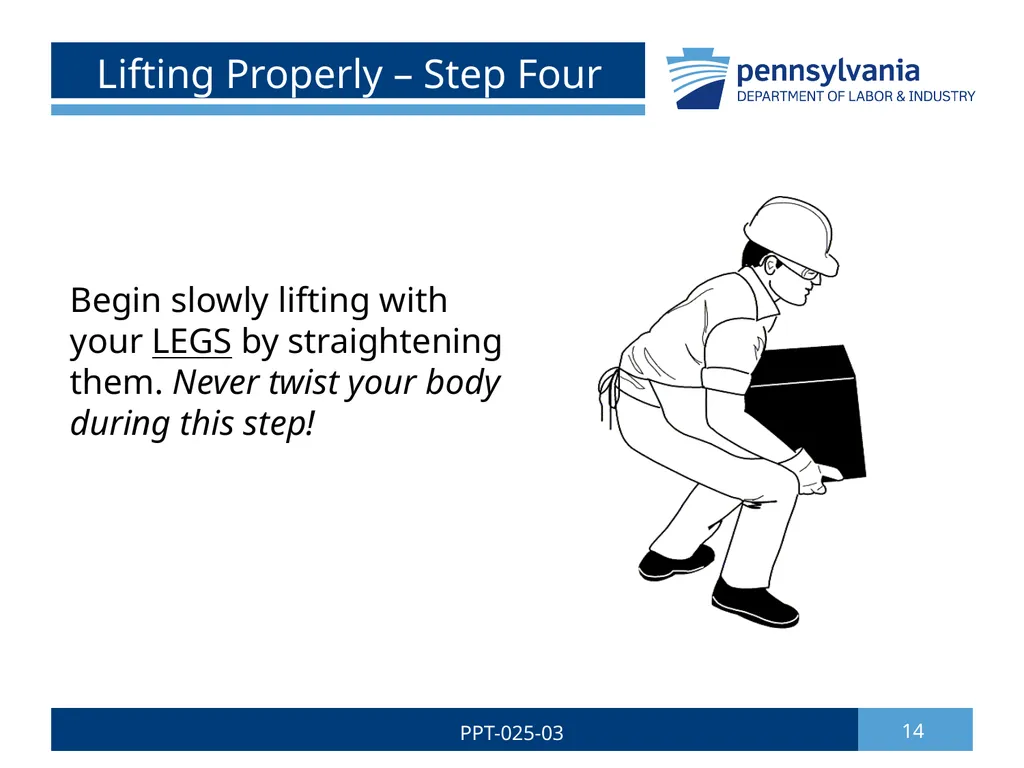
slide14. Lifting Properly – Step Four Begin slowly lifting with your LEGS by straightening them. Never twist your body during this step! 14 PPT-025-03<br>
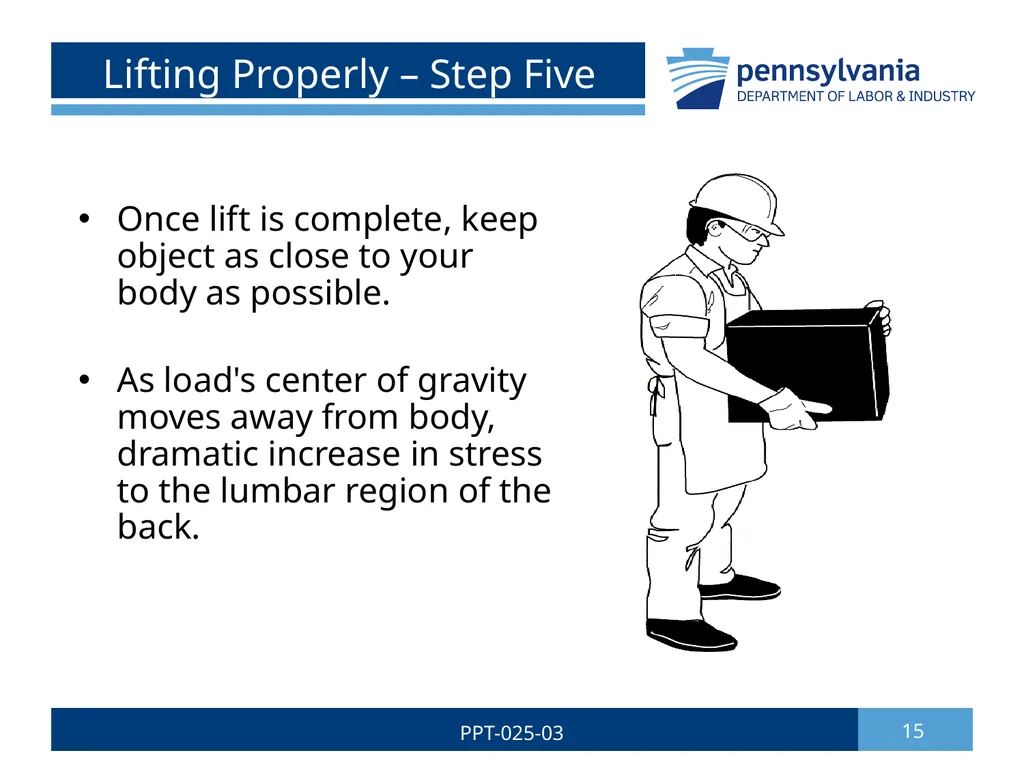
slide15. Lifting Properly – Step Five Once lift is complete, keep object as close to your body as possible.
As load's center of gravity moves away from body, dramatic increase in stress to the lumbar region of the back. 15 PPT-025-03<br>
slide16. Other Considerations Team Lifting – More than one person required to lift a load: team of folks; one person “calls” directions and lifting steps so everyone will move at the same pace.
Stacking – Overlap and interlock rows. Never stack above the crush height or above height limits for the facility you’re working in. Make certain the base is clean, level and can support the weight. 16 PPT-025-03<br>
slide17. Other Considerations Drums –
Use a lift truck with drum forks or a drum dolly to move, even a short distance.
If moving individual empty drums, roll on the side not the rim and always work on the down side of the drum with the hands on the “belly” of the drum, not the rim. 17 PPT-025-03<br>
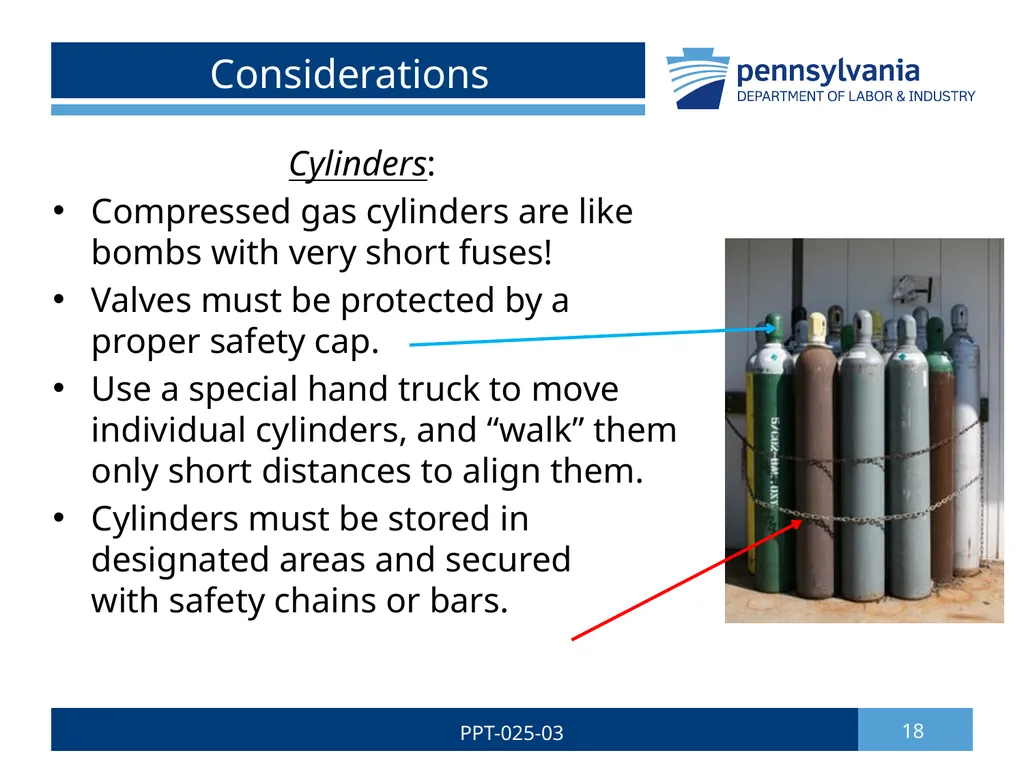
slide18. Considerations Cylinders:
Compressed gas cylinders are like bombs with very short fuses!
Valves must be protected by a proper safety cap.
Use a special hand truck to move individual cylinders, and “walk” them only short distances to align them.
Cylinders must be stored in designated areas and secured with safety chains or bars. 18 PPT-025-03<br>
slide19. Considerations Mechanical Aids –
Often the best way to move loads is with a mechanical aid like a hand truck or rolling cart.
Choose the right aid for the job and inspect it before use.
Place the heaviest items on the bottom with the weight concentrated between the wheels.
Keep your hands away from the edges so they won’t be scraped or crushed in doorways. 19 PPT-025-03-<br>
slide20. Tips for Safe Listing PLAN THE LIFT.
REMOVE ANYTHING IN YOUR WAY.
PUSHING IS EASIER THAN PULLING.
PULLING IS EASIER THAN CARRYING.
GET HELP FOR HEAVY/BULKY LOADS. 20 PPT-025-03<br>
slide21. More Tips for Safe Lifting WARM UP YOUR MUSCLES WITH STRETCHES.
TEST THE WEIGHT OF THE LOAD FIRST.
FACE THE WAY YOU NEED TO MOVE.
HOLD THE LOAD CLOSE TO YOUR BODY. 21 PPT-025-03<br>
slide22. More Tips LIFT WITH YOUR BACK AS STRAIGHT AS COMFORTABLE.
KEEP THE LOAD BETWEEN SHOULDER AND KNEE HEIGHT.
CHANGE YOUR POSITION.
STRETCH TO RELAX AND REST TIRED MUSCLES. 22 PPT-025-03<br>
slide23. and More Tips PLAN WHERE TO SET THE LOAD DOWN.
REST MORE OFTEN WHEN IT IS HOT/HUMID.
TAKE MORE TIME TO WARM UP YOUR MUSCLES IN THE COLD.
TAKE MORE BREAKS IF USING TOOLS/EQUIPMENT THAT VIBRATES. 23 PPT-025-03<br>
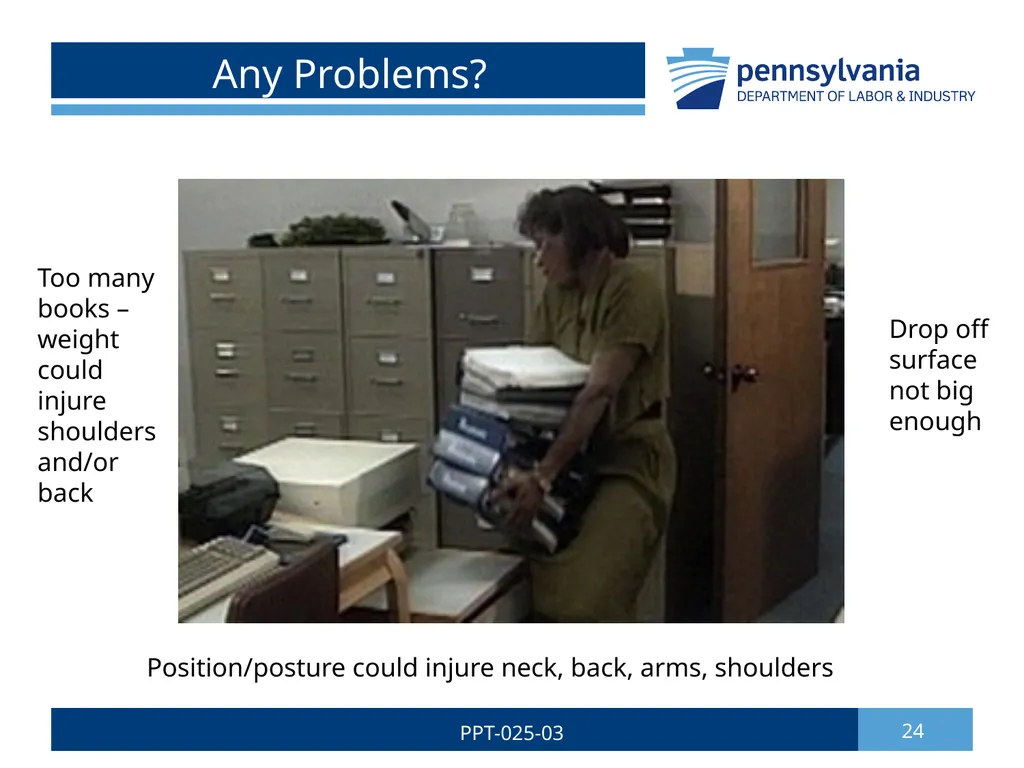
slide24. Any Problems? 24 PPT-025-03 Position/posture could injure neck, back, arms, shoulders Too many books – weight could injure shoulders and/or back Drop off surface not big enough<br>
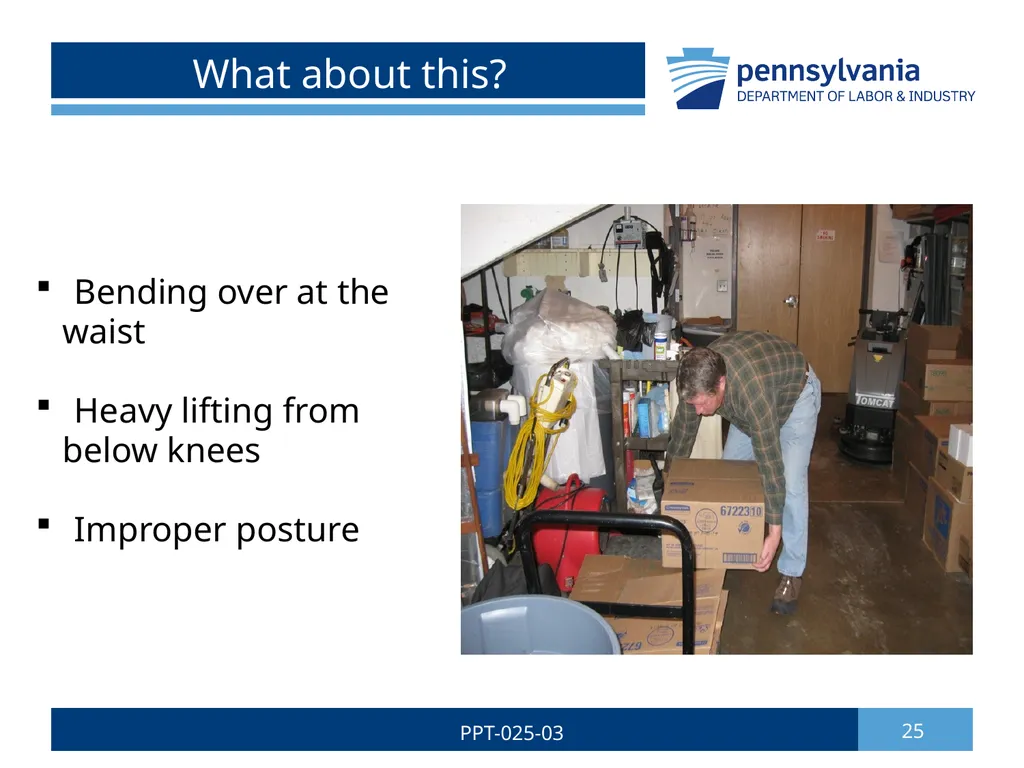
slide25. What about this? Bending over at the
waist
Heavy lifting from
below knees
Improper posture 25 PPT-025-03<br>
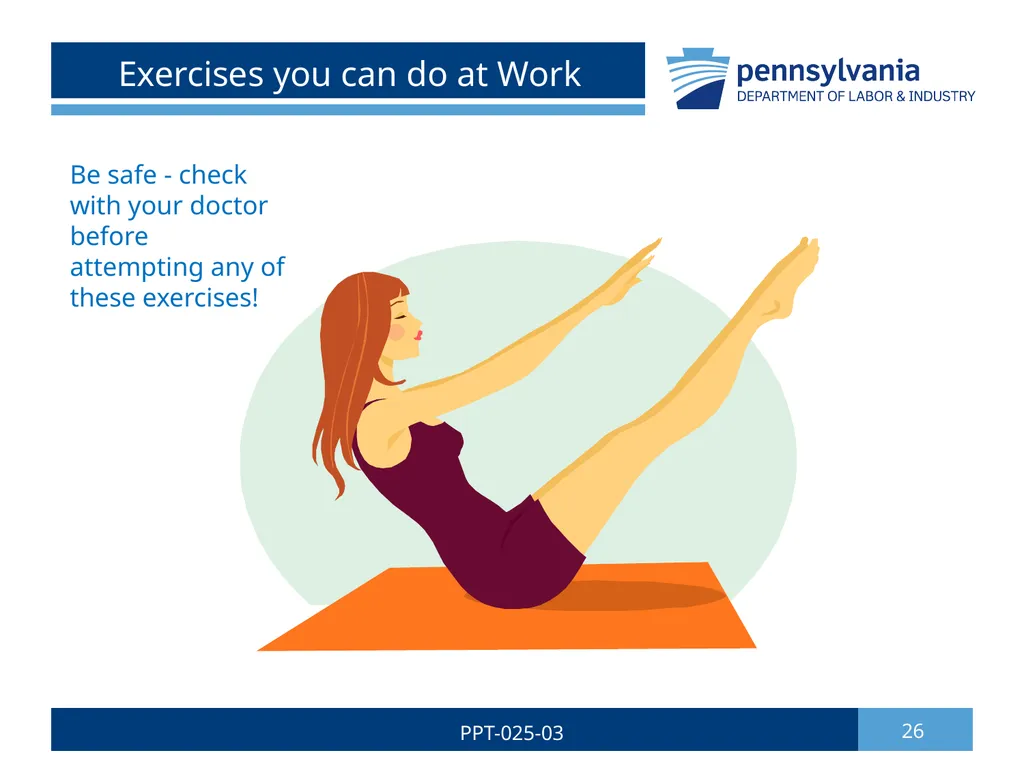
slide26. Exercises you can do at Work 26 PPT-025-03 Be safe - check with your doctor before attempting any of these exercises!<br>
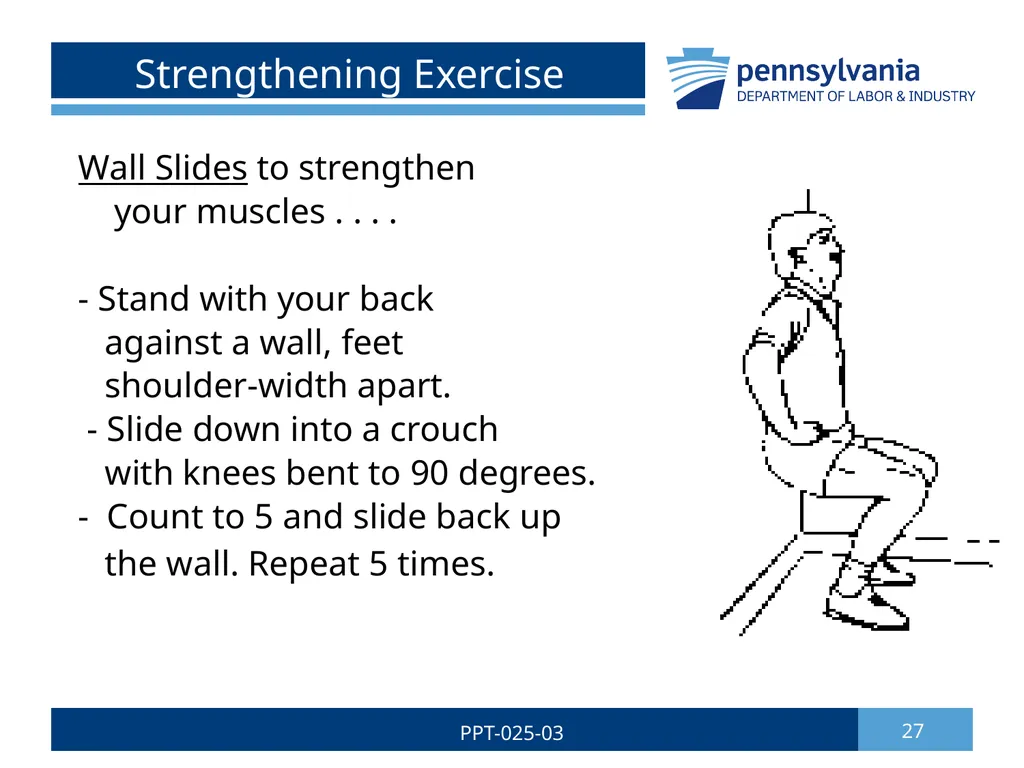
slide27. Strengthening Exercise Wall Slides to strengthen
your muscles . . . .
- Stand with your back
against a wall, feet
shoulder-width apart.
- Slide down into a crouch
with knees bent to 90 degrees.
- Count to 5 and slide back up
the wall. Repeat 5 times. 27 PPT-025-03<br>
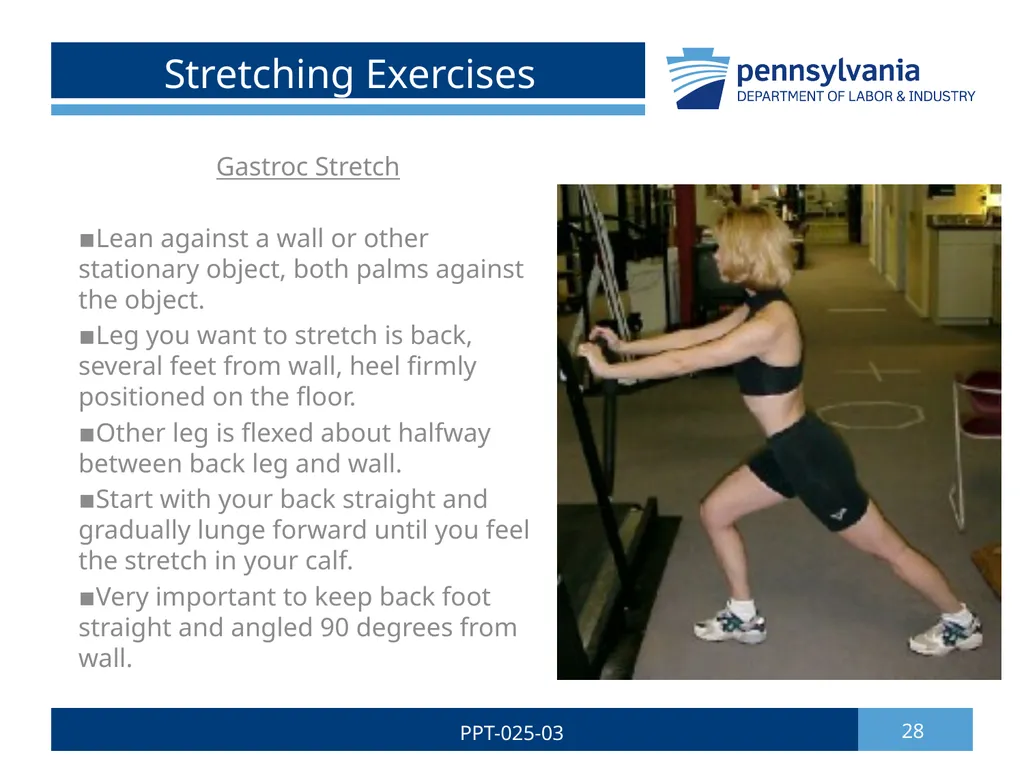
slide28. Stretching Exercises Gastroc Stretch
▪Lean against a wall or other stationary object, both palms against the object.
▪Leg you want to stretch is back, several feet from wall, heel firmly positioned on the floor.
▪Other leg is flexed about halfway between back leg and wall.
▪Start with your back straight and gradually lunge forward until you feel the stretch in your calf.
▪Very important to keep back foot straight and angled 90 degrees from wall. 28 PPT-025-03<br>
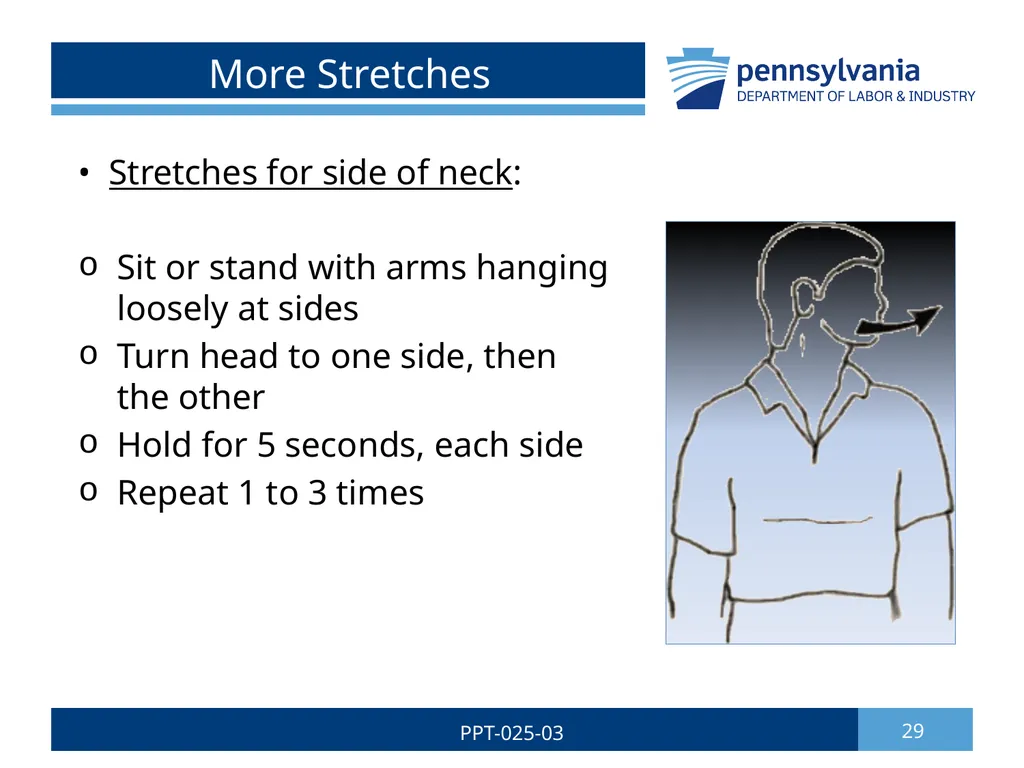
slide29. More Stretches • Stretches for side of neck:
Sit or stand with arms hanging loosely at sides
Turn head to one side, then the other
Hold for 5 seconds, each side
Repeat 1 to 3 times 29 PPT-025-03<br>
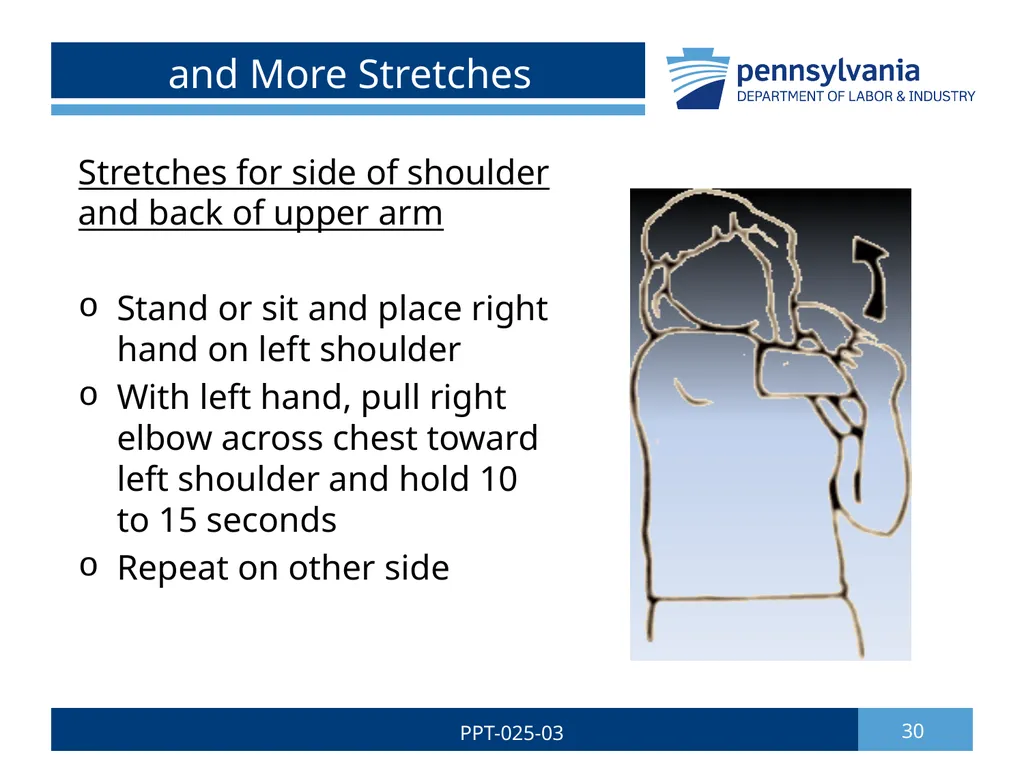
slide30. and More Stretches Stretches for side of shoulder and back of upper arm
Stand or sit and place right hand on left shoulder
With left hand, pull right elbow across chest toward left shoulder and hold 10 to 15 seconds
Repeat on other side 30 PPT-025-03<br>
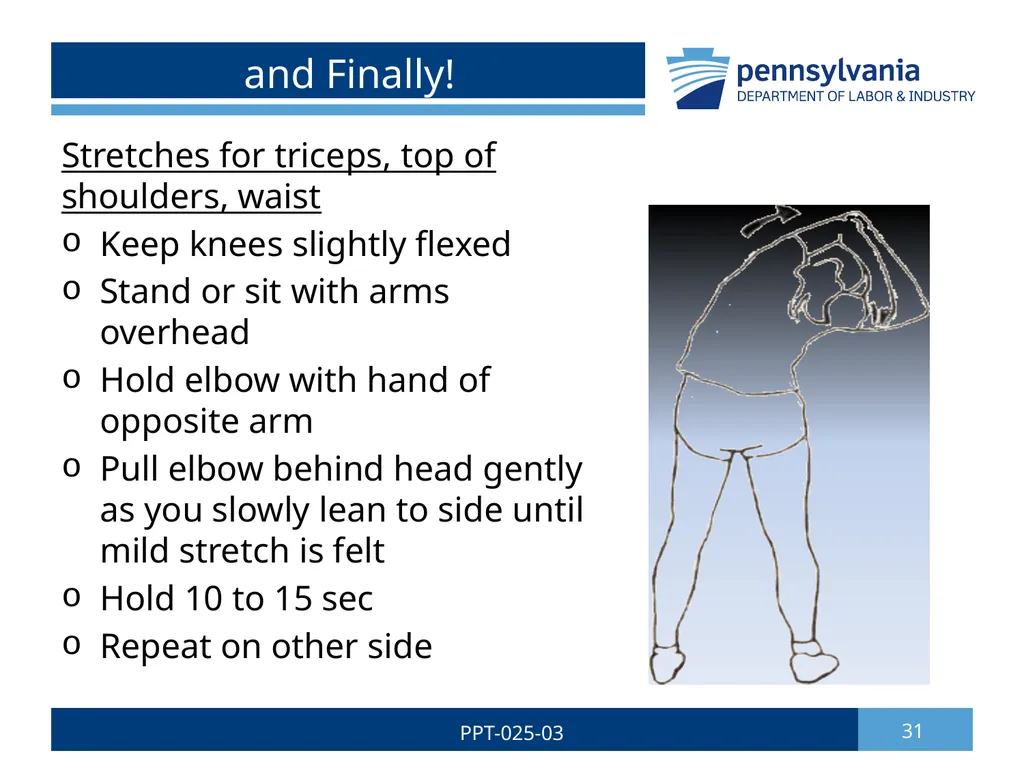
slide31. and Finally! Stretches for triceps, top of shoulders, waist
Keep knees slightly flexed
Stand or sit with arms overhead
Hold elbow with hand of opposite arm
Pull elbow behind head gently as you slowly lean to side until mild stretch is felt
Hold 10 to 15 sec
Repeat on other side 31 PPT-025-03<br>
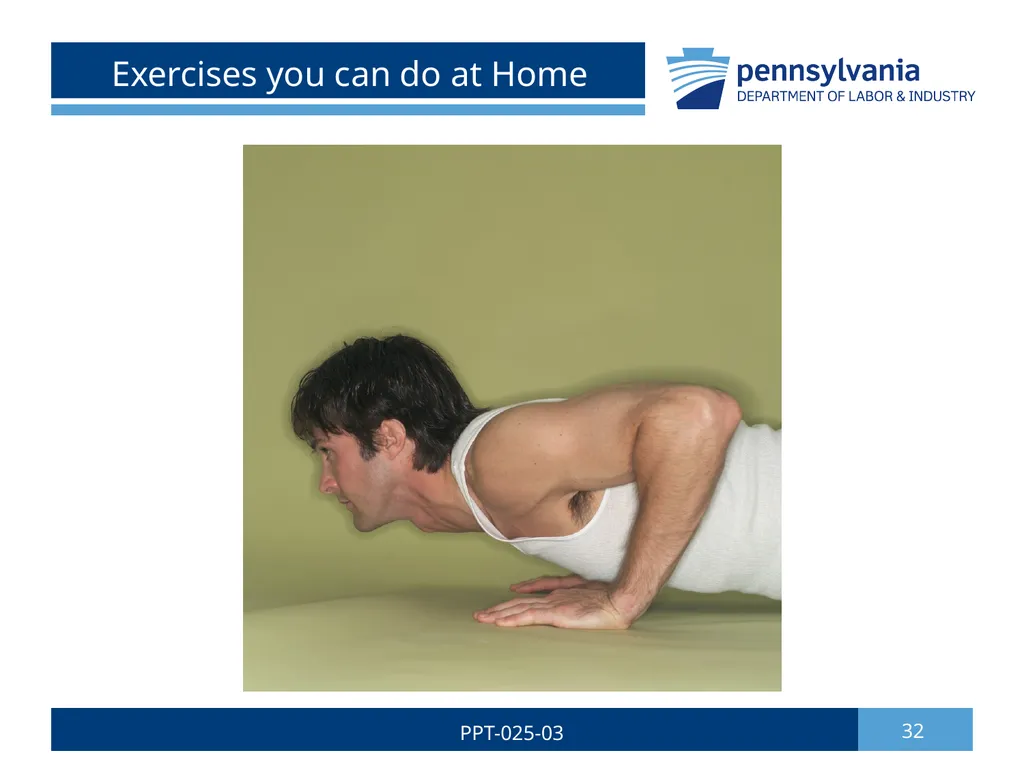
slide32. Exercises you can do at Home 32 PPT-025-03<br>
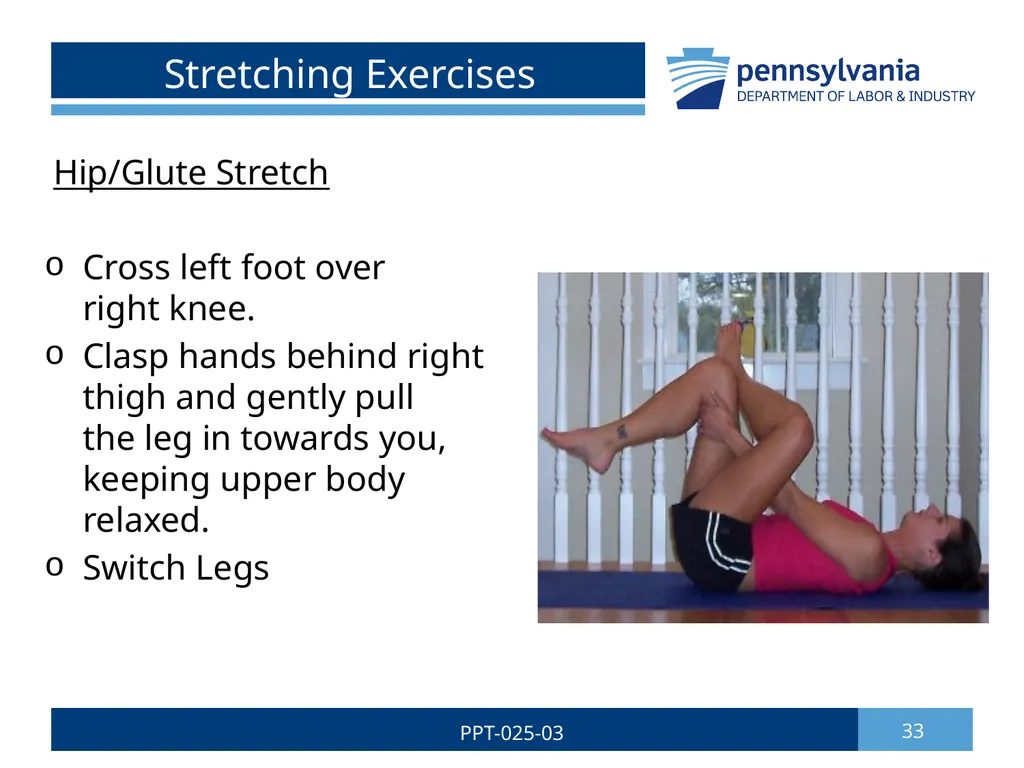
slide33. Stretching Exercises Hip/Glute Stretch
Cross left foot over right knee.
Clasp hands behind right thigh and gently pull the leg in towards you, keeping upper body relaxed.
Switch Legs 33 PPT-025-03<br>
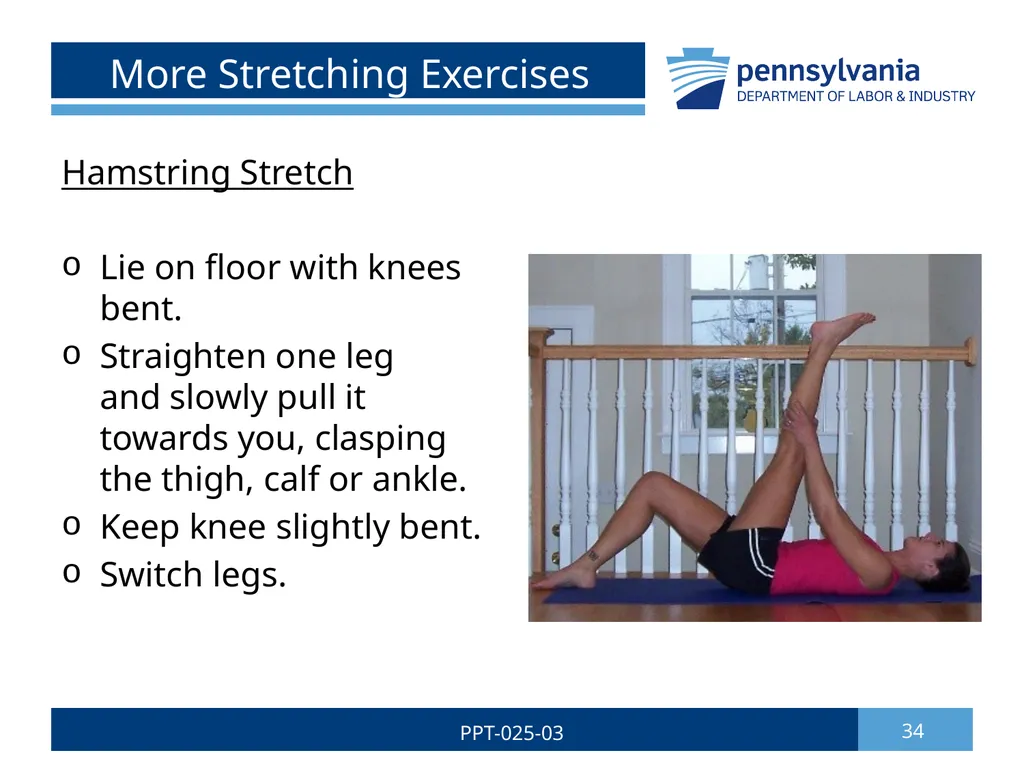
slide34. More Stretching Exercises Hamstring Stretch
Lie on floor with knees bent.
Straighten one leg and slowly pull it towards you, clasping the thigh, calf or ankle.
Keep knee slightly bent.
Switch legs. 34 PPT-025-03<br>
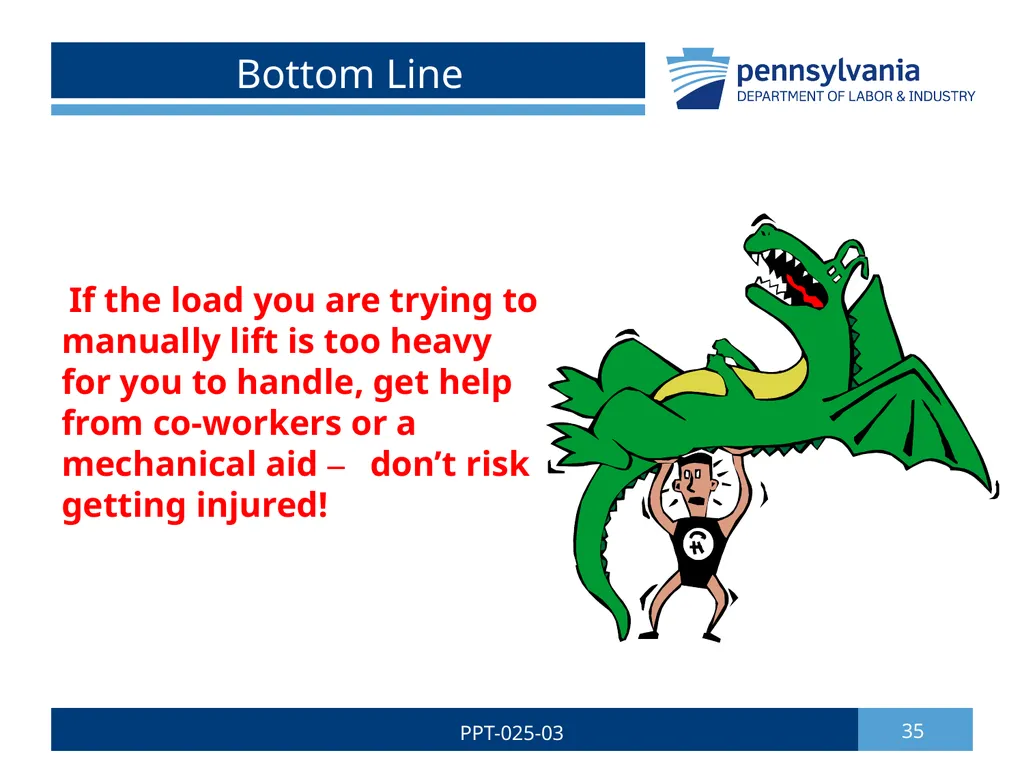
slide35. Bottom Line If the load you are trying to manually lift is too heavy for you to handle, get help from co-workers or a mechanical aid – don’t risk getting injured! 35 PPT-025-03<br>
slide36. Contact Information Health & Safety Training Specialists
1171 South Cameron Street, Room 324
Harrisburg, PA 17104-2501
(717) 772-1635
RA-LI-BWC-PATHS@pa.gov 36 PPT-025-03 Like us on Facebook! - https://www.facebook.com/BWCPATHS<br>
slide37. Questions 37 PPT-025-03<br>
PA Training for Health & Safety (PATHS)<br>
slide2. What we’ll talk About Material Handling Tips
Proper Lifting
Considerations
Tips for Safe Lifting
Exercises for Work and Home 2 PPT-025-03<br>
slide3. Material Handling Tips Check the object before you attempt to lift it.
Test every load before lifting = pushing object lightly with hands or feet to see how easily it moves (good indication as to how heavy it is).
Remember, a small size does not always mean a light load!
Make sure the load you are lifting is packed correctly.
Employees packing boxes should make sure weight is balanced and packed so it won’t move around.
Loose pieces inside a box can cause accidents if the box becomes unbalanced. 3 PPT-025-03<br>
slide4. More Tips Make sure the load is easy to reach.
Don’t arch your back when lifting a load over your head.
Use a ladder instead of lifting something over your head.
Here’s the best way to pick up an object:
Use slow and smooth movements (hurried, jerky movements can strain the muscles in your back).
Keep your body facing the object while you lift it (twisting while lifting can injure your back). 4 PPT-025-03<br>
slide5. Test the Load! Always test the load before lifting to ensure it’s not too heavy for you to lift and carry by yourself!
If you determine the load is too heavy get assistance (either by using people or an appropriate mechanical aid). 5 PPT-025-03<br>
slide6. Planning Ahead Before moving a load plan both the load and the route (allows you to evaluate hazards, limitations, route safety, and final placement).
Evaluate the weight and shape of the load and also what material is made of.
Some items to check:
→ Is PPE or other safety gear necessary?
→ Size/shape/weight within your limits?
→ Can you get a firm hand hold?
→ Will you be able to see over the load?
→ Will you need assistance (people, cart,
forklift)? 6 PPT-025-03<br>
slide7. Prevention: Plan your Lift Think about the weight, size, and shape of the object and the distance you will be moving it.
Is the object bulky? Will you need help?
Do you see any hazards that can be eliminated?
Think about the route you’ll be taking: any stairs, doors, obstacles?
If the object is heavy or awkward use a hand cart or pallet jack. 7 PPT-025-03<br>
slide8. Plan Ahead – The Route Check the route you will take and place where you will put the load down.
Injuries and property damage can occur when unexpected problems happen during the move.
Considerations for the route:
- Are there steps, tripping hazards, closed
doors, tight doorways or passageways?
- Are there blind corners or wet/slippery floors?
- What is the traffic situation (people, vehicles,
etc.)? 8 PPT-025-03<br>
slide9. Plan Ahead – the Drop Off Point Some considerations:
▪ Where will you place the load?
▪ Is there room for the load?
▪ Is the site strong enough to hold the load?
▪ Will the load block traffic or create a hazard
when placed?
▪ Will the load have to be placed elsewhere or
will it be in the right location after you set it
down? 9 PPT-025-03<br>
slide10. Lowering the Object When lowering an object remember to bend at the knees not at the waist and avoid twisting motions while putting the load down. (the picture shown demonstrates how NOT to put an object down!).
If you must turn while lowering an object adjust your feet rather than twisting your
back. 10 PPT-025-03 Not the correct way to lower a box<br>
slide11. Lifting Properly – Step One ▫ Stand close to the load
with your feet spread
about shoulder width
apart.
▫ One foot slightly in
front of the other for
balance. 11 PPT-025-03<br>
slide12. Lifting Properly – Step Two Squat down bending at the knees (not your waist).
Tuck your chin while keeping your back as vertical as possible. 12 PPT-025-03<br>
slide13. Lifting Properly – Step Three Get a firm grasp of the object before beginning the lift. 13 PPT-025-03<br>
slide14. Lifting Properly – Step Four Begin slowly lifting with your LEGS by straightening them. Never twist your body during this step! 14 PPT-025-03<br>
slide15. Lifting Properly – Step Five Once lift is complete, keep object as close to your body as possible.
As load's center of gravity moves away from body, dramatic increase in stress to the lumbar region of the back. 15 PPT-025-03<br>
slide16. Other Considerations Team Lifting – More than one person required to lift a load: team of folks; one person “calls” directions and lifting steps so everyone will move at the same pace.
Stacking – Overlap and interlock rows. Never stack above the crush height or above height limits for the facility you’re working in. Make certain the base is clean, level and can support the weight. 16 PPT-025-03<br>
slide17. Other Considerations Drums –
Use a lift truck with drum forks or a drum dolly to move, even a short distance.
If moving individual empty drums, roll on the side not the rim and always work on the down side of the drum with the hands on the “belly” of the drum, not the rim. 17 PPT-025-03<br>
slide18. Considerations Cylinders:
Compressed gas cylinders are like bombs with very short fuses!
Valves must be protected by a proper safety cap.
Use a special hand truck to move individual cylinders, and “walk” them only short distances to align them.
Cylinders must be stored in designated areas and secured with safety chains or bars. 18 PPT-025-03<br>
slide19. Considerations Mechanical Aids –
Often the best way to move loads is with a mechanical aid like a hand truck or rolling cart.
Choose the right aid for the job and inspect it before use.
Place the heaviest items on the bottom with the weight concentrated between the wheels.
Keep your hands away from the edges so they won’t be scraped or crushed in doorways. 19 PPT-025-03-<br>
slide20. Tips for Safe Listing PLAN THE LIFT.
REMOVE ANYTHING IN YOUR WAY.
PUSHING IS EASIER THAN PULLING.
PULLING IS EASIER THAN CARRYING.
GET HELP FOR HEAVY/BULKY LOADS. 20 PPT-025-03<br>
slide21. More Tips for Safe Lifting WARM UP YOUR MUSCLES WITH STRETCHES.
TEST THE WEIGHT OF THE LOAD FIRST.
FACE THE WAY YOU NEED TO MOVE.
HOLD THE LOAD CLOSE TO YOUR BODY. 21 PPT-025-03<br>
slide22. More Tips LIFT WITH YOUR BACK AS STRAIGHT AS COMFORTABLE.
KEEP THE LOAD BETWEEN SHOULDER AND KNEE HEIGHT.
CHANGE YOUR POSITION.
STRETCH TO RELAX AND REST TIRED MUSCLES. 22 PPT-025-03<br>
slide23. and More Tips PLAN WHERE TO SET THE LOAD DOWN.
REST MORE OFTEN WHEN IT IS HOT/HUMID.
TAKE MORE TIME TO WARM UP YOUR MUSCLES IN THE COLD.
TAKE MORE BREAKS IF USING TOOLS/EQUIPMENT THAT VIBRATES. 23 PPT-025-03<br>
slide24. Any Problems? 24 PPT-025-03 Position/posture could injure neck, back, arms, shoulders Too many books – weight could injure shoulders and/or back Drop off surface not big enough<br>
slide25. What about this? Bending over at the
waist
Heavy lifting from
below knees
Improper posture 25 PPT-025-03<br>
slide26. Exercises you can do at Work 26 PPT-025-03 Be safe - check with your doctor before attempting any of these exercises!<br>
slide27. Strengthening Exercise Wall Slides to strengthen
your muscles . . . .
- Stand with your back
against a wall, feet
shoulder-width apart.
- Slide down into a crouch
with knees bent to 90 degrees.
- Count to 5 and slide back up
the wall. Repeat 5 times. 27 PPT-025-03<br>
slide28. Stretching Exercises Gastroc Stretch
▪Lean against a wall or other stationary object, both palms against the object.
▪Leg you want to stretch is back, several feet from wall, heel firmly positioned on the floor.
▪Other leg is flexed about halfway between back leg and wall.
▪Start with your back straight and gradually lunge forward until you feel the stretch in your calf.
▪Very important to keep back foot straight and angled 90 degrees from wall. 28 PPT-025-03<br>
slide29. More Stretches • Stretches for side of neck:
Sit or stand with arms hanging loosely at sides
Turn head to one side, then the other
Hold for 5 seconds, each side
Repeat 1 to 3 times 29 PPT-025-03<br>
slide30. and More Stretches Stretches for side of shoulder and back of upper arm
Stand or sit and place right hand on left shoulder
With left hand, pull right elbow across chest toward left shoulder and hold 10 to 15 seconds
Repeat on other side 30 PPT-025-03<br>
slide31. and Finally! Stretches for triceps, top of shoulders, waist
Keep knees slightly flexed
Stand or sit with arms overhead
Hold elbow with hand of opposite arm
Pull elbow behind head gently as you slowly lean to side until mild stretch is felt
Hold 10 to 15 sec
Repeat on other side 31 PPT-025-03<br>
slide32. Exercises you can do at Home 32 PPT-025-03<br>
slide33. Stretching Exercises Hip/Glute Stretch
Cross left foot over right knee.
Clasp hands behind right thigh and gently pull the leg in towards you, keeping upper body relaxed.
Switch Legs 33 PPT-025-03<br>
slide34. More Stretching Exercises Hamstring Stretch
Lie on floor with knees bent.
Straighten one leg and slowly pull it towards you, clasping the thigh, calf or ankle.
Keep knee slightly bent.
Switch legs. 34 PPT-025-03<br>
slide35. Bottom Line If the load you are trying to manually lift is too heavy for you to handle, get help from co-workers or a mechanical aid – don’t risk getting injured! 35 PPT-025-03<br>
slide36. Contact Information Health & Safety Training Specialists
1171 South Cameron Street, Room 324
Harrisburg, PA 17104-2501
(717) 772-1635
RA-LI-BWC-PATHS@pa.gov 36 PPT-025-03 Like us on Facebook! - https://www.facebook.com/BWCPATHS<br>
slide37. Questions 37 PPT-025-03<br>