
Safeguarding children, young people Working
PC
Published · 36 slides · 0 views

1 / 1




Description
Safeguarding children, young people Working Together To Safeguard Children Key Changes to New Guidance Dec 2023 Hayley Cameron: Education Safeguarding Manager Stephen Welding: Esafety AdviserPrevent Trainer Gill Bush: Education Lead, CFCS
Related Topics
Share
Embed code
Download this presentation From Below
"Safeguarding children, young people Working" is the property of its rightful owner. Permission is granted to download and print the materials on this website for personal, non-commercial use only, and to display it on your personal computer provided you do not modify the materials and that you retain all copyright notices contained in the materials. By downloading content from our website, you accept the terms of this agreement.
Presentation Transcript
01
Safeguarding children, young people
Working Together To Safeguard Children
Key Changes to New Guidance Dec 2023 Hayley Cameron: Education Safeguarding Manager
Stephen Welding: Esafety Adviser/Prevent Trainer
Gill Bush: Education Lead, CFCS
Mick Bradshaw: Outdoor Education Adviser<br>
Stephen Welding: Esafety Adviser/Prevent Trainer
Gill Bush: Education Lead, CFCS
Mick Bradshaw: Outdoor Education Adviser<br>
02
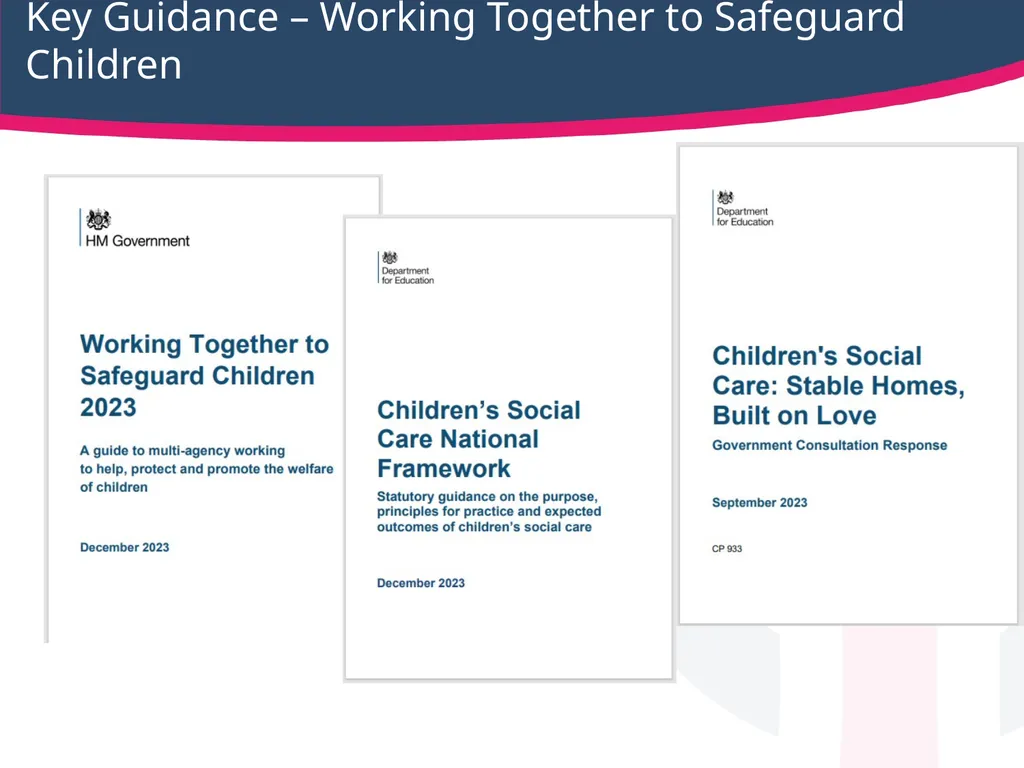
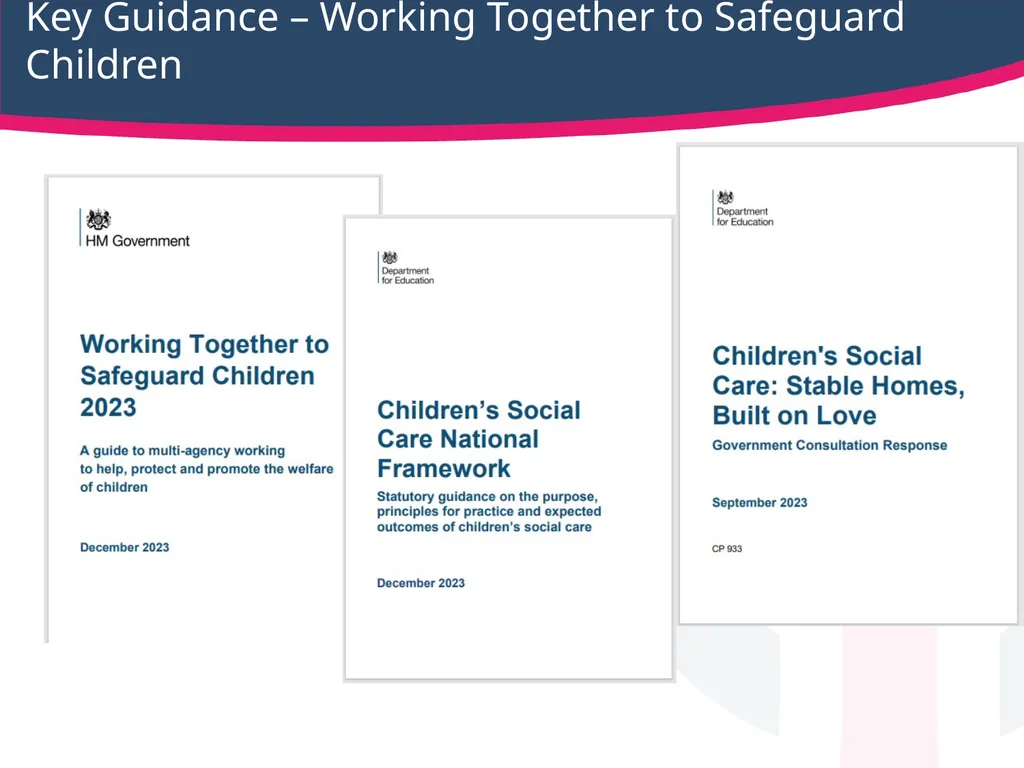
Key Guidance – Working Together to Safeguard Children<br>
03
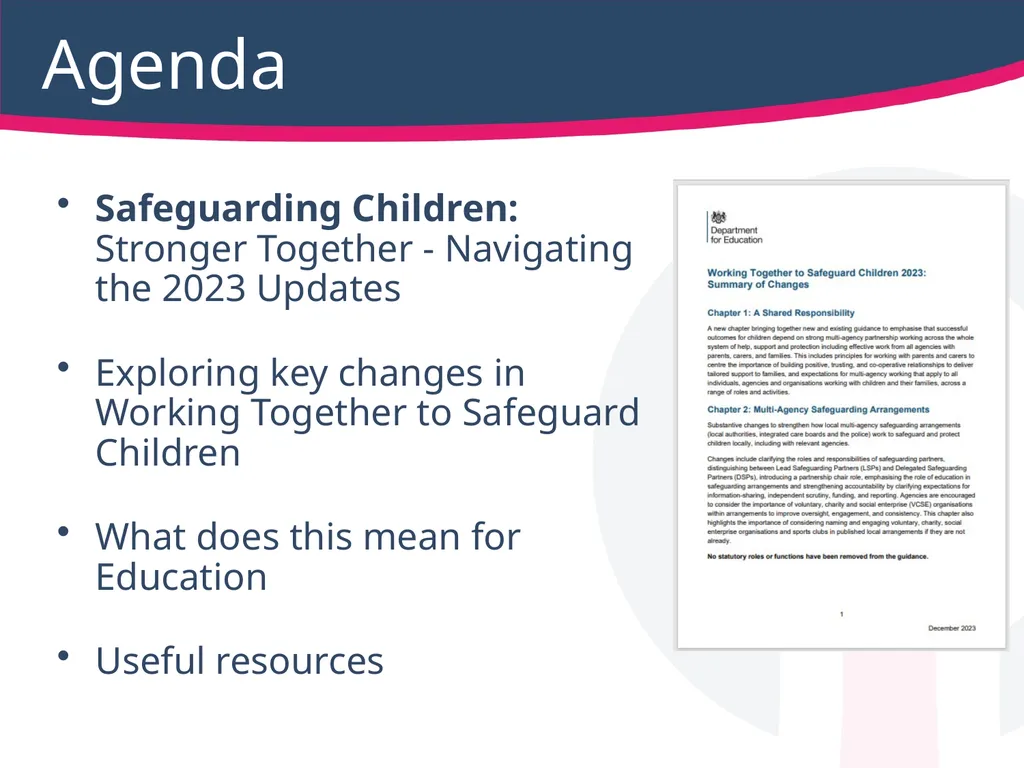
Agenda Safeguarding Children: Stronger Together - Navigating the 2023 Updates
Exploring key changes in Working Together to Safeguard Children
What does this mean for Education
Useful resources<br>
Exploring key changes in Working Together to Safeguard Children
What does this mean for Education
Useful resources<br>
04
Who is this guidance for? This statutory guidance sets out key roles for individual organisations and agencies to deliver effective arrangements for help, support, safeguarding, and protection. It should be read and followed by leaders, managers and frontline practitioners of all organisations
and agencies as set out in chapter 4 of this document. (WTSC 2023)<br>
and agencies as set out in chapter 4 of this document. (WTSC 2023)<br>
05
Introduction Nothing is more important than children’s welfare. Every child deserves to grow up in a safe, stable, and loving home. Children who need help and protection deserve high quality and effective support.
This requires individuals, agencies, and organisations to be clear about their own and each other’s roles and responsibilities, and how they work together.<br>
This requires individuals, agencies, and organisations to be clear about their own and each other’s roles and responsibilities, and how they work together.<br>
06
A child-centred approach within a whole family focus A child-centred approach is fundamental to safeguarding and promoting the welfare of every child. All practitioners should follow the principles of the Children Acts 1989 and 2004. These Acts make clear that the welfare of children is paramount and that they are best looked after within their families, with their parents playing a full part in their lives, unless compulsory intervention in family life is necessary.<br>
07
Children and Young People In this guidance, a child is defined as anyone who has not yet reached their 18th birthday.
‘Children’ therefore means ‘children and young people’ throughout.
The term practitioner is used in the guidance to refer to individuals who work with children and their families in any capacity, including a range of professionals, such as qualified social workers and those who work for the statutory safeguarding partners or in education settings.<br>
‘Children’ therefore means ‘children and young people’ throughout.
The term practitioner is used in the guidance to refer to individuals who work with children and their families in any capacity, including a range of professionals, such as qualified social workers and those who work for the statutory safeguarding partners or in education settings.<br>
08
Working with parents and carers The updated guidance sets out four principles that professionals should follow when working with parents and carers:
effective partnership and the importance of building strong, positive, trusting and co-operative relationships.
respectful, non-blaming, clear and inclusive verbal and non-verbal communication that is adapted to the needs of parents and carers.
empowering parents and carers to participate in decision making by equipping them with information, keeping them updated and directing them to further resources.
involving parents and carers in the design of processes and services that affect them.<br>
effective partnership and the importance of building strong, positive, trusting and co-operative relationships.
respectful, non-blaming, clear and inclusive verbal and non-verbal communication that is adapted to the needs of parents and carers.
empowering parents and carers to participate in decision making by equipping them with information, keeping them updated and directing them to further resources.
involving parents and carers in the design of processes and services that affect them.<br>
09
The Children Act 1989 Whilst it is parents and carers who have primary care for their children, local authorities, working with partner organisations and agencies, have specific duties to safeguard and promote the welfare of all children in their area. The Children Act 1989 1 sets out specific duties to provide services to children in their area if they are in need and to undertake enquiries if they believe a child has suffered or is likely to suffer significant harm. The Director of Children’s Services and Lead Member for Children’s Services in local authorities are the key points of professional and political accountability, with responsibility for the effective delivery of these functions<br>
10
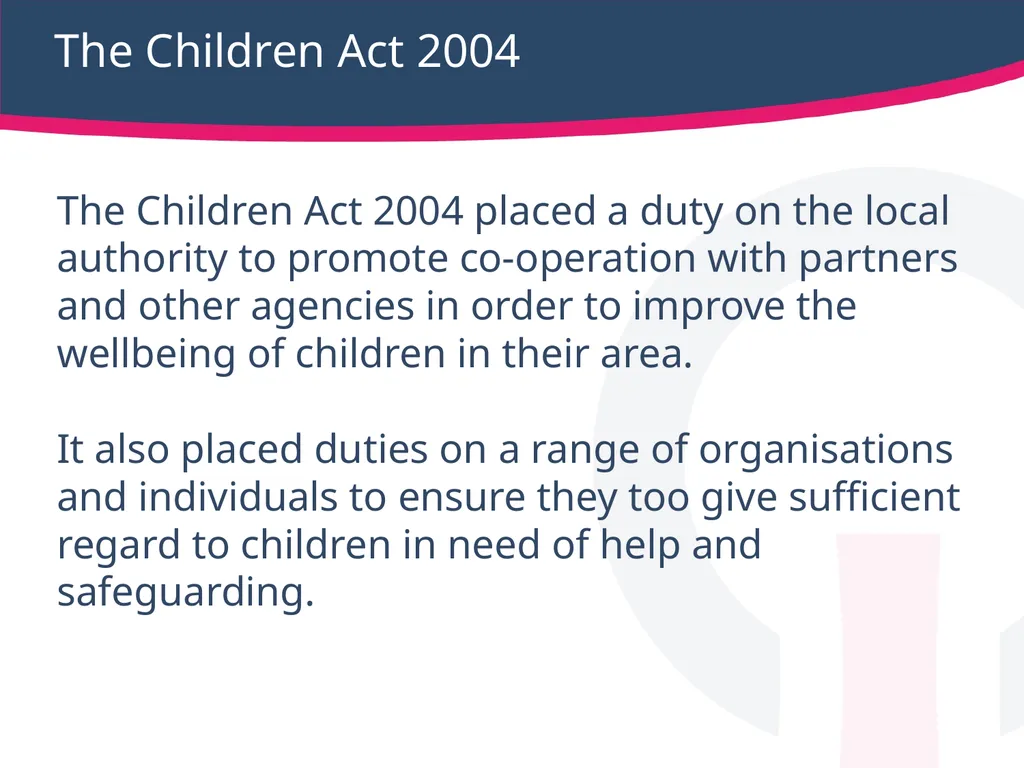
The Children Act 2004 The Children Act 2004 placed a duty on the local authority to promote co-operation with partners and other agencies in order to improve the wellbeing of children in their area.
It also placed duties on a range of organisations and individuals to ensure they too give sufficient regard to children in need of help and safeguarding.<br>
It also placed duties on a range of organisations and individuals to ensure they too give sufficient regard to children in need of help and safeguarding.<br>
11
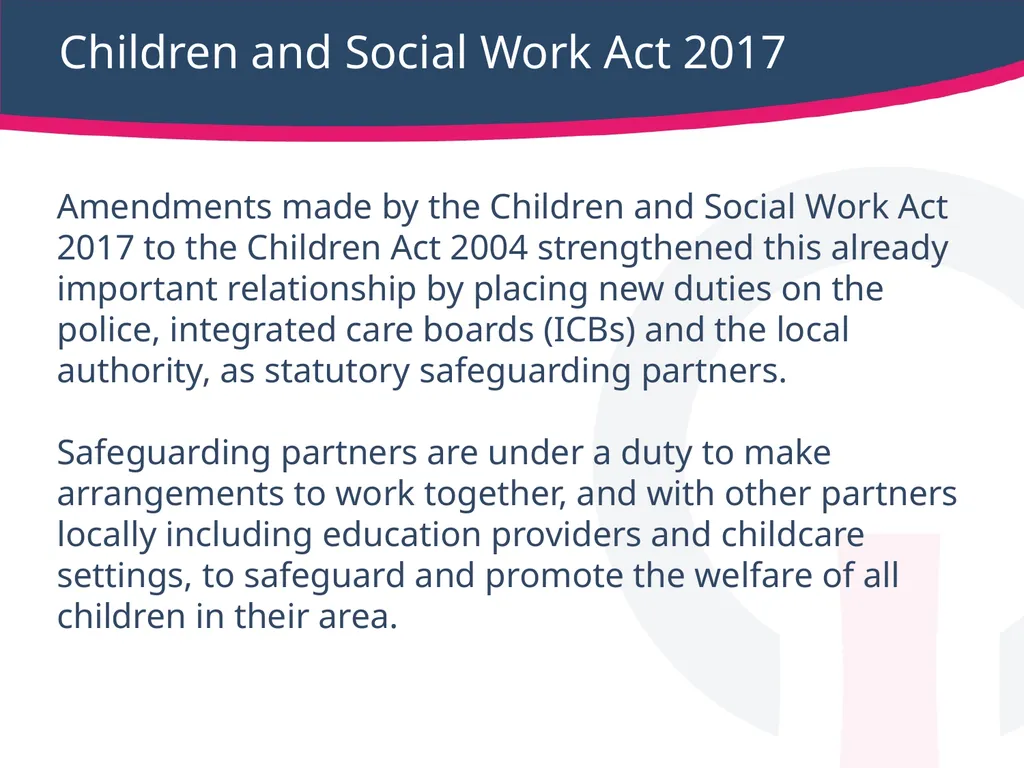
Children and Social Work Act 2017 Amendments made by the Children and Social Work Act 2017 to the Children Act 2004 strengthened this already important relationship by placing new duties on the police, integrated care boards (ICBs) and the local authority, as statutory safeguarding partners.
Safeguarding partners are under a duty to make arrangements to work together, and with other partners locally including education providers and childcare settings, to safeguard and promote the welfare of all children in their area.<br>
Safeguarding partners are under a duty to make arrangements to work together, and with other partners locally including education providers and childcare settings, to safeguard and promote the welfare of all children in their area.<br>
12
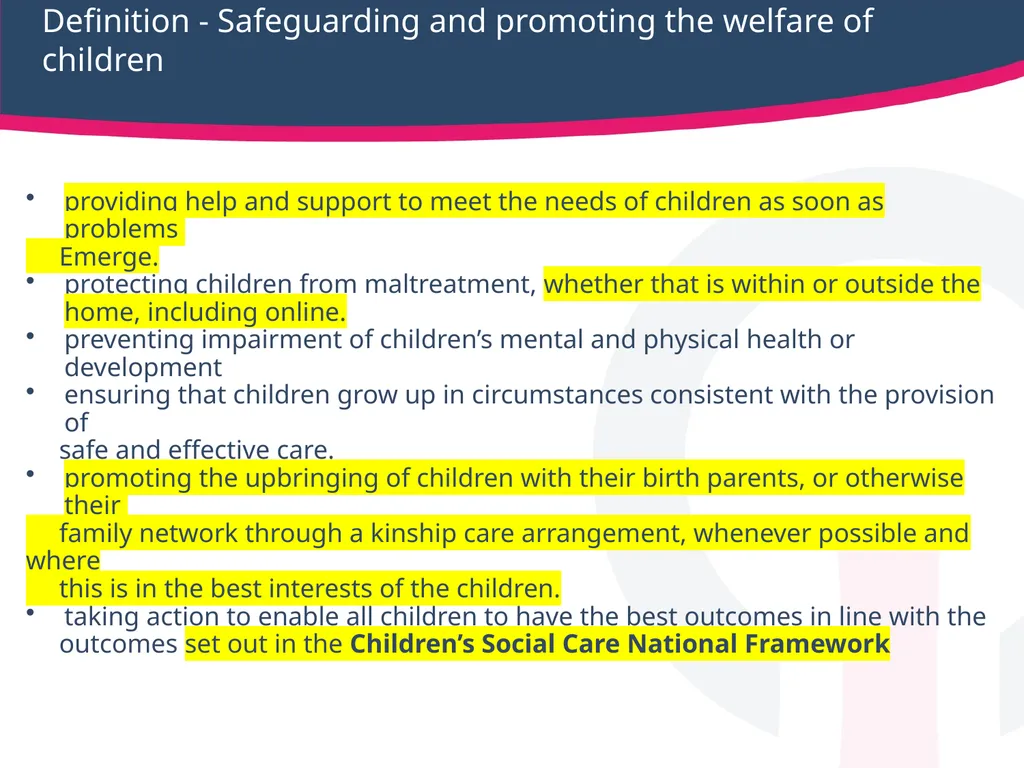
Definition - Safeguarding and promoting the welfare of children providing help and support to meet the needs of children as soon as problems
Emerge.
protecting children from maltreatment, whether that is within or outside the home, including online.
preventing impairment of children’s mental and physical health or development
ensuring that children grow up in circumstances consistent with the provision of
safe and effective care.
promoting the upbringing of children with their birth parents, or otherwise their
family network through a kinship care arrangement, whenever possible and where
this is in the best interests of the children.
taking action to enable all children to have the best outcomes in line with the
outcomes set out in the Children’s Social Care National Framework<br>
Emerge.
protecting children from maltreatment, whether that is within or outside the home, including online.
preventing impairment of children’s mental and physical health or development
ensuring that children grow up in circumstances consistent with the provision of
safe and effective care.
promoting the upbringing of children with their birth parents, or otherwise their
family network through a kinship care arrangement, whenever possible and where
this is in the best interests of the children.
taking action to enable all children to have the best outcomes in line with the
outcomes set out in the Children’s Social Care National Framework<br>
13
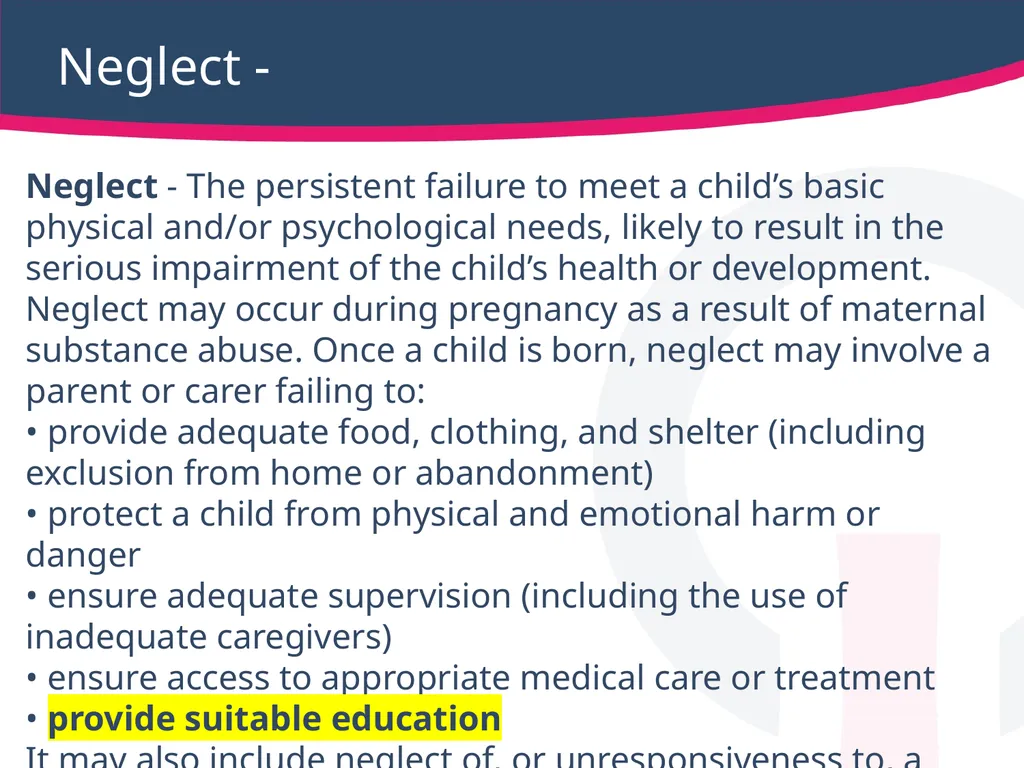
Neglect - Neglect - The persistent failure to meet a child’s basic physical and/or psychological needs, likely to result in the serious impairment of the child’s health or development. Neglect may occur during pregnancy as a result of maternal substance abuse. Once a child is born, neglect may involve a parent or carer failing to:
• provide adequate food, clothing, and shelter (including exclusion from home or abandonment)
• protect a child from physical and emotional harm or danger
• ensure adequate supervision (including the use of inadequate caregivers)
• ensure access to appropriate medical care or treatment
• provide suitable education
It may also include neglect of, or unresponsiveness to, a child’s basic emotional needs<br>
• provide adequate food, clothing, and shelter (including exclusion from home or abandonment)
• protect a child from physical and emotional harm or danger
• ensure adequate supervision (including the use of inadequate caregivers)
• ensure access to appropriate medical care or treatment
• provide suitable education
It may also include neglect of, or unresponsiveness to, a child’s basic emotional needs<br>
14
Child protection Child protection is part of safeguarding and promoting the welfare of children and is defined for the purpose of this guidance as activity that is undertaken to protect specific children who are suspected to be suffering, or likely to suffer, significant harm. This
includes harm that occurs inside or outside the home, including online.
Effective safeguarding means practitioners should understand and be sensitive to factors, including economic and social circumstances and ethnicity, which can impact children and families’ lives.<br>
includes harm that occurs inside or outside the home, including online.
Effective safeguarding means practitioners should understand and be sensitive to factors, including economic and social circumstances and ethnicity, which can impact children and families’ lives.<br>
15
Emphasis on Multi-Agency Collaboration Introduce the revised roles and responsibilities of Lead and Delegated Safeguarding Partners.
Explain the new Partnership Chair role and its importance in facilitating coordination.
Emphasise the strengthened role of education and childcare providers in information-sharing and joint working.
Illustrate this with an example of how effective multi-agency collaboration can benefit a child in need.<br>
Explain the new Partnership Chair role and its importance in facilitating coordination.
Emphasise the strengthened role of education and childcare providers in information-sharing and joint working.
Illustrate this with an example of how effective multi-agency collaboration can benefit a child in need.<br>
16
Enhanced Multi-Agency Collaboration: Clearer Roles and Responsibilities:
Lead Safeguarding Partners (LSPs) coordinate overall safeguarding efforts.
Delegated Safeguarding Partners (DSPs) fulfil specific roles within their areas.
Partnership Chair: Facilitates effective communication and decision-making.
Education and Childcare Providers: Stronger role in information-sharing and joint working.
National Multi-Agency Child Protection Standards: Minimum expectations for effective practice<br>
Lead Safeguarding Partners (LSPs) coordinate overall safeguarding efforts.
Delegated Safeguarding Partners (DSPs) fulfil specific roles within their areas.
Partnership Chair: Facilitates effective communication and decision-making.
Education and Childcare Providers: Stronger role in information-sharing and joint working.
National Multi-Agency Child Protection Standards: Minimum expectations for effective practice<br>
17
Lead Safeguarding Partners (LSPs) The LSP is the head of each statutory safeguarding partner agency. For local authorities, for example, the LSP should be the Head of Paid Service, also known as the Chief Executive.
The LSP is responsible for holding their own organisation or agency to account, speaking and making decisions on behalf of their agency, and meeting the statutory and legislative duties of their agency.
LSPs from different agencies are jointly responsible for the proper involvement of all relevant agencies, and should work as a team, as opposed to as a voice for their own organisation.<br>
The LSP is responsible for holding their own organisation or agency to account, speaking and making decisions on behalf of their agency, and meeting the statutory and legislative duties of their agency.
LSPs from different agencies are jointly responsible for the proper involvement of all relevant agencies, and should work as a team, as opposed to as a voice for their own organisation.<br>
18
Delegated Safeguarding Partners (DSPs) The LSP of each partner agency should appoint a delegated safeguarding partner (DSP) responsible for operational delivery.
One DSP within the partnership should be appointed partnership chair for multi-agency arrangements. This role can be rotated between the DSPs if deemed appropriate by the LSPs.
The partnership chair should facilitate partner discussions, provide greater continuity, and act as a single point of contact for the partnership.
The role of partnership chair should not replace existing formal complaints procedures and does not provide independent scrutiny.<br>
One DSP within the partnership should be appointed partnership chair for multi-agency arrangements. This role can be rotated between the DSPs if deemed appropriate by the LSPs.
The partnership chair should facilitate partner discussions, provide greater continuity, and act as a single point of contact for the partnership.
The role of partnership chair should not replace existing formal complaints procedures and does not provide independent scrutiny.<br>
19
Schools, colleges and education providers It is recommended that LSPs have a representative from the education sector present at strategic discussions.
It is expected that all local education and childcare providers working with children up to the age of 18 will be included in local arrangements.
LSPs should consider including voluntary, charity, social enterprise (VCSE) organisations, childcare settings, and sports clubs in their arrangements.<br>
It is expected that all local education and childcare providers working with children up to the age of 18 will be included in local arrangements.
LSPs should consider including voluntary, charity, social enterprise (VCSE) organisations, childcare settings, and sports clubs in their arrangements.<br>
20
Prioritising Early Help and Support: Principles for Working with Parents and Carers: Building trust and collaboration for tailored family support.
Whole-Family Focus: Recognizing the needs of all family members in safeguarding efforts.
Early Help System Guide: Practical guidance for implementing effective early intervention strategies<br>
Whole-Family Focus: Recognizing the needs of all family members in safeguarding efforts.
Early Help System Guide: Practical guidance for implementing effective early intervention strategies<br>
21
Considering family needs in the context of early help Assessments for early help should consider how the needs of different family members impact each other. This includes needs relating to education, mental and physical health, financial stability, housing, substance use and crime.
Specific needs should be considered such as disabilities, those whose first language isn’t English, fathers or male carers, and parents who identify as LGBTQ.
Early help services may focus on improving family functioning and developing the family’s capacity to establish positive routines and solve problems. Where family networks are supporting the child and parents, services may take an approach that enables family group decision making, such as family group conferences.<br>
Specific needs should be considered such as disabilities, those whose first language isn’t English, fathers or male carers, and parents who identify as LGBTQ.
Early help services may focus on improving family functioning and developing the family’s capacity to establish positive routines and solve problems. Where family networks are supporting the child and parents, services may take an approach that enables family group decision making, such as family group conferences.<br>
22
The Role of Education Schools, colleges, early years and childcare settings, and other educational providers (including alternative provision) all have a pivotal role to play in safeguarding children and promoting their welfare.
Their insight and co-operation are vital to the successful delivery of multi-agency safeguarding arrangements. People working in
education settings play an important role in building relationships, identifying concerns and providing direct support to children.<br>
Their insight and co-operation are vital to the successful delivery of multi-agency safeguarding arrangements. People working in
education settings play an important role in building relationships, identifying concerns and providing direct support to children.<br>
23
Education's Role in the New Working Together to Safeguard Children (2023) The updated Working Together to Safeguard Children (2023) document places a stronger emphasis on education's role in safeguarding children. Here's a breakdown of the key changes:
Education providers, including schools, colleges, and early years settings, are now recognised as key safeguarding partners.
They have a clearer duty to work together with other agencies like health, social care, and police to safeguard children.
This includes sharing information, identifying concerns, and supporting children and families<br>
Education providers, including schools, colleges, and early years settings, are now recognised as key safeguarding partners.
They have a clearer duty to work together with other agencies like health, social care, and police to safeguard children.
This includes sharing information, identifying concerns, and supporting children and families<br>
24
The Role of Education They may be the first trusted adult to whom children report safeguarding concerns. LSPs should give careful consideration to naming all local schools, colleges and education providers set out in the 2018 Regulations as relevant agencies.
The statutory guidance ‘Keeping children safe in education’ and ‘Early years foundation stage (EYFS) statutory framework’ set out the safeguarding duties and expectations on schools, colleges and other education providers and should be read alongside the new “Working Together to Safeguard children Dec 2023.<br>
The statutory guidance ‘Keeping children safe in education’ and ‘Early years foundation stage (EYFS) statutory framework’ set out the safeguarding duties and expectations on schools, colleges and other education providers and should be read alongside the new “Working Together to Safeguard children Dec 2023.<br>
25
Enhanced Information Sharing: Education settings are expected to proactively share information about children's welfare with other safeguarding partners when concerns arise.
This includes concerns about abuse, neglect, mental health, or any other factors impacting a child's well-being.
However, the guidance also emphasises the importance of maintaining confidentiality and respecting families' privacy.<br>
This includes concerns about abuse, neglect, mental health, or any other factors impacting a child's well-being.
However, the guidance also emphasises the importance of maintaining confidentiality and respecting families' privacy.<br>
26
Promoting a Culture of Safeguarding: The updated guidance emphasises the importance of creating a culture of safeguarding within all education settings.
This means embedding safeguarding principles into policies, procedures, and everyday practices.
It also involves raising awareness among all staff, students, and parents about their roles and responsibilities in keeping children safe.<br>
This means embedding safeguarding principles into policies, procedures, and everyday practices.
It also involves raising awareness among all staff, students, and parents about their roles and responsibilities in keeping children safe.<br>
27
Dedicated Training and Resources: The document calls for better training and resources for education staff on identifying and responding to safeguarding concerns.
This includes training on child abuse awareness, recognising signs of neglect, and reporting procedures.
Additionally, resources should be available to support children who have experienced abuse or are at risk of harm.<br>
This includes training on child abuse awareness, recognising signs of neglect, and reporting procedures.
Additionally, resources should be available to support children who have experienced abuse or are at risk of harm.<br>
28
Early Intervention and Support: Schools and other education settings play a crucial role in early identification of problems that could put children at risk.
They are encouraged to develop strong relationships with children and families to create a safe and supportive environment where concerns can be raised early.
This can help prevent issues from escalating and ensure children receive the necessary support before they reach crisis point.<br>
They are encouraged to develop strong relationships with children and families to create a safe and supportive environment where concerns can be raised early.
This can help prevent issues from escalating and ensure children receive the necessary support before they reach crisis point.<br>
29
Other Significant Updates: Clarified Terminology: Reflecting recent legislation and language changes.
Information Sharing: Balancing transparency with confidentiality concerns.
Independent Scrutiny: Stronger role for independent review of safeguarding practices.
Reporting Changes: Clarifying procedures for reporting concerns about children, including non-mandatory reporting of care leaver deaths.<br>
Information Sharing: Balancing transparency with confidentiality concerns.
Independent Scrutiny: Stronger role for independent review of safeguarding practices.
Reporting Changes: Clarifying procedures for reporting concerns about children, including non-mandatory reporting of care leaver deaths.<br>
30
Conclusion: The 2023 update to "Working Together to Safeguard Children" is a significant step forward in strengthening multi-agency collaboration, prioritising early help, and ensuring effective child protection practices.
By understanding these changes and working together, we can create a safer environment for all children.
Overall, the new Working Together to Safeguard Children document recognises the vital role education plays in protecting children. By strengthening collaboration, information sharing, and early intervention, education settings can make a significant contribution to keeping children safe and promoting their well-being.<br>
By understanding these changes and working together, we can create a safer environment for all children.
Overall, the new Working Together to Safeguard Children document recognises the vital role education plays in protecting children. By strengthening collaboration, information sharing, and early intervention, education settings can make a significant contribution to keeping children safe and promoting their well-being.<br>
31
Key Guidance – Working Together to Safeguard Children<br>
32
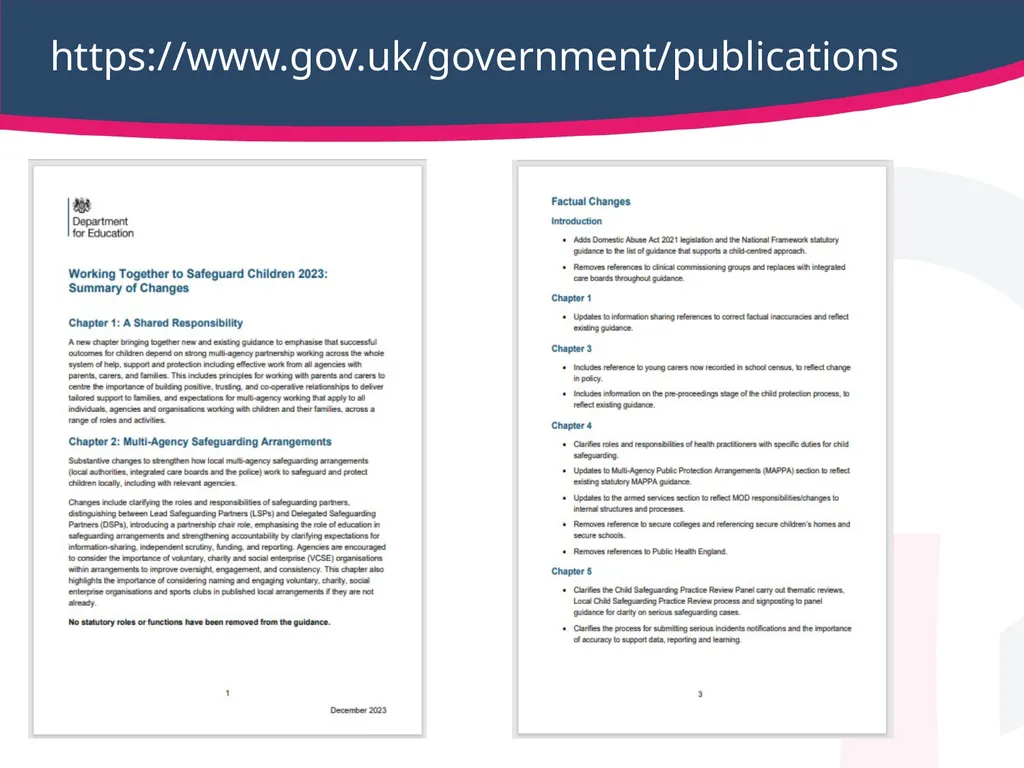
https://www.gov.uk/government/publications<br>
33
Safeguarding contacts Sutton childrensfirstcontactservice@sutton.gov.uk
Tel: 020 8770 6001
Emergency Duty Team (Out of Hours)
Tel: 020 8770 5000x9
Email: childrens.edt@sutton.gov.uk
suttonlscp@sutton.gov.uk
lado@Sutton.gov.uk
0208 770 4532<br>
Tel: 020 8770 6001
Emergency Duty Team (Out of Hours)
Tel: 020 8770 5000x9
Email: childrens.edt@sutton.gov.uk
suttonlscp@sutton.gov.uk
lado@Sutton.gov.uk
0208 770 4532<br>
34
Safeguarding contacts Croydon Single Point of Contact (SPOC)
Phone: 0208 255 2888
Monday to Friday, 9am to 5pm
Emergency Duty Team
Telephone: 0208 726 6000
Email: SSD-EMERGENCY-DUTY-TEAM@croydon.gov.uk
Monday to Friday, 5pm to 9am
Weekends and bank holidays, 24 hours
Contact the LADO
Telephone: 020 8255 2889
Email: LADO@croydon.gov.uk<br>
Phone: 0208 255 2888
Monday to Friday, 9am to 5pm
Emergency Duty Team
Telephone: 0208 726 6000
Email: SSD-EMERGENCY-DUTY-TEAM@croydon.gov.uk
Monday to Friday, 5pm to 9am
Weekends and bank holidays, 24 hours
Contact the LADO
Telephone: 020 8255 2889
Email: LADO@croydon.gov.uk<br>
35
Safeguarding contacts Merton Children and Family Hub: 020 8545 4226/4227
CandFhub@merton.gov.uk
Emergency Duty Team
Out of hours: 020 8770 5000
LADO: John Shelley
Email: lado@merton.gov.uk
Tel: 020 8545 3187<br>
CandFhub@merton.gov.uk
Emergency Duty Team
Out of hours: 020 8770 5000
LADO: John Shelley
Email: lado@merton.gov.uk
Tel: 020 8545 3187<br>
36
Thank You for Listening Hayley Cameron: Education Safeguarding Manager
Stephen Welding: E safety Adviser/Prevent Trainer
Gill Bush: Education Lead, CFCS
Mick Bradshaw: Outdoor Education Adviser Please visit www.Cognus.org.uk where you will find more bitesize training packages.<br>
Stephen Welding: E safety Adviser/Prevent Trainer
Gill Bush: Education Lead, CFCS
Mick Bradshaw: Outdoor Education Adviser Please visit www.Cognus.org.uk where you will find more bitesize training packages.<br>