Safety Considerations: Regulatory Definitions and Practical Considerations Ramy Abdelrahman, MD Division of Pediatric and Maternal Health (DPMH) Office of New Drugs Centre of Drug Evaluation and Research February 28, 2019 www.fda.gov
"Safety Considerations: Regulatory Definitions and" is the property of its rightful owner. Permission is granted to
download and print the materials on this website for personal, non-commercial use only, and to display it
on your personal computer provided you do not modify the materials and that you retain all copyright
notices contained in the materials. By downloading content from our website, you accept the terms of this
agreement.
Presentation Transcript
01
Safety Considerations: Regulatory Definitions and Practical Considerations Ramy Abdelrahman, MD
Division of Pediatric and Maternal Health (DPMH)
Office of New Drugs
Centre of Drug Evaluation and Research
February 28, 2019 www.fda.gov<br>
02
Disclaimer I’ve no financial interests or relationships to disclose
The views presented here are personal and do not necessarily reflect the views of the Agency<br>
03
Outline Definitions
Investigator and sponsor reporting responsibilities
IND safety reporting time frame<br>
04
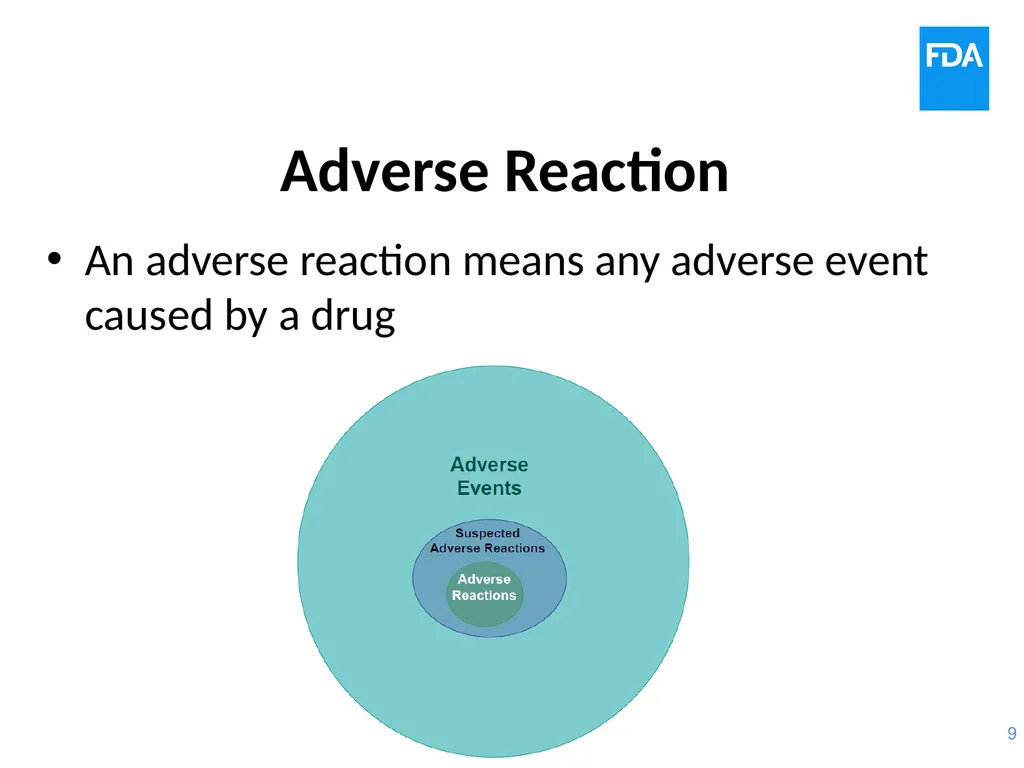
Adverse Event Adverse event means any untoward medical occurrence associated with the use of a drug in humans, whether or not considered drug related www.fda.gov<br>
05
Suspected Adverse Reaction Suspected adverse reaction means any adverse event for which there is a reasonable possibility that the drug caused the adverse event
For the purposes of IND safety reporting, ‘reasonable possibility’ means there is evidence to suggest a causal relationship between the drug and the adverse event.
Who is responsible for making the causality judgment?
FDA: the sponsor
ICH E2A guidance: either the investigator or the sponsor<br>
06
Individual Occurrences Certain serious adverse events are informative as single cases because they are uncommon and are known to be strongly associated with drug exposure (e.g., angioedema, blood dyscrasias, rhabdomyolysis, hepatic injury, anaphylaxis, and Stevens-Johnson Syndrome)<br>
07
One or More Occurrences One or more occurrences of an event that is not commonly associated with drug exposure, but is otherwise uncommon in the population exposed to the drug
If the event occurs in association with other factors strongly suggesting causation (e.g., strong temporal association, event recurs on rechallenge), a single case may be sufficiently persuasive to report in an IND safety report
Examples: tendon rupture or heart valve lesions in young adults, or intussusception in healthy infants<br>
08
Aggregate Analysis of Specific Events An aggregate analysis of specific events observed in a clinical trial that indicates those events occur more frequently in the drug treatment group than in a concurrent or historical control group
Examples:
Non-acute death observed in a trial in cancer patients
Acute myocardial infarction observed in a long-duration trial in an elderly population with cancer<br>
09
Adverse Reaction An adverse reaction means any adverse event caused by a drug<br>
10
Unexpected Adverse Events An adverse event or suspected adverse reaction is considered “unexpected” if it is:
Not listed in the investigator brochure for the particular drug under investigation (or elsewhere in the general investigational plan if an investigator brochure is not required or available)
Not listed at the specificity or severity that has been observed, examples:
Hepatic necrosis would be unexpected (by virtue of greater severity) if the investigator brochure referred only to elevated hepatic enzymes or hepatitis
Cerebral thromboembolism and cerebral vasculitis would be unexpected (by virtue of greater specificity) if the investigator brochure listed only cerebral vascular accidents<br>
11
Serious Adverse Events An adverse event or suspected adverse reaction is considered “serious” if, in the view of either the investigator or sponsor, it results in any of the following outcomes:
Death
Life-threatening adverse event
Inpatient hospitalization or prolongation of existing hospitalization
A persistent or significant incapacity or substantial disruption of the ability to conduct normal life functions, or a congenital anomaly/birth defect
Important medical events may be considered serious when, based upon appropriate medical judgment, they may jeopardize the patient or subject and may require medical or surgical intervention to prevent one of the outcomes listed in this definition, Examples:
Allergic bronchospasm requiring intensive treatment in an emergency room or at home
Blood dyscrasias or convulsions that do not result in inpatient hospitalization<br>
12
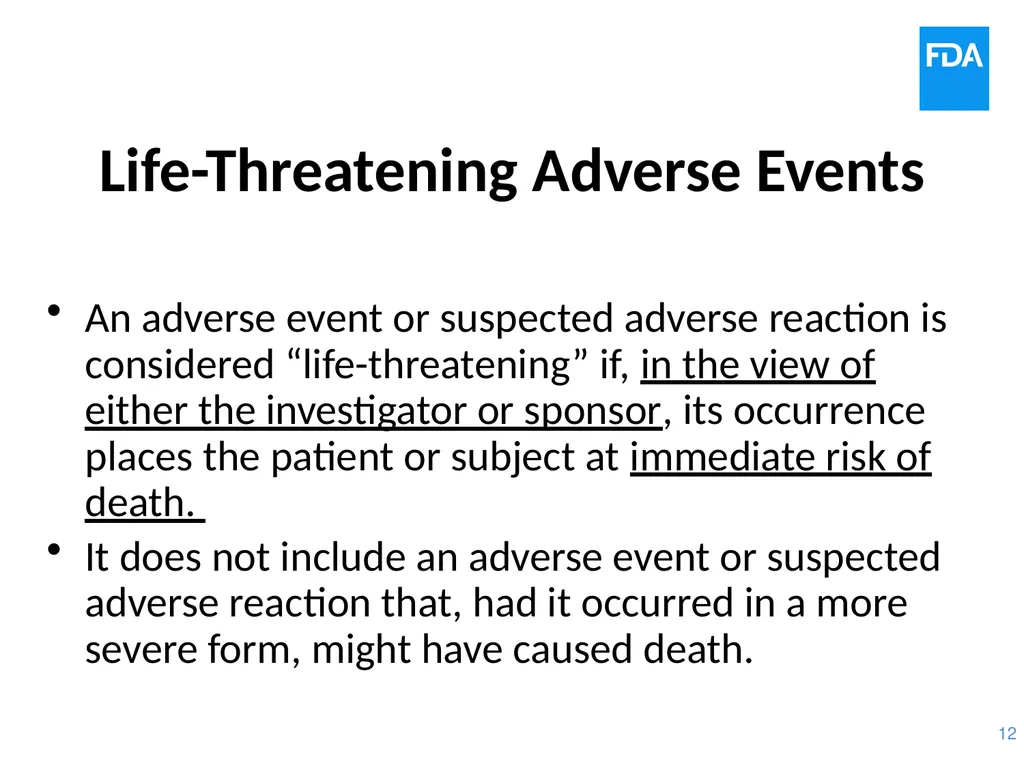
Life-Threatening Adverse Events An adverse event or suspected adverse reaction is considered “life-threatening” if, in the view of either the investigator or sponsor, its occurrence places the patient or subject at immediate risk of death.
It does not include an adverse event or suspected adverse reaction that, had it occurred in a more severe form, might have caused death.<br>
13
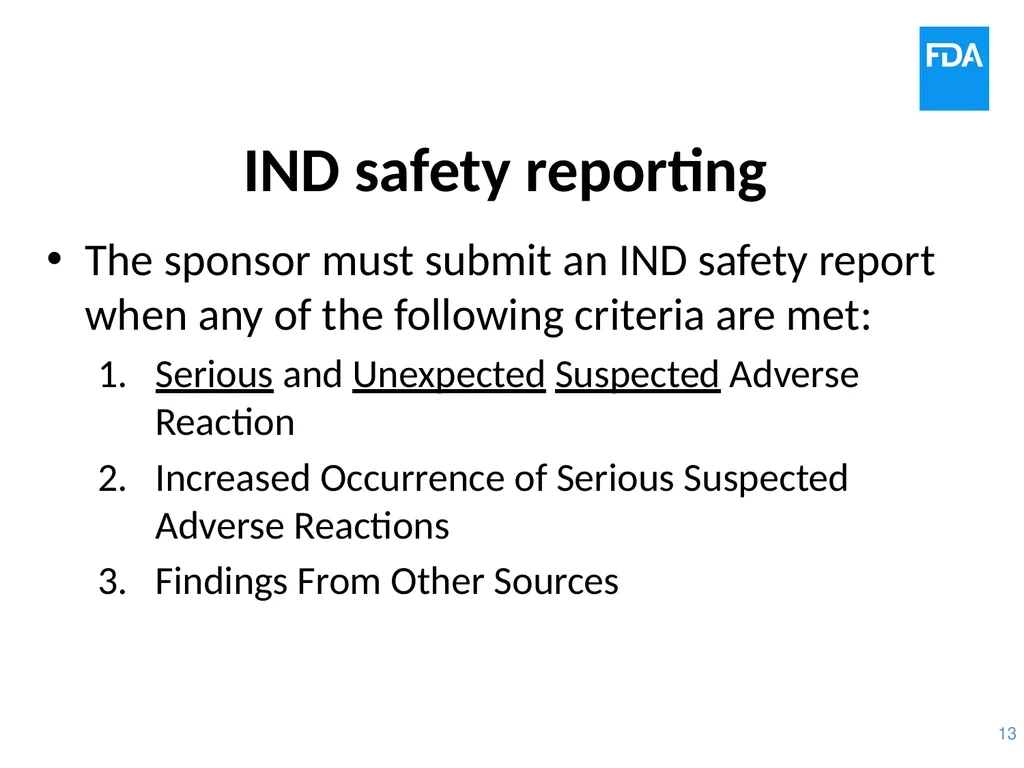
IND safety reporting The sponsor must submit an IND safety report when any of the following criteria are met:
Serious and Unexpected Suspected Adverse Reaction
Increased Occurrence of Serious Suspected Adverse Reactions
Findings From Other Sources<br>
14
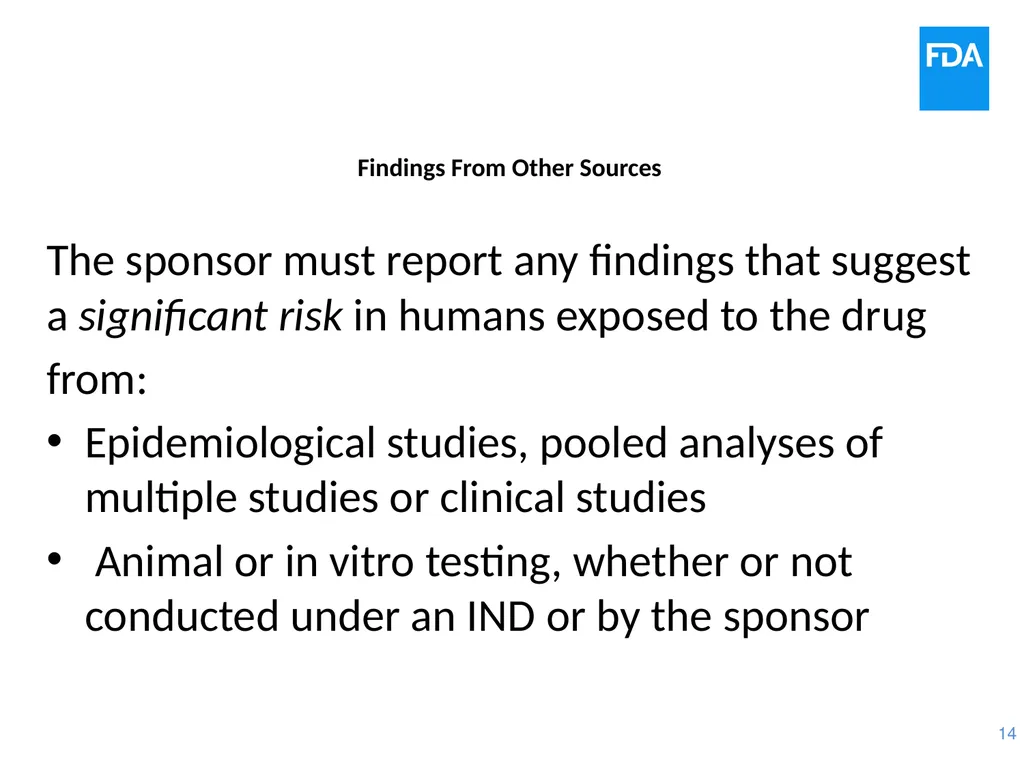
Findings From Other Sources The sponsor must report any findings that suggest a significant risk in humans exposed to the drug
from:
Epidemiological studies, pooled analyses of multiple studies or clinical studies
Animal or in vitro testing, whether or not conducted under an IND or by the sponsor<br>
15
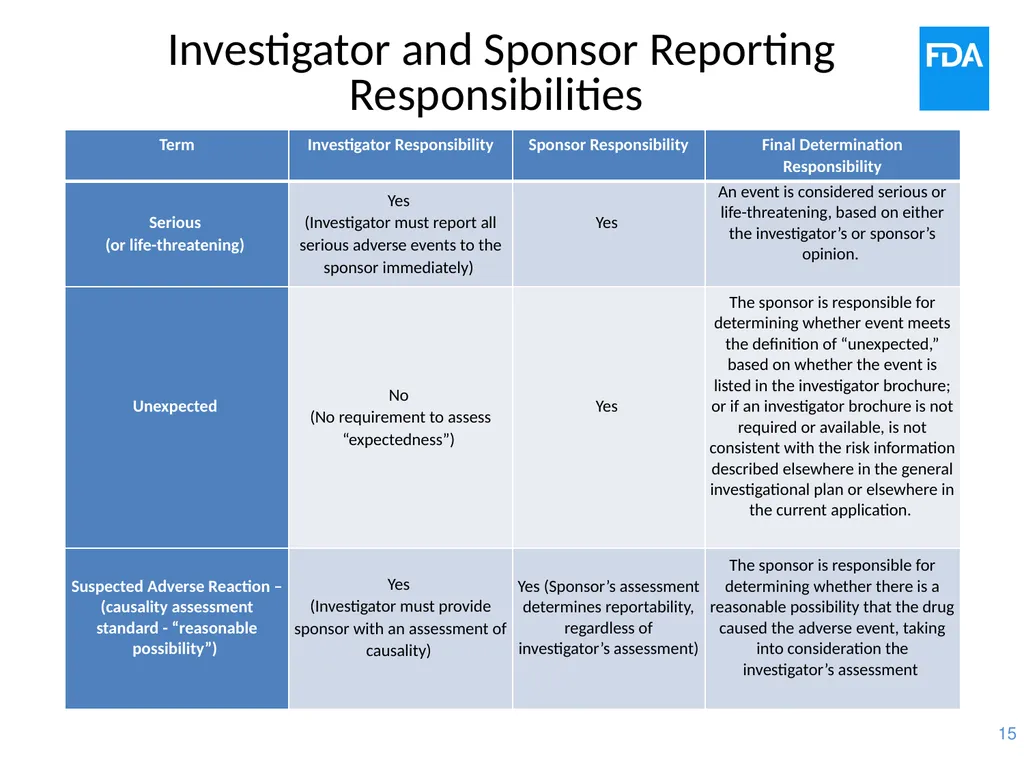
Investigator and Sponsor Reporting Responsibilities<br>
16
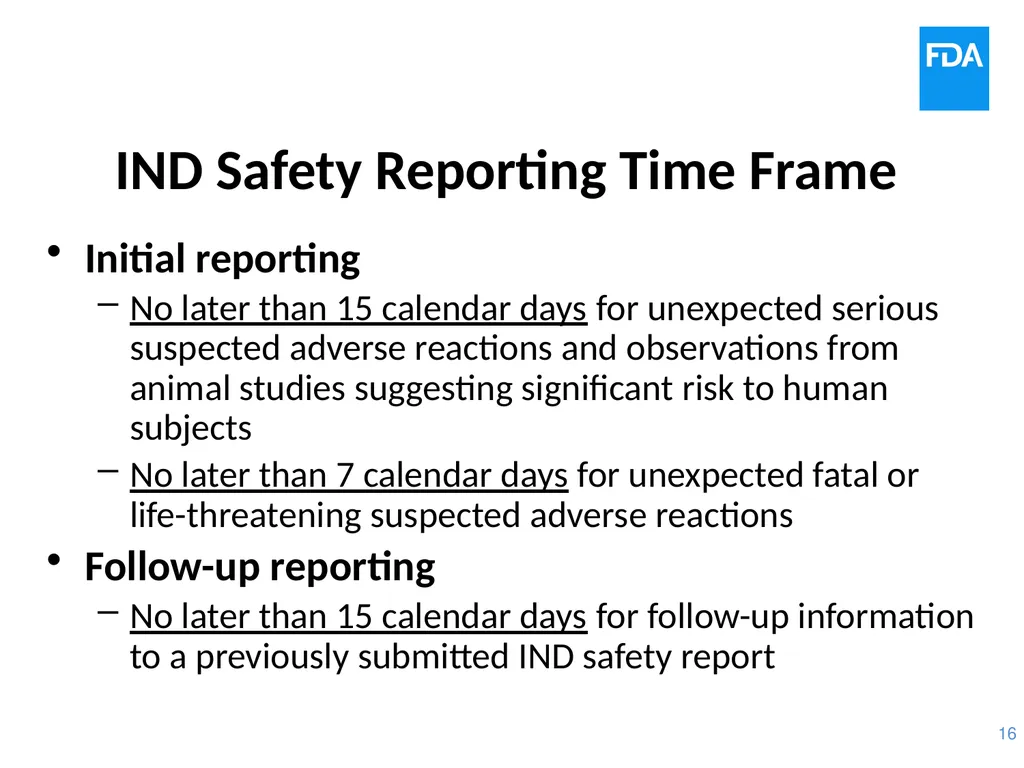
IND Safety Reporting Time Frame Initial reporting
No later than 15 calendar days for unexpected serious suspected adverse reactions and observations from animal studies suggesting significant risk to human subjects
No later than 7 calendar days for unexpected fatal or life-threatening suspected adverse reactions
Follow-up reporting
No later than 15 calendar days for follow-up information to a previously submitted IND safety report<br>
17
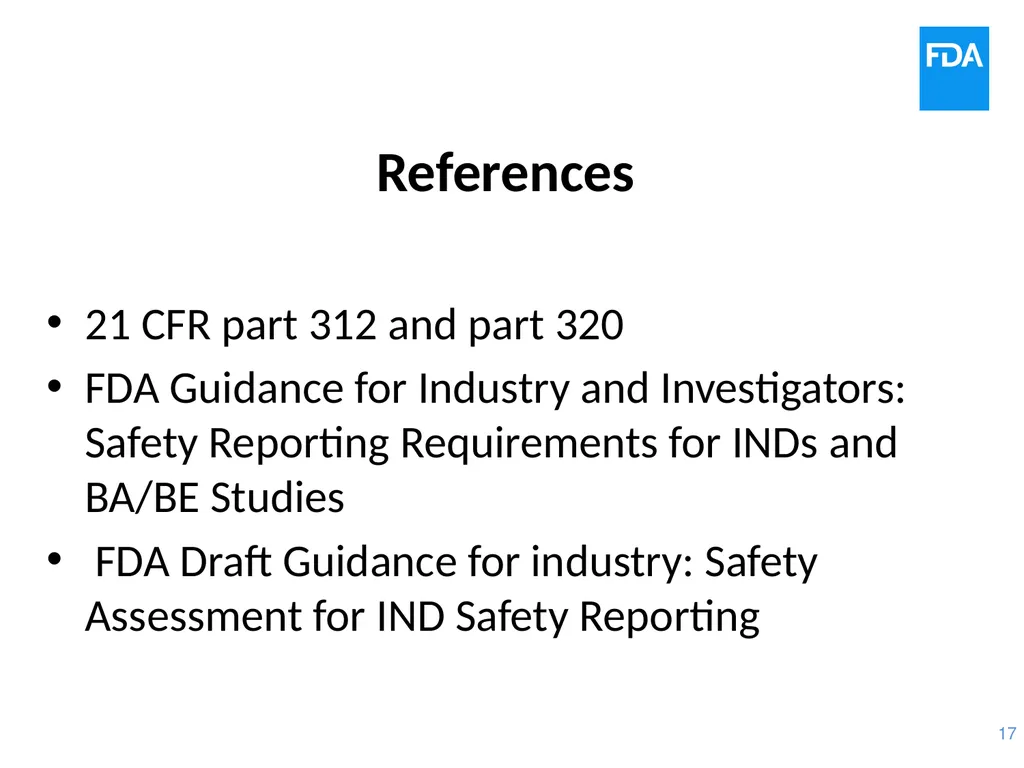
References 21 CFR part 312 and part 320
FDA Guidance for Industry and Investigators: Safety Reporting Requirements for INDs and BA/BE Studies
FDA Draft Guidance for industry: Safety Assessment for IND Safety Reporting<br>