
Sales Volume NIQ RMS Certification Course Session




Description: Sales Volume NIQ RMS Certification Course Session 3 How is Sales Volume reported? What are the nuances of using each Sales Volume type? What Sales Volume considerations should you keep in mind when doing an analysis? 2 Todays learning
Related Topics
Download Presentation
"Sales Volume NIQ RMS Certification Course Session" is the property of its rightful owner. Permission is granted to download and print the materials on this website for personal, non-commercial use only, and to display it on your personal computer provided you do not modify the materials and that you retain all copyright notices contained in the materials. By downloading content from our website, you accept the terms of this agreement.
Presentation Transcript
slide1. Sales Volume NIQ RMS Certification Course
Session #3<br>
slide2. How is Sales Volume reported?
What are the nuances of using each Sales Volume type?
What Sales Volume considerations should you keep in mind when doing an analysis? 2 Today’s learning objectives<br>
slide3. 3 How is Sales Volume reported?<br>
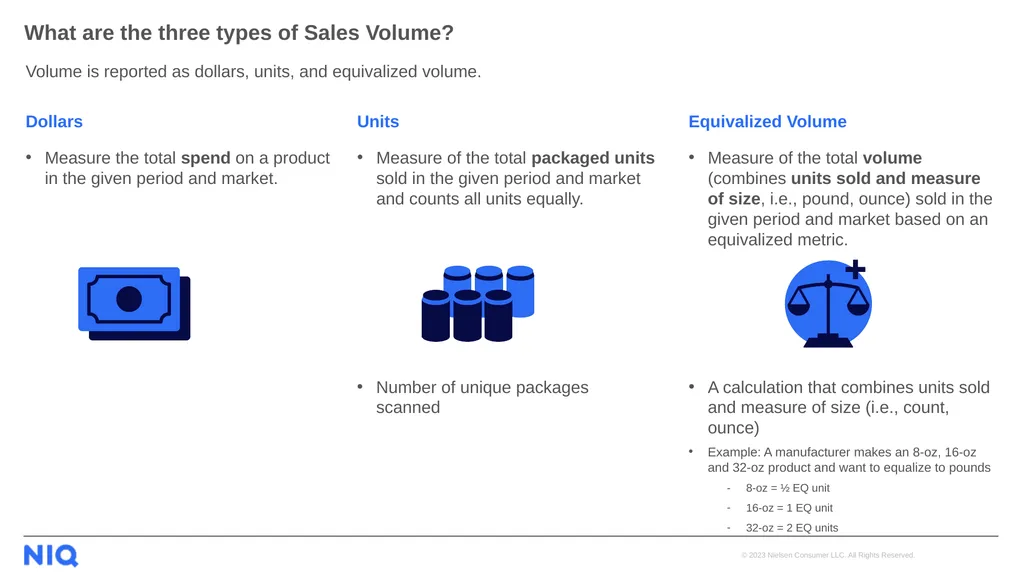
slide4. Measure the total spend on a product in the given period and market. 4 Measure of the total packaged units sold in the given period and market and counts all units equally. Measure of the total volume (combines units sold and measure of size, i.e., pound, ounce) sold in the given period and market based on an equivalized metric. Dollars Units Equivalized Volume What are the three types of Sales Volume? Volume is reported as dollars, units, and equivalized volume. Number of unique packages scanned A calculation that combines units sold and measure of size (i.e., count, ounce)
Example: A manufacturer makes an 8-oz, 16-oz and 32-oz product and want to equalize to pounds
8-oz = ½ EQ unit
16-oz = 1 EQ unit
32-oz = 2 EQ units<br>
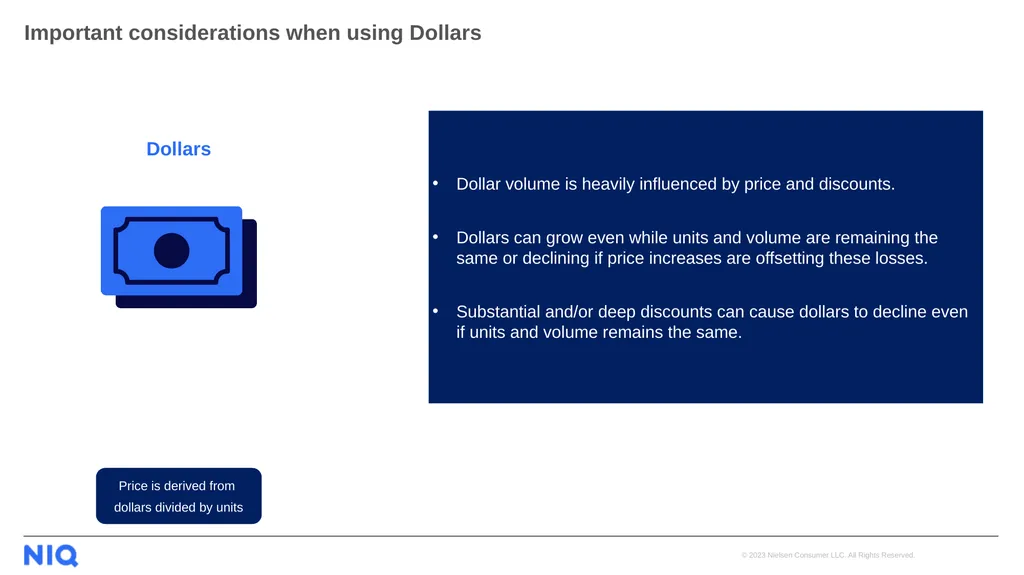
slide5. 5 Dollars Important considerations when using Dollars Dollar volume is heavily influenced by price and discounts.
Dollars can grow even while units and volume are remaining the same or declining if price increases are offsetting these losses.
Substantial and/or deep discounts can cause dollars to decline even if units and volume remains the same. Price is derived from
dollars divided by units<br>
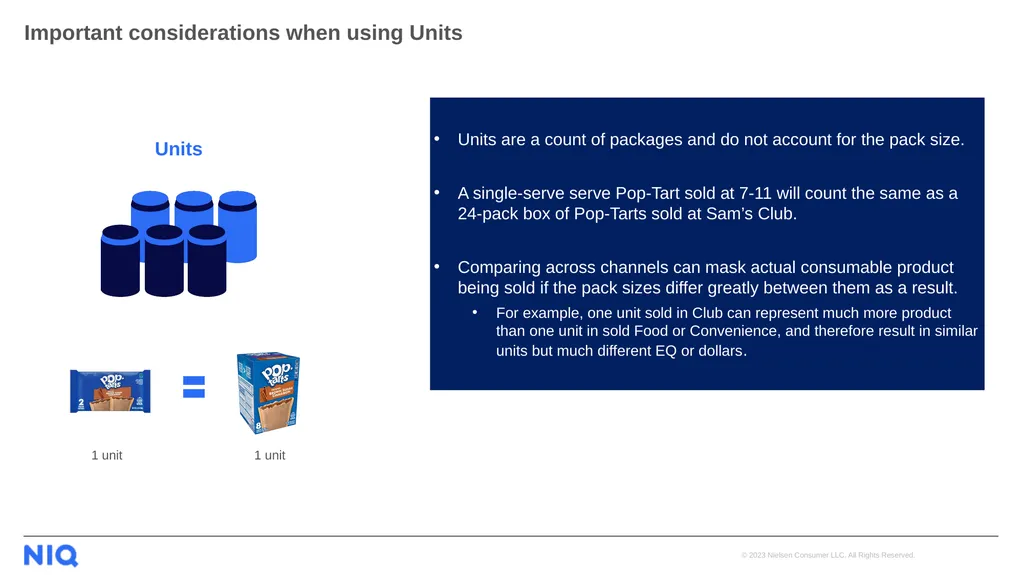
slide6. 6 Units Important considerations when using Units Units are a count of packages and do not account for the pack size.
A single-serve serve Pop-Tart sold at 7-11 will count the same as a 24-pack box of Pop-Tarts sold at Sam’s Club.
Comparing across channels can mask actual consumable product being sold if the pack sizes differ greatly between them as a result.
For example, one unit sold in Club can represent much more product than one unit in sold Food or Convenience, and therefore result in similar units but much different EQ or dollars.<br>
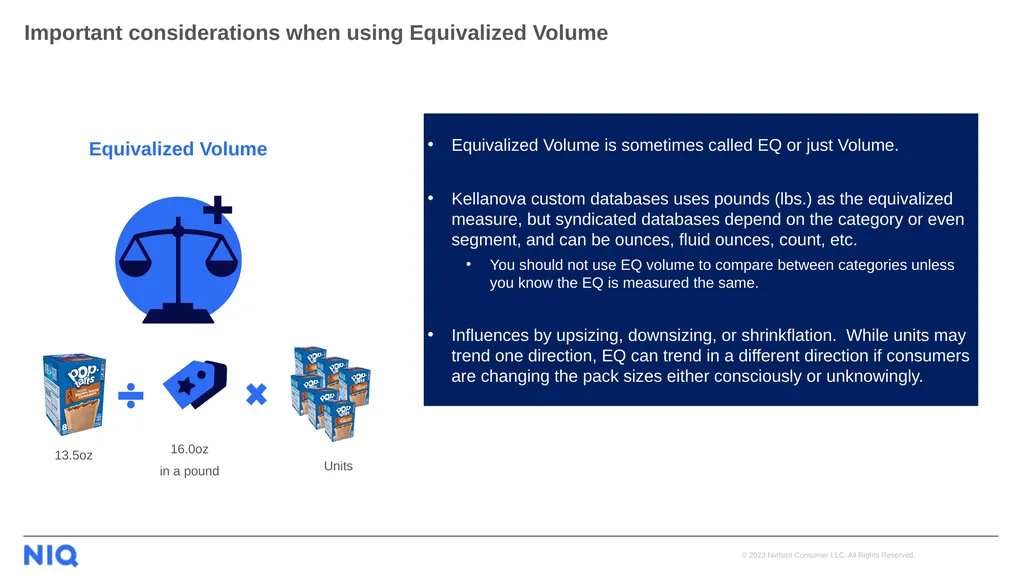
slide7. 7 Equivalized Volume Important considerations when using Equivalized Volume Equivalized Volume is sometimes called EQ or just Volume.
Kellanova custom databases uses pounds (lbs.) as the equivalized measure, but syndicated databases depend on the category or even segment, and can be ounces, fluid ounces, count, etc.
You should not use EQ volume to compare between categories unless you know the EQ is measured the same.
Influences by upsizing, downsizing, or shrinkflation. While units may trend one direction, EQ can trend in a different direction if consumers are changing the pack sizes either consciously or unknowingly.<br>
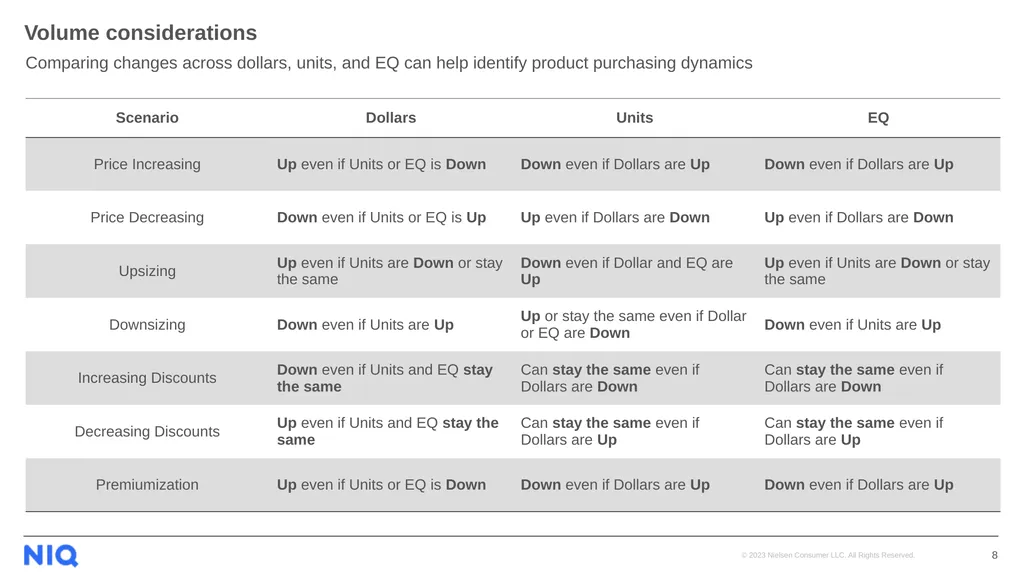
slide8. 8 Volume considerations Comparing changes across dollars, units, and EQ can help identify product purchasing dynamics<br>
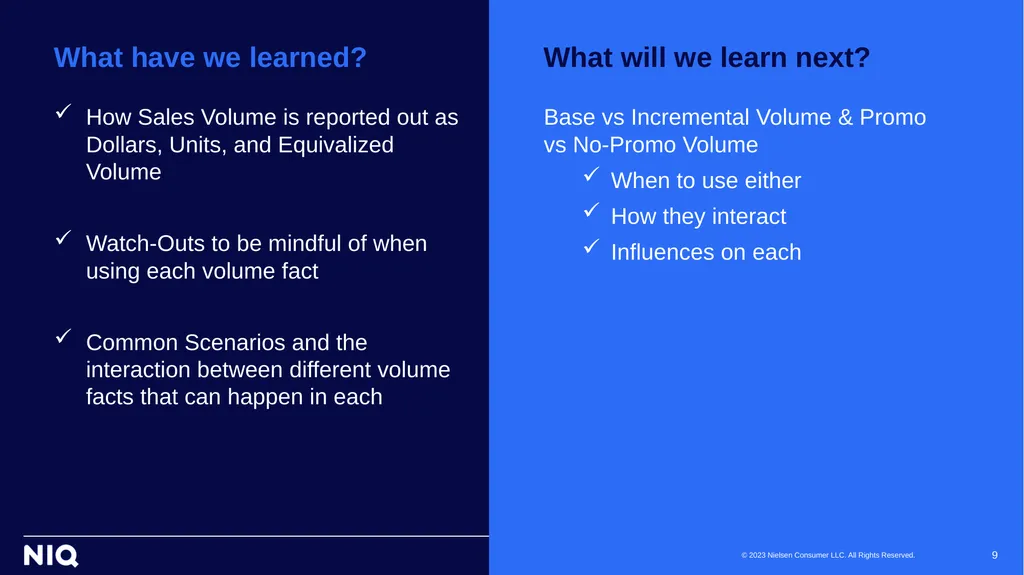
slide9. 9 What will we learn next? Base vs Incremental Volume & Promo vs No-Promo Volume
When to use either
How they interact
Influences on each What have we learned? How Sales Volume is reported out as Dollars, Units, and Equivalized Volume
Watch-Outs to be mindful of when using each volume fact
Common Scenarios and the interaction between different volume facts that can happen in each<br>
slide10. Test your knowledge! Please use the following link to access this session’s knowledge check: Knowledge Check: Sales Volume Note: Users must pass the knowledge check prior to receiving completion credit for this course<br>
Session #3<br>
slide2. How is Sales Volume reported?
What are the nuances of using each Sales Volume type?
What Sales Volume considerations should you keep in mind when doing an analysis? 2 Today’s learning objectives<br>
slide3. 3 How is Sales Volume reported?<br>
slide4. Measure the total spend on a product in the given period and market. 4 Measure of the total packaged units sold in the given period and market and counts all units equally. Measure of the total volume (combines units sold and measure of size, i.e., pound, ounce) sold in the given period and market based on an equivalized metric. Dollars Units Equivalized Volume What are the three types of Sales Volume? Volume is reported as dollars, units, and equivalized volume. Number of unique packages scanned A calculation that combines units sold and measure of size (i.e., count, ounce)
Example: A manufacturer makes an 8-oz, 16-oz and 32-oz product and want to equalize to pounds
8-oz = ½ EQ unit
16-oz = 1 EQ unit
32-oz = 2 EQ units<br>
slide5. 5 Dollars Important considerations when using Dollars Dollar volume is heavily influenced by price and discounts.
Dollars can grow even while units and volume are remaining the same or declining if price increases are offsetting these losses.
Substantial and/or deep discounts can cause dollars to decline even if units and volume remains the same. Price is derived from
dollars divided by units<br>
slide6. 6 Units Important considerations when using Units Units are a count of packages and do not account for the pack size.
A single-serve serve Pop-Tart sold at 7-11 will count the same as a 24-pack box of Pop-Tarts sold at Sam’s Club.
Comparing across channels can mask actual consumable product being sold if the pack sizes differ greatly between them as a result.
For example, one unit sold in Club can represent much more product than one unit in sold Food or Convenience, and therefore result in similar units but much different EQ or dollars.<br>
slide7. 7 Equivalized Volume Important considerations when using Equivalized Volume Equivalized Volume is sometimes called EQ or just Volume.
Kellanova custom databases uses pounds (lbs.) as the equivalized measure, but syndicated databases depend on the category or even segment, and can be ounces, fluid ounces, count, etc.
You should not use EQ volume to compare between categories unless you know the EQ is measured the same.
Influences by upsizing, downsizing, or shrinkflation. While units may trend one direction, EQ can trend in a different direction if consumers are changing the pack sizes either consciously or unknowingly.<br>
slide8. 8 Volume considerations Comparing changes across dollars, units, and EQ can help identify product purchasing dynamics<br>
slide9. 9 What will we learn next? Base vs Incremental Volume & Promo vs No-Promo Volume
When to use either
How they interact
Influences on each What have we learned? How Sales Volume is reported out as Dollars, Units, and Equivalized Volume
Watch-Outs to be mindful of when using each volume fact
Common Scenarios and the interaction between different volume facts that can happen in each<br>
slide10. Test your knowledge! Please use the following link to access this session’s knowledge check: Knowledge Check: Sales Volume Note: Users must pass the knowledge check prior to receiving completion credit for this course<br>