
Sanitation concepts Capacity Building workshop for
TF
Published · 25 slides · 0 views
1 / 1


Description
Sanitation concepts Capacity Building workshop for Civil Society Organisations in Adamawa Thursday 26 November Friday 27 November 2015 Babatope Babalobi Senior Sanitation Reform Expert EU-Water Supply and Sanitation Sector Reform
Related Topics
Share
Embed code
Download this presentation From Below
"Sanitation concepts Capacity Building workshop for" is the property of its rightful owner. Permission is granted to download and print the materials on this website for personal, non-commercial use only, and to display it on your personal computer provided you do not modify the materials and that you retain all copyright notices contained in the materials. By downloading content from our website, you accept the terms of this agreement.
Presentation Transcript
01
Sanitation concepts
Capacity Building workshop for Civil Society Organisations in Adamawa
Thursday 26 November – Friday 27 November 2015
Babatope Babalobi
Senior Sanitation Reform Expert
EU-Water Supply and Sanitation Sector Reform Programme Phase III (WSSSRP III)
Babalobi@yahoo.com +2348035897435<br>
02
Outline What is Water related Sanitation?
Sanitation statistics
The elements of a sanitation system
Sanitation commitments
WASH and public health
Equity and Inclusion
Gender mainstreaming<br>
Sanitation statistics
The elements of a sanitation system
Sanitation commitments
WASH and public health
Equity and Inclusion
Gender mainstreaming<br>
03
What is water related sanitation? Water related Sanitation is management of human excreta or better said- management of shit.
Hygiene is appropriate behaviours including but beyond the management of human shit, which are used to break the chain of infection transmission in the home and community. Hygiene includes:
Hand hygiene and personal hygiene-appropriate hand washing with soap and/or ash, sanitizer.
Food hygiene (cooking, storing, preventing cross contamination)
Menstrual Hygiene Management
Ensuring safe water at point of use
Respiratory Hygiene
Safe disposal of faeces (both human and animal)
General hygiene (laundry, surfaces, toilets, baths, and sinks)
Disposal of solid wastes, control of waste water and rain water
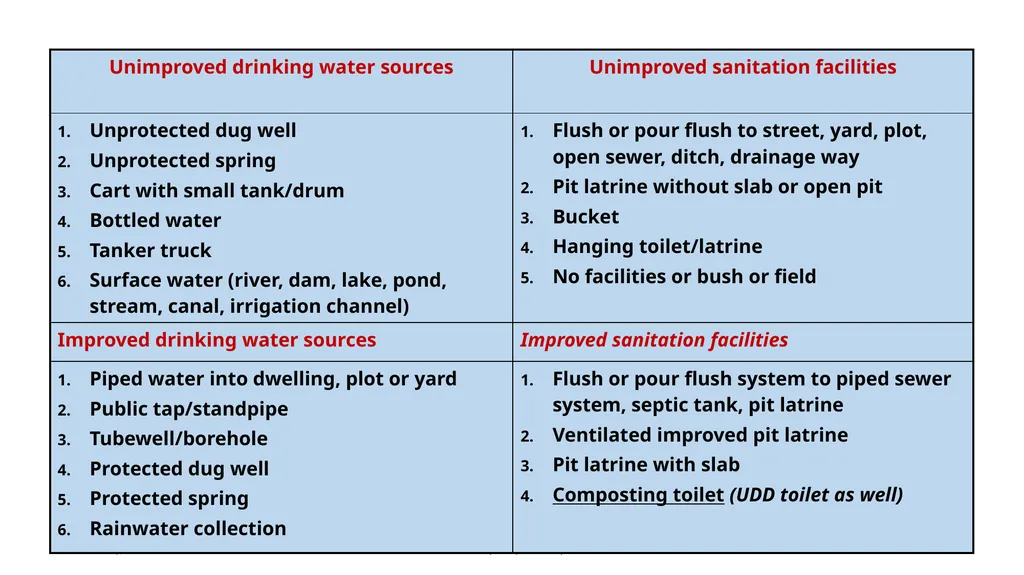
Improved sanitation is a ‘sanitation facility that hygienically separates human excreta from human contact’.
(WHO//UNICEF Joint Monitoring Programme (JMP) Monday, June 30, 2014 Sanitation Concepts by Babatope Babalobi 3<br>
Hygiene is appropriate behaviours including but beyond the management of human shit, which are used to break the chain of infection transmission in the home and community. Hygiene includes:
Hand hygiene and personal hygiene-appropriate hand washing with soap and/or ash, sanitizer.
Food hygiene (cooking, storing, preventing cross contamination)
Menstrual Hygiene Management
Ensuring safe water at point of use
Respiratory Hygiene
Safe disposal of faeces (both human and animal)
General hygiene (laundry, surfaces, toilets, baths, and sinks)
Disposal of solid wastes, control of waste water and rain water
Improved sanitation is a ‘sanitation facility that hygienically separates human excreta from human contact’.
(WHO//UNICEF Joint Monitoring Programme (JMP) Monday, June 30, 2014 Sanitation Concepts by Babatope Babalobi 3<br>
04
Monday, June 30, 2014 Sanitation Concepts by Babatope Babalobi 4<br>
05
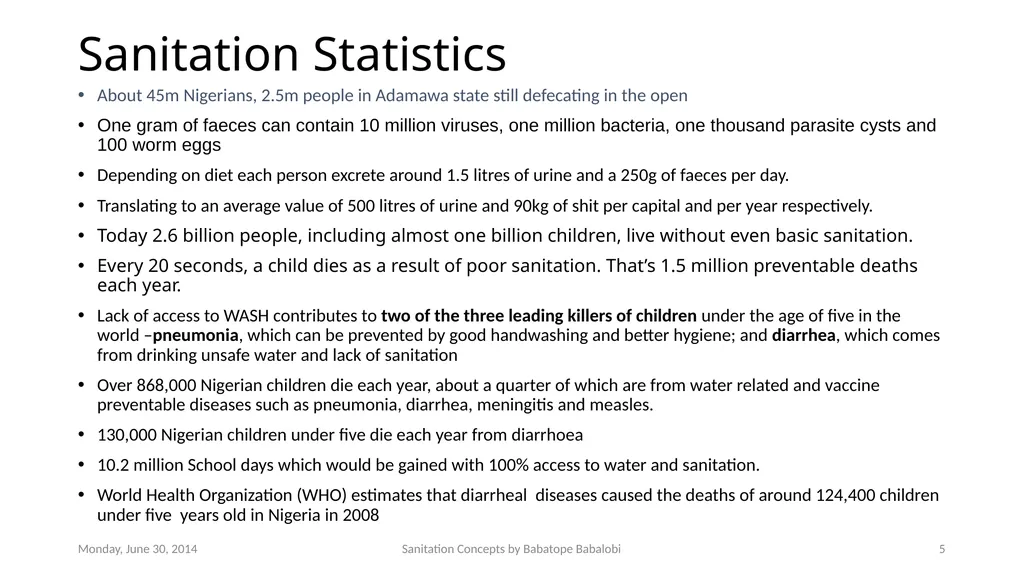
Sanitation Statistics About 45m Nigerians, 2.5m people in Adamawa state still defecating in the open
One gram of faeces can contain 10 million viruses, one million bacteria, one thousand parasite cysts and 100 worm eggs
Depending on diet each person excrete around 1.5 litres of urine and a 250g of faeces per day.
Translating to an average value of 500 litres of urine and 90kg of shit per capital and per year respectively.
Today 2.6 billion people, including almost one billion children, live without even basic sanitation.
Every 20 seconds, a child dies as a result of poor sanitation. That’s 1.5 million preventable deaths each year.
Lack of access to WASH contributes to two of the three leading killers of children under the age of five in the world –pneumonia, which can be prevented by good handwashing and better hygiene; and diarrhea, which comes from drinking unsafe water and lack of sanitation
Over 868,000 Nigerian children die each year, about a quarter of which are from water related and vaccine preventable diseases such as pneumonia, diarrhea, meningitis and measles.
130,000 Nigerian children under five die each year from diarrhoea
10.2 million School days which would be gained with 100% access to water and sanitation.
World Health Organization (WHO) estimates that diarrheal diseases caused the deaths of around 124,400 children under five years old in Nigeria in 2008 Monday, June 30, 2014 Sanitation Concepts by Babatope Babalobi 5<br>
One gram of faeces can contain 10 million viruses, one million bacteria, one thousand parasite cysts and 100 worm eggs
Depending on diet each person excrete around 1.5 litres of urine and a 250g of faeces per day.
Translating to an average value of 500 litres of urine and 90kg of shit per capital and per year respectively.
Today 2.6 billion people, including almost one billion children, live without even basic sanitation.
Every 20 seconds, a child dies as a result of poor sanitation. That’s 1.5 million preventable deaths each year.
Lack of access to WASH contributes to two of the three leading killers of children under the age of five in the world –pneumonia, which can be prevented by good handwashing and better hygiene; and diarrhea, which comes from drinking unsafe water and lack of sanitation
Over 868,000 Nigerian children die each year, about a quarter of which are from water related and vaccine preventable diseases such as pneumonia, diarrhea, meningitis and measles.
130,000 Nigerian children under five die each year from diarrhoea
10.2 million School days which would be gained with 100% access to water and sanitation.
World Health Organization (WHO) estimates that diarrheal diseases caused the deaths of around 124,400 children under five years old in Nigeria in 2008 Monday, June 30, 2014 Sanitation Concepts by Babatope Babalobi 5<br>
06
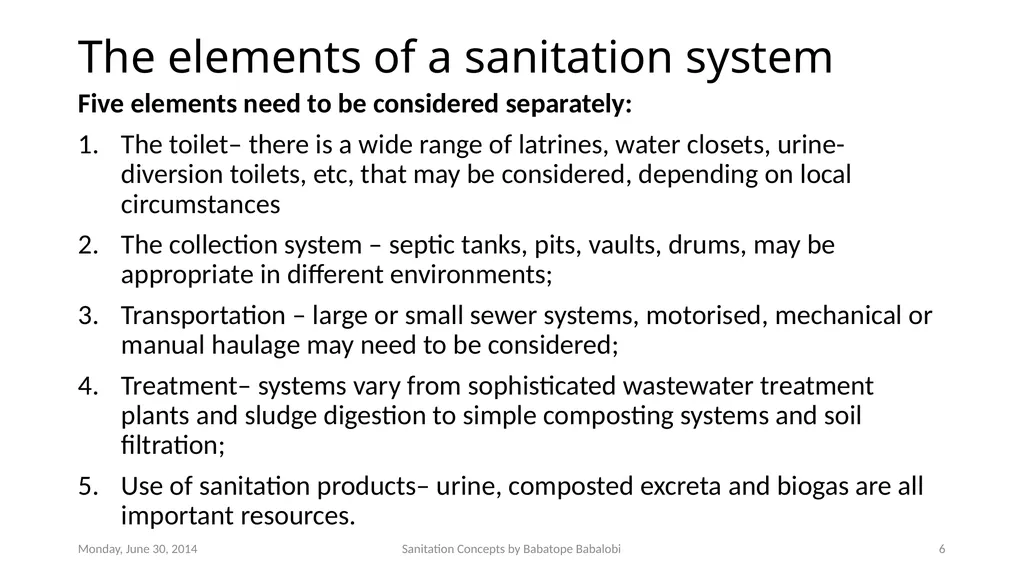
The elements of a sanitation system Five elements need to be considered separately:
The toilet– there is a wide range of latrines, water closets, urine-diversion toilets, etc, that may be considered, depending on local circumstances
The collection system – septic tanks, pits, vaults, drums, may be appropriate in different environments;
Transportation – large or small sewer systems, motorised, mechanical or manual haulage may need to be considered;
Treatment– systems vary from sophisticated wastewater treatment plants and sludge digestion to simple composting systems and soil filtration;
Use of sanitation products– urine, composted excreta and biogas are all important resources. Monday, June 30, 2014 Sanitation Concepts by Babatope Babalobi 6<br>
The toilet– there is a wide range of latrines, water closets, urine-diversion toilets, etc, that may be considered, depending on local circumstances
The collection system – septic tanks, pits, vaults, drums, may be appropriate in different environments;
Transportation – large or small sewer systems, motorised, mechanical or manual haulage may need to be considered;
Treatment– systems vary from sophisticated wastewater treatment plants and sludge digestion to simple composting systems and soil filtration;
Use of sanitation products– urine, composted excreta and biogas are all important resources. Monday, June 30, 2014 Sanitation Concepts by Babatope Babalobi 6<br>
07
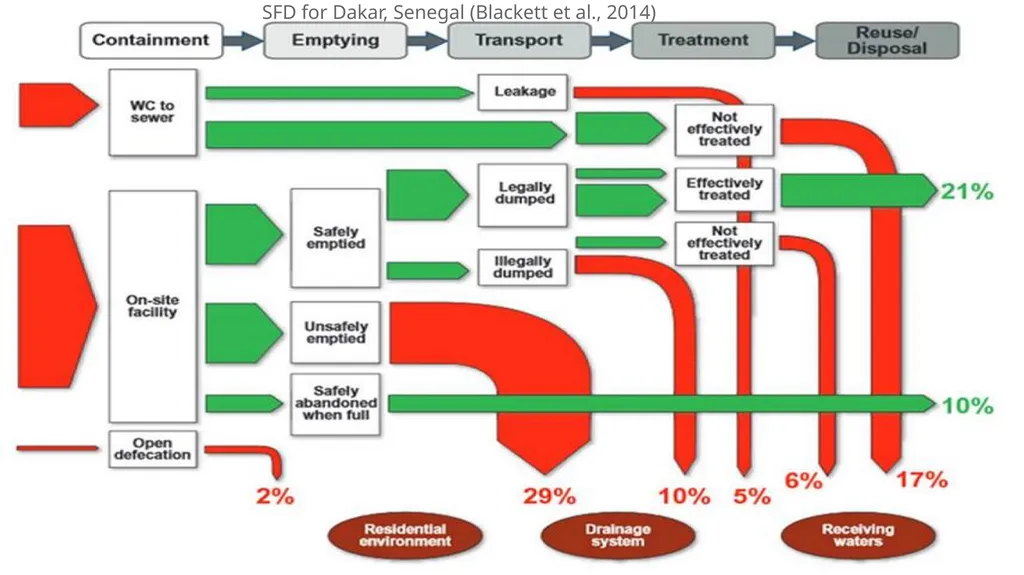
23-25 November 2015 Capacity Building Workshop for Adamawa State Sanitation Task Group 7 SFD for Dakar, Senegal (Blackett et al., 2014)<br>
08
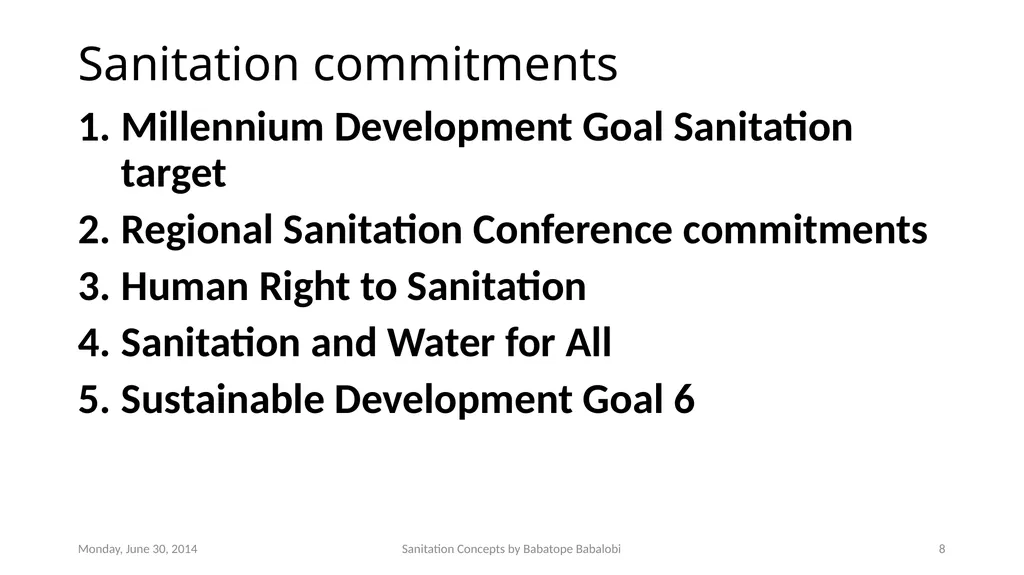
Sanitation commitments Millennium Development Goal Sanitation target
Regional Sanitation Conference commitments
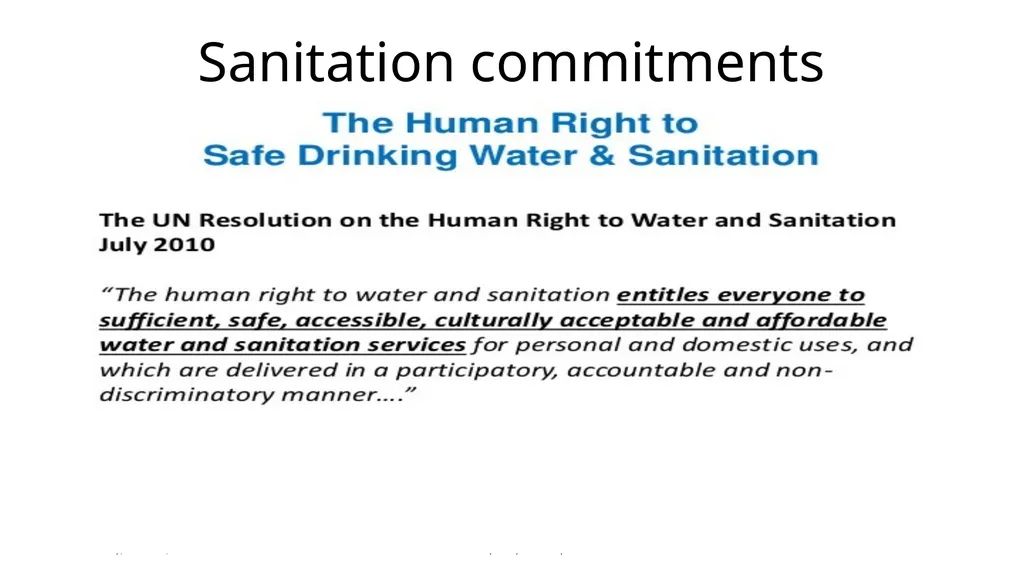
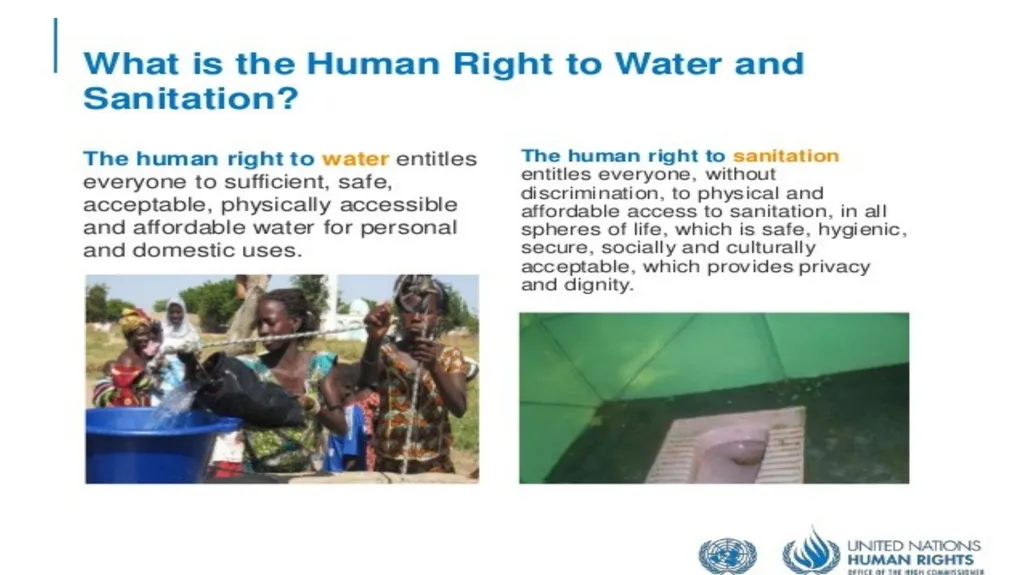
Human Right to Sanitation
Sanitation and Water for All
Sustainable Development Goal 6 Monday, June 30, 2014 Sanitation Concepts by Babatope Babalobi 8<br>
Regional Sanitation Conference commitments
Human Right to Sanitation
Sanitation and Water for All
Sustainable Development Goal 6 Monday, June 30, 2014 Sanitation Concepts by Babatope Babalobi 8<br>
09
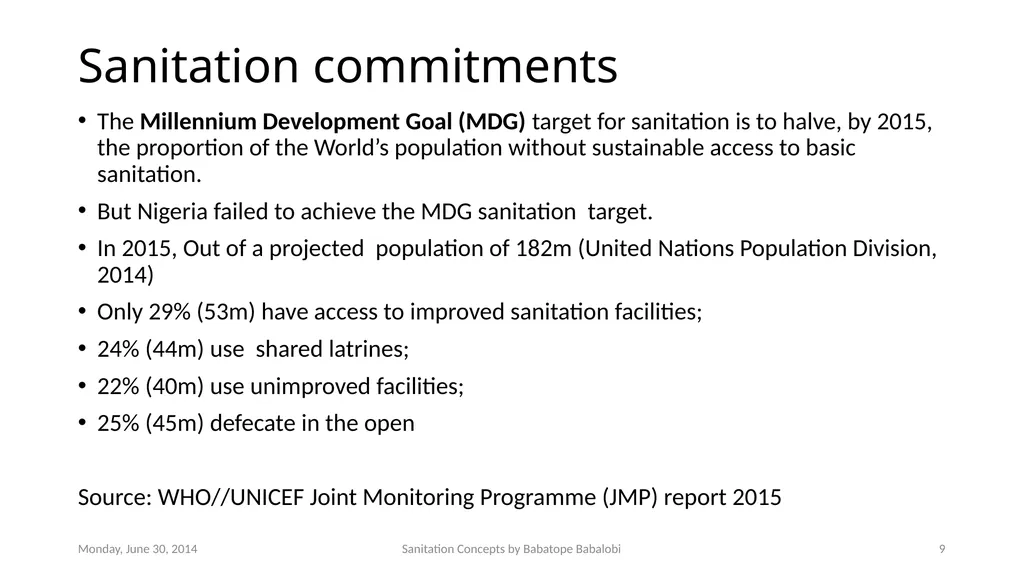
Sanitation commitments The Millennium Development Goal (MDG) target for sanitation is to halve, by 2015, the proportion of the World’s population without sustainable access to basic sanitation.
But Nigeria failed to achieve the MDG sanitation target.
In 2015, Out of a projected population of 182m (United Nations Population Division, 2014)
Only 29% (53m) have access to improved sanitation facilities;
24% (44m) use shared latrines;
22% (40m) use unimproved facilities;
25% (45m) defecate in the open
Source: WHO//UNICEF Joint Monitoring Programme (JMP) report 2015 Monday, June 30, 2014 Sanitation Concepts by Babatope Babalobi 9<br>
But Nigeria failed to achieve the MDG sanitation target.
In 2015, Out of a projected population of 182m (United Nations Population Division, 2014)
Only 29% (53m) have access to improved sanitation facilities;
24% (44m) use shared latrines;
22% (40m) use unimproved facilities;
25% (45m) defecate in the open
Source: WHO//UNICEF Joint Monitoring Programme (JMP) report 2015 Monday, June 30, 2014 Sanitation Concepts by Babatope Babalobi 9<br>
10
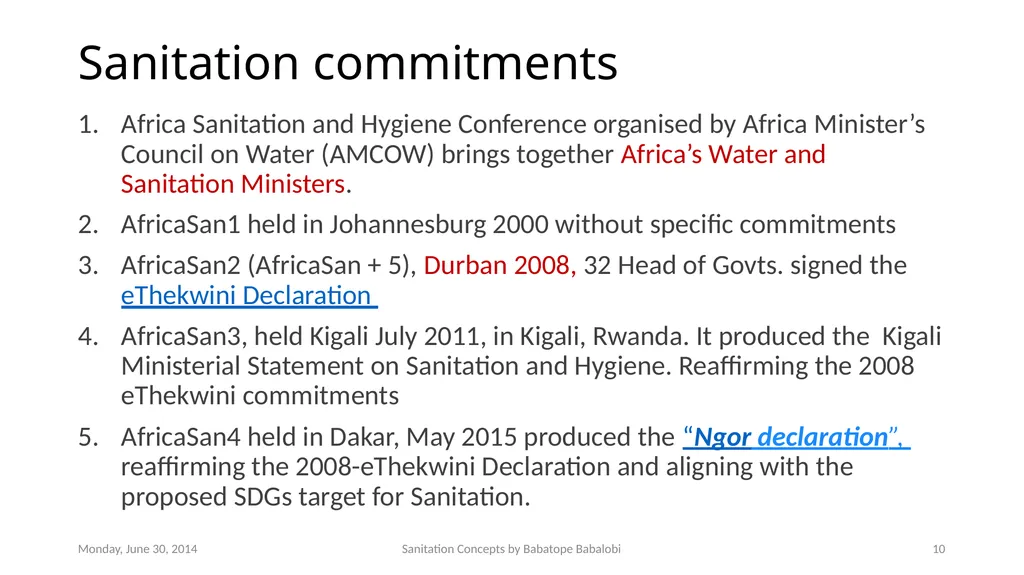
Sanitation commitments Africa Sanitation and Hygiene Conference organised by Africa Minister’s Council on Water (AMCOW) brings together Africa’s Water and Sanitation Ministers.
AfricaSan1 held in Johannesburg 2000 without specific commitments
AfricaSan2 (AfricaSan + 5), Durban 2008, 32 Head of Govts. signed the eThekwini Declaration
AfricaSan3, held Kigali July 2011, in Kigali, Rwanda. It produced the Kigali Ministerial Statement on Sanitation and Hygiene. Reaffirming the 2008 eThekwini commitments
AfricaSan4 held in Dakar, May 2015 produced the “Ngor declaration”, reaffirming the 2008-eThekwini Declaration and aligning with the proposed SDGs target for Sanitation. Monday, June 30, 2014 Sanitation Concepts by Babatope Babalobi 10<br>
AfricaSan1 held in Johannesburg 2000 without specific commitments
AfricaSan2 (AfricaSan + 5), Durban 2008, 32 Head of Govts. signed the eThekwini Declaration
AfricaSan3, held Kigali July 2011, in Kigali, Rwanda. It produced the Kigali Ministerial Statement on Sanitation and Hygiene. Reaffirming the 2008 eThekwini commitments
AfricaSan4 held in Dakar, May 2015 produced the “Ngor declaration”, reaffirming the 2008-eThekwini Declaration and aligning with the proposed SDGs target for Sanitation. Monday, June 30, 2014 Sanitation Concepts by Babatope Babalobi 10<br>
11
Sanitation commitments Monday, June 30, 2014 Sanitation Concepts by Babatope Babalobi 11<br>
12
Monday, June 30, 2014 Sanitation Concepts by Babatope Babalobi 12<br>
13
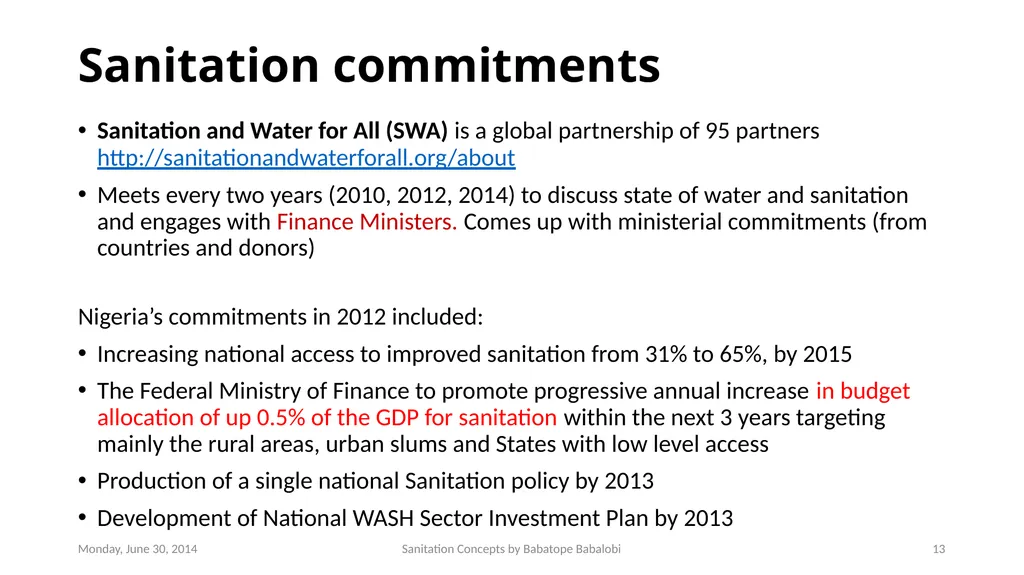
Sanitation commitments Sanitation and Water for All (SWA) is a global partnership of 95 partners http://sanitationandwaterforall.org/about
Meets every two years (2010, 2012, 2014) to discuss state of water and sanitation and engages with Finance Ministers. Comes up with ministerial commitments (from countries and donors)
Nigeria’s commitments in 2012 included:
Increasing national access to improved sanitation from 31% to 65%, by 2015
The Federal Ministry of Finance to promote progressive annual increase in budget allocation of up 0.5% of the GDP for sanitation within the next 3 years targeting mainly the rural areas, urban slums and States with low level access
Production of a single national Sanitation policy by 2013
Development of National WASH Sector Investment Plan by 2013 Monday, June 30, 2014 Sanitation Concepts by Babatope Babalobi 13<br>
Meets every two years (2010, 2012, 2014) to discuss state of water and sanitation and engages with Finance Ministers. Comes up with ministerial commitments (from countries and donors)
Nigeria’s commitments in 2012 included:
Increasing national access to improved sanitation from 31% to 65%, by 2015
The Federal Ministry of Finance to promote progressive annual increase in budget allocation of up 0.5% of the GDP for sanitation within the next 3 years targeting mainly the rural areas, urban slums and States with low level access
Production of a single national Sanitation policy by 2013
Development of National WASH Sector Investment Plan by 2013 Monday, June 30, 2014 Sanitation Concepts by Babatope Babalobi 13<br>
14
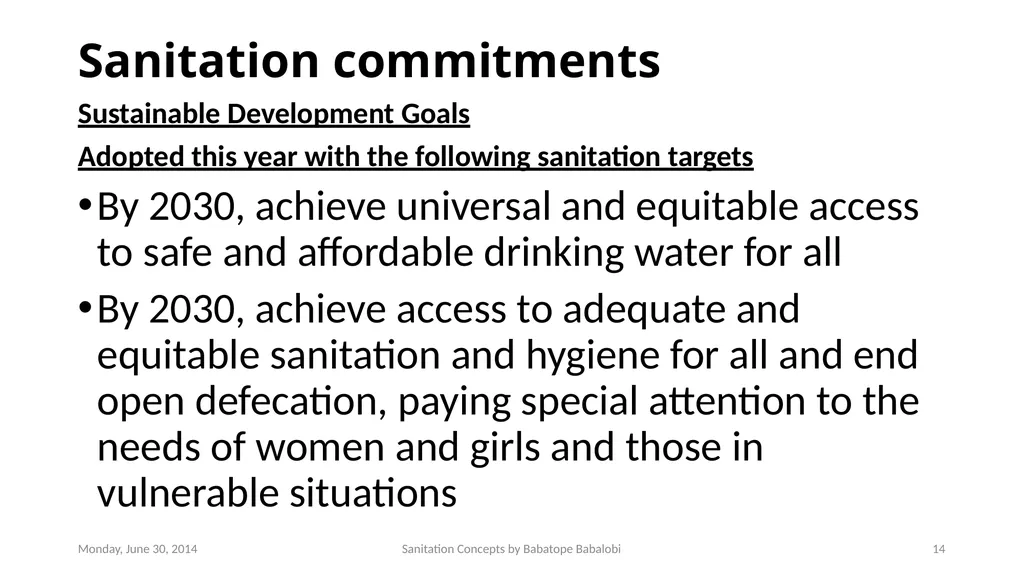
Sanitation commitments Sustainable Development Goals
Adopted this year with the following sanitation targets
By 2030, achieve universal and equitable access to safe and affordable drinking water for all
By 2030, achieve access to adequate and equitable sanitation and hygiene for all and end open defecation, paying special attention to the needs of women and girls and those in vulnerable situations Monday, June 30, 2014 Sanitation Concepts by Babatope Babalobi 14<br>
Adopted this year with the following sanitation targets
By 2030, achieve universal and equitable access to safe and affordable drinking water for all
By 2030, achieve access to adequate and equitable sanitation and hygiene for all and end open defecation, paying special attention to the needs of women and girls and those in vulnerable situations Monday, June 30, 2014 Sanitation Concepts by Babatope Babalobi 14<br>
15
Monday, June 30, 2014 Sanitation Concepts by Babatope Babalobi 15<br>
16
Monday, June 30, 2014 Sanitation Concepts by Babatope Babalobi 16<br>
17
WASH and public health Waterborne diseases: caused by the ingestion of water contaminated by human or animal faeces or urine containing pathogenic bacteria or viruses; include cholera, typhoid, amoebic and bacillary dysentery and other diarrheal diseases.
Water-washed diseases: caused by poor personal hygiene and skin or eye contact with contaminated water; include scabies, trachoma, flea, lice and tick-borne diseases.
Water-based diseases: caused by parasites found in intermediate organisms living in contaminated water; include dracunculiasis, schistosomiasis, and other helminths.
Water-related diseases: caused by insect vectors, especially mosquitoes, that breed in stagnant water; include dengue, filariasis, malaria, onchocerciasis, trypanosomiasis and yellow fever. Monday, June 30, 2014 Sanitation Concepts by Babatope Babalobi 17<br>
Water-washed diseases: caused by poor personal hygiene and skin or eye contact with contaminated water; include scabies, trachoma, flea, lice and tick-borne diseases.
Water-based diseases: caused by parasites found in intermediate organisms living in contaminated water; include dracunculiasis, schistosomiasis, and other helminths.
Water-related diseases: caused by insect vectors, especially mosquitoes, that breed in stagnant water; include dengue, filariasis, malaria, onchocerciasis, trypanosomiasis and yellow fever. Monday, June 30, 2014 Sanitation Concepts by Babatope Babalobi 17<br>
18
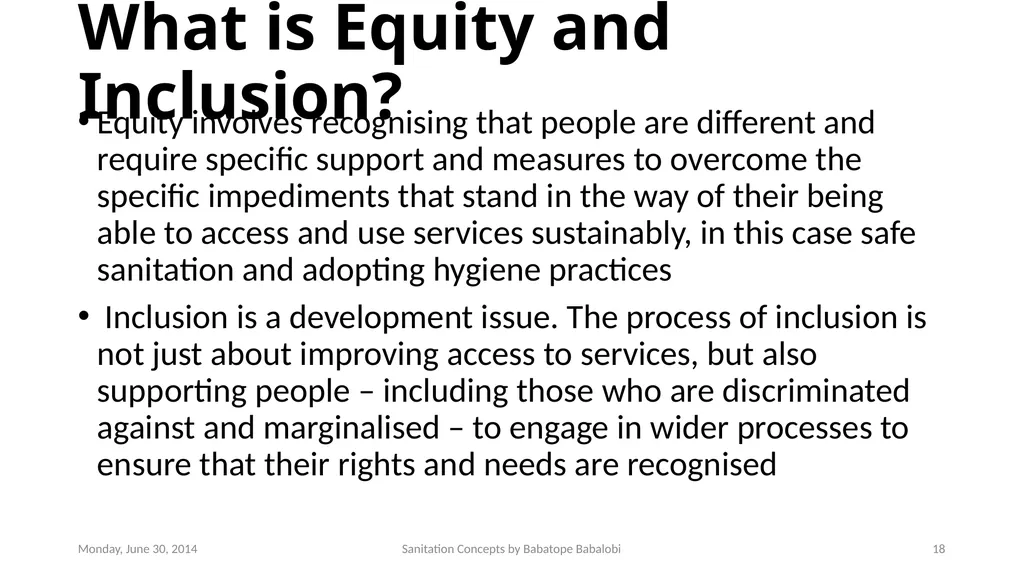
What is Equity and Inclusion? Equity involves recognising that people are different and require specific support and measures to overcome the specific impediments that stand in the way of their being able to access and use services sustainably, in this case safe sanitation and adopting hygiene practices
Inclusion is a development issue. The process of inclusion is not just about improving access to services, but also supporting people – including those who are discriminated against and marginalised – to engage in wider processes to ensure that their rights and needs are recognised Monday, June 30, 2014 Sanitation Concepts by Babatope Babalobi 18<br>
Inclusion is a development issue. The process of inclusion is not just about improving access to services, but also supporting people – including those who are discriminated against and marginalised – to engage in wider processes to ensure that their rights and needs are recognised Monday, June 30, 2014 Sanitation Concepts by Babatope Babalobi 18<br>
19
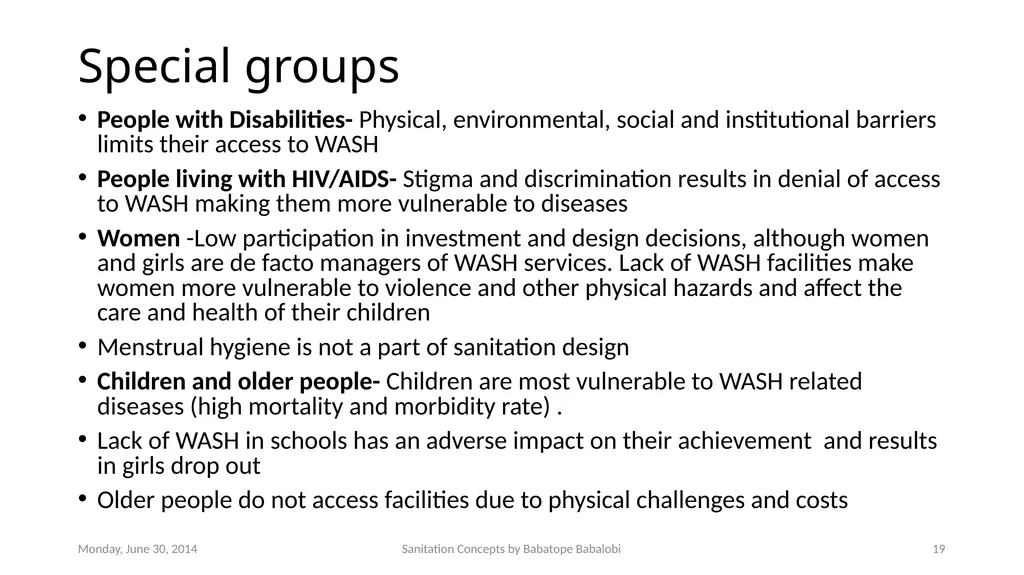
Special groups People with Disabilities- Physical, environmental, social and institutional barriers limits their access to WASH
People living with HIV/AIDS- Stigma and discrimination results in denial of access to WASH making them more vulnerable to diseases
Women -Low participation in investment and design decisions, although women and girls are de facto managers of WASH services. Lack of WASH facilities make women more vulnerable to violence and other physical hazards and affect the care and health of their children
Menstrual hygiene is not a part of sanitation design
Children and older people- Children are most vulnerable to WASH related diseases (high mortality and morbidity rate) .
Lack of WASH in schools has an adverse impact on their achievement and results in girls drop out
Older people do not access facilities due to physical challenges and costs Monday, June 30, 2014 Sanitation Concepts by Babatope Babalobi 19<br>
People living with HIV/AIDS- Stigma and discrimination results in denial of access to WASH making them more vulnerable to diseases
Women -Low participation in investment and design decisions, although women and girls are de facto managers of WASH services. Lack of WASH facilities make women more vulnerable to violence and other physical hazards and affect the care and health of their children
Menstrual hygiene is not a part of sanitation design
Children and older people- Children are most vulnerable to WASH related diseases (high mortality and morbidity rate) .
Lack of WASH in schools has an adverse impact on their achievement and results in girls drop out
Older people do not access facilities due to physical challenges and costs Monday, June 30, 2014 Sanitation Concepts by Babatope Babalobi 19<br>
20
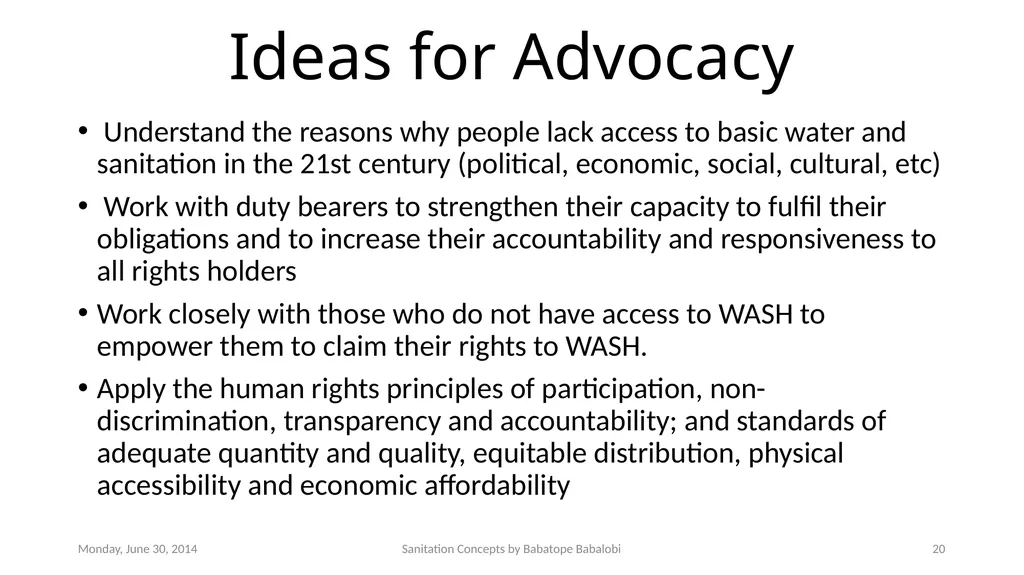
Ideas for Advocacy Understand the reasons why people lack access to basic water and sanitation in the 21st century (political, economic, social, cultural, etc)
Work with duty bearers to strengthen their capacity to fulfil their obligations and to increase their accountability and responsiveness to all rights holders
Work closely with those who do not have access to WASH to empower them to claim their rights to WASH.
Apply the human rights principles of participation, non-discrimination, transparency and accountability; and standards of adequate quantity and quality, equitable distribution, physical accessibility and economic affordability Monday, June 30, 2014 Sanitation Concepts by Babatope Babalobi 20<br>
Work with duty bearers to strengthen their capacity to fulfil their obligations and to increase their accountability and responsiveness to all rights holders
Work closely with those who do not have access to WASH to empower them to claim their rights to WASH.
Apply the human rights principles of participation, non-discrimination, transparency and accountability; and standards of adequate quantity and quality, equitable distribution, physical accessibility and economic affordability Monday, June 30, 2014 Sanitation Concepts by Babatope Babalobi 20<br>
21
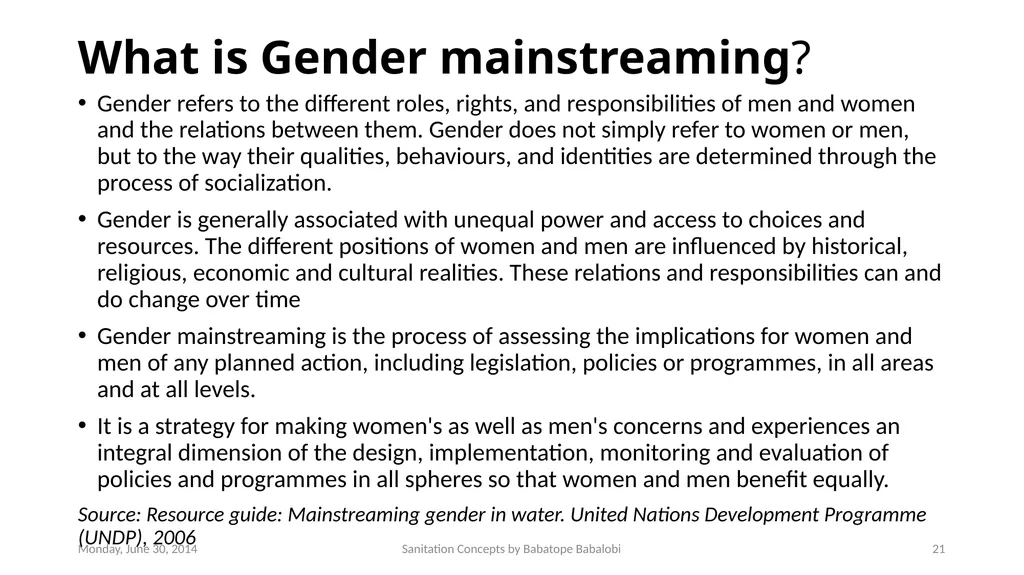
What is Gender mainstreaming? Gender refers to the different roles, rights, and responsibilities of men and women and the relations between them. Gender does not simply refer to women or men, but to the way their qualities, behaviours, and identities are determined through the process of socialization.
Gender is generally associated with unequal power and access to choices and resources. The different positions of women and men are influenced by historical, religious, economic and cultural realities. These relations and responsibilities can and do change over time
Gender mainstreaming is the process of assessing the implications for women and men of any planned action, including legislation, policies or programmes, in all areas and at all levels.
It is a strategy for making women's as well as men's concerns and experiences an integral dimension of the design, implementation, monitoring and evaluation of policies and programmes in all spheres so that women and men benefit equally.
Source: Resource guide: Mainstreaming gender in water. United Nations Development Programme (UNDP), 2006 Monday, June 30, 2014 Sanitation Concepts by Babatope Babalobi 21<br>
Gender is generally associated with unequal power and access to choices and resources. The different positions of women and men are influenced by historical, religious, economic and cultural realities. These relations and responsibilities can and do change over time
Gender mainstreaming is the process of assessing the implications for women and men of any planned action, including legislation, policies or programmes, in all areas and at all levels.
It is a strategy for making women's as well as men's concerns and experiences an integral dimension of the design, implementation, monitoring and evaluation of policies and programmes in all spheres so that women and men benefit equally.
Source: Resource guide: Mainstreaming gender in water. United Nations Development Programme (UNDP), 2006 Monday, June 30, 2014 Sanitation Concepts by Babatope Babalobi 21<br>
22
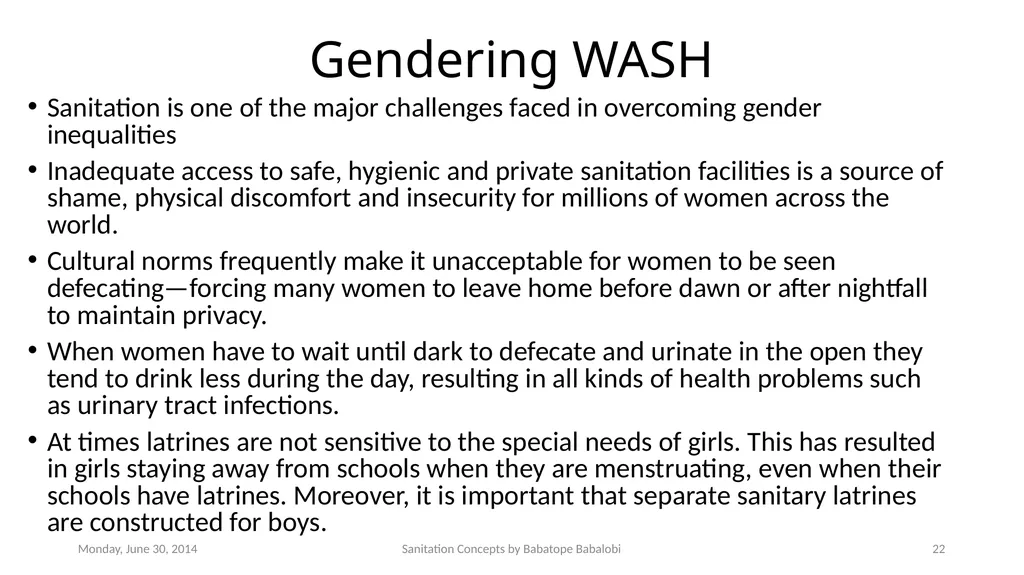
Gendering WASH Sanitation is one of the major challenges faced in overcoming gender inequalities
Inadequate access to safe, hygienic and private sanitation facilities is a source of shame, physical discomfort and insecurity for millions of women across the world.
Cultural norms frequently make it unacceptable for women to be seen defecating—forcing many women to leave home before dawn or after nightfall to maintain privacy.
When women have to wait until dark to defecate and urinate in the open they tend to drink less during the day, resulting in all kinds of health problems such as urinary tract infections.
At times latrines are not sensitive to the special needs of girls. This has resulted in girls staying away from schools when they are menstruating, even when their schools have latrines. Moreover, it is important that separate sanitary latrines are constructed for boys. Monday, June 30, 2014 Sanitation Concepts by Babatope Babalobi 22<br>
Inadequate access to safe, hygienic and private sanitation facilities is a source of shame, physical discomfort and insecurity for millions of women across the world.
Cultural norms frequently make it unacceptable for women to be seen defecating—forcing many women to leave home before dawn or after nightfall to maintain privacy.
When women have to wait until dark to defecate and urinate in the open they tend to drink less during the day, resulting in all kinds of health problems such as urinary tract infections.
At times latrines are not sensitive to the special needs of girls. This has resulted in girls staying away from schools when they are menstruating, even when their schools have latrines. Moreover, it is important that separate sanitary latrines are constructed for boys. Monday, June 30, 2014 Sanitation Concepts by Babatope Babalobi 22<br>
23
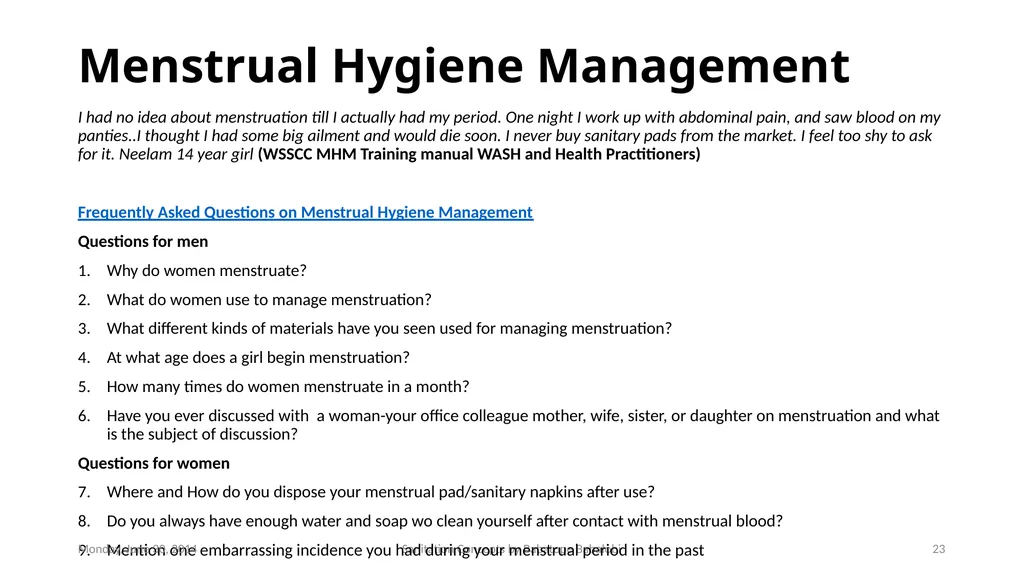
Menstrual Hygiene Management I had no idea about menstruation till I actually had my period. One night I work up with abdominal pain, and saw blood on my panties..I thought I had some big ailment and would die soon. I never buy sanitary pads from the market. I feel too shy to ask for it. Neelam 14 year girl (WSSCC MHM Training manual WASH and Health Practitioners)
Frequently Asked Questions on Menstrual Hygiene Management
Questions for men
Why do women menstruate?
What do women use to manage menstruation?
What different kinds of materials have you seen used for managing menstruation?
At what age does a girl begin menstruation?
How many times do women menstruate in a month?
Have you ever discussed with a woman-your office colleague mother, wife, sister, or daughter on menstruation and what is the subject of discussion?
Questions for women
Where and How do you dispose your menstrual pad/sanitary napkins after use?
Do you always have enough water and soap wo clean yourself after contact with menstrual blood?
Mention one embarrassing incidence you had during your menstrual period in the past Monday, June 30, 2014 Sanitation Concepts by Babatope Babalobi 23<br>
Frequently Asked Questions on Menstrual Hygiene Management
Questions for men
Why do women menstruate?
What do women use to manage menstruation?
What different kinds of materials have you seen used for managing menstruation?
At what age does a girl begin menstruation?
How many times do women menstruate in a month?
Have you ever discussed with a woman-your office colleague mother, wife, sister, or daughter on menstruation and what is the subject of discussion?
Questions for women
Where and How do you dispose your menstrual pad/sanitary napkins after use?
Do you always have enough water and soap wo clean yourself after contact with menstrual blood?
Mention one embarrassing incidence you had during your menstrual period in the past Monday, June 30, 2014 Sanitation Concepts by Babatope Babalobi 23<br>
24
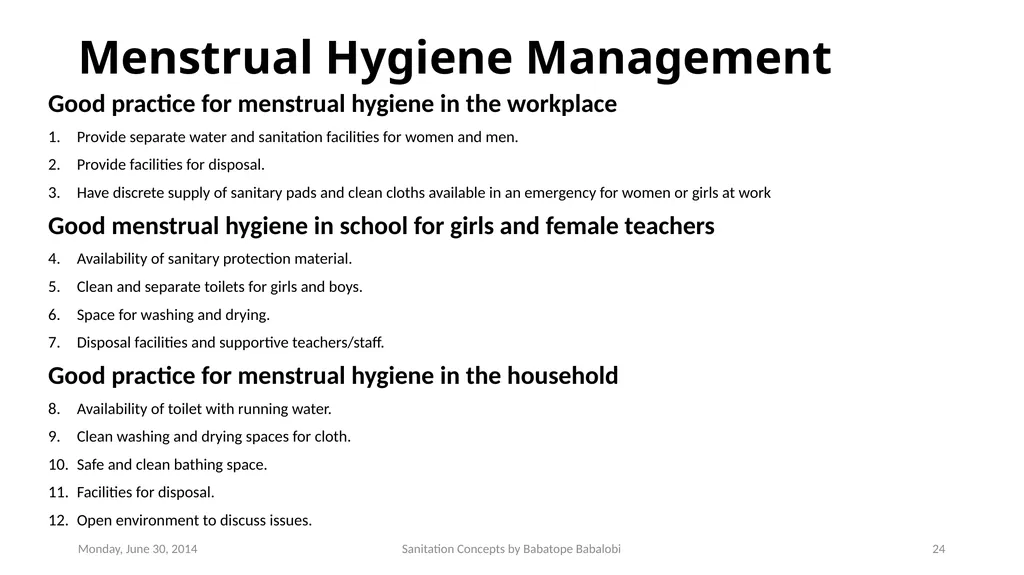
Menstrual Hygiene Management Monday, June 30, 2014 Sanitation Concepts by Babatope Babalobi 24 Good practice for menstrual hygiene in the workplace
Provide separate water and sanitation facilities for women and men.
Provide facilities for disposal.
Have discrete supply of sanitary pads and clean cloths available in an emergency for women or girls at work
Good menstrual hygiene in school for girls and female teachers
Availability of sanitary protection material.
Clean and separate toilets for girls and boys.
Space for washing and drying.
Disposal facilities and supportive teachers/staff.
Good practice for menstrual hygiene in the household
Availability of toilet with running water.
Clean washing and drying spaces for cloth.
Safe and clean bathing space.
Facilities for disposal.
Open environment to discuss issues.<br>
Provide separate water and sanitation facilities for women and men.
Provide facilities for disposal.
Have discrete supply of sanitary pads and clean cloths available in an emergency for women or girls at work
Good menstrual hygiene in school for girls and female teachers
Availability of sanitary protection material.
Clean and separate toilets for girls and boys.
Space for washing and drying.
Disposal facilities and supportive teachers/staff.
Good practice for menstrual hygiene in the household
Availability of toilet with running water.
Clean washing and drying spaces for cloth.
Safe and clean bathing space.
Facilities for disposal.
Open environment to discuss issues.<br>
25
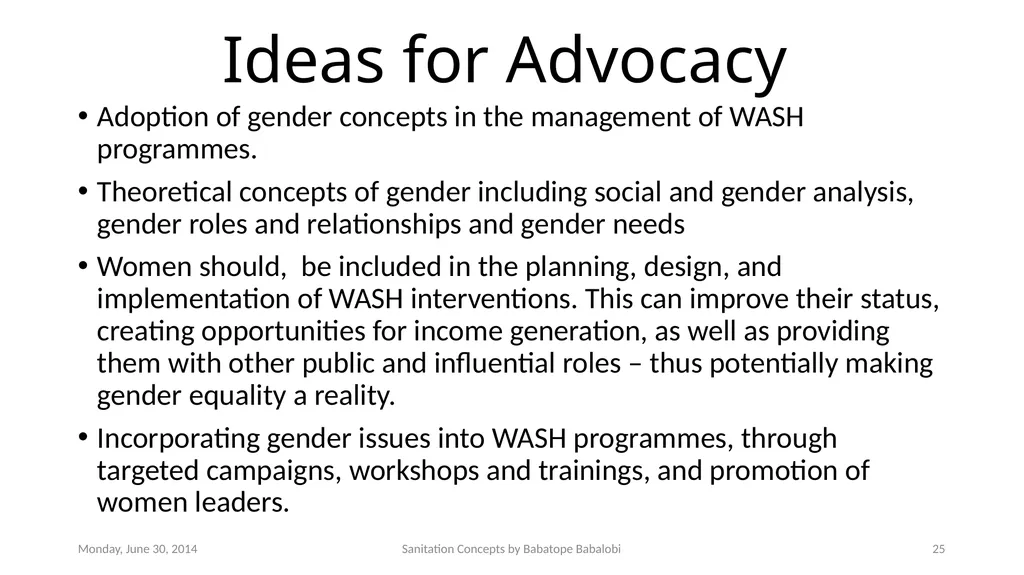
Ideas for Advocacy Adoption of gender concepts in the management of WASH programmes.
Theoretical concepts of gender including social and gender analysis, gender roles and relationships and gender needs
Women should, be included in the planning, design, and implementation of WASH interventions. This can improve their status, creating opportunities for income generation, as well as providing them with other public and influential roles – thus potentially making gender equality a reality.
Incorporating gender issues into WASH programmes, through targeted campaigns, workshops and trainings, and promotion of women leaders. Monday, June 30, 2014 Sanitation Concepts by Babatope Babalobi 25<br>
Theoretical concepts of gender including social and gender analysis, gender roles and relationships and gender needs
Women should, be included in the planning, design, and implementation of WASH interventions. This can improve their status, creating opportunities for income generation, as well as providing them with other public and influential roles – thus potentially making gender equality a reality.
Incorporating gender issues into WASH programmes, through targeted campaigns, workshops and trainings, and promotion of women leaders. Monday, June 30, 2014 Sanitation Concepts by Babatope Babalobi 25<br>