
Sanitation, Safety and Housekeeping N4
TG
Published · 37 slides · 0 views

1 / 1

Description
Sanitation, Safety and Housekeeping N4 www.futuremanagers.com The following slides summarise the contents of your textbook. This is an editable document, so feel free to add your own notes and details and make it work for you as your own
Related Topics
Share
Embed code
Download this presentation From Below
"Sanitation, Safety and Housekeeping N4" is the property of its rightful owner. Permission is granted to download and print the materials on this website for personal, non-commercial use only, and to display it on your personal computer provided you do not modify the materials and that you retain all copyright notices contained in the materials. By downloading content from our website, you accept the terms of this agreement.
Presentation Transcript
01
Sanitation, Safety and Housekeeping
N4<br>
N4<br>
02
www.futuremanagers.com The following slides summarise the contents of your textbook.
This is an editable document, so feel free to add your own notes and details and make it work for you as your own study aid!<br>
This is an editable document, so feel free to add your own notes and details and make it work for you as your own study aid!<br>
03
www.futuremanagers.com INTRODUCTION
This module focuses on understanding hygiene, particularly food hygiene, personal hygiene and maintaining hygiene standards in food establishments.
Hygiene refers to maintaining cleanliness to prevent disease spread. It includes personal hygiene, environmental hygiene, and food hygiene. Module 1: Hygiene<br>
This module focuses on understanding hygiene, particularly food hygiene, personal hygiene and maintaining hygiene standards in food establishments.
Hygiene refers to maintaining cleanliness to prevent disease spread. It includes personal hygiene, environmental hygiene, and food hygiene. Module 1: Hygiene<br>
04
www.futuremanagers.com FOOD HYGIENE PRINCIPLES
Cleanliness: Washing hands, cleaning utensils, and keeping food areas sanitized.
Cooking: Ensuring food is cooked to proper temperatures to kill bacteria.
Chilling: Proper refrigeration and storage to prevent bacterial growth. Module 1: Hygiene (continued)<br>
Cleanliness: Washing hands, cleaning utensils, and keeping food areas sanitized.
Cooking: Ensuring food is cooked to proper temperatures to kill bacteria.
Chilling: Proper refrigeration and storage to prevent bacterial growth. Module 1: Hygiene (continued)<br>
05
www.futuremanagers.com FOOD HYGIENE LEGISLATION
Enforces hygiene standards in food handling establishments.
Regulated by municipal health departments to ensure public health.
Includes proper waste disposal, safe food storage, and hygiene inspections. Module 1: Hygiene (continued)<br>
Enforces hygiene standards in food handling establishments.
Regulated by municipal health departments to ensure public health.
Includes proper waste disposal, safe food storage, and hygiene inspections. Module 1: Hygiene (continued)<br>
06
www.futuremanagers.com PERSONAL HYGIENE
Skin, foot, nail, hair, and dental care: Essential for preventing contamination in food service.
Handwashing and grooming: Regular washing and appropriate attire, such as chef’s uniforms. Module 1: Hygiene (continued)<br>
Skin, foot, nail, hair, and dental care: Essential for preventing contamination in food service.
Handwashing and grooming: Regular washing and appropriate attire, such as chef’s uniforms. Module 1: Hygiene (continued)<br>
07
www.futuremanagers.com CONSEQUENCES OF POOR HYGIENE
Foodborne illnesses: Can lead to legal penalties, business closure, and customer harm.
Legal and financial repercussions: Failure to meet hygiene standards can result in fines.
Loss of reputation: Poor hygiene can drive customers away. Module 1: Hygiene (continued)<br>
Foodborne illnesses: Can lead to legal penalties, business closure, and customer harm.
Legal and financial repercussions: Failure to meet hygiene standards can result in fines.
Loss of reputation: Poor hygiene can drive customers away. Module 1: Hygiene (continued)<br>
08
www.futuremanagers.com ETIQUETTE IN FOOD SERVICE
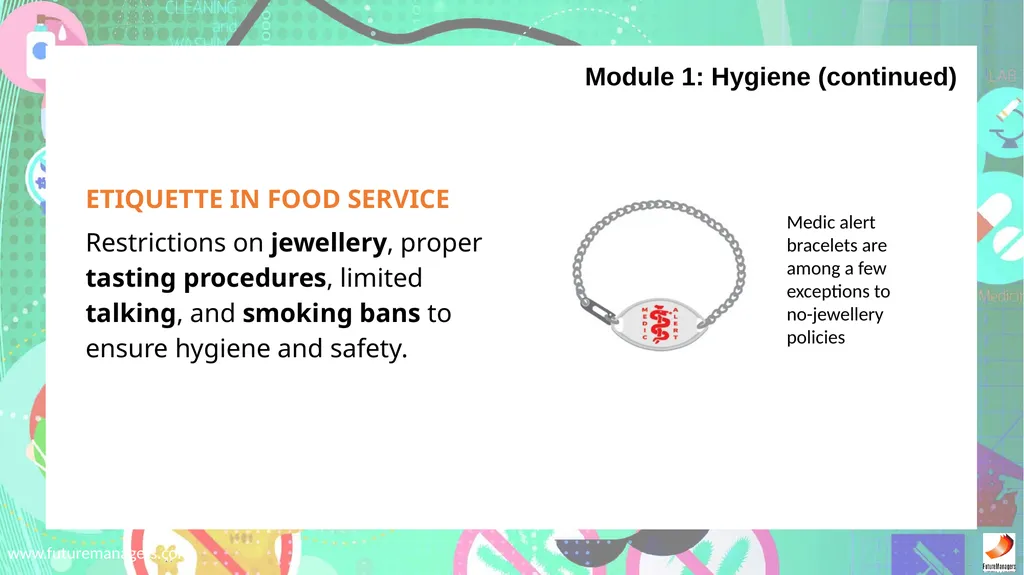
Restrictions on jewellery, proper tasting procedures, limited talking, and smoking bans to ensure hygiene and safety. Module 1: Hygiene (continued) Medic alert bracelets are among a few exceptions to no-jewellery policies<br>
Restrictions on jewellery, proper tasting procedures, limited talking, and smoking bans to ensure hygiene and safety. Module 1: Hygiene (continued) Medic alert bracelets are among a few exceptions to no-jewellery policies<br>
09
www.futuremanagers.com HYGIENE IN ESTABLISHMENTS
Proper water supply and cleaning schedules.
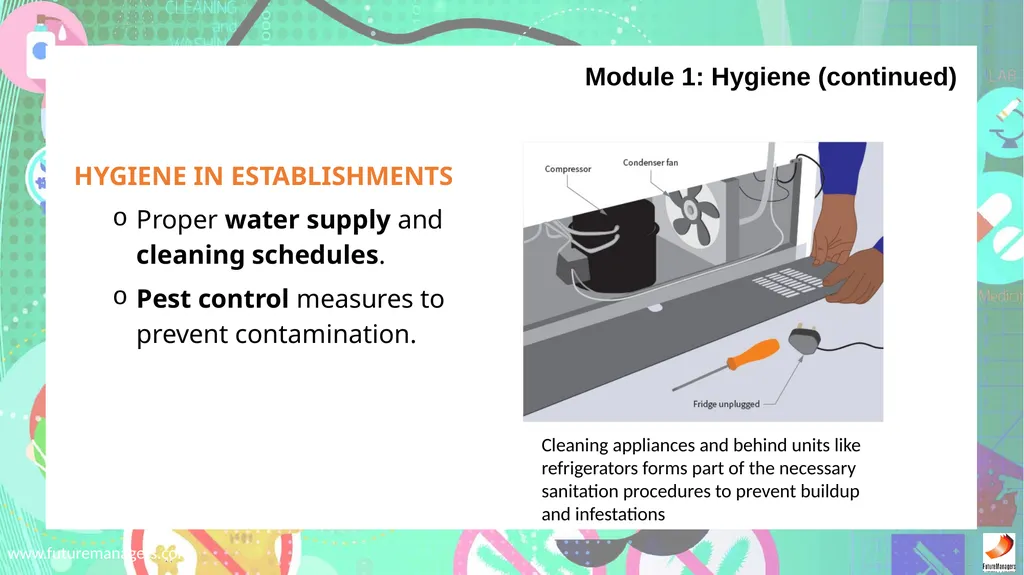
Pest control measures to prevent contamination. Module 1: Hygiene (continued) Cleaning appliances and behind units like refrigerators forms part of the necessary sanitation procedures to prevent buildup and infestations<br>
Proper water supply and cleaning schedules.
Pest control measures to prevent contamination. Module 1: Hygiene (continued) Cleaning appliances and behind units like refrigerators forms part of the necessary sanitation procedures to prevent buildup and infestations<br>
10
www.futuremanagers.com STORAGE REQUIREMENTS
Guidelines for dry stores, refrigerators, cold rooms, and freezers.
Maintaining the cold chain to prevent bacterial growth in perishable food. Module 1: Hygiene (continued)<br>
Guidelines for dry stores, refrigerators, cold rooms, and freezers.
Maintaining the cold chain to prevent bacterial growth in perishable food. Module 1: Hygiene (continued)<br>
11
www.futuremanagers.com INTRODUCTION
This module focuses on understanding the use and different types of cleaning agents, surface cleanliness, equipment maintenance and recycling.
Cleaning is the removal of dirt, grease, bacteria, and contaminants from surfaces. Module 2: Cleaning and disinfecting<br>
This module focuses on understanding the use and different types of cleaning agents, surface cleanliness, equipment maintenance and recycling.
Cleaning is the removal of dirt, grease, bacteria, and contaminants from surfaces. Module 2: Cleaning and disinfecting<br>
12
www.futuremanagers.com SURFACE CLEANLINESS
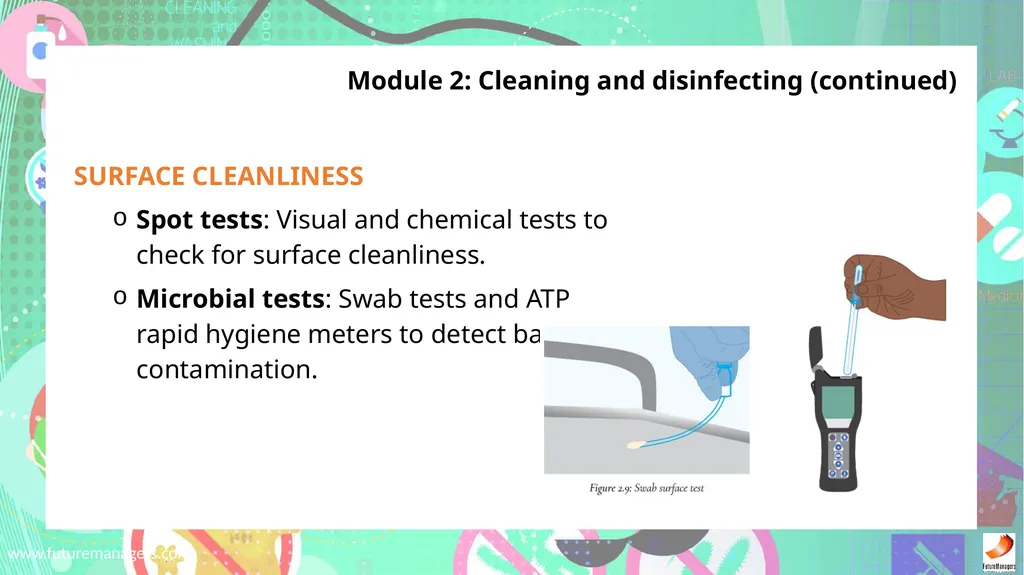
Spot tests: Visual and chemical tests to check for surface cleanliness.
Microbial tests: Swab tests and ATP rapid hygiene meters to detect bacterial contamination. Module 2: Cleaning and disinfecting (continued)<br>
Spot tests: Visual and chemical tests to check for surface cleanliness.
Microbial tests: Swab tests and ATP rapid hygiene meters to detect bacterial contamination. Module 2: Cleaning and disinfecting (continued)<br>
13
www.futuremanagers.com OBJECTIVES AND PRINCIPLES OF CLEANING
Cleaning reduces bacterial spread, ensures food safety, and maintains a pleasant work environment.
Cleaning should be frequent, thorough, and follow a systematic approach. Module 2: Cleaning and disinfecting (continued)<br>
Cleaning reduces bacterial spread, ensures food safety, and maintains a pleasant work environment.
Cleaning should be frequent, thorough, and follow a systematic approach. Module 2: Cleaning and disinfecting (continued)<br>
14
www.futuremanagers.com TYPES OF CLEANING AGENTS
Detergents: Remove dirt and grease.
Disinfectants: Kill bacteria and viruses.
Sanitizers: Reduce microbial presence to safe levels.
Sterilants: Eliminate all microorganisms, including spores. Module 2: Cleaning and disinfecting (continued)<br>
Detergents: Remove dirt and grease.
Disinfectants: Kill bacteria and viruses.
Sanitizers: Reduce microbial presence to safe levels.
Sterilants: Eliminate all microorganisms, including spores. Module 2: Cleaning and disinfecting (continued)<br>
15
www.futuremanagers.com CORRECT USE AND STORAGE OF CLEANING AGENTS
Proper labelling and storage of chemicals to prevent contamination.
Avoiding cross-contamination by using separate cloths for different areas. Module 2: Cleaning and disinfecting (continued)<br>
Proper labelling and storage of chemicals to prevent contamination.
Avoiding cross-contamination by using separate cloths for different areas. Module 2: Cleaning and disinfecting (continued)<br>
16
www.futuremanagers.com CLEANING EQUIPMENT
Includes brushes, mops, vacuums, steam cleaners.
Ensuring proper maintenance and storage of cleaning tools. Module 2: Cleaning and disinfecting (continued)<br>
Includes brushes, mops, vacuums, steam cleaners.
Ensuring proper maintenance and storage of cleaning tools. Module 2: Cleaning and disinfecting (continued)<br>
17
www.futuremanagers.com RECYCLING
Sorting waste into general, organic, recyclable, hazardous, and electronic waste.
Implementing waste management systems to promote environmental responsibility. Module 2: Cleaning and disinfecting (continued)<br>
Sorting waste into general, organic, recyclable, hazardous, and electronic waste.
Implementing waste management systems to promote environmental responsibility. Module 2: Cleaning and disinfecting (continued)<br>
18
www.futuremanagers.com INTRODUCTION
This module focuses on understanding cleaning procedures, linen storage, and housekeeping duties.
Housekeeping is the maintenance of cleanliness, order and hygiene in hospitality settings. Module 3: Housekeeping<br>
This module focuses on understanding cleaning procedures, linen storage, and housekeeping duties.
Housekeeping is the maintenance of cleanliness, order and hygiene in hospitality settings. Module 3: Housekeeping<br>
19
www.futuremanagers.com ROLES OF HOUSEKEEPING STAFF
Housekeeping Managers: Oversee staff and cleaning procedures.
Room Attendants: Responsible for daily cleaning of guest rooms.
Laundry Attendants: Handle linens, towels, and guest laundry. Module 3: Housekeeping (continued)<br>
Housekeeping Managers: Oversee staff and cleaning procedures.
Room Attendants: Responsible for daily cleaning of guest rooms.
Laundry Attendants: Handle linens, towels, and guest laundry. Module 3: Housekeeping (continued)<br>
20
www.futuremanagers.com HOUSEKEEPING ACTIVITIES
Cleaning stairs, dining rooms, lounges, bedrooms, bathrooms, and windows.
Dusting, vacuuming, sanitizing surfaces, and waste disposal. Module 3: Housekeeping (continued)<br>
Cleaning stairs, dining rooms, lounges, bedrooms, bathrooms, and windows.
Dusting, vacuuming, sanitizing surfaces, and waste disposal. Module 3: Housekeeping (continued)<br>
21
www.futuremanagers.com BEDROOMS & LINEN STORAGE
Types of beds: Single, double, queen, king-sized.
Bedding Elements: Sheets, blankets, duvets, pillows, and mattress protectors.
Storage Requirements: Proper storage ensures hygiene and longevity of linens. Module 3: Housekeeping (continued)<br>
Types of beds: Single, double, queen, king-sized.
Bedding Elements: Sheets, blankets, duvets, pillows, and mattress protectors.
Storage Requirements: Proper storage ensures hygiene and longevity of linens. Module 3: Housekeeping (continued)<br>
22
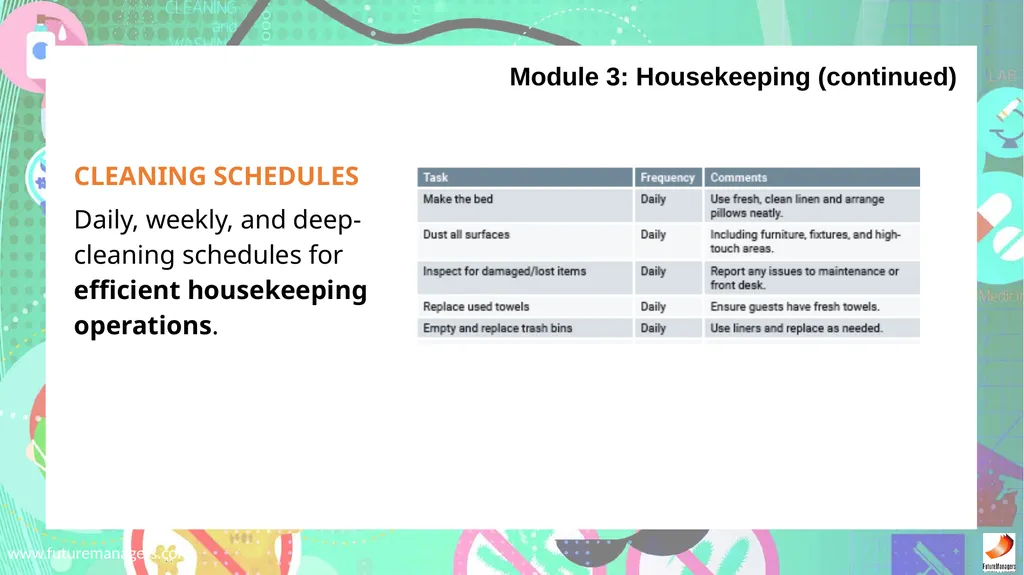
www.futuremanagers.com CLEANING SCHEDULES
Daily, weekly, and deep-cleaning schedules for efficient housekeeping operations. Module 3: Housekeeping (continued)<br>
Daily, weekly, and deep-cleaning schedules for efficient housekeeping operations. Module 3: Housekeeping (continued)<br>
23
www.futuremanagers.com INTRODUCTION
This module is about identifying hazards, preventing workplace accidents, and ensuring emergency preparedness.
Safety is the protection from accidents, injuries and hazards to yourself or others. Module 4: Safety<br>
This module is about identifying hazards, preventing workplace accidents, and ensuring emergency preparedness.
Safety is the protection from accidents, injuries and hazards to yourself or others. Module 4: Safety<br>
24
www.futuremanagers.com SAFETY PROCEDURES
Handling of toxic and flammable substances.
Safe use of gas, electricity, and generators.
Proper lifting techniques to prevent back injuries. Module 4: Safety (continued)<br>
Handling of toxic and flammable substances.
Safe use of gas, electricity, and generators.
Proper lifting techniques to prevent back injuries. Module 4: Safety (continued)<br>
25
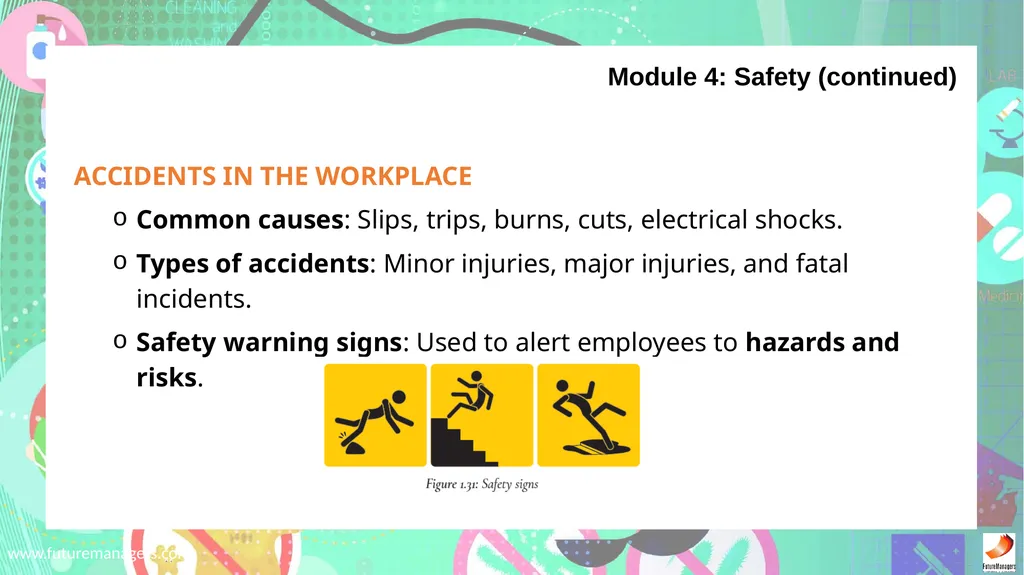
www.futuremanagers.com ACCIDENTS IN THE WORKPLACE
Common causes: Slips, trips, burns, cuts, electrical shocks.
Types of accidents: Minor injuries, major injuries, and fatal incidents.
Safety warning signs: Used to alert employees to hazards and risks. Module 4: Safety (continued)<br>
Common causes: Slips, trips, burns, cuts, electrical shocks.
Types of accidents: Minor injuries, major injuries, and fatal incidents.
Safety warning signs: Used to alert employees to hazards and risks. Module 4: Safety (continued)<br>
26
www.futuremanagers.com FIRE SAFETY
Fire triangle: Understanding the elements needed for a fire.
Firefighting equipment: Fire extinguishers, blankets, and hoses.
Emergency response: Evacuation procedures and first-aid for burns. Module 4: Safety (continued)<br>
Fire triangle: Understanding the elements needed for a fire.
Firefighting equipment: Fire extinguishers, blankets, and hoses.
Emergency response: Evacuation procedures and first-aid for burns. Module 4: Safety (continued)<br>
27
www.futuremanagers.com OCCUPATIONAL HEALTH AND SAFETY ACT
Employer responsibilities Providing training and a safe environment.
Employee responsibilities Following safety protocols. Module 4: Safety (continued)<br>
Employer responsibilities Providing training and a safe environment.
Employee responsibilities Following safety protocols. Module 4: Safety (continued)<br>
28
www.futuremanagers.com INTRODUCTION
This module focuses on understanding types, growth, and control of microorganisms.
Microorganisms are tiny living organisms, including bacteria, viruses, fungi, and protozoa. Module 5: Microorganisms<br>
This module focuses on understanding types, growth, and control of microorganisms.
Microorganisms are tiny living organisms, including bacteria, viruses, fungi, and protozoa. Module 5: Microorganisms<br>
29
www.futuremanagers.com SPREAD AND CONTROL MEASURES
Modes of transmission: Airborne, waterborne, foodborne, and direct contact.
Control methods: Proper hygiene, sanitization, temperature control. Module 5: Microorganisms (continued)<br>
Modes of transmission: Airborne, waterborne, foodborne, and direct contact.
Control methods: Proper hygiene, sanitization, temperature control. Module 5: Microorganisms (continued)<br>
30
www.futuremanagers.com TYPES OF MICROORGANISMS
Protozoa: Cause waterborne diseases.
Algae: Can lead to harmful algal blooms.
Fungi (Yeast & Moulds): Cause spoilage and produce toxins.
Viruses: Can cause foodborne illnesses (e.g., norovirus).
Bacteria: Some are beneficial, while others cause food poisoning. Module 5: Microorganisms (continued)<br>
Protozoa: Cause waterborne diseases.
Algae: Can lead to harmful algal blooms.
Fungi (Yeast & Moulds): Cause spoilage and produce toxins.
Viruses: Can cause foodborne illnesses (e.g., norovirus).
Bacteria: Some are beneficial, while others cause food poisoning. Module 5: Microorganisms (continued)<br>
31
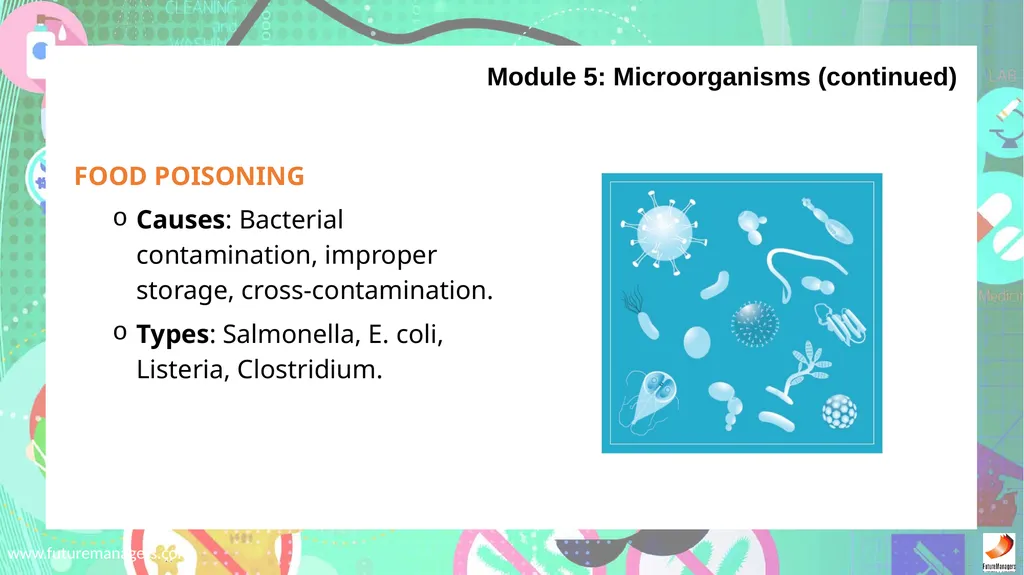
www.futuremanagers.com FOOD POISONING
Causes: Bacterial contamination, improper storage, cross-contamination.
Types: Salmonella, E. coli, Listeria, Clostridium. Module 5: Microorganisms (continued)<br>
Causes: Bacterial contamination, improper storage, cross-contamination.
Types: Salmonella, E. coli, Listeria, Clostridium. Module 5: Microorganisms (continued)<br>
32
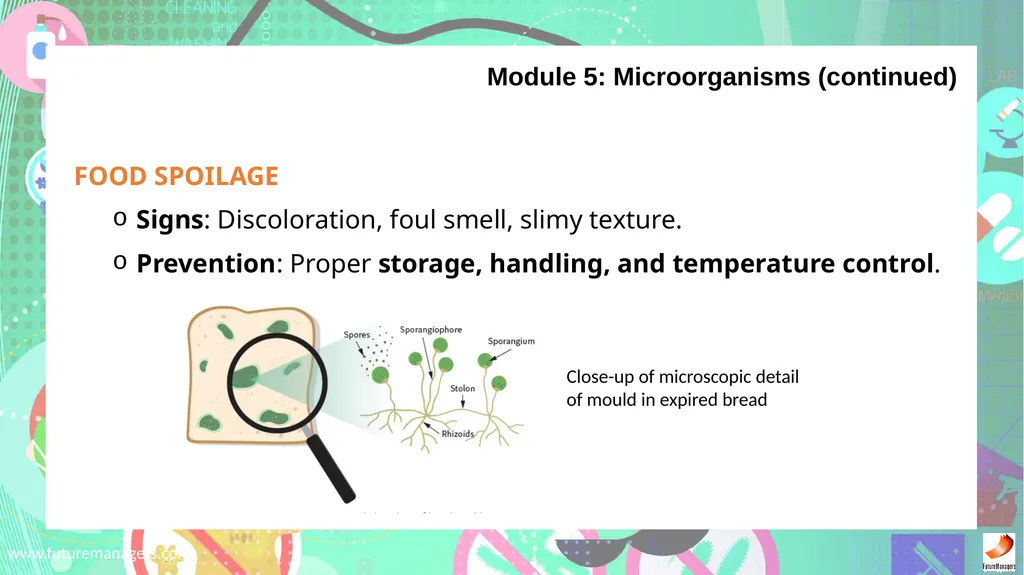
www.futuremanagers.com FOOD SPOILAGE
Signs: Discoloration, foul smell, slimy texture.
Prevention: Proper storage, handling, and temperature control. Module 5: Microorganisms (continued) Close-up of microscopic detail of mould in expired bread<br>
Signs: Discoloration, foul smell, slimy texture.
Prevention: Proper storage, handling, and temperature control. Module 5: Microorganisms (continued) Close-up of microscopic detail of mould in expired bread<br>
33
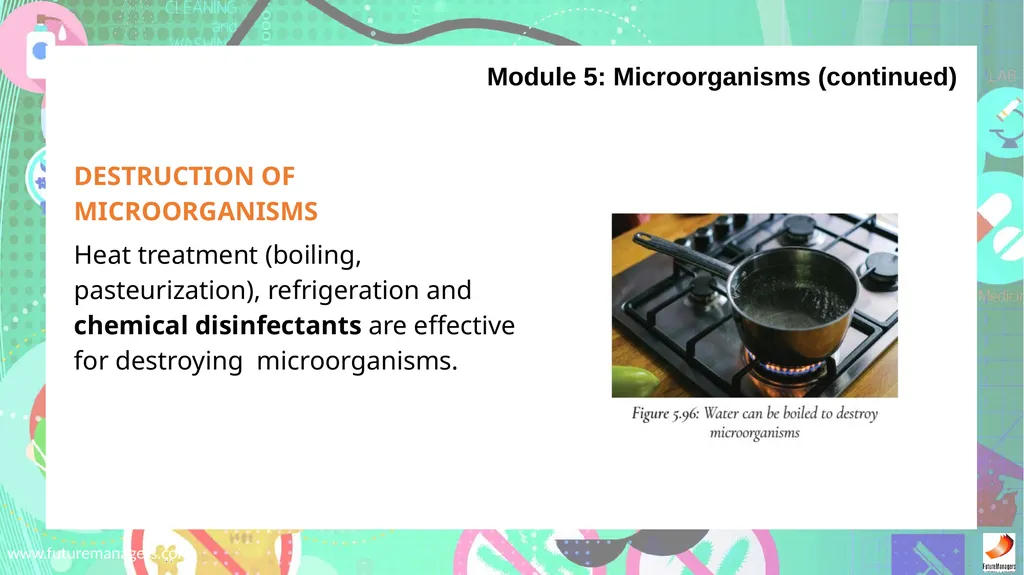
www.futuremanagers.com DESTRUCTION OF MICROORGANISMS
Heat treatment (boiling, pasteurization), refrigeration and chemical disinfectants are effective for destroying microorganisms. Module 5: Microorganisms (continued)<br>
Heat treatment (boiling, pasteurization), refrigeration and chemical disinfectants are effective for destroying microorganisms. Module 5: Microorganisms (continued)<br>
34
www.futuremanagers.com INTRODUCTION
This module focuses workplace health, medical examinations, contagious diseases and drug awareness. Module 6: Health<br>
This module focuses workplace health, medical examinations, contagious diseases and drug awareness. Module 6: Health<br>
35
www.futuremanagers.com MEDICAL EXAMINATIONS IN THE WORKPLACE
Fitness for duty assessments for employees.
Drug testing policies to ensure workplace safety. Module 6: Health (continued)<br>
Fitness for duty assessments for employees.
Drug testing policies to ensure workplace safety. Module 6: Health (continued)<br>
36
www.futuremanagers.com CONTAGIOUS DISEASES
Influenza and the common cold: Preventable through hygiene and vaccination.
Gastroenteritis: Often caused by contaminated food or water.
COVID-19: Requires mask-wearing, hygiene, and social distancing.
Tuberculosis (TB): Spreads through respiratory droplets.
HIV/Aids: Managing stigma and ensuring workplace health policies. Module 6: Health (continued)<br>
Influenza and the common cold: Preventable through hygiene and vaccination.
Gastroenteritis: Often caused by contaminated food or water.
COVID-19: Requires mask-wearing, hygiene, and social distancing.
Tuberculosis (TB): Spreads through respiratory droplets.
HIV/Aids: Managing stigma and ensuring workplace health policies. Module 6: Health (continued)<br>
37
www.futuremanagers.com DRUG AWARENESS
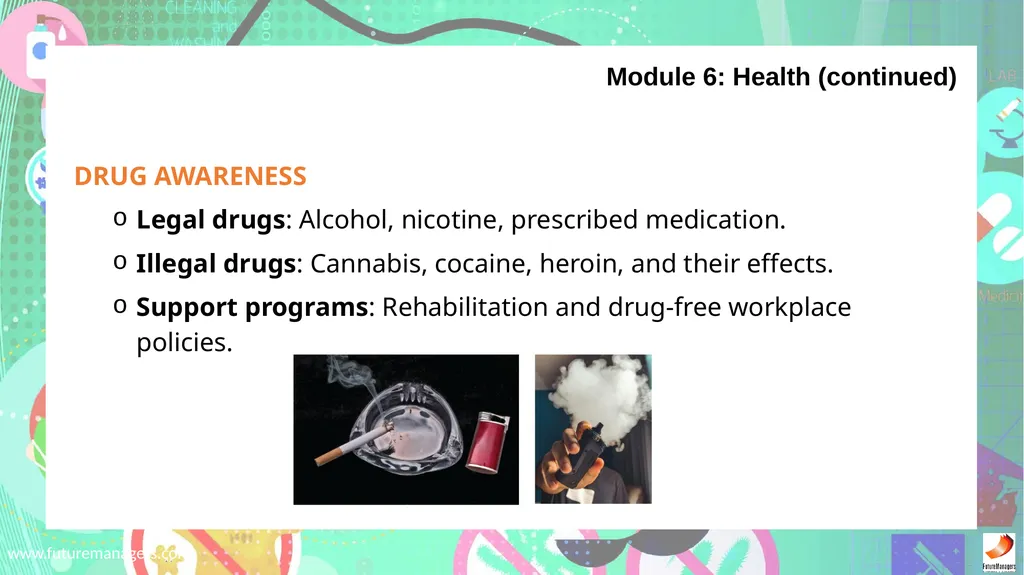
Legal drugs: Alcohol, nicotine, prescribed medication.
Illegal drugs: Cannabis, cocaine, heroin, and their effects.
Support programs: Rehabilitation and drug-free workplace policies. Module 6: Health (continued)<br>
Legal drugs: Alcohol, nicotine, prescribed medication.
Illegal drugs: Cannabis, cocaine, heroin, and their effects.
Support programs: Rehabilitation and drug-free workplace policies. Module 6: Health (continued)<br>