
Sayables and Simple Propositions Language is


Description: Sayables and Simple Propositions Language is closely connected with Stoic logic and epistemology Language is a key part of the process of assenting to impressions, so it has to fit in with the ideas of corporeality, reason, and truth To
Related Topics
Download Presentation
"Sayables and Simple Propositions Language is" is the property of its rightful owner. Permission is granted to download and print the materials on this website for personal, non-commercial use only, and to display it on your personal computer provided you do not modify the materials and that you retain all copyright notices contained in the materials. By downloading content from our website, you accept the terms of this agreement.
Presentation Transcript
slide1. Sayables and Simple Propositions<br>
slide2. Language is closely connected with Stoic logic and epistemology Language is a key part of the process of assenting to impressions, so it has to fit in with the ideas of corporeality, reason, and truth
To sort out why language was so important, they had to first separate unimportant language from important, which they called signification<br>
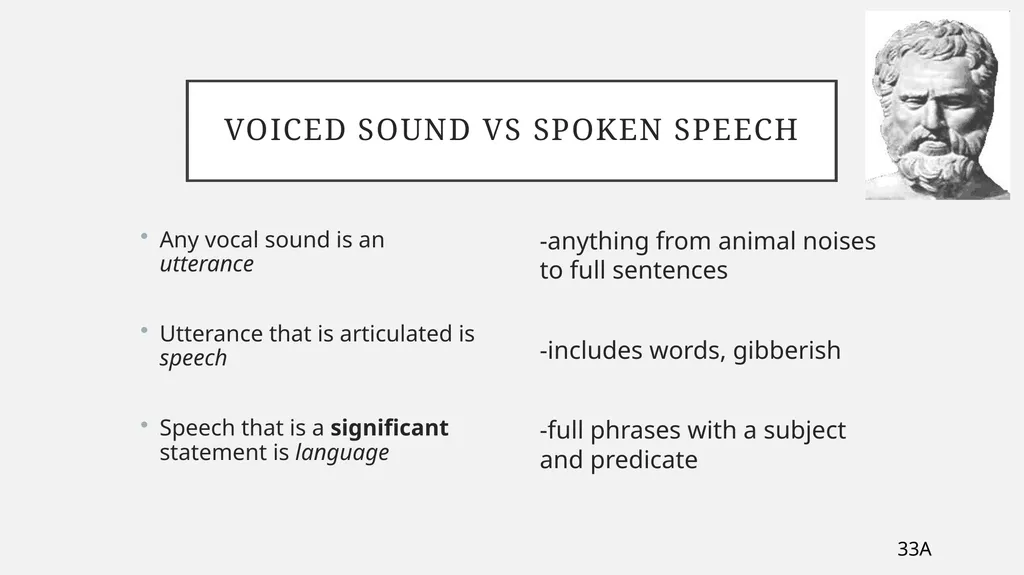
slide3. Voiced sound vs spoken speech Any vocal sound is an utterance
Utterance that is articulated is speech
Speech that is a significant statement is language -anything from animal noises to full sentences
-includes words, gibberish
-full phrases with a subject and predicate 33A<br>
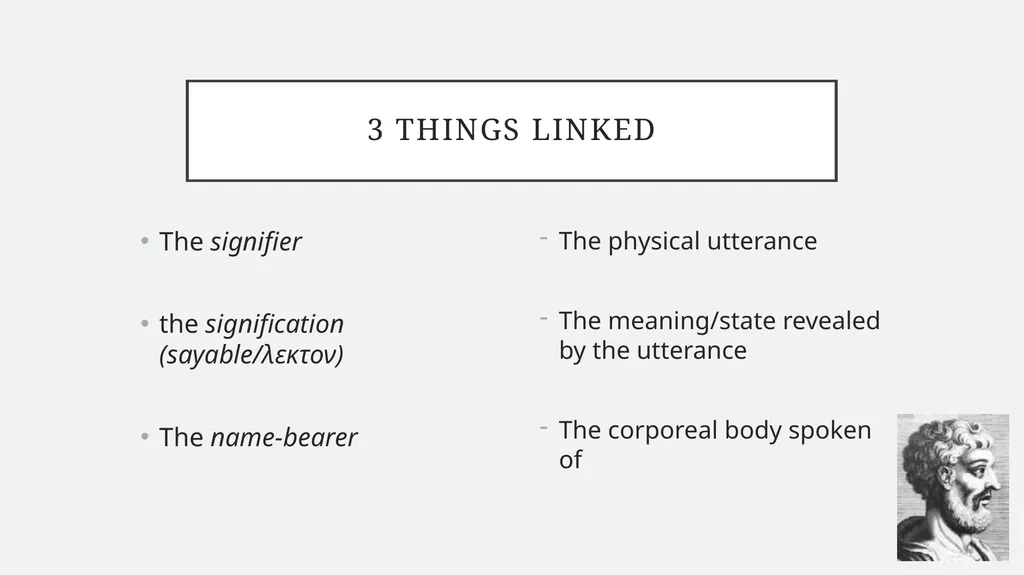
slide4. 3 things linked The signifier
the signification (sayable/λεκτον)
The name-bearer The physical utterance
The meaning/state revealed by the utterance
The corporeal body spoken of<br>
slide5. The significance isn’t inherent in speech, but a separate thing Because…
Someone who doesn’t speak the language won’t receive the meaning
All minds are different, and the impressions created by a signification are different for everyone (B2)
So…
The significance is a logical conclusion or summary of the thought, which can be passed from person to person with language<br>
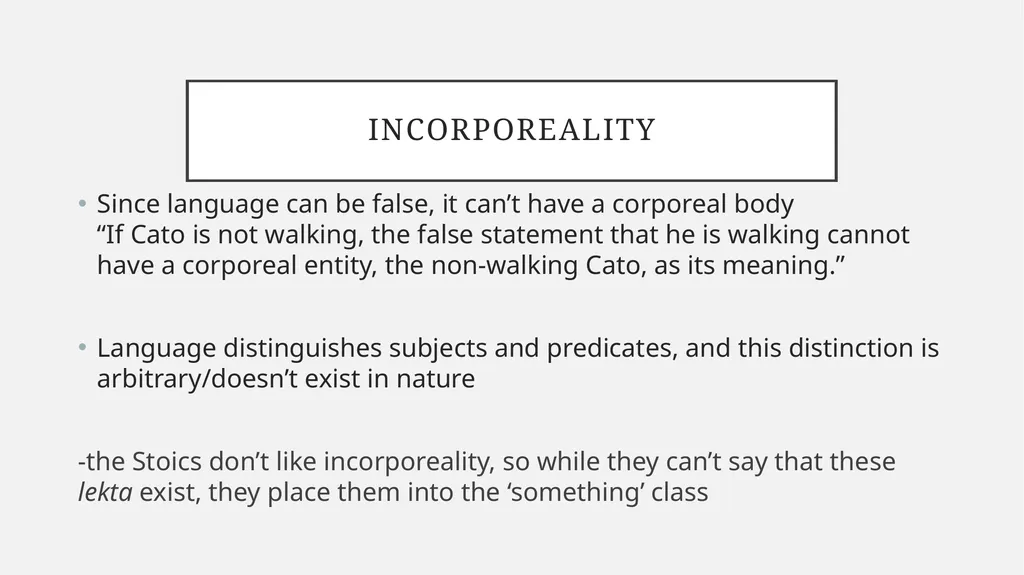
slide6. Incorporeality Since language can be false, it can’t have a corporeal body “If Cato is not walking, the false statement that he is walking cannot have a corporeal entity, the non-walking Cato, as its meaning.”
Language distinguishes subjects and predicates, and this distinction is arbitrary/doesn’t exist in nature
-the Stoics don’t like incorporeality, so while they can’t say that these lekta exist, they place them into the ‘something’ class<br>
slide7. Impressions and the signification/sayable/λεκτον When an impression arises from outside stimulus, the “commanding-faculty will be disposed in a certain way” (L&S 200) -the sayable is the correlate of that (corporeal) disposition
This sayable can be assented to or not (rationality)
This sayable is what we use to form speech to convey that thought<br>
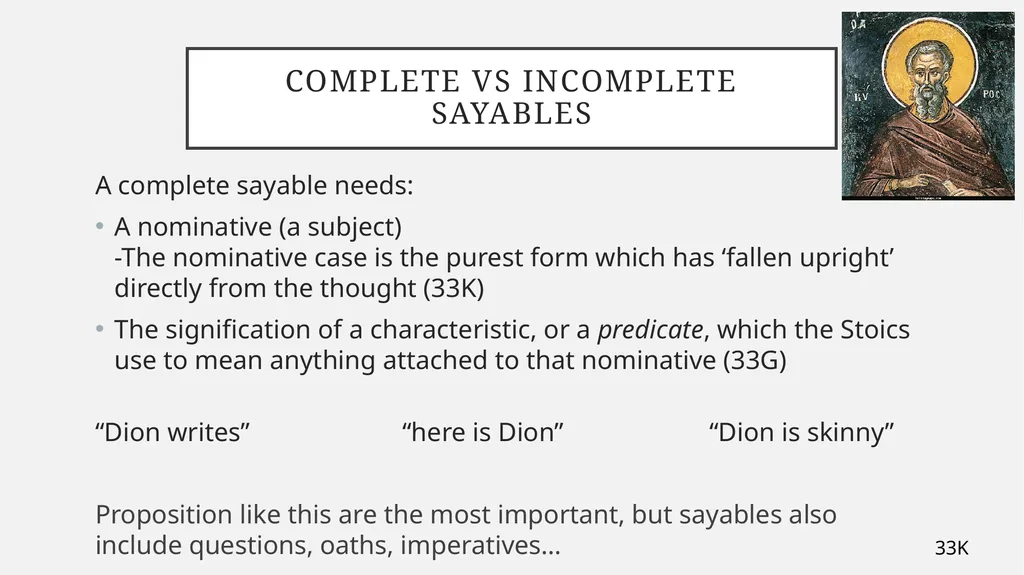
slide8. Complete vs Incomplete Sayables A complete sayable needs:
A nominative (a subject) -The nominative case is the purest form which has ‘fallen upright’ directly from the thought (33K)
The signification of a characteristic, or a predicate, which the Stoics use to mean anything attached to that nominative (33G)
“Dion writes” “here is Dion” “Dion is skinny”
Proposition like this are the most important, but sayables also include questions, oaths, imperatives… 33K<br>
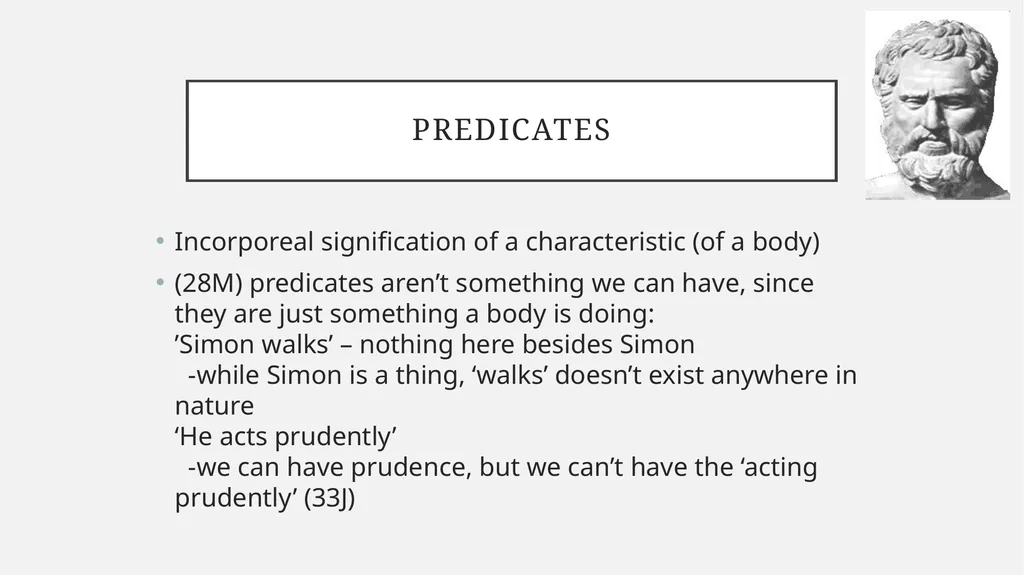
slide9. Predicates Incorporeal signification of a characteristic (of a body)
(28M) predicates aren’t something we can have, since they are just something a body is doing: ’Simon walks’ – nothing here besides Simon -while Simon is a thing, ‘walks’ doesn’t exist anywhere in nature ‘He acts prudently’ -we can have prudence, but we can’t have the ‘acting prudently’ (33J)<br>
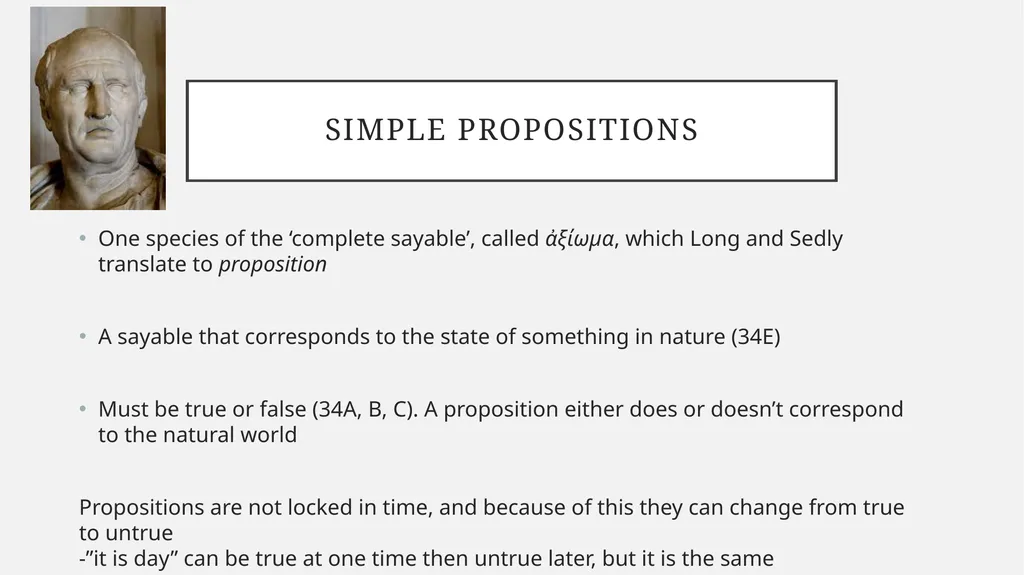
slide10. Simple Propositions One species of the ‘complete sayable’, called ἀξίωμα, which Long and Sedly translate to proposition
A sayable that corresponds to the state of something in nature (34E)
Must be true or false (34A, B, C). A proposition either does or doesn’t correspond to the natural world
Propositions are not locked in time, and because of this they can change from true to untrue -”it is day” can be true at one time then untrue later, but it is the same axiom/proposition (34J, K)<br>
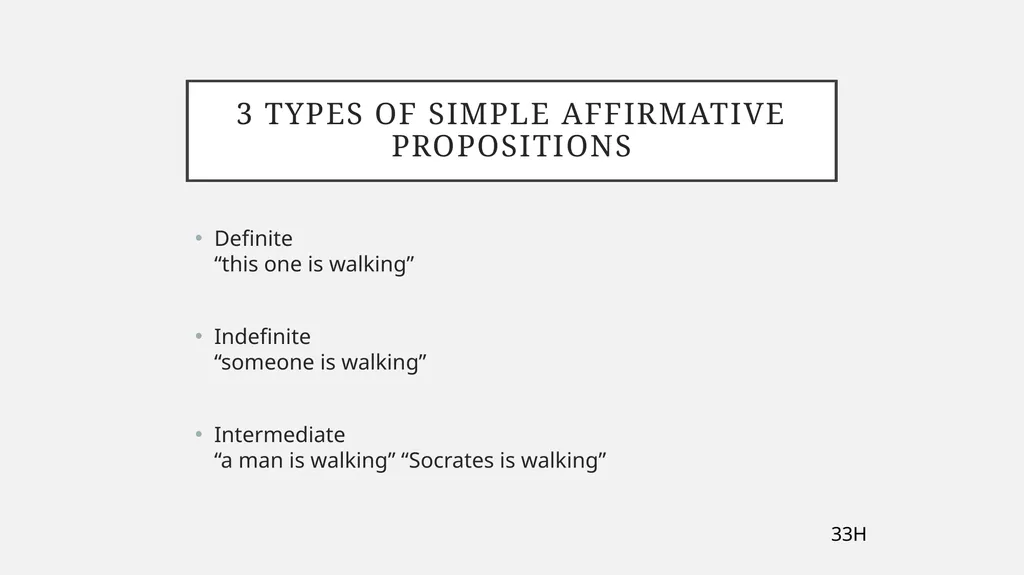
slide11. 3 types of simple affirmative propositions Definite “this one is walking”
Indefinite “someone is walking”
Intermediate “a man is walking” “Socrates is walking” 33H<br>
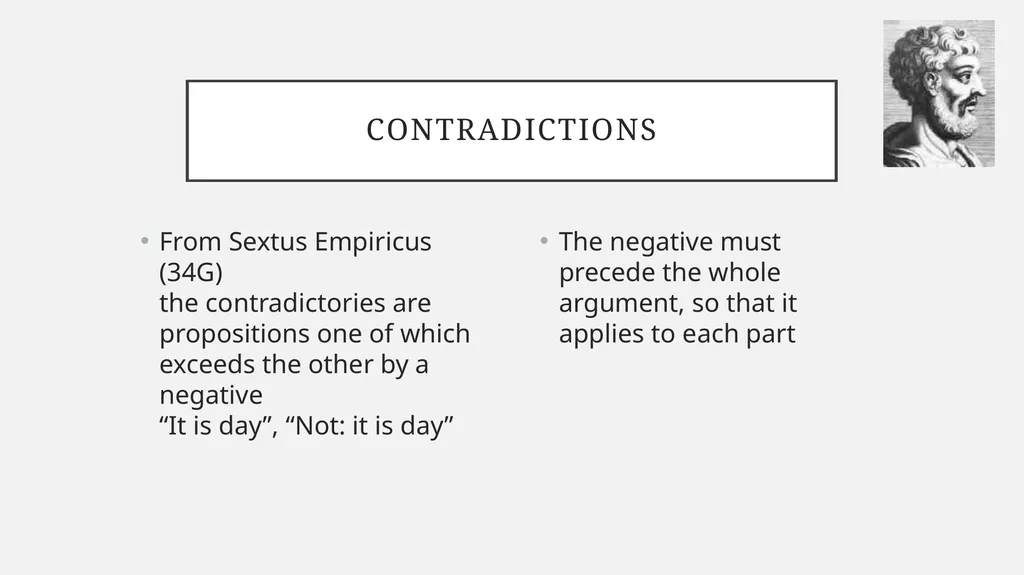
slide12. Contradictions From Sextus Empiricus (34G) the contradictories are propositions one of which exceeds the other by a negative “It is day”, “Not: it is day” The negative must precede the whole argument, so that it applies to each part<br>
slide13. In conclusion, impressions form on our mind from a stimulus. With the power of language, our thoughts extract sayables, or lekta from these impressions, which we can convey to others by voicing these sayables in speech. Regarding simple statements of truth these sayables are called propositions.<br>
slide2. Language is closely connected with Stoic logic and epistemology Language is a key part of the process of assenting to impressions, so it has to fit in with the ideas of corporeality, reason, and truth
To sort out why language was so important, they had to first separate unimportant language from important, which they called signification<br>
slide3. Voiced sound vs spoken speech Any vocal sound is an utterance
Utterance that is articulated is speech
Speech that is a significant statement is language -anything from animal noises to full sentences
-includes words, gibberish
-full phrases with a subject and predicate 33A<br>
slide4. 3 things linked The signifier
the signification (sayable/λεκτον)
The name-bearer The physical utterance
The meaning/state revealed by the utterance
The corporeal body spoken of<br>
slide5. The significance isn’t inherent in speech, but a separate thing Because…
Someone who doesn’t speak the language won’t receive the meaning
All minds are different, and the impressions created by a signification are different for everyone (B2)
So…
The significance is a logical conclusion or summary of the thought, which can be passed from person to person with language<br>
slide6. Incorporeality Since language can be false, it can’t have a corporeal body “If Cato is not walking, the false statement that he is walking cannot have a corporeal entity, the non-walking Cato, as its meaning.”
Language distinguishes subjects and predicates, and this distinction is arbitrary/doesn’t exist in nature
-the Stoics don’t like incorporeality, so while they can’t say that these lekta exist, they place them into the ‘something’ class<br>
slide7. Impressions and the signification/sayable/λεκτον When an impression arises from outside stimulus, the “commanding-faculty will be disposed in a certain way” (L&S 200) -the sayable is the correlate of that (corporeal) disposition
This sayable can be assented to or not (rationality)
This sayable is what we use to form speech to convey that thought<br>
slide8. Complete vs Incomplete Sayables A complete sayable needs:
A nominative (a subject) -The nominative case is the purest form which has ‘fallen upright’ directly from the thought (33K)
The signification of a characteristic, or a predicate, which the Stoics use to mean anything attached to that nominative (33G)
“Dion writes” “here is Dion” “Dion is skinny”
Proposition like this are the most important, but sayables also include questions, oaths, imperatives… 33K<br>
slide9. Predicates Incorporeal signification of a characteristic (of a body)
(28M) predicates aren’t something we can have, since they are just something a body is doing: ’Simon walks’ – nothing here besides Simon -while Simon is a thing, ‘walks’ doesn’t exist anywhere in nature ‘He acts prudently’ -we can have prudence, but we can’t have the ‘acting prudently’ (33J)<br>
slide10. Simple Propositions One species of the ‘complete sayable’, called ἀξίωμα, which Long and Sedly translate to proposition
A sayable that corresponds to the state of something in nature (34E)
Must be true or false (34A, B, C). A proposition either does or doesn’t correspond to the natural world
Propositions are not locked in time, and because of this they can change from true to untrue -”it is day” can be true at one time then untrue later, but it is the same axiom/proposition (34J, K)<br>
slide11. 3 types of simple affirmative propositions Definite “this one is walking”
Indefinite “someone is walking”
Intermediate “a man is walking” “Socrates is walking” 33H<br>
slide12. Contradictions From Sextus Empiricus (34G) the contradictories are propositions one of which exceeds the other by a negative “It is day”, “Not: it is day” The negative must precede the whole argument, so that it applies to each part<br>
slide13. In conclusion, impressions form on our mind from a stimulus. With the power of language, our thoughts extract sayables, or lekta from these impressions, which we can convey to others by voicing these sayables in speech. Regarding simple statements of truth these sayables are called propositions.<br>