
Schacter and Singer (1962) Announcements Pop Quiz!
A
Published · 62 slides · 0 views

1 / 1

Description
Schacter and Singer (1962) Announcements Pop Quiz! This will be worth an EXAM GRADE. There should be NO TALKING. 1. Physiologically, how do you feel? If you are experiencing a fast heart rate or are tense, write that. 2. What emotion best
Related Topics
Share
Embed code
Download this presentation From Below
"Schacter and Singer (1962) Announcements Pop Quiz!" is the property of its rightful owner. Permission is granted to download and print the materials on this website for personal, non-commercial use only, and to display it on your personal computer provided you do not modify the materials and that you retain all copyright notices contained in the materials. By downloading content from our website, you accept the terms of this agreement.
Presentation Transcript
01
Schacter and Singer (1962)<br>
02
Announcements Pop Quiz! This will be worth an EXAM GRADE.
There should be NO TALKING.<br>
There should be NO TALKING.<br>
03
1. Physiologically, how do you feel? If you are experiencing a fast heart rate or are tense, write that.
2. What emotion best describes your current state?<br>
2. What emotion best describes your current state?<br>
04
Bellringer Actual competition!
Label as many parts of the brain as you can.<br>
Label as many parts of the brain as you can.<br>
05
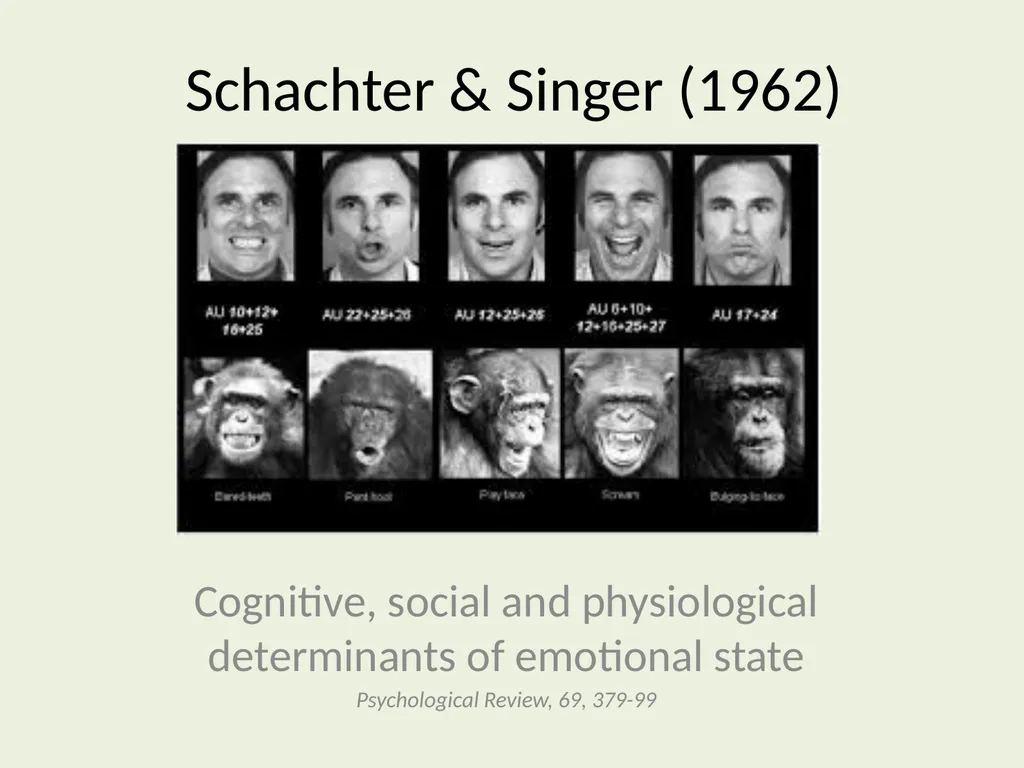
Schachter & Singer (1962) Cognitive, social and physiological determinants of emotional state
Psychological Review, 69, 379-99<br>
Psychological Review, 69, 379-99<br>
06
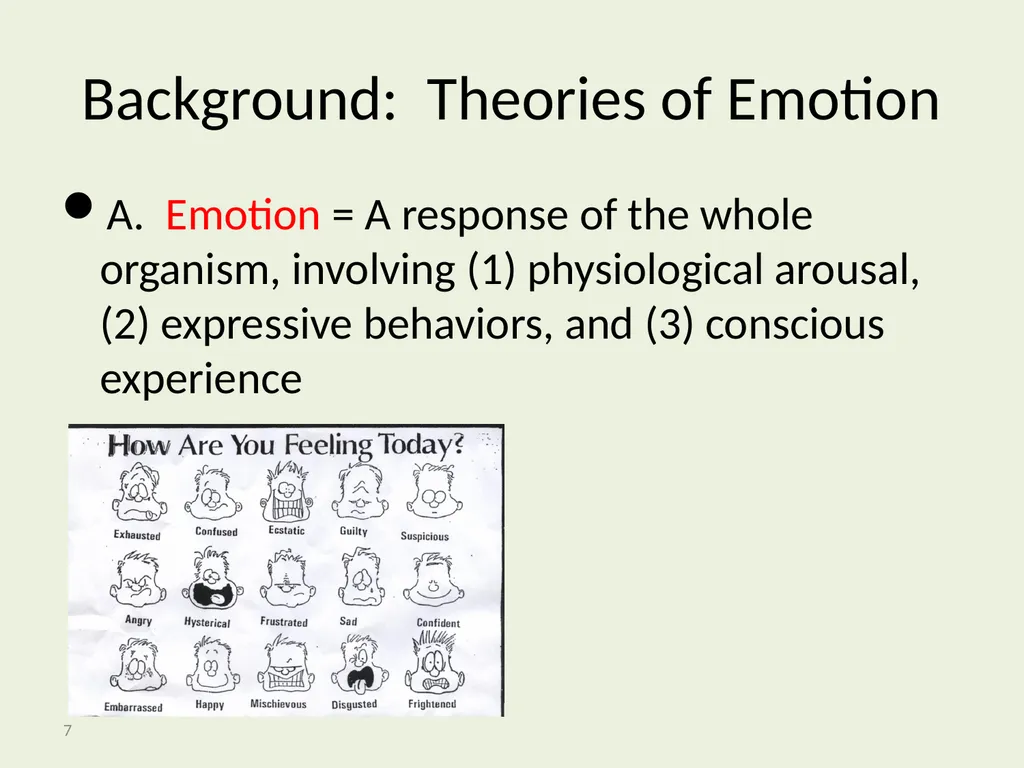
Background: Theories of Emotion A. Emotion = A response of the whole organism, involving (1) physiological arousal, (2) expressive behaviors, and (3) conscious experience 7<br>
07
Cognitive Theory of Emotion:
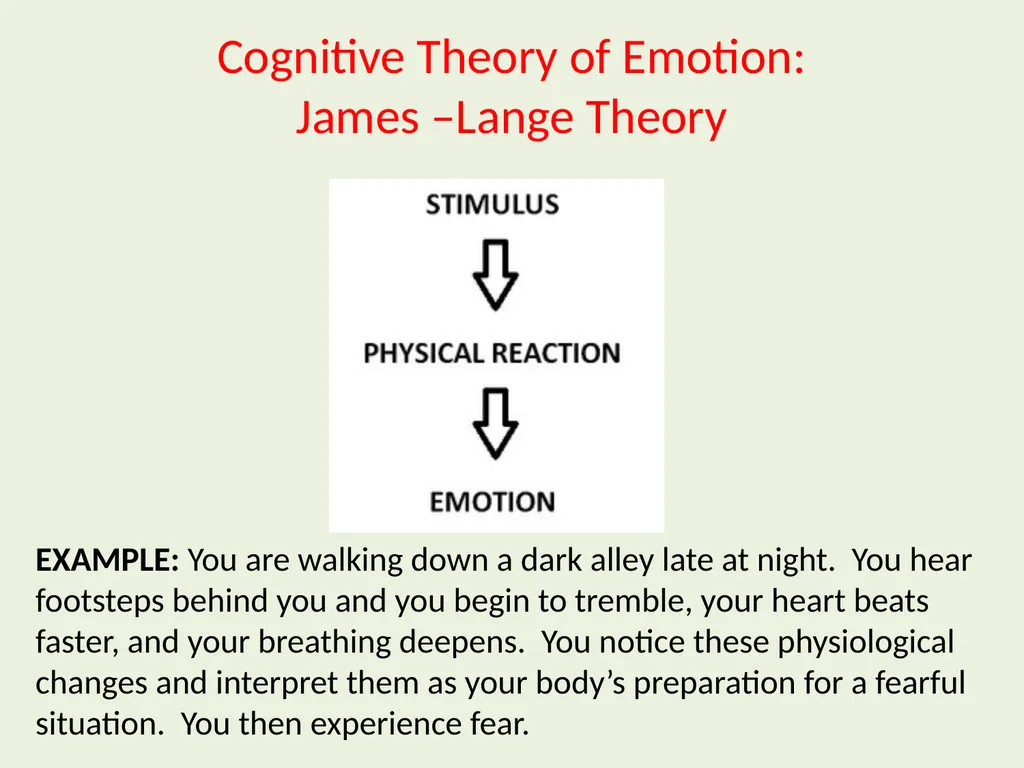
James –Lange Theory EXAMPLE: You are walking down a dark alley late at night. You hear footsteps behind you and you begin to tremble, your heart beats faster, and your breathing deepens. You notice these physiological changes and interpret them as your body’s preparation for a fearful situation. You then experience fear.<br>
08
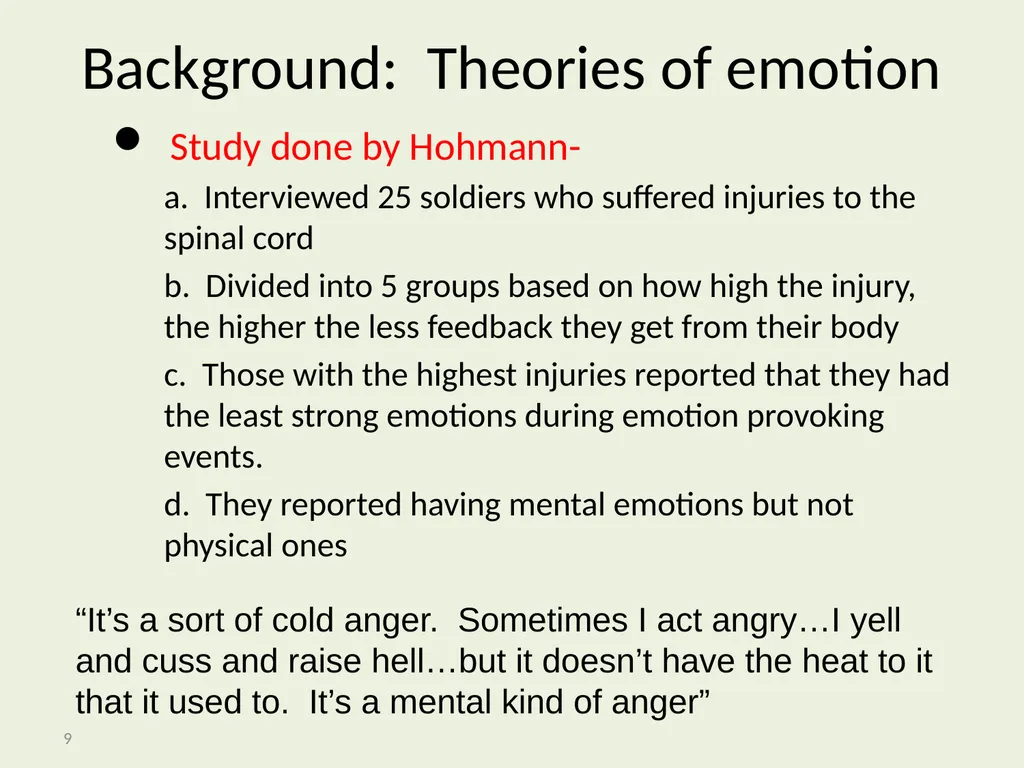
Background: Theories of emotion Study done by Hohmann-
a. Interviewed 25 soldiers who suffered injuries to the spinal cord
b. Divided into 5 groups based on how high the injury, the higher the less feedback they get from their body
c. Those with the highest injuries reported that they had the least strong emotions during emotion provoking events.
d. They reported having mental emotions but not physical ones 9 “It’s a sort of cold anger. Sometimes I act angry…I yell and cuss and raise hell…but it doesn’t have the heat to it that it used to. It’s a mental kind of anger”<br>
09
b. Those who suffered injuries that left them paralyzed from the neck down responded that their emotions were much less intense, which would seem to support the James-Lange Theory 10<br>
10
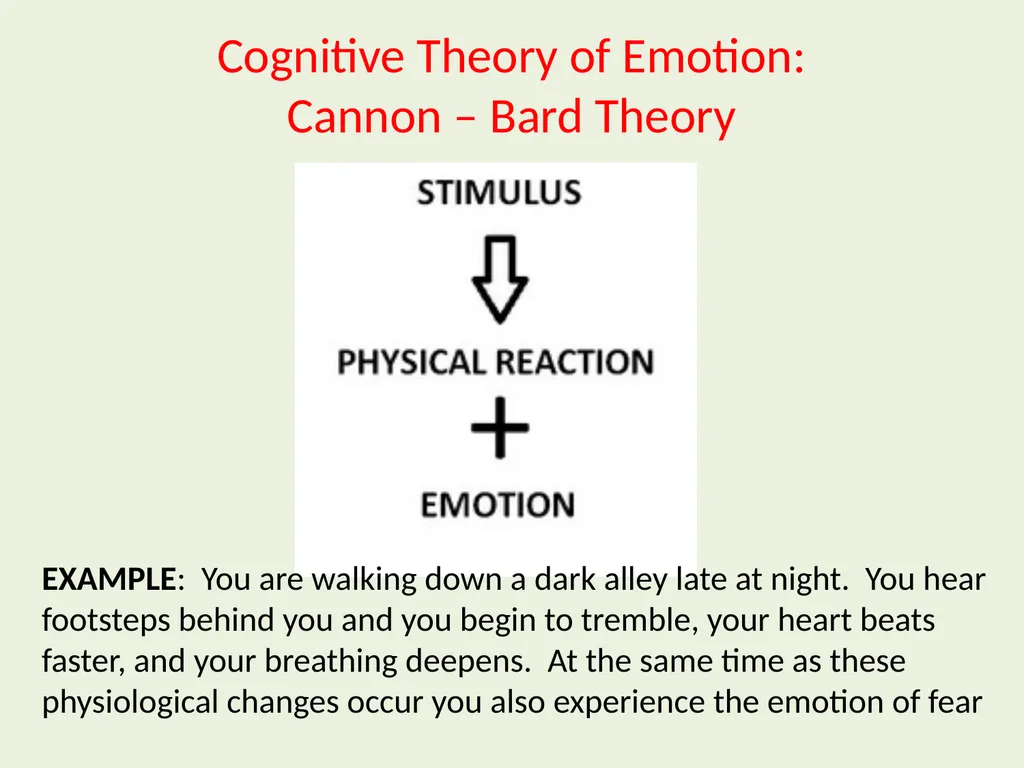
Cognitive Theory of Emotion:
Cannon – Bard Theory EXAMPLE: You are walking down a dark alley late at night. You hear footsteps behind you and you begin to tremble, your heart beats faster, and your breathing deepens. At the same time as these physiological changes occur you also experience the emotion of fear<br>
11
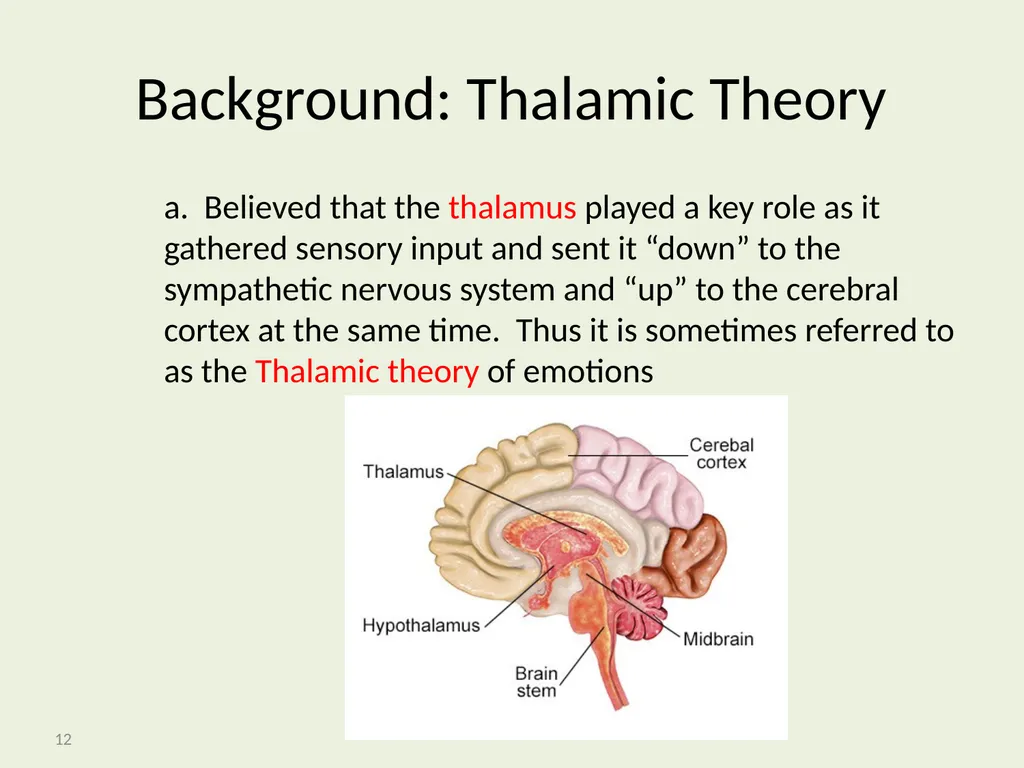
Background: Thalamic Theory a. Believed that the thalamus played a key role as it gathered sensory input and sent it “down” to the sympathetic nervous system and “up” to the cerebral cortex at the same time. Thus it is sometimes referred to as the Thalamic theory of emotions 12<br>
12
Schachter & Singer’s hypotheses Physiological arousal + an appropriate cognition → (a describable) emotion
(Two-factors necessary and sufficient) 14<br>
(Two-factors necessary and sufficient) 14<br>
13
III. Aim/Hypotheses This study consisted of 3 major hypotheses
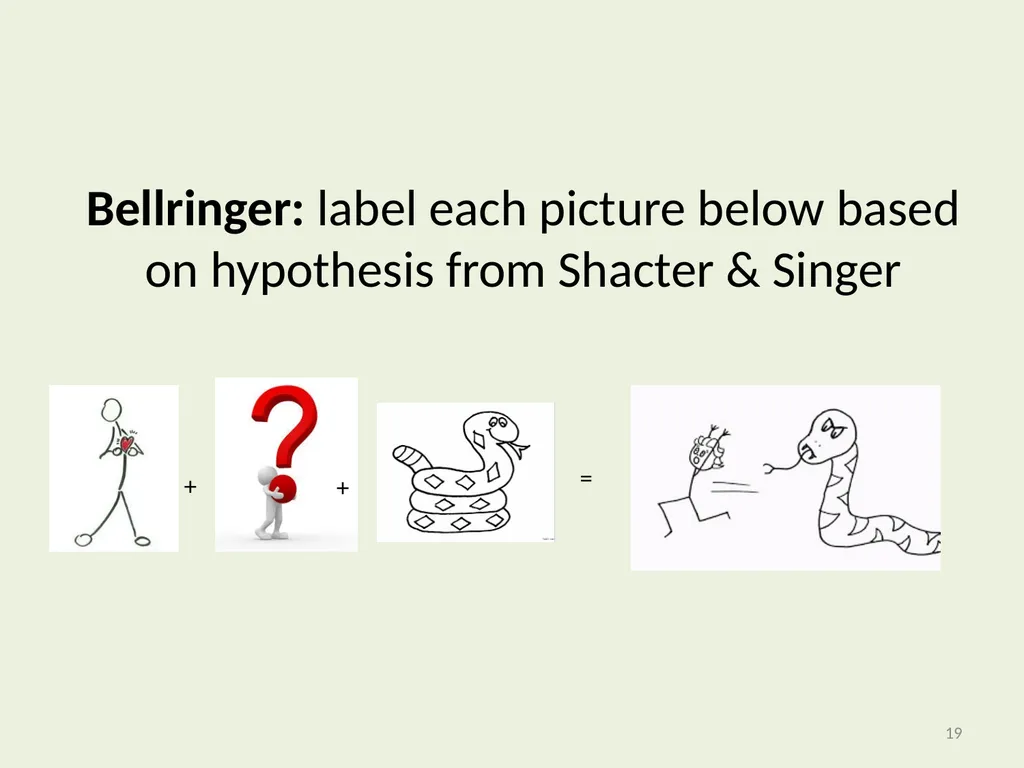
1. Given a state of physiological arousal for which an individual has no immediate explanation, they will "label” this state and describe their feelings in terms of the cognitions available
Physiological arousal + no rational explanation + an appropriate cognition → (a describable) emotion 15<br>
1. Given a state of physiological arousal for which an individual has no immediate explanation, they will "label” this state and describe their feelings in terms of the cognitions available
Physiological arousal + no rational explanation + an appropriate cognition → (a describable) emotion 15<br>
14
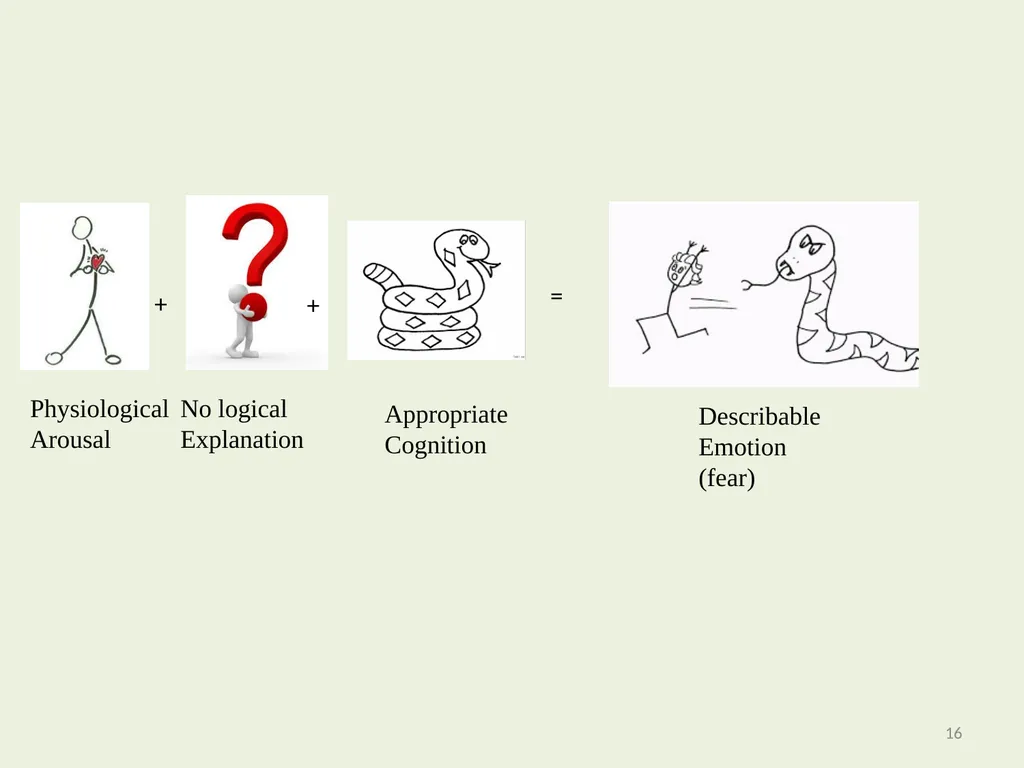
16 Describable Emotion
(fear)<br>
(fear)<br>
15
III. Aim/Hypothesis Given a state of physiological arousal for which an individual has a completely appropriate explanation, the individual is unlikely to label their feelings in terms of the alternative cognitions available
a. Physiological arousal + a rational explanation → NO emotion an appropriate cognition does not have an impact 17<br>
a. Physiological arousal + a rational explanation → NO emotion an appropriate cognition does not have an impact 17<br>
16
3. Given no physiological arousal, even if emotion-inducing cognitive circumstances are present the subject will not create emotions.
a. No Physiological arousal + an appropriate cognition → No emotion 18 III. Aim/Hypothesis<br>
a. No Physiological arousal + an appropriate cognition → No emotion 18 III. Aim/Hypothesis<br>
17
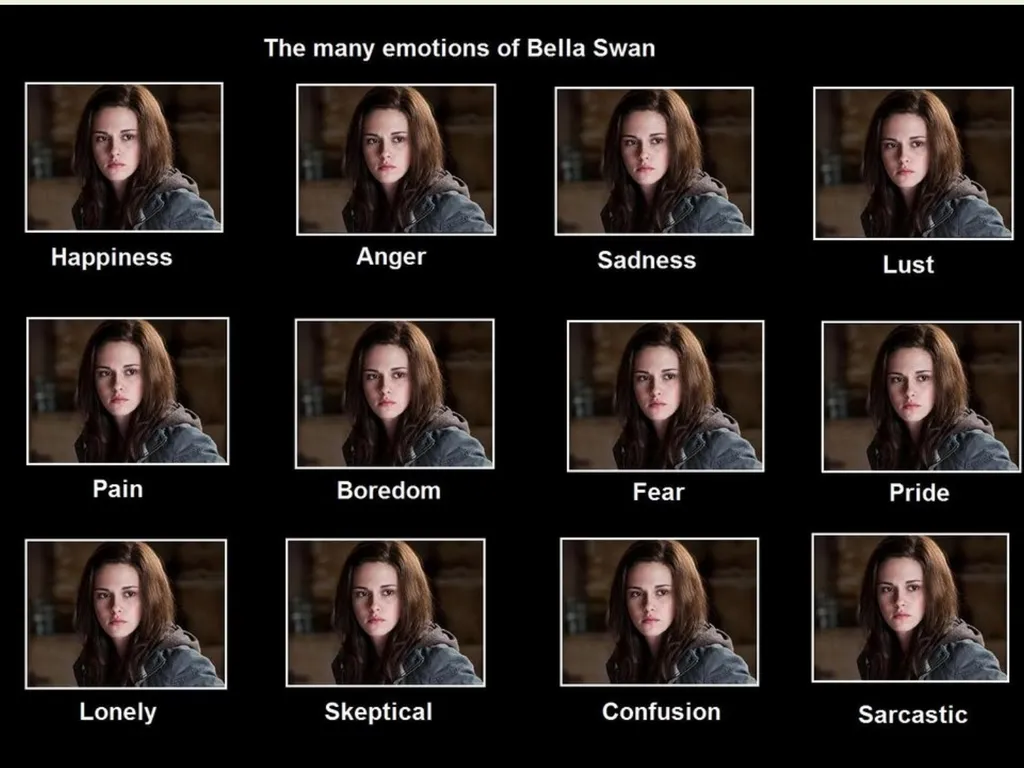
19 Bellringer: label each picture below based on hypothesis from Shacter & Singer<br>
18
Schachter & Singer’s hypotheses Physiological arousal + an appropriate cognition → (a describable) emotion
(Two-factors necessary and sufficient) 20<br>
(Two-factors necessary and sufficient) 20<br>
19
IV. Methodology - Sample A. The Sample
1. Began with 185 Ps –
2. All male and white in their 1st year at the University of Minnesota studying psychology
3. 1 dropped in initial phase because of refusal to receive an injection
4. Students offered 2pts extra credit on final exam for each hour participating in a psych study on campus 21<br>
20
IV. Methodology - Variables B. Variables
1. 3 IVs
a. Physiological arousal (epinephrine vs saline)
b. Explanations of arousal (Informed of side effects, Ignorant of side effects, Misinformed of side effects)
c. Emotion-inducing situations w/ explanatory cognitions (Euphoric stooge vs Angry stooge)
2. DV: Emotions – self-feedback & observations
C. Design
1. Laboratory Experiment
2. Snapshot study 22<br>
21
IV. Methodology - Procedure D. Set-up of the experiment
1. Told they were studying the impact of a vitamin “Suproxin” (really epinephrine) on vision.
2. Asked, “would you mind having an injection of Suproxin (made up name) to look at the effects of vitamins on vision?” (1 person of 185 declined) 23<br>
1. Told they were studying the impact of a vitamin “Suproxin” (really epinephrine) on vision.
2. Asked, “would you mind having an injection of Suproxin (made up name) to look at the effects of vitamins on vision?” (1 person of 185 declined) 23<br>
22
What does adrenaline do? Causes similar effects to the arousal of the autonomic nervous system (ANS – “fight or flight”). Starts after 3-5 mins, lasts 15-30 mins.
Increases blood pressure
Increases heart rate
Increases blood sugar
Increases respiration
Increases blood flow to muscles & brain
Decreases blood flow to skin (feels cold)
Palpitations
Tremors
Flushing 25<br>
Increases blood pressure
Increases heart rate
Increases blood sugar
Increases respiration
Increases blood flow to muscles & brain
Decreases blood flow to skin (feels cold)
Palpitations
Tremors
Flushing 25<br>
23
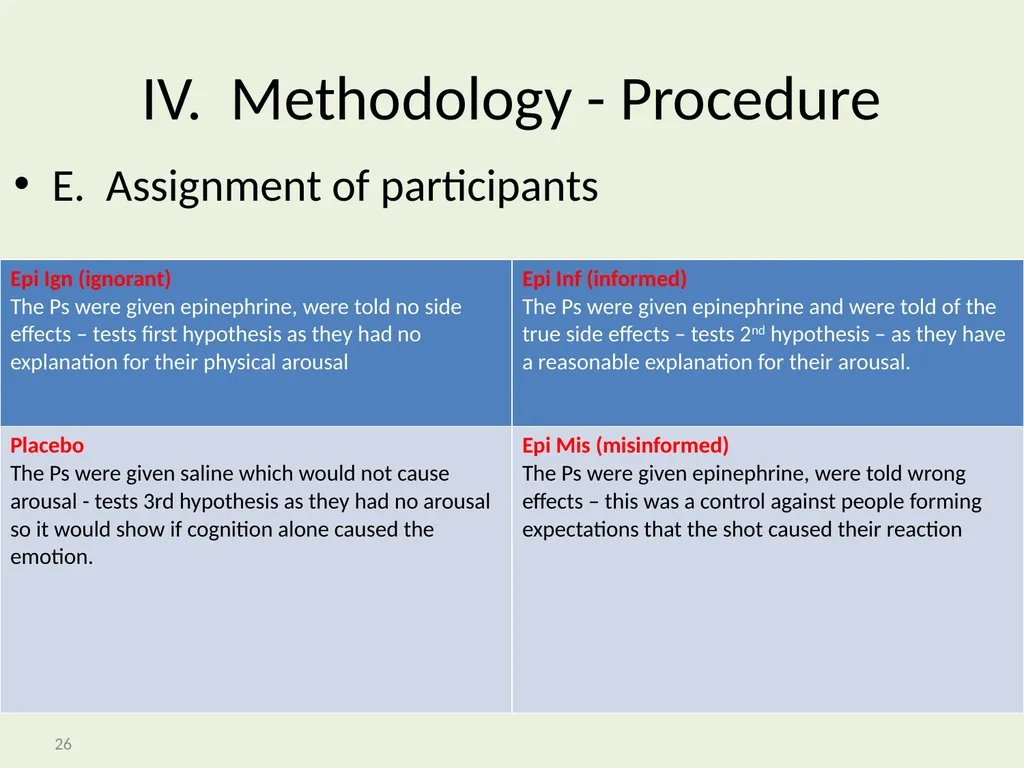
IV. Methodology - Procedure E. Assignment of participants 26<br>
24
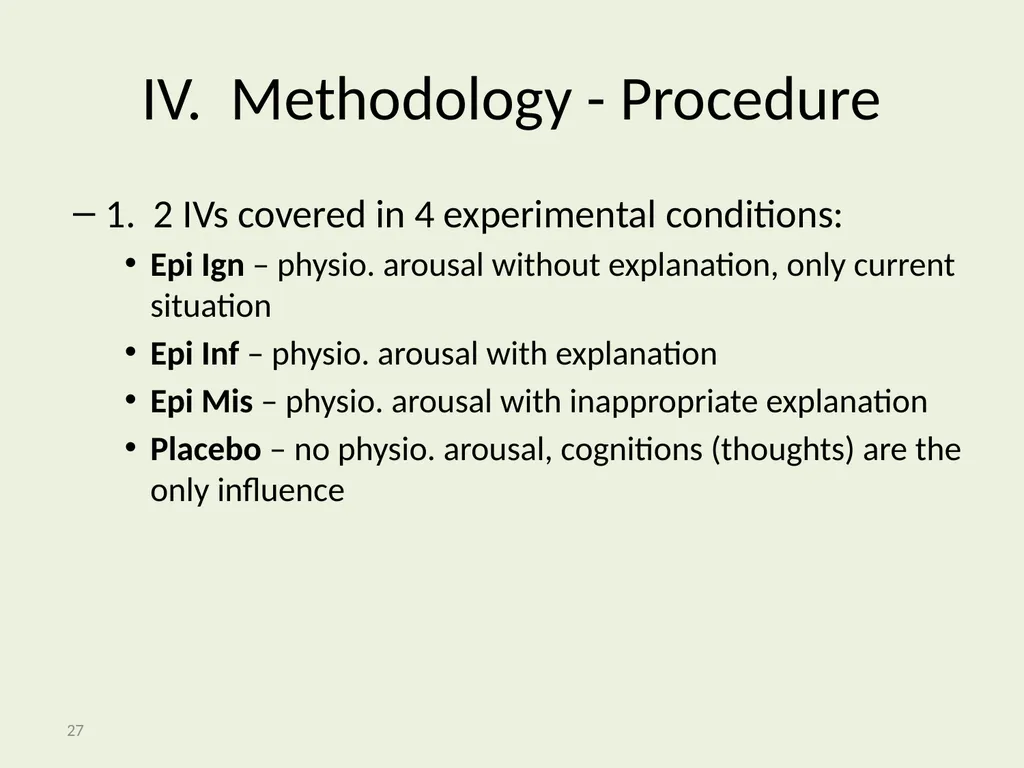
IV. Methodology - Procedure 1. 2 IVs covered in 4 experimental conditions:
Epi Ign – physio. arousal without explanation, only current situation
Epi Inf – physio. arousal with explanation
Epi Mis – physio. arousal with inappropriate explanation
Placebo – no physio. arousal, cognitions (thoughts) are the only influence 27<br>
Epi Ign – physio. arousal without explanation, only current situation
Epi Inf – physio. arousal with explanation
Epi Mis – physio. arousal with inappropriate explanation
Placebo – no physio. arousal, cognitions (thoughts) are the only influence 27<br>
25
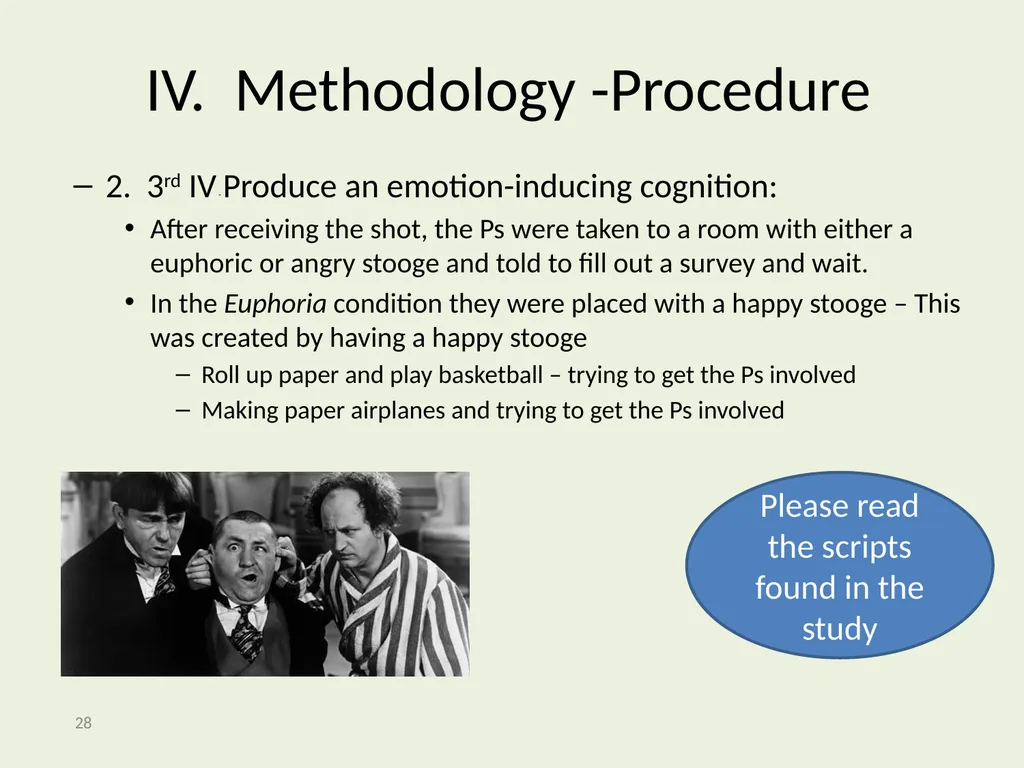
IV. Methodology -Procedure 2. 3rd IV - Produce an emotion-inducing cognition:
After receiving the shot, the Ps were taken to a room with either a euphoric or angry stooge and told to fill out a survey and wait.
In the Euphoria condition they were placed with a happy stooge – This was created by having a happy stooge
Roll up paper and play basketball – trying to get the Ps involved
Making paper airplanes and trying to get the Ps involved 28 Please read the scripts found in the study<br>
26
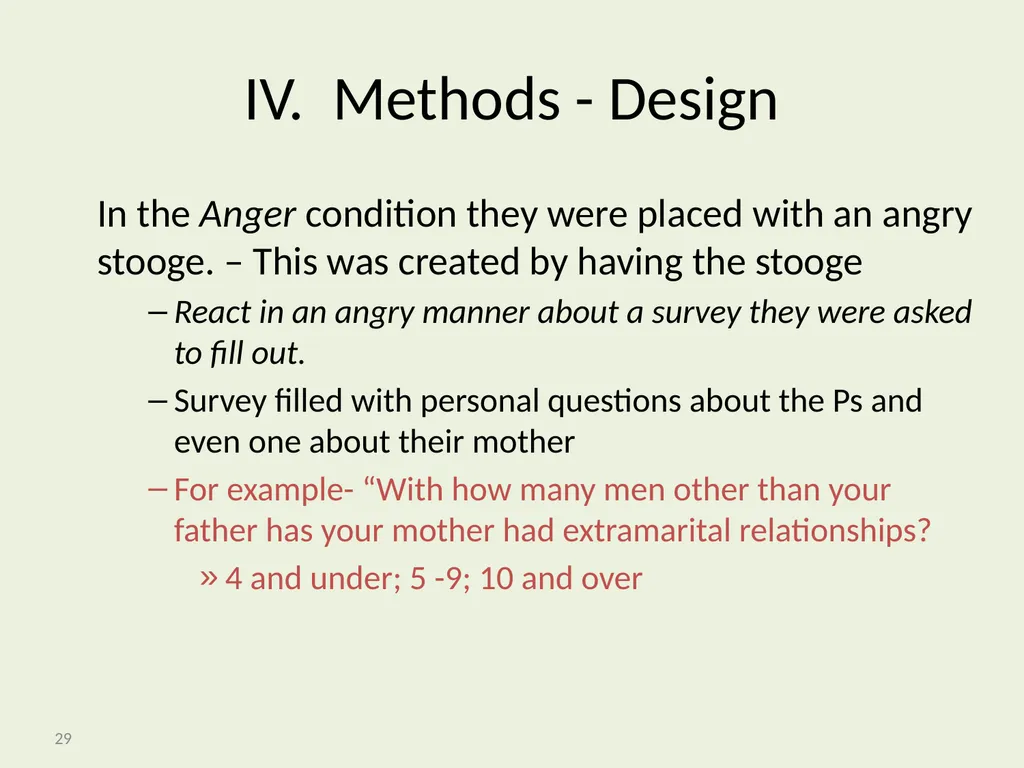
IV. Methods - Design In the Anger condition they were placed with an angry stooge. – This was created by having the stooge
React in an angry manner about a survey they were asked to fill out.
Survey filled with personal questions about the Ps and even one about their mother
For example- “With how many men other than your father has your mother had extramarital relationships?
4 and under; 5 -9; 10 and over 29<br>
React in an angry manner about a survey they were asked to fill out.
Survey filled with personal questions about the Ps and even one about their mother
For example- “With how many men other than your father has your mother had extramarital relationships?
4 and under; 5 -9; 10 and over 29<br>
27
IV. Methodology - Procedure DV
1. Emotional response
2. Measured in two ways:
a. Researcher’s observations
b. Self-report questionnaires divided into Likert type scales (quantitative data) and Open-ended questions (qualitative data) 30<br>
1. Emotional response
2. Measured in two ways:
a. Researcher’s observations
b. Self-report questionnaires divided into Likert type scales (quantitative data) and Open-ended questions (qualitative data) 30<br>
28
IV. Methodology - Procedure G. Debriefing
1. After the exp was over subjects were told the true purpose of the exp and all deceptions were revealed
2. Subjects were sworn to secrecy. 31<br>
1. After the exp was over subjects were told the true purpose of the exp and all deceptions were revealed
2. Subjects were sworn to secrecy. 31<br>
29
IV. Methodology - Procedure 3. Subjects given a questionnaire about prior knowledge of adrenalin or this experiment
11 subjects reported that they were “extremely suspicious” about the true nature of the experiment so their results were excluded. 32<br>
11 subjects reported that they were “extremely suspicious” about the true nature of the experiment so their results were excluded. 32<br>
30
IV. Methodology –Data Collection G. Data Collection
1. Observation through 1 way mirror this was considered a “semiprivate” index of mood as the subject was unaware that he was being observed.
a. In Euphoric condition coded in 3 categories
Joins activity
Initiates activity
Ignores activity
b. 88% level of interrater reliability 33<br>
1. Observation through 1 way mirror this was considered a “semiprivate” index of mood as the subject was unaware that he was being observed.
a. In Euphoric condition coded in 3 categories
Joins activity
Initiates activity
Ignores activity
b. 88% level of interrater reliability 33<br>
31
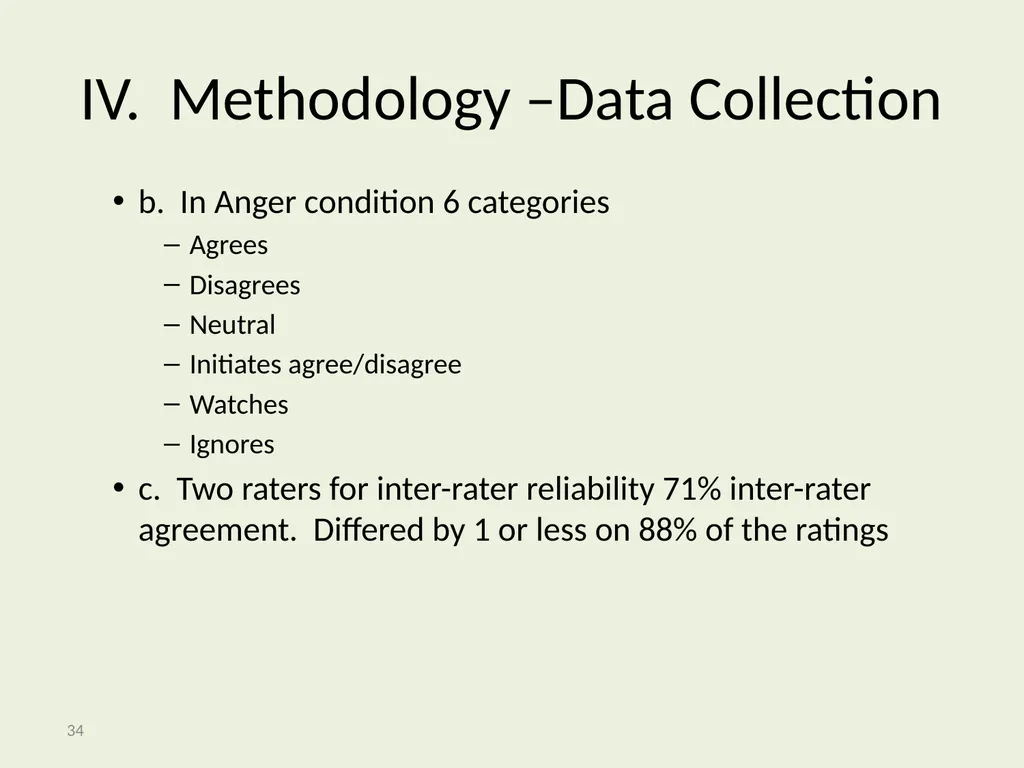
IV. Methodology –Data Collection b. In Anger condition 6 categories
Agrees
Disagrees
Neutral
Initiates agree/disagree
Watches
Ignores
c. Two raters for inter-rater reliability 71% inter-rater agreement. Differed by 1 or less on 88% of the ratings 34<br>
Agrees
Disagrees
Neutral
Initiates agree/disagree
Watches
Ignores
c. Two raters for inter-rater reliability 71% inter-rater agreement. Differed by 1 or less on 88% of the ratings 34<br>
32
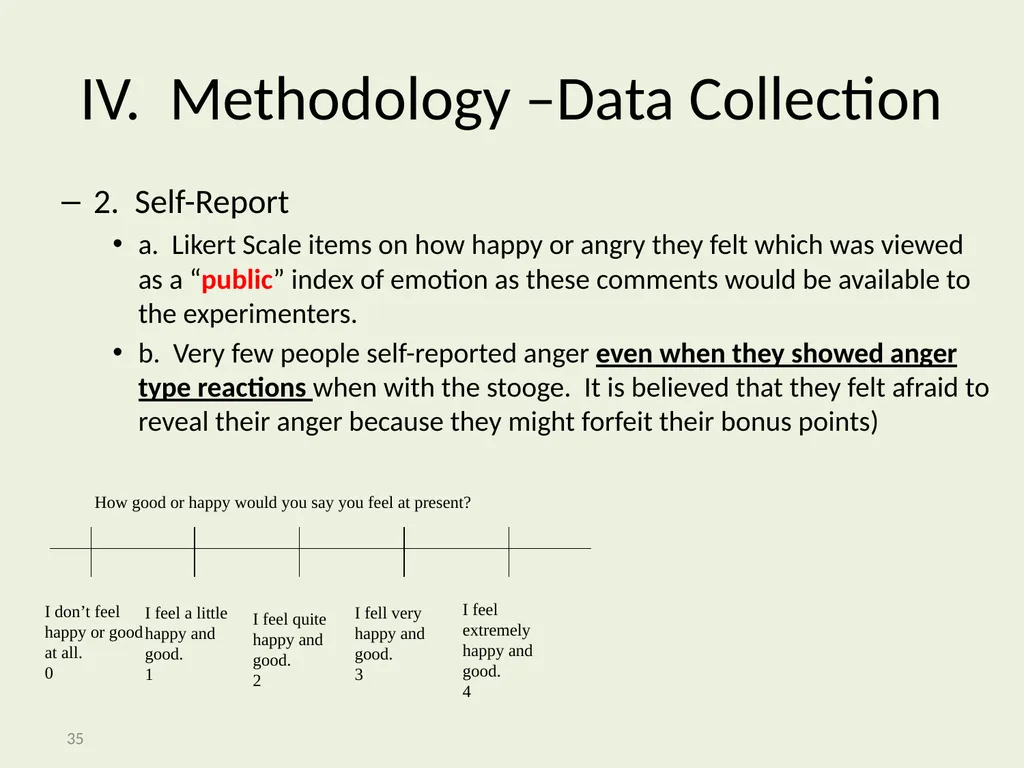
IV. Methodology –Data Collection 2. Self-Report
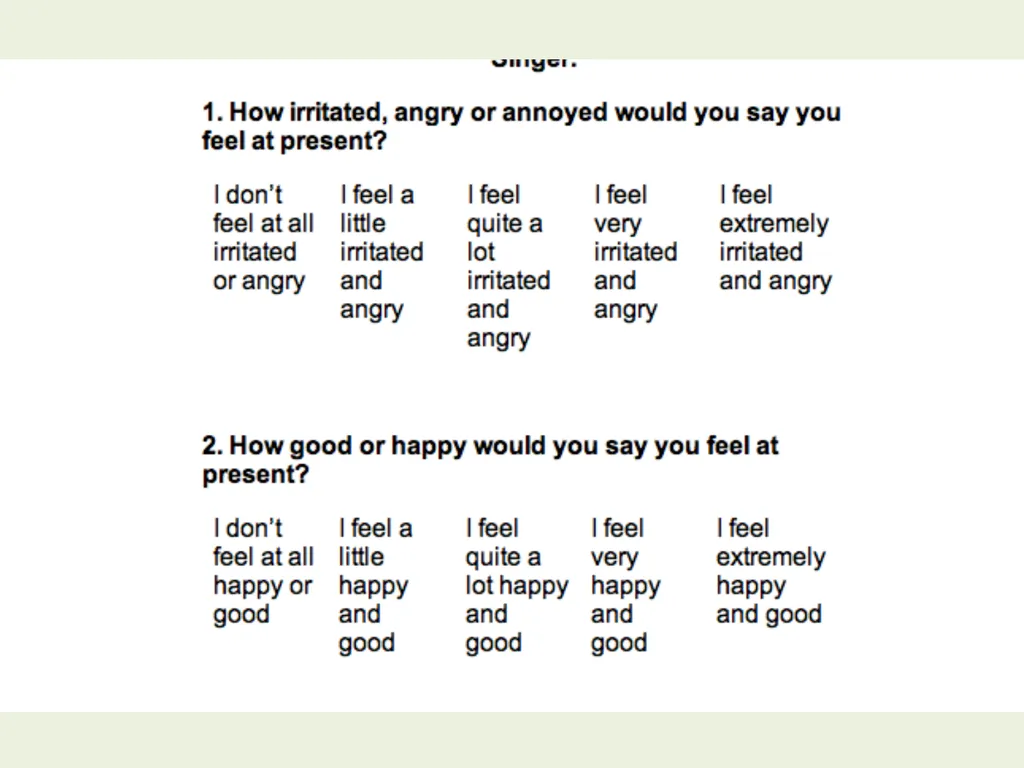
a. Likert Scale items on how happy or angry they felt which was viewed as a “public” index of emotion as these comments would be available to the experimenters.
b. Very few people self-reported anger even when they showed anger type reactions when with the stooge. It is believed that they felt afraid to reveal their anger because they might forfeit their bonus points) 35 How good or happy would you say you feel at present? I don’t feel happy or good at all.
0 I feel a little happy and good.
1 I feel quite happy and good.
2 I fell very happy and good.
3 I feel extremely happy and good.
4<br>
33
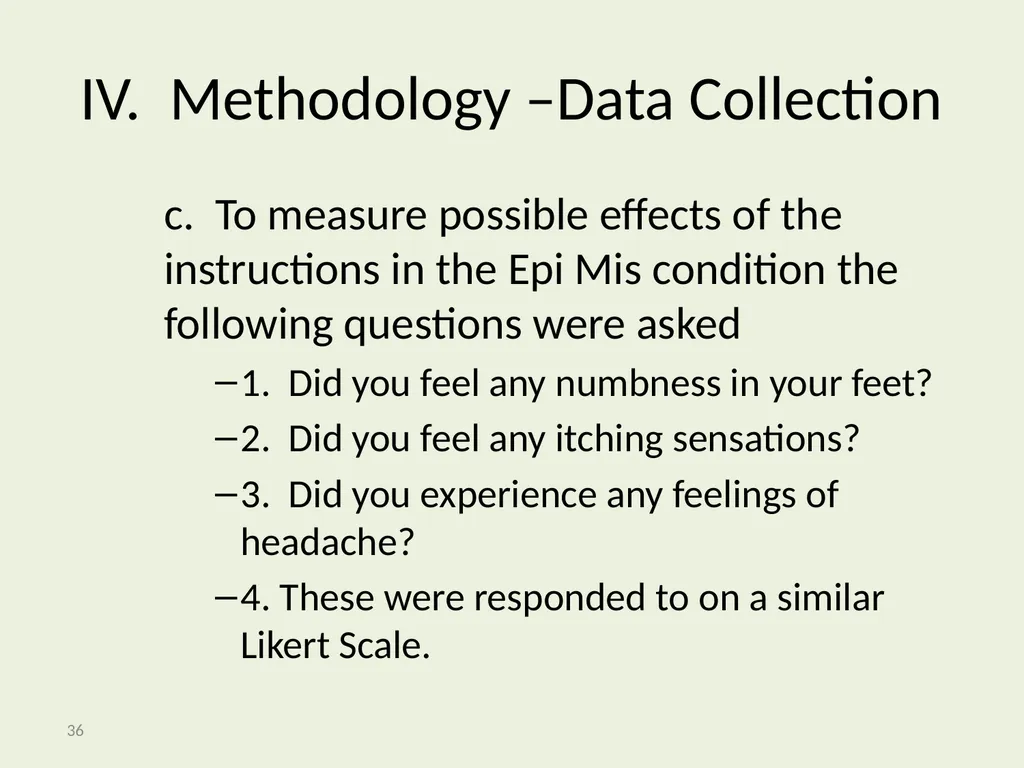
IV. Methodology –Data Collection c. To measure possible effects of the instructions in the Epi Mis condition the following questions were asked
1. Did you feel any numbness in your feet?
2. Did you feel any itching sensations?
3. Did you experience any feelings of headache?
4. These were responded to on a similar Likert Scale. 36<br>
1. Did you feel any numbness in your feet?
2. Did you feel any itching sensations?
3. Did you experience any feelings of headache?
4. These were responded to on a similar Likert Scale. 36<br>
34
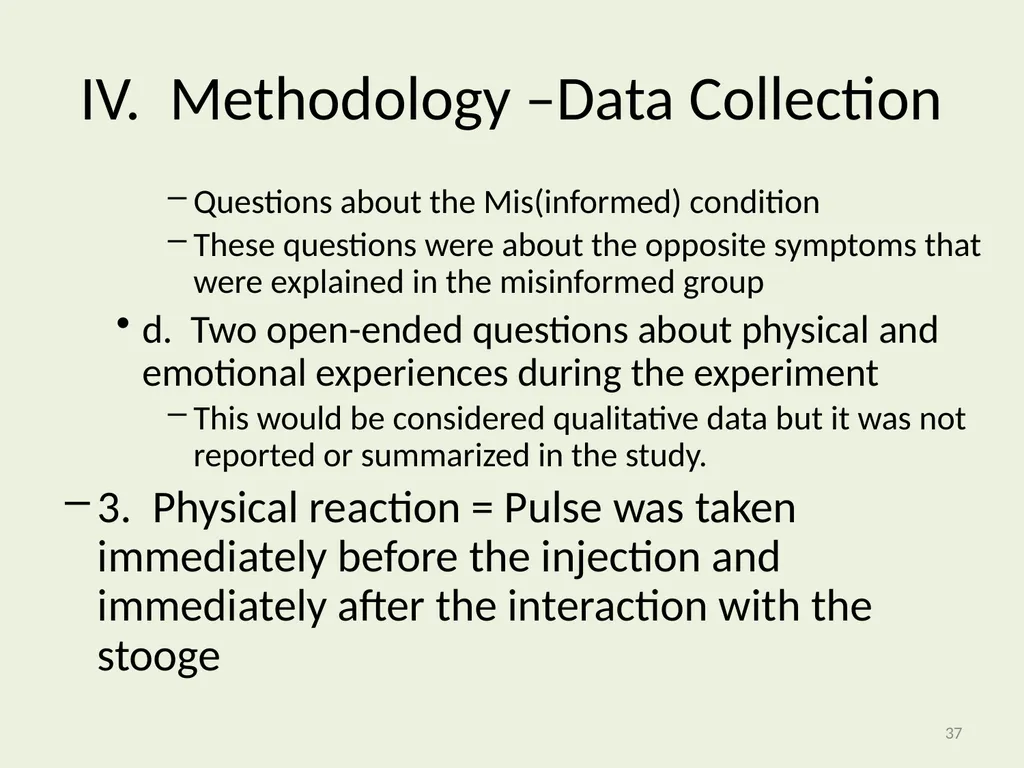
IV. Methodology –Data Collection Questions about the Mis(informed) condition
These questions were about the opposite symptoms that were explained in the misinformed group
d. Two open-ended questions about physical and emotional experiences during the experiment
This would be considered qualitative data but it was not reported or summarized in the study.
3. Physical reaction = Pulse was taken immediately before the injection and immediately after the interaction with the stooge 37<br>
35
Study Alternatives (Re-Creation) WHAT
HOW
WHO
WHERE<br>
HOW
WHO
WHERE<br>
36
Bellringer<br>
37
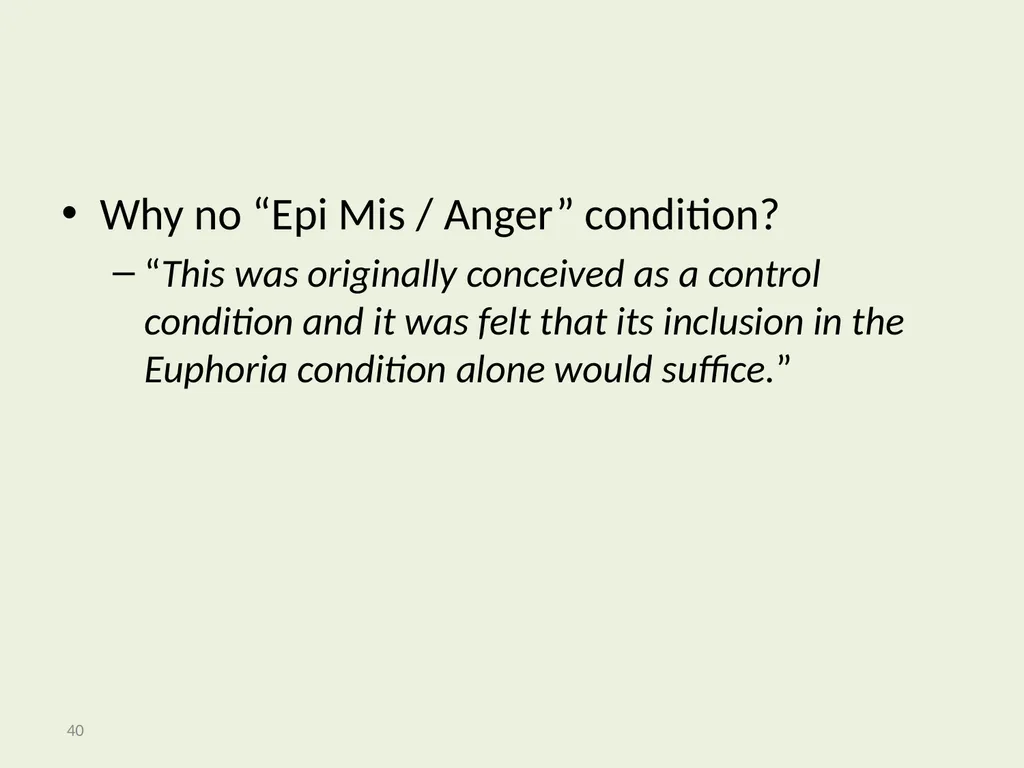
Why no “Epi Mis / Anger” condition?
“This was originally conceived as a control condition and it was felt that its inclusion in the Euphoria condition alone would suffice.” 40<br>
“This was originally conceived as a control condition and it was felt that its inclusion in the Euphoria condition alone would suffice.” 40<br>
38
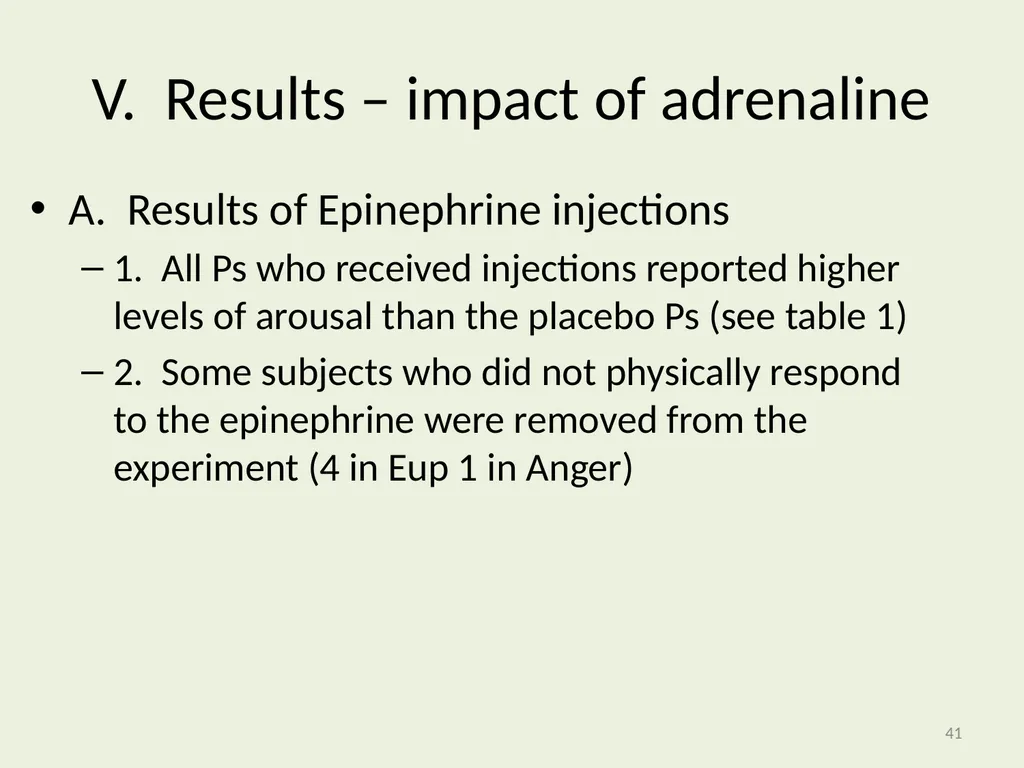
V. Results – impact of adrenaline A. Results of Epinephrine injections
1. All Ps who received injections reported higher levels of arousal than the placebo Ps (see table 1)
2. Some subjects who did not physically respond to the epinephrine were removed from the experiment (4 in Eup 1 in Anger) 41<br>
1. All Ps who received injections reported higher levels of arousal than the placebo Ps (see table 1)
2. Some subjects who did not physically respond to the epinephrine were removed from the experiment (4 in Eup 1 in Anger) 41<br>
39
V. Results – impact of adrenaline 3. Those in the misinformed condition did not differ from the others so this condition was only used in the Euphoric condition
4. When asked open-ended questions in which subjects described their own mood and state, 28% of the subjects in the Epi Ign made a connection between the shot and their mood compared to only 16% of the Epi Mis 5. Placebo Ps reported that the were less euphoric/angry than either Epi Mis or Epi Ign but more so than Epi Inf. 42<br>
4. When asked open-ended questions in which subjects described their own mood and state, 28% of the subjects in the Epi Ign made a connection between the shot and their mood compared to only 16% of the Epi Mis 5. Placebo Ps reported that the were less euphoric/angry than either Epi Mis or Epi Ign but more so than Epi Inf. 42<br>
40
V. Results – Effect of the Manipulations B. Euphoric Condition
1. In the Euphoria condition both the Epi Ign & Epi Mis groups reported more happiness and less anger
2. Those in the Anger condition who were Epi Ign reported less happiness and greater anger as predicted 43<br>
1. In the Euphoria condition both the Epi Ign & Epi Mis groups reported more happiness and less anger
2. Those in the Anger condition who were Epi Ign reported less happiness and greater anger as predicted 43<br>
41
V. Results – Effect of the Manipulations 3. Results of the observations
a. Score represents both the nature “wildness” of the action and the time spent in the action
b. Thus using the Hula Hoop was weighted as a 5 and doing nothing was a zero.
c. This score was multiplied by an estimate of how much time the Ps spent on that activity, this was scored across all activities. 44<br>
42
V. Results – Effect of the Manipulations d. The weightings were created based on the results of a “pre-test” using 15 college students.
e. Based on these ratings Epi Mis>Epi Ign>Epi Inf
f. Using these behavioral indices the Epi Ign and Epi Mis subjects are somewhat more euphoric than the placebo subjects but NOT SIGNIFICANTLY SO. 45<br>
e. Based on these ratings Epi Mis>Epi Ign>Epi Inf
f. Using these behavioral indices the Epi Ign and Epi Mis subjects are somewhat more euphoric than the placebo subjects but NOT SIGNIFICANTLY SO. 45<br>
43
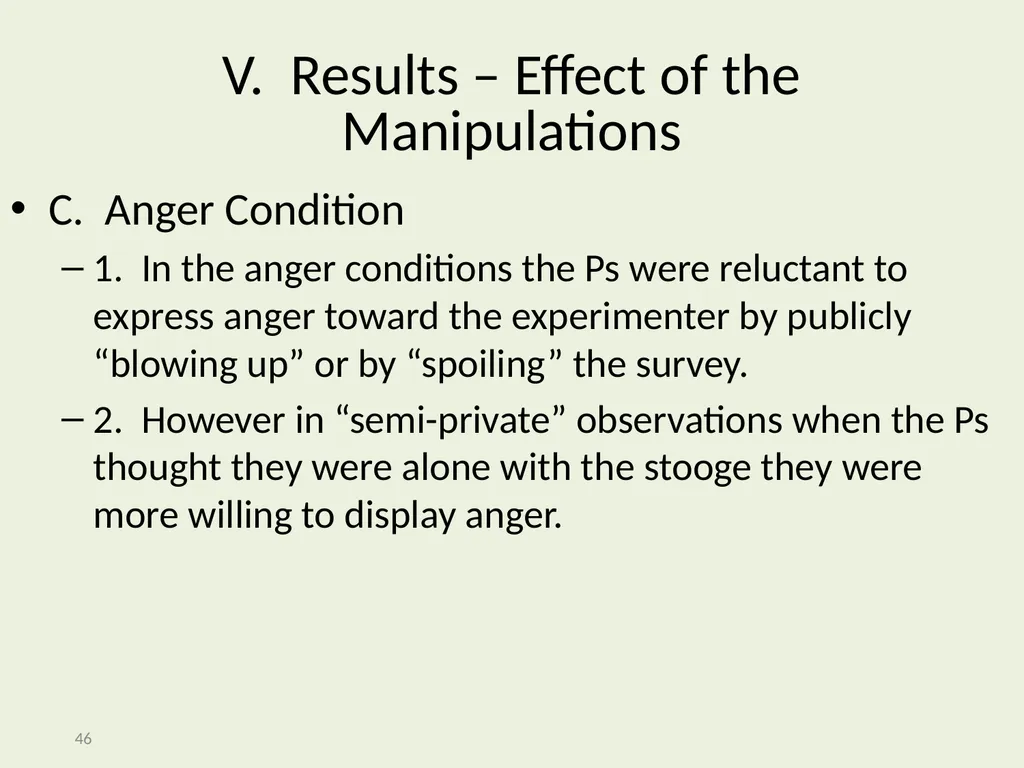
V. Results – Effect of the Manipulations C. Anger Condition
1. In the anger conditions the Ps were reluctant to express anger toward the experimenter by publicly “blowing up” or by “spoiling” the survey.
2. However in “semi-private” observations when the Ps thought they were alone with the stooge they were more willing to display anger. 46<br>
1. In the anger conditions the Ps were reluctant to express anger toward the experimenter by publicly “blowing up” or by “spoiling” the survey.
2. However in “semi-private” observations when the Ps thought they were alone with the stooge they were more willing to display anger. 46<br>
44
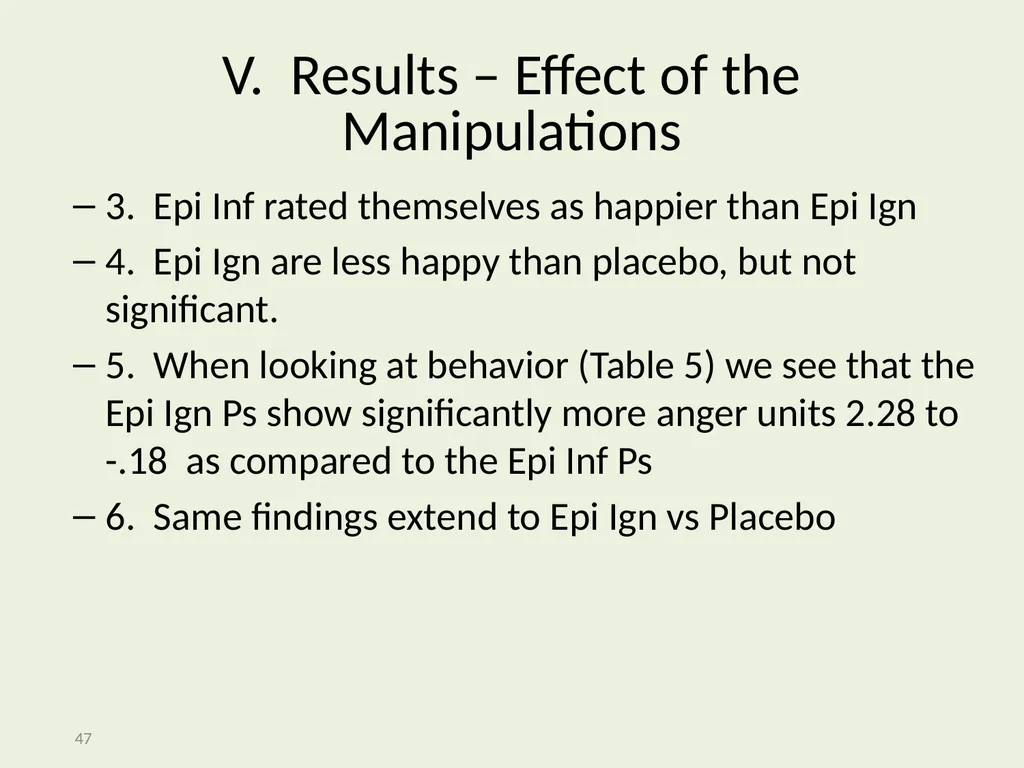
V. Results – Effect of the Manipulations 3. Epi Inf rated themselves as happier than Epi Ign
4. Epi Ign are less happy than placebo, but not significant.
5. When looking at behavior (Table 5) we see that the Epi Ign Ps show significantly more anger units 2.28 to -.18 as compared to the Epi Inf Ps
6. Same findings extend to Epi Ign vs Placebo 47<br>
4. Epi Ign are less happy than placebo, but not significant.
5. When looking at behavior (Table 5) we see that the Epi Ign Ps show significantly more anger units 2.28 to -.18 as compared to the Epi Inf Ps
6. Same findings extend to Epi Ign vs Placebo 47<br>
45
V. Results – Effect of the Manipulations 6. Therefore the authors chose to rely on the behavioral observation indices but they still present the self-report data in Table 4. 48<br>
46
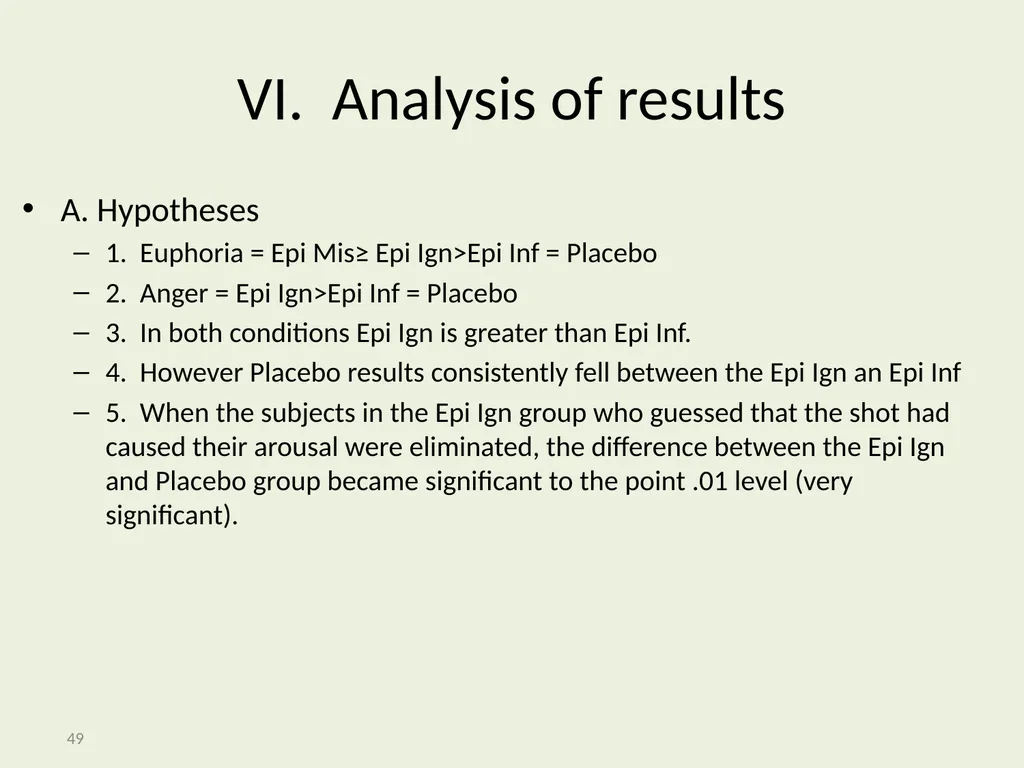
VI. Analysis of results A. Hypotheses
1. Euphoria = Epi Mis≥ Epi Ign>Epi Inf = Placebo
2. Anger = Epi Ign>Epi Inf = Placebo
3. In both conditions Epi Ign is greater than Epi Inf.
4. However Placebo results consistently fell between the Epi Ign an Epi Inf
5. When the subjects in the Epi Ign group who guessed that the shot had caused their arousal were eliminated, the difference between the Epi Ign and Placebo group became significant to the point .01 level (very significant). 49<br>
47
VI. Analysis of Results 6. Why then would the Placebo Ps show both greater self report and behavioral emotional responses than the Epi Inf group.
a. Lack of epinephrine does not mean that they will not experience some arousal
b. The shot itself could have caused some arousal 50<br>
a. Lack of epinephrine does not mean that they will not experience some arousal
b. The shot itself could have caused some arousal 50<br>
48
VI. Analysis of Results – summary B. In regards to Aim 1 where the subjects experienced arousal w/o cognition both the Epi Ign & Epi Mis Ps showed the most emotion
C. In conditions where the subjects experienced arousal w/ cognition (=Inf) they experienced no emotion in other words, the environment didn’t affect them (AIM 2)
D. For those with no arousal (placebo), Aim 3 doesn’t seem to be supported as they did show more emotional responses than the EPI Inf group. However a possible explanation for this was provided by the authors. 51<br>
49
Group Practice You will be writing on a piece of lined post-it paper.
Using the PEE method, respond:
Describe two ethical issues raised by Shacter & Singer. [6]
Explain one reason why the researchers needed to break ethical guidelines and one reason why they should not have done so. [6]<br>
Using the PEE method, respond:
Describe two ethical issues raised by Shacter & Singer. [6]
Explain one reason why the researchers needed to break ethical guidelines and one reason why they should not have done so. [6]<br>
50
VII. Evaluation – Methodological issues A. Over-all Ethical
1. all participants were psychology students
2. health checked in advance
3. consent received
4. no long-term harm
5. However, shots are painful.
6. Deception was used 53<br>
1. all participants were psychology students
2. health checked in advance
3. consent received
4. no long-term harm
5. However, shots are painful.
6. Deception was used 53<br>
51
VII. Evaluation – Methodological issues B. Validity of the results
1. Not all results were statistically significant unless certain subject’s data points were removed from consideration
2. Using an injection is not ideal
a. Would be better to deliver unbeknownst to the Ps
b. Could injection have caused Placebo Ps to have heightened arousal. 54<br>
1. Not all results were statistically significant unless certain subject’s data points were removed from consideration
2. Using an injection is not ideal
a. Would be better to deliver unbeknownst to the Ps
b. Could injection have caused Placebo Ps to have heightened arousal. 54<br>
52
VII. Evaluation – Methodological issues 3. Some Ps in the Mis & Ign also linked injection to arousal (design: to exp arousal w/o obvious cause!?!) these self- informers were excluded from the results possibly impacting the findings.
4. This is referred to as Experimental artifacts.
a. Artifacts refer to variables that should have been systematically varied, either within or across studies, but that were accidentally held constant.
b. Artifacts are thus threats to external validity. 55<br>
4. This is referred to as Experimental artifacts.
a. Artifacts refer to variables that should have been systematically varied, either within or across studies, but that were accidentally held constant.
b. Artifacts are thus threats to external validity. 55<br>
53
VII. Evaluation – Methodological issues 5. As two different methods were used for measuring behavior between the Anger and Euphoria conditions no direct test of hypothesis 1 is possible. (Hilgard 1979)
6. Other problems identified by Hilgard
a. Epinephrine doesn’t effect all the same way
b. No mood check before injection
c. Is synthetic arousal similar to real life arousal? 56<br>
6. Other problems identified by Hilgard
a. Epinephrine doesn’t effect all the same way
b. No mood check before injection
c. Is synthetic arousal similar to real life arousal? 56<br>
54
VII. Evaluation – Methodological issues 7. Self-report presented as [happiness or anger]
a. all Ps’ self-reports were on happy side
b. Thus the self-report alone shows that S&S failed to produce any anger with the questionnaire.
c. However S&S argued that it could be seen behaviorally 57<br>
a. all Ps’ self-reports were on happy side
b. Thus the self-report alone shows that S&S failed to produce any anger with the questionnaire.
c. However S&S argued that it could be seen behaviorally 57<br>
55
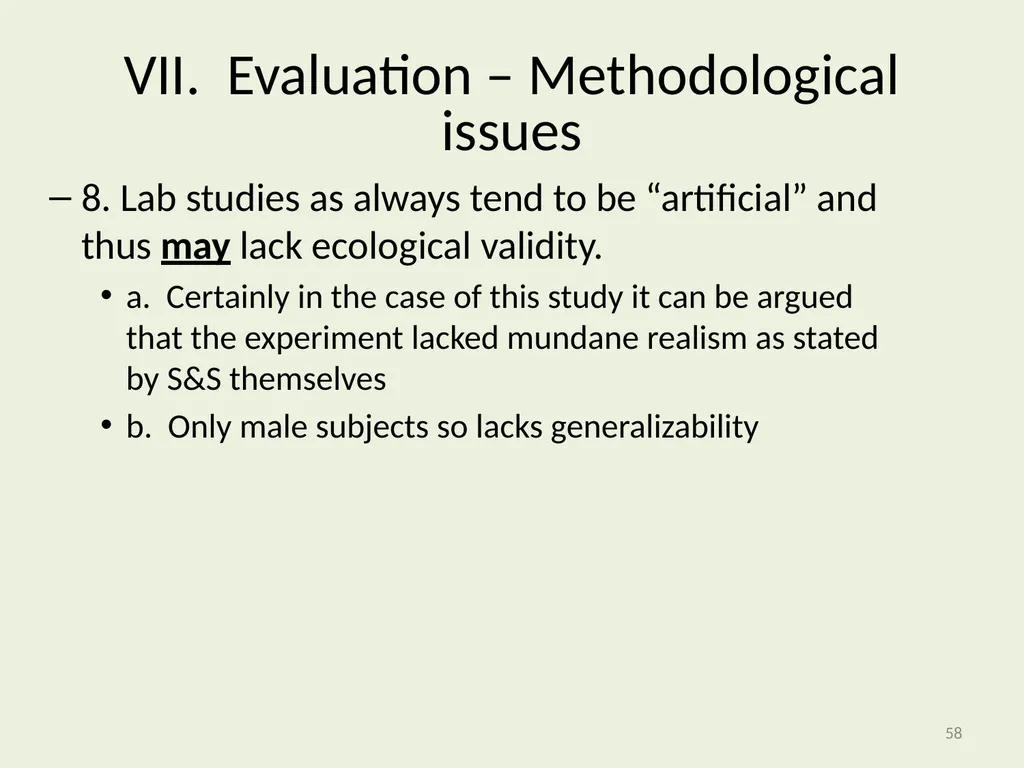
VII. Evaluation – Methodological issues 8. Lab studies as always tend to be “artificial” and thus may lack ecological validity.
a. Certainly in the case of this study it can be argued that the experiment lacked mundane realism as stated by S&S themselves
b. Only male subjects so lacks generalizability 58<br>
a. Certainly in the case of this study it can be argued that the experiment lacked mundane realism as stated by S&S themselves
b. Only male subjects so lacks generalizability 58<br>
56
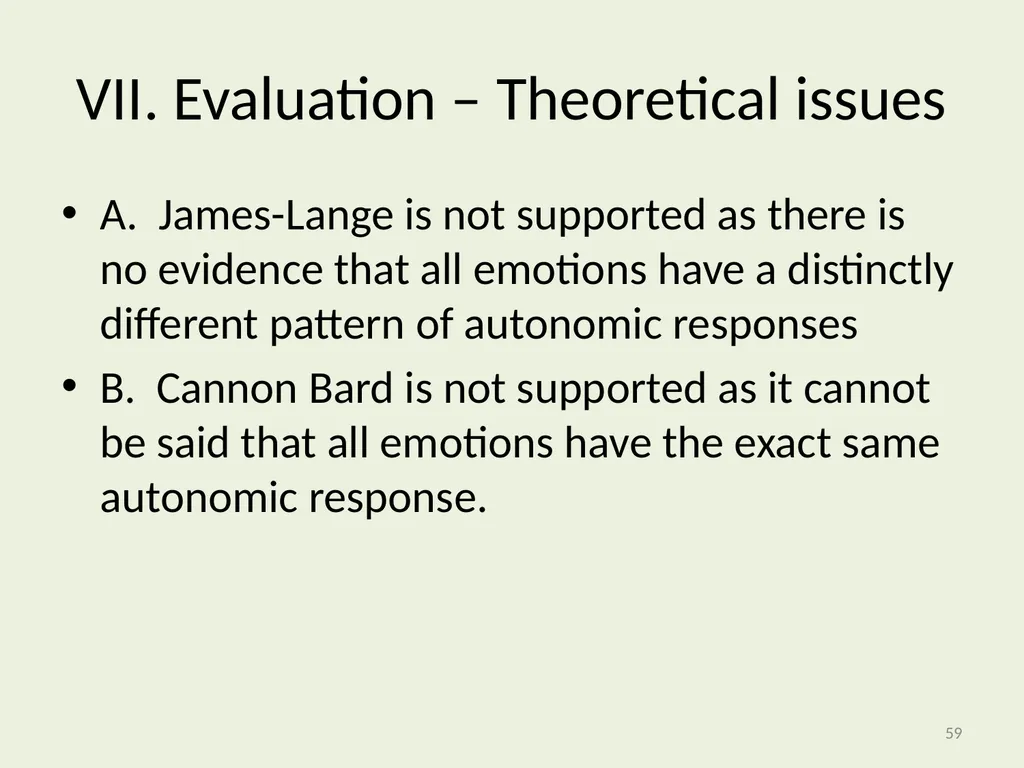
VII. Evaluation – Theoretical issues A. James-Lange is not supported as there is no evidence that all emotions have a distinctly different pattern of autonomic responses
B. Cannon Bard is not supported as it cannot be said that all emotions have the exact same autonomic response. 59<br>
B. Cannon Bard is not supported as it cannot be said that all emotions have the exact same autonomic response. 59<br>
57
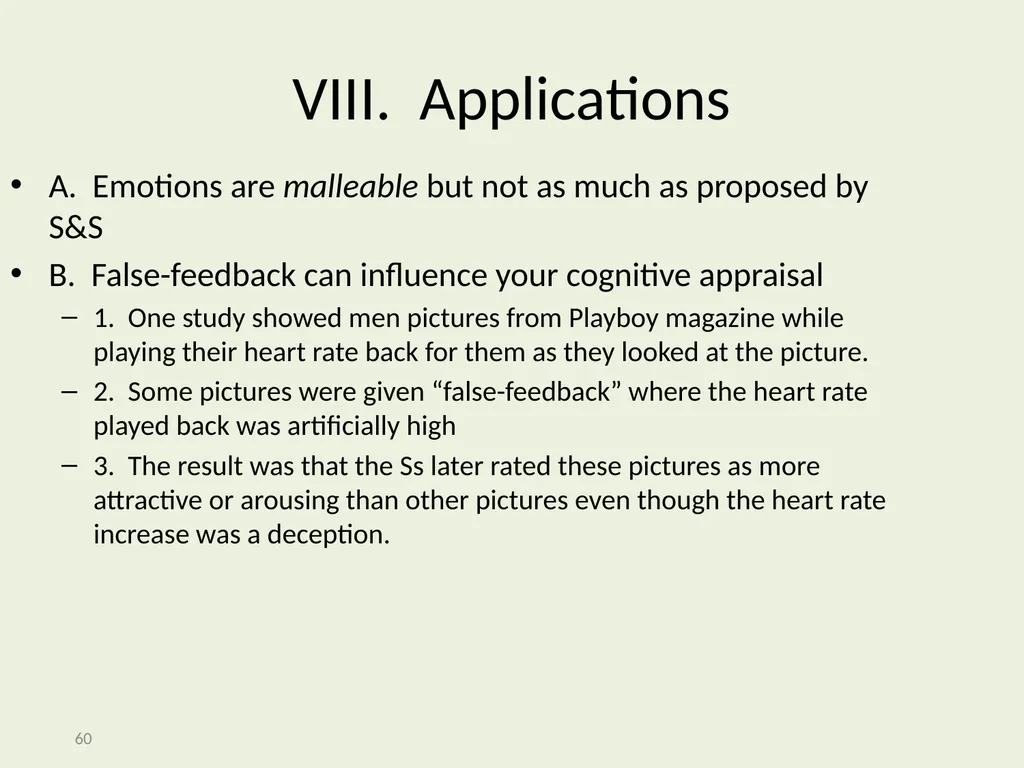
VIII. Applications A. Emotions are malleable but not as much as proposed by S&S
B. False-feedback can influence your cognitive appraisal
1. One study showed men pictures from Playboy magazine while playing their heart rate back for them as they looked at the picture.
2. Some pictures were given “false-feedback” where the heart rate played back was artificially high
3. The result was that the Ss later rated these pictures as more attractive or arousing than other pictures even though the heart rate increase was a deception. 60<br>
58
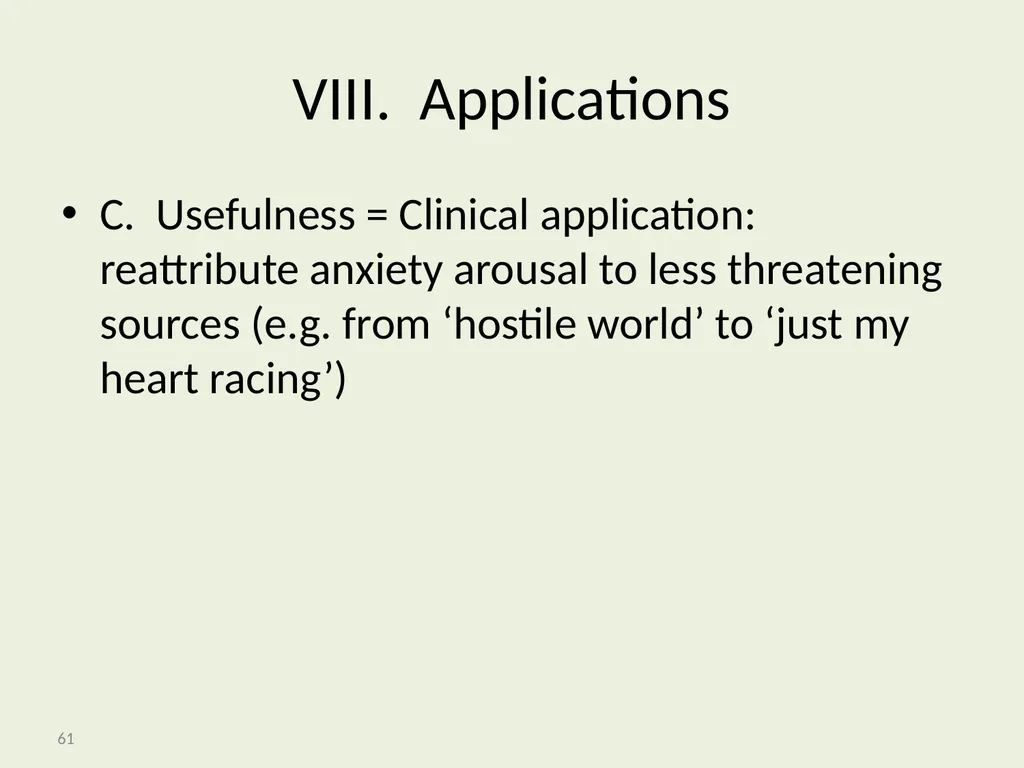
VIII. Applications C. Usefulness = Clinical application: reattribute anxiety arousal to less threatening sources (e.g. from ‘hostile world’ to ‘just my heart racing’) 61<br>
59
Cue 10: List 3 ways subjects were deceived in this experiment
Cue 11: From the reading describe the alternative to injection described by S&S 62<br>
Cue 11: From the reading describe the alternative to injection described by S&S 62<br>