
SCHIZOPHRENIA Presenter: Dr. Arpit Jaiswal
SB
Published · 46 slides · 0 views
1 / 1








Description
SCHIZOPHRENIA Presenter: Dr. Arpit Jaiswal Assistant Professor Deptt.of Psychiatry A married man, age 38, with a history of dependable, conscientious work as a bookkeeper, became sleepless, anxious, and unable to concentrate. He developed
Related Topics
Share
Embed code
Download this presentation From Below
"SCHIZOPHRENIA Presenter: Dr. Arpit Jaiswal" is the property of its rightful owner. Permission is granted to download and print the materials on this website for personal, non-commercial use only, and to display it on your personal computer provided you do not modify the materials and that you retain all copyright notices contained in the materials. By downloading content from our website, you accept the terms of this agreement.
Presentation Transcript
01
SCHIZOPHRENIA Presenter: Dr. Arpit Jaiswal
Assistant Professor
Deptt.of Psychiatry<br>
Assistant Professor
Deptt.of Psychiatry<br>
02
A married man, age 38, with a history of dependable, conscientious work as a bookkeeper, became sleepless, anxious, and unable to concentrate. He developed the belief that his vision was failing because of poisons secretly placed in his food by former neighbors. He found a misprint in a newspaper that he felt was placed there by the editor to shame him publicly.<br>
03
Admitted to the psychiatric service of a general hospital, he said that cars passing up and down the street contained agents who were spying on him. He believed that the electric light bulbs in his room were emanating a purifying radiation to counteract syphilitic germs, which he was supposedly breathing into the atmosphere, although a physical examination was negative for syphilis.<br>
04
History
Epidemiology
Etiopathogenesis
Diagnosis
Clinical features Mangement Sir John Nash, worked on Game theory , Nobel Prize winner<br>
05
Schizophrenia is a clinical syndrome of variable, but profoundly disruptive, psychopathology that involves cognition, emotion, perception, and other aspects of behavior.
It is an illness in which episodes of florid disturbance are usually set against a background of sustained disability<br>
It is an illness in which episodes of florid disturbance are usually set against a background of sustained disability<br>
06
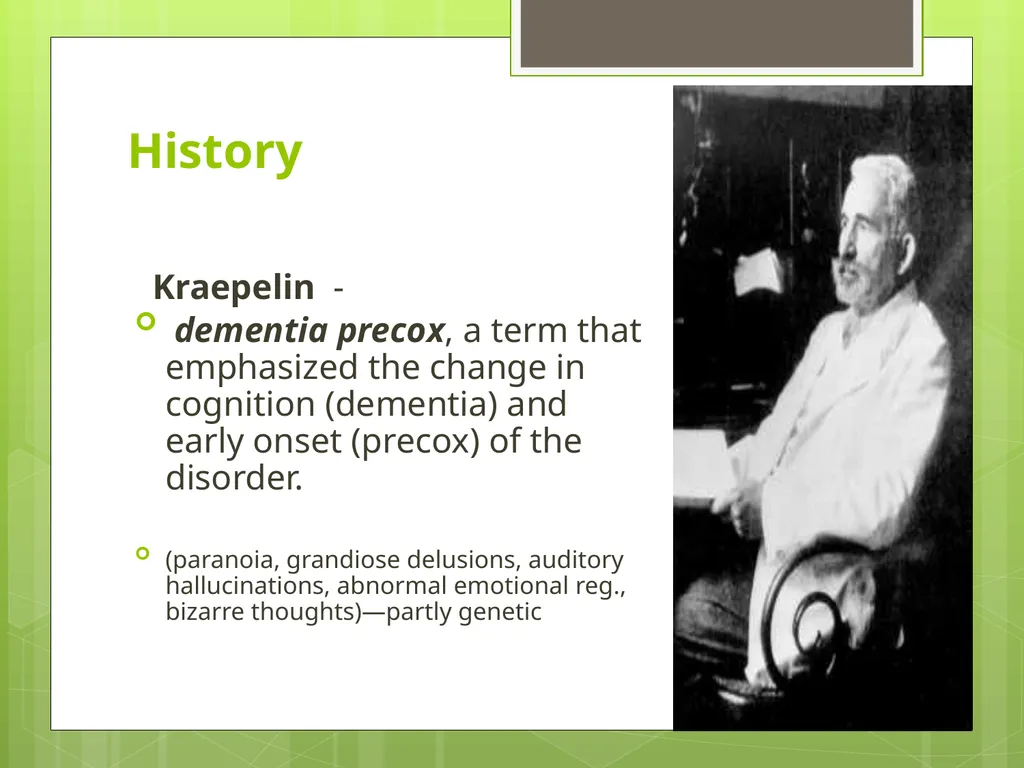
History Kraepelin -
dementia precox, a term that emphasized the change in cognition (dementia) and early onset (precox) of the disorder.
(paranoia, grandiose delusions, auditory hallucinations, abnormal emotional reg., bizarre thoughts)—partly genetic Emile Kraeplin<br>
dementia precox, a term that emphasized the change in cognition (dementia) and early onset (precox) of the disorder.
(paranoia, grandiose delusions, auditory hallucinations, abnormal emotional reg., bizarre thoughts)—partly genetic Emile Kraeplin<br>
07
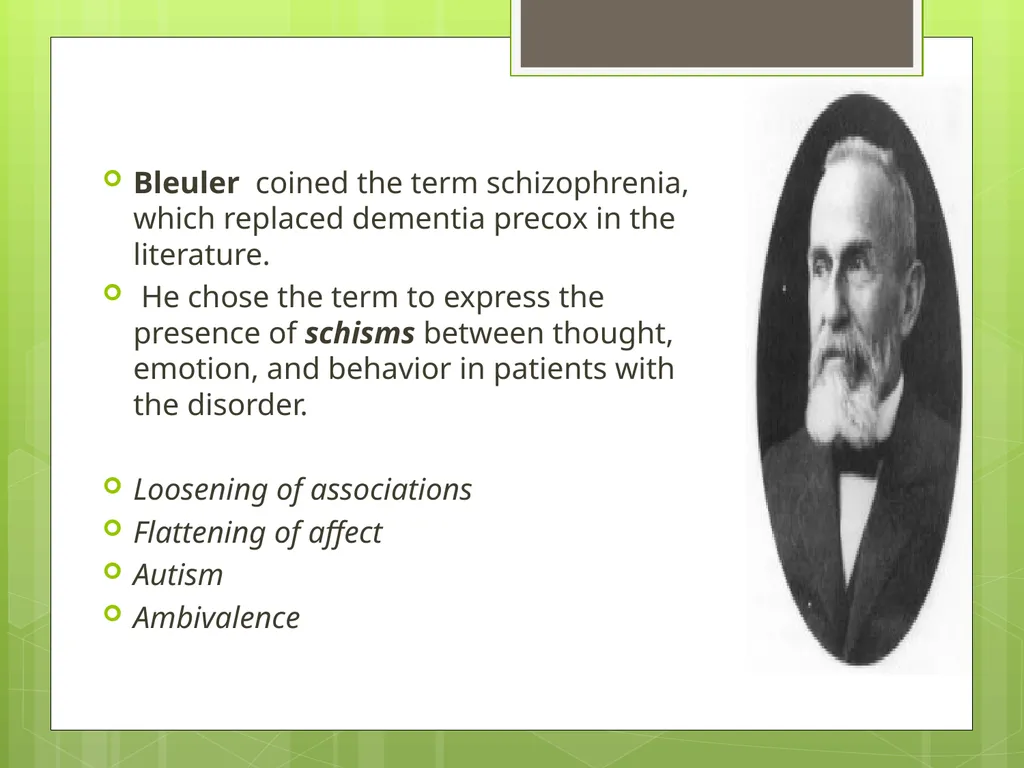
Bleuler coined the term schizophrenia, which replaced dementia precox in the literature.
He chose the term to express the presence of schisms between thought, emotion, and behavior in patients with the disorder.
Loosening of associations
Flattening of affect
Autism
Ambivalence Eugene B<br>
He chose the term to express the presence of schisms between thought, emotion, and behavior in patients with the disorder.
Loosening of associations
Flattening of affect
Autism
Ambivalence Eugene B<br>
08
Epidemiology Schizophrenia is found in all societies and geographical areas, and incidence and prevalence rates are roughly equal worldwide.
the lifetime prevalence of schizophrenia is about 1 percent, which means that about 1 person in 100 will develop schizophrenia during their lifetime.
The Epidemiologic Catchment Area study sponsored by the National Institute of Mental Health reported a lifetime prevalence of 0.6 to 1.9 percent. According to DSM-IV-TR, the annual incidence of schizophrenia ranges from 0.5 to 5.0 per 10,000.<br>
the lifetime prevalence of schizophrenia is about 1 percent, which means that about 1 person in 100 will develop schizophrenia during their lifetime.
The Epidemiologic Catchment Area study sponsored by the National Institute of Mental Health reported a lifetime prevalence of 0.6 to 1.9 percent. According to DSM-IV-TR, the annual incidence of schizophrenia ranges from 0.5 to 5.0 per 10,000.<br>
09
Schizophrenia is equally prevalent in men and women.
The peak ages of onset mid twenties. Unlike men, women display a bimodal age distribution, with a second peak occurring in middle age.<br>
The peak ages of onset mid twenties. Unlike men, women display a bimodal age distribution, with a second peak occurring in middle age.<br>
10
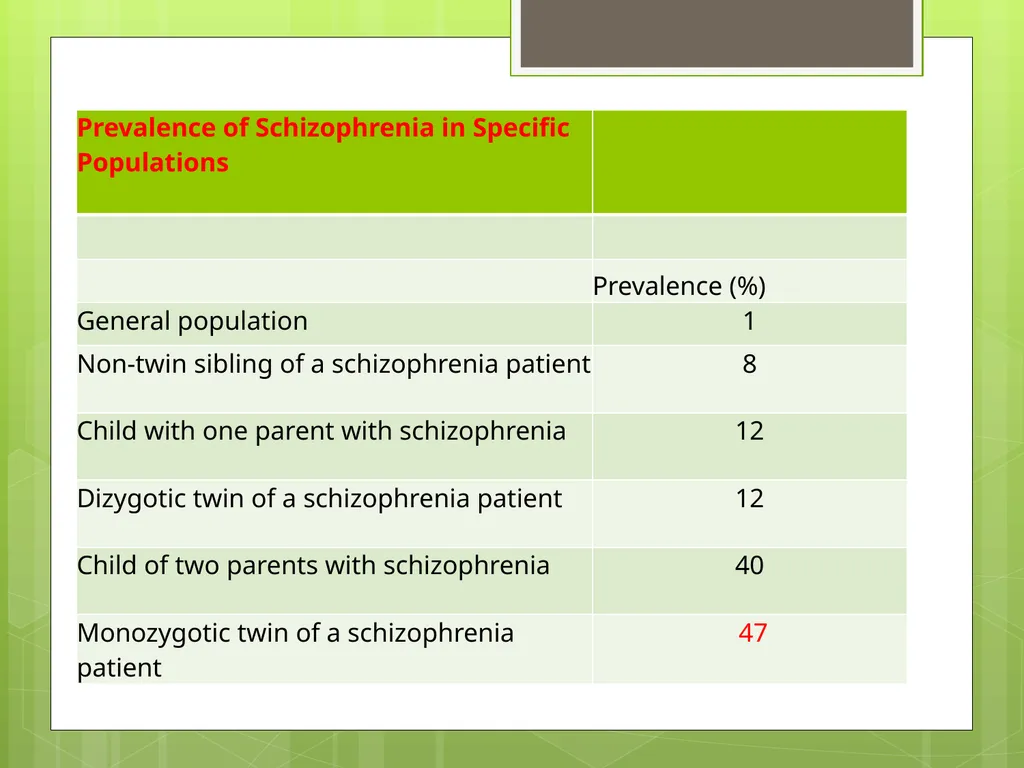
Genetic factor: Genetic factors account for the majority of liability to schizophrenia.
Heritability estimates range from 60-80%
One affected parent 10%risk in child<br>
Heritability estimates range from 60-80%
One affected parent 10%risk in child<br>
11
Environmental factors:
-Complications of pregnancy
- neurodevelopmental difficulties
-Disturbed childhood behaviour
-Maternal influenza in pregnancy and winter births
-Degree of urbanisation at birth<br>
-Complications of pregnancy
- neurodevelopmental difficulties
-Disturbed childhood behaviour
-Maternal influenza in pregnancy and winter births
-Degree of urbanisation at birth<br>
12
Substance Abuse in Schizophrenia Nicotine : Up to 90 % patients may be dependent on nicotine. Apart from smoking-associated mortality, nicotine decreases the blood concentrations of some antipsychotics.
Those reporting high levels of cannabis use (more than 50 occasions) were at sixfold increased risk of schizophrenia compared to nonusers.
Comorbid Alcohol abuse is high.<br>
Those reporting high levels of cannabis use (more than 50 occasions) were at sixfold increased risk of schizophrenia compared to nonusers.
Comorbid Alcohol abuse is high.<br>
13
Etiopathogenesis Schizophrenia is a misregulation of information in the brain
Many different NT pathways are hypothesized to be involved in the biological basis of the disorder
Genetics may be an important role
The environment/ stress triggers a possible genetic predisposition<br>
Many different NT pathways are hypothesized to be involved in the biological basis of the disorder
Genetics may be an important role
The environment/ stress triggers a possible genetic predisposition<br>
14
Genes Genes scattered across 1q, 5q, 6p, 6q, 8p, 10p, 13q, 15q, and 22q
Susceptible genes
Neuregulin 1: NMDA, GABA, & Ach receptors
Dysbindin: synaptic plasticity
Catechol-O-methyl transferase: DA metabol.
G72: regulates glutamatergic activity
Others: myelination, glial function<br>
Susceptible genes
Neuregulin 1: NMDA, GABA, & Ach receptors
Dysbindin: synaptic plasticity
Catechol-O-methyl transferase: DA metabol.
G72: regulates glutamatergic activity
Others: myelination, glial function<br>
15
Neurotransmitters DOPAMINE :
Original theory proposed that an over activation of DA led to schizophrenic symptoms
More recently it has been hypothesized that
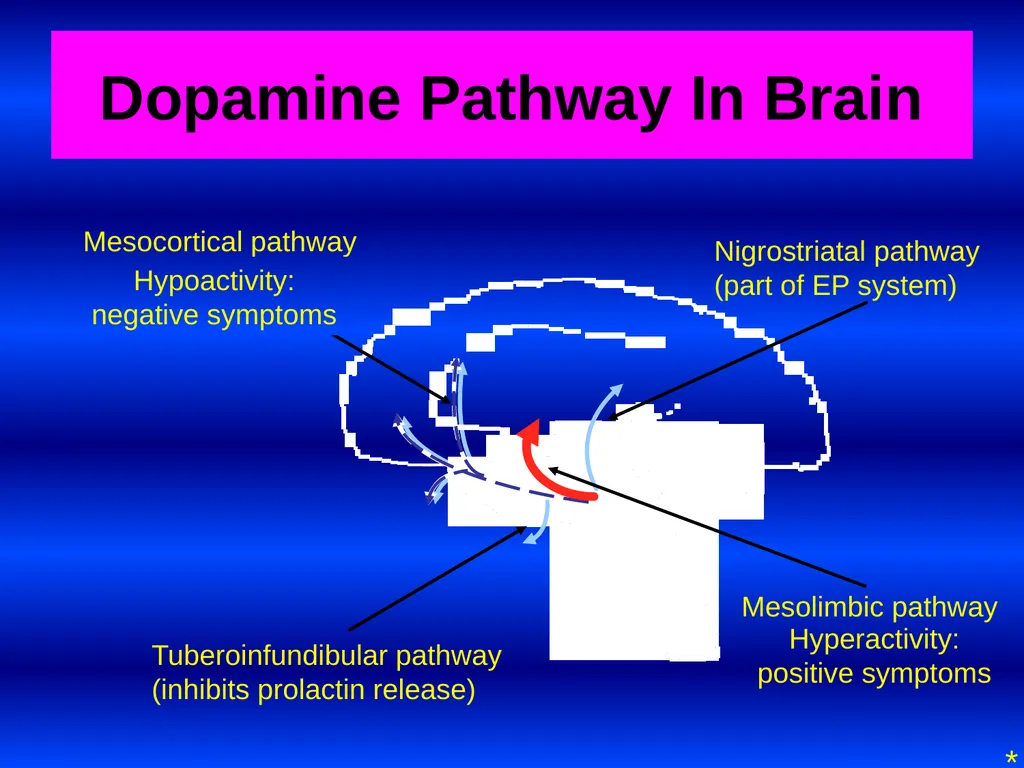
Positive symptoms are caused by an over activation of specific DA pathways
Negative symptoms arise from and under activation of different DA pathways<br>
Original theory proposed that an over activation of DA led to schizophrenic symptoms
More recently it has been hypothesized that
Positive symptoms are caused by an over activation of specific DA pathways
Negative symptoms arise from and under activation of different DA pathways<br>
16
Hyperactivity:
positive symptoms Dopamine Pathway In Brain Hypoactivity:
negative symptoms *<br>
17
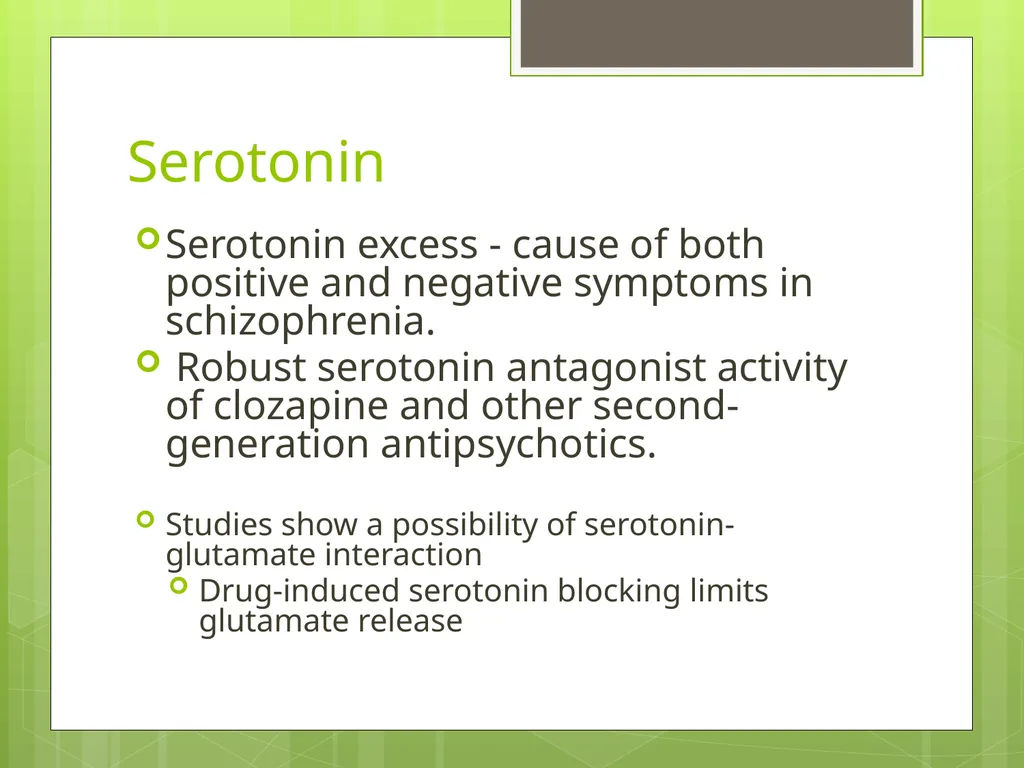
Serotonin Serotonin excess - cause of both positive and negative symptoms in schizophrenia.
Robust serotonin antagonist activity of clozapine and other second-generation antipsychotics.
Studies show a possibility of serotonin-glutamate interaction
Drug-induced serotonin blocking limits glutamate release<br>
Robust serotonin antagonist activity of clozapine and other second-generation antipsychotics.
Studies show a possibility of serotonin-glutamate interaction
Drug-induced serotonin blocking limits glutamate release<br>
18
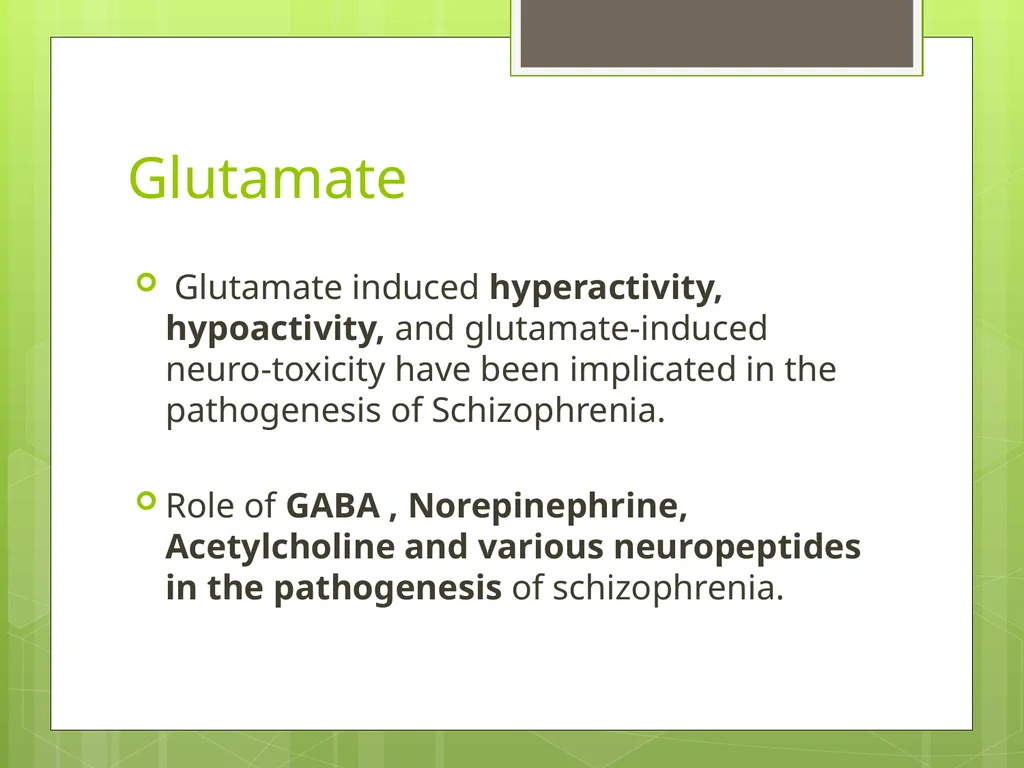
Glutamate Glutamate induced hyperactivity, hypoactivity, and glutamate-induced neuro-toxicity have been implicated in the pathogenesis of Schizophrenia.
Role of GABA , Norepinephrine, Acetylcholine and various neuropeptides in the pathogenesis of schizophrenia.<br>
Role of GABA , Norepinephrine, Acetylcholine and various neuropeptides in the pathogenesis of schizophrenia.<br>
19
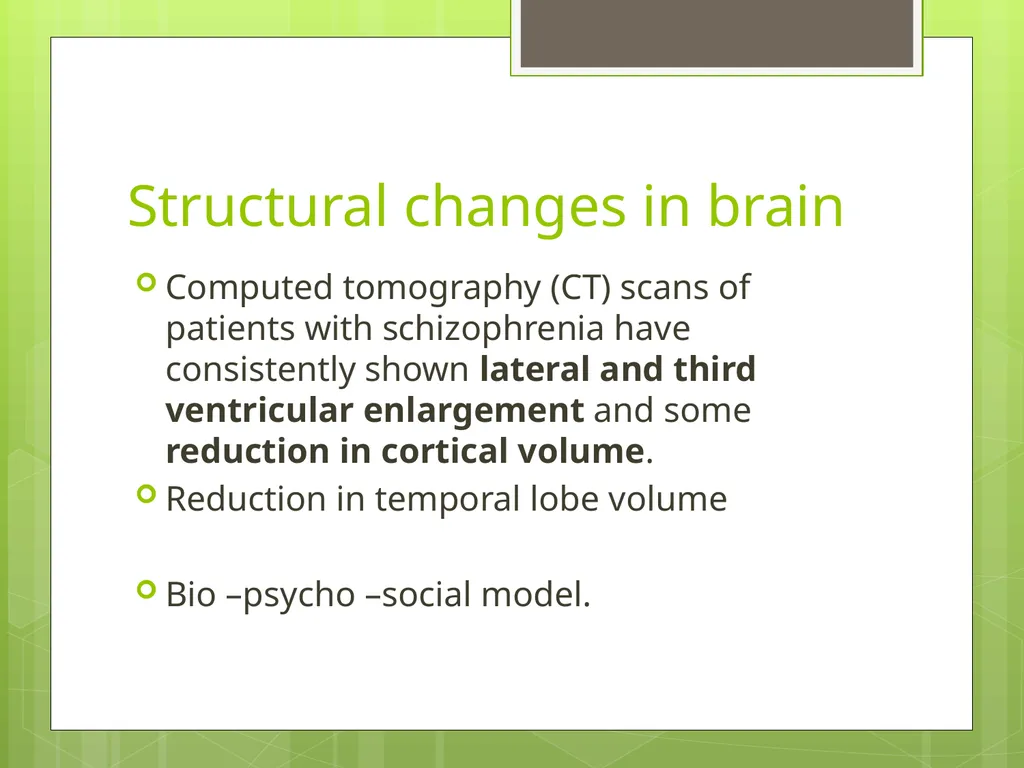
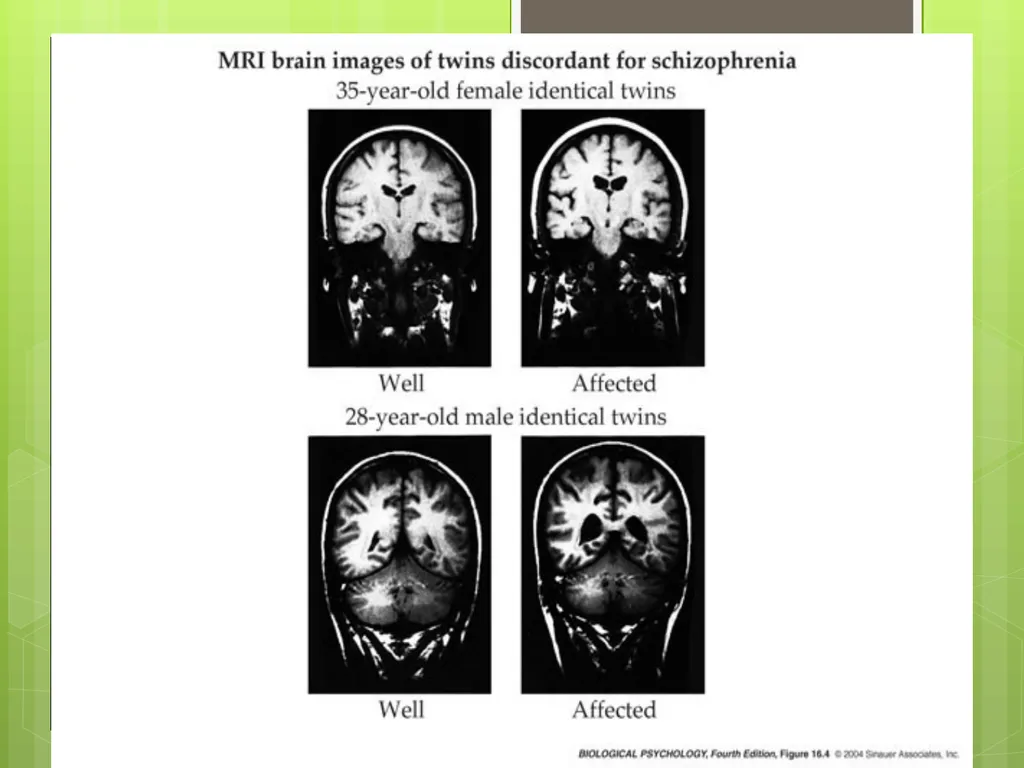
Structural changes in brain Computed tomography (CT) scans of patients with schizophrenia have consistently shown lateral and third ventricular enlargement and some reduction in cortical volume.
Reduction in temporal lobe volume
Bio –psycho –social model.<br>
Reduction in temporal lobe volume
Bio –psycho –social model.<br>
20
Studies of PM brain samples from schizophrenic patients have shown a decrease in the size of the amygdala, the hippocampus, and the parahippocampal gyrus.<br>
21
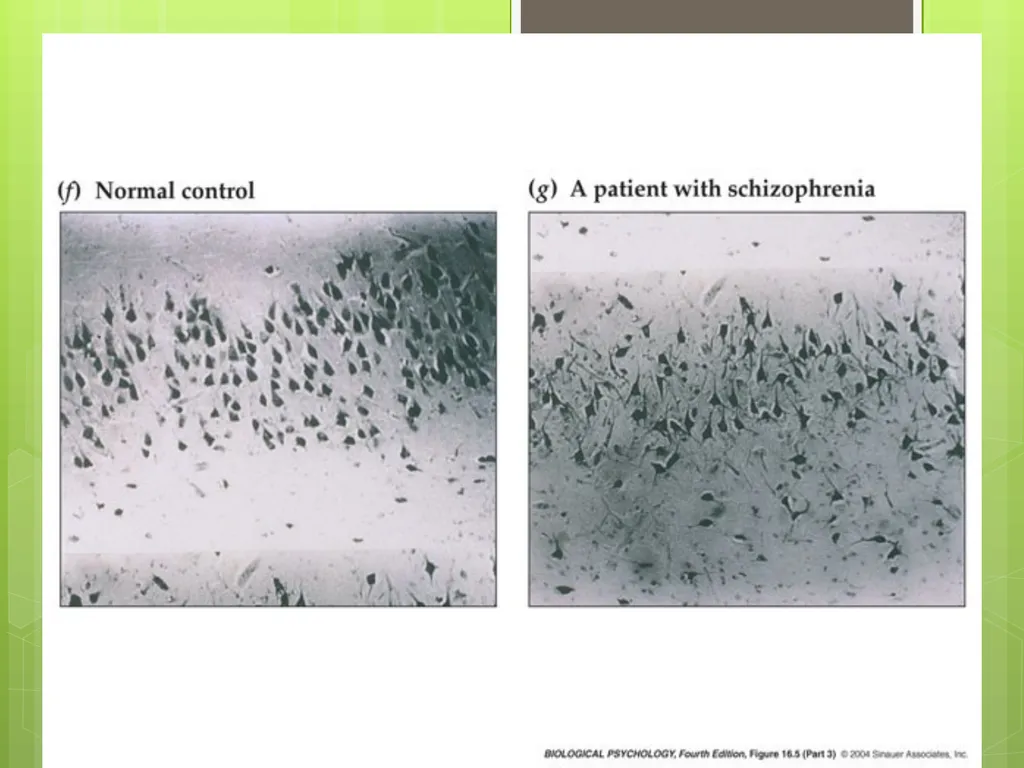
Neuropathology Loss of brain volume occurs in schizophrenic brains, this results from reduced density of the axons, dendrites, and synapses that mediate associative functions of the brain.
Schizophrenia results from excessive pruning of synapses during adolescence.<br>
Schizophrenia results from excessive pruning of synapses during adolescence.<br>
22
Social theories
In the 1960s
e.g. schizophrenogenic mother, marital skew and schism
They are now of historical interest only
. Expressed Emotion: Parents or other caregivers may behave with overt criticism, hostility, and overinvolvement toward a person with schizophrenia
Many studies have indicated that in families with high levels of expressed emotion, the relapse rate for schizophrenia is high.<br>
In the 1960s
e.g. schizophrenogenic mother, marital skew and schism
They are now of historical interest only
. Expressed Emotion: Parents or other caregivers may behave with overt criticism, hostility, and overinvolvement toward a person with schizophrenia
Many studies have indicated that in families with high levels of expressed emotion, the relapse rate for schizophrenia is high.<br>
23
Diagnosis<br>
24
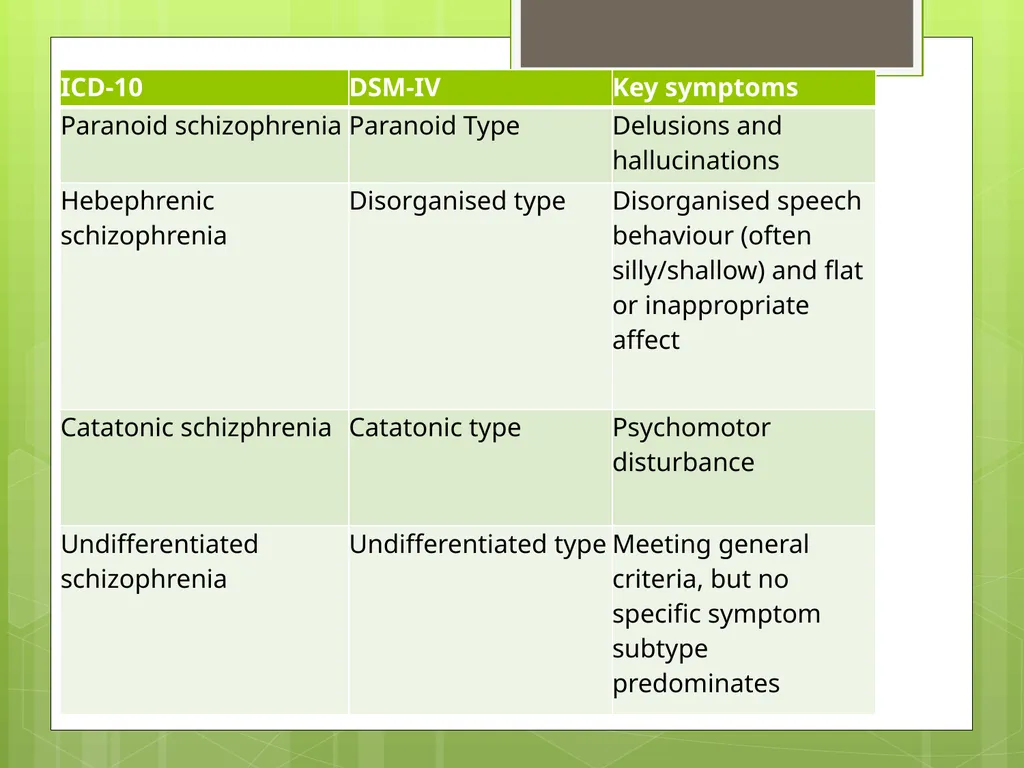
ICD-10 criteria schizophrenia F20
1. At least one of the following:
Thought echo, insertion, withdrawal, or broadcasting.
Delusions of control, influence, or passivity; clearly referred to body or limb movements or specific thoughts, actions, or sensations; and delusional perception.
Hallucinatory voices giving a running commentary on the patient's behaviour or discussing him/her between themselves, or other types of hallucinatory voices coming from some part of the body.
Persistent delusions of other kinds that are culturally inappropriate or implausible, (e.g. religious/political identity, superhuman powers and ability).<br>
1. At least one of the following:
Thought echo, insertion, withdrawal, or broadcasting.
Delusions of control, influence, or passivity; clearly referred to body or limb movements or specific thoughts, actions, or sensations; and delusional perception.
Hallucinatory voices giving a running commentary on the patient's behaviour or discussing him/her between themselves, or other types of hallucinatory voices coming from some part of the body.
Persistent delusions of other kinds that are culturally inappropriate or implausible, (e.g. religious/political identity, superhuman powers and ability).<br>
25
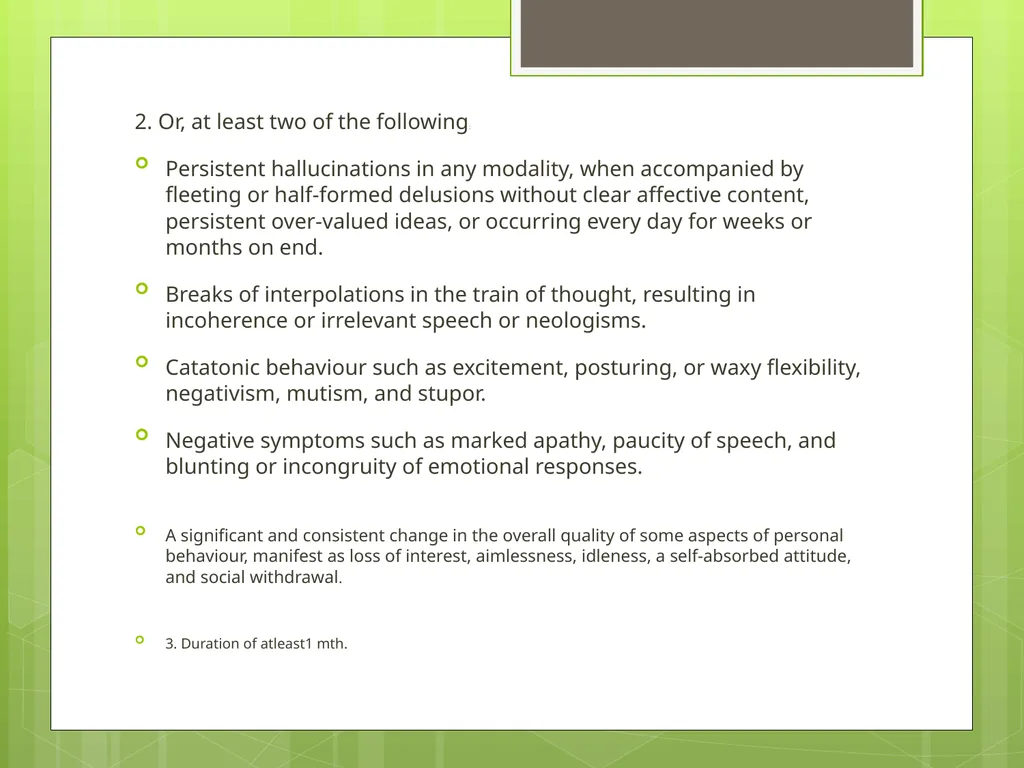
2. Or, at least two of the following:
Persistent hallucinations in any modality, when accompanied by fleeting or half-formed delusions without clear affective content, persistent over-valued ideas, or occurring every day for weeks or months on end.
Breaks of interpolations in the train of thought, resulting in incoherence or irrelevant speech or neologisms.
Catatonic behaviour such as excitement, posturing, or waxy flexibility, negativism, mutism, and stupor.
Negative symptoms such as marked apathy, paucity of speech, and blunting or incongruity of emotional responses.
A significant and consistent change in the overall quality of some aspects of personal behaviour, manifest as loss of interest, aimlessness, idleness, a self-absorbed attitude, and social withdrawal.
3. Duration of atleast1 mth.<br>
Persistent hallucinations in any modality, when accompanied by fleeting or half-formed delusions without clear affective content, persistent over-valued ideas, or occurring every day for weeks or months on end.
Breaks of interpolations in the train of thought, resulting in incoherence or irrelevant speech or neologisms.
Catatonic behaviour such as excitement, posturing, or waxy flexibility, negativism, mutism, and stupor.
Negative symptoms such as marked apathy, paucity of speech, and blunting or incongruity of emotional responses.
A significant and consistent change in the overall quality of some aspects of personal behaviour, manifest as loss of interest, aimlessness, idleness, a self-absorbed attitude, and social withdrawal.
3. Duration of atleast1 mth.<br>
26
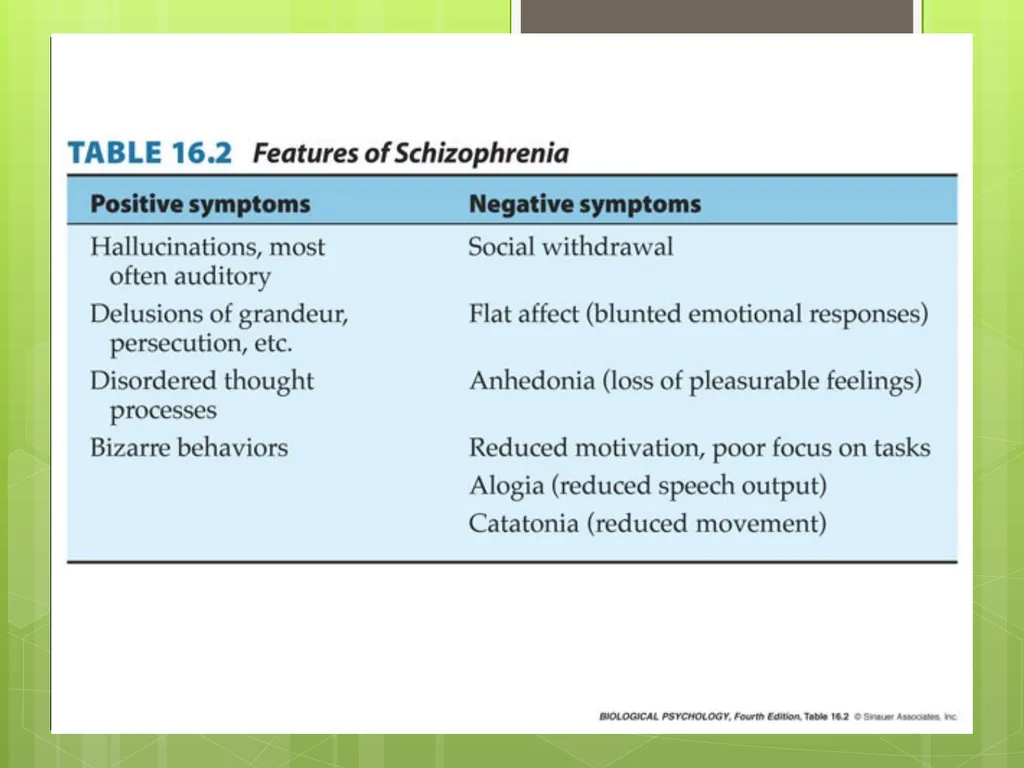
The symptoms of schizophrenia are conventionally divided into positive (new symptoms or signs) and negative (loss of a previous function):
Positive symptoms
Delusions (commonly persecutory, thought interference, or passivity) and Hallucinations (usually auditory hallucinations commenting on the subject or referring to them in third person).<br>
Positive symptoms
Delusions (commonly persecutory, thought interference, or passivity) and Hallucinations (usually auditory hallucinations commenting on the subject or referring to them in third person).<br>
27
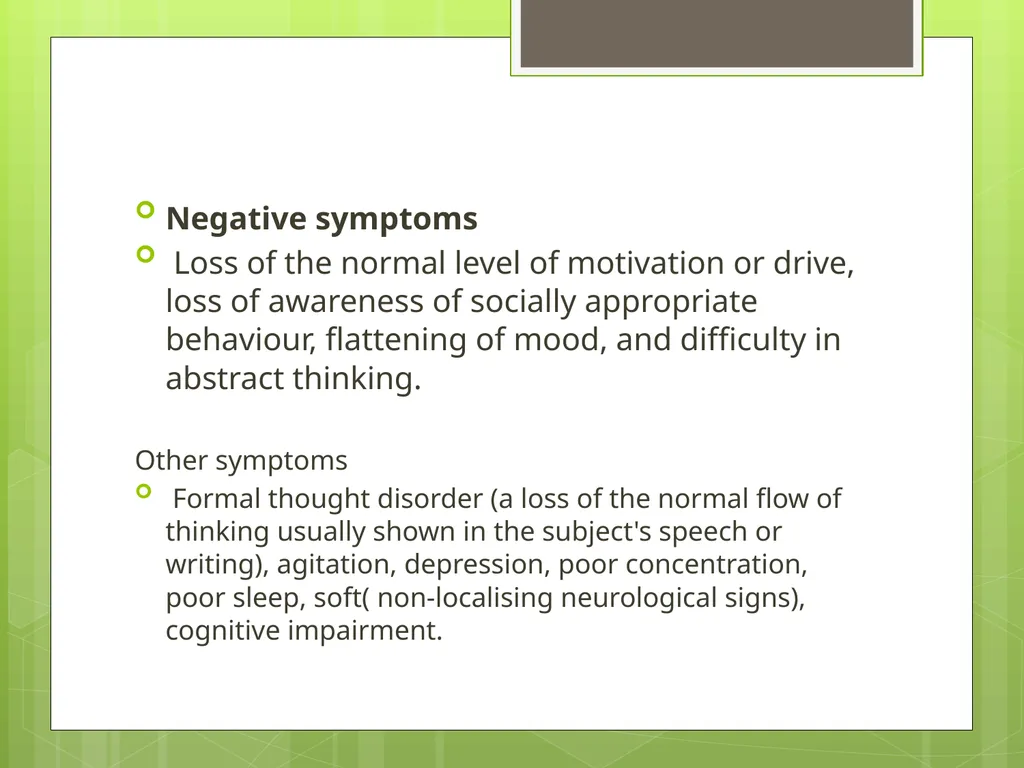
Negative symptoms
Loss of the normal level of motivation or drive, loss of awareness of socially appropriate behaviour, flattening of mood, and difficulty in abstract thinking.
Other symptoms
Formal thought disorder (a loss of the normal flow of thinking usually shown in the subject's speech or writing), agitation, depression, poor concentration, poor sleep, soft( non-localising neurological signs), cognitive impairment.<br>
Loss of the normal level of motivation or drive, loss of awareness of socially appropriate behaviour, flattening of mood, and difficulty in abstract thinking.
Other symptoms
Formal thought disorder (a loss of the normal flow of thinking usually shown in the subject's speech or writing), agitation, depression, poor concentration, poor sleep, soft( non-localising neurological signs), cognitive impairment.<br>
28
A spouse or relative noticing withdrawn or bizarre behaviour.
Not achieving educational potential
Complaining to GP about various symptoms.
Presentation to criminal justice system.
Deliberate self harm.
Complaining to council/police etc. on basis of delusional symptoms (e.g. hearing voices of neighbours throughout the night).<br>
Not achieving educational potential
Complaining to GP about various symptoms.
Presentation to criminal justice system.
Deliberate self harm.
Complaining to council/police etc. on basis of delusional symptoms (e.g. hearing voices of neighbours throughout the night).<br>
29
Differential diagnosis
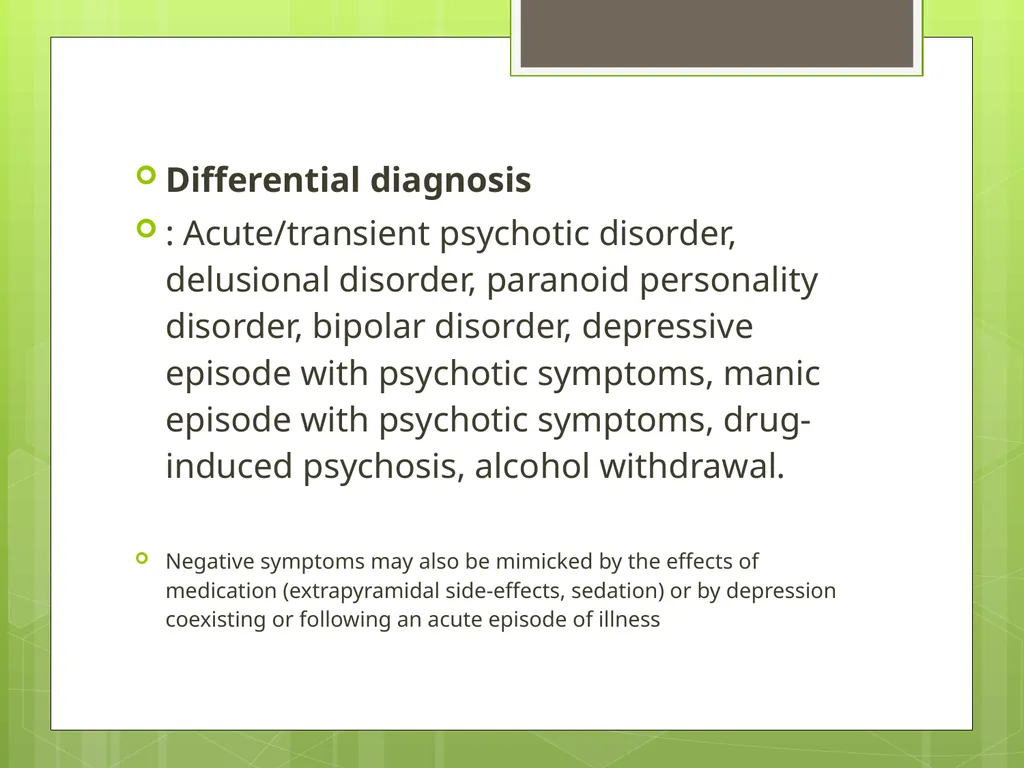
: Acute/transient psychotic disorder, delusional disorder, paranoid personality disorder, bipolar disorder, depressive episode with psychotic symptoms, manic episode with psychotic symptoms, drug-induced psychosis, alcohol withdrawal.
Negative symptoms may also be mimicked by the effects of medication (extrapyramidal side-effects, sedation) or by depression coexisting or following an acute episode of illness<br>
: Acute/transient psychotic disorder, delusional disorder, paranoid personality disorder, bipolar disorder, depressive episode with psychotic symptoms, manic episode with psychotic symptoms, drug-induced psychosis, alcohol withdrawal.
Negative symptoms may also be mimicked by the effects of medication (extrapyramidal side-effects, sedation) or by depression coexisting or following an acute episode of illness<br>
30
Investigations
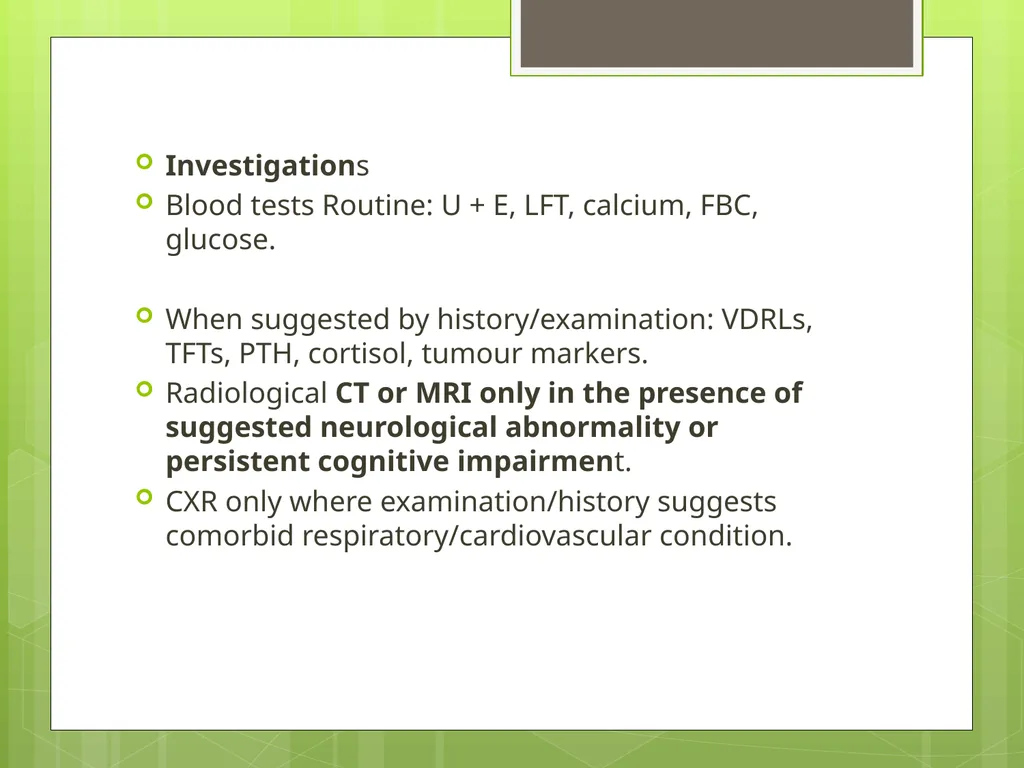
Blood tests Routine: U + E, LFT, calcium, FBC, glucose.
When suggested by history/examination: VDRLs, TFTs, PTH, cortisol, tumour markers.
Radiological CT or MRI only in the presence of suggested neurological abnormality or persistent cognitive impairment.
CXR only where examination/history suggests comorbid respiratory/cardiovascular condition.<br>
Blood tests Routine: U + E, LFT, calcium, FBC, glucose.
When suggested by history/examination: VDRLs, TFTs, PTH, cortisol, tumour markers.
Radiological CT or MRI only in the presence of suggested neurological abnormality or persistent cognitive impairment.
CXR only where examination/history suggests comorbid respiratory/cardiovascular condition.<br>
31
Urine drugs screen (particularly stimulants and cannabis), microscopy and culture (where history suggestive).
Other EEG rarely necessary unless history of seizure or symptoms suggest TLE.
Special investigations 24hr collection for cortisol (if Cushing's disease suggested from history/examination).
24hr catecholamine/5-HIAA collection for suspected phaeochromocytoma/carcinoid syndrome respectively.<br>
Other EEG rarely necessary unless history of seizure or symptoms suggest TLE.
Special investigations 24hr collection for cortisol (if Cushing's disease suggested from history/examination).
24hr catecholamine/5-HIAA collection for suspected phaeochromocytoma/carcinoid syndrome respectively.<br>
32
TREATMENT :
Pharmacological
Psychosocial<br>
Pharmacological
Psychosocial<br>
33
Before treatment Involve patients and their relatives in decisions about medical care.
Undertake a comprehensive assessment of medical, social, and psychological needs.
Provide patients and carers with clear verbal and, if necessary, written information.
Obtaining consent from the patient for any procedures or treatments.<br>
Undertake a comprehensive assessment of medical, social, and psychological needs.
Provide patients and carers with clear verbal and, if necessary, written information.
Obtaining consent from the patient for any procedures or treatments.<br>
34
Acute psychotic symptoms require immediate attention. Treatment during the acute phase focuses on alleviating the most severe psychotic symptoms. This phase usually lasts from 4 to 8 weeks<br>
35
Medications Commence atypical antipsychotic risperidone, olanzapine, quetiapine,aripiprazole ) at an effective dose in Ist episode psychosis .
Use benzodiazepines (e.g. lorazepam ) to control non-acute anxiety/behavioural disturbance.<br>
Use benzodiazepines (e.g. lorazepam ) to control non-acute anxiety/behavioural disturbance.<br>
36
Relapse prevention
Continue antipsychotic medication at minimum necessary dose. Atypical or a preferably non-sedating, conventional antipsychotic (e.g. trifluoperazine, flupenthixol, haloperidol).
Depot antipsychotic medication, particularly where use of oral medication has resulted in relapse due to non-compliance.<br>
Continue antipsychotic medication at minimum necessary dose. Atypical or a preferably non-sedating, conventional antipsychotic (e.g. trifluoperazine, flupenthixol, haloperidol).
Depot antipsychotic medication, particularly where use of oral medication has resulted in relapse due to non-compliance.<br>
37
Psychological Family therapy and psychoeducation are effective in reducing relapse.
Evidence also exists for CBT.
Social skills Training
Role in ensuring compliance and Relapse Prevention.<br>
Evidence also exists for CBT.
Social skills Training
Role in ensuring compliance and Relapse Prevention.<br>
38
Course and Prognosis The classic course of schizophrenia is one of exacerbations and remissions.
This failure to return to baseline functioning after each relapse is the major distinction between schizophrenia and the mood disorders.<br>
This failure to return to baseline functioning after each relapse is the major distinction between schizophrenia and the mood disorders.<br>
39
The schizophrenia patient's vulnerability to stress is usually lifelong. Positive symptoms tend to become less severe with time, but the socially debilitating negative or deficit symptoms may increase.
¼ have good outcome,1/3 have chronic course remainder are somewhat functioning with relapses.
Suicide in 1:10 patients
Maximum relapse first 2 yrs. Medication reduces the relapse rate.<br>
¼ have good outcome,1/3 have chronic course remainder are somewhat functioning with relapses.
Suicide in 1:10 patients
Maximum relapse first 2 yrs. Medication reduces the relapse rate.<br>
40
Thank You<br>