
Science of Learning: Critical Thinking about


Description: Science of Learning: Critical Thinking about Brain-based claims This presentation is part of a collection of resources for an online workshop for initial teacher education . The other resources can be found on our website.
Related Topics
Download Presentation
"Science of Learning: Critical Thinking about" is the property of its rightful owner. Permission is granted to download and print the materials on this website for personal, non-commercial use only, and to display it on your personal computer provided you do not modify the materials and that you retain all copyright notices contained in the materials. By downloading content from our website, you accept the terms of this agreement.
Presentation Transcript
slide1. Science of Learning:
Critical Thinking about Brain-based claims This presentation is part of a collection of resources for an online workshop for initial teacher education .
The other resources can be found on our website. https://www.bathspa.ac.uk/projects/learning-sciences-in-teacher-education/ and permanently on BathSpa Data
This version is for tutors with tutor notes below the slides. Please adapt it for your own educational purposes.<br>
slide2. For tutor to do pre-session If working on line, use a class register to help you allocate a stimulus sheet number to each student.
Open a data collection sheet for your group<br>
slide3. Timings
Experiment
15 minutes experiment (5 minutes to explain task, 10 mins for students to complete independently)
10 mins to explain results and relevance
Research
20-30 minutes research in breakout groups
15 minutes to present<br>
slide4. Science of Learning:
Critical Thinking about Brain-based claims<br>
slide5. Intended Learning Outcomes To challenge you to think critically about the science of learning
To consider what is known about learning and the brain
To equip you with the skills to critique claims and to make informed pedagogical decisions<br>
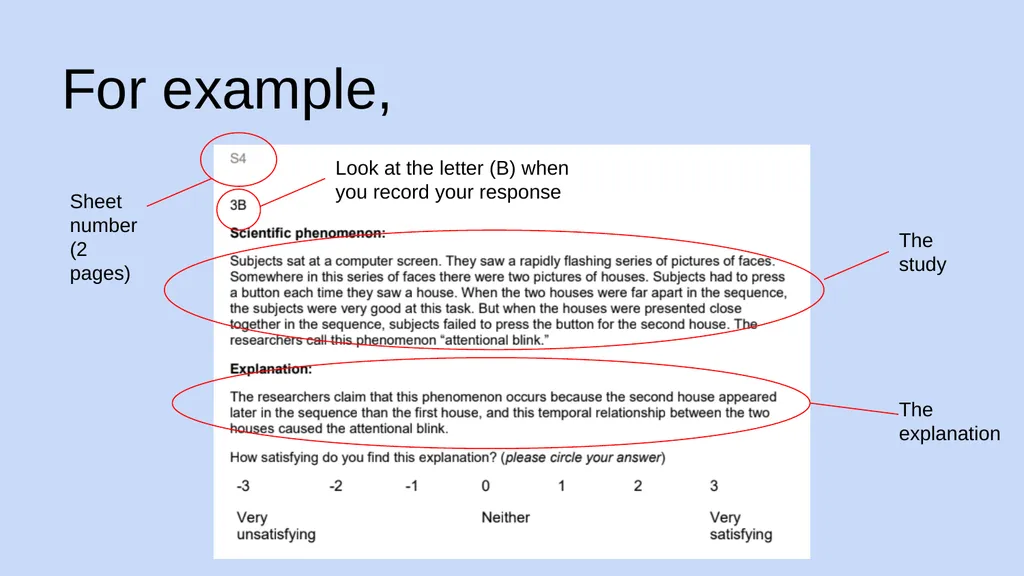
slide6. A short research study... You will be allocated 4 descriptions of scientific studies (scroll to find your allocated sheet number. There will be two pages to look at)
For each study, you will also be given an explanation of the phenomenon described
The explanations may not necessarily be real explanations of the phenomenon
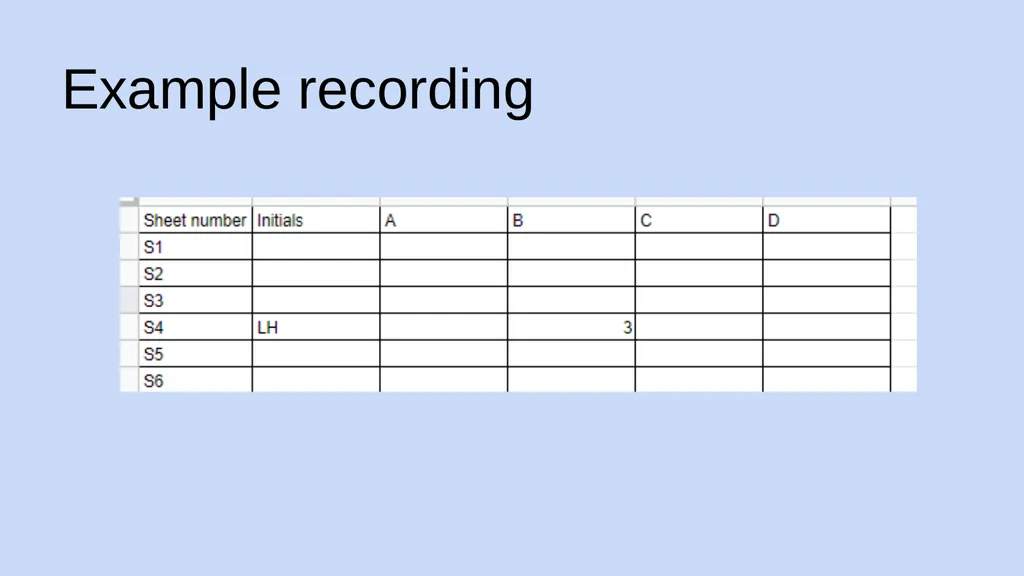
Your task is to rate how convincing you find each explanation on a scale from -3 to 3 and to record this on a spreadsheet<br>
slide7. For example, Sheet number (2 pages) Look at the letter (B) when you record your response The study The explanation<br>
slide8. Example recording<br>
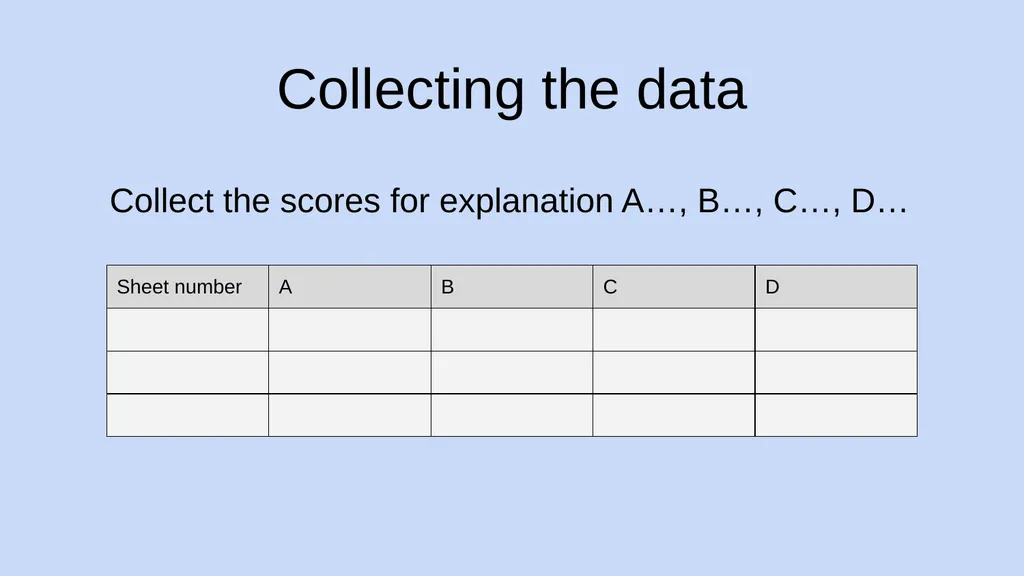
slide9. Collecting the data Collect the scores for explanation A…, B…, C…, D…<br>
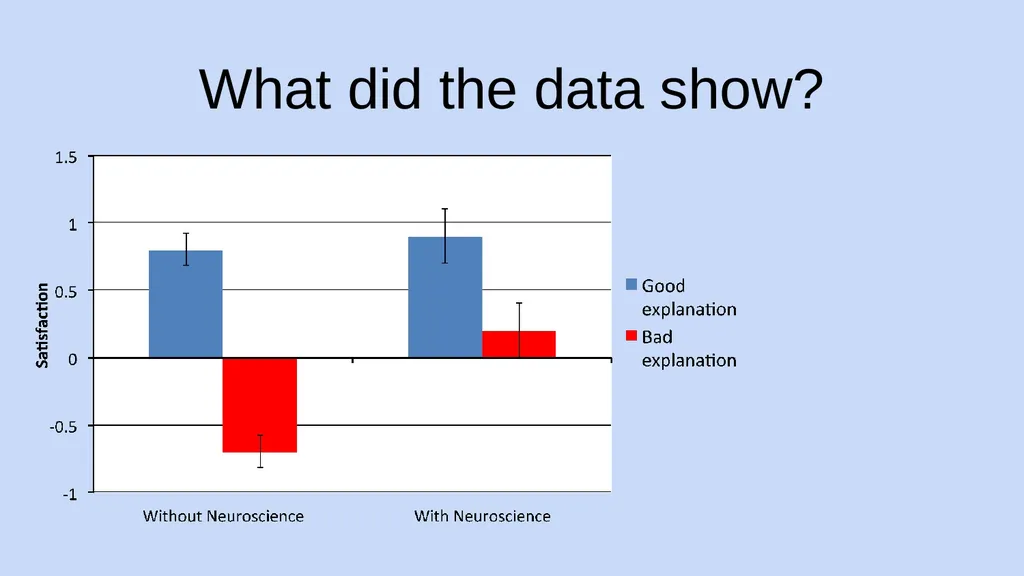
slide10. What is this all about? This is a quick version of a classic study by Deena Skolnick Weisberg and colleagues called ‘the seductive allure of neuroscience explanations’.
The rationale behind the study was that neuroscience uniquely piques the interest of the general public (we all love to hear about brains).
But does this cause problems when it comes to being objective about neuroscientific explanations?<br>
slide11. What did the data show?<br>
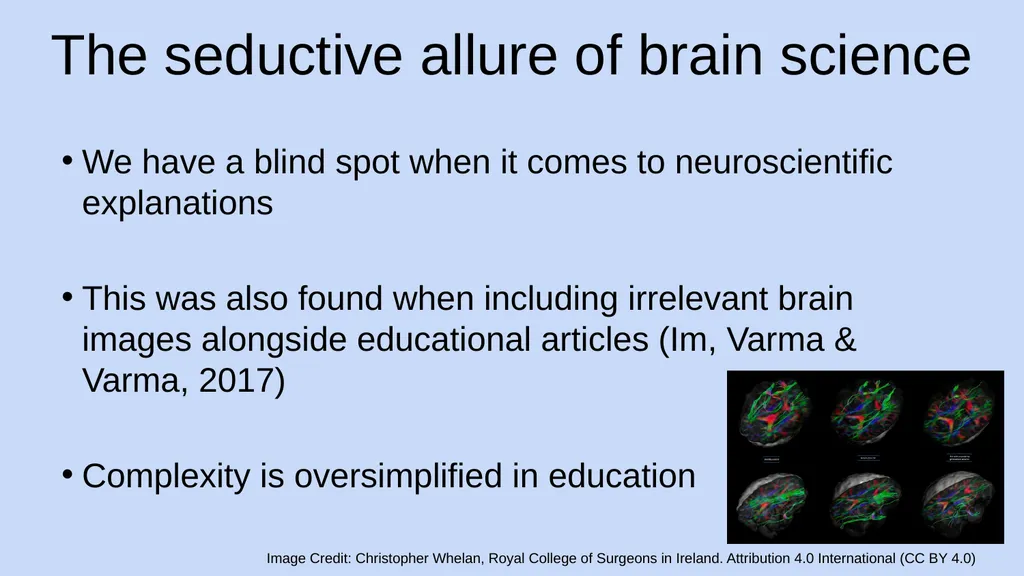
slide12. The seductive allure of brain science We have a blind spot when it comes to neuroscientific explanations
This was also found when including irrelevant brain images alongside educational articles (Im, Varma & Varma, 2017)
Complexity is oversimplified in education Image Credit: Christopher Whelan, Royal College of Surgeons in Ireland. Attribution 4.0 International (CC BY 4.0)<br>
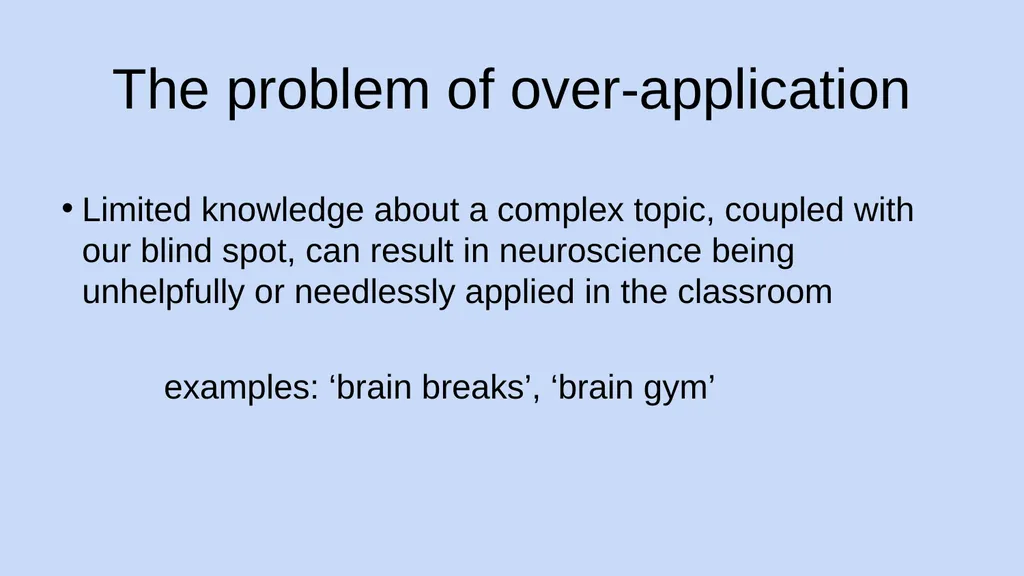
slide13. The problem of over-application Limited knowledge about a complex topic, coupled with our blind spot, can result in neuroscience being unhelpfully or needlessly applied in the classroom
examples: ‘brain breaks’, ‘brain gym’<br>
slide14. Does it matter? Teachers
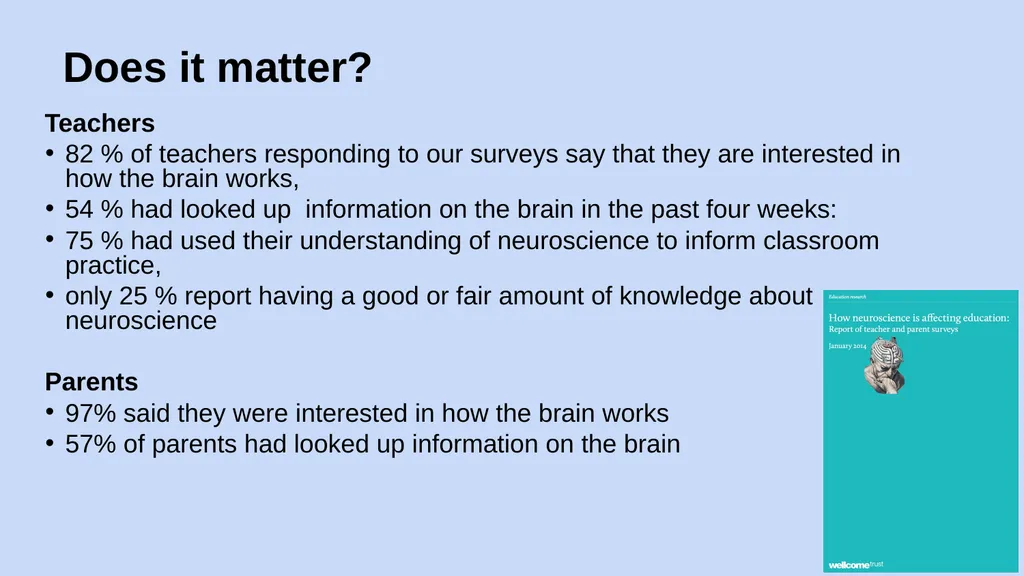
82 % of teachers responding to our surveys say that they are interested in how the brain works,
54 % had looked up information on the brain in the past four weeks:
75 % had used their understanding of neuroscience to inform classroom practice,
only 25 % report having a good or fair amount of knowledge about neuroscience
Parents
97% said they were interested in how the brain works
57% of parents had looked up information on the brain<br>
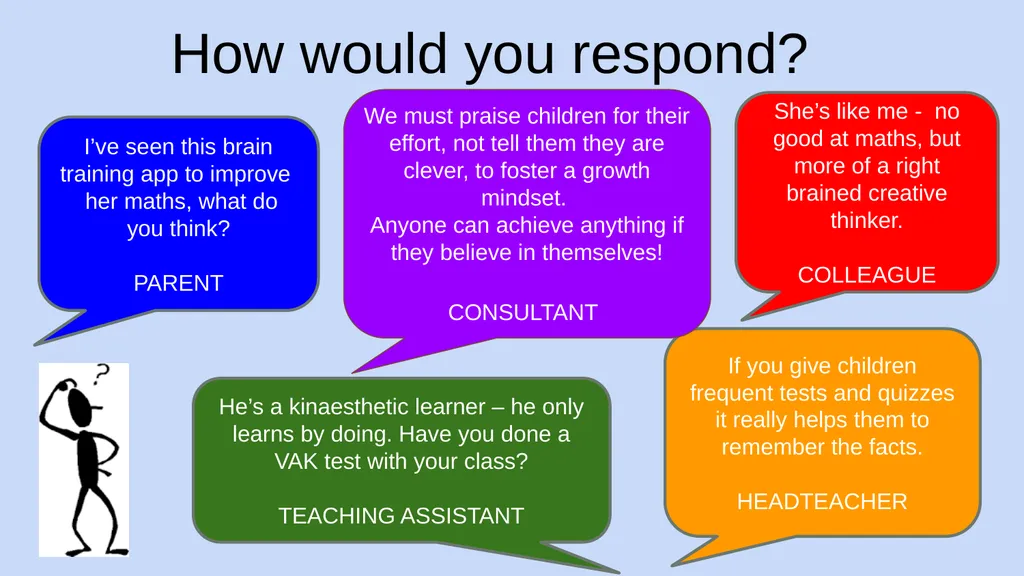
slide15. How would you respond? She’s like me - no good at maths, but more of a right brained creative thinker.
COLLEAGUE He’s a kinaesthetic learner – he only learns by doing. Have you done a VAK test with your class?
TEACHING ASSISTANT I’ve seen this brain training app to improve
her maths, what do you think?
PARENT If you give children frequent tests and quizzes it really helps them to remember the facts.
HEADTEACHER We must praise children for their effort, not tell them they are clever, to foster a growth mindset.
Anyone can achieve anything if they believe in themselves!
CONSULTANT<br>
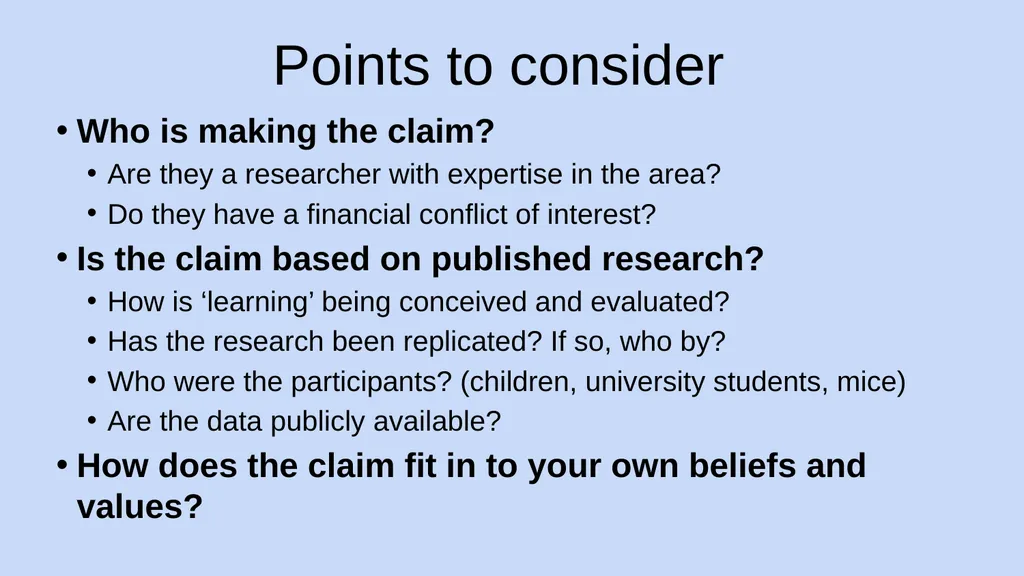
slide16. Points to consider Who is making the claim?
Are they a researcher with expertise in the area?
Do they have a financial conflict of interest?
Is the claim based on published research?
How is ‘learning’ being conceived and evaluated?
Has the research been replicated? If so, who by?
Who were the participants? (children, university students, mice)
Are the data publicly available?
How does the claim fit in to your own beliefs and values?<br>
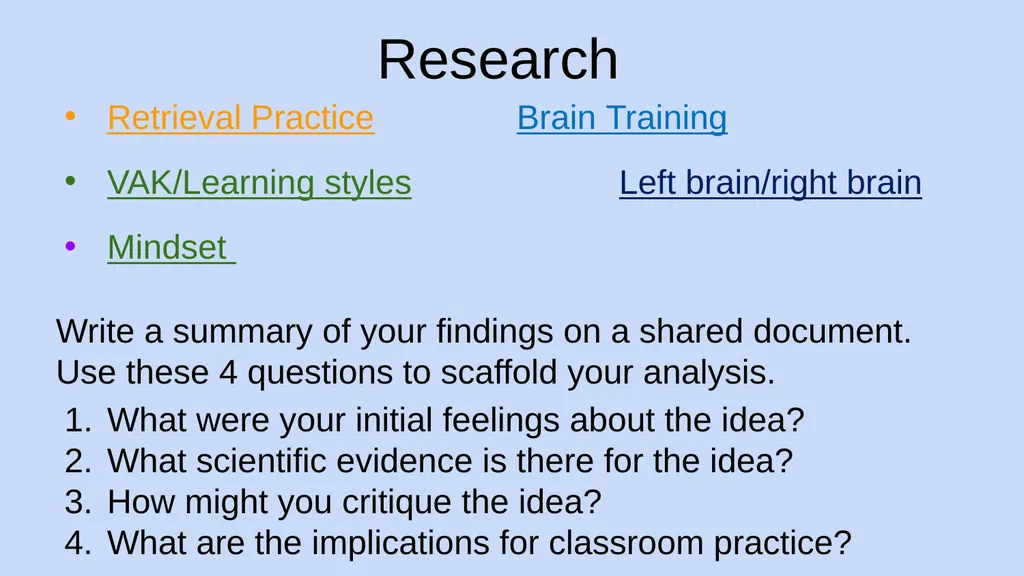
slide17. Research Retrieval Practice Brain Training
VAK/Learning styles Left brain/right brain
Mindset
Write a summary of your findings on a shared document. Use these 4 questions to scaffold your analysis.
What were your initial feelings about the idea?
What scientific evidence is there for the idea?
How might you critique the idea?
What are the implications for classroom practice?<br>
slide18. Research Retrieval Practice
VAK/Learning styles
Mindset Brain Training
Left brain/right brain Write a summary of your findings on a shared document.
Use these 4 questions to scaffold your analysis.
What were your initial feelings about the idea?
What scientific evidence is there for the idea?
How might you critique the idea?
What are the implications for classroom practice?<br>
slide19. Present a claim Spend 2 or 3 minutes explaining the implications for classroom practice, based on the scientific evidence (or lack thereof)<br>
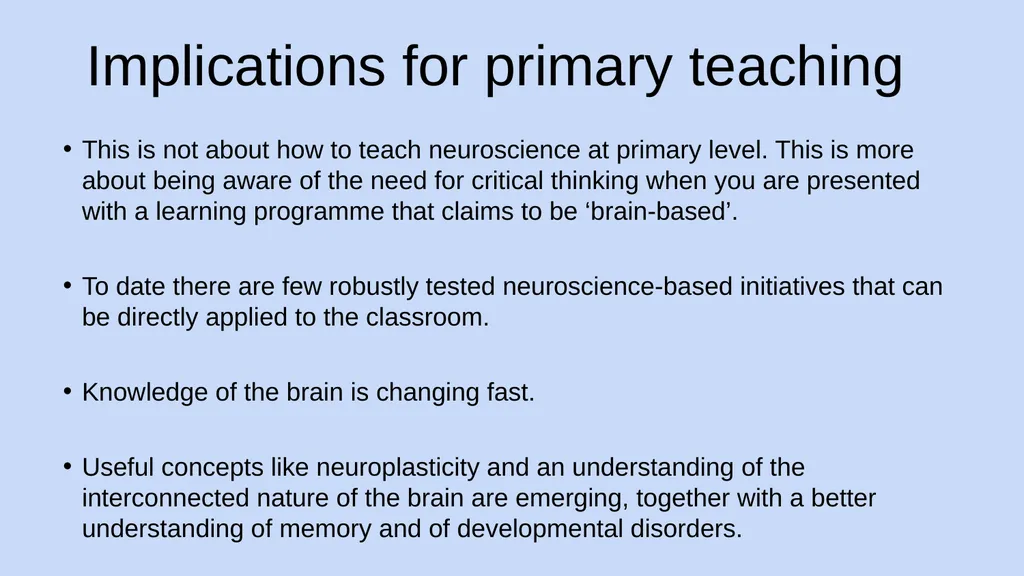
slide20. Implications for primary teaching This is not about how to teach neuroscience at primary level. This is more about being aware of the need for critical thinking when you are presented with a learning programme that claims to be ‘brain-based’.
To date there are few robustly tested neuroscience-based initiatives that can be directly applied to the classroom.
Knowledge of the brain is changing fast.
Useful concepts like neuroplasticity and an understanding of the interconnected nature of the brain are emerging, together with a better understanding of memory and of developmental disorders.<br>
slide21. Post seminar task Choose one article you have not already read from the Science of Learning collection in the Chartered College of Teaching Journal; Impact. There are 3 pages of articles.
Remember to read this with a critical eye. This can be used as general reading to support your assignments.<br>
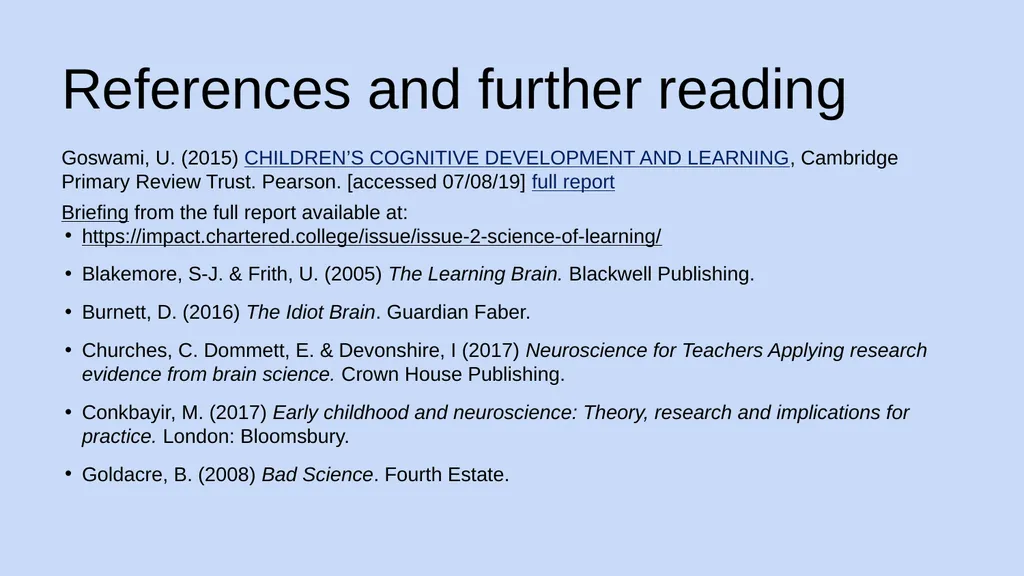
slide22. References and further reading Goswami, U. (2015) CHILDREN’S COGNITIVE DEVELOPMENT AND LEARNING, Cambridge Primary Review Trust. Pearson. [accessed 07/08/19] full report
Briefing from the full report available at:
https://impact.chartered.college/issue/issue-2-science-of-learning/
Blakemore, S-J. & Frith, U. (2005) The Learning Brain. Blackwell Publishing.
Burnett, D. (2016) The Idiot Brain. Guardian Faber.
Churches, C. Dommett, E. & Devonshire, I (2017) Neuroscience for Teachers Applying research evidence from brain science. Crown House Publishing.
Conkbayir, M. (2017) Early childhood and neuroscience: Theory, research and implications for practice. London: Bloomsbury.
Goldacre, B. (2008) Bad Science. Fourth Estate.<br>
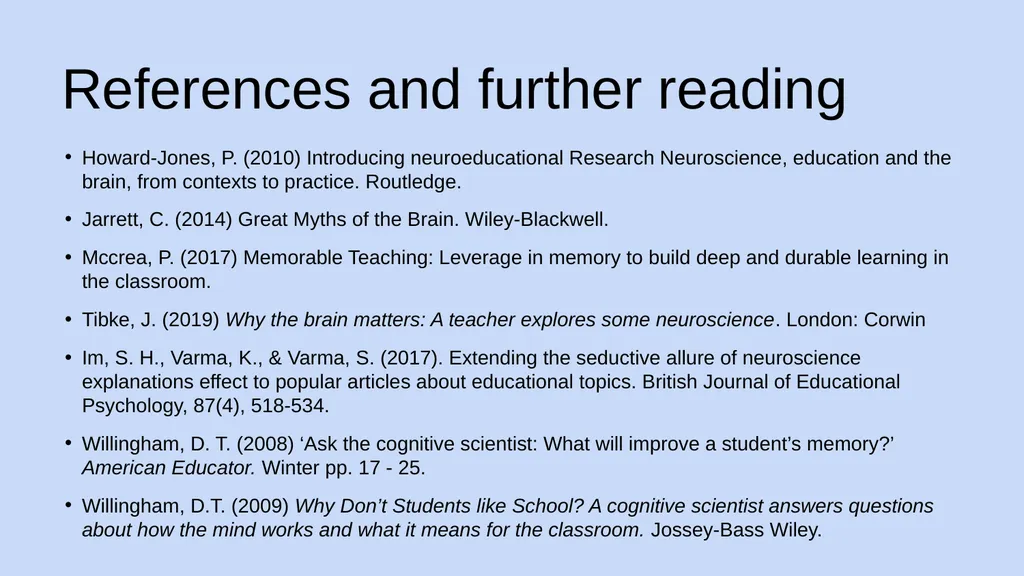
slide23. References and further reading Howard-Jones, P. (2010) Introducing neuroeducational Research Neuroscience, education and the brain, from contexts to practice. Routledge.
Jarrett, C. (2014) Great Myths of the Brain. Wiley-Blackwell.
Mccrea, P. (2017) Memorable Teaching: Leverage in memory to build deep and durable learning in the classroom.
Tibke, J. (2019) Why the brain matters: A teacher explores some neuroscience. London: Corwin
Im, S. H., Varma, K., & Varma, S. (2017). Extending the seductive allure of neuroscience explanations effect to popular articles about educational topics. British Journal of Educational Psychology, 87(4), 518-534.
Willingham, D. T. (2008) ‘Ask the cognitive scientist: What will improve a student’s memory?’ American Educator. Winter pp. 17 - 25.
Willingham, D.T. (2009) Why Don’t Students like School? A cognitive scientist answers questions about how the mind works and what it means for the classroom. Jossey-Bass Wiley.<br>
The other resources can be found on our website. https://www.bathspa.ac.uk/projects/learning-sciences-in-teacher-education/ and permanently on BathSpa Data
This version is for tutors with tutor notes below the slides. Please adapt it for your own educational purposes.<br>
slide2. For tutor to do pre-session If working on line, use a class register to help you allocate a stimulus sheet number to each student.
Open a data collection sheet for your group<br>
slide3. Timings
Experiment
15 minutes experiment (5 minutes to explain task, 10 mins for students to complete independently)
10 mins to explain results and relevance
Research
20-30 minutes research in breakout groups
15 minutes to present<br>
slide4. Science of Learning:
Critical Thinking about Brain-based claims<br>
slide5. Intended Learning Outcomes To challenge you to think critically about the science of learning
To consider what is known about learning and the brain
To equip you with the skills to critique claims and to make informed pedagogical decisions<br>
slide6. A short research study... You will be allocated 4 descriptions of scientific studies (scroll to find your allocated sheet number. There will be two pages to look at)
For each study, you will also be given an explanation of the phenomenon described
The explanations may not necessarily be real explanations of the phenomenon
Your task is to rate how convincing you find each explanation on a scale from -3 to 3 and to record this on a spreadsheet<br>
slide7. For example, Sheet number (2 pages) Look at the letter (B) when you record your response The study The explanation<br>
slide8. Example recording<br>
slide9. Collecting the data Collect the scores for explanation A…, B…, C…, D…<br>
slide10. What is this all about? This is a quick version of a classic study by Deena Skolnick Weisberg and colleagues called ‘the seductive allure of neuroscience explanations’.
The rationale behind the study was that neuroscience uniquely piques the interest of the general public (we all love to hear about brains).
But does this cause problems when it comes to being objective about neuroscientific explanations?<br>
slide11. What did the data show?<br>
slide12. The seductive allure of brain science We have a blind spot when it comes to neuroscientific explanations
This was also found when including irrelevant brain images alongside educational articles (Im, Varma & Varma, 2017)
Complexity is oversimplified in education Image Credit: Christopher Whelan, Royal College of Surgeons in Ireland. Attribution 4.0 International (CC BY 4.0)<br>
slide13. The problem of over-application Limited knowledge about a complex topic, coupled with our blind spot, can result in neuroscience being unhelpfully or needlessly applied in the classroom
examples: ‘brain breaks’, ‘brain gym’<br>
slide14. Does it matter? Teachers
82 % of teachers responding to our surveys say that they are interested in how the brain works,
54 % had looked up information on the brain in the past four weeks:
75 % had used their understanding of neuroscience to inform classroom practice,
only 25 % report having a good or fair amount of knowledge about neuroscience
Parents
97% said they were interested in how the brain works
57% of parents had looked up information on the brain<br>
slide15. How would you respond? She’s like me - no good at maths, but more of a right brained creative thinker.
COLLEAGUE He’s a kinaesthetic learner – he only learns by doing. Have you done a VAK test with your class?
TEACHING ASSISTANT I’ve seen this brain training app to improve
her maths, what do you think?
PARENT If you give children frequent tests and quizzes it really helps them to remember the facts.
HEADTEACHER We must praise children for their effort, not tell them they are clever, to foster a growth mindset.
Anyone can achieve anything if they believe in themselves!
CONSULTANT<br>
slide16. Points to consider Who is making the claim?
Are they a researcher with expertise in the area?
Do they have a financial conflict of interest?
Is the claim based on published research?
How is ‘learning’ being conceived and evaluated?
Has the research been replicated? If so, who by?
Who were the participants? (children, university students, mice)
Are the data publicly available?
How does the claim fit in to your own beliefs and values?<br>
slide17. Research Retrieval Practice Brain Training
VAK/Learning styles Left brain/right brain
Mindset
Write a summary of your findings on a shared document. Use these 4 questions to scaffold your analysis.
What were your initial feelings about the idea?
What scientific evidence is there for the idea?
How might you critique the idea?
What are the implications for classroom practice?<br>
slide18. Research Retrieval Practice
VAK/Learning styles
Mindset Brain Training
Left brain/right brain Write a summary of your findings on a shared document.
Use these 4 questions to scaffold your analysis.
What were your initial feelings about the idea?
What scientific evidence is there for the idea?
How might you critique the idea?
What are the implications for classroom practice?<br>
slide19. Present a claim Spend 2 or 3 minutes explaining the implications for classroom practice, based on the scientific evidence (or lack thereof)<br>
slide20. Implications for primary teaching This is not about how to teach neuroscience at primary level. This is more about being aware of the need for critical thinking when you are presented with a learning programme that claims to be ‘brain-based’.
To date there are few robustly tested neuroscience-based initiatives that can be directly applied to the classroom.
Knowledge of the brain is changing fast.
Useful concepts like neuroplasticity and an understanding of the interconnected nature of the brain are emerging, together with a better understanding of memory and of developmental disorders.<br>
slide21. Post seminar task Choose one article you have not already read from the Science of Learning collection in the Chartered College of Teaching Journal; Impact. There are 3 pages of articles.
Remember to read this with a critical eye. This can be used as general reading to support your assignments.<br>
slide22. References and further reading Goswami, U. (2015) CHILDREN’S COGNITIVE DEVELOPMENT AND LEARNING, Cambridge Primary Review Trust. Pearson. [accessed 07/08/19] full report
Briefing from the full report available at:
https://impact.chartered.college/issue/issue-2-science-of-learning/
Blakemore, S-J. & Frith, U. (2005) The Learning Brain. Blackwell Publishing.
Burnett, D. (2016) The Idiot Brain. Guardian Faber.
Churches, C. Dommett, E. & Devonshire, I (2017) Neuroscience for Teachers Applying research evidence from brain science. Crown House Publishing.
Conkbayir, M. (2017) Early childhood and neuroscience: Theory, research and implications for practice. London: Bloomsbury.
Goldacre, B. (2008) Bad Science. Fourth Estate.<br>
slide23. References and further reading Howard-Jones, P. (2010) Introducing neuroeducational Research Neuroscience, education and the brain, from contexts to practice. Routledge.
Jarrett, C. (2014) Great Myths of the Brain. Wiley-Blackwell.
Mccrea, P. (2017) Memorable Teaching: Leverage in memory to build deep and durable learning in the classroom.
Tibke, J. (2019) Why the brain matters: A teacher explores some neuroscience. London: Corwin
Im, S. H., Varma, K., & Varma, S. (2017). Extending the seductive allure of neuroscience explanations effect to popular articles about educational topics. British Journal of Educational Psychology, 87(4), 518-534.
Willingham, D. T. (2008) ‘Ask the cognitive scientist: What will improve a student’s memory?’ American Educator. Winter pp. 17 - 25.
Willingham, D.T. (2009) Why Don’t Students like School? A cognitive scientist answers questions about how the mind works and what it means for the classroom. Jossey-Bass Wiley.<br>