Science We are learning to explore how sounds change over distance. I can identify how sounds change over distance. I can identify sounds at a distance. I can create a string telephone and explain how sound travels through it. Warm Up!
"Science We are learning to explore how sounds" is the property of its rightful owner. Permission is granted to
download and print the materials on this website for personal, non-commercial use only, and to display it
on your personal computer provided you do not modify the materials and that you retain all copyright
notices contained in the materials. By downloading content from our website, you accept the terms of this
agreement.
Presentation Transcript
01
Science We are learning to explore how sounds change over distance. I can identify how sounds change over distance.
I can identify sounds at a distance.
I can create a string telephone and explain how sound travels through it.<br>
02
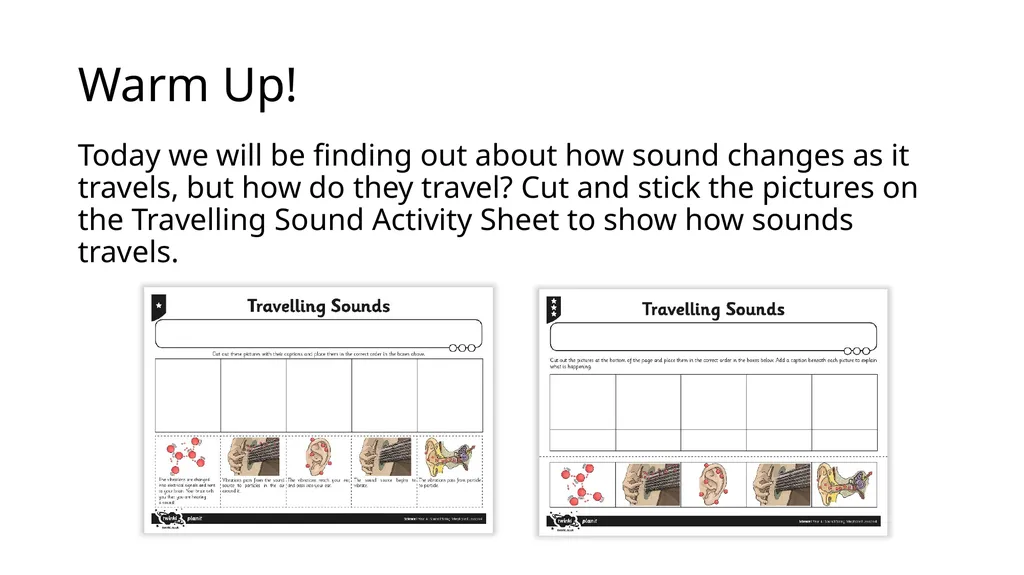
Warm Up! Today we will be finding out about how sound changes as it travels, but how do they travel? Cut and stick the pictures on the Travelling Sound Activity Sheet to show how sounds travels.<br>
03
Travelling Sounds Sounds get quieter as the distance between the sound source and your ear increases.
Sounds travel as vibrations. As the sound waves travel, the particles of whatever they are travelling through vibrate, or move quickly on the spot. The further the vibrations travel, the more they spread out. As they spread out through more and more particles, the vibrations become smaller and smaller. This causes the sound to get quieter and quieter.
Think of dropping a leaf into a pond. The very first ripples directly around the leaf will be very large, but as the ripples spread out across the pond, they will get smaller and smaller until eventually they disappear.
This is why sounds get quieter and quieter as you move further away from the source, until you eventually can't hear the sound at all.<br>
04
Travelling Sounds You can see the ripples getting smaller as they spread out across the pond, until they eventually disappear. This is like the way the vibrations of sound get smaller as they spread out over distance, getting quieter and quieter.<br>
05
Travelling Sounds Sounds also get quieter over distance because some of the vibrations are absorbed by obstacles they meet.
If the ripples in the pond below hit an obstacle such as a stick or rock, they would not travel as far. This can help you understand why sounds get quieter as you move further away.<br>
06
Sound over Distance Try this experiment out - sit near an alarm clock or loud sound. Move one metre away - how has the sound changed? Keep moving further away, one metre at a time.
Now have a go at blindfolding yourself - make sure an adult is there to supervise! Ask someone to sound the alarm a certain distance away. Can you tell how far away the alarm is just by listening?<br>
07
Telephone Transmission Telephones are used to transmit the sound of people’s voices over long distances.
When you speak into a telephone, the sound energy in your voice is turned into electrical energy, which is transported down a wire to the other person’s telephone. The electrical energy is converted back into sound energy, and they can hear what you are saying!
Your challenge today is to create a string telephone that will transmit the sound of your voice over a distance.<br>
08
Telephone Transmission Use the instructions to construct your string telephone. Next, find a partner and stand far enough away that you can’t hear each other when speaking normally. Test out your telephone - can you hear the other person? If you don’t have a partner, you can use music instead. This video explains what you’re doing: https://www.bbc.co.uk/programmes/p011mzys<br>
09
Telephone Transmission How does your telephone work?
The string and the cups are solid, so the particles are much closer together than the particles in the air, which is a gas.
The sound energy can travel from particle to particle far easier in the solid string telephone, so the sound of your voice is louder over the same distance than it was in the air. Solid Particles Gas Particles<br>
10
Your task: Make a string telephone, by following the instructions. The instruction sheet says to use paper cups, but tins would also work well and might be easier to find.<br>