
SCOTTISH CHILDREN’S REPORTER ADMINISTRATION ANNUAL
JO
Published · 21 slides · 0 views

1 / 1

Description
SCOTTISH CHILDRENS REPORTER ADMINISTRATION ANNUAL INTERNAL AUDIT PLAN 2022-23 SCRA Audit Risk Committee (Feb 22) Item 10.4 2 CONTENTS Restrictions of use Restrictions on use: This document has been prepared solely for the management of
Related Topics
Share
Embed code
Download this presentation From Below
"SCOTTISH CHILDREN’S REPORTER ADMINISTRATION ANNUAL" is the property of its rightful owner. Permission is granted to download and print the materials on this website for personal, non-commercial use only, and to display it on your personal computer provided you do not modify the materials and that you retain all copyright notices contained in the materials. By downloading content from our website, you accept the terms of this agreement.
Presentation Transcript
01
SCOTTISH CHILDREN’S REPORTER ADMINISTRATION ANNUAL INTERNAL AUDIT PLAN 2022-23 SCRA Audit & Risk Committee (Feb 22) Item 10.4<br>
02
2 CONTENTS Restrictions of use
Restrictions on use: This document has been prepared solely for the management of SCRA and should not be quoted in whole or in part without our prior written consent. BDO LLP neither owes nor accepts any duty to any third party whether in contract or in tort and shall not be liable, in respect of any loss, damage or expense which is caused by their reliance on this document.<br>
Restrictions on use: This document has been prepared solely for the management of SCRA and should not be quoted in whole or in part without our prior written consent. BDO LLP neither owes nor accepts any duty to any third party whether in contract or in tort and shall not be liable, in respect of any loss, damage or expense which is caused by their reliance on this document.<br>
03
1. INTERNAL AUDIT APPROACH 3 Introduction
Our role as internal auditors is to provide an independent, objective assurance and consulting activity designed to add value and improve an organisation’s operations. Our approach, as set out in the Firm’s Internal Audit Manual, is to help the organisation accomplish its objectives by bringing a systematic, disciplined approach to evaluating and improving the effectiveness of risk management, control and governance processes.
Our approach complies with best professional practice, in particular the Chartered Institute of Internal Auditors’ Position Statement on Risk Based Internal Auditing. Internal Audit at Scottish Children’s Reporter Administration
We have been appointed as internal auditors to Scottish Children’s Reporter Administration (SCRA) to provide the Board (via the Audit & Risk Committee), the Chief Executive and other managers with assurance on the adequacy of internal control arrangements, including risk management and governance.
Responsibility for these arrangements remains fully with management, who should recognise that internal audit can only provide ‘reasonable assurance’ and cannot provide any guarantee against material errors, loss or fraud. Our role at SCRA will also be aimed at helping management to improve risk management, governance and internal control, so reducing the effects of any significant risks facing the organisation.
In producing the internal audit plan for 2022-23 we have undertaken a detailed audit needs assessment, gaining an understanding of the business of SCRA together with its risk profile in the context of:
The overall business strategy of SCRA;
The key areas where management wish to monitor performance and the manner in which performance is measured;
The financial and non financial measurements and indicators of such performance;
The information required to ‘run the business’;
The key challenges facing SCRA.<br>
Our role as internal auditors is to provide an independent, objective assurance and consulting activity designed to add value and improve an organisation’s operations. Our approach, as set out in the Firm’s Internal Audit Manual, is to help the organisation accomplish its objectives by bringing a systematic, disciplined approach to evaluating and improving the effectiveness of risk management, control and governance processes.
Our approach complies with best professional practice, in particular the Chartered Institute of Internal Auditors’ Position Statement on Risk Based Internal Auditing. Internal Audit at Scottish Children’s Reporter Administration
We have been appointed as internal auditors to Scottish Children’s Reporter Administration (SCRA) to provide the Board (via the Audit & Risk Committee), the Chief Executive and other managers with assurance on the adequacy of internal control arrangements, including risk management and governance.
Responsibility for these arrangements remains fully with management, who should recognise that internal audit can only provide ‘reasonable assurance’ and cannot provide any guarantee against material errors, loss or fraud. Our role at SCRA will also be aimed at helping management to improve risk management, governance and internal control, so reducing the effects of any significant risks facing the organisation.
In producing the internal audit plan for 2022-23 we have undertaken a detailed audit needs assessment, gaining an understanding of the business of SCRA together with its risk profile in the context of:
The overall business strategy of SCRA;
The key areas where management wish to monitor performance and the manner in which performance is measured;
The financial and non financial measurements and indicators of such performance;
The information required to ‘run the business’;
The key challenges facing SCRA.<br>
04
2. AUDIT RISK ASSESSMENT 4 Background
Our risk based approach to internal audit uses SCRA’s own risk management process and risk register as a starting point for audit planning as this represents the client’s own assessment of the risks to it achieving its strategic objectives.
The extent to which we can rely on management’s own perception of risk largely depends on the maturity and effectiveness of SCRA’s own risk management arrangements. In estimating the amount of audit resource required to address the most significant risks, we will also seek to confirm that senior management’s own assessment of risk accurately reflects SCRA’s current risk profile.
Planned approach to internal audit 2022-23
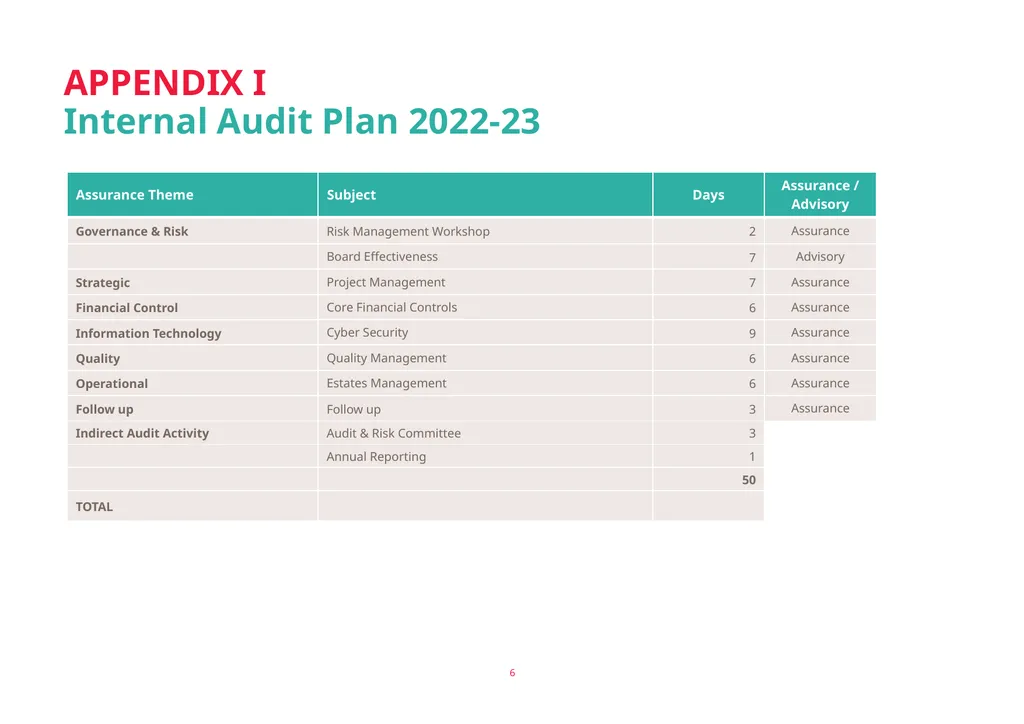
The Internal Audit proposed audit programme for 2022-23 is shown at Appendix I. We will keep the programme under continuous review during the year and will introduce to the plan any significant areas of risk identified during that period.
We have set out further in Appendix II the rationale for the inclusion of particular reviews in the audit plan, based on our initial review of SCRA’s risk register, discussions with a number of key stakeholders and consideration of various documents, publications and information sources. Individual audits
When we scope each review, we will reconsider our estimate for the number of days needed to achieve the objectives established for the work and to complete it to a satisfactory standard in light of the control environment identified within SCRA. Where revisions are required we will obtain approval from the Head of Finance and Resources prior to commencing fieldwork.
In determining the timing of our individual audits we will seek to agree a date which is convenient to SCRA and which ensures availability of key officers.
A proposed phasing of our audit plan, based on our current understanding of SCRA’s workloads is set out in Appendix III.
Variations to the Plan
Significant variations to the plan arising from our reviews, changes to SCRA’s risk profile or due to management requests will be discussed in the first instance with the Head of Finance and Resources and approved by the Audit & Risk Committee before any variation is confirmed.<br>
Our risk based approach to internal audit uses SCRA’s own risk management process and risk register as a starting point for audit planning as this represents the client’s own assessment of the risks to it achieving its strategic objectives.
The extent to which we can rely on management’s own perception of risk largely depends on the maturity and effectiveness of SCRA’s own risk management arrangements. In estimating the amount of audit resource required to address the most significant risks, we will also seek to confirm that senior management’s own assessment of risk accurately reflects SCRA’s current risk profile.
Planned approach to internal audit 2022-23
The Internal Audit proposed audit programme for 2022-23 is shown at Appendix I. We will keep the programme under continuous review during the year and will introduce to the plan any significant areas of risk identified during that period.
We have set out further in Appendix II the rationale for the inclusion of particular reviews in the audit plan, based on our initial review of SCRA’s risk register, discussions with a number of key stakeholders and consideration of various documents, publications and information sources. Individual audits
When we scope each review, we will reconsider our estimate for the number of days needed to achieve the objectives established for the work and to complete it to a satisfactory standard in light of the control environment identified within SCRA. Where revisions are required we will obtain approval from the Head of Finance and Resources prior to commencing fieldwork.
In determining the timing of our individual audits we will seek to agree a date which is convenient to SCRA and which ensures availability of key officers.
A proposed phasing of our audit plan, based on our current understanding of SCRA’s workloads is set out in Appendix III.
Variations to the Plan
Significant variations to the plan arising from our reviews, changes to SCRA’s risk profile or due to management requests will be discussed in the first instance with the Head of Finance and Resources and approved by the Audit & Risk Committee before any variation is confirmed.<br>
05
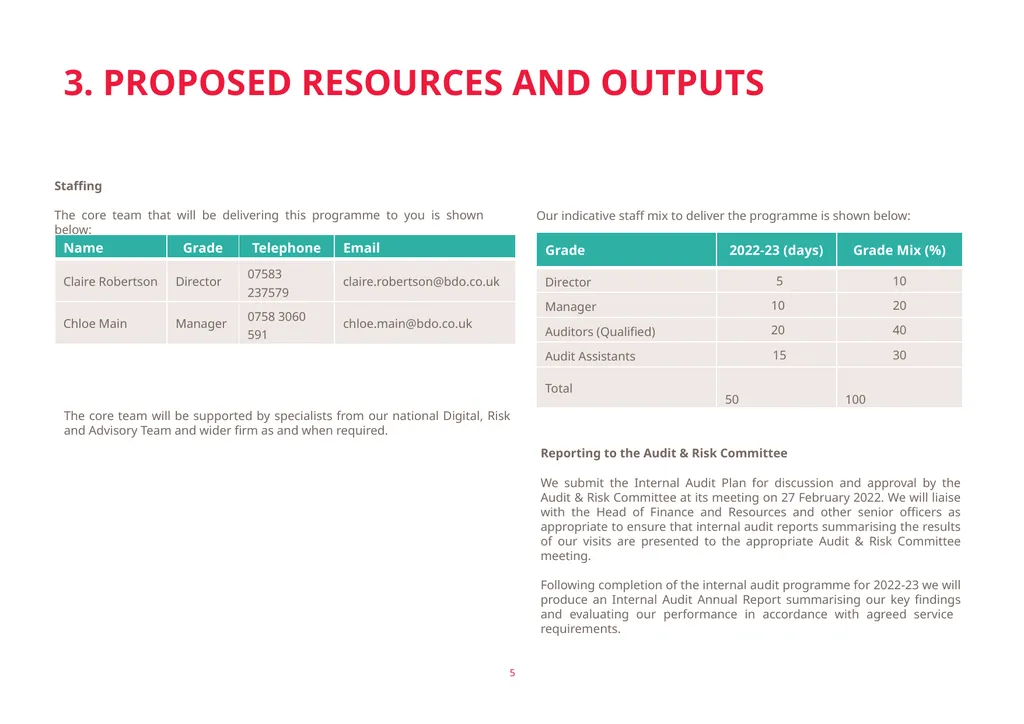
3. PROPOSED RESOURCES AND OUTPUTS 5 Staffing
The core team that will be delivering this programme to you is shown below: Our indicative staff mix to deliver the programme is shown below: The core team will be supported by specialists from our national Digital, Risk and Advisory Team and wider firm as and when required. Reporting to the Audit & Risk Committee
We submit the Internal Audit Plan for discussion and approval by the Audit & Risk Committee at its meeting on 27 February 2022. We will liaise with the Head of Finance and Resources and other senior officers as appropriate to ensure that internal audit reports summarising the results of our visits are presented to the appropriate Audit & Risk Committee meeting.
Following completion of the internal audit programme for 2022-23 we will produce an Internal Audit Annual Report summarising our key findings and evaluating our performance in accordance with agreed service requirements.<br>
The core team that will be delivering this programme to you is shown below: Our indicative staff mix to deliver the programme is shown below: The core team will be supported by specialists from our national Digital, Risk and Advisory Team and wider firm as and when required. Reporting to the Audit & Risk Committee
We submit the Internal Audit Plan for discussion and approval by the Audit & Risk Committee at its meeting on 27 February 2022. We will liaise with the Head of Finance and Resources and other senior officers as appropriate to ensure that internal audit reports summarising the results of our visits are presented to the appropriate Audit & Risk Committee meeting.
Following completion of the internal audit programme for 2022-23 we will produce an Internal Audit Annual Report summarising our key findings and evaluating our performance in accordance with agreed service requirements.<br>
06
APPENDIX I
Internal Audit Plan 2022-23 6<br>
Internal Audit Plan 2022-23 6<br>
07
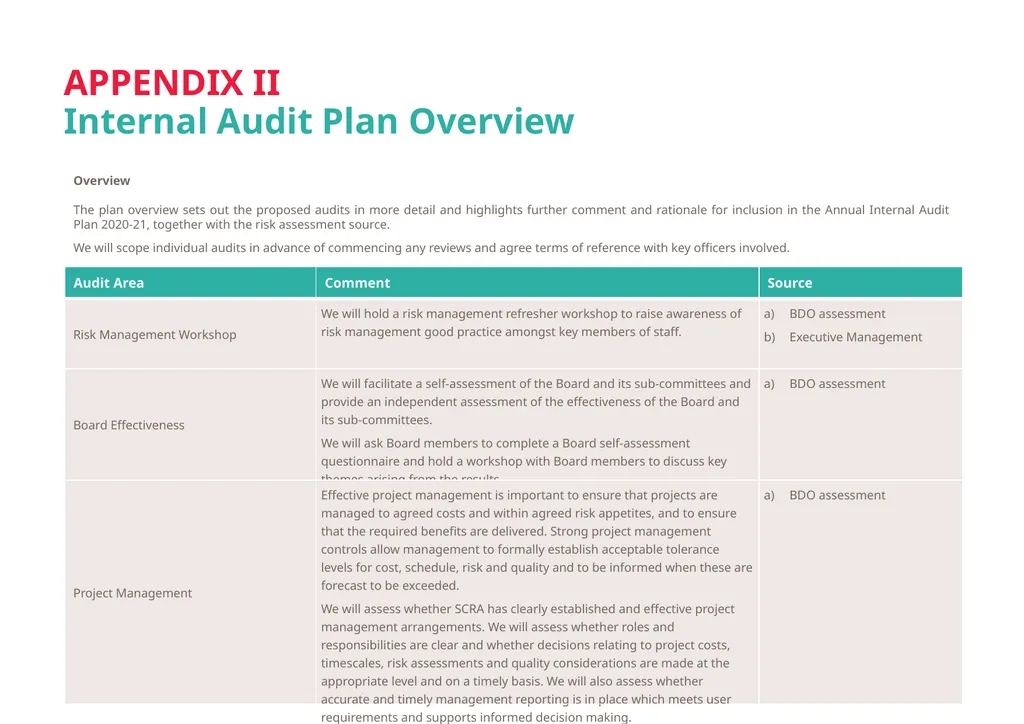
APPENDIX II
Internal Audit Plan Overview 7 Overview
The plan overview sets out the proposed audits in more detail and highlights further comment and rationale for inclusion in the Annual Internal Audit Plan 2020-21, together with the risk assessment source.
We will scope individual audits in advance of commencing any reviews and agree terms of reference with key officers involved.<br>
Internal Audit Plan Overview 7 Overview
The plan overview sets out the proposed audits in more detail and highlights further comment and rationale for inclusion in the Annual Internal Audit Plan 2020-21, together with the risk assessment source.
We will scope individual audits in advance of commencing any reviews and agree terms of reference with key officers involved.<br>
08
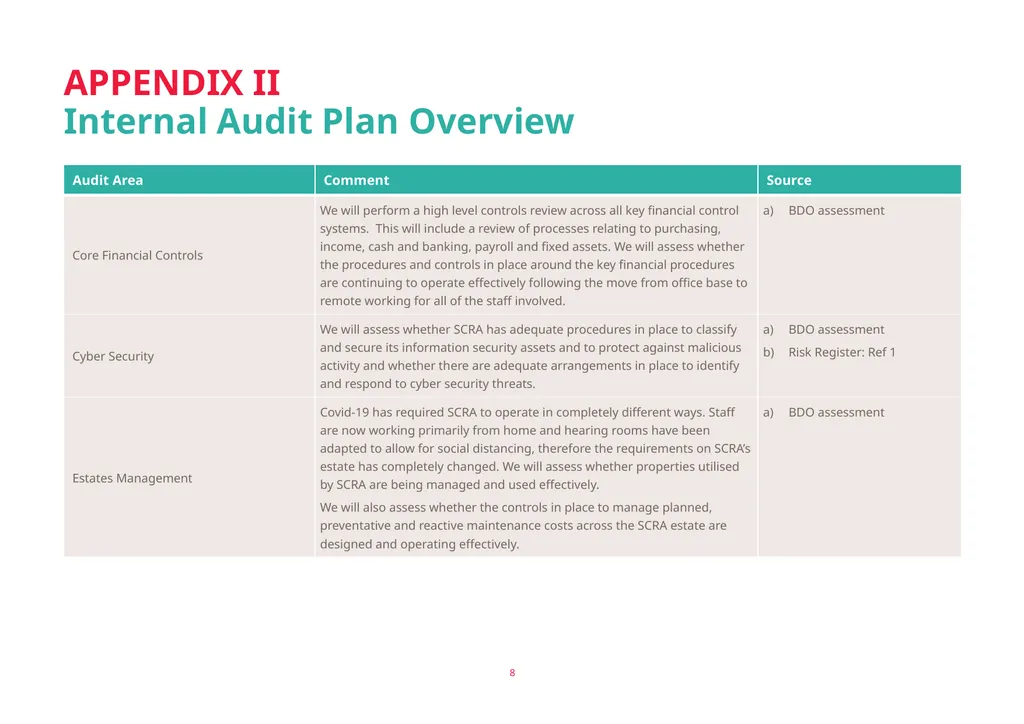
APPENDIX II
Internal Audit Plan Overview 8<br>
Internal Audit Plan Overview 8<br>
09
APPENDIX II
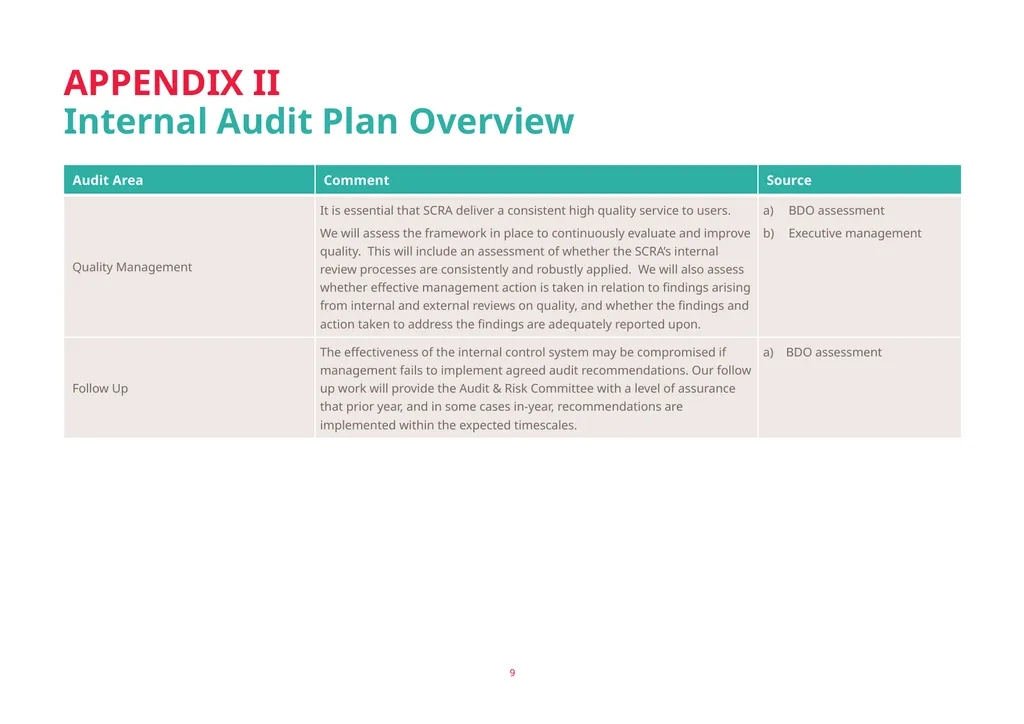
Internal Audit Plan Overview 9<br>
Internal Audit Plan Overview 9<br>
10
APPENDIX III
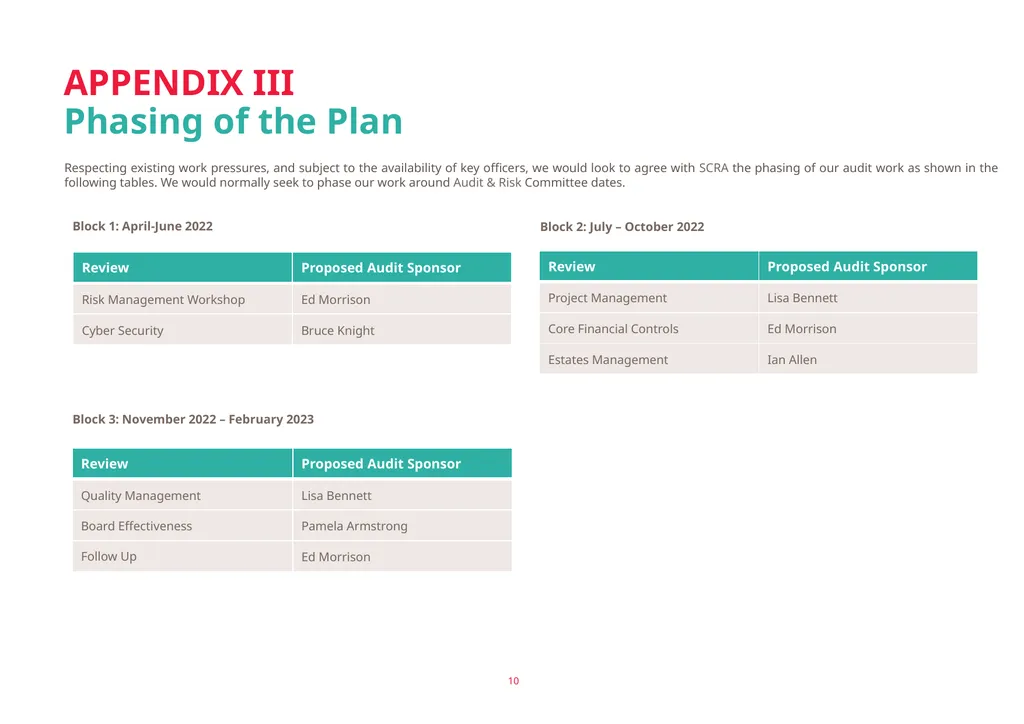
Phasing of the Plan 10 Respecting existing work pressures, and subject to the availability of key officers, we would look to agree with SCRA the phasing of our audit work as shown in the following tables. We would normally seek to phase our work around Audit & Risk Committee dates. Block 1: April-June 2022 Block 3: November 2022 – February 2023 Block 2: July – October 2022<br>
Phasing of the Plan 10 Respecting existing work pressures, and subject to the availability of key officers, we would look to agree with SCRA the phasing of our audit work as shown in the following tables. We would normally seek to phase our work around Audit & Risk Committee dates. Block 1: April-June 2022 Block 3: November 2022 – February 2023 Block 2: July – October 2022<br>
11
APPENDIX IV
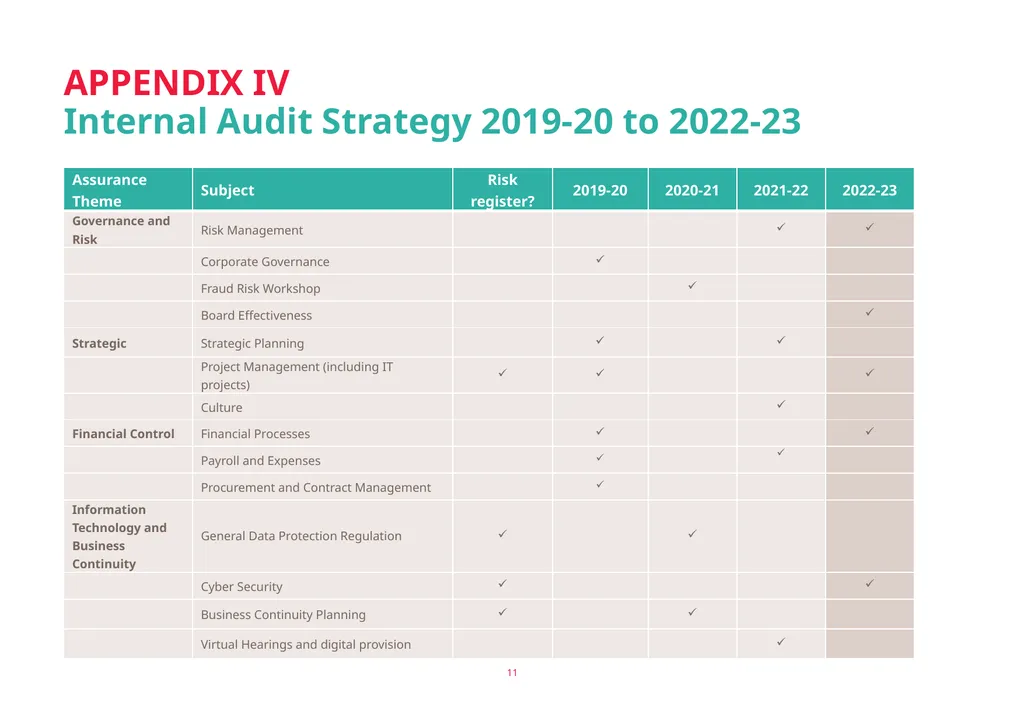
Internal Audit Strategy 2019-20 to 2022-23 11<br>
Internal Audit Strategy 2019-20 to 2022-23 11<br>
12
APPENDIX IV
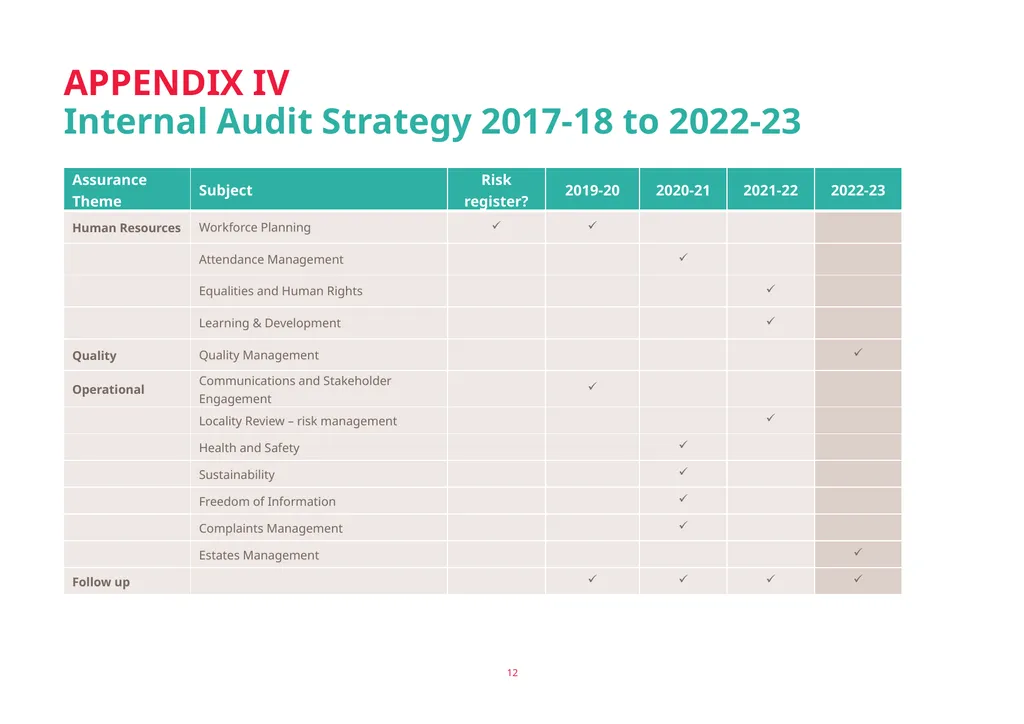
Internal Audit Strategy 2017-18 to 2022-23 12<br>
Internal Audit Strategy 2017-18 to 2022-23 12<br>
13
APPENDIX V
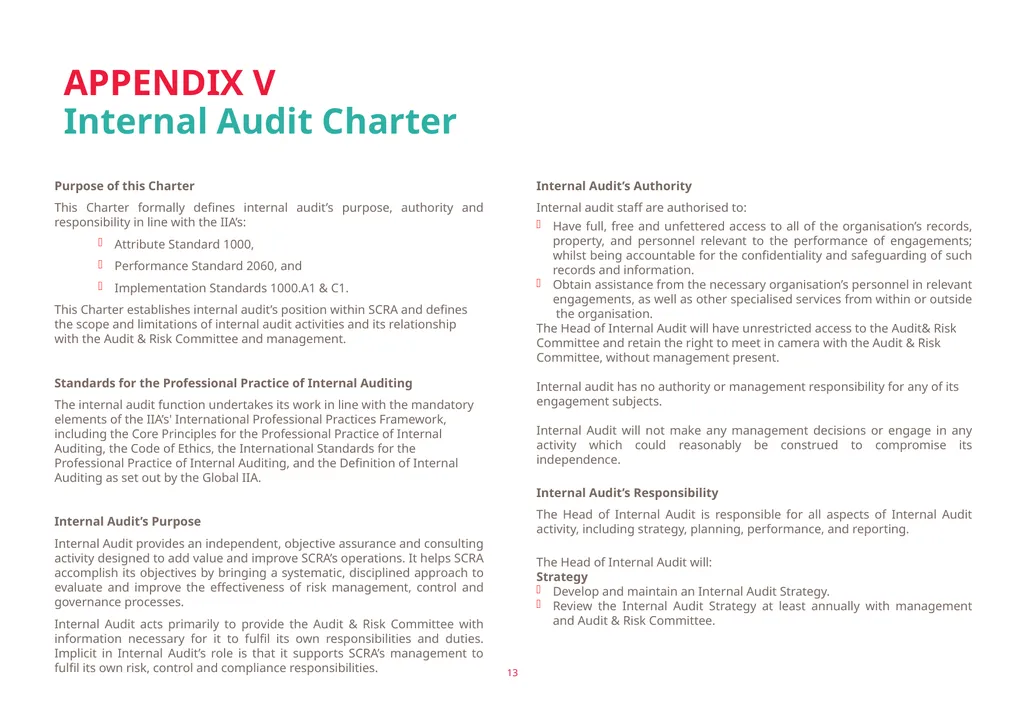
Internal Audit Charter 13 Purpose of this Charter
This Charter formally defines internal audit’s purpose, authority and responsibility in line with the IIA’s:
Attribute Standard 1000,
Performance Standard 2060, and
Implementation Standards 1000.A1 & C1.
This Charter establishes internal audit’s position within SCRA and defines the scope and limitations of internal audit activities and its relationship with the Audit & Risk Committee and management.
Standards for the Professional Practice of Internal Auditing
The internal audit function undertakes its work in line with the mandatory elements of the IIA’s' International Professional Practices Framework, including the Core Principles for the Professional Practice of Internal Auditing, the Code of Ethics, the International Standards for the Professional Practice of Internal Auditing, and the Definition of Internal Auditing as set out by the Global IIA.
Internal Audit’s Purpose
Internal Audit provides an independent, objective assurance and consulting activity designed to add value and improve SCRA’s operations. It helps SCRA accomplish its objectives by bringing a systematic, disciplined approach to evaluate and improve the effectiveness of risk management, control and governance processes.
Internal Audit acts primarily to provide the Audit & Risk Committee with information necessary for it to fulfil its own responsibilities and duties. Implicit in Internal Audit’s role is that it supports SCRA’s management to fulfil its own risk, control and compliance responsibilities. Internal Audit’s Authority
Internal audit staff are authorised to:
Have full, free and unfettered access to all of the organisation’s records, property, and personnel relevant to the performance of engagements; whilst being accountable for the confidentiality and safeguarding of such records and information.
Obtain assistance from the necessary organisation’s personnel in relevant engagements, as well as other specialised services from within or outside the organisation.
The Head of Internal Audit will have unrestricted access to the Audit& Risk Committee and retain the right to meet in camera with the Audit & Risk Committee, without management present.
Internal audit has no authority or management responsibility for any of its engagement subjects.
Internal Audit will not make any management decisions or engage in any activity which could reasonably be construed to compromise its independence.
Internal Audit’s Responsibility
The Head of Internal Audit is responsible for all aspects of Internal Audit activity, including strategy, planning, performance, and reporting.
The Head of Internal Audit will:
Strategy
Develop and maintain an Internal Audit Strategy.
Review the Internal Audit Strategy at least annually with management and Audit & Risk Committee.<br>
Internal Audit Charter 13 Purpose of this Charter
This Charter formally defines internal audit’s purpose, authority and responsibility in line with the IIA’s:
Attribute Standard 1000,
Performance Standard 2060, and
Implementation Standards 1000.A1 & C1.
This Charter establishes internal audit’s position within SCRA and defines the scope and limitations of internal audit activities and its relationship with the Audit & Risk Committee and management.
Standards for the Professional Practice of Internal Auditing
The internal audit function undertakes its work in line with the mandatory elements of the IIA’s' International Professional Practices Framework, including the Core Principles for the Professional Practice of Internal Auditing, the Code of Ethics, the International Standards for the Professional Practice of Internal Auditing, and the Definition of Internal Auditing as set out by the Global IIA.
Internal Audit’s Purpose
Internal Audit provides an independent, objective assurance and consulting activity designed to add value and improve SCRA’s operations. It helps SCRA accomplish its objectives by bringing a systematic, disciplined approach to evaluate and improve the effectiveness of risk management, control and governance processes.
Internal Audit acts primarily to provide the Audit & Risk Committee with information necessary for it to fulfil its own responsibilities and duties. Implicit in Internal Audit’s role is that it supports SCRA’s management to fulfil its own risk, control and compliance responsibilities. Internal Audit’s Authority
Internal audit staff are authorised to:
Have full, free and unfettered access to all of the organisation’s records, property, and personnel relevant to the performance of engagements; whilst being accountable for the confidentiality and safeguarding of such records and information.
Obtain assistance from the necessary organisation’s personnel in relevant engagements, as well as other specialised services from within or outside the organisation.
The Head of Internal Audit will have unrestricted access to the Audit& Risk Committee and retain the right to meet in camera with the Audit & Risk Committee, without management present.
Internal audit has no authority or management responsibility for any of its engagement subjects.
Internal Audit will not make any management decisions or engage in any activity which could reasonably be construed to compromise its independence.
Internal Audit’s Responsibility
The Head of Internal Audit is responsible for all aspects of Internal Audit activity, including strategy, planning, performance, and reporting.
The Head of Internal Audit will:
Strategy
Develop and maintain an Internal Audit Strategy.
Review the Internal Audit Strategy at least annually with management and Audit & Risk Committee.<br>
14
APPENDIX V
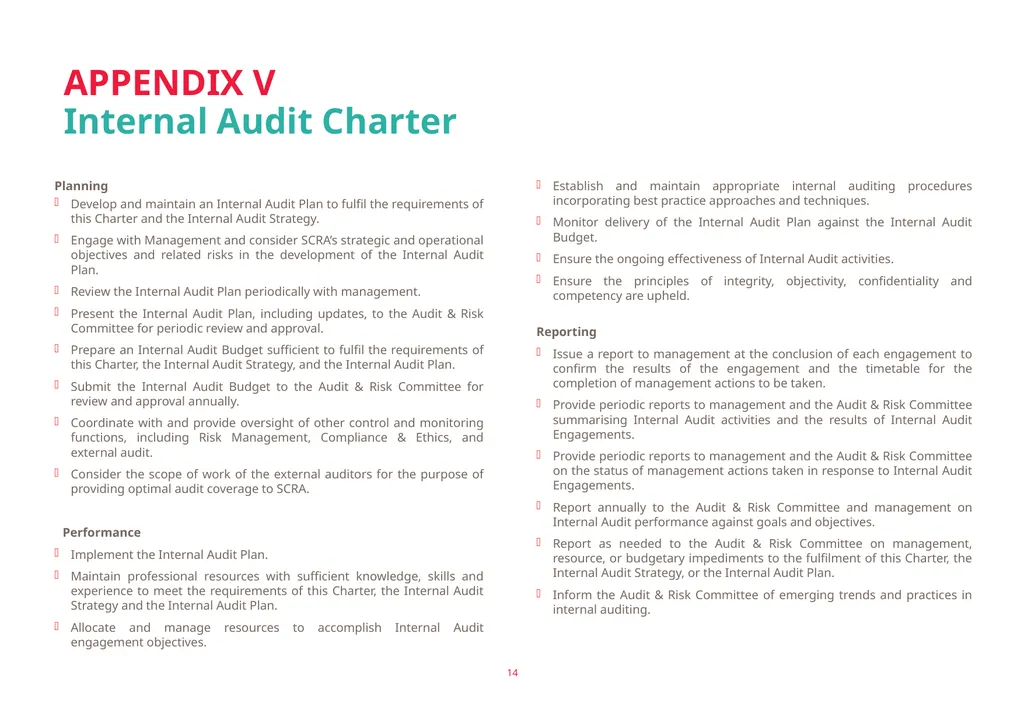
Internal Audit Charter 14 Planning
Develop and maintain an Internal Audit Plan to fulfil the requirements of this Charter and the Internal Audit Strategy.
Engage with Management and consider SCRA’s strategic and operational objectives and related risks in the development of the Internal Audit Plan.
Review the Internal Audit Plan periodically with management.
Present the Internal Audit Plan, including updates, to the Audit & Risk Committee for periodic review and approval.
Prepare an Internal Audit Budget sufficient to fulfil the requirements of this Charter, the Internal Audit Strategy, and the Internal Audit Plan.
Submit the Internal Audit Budget to the Audit & Risk Committee for review and approval annually.
Coordinate with and provide oversight of other control and monitoring functions, including Risk Management, Compliance & Ethics, and external audit.
Consider the scope of work of the external auditors for the purpose of providing optimal audit coverage to SCRA.
Performance
Implement the Internal Audit Plan.
Maintain professional resources with sufficient knowledge, skills and experience to meet the requirements of this Charter, the Internal Audit Strategy and the Internal Audit Plan.
Allocate and manage resources to accomplish Internal Audit engagement objectives. Establish and maintain appropriate internal auditing procedures incorporating best practice approaches and techniques.
Monitor delivery of the Internal Audit Plan against the Internal Audit Budget.
Ensure the ongoing effectiveness of Internal Audit activities.
Ensure the principles of integrity, objectivity, confidentiality and competency are upheld.
Reporting
Issue a report to management at the conclusion of each engagement to confirm the results of the engagement and the timetable for the completion of management actions to be taken.
Provide periodic reports to management and the Audit & Risk Committee summarising Internal Audit activities and the results of Internal Audit Engagements.
Provide periodic reports to management and the Audit & Risk Committee on the status of management actions taken in response to Internal Audit Engagements.
Report annually to the Audit & Risk Committee and management on Internal Audit performance against goals and objectives.
Report as needed to the Audit & Risk Committee on management, resource, or budgetary impediments to the fulfilment of this Charter, the Internal Audit Strategy, or the Internal Audit Plan.
Inform the Audit & Risk Committee of emerging trends and practices in internal auditing.<br>
Internal Audit Charter 14 Planning
Develop and maintain an Internal Audit Plan to fulfil the requirements of this Charter and the Internal Audit Strategy.
Engage with Management and consider SCRA’s strategic and operational objectives and related risks in the development of the Internal Audit Plan.
Review the Internal Audit Plan periodically with management.
Present the Internal Audit Plan, including updates, to the Audit & Risk Committee for periodic review and approval.
Prepare an Internal Audit Budget sufficient to fulfil the requirements of this Charter, the Internal Audit Strategy, and the Internal Audit Plan.
Submit the Internal Audit Budget to the Audit & Risk Committee for review and approval annually.
Coordinate with and provide oversight of other control and monitoring functions, including Risk Management, Compliance & Ethics, and external audit.
Consider the scope of work of the external auditors for the purpose of providing optimal audit coverage to SCRA.
Performance
Implement the Internal Audit Plan.
Maintain professional resources with sufficient knowledge, skills and experience to meet the requirements of this Charter, the Internal Audit Strategy and the Internal Audit Plan.
Allocate and manage resources to accomplish Internal Audit engagement objectives. Establish and maintain appropriate internal auditing procedures incorporating best practice approaches and techniques.
Monitor delivery of the Internal Audit Plan against the Internal Audit Budget.
Ensure the ongoing effectiveness of Internal Audit activities.
Ensure the principles of integrity, objectivity, confidentiality and competency are upheld.
Reporting
Issue a report to management at the conclusion of each engagement to confirm the results of the engagement and the timetable for the completion of management actions to be taken.
Provide periodic reports to management and the Audit & Risk Committee summarising Internal Audit activities and the results of Internal Audit Engagements.
Provide periodic reports to management and the Audit & Risk Committee on the status of management actions taken in response to Internal Audit Engagements.
Report annually to the Audit & Risk Committee and management on Internal Audit performance against goals and objectives.
Report as needed to the Audit & Risk Committee on management, resource, or budgetary impediments to the fulfilment of this Charter, the Internal Audit Strategy, or the Internal Audit Plan.
Inform the Audit & Risk Committee of emerging trends and practices in internal auditing.<br>
15
APPENDIX V
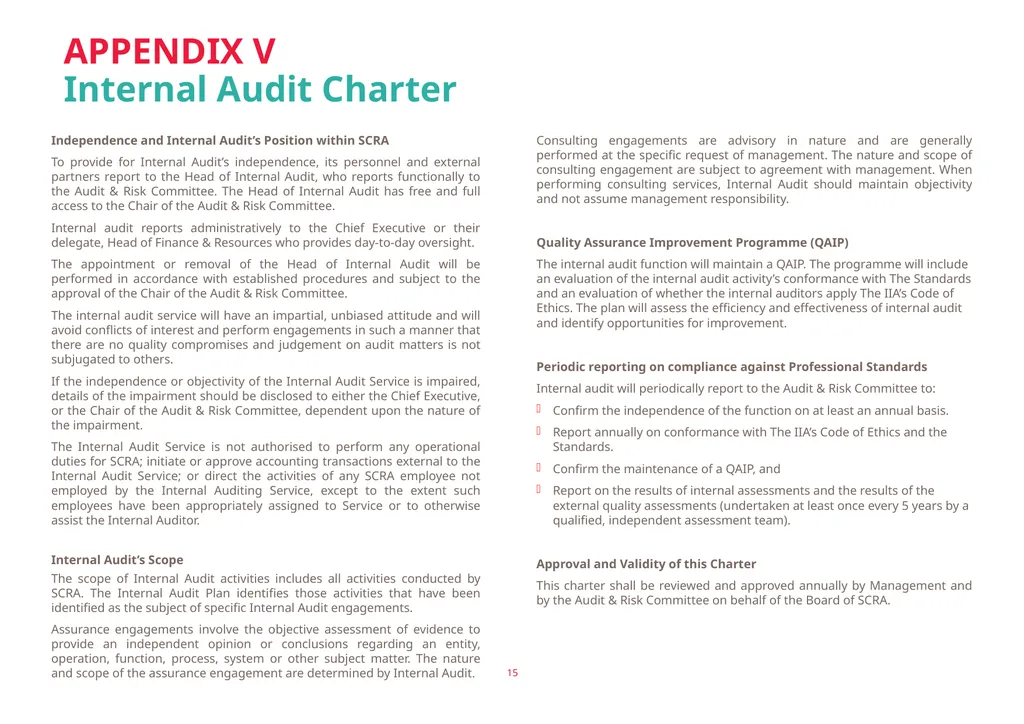
Internal Audit Charter 15 Independence and Internal Audit’s Position within SCRA
To provide for Internal Audit’s independence, its personnel and external partners report to the Head of Internal Audit, who reports functionally to the Audit & Risk Committee. The Head of Internal Audit has free and full access to the Chair of the Audit & Risk Committee.
Internal audit reports administratively to the Chief Executive or their delegate, Head of Finance & Resources who provides day-to-day oversight.
The appointment or removal of the Head of Internal Audit will be performed in accordance with established procedures and subject to the approval of the Chair of the Audit & Risk Committee.
The internal audit service will have an impartial, unbiased attitude and will avoid conflicts of interest and perform engagements in such a manner that there are no quality compromises and judgement on audit matters is not subjugated to others.
If the independence or objectivity of the Internal Audit Service is impaired, details of the impairment should be disclosed to either the Chief Executive, or the Chair of the Audit & Risk Committee, dependent upon the nature of the impairment.
The Internal Audit Service is not authorised to perform any operational duties for SCRA; initiate or approve accounting transactions external to the Internal Audit Service; or direct the activities of any SCRA employee not employed by the Internal Auditing Service, except to the extent such employees have been appropriately assigned to Service or to otherwise assist the Internal Auditor.
Internal Audit’s Scope
The scope of Internal Audit activities includes all activities conducted by SCRA. The Internal Audit Plan identifies those activities that have been identified as the subject of specific Internal Audit engagements.
Assurance engagements involve the objective assessment of evidence to provide an independent opinion or conclusions regarding an entity, operation, function, process, system or other subject matter. The nature and scope of the assurance engagement are determined by Internal Audit. Consulting engagements are advisory in nature and are generally performed at the specific request of management. The nature and scope of consulting engagement are subject to agreement with management. When performing consulting services, Internal Audit should maintain objectivity and not assume management responsibility.
Quality Assurance Improvement Programme (QAIP)
The internal audit function will maintain a QAIP. The programme will include an evaluation of the internal audit activity’s conformance with The Standards and an evaluation of whether the internal auditors apply The IIA’s Code of Ethics. The plan will assess the efficiency and effectiveness of internal audit and identify opportunities for improvement.
Periodic reporting on compliance against Professional Standards
Internal audit will periodically report to the Audit & Risk Committee to:
Confirm the independence of the function on at least an annual basis.
Report annually on conformance with The IIA’s Code of Ethics and the Standards.
Confirm the maintenance of a QAIP, and
Report on the results of internal assessments and the results of the external quality assessments (undertaken at least once every 5 years by a qualified, independent assessment team).
Approval and Validity of this Charter
This charter shall be reviewed and approved annually by Management and by the Audit & Risk Committee on behalf of the Board of SCRA.<br>
Internal Audit Charter 15 Independence and Internal Audit’s Position within SCRA
To provide for Internal Audit’s independence, its personnel and external partners report to the Head of Internal Audit, who reports functionally to the Audit & Risk Committee. The Head of Internal Audit has free and full access to the Chair of the Audit & Risk Committee.
Internal audit reports administratively to the Chief Executive or their delegate, Head of Finance & Resources who provides day-to-day oversight.
The appointment or removal of the Head of Internal Audit will be performed in accordance with established procedures and subject to the approval of the Chair of the Audit & Risk Committee.
The internal audit service will have an impartial, unbiased attitude and will avoid conflicts of interest and perform engagements in such a manner that there are no quality compromises and judgement on audit matters is not subjugated to others.
If the independence or objectivity of the Internal Audit Service is impaired, details of the impairment should be disclosed to either the Chief Executive, or the Chair of the Audit & Risk Committee, dependent upon the nature of the impairment.
The Internal Audit Service is not authorised to perform any operational duties for SCRA; initiate or approve accounting transactions external to the Internal Audit Service; or direct the activities of any SCRA employee not employed by the Internal Auditing Service, except to the extent such employees have been appropriately assigned to Service or to otherwise assist the Internal Auditor.
Internal Audit’s Scope
The scope of Internal Audit activities includes all activities conducted by SCRA. The Internal Audit Plan identifies those activities that have been identified as the subject of specific Internal Audit engagements.
Assurance engagements involve the objective assessment of evidence to provide an independent opinion or conclusions regarding an entity, operation, function, process, system or other subject matter. The nature and scope of the assurance engagement are determined by Internal Audit. Consulting engagements are advisory in nature and are generally performed at the specific request of management. The nature and scope of consulting engagement are subject to agreement with management. When performing consulting services, Internal Audit should maintain objectivity and not assume management responsibility.
Quality Assurance Improvement Programme (QAIP)
The internal audit function will maintain a QAIP. The programme will include an evaluation of the internal audit activity’s conformance with The Standards and an evaluation of whether the internal auditors apply The IIA’s Code of Ethics. The plan will assess the efficiency and effectiveness of internal audit and identify opportunities for improvement.
Periodic reporting on compliance against Professional Standards
Internal audit will periodically report to the Audit & Risk Committee to:
Confirm the independence of the function on at least an annual basis.
Report annually on conformance with The IIA’s Code of Ethics and the Standards.
Confirm the maintenance of a QAIP, and
Report on the results of internal assessments and the results of the external quality assessments (undertaken at least once every 5 years by a qualified, independent assessment team).
Approval and Validity of this Charter
This charter shall be reviewed and approved annually by Management and by the Audit & Risk Committee on behalf of the Board of SCRA.<br>
16
APPENDIX VI
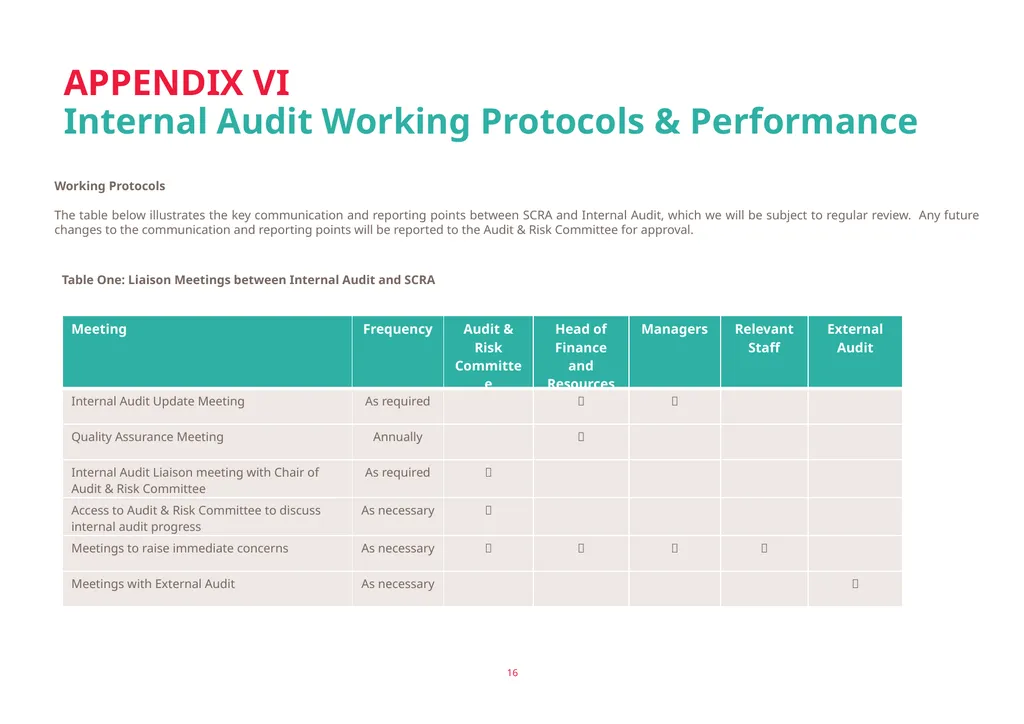
Internal Audit Working Protocols & Performance 16 Working Protocols
The table below illustrates the key communication and reporting points between SCRA and Internal Audit, which we will be subject to regular review. Any future changes to the communication and reporting points will be reported to the Audit & Risk Committee for approval. Table One: Liaison Meetings between Internal Audit and SCRA<br>
Internal Audit Working Protocols & Performance 16 Working Protocols
The table below illustrates the key communication and reporting points between SCRA and Internal Audit, which we will be subject to regular review. Any future changes to the communication and reporting points will be reported to the Audit & Risk Committee for approval. Table One: Liaison Meetings between Internal Audit and SCRA<br>
17
APPENDIX VI
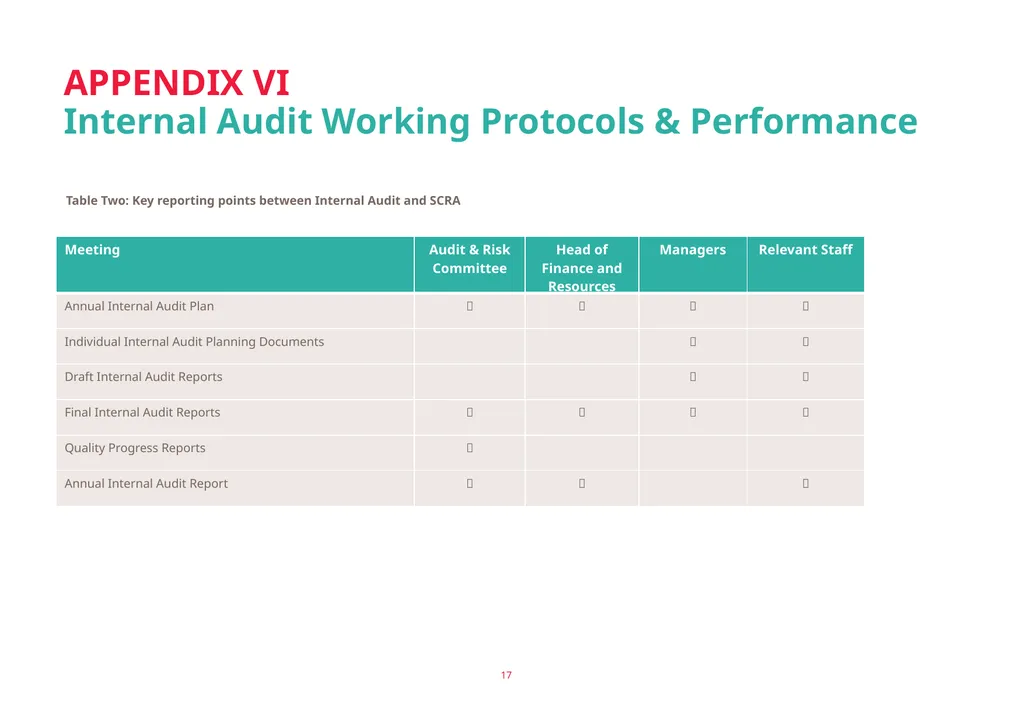
Internal Audit Working Protocols & Performance 17 Table Two: Key reporting points between Internal Audit and SCRA<br>
Internal Audit Working Protocols & Performance 17 Table Two: Key reporting points between Internal Audit and SCRA<br>
18
18 Performance Measurement
Performance measurement is the use of measures and associated targets to assess objectively the performance of a body. It is now well established as an important means of improving performance and reinforcing accountability.
BDO LLP has been appointed as internal auditors to SCRA, subject to satisfactory performance. Consequently there is value in reviewing the quality of our service on a regular basis.
Internal Audit Performance measures and indicators
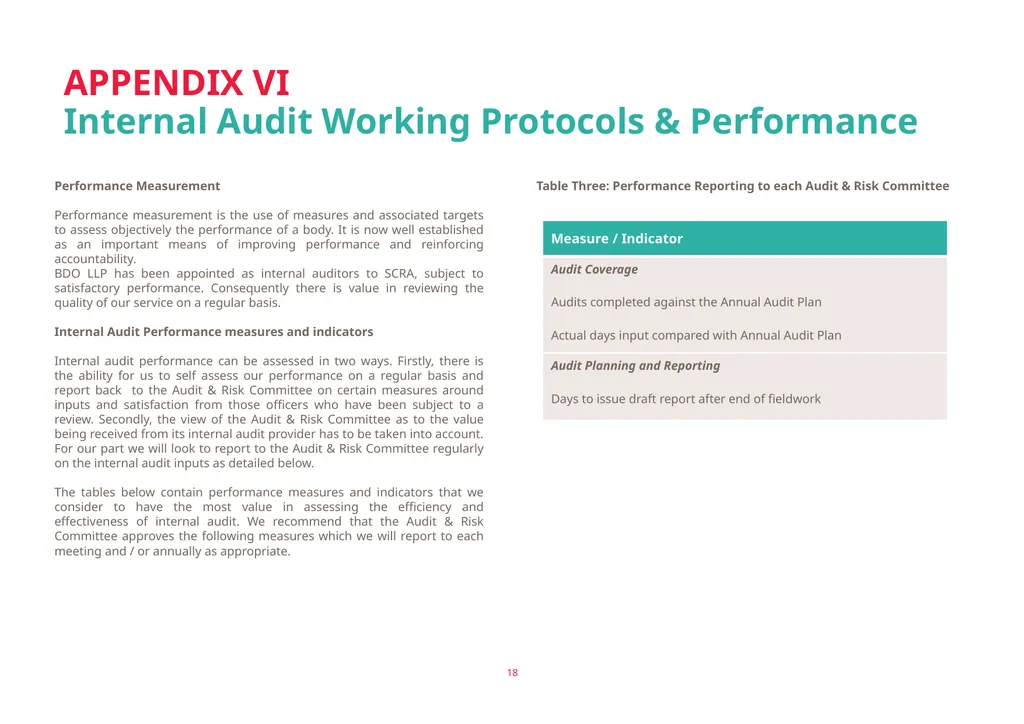
Internal audit performance can be assessed in two ways. Firstly, there is the ability for us to self assess our performance on a regular basis and report back to the Audit & Risk Committee on certain measures around inputs and satisfaction from those officers who have been subject to a review. Secondly, the view of the Audit & Risk Committee as to the value being received from its internal audit provider has to be taken into account. For our part we will look to report to the Audit & Risk Committee regularly on the internal audit inputs as detailed below.
The tables below contain performance measures and indicators that we consider to have the most value in assessing the efficiency and effectiveness of internal audit. We recommend that the Audit & Risk Committee approves the following measures which we will report to each meeting and / or annually as appropriate. Table Three: Performance Reporting to each Audit & Risk Committee APPENDIX VI
Internal Audit Working Protocols & Performance<br>
Performance measurement is the use of measures and associated targets to assess objectively the performance of a body. It is now well established as an important means of improving performance and reinforcing accountability.
BDO LLP has been appointed as internal auditors to SCRA, subject to satisfactory performance. Consequently there is value in reviewing the quality of our service on a regular basis.
Internal Audit Performance measures and indicators
Internal audit performance can be assessed in two ways. Firstly, there is the ability for us to self assess our performance on a regular basis and report back to the Audit & Risk Committee on certain measures around inputs and satisfaction from those officers who have been subject to a review. Secondly, the view of the Audit & Risk Committee as to the value being received from its internal audit provider has to be taken into account. For our part we will look to report to the Audit & Risk Committee regularly on the internal audit inputs as detailed below.
The tables below contain performance measures and indicators that we consider to have the most value in assessing the efficiency and effectiveness of internal audit. We recommend that the Audit & Risk Committee approves the following measures which we will report to each meeting and / or annually as appropriate. Table Three: Performance Reporting to each Audit & Risk Committee APPENDIX VI
Internal Audit Working Protocols & Performance<br>
19
19 Management Performance Measures and Indicators
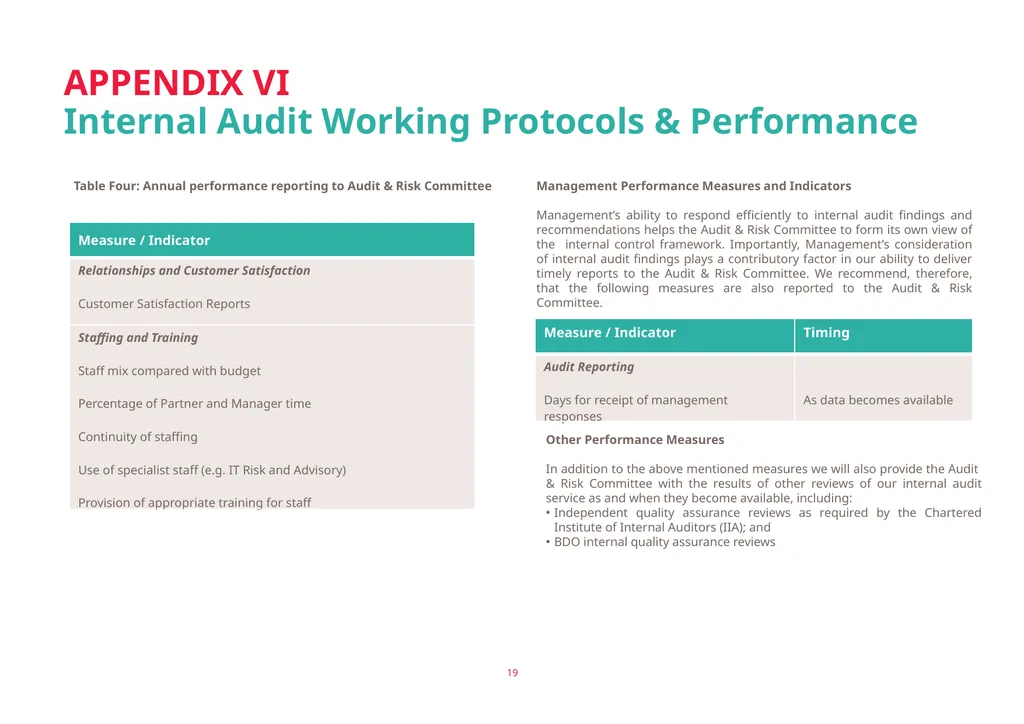
Management’s ability to respond efficiently to internal audit findings and recommendations helps the Audit & Risk Committee to form its own view of the internal control framework. Importantly, Management’s consideration of internal audit findings plays a contributory factor in our ability to deliver timely reports to the Audit & Risk Committee. We recommend, therefore, that the following measures are also reported to the Audit & Risk Committee. APPENDIX VI
Internal Audit Working Protocols & Performance Table Four: Annual performance reporting to Audit & Risk Committee Other Performance Measures
In addition to the above mentioned measures we will also provide the Audit & Risk Committee with the results of other reviews of our internal audit service as and when they become available, including:
Independent quality assurance reviews as required by the Chartered Institute of Internal Auditors (IIA); and
BDO internal quality assurance reviews<br>
Management’s ability to respond efficiently to internal audit findings and recommendations helps the Audit & Risk Committee to form its own view of the internal control framework. Importantly, Management’s consideration of internal audit findings plays a contributory factor in our ability to deliver timely reports to the Audit & Risk Committee. We recommend, therefore, that the following measures are also reported to the Audit & Risk Committee. APPENDIX VI
Internal Audit Working Protocols & Performance Table Four: Annual performance reporting to Audit & Risk Committee Other Performance Measures
In addition to the above mentioned measures we will also provide the Audit & Risk Committee with the results of other reviews of our internal audit service as and when they become available, including:
Independent quality assurance reviews as required by the Chartered Institute of Internal Auditors (IIA); and
BDO internal quality assurance reviews<br>
20
Appendix VII
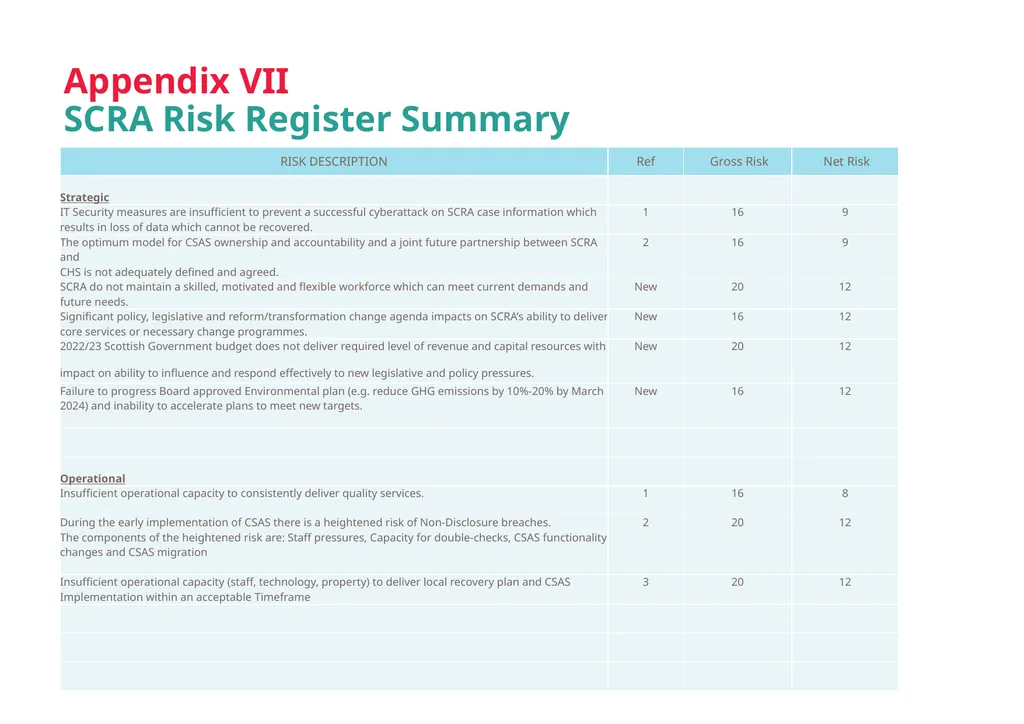
SCRA Risk Register Summary 20<br>
21
BDO LLP, a UK limited liability partnership registered in England and Wales under number OC305127, is a member of BDO International Limited, a UK company limited by guarantee, and forms part of the international BDO network of independent member firms. A list of members' names is open to inspection at our registered office, 55 Baker Street, London W1U 7EU. BDO LLP is authorised and regulated by the Financial Conduct Authority to conduct investment business.
BDO is the brand name of the BDO network and for each of the BDO Member Firms.
BDO Northern Ireland, a partnership formed in and under the laws of Northern Ireland, is licensed to operate within the international BDO network of independent member firms.
Copyright ©2022 BDO LLP. All rights reserved.
www.bdo.co.uk<br>
BDO is the brand name of the BDO network and for each of the BDO Member Firms.
BDO Northern Ireland, a partnership formed in and under the laws of Northern Ireland, is licensed to operate within the international BDO network of independent member firms.
Copyright ©2022 BDO LLP. All rights reserved.
www.bdo.co.uk<br>