
SDitH in Hardware Sanjay Deshpande, James Howe,
Description: SDitH in Hardware Sanjay Deshpande, James Howe, Jakub Szefer, and Dongze (Steven) Yue Motivation Quantum Computing holds tremendous potential that could solve complex problems that are out of reach for current high-performance computers
Related Topics
Download Presentation
"SDitH in Hardware Sanjay Deshpande, James Howe," is the property of its rightful owner. Permission is granted to download and print the materials on this website for personal, non-commercial use only, and to display it on your personal computer provided you do not modify the materials and that you retain all copyright notices contained in the materials. By downloading content from our website, you accept the terms of this agreement.
Presentation Transcript
slide1. SDitH in Hardware Sanjay Deshpande, James Howe, Jakub Szefer, and Dongze (Steven) Yue<br>
slide2. Motivation Quantum Computing holds tremendous potential that could solve complex problems that are out of reach for current high-performance computers
E.g., Life-saving pharmaceuticals, Green-battery technology
However, they also pose significant cybersecurity risks
Can break existing standards of public key cryptography
Hence, there is a need for Quantum-safe cryptography!
Post-quantum cryptography emerges as a beacon of hope 2<br>
slide3. NIST Post Quantum Cryptography Standardization Effort 3 Post-quantum cryptography standardization efforts are in progress around the world
PQC algorithms proposals
Key Encapsulation Mechanism
Digital Signature Schemes
Evaluation of PQC algorithms
Security
Implementation efficiency and implementation security – Hardware and Software
Cost
This talk – Syndrome Decoding in the Head (SDitH)<br>
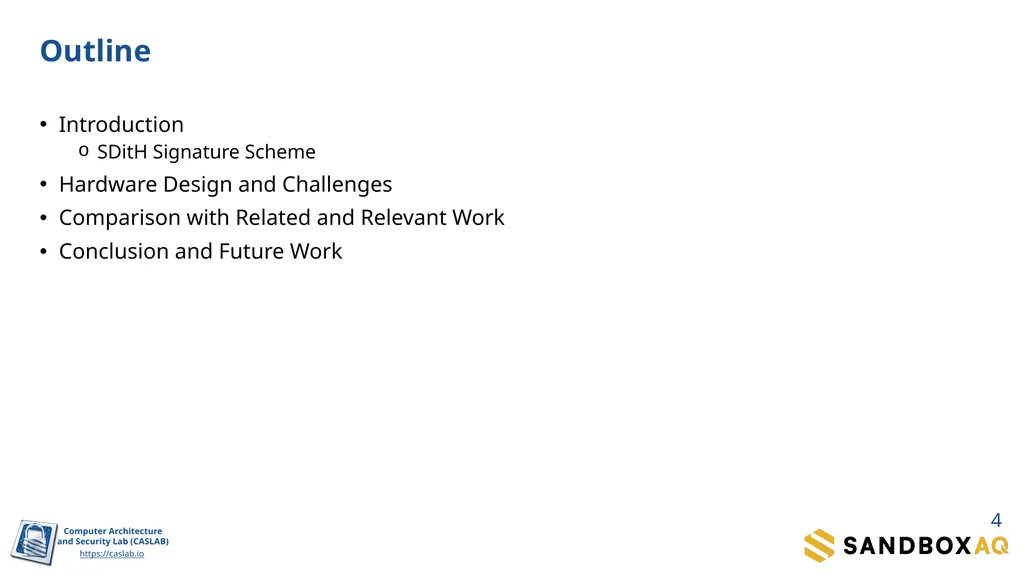
slide4. Outline Introduction
SDitH Signature Scheme
Hardware Design and Challenges
Comparison with Related and Relevant Work
Conclusion and Future Work 4<br>
slide5. Introduction<br>
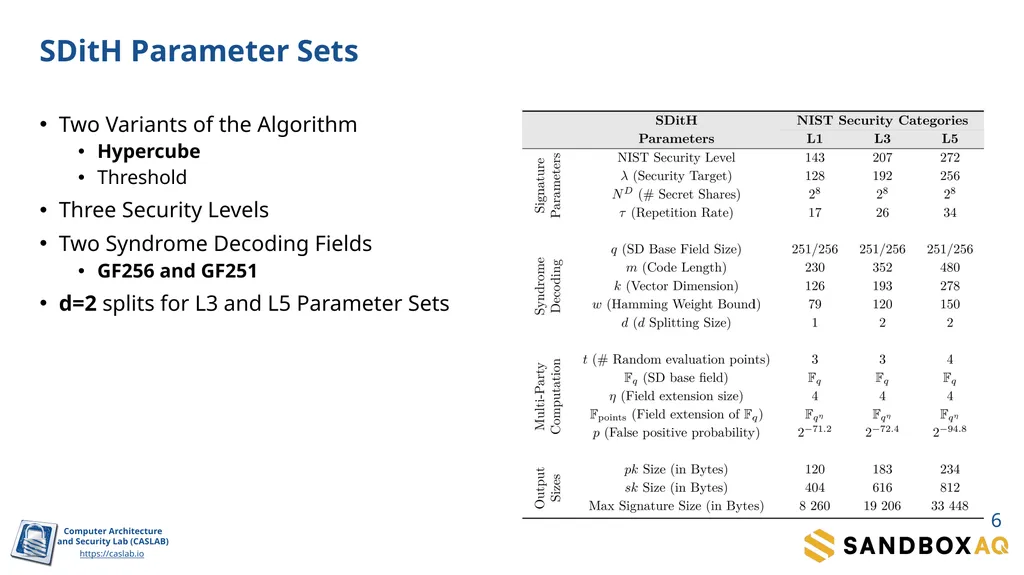
slide6. SDitH Parameter Sets Two Variants of the Algorithm
Hypercube
Threshold
Three Security Levels
Two Syndrome Decoding Fields
GF256 and GF251
d=2 splits for L3 and L5 Parameter Sets 6<br>
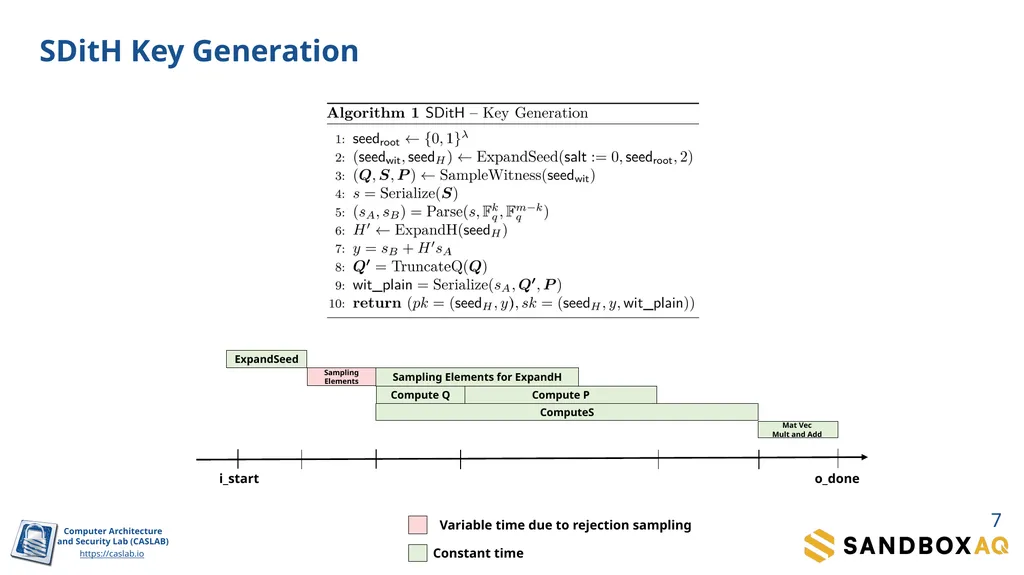
slide7. SDitH Key Generation ComputeS Mat Vec
Mult and Add Sampling Elements for ExpandH Compute Q Compute P Sampling Elements i_start o_done ExpandSeed Variable time due to rejection sampling Constant time 7<br>
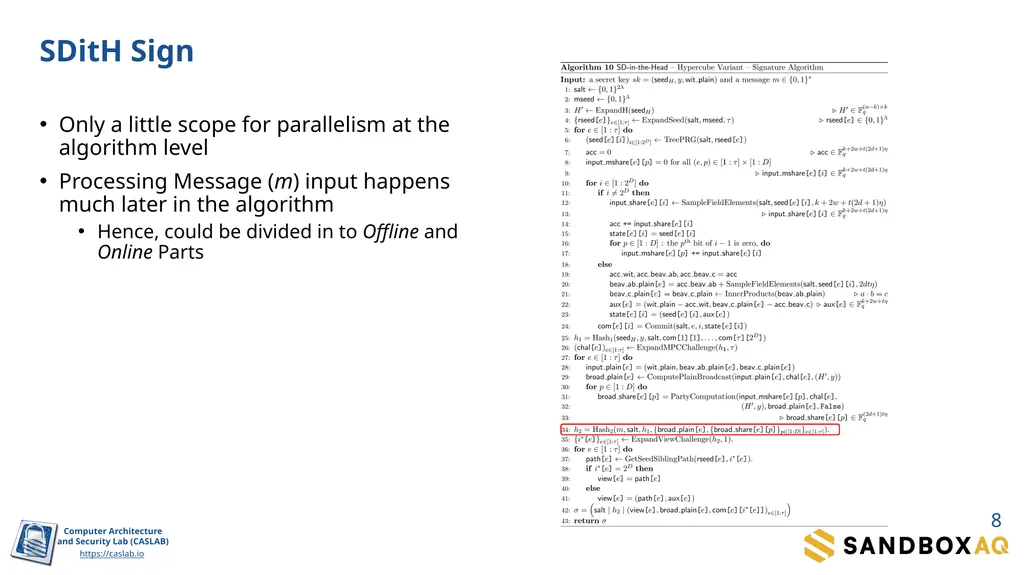
slide8. SDitH Sign Only a little scope for parallelism at the algorithm level
Processing Message (m) input happens much later in the algorithm
Hence, could be divided in to Offline and Online Parts 8<br>
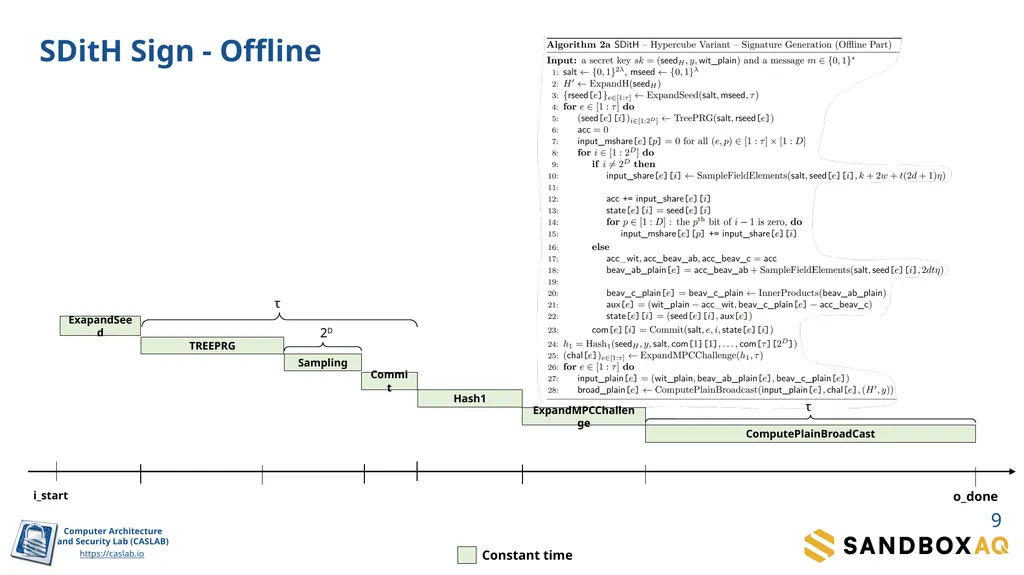
slide9. SDitH Sign - Offline TREEPRG Commit Sampling Hash1 ExapandSeed 2D ExpandMPCChallenge ComputePlainBroadCast i_start τ τ o_done Constant time 9<br>
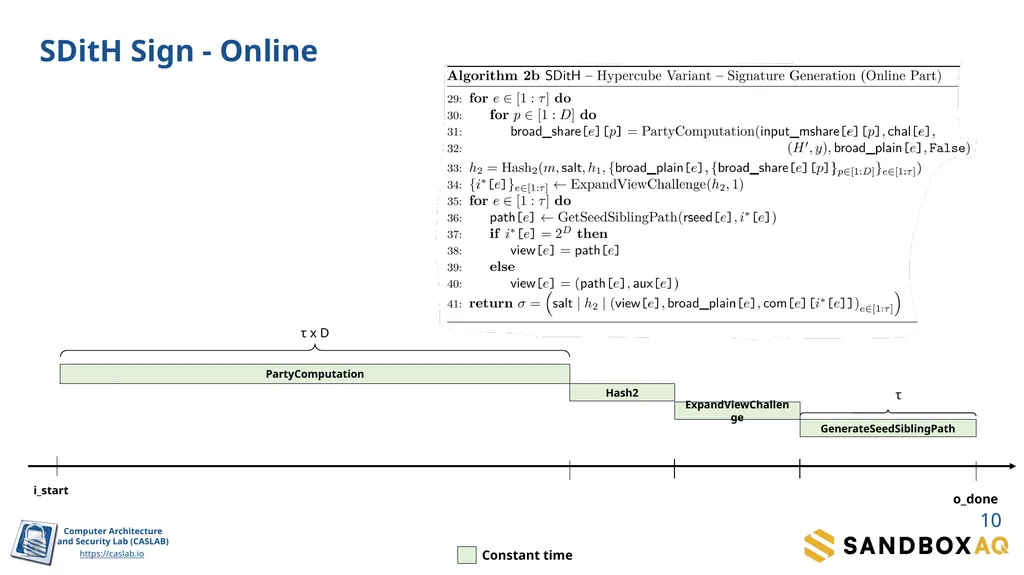
slide10. SDitH Sign - Online Constant time Hash2 PartyComputation τ x D ExpandViewChallenge GenerateSeedSiblingPath τ i_start o_done 10<br>
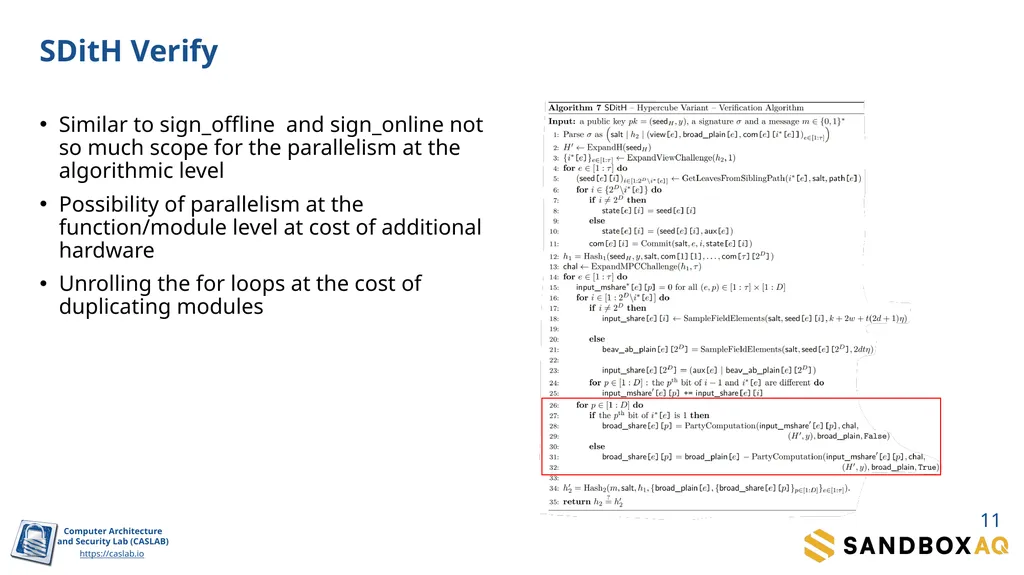
slide11. SDitH Verify Similar to sign_offline and sign_online not so much scope for the parallelism at the algorithmic level
Possibility of parallelism at the function/module level at cost of additional hardware
Unrolling the for loops at the cost of duplicating modules 11<br>
slide12. Hardware Design and Challenges<br>
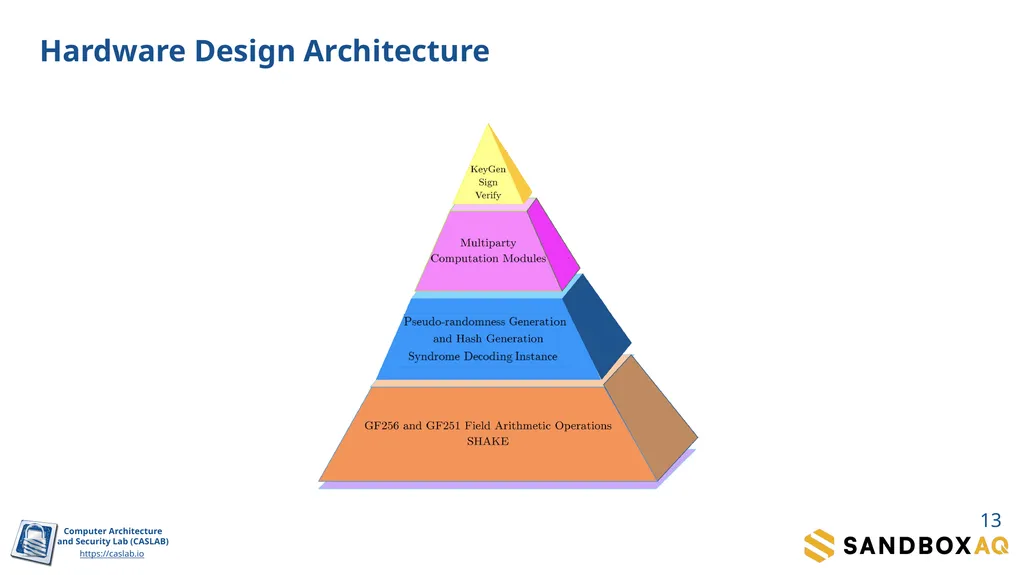
slide13. Hardware Design Architecture 13<br>
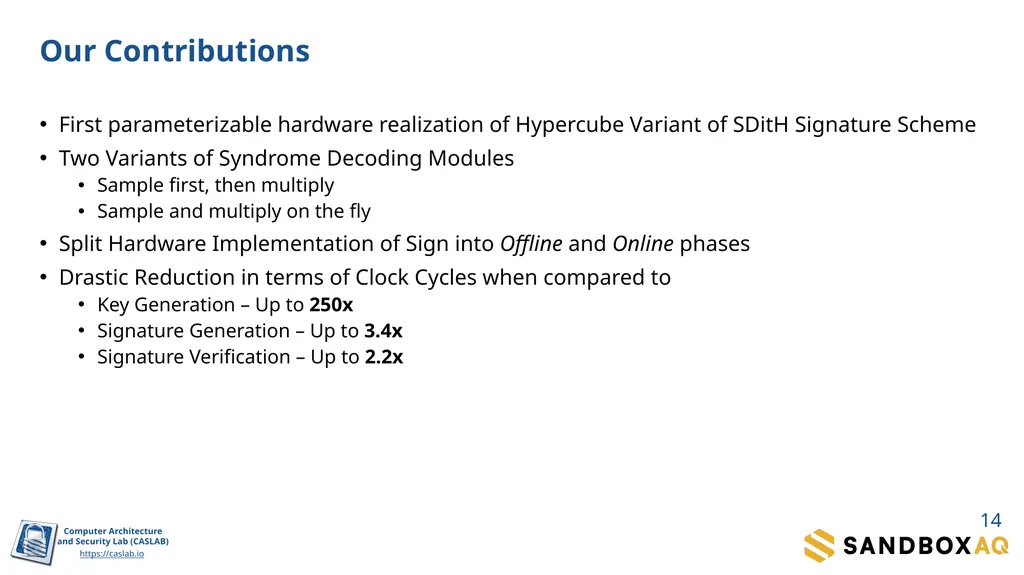
slide14. Our Contributions First parameterizable hardware realization of Hypercube Variant of SDitH Signature Scheme
Two Variants of Syndrome Decoding Modules
Sample first, then multiply
Sample and multiply on the fly
Split Hardware Implementation of Sign into Offline and Online phases
Drastic Reduction in terms of Clock Cycles when compared to
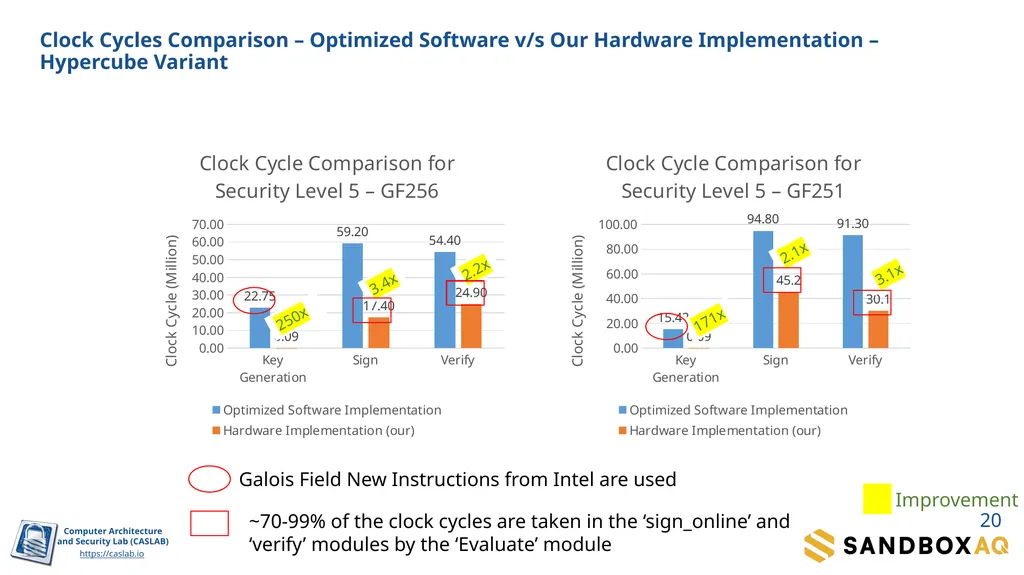
Key Generation – Up to 250x
Signature Generation – Up to 3.4x
Signature Verification – Up to 2.2x 14<br>
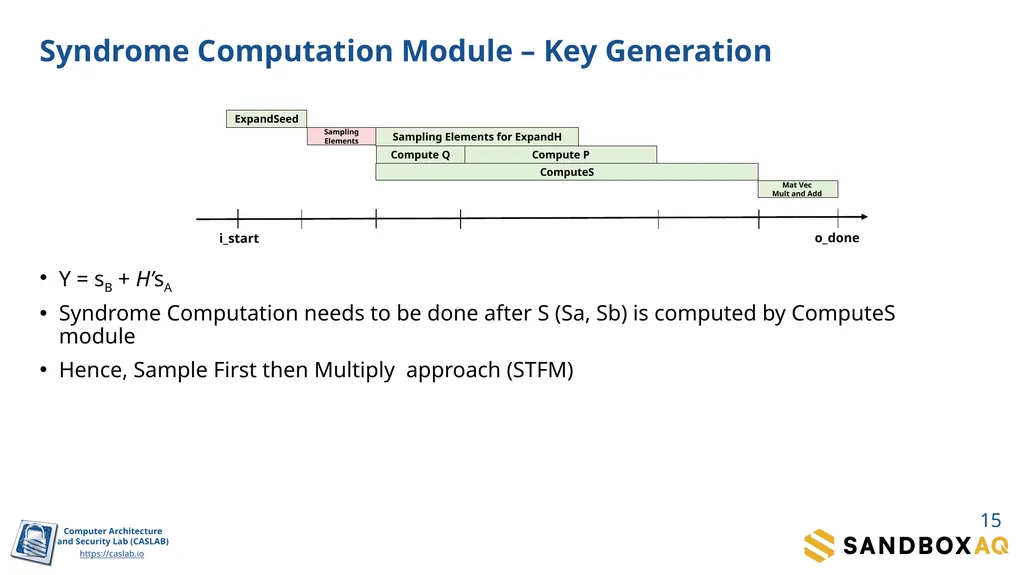
slide15. Syndrome Computation Module – Key Generation Y = sB + H’sA
Syndrome Computation needs to be done after S (Sa, Sb) is computed by ComputeS module
Hence, Sample First then Multiply approach (STFM) ComputeS Mat Vec
Mult and Add Sampling Elements for ExpandH Compute Q Compute P Sampling Elements i_start o_done ExpandSeed 15<br>
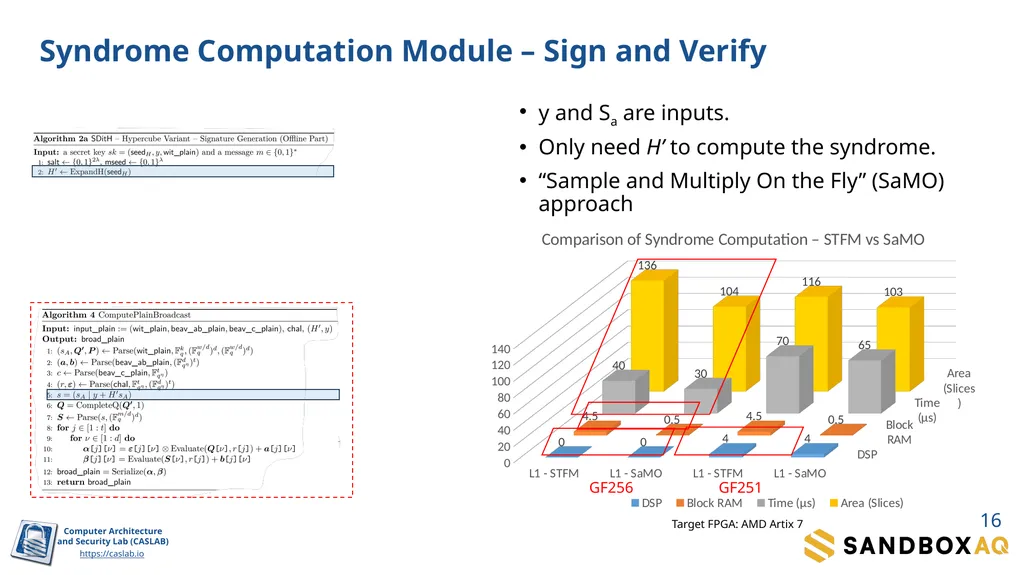
slide16. Syndrome Computation Module – Sign and Verify y and Sa are inputs.
Only need H’ to compute the syndrome.
“Sample and Multiply On the Fly” (SaMO) approach GF256 GF251 16 Target FPGA: AMD Artix 7<br>
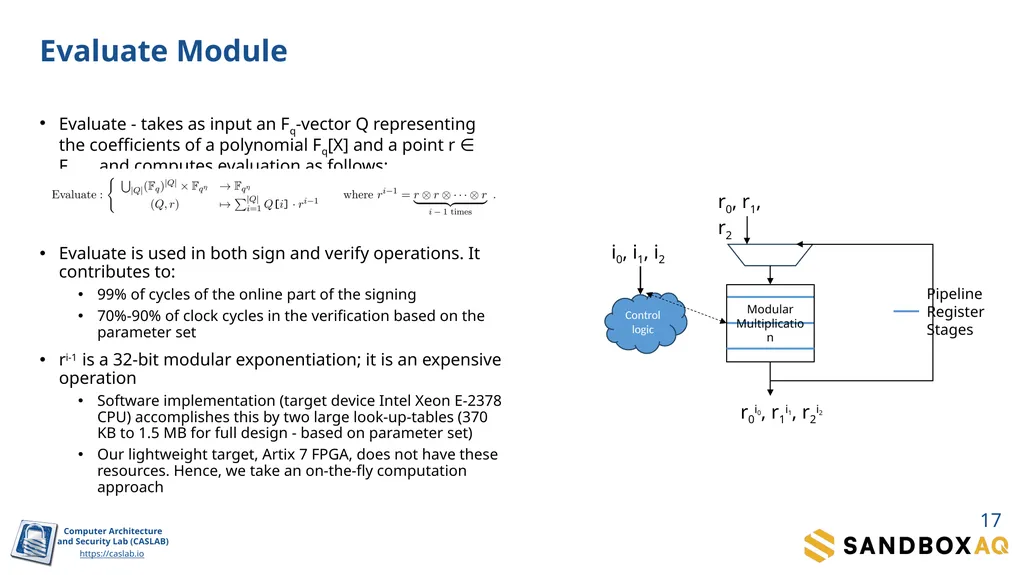
slide17. Evaluate Module Evaluate - takes as input an Fq-vector Q representing the coefficients of a polynomial Fq[X] and a point r ∈ Fpoints and computes evaluation as follows:
Evaluate is used in both sign and verify operations. It contributes to:
99% of cycles of the online part of the signing
70%-90% of clock cycles in the verification based on the parameter set
ri-1 is a 32-bit modular exponentiation; it is an expensive operation
Software implementation (target device Intel Xeon E-2378 CPU) accomplishes this by two large look-up-tables (370 KB to 1.5 MB for full design - based on parameter set)
Our lightweight target, Artix 7 FPGA, does not have these resources. Hence, we take an on-the-fly computation approach r0, r1, r2 Modular
Multiplication Pipeline Register
Stages Control logic i0, i1, i2 r0i0, r1i1, r2i2 17<br>
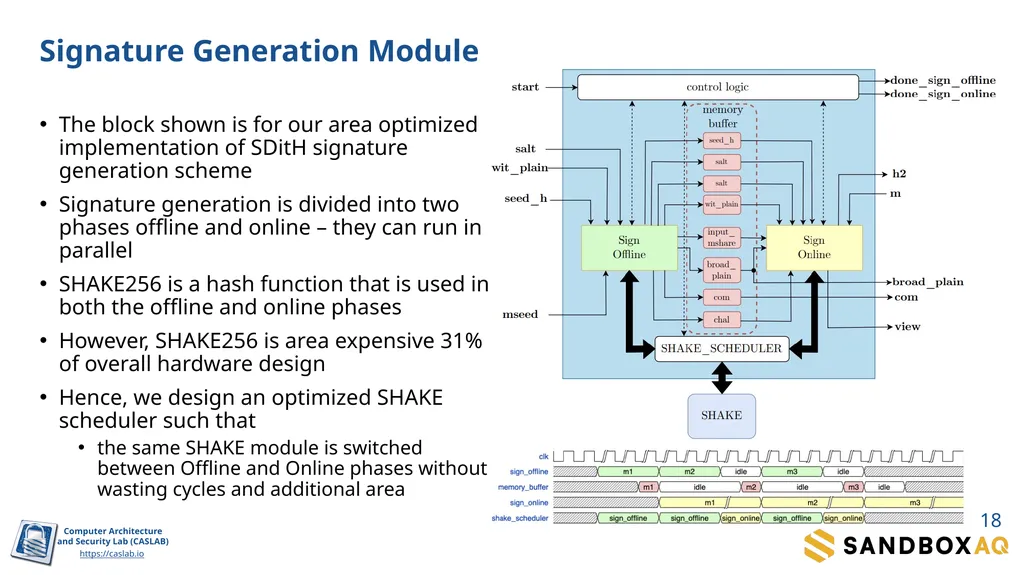
slide18. Signature Generation Module The block shown is for our area optimized implementation of SDitH signature generation scheme
Signature generation is divided into two phases offline and online – they can run in parallel
SHAKE256 is a hash function that is used in both the offline and online phases
However, SHAKE256 is area expensive 31% of overall hardware design
Hence, we design an optimized SHAKE scheduler such that
the same SHAKE module is switched between Offline and Online phases without wasting cycles and additional area 18<br>
slide19. Comparison with Related and Relevant Work<br>
slide20. Clock Cycles Comparison – Optimized Software v/s Our Hardware Implementation – Hypercube Variant 250x 3.4x 2.2x Improvement 171x 2.1x 3.1x Galois Field New Instructions from Intel are used ~70-99% of the clock cycles are taken in the ‘sign_online’ and ‘verify’ modules by the ‘Evaluate’ module 20<br>
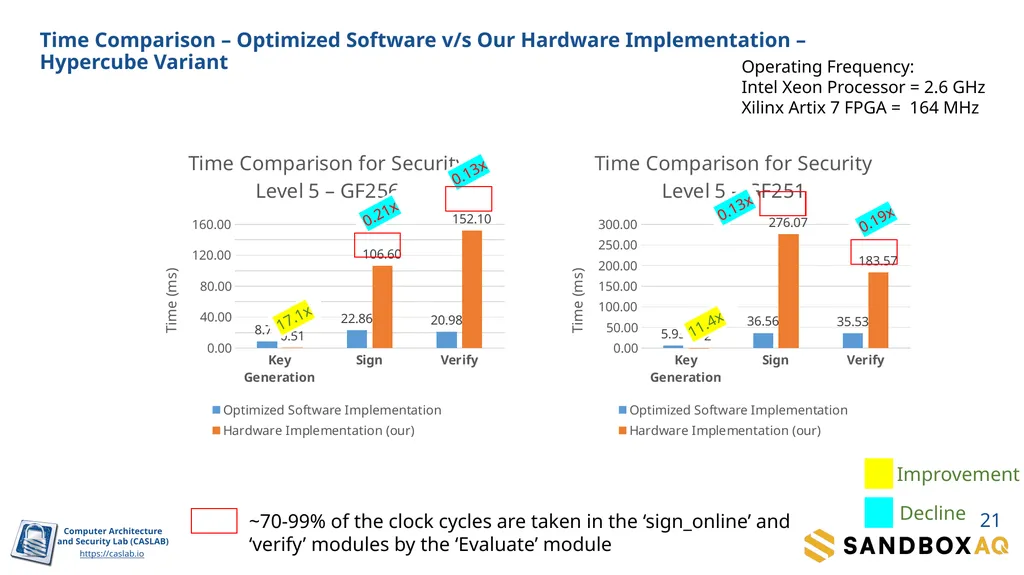
slide21. Time Comparison – Optimized Software v/s Our Hardware Implementation – Hypercube Variant 17.1x 0.21x 0.13x Improvement 11.4x 0.13x 0.19x ~70-99% of the clock cycles are taken in the ‘sign_online’ and ‘verify’ modules by the ‘Evaluate’ module Decline Operating Frequency:
Intel Xeon Processor = 2.6 GHz
Xilinx Artix 7 FPGA = 164 MHz 21<br>
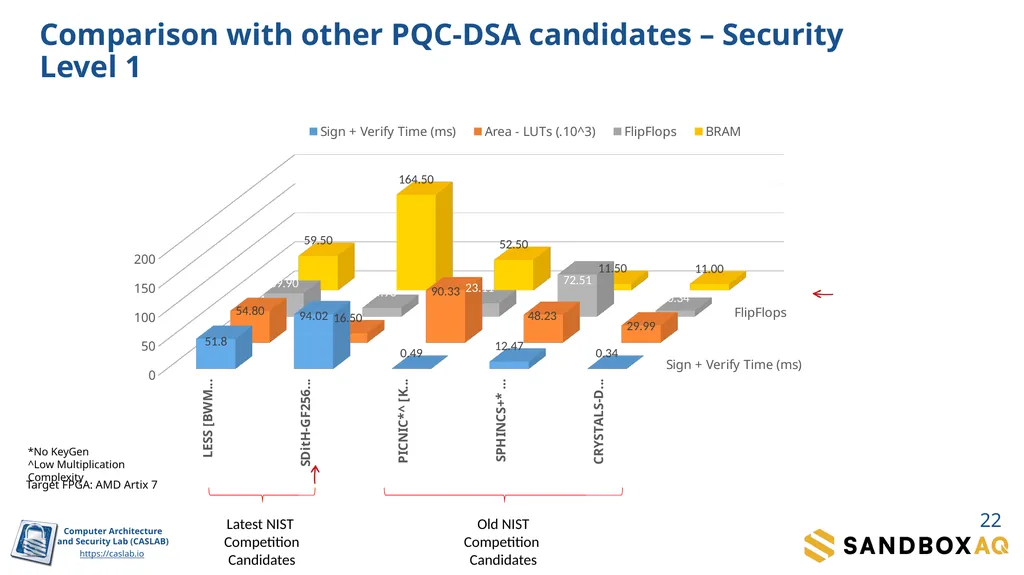
slide22. Comparison with other PQC-DSA candidates – Security Level 1 Latest NIST
Competition
Candidates Old NIST
Competition
Candidates *No KeyGen
^Low Multiplication Complexity 22 Target FPGA: AMD Artix 7<br>
slide23. Conclusion and Future Work<br>
slide24. Conclusion This work presents first hardware realization of SDitH Signature Scheme.
Parameterizable across three Security Levels and Two Arithmetic Fields.
SDitH could be realized as a light-weight implementation. However, the memory consumption is higher. 24<br>
slide25. Future Work The lower-level modules implemented as part of this work could be used to construct the ‘threshold’ variant of SDitH easily.
Module level parallelism could be exploited to build a high-performance design which could speed-up the sign and verify operations.
The MPC hardware modules’ components could be reused outside SDitH. 25<br>
slide26. References [BWM+23] Luke Beckwith, Robert Wallace, Kamyar Mohajerani, and Kris Gaj. A high-performance hardware implementation of the less digital signature scheme. In Thomas Johansson and Daniel Smith-Tone, editors, Post-Quantum Cryptography, pages 57–90, Cham, 2023. Springer Nature Switzerland.
[KRR+20] Daniel Kales, Sebastian Ramacher, Christian Rechberger, Roman Walch, and Mario Werner. Efficient FPGA implementations of lowmc and picnic. In Stanislaw Jarecki, editor, Topics in Cryptology – CT-RSA 2020, pages 417–441, Cham, 2020. Springer International Publishing.
[ZZW+23] Cankun Zhao, Neng Zhang, Hanning Wang, Bohan Yang, Wenping Zhu, Zhengdong Li, Min Zhu, Shouyi Yin, Shaojun Wei, and Leibo Liu. A compact and high-performance hardware architecture for CRYSTALS-Dilithium. IACR Transactions on Cryptographic Hardware and Embedded Systems,2022(1):270–295, Nov. 2021.
[ALC+20] Dorian Amiet, Lukas Leuenberger, Andreas Curiger, and Paul Zbinden. Fpga-based sphincs+ implementations: Mind the glitch. In 2020 23rd Euromicro Conference on Digital System Design (DSD), pages 229–237, 2020. 26<br>
slide27. Thank you! Sanjay Deshpande
email: sanjay.deshpande@yale.edu<br>
slide2. Motivation Quantum Computing holds tremendous potential that could solve complex problems that are out of reach for current high-performance computers
E.g., Life-saving pharmaceuticals, Green-battery technology
However, they also pose significant cybersecurity risks
Can break existing standards of public key cryptography
Hence, there is a need for Quantum-safe cryptography!
Post-quantum cryptography emerges as a beacon of hope 2<br>
slide3. NIST Post Quantum Cryptography Standardization Effort 3 Post-quantum cryptography standardization efforts are in progress around the world
PQC algorithms proposals
Key Encapsulation Mechanism
Digital Signature Schemes
Evaluation of PQC algorithms
Security
Implementation efficiency and implementation security – Hardware and Software
Cost
This talk – Syndrome Decoding in the Head (SDitH)<br>
slide4. Outline Introduction
SDitH Signature Scheme
Hardware Design and Challenges
Comparison with Related and Relevant Work
Conclusion and Future Work 4<br>
slide5. Introduction<br>
slide6. SDitH Parameter Sets Two Variants of the Algorithm
Hypercube
Threshold
Three Security Levels
Two Syndrome Decoding Fields
GF256 and GF251
d=2 splits for L3 and L5 Parameter Sets 6<br>
slide7. SDitH Key Generation ComputeS Mat Vec
Mult and Add Sampling Elements for ExpandH Compute Q Compute P Sampling Elements i_start o_done ExpandSeed Variable time due to rejection sampling Constant time 7<br>
slide8. SDitH Sign Only a little scope for parallelism at the algorithm level
Processing Message (m) input happens much later in the algorithm
Hence, could be divided in to Offline and Online Parts 8<br>
slide9. SDitH Sign - Offline TREEPRG Commit Sampling Hash1 ExapandSeed 2D ExpandMPCChallenge ComputePlainBroadCast i_start τ τ o_done Constant time 9<br>
slide10. SDitH Sign - Online Constant time Hash2 PartyComputation τ x D ExpandViewChallenge GenerateSeedSiblingPath τ i_start o_done 10<br>
slide11. SDitH Verify Similar to sign_offline and sign_online not so much scope for the parallelism at the algorithmic level
Possibility of parallelism at the function/module level at cost of additional hardware
Unrolling the for loops at the cost of duplicating modules 11<br>
slide12. Hardware Design and Challenges<br>
slide13. Hardware Design Architecture 13<br>
slide14. Our Contributions First parameterizable hardware realization of Hypercube Variant of SDitH Signature Scheme
Two Variants of Syndrome Decoding Modules
Sample first, then multiply
Sample and multiply on the fly
Split Hardware Implementation of Sign into Offline and Online phases
Drastic Reduction in terms of Clock Cycles when compared to
Key Generation – Up to 250x
Signature Generation – Up to 3.4x
Signature Verification – Up to 2.2x 14<br>
slide15. Syndrome Computation Module – Key Generation Y = sB + H’sA
Syndrome Computation needs to be done after S (Sa, Sb) is computed by ComputeS module
Hence, Sample First then Multiply approach (STFM) ComputeS Mat Vec
Mult and Add Sampling Elements for ExpandH Compute Q Compute P Sampling Elements i_start o_done ExpandSeed 15<br>
slide16. Syndrome Computation Module – Sign and Verify y and Sa are inputs.
Only need H’ to compute the syndrome.
“Sample and Multiply On the Fly” (SaMO) approach GF256 GF251 16 Target FPGA: AMD Artix 7<br>
slide17. Evaluate Module Evaluate - takes as input an Fq-vector Q representing the coefficients of a polynomial Fq[X] and a point r ∈ Fpoints and computes evaluation as follows:
Evaluate is used in both sign and verify operations. It contributes to:
99% of cycles of the online part of the signing
70%-90% of clock cycles in the verification based on the parameter set
ri-1 is a 32-bit modular exponentiation; it is an expensive operation
Software implementation (target device Intel Xeon E-2378 CPU) accomplishes this by two large look-up-tables (370 KB to 1.5 MB for full design - based on parameter set)
Our lightweight target, Artix 7 FPGA, does not have these resources. Hence, we take an on-the-fly computation approach r0, r1, r2 Modular
Multiplication Pipeline Register
Stages Control logic i0, i1, i2 r0i0, r1i1, r2i2 17<br>
slide18. Signature Generation Module The block shown is for our area optimized implementation of SDitH signature generation scheme
Signature generation is divided into two phases offline and online – they can run in parallel
SHAKE256 is a hash function that is used in both the offline and online phases
However, SHAKE256 is area expensive 31% of overall hardware design
Hence, we design an optimized SHAKE scheduler such that
the same SHAKE module is switched between Offline and Online phases without wasting cycles and additional area 18<br>
slide19. Comparison with Related and Relevant Work<br>
slide20. Clock Cycles Comparison – Optimized Software v/s Our Hardware Implementation – Hypercube Variant 250x 3.4x 2.2x Improvement 171x 2.1x 3.1x Galois Field New Instructions from Intel are used ~70-99% of the clock cycles are taken in the ‘sign_online’ and ‘verify’ modules by the ‘Evaluate’ module 20<br>
slide21. Time Comparison – Optimized Software v/s Our Hardware Implementation – Hypercube Variant 17.1x 0.21x 0.13x Improvement 11.4x 0.13x 0.19x ~70-99% of the clock cycles are taken in the ‘sign_online’ and ‘verify’ modules by the ‘Evaluate’ module Decline Operating Frequency:
Intel Xeon Processor = 2.6 GHz
Xilinx Artix 7 FPGA = 164 MHz 21<br>
slide22. Comparison with other PQC-DSA candidates – Security Level 1 Latest NIST
Competition
Candidates Old NIST
Competition
Candidates *No KeyGen
^Low Multiplication Complexity 22 Target FPGA: AMD Artix 7<br>
slide23. Conclusion and Future Work<br>
slide24. Conclusion This work presents first hardware realization of SDitH Signature Scheme.
Parameterizable across three Security Levels and Two Arithmetic Fields.
SDitH could be realized as a light-weight implementation. However, the memory consumption is higher. 24<br>
slide25. Future Work The lower-level modules implemented as part of this work could be used to construct the ‘threshold’ variant of SDitH easily.
Module level parallelism could be exploited to build a high-performance design which could speed-up the sign and verify operations.
The MPC hardware modules’ components could be reused outside SDitH. 25<br>
slide26. References [BWM+23] Luke Beckwith, Robert Wallace, Kamyar Mohajerani, and Kris Gaj. A high-performance hardware implementation of the less digital signature scheme. In Thomas Johansson and Daniel Smith-Tone, editors, Post-Quantum Cryptography, pages 57–90, Cham, 2023. Springer Nature Switzerland.
[KRR+20] Daniel Kales, Sebastian Ramacher, Christian Rechberger, Roman Walch, and Mario Werner. Efficient FPGA implementations of lowmc and picnic. In Stanislaw Jarecki, editor, Topics in Cryptology – CT-RSA 2020, pages 417–441, Cham, 2020. Springer International Publishing.
[ZZW+23] Cankun Zhao, Neng Zhang, Hanning Wang, Bohan Yang, Wenping Zhu, Zhengdong Li, Min Zhu, Shouyi Yin, Shaojun Wei, and Leibo Liu. A compact and high-performance hardware architecture for CRYSTALS-Dilithium. IACR Transactions on Cryptographic Hardware and Embedded Systems,2022(1):270–295, Nov. 2021.
[ALC+20] Dorian Amiet, Lukas Leuenberger, Andreas Curiger, and Paul Zbinden. Fpga-based sphincs+ implementations: Mind the glitch. In 2020 23rd Euromicro Conference on Digital System Design (DSD), pages 229–237, 2020. 26<br>
slide27. Thank you! Sanjay Deshpande
email: sanjay.deshpande@yale.edu<br>