SDN and ForCES based optimal network topology discovery1 George Tarnaras (gtarn91gmail.com) Evangelos Haleplidis (ehalepece.upatras.gr) Spyros Denazis (sdenaupatras.gr) IETF 94, Yokohama, Japan (remote) Monday 02 November 2015 1Tarnaras,
"SDN and ForCES based optimal network topology" is the property of its rightful owner. Permission is granted to
download and print the materials on this website for personal, non-commercial use only, and to display it
on your personal computer provided you do not modify the materials and that you retain all copyright
notices contained in the materials. By downloading content from our website, you accept the terms of this
agreement.
Presentation Transcript
01
SDN and ForCES based optimal network topology discovery1 George Tarnaras (gtarn91@gmail.com)
Evangelos Haleplidis (ehalep@ece.upatras.gr)
Spyros Denazis (sdena@upatras.gr) IETF 94, Yokohama, Japan (remote)
Monday 02 November 2015 1Tarnaras, G.; Haleplidis, E.; Denazis, S., "SDN and ForCES based optimal network topology discovery," in Network Softwarization (NetSoft), 2015 1st IEEE Conference on , vol., no., pp.1-6, 13-17 April 2015. DOI: 10.1109/NETSOFT.2015.7116181<br>
02
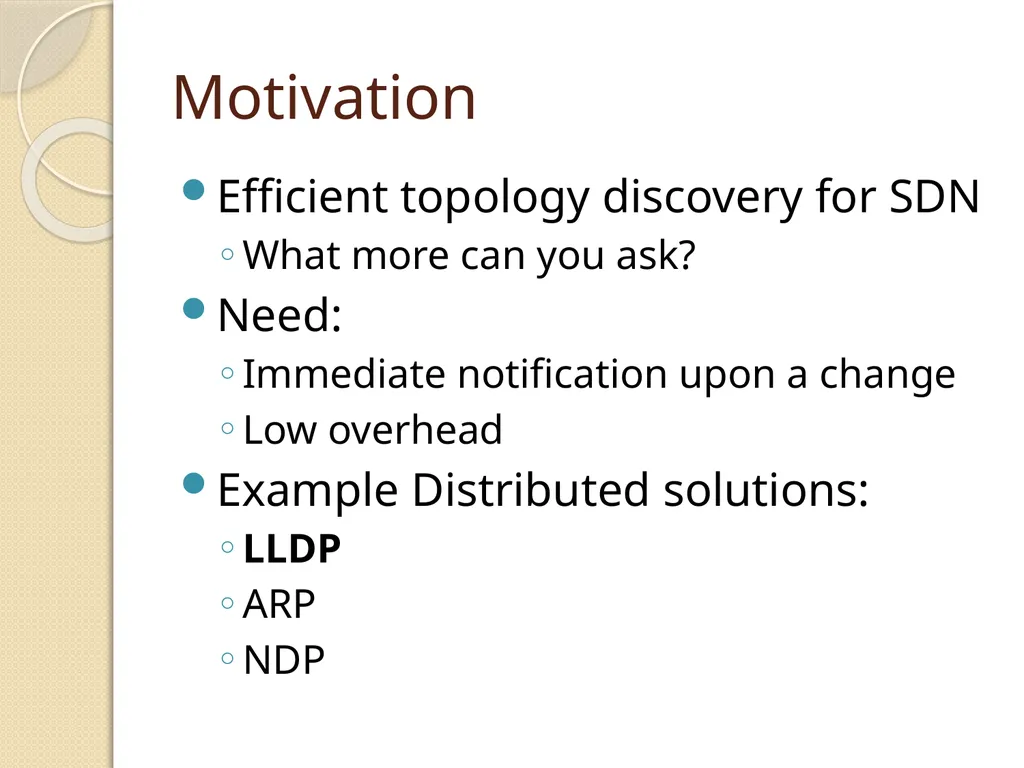
Motivation Efficient topology discovery for SDN
What more can you ask?
Need:
Immediate notification upon a change
Low overhead
Example Distributed solutions:
LLDP
ARP
NDP<br>
03
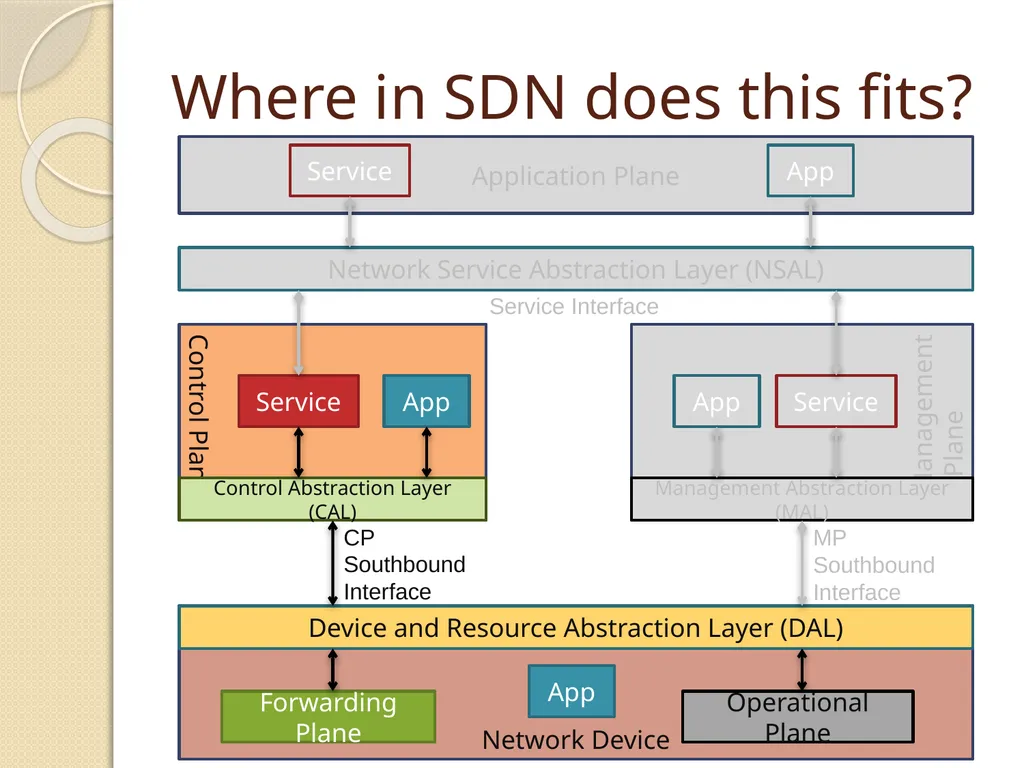
Where in SDN does this fits? Network Device Forwarding Plane Operational Plane App Device and Resource Abstraction Layer (DAL) Control Plane Control Abstraction Layer (CAL) App Service Management Plane . Management Abstraction Layer (MAL) App Service Network Service Abstraction Layer (NSAL) Application Plane App Service CP
Southbound
Interface MP
Southbound
Interface Service Interface<br>
04
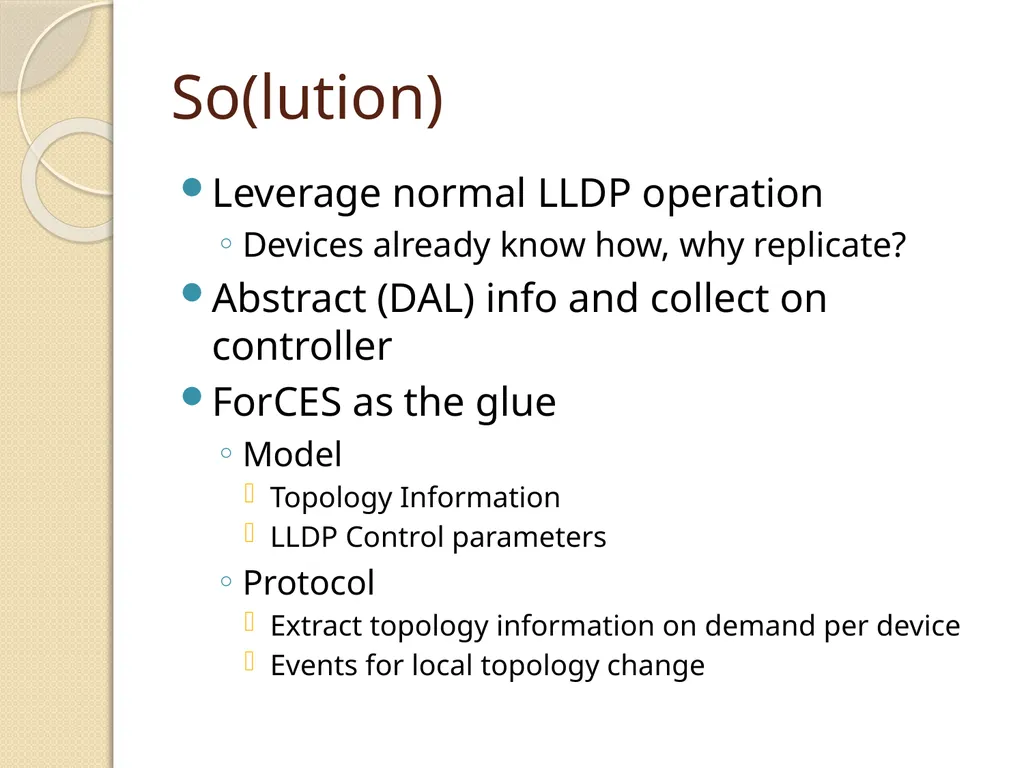
So(lution) Leverage normal LLDP operation
Devices already know how, why replicate?
Abstract (DAL) info and collect on controller
ForCES as the glue
Model
Topology Information
LLDP Control parameters
Protocol
Extract topology information on demand per device
Events for local topology change<br>
05
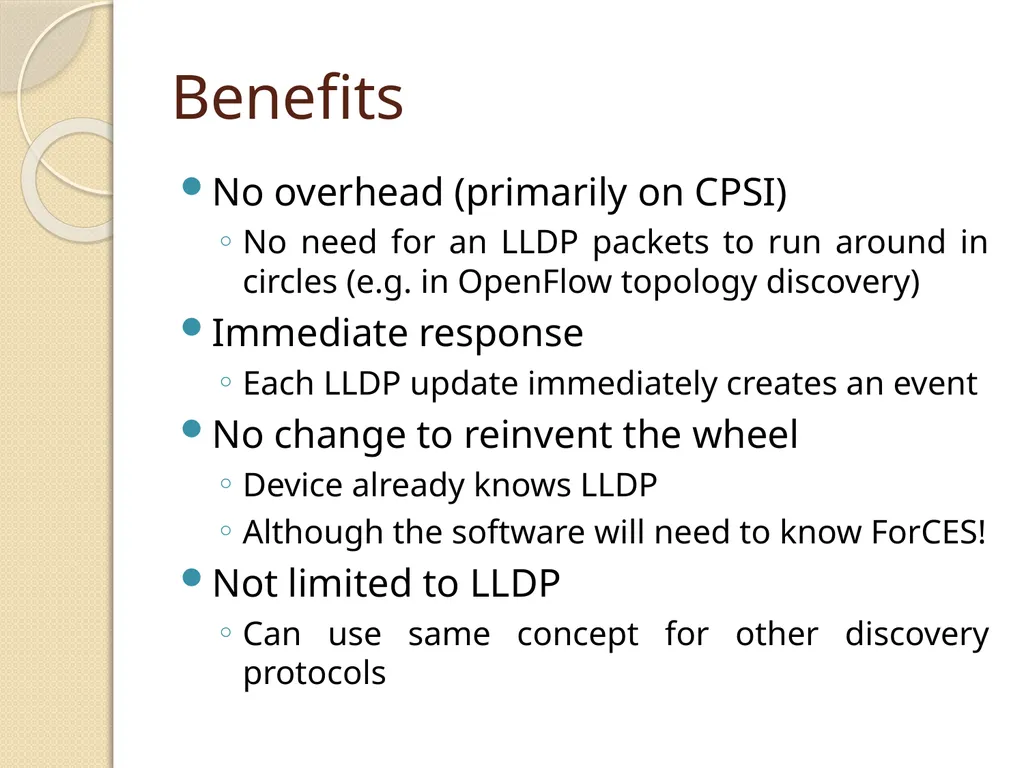
Benefits No overhead (primarily on CPSI)
No need for an LLDP packets to run around in circles (e.g. in OpenFlow topology discovery)
Immediate response
Each LLDP update immediately creates an event
No change to reinvent the wheel
Device already knows LLDP
Although the software will need to know ForCES!
Not limited to LLDP
Can use same concept for other discovery protocols<br>
06
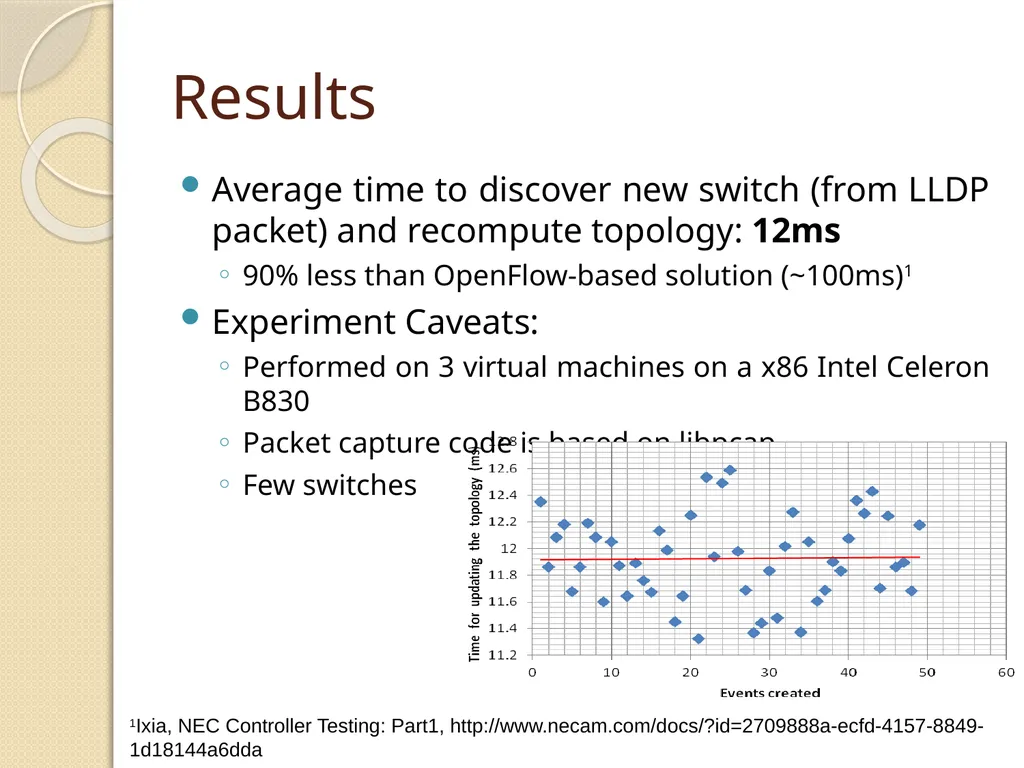
Results Average time to discover new switch (from LLDP packet) and recompute topology: 12ms
90% less than OpenFlow-based solution (~100ms)1
Experiment Caveats:
Performed on 3 virtual machines on a x86 Intel Celeron B830
Packet capture code is based on libpcap
Few switches 1Ixia, NEC Controller Testing: Part1, http://www.necam.com/docs/?id=2709888a-ecfd-4157-8849-
1d18144a6dda<br>