
Seasonal Rainfall and Temperature Guidance Issued
PT
Published · 16 slides · 0 views

1 / 1



Description
Seasonal Rainfall and Temperature Guidance Issued 13 August 2026 NOAAClimate Prediction Center Forecast Background ENSO update Current State of the global climate SST Forecasts Regional Rainfall Forecast maps Summary CPC ENSO Update ENSO
Related Topics
Download this presentation From Below
"Seasonal Rainfall and Temperature Guidance Issued" is the property of its rightful owner. Permission is granted to download and print the materials on this website for personal, non-commercial use only, and to display it on your personal computer provided you do not modify the materials and that you retain all copyright notices contained in the materials. By downloading content from our website, you accept the terms of this agreement.
Share
Embed code
Presentation Transcript
01
Seasonal Rainfall and Temperature Guidance
Issued 13 August 2026
NOAA/Climate Prediction Center Forecast Background
ENSO update
Current State of the global climate
SST Forecasts
Regional Rainfall Forecast maps
Summary<br>
ENSO update
Current State of the global climate
SST Forecasts
Regional Rainfall Forecast maps
Summary<br>
02
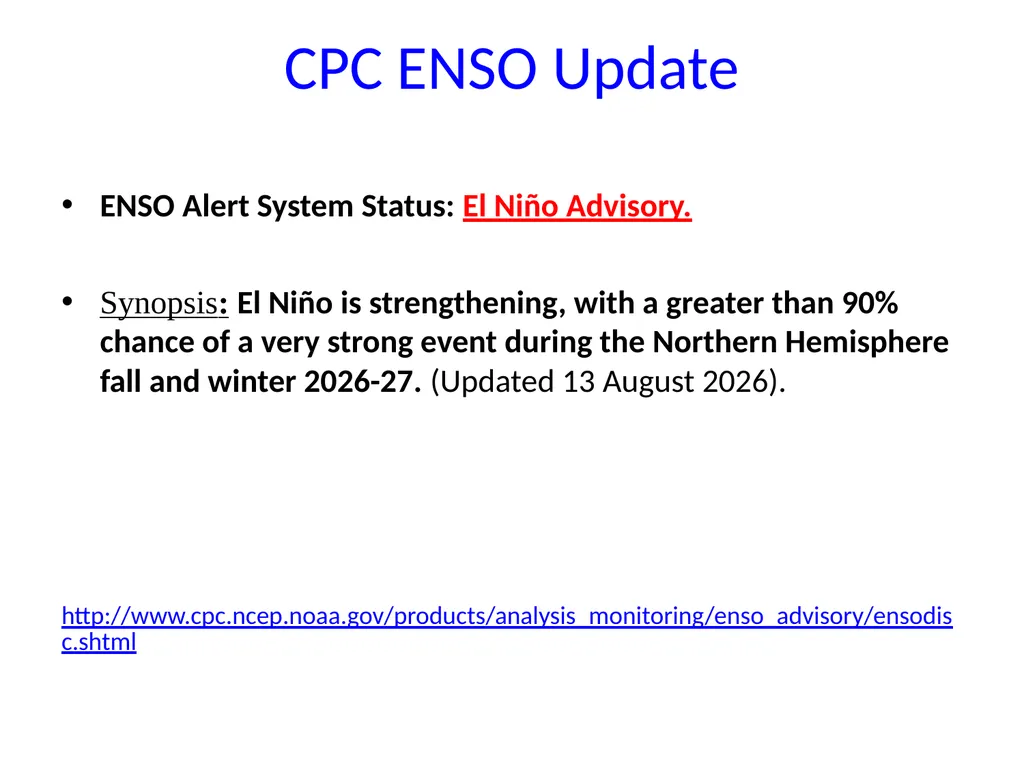
CPC ENSO Update ENSO Alert System Status: El Niño Advisory.
Synopsis: El Niño is strengthening, with a greater than 90% chance of a very strong event during the Northern Hemisphere fall and winter 2026-27. (Updated 13 August 2026).
http://www.cpc.ncep.noaa.gov/products/analysis_monitoring/enso_advisory/ensodisc.shtml<br>
Synopsis: El Niño is strengthening, with a greater than 90% chance of a very strong event during the Northern Hemisphere fall and winter 2026-27. (Updated 13 August 2026).
http://www.cpc.ncep.noaa.gov/products/analysis_monitoring/enso_advisory/ensodisc.shtml<br>
03
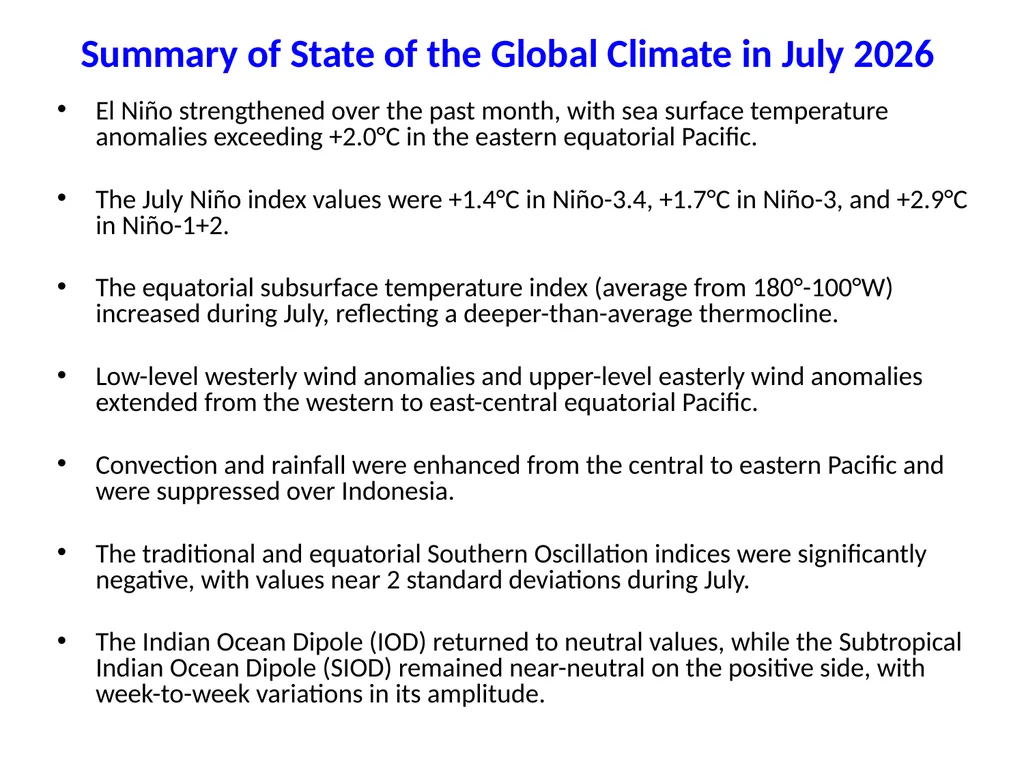
Summary of State of the Global Climate in July 2026 El Niño strengthened over the past month, with sea surface temperature anomalies exceeding +2.0°C in the eastern equatorial Pacific.
The July Niño index values were +1.4°C in Niño-3.4, +1.7°C in Niño-3, and +2.9°C in Niño-1+2.
The equatorial subsurface temperature index (average from 180°-100°W) increased during July, reflecting a deeper-than-average thermocline.
Low-level westerly wind anomalies and upper-level easterly wind anomalies extended from the western to east-central equatorial Pacific.
Convection and rainfall were enhanced from the central to eastern Pacific and were suppressed over Indonesia.
The traditional and equatorial Southern Oscillation indices were significantly negative, with values near 2 standard deviations during July.
The Indian Ocean Dipole (IOD) returned to neutral values, while the Subtropical Indian Ocean Dipole (SIOD) remained near-neutral on the positive side, with week-to-week variations in its amplitude.<br>
The July Niño index values were +1.4°C in Niño-3.4, +1.7°C in Niño-3, and +2.9°C in Niño-1+2.
The equatorial subsurface temperature index (average from 180°-100°W) increased during July, reflecting a deeper-than-average thermocline.
Low-level westerly wind anomalies and upper-level easterly wind anomalies extended from the western to east-central equatorial Pacific.
Convection and rainfall were enhanced from the central to eastern Pacific and were suppressed over Indonesia.
The traditional and equatorial Southern Oscillation indices were significantly negative, with values near 2 standard deviations during July.
The Indian Ocean Dipole (IOD) returned to neutral values, while the Subtropical Indian Ocean Dipole (SIOD) remained near-neutral on the positive side, with week-to-week variations in its amplitude.<br>
04
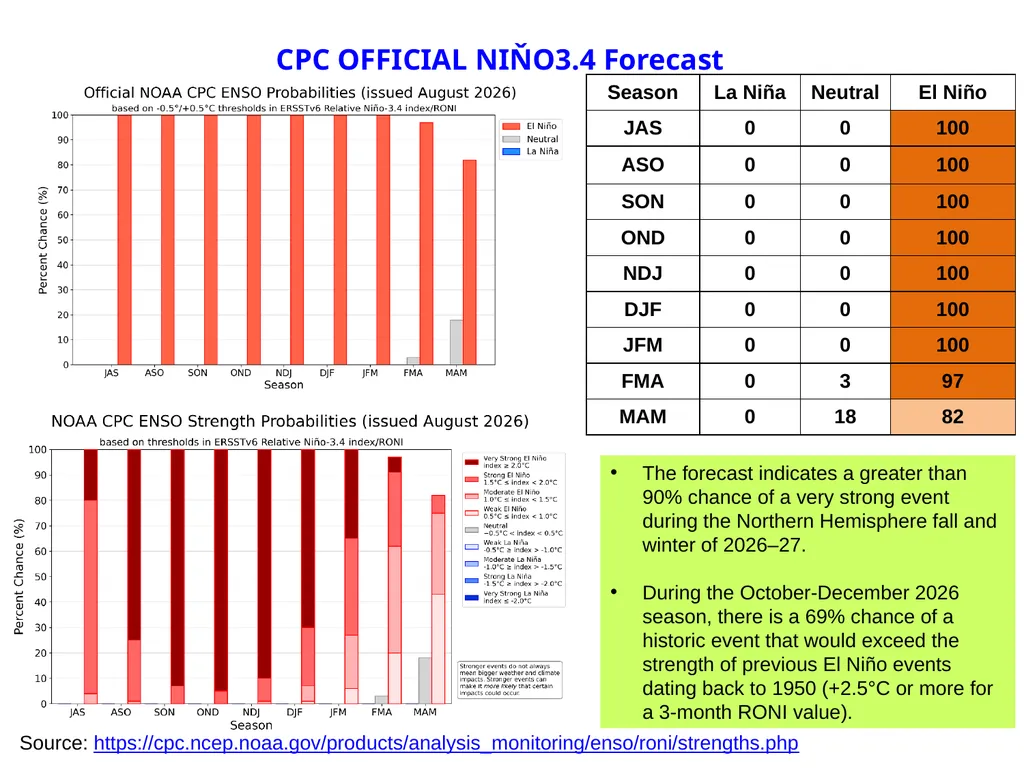
CPC OFFICIAL NIŇO3.4 Forecast The forecast indicates a greater than 90% chance of a very strong event during the Northern Hemisphere fall and winter of 2026–27.
During the October-December 2026 season, there is a 69% chance of a historic event that would exceed the strength of previous El Niño events dating back to 1950 (+2.5°C or more for a 3-month RONI value). Source: https://cpc.ncep.noaa.gov/products/analysis_monitoring/enso/roni/strengths.php<br>
During the October-December 2026 season, there is a 69% chance of a historic event that would exceed the strength of previous El Niño events dating back to 1950 (+2.5°C or more for a 3-month RONI value). Source: https://cpc.ncep.noaa.gov/products/analysis_monitoring/enso/roni/strengths.php<br>
05
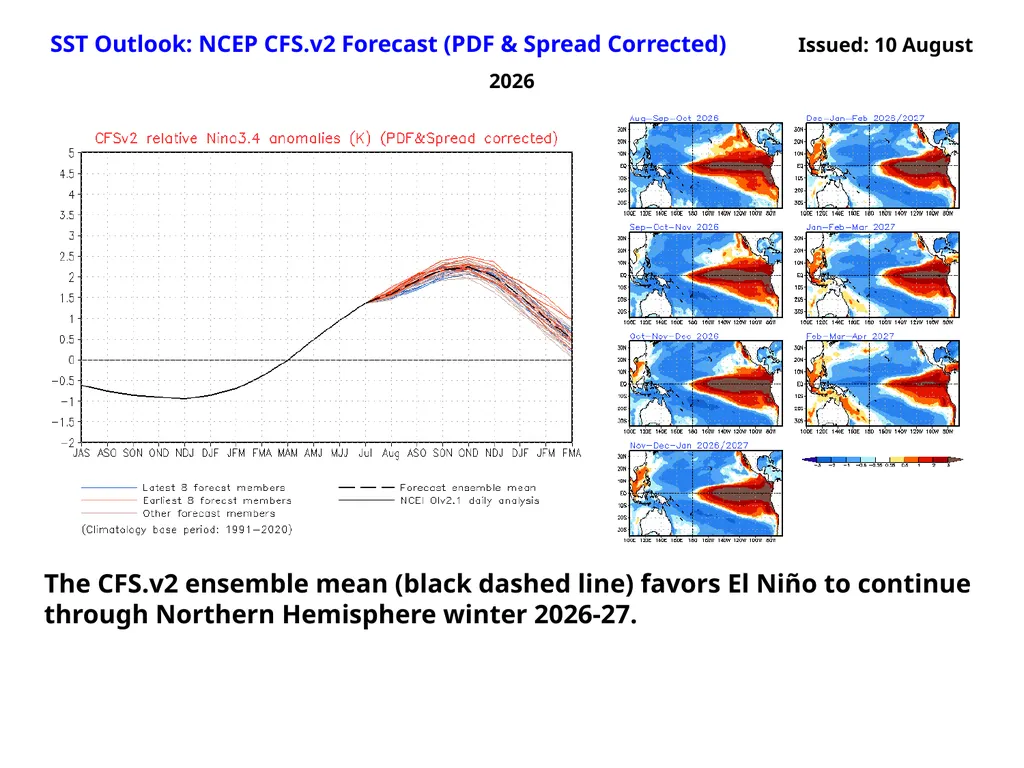
SST Outlook: NCEP CFS.v2 Forecast (PDF & Spread Corrected) Issued: 10 August 2026 The CFS.v2 ensemble mean (black dashed line) favors El Niño to continue through Northern Hemisphere winter 2026-27.<br>
06
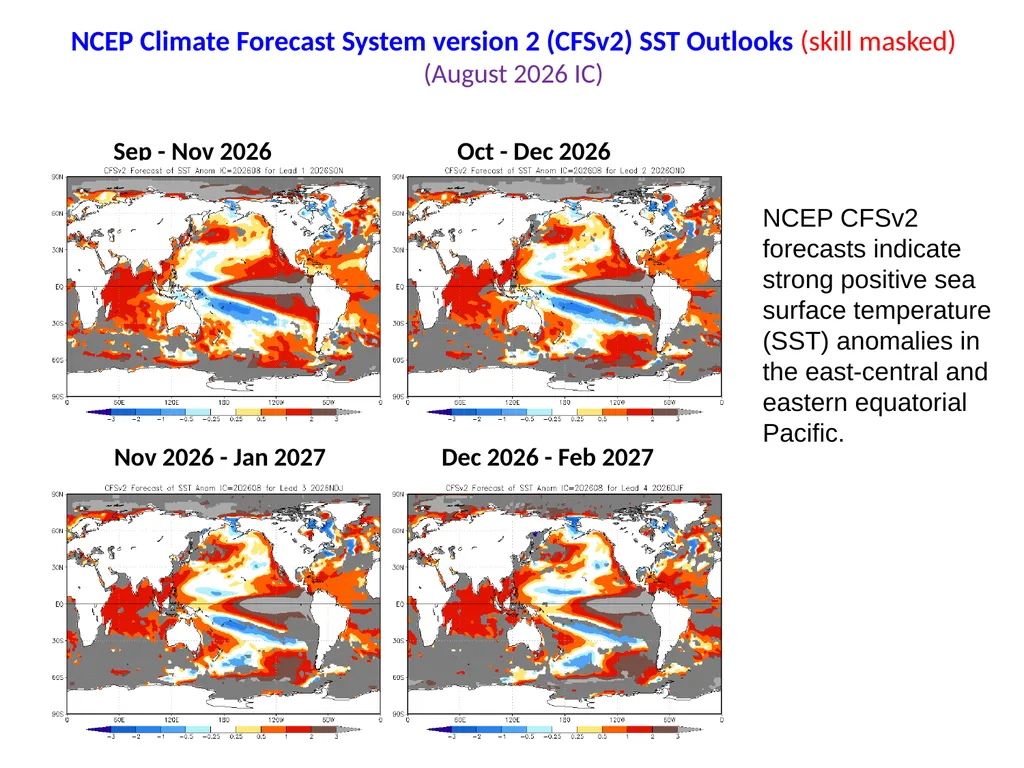
NCEP CFSv2 forecasts indicate strong positive sea surface temperature (SST) anomalies in the east-central and eastern equatorial Pacific. Sep - Nov 2026 Oct - Dec 2026 Nov 2026 - Jan 2027 NCEP Climate Forecast System version 2 (CFSv2) SST Outlooks (skill masked)
(August 2026 IC) Dec 2026 - Feb 2027<br>
(August 2026 IC) Dec 2026 - Feb 2027<br>
07
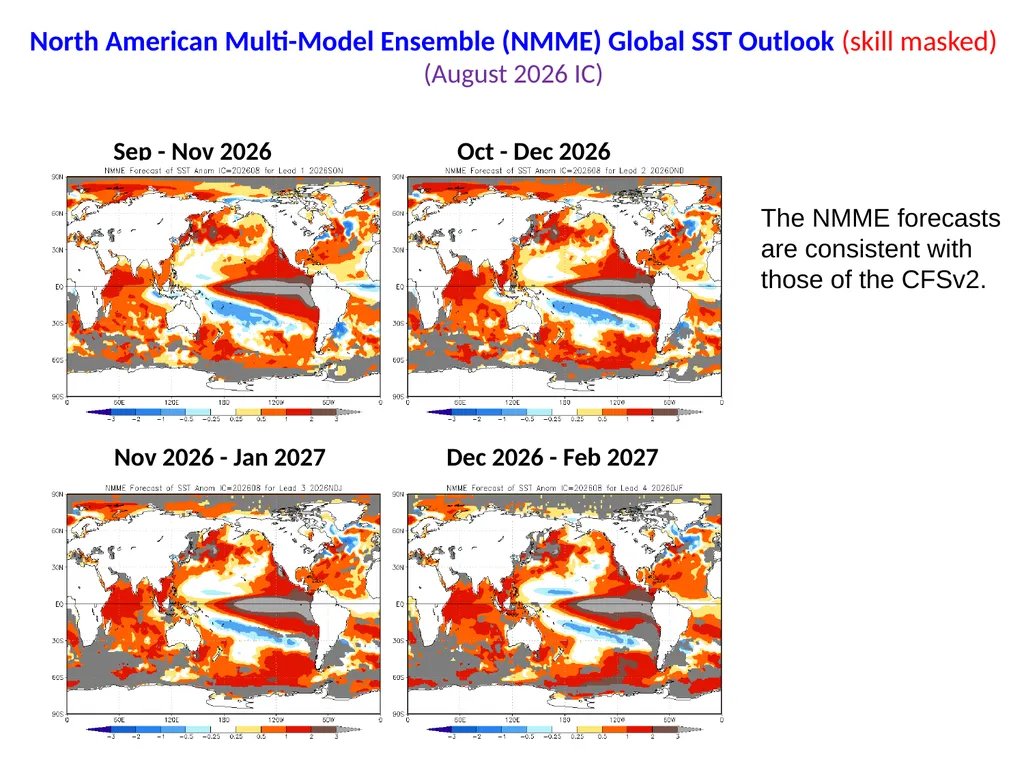
North American Multi-Model Ensemble (NMME) Global SST Outlook (skill masked)
(August 2026 IC) Sep - Nov 2026 Oct - Dec 2026 Dec 2026 - Feb 2027 Nov 2026 - Jan 2027 The NMME forecasts are consistent with those of the CFSv2.<br>
(August 2026 IC) Sep - Nov 2026 Oct - Dec 2026 Dec 2026 - Feb 2027 Nov 2026 - Jan 2027 The NMME forecasts are consistent with those of the CFSv2.<br>
08
Indian Ocean Dipole (IOD) and Subtropical Indian Ocean Dipole (SIOD) Outlooks The NMME forecast suggests a transition toward positive Indian Ocean Dipole (IOD) conditions by the end of the Northern Hemisphere summer of 2026. IOD SIOD The Subtropical Indian Ocean Dipole (SIOD) is forecast to remain neutral through the end of 2026.<br>
09
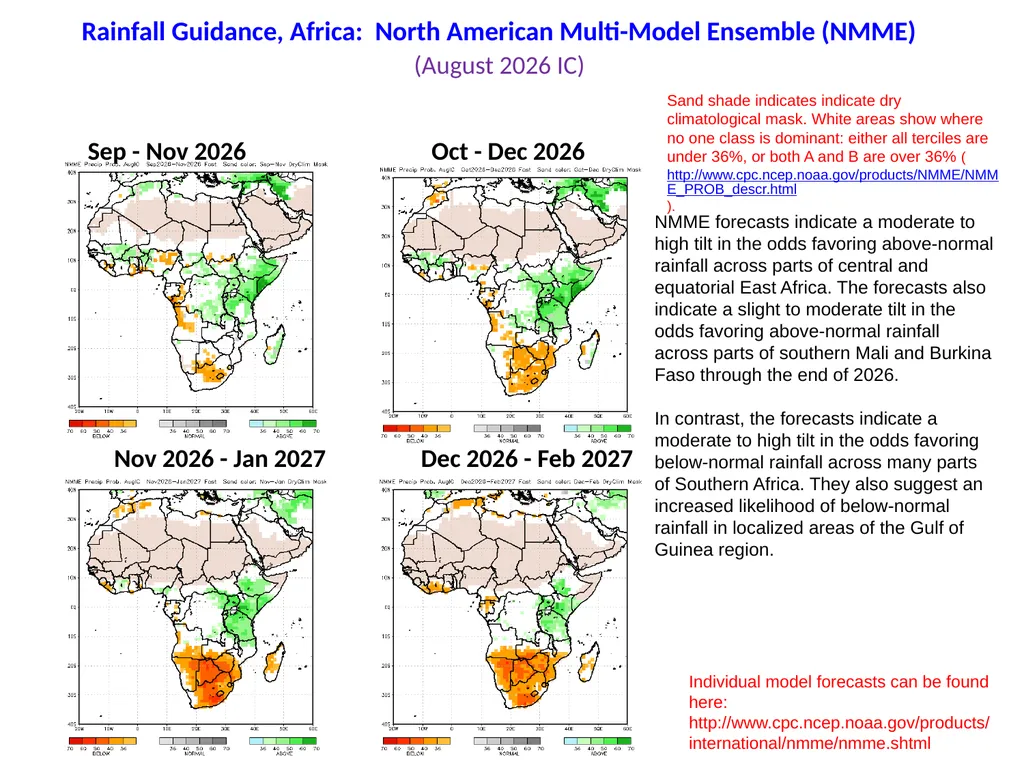
Rainfall Guidance, Africa: North American Multi-Model Ensemble (NMME) Sand shade indicates indicate dry climatological mask. White areas show where no one class is dominant: either all terciles are under 36%, or both A and B are over 36% (http://www.cpc.ncep.noaa.gov/products/NMME/NMME_PROB_descr.html). Sep - Nov 2026 Oct - Dec 2026 Dec 2026 - Feb 2027 Nov 2026 - Jan 2027 (August 2026 IC) NMME forecasts indicate a moderate to high tilt in the odds favoring above-normal rainfall across parts of central and equatorial East Africa. The forecasts also indicate a slight to moderate tilt in the odds favoring above-normal rainfall across parts of southern Mali and Burkina Faso through the end of 2026.
In contrast, the forecasts indicate a moderate to high tilt in the odds favoring below-normal rainfall across many parts of Southern Africa. They also suggest an increased likelihood of below-normal rainfall in localized areas of the Gulf of Guinea region. Individual model forecasts can be found here:
http://www.cpc.ncep.noaa.gov/products/international/nmme/nmme.shtml<br>
In contrast, the forecasts indicate a moderate to high tilt in the odds favoring below-normal rainfall across many parts of Southern Africa. They also suggest an increased likelihood of below-normal rainfall in localized areas of the Gulf of Guinea region. Individual model forecasts can be found here:
http://www.cpc.ncep.noaa.gov/products/international/nmme/nmme.shtml<br>
10
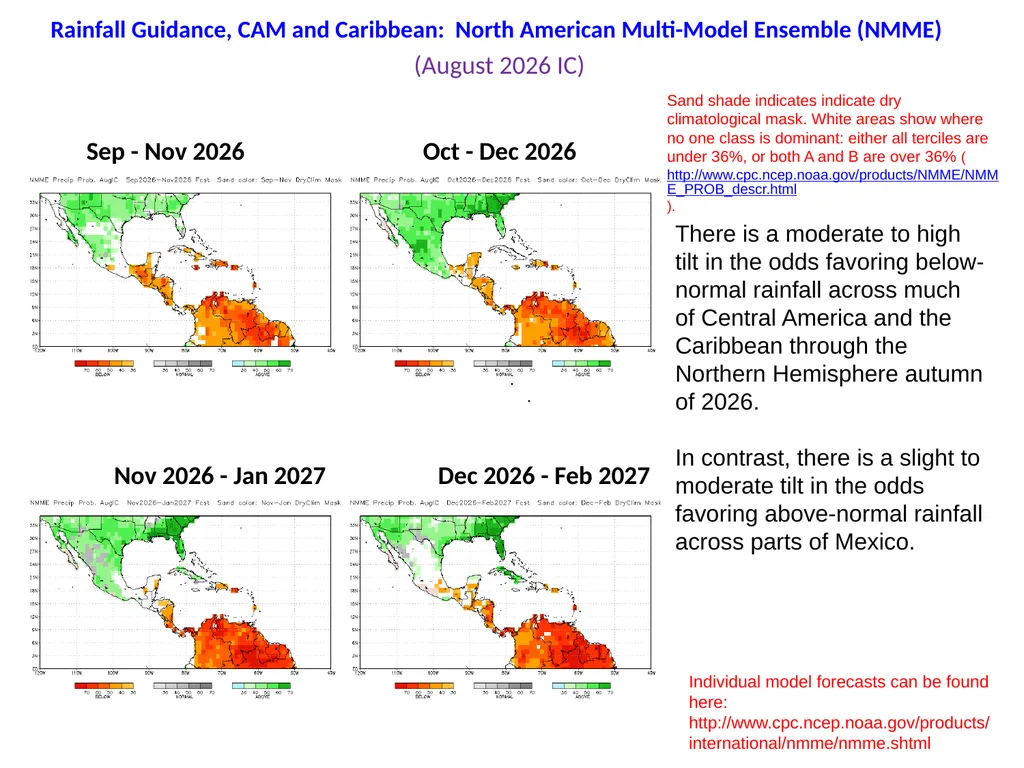
Rainfall Guidance, CAM and Caribbean: North American Multi-Model Ensemble (NMME) There is a moderate to high tilt in the odds favoring below-normal rainfall across much of Central America and the Caribbean through the Northern Hemisphere autumn of 2026.
In contrast, there is a slight to moderate tilt in the odds favoring above-normal rainfall across parts of Mexico. Individual model forecasts can be found here:
http://www.cpc.ncep.noaa.gov/products/international/nmme/nmme.shtml Sand shade indicates indicate dry climatological mask. White areas show where no one class is dominant: either all terciles are under 36%, or both A and B are over 36% (http://www.cpc.ncep.noaa.gov/products/NMME/NMME_PROB_descr.html). Sep - Nov 2026 Oct - Dec 2026 Dec 2026 - Feb 2027 Nov 2026 - Jan 2027 (August 2026 IC)<br>
In contrast, there is a slight to moderate tilt in the odds favoring above-normal rainfall across parts of Mexico. Individual model forecasts can be found here:
http://www.cpc.ncep.noaa.gov/products/international/nmme/nmme.shtml Sand shade indicates indicate dry climatological mask. White areas show where no one class is dominant: either all terciles are under 36%, or both A and B are over 36% (http://www.cpc.ncep.noaa.gov/products/NMME/NMME_PROB_descr.html). Sep - Nov 2026 Oct - Dec 2026 Dec 2026 - Feb 2027 Nov 2026 - Jan 2027 (August 2026 IC)<br>
11
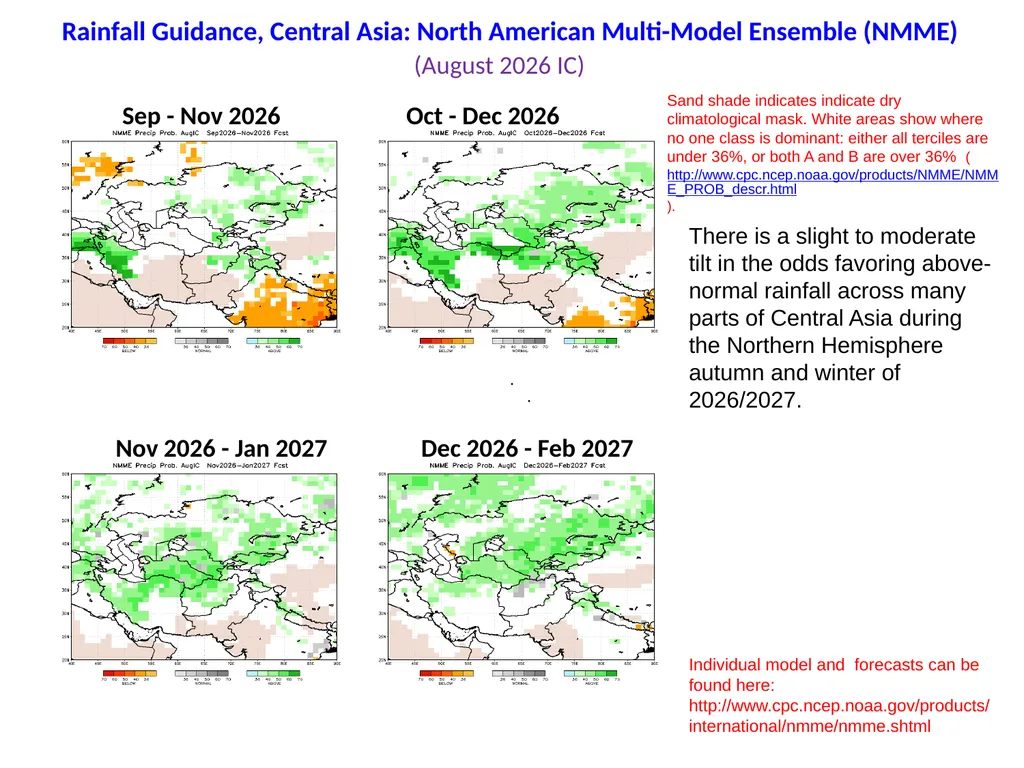
Rainfall Guidance, Central Asia: North American Multi-Model Ensemble (NMME) There is a slight to moderate tilt in the odds favoring above-normal rainfall across many parts of Central Asia during the Northern Hemisphere autumn and winter of 2026/2027. Individual model and forecasts can be found here:
http://www.cpc.ncep.noaa.gov/products/international/nmme/nmme.shtml Sand shade indicates indicate dry climatological mask. White areas show where no one class is dominant: either all terciles are under 36%, or both A and B are over 36% (http://www.cpc.ncep.noaa.gov/products/NMME/NMME_PROB_descr.html). Sep - Nov 2026 Oct - Dec 2026 Dec 2026 - Feb 2027 Nov 2026 - Jan 2027 (August 2026 IC)<br>
http://www.cpc.ncep.noaa.gov/products/international/nmme/nmme.shtml Sand shade indicates indicate dry climatological mask. White areas show where no one class is dominant: either all terciles are under 36%, or both A and B are over 36% (http://www.cpc.ncep.noaa.gov/products/NMME/NMME_PROB_descr.html). Sep - Nov 2026 Oct - Dec 2026 Dec 2026 - Feb 2027 Nov 2026 - Jan 2027 (August 2026 IC)<br>
12
Rainfall Guidance, South Asia: North American Multi-Model Ensemble (NMME) NMME forecasts indicate a moderate to high tilt in the odds favoring below-normal rainfall across large parts of India and portions of western and western China through the Northern Hemisphere autumn of 2026.
In contrast, there is a slight to moderate tilt in the odds favoring above-normal rainfall across parts of central and eastern China during the Northern Hemisphere autumn and early winter of 2026/2027. Individual model foeastern recasts can be found here:
http://www.cpc.ncep.noaa.gov/products/international/nmme/nmme.shtml Sand shade indicates indicate dry climatological mask. White areas show where no one class is dominant: either all terciles are under 36%, or both A and B are over 36% (http://www.cpc.ncep.noaa.gov/products/NMME/NMME_PROB_descr.html). Sep - Nov 2026 Oct - Dec 2026 Dec 2026 - Feb 2027 Nov 2026 - Jan 2027 (August 2026 IC)<br>
In contrast, there is a slight to moderate tilt in the odds favoring above-normal rainfall across parts of central and eastern China during the Northern Hemisphere autumn and early winter of 2026/2027. Individual model foeastern recasts can be found here:
http://www.cpc.ncep.noaa.gov/products/international/nmme/nmme.shtml Sand shade indicates indicate dry climatological mask. White areas show where no one class is dominant: either all terciles are under 36%, or both A and B are over 36% (http://www.cpc.ncep.noaa.gov/products/NMME/NMME_PROB_descr.html). Sep - Nov 2026 Oct - Dec 2026 Dec 2026 - Feb 2027 Nov 2026 - Jan 2027 (August 2026 IC)<br>
13
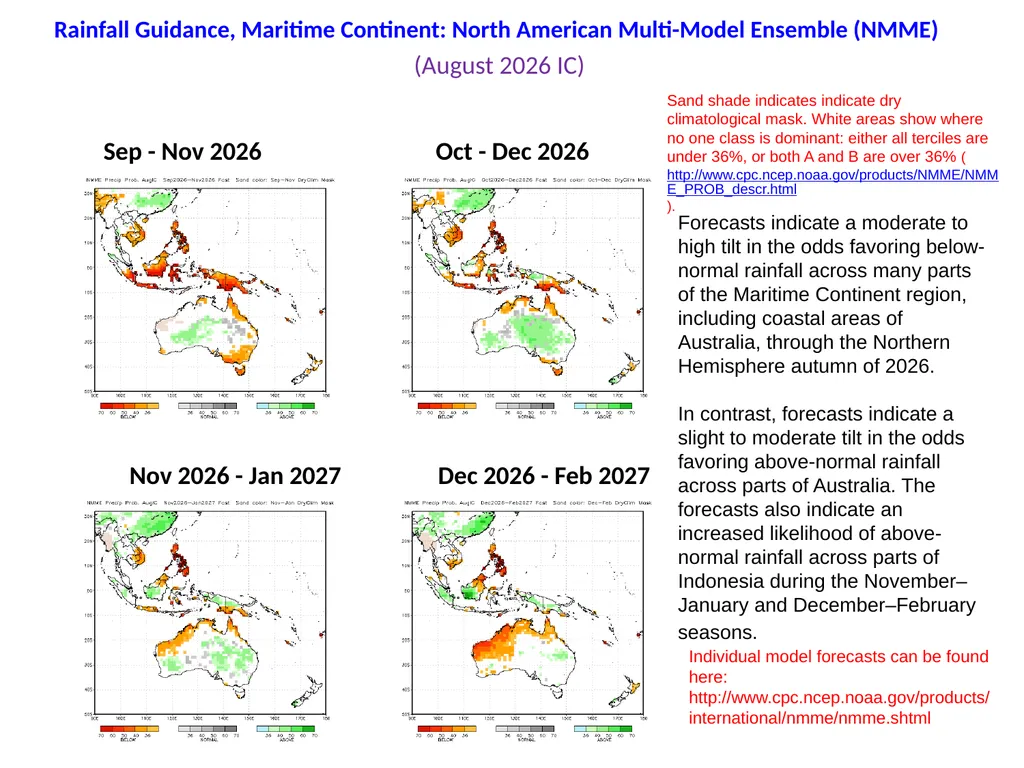
Rainfall Guidance, Maritime Continent: North American Multi-Model Ensemble (NMME) Sep - Nov 2026 Oct - Dec 2026 Dec 2026 - Feb 2027 Nov 2026 - Jan 2027 (August 2026 IC) Individual model forecasts can be found here:
http://www.cpc.ncep.noaa.gov/products/international/nmme/nmme.shtml Forecasts indicate a moderate to high tilt in the odds favoring below-normal rainfall across many parts of the Maritime Continent region, including coastal areas of Australia, through the Northern Hemisphere autumn of 2026.
In contrast, forecasts indicate a slight to moderate tilt in the odds favoring above-normal rainfall across parts of Australia. The forecasts also indicate an increased likelihood of above-normal rainfall across parts of Indonesia during the November–January and December–February seasons. Sand shade indicates indicate dry climatological mask. White areas show where no one class is dominant: either all terciles are under 36%, or both A and B are over 36% (http://www.cpc.ncep.noaa.gov/products/NMME/NMME_PROB_descr.html).<br>
http://www.cpc.ncep.noaa.gov/products/international/nmme/nmme.shtml Forecasts indicate a moderate to high tilt in the odds favoring below-normal rainfall across many parts of the Maritime Continent region, including coastal areas of Australia, through the Northern Hemisphere autumn of 2026.
In contrast, forecasts indicate a slight to moderate tilt in the odds favoring above-normal rainfall across parts of Australia. The forecasts also indicate an increased likelihood of above-normal rainfall across parts of Indonesia during the November–January and December–February seasons. Sand shade indicates indicate dry climatological mask. White areas show where no one class is dominant: either all terciles are under 36%, or both A and B are over 36% (http://www.cpc.ncep.noaa.gov/products/NMME/NMME_PROB_descr.html).<br>
14
Rainfall Guidance, South America: North American Multi-Model Ensemble (NMME) Forecasts indicate a moderate to high tilt in the odds favoring below-normal rainfall across northern and adjacent central parts of South America.
In contrast, there is a slight to moderate tilt in the odds favoring above-normal rainfall in parts of central and southern South America. Individual model forecasts can be found here:
http://www.cpc.ncep.noaa.gov/products/international/nmme/nmme.shtml Sand shade indicates indicate dry climatological mask. White areas show where no one class is dominant: either all terciles are under 36%, or both A and B are over 36% (http://www.cpc.ncep.noaa.gov/products/NMME/NMME_PROB_descr.html). Sep - Nov 2026 Oct - Dec 2026 Dec 2026 - Feb 2027 Nov 2026 - Jan 2027 (August 2026 IC)<br>
In contrast, there is a slight to moderate tilt in the odds favoring above-normal rainfall in parts of central and southern South America. Individual model forecasts can be found here:
http://www.cpc.ncep.noaa.gov/products/international/nmme/nmme.shtml Sand shade indicates indicate dry climatological mask. White areas show where no one class is dominant: either all terciles are under 36%, or both A and B are over 36% (http://www.cpc.ncep.noaa.gov/products/NMME/NMME_PROB_descr.html). Sep - Nov 2026 Oct - Dec 2026 Dec 2026 - Feb 2027 Nov 2026 - Jan 2027 (August 2026 IC)<br>
15
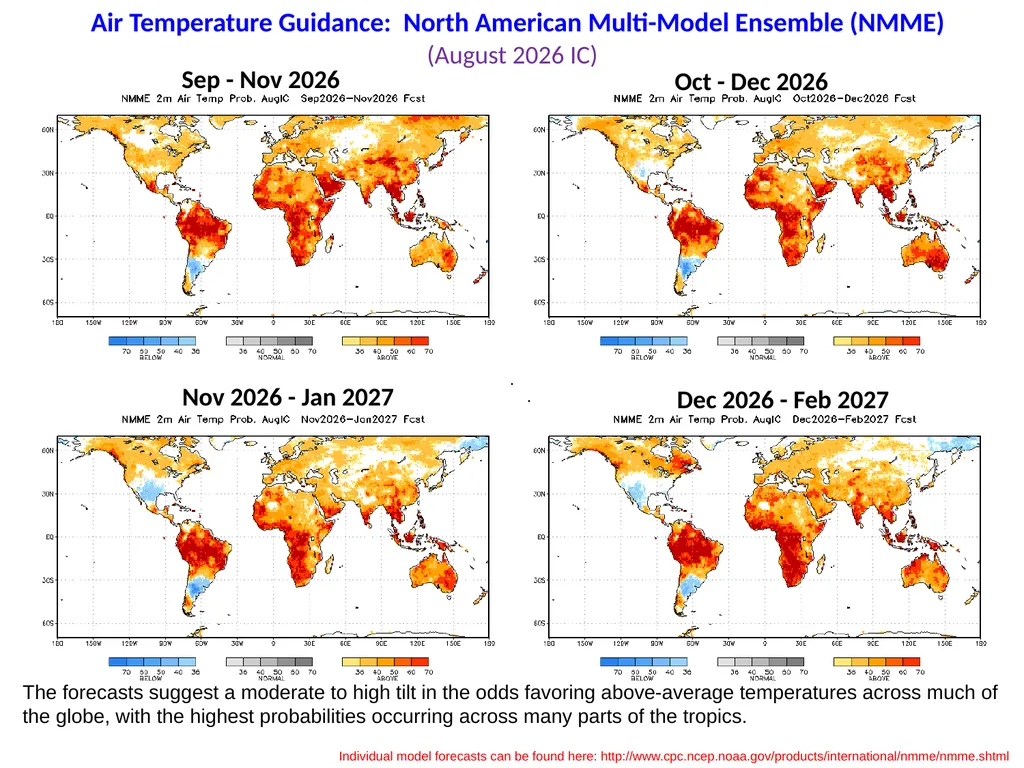
Air Temperature Guidance: North American Multi-Model Ensemble (NMME) The forecasts suggest a moderate to high tilt in the odds favoring above-average temperatures across much of the globe, with the highest probabilities occurring across many parts of the tropics. Individual model forecasts can be found here: http://www.cpc.ncep.noaa.gov/products/international/nmme/nmme.shtml (August 2026 IC) Sep - Nov 2026 Oct - Dec 2026 Dec 2026 - Feb 2027 Nov 2026 - Jan 2027<br>
16
Summary El Niño is strengthening, with a greater than 90% chance of a very strong event during the Northern Hemisphere fall and winter 2026-27.
The NMME ensemble mean forecast suggests a transition to a positive IOD by the end of the northern hemisphere summer of 2026, while SIOD is expected to remain neutral through end of 2026.
The NMME forecasts favor a moderate to high chance for above-average rainfall over parts of southern South America, and equatorial Eastern Africa.
The forecasts call for an increased chance for below-average rainfall over much of the Maritime Continent region, Central America, northern South America, and southern Africa.
The forecasts suggest a moderate to high tilt in the odds favoring above-average temperatures across much of the globe, with the highest probabilities occurring across many parts of the tropics.
Additional forecast resources can be found here:
http://www.cpc.ncep.noaa.gov/products/international/index.shtml
http://www.cpc.ncep.noaa.gov/products/international/nmme/nmme.shtml
http://origin.cpc.ncep.noaa.gov/products/people/wwang/cfsv2fcst/<br>
The NMME ensemble mean forecast suggests a transition to a positive IOD by the end of the northern hemisphere summer of 2026, while SIOD is expected to remain neutral through end of 2026.
The NMME forecasts favor a moderate to high chance for above-average rainfall over parts of southern South America, and equatorial Eastern Africa.
The forecasts call for an increased chance for below-average rainfall over much of the Maritime Continent region, Central America, northern South America, and southern Africa.
The forecasts suggest a moderate to high tilt in the odds favoring above-average temperatures across much of the globe, with the highest probabilities occurring across many parts of the tropics.
Additional forecast resources can be found here:
http://www.cpc.ncep.noaa.gov/products/international/index.shtml
http://www.cpc.ncep.noaa.gov/products/international/nmme/nmme.shtml
http://origin.cpc.ncep.noaa.gov/products/people/wwang/cfsv2fcst/<br>