Second Year Submitted by Real-time Energy-Harvesting Power-Conditioning System for an Urban-Farm Greenhouse Faculty Mentor: Problem Statement Community Context Urban-farm greenhouses connected to the grid face inefficient, non-resilient
"Second Year Submitted by Real-time" is the property of its rightful owner. Permission is granted to
download and print the materials on this website for personal, non-commercial use only, and to display it
on your personal computer provided you do not modify the materials and that you retain all copyright
notices contained in the materials. By downloading content from our website, you accept the terms of this
agreement.
Presentation Transcript
01
Second Year
Submitted by Real-time Energy-Harvesting & Power-Conditioning System for an Urban-Farm Greenhouse Faculty Mentor:<br>
02
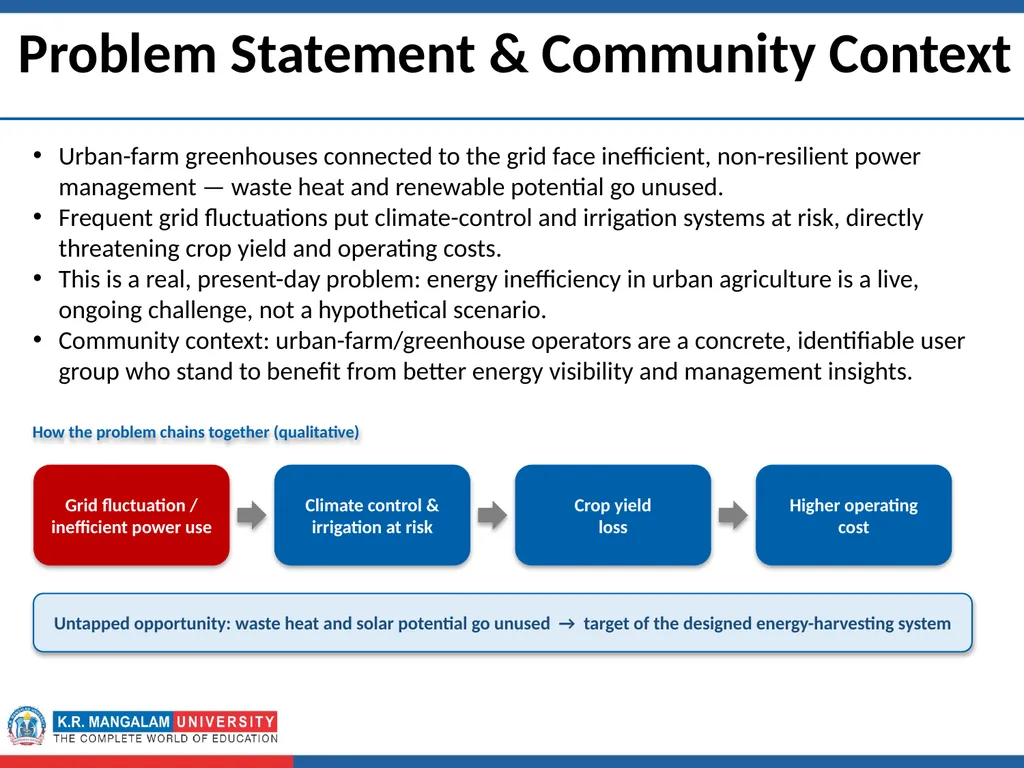
Problem Statement & Community Context Urban-farm greenhouses connected to the grid face inefficient, non-resilient power management — waste heat and renewable potential go unused.
Frequent grid fluctuations put climate-control and irrigation systems at risk, directly threatening crop yield and operating costs.
This is a real, present-day problem: energy inefficiency in urban agriculture is a live, ongoing challenge, not a hypothetical scenario.
Community context: urban-farm/greenhouse operators are a concrete, identifiable user group who stand to benefit from better energy visibility and management insights. How the problem chains together (qualitative) Grid fluctuation /
inefficient power use Climate control &
irrigation at risk Crop yield
loss Higher operating
cost Untapped opportunity: waste heat and solar potential go unused → target of the designed energy-harvesting system<br>
03
Specific Objectives of Project /
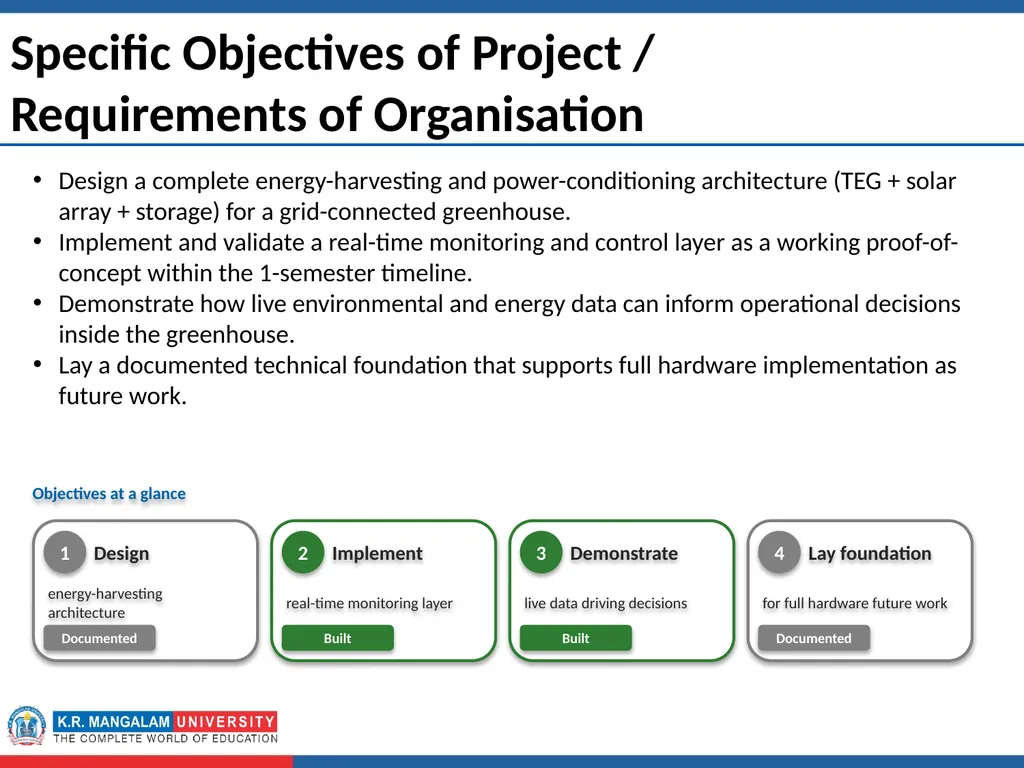
Requirements of Organisation Design a complete energy-harvesting and power-conditioning architecture (TEG + solar array + storage) for a grid-connected greenhouse.
Implement and validate a real-time monitoring and control layer as a working proof-of-concept within the 1-semester timeline.
Demonstrate how live environmental and energy data can inform operational decisions inside the greenhouse.
Lay a documented technical foundation that supports full hardware implementation as future work. Objectives at a glance 1 Design energy-harvesting architecture Documented 2 Implement real-time monitoring layer Built 3 Demonstrate live data driving decisions Built 4 Lay foundation for full hardware future work Documented<br>
04
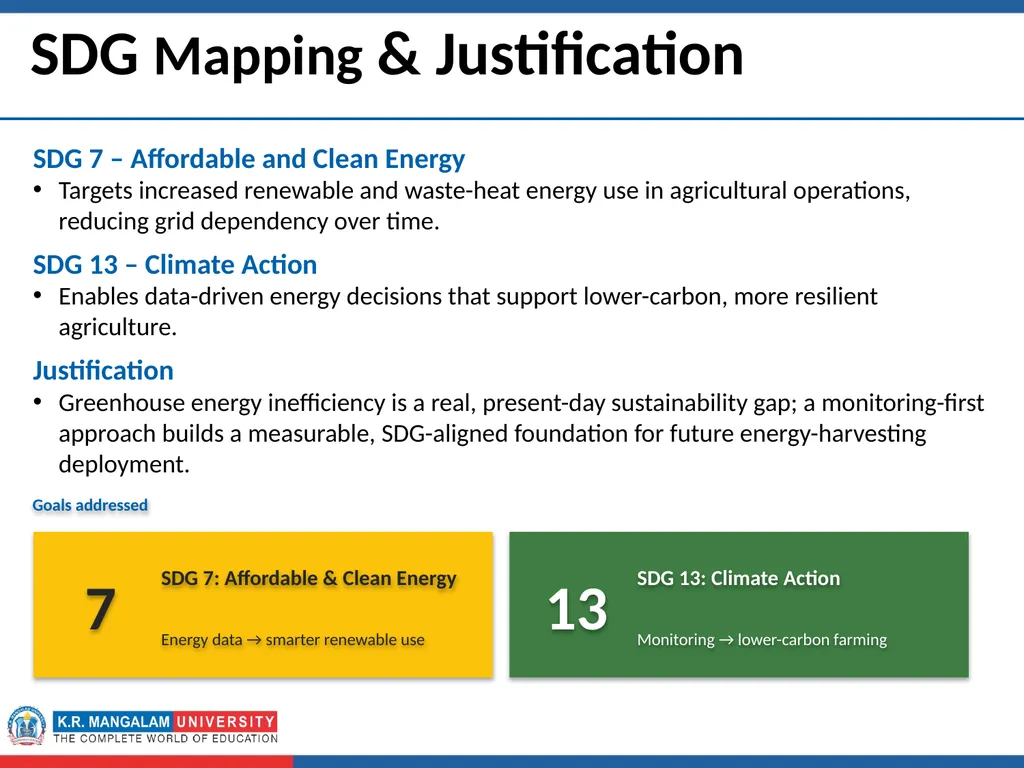
SDG Mapping & Justification SDG 7 – Affordable and Clean Energy
Targets increased renewable and waste-heat energy use in agricultural operations, reducing grid dependency over time.
SDG 13 – Climate Action
Enables data-driven energy decisions that support lower-carbon, more resilient agriculture.
Justification
Greenhouse energy inefficiency is a real, present-day sustainability gap; a monitoring-first approach builds a measurable, SDG-aligned foundation for future energy-harvesting deployment. Goals addressed 7 SDG 7: Affordable & Clean Energy Energy data → smarter renewable use 13 SDG 13: Climate Action Monitoring → lower-carbon farming<br>
05
Methodology and Tech Stack Designed Architecture (documented, not physically built)
Thermoelectric Generator (TEG) for waste-heat recovery
Solar panel array for renewable energy input
DC-DC power converter for output regulation
Energy Storage System (ESS) for load leveling and backup
Implemented Prototype (working build)
ESP32 microcontroller with built-in WiFi
DHT11/DHT22 temperature and humidity sensor
Python/Flask backend
SQLite database
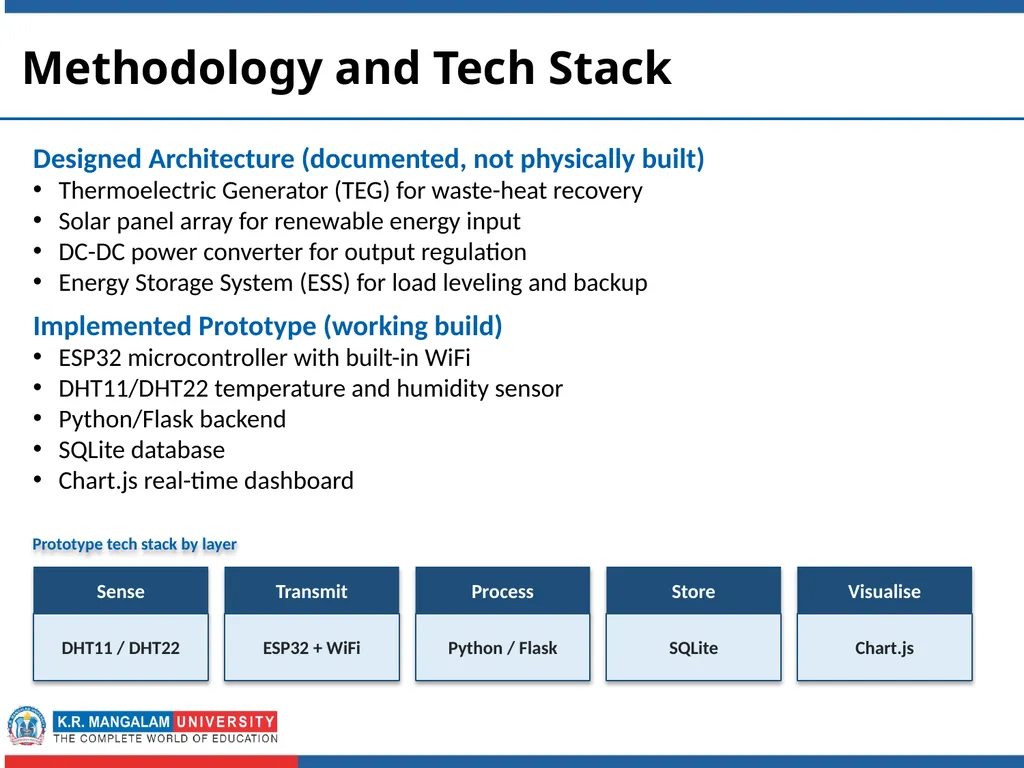
Chart.js real-time dashboard Prototype tech stack by layer Sense DHT11 / DHT22 Transmit ESP32 + WiFi Process Python / Flask Store SQLite Visualise Chart.js<br>
06
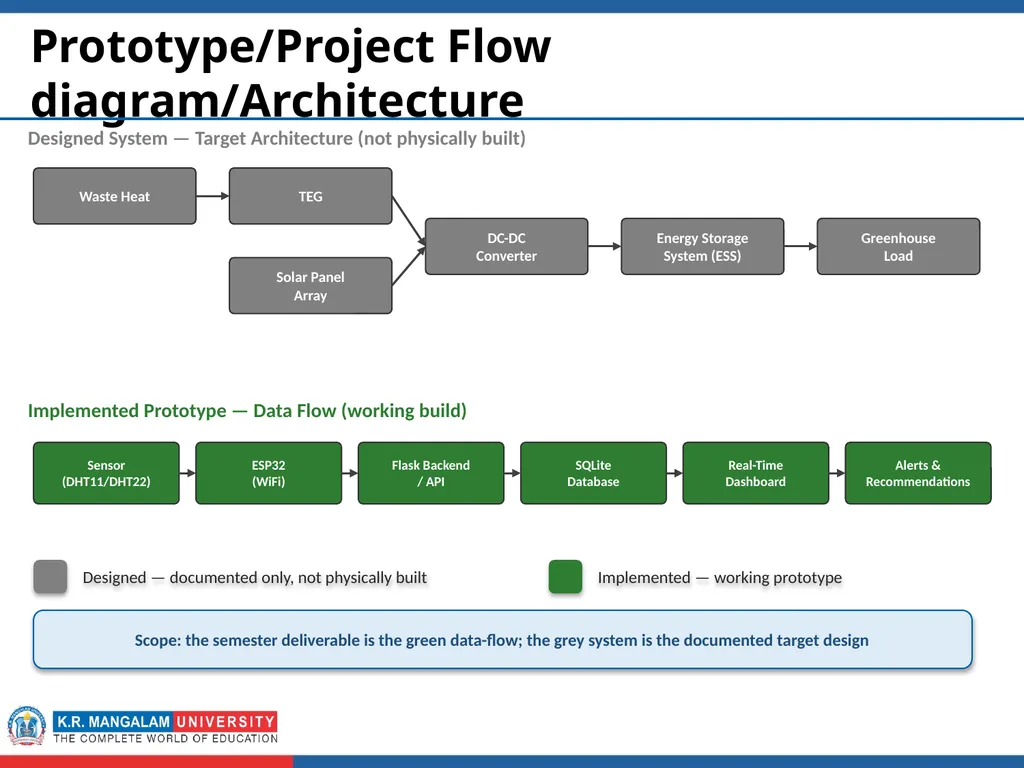
Prototype/Project Flow diagram/Architecture Designed System — Target Architecture (not physically built) Waste Heat TEG Solar Panel Array DC-DC Converter Energy Storage System (ESS) Greenhouse Load Implemented Prototype — Data Flow (working build) Sensor (DHT11/DHT22) ESP32 (WiFi) Flask Backend / API SQLite Database Real-Time Dashboard Alerts & Recommendations Designed — documented only, not physically built Implemented — working prototype Scope: the semester deliverable is the green data-flow; the grey system is the documented target design<br>
07
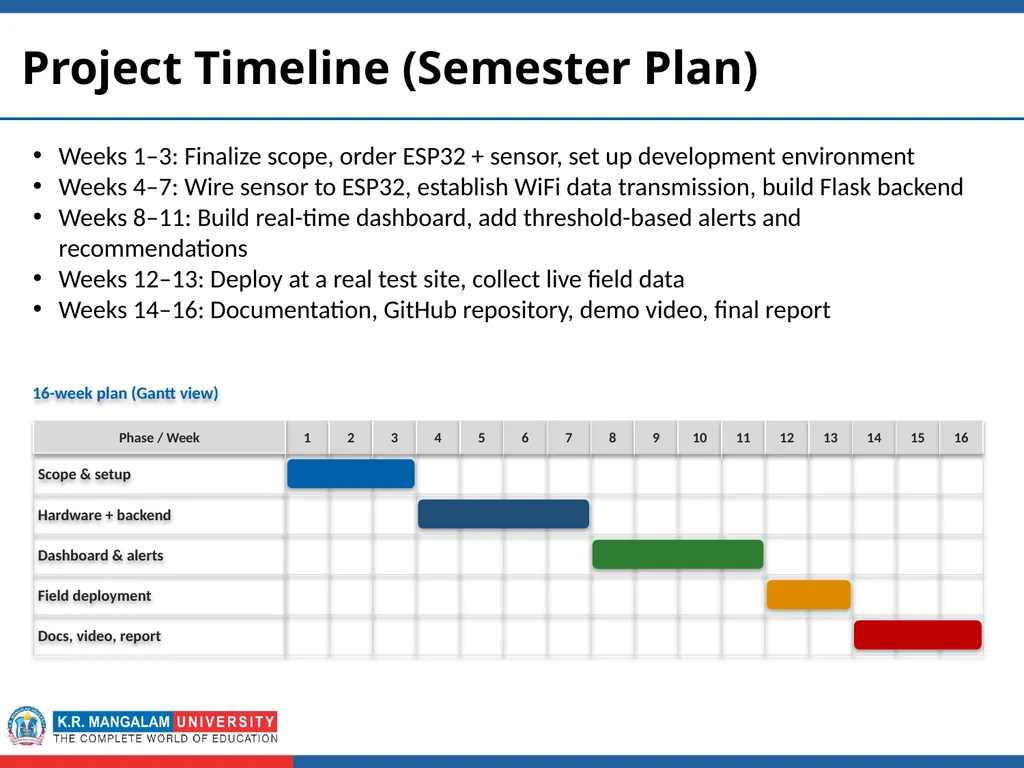
Project Timeline (Semester Plan) Weeks 1–3: Finalize scope, order ESP32 + sensor, set up development environment
Weeks 4–7: Wire sensor to ESP32, establish WiFi data transmission, build Flask backend
Weeks 8–11: Build real-time dashboard, add threshold-based alerts and recommendations
Weeks 12–13: Deploy at a real test site, collect live field data
Weeks 14–16: Documentation, GitHub repository, demo video, final report 16-week plan (Gantt view) 1 2 3 4 5 6 7 8 9 10 11 12 13 14 15 16 Phase / Week Scope & setup Hardware + backend Dashboard & alerts Field deployment Docs, video, report<br>
08
Data & Resources (if any) Hardware
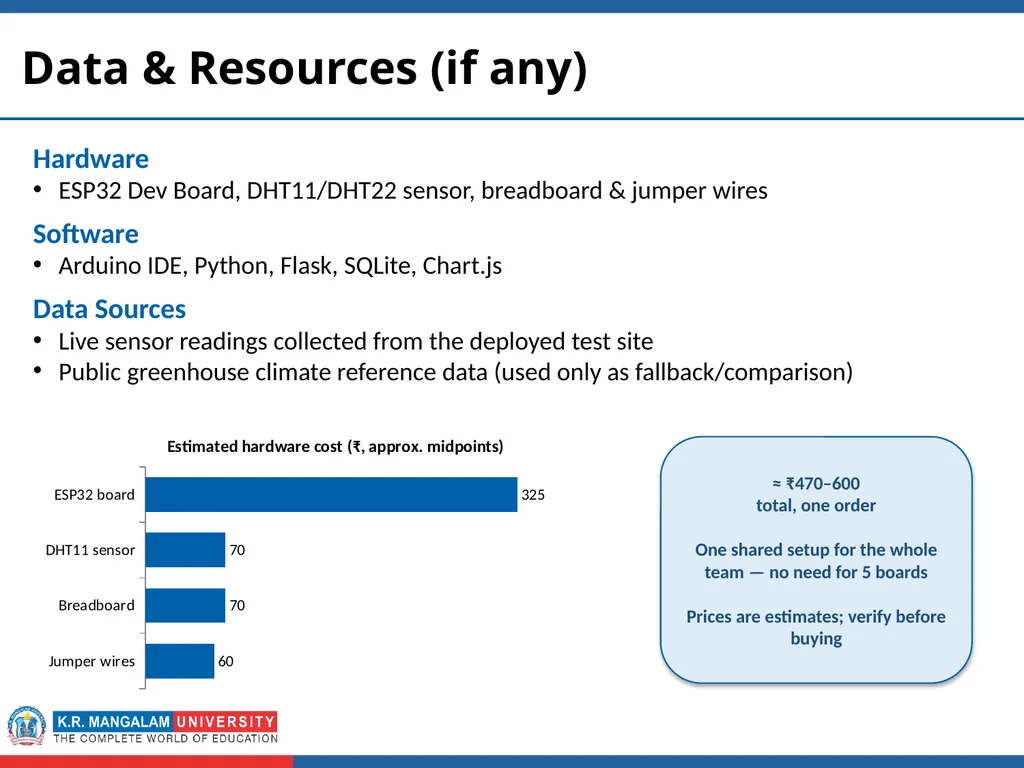
ESP32 Dev Board, DHT11/DHT22 sensor, breadboard & jumper wires
Data Sources
Live sensor readings collected from the deployed test site
Public greenhouse climate reference data (used only as fallback/comparison) ≈ ₹470–600
total, one order
One shared setup for the whole team — no need for 5 boards
Prices are estimates; verify before buying<br>
09
Project Usecases & Scope Real-time monitoring of greenhouse temperature and humidity
Automated threshold-based alerts (e.g., high temperature, low humidity)
Rule-based operational recommendations (e.g., ventilation, misting)
Historical trend visualization for planning and analysis
Out of scope this semester:
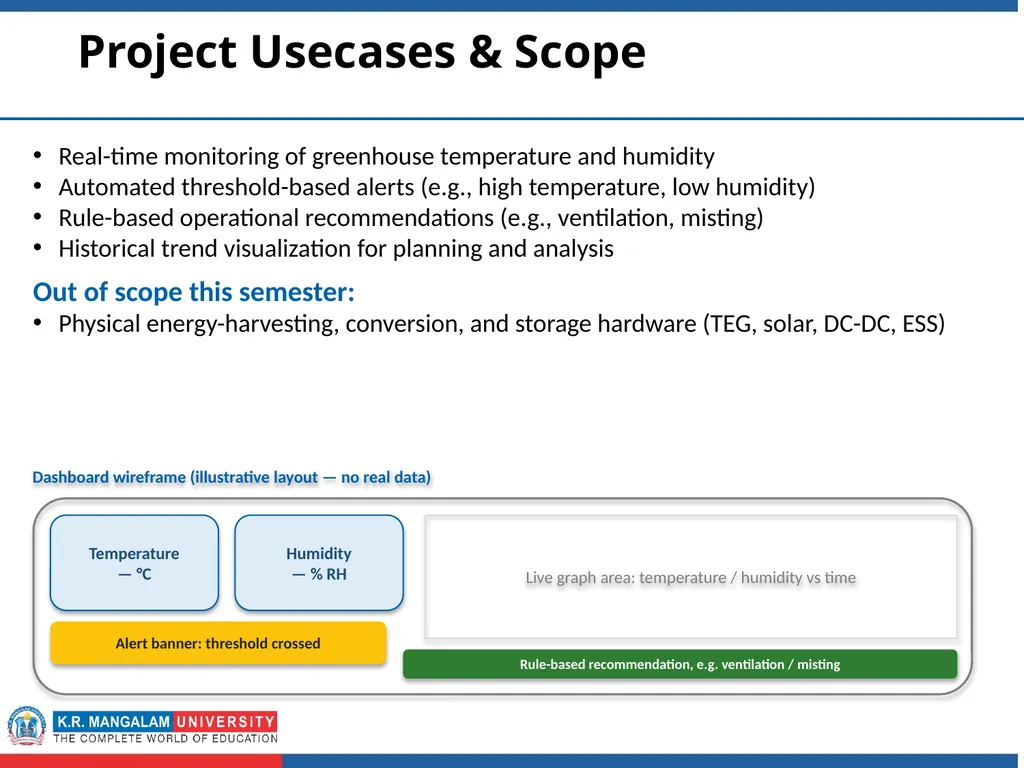
Physical energy-harvesting, conversion, and storage hardware (TEG, solar, DC-DC, ESS) Dashboard wireframe (illustrative layout — no real data) Temperature
— °C Humidity
— % RH Live graph area: temperature / humidity vs time Alert banner: threshold crossed Rule-based recommendation, e.g. ventilation / misting<br>
10
Expected Results & Impact A functioning, deployed monitoring dashboard tracking live greenhouse conditions
Documented architecture for a full energy-harvesting system, ready for future implementation
Field-validated data collected from a real test site
Honest outcome:
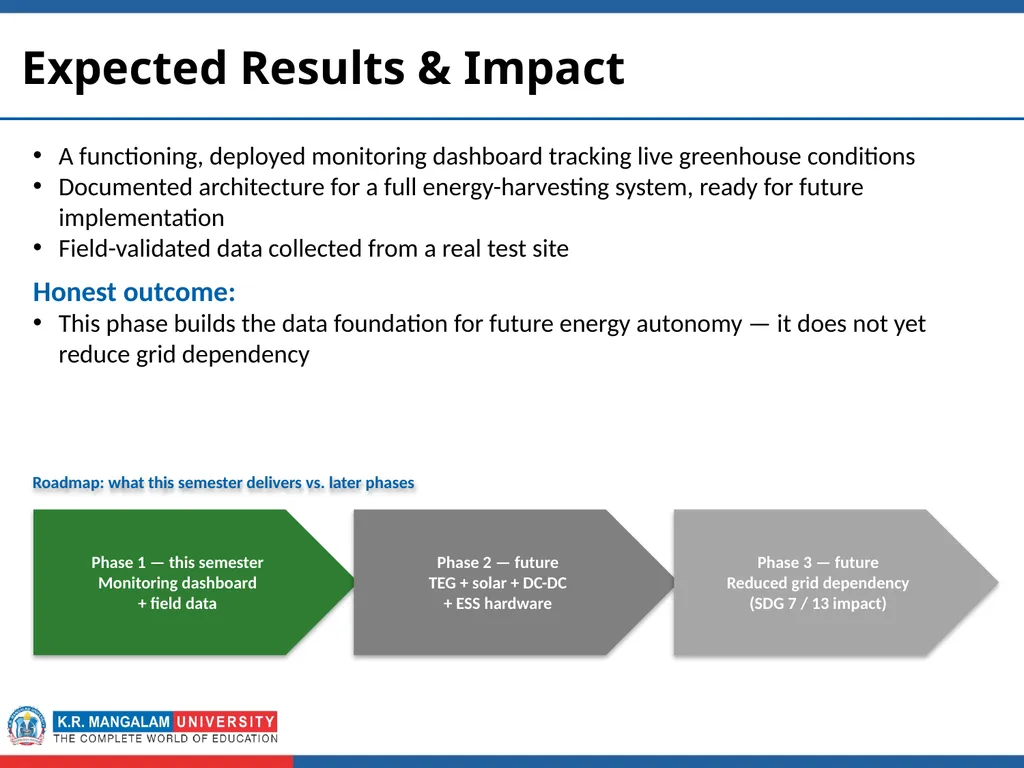
This phase builds the data foundation for future energy autonomy — it does not yet reduce grid dependency Roadmap: what this semester delivers vs. later phases Phase 1 — this semester
Monitoring dashboard
+ field data Phase 2 — future
TEG + solar + DC-DC
+ ESS hardware Phase 3 — future
Reduced grid dependency
(SDG 7 / 13 impact)<br>