Second Year Submitted by Real-time Defect Detection and Classification System for Cast Metal Parts using 3D Scanning and Machine Learning Faculty Mentor: Dr. Pinki Kumari Problem Statement Community Context Problem Description Traditional
"Second Year Submitted by Real-time Defect" is the property of its rightful owner. Permission is granted to
download and print the materials on this website for personal, non-commercial use only, and to display it
on your personal computer provided you do not modify the materials and that you retain all copyright
notices contained in the materials. By downloading content from our website, you accept the terms of this
agreement.
Presentation Transcript
01
Second Year
Submitted by Real-time Defect Detection and Classification System for Cast Metal Parts using 3D Scanning and Machine Learning Faculty Mentor: Dr. Pinki Kumari<br>
02
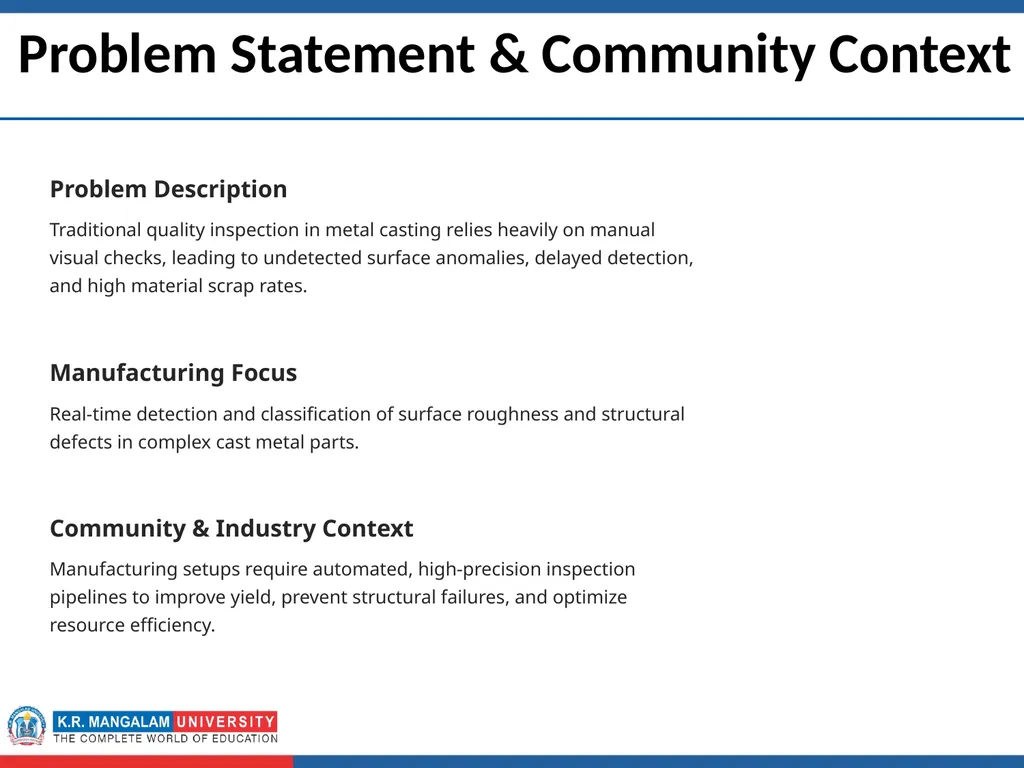
Problem Statement & Community Context Problem Description Traditional quality inspection in metal casting relies heavily on manual visual checks, leading to undetected surface anomalies, delayed detection, and high material scrap rates. Manufacturing Focus Real-time detection and classification of surface roughness and structural defects in complex cast metal parts. Community & Industry Context Manufacturing setups require automated, high-precision inspection pipelines to improve yield, prevent structural failures, and optimize resource efficiency.<br>
03
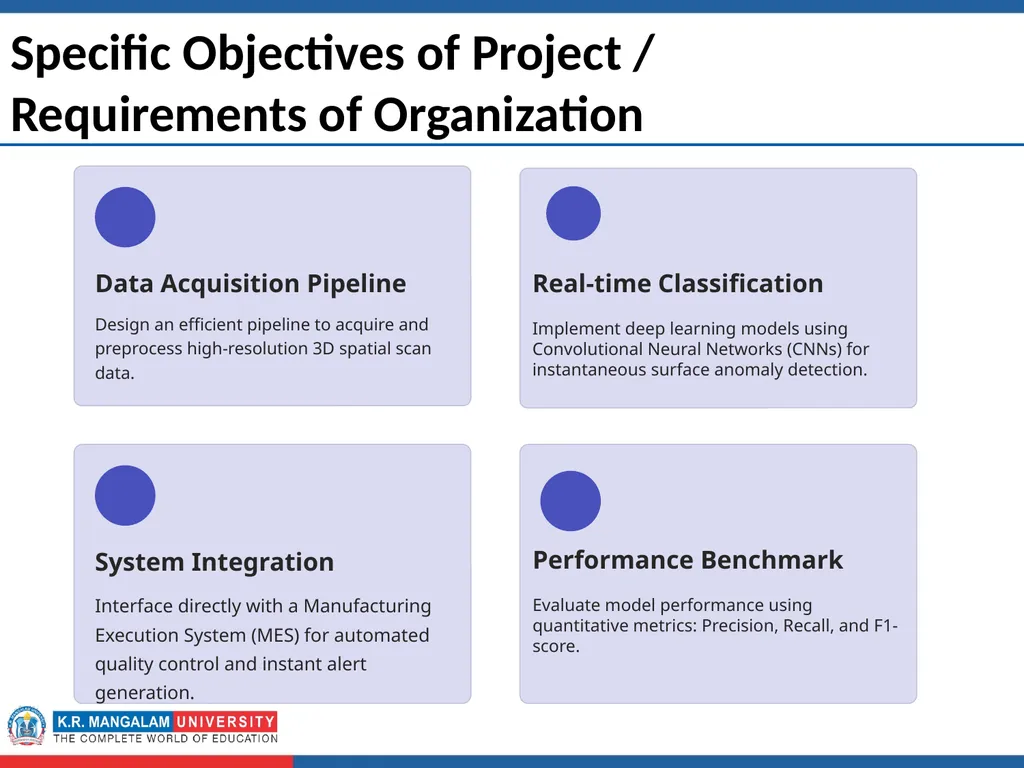
Specific Objectives of Project /
Requirements of Organization Data Acquisition Pipeline Design an efficient pipeline to acquire and preprocess high-resolution 3D spatial scan data. System Integration Interface directly with a Manufacturing Execution System (MES) for automated quality control and instant alert generation. Real-time Classification
Implement deep learning models using Convolutional Neural Networks (CNNs) for instantaneous surface anomaly detection. Performance Benchmark
Evaluate model performance using quantitative metrics: Precision, Recall, and F1-score.<br>
04
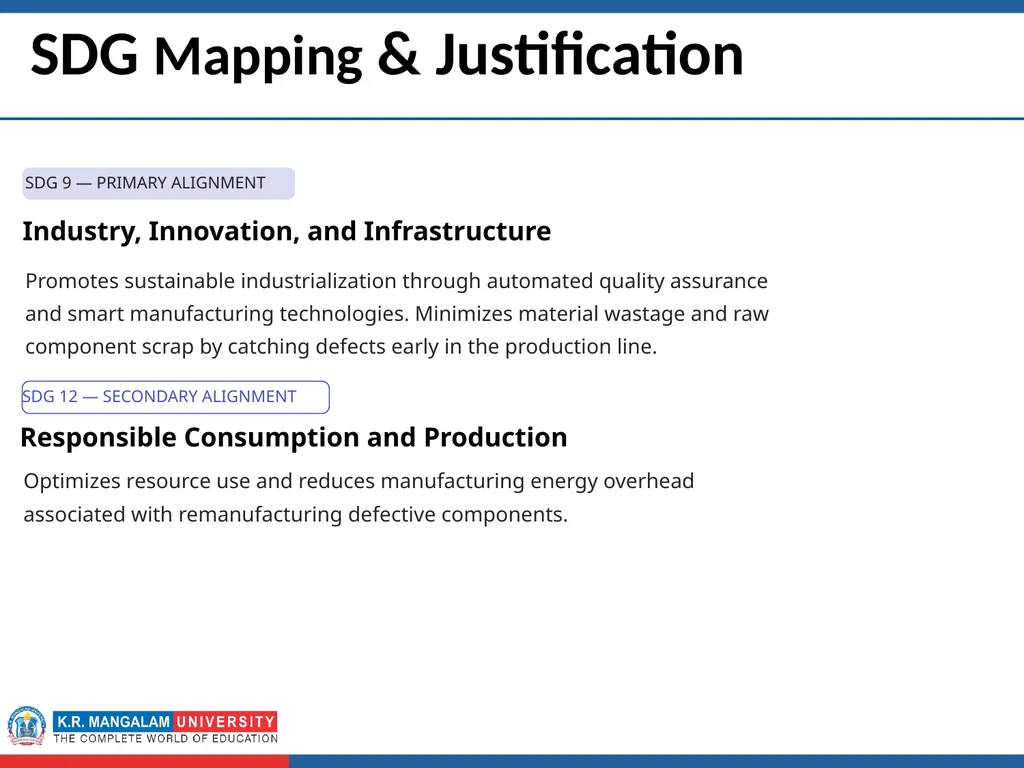
SDG Mapping & Justification SDG 9 — PRIMARY ALIGNMENT Industry, Innovation, and Infrastructure Promotes sustainable industrialization through automated quality assurance and smart manufacturing technologies. Minimizes material wastage and raw component scrap by catching defects early in the production line. SDG 12 — SECONDARY ALIGNMENT Responsible Consumption and Production Optimizes resource use and reduces manufacturing energy overhead associated with remanufacturing defective components.<br>
05
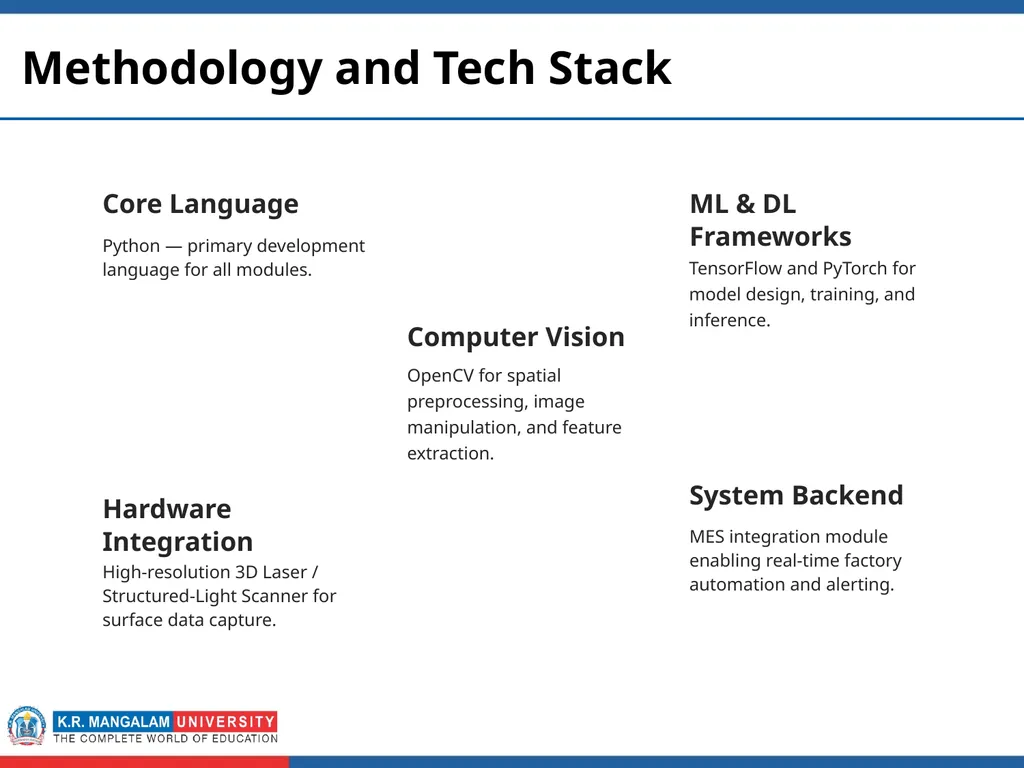
Methodology and Tech Stack Core Language Python — primary development language for all modules. ML & DL Frameworks TensorFlow and PyTorch for model design, training, and inference. Computer Vision OpenCV for spatial preprocessing, image manipulation, and feature extraction. Hardware Integration High-resolution 3D Laser / Structured-Light Scanner for surface data capture. System Backend MES integration module enabling real-time factory automation and alerting.<br>
06
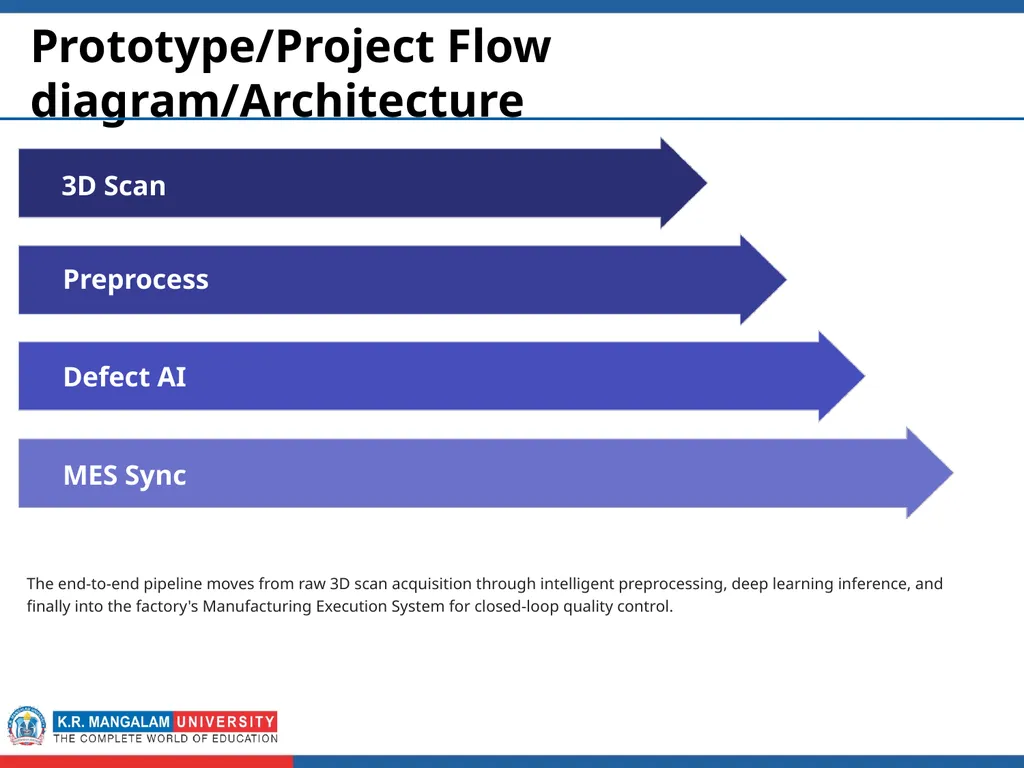
Prototype/Project Flow diagram/Architecture 3D Scan Preprocess Defect AI MES Sync The end-to-end pipeline moves from raw 3D scan acquisition through intelligent preprocessing, deep learning inference, and finally into the factory's Manufacturing Execution System for closed-loop quality control.<br>
07
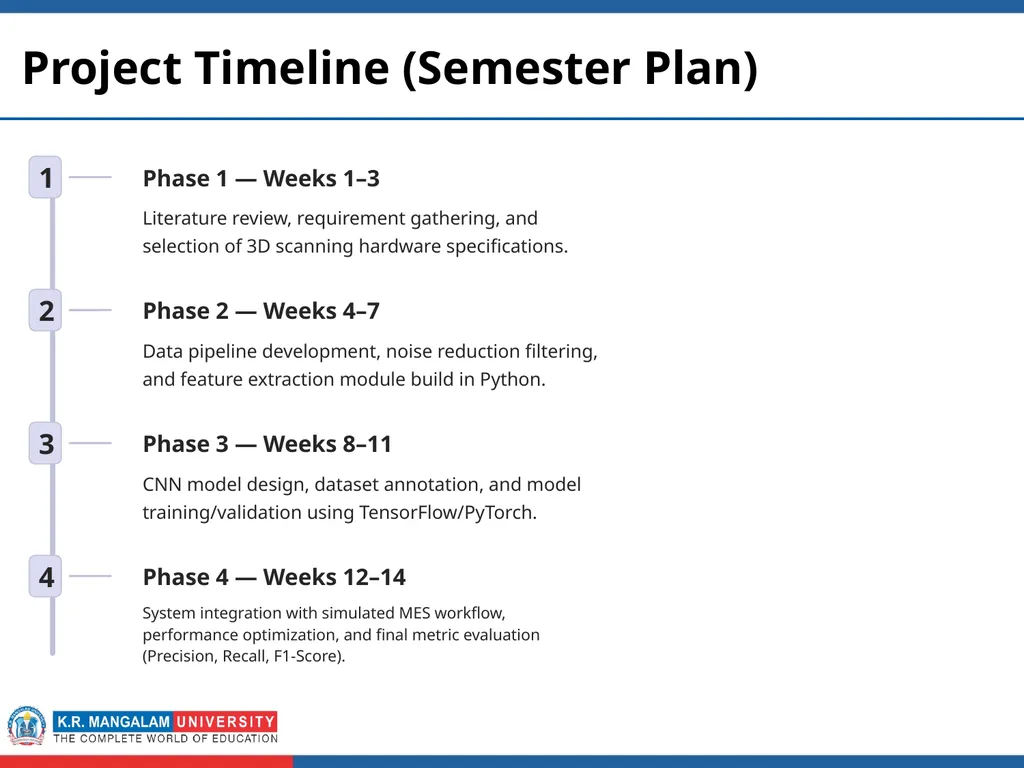
Project Timeline (Semester Plan) 1 Phase 1 — Weeks 1–3 Literature review, requirement gathering, and selection of 3D scanning hardware specifications. 2 Phase 2 — Weeks 4–7 Data pipeline development, noise reduction filtering, and feature extraction module build in Python. 3 Phase 3 — Weeks 8–11 CNN model design, dataset annotation, and model training/validation using TensorFlow/PyTorch. 4 Phase 4 — Weeks 12–14 System integration with simulated MES workflow, performance optimization, and final metric evaluation (Precision, Recall, F1-Score).<br>
08
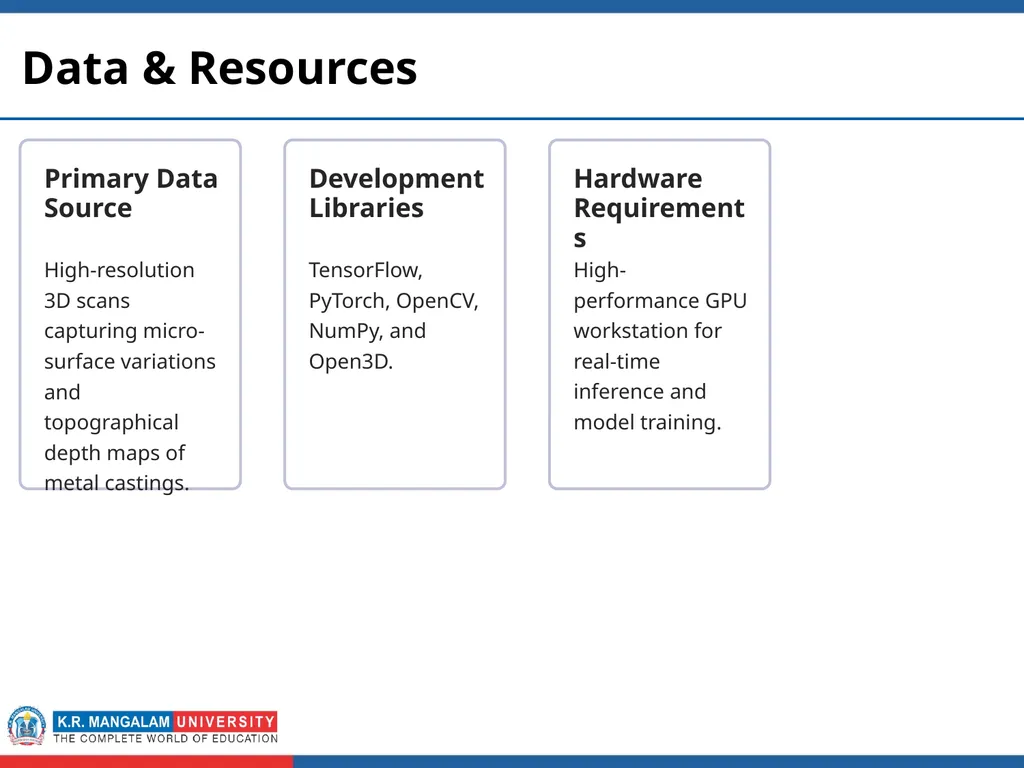
Data & Resources Primary Data Source High-resolution 3D scans capturing micro-surface variations and topographical depth maps of metal castings. Development Libraries TensorFlow, PyTorch, OpenCV, NumPy, and Open3D. Hardware Requirements High-performance GPU workstation for real-time inference and model training.<br>
09
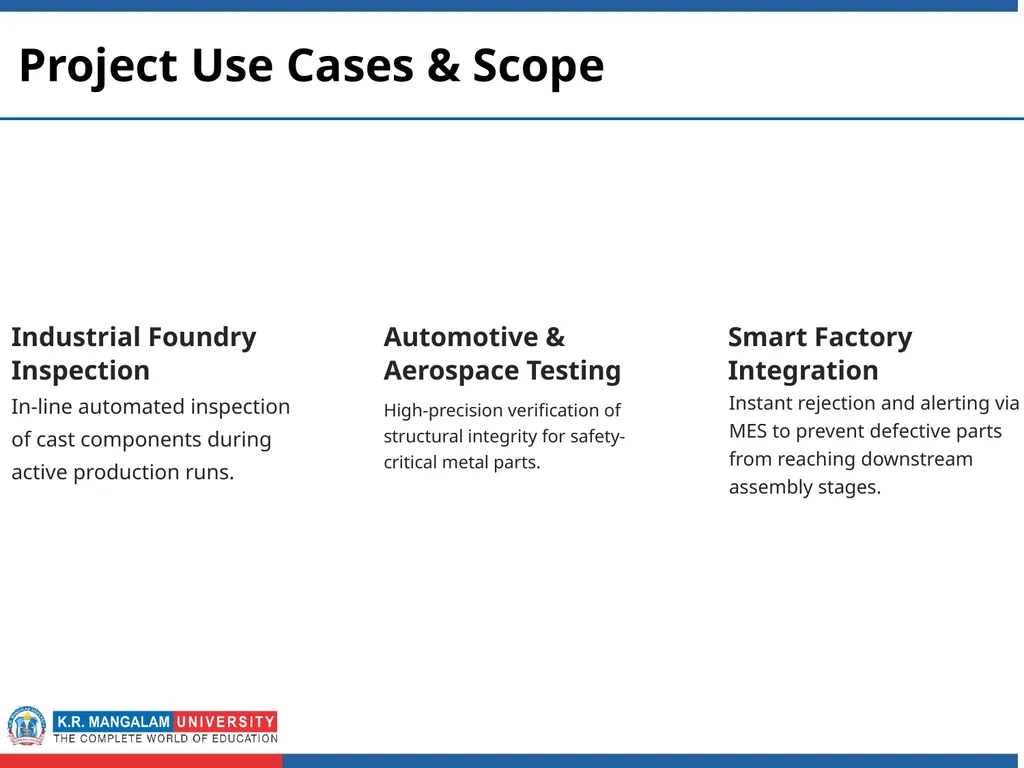
Project Use Cases & Scope Industrial Foundry Inspection In-line automated inspection of cast components during active production runs. Automotive & Aerospace Testing High-precision verification of structural integrity for safety-critical metal parts. Smart Factory
Integration Instant rejection and alerting via MES to prevent defective parts from reaching downstream assembly stages.<br>
10
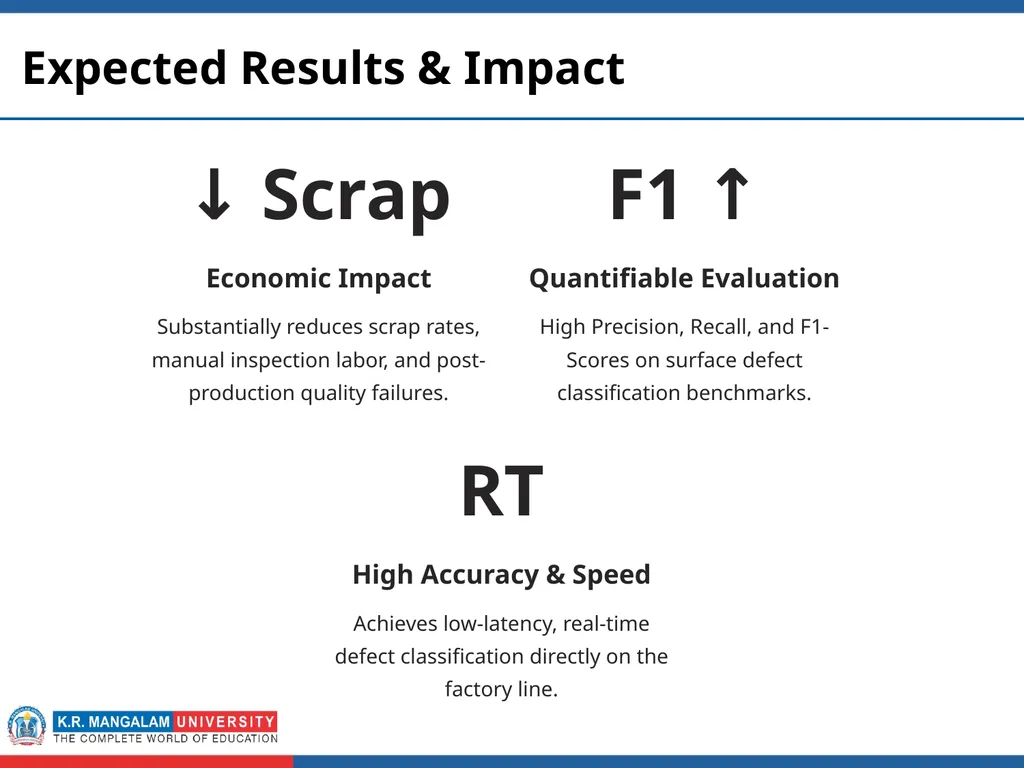
Expected Results & Impact ↓ Scrap Economic Impact Substantially reduces scrap rates, manual inspection labor, and post-production quality failures. F1 ↑ Quantifiable Evaluation High Precision, Recall, and F1-Scores on surface defect classification benchmarks. RT High Accuracy & Speed Achieves low-latency, real-time defect classification directly on the factory line.<br>