
Section 2: Understanding Myself and Others Lessons
T
Published · 71 slides · 0 views
1 / 1






Description
Section 2: Understanding Myself and Others Lessons 917 Lesson 9 Communication Passive communication means accepting what happens without actively responding or expressing what you feel. Aggressive communication means communicating
Related Topics
Share
Embed code
Download this presentation From Below
"Section 2: Understanding Myself and Others Lessons" is the property of its rightful owner. Permission is granted to download and print the materials on this website for personal, non-commercial use only, and to display it on your personal computer provided you do not modify the materials and that you retain all copyright notices contained in the materials. By downloading content from our website, you accept the terms of this agreement.
Presentation Transcript
01
Section 2: Understanding Myself and Others Lessons 9–17<br>
02
Lesson 9
Communication<br>
Communication<br>
03
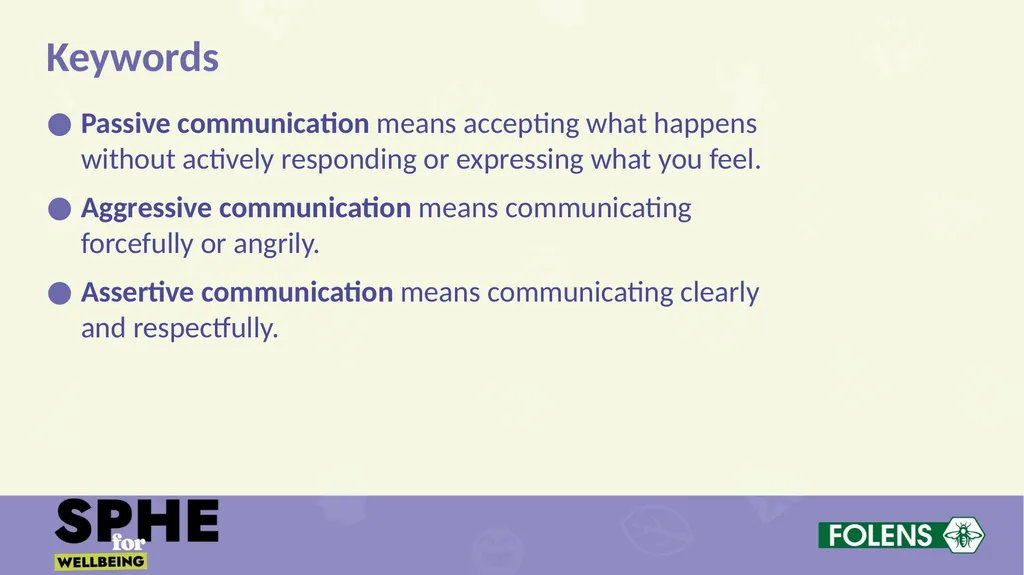
Passive communication means accepting what happens without actively responding or expressing what you feel.
Aggressive communication means communicating forcefully or angrily.
Assertive communication means communicating clearly and respectfully. Keywords<br>
Aggressive communication means communicating forcefully or angrily.
Assertive communication means communicating clearly and respectfully. Keywords<br>
04
1. Express your feelings with greater awareness.
2. Explain how we express ourselves verbally and nonverbally.
3. Use your skills for communicating effectively with others. At the end of this lesson, you will:<br>
2. Explain how we express ourselves verbally and nonverbally.
3. Use your skills for communicating effectively with others. At the end of this lesson, you will:<br>
05
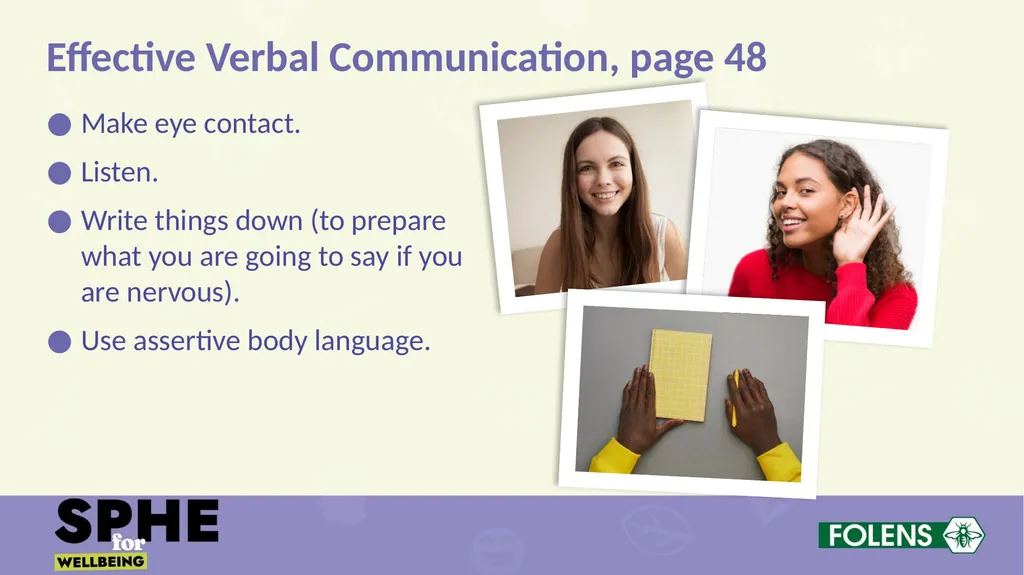
Make eye contact.
Listen.
Write things down (to prepare what you are going to say if you are nervous).
Use assertive body language. Effective Verbal Communication, page 48<br>
Listen.
Write things down (to prepare what you are going to say if you are nervous).
Use assertive body language. Effective Verbal Communication, page 48<br>
06
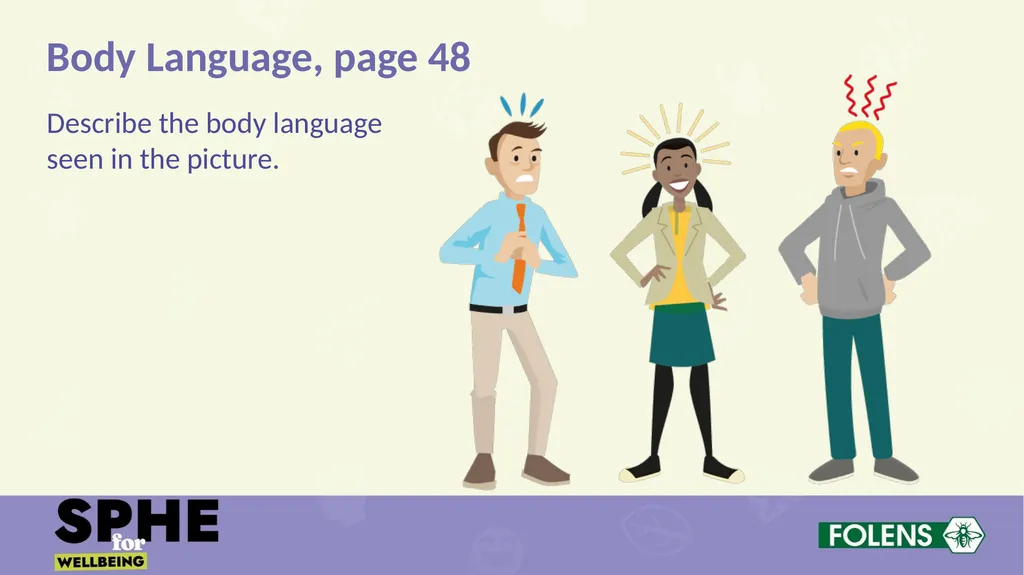
Describe the body language seen in the picture. Body Language, page 48<br>
07
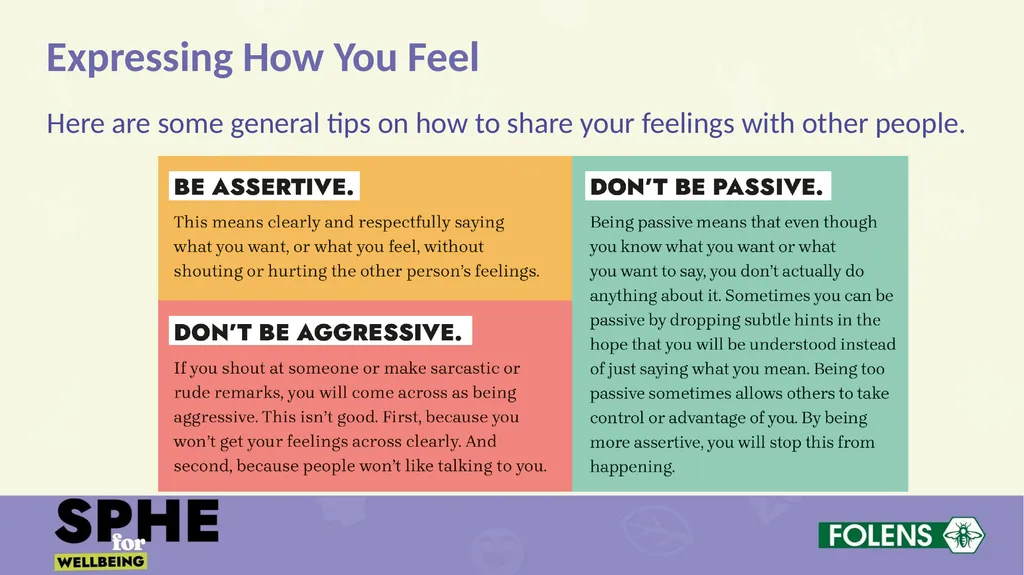
Expressing How You Feel Here are some general tips on how to share your feelings with other people.<br>
08
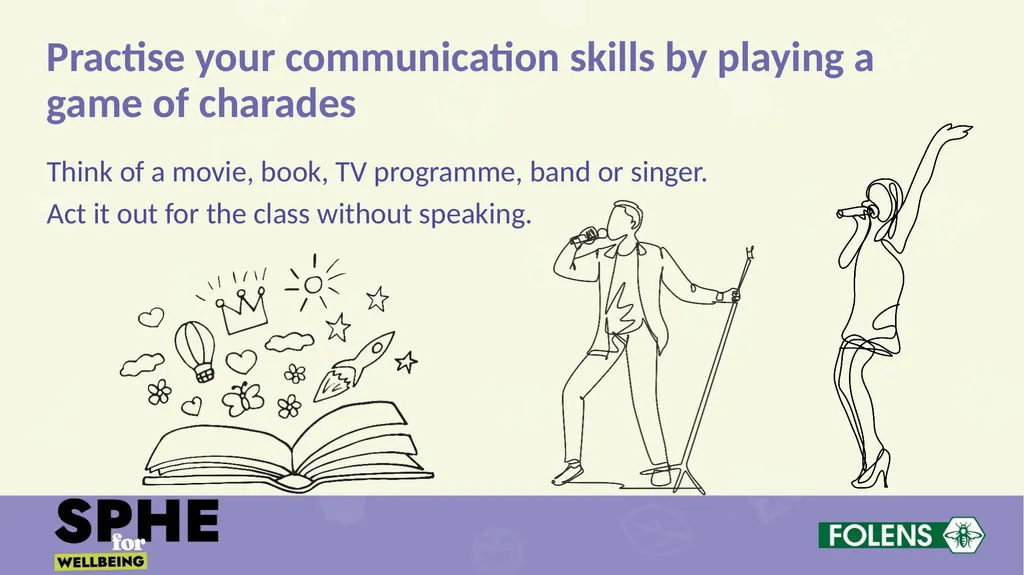
Practise your communication skills by playing a game of charades Think of a movie, book, TV programme, band or singer.
Act it out for the class without speaking.<br>
Act it out for the class without speaking.<br>
09
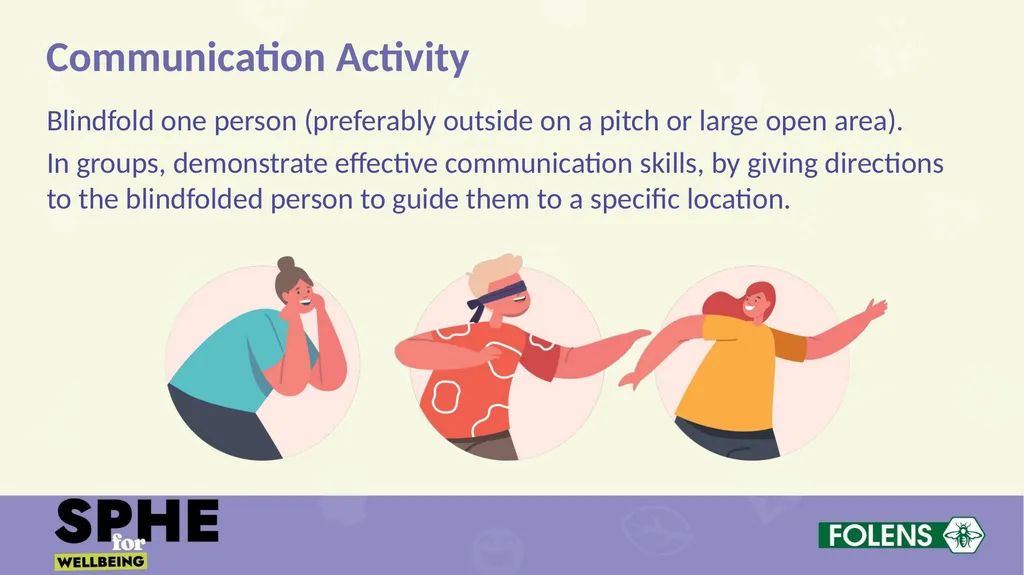
Communication Activity Blindfold one person (preferably outside on a pitch or large open area).
In groups, demonstrate effective communication skills, by giving directions to the blindfolded person to guide them to a specific location.<br>
In groups, demonstrate effective communication skills, by giving directions to the blindfolded person to guide them to a specific location.<br>
10
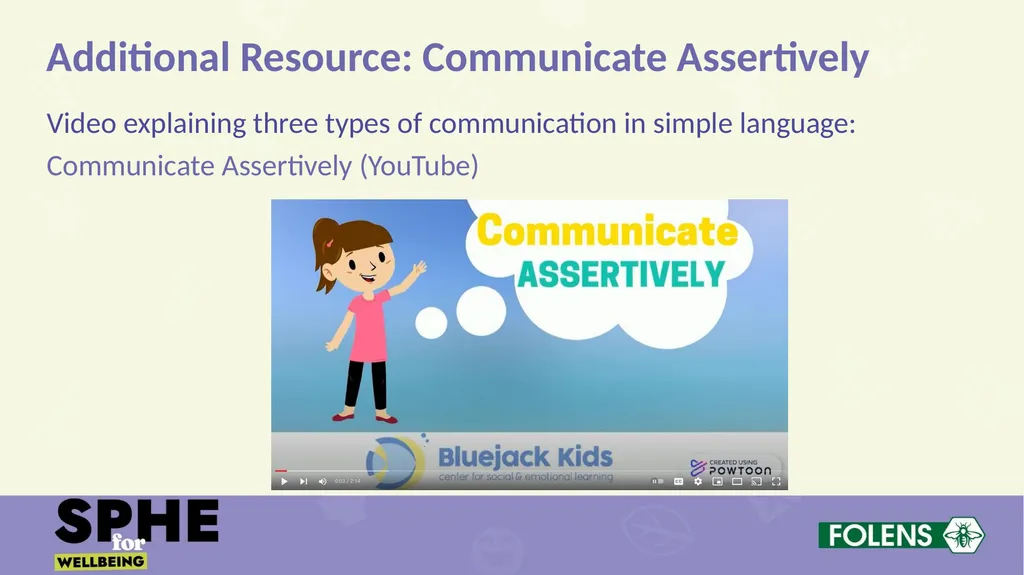
Additional Resource: Communicate Assertively Video explaining three types of communication in simple language:
Communicate Assertively (YouTube)<br>
Communicate Assertively (YouTube)<br>
11
Lesson 10
Inclusive Communication<br>
Inclusive Communication<br>
12
1. Communicate more effectively with people who have physical or sensory conditions or needs.
2. Explain how communication can differ across cultures.
3. Use your improved skills for communicating with others. At the end of this lesson, you will:<br>
2. Explain how communication can differ across cultures.
3. Use your improved skills for communicating with others. At the end of this lesson, you will:<br>
13
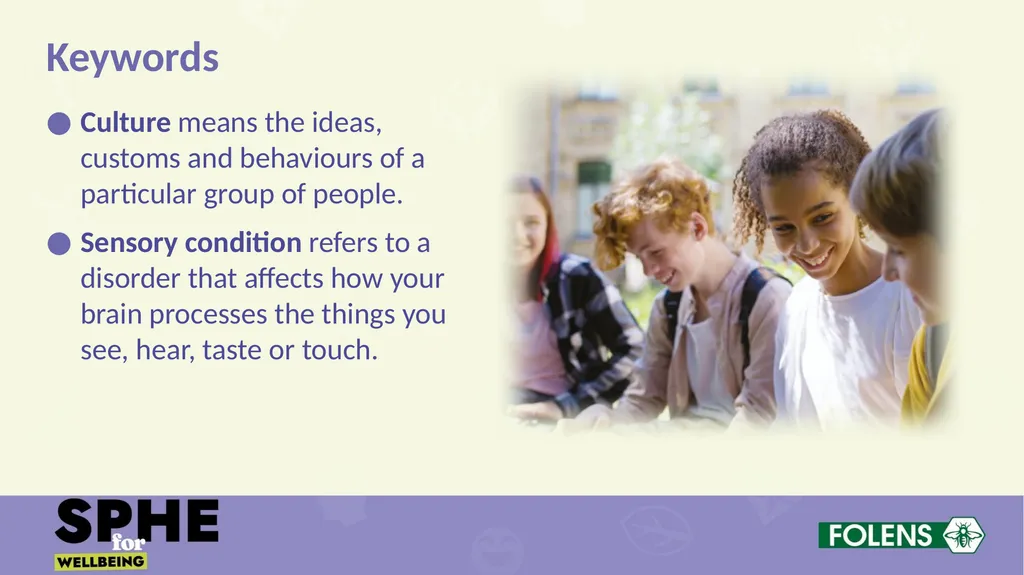
Culture means the ideas, customs and behaviours of a particular group of people.
Sensory condition refers to a disorder that affects how your brain processes the things you see, hear, taste or touch. Keywords<br>
Sensory condition refers to a disorder that affects how your brain processes the things you see, hear, taste or touch. Keywords<br>
14
Speak to a person with a disability as you would speak to anyone else.
Speak directly to the person with the disability, not the carer.
Respect their personal space.
Try to speak to them at eye level. General Tips for Communicating With a Person
With a Disability, page 51<br>
Speak directly to the person with the disability, not the carer.
Respect their personal space.
Try to speak to them at eye level. General Tips for Communicating With a Person
With a Disability, page 51<br>
15
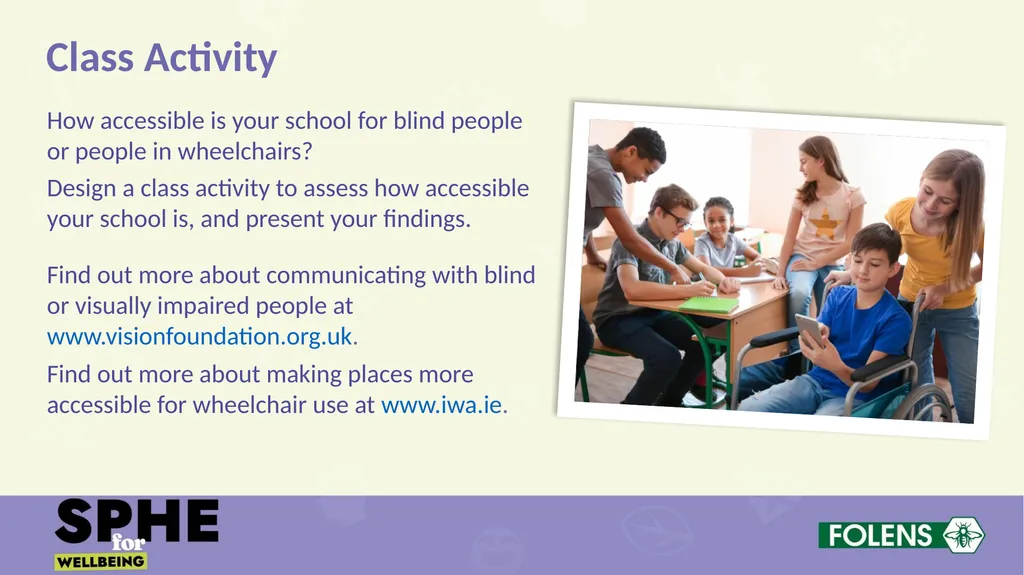
Class Activity How accessible is your school for blind people or people in wheelchairs?
Design a class activity to assess how accessible your school is, and present your findings.
Find out more about communicating with blind or visually impaired people at www.visionfoundation.org.uk.
Find out more about making places more accessible for wheelchair use at www.iwa.ie.<br>
Design a class activity to assess how accessible your school is, and present your findings.
Find out more about communicating with blind or visually impaired people at www.visionfoundation.org.uk.
Find out more about making places more accessible for wheelchair use at www.iwa.ie.<br>
16
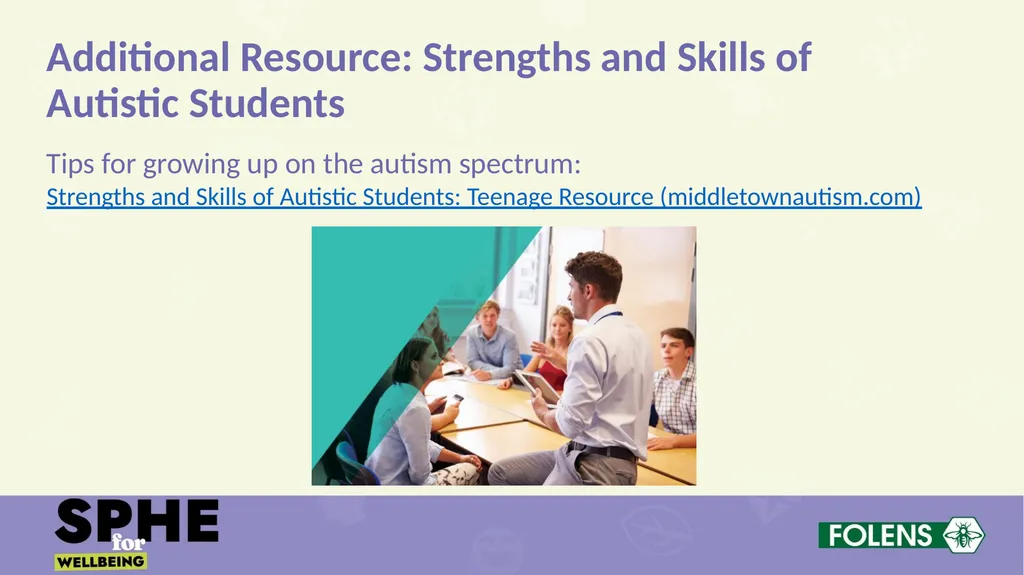
Tips for growing up on the autism spectrum:
Strengths and Skills of Autistic Students: Teenage Resource (middletownautism.com) Additional Resource: Strengths and Skills of Autistic Students<br>
Strengths and Skills of Autistic Students: Teenage Resource (middletownautism.com) Additional Resource: Strengths and Skills of Autistic Students<br>
17
Lesson 11
Self-Esteem<br>
Self-Esteem<br>
18
1. Demonstrate skills for improving your self-esteem.
2. Explain what makes you different and unique. At the end of this lesson, you will:<br>
2. Explain what makes you different and unique. At the end of this lesson, you will:<br>
19
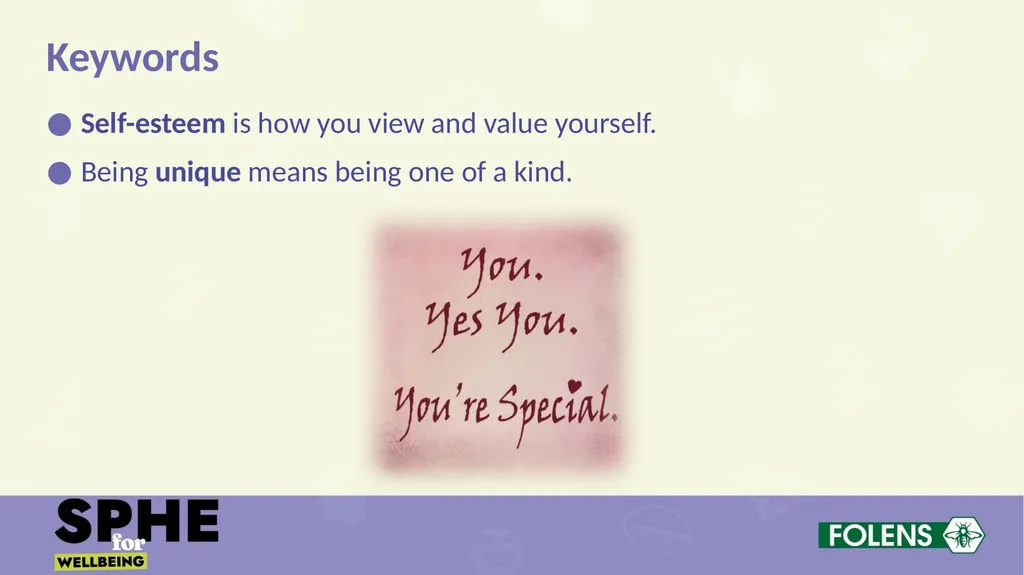
Self-esteem is how you view and value yourself.
Being unique means being one of a kind. Keywords<br>
Being unique means being one of a kind. Keywords<br>
20
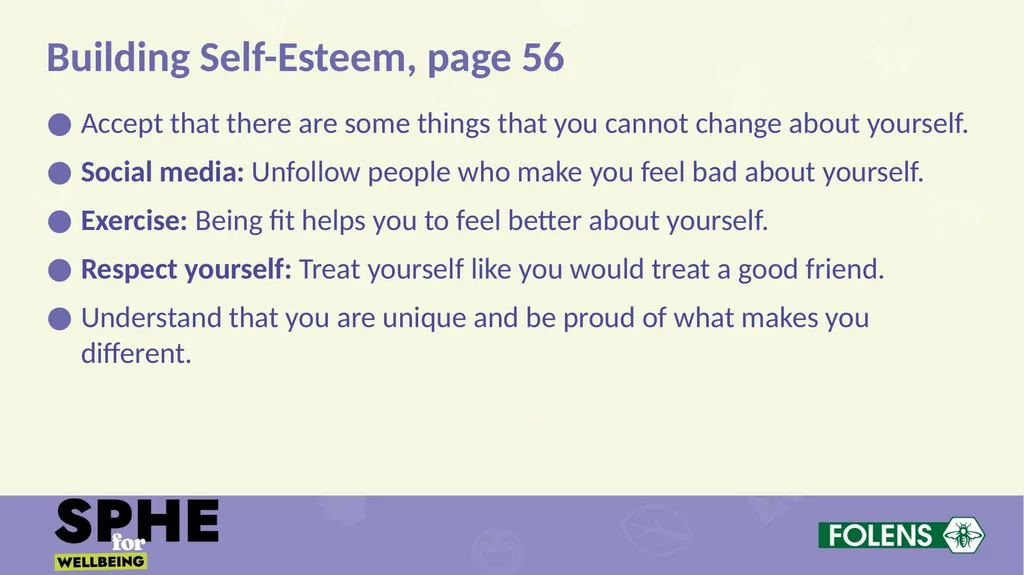
Accept that there are some things that you cannot change about yourself.
Social media: Unfollow people who make you feel bad about yourself.
Exercise: Being fit helps you to feel better about yourself.
Respect yourself: Treat yourself like you would treat a good friend.
Understand that you are unique and be proud of what makes you different. Building Self-Esteem, page 56<br>
21
Find more information for 11- to 18-year-olds about confidence and self-esteem here. Self-Esteem<br>
22
Class Discussion Social Media and Self-Esteem
Do you think that people have more or less self-esteem issues because of social media?
Discuss ways that social media can have a negative effect on self-esteem.
Discuss ways in which social media can have a positive effect on self-esteem.<br>
Do you think that people have more or less self-esteem issues because of social media?
Discuss ways that social media can have a negative effect on self-esteem.
Discuss ways in which social media can have a positive effect on self-esteem.<br>
23
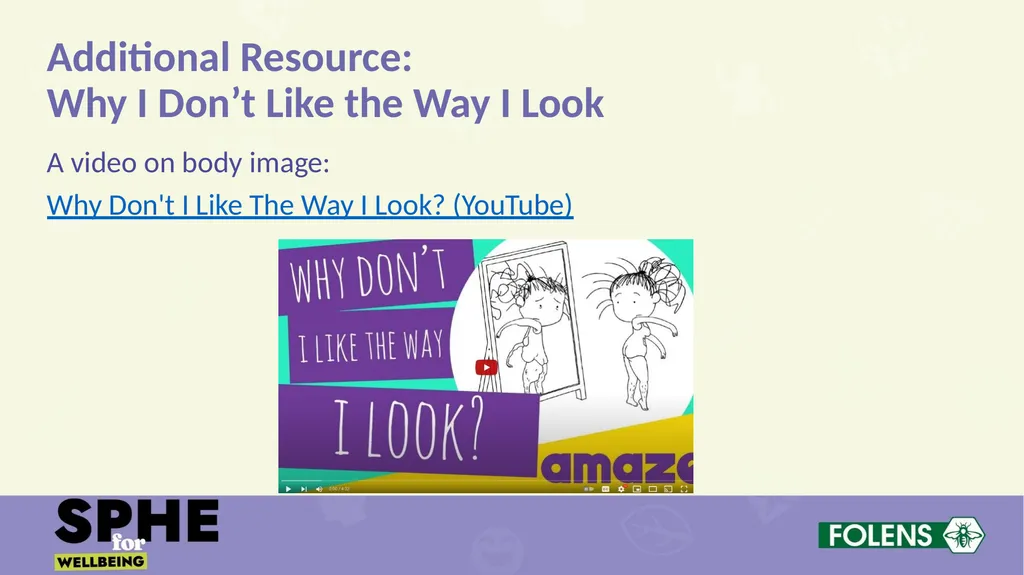
Additional Resource:
Why I Don’t Like the Way I Look A video on body image:
Why Don't I Like The Way I Look? (YouTube)<br>
Why Don't I Like The Way I Look? (YouTube)<br>
24
Lesson 12
Respecting Myself and Others<br>
Respecting Myself and Others<br>
25
1. Explain your rights and the rights of others.
2. Recognise the importance of respecting other people and yourself. At the end of this lesson, you will:<br>
2. Recognise the importance of respecting other people and yourself. At the end of this lesson, you will:<br>
26
Non-discrimination is fair treatment of all people.
Respect means to have regard for someone’s feelings, wishes and rights.
A right is something that you are entitled to. Keywords<br>
Respect means to have regard for someone’s feelings, wishes and rights.
A right is something that you are entitled to. Keywords<br>
27
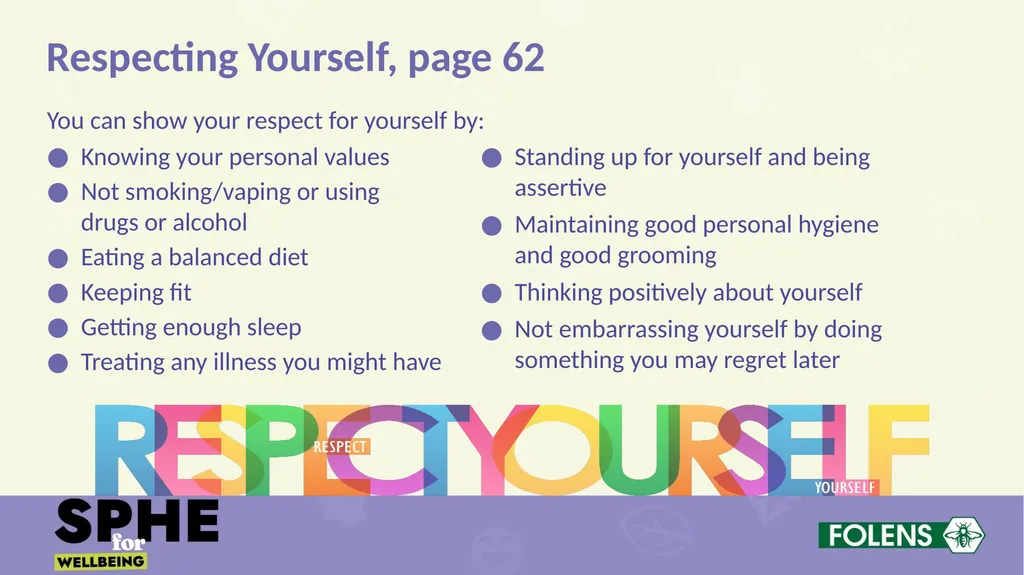
Respecting Yourself, page 62 You can show your respect for yourself by: Knowing your personal values
Not smoking/vaping or using drugs or alcohol
Eating a balanced diet
Keeping fit
Getting enough sleep
Treating any illness you might have
Standing up for yourself and being assertive
Maintaining good personal hygiene and good grooming
Thinking positively about yourself
Not embarrassing yourself by doing something you may regret later<br>
28
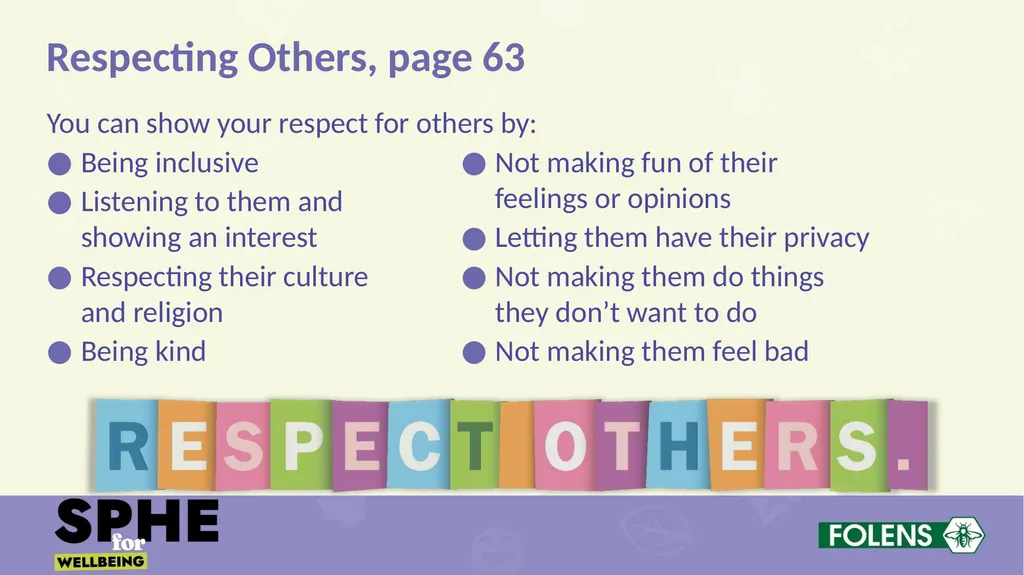
You can show your respect for others by: Respecting Others, page 63 Being inclusive
Listening to them and showing an interest
Respecting their culture and religion
Being kind
Not making fun of their feelings or opinions
Letting them have their privacy
Not making them do things they don’t want to do
Not making them feel bad<br>
Listening to them and showing an interest
Respecting their culture and religion
Being kind
Not making fun of their feelings or opinions
Letting them have their privacy
Not making them do things they don’t want to do
Not making them feel bad<br>
29
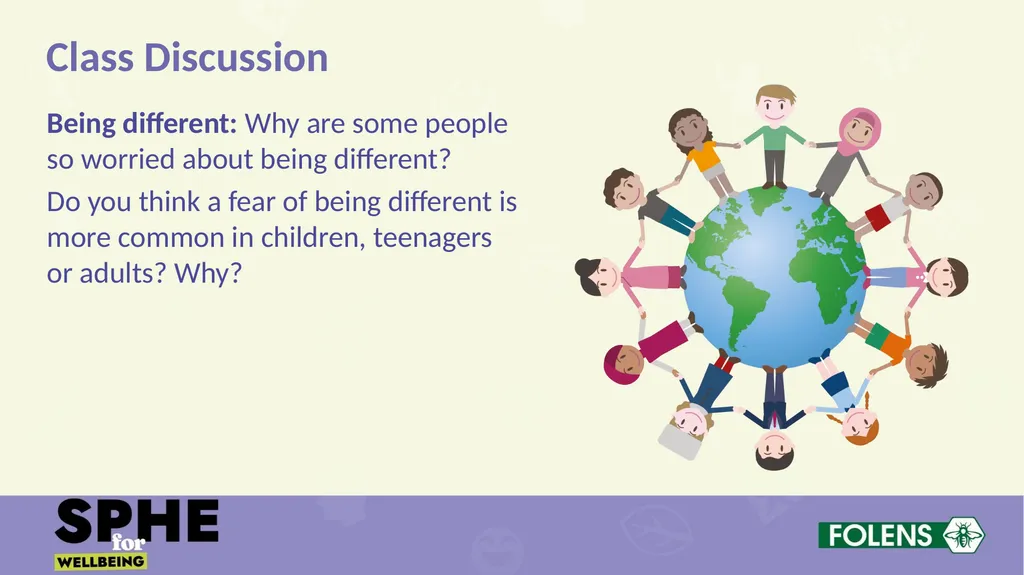
Class Discussion Being different: Why are some people so worried about being different?
Do you think a fear of being different is more common in children, teenagers or adults? Why?<br>
Do you think a fear of being different is more common in children, teenagers or adults? Why?<br>
30
Additional Resource: Show Racism the Red Card Education resource with lessons, activities and worksheets:
Secondary School Education Pack (theredcard.ie)<br>
Secondary School Education Pack (theredcard.ie)<br>
31
Lesson 13
Being Inclusive<br>
Being Inclusive<br>
32
1. Appreciate the importance of inclusive behaviour.
2. Define discrimination and know how to create an environment free from discrimination.
3. Appreciate other people for their uniqueness. At the end of this lesson, you will:<br>
2. Define discrimination and know how to create an environment free from discrimination.
3. Appreciate other people for their uniqueness. At the end of this lesson, you will:<br>
33
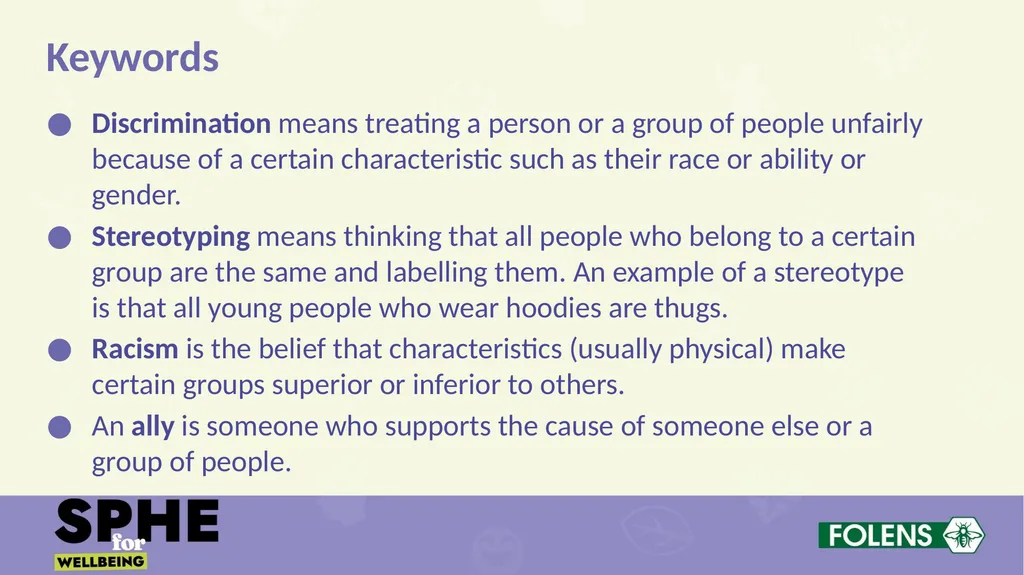
Discrimination means treating a person or a group of people unfairly because of a certain characteristic such as their race or ability or gender.
Stereotyping means thinking that all people who belong to a certain group are the same and labelling them. An example of a stereotype is that all young people who wear hoodies are thugs.
Racism is the belief that characteristics (usually physical) make certain groups superior or inferior to others.
An ally is someone who supports the cause of someone else or a group of people. Keywords<br>
34
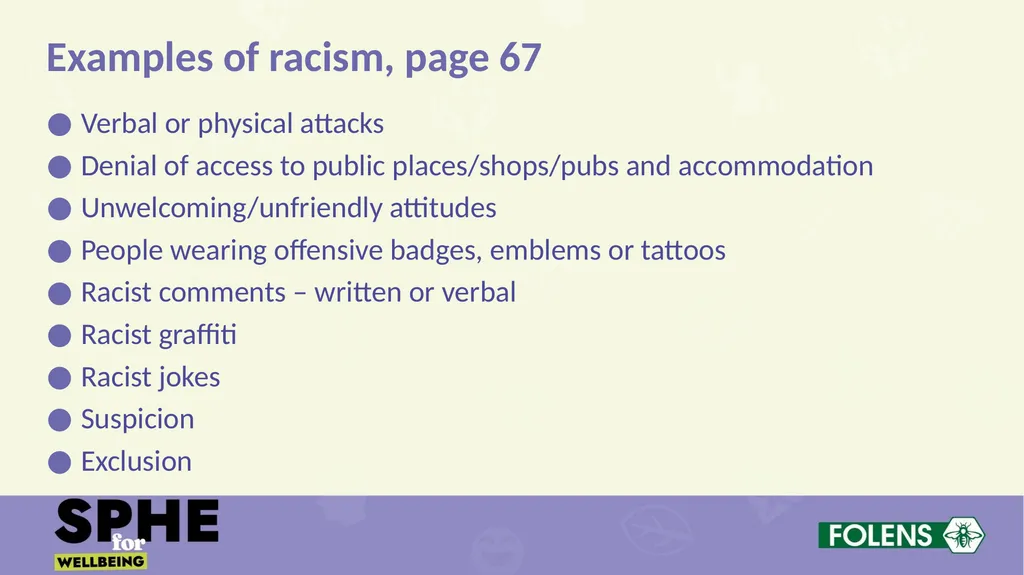
Verbal or physical attacks
Denial of access to public places/shops/pubs and accommodation
Unwelcoming/unfriendly attitudes
People wearing offensive badges, emblems or tattoos
Racist comments – written or verbal
Racist graffiti
Racist jokes
Suspicion
Exclusion Examples of racism, page 67<br>
Denial of access to public places/shops/pubs and accommodation
Unwelcoming/unfriendly attitudes
People wearing offensive badges, emblems or tattoos
Racist comments – written or verbal
Racist graffiti
Racist jokes
Suspicion
Exclusion Examples of racism, page 67<br>
35
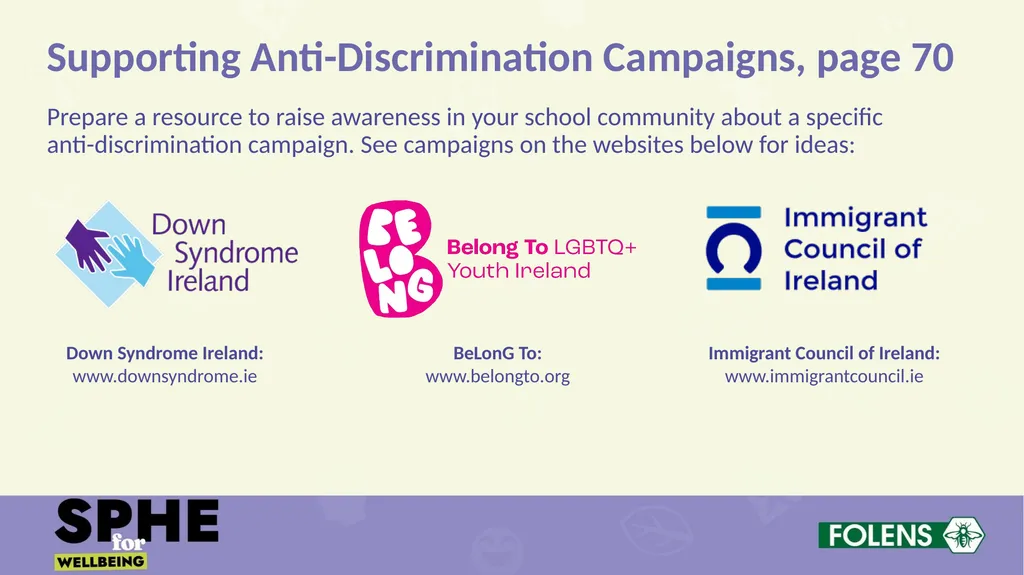
Supporting Anti-Discrimination Campaigns, page 70 Prepare a resource to raise awareness in your school community about a specific anti-discrimination campaign. See campaigns on the websites below for ideas: Down Syndrome Ireland:
www.downsyndrome.ie BeLonG To:
www.belongto.org Immigrant Council of Ireland:
www.immigrantcouncil.ie<br>
www.downsyndrome.ie BeLonG To:
www.belongto.org Immigrant Council of Ireland:
www.immigrantcouncil.ie<br>
36
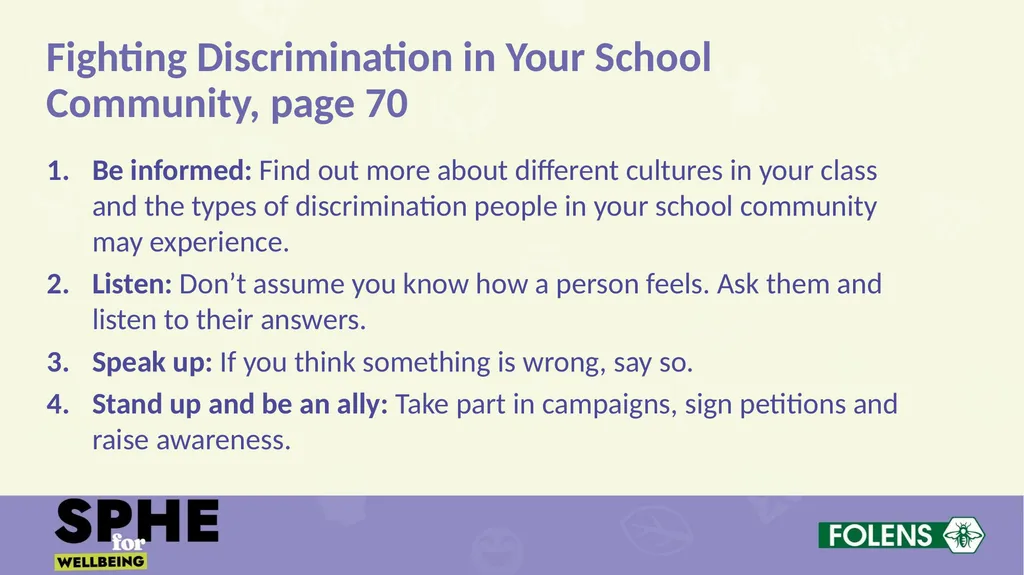
Fighting Discrimination in Your School Community, page 70 1. Be informed: Find out more about different cultures in your class and the types of discrimination people in your school community may experience.
2. Listen: Don’t assume you know how a person feels. Ask them and listen to their answers.
3. Speak up: If you think something is wrong, say so.
4. Stand up and be an ally: Take part in campaigns, sign petitions and raise awareness.<br>
2. Listen: Don’t assume you know how a person feels. Ask them and listen to their answers.
3. Speak up: If you think something is wrong, say so.
4. Stand up and be an ally: Take part in campaigns, sign petitions and raise awareness.<br>
37
Additional Resource: Gender Stereotyping A short video on how boys and girls can be stereotyped:
Gender Stereotypes (B4UDecide)<br>
Gender Stereotypes (B4UDecide)<br>
38
Lesson 14
Changes During Adolescence<br>
Changes During Adolescence<br>
39
1. Describe the physical, social, emotional and mental changes that take place during adolescence.
2. Explain the difference between sexual orientation and gender identity.
3. Ask the right people for help if you are having problems. At the end of this lesson, you will:<br>
2. Explain the difference between sexual orientation and gender identity.
3. Ask the right people for help if you are having problems. At the end of this lesson, you will:<br>
40
Puberty is a time during adolescence when the body changes and develops.
Adolescence is the phase during which a young person develops from a child into an adult.
Sexual orientation describes who we are attracted to and how we feel about other people.
Gender identity refers to whether someone feels male or female or something else. It describes how you feel inside, not how you might look on the outside. Keywords<br>
41
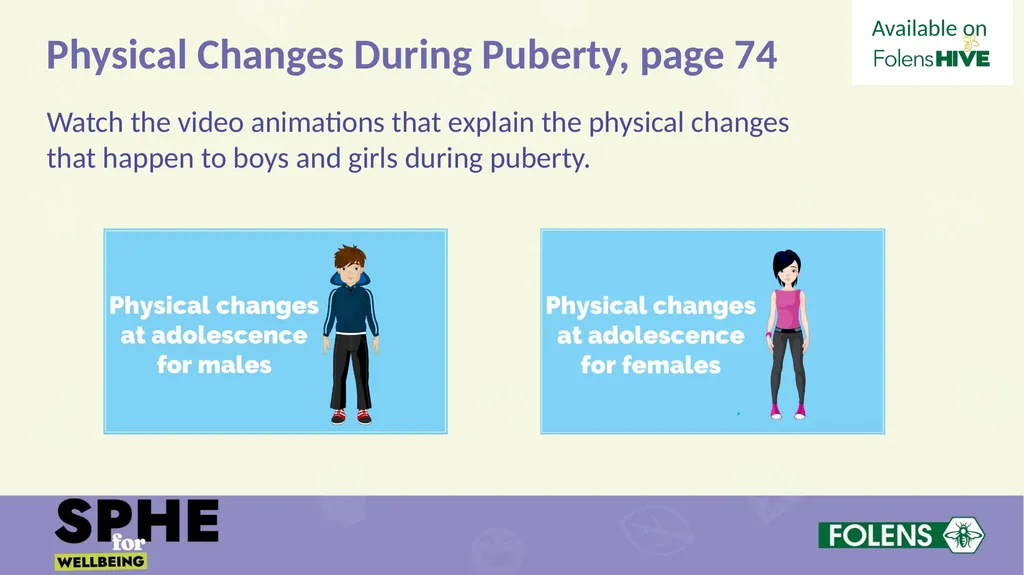
Watch the video animations that explain the physical changes that happen to boys and girls during puberty. Physical Changes During Puberty, page 74<br>
42
Changes that happen to boys during puberty, page 74<br>
43
Changes that happen to girls during puberty, page 75<br>
44
Answers for Class Discussion, page 75 Underarm hair prevents skin-to-skin contact when doing certain activities, such as running and walking. It draws sweat or perspiration away from the skin.
Girls’ hips widen because the pelvis bones grow and widen in order for them to be able to bear a child. This starts during puberty and can continue until the twenties.
Boys’ shoulders grow broader as the rib cage expands. The rib cage expands to allow them to inhale more air, to supply muscles with oxygen. This happens due to increased testosterone production and continues up to the age of 20.<br>
45
Watch the video called ‘Range of Gender Identities’ and answer the questions in your book on page 76. Range of Gender Identities, page 76<br>
46
Additional Resource: Understanding Gender Identity A short animation explaining gender identity:
Understanding gender identity (YouTube)<br>
Understanding gender identity (YouTube)<br>
47
Lesson 15
The Male Reproductive System<br>
The Male Reproductive System<br>
48
1. Identify the main parts of the male reproductive system.
2. Be aware of body image and issues associated with it.
3. Recognise the signs and symptoms of testicular or scrotal conditions. At the end of this lesson, you will:<br>
2. Be aware of body image and issues associated with it.
3. Recognise the signs and symptoms of testicular or scrotal conditions. At the end of this lesson, you will:<br>
49
Body image is how you see yourself, how you feel about the way you look, and how you think others see you.
Testicular or scrotal condition is an illness that develops in the testicles or scrotum. Its most common symptoms include pain and swelling in the testicles or scrotum. Keywords<br>
Testicular or scrotal condition is an illness that develops in the testicles or scrotum. Its most common symptoms include pain and swelling in the testicles or scrotum. Keywords<br>
50
Watch the video about the male reproductive system. The Male Reproductive System, page 81<br>
51
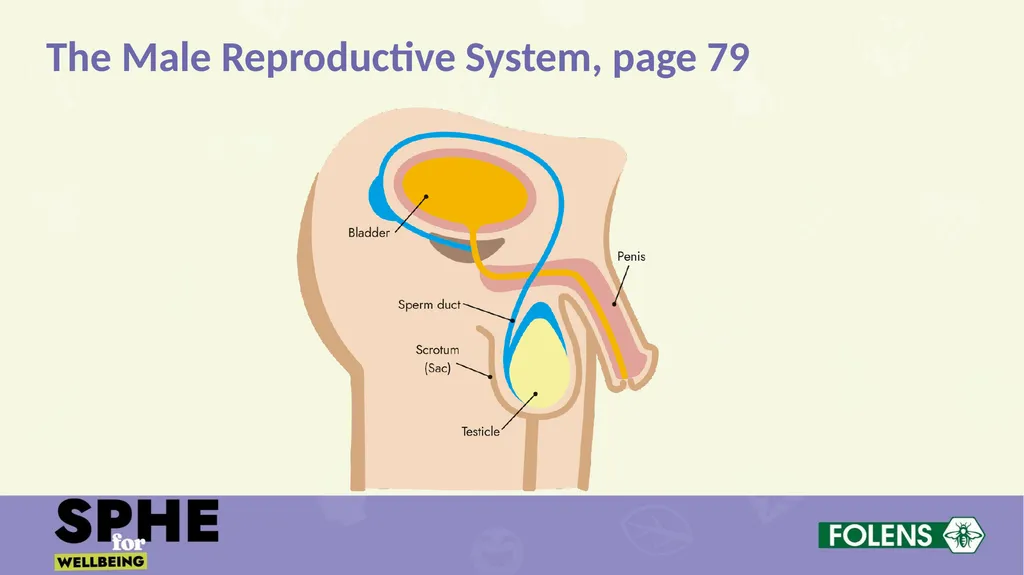
The Male Reproductive System, page 79<br>
52
Signs and Symptoms of Testicular or Scrotal Conditions, page 89 Testicular cancer is rare, but it is the most common cancer in Ireland in young men aged between 15 and 34. Other testicular and scrotal conditions can also occur. Common signs and symptoms are:
Pain or swelling in the testicles or scrotum
Lower abdominal or groin pain
A lump in either testicle
Heavy or achy feeling in the lower abdomen, groin or testicles
Tenderness or soreness in the testicles and/or scrotum<br>
Pain or swelling in the testicles or scrotum
Lower abdominal or groin pain
A lump in either testicle
Heavy or achy feeling in the lower abdomen, groin or testicles
Tenderness or soreness in the testicles and/or scrotum<br>
53
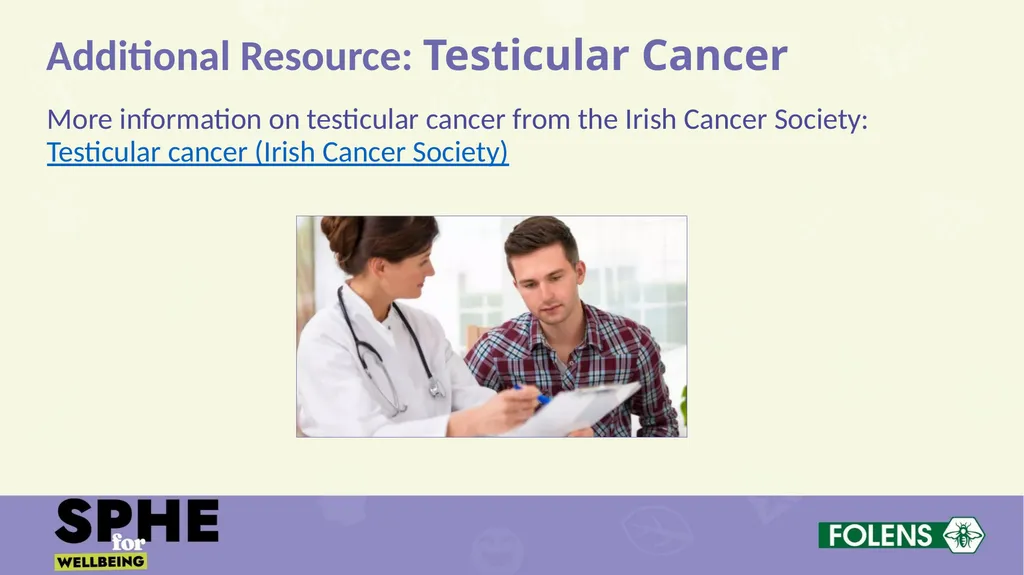
Additional Resource: Testicular Cancer More information on testicular cancer from the Irish Cancer Society:
Testicular cancer (Irish Cancer Society)<br>
Testicular cancer (Irish Cancer Society)<br>
54
Lesson 16
The Female Reproductive System<br>
The Female Reproductive System<br>
55
1. Describe the female reproductive system.
2. Appreciate the importance of the menstrual cycle in relation to conception. At the end of this lesson, you will:<br>
2. Appreciate the importance of the menstrual cycle in relation to conception. At the end of this lesson, you will:<br>
56
Conception is when a sperm fertilises an egg.
The menstrual cycle is a monthly series of changes in a woman’s body involving an egg being released from the ovaries.
Fertility is the ability to conceive children. Keywords<br>
The menstrual cycle is a monthly series of changes in a woman’s body involving an egg being released from the ovaries.
Fertility is the ability to conceive children. Keywords<br>
57
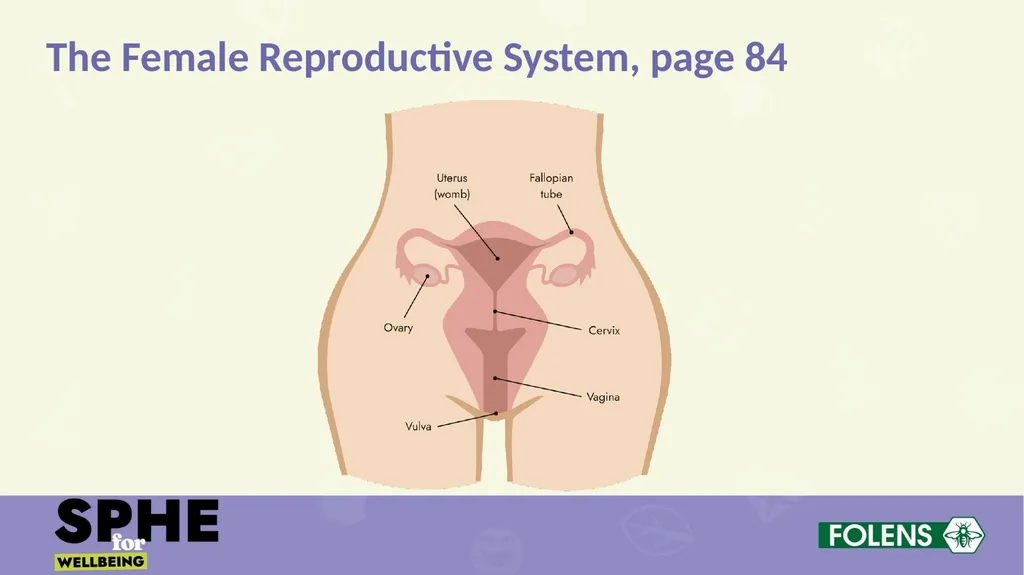
The Female Reproductive System, page 84<br>
58
Watch the video which explains the female reproductive system. The Female Reproductive System, page 84<br>
59
Watch the video which explains the menstrual cycle. The Menstrual Cycle, page 85<br>
60
Tips for Dealing with Periods (extra information) Have sanitary products in your bag just in case.
A hot water bottle or warm bath can help with cramps and pains.
Sometimes you may feel bloated or tender during your period. Cosy, comfortable clothes that are not tight-fitting can help you feel more comfortable.
Exercise releases hormones that can help with pain, but listen to your body and don’t over-exert yourself if you are very tired or sore.<br>
61
Tips for Dealing with Periods (extra information) Rest: You may fell more tired than normal during or before your period, so make sure to have a good night's sleep.
Keep cool: Your temperature can rise slightly at this time of month, so have some nice cool PJs and breathable underclothes (cotton bra, socks, underwear, etc.). Take extra care with your personal hygiene at this time, as you may feel sweatier than usual.
Mood: Your hormones control your period but also affect your mood, so be aware that you feel emotional at this time, and do something nice for yourself.<br>
62
Periods can sometimes be unpleasant and uncomfortable, but they should not affect what you can and cannot do in your everyday life.
You can take different supplements or painkillers that can help manage mild period symptoms – talk to an adult about what options you have.
If your periods last more than a week or if they are very heavy (e.g. you need to change a pad or tampon after an hour), then you should talk to a doctor.
If you are experiencing extreme moods around your period, talk to a doctor too. You don’t have to put up with bad periods – there is treatment that can help. Period Problems (extra information)<br>
63
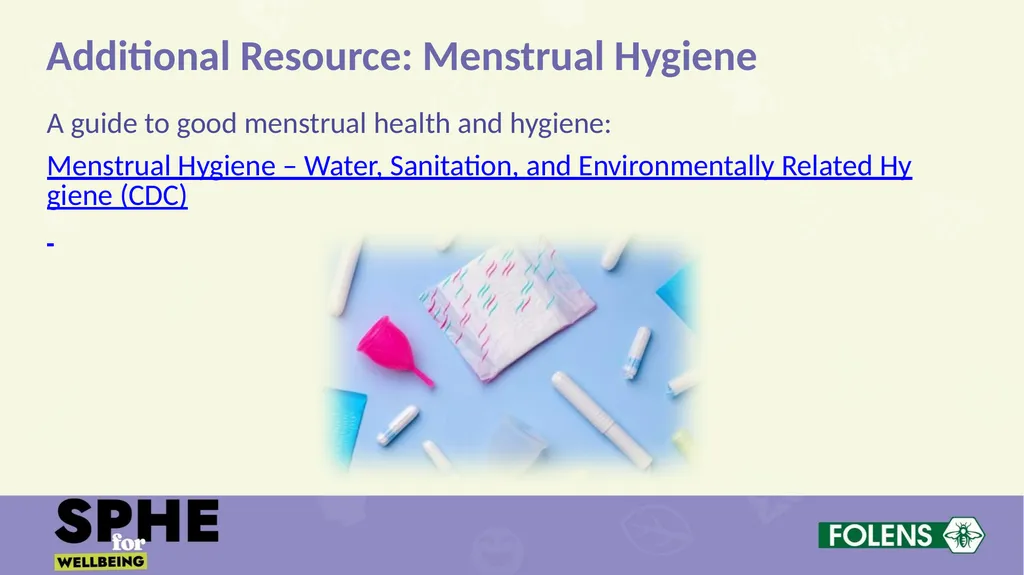
Additional Resource: Menstrual Hygiene A guide to good menstrual health and hygiene:
Menstrual Hygiene – Water, Sanitation, and Environmentally Related Hygiene (CDC)<br>
Menstrual Hygiene – Water, Sanitation, and Environmentally Related Hygiene (CDC)<br>
64
Lesson 17
Sex and Consent<br>
Sex and Consent<br>
65
1. Demonstrate a clear understanding of intercourse and conception.
2. Understand consent and its importance.
3. Appreciate the emotional aspect of sex. At the end of this lesson, you will:<br>
2. Understand consent and its importance.
3. Appreciate the emotional aspect of sex. At the end of this lesson, you will:<br>
66
Sexual attraction is to be attracted to or drawn to someone and wanting to be close with them physically.
Intimacy is a closeness in a relationship. Keywords<br>
Intimacy is a closeness in a relationship. Keywords<br>
67
Consent, page 90 Consent means to give permission or to agree to something. It is very important that both people give consent to any sexual activity, before it happens. The age of consent in Ireland for sex is 17 for boys and girls.
This means that it is against the law to have sex with someone under the age of 17, as someone under 17 cannot legally consent to sex.
Find out more about consent on the Jigsaw website here.<br>
This means that it is against the law to have sex with someone under the age of 17, as someone under 17 cannot legally consent to sex.
Find out more about consent on the Jigsaw website here.<br>
68
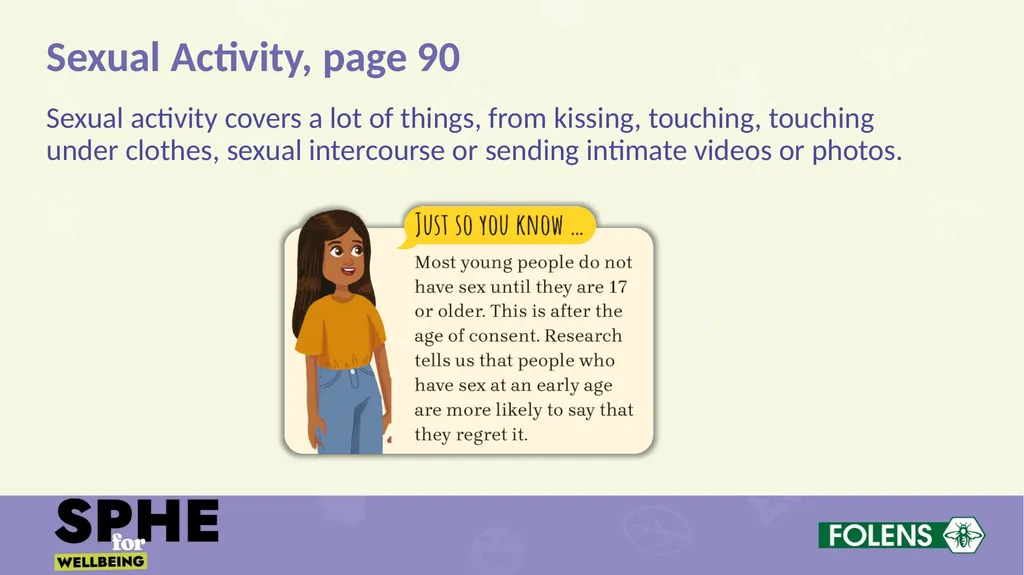
Sexual Activity, page 90 Sexual activity covers a lot of things, from kissing, touching, touching under clothes, sexual intercourse or sending intimate videos or photos.<br>
69
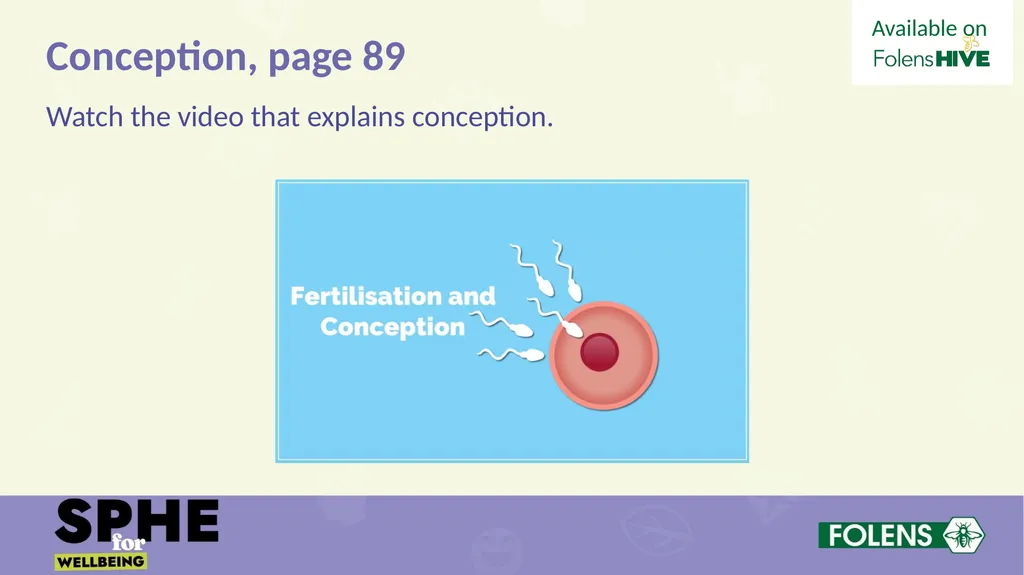
Conception, page 89 Watch the video that explains conception.<br>
70
Emotional Impacts of Sex, page 90 If a teenager has sex with someone just to feel emotionally closer, they may feel very disappointed.
Sometimes those who have sex at a young age regret the decision because they feel used or embarrassed.
Often those who have sex at a young age may feel disappointed that it wasn’t what they were expecting it to be – or are upset as it isn’t what they had planned.
Teenagers may be used to seeing sex portrayed in the media in a certain way, but often the reality can be very different, causing confusion, unhappiness or frustration.<br>
71
Additional Resource: Let’s Talk About Consent A guide for young people exploring the topic of consent:
Consent and Irish law
Tools to build the confidence and the communication skills of young people in relation to their sexual health
Let’s Talk About Consent (National Youth Council of Ireland)<br>
Consent and Irish law
Tools to build the confidence and the communication skills of young people in relation to their sexual health
Let’s Talk About Consent (National Youth Council of Ireland)<br>