
Self-Care: Building Your Resilience Toolkit
Description: Self-Care: Building Your Resilience Toolkit Presentation to the NLU Faculty Jon Oelke Leah Horvath Check-in Icebreaker Use the JamBoard to share some progress youve made on self-improvement since the beginning of the pandemic. You can add
Related Topics
Download Presentation
"Self-Care: Building Your Resilience Toolkit" is the property of its rightful owner. Permission is granted to download and print the materials on this website for personal, non-commercial use only, and to display it on your personal computer provided you do not modify the materials and that you retain all copyright notices contained in the materials. By downloading content from our website, you accept the terms of this agreement.
Presentation Transcript
slide1. Self-Care: Building Your Resilience Toolkit Presentation to the NLU Faculty
Jon Oelke
Leah Horvath<br>
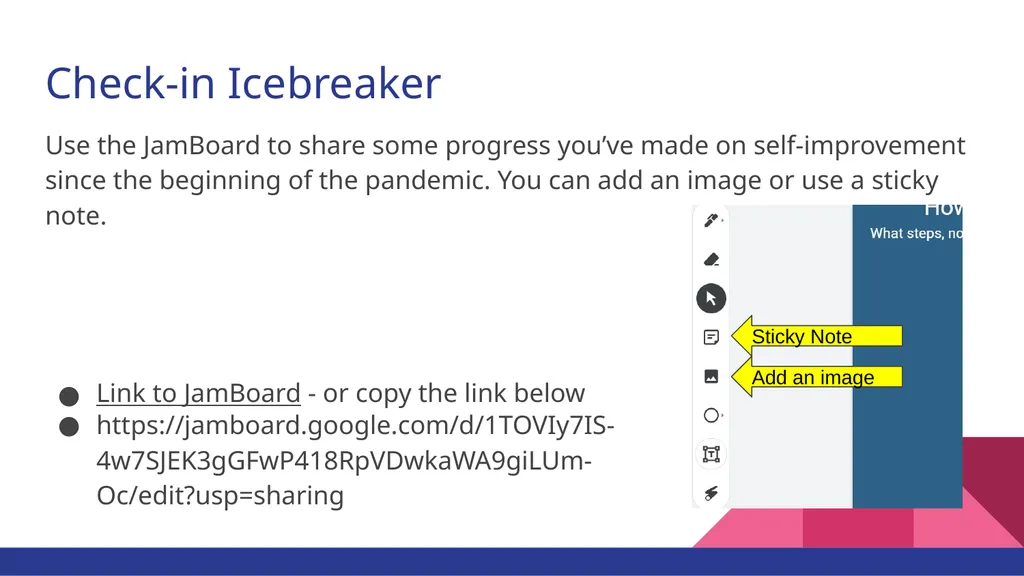
slide2. Check-in Icebreaker Use the JamBoard to share some progress you’ve made on self-improvement since the beginning of the pandemic. You can add an image or use a sticky note.
Link to JamBoard - or copy the link below https://jamboard.google.com/d/1TOVIy7IS-4w7SJEK3gGFwP418RpVDwkaWA9giLUm-Oc/edit?usp=sharing Sticky Note Add an image<br>
slide3. Defining Self-Care What comes to mind when you hear these words?
Consider how you care for yourself in each of these domains:
Physical
Emotional/Well-being
Spiritual
Social/Relationships
Intellectual/Work
Financial
Environmental<br>
slide4. What gets in the way of self-care? We all know self-care is good for us - but we aren’t always the best at prioritizing our health and well-being.
So what gets in the way for you?
Too busy/not enough time
Not making myself a priority/putting other people’s needs first
Fear of asking for help
Difficulty setting boundaries and saying no
Not part of your routine
Not something that was taught or modeled for you<br>
slide5. Share What Helps You Cope Outdoor activities (hiking or biking)
Sports
Working out
Board games
Chatting with friends
People-watching
Binging a new show on Netflix
Reading that new novel that’s meant to be for tweens, but omg you just can’t get enough<br>
slide6. Building Your Resilience Toolkit (Bank Account) Think of self-care as more than an activity -it’s a daily practice - a way of living.
If we are in the habit of taking care of our whole self and regularly checking in on areas that need attention, we’ll be better positioned to manage bigger crises.
Just like it’s recommended to have a safety net of financial savings (if possible), we want to have a safety net of resiliency.<br>
slide7. Building Your Resilience Toolkit (Bank Account) Physical
Exercise, sleep, nutrition, treating illnesses, taking medications as prescribed
Emotional/Well-being
Managing stress, expressing emotion, engaging in therapy, cognitive reframing, doing things you enjoy
Spiritual
Connecting with your beliefs and values and living in accord with those
Social/Relationships
Tending to relationships with family, friends, partners, co-workers, neighbors; pruning unhealthy relationships
Intellectual/Work
Staying curious, learning, finding meaning/value in your work
Financial
Living within financial means, creating a budget, spending in a values-consistent way
Environmental
Caring for your surroundings, inside and out; avoiding clutter, keeping things that have meaning<br>
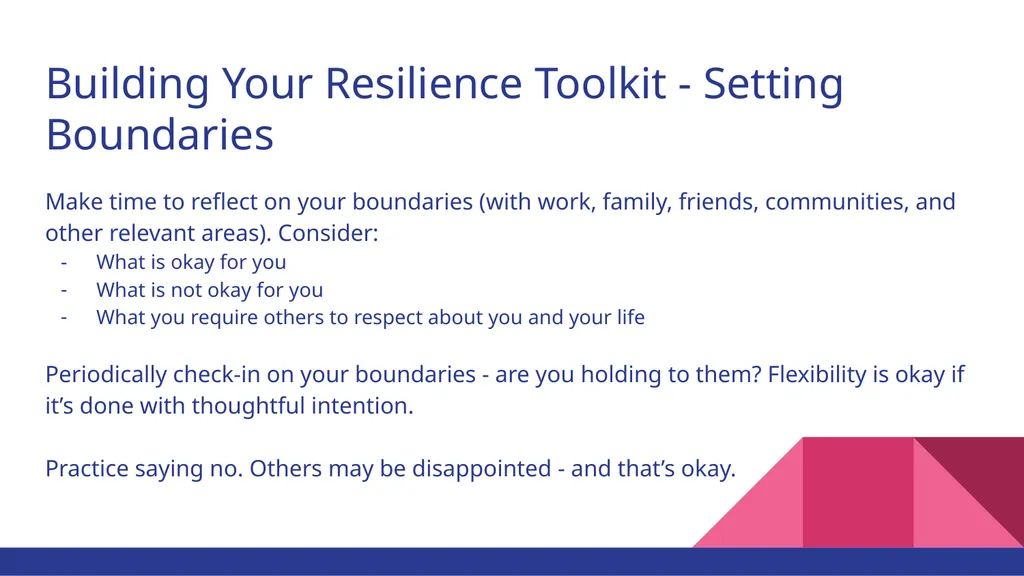
slide8. Building Your Resilience Toolkit - Setting Boundaries Make time to reflect on your boundaries (with work, family, friends, communities, and other relevant areas). Consider:
What is okay for you
What is not okay for you
What you require others to respect about you and your life
Periodically check-in on your boundaries - are you holding to them? Flexibility is okay if it’s done with thoughtful intention.
Practice saying no. Others may be disappointed - and that’s okay.<br>
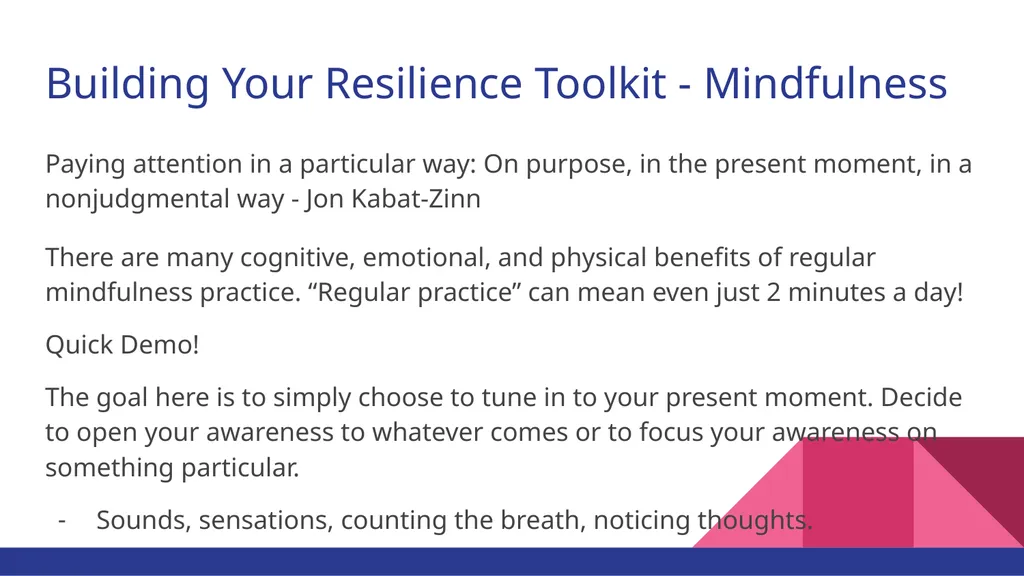
slide9. Building Your Resilience Toolkit - Mindfulness Paying attention in a particular way: On purpose, in the present moment, in a nonjudgmental way - Jon Kabat-Zinn
There are many cognitive, emotional, and physical benefits of regular mindfulness practice. “Regular practice” can mean even just 2 minutes a day!
Quick Demo!
The goal here is to simply choose to tune in to your present moment. Decide to open your awareness to whatever comes or to focus your awareness on something particular.
Sounds, sensations, counting the breath, noticing thoughts.<br>
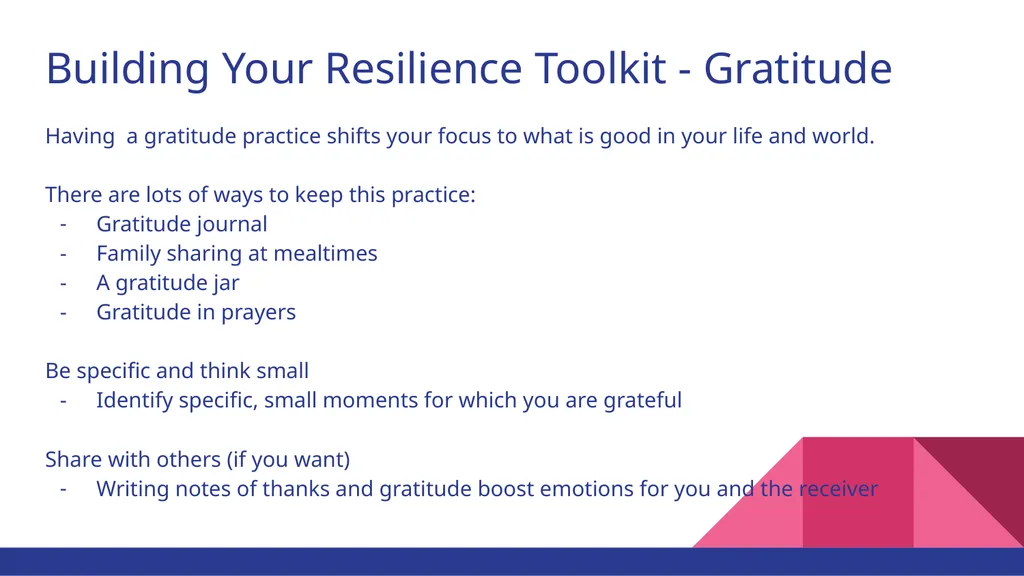
slide10. Building Your Resilience Toolkit - Gratitude Having a gratitude practice shifts your focus to what is good in your life and world.
There are lots of ways to keep this practice:
Gratitude journal
Family sharing at mealtimes
A gratitude jar
Gratitude in prayers
Be specific and think small
Identify specific, small moments for which you are grateful
Share with others (if you want)
Writing notes of thanks and gratitude boost emotions for you and the receiver<br>
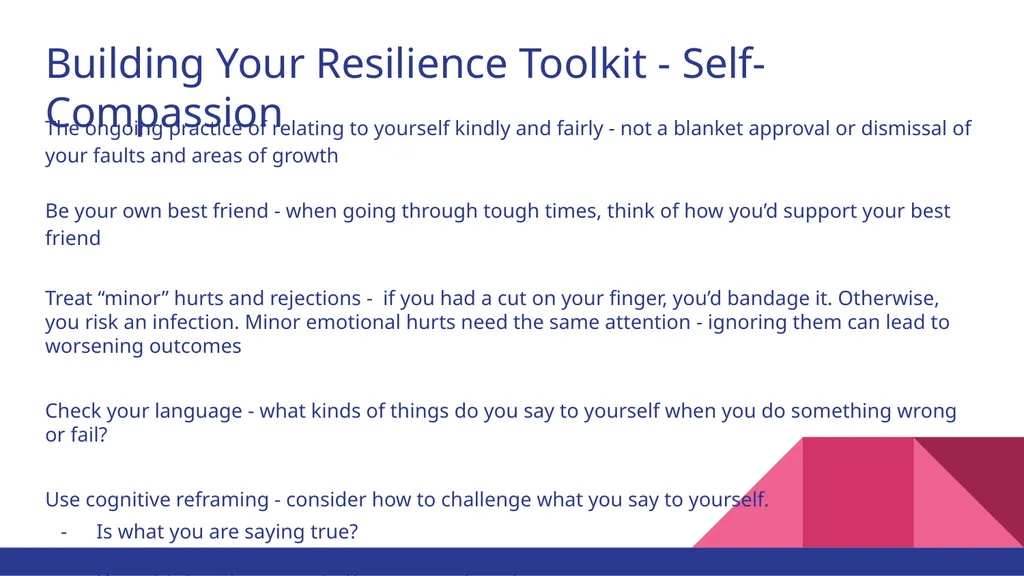
slide11. Building Your Resilience Toolkit - Self-Compassion The ongoing practice of relating to yourself kindly and fairly - not a blanket approval or dismissal of your faults and areas of growth
Be your own best friend - when going through tough times, think of how you’d support your best friend
Treat “minor” hurts and rejections - if you had a cut on your finger, you’d bandage it. Otherwise, you risk an infection. Minor emotional hurts need the same attention - ignoring them can lead to worsening outcomes
Check your language - what kinds of things do you say to yourself when you do something wrong or fail?
Use cognitive reframing - consider how to challenge what you say to yourself.
Is what you are saying true?
Is it fair?
Does it take into account other perspectives?
And, even if it is true - is it helpful?<br>
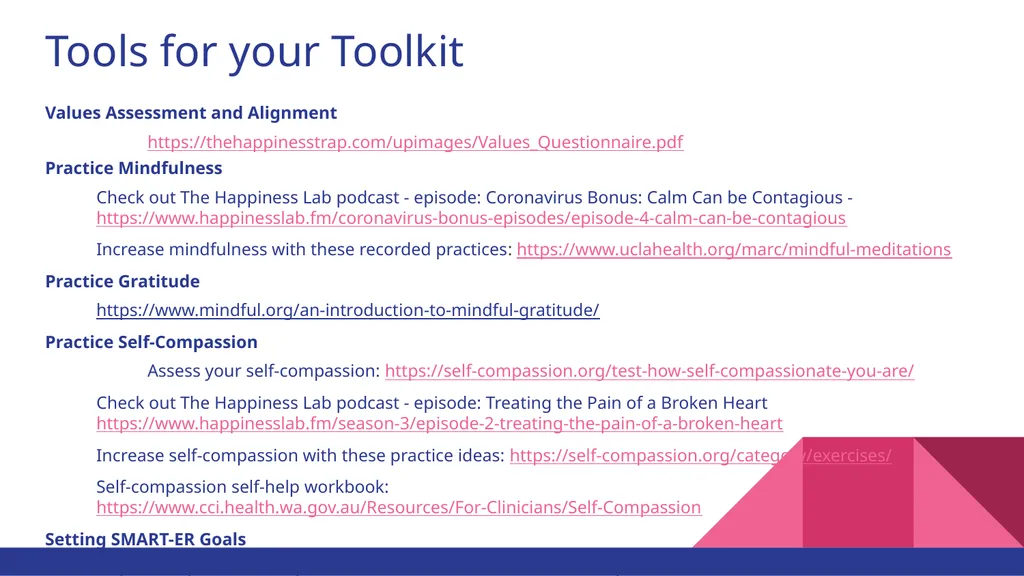
slide12. Tools for your Toolkit Values Assessment and Alignment
https://thehappinesstrap.com/upimages/Values_Questionnaire.pdf
Practice Mindfulness
Check out The Happiness Lab podcast - episode: Coronavirus Bonus: Calm Can be Contagious - https://www.happinesslab.fm/coronavirus-bonus-episodes/episode-4-calm-can-be-contagious
Increase mindfulness with these recorded practices: https://www.uclahealth.org/marc/mindful-meditations
Practice Gratitude
https://www.mindful.org/an-introduction-to-mindful-gratitude/
Practice Self-Compassion
Assess your self-compassion: https://self-compassion.org/test-how-self-compassionate-you-are/
Check out The Happiness Lab podcast - episode: Treating the Pain of a Broken Heart https://www.happinesslab.fm/season-3/episode-2-treating-the-pain-of-a-broken-heart
Increase self-compassion with these practice ideas: https://self-compassion.org/category/exercises/
Self-compassion self-help workbook: https://www.cci.health.wa.gov.au/Resources/For-Clinicians/Self-Compassion
Setting SMART-ER Goals
https://oregoncounseling.com/article/how-to-set-mental-health-goals-for-2021/<br>
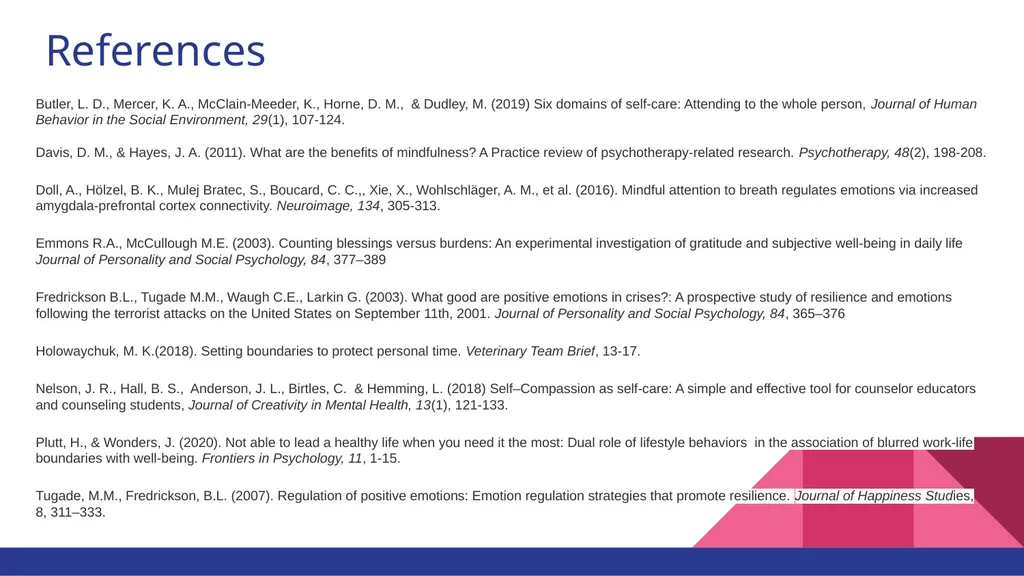
slide13. References Butler, L. D., Mercer, K. A., McClain-Meeder, K., Horne, D. M., & Dudley, M. (2019) Six domains of self-care: Attending to the whole person, Journal of Human Behavior in the Social Environment, 29(1), 107-124.
Davis, D. M., & Hayes, J. A. (2011). What are the benefits of mindfulness? A Practice review of psychotherapy-related research. Psychotherapy, 48(2), 198-208.
Doll, A., Hölzel, B. K., Mulej Bratec, S., Boucard, C. C.,, Xie, X., Wohlschläger, A. M., et al. (2016). Mindful attention to breath regulates emotions via increased amygdala-prefrontal cortex connectivity. Neuroimage, 134, 305-313.
Emmons R.A., McCullough M.E. (2003). Counting blessings versus burdens: An experimental investigation of gratitude and subjective well-being in daily life Journal of Personality and Social Psychology, 84, 377–389
Fredrickson B.L., Tugade M.M., Waugh C.E., Larkin G. (2003). What good are positive emotions in crises?: A prospective study of resilience and emotions following the terrorist attacks on the United States on September 11th, 2001. Journal of Personality and Social Psychology, 84, 365–376
Holowaychuk, M. K.(2018). Setting boundaries to protect personal time. Veterinary Team Brief, 13-17.
Nelson, J. R., Hall, B. S., Anderson, J. L., Birtles, C. & Hemming, L. (2018) Self–Compassion as self-care: A simple and effective tool for counselor educators and counseling students, Journal of Creativity in Mental Health, 13(1), 121-133.
Plutt, H., & Wonders, J. (2020). Not able to lead a healthy life when you need it the most: Dual role of lifestyle behaviors in the association of blurred work-life boundaries with well-being. Frontiers in Psychology, 11, 1-15.
Tugade, M.M., Fredrickson, B.L. (2007). Regulation of positive emotions: Emotion regulation strategies that promote resilience. Journal of Happiness Studies, 8, 311–333.<br>
Jon Oelke
Leah Horvath<br>
slide2. Check-in Icebreaker Use the JamBoard to share some progress you’ve made on self-improvement since the beginning of the pandemic. You can add an image or use a sticky note.
Link to JamBoard - or copy the link below https://jamboard.google.com/d/1TOVIy7IS-4w7SJEK3gGFwP418RpVDwkaWA9giLUm-Oc/edit?usp=sharing Sticky Note Add an image<br>
slide3. Defining Self-Care What comes to mind when you hear these words?
Consider how you care for yourself in each of these domains:
Physical
Emotional/Well-being
Spiritual
Social/Relationships
Intellectual/Work
Financial
Environmental<br>
slide4. What gets in the way of self-care? We all know self-care is good for us - but we aren’t always the best at prioritizing our health and well-being.
So what gets in the way for you?
Too busy/not enough time
Not making myself a priority/putting other people’s needs first
Fear of asking for help
Difficulty setting boundaries and saying no
Not part of your routine
Not something that was taught or modeled for you<br>
slide5. Share What Helps You Cope Outdoor activities (hiking or biking)
Sports
Working out
Board games
Chatting with friends
People-watching
Binging a new show on Netflix
Reading that new novel that’s meant to be for tweens, but omg you just can’t get enough<br>
slide6. Building Your Resilience Toolkit (Bank Account) Think of self-care as more than an activity -it’s a daily practice - a way of living.
If we are in the habit of taking care of our whole self and regularly checking in on areas that need attention, we’ll be better positioned to manage bigger crises.
Just like it’s recommended to have a safety net of financial savings (if possible), we want to have a safety net of resiliency.<br>
slide7. Building Your Resilience Toolkit (Bank Account) Physical
Exercise, sleep, nutrition, treating illnesses, taking medications as prescribed
Emotional/Well-being
Managing stress, expressing emotion, engaging in therapy, cognitive reframing, doing things you enjoy
Spiritual
Connecting with your beliefs and values and living in accord with those
Social/Relationships
Tending to relationships with family, friends, partners, co-workers, neighbors; pruning unhealthy relationships
Intellectual/Work
Staying curious, learning, finding meaning/value in your work
Financial
Living within financial means, creating a budget, spending in a values-consistent way
Environmental
Caring for your surroundings, inside and out; avoiding clutter, keeping things that have meaning<br>
slide8. Building Your Resilience Toolkit - Setting Boundaries Make time to reflect on your boundaries (with work, family, friends, communities, and other relevant areas). Consider:
What is okay for you
What is not okay for you
What you require others to respect about you and your life
Periodically check-in on your boundaries - are you holding to them? Flexibility is okay if it’s done with thoughtful intention.
Practice saying no. Others may be disappointed - and that’s okay.<br>
slide9. Building Your Resilience Toolkit - Mindfulness Paying attention in a particular way: On purpose, in the present moment, in a nonjudgmental way - Jon Kabat-Zinn
There are many cognitive, emotional, and physical benefits of regular mindfulness practice. “Regular practice” can mean even just 2 minutes a day!
Quick Demo!
The goal here is to simply choose to tune in to your present moment. Decide to open your awareness to whatever comes or to focus your awareness on something particular.
Sounds, sensations, counting the breath, noticing thoughts.<br>
slide10. Building Your Resilience Toolkit - Gratitude Having a gratitude practice shifts your focus to what is good in your life and world.
There are lots of ways to keep this practice:
Gratitude journal
Family sharing at mealtimes
A gratitude jar
Gratitude in prayers
Be specific and think small
Identify specific, small moments for which you are grateful
Share with others (if you want)
Writing notes of thanks and gratitude boost emotions for you and the receiver<br>
slide11. Building Your Resilience Toolkit - Self-Compassion The ongoing practice of relating to yourself kindly and fairly - not a blanket approval or dismissal of your faults and areas of growth
Be your own best friend - when going through tough times, think of how you’d support your best friend
Treat “minor” hurts and rejections - if you had a cut on your finger, you’d bandage it. Otherwise, you risk an infection. Minor emotional hurts need the same attention - ignoring them can lead to worsening outcomes
Check your language - what kinds of things do you say to yourself when you do something wrong or fail?
Use cognitive reframing - consider how to challenge what you say to yourself.
Is what you are saying true?
Is it fair?
Does it take into account other perspectives?
And, even if it is true - is it helpful?<br>
slide12. Tools for your Toolkit Values Assessment and Alignment
https://thehappinesstrap.com/upimages/Values_Questionnaire.pdf
Practice Mindfulness
Check out The Happiness Lab podcast - episode: Coronavirus Bonus: Calm Can be Contagious - https://www.happinesslab.fm/coronavirus-bonus-episodes/episode-4-calm-can-be-contagious
Increase mindfulness with these recorded practices: https://www.uclahealth.org/marc/mindful-meditations
Practice Gratitude
https://www.mindful.org/an-introduction-to-mindful-gratitude/
Practice Self-Compassion
Assess your self-compassion: https://self-compassion.org/test-how-self-compassionate-you-are/
Check out The Happiness Lab podcast - episode: Treating the Pain of a Broken Heart https://www.happinesslab.fm/season-3/episode-2-treating-the-pain-of-a-broken-heart
Increase self-compassion with these practice ideas: https://self-compassion.org/category/exercises/
Self-compassion self-help workbook: https://www.cci.health.wa.gov.au/Resources/For-Clinicians/Self-Compassion
Setting SMART-ER Goals
https://oregoncounseling.com/article/how-to-set-mental-health-goals-for-2021/<br>
slide13. References Butler, L. D., Mercer, K. A., McClain-Meeder, K., Horne, D. M., & Dudley, M. (2019) Six domains of self-care: Attending to the whole person, Journal of Human Behavior in the Social Environment, 29(1), 107-124.
Davis, D. M., & Hayes, J. A. (2011). What are the benefits of mindfulness? A Practice review of psychotherapy-related research. Psychotherapy, 48(2), 198-208.
Doll, A., Hölzel, B. K., Mulej Bratec, S., Boucard, C. C.,, Xie, X., Wohlschläger, A. M., et al. (2016). Mindful attention to breath regulates emotions via increased amygdala-prefrontal cortex connectivity. Neuroimage, 134, 305-313.
Emmons R.A., McCullough M.E. (2003). Counting blessings versus burdens: An experimental investigation of gratitude and subjective well-being in daily life Journal of Personality and Social Psychology, 84, 377–389
Fredrickson B.L., Tugade M.M., Waugh C.E., Larkin G. (2003). What good are positive emotions in crises?: A prospective study of resilience and emotions following the terrorist attacks on the United States on September 11th, 2001. Journal of Personality and Social Psychology, 84, 365–376
Holowaychuk, M. K.(2018). Setting boundaries to protect personal time. Veterinary Team Brief, 13-17.
Nelson, J. R., Hall, B. S., Anderson, J. L., Birtles, C. & Hemming, L. (2018) Self–Compassion as self-care: A simple and effective tool for counselor educators and counseling students, Journal of Creativity in Mental Health, 13(1), 121-133.
Plutt, H., & Wonders, J. (2020). Not able to lead a healthy life when you need it the most: Dual role of lifestyle behaviors in the association of blurred work-life boundaries with well-being. Frontiers in Psychology, 11, 1-15.
Tugade, M.M., Fredrickson, B.L. (2007). Regulation of positive emotions: Emotion regulation strategies that promote resilience. Journal of Happiness Studies, 8, 311–333.<br>