
Self-neglect: the evidence-base from safeguarding
CP
Published · 50 slides · 0 views

1 / 1









Description
Self-neglect: the evidence-base from safeguarding adult reviews, people with lived experience , and research Professor Michael Preston-Shoot Surrey SAB Partners February 2025 Self-Neglect Definition lack of self-care neglect of personal
Related Topics
Share
Embed code
Download this presentation From Below
"Self-neglect: the evidence-base from safeguarding" is the property of its rightful owner. Permission is granted to download and print the materials on this website for personal, non-commercial use only, and to display it on your personal computer provided you do not modify the materials and that you retain all copyright notices contained in the materials. By downloading content from our website, you accept the terms of this agreement.
Presentation Transcript
01
Self-neglect: the evidence-base from safeguarding adult reviews, people with lived experience , and research Professor Michael Preston-Shoot
Surrey SAB Partners
February 2025<br>
Surrey SAB Partners
February 2025<br>
02
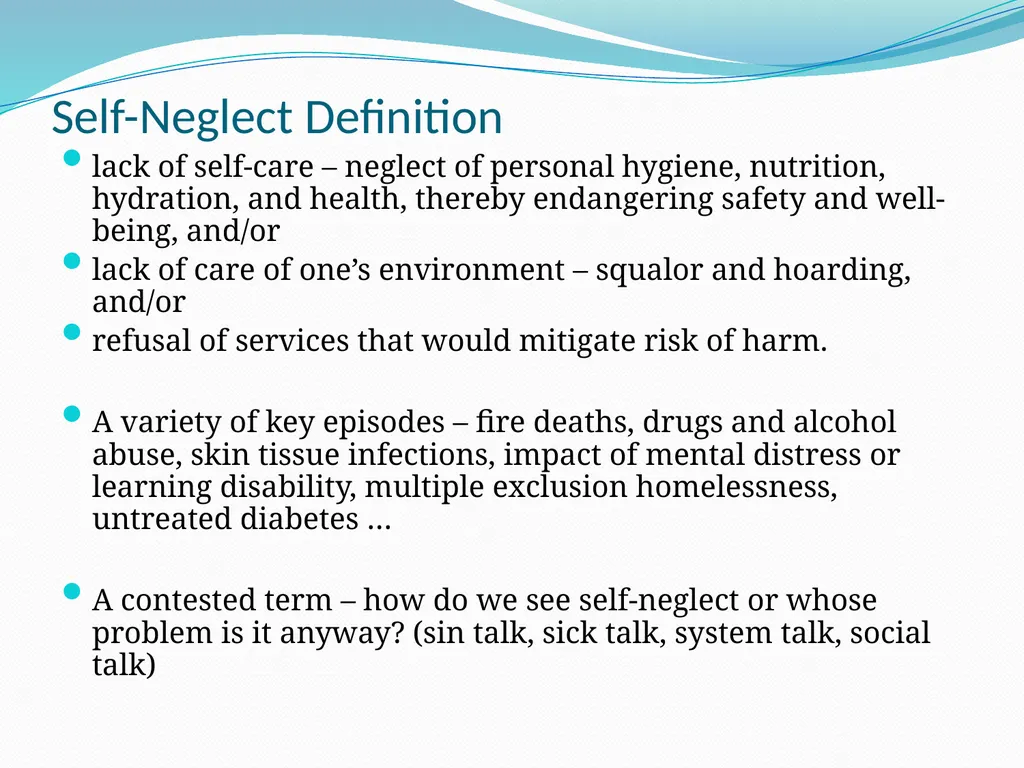
Self-Neglect Definition lack of self-care – neglect of personal hygiene, nutrition, hydration, and health, thereby endangering safety and well-being, and/or
lack of care of one’s environment – squalor and hoarding, and/or
refusal of services that would mitigate risk of harm.
A variety of key episodes – fire deaths, drugs and alcohol abuse, skin tissue infections, impact of mental distress or learning disability, multiple exclusion homelessness, untreated diabetes …
A contested term – how do we see self-neglect or whose problem is it anyway? (sin talk, sick talk, system talk, social talk)<br>
lack of care of one’s environment – squalor and hoarding, and/or
refusal of services that would mitigate risk of harm.
A variety of key episodes – fire deaths, drugs and alcohol abuse, skin tissue infections, impact of mental distress or learning disability, multiple exclusion homelessness, untreated diabetes …
A contested term – how do we see self-neglect or whose problem is it anyway? (sin talk, sick talk, system talk, social talk)<br>
03
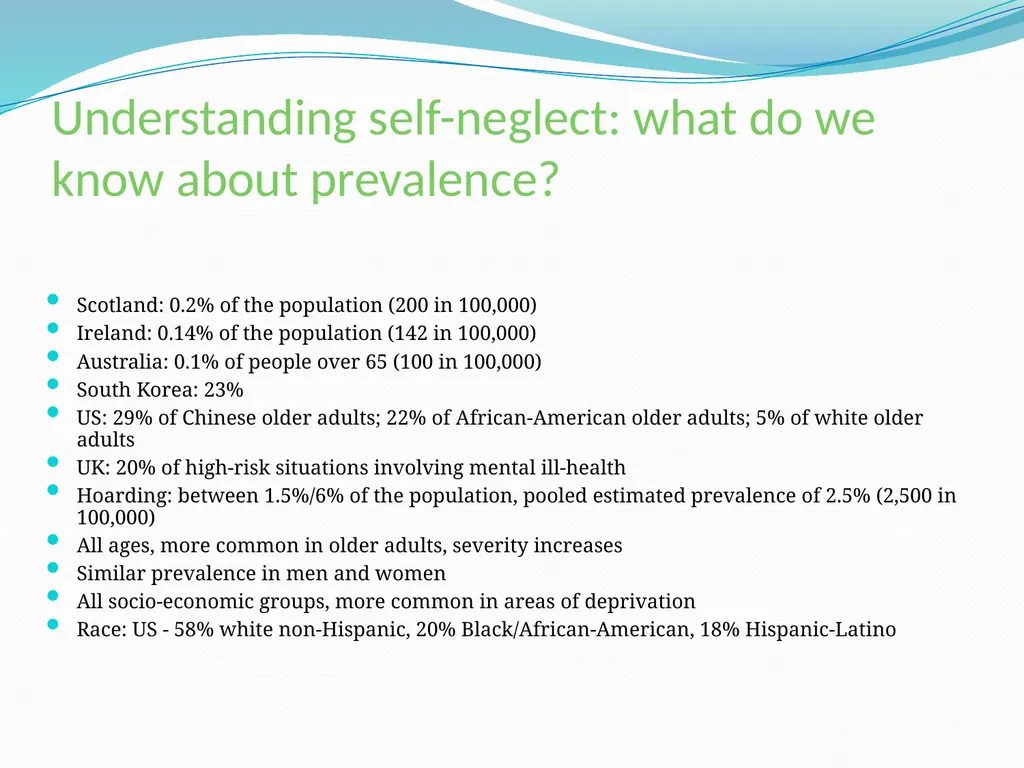
Understanding self-neglect: what do we know about prevalence? Scotland: 0.2% of the population (200 in 100,000)
Ireland: 0.14% of the population (142 in 100,000)
Australia: 0.1% of people over 65 (100 in 100,000)
South Korea: 23%
US: 29% of Chinese older adults; 22% of African-American older adults; 5% of white older adults
UK: 20% of high-risk situations involving mental ill-health
Hoarding: between 1.5%/6% of the population, pooled estimated prevalence of 2.5% (2,500 in 100,000)
All ages, more common in older adults, severity increases
Similar prevalence in men and women
All socio-economic groups, more common in areas of deprivation
Race: US - 58% white non-Hispanic, 20% Black/African-American, 18% Hispanic-Latino<br>
Ireland: 0.14% of the population (142 in 100,000)
Australia: 0.1% of people over 65 (100 in 100,000)
South Korea: 23%
US: 29% of Chinese older adults; 22% of African-American older adults; 5% of white older adults
UK: 20% of high-risk situations involving mental ill-health
Hoarding: between 1.5%/6% of the population, pooled estimated prevalence of 2.5% (2,500 in 100,000)
All ages, more common in older adults, severity increases
Similar prevalence in men and women
All socio-economic groups, more common in areas of deprivation
Race: US - 58% white non-Hispanic, 20% Black/African-American, 18% Hispanic-Latino<br>
04
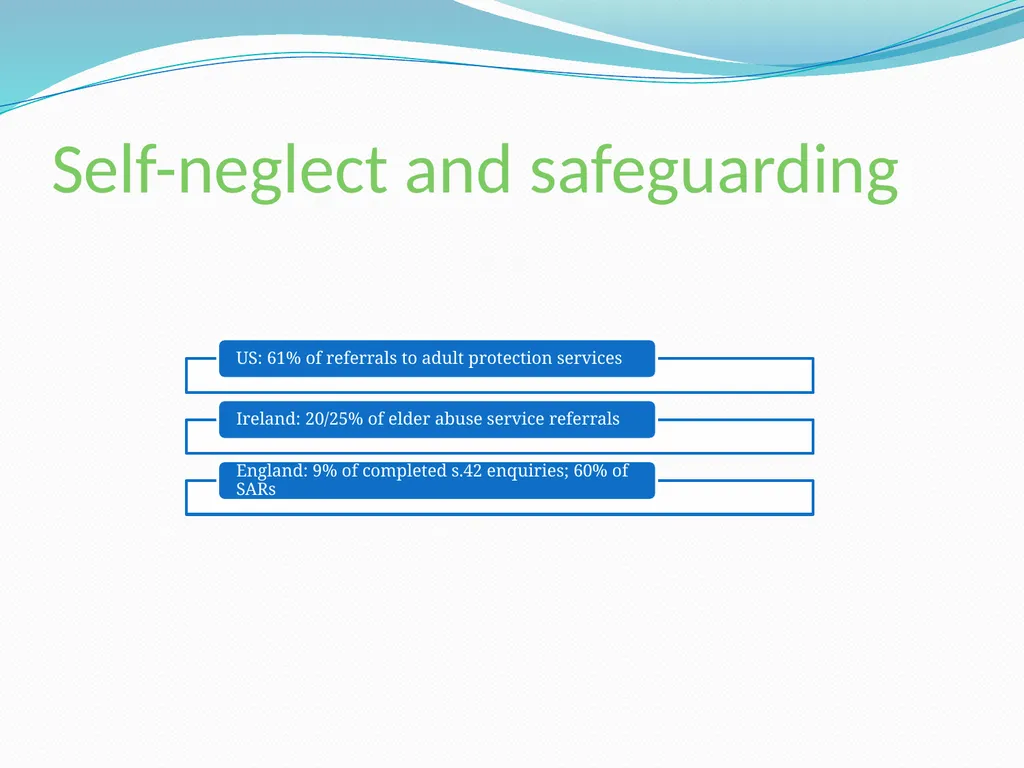
Self-neglect and safeguarding<br>
05
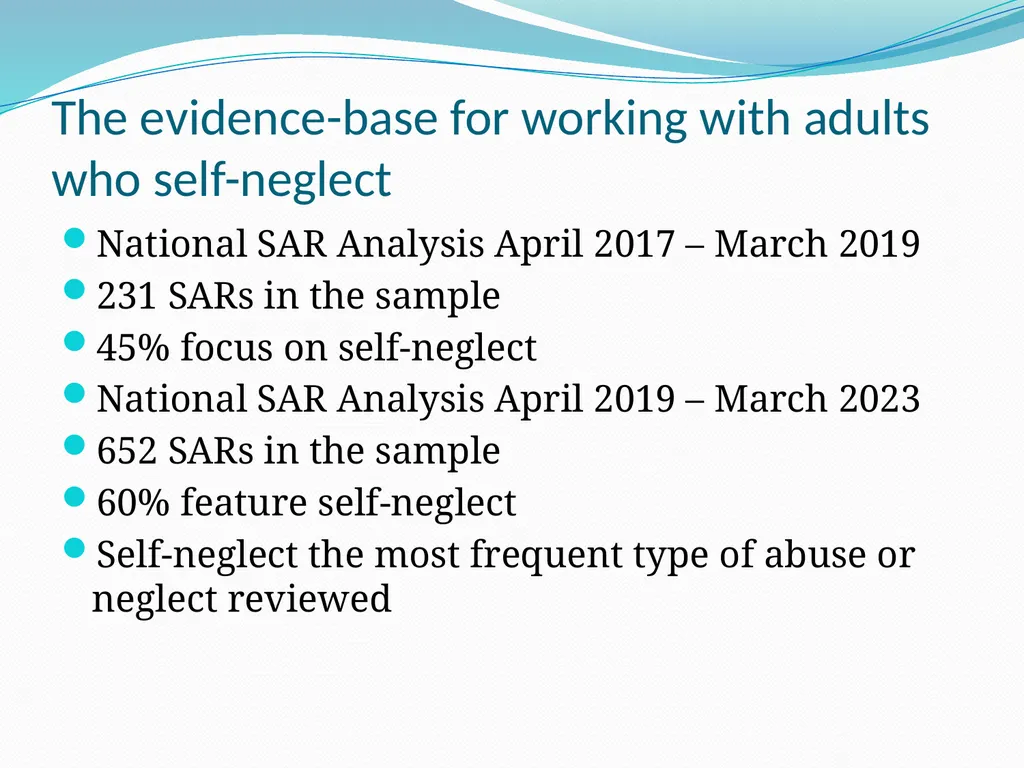
The evidence-base for working with adults who self-neglect National SAR Analysis April 2017 – March 2019
231 SARs in the sample
45% focus on self-neglect
National SAR Analysis April 2019 – March 2023
652 SARs in the sample
60% feature self-neglect
Self-neglect the most frequent type of abuse or neglect reviewed<br>
231 SARs in the sample
45% focus on self-neglect
National SAR Analysis April 2019 – March 2023
652 SARs in the sample
60% feature self-neglect
Self-neglect the most frequent type of abuse or neglect reviewed<br>
06
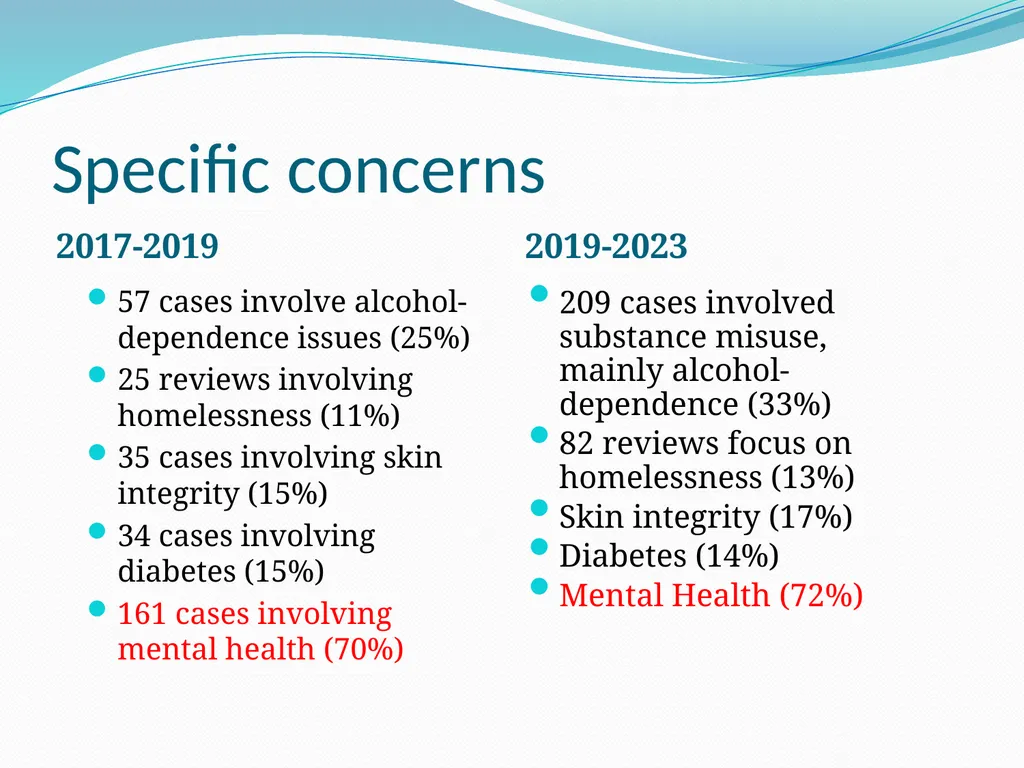
Specific concerns 2017-2019 57 cases involve alcohol-dependence issues (25%)
25 reviews involving homelessness (11%)
35 cases involving skin integrity (15%)
34 cases involving diabetes (15%)
161 cases involving mental health (70%) 2019-2023 209 cases involved substance misuse, mainly alcohol-dependence (33%)
82 reviews focus on homelessness (13%)
Skin integrity (17%)
Diabetes (14%)
Mental Health (72%)<br>
25 reviews involving homelessness (11%)
35 cases involving skin integrity (15%)
34 cases involving diabetes (15%)
161 cases involving mental health (70%) 2019-2023 209 cases involved substance misuse, mainly alcohol-dependence (33%)
82 reviews focus on homelessness (13%)
Skin integrity (17%)
Diabetes (14%)
Mental Health (72%)<br>
07
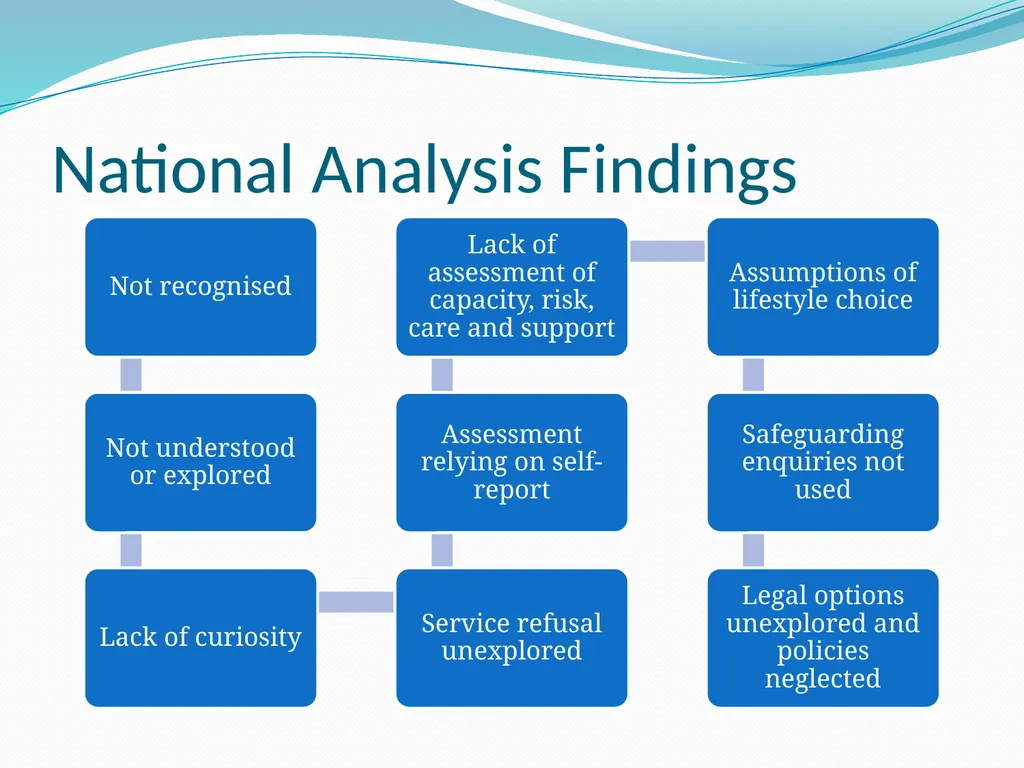
National Analysis Findings<br>
08
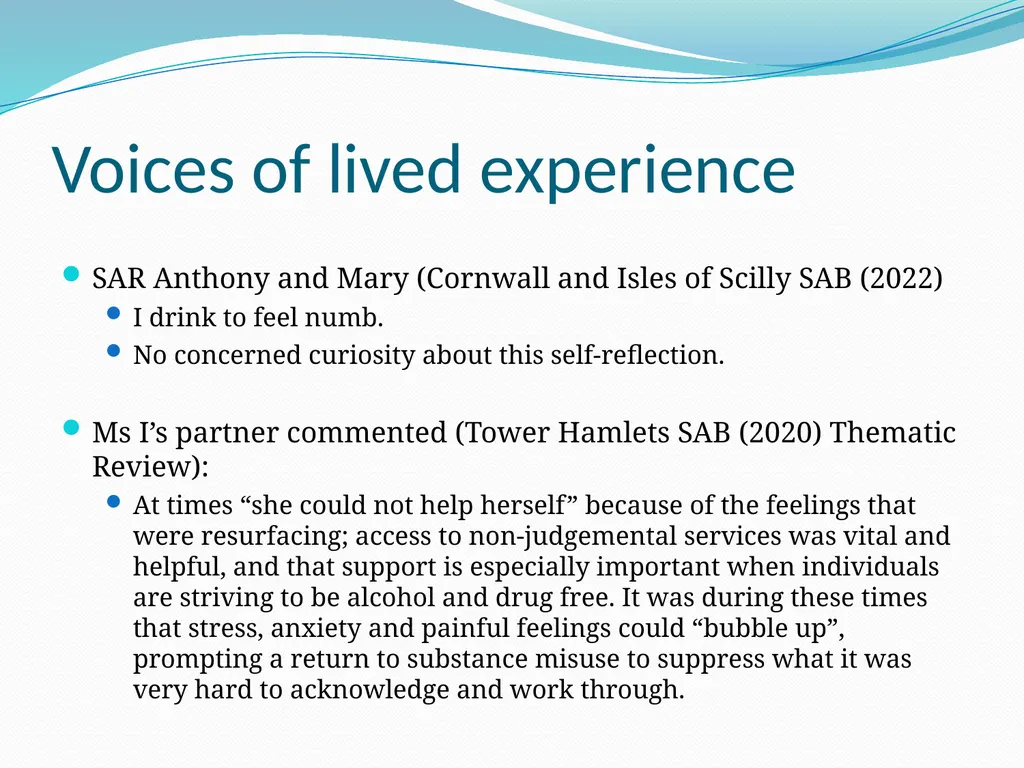
Voices of lived experience SAR Anthony and Mary (Cornwall and Isles of Scilly SAB (2022)
I drink to feel numb.
No concerned curiosity about this self-reflection.
Ms I’s partner commented (Tower Hamlets SAB (2020) Thematic Review):
At times “she could not help herself” because of the feelings that were resurfacing; access to non-judgemental services was vital and helpful, and that support is especially important when individuals are striving to be alcohol and drug free. It was during these times that stress, anxiety and painful feelings could “bubble up”, prompting a return to substance misuse to suppress what it was very hard to acknowledge and work through.<br>
I drink to feel numb.
No concerned curiosity about this self-reflection.
Ms I’s partner commented (Tower Hamlets SAB (2020) Thematic Review):
At times “she could not help herself” because of the feelings that were resurfacing; access to non-judgemental services was vital and helpful, and that support is especially important when individuals are striving to be alcohol and drug free. It was during these times that stress, anxiety and painful feelings could “bubble up”, prompting a return to substance misuse to suppress what it was very hard to acknowledge and work through.<br>
09
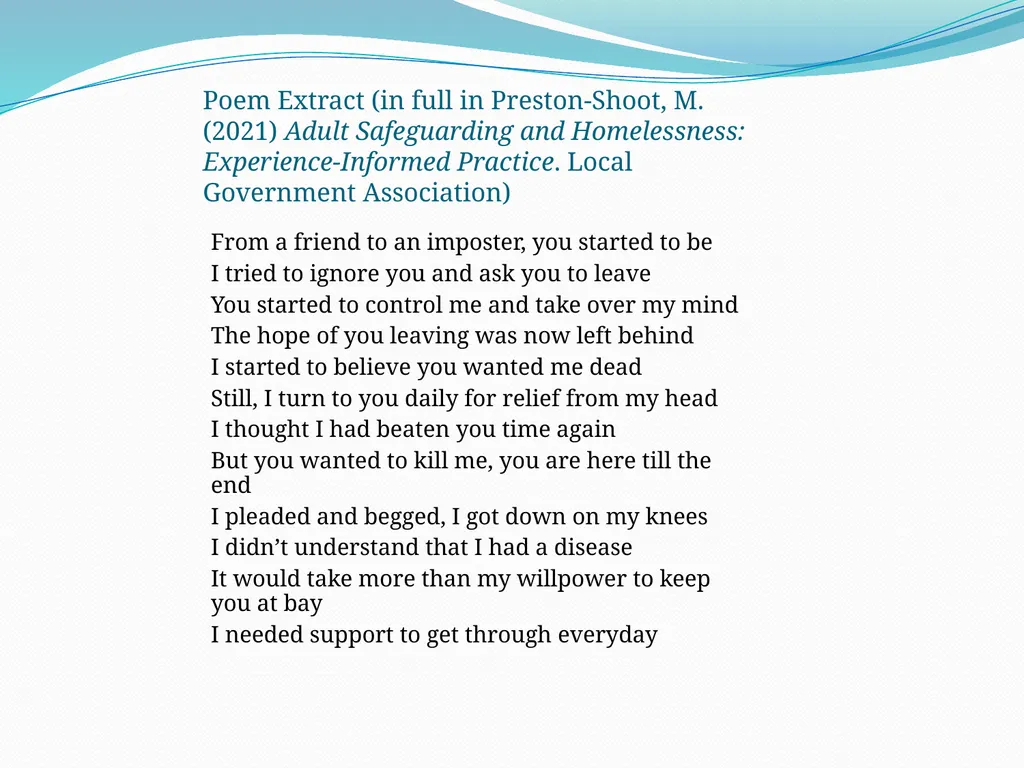
Poem Extract (in full in Preston-Shoot, M. (2021) Adult Safeguarding and Homelessness: Experience-Informed Practice. Local Government Association) From a friend to an imposter, you started to be
I tried to ignore you and ask you to leave
You started to control me and take over my mind
The hope of you leaving was now left behind
I started to believe you wanted me dead
Still, I turn to you daily for relief from my head
I thought I had beaten you time again
But you wanted to kill me, you are here till the end
I pleaded and begged, I got down on my knees
I didn’t understand that I had a disease
It would take more than my willpower to keep you at bay
I needed support to get through everyday<br>
I tried to ignore you and ask you to leave
You started to control me and take over my mind
The hope of you leaving was now left behind
I started to believe you wanted me dead
Still, I turn to you daily for relief from my head
I thought I had beaten you time again
But you wanted to kill me, you are here till the end
I pleaded and begged, I got down on my knees
I didn’t understand that I had a disease
It would take more than my willpower to keep you at bay
I needed support to get through everyday<br>
10
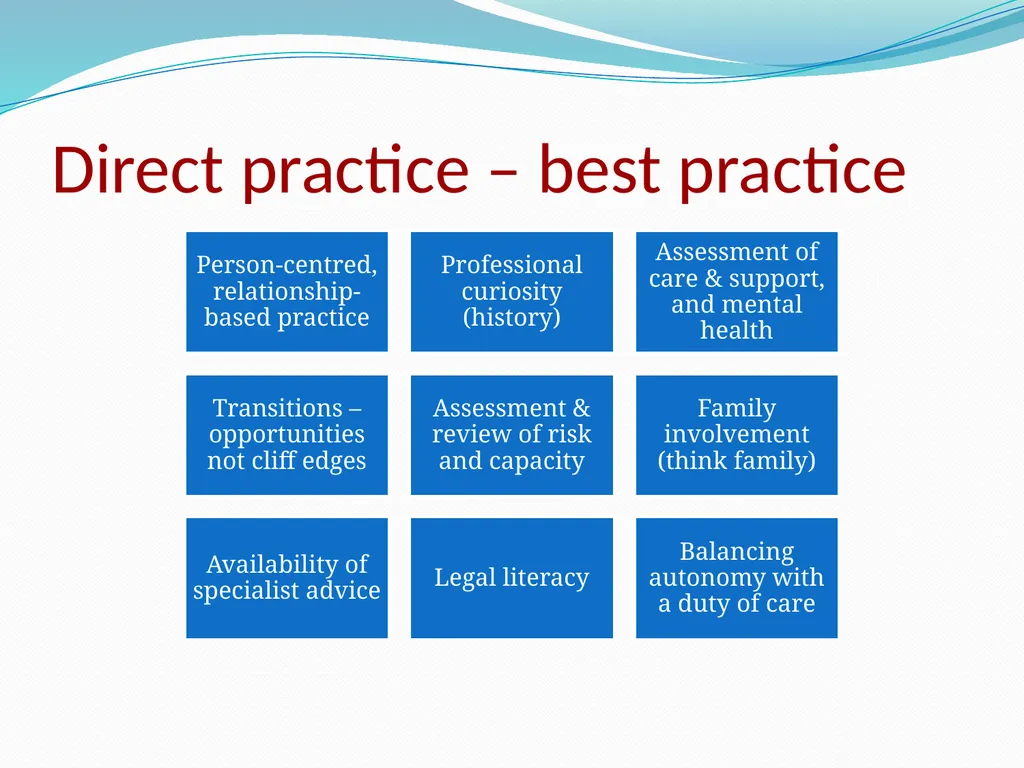
Direct practice – best practice<br>
11
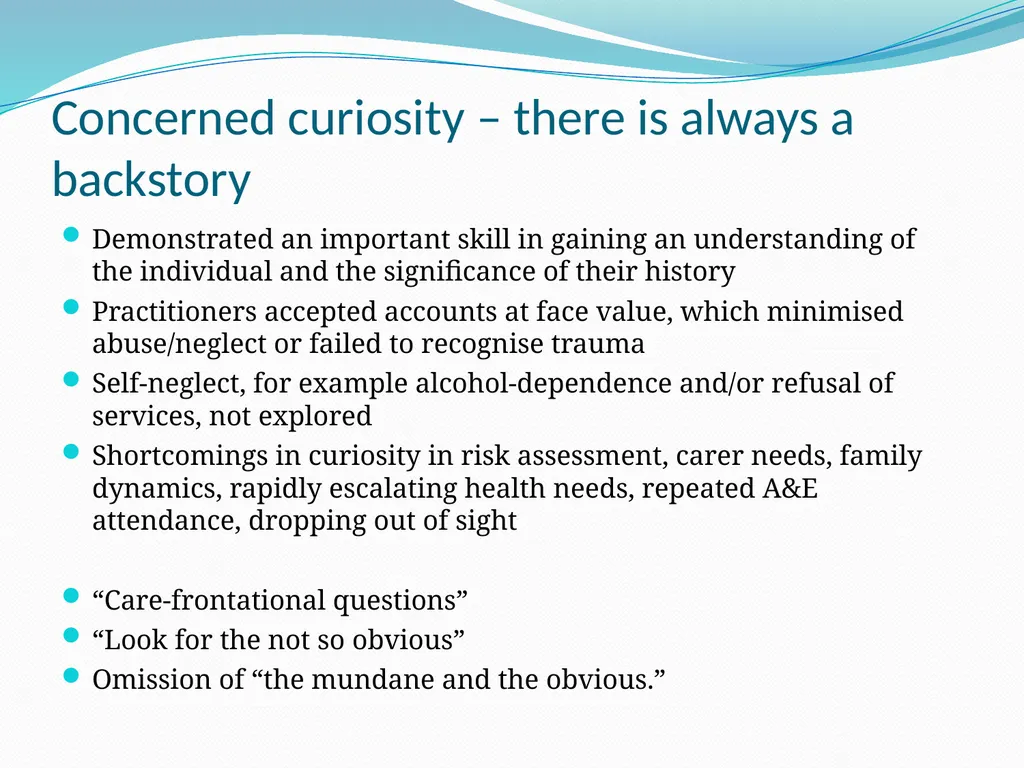
Concerned curiosity – there is always a backstory Demonstrated an important skill in gaining an understanding of the individual and the significance of their history
Practitioners accepted accounts at face value, which minimised abuse/neglect or failed to recognise trauma
Self-neglect, for example alcohol-dependence and/or refusal of services, not explored
Shortcomings in curiosity in risk assessment, carer needs, family dynamics, rapidly escalating health needs, repeated A&E attendance, dropping out of sight
“Care-frontational questions”
“Look for the not so obvious”
Omission of “the mundane and the obvious.”<br>
Practitioners accepted accounts at face value, which minimised abuse/neglect or failed to recognise trauma
Self-neglect, for example alcohol-dependence and/or refusal of services, not explored
Shortcomings in curiosity in risk assessment, carer needs, family dynamics, rapidly escalating health needs, repeated A&E attendance, dropping out of sight
“Care-frontational questions”
“Look for the not so obvious”
Omission of “the mundane and the obvious.”<br>
12
Why is curiosity in the too difficult box? Lack of time, pressure of workloads, and priority given to short-term involvement over relationship-based practice?
Fear of reaction – even hostility and anger?
Concerns about causing offence?
Concerns about lack of cultural awareness?
Perceived lack of skill – uncertainty about how to question?
Myths about making safeguarding personal?
Impact of rule of optimism/
Prioritising autonomy and self-determination, the right to private and family life?
Myth of lifestyle choice?<br>
Fear of reaction – even hostility and anger?
Concerns about causing offence?
Concerns about lack of cultural awareness?
Perceived lack of skill – uncertainty about how to question?
Myths about making safeguarding personal?
Impact of rule of optimism/
Prioritising autonomy and self-determination, the right to private and family life?
Myth of lifestyle choice?<br>
13
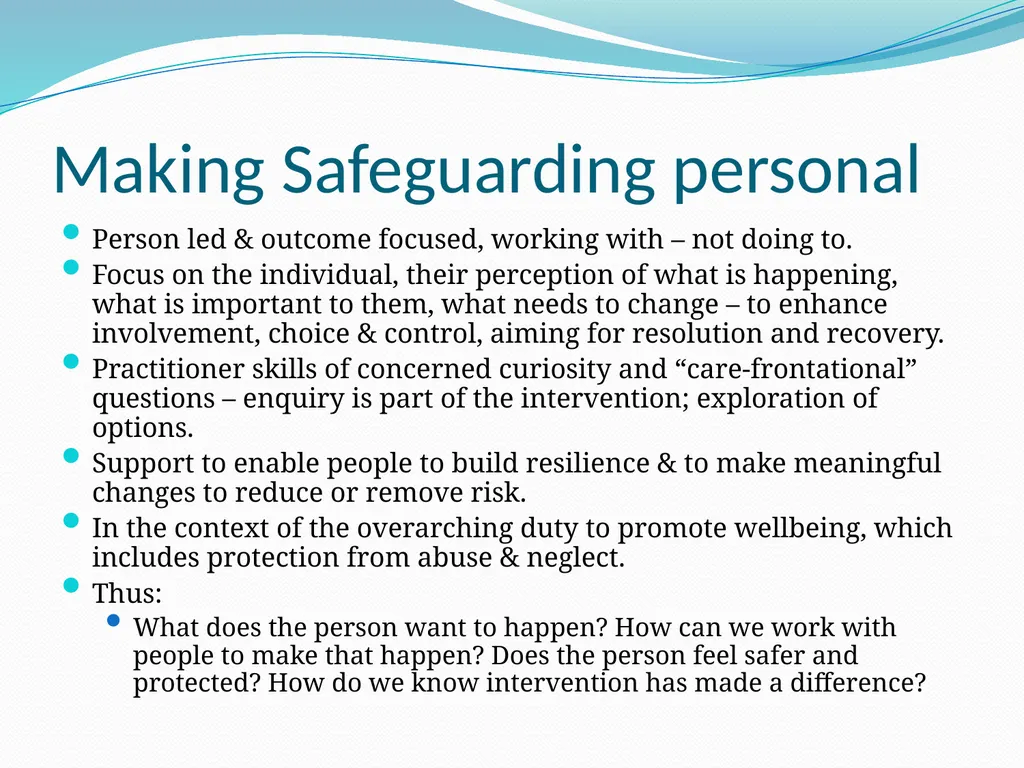
Making Safeguarding personal Person led & outcome focused, working with – not doing to.
Focus on the individual, their perception of what is happening, what is important to them, what needs to change – to enhance involvement, choice & control, aiming for resolution and recovery.
Practitioner skills of concerned curiosity and “care-frontational” questions – enquiry is part of the intervention; exploration of options.
Support to enable people to build resilience & to make meaningful changes to reduce or remove risk.
In the context of the overarching duty to promote wellbeing, which includes protection from abuse & neglect.
Thus:
What does the person want to happen? How can we work with people to make that happen? Does the person feel safer and protected? How do we know intervention has made a difference?<br>
Focus on the individual, their perception of what is happening, what is important to them, what needs to change – to enhance involvement, choice & control, aiming for resolution and recovery.
Practitioner skills of concerned curiosity and “care-frontational” questions – enquiry is part of the intervention; exploration of options.
Support to enable people to build resilience & to make meaningful changes to reduce or remove risk.
In the context of the overarching duty to promote wellbeing, which includes protection from abuse & neglect.
Thus:
What does the person want to happen? How can we work with people to make that happen? Does the person feel safer and protected? How do we know intervention has made a difference?<br>
14
Liverpool SAB – SAR Hazel Hazel died age 55. She had a medical history of alcohol-dependence and hepatitis, cirrhosis of the liver, diabetes and hypertension.
Hazel’s property was in a poor state of repair, with accumulated rubbish. She was lying in her own faeces. Hazel had refused care, support and treatment. She had previously been discovered in a similar state in November 2020.
She received support from her father. Do we think family? She had one son. We know little about her life , her mental distress, to help us understand the challenges she faced. Do we know the backstory?
She did not always keep appointments for her various health issues. Services reported difficulty in making contact with her. Do we reach out?
When Hazel declined assessments from Adult Social Care, the provision in Section 11 Care Act 2014 should have been considered
Making Safeguarding Personal should include concerned curiosity, attempting to establish a relationship.
Was consideration was given to executive functioning, the impact of her alcohol misuse/dependence on her mental capacity?<br>
Hazel’s property was in a poor state of repair, with accumulated rubbish. She was lying in her own faeces. Hazel had refused care, support and treatment. She had previously been discovered in a similar state in November 2020.
She received support from her father. Do we think family? She had one son. We know little about her life , her mental distress, to help us understand the challenges she faced. Do we know the backstory?
She did not always keep appointments for her various health issues. Services reported difficulty in making contact with her. Do we reach out?
When Hazel declined assessments from Adult Social Care, the provision in Section 11 Care Act 2014 should have been considered
Making Safeguarding Personal should include concerned curiosity, attempting to establish a relationship.
Was consideration was given to executive functioning, the impact of her alcohol misuse/dependence on her mental capacity?<br>
15
South Tyneside SAB: Adults AT and AS Adult AT was an only child. Her cousin in the USA maintained contact by telephone and letters. She described Adult AT as “living in the past” and as “obsessed with old memories.” She had moved to the UK with her husband and son. Soon after her husband died.
Adult AT and Adult AS relied on take-away food. They rarely went out. Sometimes Adult AT would indicate that she did not feel like getting up. Neighbours rarely saw Adult AT or Adult AS.
She kept Adult AS close – “he’s right here.” She had no friends.
There were occasional contacts with housing officers (repairs and unkempt garden) and social workers but plans for AS were never followed through, partly because of the influence of his mother in distancing them both from support.
Post Office manager noticed a deterioration in how Adult AT presented in the final year when withdrawing money and shopping (a weekly routine). She was unkempt, would sit on the shop floor and appeared “not all there.”
Around this time, Adult AS was markedly losing weight. Adult AT could be impatient with him.
When she collapsed and was admitted to hospital, there were missed opportunities to respond to adult safeguarding concerns and to seek to meet their care and support needs. The pattern returned when AT was discharged home.<br>
Adult AT and Adult AS relied on take-away food. They rarely went out. Sometimes Adult AT would indicate that she did not feel like getting up. Neighbours rarely saw Adult AT or Adult AS.
She kept Adult AS close – “he’s right here.” She had no friends.
There were occasional contacts with housing officers (repairs and unkempt garden) and social workers but plans for AS were never followed through, partly because of the influence of his mother in distancing them both from support.
Post Office manager noticed a deterioration in how Adult AT presented in the final year when withdrawing money and shopping (a weekly routine). She was unkempt, would sit on the shop floor and appeared “not all there.”
Around this time, Adult AS was markedly losing weight. Adult AT could be impatient with him.
When she collapsed and was admitted to hospital, there were missed opportunities to respond to adult safeguarding concerns and to seek to meet their care and support needs. The pattern returned when AT was discharged home.<br>
16
Using the voice of lived experience (SAR - Ms H and Ms I – Tower Hamlets SAB) – Being trauma-informed In the context of people’s experiences of self-neglect, the notion of lifestyle choice is erroneous.
Tackling symptoms is less effective than addressing causes.
Attempting to change someone’s behaviour without understanding its survival function will prove unsuccessful. The problem is a way of coping, however dysfunctional it may appear. Too often we are responding to symptoms and not causes. Put another way, individuals experiencing self-neglect are in a “life threatening double bind, driven addictively to avoid suffering through ways that only deepen their suffering.”
At times “she could not help herself” because of the feelings that were resurfacing; access to non-judgemental services was vital and helpful, and that support is especially important when individuals are striving to be alcohol and drug free. It was during these times that stress, anxiety and painful feelings could “bubble up”, prompting a return to substance misuse to suppress what it was very hard to acknowledge and work through.<br>
Tackling symptoms is less effective than addressing causes.
Attempting to change someone’s behaviour without understanding its survival function will prove unsuccessful. The problem is a way of coping, however dysfunctional it may appear. Too often we are responding to symptoms and not causes. Put another way, individuals experiencing self-neglect are in a “life threatening double bind, driven addictively to avoid suffering through ways that only deepen their suffering.”
At times “she could not help herself” because of the feelings that were resurfacing; access to non-judgemental services was vital and helpful, and that support is especially important when individuals are striving to be alcohol and drug free. It was during these times that stress, anxiety and painful feelings could “bubble up”, prompting a return to substance misuse to suppress what it was very hard to acknowledge and work through.<br>
17
Wandsworth SAB – WWF (2017) A widow living alone with diagnosed multiple sclerosis. She holds strong views about the support she is prepared to accept but some care workers have developed very effective working relationships with her. Her deteriorating ability to mobilise and increasing difficulties with swallowing, transfers and hand movements has had a significant impact on her mood and ability to go out. It has become progressively difficult for her to smoke safely and there have been several small fires when she has dropped lighted matches or cigarettes, sustaining serious burns, aggravated by the emollient creams that are applied to treat skin problems. She refuses to stop smoking or to light cigarettes only when friends, family or care workers are present.
Findings – willingness to commission agencies with specific expertise; multi-agency communication; challenge of balancing risk reduction approach with rights of adults with capacity to make choices; fire risk not part of risk assessment and management.
The right to private and family life should not obscure the right to life.<br>
Findings – willingness to commission agencies with specific expertise; multi-agency communication; challenge of balancing risk reduction approach with rights of adults with capacity to make choices; fire risk not part of risk assessment and management.
The right to private and family life should not obscure the right to life.<br>
18
Salford SAB: SAR Eric Eric, aged 81, died in hospital in October 2019. Since mid-September he had consistently refused food, water, personal care and treatment
Coroner ruled that the medical cause of death was starvation and noted that Eric lacked mental capacity over a period of time but this was not picked up.
Three years previously Eric had experienced a period of depression, anxiety and weight loss. More recently in August 2019 he had refused to eat and drink, and to take prescribed medication.
His wife and daughter have described Eric as happy but a private family man. He perhaps struggled with getting older. Was sufficient curiosity expressed?<br>
Coroner ruled that the medical cause of death was starvation and noted that Eric lacked mental capacity over a period of time but this was not picked up.
Three years previously Eric had experienced a period of depression, anxiety and weight loss. More recently in August 2019 he had refused to eat and drink, and to take prescribed medication.
His wife and daughter have described Eric as happy but a private family man. He perhaps struggled with getting older. Was sufficient curiosity expressed?<br>
19
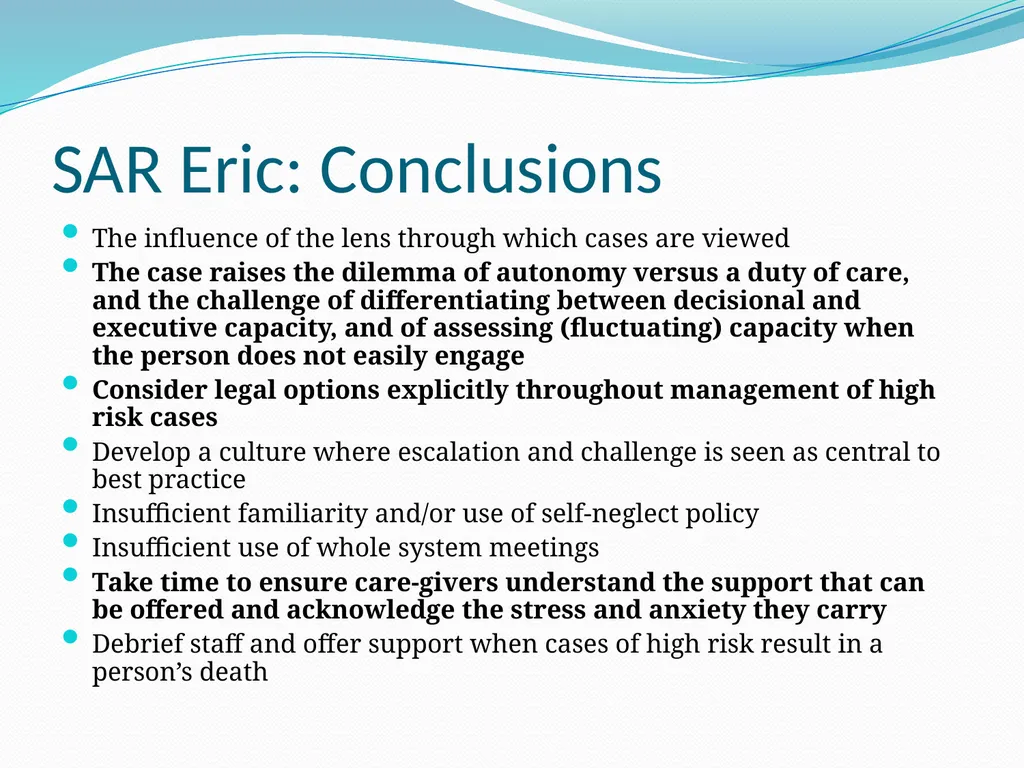
SAR Eric: Conclusions The influence of the lens through which cases are viewed
The case raises the dilemma of autonomy versus a duty of care, and the challenge of differentiating between decisional and executive capacity, and of assessing (fluctuating) capacity when the person does not easily engage
Consider legal options explicitly throughout management of high risk cases
Develop a culture where escalation and challenge is seen as central to best practice
Insufficient familiarity and/or use of self-neglect policy
Insufficient use of whole system meetings
Take time to ensure care-givers understand the support that can be offered and acknowledge the stress and anxiety they carry
Debrief staff and offer support when cases of high risk result in a person’s death<br>
The case raises the dilemma of autonomy versus a duty of care, and the challenge of differentiating between decisional and executive capacity, and of assessing (fluctuating) capacity when the person does not easily engage
Consider legal options explicitly throughout management of high risk cases
Develop a culture where escalation and challenge is seen as central to best practice
Insufficient familiarity and/or use of self-neglect policy
Insufficient use of whole system meetings
Take time to ensure care-givers understand the support that can be offered and acknowledge the stress and anxiety they carry
Debrief staff and offer support when cases of high risk result in a person’s death<br>
20
Andy: a pen picture (2019) Salford SAB Andy died aged 32 at home.
He required treatment for throat swelling, diabetes and renal failure; he did not always comply with his insulin regime or attend dialysis appointments. BUT, did services explore why?
His living conditions in private rented accommodation were poor but his engagement with efforts to improve his housing situation was intermittent. He was living in poverty but his engagement with efforts to improve his financial situation was intermittent.
BUT, was there sufficient curiosity and outreach?
He was known to self-neglect and to be hard to consistently engage. There was a pattern of rejecting assessments and treatment. BUT, was there sufficient outreach?
There are references to concerns about low mood and depression. BUT, the initiative was left with Andy to engage.
He lived alone. There was some support/contact with a friend and family members. There are references to “family dynamics.” BUT, services did not seek support from the family.<br>
He required treatment for throat swelling, diabetes and renal failure; he did not always comply with his insulin regime or attend dialysis appointments. BUT, did services explore why?
His living conditions in private rented accommodation were poor but his engagement with efforts to improve his housing situation was intermittent. He was living in poverty but his engagement with efforts to improve his financial situation was intermittent.
BUT, was there sufficient curiosity and outreach?
He was known to self-neglect and to be hard to consistently engage. There was a pattern of rejecting assessments and treatment. BUT, was there sufficient outreach?
There are references to concerns about low mood and depression. BUT, the initiative was left with Andy to engage.
He lived alone. There was some support/contact with a friend and family members. There are references to “family dynamics.” BUT, services did not seek support from the family.<br>
21
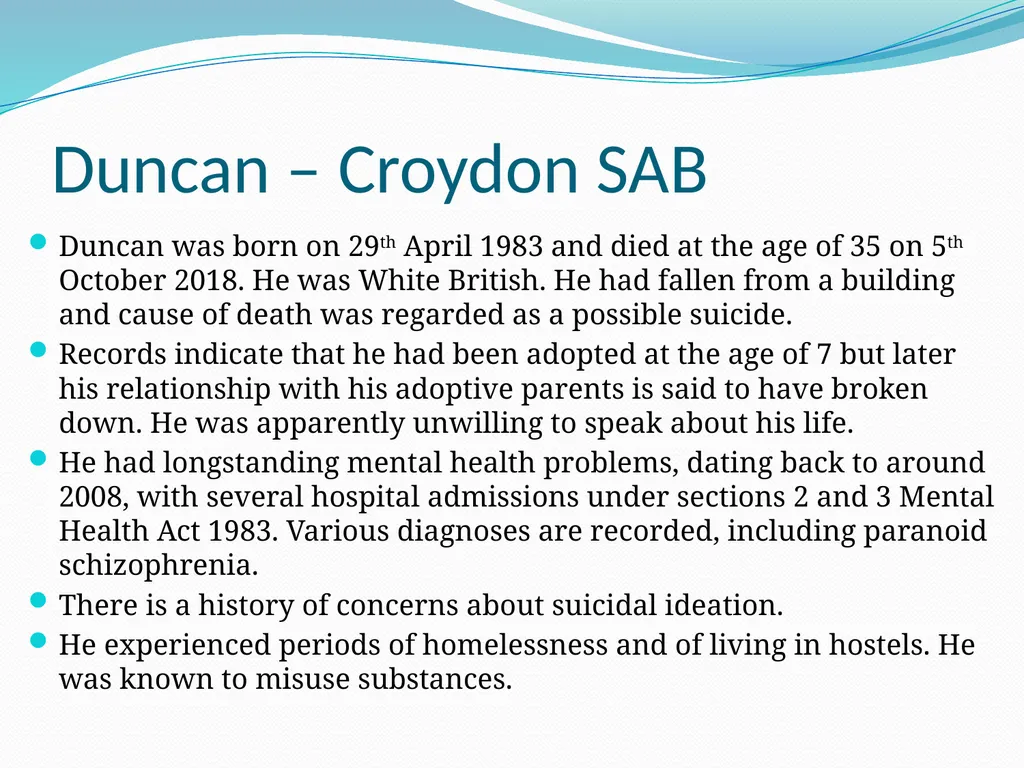
Duncan – Croydon SAB Duncan was born on 29th April 1983 and died at the age of 35 on 5th October 2018. He was White British. He had fallen from a building and cause of death was regarded as a possible suicide.
Records indicate that he had been adopted at the age of 7 but later his relationship with his adoptive parents is said to have broken down. He was apparently unwilling to speak about his life.
He had longstanding mental health problems, dating back to around 2008, with several hospital admissions under sections 2 and 3 Mental Health Act 1983. Various diagnoses are recorded, including paranoid schizophrenia.
There is a history of concerns about suicidal ideation.
He experienced periods of homelessness and of living in hostels. He was known to misuse substances.<br>
Records indicate that he had been adopted at the age of 7 but later his relationship with his adoptive parents is said to have broken down. He was apparently unwilling to speak about his life.
He had longstanding mental health problems, dating back to around 2008, with several hospital admissions under sections 2 and 3 Mental Health Act 1983. Various diagnoses are recorded, including paranoid schizophrenia.
There is a history of concerns about suicidal ideation.
He experienced periods of homelessness and of living in hostels. He was known to misuse substances.<br>
22
Duncan – amongst the findings were Duncan wished to live independently but this option was not pursued. How well are we working with people who present with multiple needs and who find it difficult to engage? Are they not engaging with us or are we not engaging with them? How well do we know the people we are working with? Is there sufficient focus on the impact of trauma and adverse experiences? (MSP)
Duncan had several admissions under section 3 mental Health Act 1983 but there is no reference to a section 117 after-care plan. Are we assured about after-care planning for people detained under longer-term sections in MHA 1983? Are we assured about the effectiveness of the Care Programme Approach? Duncan was ultimately discharged from the CPA without an updated risk assessment and with ongoing mental health concerns. Is this common practice?
There were missed opportunities to update and share Duncan’s risk assessment. Are we assured about the quality of risk assessments, including of suicidal ideation? Duncan did not receive a section 9 Care Act 2014 assessment for care and support needs.<br>
Duncan had several admissions under section 3 mental Health Act 1983 but there is no reference to a section 117 after-care plan. Are we assured about after-care planning for people detained under longer-term sections in MHA 1983? Are we assured about the effectiveness of the Care Programme Approach? Duncan was ultimately discharged from the CPA without an updated risk assessment and with ongoing mental health concerns. Is this common practice?
There were missed opportunities to update and share Duncan’s risk assessment. Are we assured about the quality of risk assessments, including of suicidal ideation? Duncan did not receive a section 9 Care Act 2014 assessment for care and support needs.<br>
23
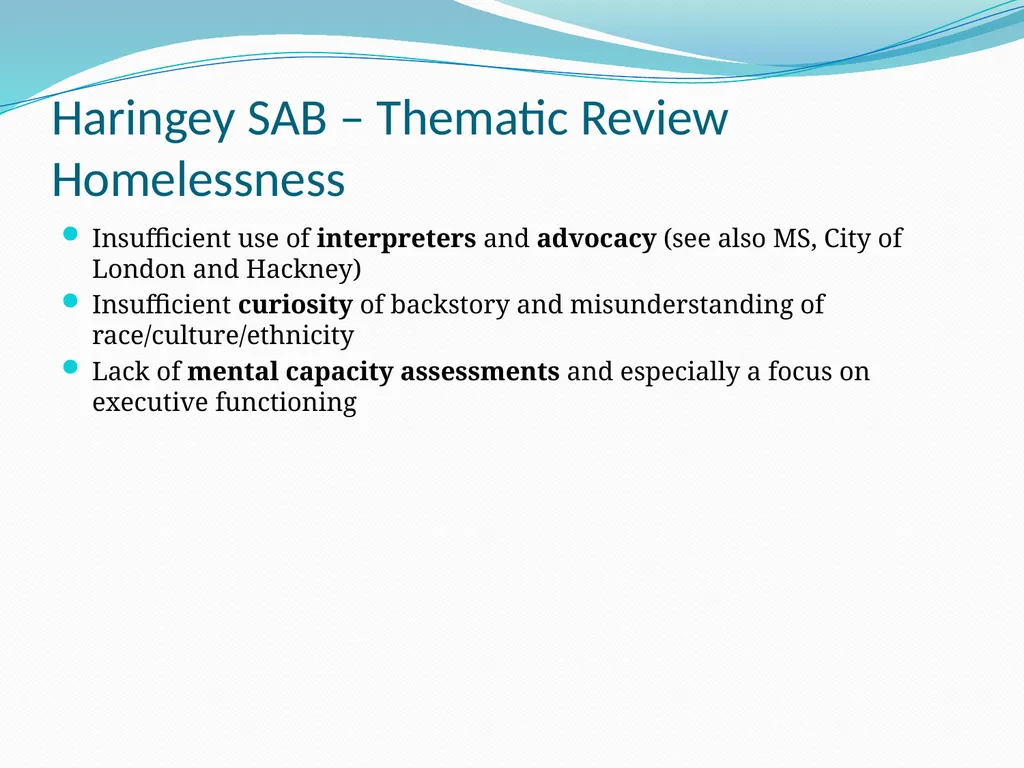
Haringey SAB – Thematic Review Homelessness Insufficient use of interpreters and advocacy (see also MS, City of London and Hackney)
Insufficient curiosity of backstory and misunderstanding of race/culture/ethnicity
Lack of mental capacity assessments and especially a focus on executive functioning<br>
Insufficient curiosity of backstory and misunderstanding of race/culture/ethnicity
Lack of mental capacity assessments and especially a focus on executive functioning<br>
24
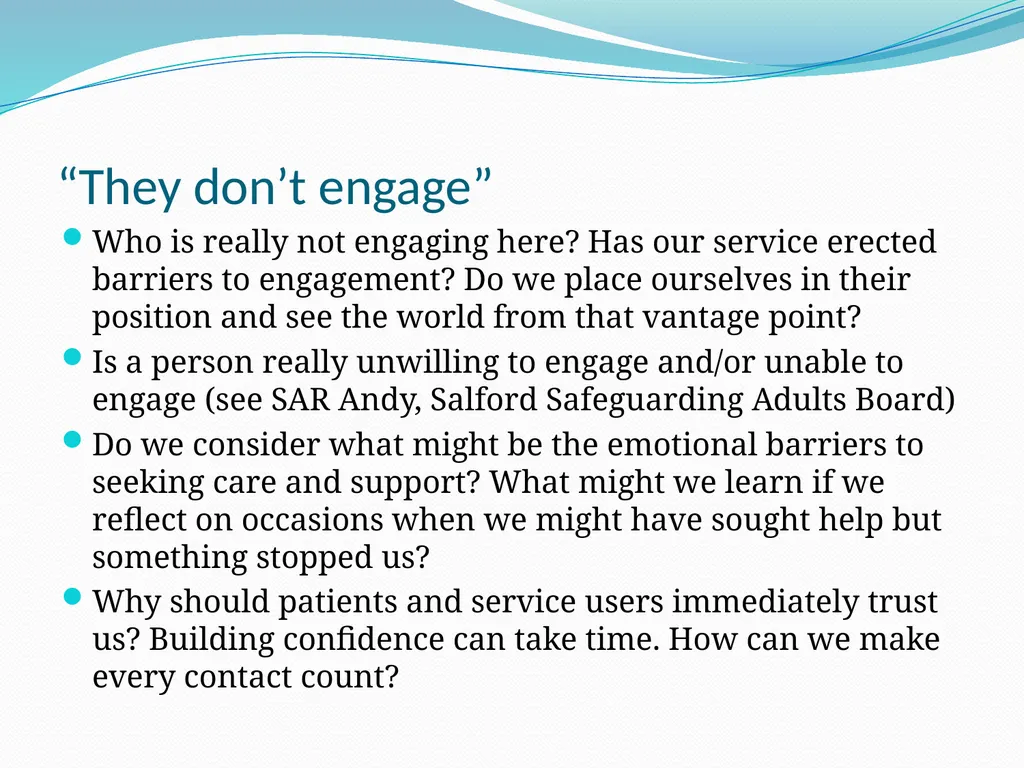
“They don’t engage” Who is really not engaging here? Has our service erected barriers to engagement? Do we place ourselves in their position and see the world from that vantage point?
Is a person really unwilling to engage and/or unable to engage (see SAR Andy, Salford Safeguarding Adults Board)
Do we consider what might be the emotional barriers to seeking care and support? What might we learn if we reflect on occasions when we might have sought help but something stopped us?
Why should patients and service users immediately trust us? Building confidence can take time. How can we make every contact count?<br>
Is a person really unwilling to engage and/or unable to engage (see SAR Andy, Salford Safeguarding Adults Board)
Do we consider what might be the emotional barriers to seeking care and support? What might we learn if we reflect on occasions when we might have sought help but something stopped us?
Why should patients and service users immediately trust us? Building confidence can take time. How can we make every contact count?<br>
25
What people with lived experience say about working with them Engagement – recognise that people may be wary of professionals and services, possibly due to past experiences of institutions and the care system; appreciate that individuals may feel alone, fearful, helpless, confused, excluded, suicidal and depressed, unable to see a way out.
Professional curiosity – “I was not asked ‘why?’” There is always more to know. Experiences (traumas) had a “lasting effect on me.” “Appreciate the beginning of the journey.” What has happened to you?
Partnership – “work with me, involve me, and support me.” “Keep in touch so that we know what is going on.” Help with form filling, bank accounts and other practicalities.
Person-centred – see the person and, where necessary, adapt our approach; “people did not see beyond the sleeping bag”; challenge misconceptions of people who self-neglect and any evidence of assumptions (unconscious bias) that someone may be undeserving or making a lifestyle choice.
Assessment – what does this individual need? Do not assume or stereotype. Explore unwillingness and/or inability to engage.
Language – be careful and respectful about the language we use; words and phrases can betray assumptions. For example, who is not engaging? What does substance misuse imply?<br>
Professional curiosity – “I was not asked ‘why?’” There is always more to know. Experiences (traumas) had a “lasting effect on me.” “Appreciate the beginning of the journey.” What has happened to you?
Partnership – “work with me, involve me, and support me.” “Keep in touch so that we know what is going on.” Help with form filling, bank accounts and other practicalities.
Person-centred – see the person and, where necessary, adapt our approach; “people did not see beyond the sleeping bag”; challenge misconceptions of people who self-neglect and any evidence of assumptions (unconscious bias) that someone may be undeserving or making a lifestyle choice.
Assessment – what does this individual need? Do not assume or stereotype. Explore unwillingness and/or inability to engage.
Language – be careful and respectful about the language we use; words and phrases can betray assumptions. For example, who is not engaging? What does substance misuse imply?<br>
26
Inter-organisational environment – best practice<br>
27
Returning to human stories Duncan (Croydon SAB) does not appear to have had any involvement with, or intervention from substance misuse services. How well do services respond to and work with individuals with both mental health and substance misuse problems? How well do services work together? No multi-agency risk management meeting was convened.
Child/Adult Y and Child/Adult Q (Havering SAB) - lack of use of adult safeguarding procedures. Multi-agency and multi-disciplinary meetings were held but plans were insufficient to reduce the risks and ensure collaboration across services.
Haringey SAB Thematic Review – absence of multi-agency risk management meetings. Safeguarding concerns referred but no safeguarding enquiries.<br>
Child/Adult Y and Child/Adult Q (Havering SAB) - lack of use of adult safeguarding procedures. Multi-agency and multi-disciplinary meetings were held but plans were insufficient to reduce the risks and ensure collaboration across services.
Haringey SAB Thematic Review – absence of multi-agency risk management meetings. Safeguarding concerns referred but no safeguarding enquiries.<br>
28
MS: City of London & Hackney SAB (2021) MS died, aged 63. Cause of death was acute myocardial infarction, coronary artery atherosclerosis and aspiration pneumonia. He died at a bus stop where he had been living and sleeping for several weeks.
MS was Turkish (Kurdish ethnicity) with limited understanding of English and a history of homelessness, self-neglect and substance abuse. He had returned to the bus stop where he eventually died at the end of May 2019, having spent the previous five months in a nursing home. When that placement came to an end he was offered a hotel room but declined. He is reported as having said that “something brings [me] back to the bus stop.”
There were discussions on whether and how to use anti-social behaviour powers, and mental capacity and mental health legislation, in order to safeguard his health and wellbeing, and to address expressed concerns from local residents. No effective means of resolving the situation was found before he died.
When practitioners could not agree on whether he had capacity, they walked away, unable to reach a decision. Those involved did not work together to agree the approach on mental capacity decision-making.
Referred adult safeguarding concerns did not lead to a section 42 enquiry. Local authority decision-making was not challenged.
No multi-agency, multi-disciplinary risk management meeting was convened.<br>
MS was Turkish (Kurdish ethnicity) with limited understanding of English and a history of homelessness, self-neglect and substance abuse. He had returned to the bus stop where he eventually died at the end of May 2019, having spent the previous five months in a nursing home. When that placement came to an end he was offered a hotel room but declined. He is reported as having said that “something brings [me] back to the bus stop.”
There were discussions on whether and how to use anti-social behaviour powers, and mental capacity and mental health legislation, in order to safeguard his health and wellbeing, and to address expressed concerns from local residents. No effective means of resolving the situation was found before he died.
When practitioners could not agree on whether he had capacity, they walked away, unable to reach a decision. Those involved did not work together to agree the approach on mental capacity decision-making.
Referred adult safeguarding concerns did not lead to a section 42 enquiry. Local authority decision-making was not challenged.
No multi-agency, multi-disciplinary risk management meeting was convened.<br>
29
Kirklees SAB Adult N (2022) Adult N died in his flat, aged 41. Cause of death was acute fatty and chronic alcoholism.
Adult N had a history of homelessness, self-neglect and substance (alcohol) abuse. This appears to have followed a relationship breakdown some five years previously.
During this time he had experienced periods of homelessness, living in a car, in woodland or occasionally hotels. At times he was found living in insanitary conditions, self-neglecting, unresponsive and intoxicated. It appears that he had paid privately for detoxification and rehabilitation but this had not been successful.
There were assumptions about lifestyle choice and insufficient curiosity about the background.
There were no multi-agency risk management meetings despite a repeating pattern of attendances at A&E and concerns expressed by paramedics and the police.
There was no lead agency or key worker appointed.
Services did not work together, for example in-reach and outreach mental health and substance misuse agencies.
There were few referrals of adult safeguarding concerns and no section 42 enquiry.<br>
Adult N had a history of homelessness, self-neglect and substance (alcohol) abuse. This appears to have followed a relationship breakdown some five years previously.
During this time he had experienced periods of homelessness, living in a car, in woodland or occasionally hotels. At times he was found living in insanitary conditions, self-neglecting, unresponsive and intoxicated. It appears that he had paid privately for detoxification and rehabilitation but this had not been successful.
There were assumptions about lifestyle choice and insufficient curiosity about the background.
There were no multi-agency risk management meetings despite a repeating pattern of attendances at A&E and concerns expressed by paramedics and the police.
There was no lead agency or key worker appointed.
Services did not work together, for example in-reach and outreach mental health and substance misuse agencies.
There were few referrals of adult safeguarding concerns and no section 42 enquiry.<br>
30
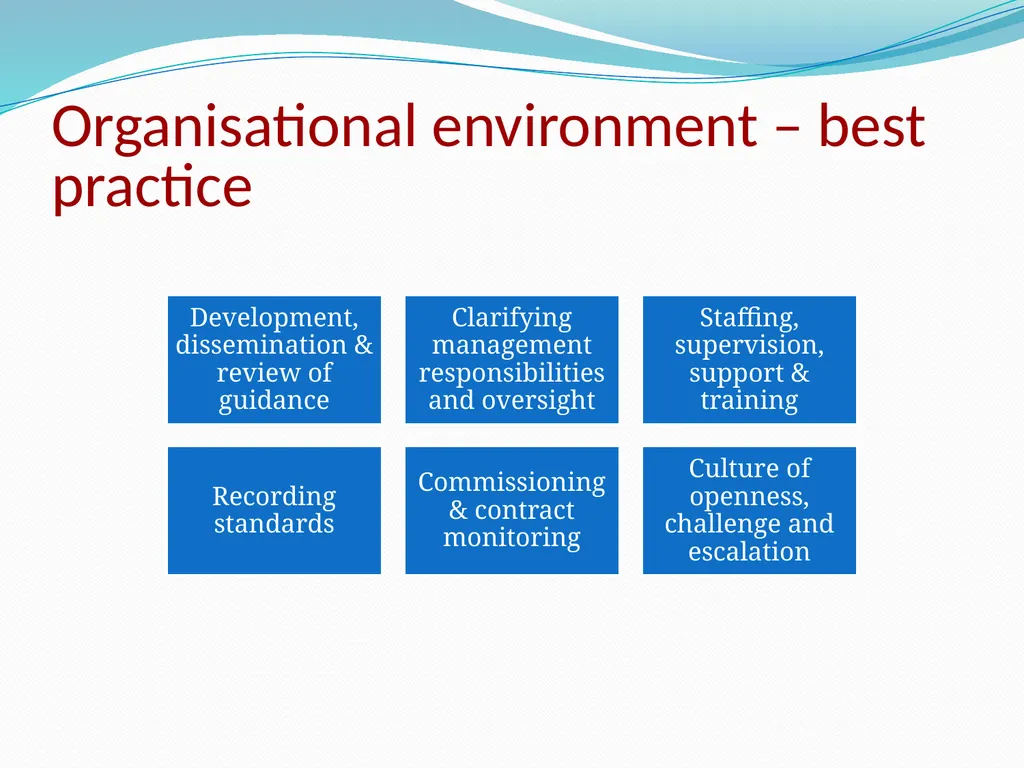
Organisational environment – best practice<br>
31
Returning to Human Stories Croydon SAB – Duncan. Working with people who self-neglect, who have longstanding challenges involving mental health, substance misuse and challenging behaviour, is itself challenging. How well supported are practitioners and operational managers for working with people who present a range of complex problems?
Havering SAB Ms A – How supportive are we of practitioners who knew the person well and who have been profoundly affected by their death? (staff support)
Havering SAB Child/Adult Y and Child/Adult Q – shortage of placements for your people and young adults with complex needs and challenging behaviours (commissioning)
Haringey SAB Thematic Review – lack of familiarity with, and use of self-neglect policies and procedures<br>
Havering SAB Ms A – How supportive are we of practitioners who knew the person well and who have been profoundly affected by their death? (staff support)
Havering SAB Child/Adult Y and Child/Adult Q – shortage of placements for your people and young adults with complex needs and challenging behaviours (commissioning)
Haringey SAB Thematic Review – lack of familiarity with, and use of self-neglect policies and procedures<br>
32
Isle of Wight SAB – Howard (2018) Homeless single adult without local family support
Impact of adverse life events
Longstanding alcohol misuse and physical ill-health
Hospital and prison discharges to no fixed abode
Police and ambulance crews concerned about risks of financial and physical abuse, and his self-neglect
Refused housing as not regarded as in priority need
No wet hostel available – commissioning (shortage of providers, especially for complex cases)
Referrals to adult safeguarding do not prompt multi-agency meetings or investigation; no completed Care Act 2014 care and support assessment
No lead agency or key worker; no risk assessment or mitigation plan<br>
Impact of adverse life events
Longstanding alcohol misuse and physical ill-health
Hospital and prison discharges to no fixed abode
Police and ambulance crews concerned about risks of financial and physical abuse, and his self-neglect
Refused housing as not regarded as in priority need
No wet hostel available – commissioning (shortage of providers, especially for complex cases)
Referrals to adult safeguarding do not prompt multi-agency meetings or investigation; no completed Care Act 2014 care and support assessment
No lead agency or key worker; no risk assessment or mitigation plan<br>
33
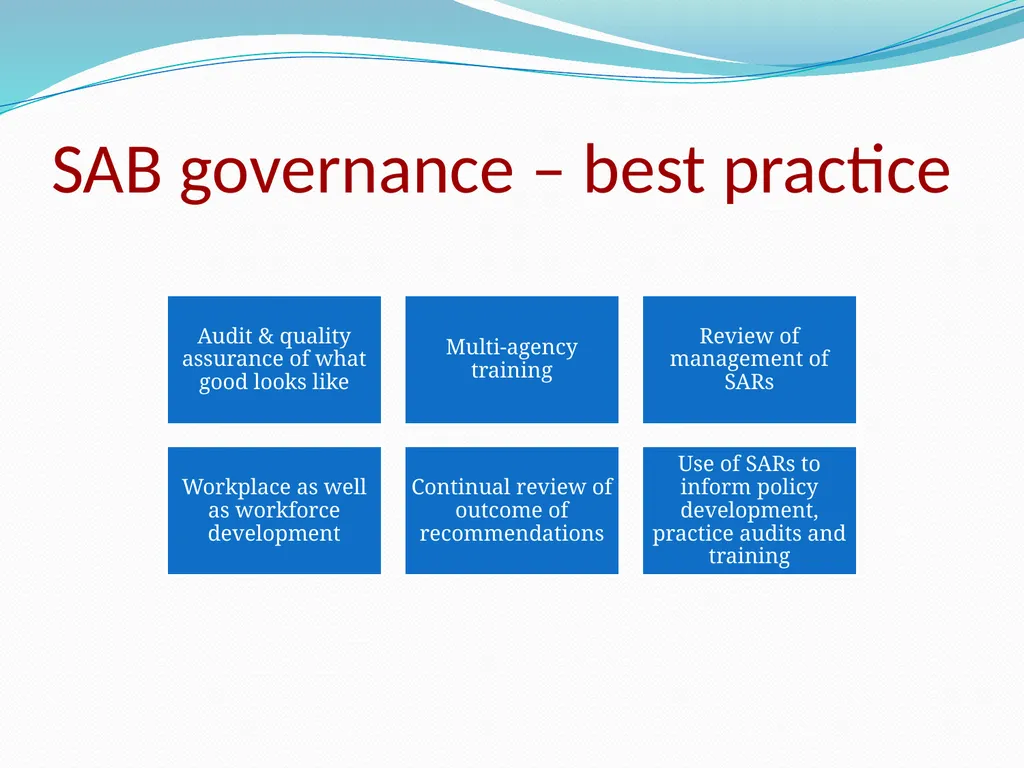
SAB governance – best practice<br>
34
Mental Capacity Good Practice Robust capacity assessments and best interest decisions
Outcomes clearly recorded
Assessment clearly mapped against MCA requirements Practice Shortfalls Failure to assess or review
Poor assessments
Misunderstanding of MCA principles
Misunderstanding of diagnostic test
Neglect of executive capacity
Neglect of advocacy
Assumptions about lifestyle choice
Poor recording
Lack of confidence<br>
Outcomes clearly recorded
Assessment clearly mapped against MCA requirements Practice Shortfalls Failure to assess or review
Poor assessments
Misunderstanding of MCA principles
Misunderstanding of diagnostic test
Neglect of executive capacity
Neglect of advocacy
Assumptions about lifestyle choice
Poor recording
Lack of confidence<br>
35
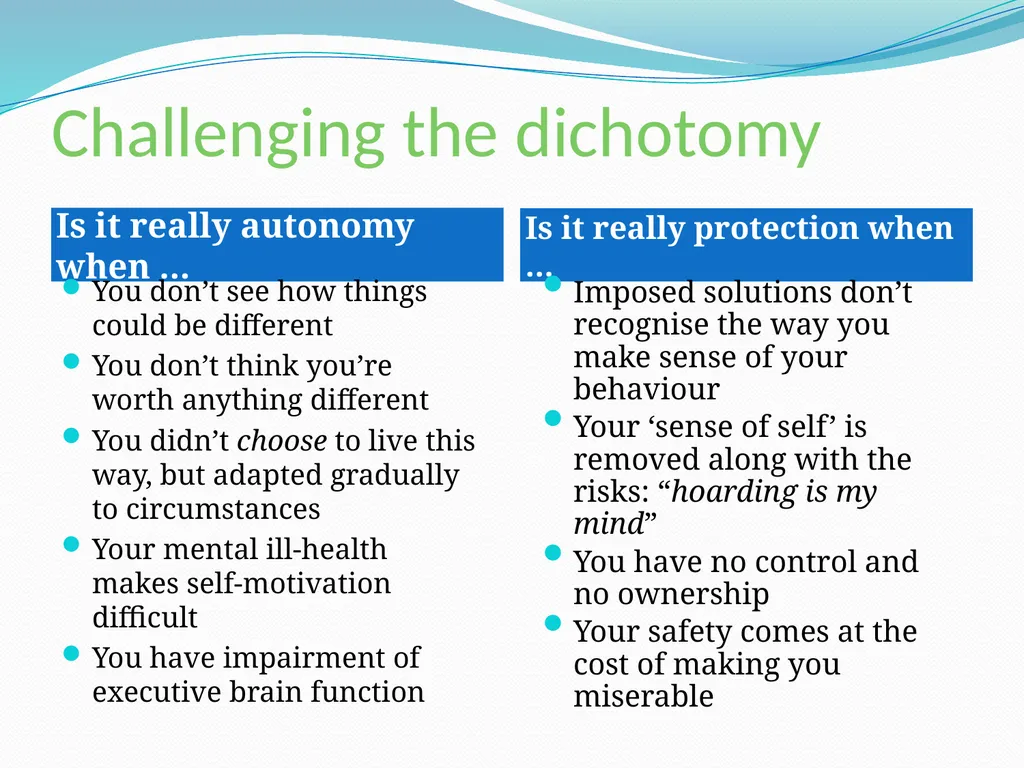
Challenging the dichotomy Is it really autonomy when … You don’t see how things could be different
You don’t think you’re worth anything different
You didn’t choose to live this way, but adapted gradually to circumstances
Your mental ill-health makes self-motivation difficult
You have impairment of executive brain function Is it really protection when … Imposed solutions don’t recognise the way you make sense of your behaviour
Your ‘sense of self’ is removed along with the risks: “hoarding is my mind”
You have no control and no ownership
Your safety comes at the cost of making you miserable<br>
You don’t think you’re worth anything different
You didn’t choose to live this way, but adapted gradually to circumstances
Your mental ill-health makes self-motivation difficult
You have impairment of executive brain function Is it really protection when … Imposed solutions don’t recognise the way you make sense of your behaviour
Your ‘sense of self’ is removed along with the risks: “hoarding is my mind”
You have no control and no ownership
Your safety comes at the cost of making you miserable<br>
36
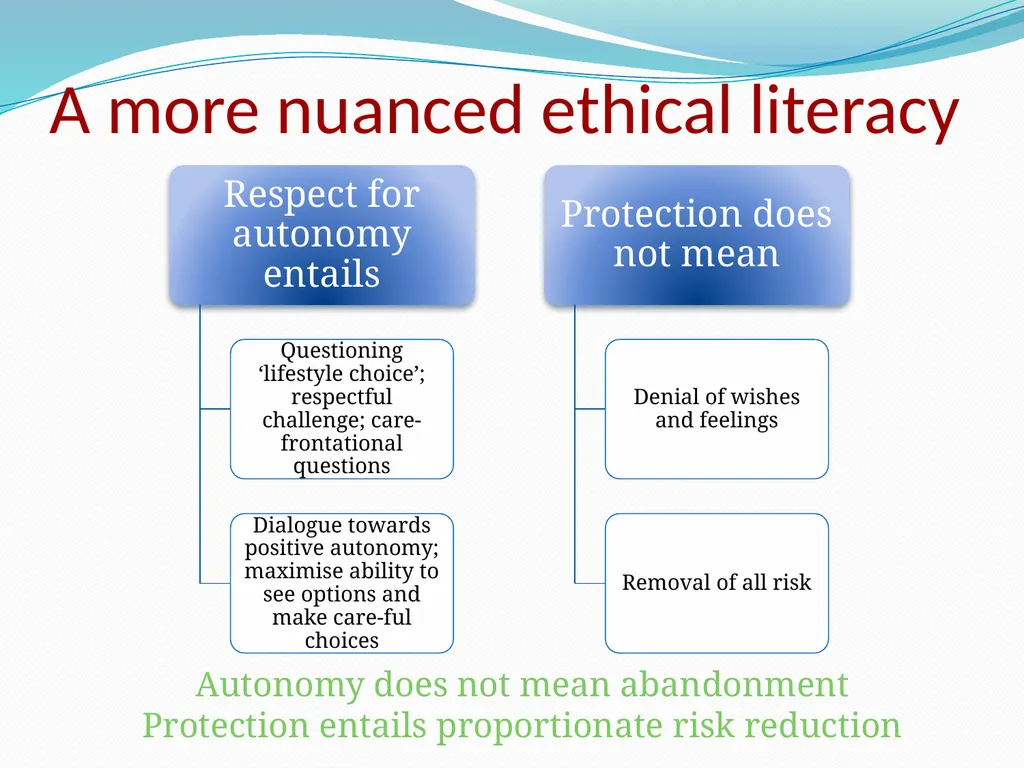
A more nuanced ethical literacy Autonomy does not mean abandonment
Protection entails proportionate risk reduction<br>
Protection entails proportionate risk reduction<br>
37
“The fact is that all life involves risk, and the young, the elderly and the vulnerable are exposed to additional risks and to risks they are less well equipped than others to cope with. But just as wise parents resist the temptation to keep their children metaphorically wrapped up in cotton wool, so too we must avoid the temptation always to put the physical health and safety of the elderly and the vulnerable before everything else. Often it will be appropriate to do so, but not always. Physical health and welfare can sometimes be bought at too high a price in happiness and emotional welfare. The emphasis must be on sensible risk appraisal, not striving to avoid all risk, whatever the price, but instead seeking a proper balance and being willing to tolerate manageable or acceptable risks as the price appropriately to be paid in order to achieve some other good – in particular to achieve the vital good of the elderly or vulnerable person’s happiness. What good is it making someone safer if it merely makes them miserable?” MM (An Adult)[2007] The core dilemma<br>
38
An older person with dementia, prone to falls and self-neglect
Application by Westminster City Council to Court of Protection for a DoL to keep her in a nursing home
Application opposed by Manuela and her nephew
What is in her best interests? To return her home with a care package where she is at risk but happy, or to deprive her of her liberty so that she is safe?
Westminster City Council v Manuela Sykes [2014] EWHC B9 (CoP)
How well do we support staff when faced with such a dilemma?
Are we commissioning care and support packages to manage such situations?
How accessible are specialists with expertise in law, mental capacity and safeguarding?
See also Lancashire and South Cumbria NHS Foundation Trust and Lancashire County Council and AH [2023] EWCOP 1 The story of Manuela Sykes<br>
Application by Westminster City Council to Court of Protection for a DoL to keep her in a nursing home
Application opposed by Manuela and her nephew
What is in her best interests? To return her home with a care package where she is at risk but happy, or to deprive her of her liberty so that she is safe?
Westminster City Council v Manuela Sykes [2014] EWHC B9 (CoP)
How well do we support staff when faced with such a dilemma?
Are we commissioning care and support packages to manage such situations?
How accessible are specialists with expertise in law, mental capacity and safeguarding?
See also Lancashire and South Cumbria NHS Foundation Trust and Lancashire County Council and AH [2023] EWCOP 1 The story of Manuela Sykes<br>
39
Mental capacity in the literature involves
Not only
the ability to understand and reason through the elements of a decision in the abstract
But also
the ability to realise when a decision needs to be put into practice and execute it at the appropriate moment – the ‘knowing/doing association’
Frontal lobe damage may cause loss of executive brain function, resulting in difficulties:
Selecting relevant information and using or weighing it in the right context, in the moment
And therefore in planning, problem-solving, enacting a decision in situ<br>
Not only
the ability to understand and reason through the elements of a decision in the abstract
But also
the ability to realise when a decision needs to be put into practice and execute it at the appropriate moment – the ‘knowing/doing association’
Frontal lobe damage may cause loss of executive brain function, resulting in difficulties:
Selecting relevant information and using or weighing it in the right context, in the moment
And therefore in planning, problem-solving, enacting a decision in situ<br>
40
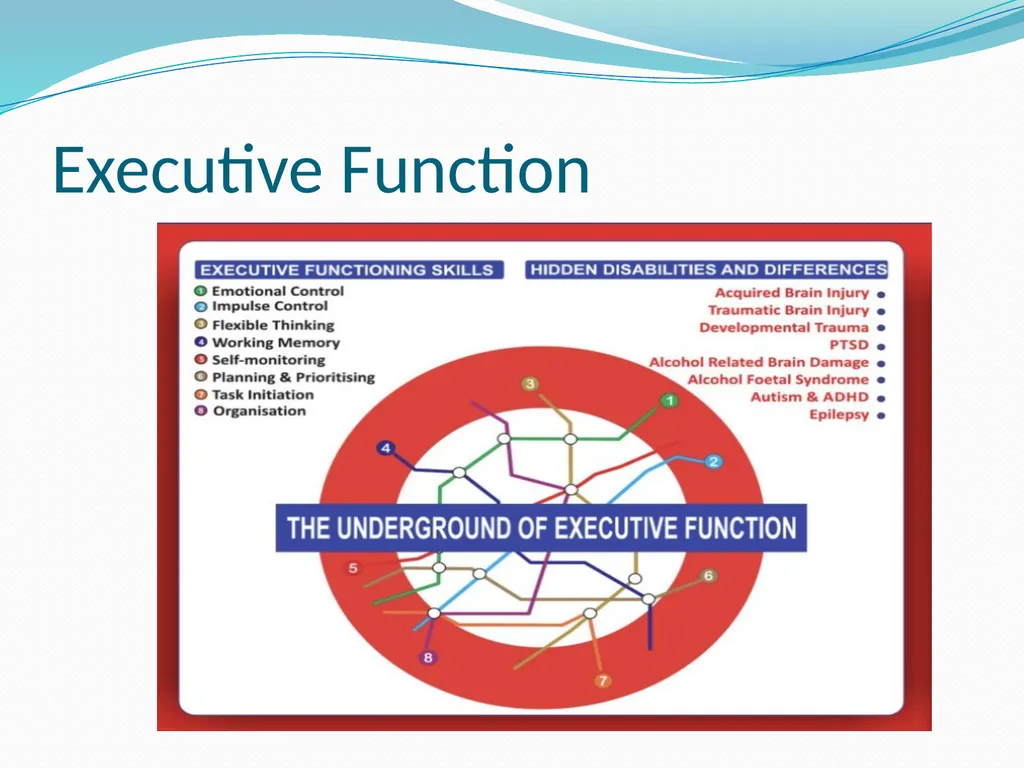
Executive Function<br>
41
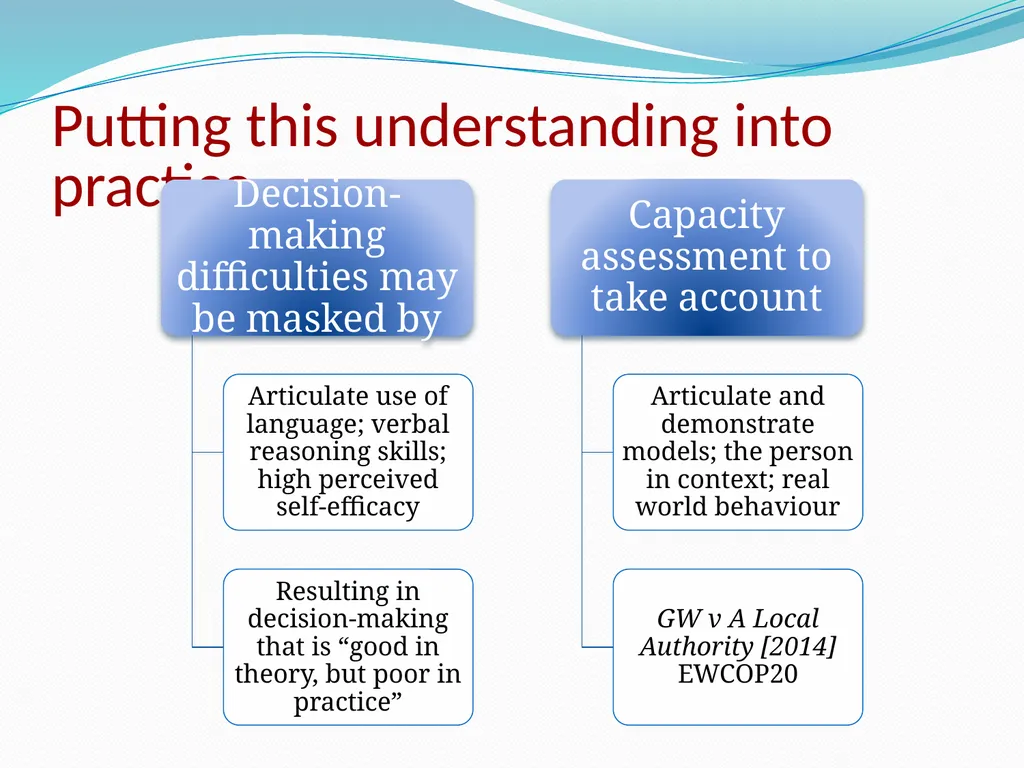
Putting this understanding into practice<br>
42
National guidance (NICE 2018) Practitioners should be aware that it may be more difficult to assess capacity in people with executive dysfunction – for example people with traumatic brain injury. Structured assessments of capacity for individuals in this group (for example, by way of interview) may therefore need to be supplemented by real world observation of the person's functioning and decision-making ability in order to provide the assessor with a complete picture of an individual's decision-making ability.
Decision-making and mental capacity guidance (para 1.4.19)<br>
Decision-making and mental capacity guidance (para 1.4.19)<br>
43
Case Law: Executive Functioning Sunderland City Council v AS and Others [2020] EWCOP 13
Importance of real world observation to obtain a full picture.
A Local Authority v AW [2020] EWCOP 24
Ability to think, act and solve problems include the functions of the brain which help us to learn new information, remember and retrieve the information we’ve learned in the past, and use this information to solve problems of everyday life.<br>
Importance of real world observation to obtain a full picture.
A Local Authority v AW [2020] EWCOP 24
Ability to think, act and solve problems include the functions of the brain which help us to learn new information, remember and retrieve the information we’ve learned in the past, and use this information to solve problems of everyday life.<br>
44
Signposts to best practice In cases of fluctuating capacity, the courts have advised taking a long-term perspective rather than simply assessing the capacity at one point in time.
Carol SAR (Teeswide SAB): the concept of “executive capacity” is relevant where the individual has addictive or compulsive behaviours. This highlights the importance of considering the individual’s ability to put a decision into effect (executive capacity) in addition to their ability to make a decision (decisional capacity).
Howard SAR (Isle of Wight SAB) and the Ms H and Ms I SAR (Tower Hamlets SAB) highlight people who are driven by compulsions that are too strong for them to ignore. Their actions often contradicted their stated intention to control their alcohol use: they were unable to execute stated decisions.
Ruth Mitchell SAR (Plymouth SAB): To assess Ruth as having the mental capacity to make specific decisions on the basis of what she said only, could produce a false picture of her actual capacity. She needed an assessment based both on her verbal explanations and on observation of her capabilities, i.e. “show me, as well as tell me”. An assessment of Ruth’s mental capacity would need to consider her ability to implement and manage the consequences of her specific decisions, as well as her ability to weigh up information and communicate decisions.<br>
Carol SAR (Teeswide SAB): the concept of “executive capacity” is relevant where the individual has addictive or compulsive behaviours. This highlights the importance of considering the individual’s ability to put a decision into effect (executive capacity) in addition to their ability to make a decision (decisional capacity).
Howard SAR (Isle of Wight SAB) and the Ms H and Ms I SAR (Tower Hamlets SAB) highlight people who are driven by compulsions that are too strong for them to ignore. Their actions often contradicted their stated intention to control their alcohol use: they were unable to execute stated decisions.
Ruth Mitchell SAR (Plymouth SAB): To assess Ruth as having the mental capacity to make specific decisions on the basis of what she said only, could produce a false picture of her actual capacity. She needed an assessment based both on her verbal explanations and on observation of her capabilities, i.e. “show me, as well as tell me”. An assessment of Ruth’s mental capacity would need to consider her ability to implement and manage the consequences of her specific decisions, as well as her ability to weigh up information and communicate decisions.<br>
45
Discussion Points How involved have you been in SARs?
How often do you read SARs commissioned locally or elsewhere?
How often would you discuss SARs with your team/service colleagues?
What is your experience of what enables best practice?
What obstacles and barriers to best practice do you encounter and how might we all tackle these?<br>
How often do you read SARs commissioned locally or elsewhere?
How often would you discuss SARs with your team/service colleagues?
What is your experience of what enables best practice?
What obstacles and barriers to best practice do you encounter and how might we all tackle these?<br>
46
Applying the Six Principles Empowerment – look beyond the presenting problem to the backstory; make every adult matter; listen, hear and acknowledge; acknowledge strengths.
Prevention – commissioning to avoid revolving doors and to provide integrated wrap-around support; transitions as opportunities; show curiosity.
Protection – address risks of premature mortality; open discussion of concerns.
Partnership – no wrong door; make every contact count; sharing information to safeguard an adult at risk. Ensuring that we have all relevant practitioners in the team around the person.
Proportionality – minimise risk; judge the level of intervention required.
Accountability – get the governance right; give reasons for decisions.<br>
Prevention – commissioning to avoid revolving doors and to provide integrated wrap-around support; transitions as opportunities; show curiosity.
Protection – address risks of premature mortality; open discussion of concerns.
Partnership – no wrong door; make every contact count; sharing information to safeguard an adult at risk. Ensuring that we have all relevant practitioners in the team around the person.
Proportionality – minimise risk; judge the level of intervention required.
Accountability – get the governance right; give reasons for decisions.<br>
47
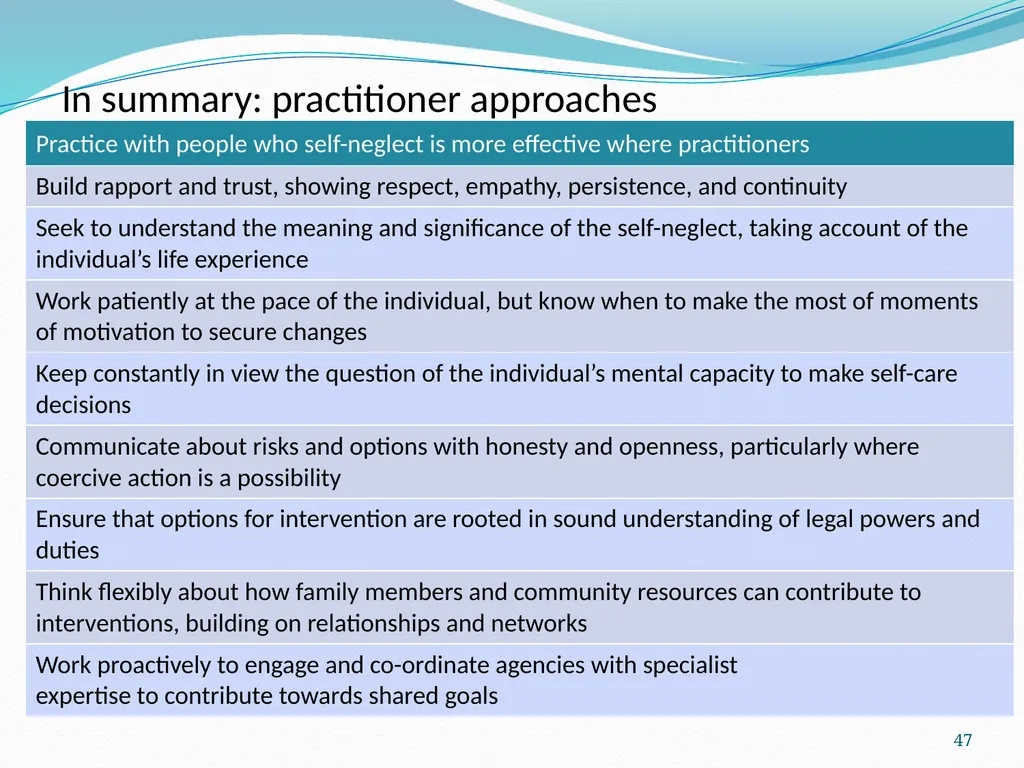
In summary: practitioner approaches 47<br>
48
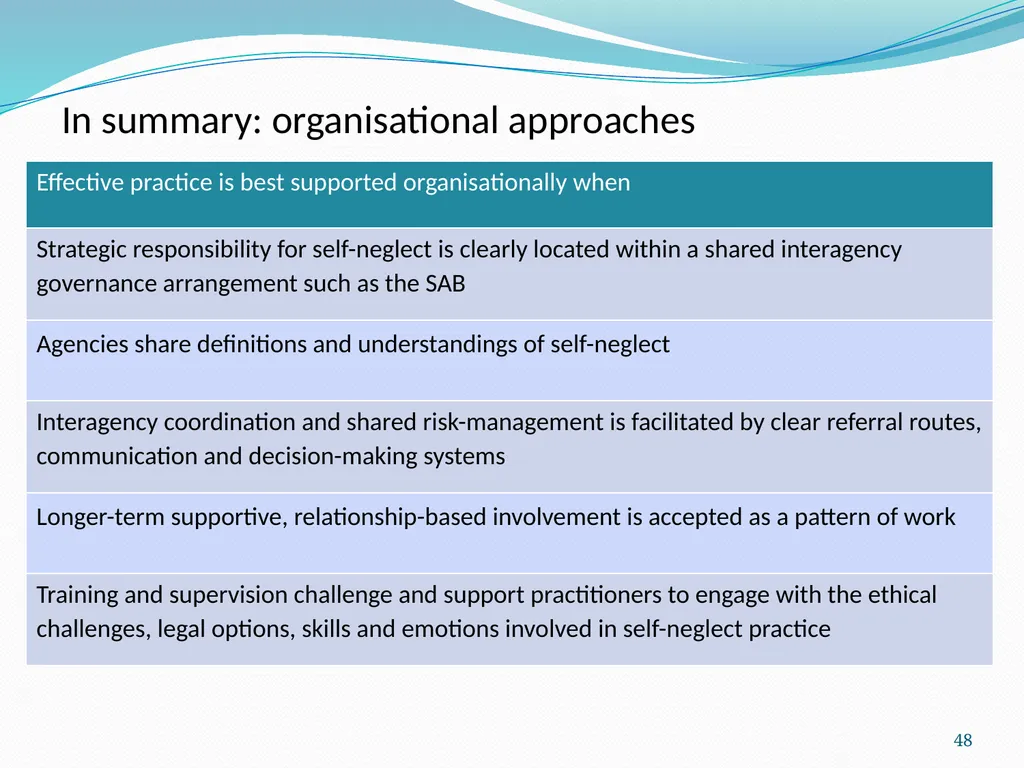
In summary: organisational approaches 48<br>
49
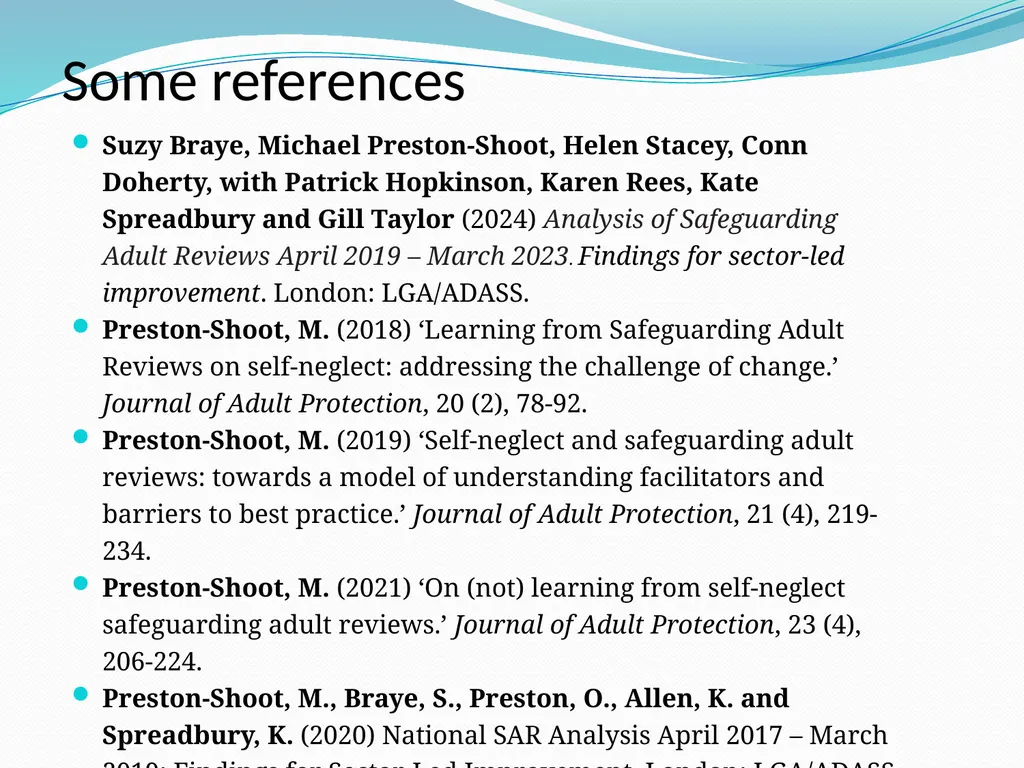
Some references Suzy Braye, Michael Preston-Shoot, Helen Stacey, Conn Doherty, with Patrick Hopkinson, Karen Rees, Kate Spreadbury and Gill Taylor (2024) Analysis of Safeguarding Adult Reviews April 2019 – March 2023. Findings for sector-led improvement. London: LGA/ADASS.
Preston-Shoot, M. (2018) ‘Learning from Safeguarding Adult Reviews on self-neglect: addressing the challenge of change.’ Journal of Adult Protection, 20 (2), 78-92.
Preston-Shoot, M. (2019) ‘Self-neglect and safeguarding adult reviews: towards a model of understanding facilitators and barriers to best practice.’ Journal of Adult Protection, 21 (4), 219-234.
Preston-Shoot, M. (2021) ‘On (not) learning from self-neglect safeguarding adult reviews.’ Journal of Adult Protection, 23 (4), 206-224.
Preston-Shoot, M., Braye, S., Preston, O., Allen, K. and Spreadbury, K. (2020) National SAR Analysis April 2017 – March 2019: Findings for Sector-Led Improvement. London: LGA/ADASS.<br>
Preston-Shoot, M. (2018) ‘Learning from Safeguarding Adult Reviews on self-neglect: addressing the challenge of change.’ Journal of Adult Protection, 20 (2), 78-92.
Preston-Shoot, M. (2019) ‘Self-neglect and safeguarding adult reviews: towards a model of understanding facilitators and barriers to best practice.’ Journal of Adult Protection, 21 (4), 219-234.
Preston-Shoot, M. (2021) ‘On (not) learning from self-neglect safeguarding adult reviews.’ Journal of Adult Protection, 23 (4), 206-224.
Preston-Shoot, M., Braye, S., Preston, O., Allen, K. and Spreadbury, K. (2020) National SAR Analysis April 2017 – March 2019: Findings for Sector-Led Improvement. London: LGA/ADASS.<br>
50
Professor Michael Preston-Shoot Independent Chair, Greenwich Safeguarding Adults Board
Independent Chair, Somerset Safeguarding Adults Board
Convenor, National Network SAB Chairs Adult Safeguarding Consultant
SAR author
michael.preston-shoot@beds.ac.uk<br>
Independent Chair, Somerset Safeguarding Adults Board
Convenor, National Network SAB Chairs Adult Safeguarding Consultant
SAR author
michael.preston-shoot@beds.ac.uk<br>