
self-neglect: what works? The evidence-base for
JO
Published · 26 slides · 0 views

1 / 1



Description
self-neglect: what works? The evidence-base for best practice from research, safeguarding adult reviews and experts by experience Somerset SAB, February 2023 The Evidence-Base What people with lived experience say about working with them
Related Topics
Share
Embed code
Download this presentation From Below
"self-neglect: what works? The evidence-base for" is the property of its rightful owner. Permission is granted to download and print the materials on this website for personal, non-commercial use only, and to display it on your personal computer provided you do not modify the materials and that you retain all copyright notices contained in the materials. By downloading content from our website, you accept the terms of this agreement.
Presentation Transcript
01
self-neglect: what works? The evidence-base for best practice from research, safeguarding adult reviews and experts by experience
Somerset SAB, February 2023<br>
Somerset SAB, February 2023<br>
02
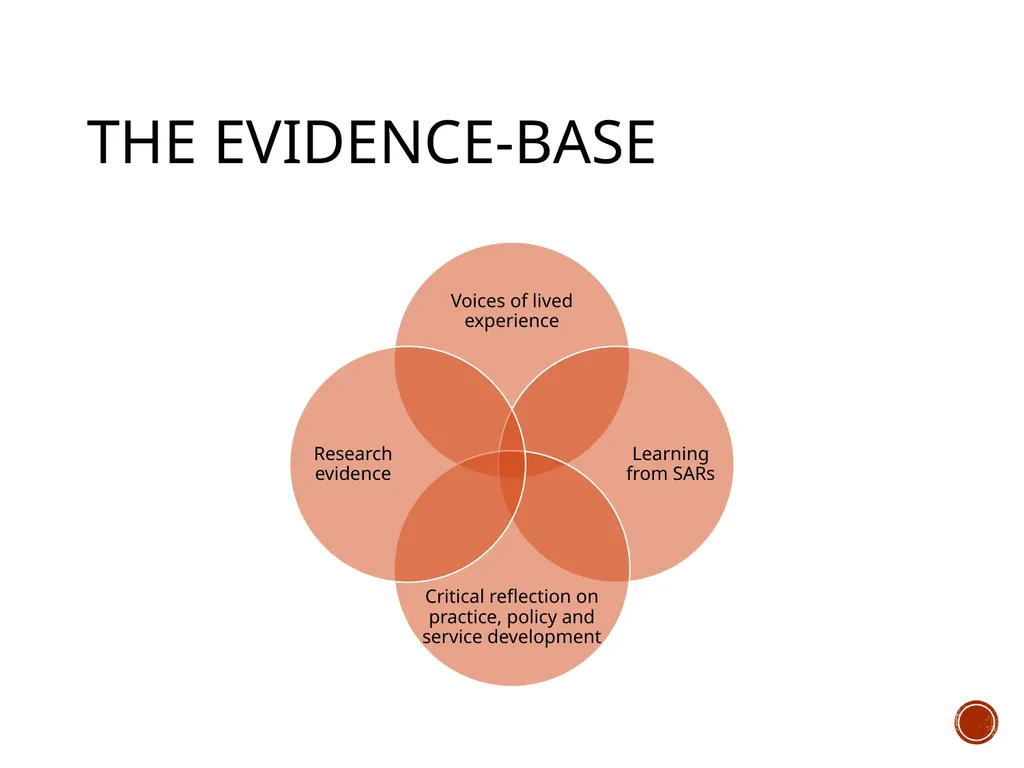
The Evidence-Base<br>
03
What people with lived experience say about working with them Engagement – recognise that people may be wary of professionals and services, possibly due to past experiences of institutions and the care system; appreciate that individuals may feel alone, fearful, helpless, confused, excluded, suicidal and depressed, unable to see a way out.
Professional curiosity – “I was not asked ‘why?’” There is always more to know. Experiences (traumas) had a “lasting effect on me.” “Appreciate the beginning of the journey.”
Partnership – “work with me, involve me, and support me.” “Keep in touch so that we know what is going on.” Help with form filling, bank accounts and other practicalities.
Person-centred – see the person and, where necessary, adapt our approach; “people did not see beyond the sleeping bag”; challenge misconceptions of people who are self-neglect and any evidence of assumptions (unconscious bias) that someone may be undeserving; there are multiple reasons behind why a person may self-neglect and/or become homeless.
Assessment – what does this individual need? Do not assume or stereotype.
Language – be careful and respectful about the language we use; words and phrases can betray assumptions. For example, who is not engaging? What does substance misuse imply?<br>
Professional curiosity – “I was not asked ‘why?’” There is always more to know. Experiences (traumas) had a “lasting effect on me.” “Appreciate the beginning of the journey.”
Partnership – “work with me, involve me, and support me.” “Keep in touch so that we know what is going on.” Help with form filling, bank accounts and other practicalities.
Person-centred – see the person and, where necessary, adapt our approach; “people did not see beyond the sleeping bag”; challenge misconceptions of people who are self-neglect and any evidence of assumptions (unconscious bias) that someone may be undeserving; there are multiple reasons behind why a person may self-neglect and/or become homeless.
Assessment – what does this individual need? Do not assume or stereotype.
Language – be careful and respectful about the language we use; words and phrases can betray assumptions. For example, who is not engaging? What does substance misuse imply?<br>
04
Learning from the voices of lived experience Seeing the whole person in their situation
A trauma-informed, whole system response to the person in context
Being careful and care-ful when thinking about removing a coping strategy
In the context of people’s experiences of multiple exclusion homelessness, the notion of lifestyle choice is erroneous
Tackling symptoms is less effective than addressing causes.
Attempting to change someone’s behaviour without understanding its survival function will prove unsuccessful. The presenting problem is a way of coping, however dysfunctional it may appear. Put another way, individuals experiencing self-neglect are in a “life threatening double bind, driven addictively to avoid suffering through ways that only deepen their suffering.”<br>
A trauma-informed, whole system response to the person in context
Being careful and care-ful when thinking about removing a coping strategy
In the context of people’s experiences of multiple exclusion homelessness, the notion of lifestyle choice is erroneous
Tackling symptoms is less effective than addressing causes.
Attempting to change someone’s behaviour without understanding its survival function will prove unsuccessful. The presenting problem is a way of coping, however dysfunctional it may appear. Put another way, individuals experiencing self-neglect are in a “life threatening double bind, driven addictively to avoid suffering through ways that only deepen their suffering.”<br>
05
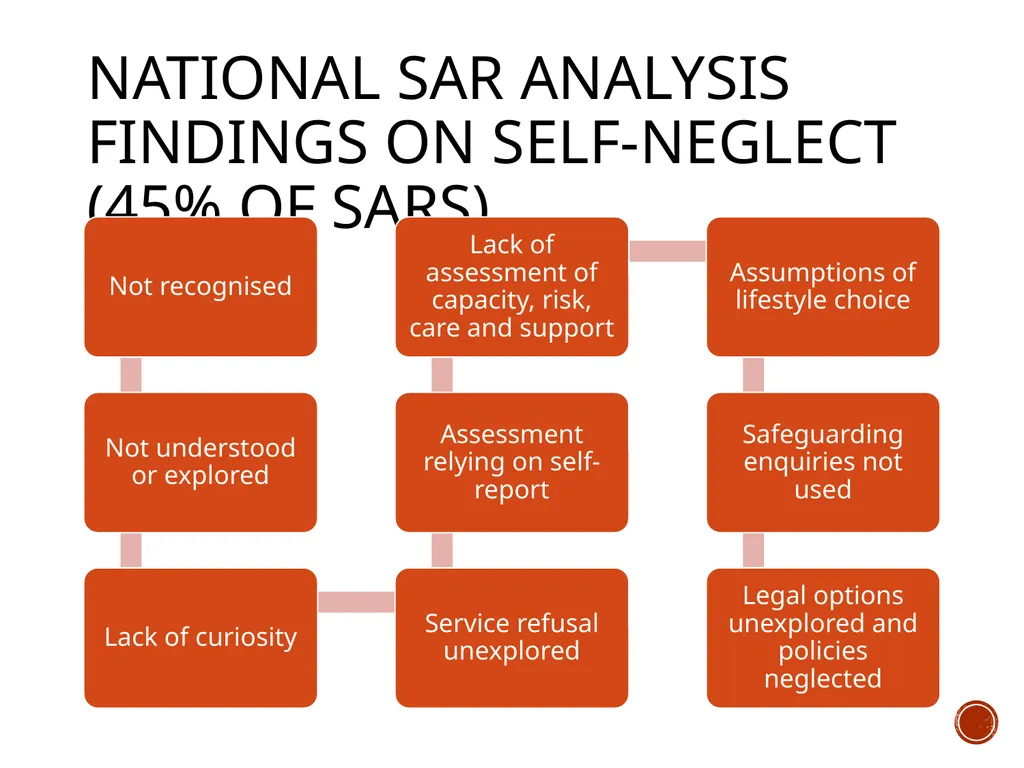
National SAR Analysis Findings on self-neglect (45% of SARs)<br>
06
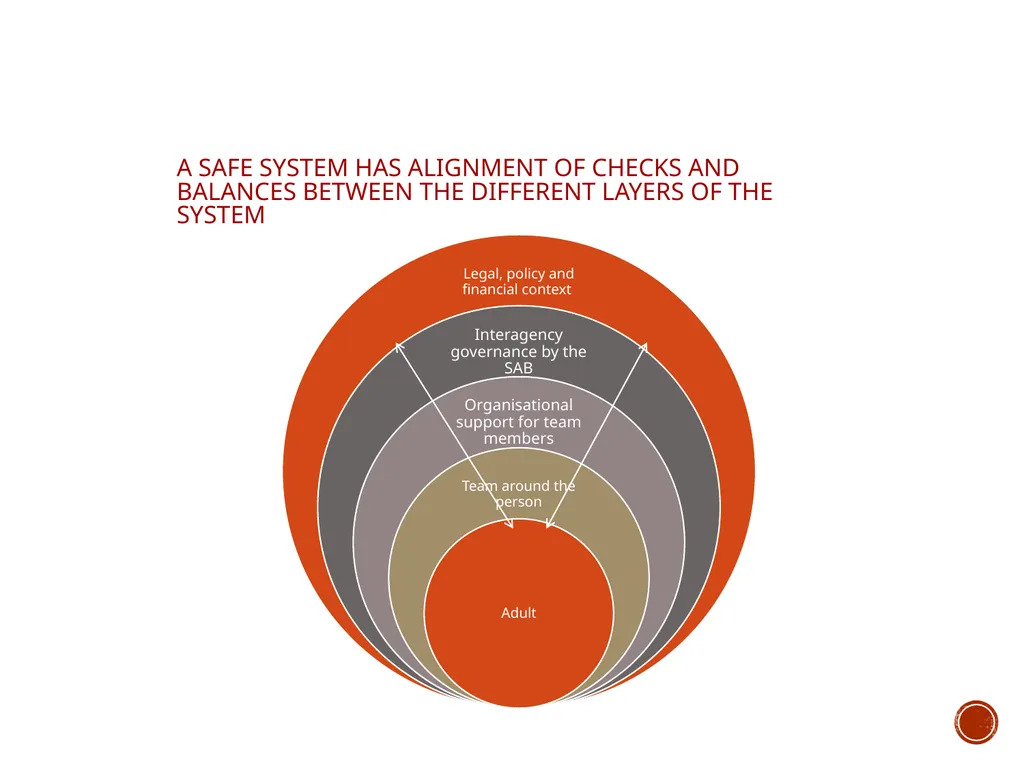
A safe system has alignment of checks and balances between the different layers of the system<br>
07
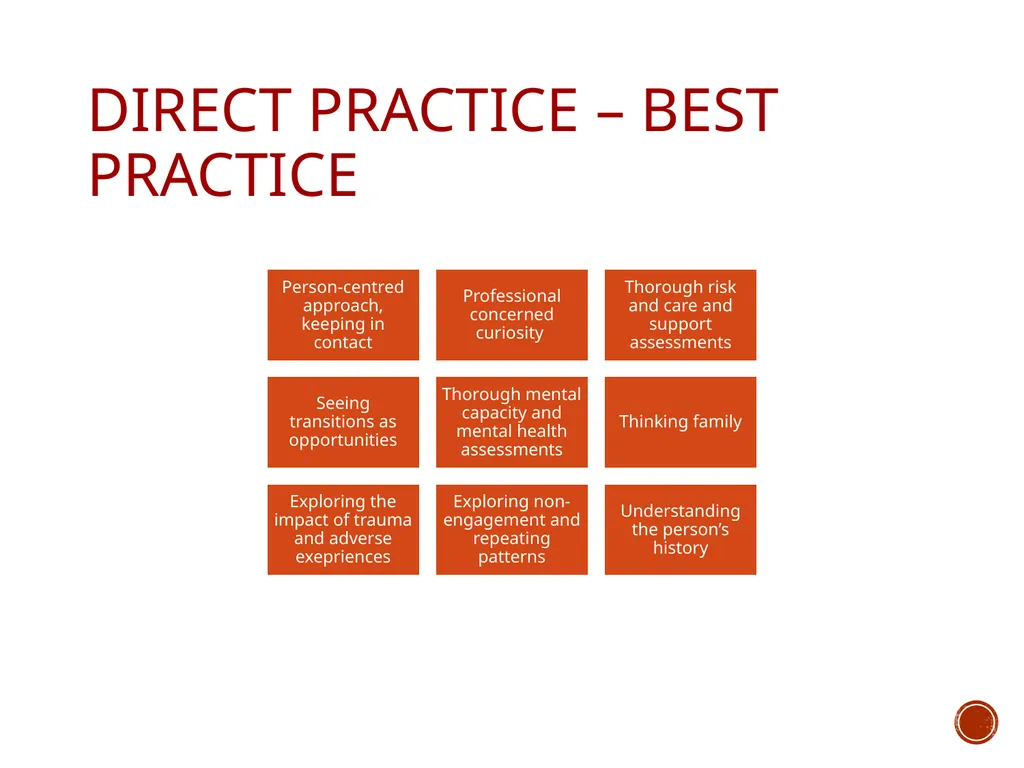
Direct practice – best practice<br>
08
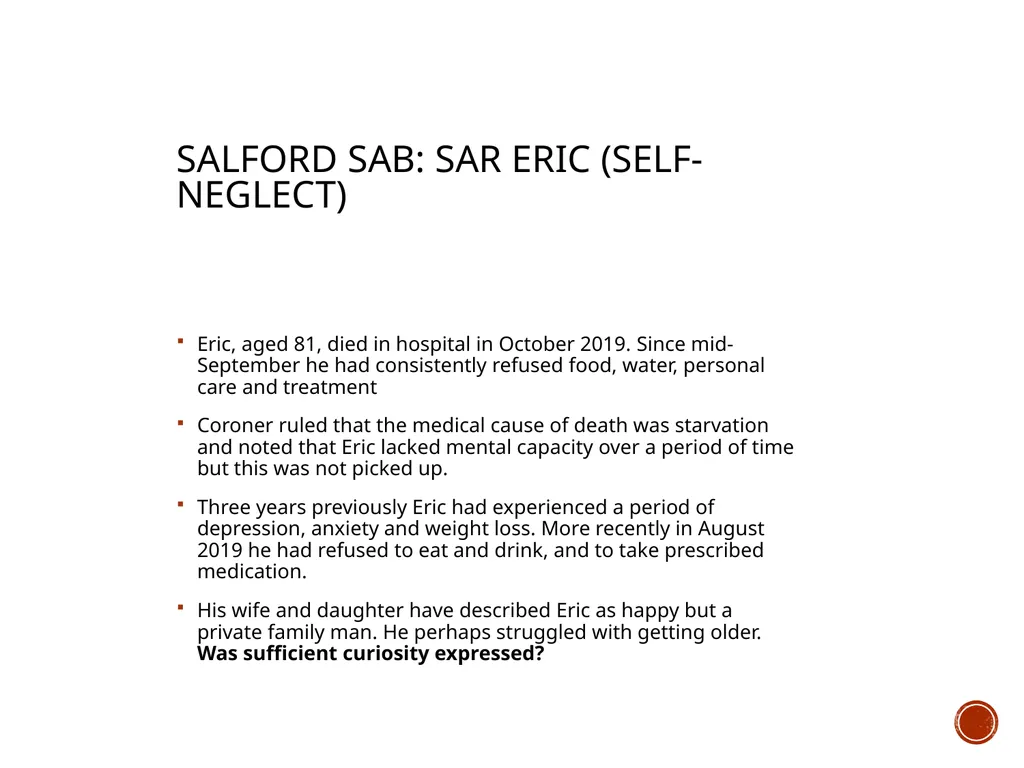
Salford SAB: SAR Eric (self-neglect) Eric, aged 81, died in hospital in October 2019. Since mid-September he had consistently refused food, water, personal care and treatment
Coroner ruled that the medical cause of death was starvation and noted that Eric lacked mental capacity over a period of time but this was not picked up.
Three years previously Eric had experienced a period of depression, anxiety and weight loss. More recently in August 2019 he had refused to eat and drink, and to take prescribed medication.
His wife and daughter have described Eric as happy but a private family man. He perhaps struggled with getting older. Was sufficient curiosity expressed?<br>
Coroner ruled that the medical cause of death was starvation and noted that Eric lacked mental capacity over a period of time but this was not picked up.
Three years previously Eric had experienced a period of depression, anxiety and weight loss. More recently in August 2019 he had refused to eat and drink, and to take prescribed medication.
His wife and daughter have described Eric as happy but a private family man. He perhaps struggled with getting older. Was sufficient curiosity expressed?<br>
09
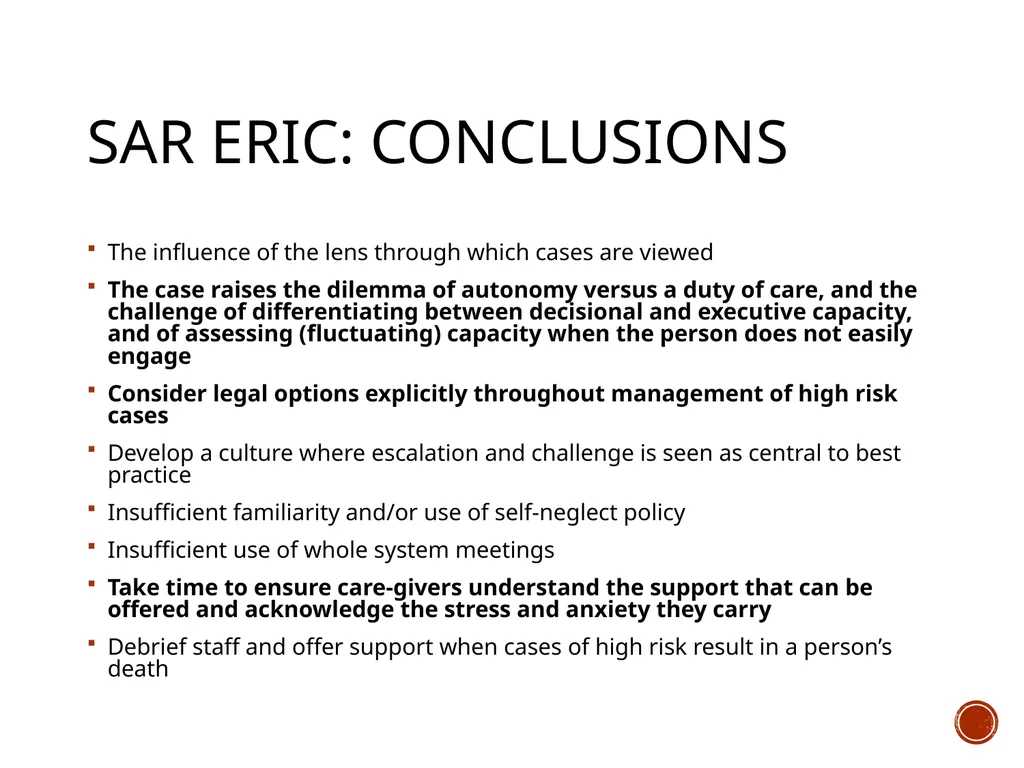
SAR Eric: Conclusions The influence of the lens through which cases are viewed
The case raises the dilemma of autonomy versus a duty of care, and the challenge of differentiating between decisional and executive capacity, and of assessing (fluctuating) capacity when the person does not easily engage
Consider legal options explicitly throughout management of high risk cases
Develop a culture where escalation and challenge is seen as central to best practice
Insufficient familiarity and/or use of self-neglect policy
Insufficient use of whole system meetings
Take time to ensure care-givers understand the support that can be offered and acknowledge the stress and anxiety they carry
Debrief staff and offer support when cases of high risk result in a person’s death<br>
The case raises the dilemma of autonomy versus a duty of care, and the challenge of differentiating between decisional and executive capacity, and of assessing (fluctuating) capacity when the person does not easily engage
Consider legal options explicitly throughout management of high risk cases
Develop a culture where escalation and challenge is seen as central to best practice
Insufficient familiarity and/or use of self-neglect policy
Insufficient use of whole system meetings
Take time to ensure care-givers understand the support that can be offered and acknowledge the stress and anxiety they carry
Debrief staff and offer support when cases of high risk result in a person’s death<br>
10
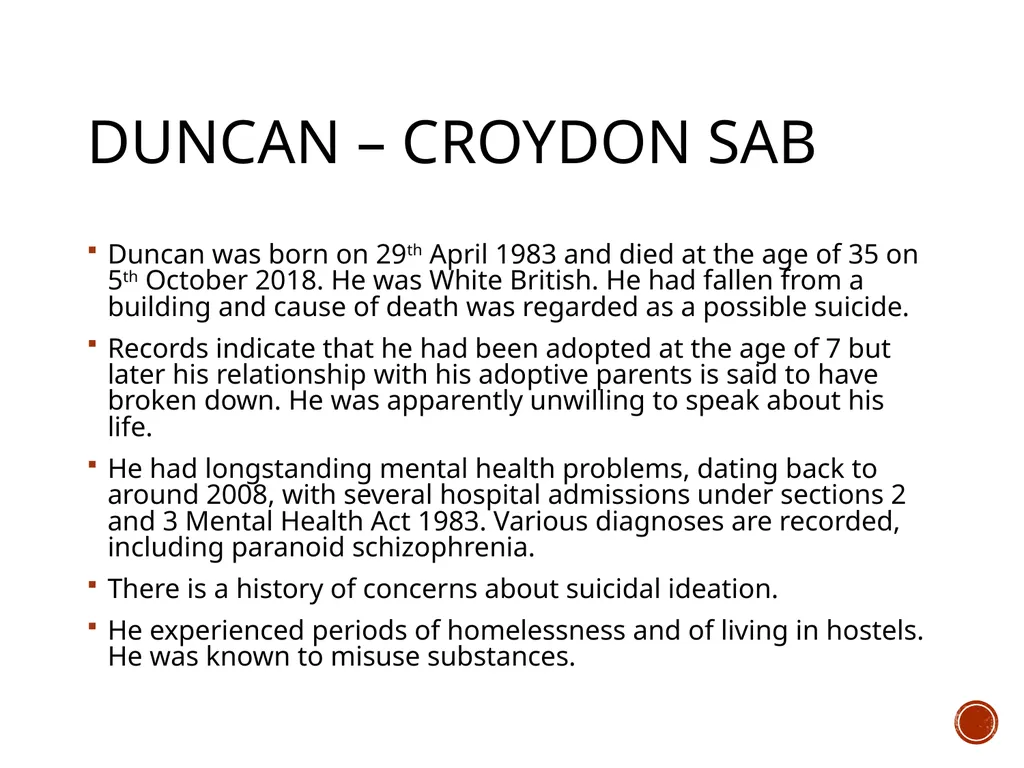
Duncan – Croydon SAB Duncan was born on 29th April 1983 and died at the age of 35 on 5th October 2018. He was White British. He had fallen from a building and cause of death was regarded as a possible suicide.
Records indicate that he had been adopted at the age of 7 but later his relationship with his adoptive parents is said to have broken down. He was apparently unwilling to speak about his life.
He had longstanding mental health problems, dating back to around 2008, with several hospital admissions under sections 2 and 3 Mental Health Act 1983. Various diagnoses are recorded, including paranoid schizophrenia.
There is a history of concerns about suicidal ideation.
He experienced periods of homelessness and of living in hostels. He was known to misuse substances.<br>
Records indicate that he had been adopted at the age of 7 but later his relationship with his adoptive parents is said to have broken down. He was apparently unwilling to speak about his life.
He had longstanding mental health problems, dating back to around 2008, with several hospital admissions under sections 2 and 3 Mental Health Act 1983. Various diagnoses are recorded, including paranoid schizophrenia.
There is a history of concerns about suicidal ideation.
He experienced periods of homelessness and of living in hostels. He was known to misuse substances.<br>
11
Duncan – amongst the findings were Duncan wished to live independently but this option was not pursued. How well are we working with people who present with multiple needs and who find it difficult to engage? Are they not engaging with us or are we not engaging with them? How well do we know the people we are working with? Is there sufficient focus on the impact of trauma and adverse experiences? (MSP)
Duncan had several admissions under section 3 mental Health Act 1983 but there is no reference to a section 117 after-care plan. Are we assured about after-care planning for people detained under longer-term sections in MHA 1983? Are we assured about the effectiveness of the Care Programme Approach? Duncan was ultimately discharged from the CPA without an updated risk assessment and with ongoing mental health concerns. Is this common practice?
There were missed opportunities to update and share Duncan’s risk assessment. Are we assured about the quality of risk assessments, including of suicidal ideation? Duncan did not receive a section 9 Care Act 2014 assessment for care and support needs.<br>
Duncan had several admissions under section 3 mental Health Act 1983 but there is no reference to a section 117 after-care plan. Are we assured about after-care planning for people detained under longer-term sections in MHA 1983? Are we assured about the effectiveness of the Care Programme Approach? Duncan was ultimately discharged from the CPA without an updated risk assessment and with ongoing mental health concerns. Is this common practice?
There were missed opportunities to update and share Duncan’s risk assessment. Are we assured about the quality of risk assessments, including of suicidal ideation? Duncan did not receive a section 9 Care Act 2014 assessment for care and support needs.<br>
12
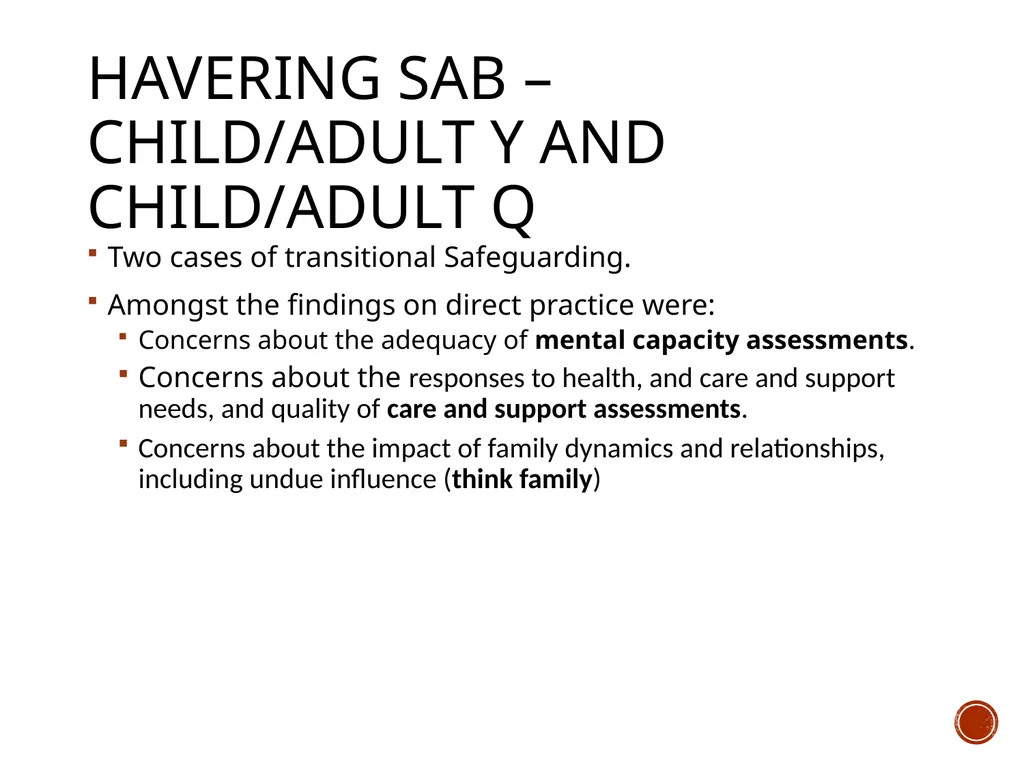
Havering SAB – Child/Adult Y and Child/Adult Q Two cases of transitional Safeguarding.
Amongst the findings on direct practice were:
Concerns about the adequacy of mental capacity assessments.
Concerns about the responses to health, and care and support needs, and quality of care and support assessments.
Concerns about the impact of family dynamics and relationships, including undue influence (think family)<br>
Amongst the findings on direct practice were:
Concerns about the adequacy of mental capacity assessments.
Concerns about the responses to health, and care and support needs, and quality of care and support assessments.
Concerns about the impact of family dynamics and relationships, including undue influence (think family)<br>
13
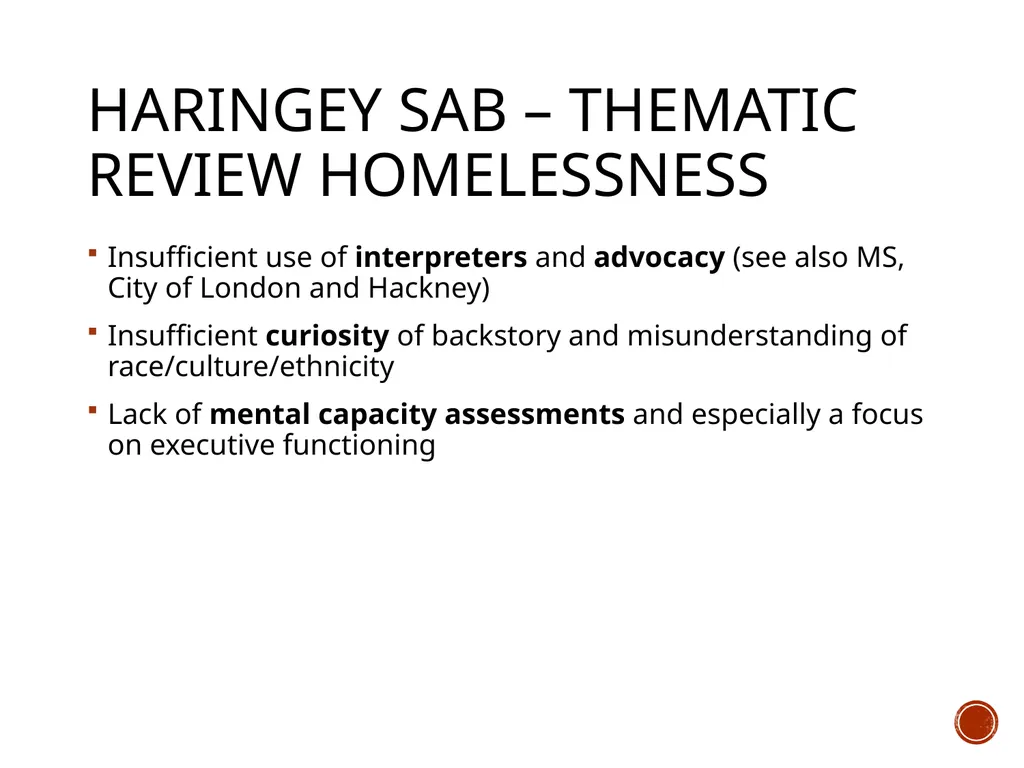
Haringey SAB – Thematic Review Homelessness Insufficient use of interpreters and advocacy (see also MS, City of London and Hackney)
Insufficient curiosity of backstory and misunderstanding of race/culture/ethnicity
Lack of mental capacity assessments and especially a focus on executive functioning<br>
Insufficient curiosity of backstory and misunderstanding of race/culture/ethnicity
Lack of mental capacity assessments and especially a focus on executive functioning<br>
14
National guidance (NICE 2018) and Case Law on Executive Functioning Practitioners should be aware that it may be more difficult to assess capacity in people with executive dysfunction – for example people with traumatic brain injury. Structured assessments of capacity for individuals in this group (for example, by way of interview) may therefore need to be supplemented by real world observation of the person's functioning and decision-making ability in order to provide the assessor with a complete picture of an individual's decision-making ability.
Decision-making and mental capacity guidance (para 1.4.19)
Sunderland City Council v AS and Others [2020] EWCOP 13
Importance of real world observation to obtain a full picture.
A Local Authority v AW [2020] EWCOP 24
Ability to think, act and solve problems include the functions of the brain which help us to learn new information, remember and retrieve the information we’ve learned in the past, and use this information to solve problems of everyday life.<br>
Decision-making and mental capacity guidance (para 1.4.19)
Sunderland City Council v AS and Others [2020] EWCOP 13
Importance of real world observation to obtain a full picture.
A Local Authority v AW [2020] EWCOP 24
Ability to think, act and solve problems include the functions of the brain which help us to learn new information, remember and retrieve the information we’ve learned in the past, and use this information to solve problems of everyday life.<br>
15
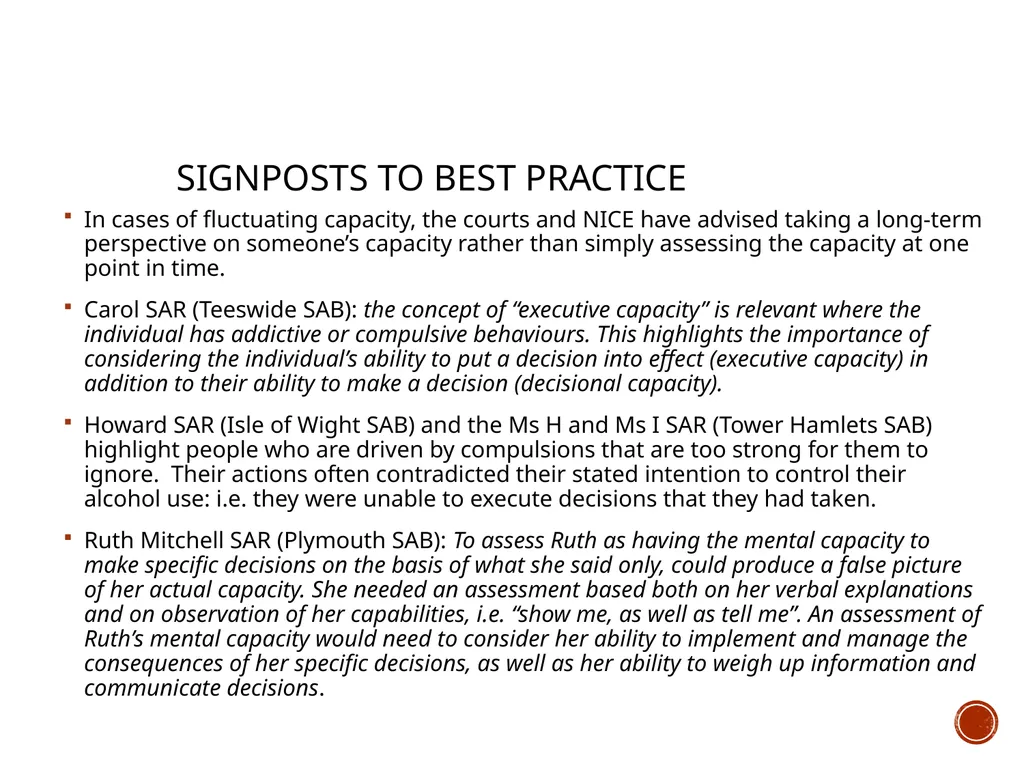
Signposts to best practice In cases of fluctuating capacity, the courts and NICE have advised taking a long-term perspective on someone’s capacity rather than simply assessing the capacity at one point in time.
Carol SAR (Teeswide SAB): the concept of “executive capacity” is relevant where the individual has addictive or compulsive behaviours. This highlights the importance of considering the individual’s ability to put a decision into effect (executive capacity) in addition to their ability to make a decision (decisional capacity).
Howard SAR (Isle of Wight SAB) and the Ms H and Ms I SAR (Tower Hamlets SAB) highlight people who are driven by compulsions that are too strong for them to ignore. Their actions often contradicted their stated intention to control their alcohol use: i.e. they were unable to execute decisions that they had taken.
Ruth Mitchell SAR (Plymouth SAB): To assess Ruth as having the mental capacity to make specific decisions on the basis of what she said only, could produce a false picture of her actual capacity. She needed an assessment based both on her verbal explanations and on observation of her capabilities, i.e. “show me, as well as tell me”. An assessment of Ruth’s mental capacity would need to consider her ability to implement and manage the consequences of her specific decisions, as well as her ability to weigh up information and communicate decisions.<br>
Carol SAR (Teeswide SAB): the concept of “executive capacity” is relevant where the individual has addictive or compulsive behaviours. This highlights the importance of considering the individual’s ability to put a decision into effect (executive capacity) in addition to their ability to make a decision (decisional capacity).
Howard SAR (Isle of Wight SAB) and the Ms H and Ms I SAR (Tower Hamlets SAB) highlight people who are driven by compulsions that are too strong for them to ignore. Their actions often contradicted their stated intention to control their alcohol use: i.e. they were unable to execute decisions that they had taken.
Ruth Mitchell SAR (Plymouth SAB): To assess Ruth as having the mental capacity to make specific decisions on the basis of what she said only, could produce a false picture of her actual capacity. She needed an assessment based both on her verbal explanations and on observation of her capabilities, i.e. “show me, as well as tell me”. An assessment of Ruth’s mental capacity would need to consider her ability to implement and manage the consequences of her specific decisions, as well as her ability to weigh up information and communicate decisions.<br>
16
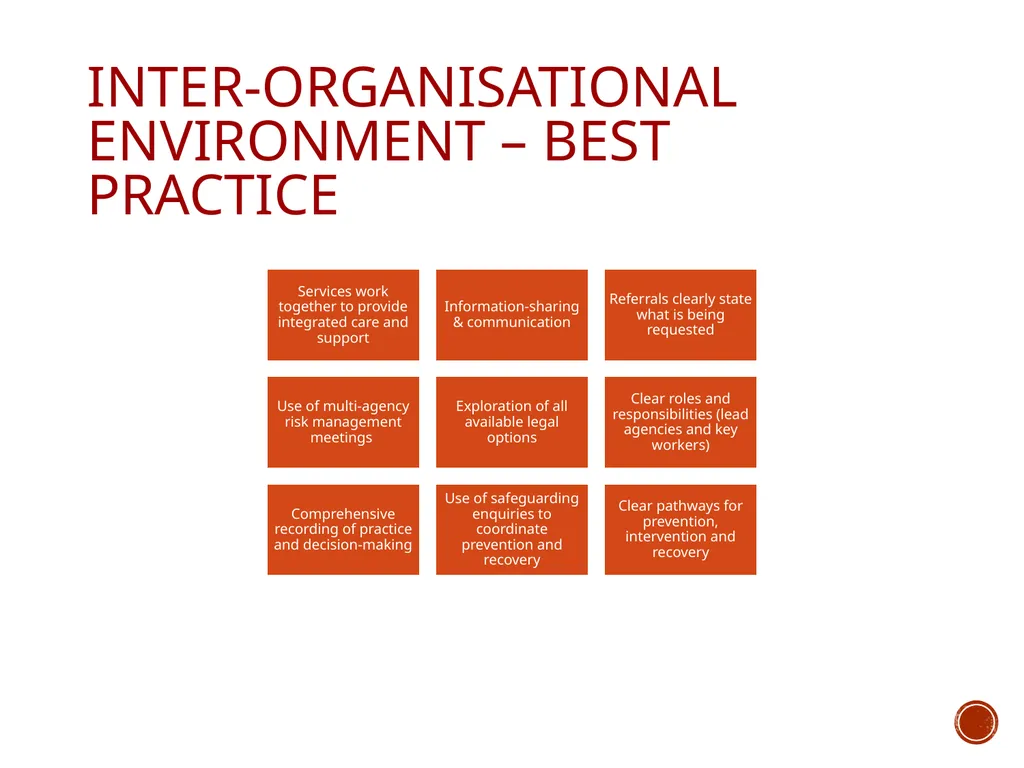
Inter-organisational environment – best practice<br>
17
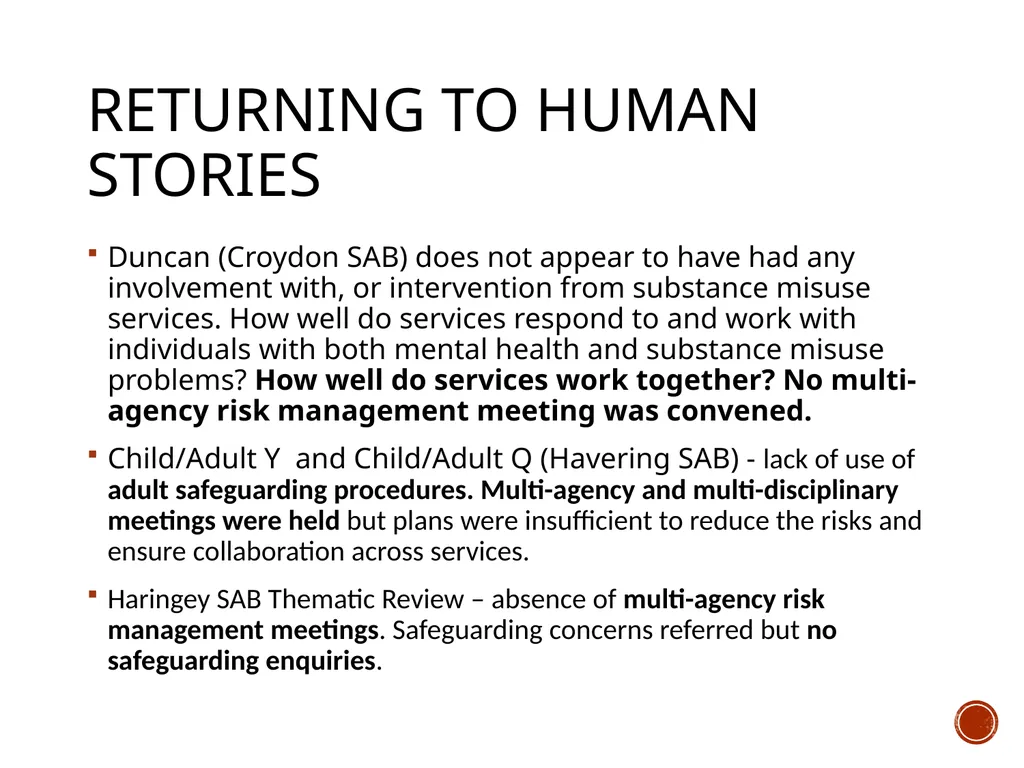
Returning to human stories Duncan (Croydon SAB) does not appear to have had any involvement with, or intervention from substance misuse services. How well do services respond to and work with individuals with both mental health and substance misuse problems? How well do services work together? No multi-agency risk management meeting was convened.
Child/Adult Y and Child/Adult Q (Havering SAB) - lack of use of adult safeguarding procedures. Multi-agency and multi-disciplinary meetings were held but plans were insufficient to reduce the risks and ensure collaboration across services.
Haringey SAB Thematic Review – absence of multi-agency risk management meetings. Safeguarding concerns referred but no safeguarding enquiries.<br>
Child/Adult Y and Child/Adult Q (Havering SAB) - lack of use of adult safeguarding procedures. Multi-agency and multi-disciplinary meetings were held but plans were insufficient to reduce the risks and ensure collaboration across services.
Haringey SAB Thematic Review – absence of multi-agency risk management meetings. Safeguarding concerns referred but no safeguarding enquiries.<br>
18
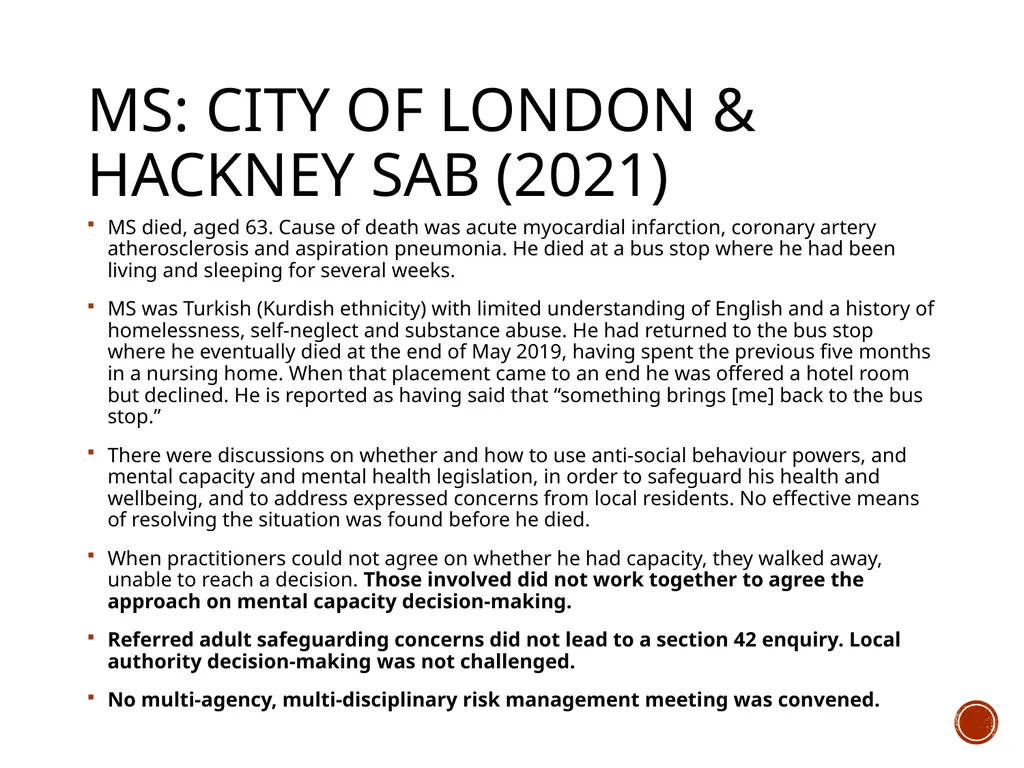
MS: City of London & Hackney SAB (2021) MS died, aged 63. Cause of death was acute myocardial infarction, coronary artery atherosclerosis and aspiration pneumonia. He died at a bus stop where he had been living and sleeping for several weeks.
MS was Turkish (Kurdish ethnicity) with limited understanding of English and a history of homelessness, self-neglect and substance abuse. He had returned to the bus stop where he eventually died at the end of May 2019, having spent the previous five months in a nursing home. When that placement came to an end he was offered a hotel room but declined. He is reported as having said that “something brings [me] back to the bus stop.”
There were discussions on whether and how to use anti-social behaviour powers, and mental capacity and mental health legislation, in order to safeguard his health and wellbeing, and to address expressed concerns from local residents. No effective means of resolving the situation was found before he died.
When practitioners could not agree on whether he had capacity, they walked away, unable to reach a decision. Those involved did not work together to agree the approach on mental capacity decision-making.
Referred adult safeguarding concerns did not lead to a section 42 enquiry. Local authority decision-making was not challenged.
No multi-agency, multi-disciplinary risk management meeting was convened.<br>
MS was Turkish (Kurdish ethnicity) with limited understanding of English and a history of homelessness, self-neglect and substance abuse. He had returned to the bus stop where he eventually died at the end of May 2019, having spent the previous five months in a nursing home. When that placement came to an end he was offered a hotel room but declined. He is reported as having said that “something brings [me] back to the bus stop.”
There were discussions on whether and how to use anti-social behaviour powers, and mental capacity and mental health legislation, in order to safeguard his health and wellbeing, and to address expressed concerns from local residents. No effective means of resolving the situation was found before he died.
When practitioners could not agree on whether he had capacity, they walked away, unable to reach a decision. Those involved did not work together to agree the approach on mental capacity decision-making.
Referred adult safeguarding concerns did not lead to a section 42 enquiry. Local authority decision-making was not challenged.
No multi-agency, multi-disciplinary risk management meeting was convened.<br>
19
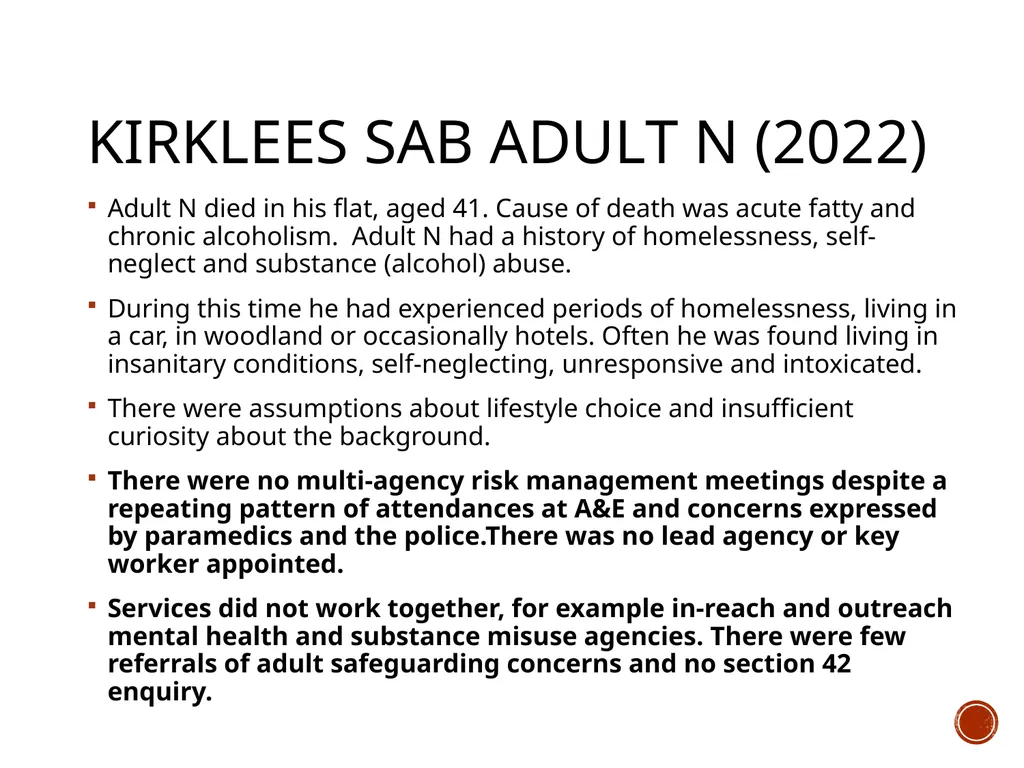
Kirklees SAB Adult N (2022) Adult N died in his flat, aged 41. Cause of death was acute fatty and chronic alcoholism. Adult N had a history of homelessness, self-neglect and substance (alcohol) abuse.
During this time he had experienced periods of homelessness, living in a car, in woodland or occasionally hotels. Often he was found living in insanitary conditions, self-neglecting, unresponsive and intoxicated.
There were assumptions about lifestyle choice and insufficient curiosity about the background.
There were no multi-agency risk management meetings despite a repeating pattern of attendances at A&E and concerns expressed by paramedics and the police.There was no lead agency or key worker appointed.
Services did not work together, for example in-reach and outreach mental health and substance misuse agencies. There were few referrals of adult safeguarding concerns and no section 42 enquiry.<br>
During this time he had experienced periods of homelessness, living in a car, in woodland or occasionally hotels. Often he was found living in insanitary conditions, self-neglecting, unresponsive and intoxicated.
There were assumptions about lifestyle choice and insufficient curiosity about the background.
There were no multi-agency risk management meetings despite a repeating pattern of attendances at A&E and concerns expressed by paramedics and the police.There was no lead agency or key worker appointed.
Services did not work together, for example in-reach and outreach mental health and substance misuse agencies. There were few referrals of adult safeguarding concerns and no section 42 enquiry.<br>
20
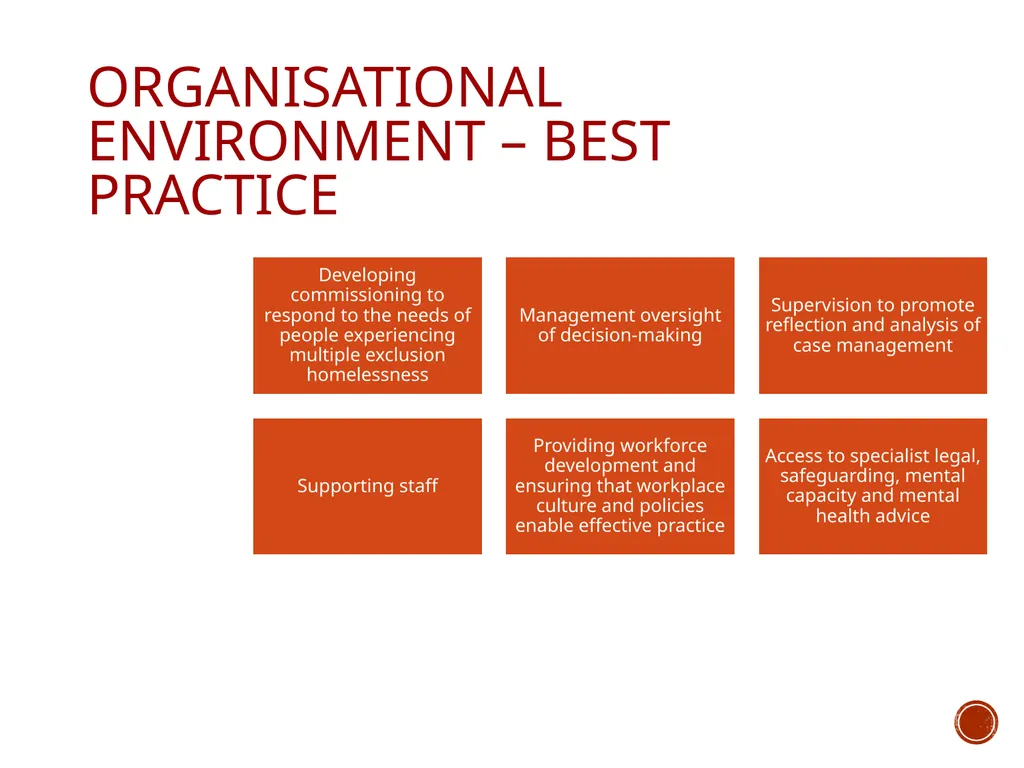
Organisational environment – best practice<br>
21
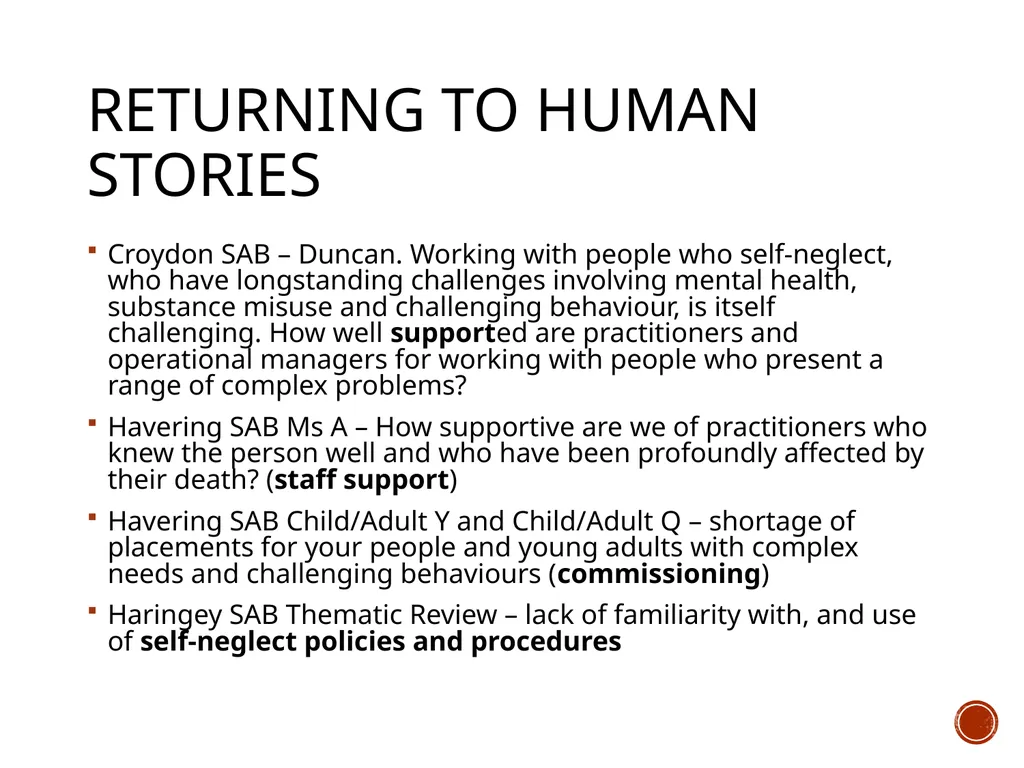
Returning to Human Stories Croydon SAB – Duncan. Working with people who self-neglect, who have longstanding challenges involving mental health, substance misuse and challenging behaviour, is itself challenging. How well supported are practitioners and operational managers for working with people who present a range of complex problems?
Havering SAB Ms A – How supportive are we of practitioners who knew the person well and who have been profoundly affected by their death? (staff support)
Havering SAB Child/Adult Y and Child/Adult Q – shortage of placements for your people and young adults with complex needs and challenging behaviours (commissioning)
Haringey SAB Thematic Review – lack of familiarity with, and use of self-neglect policies and procedures<br>
Havering SAB Ms A – How supportive are we of practitioners who knew the person well and who have been profoundly affected by their death? (staff support)
Havering SAB Child/Adult Y and Child/Adult Q – shortage of placements for your people and young adults with complex needs and challenging behaviours (commissioning)
Haringey SAB Thematic Review – lack of familiarity with, and use of self-neglect policies and procedures<br>
22
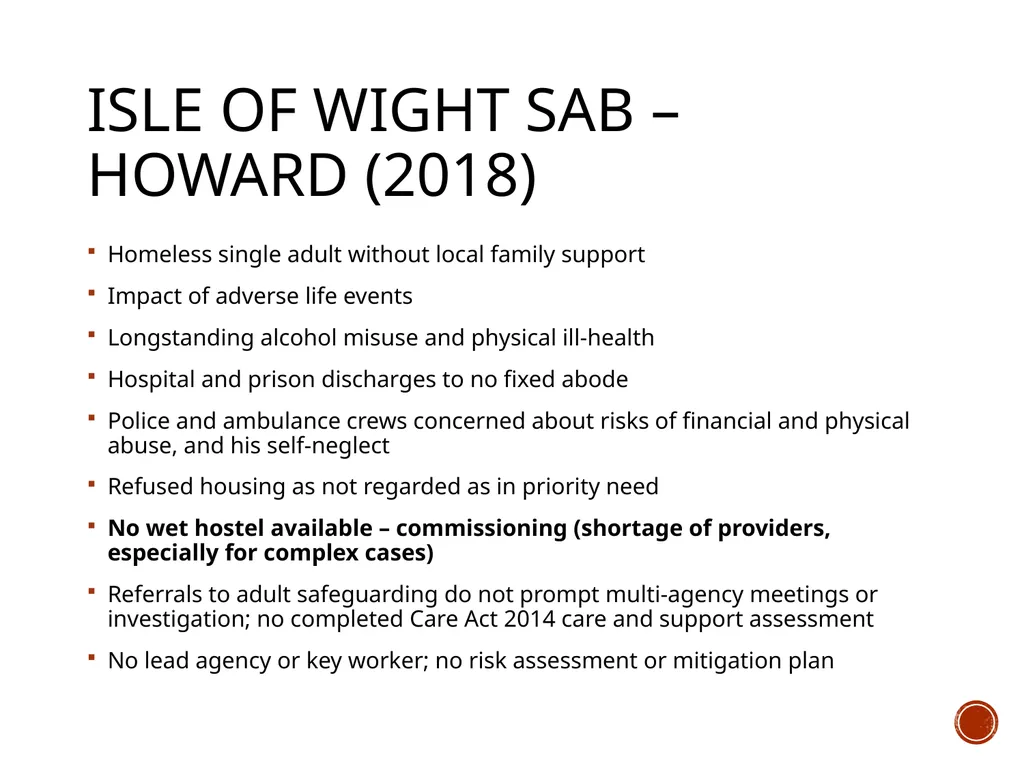
Isle of Wight SAB – Howard (2018) Homeless single adult without local family support
Impact of adverse life events
Longstanding alcohol misuse and physical ill-health
Hospital and prison discharges to no fixed abode
Police and ambulance crews concerned about risks of financial and physical abuse, and his self-neglect
Refused housing as not regarded as in priority need
No wet hostel available – commissioning (shortage of providers, especially for complex cases)
Referrals to adult safeguarding do not prompt multi-agency meetings or investigation; no completed Care Act 2014 care and support assessment
No lead agency or key worker; no risk assessment or mitigation plan<br>
Impact of adverse life events
Longstanding alcohol misuse and physical ill-health
Hospital and prison discharges to no fixed abode
Police and ambulance crews concerned about risks of financial and physical abuse, and his self-neglect
Refused housing as not regarded as in priority need
No wet hostel available – commissioning (shortage of providers, especially for complex cases)
Referrals to adult safeguarding do not prompt multi-agency meetings or investigation; no completed Care Act 2014 care and support assessment
No lead agency or key worker; no risk assessment or mitigation plan<br>
23
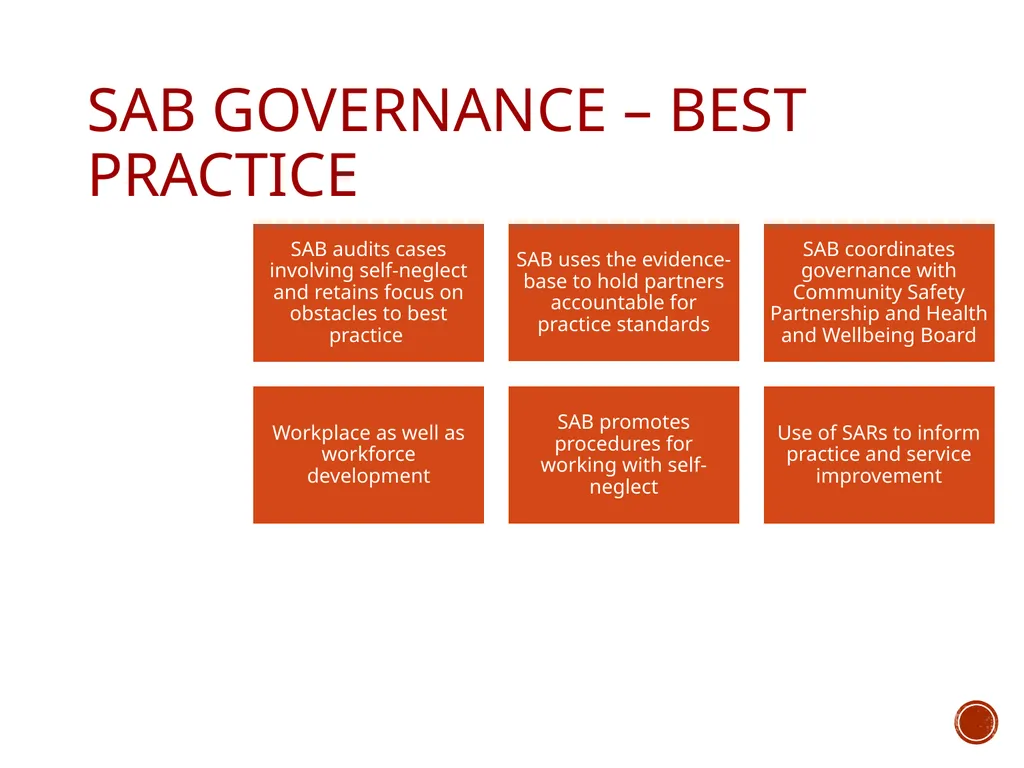
SAB governance – best practice<br>
24
Legal, policy and financial context Missing components in the legal rules
Ongoing impact of financial austerity
Government policies pulling against each other<br>
Ongoing impact of financial austerity
Government policies pulling against each other<br>
25
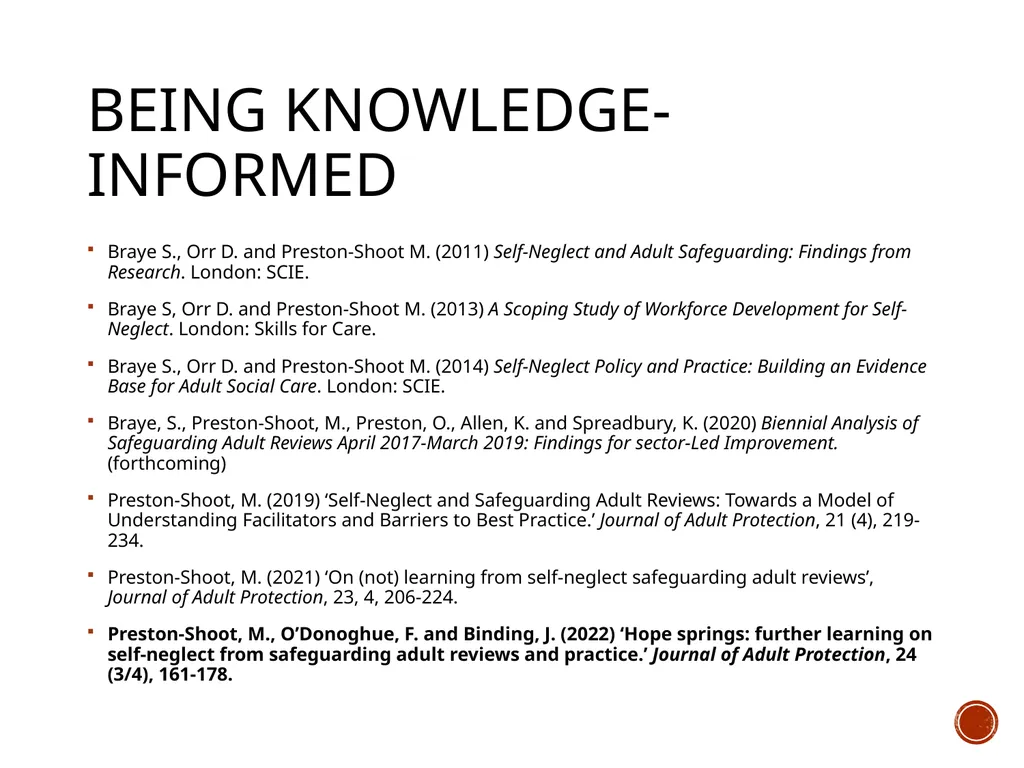
Being Knowledge-Informed Braye S., Orr D. and Preston-Shoot M. (2011) Self-Neglect and Adult Safeguarding: Findings from Research. London: SCIE.
Braye S, Orr D. and Preston-Shoot M. (2013) A Scoping Study of Workforce Development for Self-Neglect. London: Skills for Care.
Braye S., Orr D. and Preston-Shoot M. (2014) Self-Neglect Policy and Practice: Building an Evidence Base for Adult Social Care. London: SCIE.
Braye, S., Preston-Shoot, M., Preston, O., Allen, K. and Spreadbury, K. (2020) Biennial Analysis of Safeguarding Adult Reviews April 2017-March 2019: Findings for sector-Led Improvement. (forthcoming)
Preston-Shoot, M. (2019) ‘Self-Neglect and Safeguarding Adult Reviews: Towards a Model of Understanding Facilitators and Barriers to Best Practice.’ Journal of Adult Protection, 21 (4), 219-234.
Preston-Shoot, M. (2021) ‘On (not) learning from self-neglect safeguarding adult reviews’, Journal of Adult Protection, 23, 4, 206-224.
Preston-Shoot, M., O’Donoghue, F. and Binding, J. (2022) ‘Hope springs: further learning on self-neglect from safeguarding adult reviews and practice.’ Journal of Adult Protection, 24 (3/4), 161-178.<br>
Braye S, Orr D. and Preston-Shoot M. (2013) A Scoping Study of Workforce Development for Self-Neglect. London: Skills for Care.
Braye S., Orr D. and Preston-Shoot M. (2014) Self-Neglect Policy and Practice: Building an Evidence Base for Adult Social Care. London: SCIE.
Braye, S., Preston-Shoot, M., Preston, O., Allen, K. and Spreadbury, K. (2020) Biennial Analysis of Safeguarding Adult Reviews April 2017-March 2019: Findings for sector-Led Improvement. (forthcoming)
Preston-Shoot, M. (2019) ‘Self-Neglect and Safeguarding Adult Reviews: Towards a Model of Understanding Facilitators and Barriers to Best Practice.’ Journal of Adult Protection, 21 (4), 219-234.
Preston-Shoot, M. (2021) ‘On (not) learning from self-neglect safeguarding adult reviews’, Journal of Adult Protection, 23, 4, 206-224.
Preston-Shoot, M., O’Donoghue, F. and Binding, J. (2022) ‘Hope springs: further learning on self-neglect from safeguarding adult reviews and practice.’ Journal of Adult Protection, 24 (3/4), 161-178.<br>
26
Professor Michael Preston-Shoot Independent Chair, Greenwich Safeguarding Adults Board
Independent Chair, Lewisham Safeguarding Adults Board
Independent Chair, Somerset Safeguarding Adults Board
Joint Convenor, National Network SAB Chairs Adult Safeguarding Consultant
SAR author
michael.preston-shoot@beds.ac.uk<br>
Independent Chair, Lewisham Safeguarding Adults Board
Independent Chair, Somerset Safeguarding Adults Board
Joint Convenor, National Network SAB Chairs Adult Safeguarding Consultant
SAR author
michael.preston-shoot@beds.ac.uk<br>