
SEND at Athersley South Primary School Here you
SN
Published · 11 slides · 0 views

1 / 1

Description
SEND at Athersley South Primary School Here you will find slides which cover the following information: 1. What is SEND? 2. What are the areas of SEND? 3. What is a Disability? 4. Curriculum Provision for Children with SEND 5. SEND support
Related Topics
Share
Embed code
Download this presentation From Below
"SEND at Athersley South Primary School Here you" is the property of its rightful owner. Permission is granted to download and print the materials on this website for personal, non-commercial use only, and to display it on your personal computer provided you do not modify the materials and that you retain all copyright notices contained in the materials. By downloading content from our website, you accept the terms of this agreement.
Presentation Transcript
01
SEND at Athersley South Primary School Here you will find slides which cover the following information:
1. What is SEND?
2. What are the areas of SEND?
3. What is a Disability?
4. Curriculum Provision for Children with SEND
5. SEND support – The Process
6. Assessing and Evaluating the Needs of Children with SEND
7. Training and Expertise of Staff
8. How is Athersley South Primary School Accessible to children with SEND?
9. Transition to New Classes and School
10. Who Can I Contact If I Need Support About SEND? Updated September 2022<br>
1. What is SEND?
2. What are the areas of SEND?
3. What is a Disability?
4. Curriculum Provision for Children with SEND
5. SEND support – The Process
6. Assessing and Evaluating the Needs of Children with SEND
7. Training and Expertise of Staff
8. How is Athersley South Primary School Accessible to children with SEND?
9. Transition to New Classes and School
10. Who Can I Contact If I Need Support About SEND? Updated September 2022<br>
02
What is SEND? A child or young person has special educational needs if he or she has a learning difficulty or disability which calls for special educational provision to be made for him or her. (Children’s and Families Act 2014)
A child has a learning difficulty if he or she:
a) has a significantly greater difficulty in learning than the majority of children of the same age.
b) has a disability which either prevents or hinders the child from making use of educational facilities of a kind provided for children of the same age in schools within the area of the local education authority.
A child must not be regarded as having a learning difficulty solely because the language or form of language of the home is different from the language in which he or she is or will be taught.
Special educational provision means:
Additional to or different from what is made generally for other children or young people of the same age.
(Taken from the Special Educational Needs and Disability Code of Practice: 0 to 25 years January 2015) Updated September 2022<br>
A child has a learning difficulty if he or she:
a) has a significantly greater difficulty in learning than the majority of children of the same age.
b) has a disability which either prevents or hinders the child from making use of educational facilities of a kind provided for children of the same age in schools within the area of the local education authority.
A child must not be regarded as having a learning difficulty solely because the language or form of language of the home is different from the language in which he or she is or will be taught.
Special educational provision means:
Additional to or different from what is made generally for other children or young people of the same age.
(Taken from the Special Educational Needs and Disability Code of Practice: 0 to 25 years January 2015) Updated September 2022<br>
03
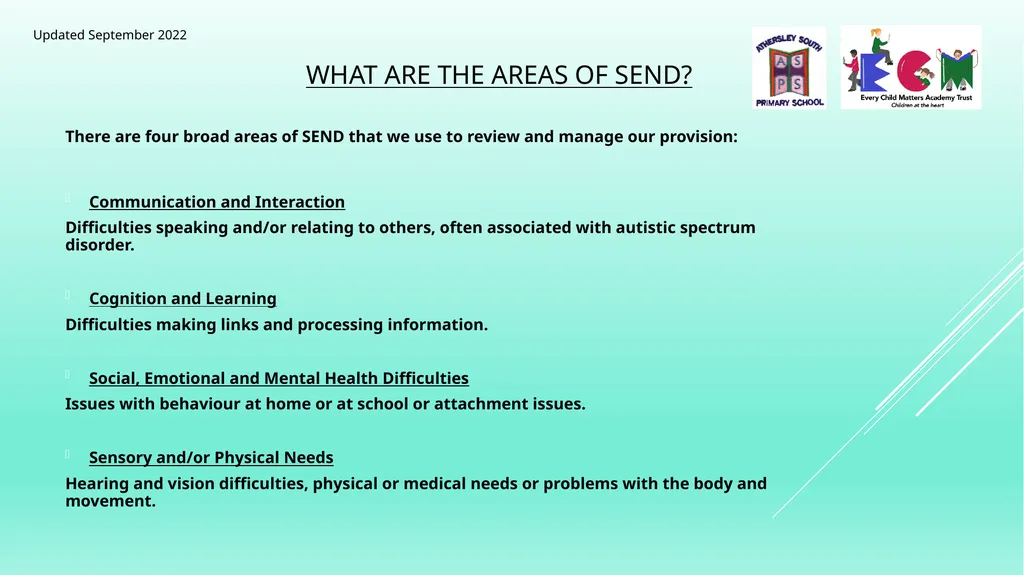
What are the areas of SEND? There are four broad areas of SEND that we use to review and manage our provision:
Communication and Interaction
Difficulties speaking and/or relating to others, often associated with autistic spectrum disorder.
Cognition and Learning
Difficulties making links and processing information.
Social, Emotional and Mental Health Difficulties
Issues with behaviour at home or at school or attachment issues.
Sensory and/or Physical Needs
Hearing and vision difficulties, physical or medical needs or problems with the body and movement. Updated September 2022<br>
Communication and Interaction
Difficulties speaking and/or relating to others, often associated with autistic spectrum disorder.
Cognition and Learning
Difficulties making links and processing information.
Social, Emotional and Mental Health Difficulties
Issues with behaviour at home or at school or attachment issues.
Sensory and/or Physical Needs
Hearing and vision difficulties, physical or medical needs or problems with the body and movement. Updated September 2022<br>
04
What is a disability? The Equality Act 2010 states that a person has a disability if they have a physical or mental impairment and the impairment has substantial and long term adverse effect on their ability to carry out normal day to day activities.
If the impairment has a substantial and long term effect on a person’s ability to carry out normal day to day activities it may amount to a disability. Updated September 2022<br>
If the impairment has a substantial and long term effect on a person’s ability to carry out normal day to day activities it may amount to a disability. Updated September 2022<br>
05
Curriculum Provision for children with SEND –
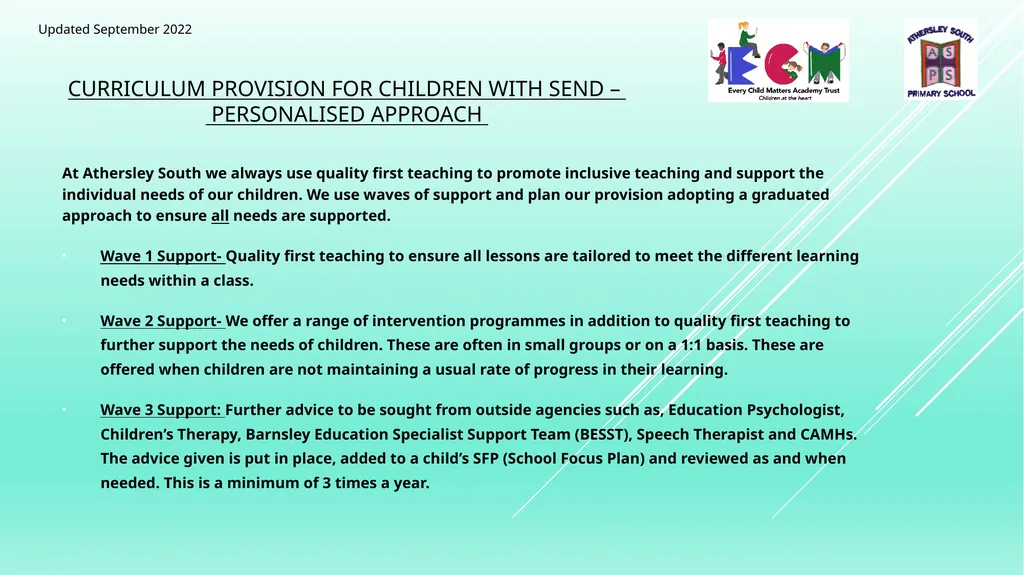
Personalised Approach At Athersley South we always use quality first teaching to promote inclusive teaching and support the individual needs of our children. We use waves of support and plan our provision adopting a graduated approach to ensure all needs are supported.
Wave 1 Support- Quality first teaching to ensure all lessons are tailored to meet the different learning needs within a class.
Wave 2 Support- We offer a range of intervention programmes in addition to quality first teaching to further support the needs of children. These are often in small groups or on a 1:1 basis. These are offered when children are not maintaining a usual rate of progress in their learning.
Wave 3 Support: Further advice to be sought from outside agencies such as, Education Psychologist, Children’s Therapy, Barnsley Education Specialist Support Team (BESST), Speech Therapist and CAMHs. The advice given is put in place, added to a child’s SFP (School Focus Plan) and reviewed as and when needed. This is a minimum of 3 times a year. Updated September 2022<br>
Wave 1 Support- Quality first teaching to ensure all lessons are tailored to meet the different learning needs within a class.
Wave 2 Support- We offer a range of intervention programmes in addition to quality first teaching to further support the needs of children. These are often in small groups or on a 1:1 basis. These are offered when children are not maintaining a usual rate of progress in their learning.
Wave 3 Support: Further advice to be sought from outside agencies such as, Education Psychologist, Children’s Therapy, Barnsley Education Specialist Support Team (BESST), Speech Therapist and CAMHs. The advice given is put in place, added to a child’s SFP (School Focus Plan) and reviewed as and when needed. This is a minimum of 3 times a year. Updated September 2022<br>
06
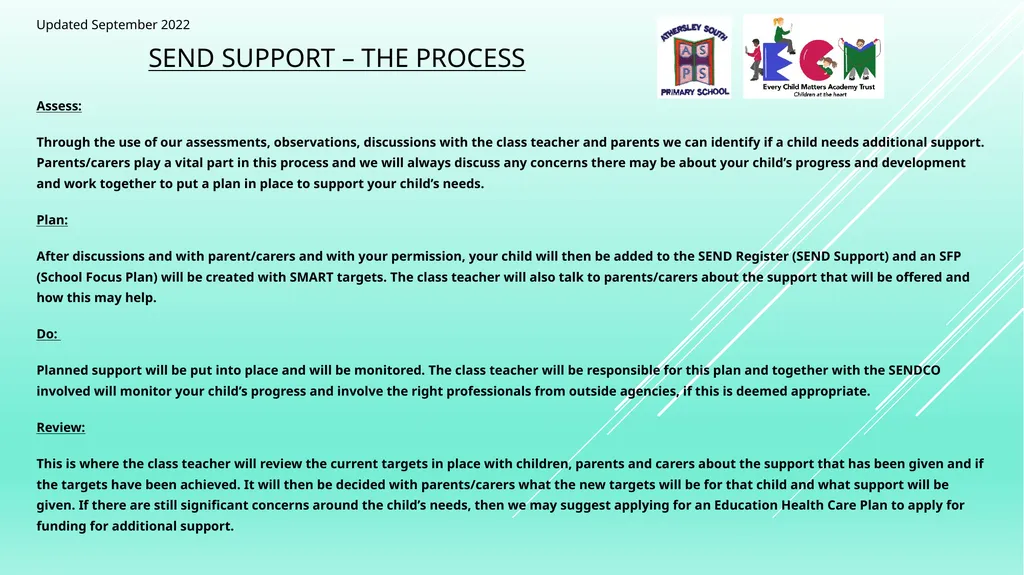
SEND Support – The Process Assess:
Through the use of our assessments, observations, discussions with the class teacher and parents we can identify if a child needs additional support. Parents/carers play a vital part in this process and we will always discuss any concerns there may be about your child’s progress and development and work together to put a plan in place to support your child’s needs.
Plan:
After discussions and with parent/carers and with your permission, your child will then be added to the SEND Register (SEND Support) and an SFP (School Focus Plan) will be created with SMART targets. The class teacher will also talk to parents/carers about the support that will be offered and how this may help.
Do:
Planned support will be put into place and will be monitored. The class teacher will be responsible for this plan and together with the SENDCO involved will monitor your child’s progress and involve the right professionals from outside agencies, if this is deemed appropriate.
Review:
This is where the class teacher will review the current targets in place with children, parents and carers about the support that has been given and if the targets have been achieved. It will then be decided with parents/carers what the new targets will be for that child and what support will be given. If there are still significant concerns around the child’s needs, then we may suggest applying for an Education Health Care Plan to apply for funding for additional support. Updated September 2022<br>
Through the use of our assessments, observations, discussions with the class teacher and parents we can identify if a child needs additional support. Parents/carers play a vital part in this process and we will always discuss any concerns there may be about your child’s progress and development and work together to put a plan in place to support your child’s needs.
Plan:
After discussions and with parent/carers and with your permission, your child will then be added to the SEND Register (SEND Support) and an SFP (School Focus Plan) will be created with SMART targets. The class teacher will also talk to parents/carers about the support that will be offered and how this may help.
Do:
Planned support will be put into place and will be monitored. The class teacher will be responsible for this plan and together with the SENDCO involved will monitor your child’s progress and involve the right professionals from outside agencies, if this is deemed appropriate.
Review:
This is where the class teacher will review the current targets in place with children, parents and carers about the support that has been given and if the targets have been achieved. It will then be decided with parents/carers what the new targets will be for that child and what support will be given. If there are still significant concerns around the child’s needs, then we may suggest applying for an Education Health Care Plan to apply for funding for additional support. Updated September 2022<br>
07
Assessing and Evaluating the Needs
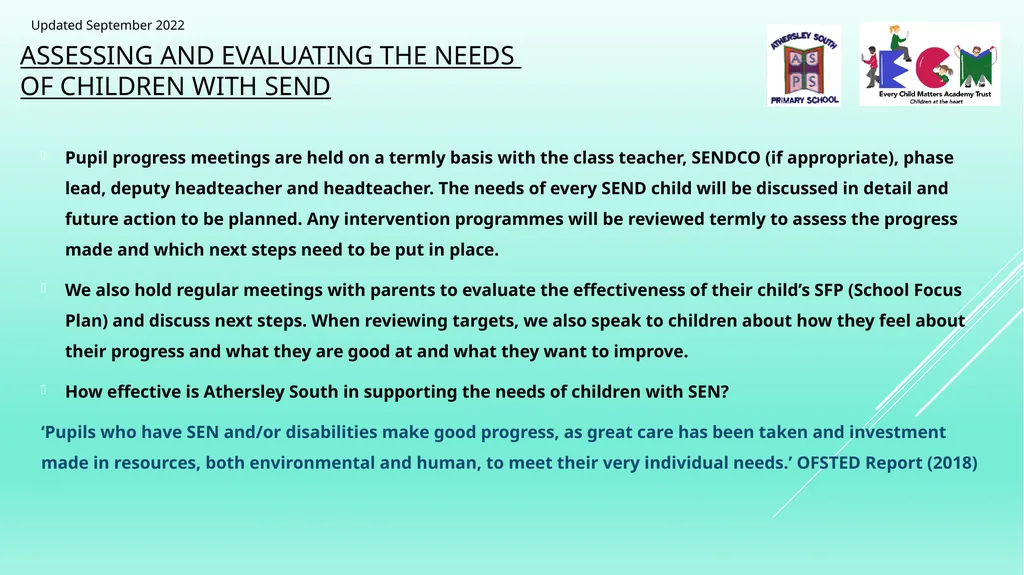
of Children WITH SEND Pupil progress meetings are held on a termly basis with the class teacher, SENDCO (if appropriate), phase lead, deputy headteacher and headteacher. The needs of every SEND child will be discussed in detail and future action to be planned. Any intervention programmes will be reviewed termly to assess the progress made and which next steps need to be put in place.
We also hold regular meetings with parents to evaluate the effectiveness of their child’s SFP (School Focus Plan) and discuss next steps. When reviewing targets, we also speak to children about how they feel about their progress and what they are good at and what they want to improve.
How effective is Athersley South in supporting the needs of children with SEN?
‘Pupils who have SEN and/or disabilities make good progress, as great care has been taken and investment made in resources, both environmental and human, to meet their very individual needs.’ OFSTED Report (2018) Updated September 2022<br>
We also hold regular meetings with parents to evaluate the effectiveness of their child’s SFP (School Focus Plan) and discuss next steps. When reviewing targets, we also speak to children about how they feel about their progress and what they are good at and what they want to improve.
How effective is Athersley South in supporting the needs of children with SEN?
‘Pupils who have SEN and/or disabilities make good progress, as great care has been taken and investment made in resources, both environmental and human, to meet their very individual needs.’ OFSTED Report (2018) Updated September 2022<br>
08
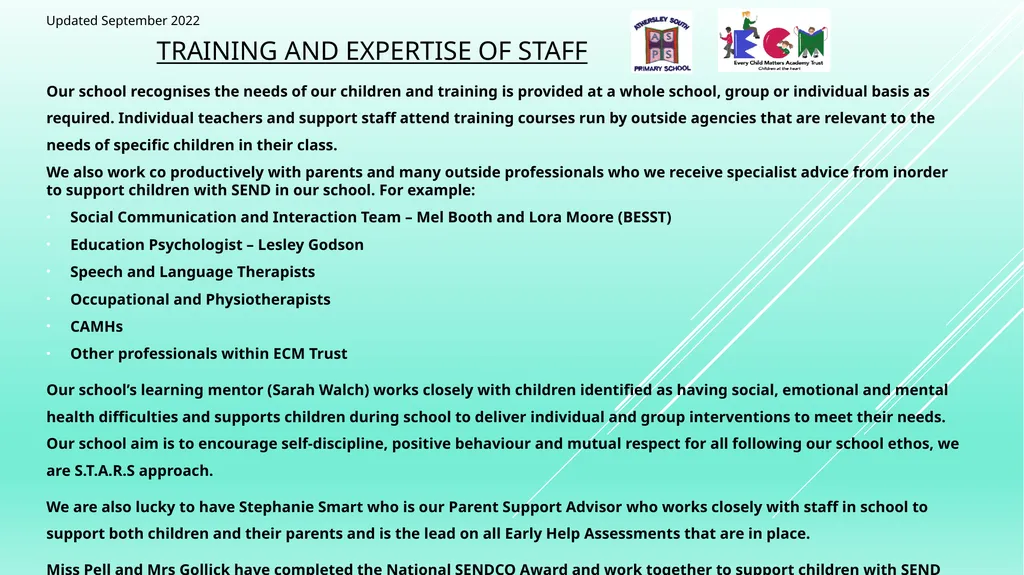
Training and Expertise of Staff Our school recognises the needs of our children and training is provided at a whole school, group or individual basis as required. Individual teachers and support staff attend training courses run by outside agencies that are relevant to the needs of specific children in their class.
We also work co productively with parents and many outside professionals who we receive specialist advice from inorder to support children with SEND in our school. For example:
Social Communication and Interaction Team – Mel Booth and Lora Moore (BESST)
Education Psychologist – Lesley Godson
Speech and Language Therapists
Occupational and Physiotherapists
CAMHs
Other professionals within ECM Trust
Our school’s learning mentor (Sarah Walch) works closely with children identified as having social, emotional and mental health difficulties and supports children during school to deliver individual and group interventions to meet their needs. Our school aim is to encourage self-discipline, positive behaviour and mutual respect for all following our school ethos, we are S.T.A.R.S approach.
We are also lucky to have Stephanie Smart who is our Parent Support Advisor who works closely with staff in school to support both children and their parents and is the lead on all Early Help Assessments that are in place.
Miss Pell and Mrs Gollick have completed the National SENDCO Award and work together to support children with SEND across school. Updated September 2022<br>
We also work co productively with parents and many outside professionals who we receive specialist advice from inorder to support children with SEND in our school. For example:
Social Communication and Interaction Team – Mel Booth and Lora Moore (BESST)
Education Psychologist – Lesley Godson
Speech and Language Therapists
Occupational and Physiotherapists
CAMHs
Other professionals within ECM Trust
Our school’s learning mentor (Sarah Walch) works closely with children identified as having social, emotional and mental health difficulties and supports children during school to deliver individual and group interventions to meet their needs. Our school aim is to encourage self-discipline, positive behaviour and mutual respect for all following our school ethos, we are S.T.A.R.S approach.
We are also lucky to have Stephanie Smart who is our Parent Support Advisor who works closely with staff in school to support both children and their parents and is the lead on all Early Help Assessments that are in place.
Miss Pell and Mrs Gollick have completed the National SENDCO Award and work together to support children with SEND across school. Updated September 2022<br>
09
How is Athersley South Primary School Accessible to Children with SEND? The Foundation Stage Unit is built on one level and is separate to the main building.
The main school is accessible for those with physical disabilities via a ramp at the main entrance. The main school is built on many levels.
There are two lifts that transport children with physical disabilities to and from the reception area to the level where the dining room and some classrooms are located.
All stairs have hand rails to support walking between levels.
There are 4 classrooms that are up a double set of stairs. In instances where children have a mobility need, the classroom is relocated into a downstairs, accessible classroom as these do not have lift access.
We ensure that all equipment used is accessible to children and that after school activities are also accessible to all children, regardless of their need.
Class sizes in school vary slightly year on year. These are the maximum numbers we operate at F1 – 26 places F2 – 40 Class 1 – Class 9 = 33 places. Each class has one qualified class teacher and access to a Learning Support Assistant during the mornings. Updated September 2022<br>
The main school is accessible for those with physical disabilities via a ramp at the main entrance. The main school is built on many levels.
There are two lifts that transport children with physical disabilities to and from the reception area to the level where the dining room and some classrooms are located.
All stairs have hand rails to support walking between levels.
There are 4 classrooms that are up a double set of stairs. In instances where children have a mobility need, the classroom is relocated into a downstairs, accessible classroom as these do not have lift access.
We ensure that all equipment used is accessible to children and that after school activities are also accessible to all children, regardless of their need.
Class sizes in school vary slightly year on year. These are the maximum numbers we operate at F1 – 26 places F2 – 40 Class 1 – Class 9 = 33 places. Each class has one qualified class teacher and access to a Learning Support Assistant during the mornings. Updated September 2022<br>
10
Transition to new classes and Schools Transition to secondary school is incredibly important and Mrs Gollick works very closely with the child, parents and secondary school SENDCOs to ensure a smooth transition. Additional visits are often arranged as well as transition meeting(s) with the secondary SENDCO.
When children move classes at the end of the academic year, class teachers liaise with the child’s new class teacher to discussany support that is in place that needs to continue. This will inform planning for the next school year. Any School Focus Plans or EHCPs that a child may have will also be passed up to the new class teacher as well as any accompanying resources, provision and intervention information.
Every year, we have transition days where children visit their new class teacher and meet their new class.
Every child also receives a transition letter or booklet with pictures of staff to familiarise themselves over the 6 week break. This is done as standard practice for all new starters to Foundation stage 1 and Foundation stage 2 and is also put onto the website for parents to share with their children. Updated September 2022<br>
When children move classes at the end of the academic year, class teachers liaise with the child’s new class teacher to discussany support that is in place that needs to continue. This will inform planning for the next school year. Any School Focus Plans or EHCPs that a child may have will also be passed up to the new class teacher as well as any accompanying resources, provision and intervention information.
Every year, we have transition days where children visit their new class teacher and meet their new class.
Every child also receives a transition letter or booklet with pictures of staff to familiarise themselves over the 6 week break. This is done as standard practice for all new starters to Foundation stage 1 and Foundation stage 2 and is also put onto the website for parents to share with their children. Updated September 2022<br>
11
Who can I contact if I need support about SEND? Class Teacher- Please speak to your child’s class teacher in the first instance if you have any worries, concerns or would like to talk about supporting your child.
SENDCOs- Miss Pell and Mrs Gollick are the SENDCO’s within school. Miss Pell has responsibility for Foundation Stage with a focus on early intervention and Mrs Gollick has responsibility from Year 1 to Year 6. Both work closely with families, children and staff throughout school. The SENDCO’s role is to support your child’s class teacher in offering the right provision to meet their needs and support learning. If you would like to speak to one of the SENDCO’s, please contact the main office on 01226 284 223 and leave a message or alternatively email them during the school day at asps.senco@ecmtrust.co.uk The SENDCO’s will then speak to you as soon as possible. Please note that Mrs Gollick’s working week is Tuesday to Friday.
Stephanie Smart – Parent Support Advisor and our Learning Mentor – Sarah Walch can be contacted by telephone on the above number or in person.
Other Information
SEND Governor – Our SEND Governor is Mrs Claire Nock
If you have any concerns, complaints or issues you can speak to our Head Teacher (Mrs Sanderson), Deputy Head Teacher (Mr Wheelwright) and/or our SEND Governor (Mrs Claire Nock). Updated September 2022<br>
SENDCOs- Miss Pell and Mrs Gollick are the SENDCO’s within school. Miss Pell has responsibility for Foundation Stage with a focus on early intervention and Mrs Gollick has responsibility from Year 1 to Year 6. Both work closely with families, children and staff throughout school. The SENDCO’s role is to support your child’s class teacher in offering the right provision to meet their needs and support learning. If you would like to speak to one of the SENDCO’s, please contact the main office on 01226 284 223 and leave a message or alternatively email them during the school day at asps.senco@ecmtrust.co.uk The SENDCO’s will then speak to you as soon as possible. Please note that Mrs Gollick’s working week is Tuesday to Friday.
Stephanie Smart – Parent Support Advisor and our Learning Mentor – Sarah Walch can be contacted by telephone on the above number or in person.
Other Information
SEND Governor – Our SEND Governor is Mrs Claire Nock
If you have any concerns, complaints or issues you can speak to our Head Teacher (Mrs Sanderson), Deputy Head Teacher (Mr Wheelwright) and/or our SEND Governor (Mrs Claire Nock). Updated September 2022<br>