Serious Incident Reporting Definitions and Regulations Office of Compliance and Risk Management 2021 CSB Mission, Vision and Values UNIT ONE Understanding the Basics of Serious Incident Reports TOPIC 1 Definitions and Regulations CSB
"Serious Incident Reporting Definitions and" is the property of its rightful owner. Permission is granted to
download and print the materials on this website for personal, non-commercial use only, and to display it
on your personal computer provided you do not modify the materials and that you retain all copyright
notices contained in the materials. By downloading content from our website, you accept the terms of this
agreement.
Presentation Transcript
01
Serious Incident Reporting Definitions and Regulations Office of Compliance and Risk Management 2021<br>
02
CSB Mission, Vision and Values UNIT ONE
Understanding the Basics of Serious Incident Reports TOPIC 1
Definitions and Regulations<br>
03
CSB Mission, Vision and Values OBJECTIVE
Recognize the impact of serious incident reporting<br>
04
Regulatory Bodies: DBHDS The Department of Behavioral Health and Developmental Services (DBHDS) has issued several licenses to program areas under the Fairfax-Falls Church Community Services Board to provide services as a behavioral health and developmental disability agency
To be in good standing under those licenses, the CSB must follow all rules and regulations that DBHDS has set for licensing providers
This includes rules and regulations around serious incident reporting that DBHDS has identified for licensed providers<br>
05
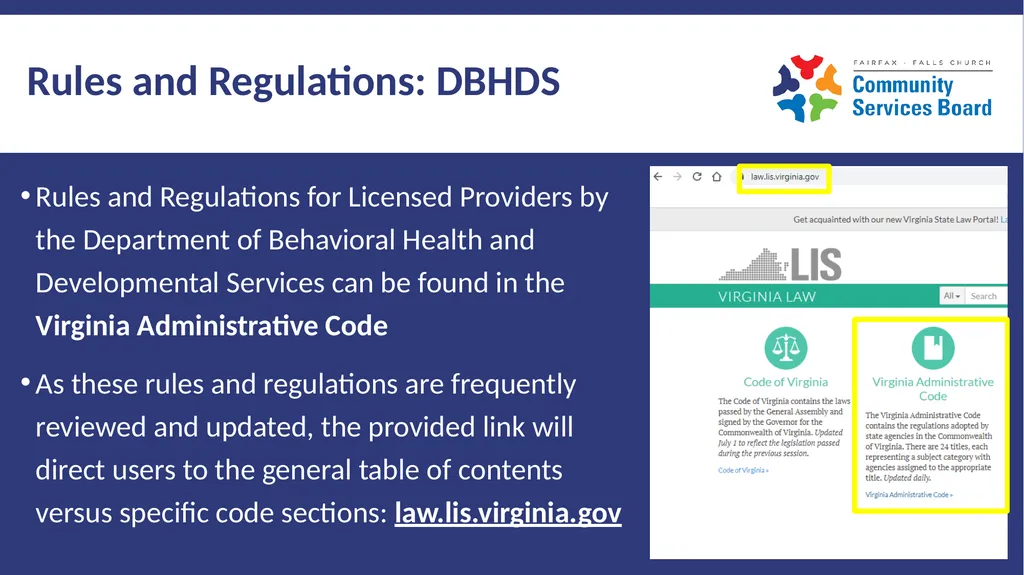
Rules and Regulations: DBHDS Rules and Regulations for Licensed Providers by the Department of Behavioral Health and Developmental Services can be found in the Virginia Administrative Code
As these rules and regulations are frequently reviewed and updated, the provided link will direct users to the general table of contents versus specific code sections: law.lis.virginia.gov<br>
06
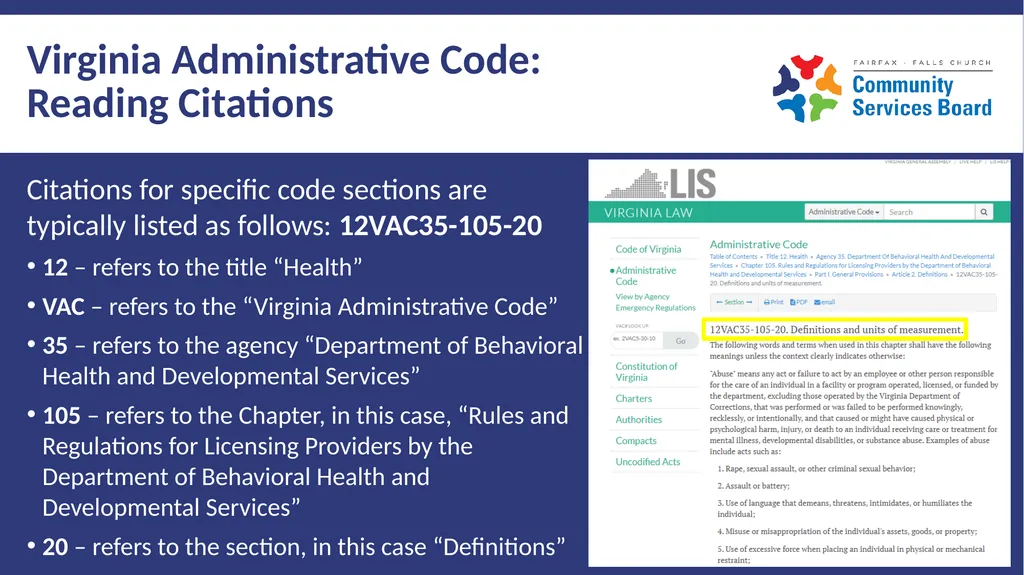
Virginia Administrative Code: Reading Citations Citations for specific code sections are typically listed as follows: 12VAC35-105-20
12 – refers to the title “Health”
VAC – refers to the “Virginia Administrative Code”
35 – refers to the agency “Department of Behavioral Health and Developmental Services”
105 – refers to the Chapter, in this case, “Rules and Regulations for Licensing Providers by the Department of Behavioral Health and Developmental Services”
20 – refers to the section, in this case “Definitions”<br>
07
Definition: Serious Incident Section 12VAC35-105-20, defines a serious incident as any event or circumstance that causes or could cause harm to the health, safety, or well-being of an individual. The term "serious incident" includes death and serious injury.
The definition categorizes serious incidents into three different levels; Level I, Level II, and Level III. We will review these levels in more detail in Unit 2: Defining Serious Incidents.<br>
08
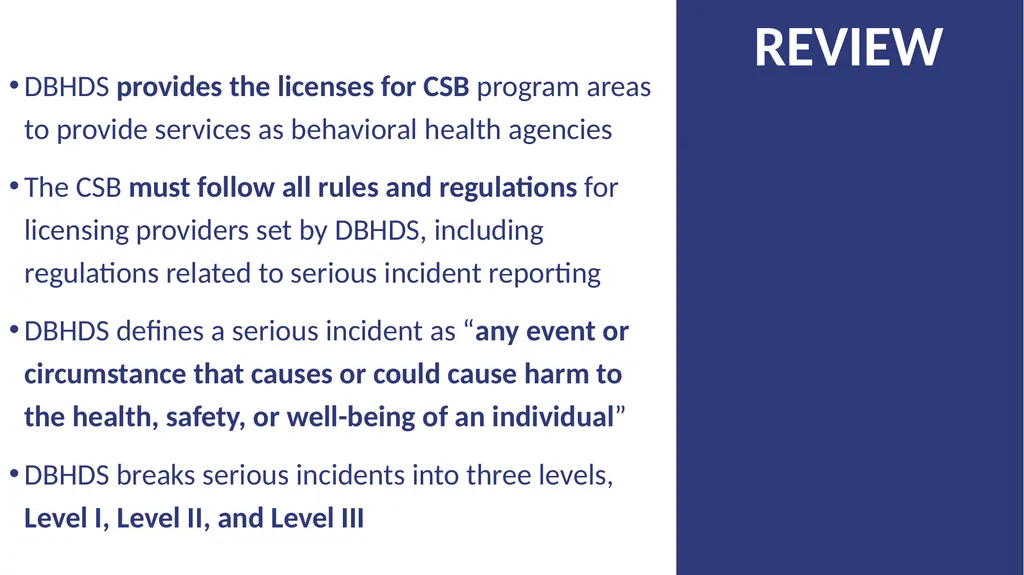
CSB Mission, Vision and Values REVIEW DBHDS provides the licenses for CSB program areas to provide services as behavioral health agencies
The CSB must follow all rules and regulations for licensing providers set by DBHDS, including regulations related to serious incident reporting
DBHDS defines a serious incident as “any event or circumstance that causes or could cause harm to the health, safety, or well-being of an individual”
DBHDS breaks serious incidents into three levels, Level I, Level II, and Level III<br>
09
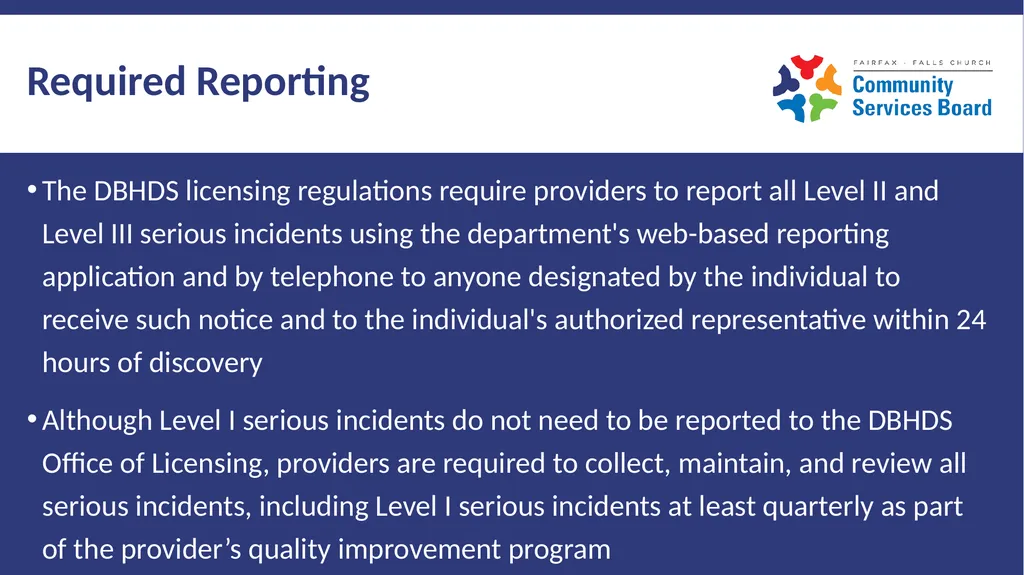
Required Reporting The DBHDS licensing regulations require providers to report all Level II and Level III serious incidents using the department's web-based reporting application and by telephone to anyone designated by the individual to receive such notice and to the individual's authorized representative within 24 hours of discovery
Although Level I serious incidents do not need to be reported to the DBHDS Office of Licensing, providers are required to collect, maintain, and review all serious incidents, including Level I serious incidents at least quarterly as part of the provider’s quality improvement program<br>
10
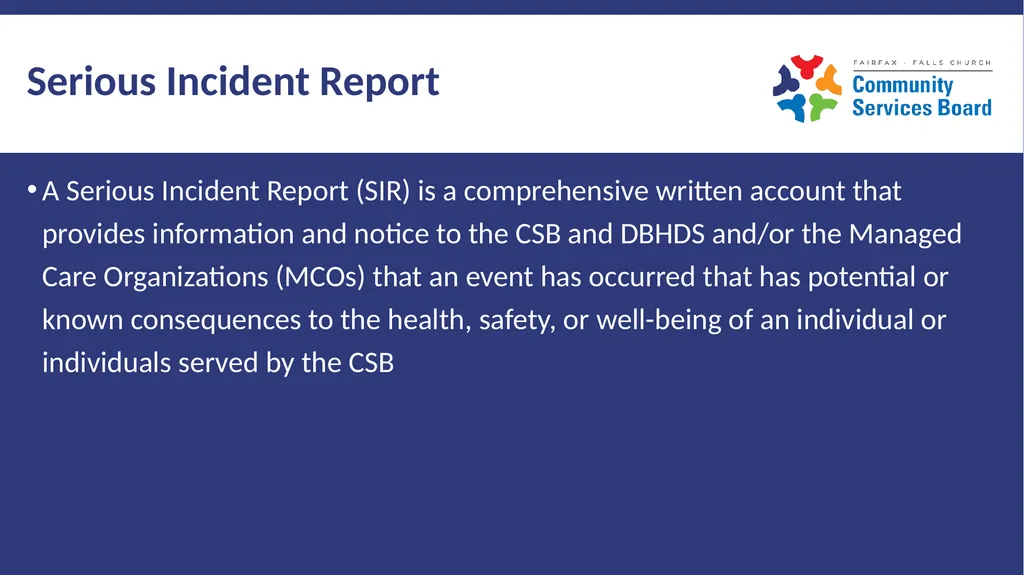
Serious Incident Report A Serious Incident Report (SIR) is a comprehensive written account that provides information and notice to the CSB and DBHDS and/or the Managed Care Organizations (MCOs) that an event has occurred that has potential or known consequences to the health, safety, or well-being of an individual or individuals served by the CSB<br>
11
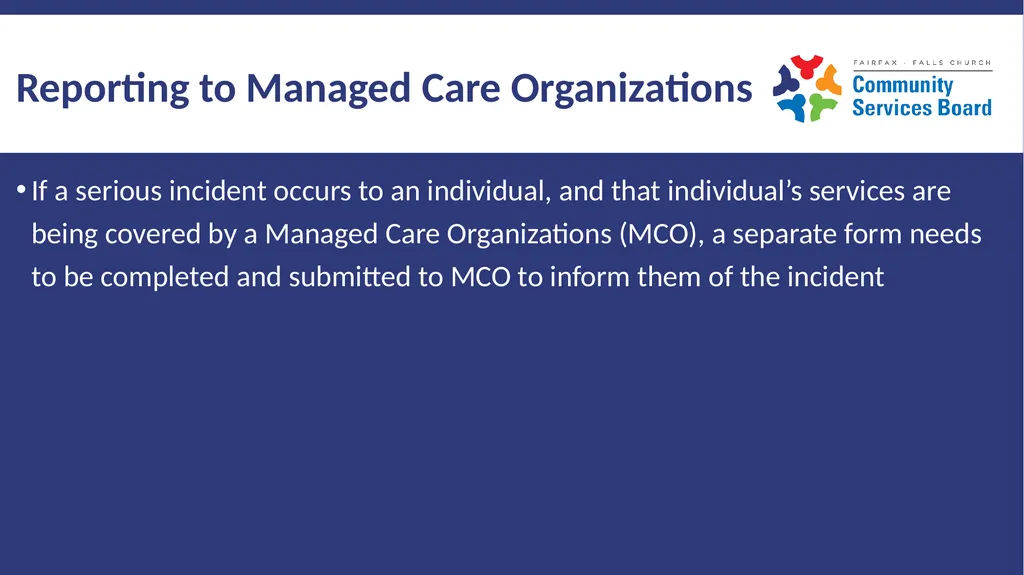
Reporting to Managed Care Organizations If a serious incident occurs to an individual, and that individual’s services are being covered by a Managed Care Organizations (MCO), a separate form needs to be completed and submitted to MCO to inform them of the incident<br>
12
Purpose: Serious Incident Report Serious incident reports are required by DBHDS and therefore the CSB must comply with this regulation to maintain provider licenses
Reporting serious incidents improves the quality of services and minimizes the risk to individuals served by the CSB
Reporting alone does not improve safety or quality, it is the response to reports and reviewing trends and outcomes at the program and organizational level that leads to change and quality improvement<br>
13
CSB Mission, Vision and Values REVIEW All CSB staff members are required to report serious incidents to OCRM within 24 hours of discovery
Serious incident reports are comprehensive written accounts that provide information and notice to the CSB, DBHDS, and the MCOs (if applicable) that a serious incident has occurred to an individual served by the CSB
Reviewing and responding to serious incident reports leads to quality improvement<br>
14
CSB Regulations In addition to regulations set by DBHDS, CSB staff must be aware of internal regulations related to serious incident reporting
CSB regulations are defined as a mandatory rule applied agency-wide
CSB regulations must be consistent with policies of the CSB Board, Fairfax County, and the State Board of Behavioral Health and Developmental Services
CSB regulations are issued by the CSB Executive Director
A current listing of CSB staff regulations can be found on the CSB Internal SharePoint pages<br>
15
CSB Regulation 2600.3 CSB Staff Regulation 2600.3 covers information related to Serious Incident Report Documentation and Review
This regulation outlines definitions, authority, responsibility, SIR completion procedures, incident response process, and applicability
In the next section of this curriculum, you will review CSB Staff Regulation 2600.3 and complete a short assessment answering questions about the regulation<br>
16
CSB Mission, Vision and Values Next Section
Review Policy 2600.3
Complete Assessment<br>