
Serious Incidents: Reporting & Investigations
BR
Published · 18 slides · 0 views

1 / 1
Description
Serious Incidents: Reporting Investigations Serious Incidents: Reporting Investigations Reporting Serious Incidents our responsibilities Reporting Serious Incidents your responsibilities What is a Serious Incident Safeguarding Near
Related Topics
Share
Embed code
Download this presentation From Below
"Serious Incidents: Reporting & Investigations" is the property of its rightful owner. Permission is granted to download and print the materials on this website for personal, non-commercial use only, and to display it on your personal computer provided you do not modify the materials and that you retain all copyright notices contained in the materials. By downloading content from our website, you accept the terms of this agreement.
Presentation Transcript
01
Serious Incidents: Reporting & Investigations<br>
02
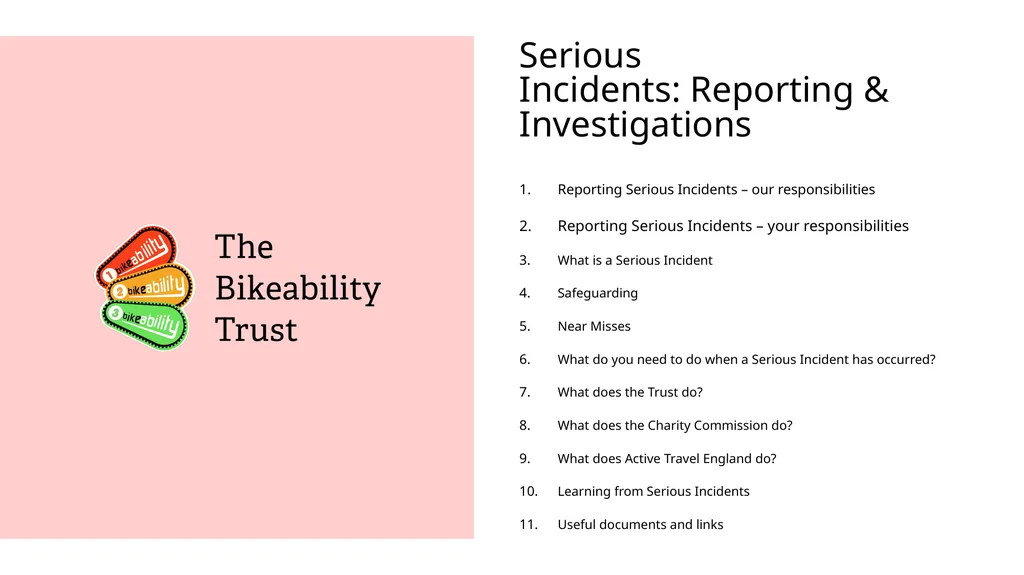
Serious Incidents: Reporting & Investigations Reporting Serious Incidents – our responsibilities
Reporting Serious Incidents – your responsibilities
What is a Serious Incident
Safeguarding
Near Misses
What do you need to do when a Serious Incident has occurred?
What does the Trust do?
What does the Charity Commission do?
What does Active Travel England do?
Learning from Serious Incidents
Useful documents and links<br>
Reporting Serious Incidents – your responsibilities
What is a Serious Incident
Safeguarding
Near Misses
What do you need to do when a Serious Incident has occurred?
What does the Trust do?
What does the Charity Commission do?
What does Active Travel England do?
Learning from Serious Incidents
Useful documents and links<br>
03
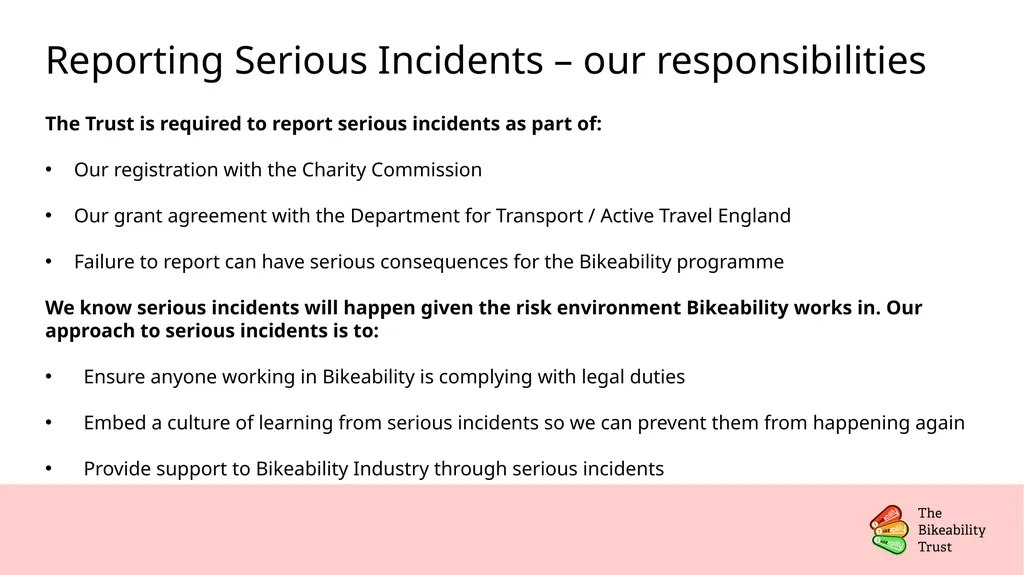
Reporting Serious Incidents – our responsibilities The Trust is required to report serious incidents as part of:
Our registration with the Charity Commission
Our grant agreement with the Department for Transport / Active Travel England
Failure to report can have serious consequences for the Bikeability programme
We know serious incidents will happen given the risk environment Bikeability works in. Our approach to serious incidents is to:
Ensure anyone working in Bikeability is complying with legal duties
Embed a culture of learning from serious incidents so we can prevent them from happening again
Provide support to Bikeability Industry through serious incidents<br>
Our registration with the Charity Commission
Our grant agreement with the Department for Transport / Active Travel England
Failure to report can have serious consequences for the Bikeability programme
We know serious incidents will happen given the risk environment Bikeability works in. Our approach to serious incidents is to:
Ensure anyone working in Bikeability is complying with legal duties
Embed a culture of learning from serious incidents so we can prevent them from happening again
Provide support to Bikeability Industry through serious incidents<br>
04
Reporting Serious Incidents – your responsibilities Make sure you:
Report any Serious Incidents to The Trust within 72 hours (if in doubt if it needs reporting get it touch and we can help advise you)
Keep accurate and dated records of all Serious Incidents reported to The Trust
Report number of Serious Incidents in your training provider annual renewal
All Serious Incidents must be reported, even those that are investigated and not upheld – it is the nature of the incident that can make it a serious incident and all must be reported.<br>
Report any Serious Incidents to The Trust within 72 hours (if in doubt if it needs reporting get it touch and we can help advise you)
Keep accurate and dated records of all Serious Incidents reported to The Trust
Report number of Serious Incidents in your training provider annual renewal
All Serious Incidents must be reported, even those that are investigated and not upheld – it is the nature of the incident that can make it a serious incident and all must be reported.<br>
05
What is a Serious Incident? The main categories of reportable incidents are:
Safeguarding incident
Health and Safety incident
Data breach
Risk to reputation
Both the safeguarding and health and safety incidents can be put in the bracket of incidents that have resulted in or risk of significant harm.
If in doubt get in touch with the Trust as we can offer advice and support.<br>
Safeguarding incident
Health and Safety incident
Data breach
Risk to reputation
Both the safeguarding and health and safety incidents can be put in the bracket of incidents that have resulted in or risk of significant harm.
If in doubt get in touch with the Trust as we can offer advice and support.<br>
06
What is a Serious Incident? Examples may include:
A child falls from their bike and hurts their arm
A child scrapes their bike pedals against a member of the public's vehicle
An instructors DBS check comes back with a safeguarding concern
A teaching assistant trips over a curb and hurts herself whilst out with a Bikeability training session
An instructor is verbally abused by a member of public when delivering Bikeability
A list of children and parents names and addresses has accidentally been emailed out to your email list
A car has pulled out of a junction and knocked a child from their bike
A training provider has noticed a series of Facebook posts making serious claims against a Bikeability professional/organisation delivering Bikeability which is in the public arena
An instructor is bitten by a dog whilst delivering Bikeability<br>
A child falls from their bike and hurts their arm
A child scrapes their bike pedals against a member of the public's vehicle
An instructors DBS check comes back with a safeguarding concern
A teaching assistant trips over a curb and hurts herself whilst out with a Bikeability training session
An instructor is verbally abused by a member of public when delivering Bikeability
A list of children and parents names and addresses has accidentally been emailed out to your email list
A car has pulled out of a junction and knocked a child from their bike
A training provider has noticed a series of Facebook posts making serious claims against a Bikeability professional/organisation delivering Bikeability which is in the public arena
An instructor is bitten by a dog whilst delivering Bikeability<br>
07
Safeguarding All Safeguarding incidents must be reported to both the Trust and your Grant recipient within 72 hours and your internal process be followed. It is the training providers responsibility to keep the Trust informed throughout the investigation.
In any safeguarding allegation against an instructor the process requires that the instructor is temporarily deregistered on LINK and all training providers they are associated with are informed until the conclusion of the investigation
All relevant professionals need to be contacted – this may be the local LADO (Local Authority Safeguarding Lead), police, school etc
Safeguarding is the action that is taken to promote the welfare of children and protect them from harm.
Safeguarding incidents are not the obvious ones we all know about but can be situations such as a child being left unattended during level two training, online/social media incident talking about a child/school naming the child and/or school<br>
In any safeguarding allegation against an instructor the process requires that the instructor is temporarily deregistered on LINK and all training providers they are associated with are informed until the conclusion of the investigation
All relevant professionals need to be contacted – this may be the local LADO (Local Authority Safeguarding Lead), police, school etc
Safeguarding is the action that is taken to promote the welfare of children and protect them from harm.
Safeguarding incidents are not the obvious ones we all know about but can be situations such as a child being left unattended during level two training, online/social media incident talking about a child/school naming the child and/or school<br>
08
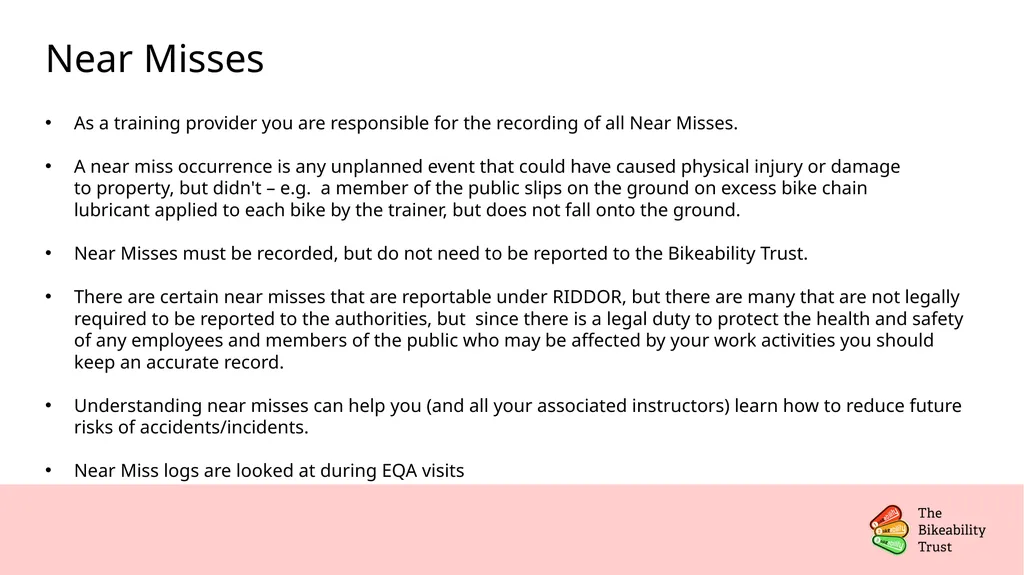
Near Misses As a training provider you are responsible for the recording of all Near Misses.
A near miss occurrence is any unplanned event that could have caused physical injury or damage to property, but didn't – e.g. a member of the public slips on the ground on excess bike chain lubricant applied to each bike by the trainer, but does not fall onto the ground.
Near Misses must be recorded, but do not need to be reported to the Bikeability Trust.
There are certain near misses that are reportable under RIDDOR, but there are many that are not legally required to be reported to the authorities, but since there is a legal duty to protect the health and safety of any employees and members of the public who may be affected by your work activities you should keep an accurate record.
Understanding near misses can help you (and all your associated instructors) learn how to reduce future risks of accidents/incidents.
Near Miss logs are looked at during EQA visits<br>
A near miss occurrence is any unplanned event that could have caused physical injury or damage to property, but didn't – e.g. a member of the public slips on the ground on excess bike chain lubricant applied to each bike by the trainer, but does not fall onto the ground.
Near Misses must be recorded, but do not need to be reported to the Bikeability Trust.
There are certain near misses that are reportable under RIDDOR, but there are many that are not legally required to be reported to the authorities, but since there is a legal duty to protect the health and safety of any employees and members of the public who may be affected by your work activities you should keep an accurate record.
Understanding near misses can help you (and all your associated instructors) learn how to reduce future risks of accidents/incidents.
Near Miss logs are looked at during EQA visits<br>
09
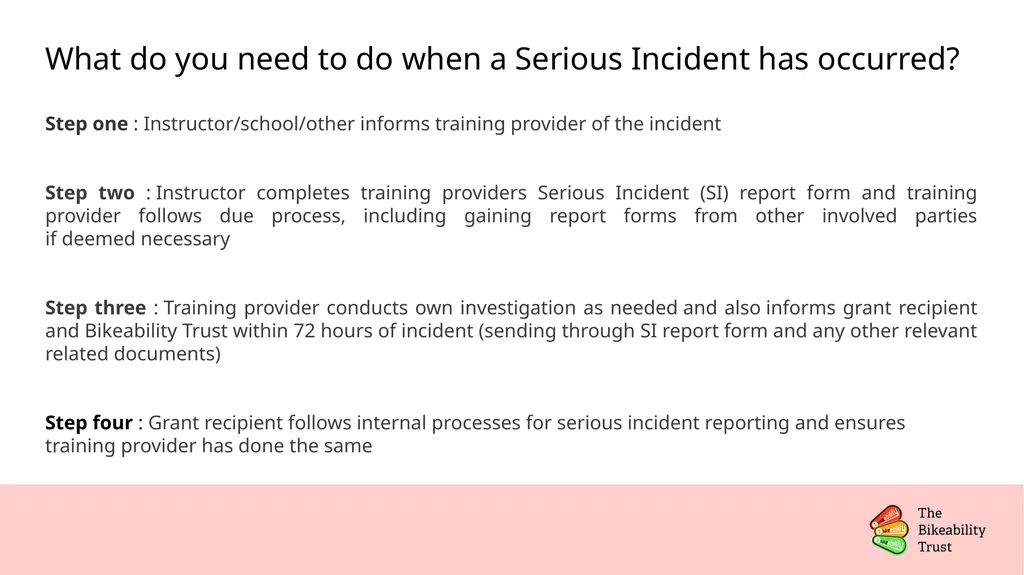
What do you need to do when a Serious Incident has occurred? Step one : Instructor/school/other informs training provider of the incident
Step two : Instructor completes training providers Serious Incident (SI) report form and training provider follows due process, including gaining report forms from other involved parties if deemed necessary
Step three : Training provider conducts own investigation as needed and also informs grant recipient and Bikeability Trust within 72 hours of incident (sending through SI report form and any other relevant related documents)
Step four : Grant recipient follows internal processes for serious incident reporting and ensures training provider has done the same<br>
Step two : Instructor completes training providers Serious Incident (SI) report form and training provider follows due process, including gaining report forms from other involved parties if deemed necessary
Step three : Training provider conducts own investigation as needed and also informs grant recipient and Bikeability Trust within 72 hours of incident (sending through SI report form and any other relevant related documents)
Step four : Grant recipient follows internal processes for serious incident reporting and ensures training provider has done the same<br>
10
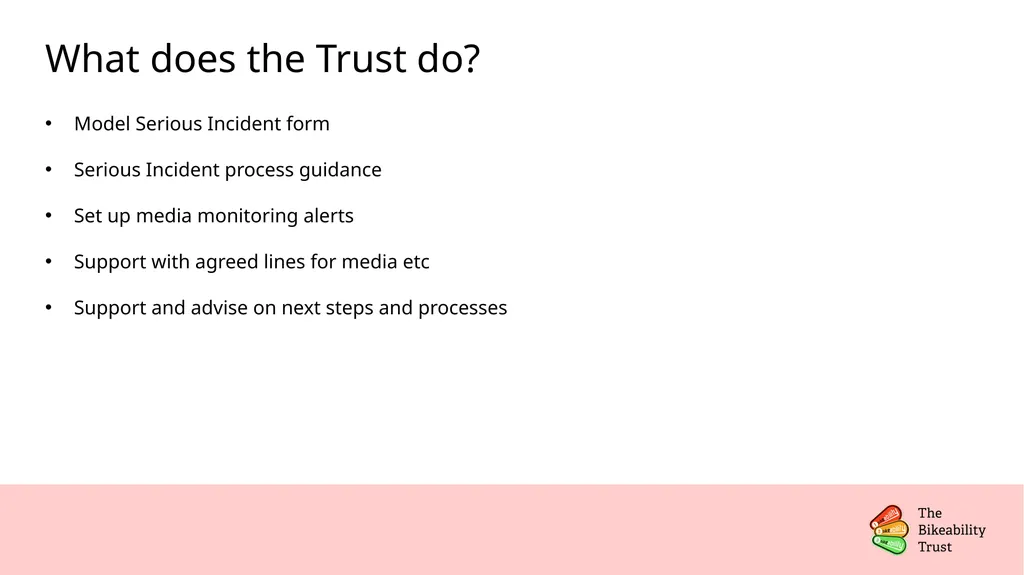
What does the Trust do? Model Serious Incident form
Serious Incident process guidance
Set up media monitoring alerts
Support with agreed lines for media etc
Support and advise on next steps and processes<br>
Serious Incident process guidance
Set up media monitoring alerts
Support with agreed lines for media etc
Support and advise on next steps and processes<br>
11
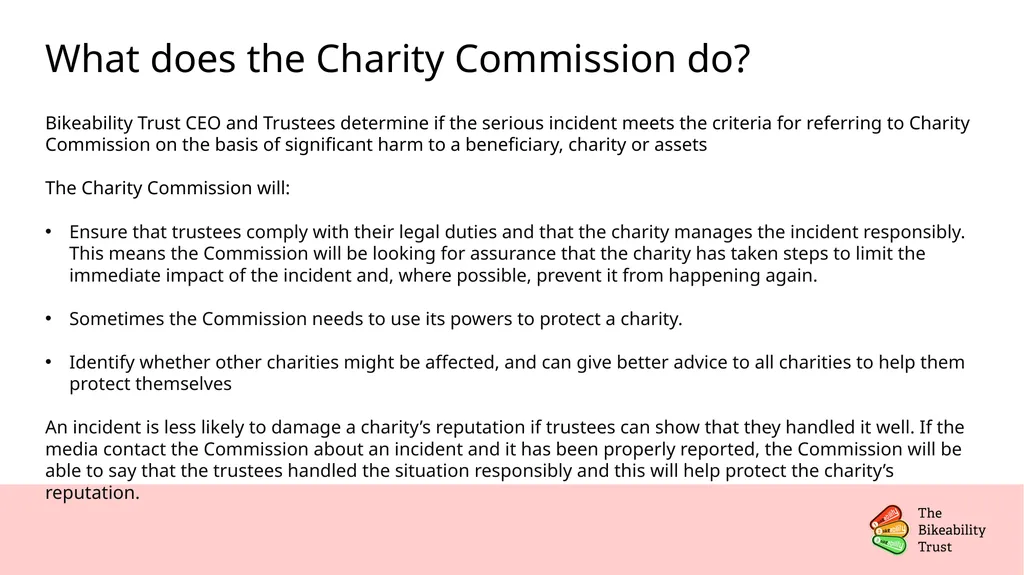
What does the Charity Commission do? Bikeability Trust CEO and Trustees determine if the serious incident meets the criteria for referring to Charity Commission on the basis of significant harm to a beneficiary, charity or assets
The Charity Commission will:
Ensure that trustees comply with their legal duties and that the charity manages the incident responsibly. This means the Commission will be looking for assurance that the charity has taken steps to limit the immediate impact of the incident and, where possible, prevent it from happening again.
Sometimes the Commission needs to use its powers to protect a charity.
Identify whether other charities might be affected, and can give better advice to all charities to help them protect themselves
An incident is less likely to damage a charity’s reputation if trustees can show that they handled it well. If the media contact the Commission about an incident and it has been properly reported, the Commission will be able to say that the trustees handled the situation responsibly and this will help protect the charity’s reputation.<br>
The Charity Commission will:
Ensure that trustees comply with their legal duties and that the charity manages the incident responsibly. This means the Commission will be looking for assurance that the charity has taken steps to limit the immediate impact of the incident and, where possible, prevent it from happening again.
Sometimes the Commission needs to use its powers to protect a charity.
Identify whether other charities might be affected, and can give better advice to all charities to help them protect themselves
An incident is less likely to damage a charity’s reputation if trustees can show that they handled it well. If the media contact the Commission about an incident and it has been properly reported, the Commission will be able to say that the trustees handled the situation responsibly and this will help protect the charity’s reputation.<br>
12
Reporting to Active Travel England The Bikeability Trust reports serious incidents to ATE on a monthly basis as part of our scrutiny meetings.
In the event of a most serious incident where significant harm has occurred ATE will:
Be briefed by the Bikeability Trust on full information of the incident; and provided with a redacted version of our serious incident log that will not contain names of organisations or individuals
Use crisis communications manual and agree approach to media handling, public enquiries and complaints
Brief Minister as appropriate
Keep informed of the incident actions and learning to be assured learning has been embedded<br>
In the event of a most serious incident where significant harm has occurred ATE will:
Be briefed by the Bikeability Trust on full information of the incident; and provided with a redacted version of our serious incident log that will not contain names of organisations or individuals
Use crisis communications manual and agree approach to media handling, public enquiries and complaints
Brief Minister as appropriate
Keep informed of the incident actions and learning to be assured learning has been embedded<br>
13
Learning from Serious Incidents Key learning/actions;
A key action following a serious incident and subsequent investigation is highlighting why/how it happened and if there are any process/policy/actions that can be undertaken to reduce the risk of a similar incident happening again
Do processes need reviewing and amending? If so review specific processes and make changes.
Is there staff training that needs to be undertaken? By an individual or all staff?
If you want support from the Trust following a serious incident then get in touch via our Contactus email and someone will be about to support you<br>
A key action following a serious incident and subsequent investigation is highlighting why/how it happened and if there are any process/policy/actions that can be undertaken to reduce the risk of a similar incident happening again
Do processes need reviewing and amending? If so review specific processes and make changes.
Is there staff training that needs to be undertaken? By an individual or all staff?
If you want support from the Trust following a serious incident then get in touch via our Contactus email and someone will be about to support you<br>
14
Recap Recognise what is a serious incident
Report it quickly
Receive support to handle incident
Engage in monitoring incident
Identify Learning for future
Bikeability Trust culture around serious incidents is one of support<br>
Report it quickly
Receive support to handle incident
Engage in monitoring incident
Identify Learning for future
Bikeability Trust culture around serious incidents is one of support<br>
15
Useful Documents and Links Serious incident reporting - For Training Providers | Bikeability
Safeguarding - For Training Providers | Bikeability
How to report a serious incident in your charity - GOV.UK (www.gov.uk)
model-Safeguarding-Policy.v2-March-2023.docx (live.com)
model-Safeguarding-Report-Form.v1-1-1.docx (live.com)
Serious-Incident-Report-Form-for-website.docx (live.com)
Safeguarding children and child protection | NSPCC Learning
The role of the LADO (Local Authority Designated Officer) – national-lado-network.co.uk
Health and safety - For Training Providers | Bikeability
DBS Checks - For Training Providers | Bikeability
Code of Practice - For Training Providers | Bikeability
Near-miss Book: Recording and reporting near misses at work (hse.gov.uk)
Reportable incidents - RIDDOR - HSE<br>
Safeguarding - For Training Providers | Bikeability
How to report a serious incident in your charity - GOV.UK (www.gov.uk)
model-Safeguarding-Policy.v2-March-2023.docx (live.com)
model-Safeguarding-Report-Form.v1-1-1.docx (live.com)
Serious-Incident-Report-Form-for-website.docx (live.com)
Safeguarding children and child protection | NSPCC Learning
The role of the LADO (Local Authority Designated Officer) – national-lado-network.co.uk
Health and safety - For Training Providers | Bikeability
DBS Checks - For Training Providers | Bikeability
Code of Practice - For Training Providers | Bikeability
Near-miss Book: Recording and reporting near misses at work (hse.gov.uk)
Reportable incidents - RIDDOR - HSE<br>
16
Support from the Trust If you want support from the Trust regarding a Serious Complaint or Near Miss then get in touch via our Contactus email<br>
17
contactus@bikeabilitytrust.org<br>