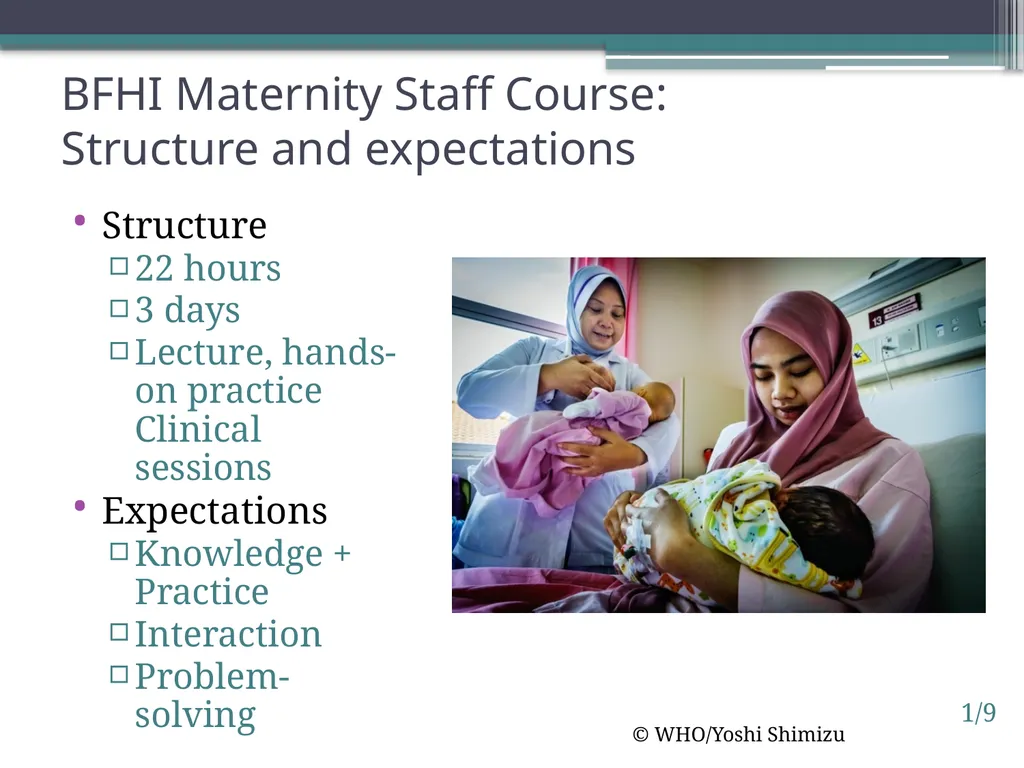
Session 1. BFHI: A key component of quality maternal and newborn care 11 WHOYoshi Shimizu Session 1. Objectives BFHI: A key component of quality maternal and newborn care After completing this session, participants will be able to:
"Session 1. BFHI: A key component of quality" is the property of its rightful owner. Permission is granted to
download and print the materials on this website for personal, non-commercial use only, and to display it
on your personal computer provided you do not modify the materials and that you retain all copyright
notices contained in the materials. By downloading content from our website, you accept the terms of this
agreement.
Session 1. Objectives BFHI: A key component of quality maternal and newborn care After completing this session, participants will be able to:
describe the importance of exclusive and continued breastfeeding;
discuss the WHO/UNICEF Global Strategy for Infant and Young Child Feeding;
outline the Baby-friendly Hospital Initiative (BFHI);
list the Ten steps to successful breastfeeding (ten Steps);
outline how this course improves capacity building. 1/2<br>
To enable mothers/parents/caregivers to establish and sustain exclusive breastfeeding for six months, WHO and UNICEF recommend: immediate and uninterrupted skin-to-skin contact from birth and initiation of breastfeeding within the first hour of life;
exclusive breastfeeding – the infant only receives breast milk, and no other foods or fluids;
breastfeeding responsively – that is, as early and often, and as long as the baby wants, day and night;
counselling mothers on the risks and use of feeding bottles, teats or pacifiers. 1/4<br>
05
Goal of Global Strategy Improve the nutritional status, growth and development, health, and survival of infants and young children through optimal feeding practices.
Support exclusive breastfeeding for six months, followed by timely, adequate, safe, and appropriate complementary feeding.
Breastfeeding should continue for up to two years and beyond.
Support maternal nutrition through social and community support initiatives. 1/5<br>
06
Ten Steps to successful breastfeeding: Critical management procedures 1a. Comply fully with the International Code of Marketing of Breast-milk Substitutes and relevant World Health Assembly Resolutions.
1b. Have a written infant feeding policy that is routinely communicated to staff and parents.
1c. Establish ongoing monitoring and data- management systems.
2. Ensure that staff have sufficient knowledge, competence and skills to support breastfeeding. 1/6<br>
07
Ten steps to successful breastfeeding: key clinical practices 3. Discuss the importance and management of breastfeeding with pregnant women and their families.
4. Facilitate immediate and uninterrupted skin-to- skin contact and support mothers to initiate breastfeeding as soon as possible after birth.
5. Support mothers to initiate and maintain breastfeeding and manage common difficulties.
6. Do not provide breastfed newborns any food or fluids other than breast milk, unless medically indicated. 1/7<br>
08
Ten steps to successful breastfeeding: key clinical practices 7. Enable mothers and their infants to remain together, and to practice rooming-in 24 hours per day.
8. Support mothers to recognize and respond to their infants’ cues for feeding.
9. Counsel mothers on the use and risks of feeding bottles, teats and pacifiers.
10. Coordinate discharge so that parents and their infants have timely access to ongoing support and care. 1/8<br>
Let’s discuss: Your local and national context Global Breastfeeding Scorecard
Please find your country’s information
https://www.who.int/publications/i/item/WHO-NMH-NHD-19.22
Discussion questions
What did you learn about your own country’s situation?
How does this reflect your local context?
What are areas of success?
What are areas of improvement? 1/10<br>
11
Let’s discuss: Your local and national context Breastfeeding rates
Early initiation in < 1 hour
Exclusive: 0-6 months
Continued at 1 year
Continued at 2 years 1/11<br>
12
Let’s discuss: Your local and national context Enabling environment and reporting:
Please include information from the listed topics on the Breastfeeding Scorecard for your country. 1/12<br>
13
Let’s discuss: Your local and national context Resources
Global Breastfeeding Scorecard
https://www.who.int/publications/i/item/WHO-NMH-NHD-19.22