
SESSION 11 & 13 FACILITIES OPERATION, MAINTENANCE
TD
Published · 36 slides · 0 views

1 / 1





Description
SESSION 11 13 FACILITIES OPERATION, MAINTENANCE REPAIR OVERVIEW Todd E. Reber Program Manager BIE Division of Facilities and Safety Management - Branch of Facilities Management DOI SECRETARIAL ORDER 3334 The purpose of this Order is to
Related Topics
Share
Embed code
Download this presentation From Below
"SESSION 11 & 13 FACILITIES OPERATION, MAINTENANCE" is the property of its rightful owner. Permission is granted to download and print the materials on this website for personal, non-commercial use only, and to display it on your personal computer provided you do not modify the materials and that you retain all copyright notices contained in the materials. By downloading content from our website, you accept the terms of this agreement.
Presentation Transcript
01
SESSION 11 & 13
FACILITIES OPERATION, MAINTENANCE & REPAIR OVERVIEW<br>
02
Todd E. Reber
Program Manager
BIE Division of Facilities and Safety Management -
Branch of Facilities Management<br>
Program Manager
BIE Division of Facilities and Safety Management -
Branch of Facilities Management<br>
03
DOI SECRETARIAL ORDER 3334 The purpose of this Order is to begin the process of implementing reforms and restructuring the BIE into an innovative organization that will improve operations for both tribally-controlled and BIE-operated schools.
Sally Jewell, Secretary of the Interior
June 12, 2014<br>
Sally Jewell, Secretary of the Interior
June 12, 2014<br>
04
MEET OUR TEAM… Todd Reber
BIE Branch of Facilities Management
Program Manager – Albuquerque
todd.reber@bie.edu
Renee Allen
Facility Operations Specialist – Albuquerque
renee.allen@bie.edu Marvin Charley
Facility Operations Specialist – Phoenix
marvin.charley@bie.edu
Paul Tohtsonie
General Engineer – Phoenix
paul.tohtsonie@bia.gov
Dave Wohlers
General Engineer – Bloomington
david.wohlers@bie.edu<br>
05
OBJECTIVES Provide high-level overview of Facilities Operation, Maintenance, and Repair.
Emphasize the importance of using IA-FMS Maximo and related work order processes for budget tracking/planning purposes.
If needs are not documented in Maximo, additional funding requirements cannot not be identified for the school.<br>
Emphasize the importance of using IA-FMS Maximo and related work order processes for budget tracking/planning purposes.
If needs are not documented in Maximo, additional funding requirements cannot not be identified for the school.<br>
06
APPLICABILITY Facilities Management Programs are for use by Indian Affairs, P.L. 100-297 Grant, and P.L. 93-638 operations. If the facility is in the IA-FMS inventory, it is eligible for funding.<br>
07
PRESENTATION TOPICS Operations and Maintenance
Emergencies
Minor Improvement & Repair
Facilities Improvement & Repair
Replacement School Construction Program
Common Maximo Issues<br>
Emergencies
Minor Improvement & Repair
Facilities Improvement & Repair
Replacement School Construction Program
Common Maximo Issues<br>
08
OPERATIONS AND MAINTENANCE (O&M) Day-to-day activities required to maintain Bureau-owned facilities
Buildings
Grounds
Equipment
Systems
Primary Goal: Ensure all facilities are maintained to provide a safe and healthy environment for the occupants and for the protection of property.<br>
Buildings
Grounds
Equipment
Systems
Primary Goal: Ensure all facilities are maintained to provide a safe and healthy environment for the occupants and for the protection of property.<br>
09
O&M CONTINUED O&M is divided into three categories:
Operations
Preventive (Scheduled) Maintenance
Unscheduled Maintenance<br>
Operations
Preventive (Scheduled) Maintenance
Unscheduled Maintenance<br>
10
Personnel, Equipment, and Supplies
Fire protection – Fire truck, training, SCBAs (might also be under DFMC program)
Services
Janitorial services, utility system expenses, refuse disposal, fire protection, vehicle maintenance, communications, and pest control
Utility Expenses
Electrical power; fuels such as natural gas, propane, and heating oil; potable water; sewer; and refuse collection.
Compliance with codes and regulations
Personal protective clothing for personnel
Safety and environmental requirements OPERATIONS<br>
11
Preventative, routine, and unscheduled work for all buildings, repairs and replacements, site structures, grounds, equipment, and utility systems.
Site structures include water towers, parking lots, landscaping, playgrounds, etc.
Grounds includes trees, ball fields, tracks, etc.
Equipment includes heating, ventilation and air conditioning (HVAC), fire alarm panels, emergency lights and sirens, etc.
Utility systems include potable water systems, sewer treatment and collection systems, fire hydrants, gas distribution, etc. MAINTENANCE<br>
12
Routine activities/services required to maintain facilities in good working condition.
Funded by annual O&M budget.
How is preventative maintenance accomplished?
Conducting routine inspections
Assure proper operation and condition
Identify more extensive replacement or repair needs
Example: Annual roof inspection
Following standard practices and manufacturer maintenance procedures to address deficiencies such as replacing light bulbs, fixing gutters, filter changes, etc.
Audience Question: What other preventive maintenance activities are conducted at schools? PREVENTATIVE MAINTENANCE (SCHEDULED)<br>
13
Correction of unforeseen problems or deficiencies.
Broken sign, automatic gate not operating, door not closing properly, etc.
Work order (WO) costs less than $2,500.
Addressed at local school level.
Assess.
Does it impact operations?
Timeline to fix?
Prioritize.
Enter in Maximo.
Track WO through to funding.
If $2,500 or above, enter in Maximo to request supplemental funding
School Facility Manager – Coordinate with respective BIA or BIE Facility Management oversight UNSCHEDULED MAINTENANCE<br>
14
Condition where death, physical harm, or property damage can be foreseen and possibly eliminated
Roof caving in, destroyed by storm; heating system failed posing threat to a building; etc.
Facility conditions must not be the result of lack of preventative maintenance EMERGENCY<br>
Roof caving in, destroyed by storm; heating system failed posing threat to a building; etc.
Facility conditions must not be the result of lack of preventative maintenance EMERGENCY<br>
15
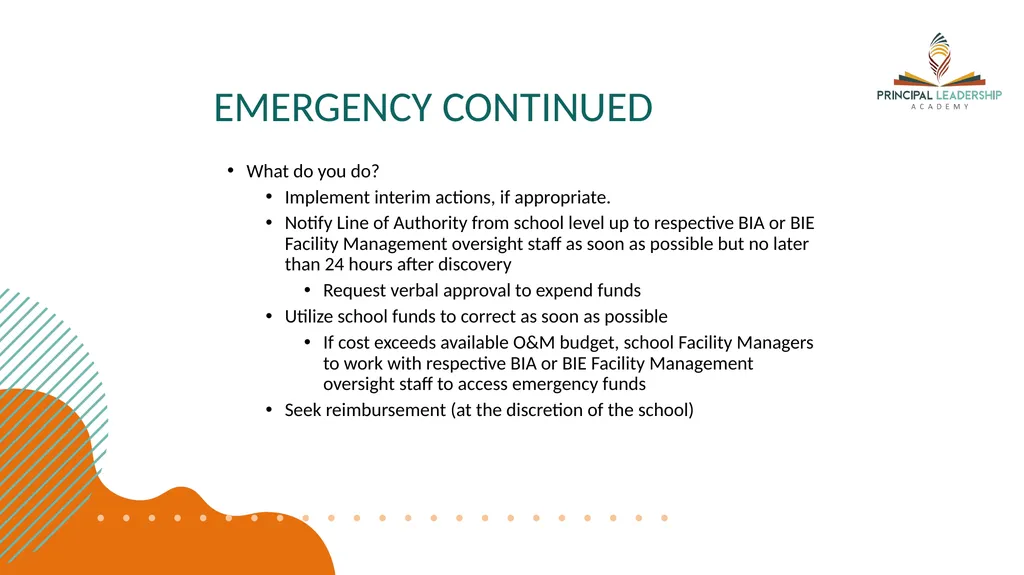
What do you do?
Implement interim actions, if appropriate.
Notify Line of Authority from school level up to respective BIA or BIE Facility Management oversight staff as soon as possible but no later than 24 hours after discovery
Request verbal approval to expend funds
Utilize school funds to correct as soon as possible
If cost exceeds available O&M budget, school Facility Managers to work with respective BIA or BIE Facility Management oversight staff to access emergency funds
Seek reimbursement (at the discretion of the school) EMERGENCY CONTINUED<br>
16
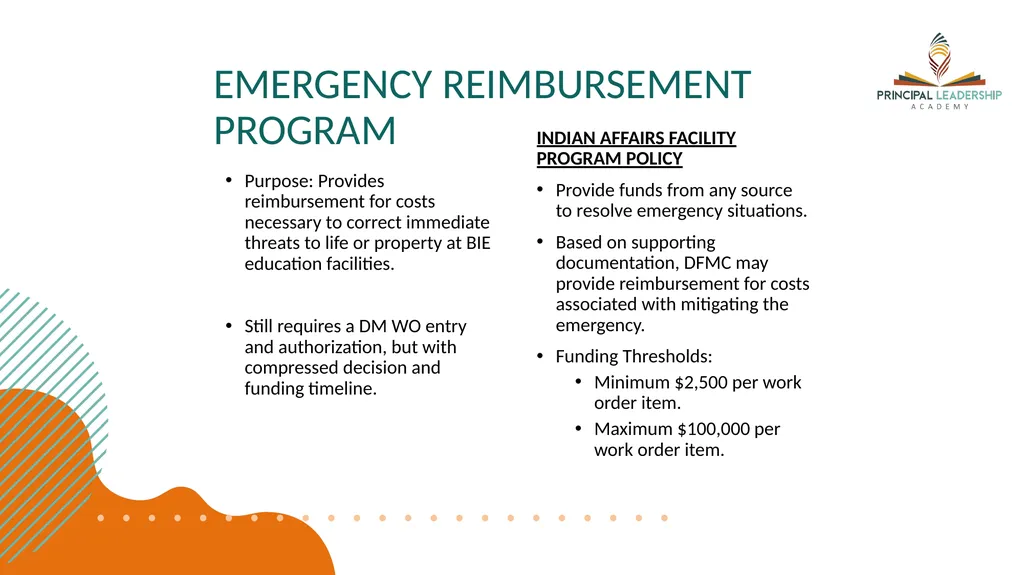
INDIAN AFFAIRS FACILITY PROGRAM POLICY
Provide funds from any source to resolve emergency situations.
Based on supporting documentation, DFMC may provide reimbursement for costs associated with mitigating the emergency.
Funding Thresholds:
Minimum $2,500 per work order item.
Maximum $100,000 per work order item. Purpose: Provides reimbursement for costs necessary to correct immediate threats to life or property at BIE education facilities.
Still requires a DM WO entry and authorization, but with compressed decision and funding timeline. EMERGENCY REIMBURSEMENT PROGRAM<br>
17
PROGRAM PROCEDURES
Schools must notify Line of Authority from school level up to respective BIA or BIE Facility Management oversight staff within 24 hours before notifying DFMC.
Correct emergency immediately utilizing funds available. EMERGENCY REIMBURSEMENT PROGRAM CONTINUED<br>
Schools must notify Line of Authority from school level up to respective BIA or BIE Facility Management oversight staff within 24 hours before notifying DFMC.
Correct emergency immediately utilizing funds available. EMERGENCY REIMBURSEMENT PROGRAM CONTINUED<br>
18
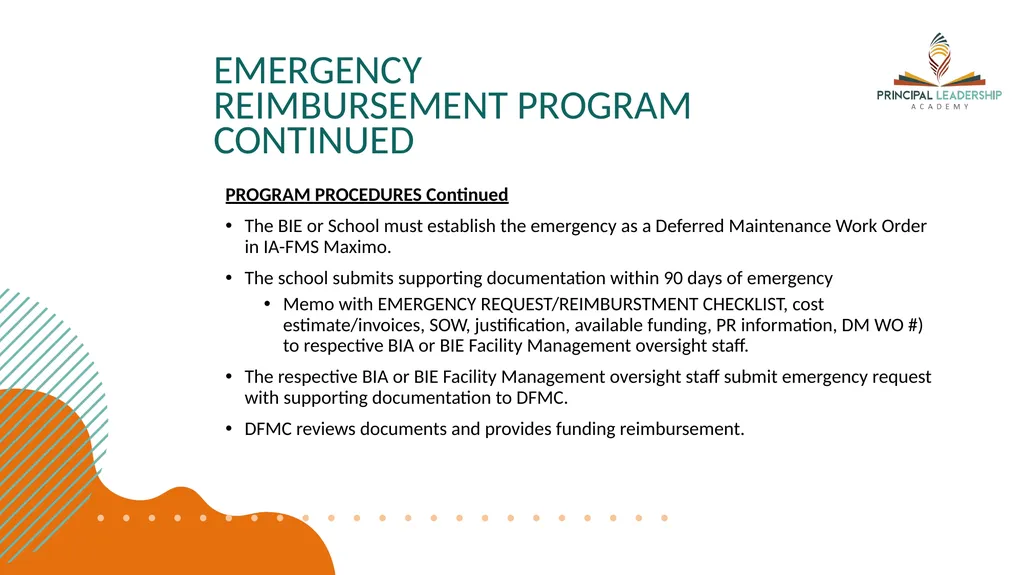
PROGRAM PROCEDURES Continued
The BIE or School must establish the emergency as a Deferred Maintenance Work Order in IA-FMS Maximo.
The school submits supporting documentation within 90 days of emergency
Memo with EMERGENCY REQUEST/REIMBURSTMENT CHECKLIST, cost estimate/invoices, SOW, justification, available funding, PR information, DM WO #) to respective BIA or BIE Facility Management oversight staff.
The respective BIA or BIE Facility Management oversight staff submit emergency request with supporting documentation to DFMC.
DFMC reviews documents and provides funding reimbursement. EMERGENCY REIMBURSEMENT PROGRAM CONTINUED<br>
19
PROGRAM PROCEDURES Continued
Advance funding
Under special circumstances on a case-by-case basis, advance emergency funding may be granted.
The Region, Agency and/or location must identify that no available funds exist to correct the emergency.
This condition normally exists at the end of the fiscal year or when the amount of cost approaches the funding threshold of $100,000. EMERGENCY REIMBURSEMENT PROGRAM CONTINUED<br>
20
Purpose: Identify and correct serious life/safety and high ranked deficiencies identified in IA-FMS as Deferred Maintenance (DM) to assist in providing safe and functional Indian Affairs facilities.
DM Work Orders
Exceed IA (O&M) Work Order threshold of $2,500 or less
Prioritized at the local school level
Funding thresholds:
Minimum $2,500 per work order item
Maximum $250,000 per work order item MINOR IMPROVEMENT & REPAIR (MI&R) PROGRAM<br>
DM Work Orders
Exceed IA (O&M) Work Order threshold of $2,500 or less
Prioritized at the local school level
Funding thresholds:
Minimum $2,500 per work order item
Maximum $250,000 per work order item MINOR IMPROVEMENT & REPAIR (MI&R) PROGRAM<br>
21
Note: Grant Schools utilizing MI&R for projects over $100,000 must have the Education Program Administrator (EPA) determine the capabilities of the Grantee and the need for a P.L. 100-297 application. MINOR IMPROVEMENT & REPAIR (MI&R) PROGRAM<br>
22
WORK ORDER PRIORITIZATION
Work Orders are prioritized according to the IA Supplemental Attachment G Project Scoring Methodology 5-Year Capital Improvement Planning as follows:
Facility Condition Index (FCI) Represents the condition of the building (DM Repair Needs compared to Current Replacement Value).
Asset Priority Index (API) Represents importance of an asset in supporting the overall mission. MI&R PROGRAM CONTINUED<br>
23
WORK ORDER PRIORITIZATION Continued
Category/Rank
U = Emergency repair on a case-by case basis
S&H/1&2 = Safety and Heath / Rank 1 and 2
M/1&2 = Physical Plant / Rank 1 and 2
Then any remaining DM WO less than $250,000
Risk Assessment Code (RAC) Represents the risk of possible injury or additional property damage may occur if the problem isn't addressed.
Assigned by safety specialists conducting safety and health inspections.
Valid RAC 1, 2, 3 issues are required to be addressed immediately. MI&R PROGRAM CONTINUED<br>
24
MILESTONES – For schools that have NOT transitioned from BIA to BIE for Facilities Management
Approximate timeframe for supplemental funding requests (MI&R prioritization)
July: BIA Region/Agency, in consultation with School(s), establishes Priority listing for DFMC.
August: BIA Regions send list to DFMC for review and consultation with BIA Region/Agency and School(s).
September: BIA Region/Agency and School(s) submit any changes to Priority listing to DFMC.
September: DFMC finalizes priorities and awaits appropriation of funding. MI&R PROGRAM CONTINUED<br>
25
MILESTONES – For schools that HAVE transitioned from BIA to BIE for Facilities Management
Approximate timeframe for supplemental funding requests (MI&R prioritization)
July: BIE Branch of Facilities Management, in consultation with School(s), establishes Priority listing for DFMC.
August: BIE Branch of Facilities Management send list to DFMC for review and consultation with BIE Branch of Facilities Management and School(s).
September: BIE Branch of Facilities Management and School(s) submit any changes to Priority listing to DFMC.
September: DFMC finalizes priorities and awaits appropriation of funding. MI&R PROGRAM CONTINUED<br>
26
Purpose: Focused on eliminating critical health and safety hazards in Bureau education facilities.
Maximizes the use of existing facilities.
Reduces the costs of repair, operation, and maintenance by repairing, rehabilitating or replacing educational facilities in lieu of complete new construction.
Improve, repair, renovate, and demolish highest priority DM items.
Funding Thresholds:
DM Work Order items greater than $250,000
Minor vs. Major Construction FI&R
Minor = $250,00 and below
Major = above $250,000 FACILITIES IMPROVEMENT & REPAIR (FI&R) PROGRAM<br>
27
Roles
Respective BIA or BIE Facility Management oversight staff
Assemble lists for FI&R Minor for packaging WOs in groups to achieve economies of scale for work performed at a specific site/building.
DFMC
Reviews data, calculates allocations for FI&R Minor, and finalizes FI&R Major priority list. FI&R PROGRAM CONTINUED<br>
28
Purpose: Provides for the replacement of total or major portions of existing facilities in those instances where rehabilitation, upgrade, or repair of the existing facilities is not economically feasible or because of student capacity needs, required functional changes, and costs.
Bureau-published Education Facilities Replacement Construction Priority List
Sets the list of schools most needing replacement. REPLACEMENT SCHOOL CONSTRUCTION PROGRAM<br>
Bureau-published Education Facilities Replacement Construction Priority List
Sets the list of schools most needing replacement. REPLACEMENT SCHOOL CONSTRUCTION PROGRAM<br>
29
All schools must enter all WOs in Maximo!
Impacts annual O&M funding, FCI, etc.
Cannot receive supplemental funding if the WO is not entered into Maximo.
Ensure sufficient staff at the school level are trained in Maximo and actively utilizing the system – keep account active.
Remember to initiate the workflow for DM WO approval
Remember to attach statement of work (SOW), independent government estimate (IGE), and vendor quotes. SOLUTIONS TO COMMON MAXIMO ISSUES…<br>
30
Be sure to track and monitor funding status of WOs – log into Maximo at least once a week.
Grant Schools – Once WO is funded, contact GMS.
Coordinate with respective BIA or BIE Facility Management oversight staff for assistance.
Close out completed WOs.
Clean up Maximo – cancel aged WOs that are not longer needed
Maximo Help Desk can assist. SOLUTIONS TO COMMON MAXIMO ISSUES…CONT.<br>
Grant Schools – Once WO is funded, contact GMS.
Coordinate with respective BIA or BIE Facility Management oversight staff for assistance.
Close out completed WOs.
Clean up Maximo – cancel aged WOs that are not longer needed
Maximo Help Desk can assist. SOLUTIONS TO COMMON MAXIMO ISSUES…CONT.<br>
31
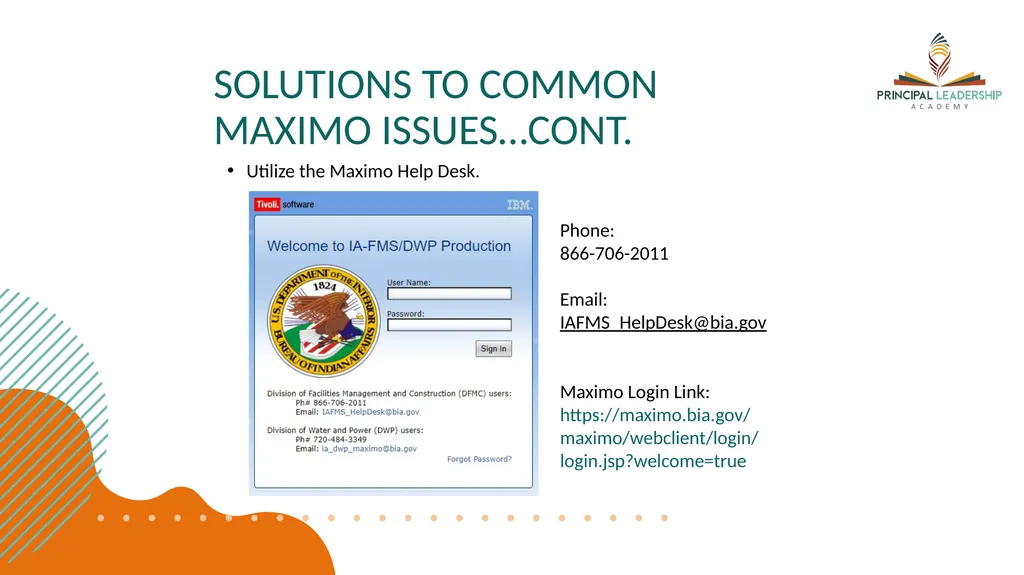
Utilize the Maximo Help Desk. SOLUTIONS TO COMMON MAXIMO ISSUES…CONT. Phone:
866-706-2011
Email:
IAFMS_HelpDesk@bia.gov
Maximo Login Link:
https://maximo.bia.gov/maximo/webclient/login/login.jsp?welcome=true<br>
866-706-2011
Email:
IAFMS_HelpDesk@bia.gov
Maximo Login Link:
https://maximo.bia.gov/maximo/webclient/login/login.jsp?welcome=true<br>
32
HELPFUL LINKS Maximo: https://maximo.bia.gov/maximo/webclient/login/login.jsp?welcome=true
Maximo Training Registration Information and Training Materials: https://www.bia.gov/as-ia/ofpsm/dfmc/iafms
DFMC’s website: https://www.bia.gov/as-ia/ofpsm/dfmc
BIE’s website: https://www.bie.edu/landing-page/facilities-safety
Emergency Reimbursement Program and Checklist: https://www.bia.gov/sites/bia.gov/files/assets/as-ia/pdf/idc-040905.pdf; https://www.bia.gov/sites/bia.gov/files/assets/as-ia/pdf/idc-040904.pdf
MI&R Program: https://www.bia.gov/sites/bia.gov/files/assets/as-ia/pdf/idc-040907.pdf
Link to facilities transition document (cannot find on website)<br>
33
CONNECT WITH US<br>