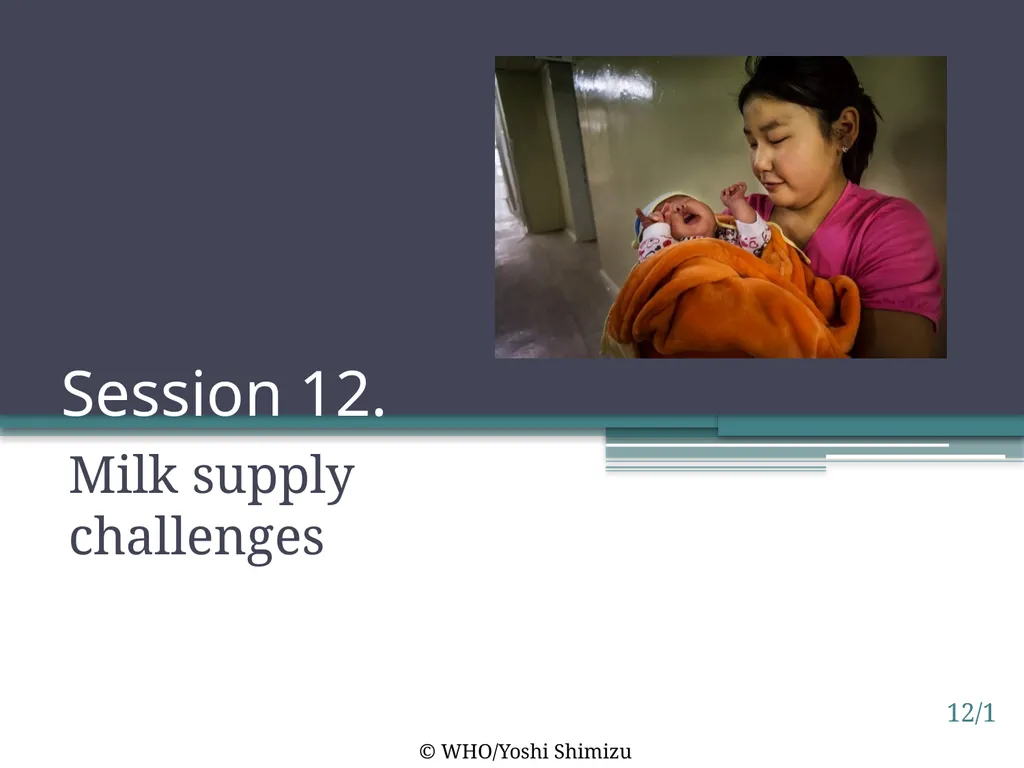
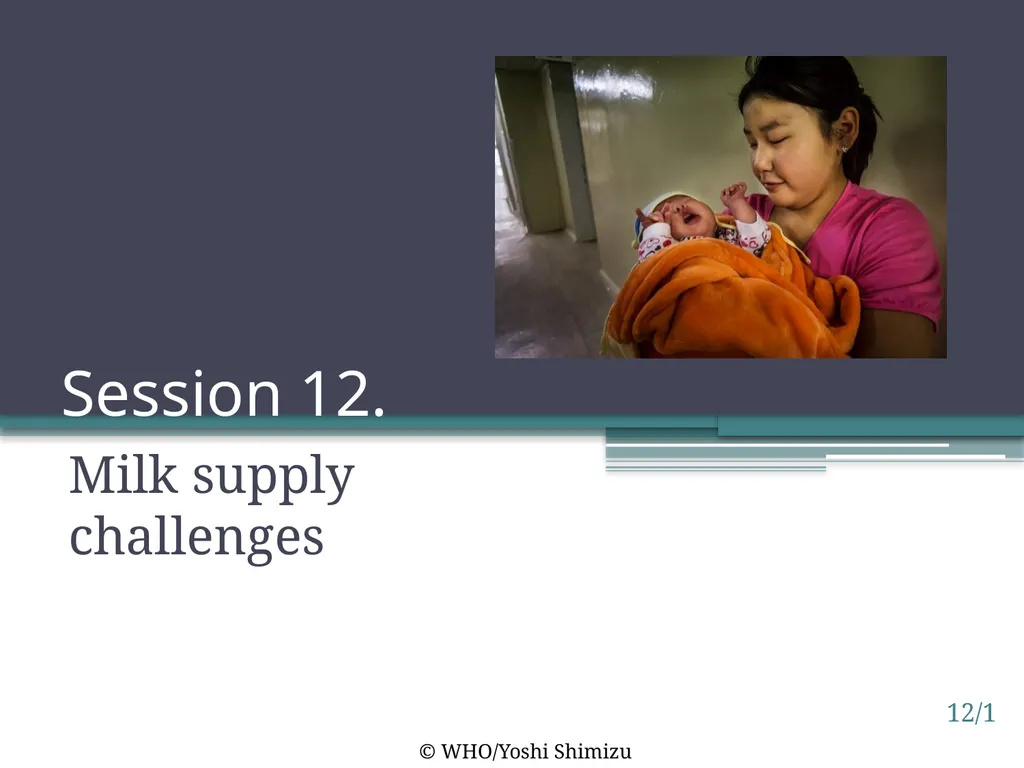
Session 12. Milk supply challenges 12/1 ©
Description: Session 12. Milk supply challenges 121 WHOYoshi Shimizu Session 12. Objectives Milk supply challenges After completing this session, participants will be able to: explain normal newborn feeding behaviour and intake; list the signs and
Related Topics
Download Presentation
"Session 12. Milk supply challenges 12/1 ©" is the property of its rightful owner. Permission is granted to download and print the materials on this website for personal, non-commercial use only, and to display it on your personal computer provided you do not modify the materials and that you retain all copyright notices contained in the materials. By downloading content from our website, you accept the terms of this agreement.
Presentation Transcript
slide1. Session 12. Milk supply challenges 12/1 © WHO/Yoshi Shimizu<br>
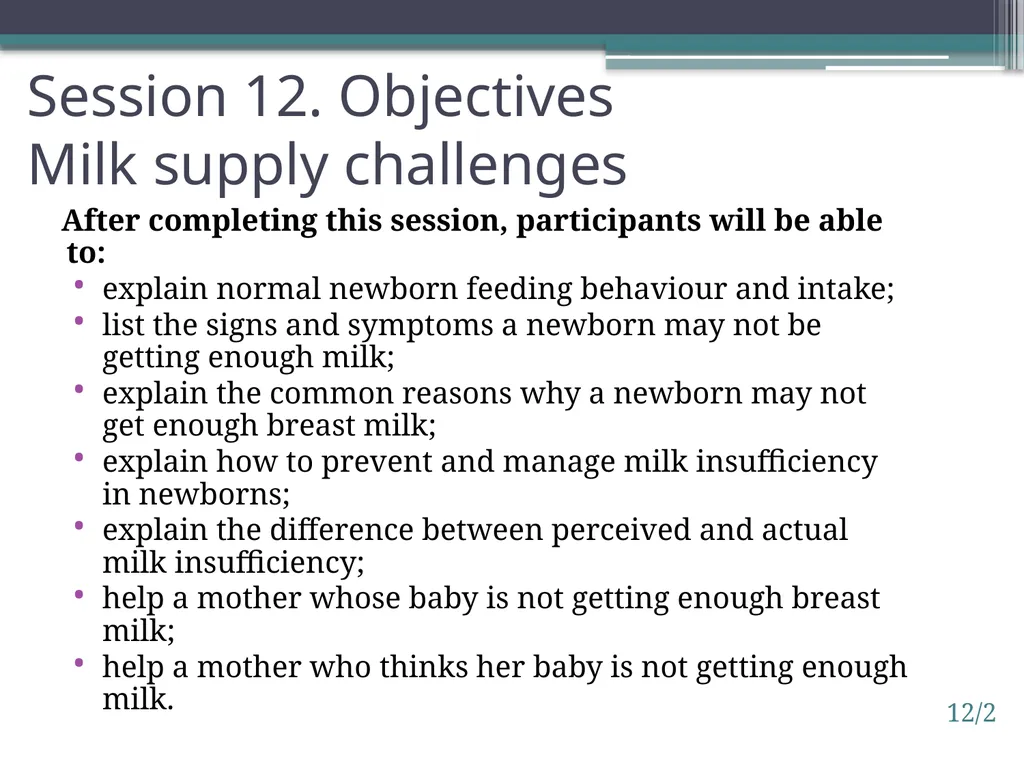
slide2. Session 12. Objectives Milk supply challenges After completing this session, participants will be able to:
explain normal newborn feeding behaviour and intake;
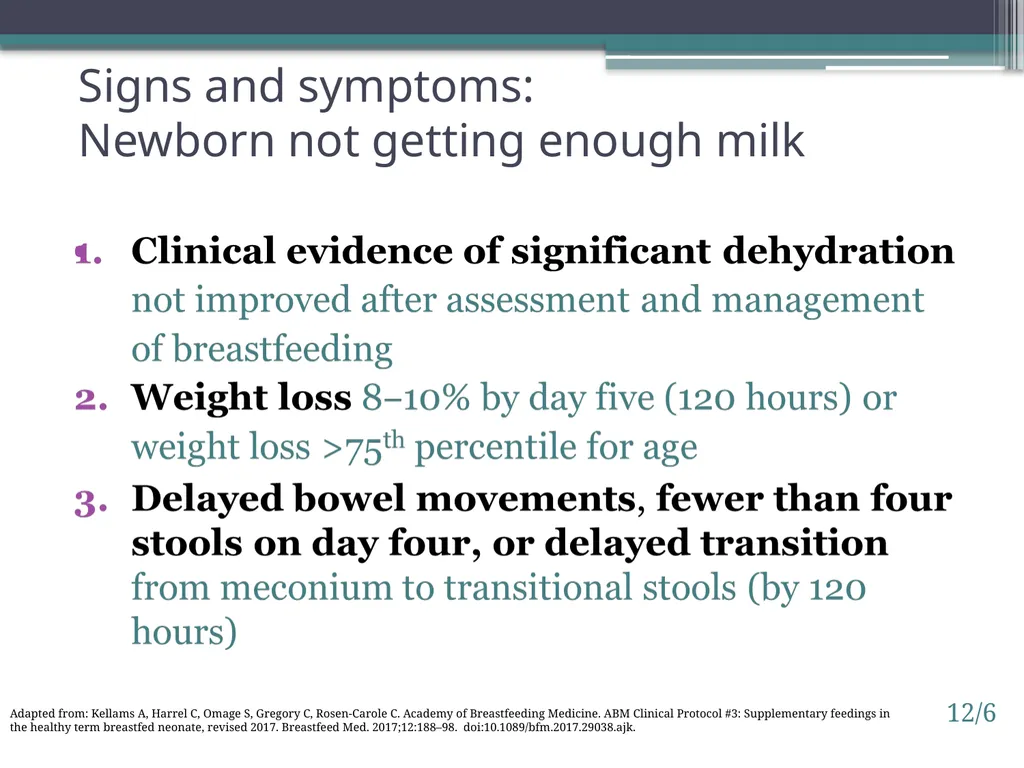
list the signs and symptoms a newborn may not be getting enough milk;
explain the common reasons why a newborn may not get enough breast milk;
explain how to prevent and manage milk insufficiency in newborns;
explain the difference between perceived and actual milk insufficiency;
help a mother whose baby is not getting enough breast milk;
help a mother who thinks her baby is not getting enough milk. 12/2<br>
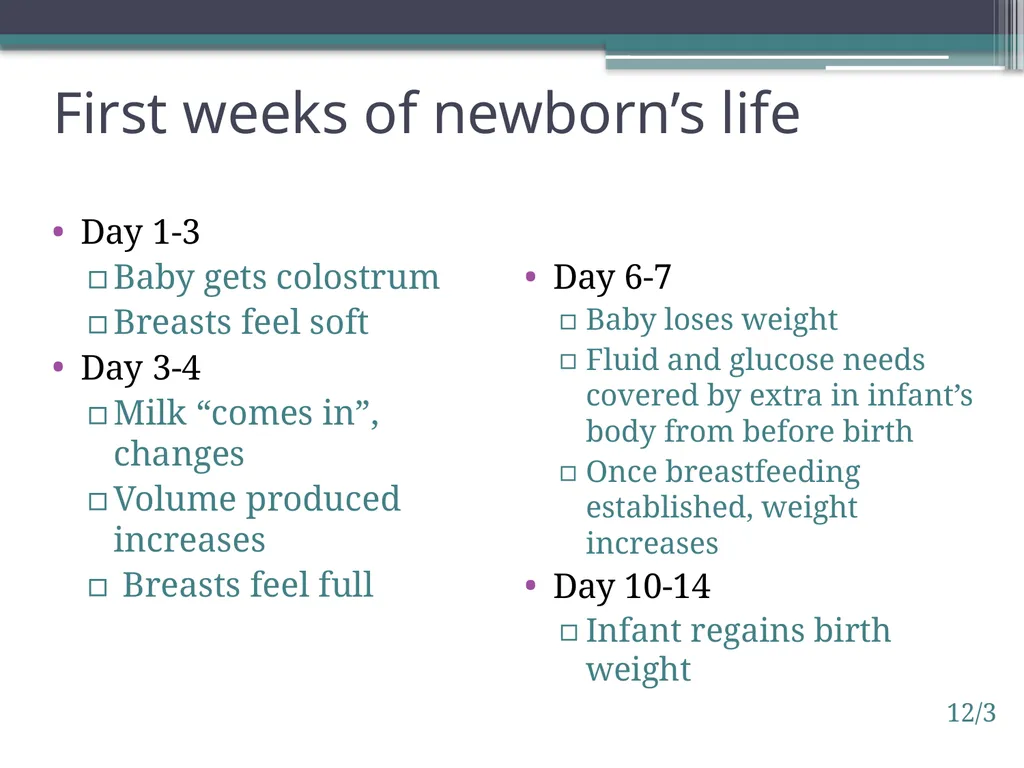
slide3. First weeks of newborn’s life Day 1-3
Baby gets colostrum
Breasts feel soft
Day 3-4
Milk “comes in”, changes
Volume produced increases
Breasts feel full
Day 6-7
Baby loses weight
Fluid and glucose needs covered by extra in infant’s body from before birth
Once breastfeeding established, weight increases
Day 10-14
Infant regains birth weight 12/3<br>
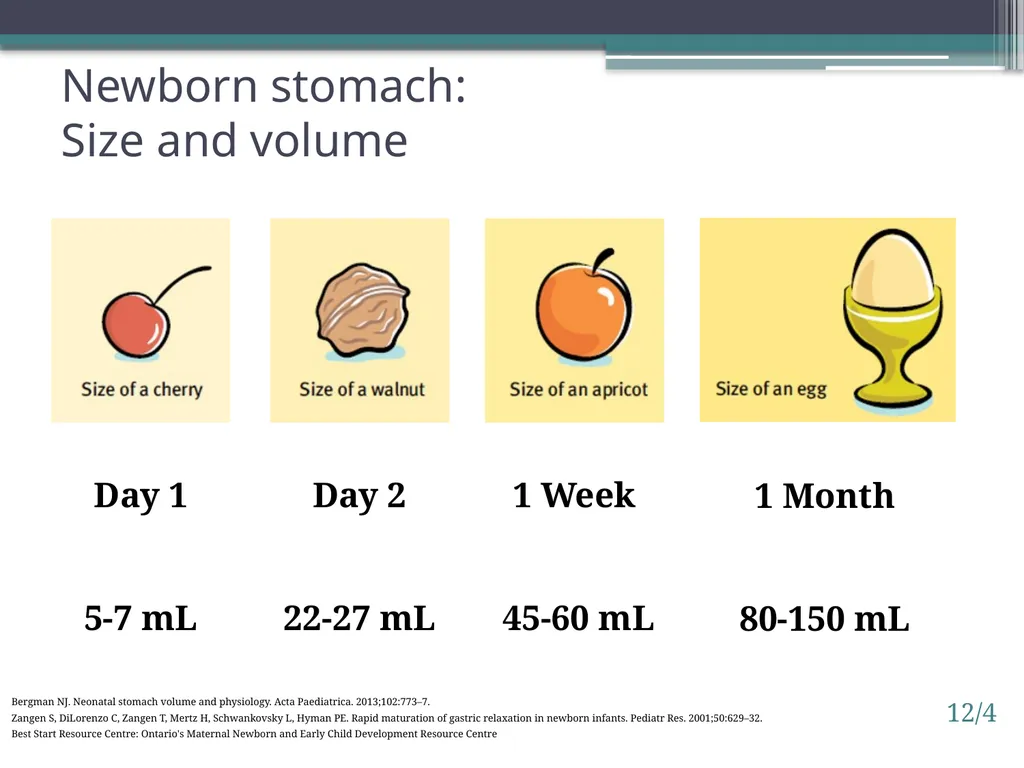
slide4. Newborn stomach: Size and volume 12/4 Bergman NJ. Neonatal stomach volume and physiology. Acta Paediatrica. 2013;102:773–7.
Zangen S, DiLorenzo C, Zangen T, Mertz H, Schwankovsky L, Hyman PE. Rapid maturation of gastric relaxation in newborn infants. Pediatr Res. 2001;50:629–32.
Best Start Resource Centre: Ontario's Maternal Newborn and Early Child Development Resource Centre Day 1
5-7 mL Day 2
22-27 mL 1 Week
45-60 mL 1 Month
80-150 mL<br>
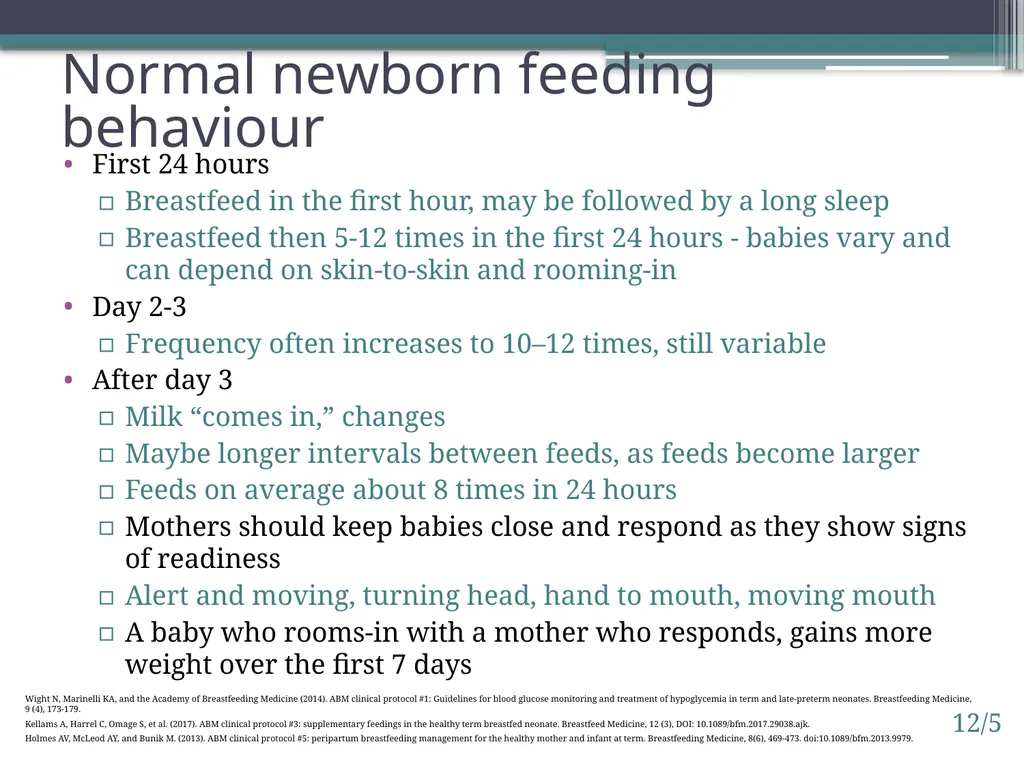
slide5. Normal newborn feeding behaviour First 24 hours
Breastfeed in the first hour, may be followed by a long sleep
Breastfeed then 5-12 times in the first 24 hours - babies vary and can depend on skin-to-skin and rooming-in
Day 2-3
Frequency often increases to 10–12 times, still variable
After day 3
Milk “comes in,” changes
Maybe longer intervals between feeds, as feeds become larger
Feeds on average about 8 times in 24 hours
Mothers should keep babies close and respond as they show signs of readiness
Alert and moving, turning head, hand to mouth, moving mouth
A baby who rooms-in with a mother who responds, gains more weight over the first 7 days 12/5 Wight N, Marinelli KA, and the Academy of Breastfeeding Medicine (2014). ABM clinical protocol #1: Guidelines for blood glucose monitoring and treatment of hypoglycemia in term and late-preterm neonates. Breastfeeding Medicine, 9 (4), 173-179.
Kellams A, Harrel C, Omage S, et al. (2017). ABM clinical protocol #3: supplementary feedings in the healthy term breastfed neonate. Breastfeed Medicine, 12 (3), DOI: 10.1089/bfm.2017.29038.ajk.
Holmes AV, McLeod AY, and Bunik M. (2013). ABM clinical protocol #5: peripartum breastfeeding management for the healthy mother and infant at term. Breastfeeding Medicine, 8(6), 469-473. doi:10.1089/bfm.2013.9979.<br>
slide6. Signs and symptoms:Newborn not getting enough milk 12/6 Adapted from: Kellams A, Harrel C, Omage S, Gregory C, Rosen-Carole C. Academy of Breastfeeding Medicine. ABM Clinical Protocol #3: Supplementary feedings in the healthy term breastfed neonate, revised 2017. Breastfeed Med. 2017;12:188–98. doi:10.1089/bfm.2017.29038.ajk.<br>
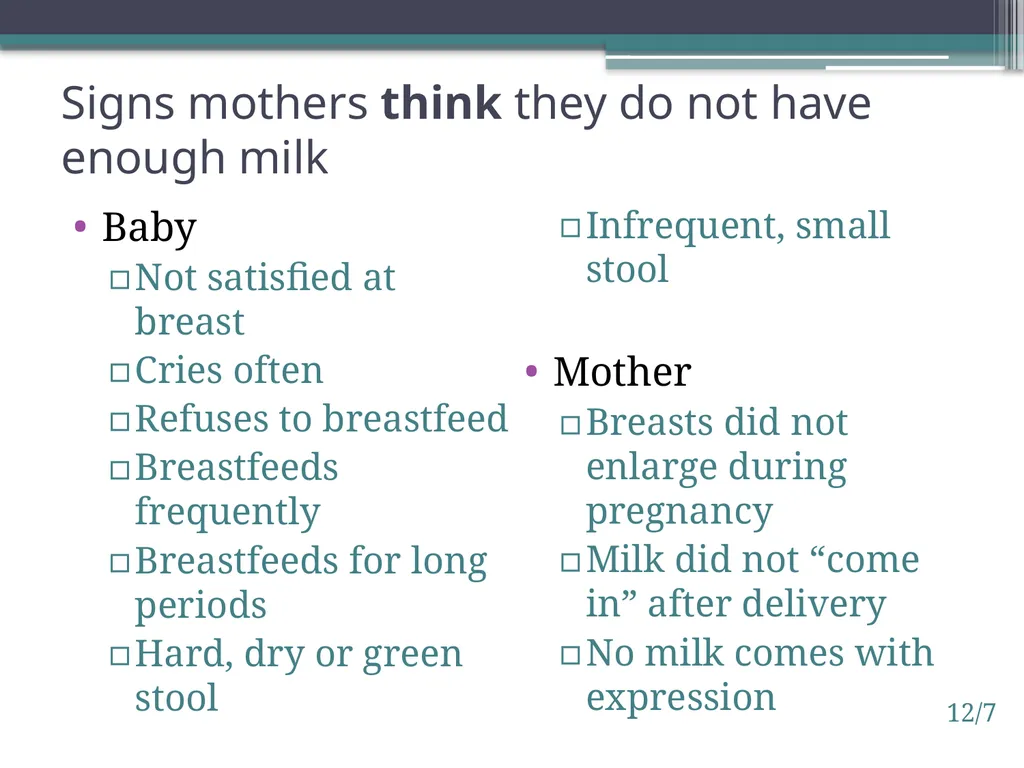
slide7. Signs mothers think they do not have enough milk Baby
Not satisfied at breast
Cries often
Refuses to breastfeed
Breastfeeds frequently
Breastfeeds for long periods
Hard, dry or green stool
Infrequent, small stool
Mother
Breasts did not enlarge during pregnancy
Milk did not “come in” after delivery
No milk comes with expression 12/7<br>
slide8. Common causes:Insufficient milk in first weeks Delay initiating breastfeeding
None or little skin-to-skin contact
Milk “coming in” delayed due to:
complications of delivery
maternal illness
diabetes
Poor attachment and ineffective suckling 12/8<br>
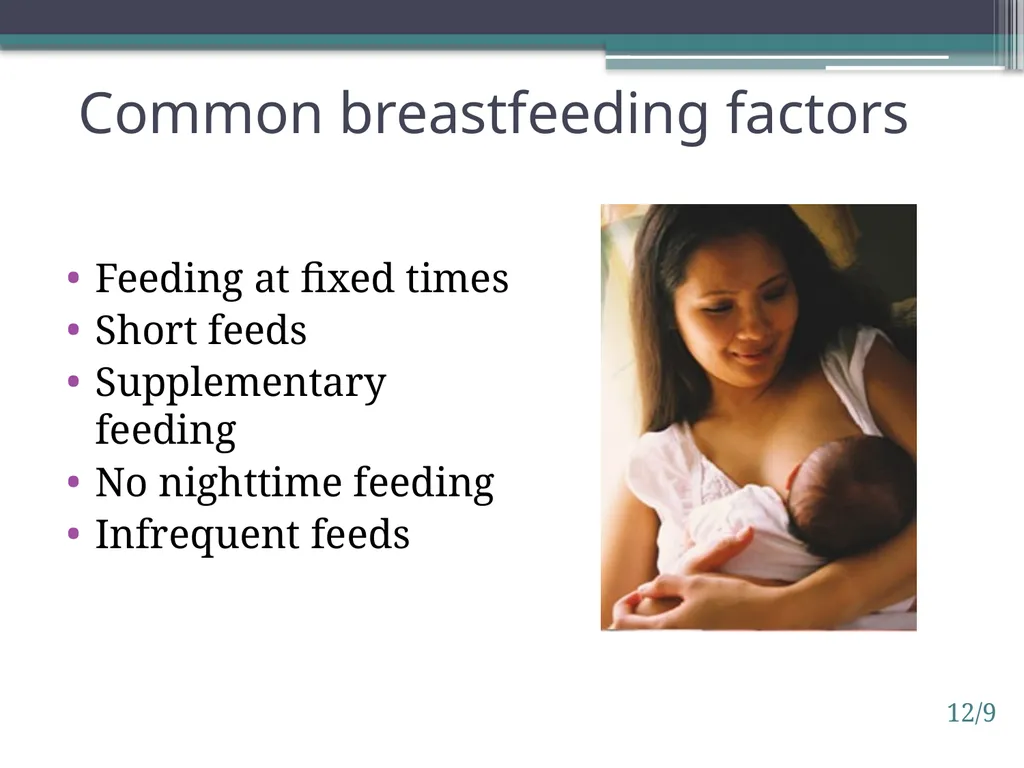
slide9. Common breastfeeding factors Feeding at fixed times
Short feeds
Supplementary feeding
No nighttime feeding
Infrequent feeds 12/9<br>
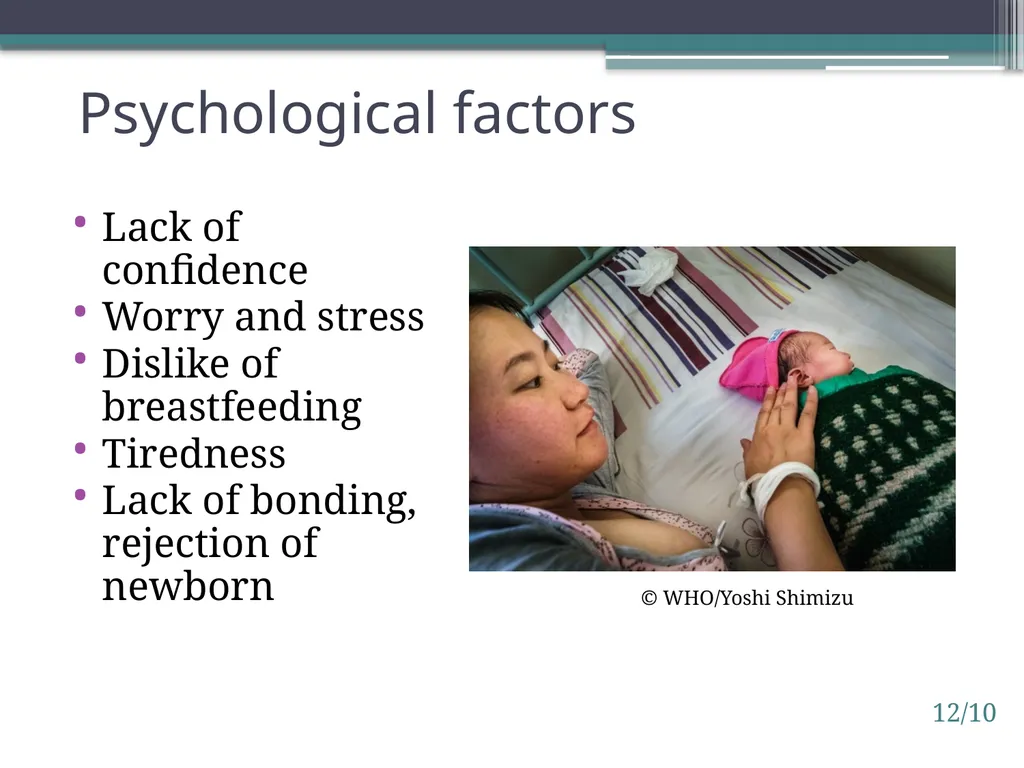
slide10. Psychological factors Lack of confidence
Worry and stress
Dislike of breastfeeding
Tiredness
Lack of bonding, rejection of newborn 12/10 © WHO/Yoshi Shimizu<br>
slide11. After 2 weeks of age:Actual or perceived insufficiency Perceived insufficiency
The most common reason for a mother giving up exclusive breastfeeding is because they think they do not have enough milk.
Almost all mothers are able to produce as much milk as their baby needs.
Often there is an issue in the interaction between mother and infant
How many mothers could continue breastfeeding if they had skilled support and help?
Actual insufficiency
In some cases, the mother does have a supply issue.
Assess the possible causes: physical, psychological or other causes. 12/11<br>
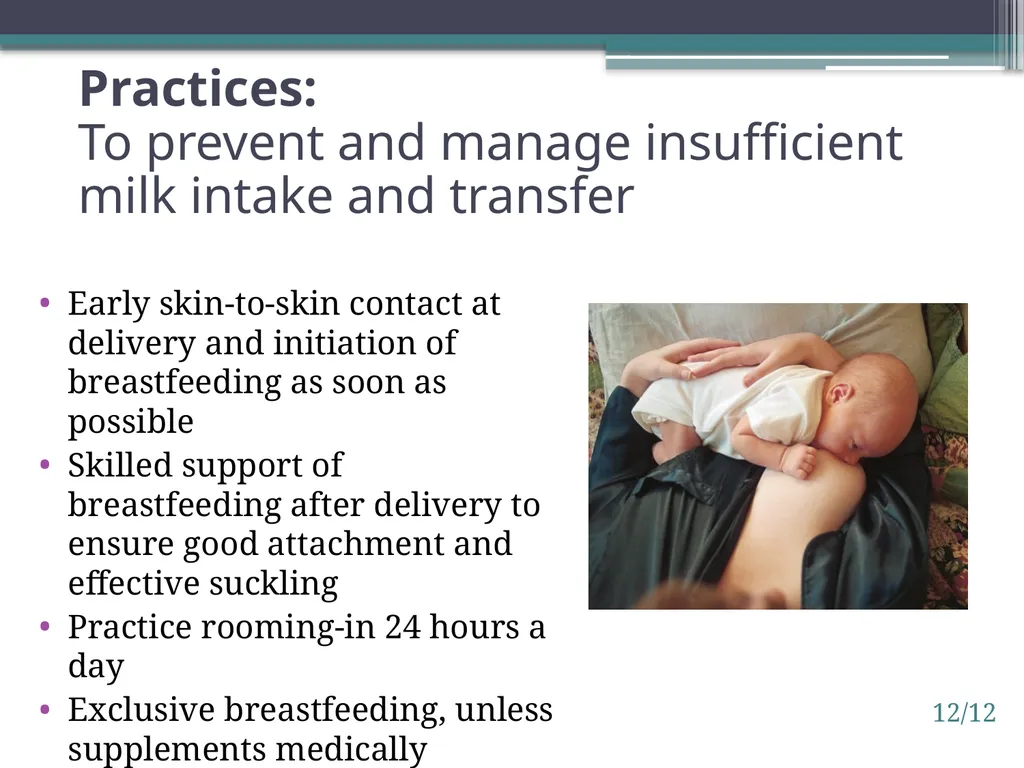
slide12. Practices:To prevent and manage insufficient milk intake and transfer Early skin-to-skin contact at delivery and initiation of breastfeeding as soon as possible
Skilled support of breastfeeding after delivery to ensure good attachment and effective suckling
Practice rooming-in 24 hours a day
Exclusive breastfeeding, unless supplements medically indicated 12/12<br>
slide13. Not enough milk:Helping the mother Listen to the mother and take a detailed history
If she is doubting her milk supply, try to learn why. In this way, you can help her to build her confidence.
Explore the mother’s ideas and feelings about her milk and pressures she may be experiencing. This pressure can come from family and friends.
Assess the infant’s health
Determine whether the baby is getting milk or not, using the signs and symptoms we have discussed.
Determine whether the baby is being fed exclusively at the breast or is being supplemented. 12/13 Adapted from: LEAARC. Core curriculum for interdisciplinary lactation care. Burlington (MA): 2019.<br>
slide14. Not enough milk:Helping the mother Assess the big picture
Is the baby’s weight within the expected range?
Has supplementation played a role?
Is baby removing milk from the breast?
What is the baby's output (urine and stooling pattern)?
Assess the mother’s health
Does the mother have risk factors for lactation problems?
Observe one or more feeds
Assess latch, milk transfer and positioning to check positioning and attachment, as well as the condition of the mother and baby. Adapted from: LEAARC. Core curriculum for interdisciplinary lactation care. Burlington (MA); 2019. 12/14<br>
slide15. Not enough milk:Helping the mother If there is a problem
Make sure baby is adequately fed. This may require supplementation.
Try to determine the cause. Has the problem been present since birth? When did the problem become apparent?
Screen for breastfeeding management problems and factors related to the mother.
If milk remained in the breast after feeding, determine the cause for the baby’s inability to remove milk.
Support milk production as needed and address any problems as soon as possible 12/15 Adapted from: LEAARC. Core curriculum for interdisciplinary lactation care. Burlington, MA; 2019.<br>

slide2. Session 12. Objectives Milk supply challenges After completing this session, participants will be able to:
explain normal newborn feeding behaviour and intake;
list the signs and symptoms a newborn may not be getting enough milk;
explain the common reasons why a newborn may not get enough breast milk;
explain how to prevent and manage milk insufficiency in newborns;
explain the difference between perceived and actual milk insufficiency;
help a mother whose baby is not getting enough breast milk;
help a mother who thinks her baby is not getting enough milk. 12/2<br>
slide3. First weeks of newborn’s life Day 1-3
Baby gets colostrum
Breasts feel soft
Day 3-4
Milk “comes in”, changes
Volume produced increases
Breasts feel full
Day 6-7
Baby loses weight
Fluid and glucose needs covered by extra in infant’s body from before birth
Once breastfeeding established, weight increases
Day 10-14
Infant regains birth weight 12/3<br>
slide4. Newborn stomach: Size and volume 12/4 Bergman NJ. Neonatal stomach volume and physiology. Acta Paediatrica. 2013;102:773–7.
Zangen S, DiLorenzo C, Zangen T, Mertz H, Schwankovsky L, Hyman PE. Rapid maturation of gastric relaxation in newborn infants. Pediatr Res. 2001;50:629–32.
Best Start Resource Centre: Ontario's Maternal Newborn and Early Child Development Resource Centre Day 1
5-7 mL Day 2
22-27 mL 1 Week
45-60 mL 1 Month
80-150 mL<br>
slide5. Normal newborn feeding behaviour First 24 hours
Breastfeed in the first hour, may be followed by a long sleep
Breastfeed then 5-12 times in the first 24 hours - babies vary and can depend on skin-to-skin and rooming-in
Day 2-3
Frequency often increases to 10–12 times, still variable
After day 3
Milk “comes in,” changes
Maybe longer intervals between feeds, as feeds become larger
Feeds on average about 8 times in 24 hours
Mothers should keep babies close and respond as they show signs of readiness
Alert and moving, turning head, hand to mouth, moving mouth
A baby who rooms-in with a mother who responds, gains more weight over the first 7 days 12/5 Wight N, Marinelli KA, and the Academy of Breastfeeding Medicine (2014). ABM clinical protocol #1: Guidelines for blood glucose monitoring and treatment of hypoglycemia in term and late-preterm neonates. Breastfeeding Medicine, 9 (4), 173-179.
Kellams A, Harrel C, Omage S, et al. (2017). ABM clinical protocol #3: supplementary feedings in the healthy term breastfed neonate. Breastfeed Medicine, 12 (3), DOI: 10.1089/bfm.2017.29038.ajk.
Holmes AV, McLeod AY, and Bunik M. (2013). ABM clinical protocol #5: peripartum breastfeeding management for the healthy mother and infant at term. Breastfeeding Medicine, 8(6), 469-473. doi:10.1089/bfm.2013.9979.<br>
slide6. Signs and symptoms:Newborn not getting enough milk 12/6 Adapted from: Kellams A, Harrel C, Omage S, Gregory C, Rosen-Carole C. Academy of Breastfeeding Medicine. ABM Clinical Protocol #3: Supplementary feedings in the healthy term breastfed neonate, revised 2017. Breastfeed Med. 2017;12:188–98. doi:10.1089/bfm.2017.29038.ajk.<br>
slide7. Signs mothers think they do not have enough milk Baby
Not satisfied at breast
Cries often
Refuses to breastfeed
Breastfeeds frequently
Breastfeeds for long periods
Hard, dry or green stool
Infrequent, small stool
Mother
Breasts did not enlarge during pregnancy
Milk did not “come in” after delivery
No milk comes with expression 12/7<br>
slide8. Common causes:Insufficient milk in first weeks Delay initiating breastfeeding
None or little skin-to-skin contact
Milk “coming in” delayed due to:
complications of delivery
maternal illness
diabetes
Poor attachment and ineffective suckling 12/8<br>
slide9. Common breastfeeding factors Feeding at fixed times
Short feeds
Supplementary feeding
No nighttime feeding
Infrequent feeds 12/9<br>
slide10. Psychological factors Lack of confidence
Worry and stress
Dislike of breastfeeding
Tiredness
Lack of bonding, rejection of newborn 12/10 © WHO/Yoshi Shimizu<br>
slide11. After 2 weeks of age:Actual or perceived insufficiency Perceived insufficiency
The most common reason for a mother giving up exclusive breastfeeding is because they think they do not have enough milk.
Almost all mothers are able to produce as much milk as their baby needs.
Often there is an issue in the interaction between mother and infant
How many mothers could continue breastfeeding if they had skilled support and help?
Actual insufficiency
In some cases, the mother does have a supply issue.
Assess the possible causes: physical, psychological or other causes. 12/11<br>
slide12. Practices:To prevent and manage insufficient milk intake and transfer Early skin-to-skin contact at delivery and initiation of breastfeeding as soon as possible
Skilled support of breastfeeding after delivery to ensure good attachment and effective suckling
Practice rooming-in 24 hours a day
Exclusive breastfeeding, unless supplements medically indicated 12/12<br>
slide13. Not enough milk:Helping the mother Listen to the mother and take a detailed history
If she is doubting her milk supply, try to learn why. In this way, you can help her to build her confidence.
Explore the mother’s ideas and feelings about her milk and pressures she may be experiencing. This pressure can come from family and friends.
Assess the infant’s health
Determine whether the baby is getting milk or not, using the signs and symptoms we have discussed.
Determine whether the baby is being fed exclusively at the breast or is being supplemented. 12/13 Adapted from: LEAARC. Core curriculum for interdisciplinary lactation care. Burlington (MA): 2019.<br>
slide14. Not enough milk:Helping the mother Assess the big picture
Is the baby’s weight within the expected range?
Has supplementation played a role?
Is baby removing milk from the breast?
What is the baby's output (urine and stooling pattern)?
Assess the mother’s health
Does the mother have risk factors for lactation problems?
Observe one or more feeds
Assess latch, milk transfer and positioning to check positioning and attachment, as well as the condition of the mother and baby. Adapted from: LEAARC. Core curriculum for interdisciplinary lactation care. Burlington (MA); 2019. 12/14<br>
slide15. Not enough milk:Helping the mother If there is a problem
Make sure baby is adequately fed. This may require supplementation.
Try to determine the cause. Has the problem been present since birth? When did the problem become apparent?
Screen for breastfeeding management problems and factors related to the mother.
If milk remained in the breast after feeding, determine the cause for the baby’s inability to remove milk.
Support milk production as needed and address any problems as soon as possible 12/15 Adapted from: LEAARC. Core curriculum for interdisciplinary lactation care. Burlington, MA; 2019.<br>