
Session 3: Aims To consider the mezuzah and create



Description: Session 3: Aims To consider the mezuzah and create their own family statement showing their own family values and beliefs. To learn about a key aspect of Jewish practise: Shabbat To consider how they take rest in their own lives, and
Related Topics
Download Presentation
"Session 3: Aims To consider the mezuzah and create" is the property of its rightful owner. Permission is granted to download and print the materials on this website for personal, non-commercial use only, and to display it on your personal computer provided you do not modify the materials and that you retain all copyright notices contained in the materials. By downloading content from our website, you accept the terms of this agreement.
Presentation Transcript
slide1. Session 3: Aims To consider the mezuzah and create their own ‘family statement’ showing their own family values and beliefs.
To learn about a key aspect of Jewish practise: Shabbat
To consider how they take rest in their own lives, and relate this to the Jewish practise of Shabbat. Key Question: ‘What does it mean to belong to the Jewish religion?’<br>
slide2. What did we learn about the mezuzah and the Shema in the previous lesson? The Shema is important because it reminds Jews that: *There is only one God *God loves everybody and they should love Him. *Everybody should follow God’s rules. *Children should be taught the Torah It also says: Write God’s commands on the doorposts of your house. This explains why Jewish households have mezuzahs on their doorposts.<br>
slide3. What would your own ‘family statement’ be to go inside a mezuzah case?
This is one family’s statement:
We share what we have
We show each other love, kindness and respect
We play and have fun together
We share our problems and try to find solutions.
I wonder what your ‘family statement’ might be?
Take a couple of minutes to jot some ideas down ready to share.<br>
slide4. My ‘family statement’ …………………………………………………………………………………………………………
………………………………………………………………………………………………………...
…………………………………………………………………………………………………………
………………………………………………………………………………………………………...<br>
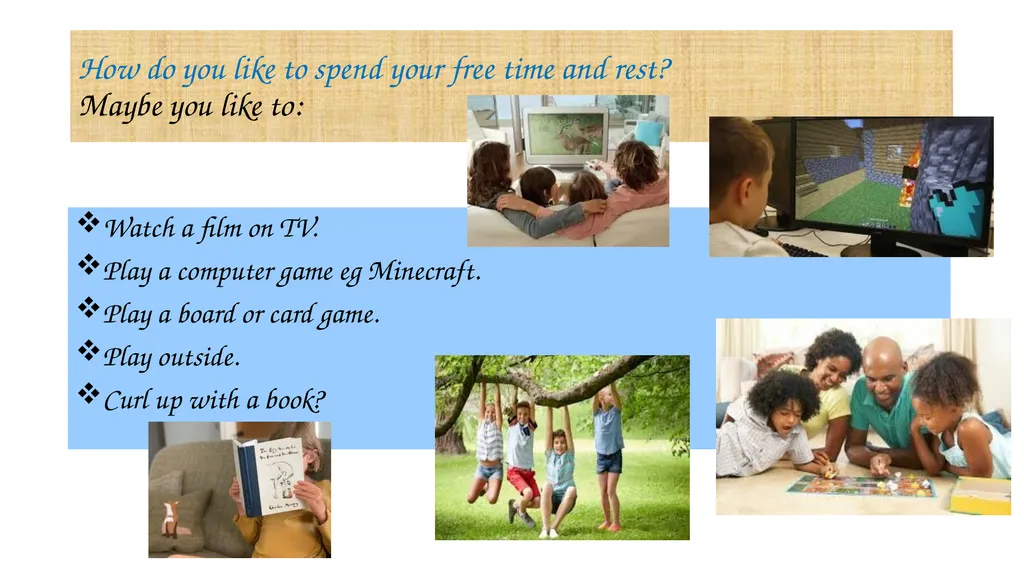
slide5. How do you like to spend your free time and rest? Maybe you like to: Watch a film on TV.
Play a computer game eg Minecraft.
Play a board or card game.
Play outside.
Curl up with a book?<br>
slide6. So what does finding out how we like to rest got to do with our key question? Well Jewish people consider resting is an important part of their faith because the Bible story tells how God created the world in six days and ‘rested’ on the 7th. This story reminds Jews that it is good to have a pattern to life that involves work and rest. In Hebrew, the Jewish language that prayers and Holy books are written in, ‘Shabbat’ means ‘ceasing’ or ‘stopping’. So let’s find out more about Shabbat… Key Question: ‘What does it mean to belong to the Jewish religion?’<br>
slide8. What Is Shabbat? Shabbat is an exciting and important day that Jewish people look forward to all week.
For Jewish people, Saturday is a special day, just like Sunday is special to Christians. Shabbat is the fourth commandment: ‘You shall remember to keep the Sabbath day Holy.’ Saturday was the seventh day of the week and the day that God rested after creating the world. Ever since ancient times, Jewish people have kept the Sabbath day Holy by celebrating Shabbat.<br>
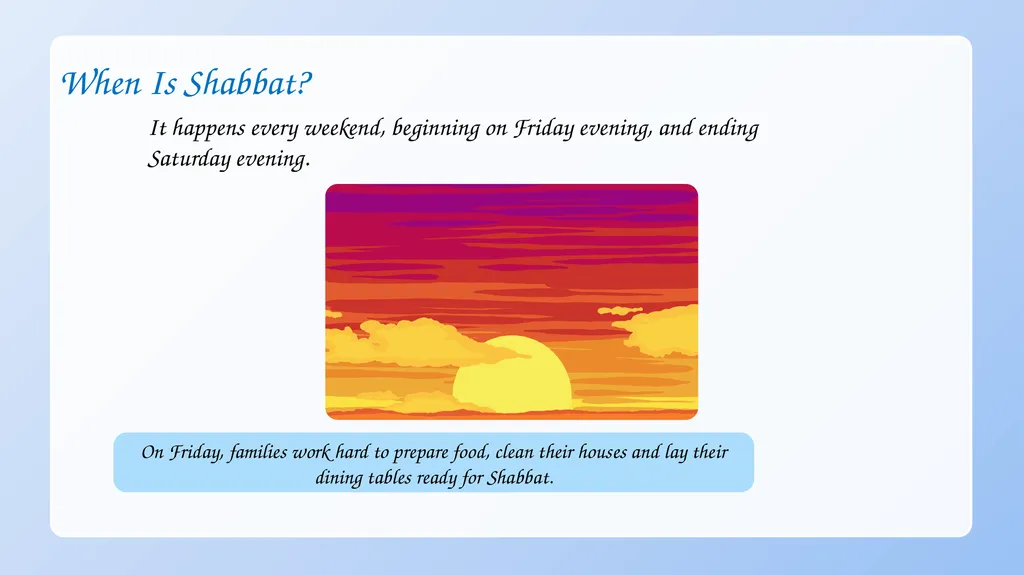
slide9. When Is Shabbat? It happens every weekend, beginning on Friday evening, and ending Saturday evening. On Friday, families work hard to prepare food, clean their houses and lay their dining tables ready for Shabbat.<br>
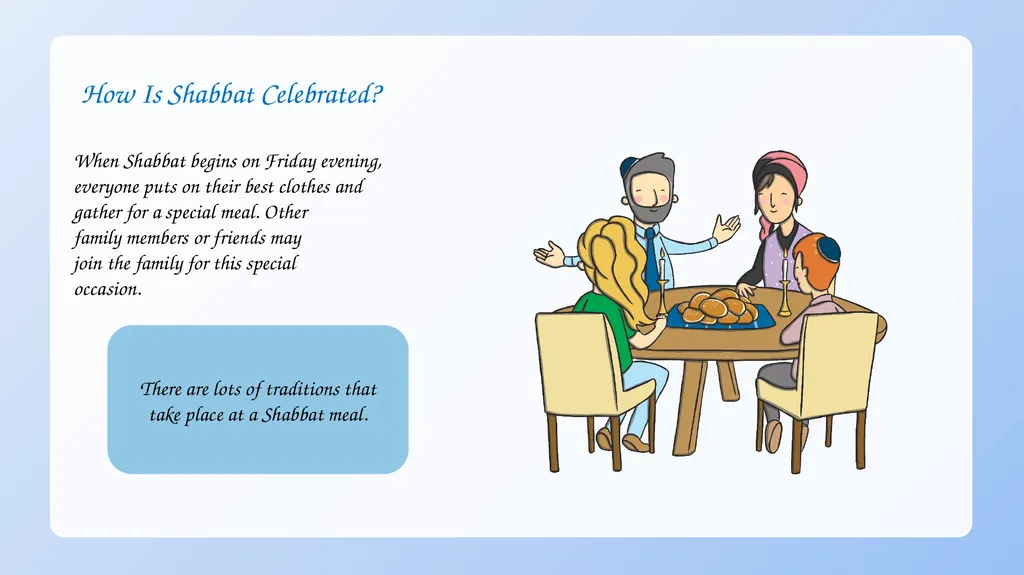
slide10. How Is Shabbat Celebrated? When Shabbat begins on Friday evening, everyone puts on their best clothes and gather for a special meal. Other family members or friends may join the family for this special occasion. There are lots of traditions that take place at a Shabbat meal.<br>
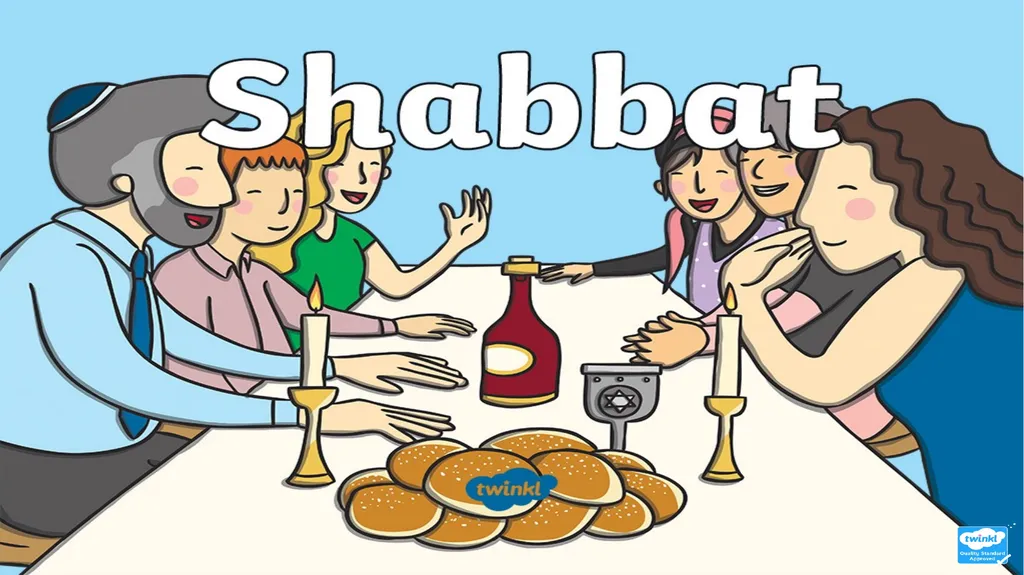
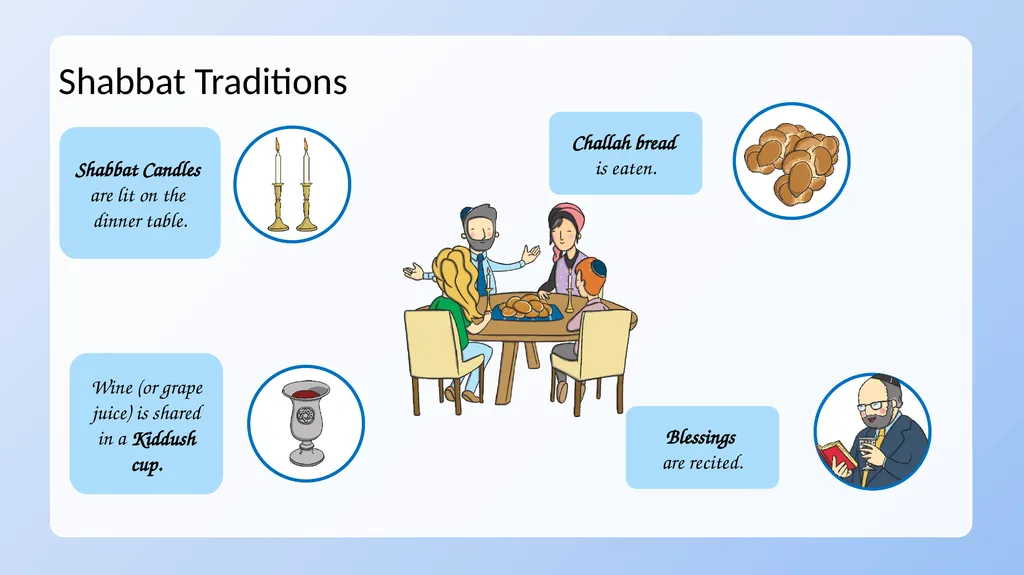
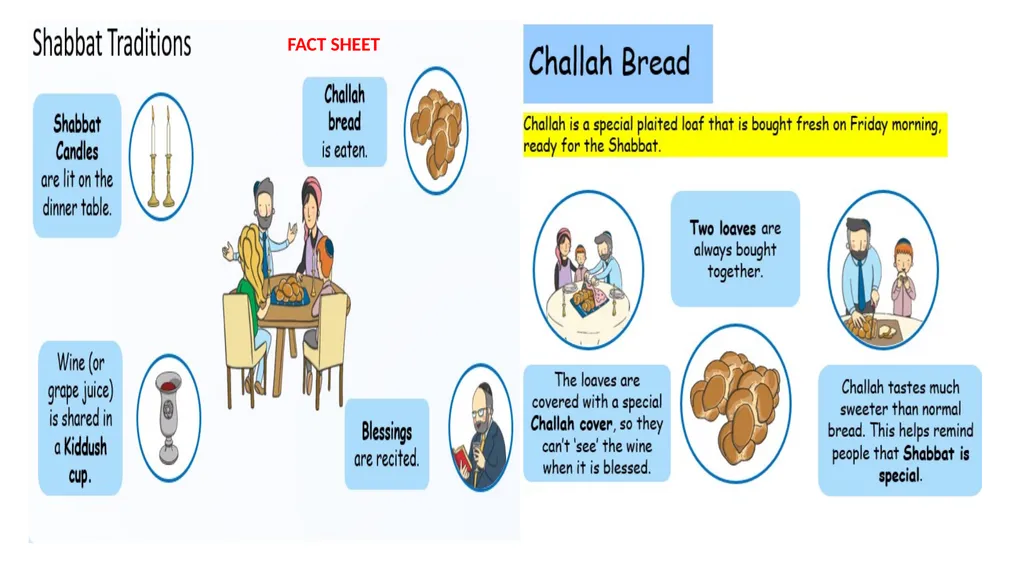
slide11. Shabbat Traditions Shabbat Candles are lit on the dinner table. Wine (or grape juice) is shared in a Kiddush cup. Challah bread is eaten. Blessings are recited.<br>
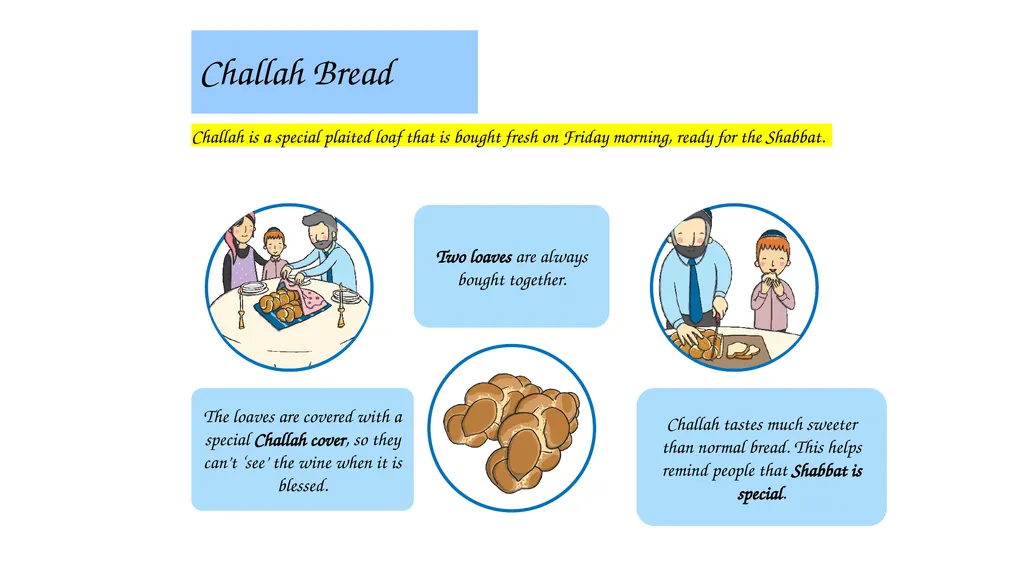
slide12. Challah Bread Challah is a special plaited loaf that is bought fresh on Friday morning, ready for the Shabbat. The loaves are covered with a special Challah cover, so they can’t ‘see’ the wine when it is blessed. Challah tastes much sweeter than normal bread. This helps remind people that Shabbat is special. Two loaves are always bought together.<br>
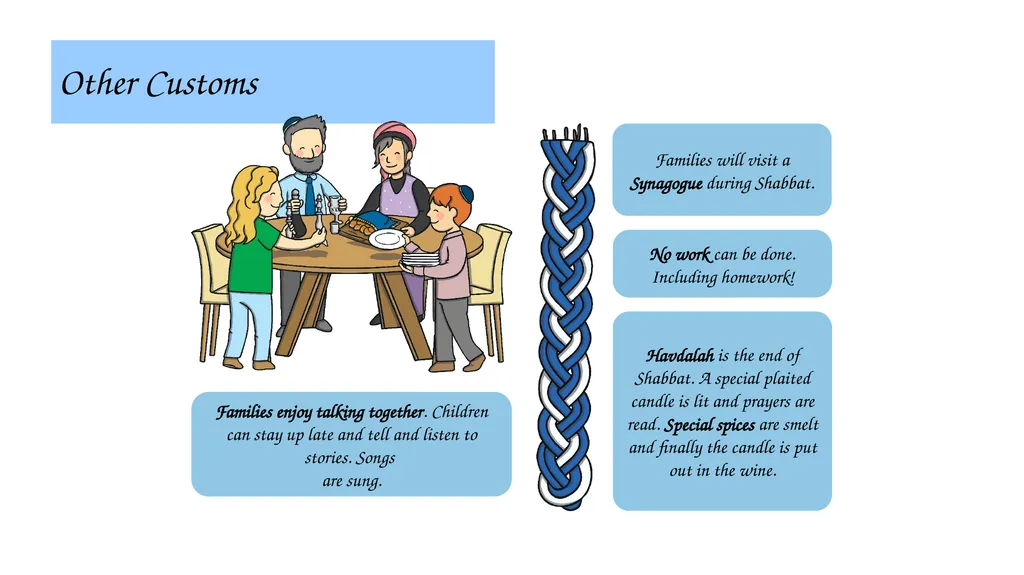
slide13. Other Customs Families enjoy talking together. Children can stay up late and tell and listen to stories. Songs are sung. Families will visit a Synagogue during Shabbat. No work can be done. Including homework! Havdalah is the end of Shabbat. A special plaited candle is lit and prayers are read. Special spices are smelt and finally the candle is put out in the wine.<br>
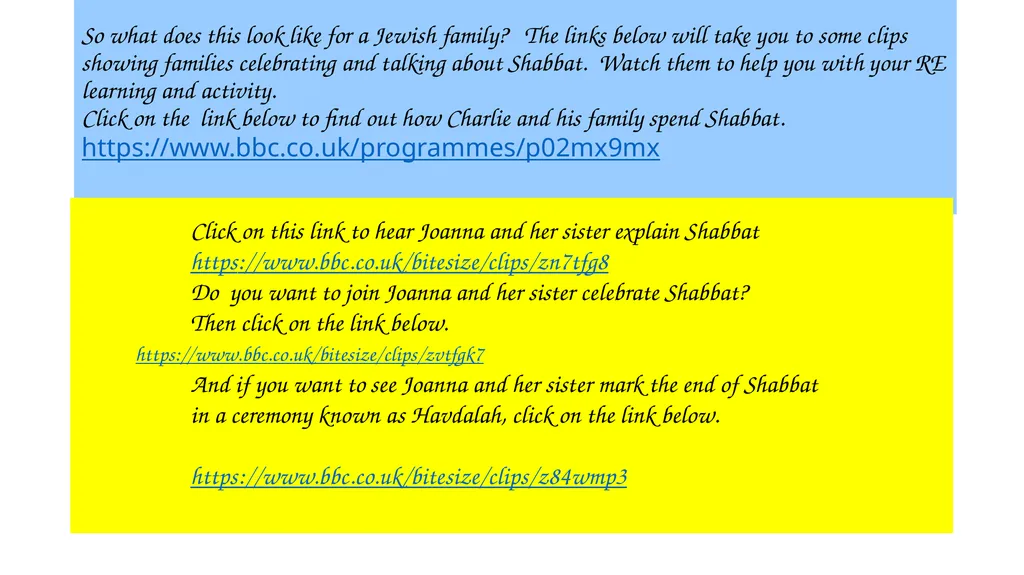
slide14. So what does this look like for a Jewish family? The links below will take you to some clips showing families celebrating and talking about Shabbat. Watch them to help you with your RE learning and activity. Click on the link below to find out how Charlie and his family spend Shabbat. https://www.bbc.co.uk/programmes/p02mx9mx https://www.bbc.co.uk/bitesize/clips/zvtfgk7 Click on this link to hear Joanna and her sister explain Shabbat
https://www.bbc.co.uk/bitesize/clips/zn7tfg8
Do you want to join Joanna and her sister celebrate Shabbat?
Then click on the link below.
And if you want to see Joanna and her sister mark the end of Shabbat
in a ceremony known as Havdalah, click on the link below.
https://www.bbc.co.uk/bitesize/clips/z84wmp3<br>
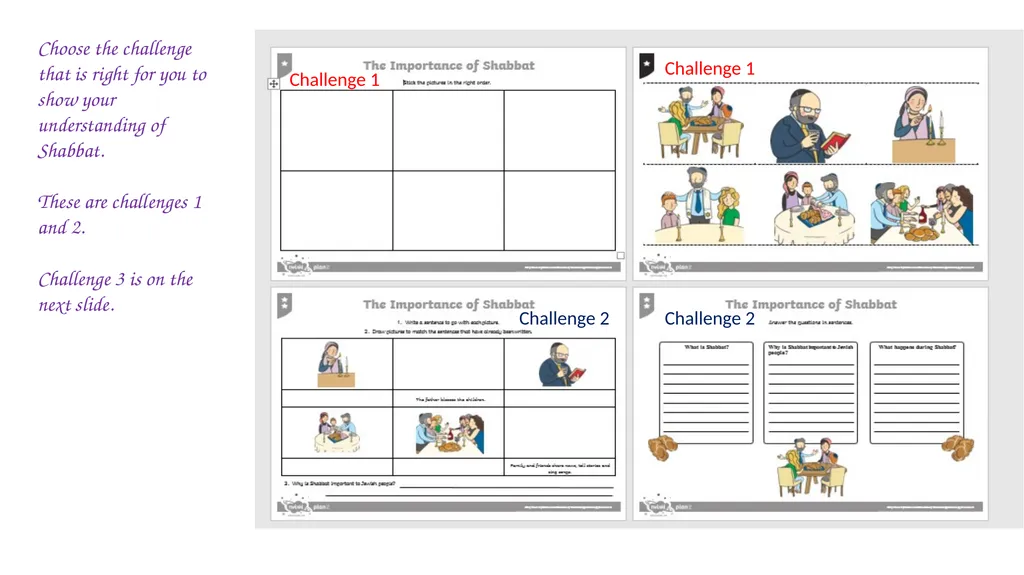
slide15. Choose the challenge that is right for you to show your understanding of Shabbat.
These are challenges 1 and 2.
Challenge 3 is on the next slide. Challenge 2 Challenge 1 Challenge 1 Challenge 2<br>
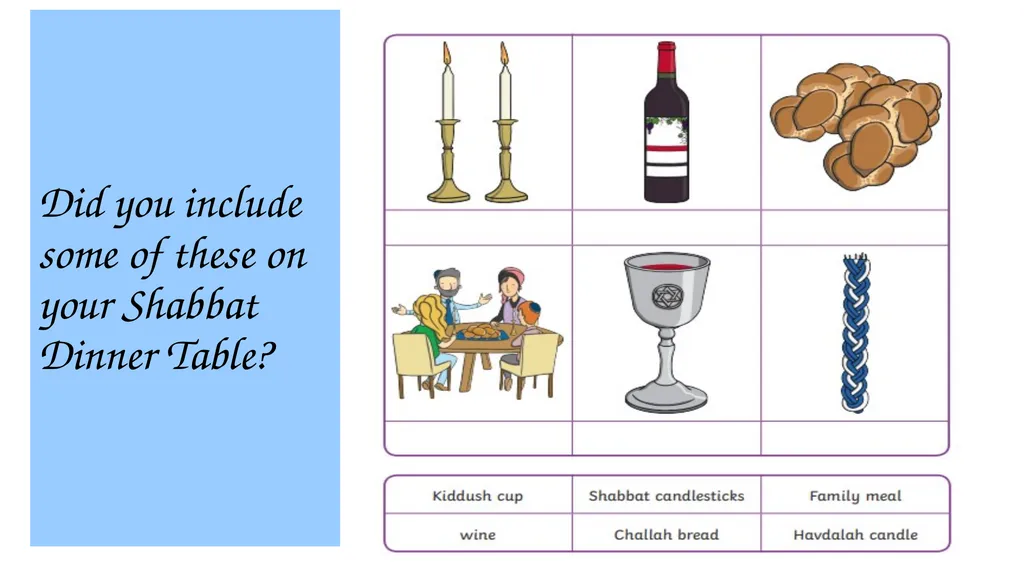
slide16. The film clips you watched told you lots of things about the Jewish day of rest called Shabbat. In the box above draw some of the things that you would find on a Shabbat dinner table. You could watch the films and pause them when it shows a picture of the table set out for the Shabbat meal to help when you are drawing. Around your picture add labels and descriptions of the items. Next add some speech bubbles saying what Jewish people are remembering at Shabbat. You could also add in extra things you have found out about Shabbat.<br>
slide17. FACT SHEET<br>
slide18. Did you include some of these on your Shabbat Dinner Table?<br>
To learn about a key aspect of Jewish practise: Shabbat
To consider how they take rest in their own lives, and relate this to the Jewish practise of Shabbat. Key Question: ‘What does it mean to belong to the Jewish religion?’<br>
slide2. What did we learn about the mezuzah and the Shema in the previous lesson? The Shema is important because it reminds Jews that: *There is only one God *God loves everybody and they should love Him. *Everybody should follow God’s rules. *Children should be taught the Torah It also says: Write God’s commands on the doorposts of your house. This explains why Jewish households have mezuzahs on their doorposts.<br>
slide3. What would your own ‘family statement’ be to go inside a mezuzah case?
This is one family’s statement:
We share what we have
We show each other love, kindness and respect
We play and have fun together
We share our problems and try to find solutions.
I wonder what your ‘family statement’ might be?
Take a couple of minutes to jot some ideas down ready to share.<br>
slide4. My ‘family statement’ …………………………………………………………………………………………………………
………………………………………………………………………………………………………...
…………………………………………………………………………………………………………
………………………………………………………………………………………………………...<br>
slide5. How do you like to spend your free time and rest? Maybe you like to: Watch a film on TV.
Play a computer game eg Minecraft.
Play a board or card game.
Play outside.
Curl up with a book?<br>
slide6. So what does finding out how we like to rest got to do with our key question? Well Jewish people consider resting is an important part of their faith because the Bible story tells how God created the world in six days and ‘rested’ on the 7th. This story reminds Jews that it is good to have a pattern to life that involves work and rest. In Hebrew, the Jewish language that prayers and Holy books are written in, ‘Shabbat’ means ‘ceasing’ or ‘stopping’. So let’s find out more about Shabbat… Key Question: ‘What does it mean to belong to the Jewish religion?’<br>
slide8. What Is Shabbat? Shabbat is an exciting and important day that Jewish people look forward to all week.
For Jewish people, Saturday is a special day, just like Sunday is special to Christians. Shabbat is the fourth commandment: ‘You shall remember to keep the Sabbath day Holy.’ Saturday was the seventh day of the week and the day that God rested after creating the world. Ever since ancient times, Jewish people have kept the Sabbath day Holy by celebrating Shabbat.<br>
slide9. When Is Shabbat? It happens every weekend, beginning on Friday evening, and ending Saturday evening. On Friday, families work hard to prepare food, clean their houses and lay their dining tables ready for Shabbat.<br>
slide10. How Is Shabbat Celebrated? When Shabbat begins on Friday evening, everyone puts on their best clothes and gather for a special meal. Other family members or friends may join the family for this special occasion. There are lots of traditions that take place at a Shabbat meal.<br>
slide11. Shabbat Traditions Shabbat Candles are lit on the dinner table. Wine (or grape juice) is shared in a Kiddush cup. Challah bread is eaten. Blessings are recited.<br>
slide12. Challah Bread Challah is a special plaited loaf that is bought fresh on Friday morning, ready for the Shabbat. The loaves are covered with a special Challah cover, so they can’t ‘see’ the wine when it is blessed. Challah tastes much sweeter than normal bread. This helps remind people that Shabbat is special. Two loaves are always bought together.<br>
slide13. Other Customs Families enjoy talking together. Children can stay up late and tell and listen to stories. Songs are sung. Families will visit a Synagogue during Shabbat. No work can be done. Including homework! Havdalah is the end of Shabbat. A special plaited candle is lit and prayers are read. Special spices are smelt and finally the candle is put out in the wine.<br>
slide14. So what does this look like for a Jewish family? The links below will take you to some clips showing families celebrating and talking about Shabbat. Watch them to help you with your RE learning and activity. Click on the link below to find out how Charlie and his family spend Shabbat. https://www.bbc.co.uk/programmes/p02mx9mx https://www.bbc.co.uk/bitesize/clips/zvtfgk7 Click on this link to hear Joanna and her sister explain Shabbat
https://www.bbc.co.uk/bitesize/clips/zn7tfg8
Do you want to join Joanna and her sister celebrate Shabbat?
Then click on the link below.
And if you want to see Joanna and her sister mark the end of Shabbat
in a ceremony known as Havdalah, click on the link below.
https://www.bbc.co.uk/bitesize/clips/z84wmp3<br>
slide15. Choose the challenge that is right for you to show your understanding of Shabbat.
These are challenges 1 and 2.
Challenge 3 is on the next slide. Challenge 2 Challenge 1 Challenge 1 Challenge 2<br>
slide16. The film clips you watched told you lots of things about the Jewish day of rest called Shabbat. In the box above draw some of the things that you would find on a Shabbat dinner table. You could watch the films and pause them when it shows a picture of the table set out for the Shabbat meal to help when you are drawing. Around your picture add labels and descriptions of the items. Next add some speech bubbles saying what Jewish people are remembering at Shabbat. You could also add in extra things you have found out about Shabbat.<br>
slide17. FACT SHEET<br>
slide18. Did you include some of these on your Shabbat Dinner Table?<br>