
Session 4 Census planning and management UNSD
MS
Published · 27 slides · 0 views

1 / 1













Description
Session 4 Census planning and management UNSD presentation Census planning Planning can be regarded as the core of the census phases and the processes that is most critical to the completion of a successful census. (HM 2.2) Links among
Related Topics
Share
Embed code
Download this presentation From Below
"Session 4 Census planning and management UNSD" is the property of its rightful owner. Permission is granted to download and print the materials on this website for personal, non-commercial use only, and to display it on your personal computer provided you do not modify the materials and that you retain all copyright notices contained in the materials. By downloading content from our website, you accept the terms of this agreement.
Presentation Transcript
01
Session 4
Census planning and management
UNSD presentation<br>
Census planning and management
UNSD presentation<br>
02
Census planning Planning can be regarded as the core of the census phases and the processes that is most critical to the completion of a successful census. (HM 2.2)<br>
03
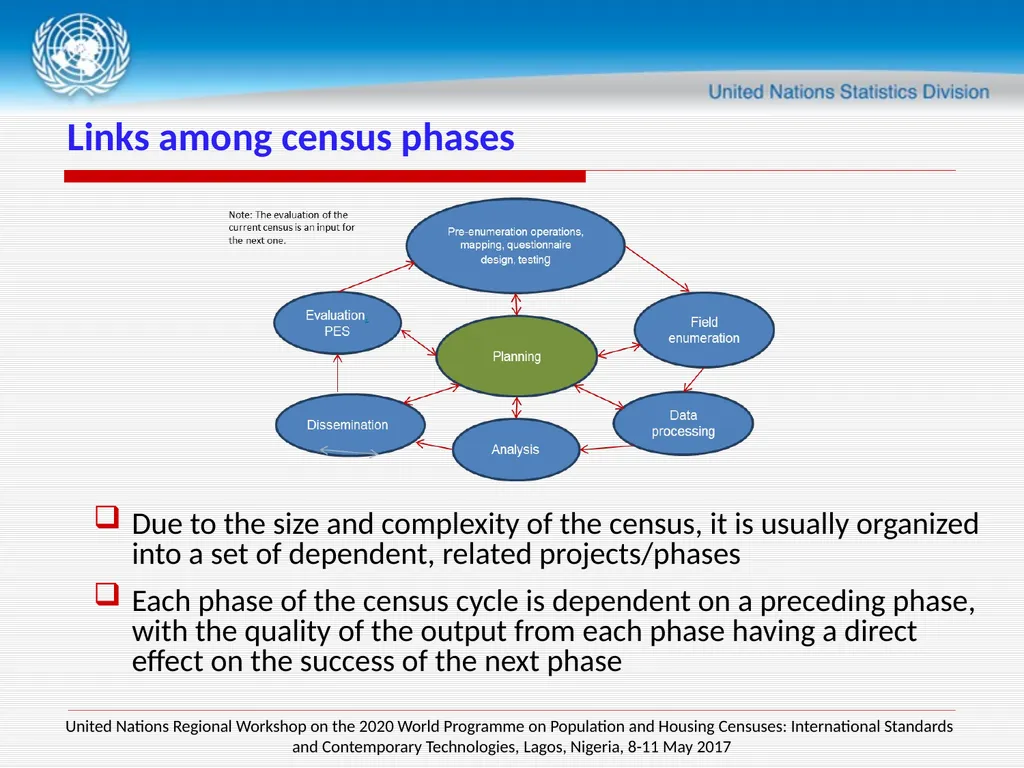
Links among census phases Due to the size and complexity of the census, it is usually organized into a set of dependent, related projects/phases
Each phase of the census cycle is dependent on a preceding phase, with the quality of the output from each phase having a direct effect on the success of the next phase<br>
Each phase of the census cycle is dependent on a preceding phase, with the quality of the output from each phase having a direct effect on the success of the next phase<br>
04
Aim of census planning Ensure each phase is properly resourced and organized
The output of each phase is of sufficient quality for all subsequent phases
All dependencies between the different phases are identified and properly managed
Due to the long duration of the census cycle, planning should not remain static but be dynamic and flexible to take into account changes that occur
Plans must be regularly monitored, evaluated and updated reflecting changes in resource, timing of activities, quality control concerns and other un-anticipated events<br>
The output of each phase is of sufficient quality for all subsequent phases
All dependencies between the different phases are identified and properly managed
Due to the long duration of the census cycle, planning should not remain static but be dynamic and flexible to take into account changes that occur
Plans must be regularly monitored, evaluated and updated reflecting changes in resource, timing of activities, quality control concerns and other un-anticipated events<br>
05
Key considerations for developing census plans Role of the census
Role of the government
Engagement with stakeholders
Strategic objectives for census
Project management principles
Monitoring
Census calendar (scheduling)
Administrative organization and human resources management
Financial management (budgeting)
Contracting out
Use of technology
Plans for census phases
Documentation<br>
Role of the government
Engagement with stakeholders
Strategic objectives for census
Project management principles
Monitoring
Census calendar (scheduling)
Administrative organization and human resources management
Financial management (budgeting)
Contracting out
Use of technology
Plans for census phases
Documentation<br>
06
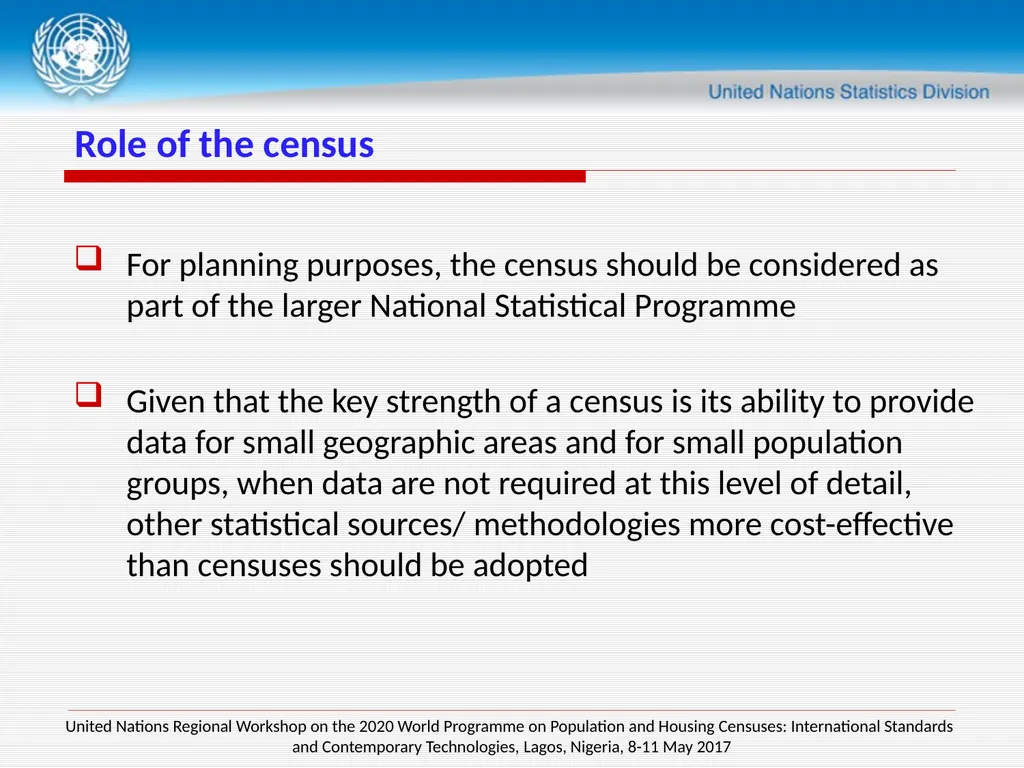
Role of the census For planning purposes, the census should be considered as part of the larger National Statistical Programme
Given that the key strength of a census is its ability to provide data for small geographic areas and for small population groups, when data are not required at this level of detail, other statistical sources/ methodologies more cost-effective than censuses should be adopted<br>
Given that the key strength of a census is its ability to provide data for small geographic areas and for small population groups, when data are not required at this level of detail, other statistical sources/ methodologies more cost-effective than censuses should be adopted<br>
07
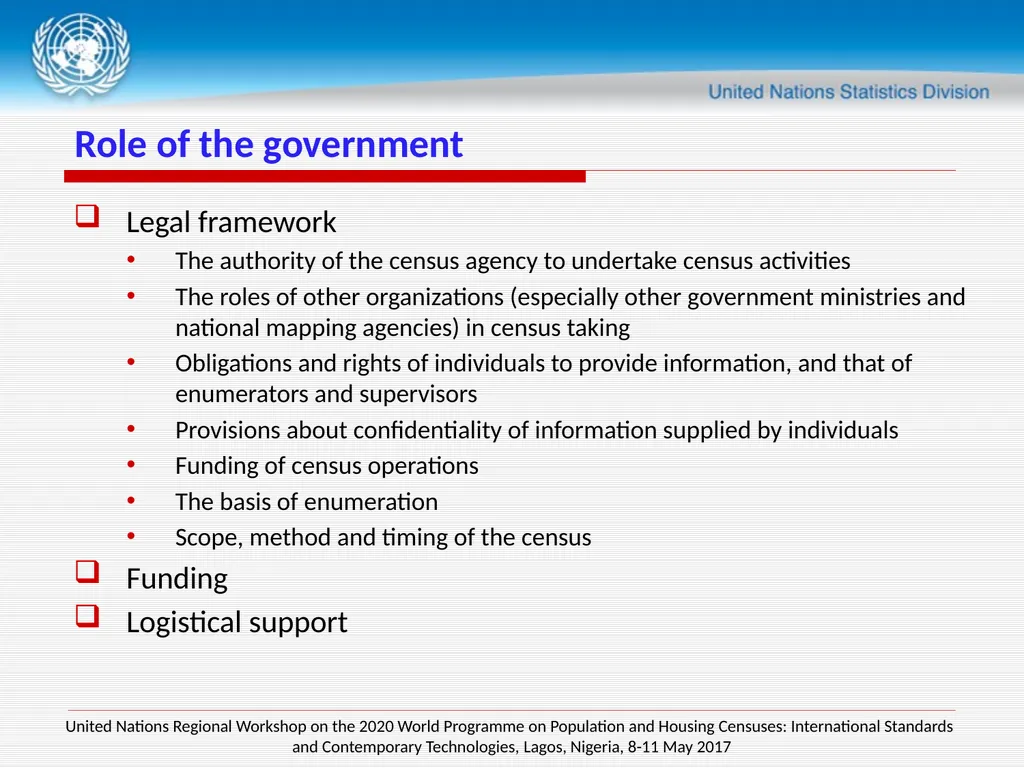
Role of the government Legal framework
The authority of the census agency to undertake census activities
The roles of other organizations (especially other government ministries and national mapping agencies) in census taking
Obligations and rights of individuals to provide information, and that of enumerators and supervisors
Provisions about confidentiality of information supplied by individuals
Funding of census operations
The basis of enumeration
Scope, method and timing of the census
Funding
Logistical support<br>
The authority of the census agency to undertake census activities
The roles of other organizations (especially other government ministries and national mapping agencies) in census taking
Obligations and rights of individuals to provide information, and that of enumerators and supervisors
Provisions about confidentiality of information supplied by individuals
Funding of census operations
The basis of enumeration
Scope, method and timing of the census
Funding
Logistical support<br>
08
Engagement with stakeholders Stakeholders within the census programme
Each phase is a key stakeholder of the one preceding it
Identifying internal stakeholders is useful for identifying dependencies, developing effective communication with these stakeholders
Other stakeholders within the statistical agency
Regional offices supporting field operations, internal stakeholders using census results (eg. survey sample frames), units of NSO working on methodology, IT, public relations
External stakeholders
Current and potential users of census data
Stakeholders outside the country
Donors and international agencies who see census as central for evidence-based decision making – funding, equipment, technical assistance
The public/community – having interest at time of census/initial data release
Publicity campaigns on benefits of census, participation, addressing concerns on privacy and confidentiality<br>
Each phase is a key stakeholder of the one preceding it
Identifying internal stakeholders is useful for identifying dependencies, developing effective communication with these stakeholders
Other stakeholders within the statistical agency
Regional offices supporting field operations, internal stakeholders using census results (eg. survey sample frames), units of NSO working on methodology, IT, public relations
External stakeholders
Current and potential users of census data
Stakeholders outside the country
Donors and international agencies who see census as central for evidence-based decision making – funding, equipment, technical assistance
The public/community – having interest at time of census/initial data release
Publicity campaigns on benefits of census, participation, addressing concerns on privacy and confidentiality<br>
09
Strategic objectives for census Census plans are usually guided by a set of strategic objectives, which set standards and benchmarks against which outcomes can be assessed - strategic objectives will differ according to national circumstances
Strategic objectives are usually derived from information from evaluation of past censuses and consideration of: Census content - topics on which to collect data; Impact on the public and on census staff (confidentiality, response burden); Production of census results (quality standards, timetable); Cost‐effectiveness; Cost-benefit analysis (aimed at increasing value of census while managing overall cost)
Objectives interact with one another, so priorities need to be set as there could be trade-offs, e.g., b/n what topics to collect and costs<br>
Strategic objectives are usually derived from information from evaluation of past censuses and consideration of: Census content - topics on which to collect data; Impact on the public and on census staff (confidentiality, response burden); Production of census results (quality standards, timetable); Cost‐effectiveness; Cost-benefit analysis (aimed at increasing value of census while managing overall cost)
Objectives interact with one another, so priorities need to be set as there could be trade-offs, e.g., b/n what topics to collect and costs<br>
10
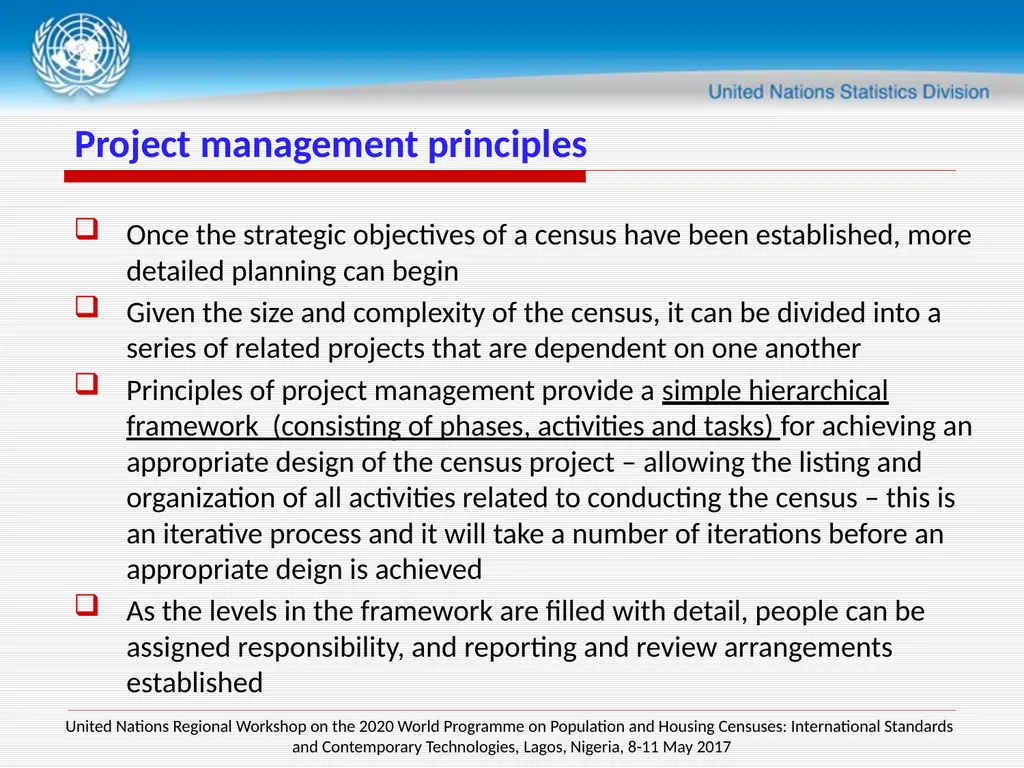
Project management principles Once the strategic objectives of a census have been established, more detailed planning can begin
Given the size and complexity of the census, it can be divided into a series of related projects that are dependent on one another
Principles of project management provide a simple hierarchical framework (consisting of phases, activities and tasks) for achieving an appropriate design of the census project – allowing the listing and organization of all activities related to conducting the census – this is an iterative process and it will take a number of iterations before an appropriate deign is achieved
As the levels in the framework are filled with detail, people can be assigned responsibility, and reporting and review arrangements established<br>
Given the size and complexity of the census, it can be divided into a series of related projects that are dependent on one another
Principles of project management provide a simple hierarchical framework (consisting of phases, activities and tasks) for achieving an appropriate design of the census project – allowing the listing and organization of all activities related to conducting the census – this is an iterative process and it will take a number of iterations before an appropriate deign is achieved
As the levels in the framework are filled with detail, people can be assigned responsibility, and reporting and review arrangements established<br>
11
Hierarchical framework for design of census project Project: Population and housing census
Phases: identifying and scheduling the various phases of the census cycle provide the basis for planning; phases are typically sequential, where the prior phase is essentially complete before the beginning of the next phase; however, they occasionally can overlap
Activities: once phases have been identified, the next step is to break down each phase into component activities; activities constitute a higher level of work covering the series of tasks defined for each phase
Tasks: activities can further be broken down to tasks - the smallest identifiable amount of work leading to a deliverable under each activity; time, cost and resources can be assigned at the task level
This framework allows for each step of the census process to be identified and assigned to the appropriate level, from the largest components down to the smallest tasks<br>
Phases: identifying and scheduling the various phases of the census cycle provide the basis for planning; phases are typically sequential, where the prior phase is essentially complete before the beginning of the next phase; however, they occasionally can overlap
Activities: once phases have been identified, the next step is to break down each phase into component activities; activities constitute a higher level of work covering the series of tasks defined for each phase
Tasks: activities can further be broken down to tasks - the smallest identifiable amount of work leading to a deliverable under each activity; time, cost and resources can be assigned at the task level
This framework allows for each step of the census process to be identified and assigned to the appropriate level, from the largest components down to the smallest tasks<br>
12
Issues that need to be taken into account in project planning Milestones: are another project management concept that represent specific points in time at which key outcomes are expected and which measure a project’s progress
Risk management - identification and assessment of risks followed by the development of actions aimed at mitigating the impact of undesired outcomes or reducing the probability of those outcomes happening<br>
Risk management - identification and assessment of risks followed by the development of actions aimed at mitigating the impact of undesired outcomes or reducing the probability of those outcomes happening<br>
13
Risk management Risks with significant likelihood should be managed explicitly by developing fully detailed plans parallel to the census plan - the success or failure of the census may depend on the implementation of the plans associated with these risks if they occur
Benefits of implementing risk management in censuses include:
Fosters early identification of strategies to reduce or eliminate the potential impact of known risks;
Provides a structure for monitoring and documenting changes in risk assessment and for managing the response to those changes;
Identifies areas where further study or analysis could potentially lower future risk;
Facilitates integration of operations/systems through early identification and resolution of risk that cuts across activities.<br>
Benefits of implementing risk management in censuses include:
Fosters early identification of strategies to reduce or eliminate the potential impact of known risks;
Provides a structure for monitoring and documenting changes in risk assessment and for managing the response to those changes;
Identifies areas where further study or analysis could potentially lower future risk;
Facilitates integration of operations/systems through early identification and resolution of risk that cuts across activities.<br>
14
Monitoring project It is important that project plans are monitored and that appropriate feedback is delivered to all levels of management
The most important components to track are:
the calendar time for completing a task;
resource usage per task;
cost per task;
milestones met
As there are always interdependency among individual tasks, monitoring instruments are needed (eg. the GANTT chart which graphically displays schedule‐related information with activities listed down on the left, and dates shown across the top and activity durations shown as date‐placed horizontal bars)<br>
The most important components to track are:
the calendar time for completing a task;
resource usage per task;
cost per task;
milestones met
As there are always interdependency among individual tasks, monitoring instruments are needed (eg. the GANTT chart which graphically displays schedule‐related information with activities listed down on the left, and dates shown across the top and activity durations shown as date‐placed horizontal bars)<br>
15
Census calendar (scheduling) Development of a census calendar is a crucial step in the planning phase of a census, which serves as a guide to measure the progress of each stage of the census operation
The calendar or time table is designed to show the census activities and the amount of time required for undertaking all processes regarding the planning, development and implementation of a census
Time estimation of each activity is a critical process for good management of census operations, and given that census consists of series of interrelated activities, preparing time estimation has to be undertaken in close cooperation with all stakeholders
Census calendars usually take the form of a diagram showing the sequence, interdependency and timing of all the various steps in the census programme (eg. GANTT chart)<br>
The calendar or time table is designed to show the census activities and the amount of time required for undertaking all processes regarding the planning, development and implementation of a census
Time estimation of each activity is a critical process for good management of census operations, and given that census consists of series of interrelated activities, preparing time estimation has to be undertaken in close cooperation with all stakeholders
Census calendars usually take the form of a diagram showing the sequence, interdependency and timing of all the various steps in the census programme (eg. GANTT chart)<br>
16
Administrative organization and human resources management Establishing the administrative organization and staffing of a census operation is a big challenge due to the sheer size and complexity of the project, geographic spread, long project timeline, coordination with a wide range of organizations, and the number of workers involved
A generic hierarchical management structure that could be used for planning is available on page 27 (figure II.3) of HM
Regardless of the structure adopted, census plans need to articulate the roles and responsibilities of the hierarchy of census staff, to avoid confusion over duties, poor oversight and mistakes in critical processes that jeopardize the census
It is also to important to note that the development phases (planning and preparations) and the operational phases might require different management approaches because the nature of the workforces and the tasks performed are quite different<br>
A generic hierarchical management structure that could be used for planning is available on page 27 (figure II.3) of HM
Regardless of the structure adopted, census plans need to articulate the roles and responsibilities of the hierarchy of census staff, to avoid confusion over duties, poor oversight and mistakes in critical processes that jeopardize the census
It is also to important to note that the development phases (planning and preparations) and the operational phases might require different management approaches because the nature of the workforces and the tasks performed are quite different<br>
17
Structure of the workforce The staffing and structure of the workforce to support the enumeration phase need to factor in:
Size of the population; Geographic area covered by the census
Topics covered in the census
Existing administrative structure, at centre and in regions
Support from other government agencies
Number of activities contracted out
Data collection and processing methods used
Complexity of data processing and analysis
For a hierarchical workforce structure, there are a number of key issues that need to be addressed including:
Roles and responsibilities of each level (regional managers, supervisors, enumerators, IT officers, etc)
Time available;
Staffing ratio between the different levels.<br>
Size of the population; Geographic area covered by the census
Topics covered in the census
Existing administrative structure, at centre and in regions
Support from other government agencies
Number of activities contracted out
Data collection and processing methods used
Complexity of data processing and analysis
For a hierarchical workforce structure, there are a number of key issues that need to be addressed including:
Roles and responsibilities of each level (regional managers, supervisors, enumerators, IT officers, etc)
Time available;
Staffing ratio between the different levels.<br>
18
Human resources management Management of human resources for census operations is of particular importance in the planning phase of the census
Growing interest for using new technologies is a very important factor for careful planning of human resources – requiring special considerations to certain specialized skills such as mapping/GIS, data capture and processing, dissemination outputs/tools using new technologies
Plans for human resources management require a two-pronged strategy:
Strategies for office work
Strategies for field work (plans for staff who employed temporarily)
For office work, as a first step the statistical offices need to analyze the existing human resources at the very early stage of the census planning, and develop strategies to secure the office staff required for successful implementation of census activities.<br>
Growing interest for using new technologies is a very important factor for careful planning of human resources – requiring special considerations to certain specialized skills such as mapping/GIS, data capture and processing, dissemination outputs/tools using new technologies
Plans for human resources management require a two-pronged strategy:
Strategies for office work
Strategies for field work (plans for staff who employed temporarily)
For office work, as a first step the statistical offices need to analyze the existing human resources at the very early stage of the census planning, and develop strategies to secure the office staff required for successful implementation of census activities.<br>
19
Human resources management These strategies should be developed by taking into account:
maximizing the capacity of the existing staff;
needs for recruitment of new staff;
needs for new skills on permanent or temporary basis;
tools for developing capacity (in‐house training, study visits, consultation services during planning and implementation stages for certain activities)
For the category of temporary field staff, careful consideration is needed in terms of:
the qualifications needed for census work
languages skills of enumerators and supervisors for area in which they will be working.
the need for special training programme in some areas for gaining specific skills, such as use of tablet computers, or cultural and gender sensitivity.
early arrangements for developing training programme is necessary to use appropriate training facilities and produce training manuals<br>
maximizing the capacity of the existing staff;
needs for recruitment of new staff;
needs for new skills on permanent or temporary basis;
tools for developing capacity (in‐house training, study visits, consultation services during planning and implementation stages for certain activities)
For the category of temporary field staff, careful consideration is needed in terms of:
the qualifications needed for census work
languages skills of enumerators and supervisors for area in which they will be working.
the need for special training programme in some areas for gaining specific skills, such as use of tablet computers, or cultural and gender sensitivity.
early arrangements for developing training programme is necessary to use appropriate training facilities and produce training manuals<br>
20
Financial management (budgeting) Census budget must be planned well in advance and cover all known activities, with sufficient resources allocated to each phase
The budgeting process typically begins with drafting a list of activities and tasks to account for the financial cost of all census activities, taking into account that the census budget is highly cyclical (peaks during enumeration and processing)
Funds allocated and used effectively on planning and preparation will result in savings in all other phases, esp. in enumeration and processing
Monitoring the census budget is critical – regularly (quarterly or even monthly) monitor expenditures against funding for each project
Estimates of expenditures for all years of the census cycle should be prepared in advance and reviewed yearly - this would allow to identify on time possible shortfalls, and take appropriate measures<br>
The budgeting process typically begins with drafting a list of activities and tasks to account for the financial cost of all census activities, taking into account that the census budget is highly cyclical (peaks during enumeration and processing)
Funds allocated and used effectively on planning and preparation will result in savings in all other phases, esp. in enumeration and processing
Monitoring the census budget is critical – regularly (quarterly or even monthly) monitor expenditures against funding for each project
Estimates of expenditures for all years of the census cycle should be prepared in advance and reviewed yearly - this would allow to identify on time possible shortfalls, and take appropriate measures<br>
21
Contracting out Many national statistical offices may need to contract out some of the tasks during a census operation in the interest of efficiency and lack of in‐house expertise
Outsourcing decisions should be made within the context of a larger organizational plan that identifies choices between both hiring and training staff or using external service providers to augment or replace resources for specific projects
Commonly contracted out tasks include: printing of census questionnaires; software development for data collection; dispatch and delivery of census material; census mapping; publicity and public relations; training; scanning/data entry; data processing and tabulation; and publication and dissemination<br>
Outsourcing decisions should be made within the context of a larger organizational plan that identifies choices between both hiring and training staff or using external service providers to augment or replace resources for specific projects
Commonly contracted out tasks include: printing of census questionnaires; software development for data collection; dispatch and delivery of census material; census mapping; publicity and public relations; training; scanning/data entry; data processing and tabulation; and publication and dissemination<br>
22
Contracting out Contracting out activities does not relieve census managers of their responsibility - so managers have to work closely with contractors and monitor them regularly
The following should be considered while contracting out any activity:
Core census activities (eg. content of census) should not be contracted out
Evaluation of the risk of contracting out should be carried out
Clear understanding of the requirements and development of detailed technical specifications (scope, deliverables, schedules, change control and dispute resolution clauses), as these have to be unambiguously specified to the service providers
Competitive bidding should be invited for contracted activities and demonstrations of capacity and good project management kills should be verified before outsourcing
Confidentiality and security of census data collected should not be compromised
Quality assurance guidelines for product/service should be laid out
Monitoring of outsourced activity for timeliness of the delivery
Careful control is needed to ensure that the selected external provider delivers a cost‐effective solution that meets the census agency’s needs<br>
The following should be considered while contracting out any activity:
Core census activities (eg. content of census) should not be contracted out
Evaluation of the risk of contracting out should be carried out
Clear understanding of the requirements and development of detailed technical specifications (scope, deliverables, schedules, change control and dispute resolution clauses), as these have to be unambiguously specified to the service providers
Competitive bidding should be invited for contracted activities and demonstrations of capacity and good project management kills should be verified before outsourcing
Confidentiality and security of census data collected should not be compromised
Quality assurance guidelines for product/service should be laid out
Monitoring of outsourced activity for timeliness of the delivery
Careful control is needed to ensure that the selected external provider delivers a cost‐effective solution that meets the census agency’s needs<br>
23
Use of technology Growing interest for using new technologies (timeliness and quality of data, efficient operation control, better capacity for monitoring, etc) is a very important factor for census planning
Census planners have to weigh in on the trade‐offs between advantages of using new technologies and whether the solutions are affordable and can be successfully implemented
As the new technologies adopted may relate to only one part of the census operations, planners have to take account how it will impact or affect other operations
The use of electronic data collection technologies, especially in a multi-mode collection context, requires careful consideration of issues including duplication, data comparability issues, timelines for each mode, and response integration<br>
Census planners have to weigh in on the trade‐offs between advantages of using new technologies and whether the solutions are affordable and can be successfully implemented
As the new technologies adopted may relate to only one part of the census operations, planners have to take account how it will impact or affect other operations
The use of electronic data collection technologies, especially in a multi-mode collection context, requires careful consideration of issues including duplication, data comparability issues, timelines for each mode, and response integration<br>
24
Use of technology Census project managers should plan for and manage the following risks in adopting new technology:
Incompatibility or other integration issues between different hardware and/or software;
Solution outage or failure (could be for many reasons – lack of connectivity, hardware failure, battery life, GPS black spots, software bugs, device theft);
Lack of skills or knowledge by system users, particularly temporary census staff;
Insufficient or inadequate communication between technology staff and business staff, particularly leading to misunderstanding of requirements;
Maintaining data security and confidentiality
Maintaining, upgrading or decommissioning old or legacy systems;
Lack of documentation and / or reliance on small number of key people;
Challenges related to micro‐data management which may be novel to the office.<br>
Incompatibility or other integration issues between different hardware and/or software;
Solution outage or failure (could be for many reasons – lack of connectivity, hardware failure, battery life, GPS black spots, software bugs, device theft);
Lack of skills or knowledge by system users, particularly temporary census staff;
Insufficient or inadequate communication between technology staff and business staff, particularly leading to misunderstanding of requirements;
Maintaining data security and confidentiality
Maintaining, upgrading or decommissioning old or legacy systems;
Lack of documentation and / or reliance on small number of key people;
Challenges related to micro‐data management which may be novel to the office.<br>
25
Plans for census phases Topic selection: plans for user consultation, strategies for communication with users
Questionnaire design and testing: plans for the use of long/short form, designing questionnaire format based on the technology used for collection, plans for testing, etc
Mapping : Plans for producing/updating maps, strategies for partnering with mapping agency; plans for use of digital maps for field enumeration and dissemination, etc.
Quality assurance
Publicity and communication with public
Procurement and outsourcing
Field enumeration: Plans for population difficult to enumerate; strategies for improving coverage; plans for monitoring; plans for logistics of census materials, etc.
Data processing: plans for method of data capture, coding, editing/imputations, validation of census data, etc.
Dissemination: plans for dissemination online tools/products, dissemination of disaggregated census results, monitoring SDG and national priorities
Evaluation: plans for method(s) of evaluation of the quality of census data<br>
Questionnaire design and testing: plans for the use of long/short form, designing questionnaire format based on the technology used for collection, plans for testing, etc
Mapping : Plans for producing/updating maps, strategies for partnering with mapping agency; plans for use of digital maps for field enumeration and dissemination, etc.
Quality assurance
Publicity and communication with public
Procurement and outsourcing
Field enumeration: Plans for population difficult to enumerate; strategies for improving coverage; plans for monitoring; plans for logistics of census materials, etc.
Data processing: plans for method of data capture, coding, editing/imputations, validation of census data, etc.
Dissemination: plans for dissemination online tools/products, dissemination of disaggregated census results, monitoring SDG and national priorities
Evaluation: plans for method(s) of evaluation of the quality of census data<br>
26
Documentation Census organizations need to pay special attention to continuity of knowledge and skills from one census to the next, since the intervening gap, which is usually a whole decade, is likely to cause loss of institutional memory and attrition of qualified personnel (P&R 2.94)
Comprehensive documentation of census activities while they are being carried out is essential, as is training of younger personnel to create a pool of knowledgeable and experienced persons by the time the next census comes (P&R 2.94)
Evaluation and recording should not be left until the end of the census process and early census planning needs to take this into account
Administrative report - a report where all census experiences are recorded – can help retain census historical memory and serve as a resource for transferring knowledge<br>
Comprehensive documentation of census activities while they are being carried out is essential, as is training of younger personnel to create a pool of knowledgeable and experienced persons by the time the next census comes (P&R 2.94)
Evaluation and recording should not be left until the end of the census process and early census planning needs to take this into account
Administrative report - a report where all census experiences are recorded – can help retain census historical memory and serve as a resource for transferring knowledge<br>
27
Reference materials for this presentation Handbook on the Management of Population and Housing Censuses, Revision 2
Principles and Recommendations for Population and Housing Censuses, Revision 3
Both available at: https://unstats.un.org/unsd/demographic/sources/census/census3.htm<br>
Principles and Recommendations for Population and Housing Censuses, Revision 3
Both available at: https://unstats.un.org/unsd/demographic/sources/census/census3.htm<br>