
Session 57 - Managing Models for Stewards and
SB
Published · 51 slides · 0 views
1 / 1



Description
Session 57 - Managing Models for Stewards and Stakeholders BILL CEMBER, FSA, MAAA SCOTT HOUGHTON, FSA, MAAA DYLAN STROTHER, FSA, MAAA OCTOBER 15th, 2018 SOCIETY OF ACTUARIES Antitrust Compliance Guidelines Active participation in the
Related Topics
Share
Embed code
Download this presentation From Below
"Session 57 - Managing Models for Stewards and" is the property of its rightful owner. Permission is granted to download and print the materials on this website for personal, non-commercial use only, and to display it on your personal computer provided you do not modify the materials and that you retain all copyright notices contained in the materials. By downloading content from our website, you accept the terms of this agreement.
Presentation Transcript
01
Session 57 - Managing Models for Stewards and Stakeholders BILL CEMBER, FSA, MAAA
SCOTT HOUGHTON, FSA, MAAA
DYLAN STROTHER, FSA, MAAA OCTOBER 15th, 2018<br>
SCOTT HOUGHTON, FSA, MAAA
DYLAN STROTHER, FSA, MAAA OCTOBER 15th, 2018<br>
02
SOCIETY OF ACTUARIES
Antitrust Compliance Guidelines Active participation in the Society of Actuaries is an important aspect of membership. While the positive contributions of professional societies and associations are well-recognized and encouraged, association activities are vulnerable to close antitrust scrutiny. By their very nature, associations bring together industry competitors and other market participants.
The United States antitrust laws aim to protect consumers by preserving the free economy and prohibiting anti-competitive business practices; they promote competition. There are both state and federal antitrust laws, although state antitrust laws closely follow federal law. The Sherman Act, is the primary U.S. antitrust law pertaining to association activities. The Sherman Act prohibits every contract, combination or conspiracy that places an unreasonable restraint on trade. There are, however, some activities that are illegal under all circumstances, such as price fixing, market allocation and collusive bidding.
There is no safe harbor under the antitrust law for professional association activities. Therefore, association meeting participants should refrain from discussing any activity that could potentially be construed as having an anti-competitive effect. Discussions relating to product or service pricing, market allocations, membership restrictions, product standardization or other conditions on trade could arguably be perceived as a restraint on trade and may expose the SOA and its members to antitrust enforcement procedures.
While participating in all SOA in person meetings, webinars, teleconferences or side discussions, you should avoid discussing competitively sensitive information with competitors and follow these guidelines:
Do not discuss prices for services or products or anything else that might affect prices
Do not discuss what you or other entities plan to do in a particular geographic or product markets or with particular customers.
Do not speak on behalf of the SOA or any of its committees unless specifically authorized to do so.
Do leave a meeting where any anticompetitive pricing or market allocation discussion occurs.
Do alert SOA staff and/or legal counsel to any concerning discussions
Do consult with legal counsel before raising any matter or making a statement that may involve competitively sensitive information.
Adherence to these guidelines involves not only avoidance of antitrust violations, but avoidance of behavior which might be so construed. These guidelines only provide an overview of prohibited activities. SOA legal counsel reviews meeting agenda and materials as deemed appropriate and any discussion that departs from the formal agenda should be scrutinized carefully. Antitrust compliance is everyone’s responsibility; however, please seek legal counsel if you have any questions or concerns. 2<br>
The United States antitrust laws aim to protect consumers by preserving the free economy and prohibiting anti-competitive business practices; they promote competition. There are both state and federal antitrust laws, although state antitrust laws closely follow federal law. The Sherman Act, is the primary U.S. antitrust law pertaining to association activities. The Sherman Act prohibits every contract, combination or conspiracy that places an unreasonable restraint on trade. There are, however, some activities that are illegal under all circumstances, such as price fixing, market allocation and collusive bidding.
There is no safe harbor under the antitrust law for professional association activities. Therefore, association meeting participants should refrain from discussing any activity that could potentially be construed as having an anti-competitive effect. Discussions relating to product or service pricing, market allocations, membership restrictions, product standardization or other conditions on trade could arguably be perceived as a restraint on trade and may expose the SOA and its members to antitrust enforcement procedures.
While participating in all SOA in person meetings, webinars, teleconferences or side discussions, you should avoid discussing competitively sensitive information with competitors and follow these guidelines:
Do not discuss prices for services or products or anything else that might affect prices
Do not discuss what you or other entities plan to do in a particular geographic or product markets or with particular customers.
Do not speak on behalf of the SOA or any of its committees unless specifically authorized to do so.
Do leave a meeting where any anticompetitive pricing or market allocation discussion occurs.
Do alert SOA staff and/or legal counsel to any concerning discussions
Do consult with legal counsel before raising any matter or making a statement that may involve competitively sensitive information.
Adherence to these guidelines involves not only avoidance of antitrust violations, but avoidance of behavior which might be so construed. These guidelines only provide an overview of prohibited activities. SOA legal counsel reviews meeting agenda and materials as deemed appropriate and any discussion that departs from the formal agenda should be scrutinized carefully. Antitrust compliance is everyone’s responsibility; however, please seek legal counsel if you have any questions or concerns. 2<br>
03
Presentation Disclaimer Presentations are intended for educational purposes only and do not replace independent professional judgment. Statements of fact and opinions expressed are those of the participants individually and, unless expressly stated to the contrary, are not the opinion or position of the Society of Actuaries, its cosponsors or its committees. The Society of Actuaries does not endorse or approve, and assumes no responsibility for, the content, accuracy or completeness of the information presented. Attendees should note that the sessions are audio-recorded and may be published in various media, including print, audio and video formats without further notice. 3<br>
04
Introductions<br>
05
5 Bill Cember is an actuary at Prudential where he is responsible for model development on interest sensitive life projections. Prior to Prudential, he worked in a variety of roles including at a large multinational insurer and as a consultant. Most recently, he saw things worked "on the other side," working as a modeler at a large global macro hedge fund. Bill is a Fellow of the Society of Actuaries and member of the American Academy of Actuaries.
Scott Houghton
Dylan Strother is a manager in Consulting Services practice at the PolySystems Chicago office. He is rooted in statutory & GAAP financial reporting and valuation across a variety of products. He has played an integral part in actuarial modernization, modeling, and model validation consulting projects throughout his career. He has prior experience as a consultant and auditor at a big four auditing firm as well as at a major insurance carrier.<br>
Scott Houghton
Dylan Strother is a manager in Consulting Services practice at the PolySystems Chicago office. He is rooted in statutory & GAAP financial reporting and valuation across a variety of products. He has played an integral part in actuarial modernization, modeling, and model validation consulting projects throughout his career. He has prior experience as a consultant and auditor at a big four auditing firm as well as at a major insurance carrier.<br>
06
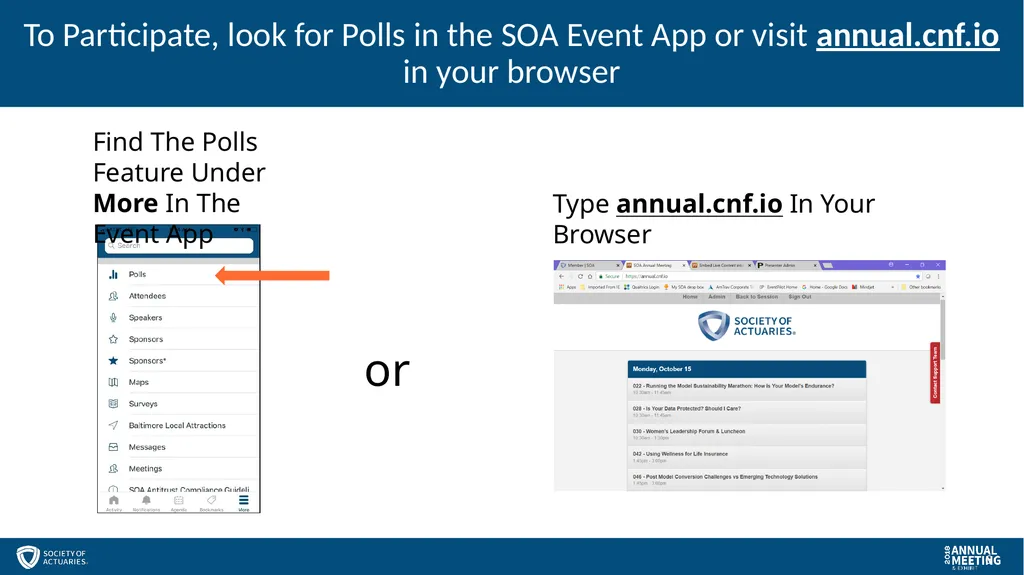
To Participate, look for Polls in the SOA Event App or visit annual.cnf.io in your browser 6 Type annual.cnf.io In Your Browser or Find The Polls Feature Under More In The Event App<br>
07
Live Content Slide When playing as a slideshow, this slide will display live content Poll: What type of actuarial function best characterizes your job?<br>
08
Live Content Slide When playing as a slideshow, this slide will display live content Poll: Does your company have a model steward position?<br>
09
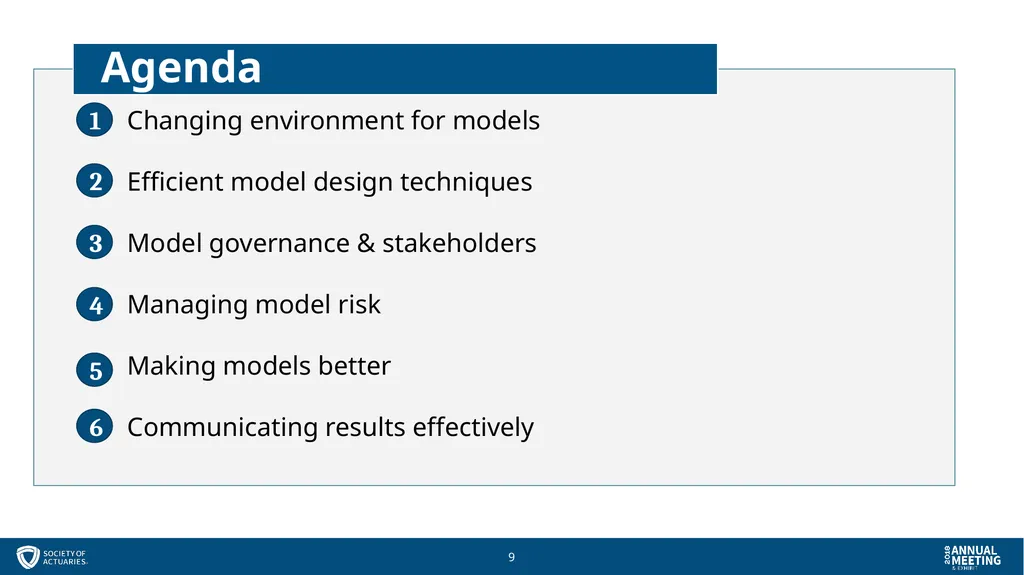
9 Changing environment for models
Efficient model design techniques
Model governance & stakeholders
Managing model risk
Making models better
Communicating results effectively 1 2 4 3 5 6<br>
Efficient model design techniques
Model governance & stakeholders
Managing model risk
Making models better
Communicating results effectively 1 2 4 3 5 6<br>
10
Changing environment for models<br>
11
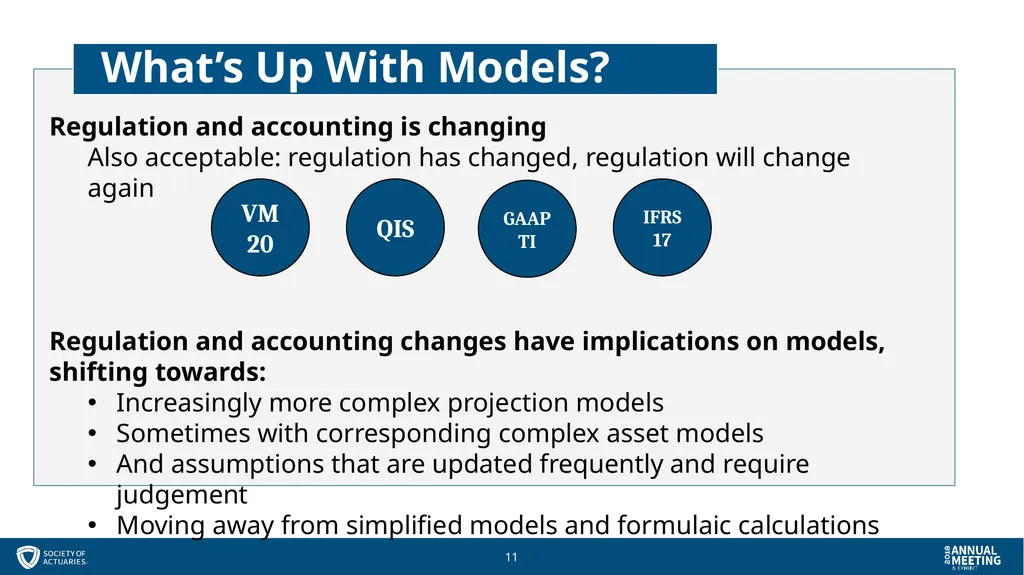
11 Regulation and accounting is changing
Also acceptable: regulation has changed, regulation will change again
Regulation and accounting changes have implications on models, shifting towards:
Increasingly more complex projection models
Sometimes with corresponding complex asset models
And assumptions that are updated frequently and require judgement
Moving away from simplified models and formulaic calculations QIS VM
20 GAAP TI IFRS
17<br>
Also acceptable: regulation has changed, regulation will change again
Regulation and accounting changes have implications on models, shifting towards:
Increasingly more complex projection models
Sometimes with corresponding complex asset models
And assumptions that are updated frequently and require judgement
Moving away from simplified models and formulaic calculations QIS VM
20 GAAP TI IFRS
17<br>
12
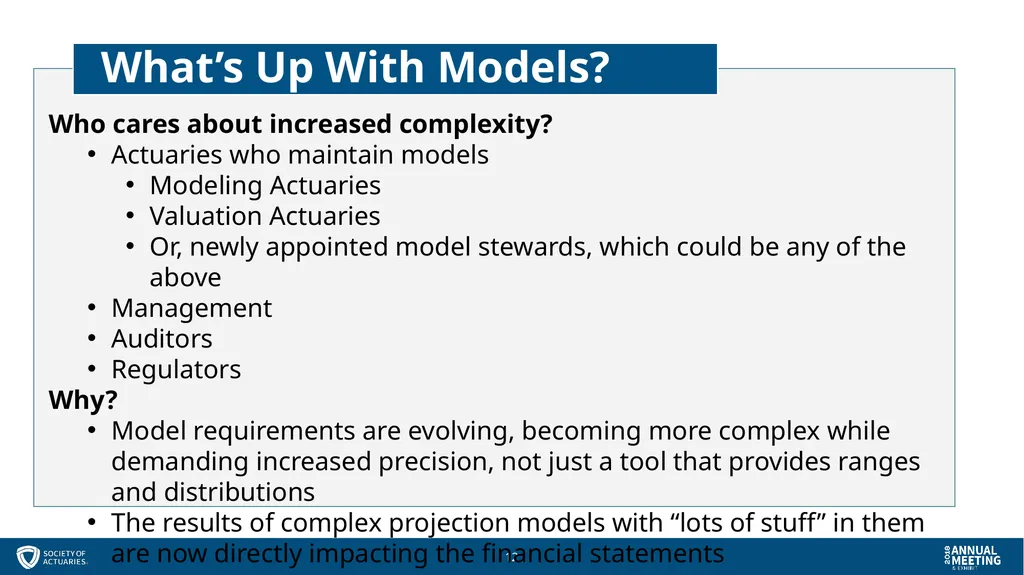
12 Who cares about increased complexity?
Actuaries who maintain models
Modeling Actuaries
Valuation Actuaries
Or, newly appointed model stewards, which could be any of the above
Management
Auditors
Regulators
Why?
Model requirements are evolving, becoming more complex while demanding increased precision, not just a tool that provides ranges and distributions
The results of complex projection models with “lots of stuff” in them are now directly impacting the financial statements<br>
Actuaries who maintain models
Modeling Actuaries
Valuation Actuaries
Or, newly appointed model stewards, which could be any of the above
Management
Auditors
Regulators
Why?
Model requirements are evolving, becoming more complex while demanding increased precision, not just a tool that provides ranges and distributions
The results of complex projection models with “lots of stuff” in them are now directly impacting the financial statements<br>
13
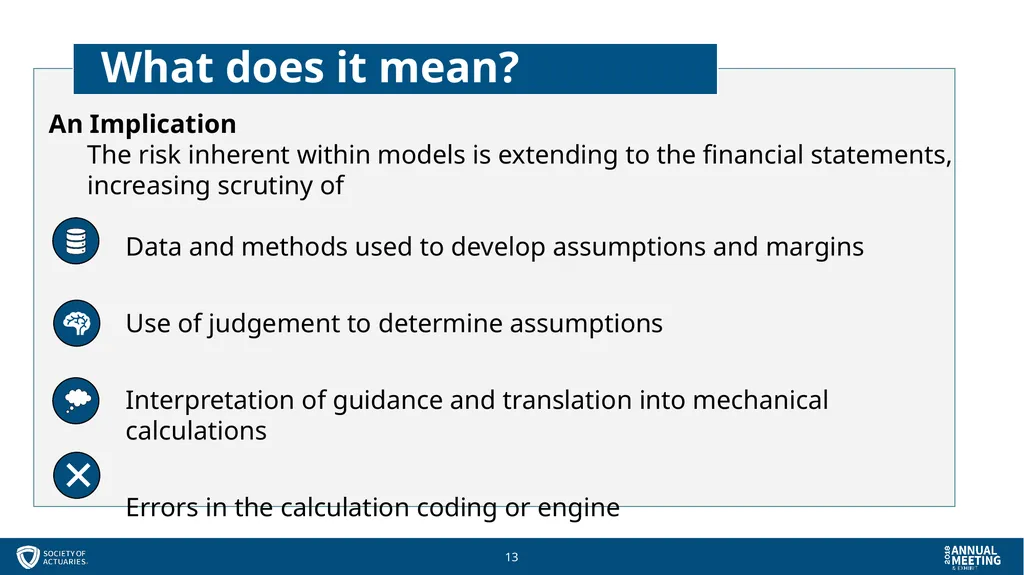
13 An Implication
The risk inherent within models is extending to the financial statements, increasing scrutiny of
Data and methods used to develop assumptions and margins
Use of judgement to determine assumptions
Interpretation of guidance and translation into mechanical calculations
Errors in the calculation coding or engine<br>
The risk inherent within models is extending to the financial statements, increasing scrutiny of
Data and methods used to develop assumptions and margins
Use of judgement to determine assumptions
Interpretation of guidance and translation into mechanical calculations
Errors in the calculation coding or engine<br>
14
14 Risk is Opportunity Model Management
Higher scrutiny drives the need for model management, especially: controls over the model, internal consistency, internal efficiency and transparency of models
A key component of communicating results is being able to rely on effective processes
An opportunity to rethink the process for different types of models
Actuarial Financial Models
Period end reporting / financial statement build process
Target Operating Model / Resourcing Models<br>
Higher scrutiny drives the need for model management, especially: controls over the model, internal consistency, internal efficiency and transparency of models
A key component of communicating results is being able to rely on effective processes
An opportunity to rethink the process for different types of models
Actuarial Financial Models
Period end reporting / financial statement build process
Target Operating Model / Resourcing Models<br>
15
15 So why is now a good opportunity to increase attention of model management?
Complex cashflow projections have arrived in the valuation of traditional life insurance products
Just about every set of financial reporting basis has a major change coming soon
Product design is increasingly more complex, the industry continues to evolve
Technology continues to improve, which in turn increases demand for detailed results<br>
Complex cashflow projections have arrived in the valuation of traditional life insurance products
Just about every set of financial reporting basis has a major change coming soon
Product design is increasingly more complex, the industry continues to evolve
Technology continues to improve, which in turn increases demand for detailed results<br>
16
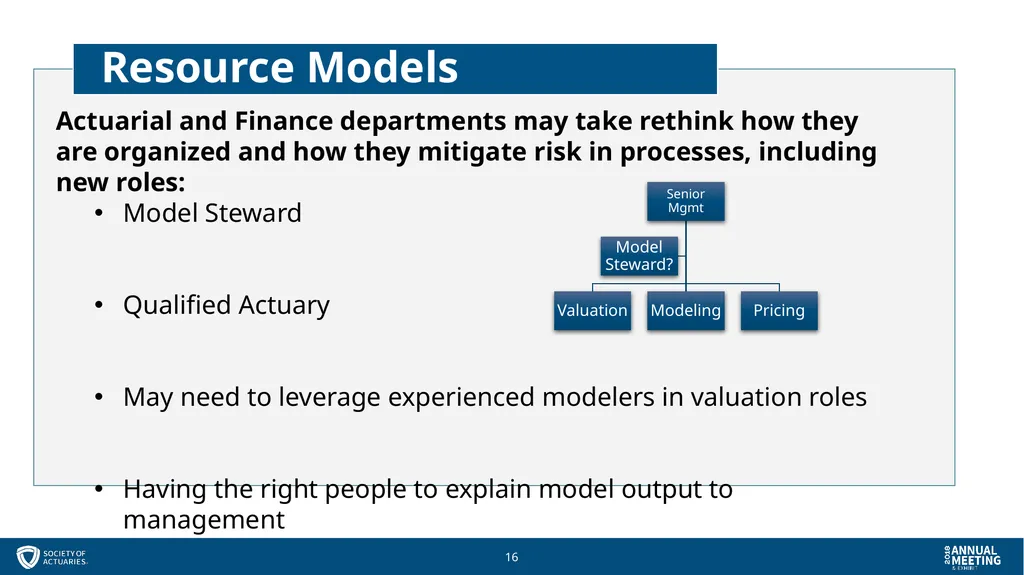
16 Actuarial and Finance departments may take rethink how they are organized and how they mitigate risk in processes, including new roles:
Model Steward
Qualified Actuary
May need to leverage experienced modelers in valuation roles
Having the right people to explain model output to management<br>
Model Steward
Qualified Actuary
May need to leverage experienced modelers in valuation roles
Having the right people to explain model output to management<br>
17
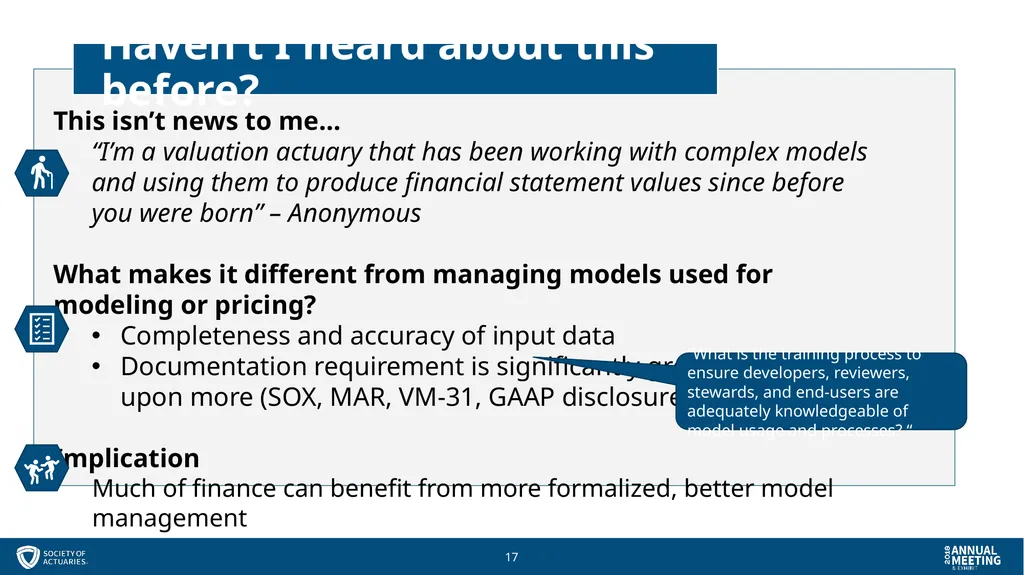
17 This isn’t news to me…
“I’m a valuation actuary that has been working with complex models and using them to produce financial statement values since before you were born” – Anonymous
What makes it different from managing models used for modeling or pricing?
Completeness and accuracy of input data
Documentation requirement is significantly greater and relied upon more (SOX, MAR, VM-31, GAAP disclosures)
Implication
Much of finance can benefit from more formalized, better model management “What is the training process to ensure developers, reviewers, stewards, and end-users are adequately knowledgeable of model usage and processes? “<br>
“I’m a valuation actuary that has been working with complex models and using them to produce financial statement values since before you were born” – Anonymous
What makes it different from managing models used for modeling or pricing?
Completeness and accuracy of input data
Documentation requirement is significantly greater and relied upon more (SOX, MAR, VM-31, GAAP disclosures)
Implication
Much of finance can benefit from more formalized, better model management “What is the training process to ensure developers, reviewers, stewards, and end-users are adequately knowledgeable of model usage and processes? “<br>
18
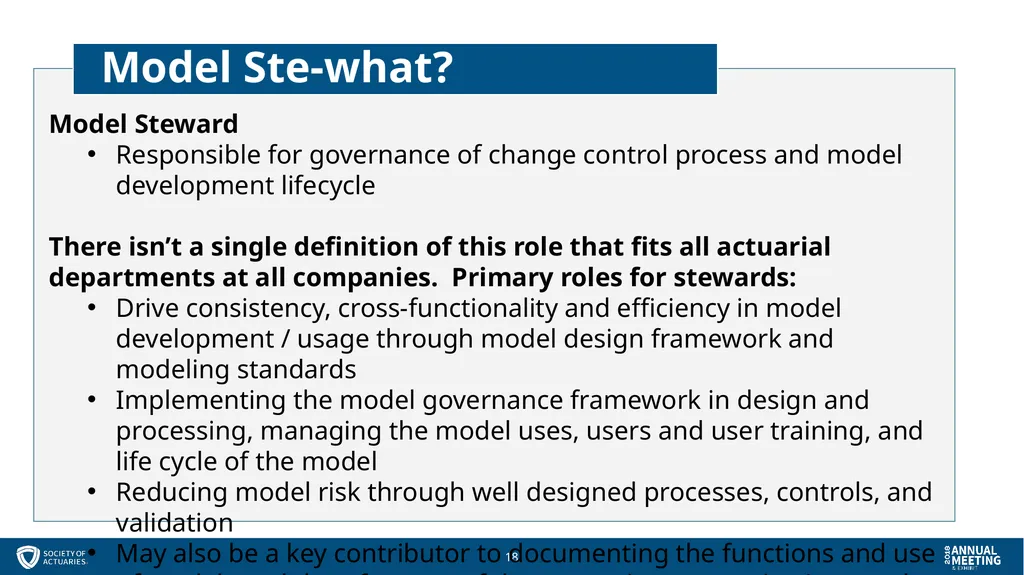
18 Model Steward
Responsible for governance of change control process and model development lifecycle
There isn’t a single definition of this role that fits all actuarial departments at all companies. Primary roles for stewards:
Drive consistency, cross-functionality and efficiency in model development / usage through model design framework and modeling standards
Implementing the model governance framework in design and processing, managing the model uses, users and user training, and life cycle of the model
Reducing model risk through well designed processes, controls, and validation
May also be a key contributor to documenting the functions and use of models and therefore a useful resource in communicating results to stakeholders<br>
Responsible for governance of change control process and model development lifecycle
There isn’t a single definition of this role that fits all actuarial departments at all companies. Primary roles for stewards:
Drive consistency, cross-functionality and efficiency in model development / usage through model design framework and modeling standards
Implementing the model governance framework in design and processing, managing the model uses, users and user training, and life cycle of the model
Reducing model risk through well designed processes, controls, and validation
May also be a key contributor to documenting the functions and use of models and therefore a useful resource in communicating results to stakeholders<br>
19
Model Design<br>
20
Model Design
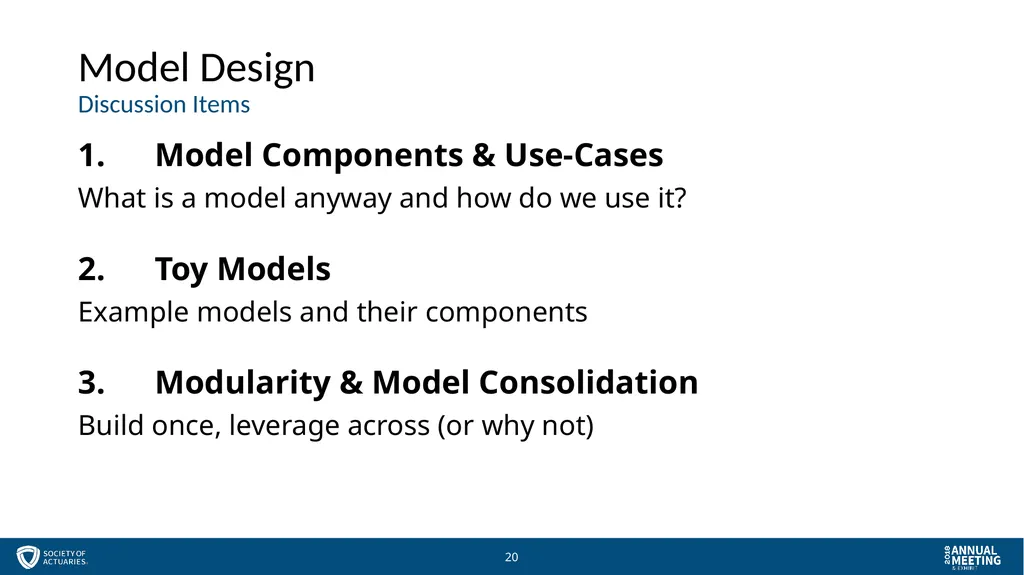
Discussion Items 20 1. Model Components & Use-Cases
What is a model anyway and how do we use it?
2. Toy Models
Example models and their components
3. Modularity & Model Consolidation
Build once, leverage across (or why not)<br>
What is a model anyway and how do we use it?
2. Toy Models
Example models and their components
3. Modularity & Model Consolidation
Build once, leverage across (or why not)<br>
21
Model Design
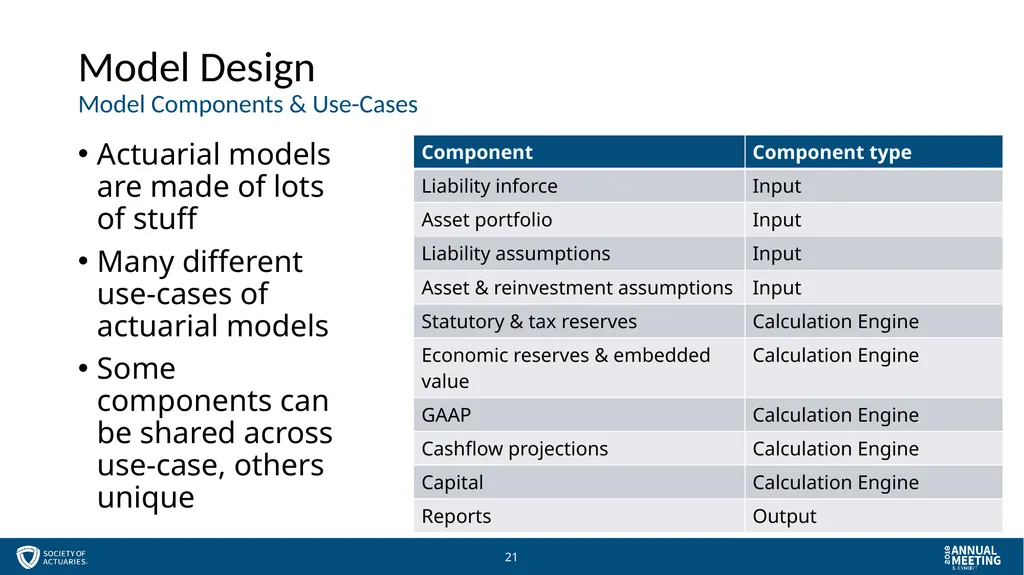
Model Components & Use-Cases 21 Actuarial models are made of lots of stuff
Many different use-cases of actuarial models
Some components can be shared across use-case, others unique<br>
Many different use-cases of actuarial models
Some components can be shared across use-case, others unique<br>
22
Model Design
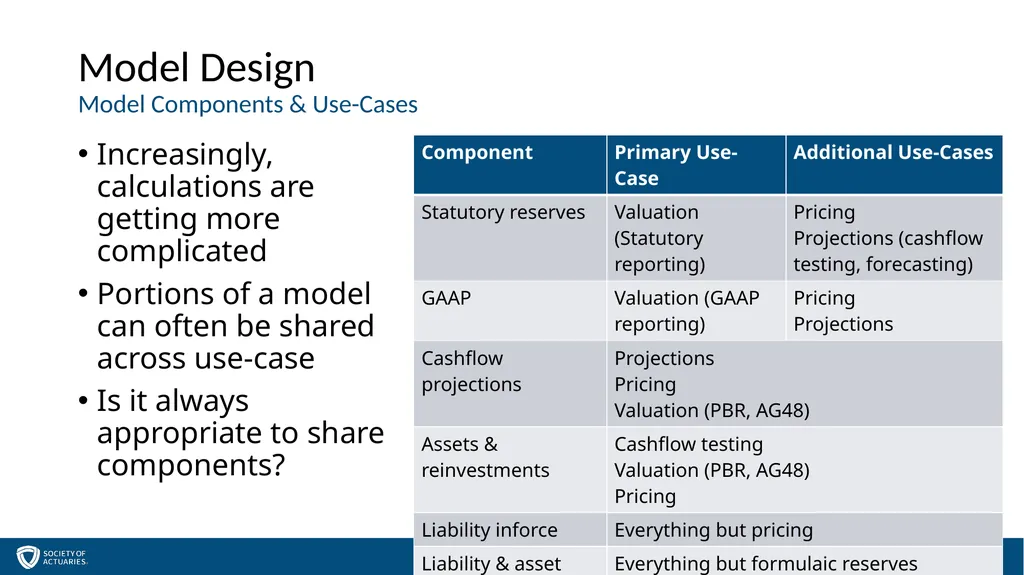
Model Components & Use-Cases 22 Increasingly, calculations are getting more complicated
Portions of a model can often be shared across use-case
Is it always appropriate to share components?<br>
Portions of a model can often be shared across use-case
Is it always appropriate to share components?<br>
23
Model Design
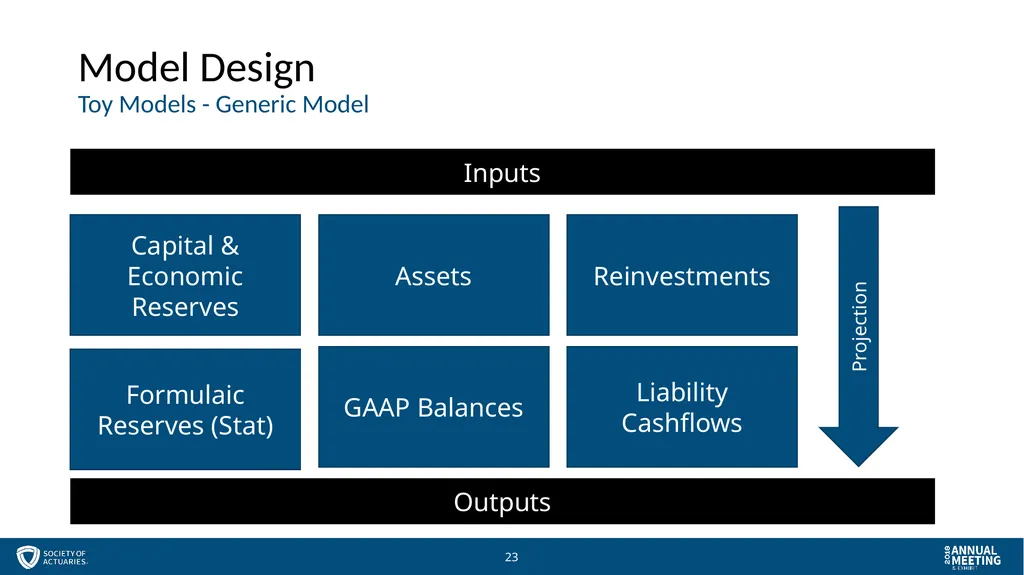
Toy Models - Generic Model 23 Outputs Formulaic Reserves (Stat) GAAP Balances Capital & Economic Reserves Assets Liability Cashflows Reinvestments Projection Inputs<br>
24
Model Design
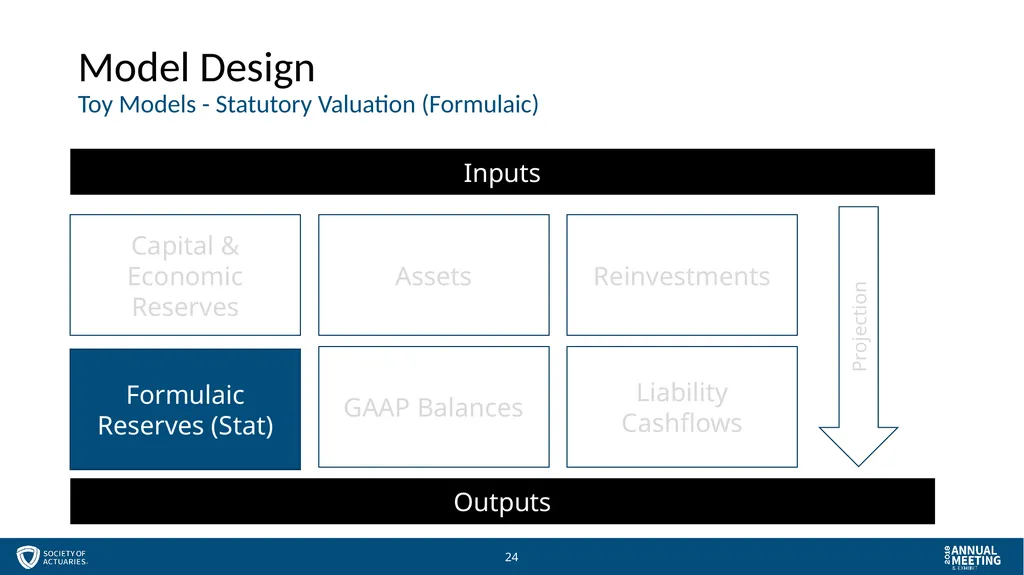
Toy Models - Statutory Valuation (Formulaic) 24 Outputs Formulaic Reserves (Stat) GAAP Balances Capital & Economic Reserves Assets Liability Cashflows Reinvestments Projection Inputs<br>
25
Model Design
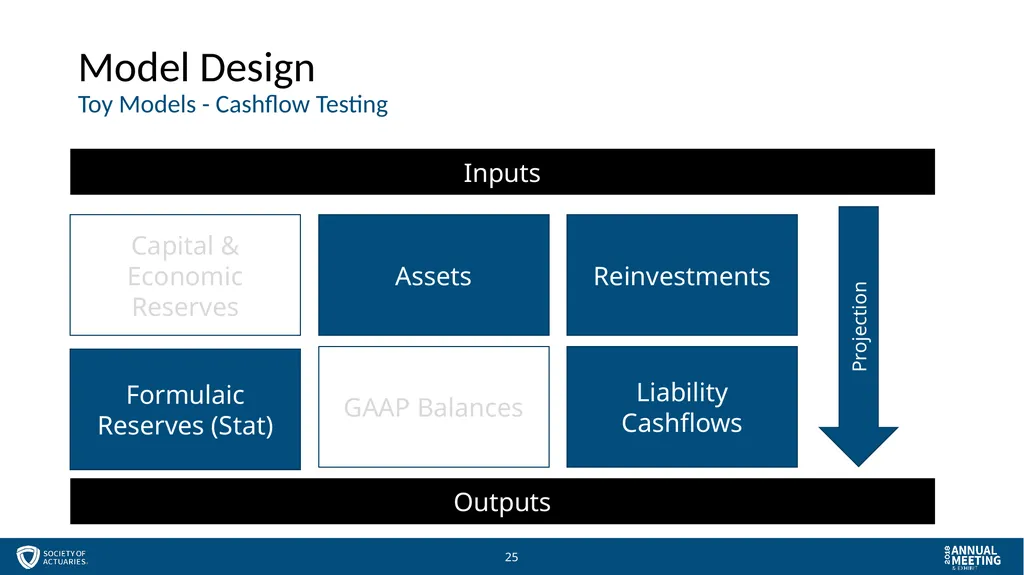
Toy Models - Cashflow Testing 25 Outputs Formulaic Reserves (Stat) GAAP Balances Capital & Economic Reserves Assets Liability Cashflows Reinvestments Projection Inputs<br>
26
Model Design
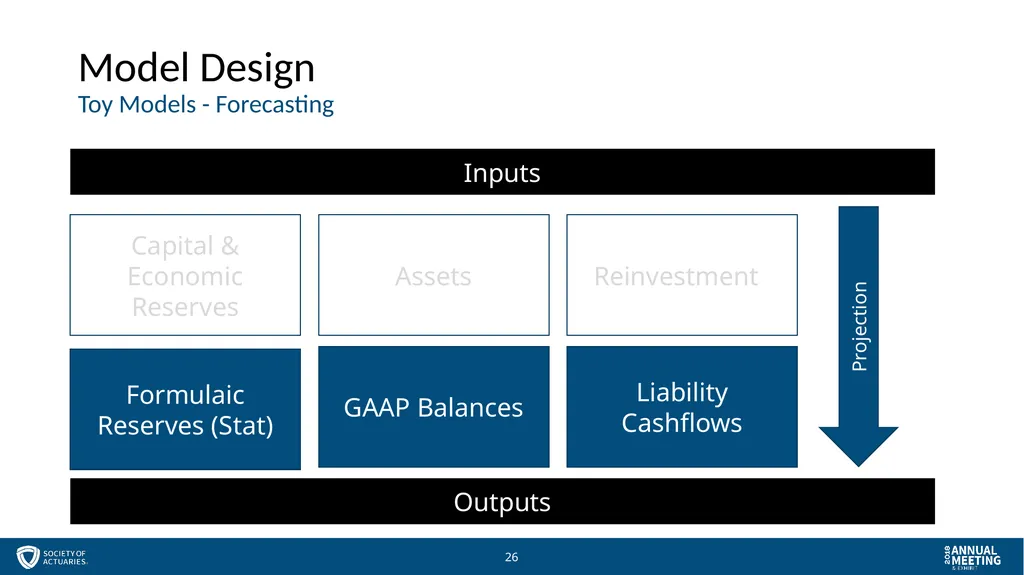
Toy Models - Forecasting 26 Outputs Formulaic Reserves (Stat) GAAP Balances Capital & Economic Reserves Assets Liability Cashflows Reinvestments Inputs Projection<br>
27
Model Design
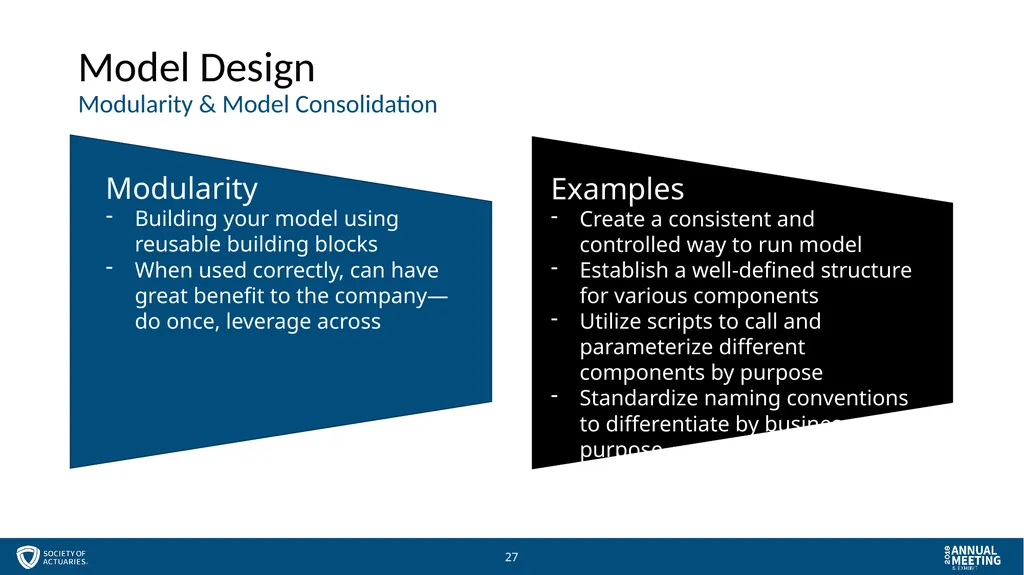
Modularity & Model Consolidation 27 Modularity
Building your model using reusable building blocks
When used correctly, can have great benefit to the company—do once, leverage across Examples
Create a consistent and controlled way to run model
Establish a well-defined structure for various components
Utilize scripts to call and parameterize different components by purpose
Standardize naming conventions to differentiate by business purpose<br>
Building your model using reusable building blocks
When used correctly, can have great benefit to the company—do once, leverage across Examples
Create a consistent and controlled way to run model
Establish a well-defined structure for various components
Utilize scripts to call and parameterize different components by purpose
Standardize naming conventions to differentiate by business purpose<br>
28
Model Design
Modularity & Model Consolidation 28<br>
29
Governance & Stakeholders<br>
30
Governance & Stakeholders
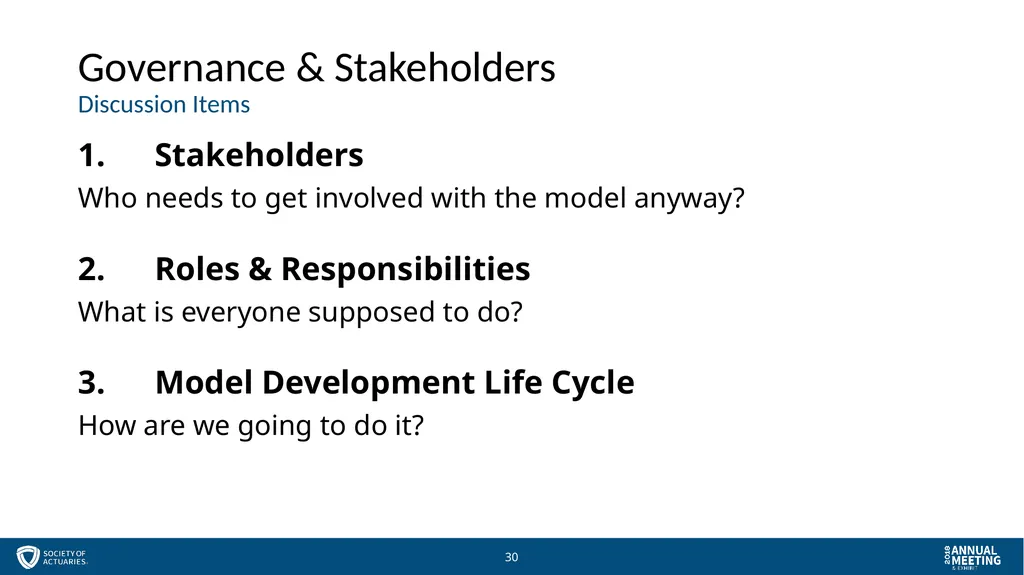
Discussion Items 30 1. Stakeholders
Who needs to get involved with the model anyway?
2. Roles & Responsibilities
What is everyone supposed to do?
3. Model Development Life Cycle
How are we going to do it?<br>
Who needs to get involved with the model anyway?
2. Roles & Responsibilities
What is everyone supposed to do?
3. Model Development Life Cycle
How are we going to do it?<br>
31
Governance & Stakeholders
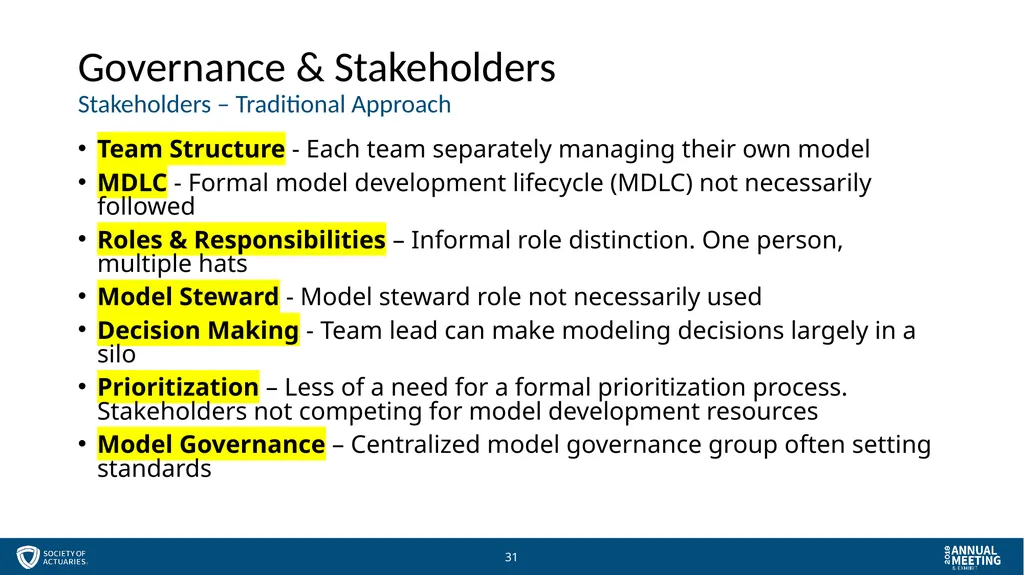
Stakeholders – Traditional Approach Team Structure - Each team separately managing their own model
MDLC - Formal model development lifecycle (MDLC) not necessarily followed
Roles & Responsibilities – Informal role distinction. One person, multiple hats
Model Steward - Model steward role not necessarily used
Decision Making - Team lead can make modeling decisions largely in a silo
Prioritization – Less of a need for a formal prioritization process. Stakeholders not competing for model development resources
Model Governance – Centralized model governance group often setting standards 31<br>
MDLC - Formal model development lifecycle (MDLC) not necessarily followed
Roles & Responsibilities – Informal role distinction. One person, multiple hats
Model Steward - Model steward role not necessarily used
Decision Making - Team lead can make modeling decisions largely in a silo
Prioritization – Less of a need for a formal prioritization process. Stakeholders not competing for model development resources
Model Governance – Centralized model governance group often setting standards 31<br>
32
Governance & Stakeholders
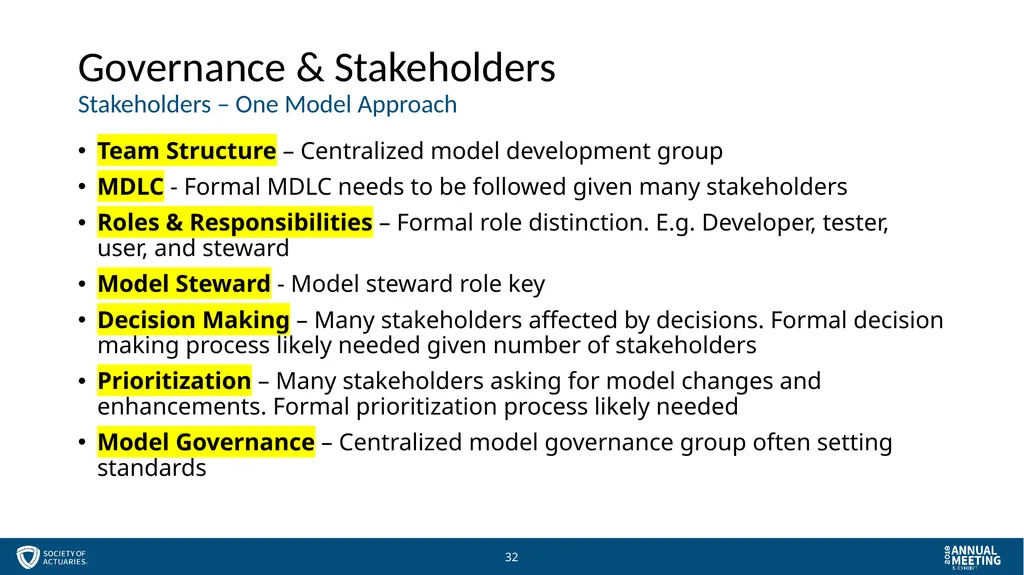
Stakeholders – One Model Approach Team Structure – Centralized model development group
MDLC - Formal MDLC needs to be followed given many stakeholders
Roles & Responsibilities – Formal role distinction. E.g. Developer, tester, user, and steward
Model Steward - Model steward role key
Decision Making – Many stakeholders affected by decisions. Formal decision making process likely needed given number of stakeholders
Prioritization – Many stakeholders asking for model changes and enhancements. Formal prioritization process likely needed
Model Governance – Centralized model governance group often setting standards 32<br>
MDLC - Formal MDLC needs to be followed given many stakeholders
Roles & Responsibilities – Formal role distinction. E.g. Developer, tester, user, and steward
Model Steward - Model steward role key
Decision Making – Many stakeholders affected by decisions. Formal decision making process likely needed given number of stakeholders
Prioritization – Many stakeholders asking for model changes and enhancements. Formal prioritization process likely needed
Model Governance – Centralized model governance group often setting standards 32<br>
33
Governance & Stakeholders
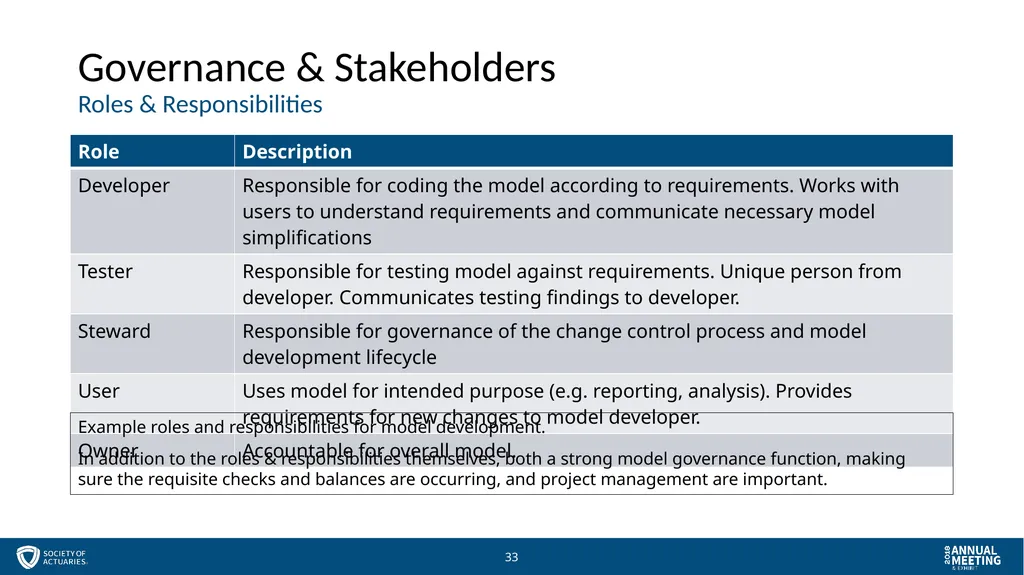
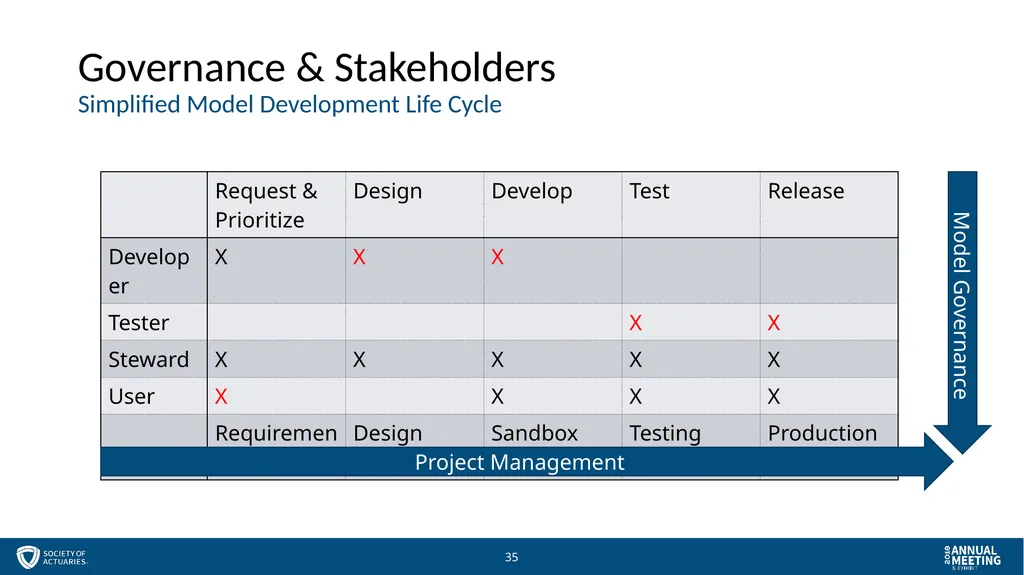
Roles & Responsibilities 33 Example roles and responsibilities for model development.
In addition to the roles & responsibilities themselves, both a strong model governance function, making sure the requisite checks and balances are occurring, and project management are important.<br>
In addition to the roles & responsibilities themselves, both a strong model governance function, making sure the requisite checks and balances are occurring, and project management are important.<br>
34
Governance & Stakeholders
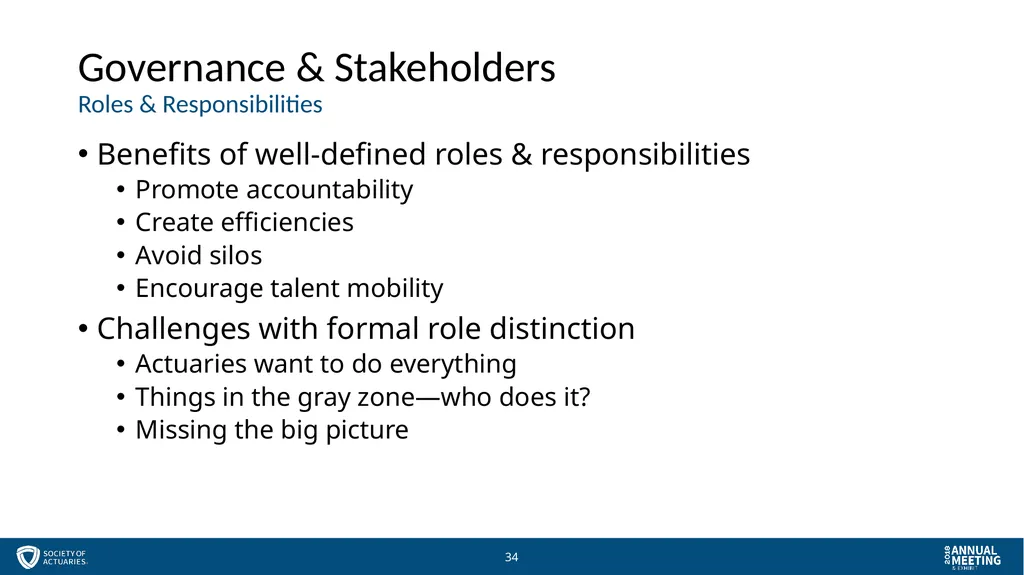
Roles & Responsibilities 34 Benefits of well-defined roles & responsibilities
Promote accountability
Create efficiencies
Avoid silos
Encourage talent mobility
Challenges with formal role distinction
Actuaries want to do everything
Things in the gray zone—who does it?
Missing the big picture<br>
Promote accountability
Create efficiencies
Avoid silos
Encourage talent mobility
Challenges with formal role distinction
Actuaries want to do everything
Things in the gray zone—who does it?
Missing the big picture<br>
35
Governance & Stakeholders
Simplified Model Development Life Cycle 35 Project Management Model Governance<br>
36
Governance & Stakeholders
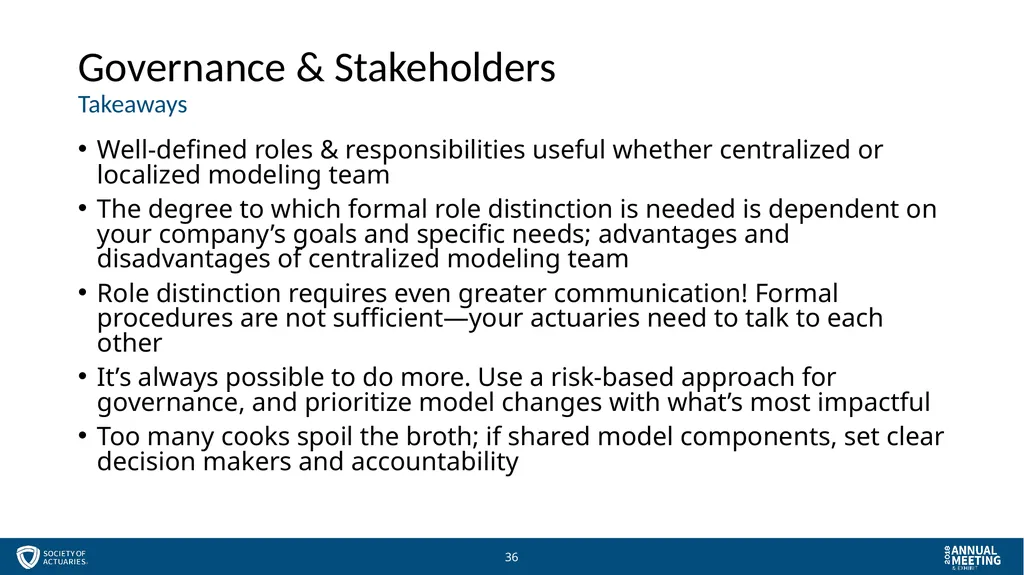
Takeaways 36 Well-defined roles & responsibilities useful whether centralized or localized modeling team
The degree to which formal role distinction is needed is dependent on your company’s goals and specific needs; advantages and disadvantages of centralized modeling team
Role distinction requires even greater communication! Formal procedures are not sufficient—your actuaries need to talk to each other
It’s always possible to do more. Use a risk-based approach for governance, and prioritize model changes with what’s most impactful
Too many cooks spoil the broth; if shared model components, set clear decision makers and accountability<br>
The degree to which formal role distinction is needed is dependent on your company’s goals and specific needs; advantages and disadvantages of centralized modeling team
Role distinction requires even greater communication! Formal procedures are not sufficient—your actuaries need to talk to each other
It’s always possible to do more. Use a risk-based approach for governance, and prioritize model changes with what’s most impactful
Too many cooks spoil the broth; if shared model components, set clear decision makers and accountability<br>
37
How stewards can manage model risk<br>
38
How stewards can manage model risk (1/3) Keep model documentation updated
Business requirements
Functional and other requirements
Users, uses, and stakeholders
Input dependencies
Output requirements
Model procedures
Model uses and limitations
Understand and document model approximations 38<br>
Business requirements
Functional and other requirements
Users, uses, and stakeholders
Input dependencies
Output requirements
Model procedures
Model uses and limitations
Understand and document model approximations 38<br>
39
How stewards can manage model risk (2/3) Understand model design
Understand choices made when model was created
Understand limitations of model created by choices
Ensure model specifications understood
Confirm model coding consistent with specifications 39<br>
Understand choices made when model was created
Understand limitations of model created by choices
Ensure model specifications understood
Confirm model coding consistent with specifications 39<br>
40
How stewards can manage model risk (3/3) Ensure controls and current and effective
Validate data and model input
Formal or informal controls to tie model statistics to source
Promote understanding of model output 40<br>
Validate data and model input
Formal or informal controls to tie model statistics to source
Promote understanding of model output 40<br>
41
How stewards and stakeholders can make models better<br>
42
How stewards and stakeholders can make models better (1/2) Keep and prioritize a “day 2” list
New and upcoming business requirements
New regulations/regulatory requirements
Items and functionality desired but not currently in model
Functionality to model new and upcoming products
New / potentially improved IT processes
Remove approximations (when appropriate) 42<br>
New and upcoming business requirements
New regulations/regulatory requirements
Items and functionality desired but not currently in model
Functionality to model new and upcoming products
New / potentially improved IT processes
Remove approximations (when appropriate) 42<br>
43
How stewards and stakeholders can make models better (2/2) Allow models to evolve with stakeholder needs
Consider model life cycle to allocate resources appropriately
Suitability of current platform to support future requirements 43<br>
Consider model life cycle to allocate resources appropriately
Suitability of current platform to support future requirements 43<br>
44
Communication of results<br>
45
Communication of results - model output Understand model output and limitations
Document users and intended uses
Address known limitations
Communicate limitations to stakeholders
Develop output based on stakeholder needs 45<br>
Document users and intended uses
Address known limitations
Communicate limitations to stakeholders
Develop output based on stakeholder needs 45<br>
46
Effective communication of results Focus on conclusions of analysis
Focus on conclusions, but include detail of process
Use charts, diagrams, and pictures when practical
Use executive summary, detail, appendix 46<br>
Focus on conclusions, but include detail of process
Use charts, diagrams, and pictures when practical
Use executive summary, detail, appendix 46<br>
47
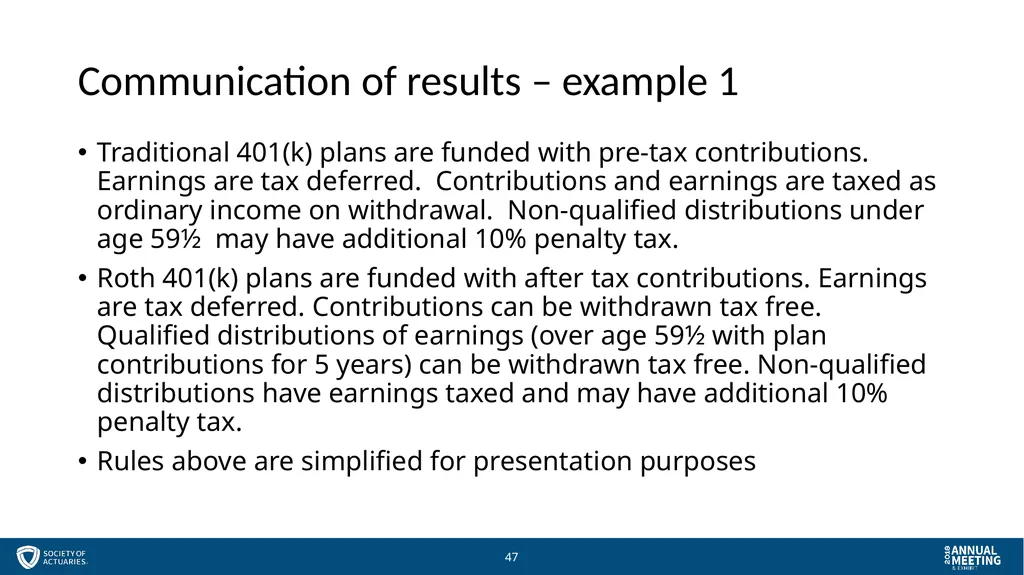
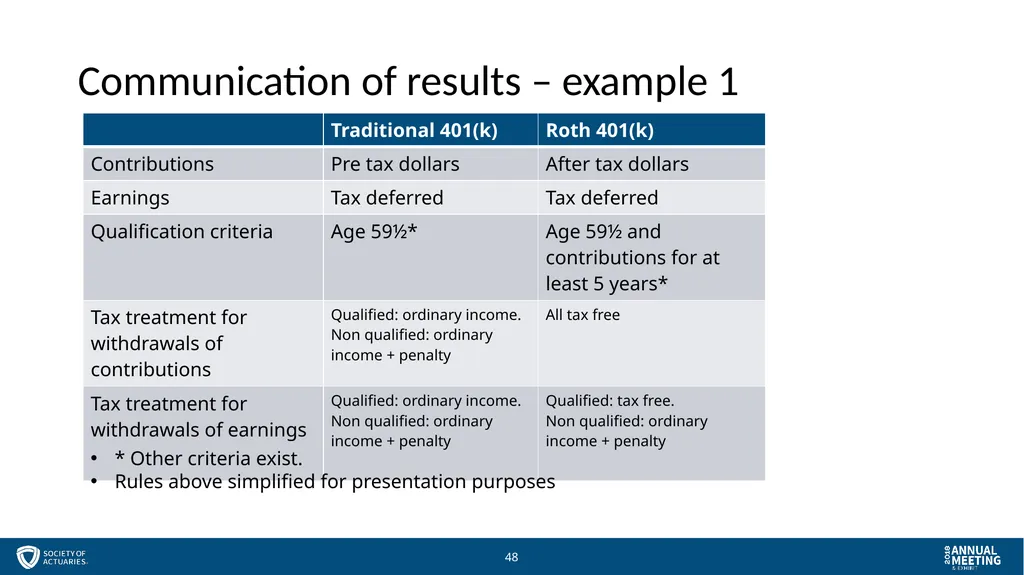
Communication of results – example 1 Traditional 401(k) plans are funded with pre-tax contributions. Earnings are tax deferred. Contributions and earnings are taxed as ordinary income on withdrawal. Non-qualified distributions under age 59½ may have additional 10% penalty tax.
Roth 401(k) plans are funded with after tax contributions. Earnings are tax deferred. Contributions can be withdrawn tax free. Qualified distributions of earnings (over age 59½ with plan contributions for 5 years) can be withdrawn tax free. Non-qualified distributions have earnings taxed and may have additional 10% penalty tax.
Rules above are simplified for presentation purposes 47<br>
Roth 401(k) plans are funded with after tax contributions. Earnings are tax deferred. Contributions can be withdrawn tax free. Qualified distributions of earnings (over age 59½ with plan contributions for 5 years) can be withdrawn tax free. Non-qualified distributions have earnings taxed and may have additional 10% penalty tax.
Rules above are simplified for presentation purposes 47<br>
48
Communication of results – example 1 48 * Other criteria exist.
Rules above simplified for presentation purposes<br>
Rules above simplified for presentation purposes<br>
49
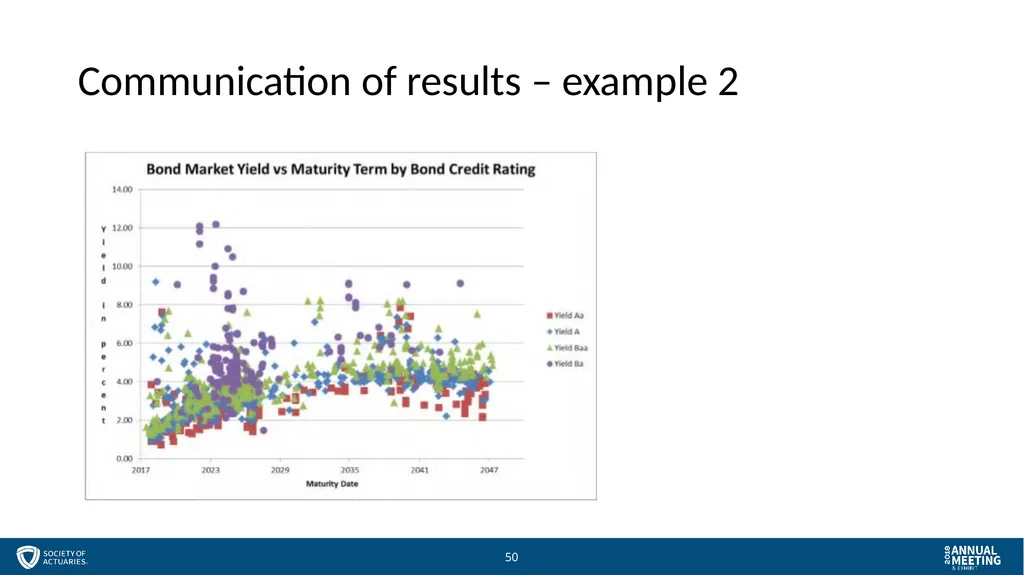
Communication of results – example 2 Plotting bond yields by maturity and credit rating indicates that most yields fit in reasonable ranges. There are some outliers that require additional research. 49<br>
50
Communication of results – example 2 50<br>