Session 8: Estimating Growth Growth in Earnings Look at the past The historical growth in earnings per share is usually a good starting point for growth estimation Look at what others are estimating Analysts estimate growth in earnings per
"Session 8: Estimating Growth Growth in Earnings" is the property of its rightful owner. Permission is granted to
download and print the materials on this website for personal, non-commercial use only, and to display it
on your personal computer provided you do not modify the materials and that you retain all copyright
notices contained in the materials. By downloading content from our website, you accept the terms of this
agreement.
Presentation Transcript
01
Session 8: Estimating Growth<br>
02
Growth in Earnings Look at the past
The historical growth in earnings per share is usually a good starting point for growth estimation
Look at what others are estimating
Analysts estimate growth in earnings per share for many firms. It is useful to know what their estimates are.
Look at fundamentals
Ultimately, all growth in earnings can be traced to two fundamentals - how much the firm is investing in new projects, and what returns these projects are making for the firm.<br>
03
I. Historical Growth in EPS The historical growth rate in earnings for a company may seem like a fact but it is an estimate. In fact, it is sensitive to
How it is computed: The growth rates in earnings will be different, depending upon how you compute the average. An simple (arithmetic) average growth rate will tend to be higher than a compounded (geometric) average growth rate.
Estimation period: The starting point for the computation can make a big difference. Using a bad year as the base year will generate much higher growth rates.
In using historical growth rates, recognize the following:
Growth rates become meaningless when earnings go from negative values to positive values
Growth rates will go down as companies get larger
Worst of all, there is evidence that historical growth rates in earnings are not very good predictors of future earnings…<br>
04
II. Management/Analyst Forecasts When valuing companies, we often fall back on management forecasts for the future (after all, they know the company better than we do) or forecasts of other analysts.
Management forecasts may reflect their “superior” knowledge, but they have a fatal flaw. They are biased.
Analyst forecasts may seem like a simple way to avoid the problem, but not only are they also biased but using them represents an abandonment of a basic requirement in valuation: that you make your own best judgment of growth.<br>
05
III. Fundamental Growth Growth has to be earned by a company. You and I do not have the power to endow a company with growth.
In terms of basic fundamentals, for a company to grow its earnings, it has to
Add to its asset or capital base and generate returns on that added capital (new investment growth)
Manage its existing assets more efficiently, generating higher margins and higher returns on existing assets (efficiency growth)<br>
06
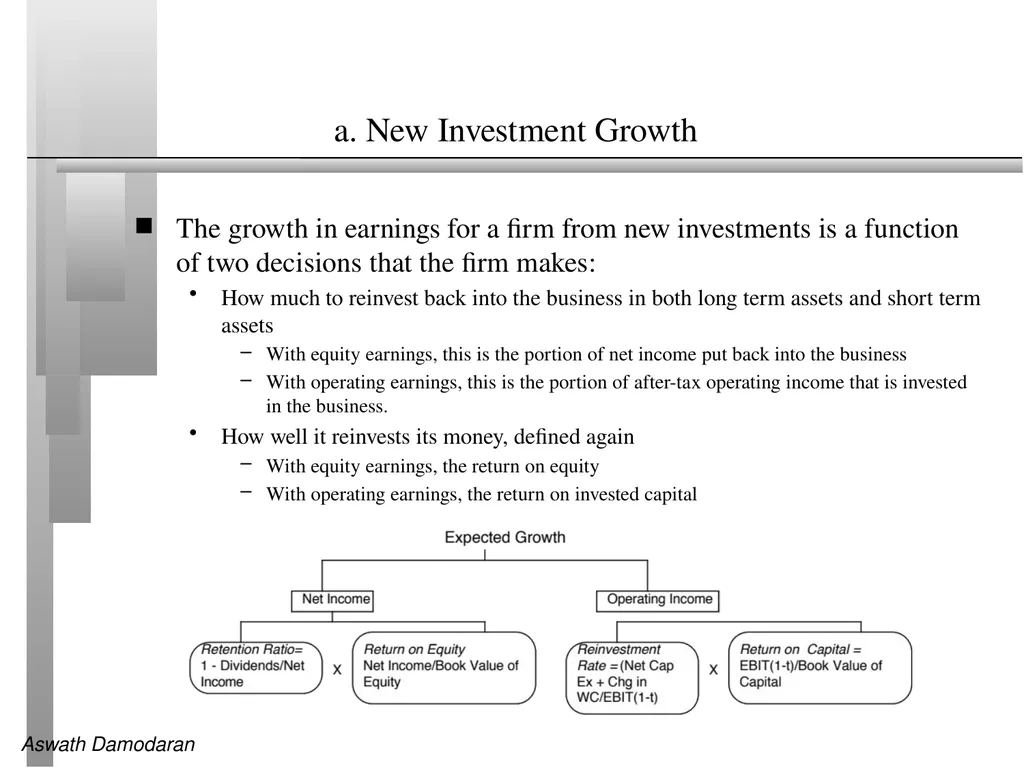
a. New Investment Growth The growth in earnings for a firm from new investments is a function of two decisions that the firm makes:
How much to reinvest back into the business in both long term assets and short term assets
With equity earnings, this is the portion of net income put back into the business
With operating earnings, this is the portion of after-tax operating income that is invested in the business.
How well it reinvests its money, defined again
With equity earnings, the return on equity
With operating earnings, the return on invested capital<br>
07
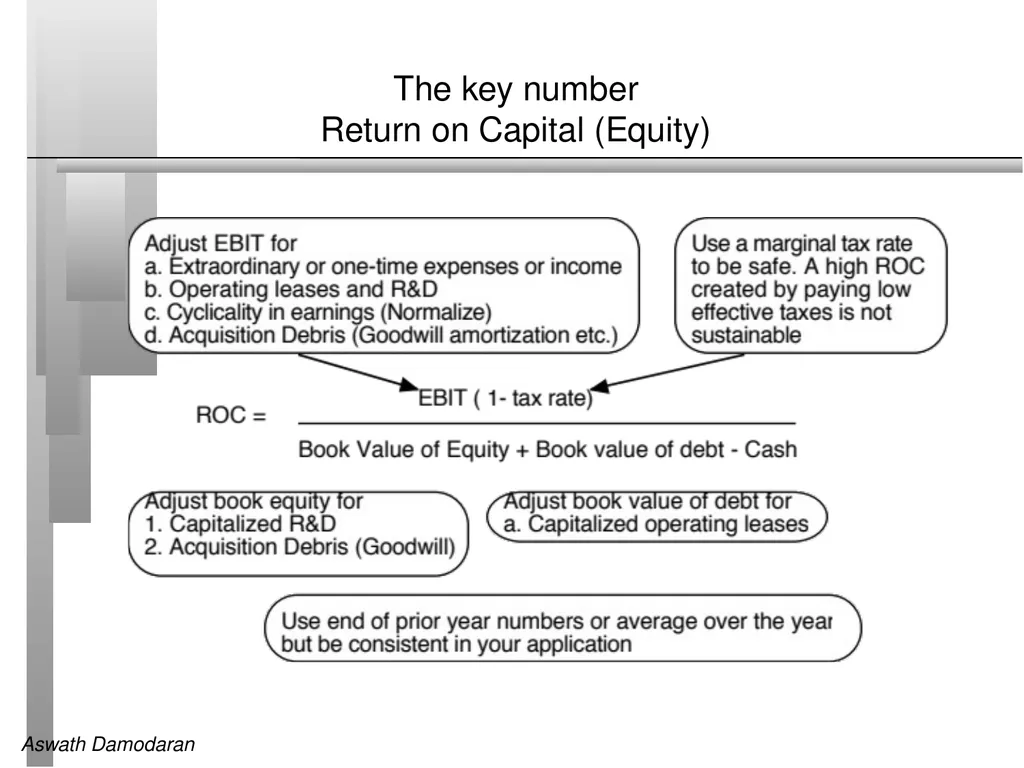
The key number Return on Capital (Equity)<br>
08
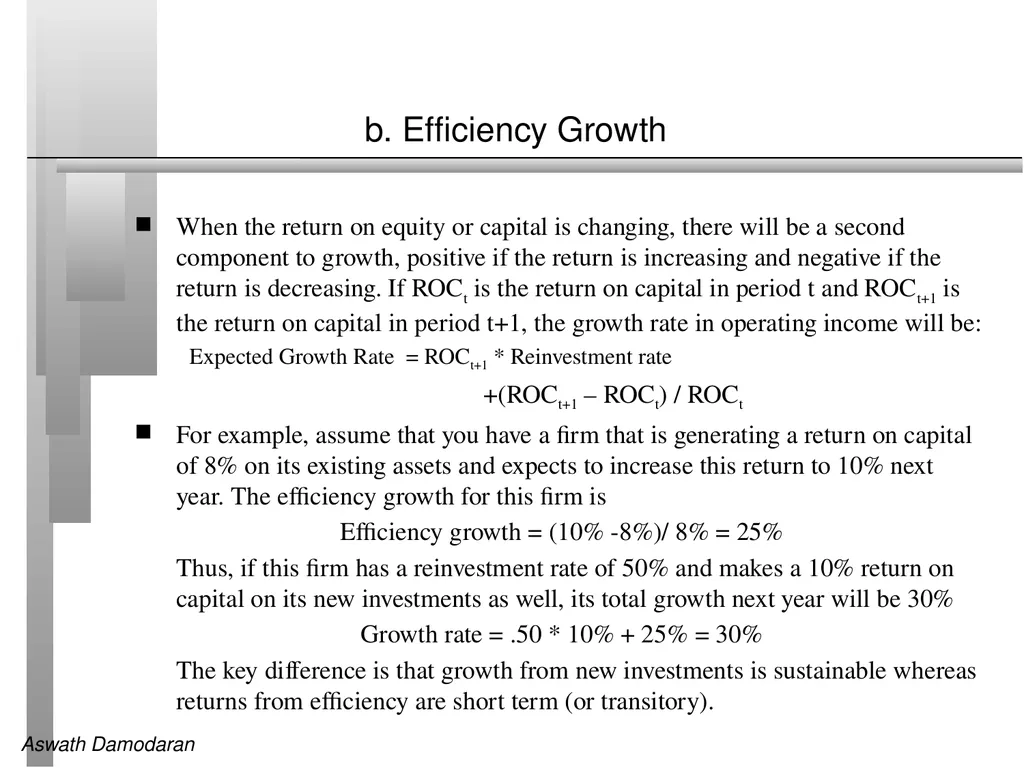
b. Efficiency Growth When the return on equity or capital is changing, there will be a second component to growth, positive if the return is increasing and negative if the return is decreasing. If ROCt is the return on capital in period t and ROCt+1 is the return on capital in period t+1, the growth rate in operating income will be:
Expected Growth Rate = ROCt+1 * Reinvestment rate
+(ROCt+1 – ROCt) / ROCt
For example, assume that you have a firm that is generating a return on capital of 8% on its existing assets and expects to increase this return to 10% next year. The efficiency growth for this firm is
Efficiency growth = (10% -8%)/ 8% = 25%
Thus, if this firm has a reinvestment rate of 50% and makes a 10% return on capital on its new investments as well, its total growth next year will be 30%
Growth rate = .50 * 10% + 25% = 30%
The key difference is that growth from new investments is sustainable whereas returns from efficiency are short term (or transitory).<br>
09
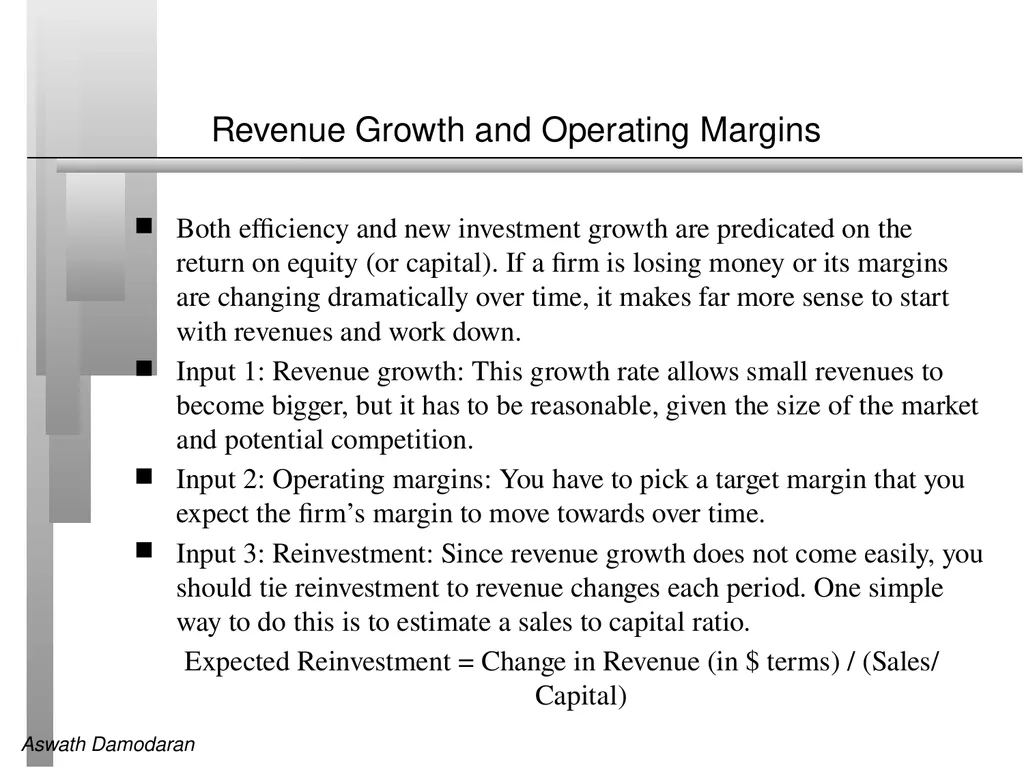
Revenue Growth and Operating Margins Both efficiency and new investment growth are predicated on the return on equity (or capital). If a firm is losing money or its margins are changing dramatically over time, it makes far more sense to start with revenues and work down.
Input 1: Revenue growth: This growth rate allows small revenues to become bigger, but it has to be reasonable, given the size of the market and potential competition.
Input 2: Operating margins: You have to pick a target margin that you expect the firm’s margin to move towards over time.
Input 3: Reinvestment: Since revenue growth does not come easily, you should tie reinvestment to revenue changes each period. One simple way to do this is to estimate a sales to capital ratio.
Expected Reinvestment = Change in Revenue (in $ terms) / (Sales/ Capital)<br>