04
4 Goals for role transition are:
Resolve the loss of the old role
Develop a balanced view with realistic expectations
Develop skills (and permission) for nurturing new mom
Develop new social support (e.g., friends with children) Session B�Role Transitions<br>
05
Any change is stressful even joyful events
Positive and negatives changes of becoming a mother
Ask for examples when women have had a change in roles and how they “survived.”
Talk about changes a baby will bring
Explore possible losses
Explore possible benefits/opportunities
Explore associated feelings
Normalize the feelings (to offset guilt)
Handout on Gains and Losses Session B�Role Transitions 5<br>
06
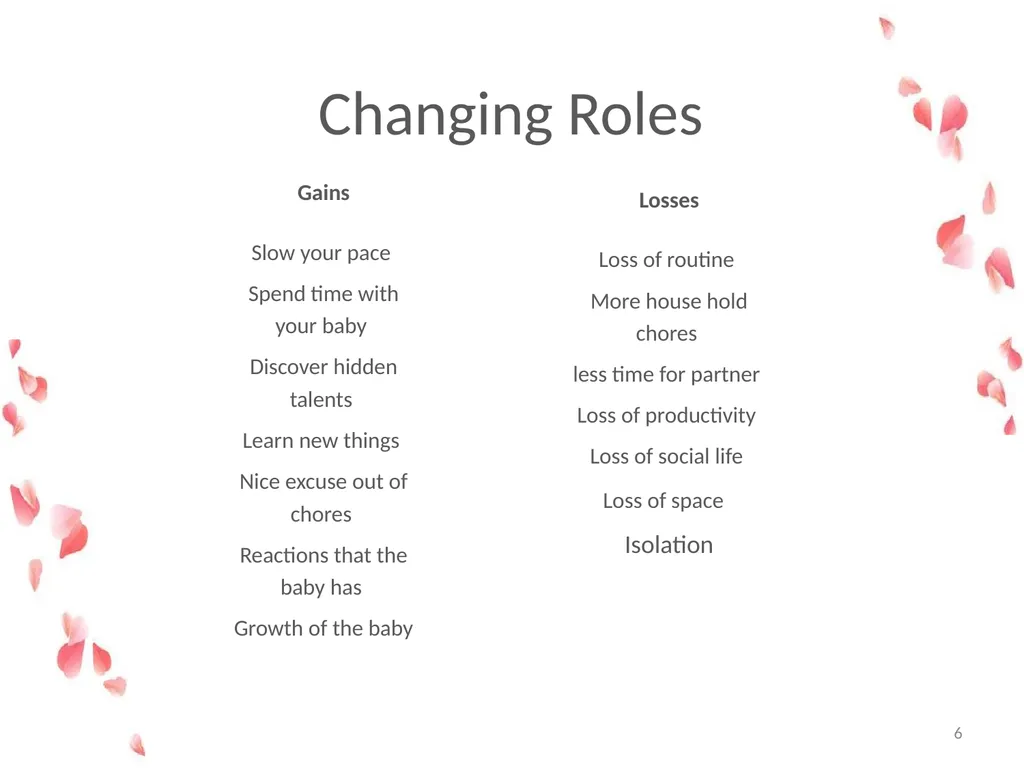
Changing Roles Gains
Slow your pace
Spend time with your baby
Discover hidden talents
Learn new things
Nice excuse out of chores
Reactions that the baby has
Growth of the baby Losses
Loss of routine
More house hold chores
less time for partner
Loss of productivity
Loss of social life
Loss of space
Isolation 6<br>
07
Session B�Nurturing The New Mother Importance of taking care of yourself to survive motherhood and prevent postpartum depression
Share handout on Mother the new Mother
Use analogy of pitcher
Importance of pleasant activities
Buffer against depression (lifts mood), energizes, etc.
The more enjoyable things you do, the better you are likely to feel
Ask group for examples of pleasant activities once baby is here
Refer to handout on pleasant activities 7<br>
08
New Mothers Survival Kit Nurture yourself physically (e.g., adequate rest, proper food, exercise)
Take breaks “mini vacations” (rest is rest-no chores during breaks!)
Give yourself credit, don’t forget to include the small tasks
Plan at least one event a day involving an adult (e.g., phone call to a friend)
Plan for something fun (e.g., a TV show, bubble bath, look at old pictures)
Ask for help-you cannot do it all
Postpone major changes in your life 8<br>
09
Mother the New
Mother
be Your Own Best Friend 9<br>
10
Treat yourself
You deserve it
This is an important time to take
�care of yourself 10<br>
11
Session B�Developing Supports Importance of positive support
Research has shown that support can protect against depression, including postpartum depression
People who can confide in others and receive support are less likely to become depressed
If you are hesitant to ask for help you may become overwhelmed 11<br>
12
Session B�Developing Supports Ask group to identify supportive people in their lives once baby is here
Who will they can turn to, what type of support will they need.
Remind women they have a right to reach out, to seek help and support. It is important to look for support from those who are receptive and caring, whoever they may be.
Remind women to also include agencies, organizations, providers, place of worship as their supports
Continuously probe for possible sources of support. Many women have people who have been supportive of them, but do not label them as support, or are scared or unsure how to ask for the support
Ask women to complete the Close People Handout 12<br>
13
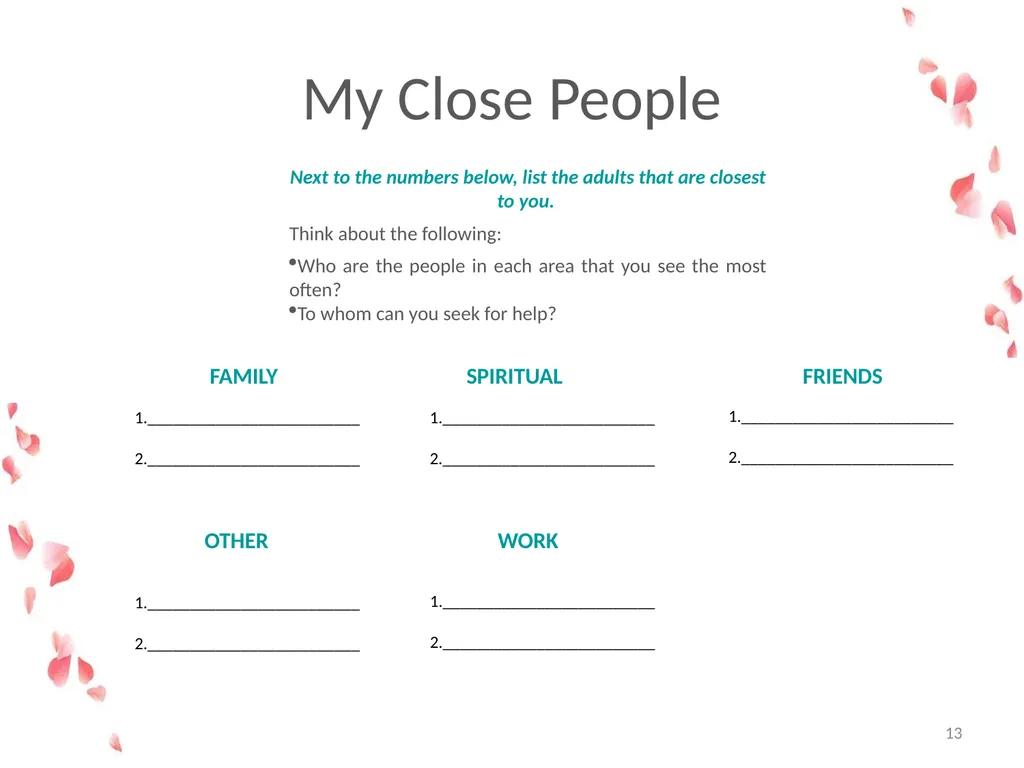
My Close People Next to the numbers below, list the adults that are closest to you.
Think about the following:
Who are the people in each area that you see the most often?
To whom can you seek for help? FAMILY 1._________________________
2._________________________ SPIRITUAL 1._________________________
2._________________________ OTHER 1._________________________
2._________________________ FRIENDS 1._________________________
2._________________________ WORK 1._________________________
2._________________________ 13<br>
14
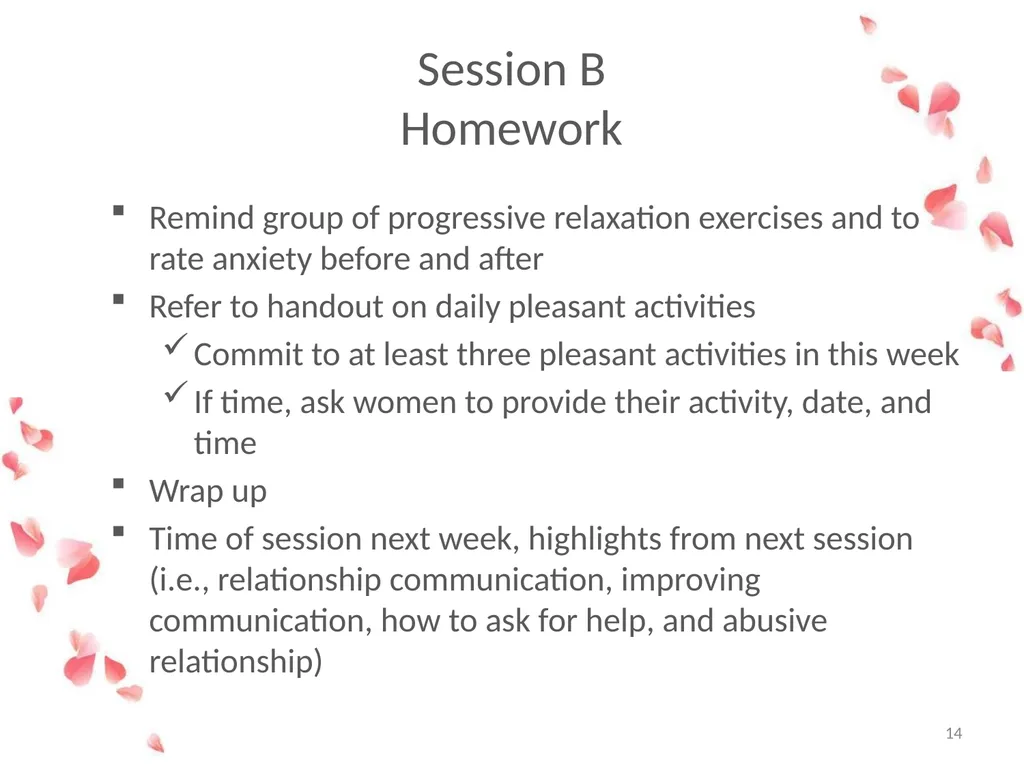
Session B�Homework Remind group of progressive relaxation exercises and to rate anxiety before and after
Refer to handout on daily pleasant activities
Commit to at least three pleasant activities in this week
If time, ask women to provide their activity, date, and time
Wrap up
Time of session next week, highlights from next session (i.e., relationship communication, improving communication, how to ask for help, and abusive relationship) 14<br>
15
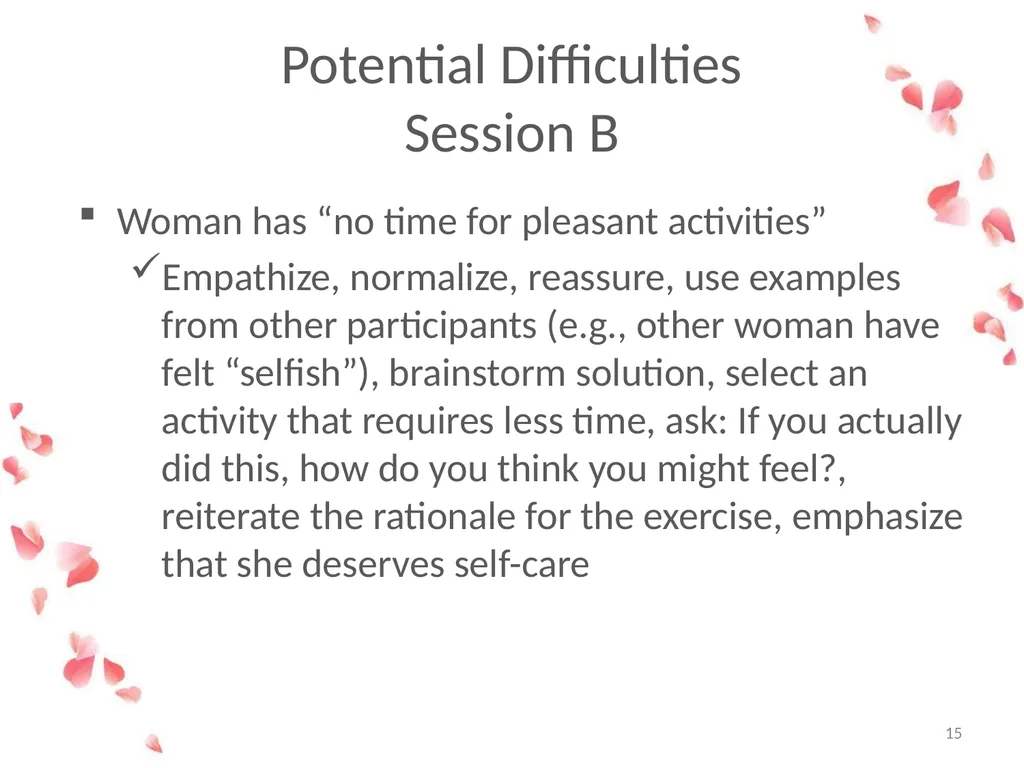
15 Woman has “no time for pleasant activities”
Empathize, normalize, reassure, use examples from other participants (e.g., other woman have felt “selfish”), brainstorm solution, select an activity that requires less time, ask: If you actually did this, how do you think you might feel?, reiterate the rationale for the exercise, emphasize that she deserves self-care Potential Difficulties�Session B<br>
16
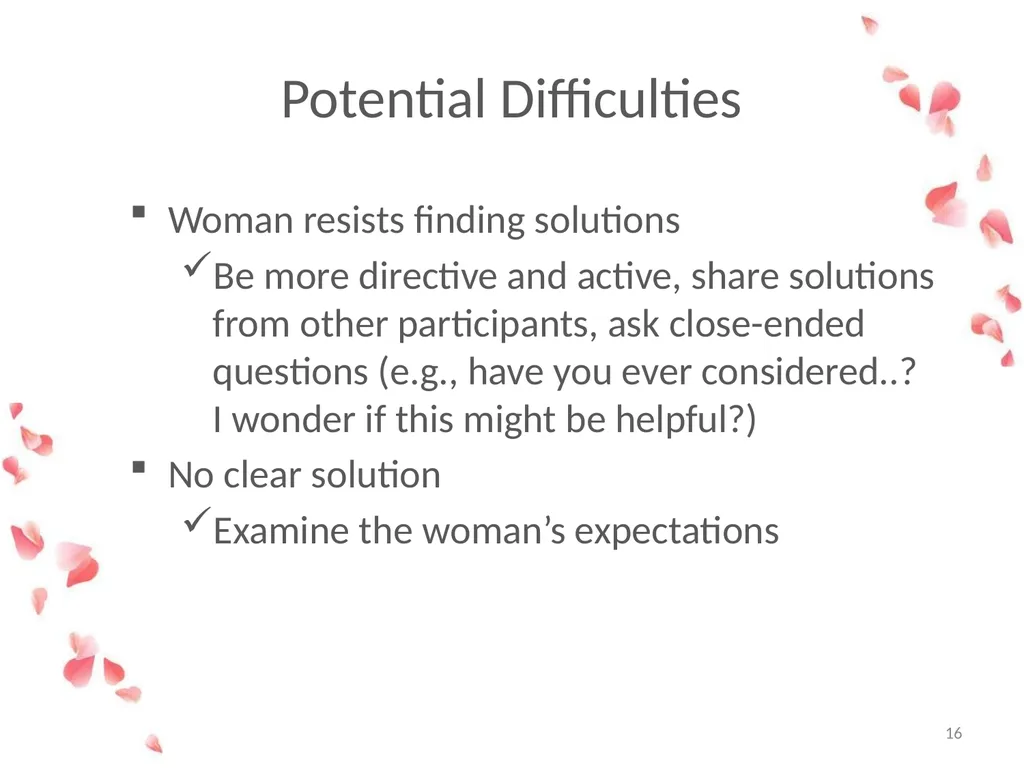
16 Potential Difficulties Woman resists finding solutions
Be more directive and active, share solutions from other participants, ask close-ended questions (e.g., have you ever considered..? I wonder if this might be helpful?)
No clear solution
Examine the woman’s expectations<br>
17
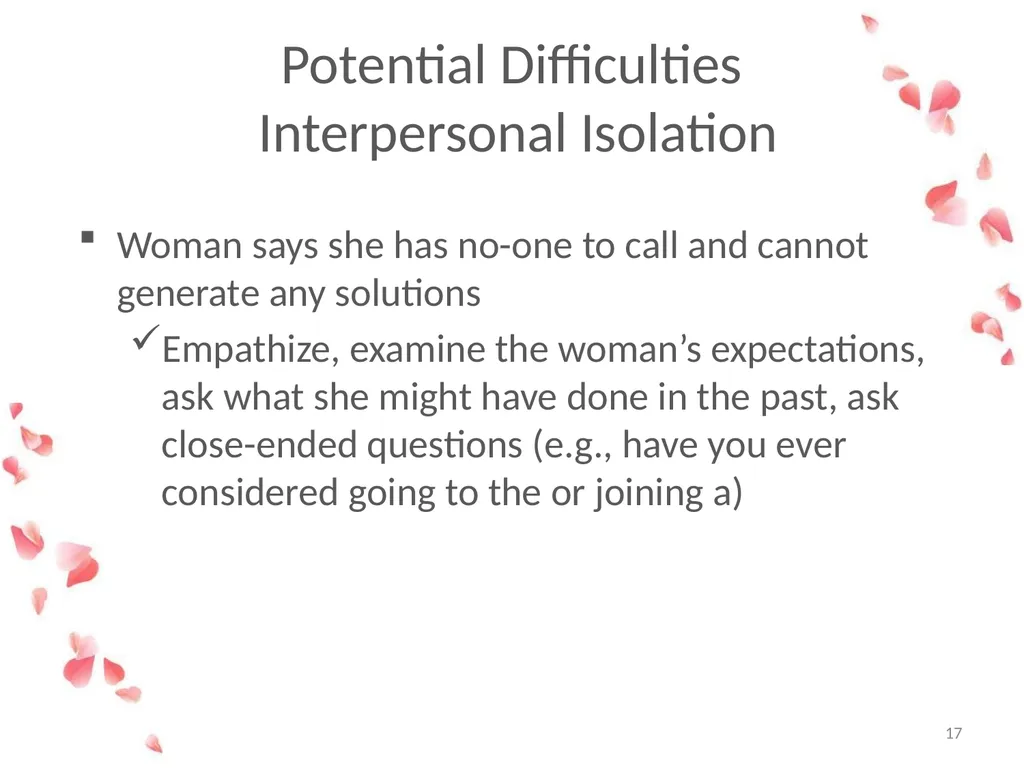
Potential Difficulties� Interpersonal Isolation 17 Woman says she has no-one to call and cannot generate any solutions
Empathize, examine the woman’s expectations, ask what she might have done in the past, ask close-ended questions (e.g., have you ever considered going to the or joining a)<br>