
Set Theory – Part I Chapter 3.1, 3.2, 3.3
MT
Published · 58 slides · 0 views

1 / 1
Description
Set Theory Part I Chapter 3.1, 3.2, 3.3 Introduction Sets are one of the basic building blocks for the types of objects considered in discrete mathematics. Important for counting. Programming languages have set operations. Introduction
Related Topics
Share
Embed code
Download this presentation From Below
"Set Theory – Part I Chapter 3.1, 3.2, 3.3" is the property of its rightful owner. Permission is granted to download and print the materials on this website for personal, non-commercial use only, and to display it on your personal computer provided you do not modify the materials and that you retain all copyright notices contained in the materials. By downloading content from our website, you accept the terms of this agreement.
Presentation Transcript
01
Set Theory – Part I Chapter 3.1, 3.2, 3.3<br>
02
Introduction Sets are one of the basic building blocks for the types of objects considered in discrete mathematics.
Important for counting.
Programming languages have set operations.<br>
Important for counting.
Programming languages have set operations.<br>
03
Introduction Sets are one of the basic building blocks for the types of objects considered in discrete mathematics.
Important for counting.
Programming languages have set operations.
Set theory is an important branch of mathematics.
Many different systems of axioms have been used to develop set theory.
Here we are not concerned with a formal set of axioms for set theory. Instead, we will use what is called naïve set theory.<br>
Important for counting.
Programming languages have set operations.
Set theory is an important branch of mathematics.
Many different systems of axioms have been used to develop set theory.
Here we are not concerned with a formal set of axioms for set theory. Instead, we will use what is called naïve set theory.<br>
04
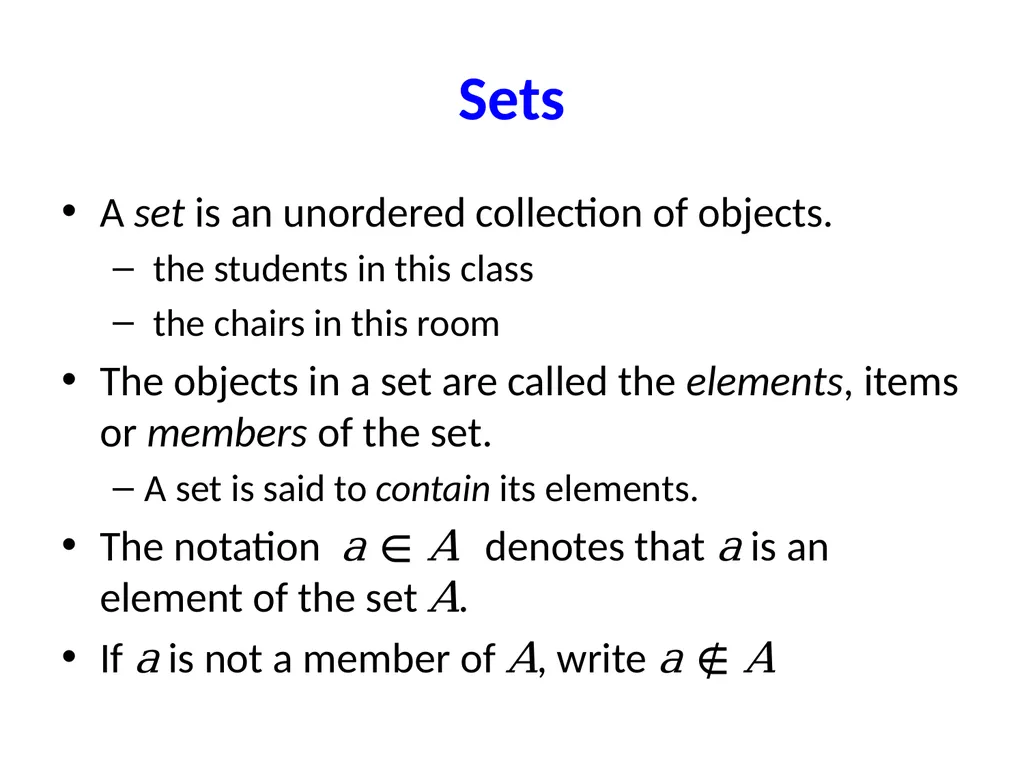
Sets A set is an unordered collection of objects.
the students in this class
the chairs in this room
The objects in a set are called the elements, items or members of the set.
A set is said to contain its elements.<br>
the students in this class
the chairs in this room
The objects in a set are called the elements, items or members of the set.
A set is said to contain its elements.<br>
05
Sets A set is an unordered collection of objects.
the students in this class
the chairs in this room
The objects in a set are called the elements, items or members of the set.
A set is said to contain its elements.
The notation a ∈ A denotes that a is an element of the set A.
If a is not a member of A, write a ∉ A<br>
the students in this class
the chairs in this room
The objects in a set are called the elements, items or members of the set.
A set is said to contain its elements.
The notation a ∈ A denotes that a is an element of the set A.
If a is not a member of A, write a ∉ A<br>
06
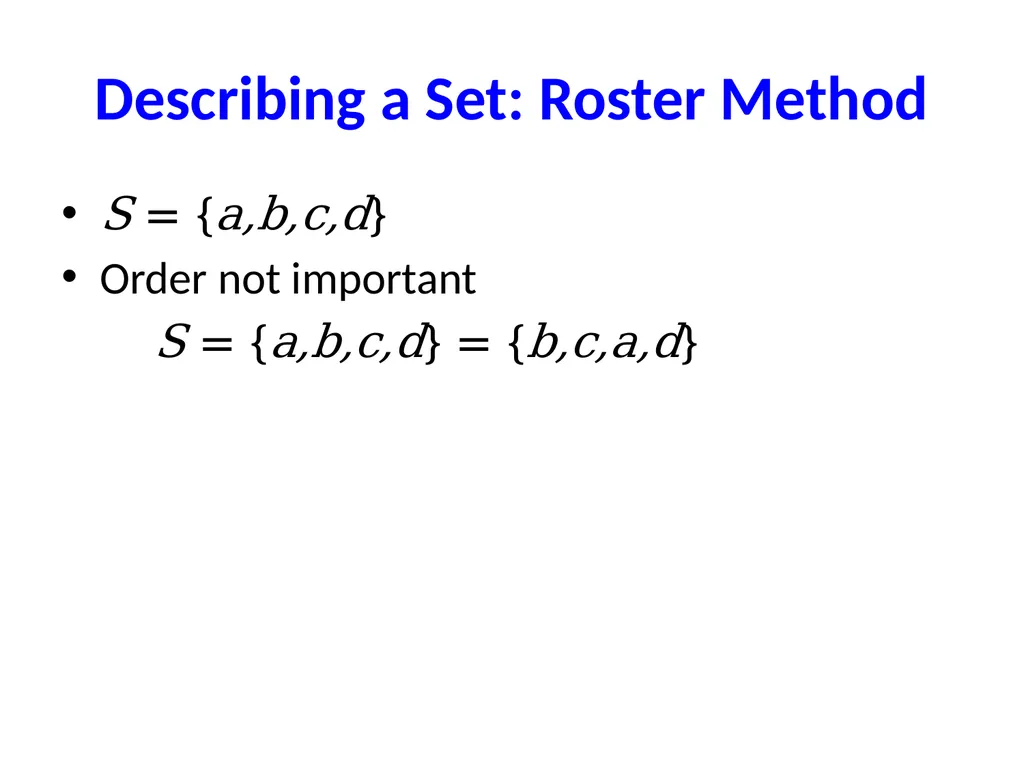
Describing a Set: Roster Method S = {a,b,c,d}
Order not important
S = {a,b,c,d} = {b,c,a,d}<br>
Order not important
S = {a,b,c,d} = {b,c,a,d}<br>
07
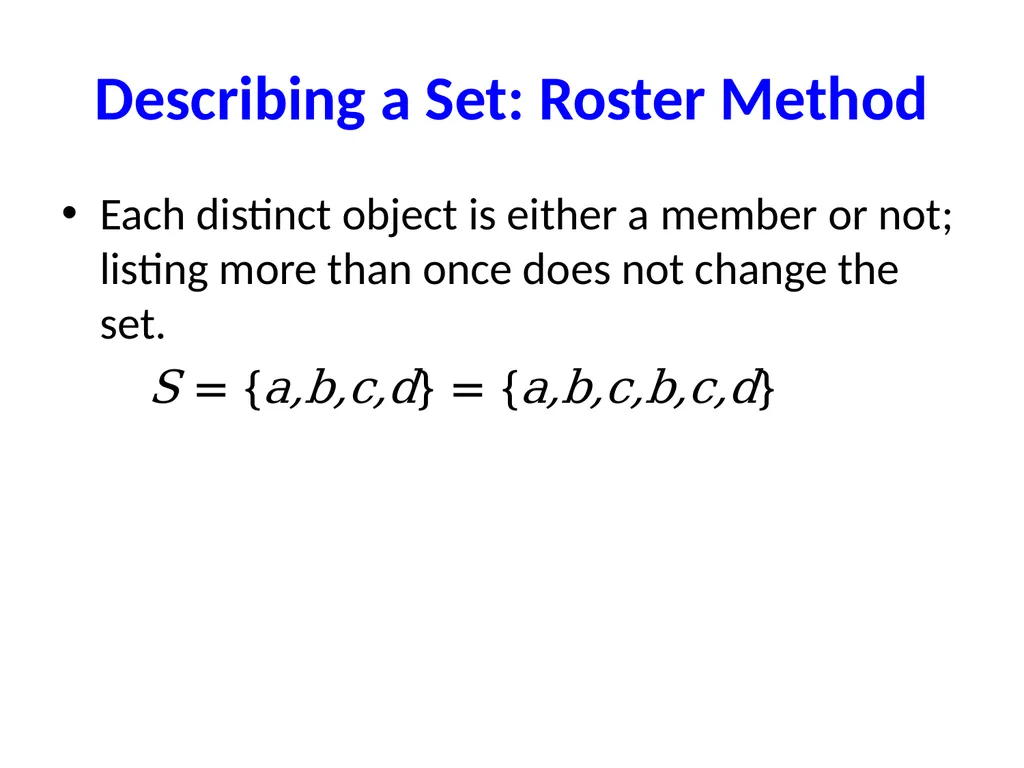
Describing a Set: Roster Method Each distinct object is either a member or not; listing more than once does not change the set.
S = {a,b,c,d} = {a,b,c,b,c,d}<br>
S = {a,b,c,d} = {a,b,c,b,c,d}<br>
08
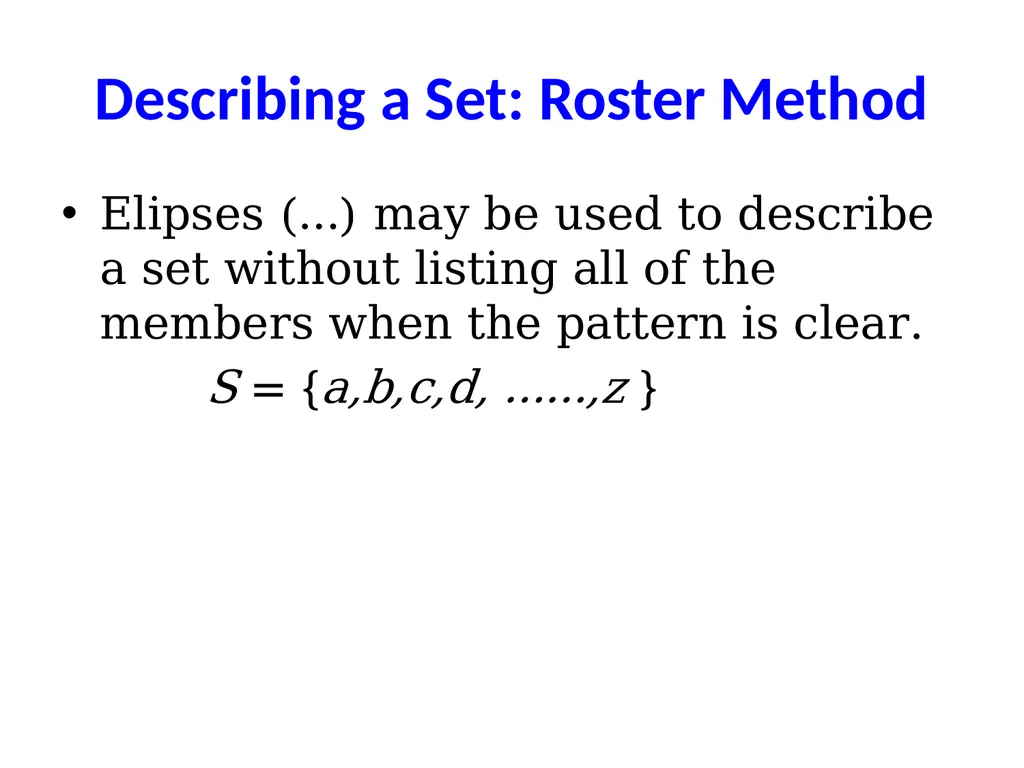
Describing a Set: Roster Method Elipses (…) may be used to describe a set without listing all of the members when the pattern is clear.
S = {a,b,c,d, ……,z }<br>
S = {a,b,c,d, ……,z }<br>
09
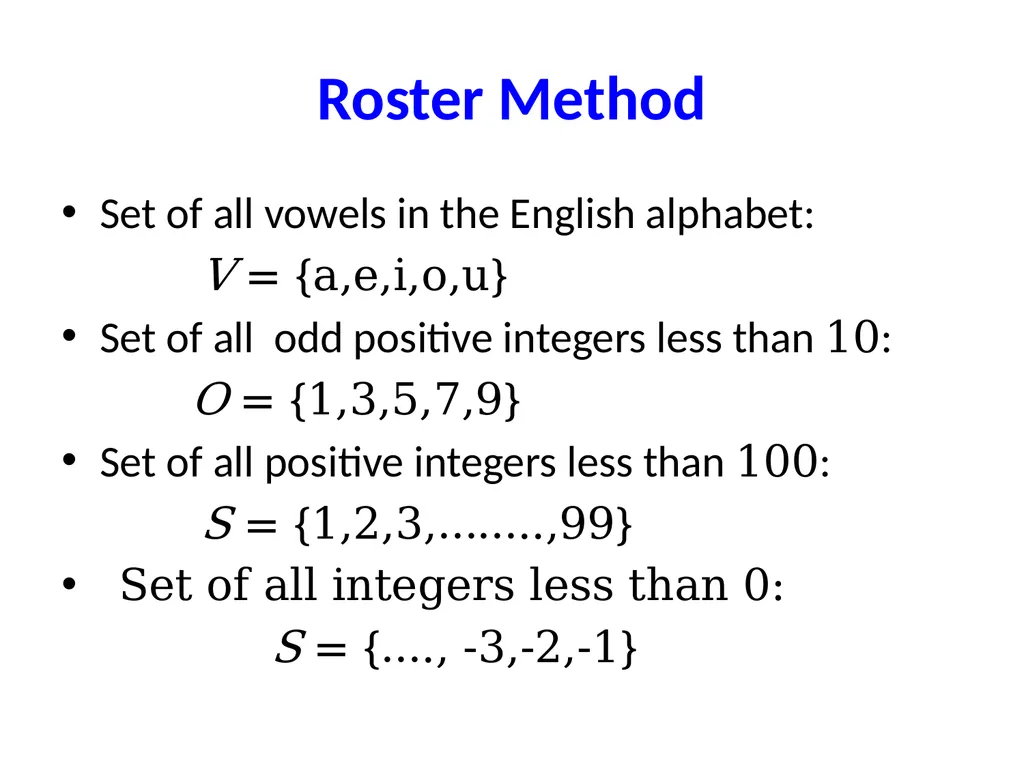
Roster Method Set of all vowels in the English alphabet:
V = {a,e,i,o,u}
Set of all odd positive integers less than 10:
O = {1,3,5,7,9}
Set of all positive integers less than 100:
S = {1,2,3,……..,99}
Set of all integers less than 0:
S = {…., -3,-2,-1}<br>
V = {a,e,i,o,u}
Set of all odd positive integers less than 10:
O = {1,3,5,7,9}
Set of all positive integers less than 100:
S = {1,2,3,……..,99}
Set of all integers less than 0:
S = {…., -3,-2,-1}<br>
10
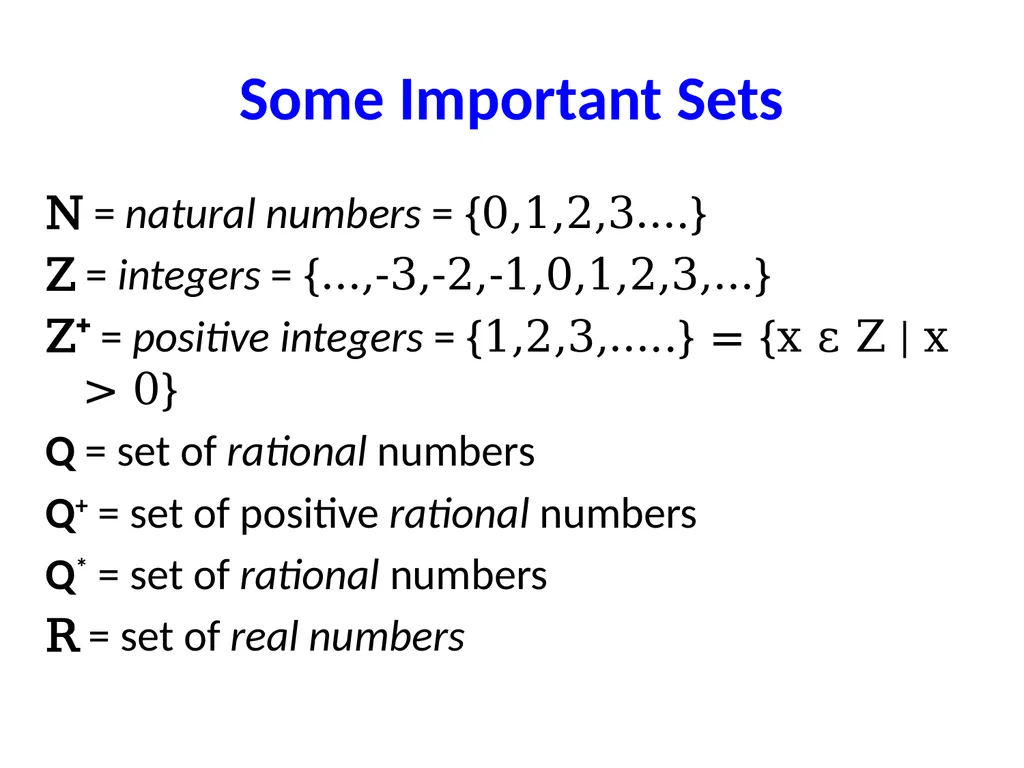
Some Important Sets N = natural numbers = {0,1,2,3….}
Z = integers = {…,-3,-2,-1,0,1,2,3,…}
Z⁺ = positive integers = {1,2,3,…..} = {x ε Z | x > 0}
Q = set of rational numbers
Q+ = set of positive rational numbers
Q* = set of rational numbers
R = set of real numbers<br>
Z = integers = {…,-3,-2,-1,0,1,2,3,…}
Z⁺ = positive integers = {1,2,3,…..} = {x ε Z | x > 0}
Q = set of rational numbers
Q+ = set of positive rational numbers
Q* = set of rational numbers
R = set of real numbers<br>
11
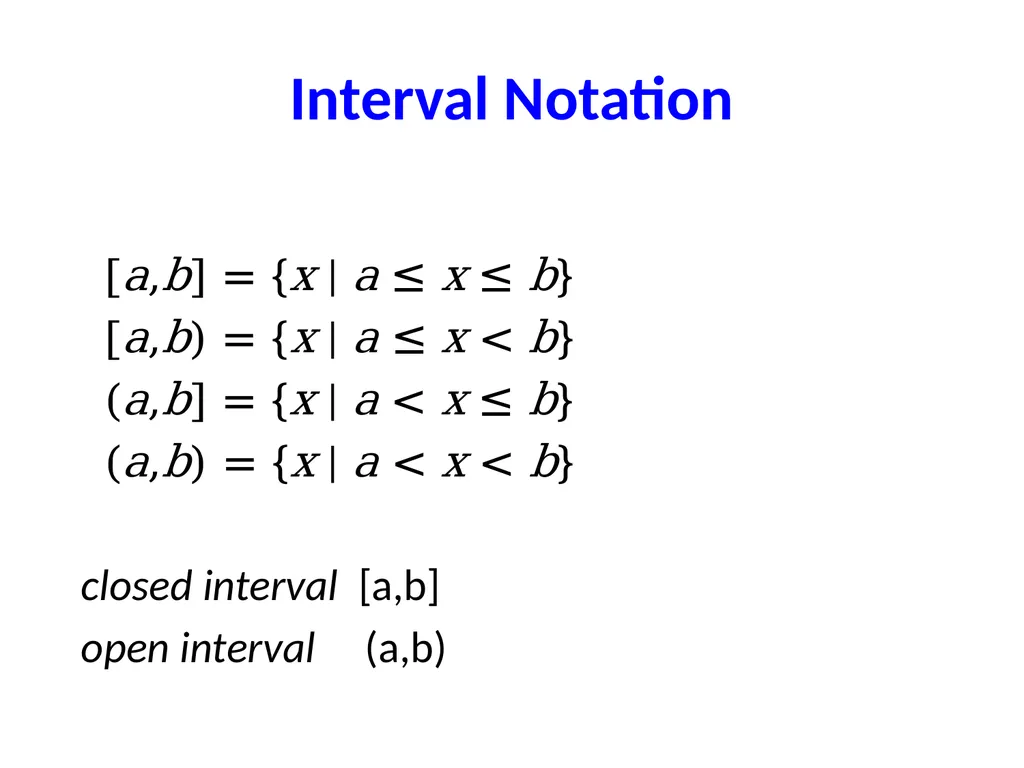
Interval Notation [a,b] = {x | a ≤ x ≤ b}
[a,b) = {x | a ≤ x < b}
(a,b] = {x | a < x ≤ b}
(a,b) = {x | a < x < b}
closed interval [a,b]
open interval (a,b)<br>
[a,b) = {x | a ≤ x < b}
(a,b] = {x | a < x ≤ b}
(a,b) = {x | a < x < b}
closed interval [a,b]
open interval (a,b)<br>
12
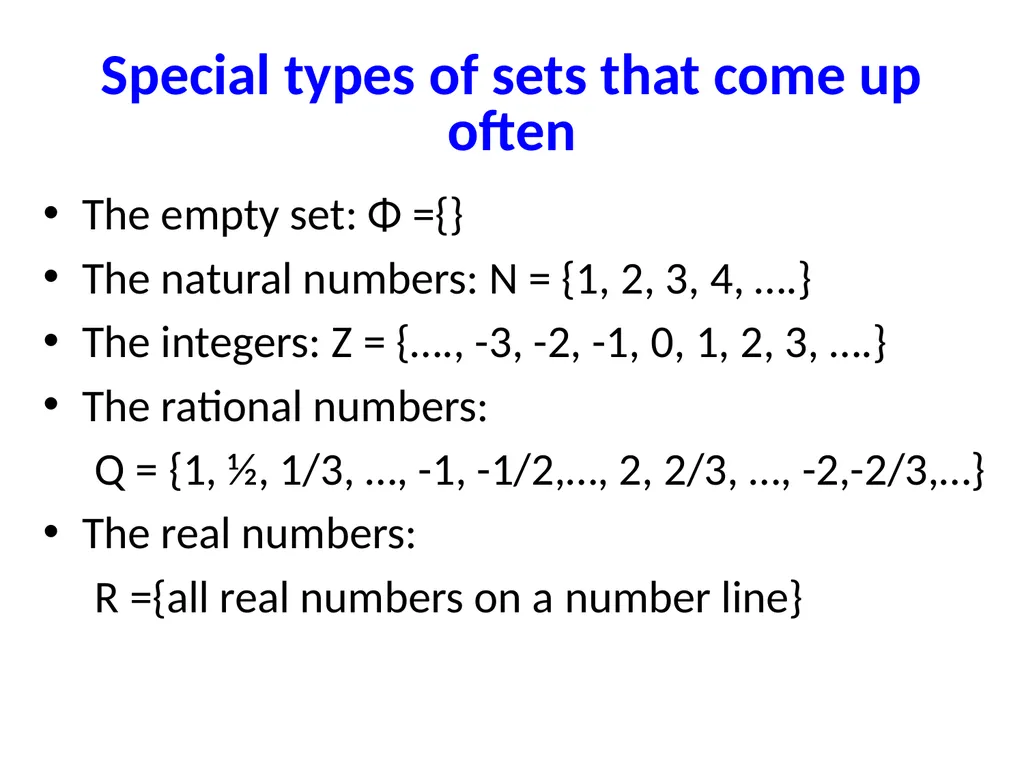
Special types of sets that come up often The empty set: Φ ={}
The natural numbers: N = {1, 2, 3, 4, ….}
The integers: Z = {…., -3, -2, -1, 0, 1, 2, 3, ….}
The rational numbers:
Q = {1, ½, 1/3, …, -1, -1/2,…, 2, 2/3, …, -2,-2/3,…}
The real numbers:
R ={all real numbers on a number line}<br>
The natural numbers: N = {1, 2, 3, 4, ….}
The integers: Z = {…., -3, -2, -1, 0, 1, 2, 3, ….}
The rational numbers:
Q = {1, ½, 1/3, …, -1, -1/2,…, 2, 2/3, …, -2,-2/3,…}
The real numbers:
R ={all real numbers on a number line}<br>
13
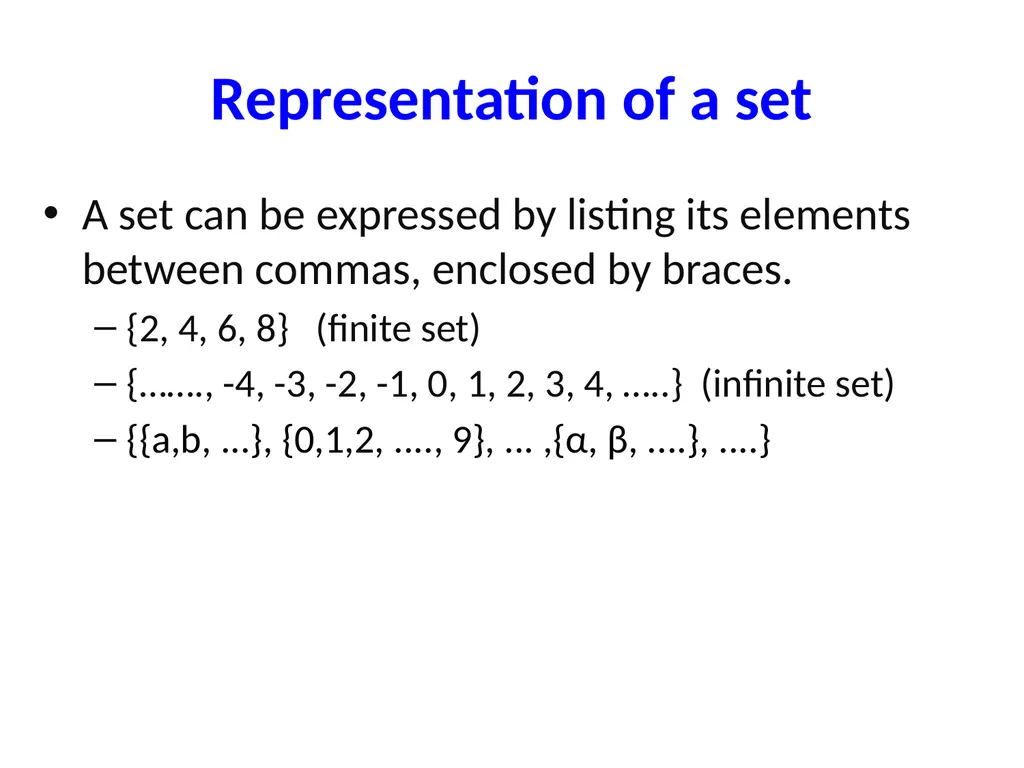
Representation of a set A set can be expressed by listing its elements between commas, enclosed by braces.
{2, 4, 6, 8} (finite set)
{……., -4, -3, -2, -1, 0, 1, 2, 3, 4, …..} (infinite set)
{{a,b, ...}, {0,1,2, ...., 9}, ... ,{α, β, ....}, ....}<br>
{2, 4, 6, 8} (finite set)
{……., -4, -3, -2, -1, 0, 1, 2, 3, 4, …..} (infinite set)
{{a,b, ...}, {0,1,2, ...., 9}, ... ,{α, β, ....}, ....}<br>
14
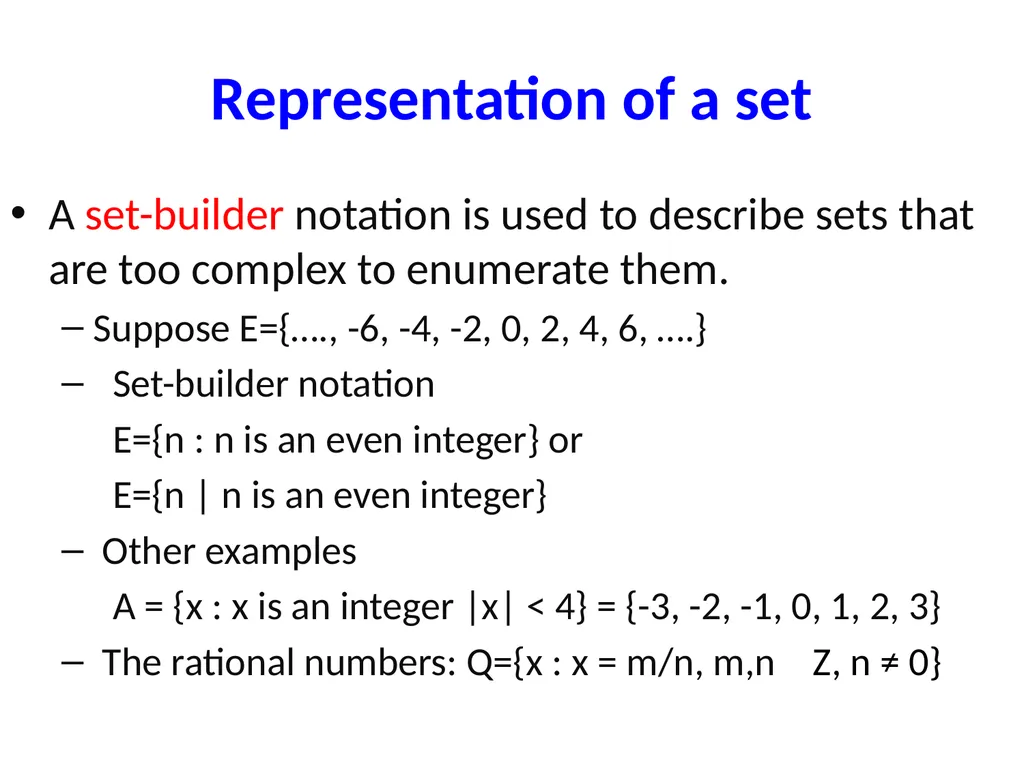
Representation of a set A set-builder notation is used to describe sets that are too complex to enumerate them.
Suppose E={…., -6, -4, -2, 0, 2, 4, 6, ….}
Set-builder notation
E={n : n is an even integer} or
E={n | n is an even integer}
Other examples
A = {x : x is an integer |x| < 4} = {-3, -2, -1, 0, 1, 2, 3}
The rational numbers: Q={x : x = m/n, m,n Z, n ≠ 0}<br>
Suppose E={…., -6, -4, -2, 0, 2, 4, 6, ….}
Set-builder notation
E={n : n is an even integer} or
E={n | n is an even integer}
Other examples
A = {x : x is an integer |x| < 4} = {-3, -2, -1, 0, 1, 2, 3}
The rational numbers: Q={x : x = m/n, m,n Z, n ≠ 0}<br>
15
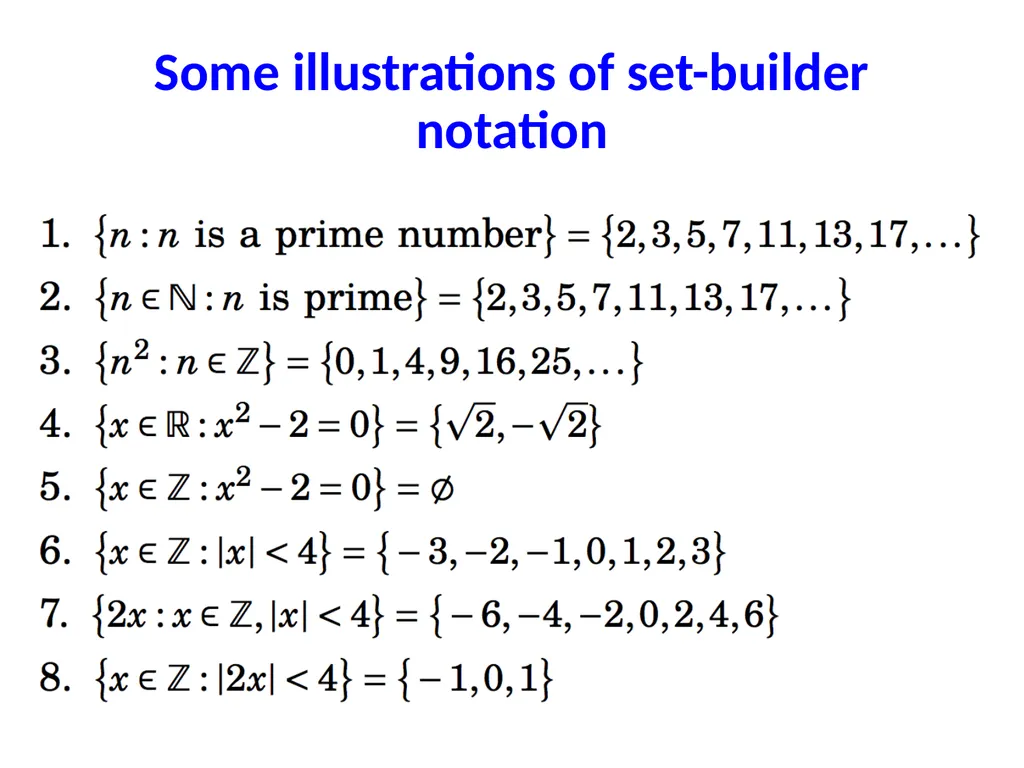
Some illustrations of set-builder notation<br>
16
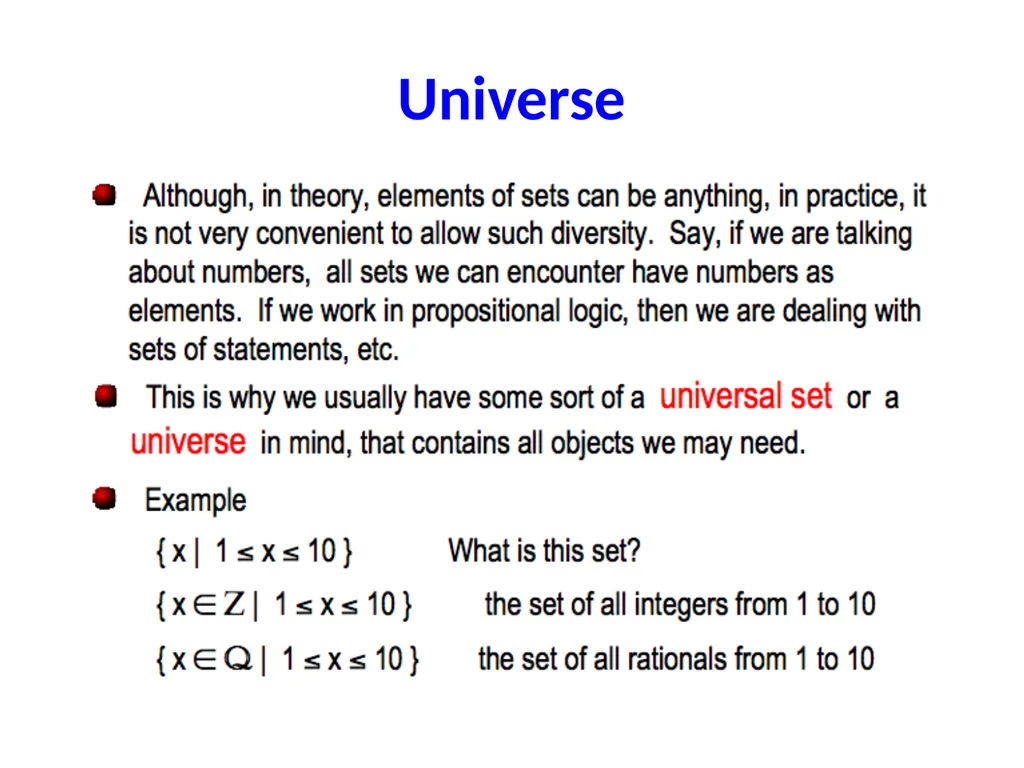
Universe<br>
17
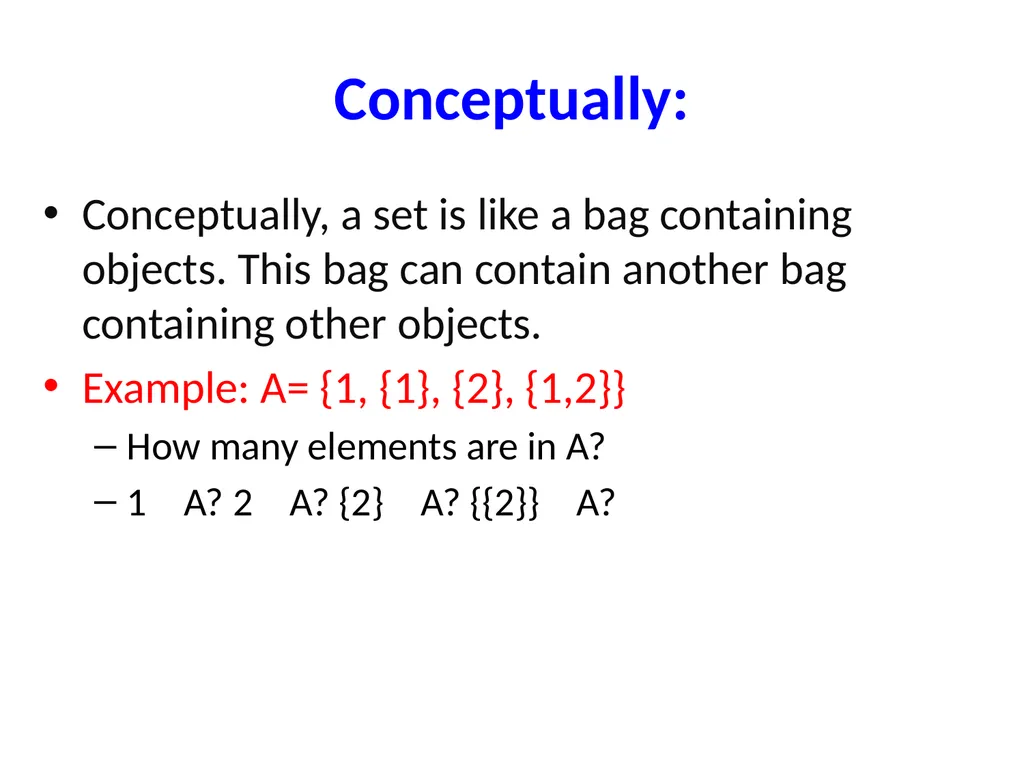
Conceptually: Conceptually, a set is like a bag containing objects. This bag can contain another bag containing other objects.
Example: A= {1, {1}, {2}, {1,2}}
How many elements are in A?
1 A? 2 A? {2} A? {{2}} A?<br>
Example: A= {1, {1}, {2}, {1,2}}
How many elements are in A?
1 A? 2 A? {2} A? {{2}} A?<br>
18
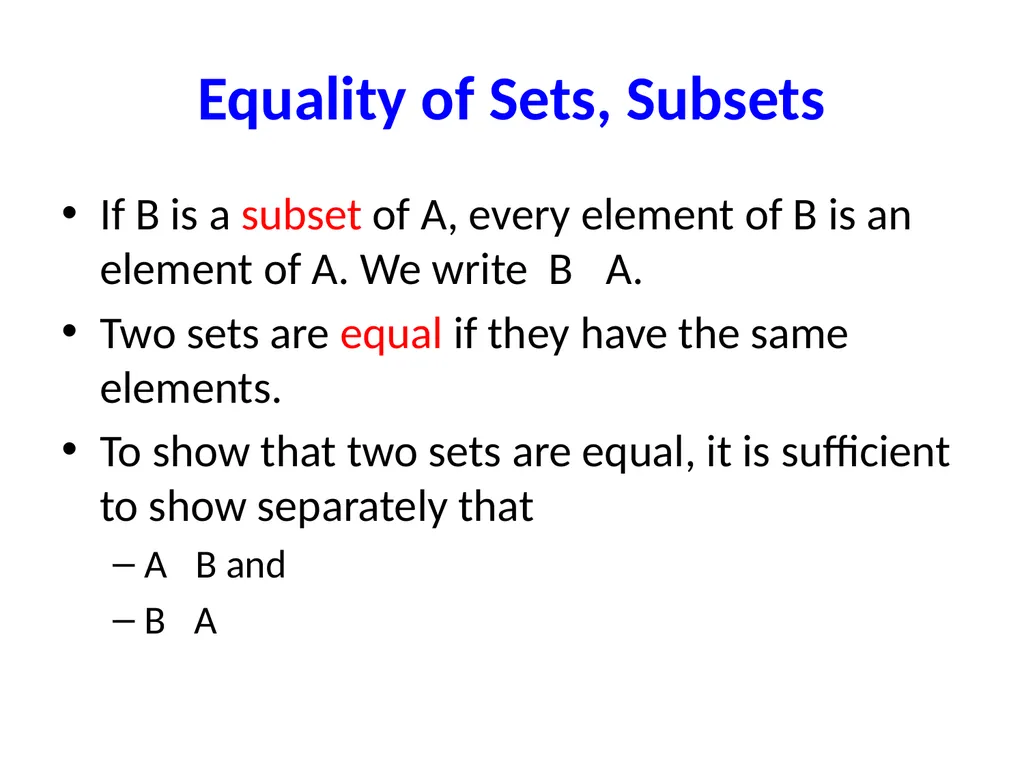
Equality of Sets, Subsets If B is a subset of A, every element of B is an element of A. We write B A.
Two sets are equal if they have the same elements.
To show that two sets are equal, it is sufficient to show separately that
A B and
B A<br>
Two sets are equal if they have the same elements.
To show that two sets are equal, it is sufficient to show separately that
A B and
B A<br>
19
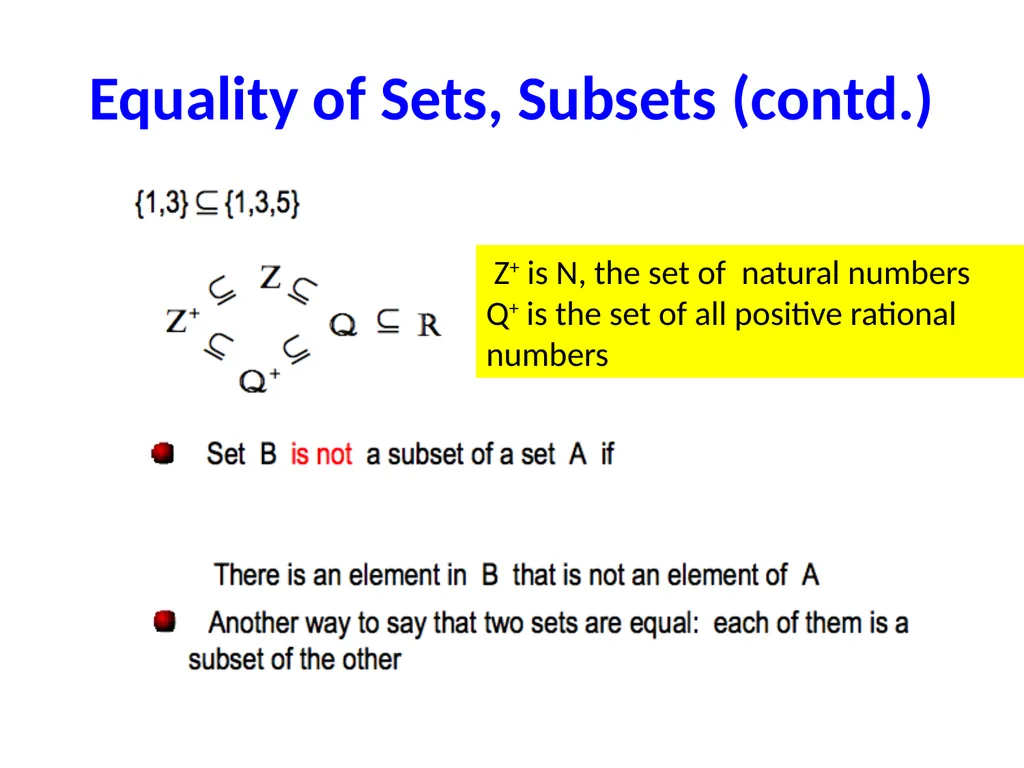
Equality of Sets, Subsets (contd.) Z+ is N, the set of natural numbers
Q+ is the set of all positive rational numbers<br>
Q+ is the set of all positive rational numbers<br>
20
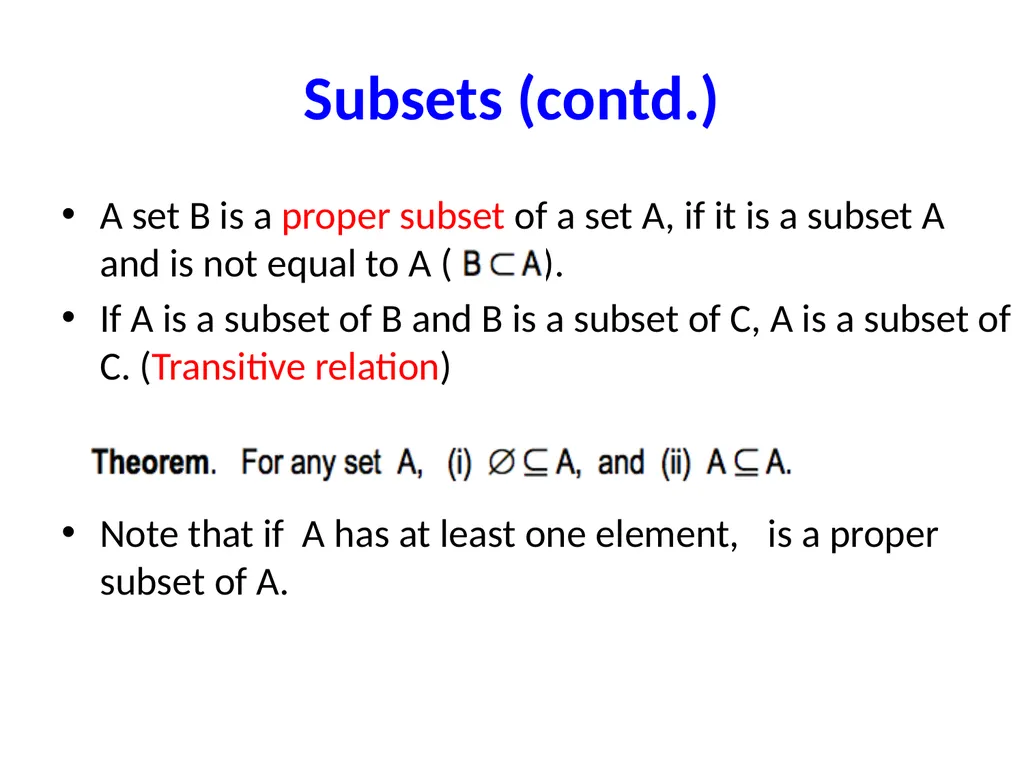
Subsets (contd.) A set B is a proper subset of a set A, if it is a subset A and is not equal to A ( ).
If A is a subset of B and B is a subset of C, A is a subset of C. (Transitive relation)
Note that if A has at least one element, is a proper subset of A.<br>
If A is a subset of B and B is a subset of C, A is a subset of C. (Transitive relation)
Note that if A has at least one element, is a proper subset of A.<br>
21
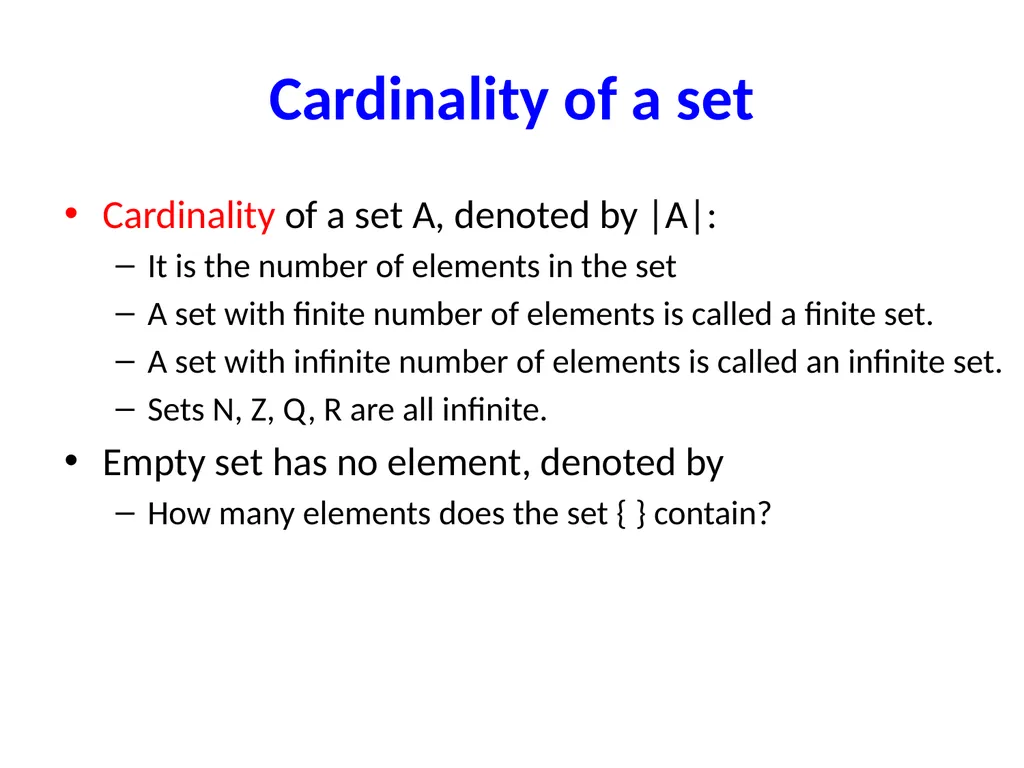
Cardinality of a set Cardinality of a set A, denoted by |A|:
It is the number of elements in the set
A set with finite number of elements is called a finite set.
A set with infinite number of elements is called an infinite set.
Sets N, Z, Q, R are all infinite.
Empty set has no element, denoted by
How many elements does the set {} contain?<br>
It is the number of elements in the set
A set with finite number of elements is called a finite set.
A set with infinite number of elements is called an infinite set.
Sets N, Z, Q, R are all infinite.
Empty set has no element, denoted by
How many elements does the set {} contain?<br>
22
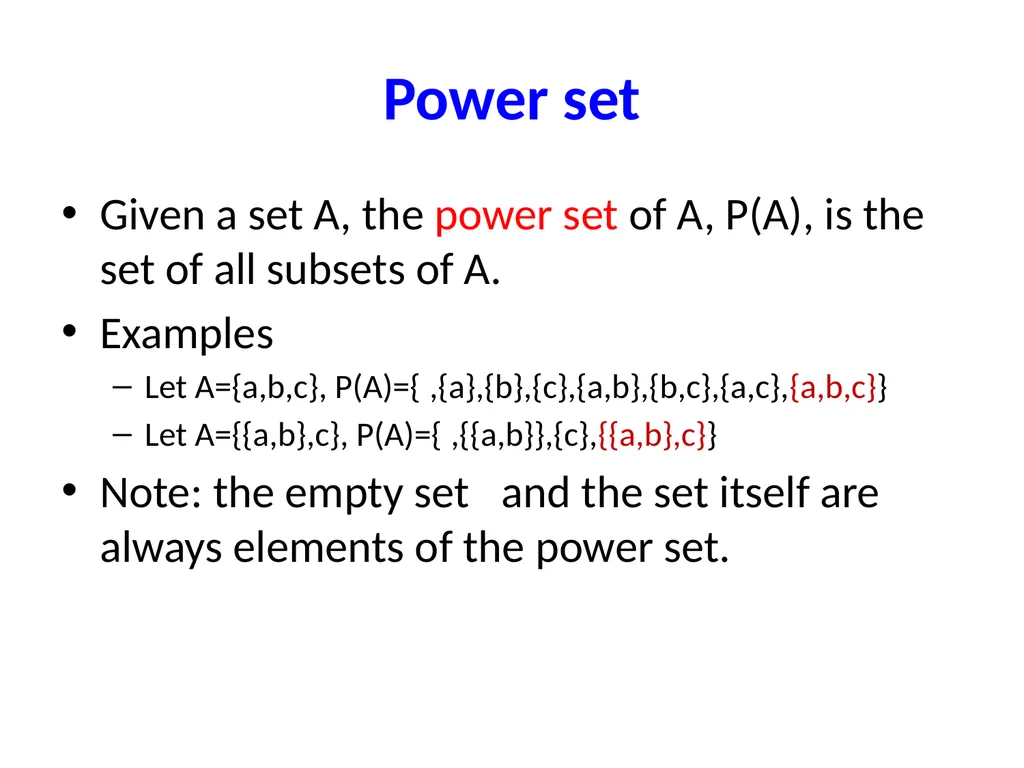
Power set Given a set A, the power set of A, P(A), is the set of all subsets of A.
Examples
Let A={a,b,c}, P(A)={,{a},{b},{c},{a,b},{b,c},{a,c},{a,b,c}}
Let A={{a,b},c}, P(A)={,{{a,b}},{c},{{a,b},c}}
Note: the empty set and the set itself are always elements of the power set.<br>
Examples
Let A={a,b,c}, P(A)={,{a},{b},{c},{a,b},{b,c},{a,c},{a,b,c}}
Let A={{a,b},c}, P(A)={,{{a,b}},{c},{{a,b},c}}
Note: the empty set and the set itself are always elements of the power set.<br>
23
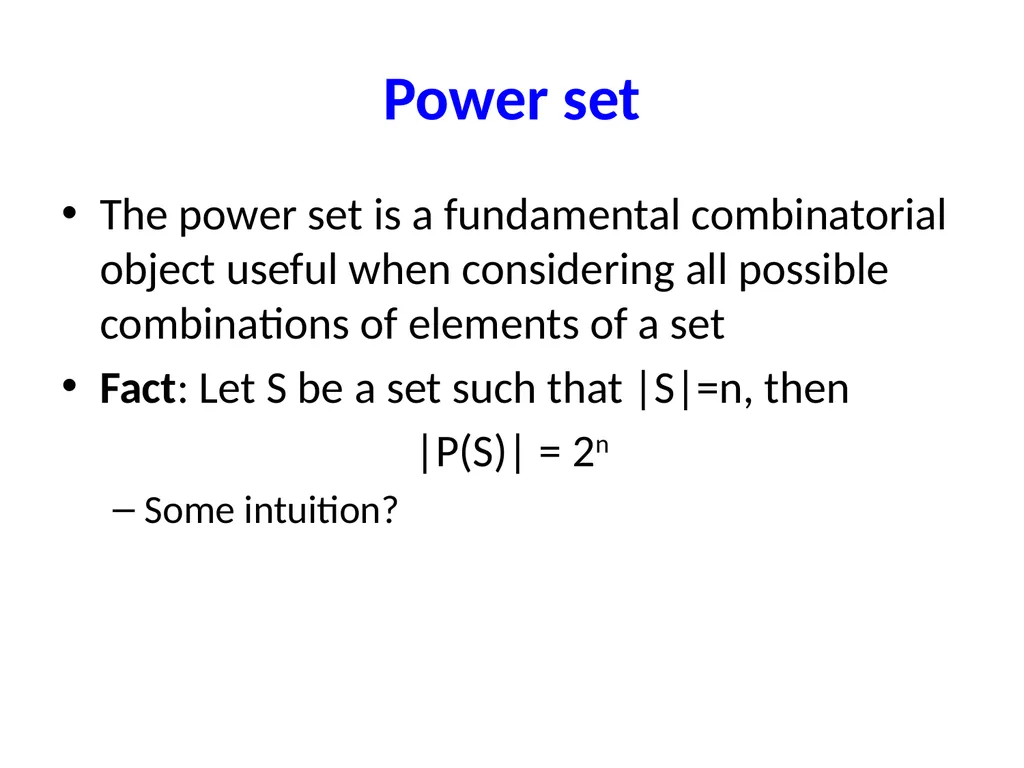
Power set The power set is a fundamental combinatorial object useful when considering all possible combinations of elements of a set
Fact: Let S be a set such that |S|=n, then
|P(S)| = 2n
Some intuition?<br>
Fact: Let S be a set such that |S|=n, then
|P(S)| = 2n
Some intuition?<br>
24
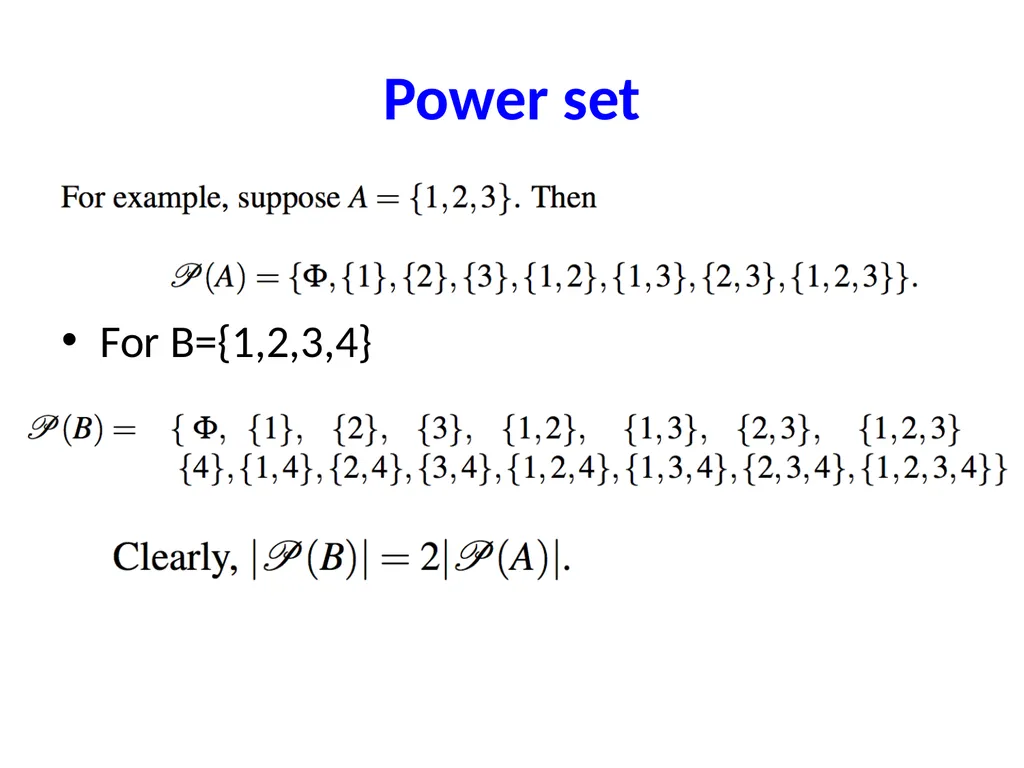
Power set For B={1,2,3,4}<br>
25
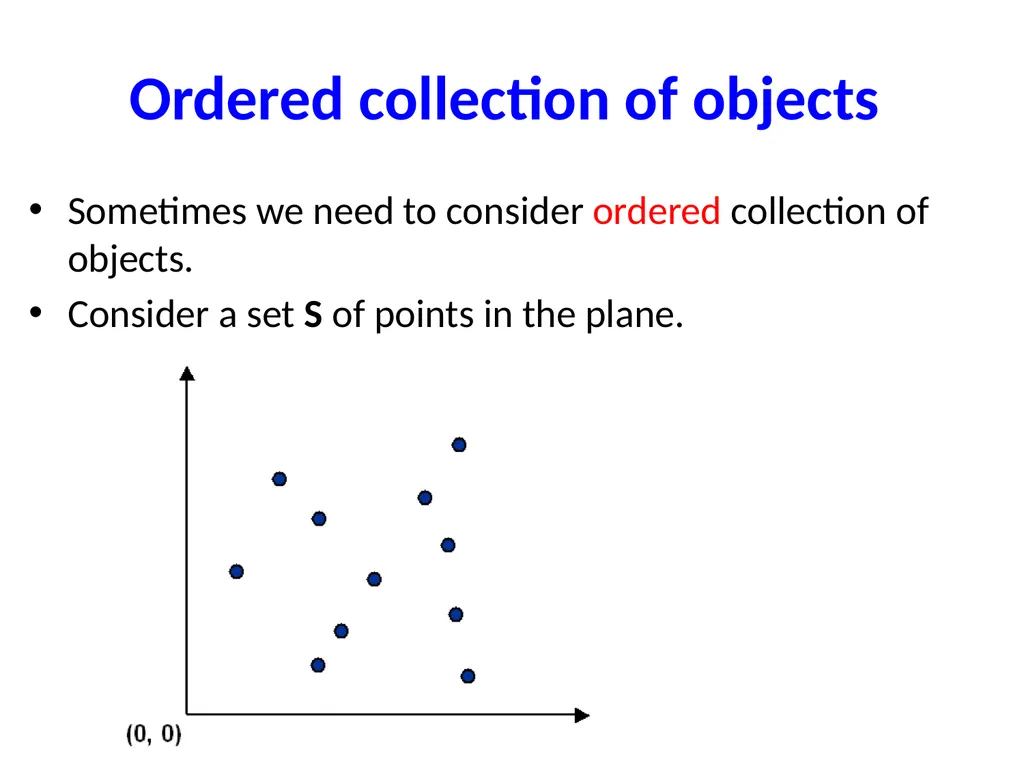
Ordered collection of objects Sometimes we need to consider ordered collection of objects.
Consider a set S of points in the plane.<br>
Consider a set S of points in the plane.<br>
26
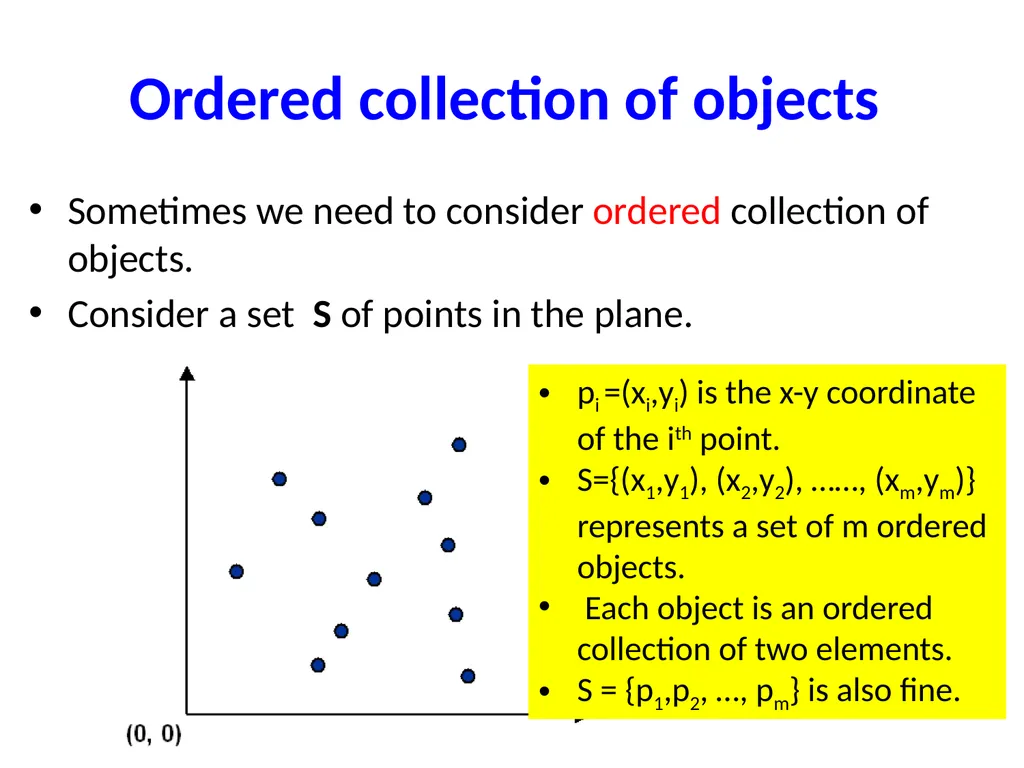
Ordered collection of objects Sometimes we need to consider ordered collection of objects.
Consider a set S of points in the plane. pi =(xi,yi) is the x-y coordinate of the ith point.
S={(x1,y1), (x2,y2), ……, (xm,ym)} represents a set of m ordered objects.
Each object is an ordered collection of two elements.
S = {p1,p2, …, pm} is also fine.<br>
Consider a set S of points in the plane. pi =(xi,yi) is the x-y coordinate of the ith point.
S={(x1,y1), (x2,y2), ……, (xm,ym)} represents a set of m ordered objects.
Each object is an ordered collection of two elements.
S = {p1,p2, …, pm} is also fine.<br>
27
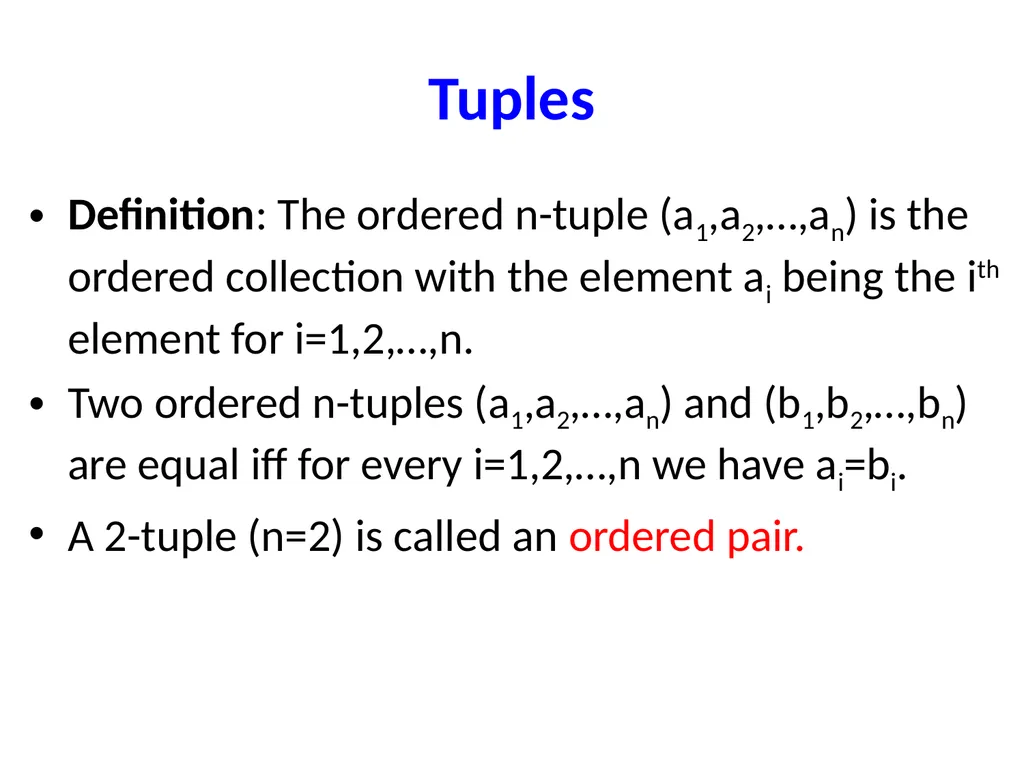
Tuples Definition: The ordered n-tuple (a1,a2,…,an) is the ordered collection with the element ai being the ith element for i=1,2,…,n.
Two ordered n-tuples (a1,a2,…,an) and (b1,b2,…,bn) are equal iff for every i=1,2,…,n we have ai=bi.
A 2-tuple (n=2) is called an ordered pair.<br>
Two ordered n-tuples (a1,a2,…,an) and (b1,b2,…,bn) are equal iff for every i=1,2,…,n we have ai=bi.
A 2-tuple (n=2) is called an ordered pair.<br>
28
Section Summary Set Operations
Union
Intersection
Complementation
Difference<br>
Union
Intersection
Complementation
Difference<br>
29
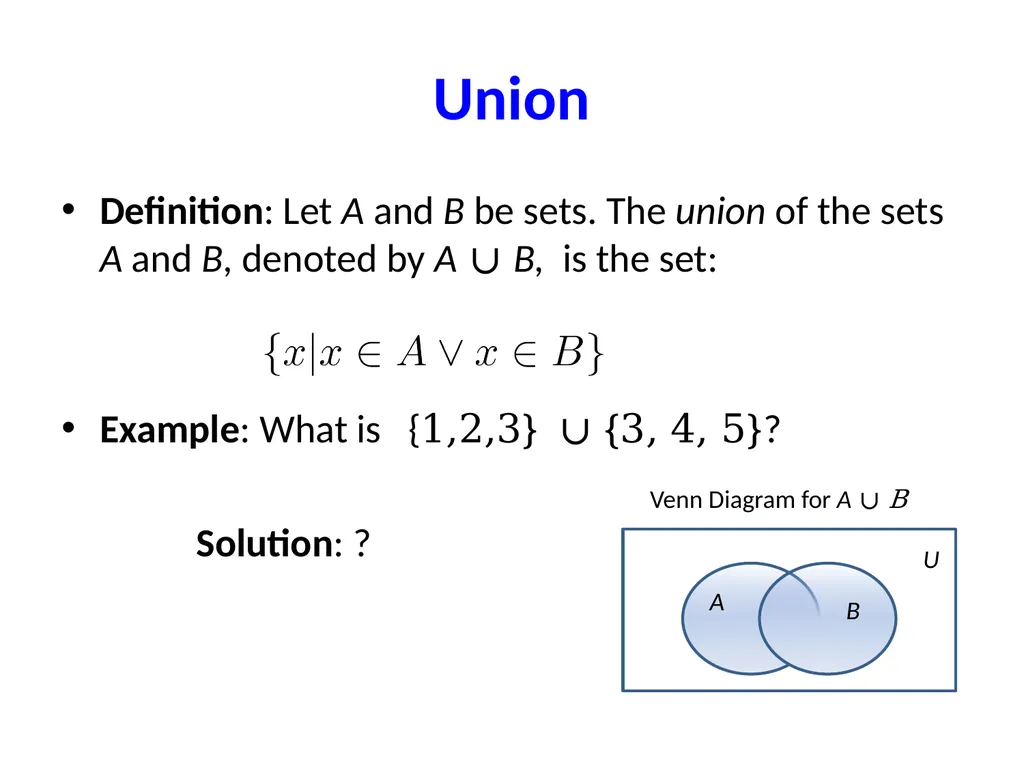
Union Definition: Let A and B be sets. The union of the sets A and B, denoted by A ∪ B, is the set:
Example: What is {1,2,3} ∪ {3, 4, 5}?
Solution: ? Venn Diagram for A ∪ B<br>
Example: What is {1,2,3} ∪ {3, 4, 5}?
Solution: ? Venn Diagram for A ∪ B<br>
30
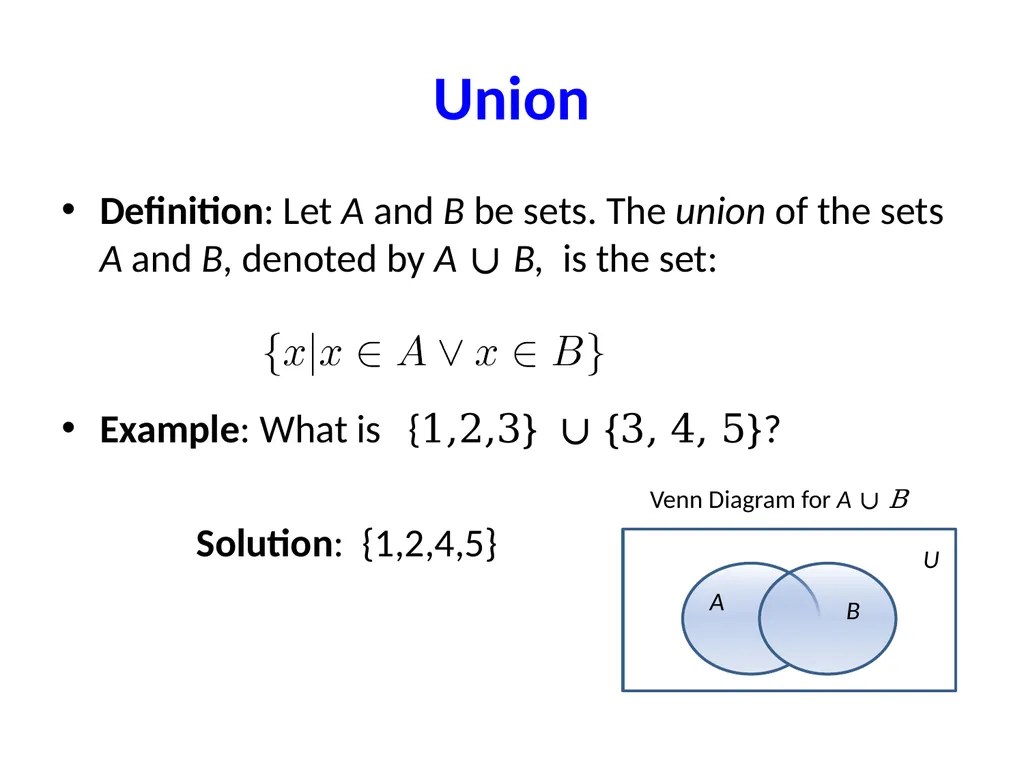
Union Definition: Let A and B be sets. The union of the sets A and B, denoted by A ∪ B, is the set:
Example: What is {1,2,3} ∪ {3, 4, 5}?
Solution: {1,2,4,5} Venn Diagram for A ∪ B<br>
Example: What is {1,2,3} ∪ {3, 4, 5}?
Solution: {1,2,4,5} Venn Diagram for A ∪ B<br>
31
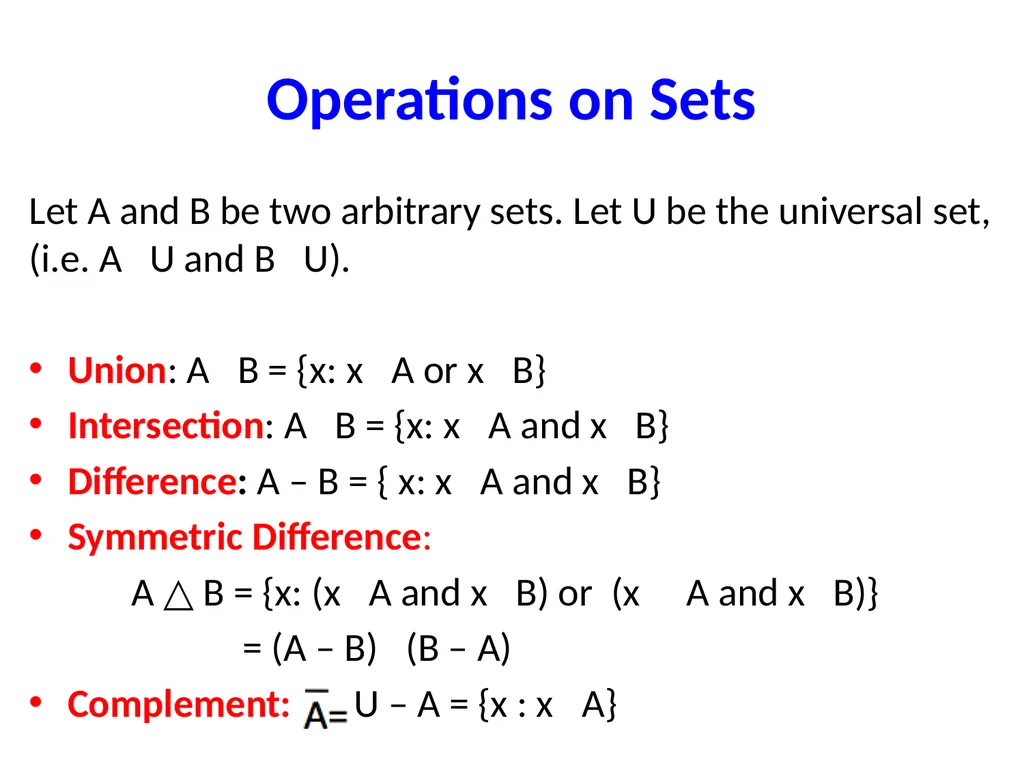
Operations on Sets Let A and B be two arbitrary sets. Let U be the universal set, (i.e. A U and B U).
Union: A B = {x: x A or x B}
Intersection: A B = {x: x A and x B}
Difference: A – B = { x: x A and x B}
Symmetric Difference:
A △ B = {x: (x A and x B) or (x A and x B)}
= (A – B) (B – A)
Complement: U – A = {x : x A}<br>
Union: A B = {x: x A or x B}
Intersection: A B = {x: x A and x B}
Difference: A – B = { x: x A and x B}
Symmetric Difference:
A △ B = {x: (x A and x B) or (x A and x B)}
= (A – B) (B – A)
Complement: U – A = {x : x A}<br>
32
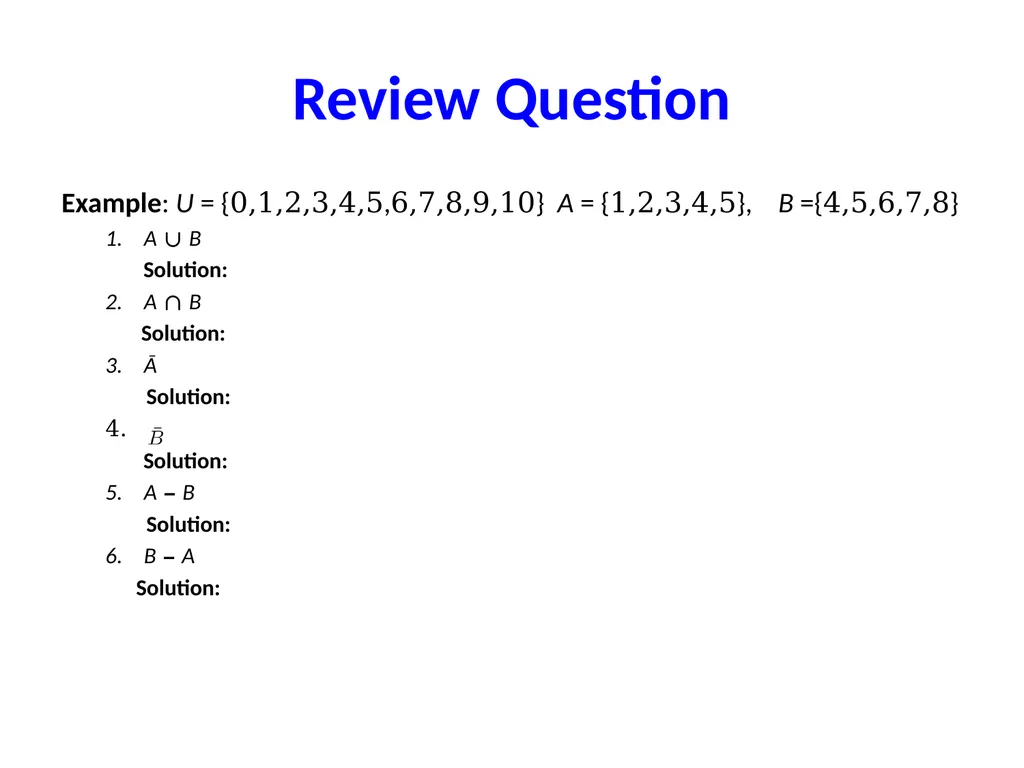
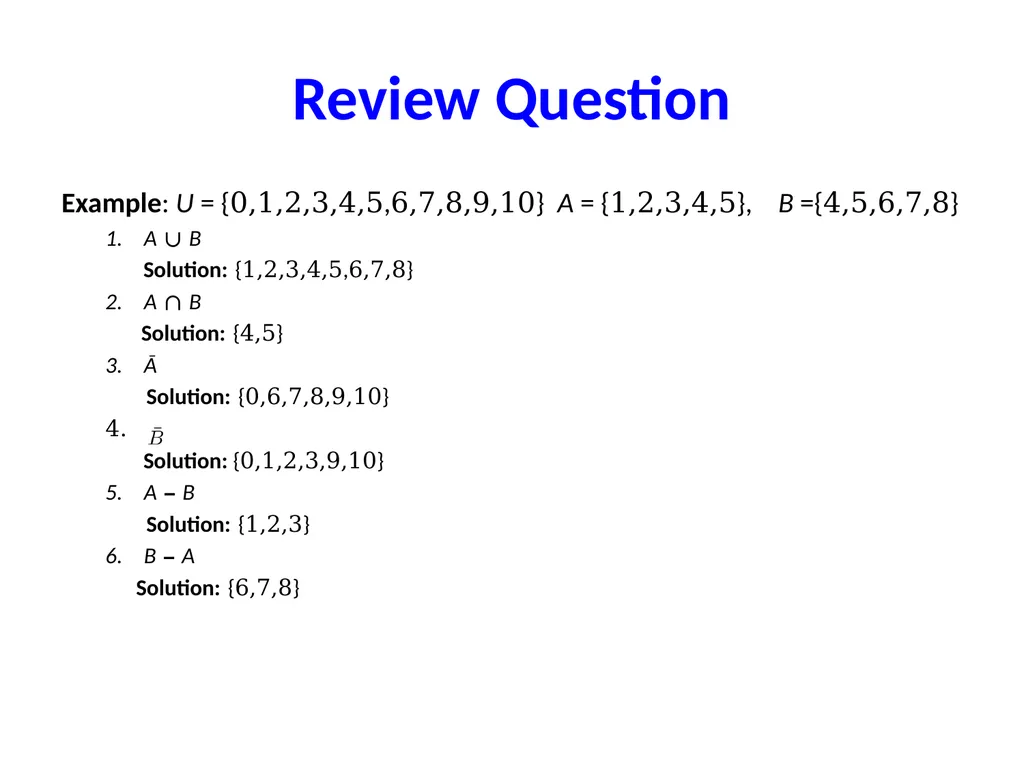
Review Question Example: U = {0,1,2,3,4,5,6,7,8,9,10} A = {1,2,3,4,5}, B ={4,5,6,7,8}
A ∪ B
Solution:
A ∩ B
Solution:
Ā
Solution:
Solution:
A – B
Solution:
B – A
Solution:<br>
A ∪ B
Solution:
A ∩ B
Solution:
Ā
Solution:
Solution:
A – B
Solution:
B – A
Solution:<br>
33
Review Question Example: U = {0,1,2,3,4,5,6,7,8,9,10} A = {1,2,3,4,5}, B ={4,5,6,7,8}
A ∪ B
Solution: {1,2,3,4,5,6,7,8}
A ∩ B
Solution: {4,5}
Ā
Solution: {0,6,7,8,9,10}
Solution: {0,1,2,3,9,10}
A – B
Solution: {1,2,3}
B – A
Solution: {6,7,8}<br>
A ∪ B
Solution: {1,2,3,4,5,6,7,8}
A ∩ B
Solution: {4,5}
Ā
Solution: {0,6,7,8,9,10}
Solution: {0,1,2,3,9,10}
A – B
Solution: {1,2,3}
B – A
Solution: {6,7,8}<br>
34
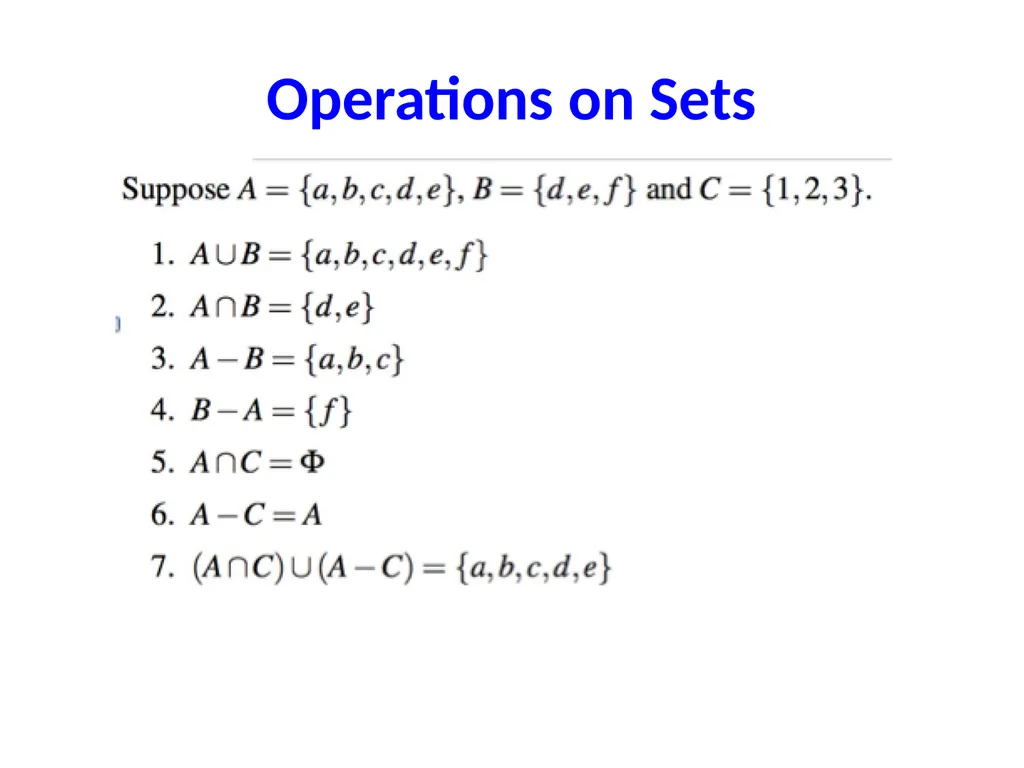
Operations on Sets<br>
35
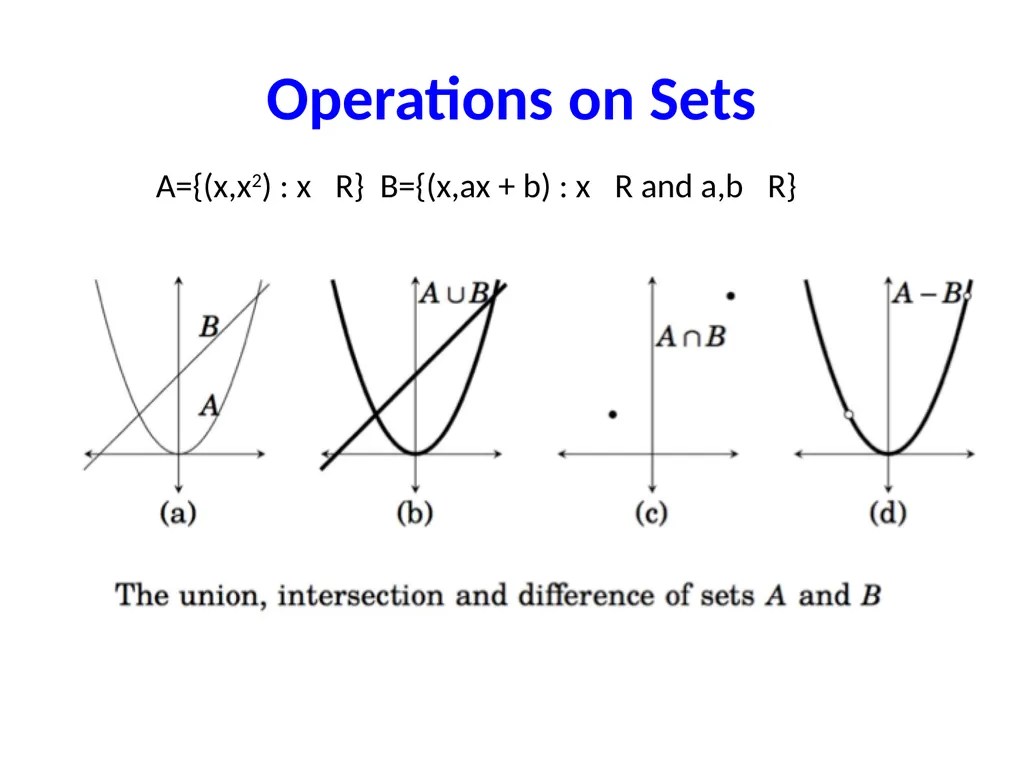
Operations on Sets A={(x,x2) : x R} B={(x,ax + b) : x R and a,b R}<br>
36
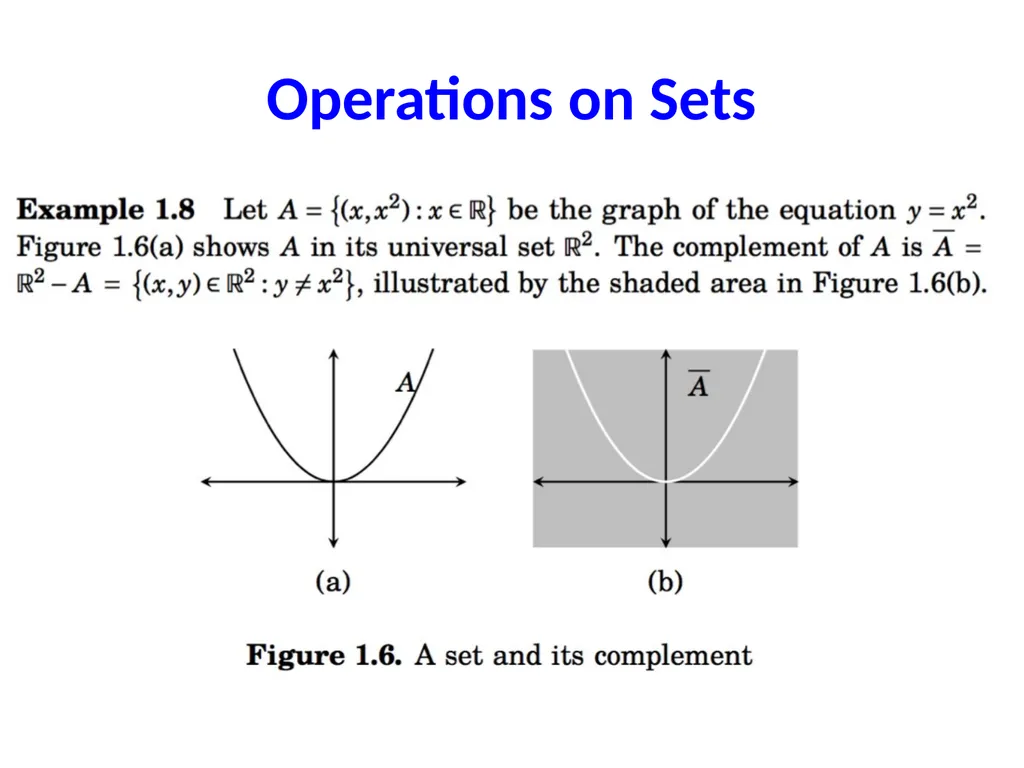
Operations on Sets<br>
37
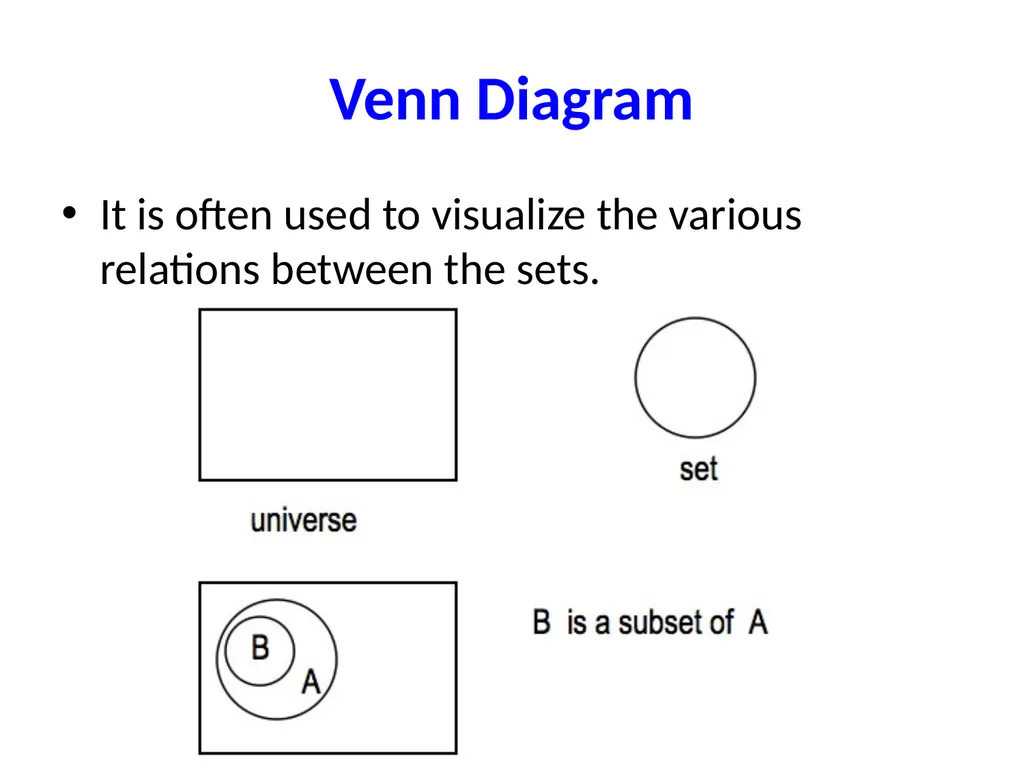
Venn Diagram It is often used to visualize the various relations between the sets.<br>
38
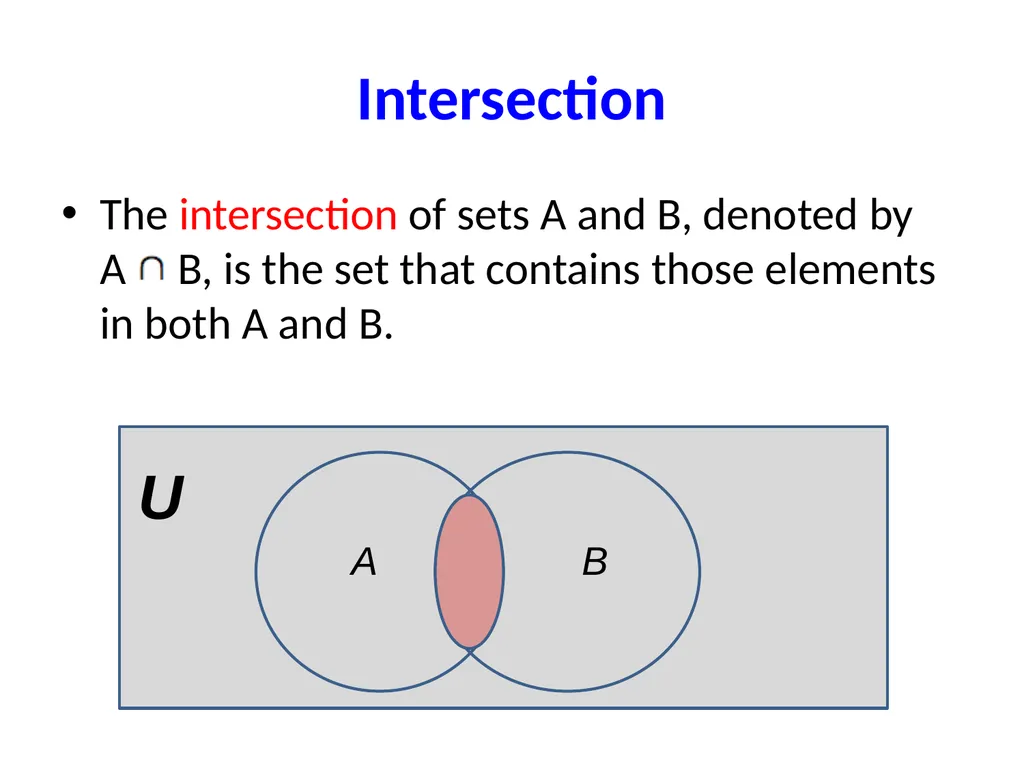
Intersection The intersection of sets A and B, denoted by A B, is the set that contains those elements in both A and B. U A B<br>
39
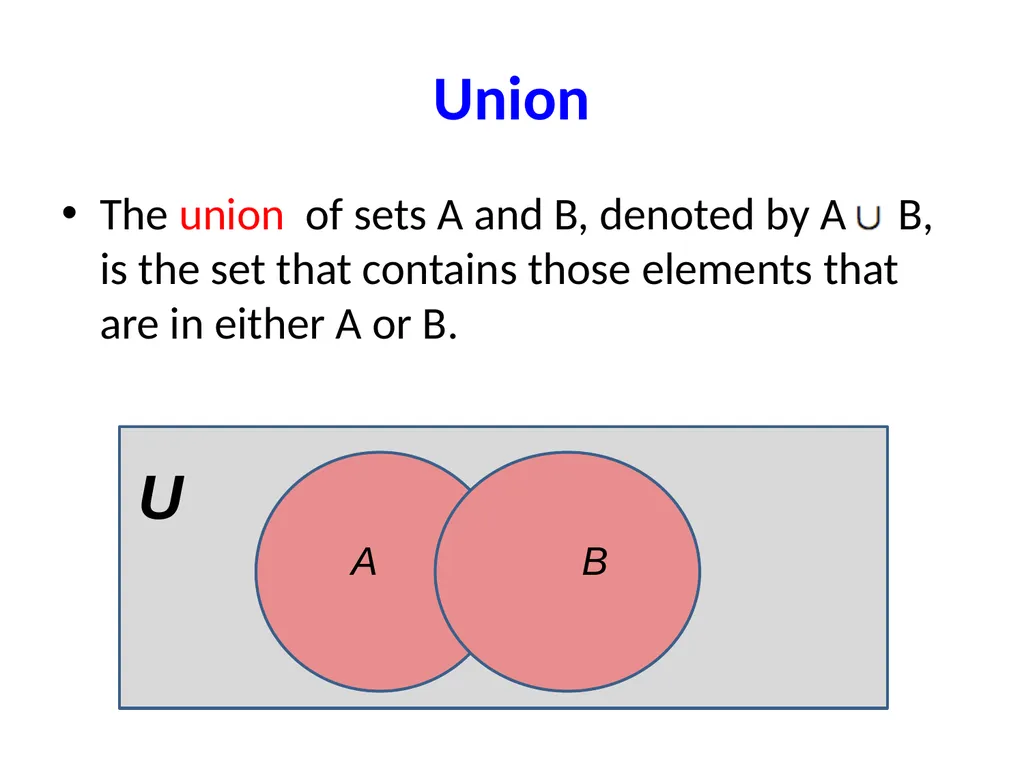
Union The union of sets A and B, denoted by A B, is the set that contains those elements that are in either A or B. U A B<br>
40
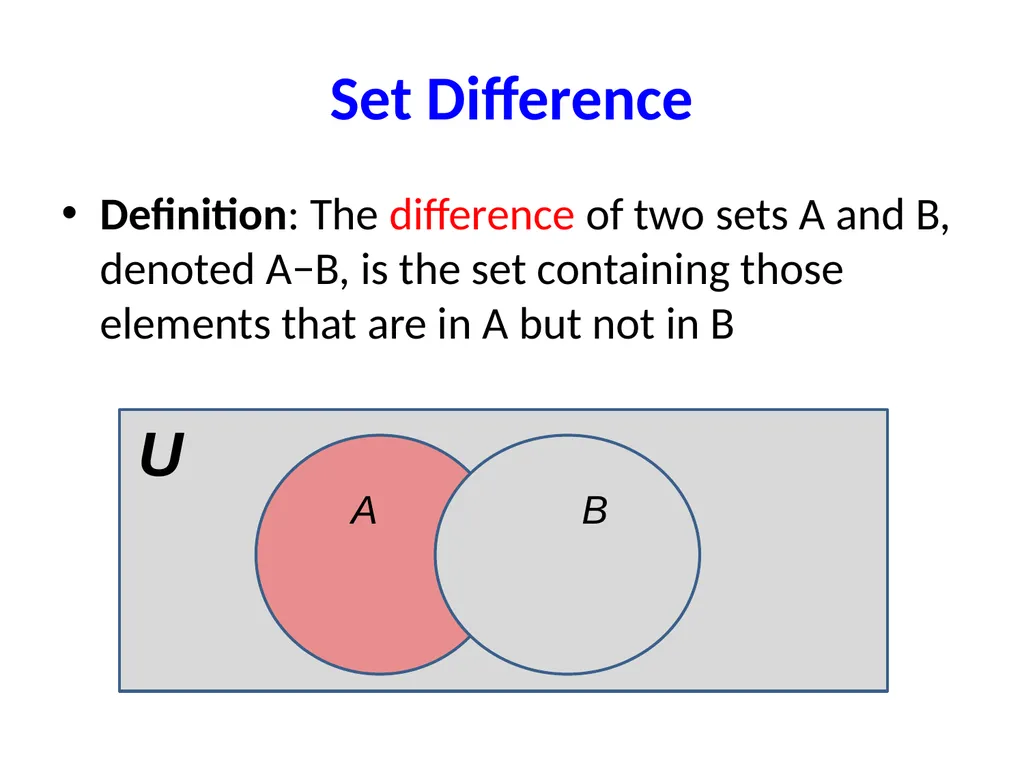
Set Difference Definition: The difference of two sets A and B, denoted A−B, is the set containing those elements that are in A but not in B U A B<br>
41
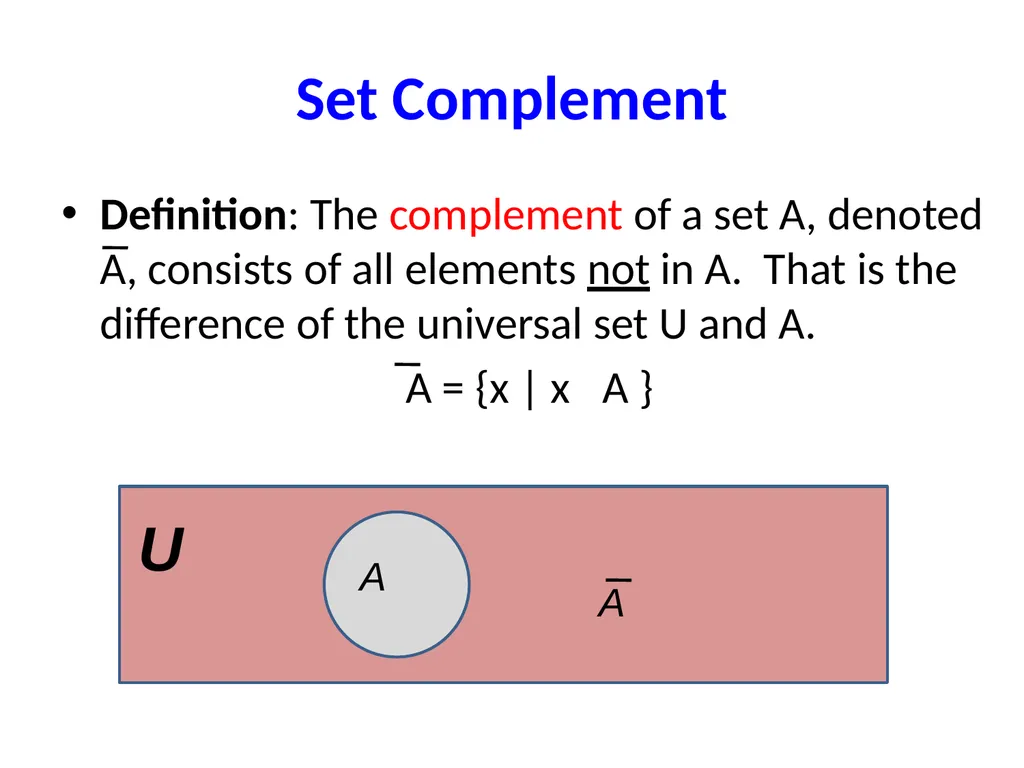
Set Complement Definition: The complement of a set A, denoted A, consists of all elements not in A. That is the difference of the universal set U and A.
A = {x | x A } U A A<br>
A = {x | x A } U A A<br>
42
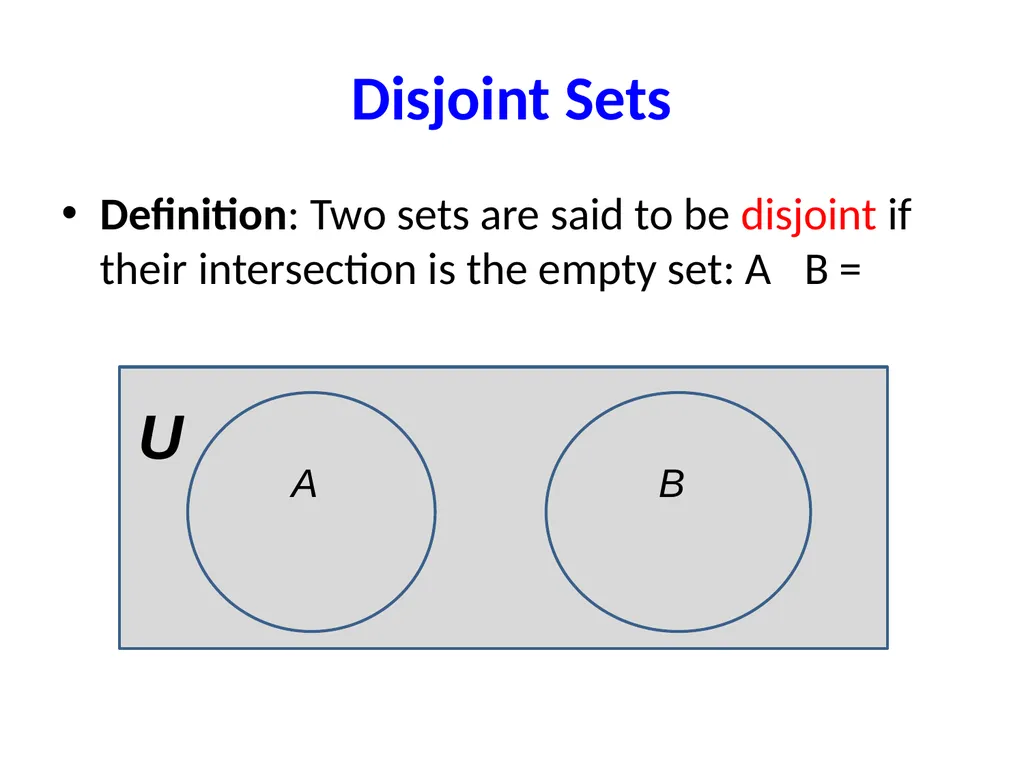
Disjoint Sets Definition: Two sets are said to be disjoint if their intersection is the empty set: A B = U A B<br>
43
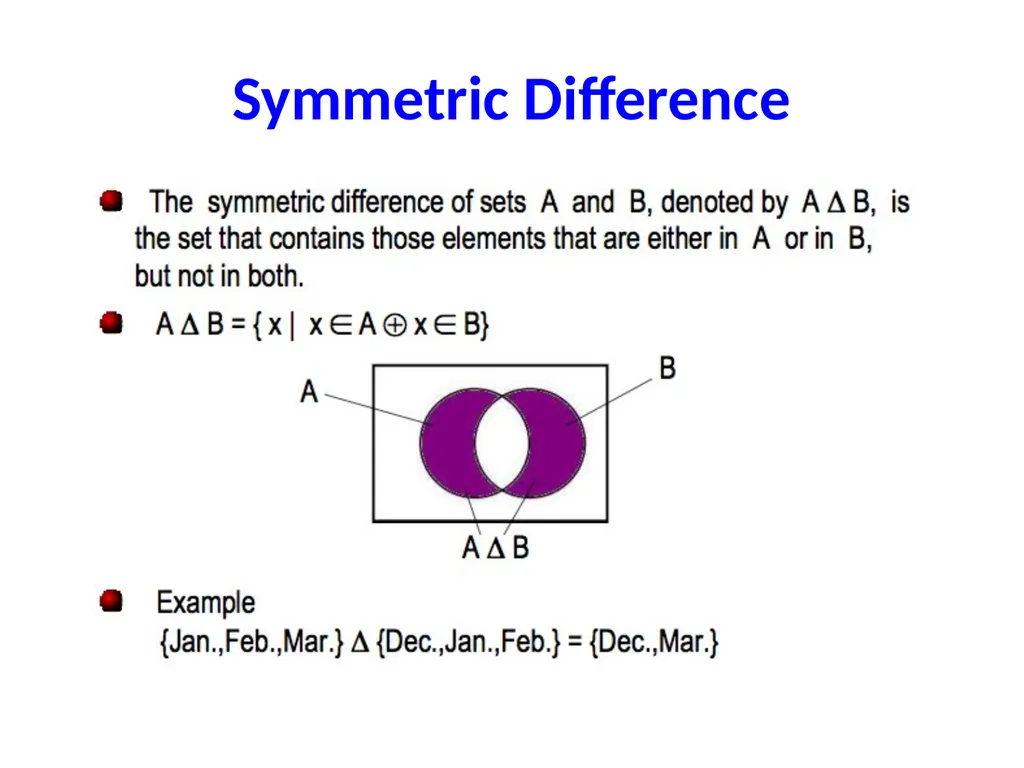
Symmetric Difference<br>
44
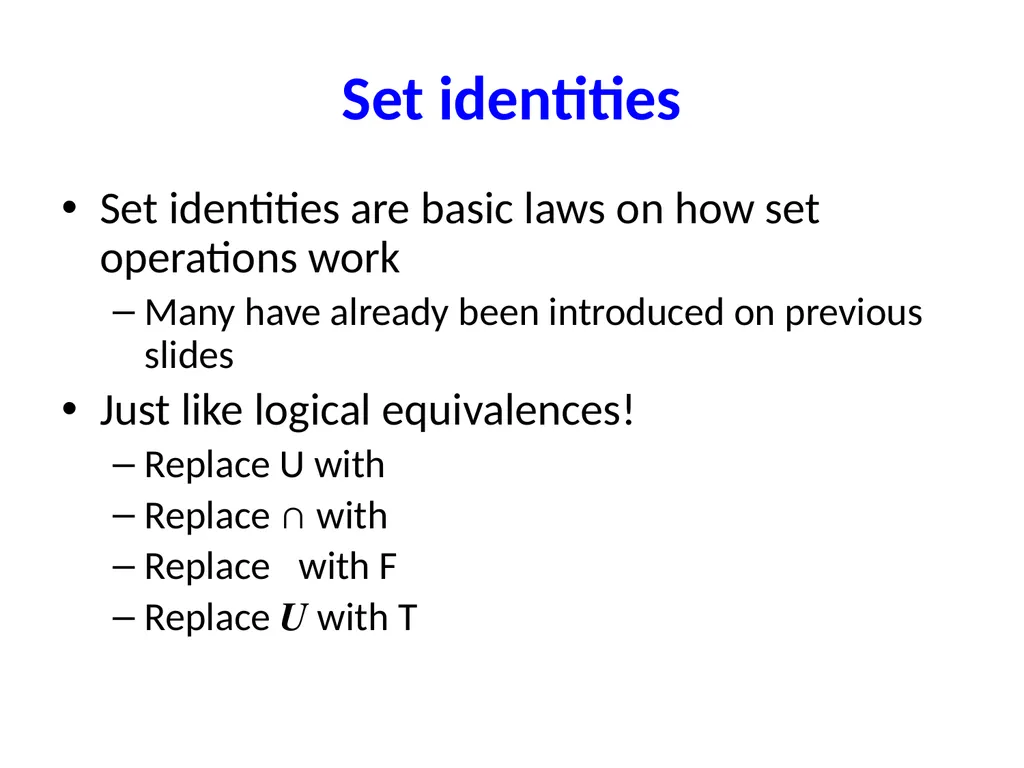
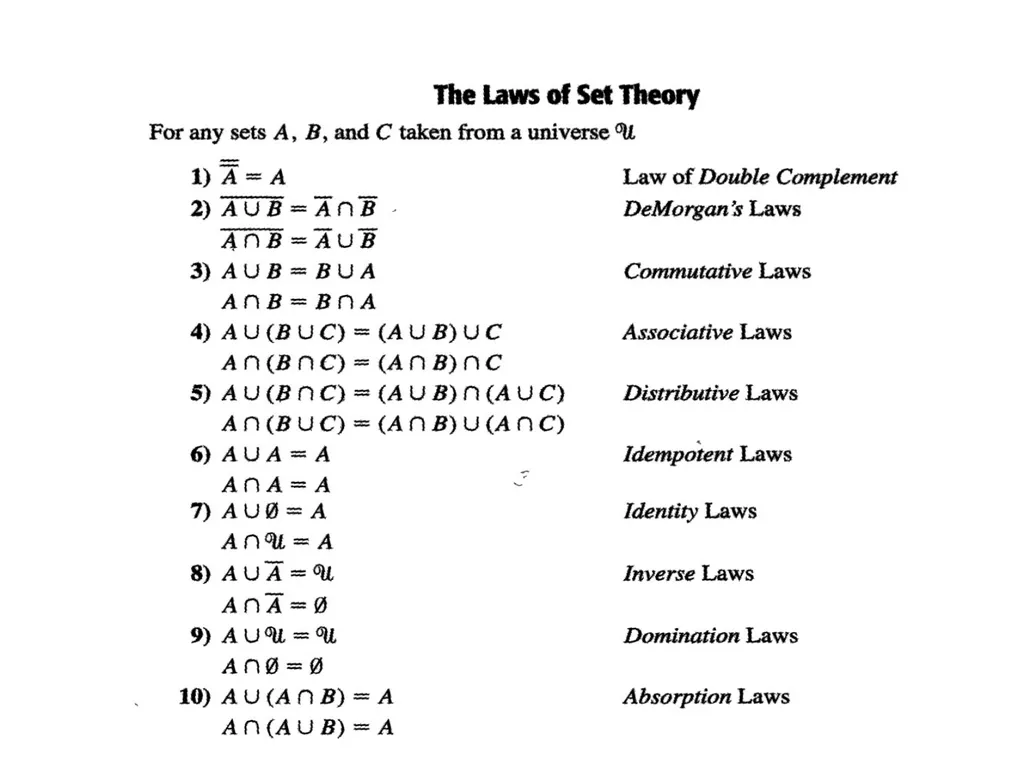
Set identities Set identities are basic laws on how set operations work
Many have already been introduced on previous slides
Just like logical equivalences!
Replace U with
Replace ∩ with
Replace with F
Replace U with T<br>
Many have already been introduced on previous slides
Just like logical equivalences!
Replace U with
Replace ∩ with
Replace with F
Replace U with T<br>
45
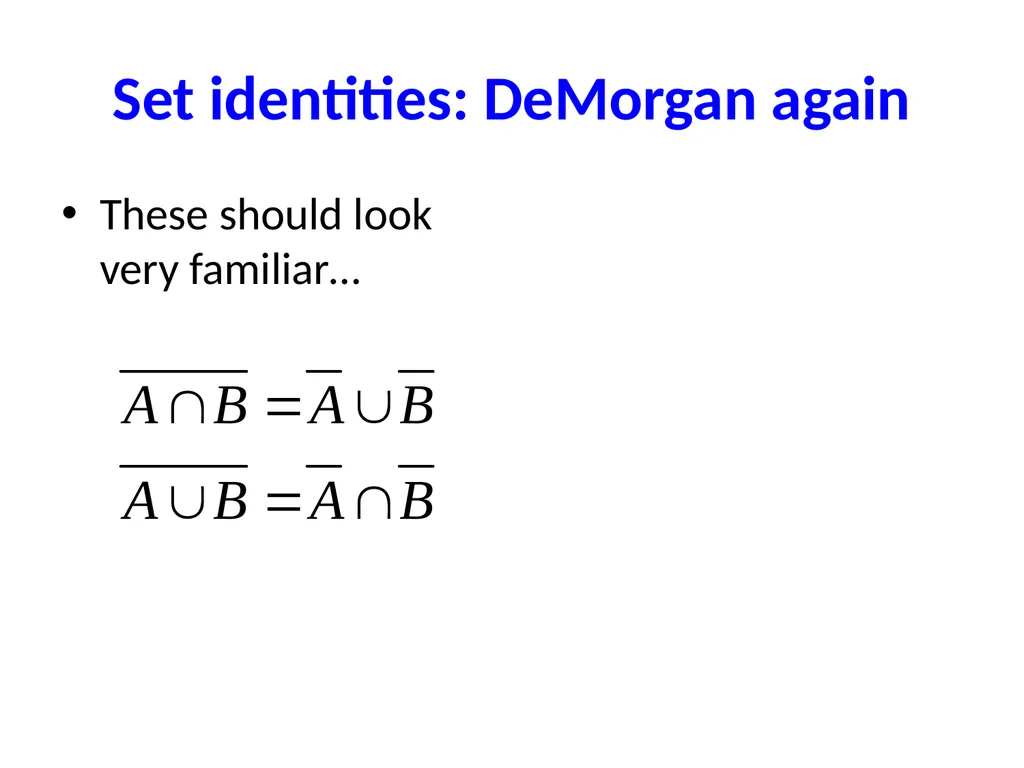
Set identities: DeMorgan again These should look
very familiar…<br>
46
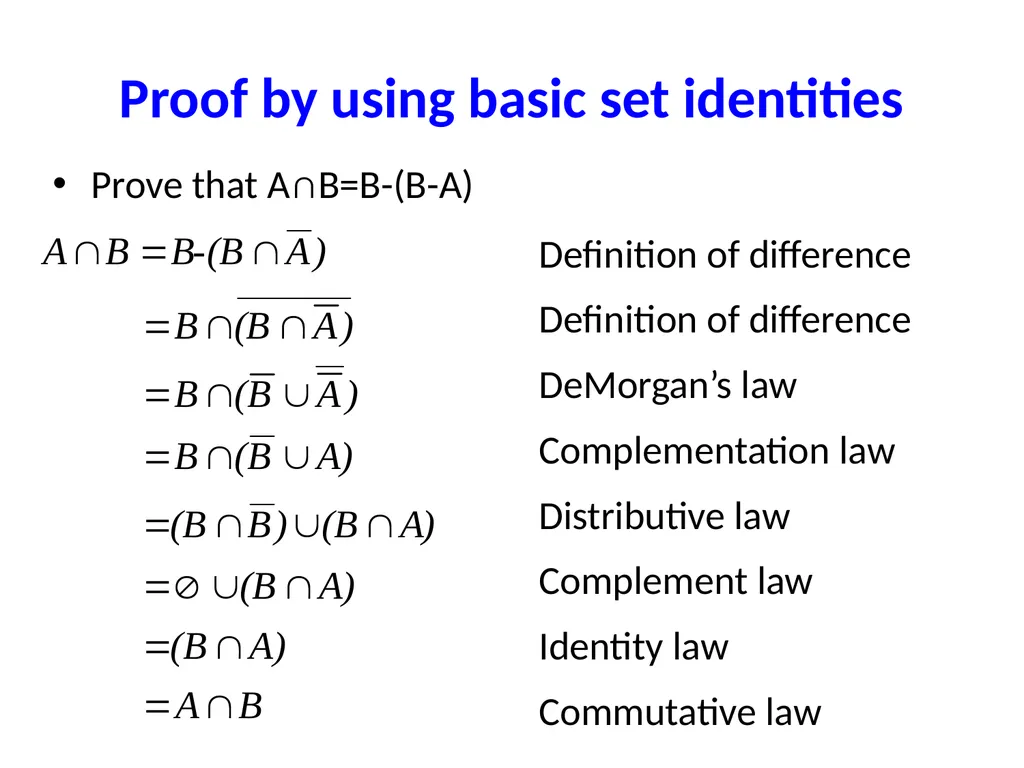
Definition of difference
Definition of difference
DeMorgan’s law
Complementation law
Distributive law
Complement law
Identity law
Commutative law Proof by using basic set identities Prove that A∩B=B-(B-A)<br>
Definition of difference
DeMorgan’s law
Complementation law
Distributive law
Complement law
Identity law
Commutative law Proof by using basic set identities Prove that A∩B=B-(B-A)<br>
47
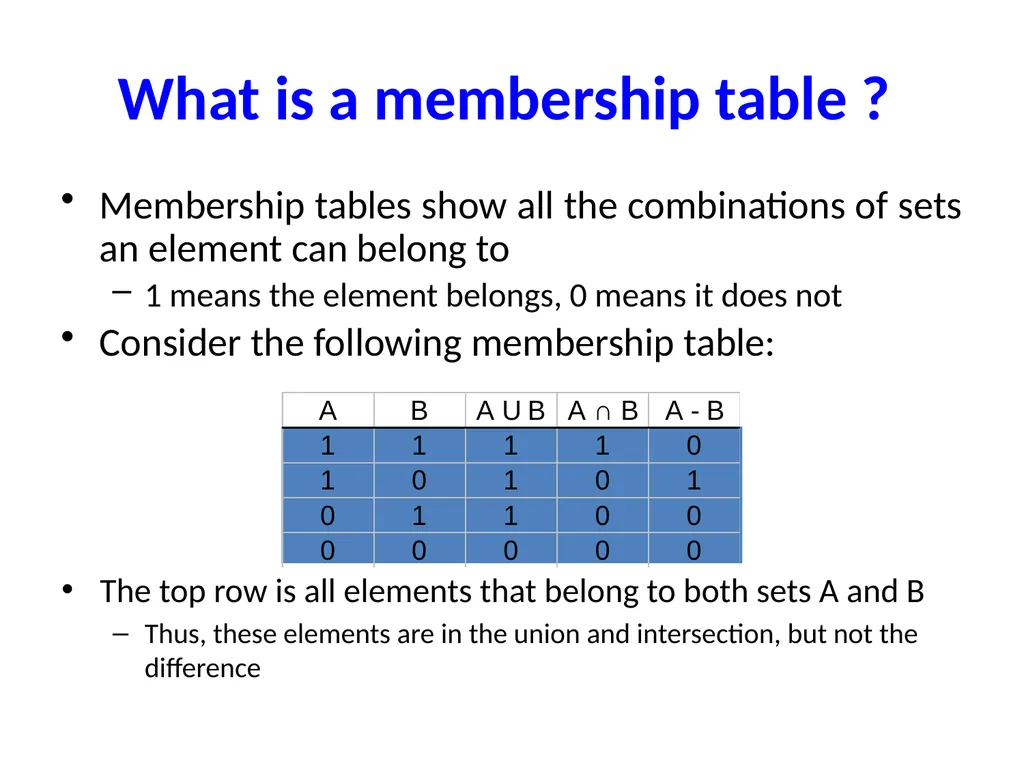
The top row is all elements that belong to both sets A and B
Thus, these elements are in the union and intersection, but not the difference What is a membership table ? Membership tables show all the combinations of sets an element can belong to
1 means the element belongs, 0 means it does not
Consider the following membership table:<br>
Thus, these elements are in the union and intersection, but not the difference What is a membership table ? Membership tables show all the combinations of sets an element can belong to
1 means the element belongs, 0 means it does not
Consider the following membership table:<br>
48
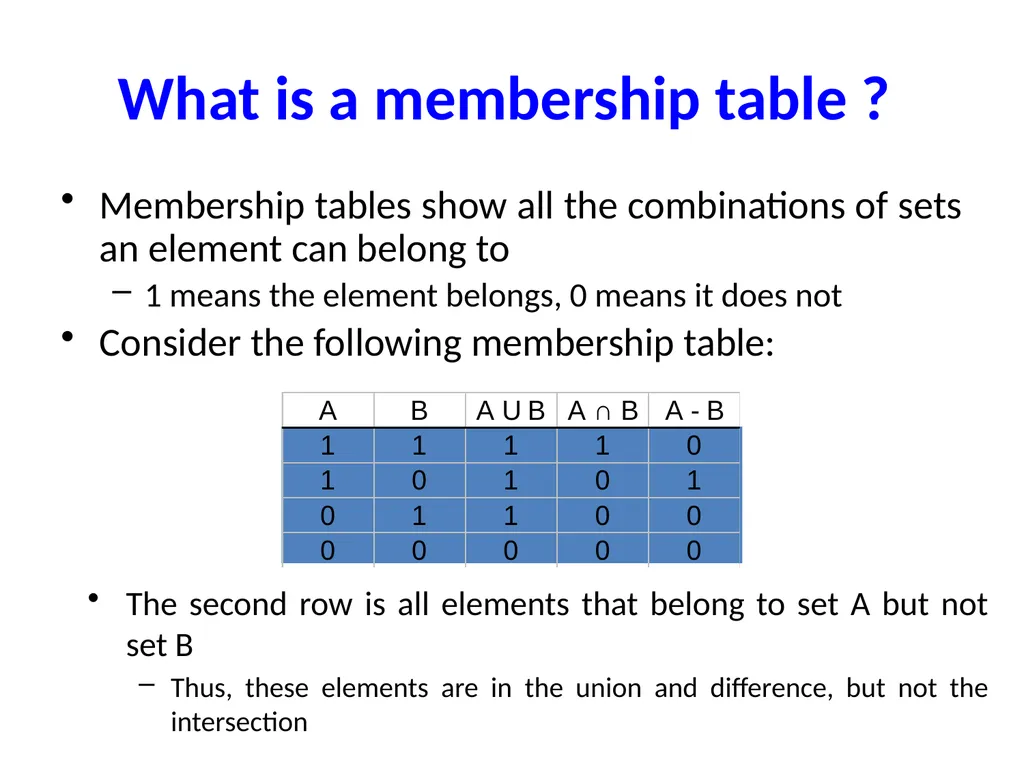
The second row is all elements that belong to set A but not set B
Thus, these elements are in the union and difference, but not the intersection What is a membership table ? Membership tables show all the combinations of sets an element can belong to
1 means the element belongs, 0 means it does not
Consider the following membership table:<br>
Thus, these elements are in the union and difference, but not the intersection What is a membership table ? Membership tables show all the combinations of sets an element can belong to
1 means the element belongs, 0 means it does not
Consider the following membership table:<br>
49
What is a membership table ? Membership tables show all the combinations of sets an element can belong to
1 means the element belongs, 0 means it does not
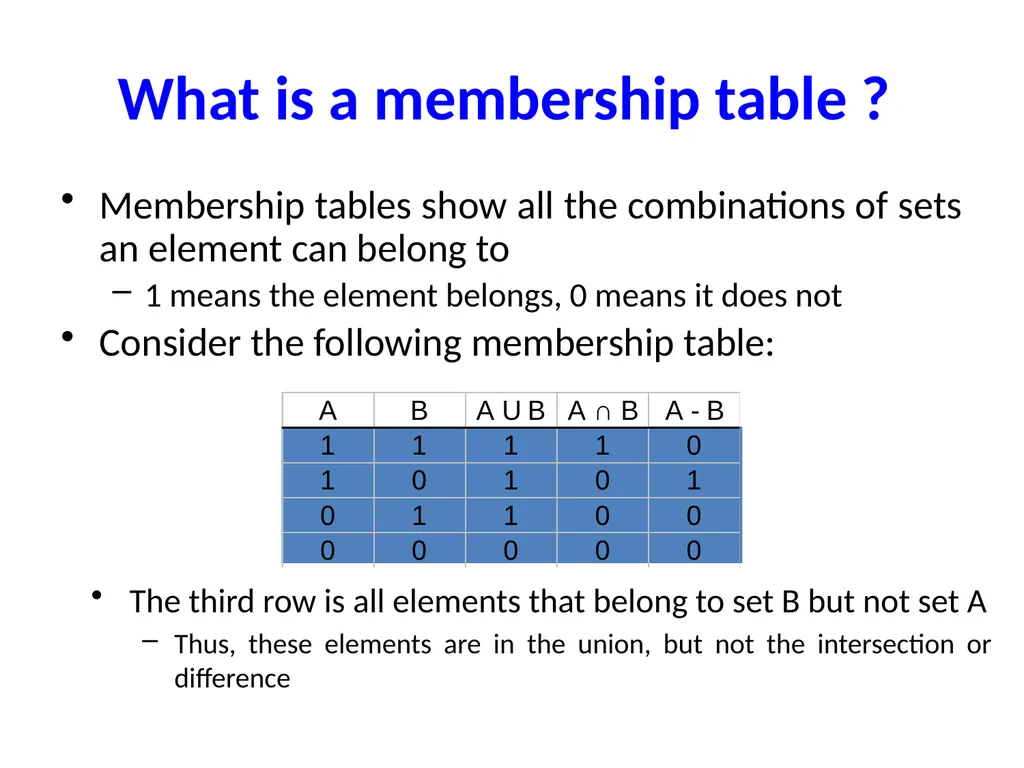
Consider the following membership table: The third row is all elements that belong to set B but not set A
Thus, these elements are in the union, but not the intersection or difference<br>
1 means the element belongs, 0 means it does not
Consider the following membership table: The third row is all elements that belong to set B but not set A
Thus, these elements are in the union, but not the intersection or difference<br>
50
What is a membership table ? Membership tables show all the combinations of sets an element can belong to
1 means the element belongs, 0 means it does not
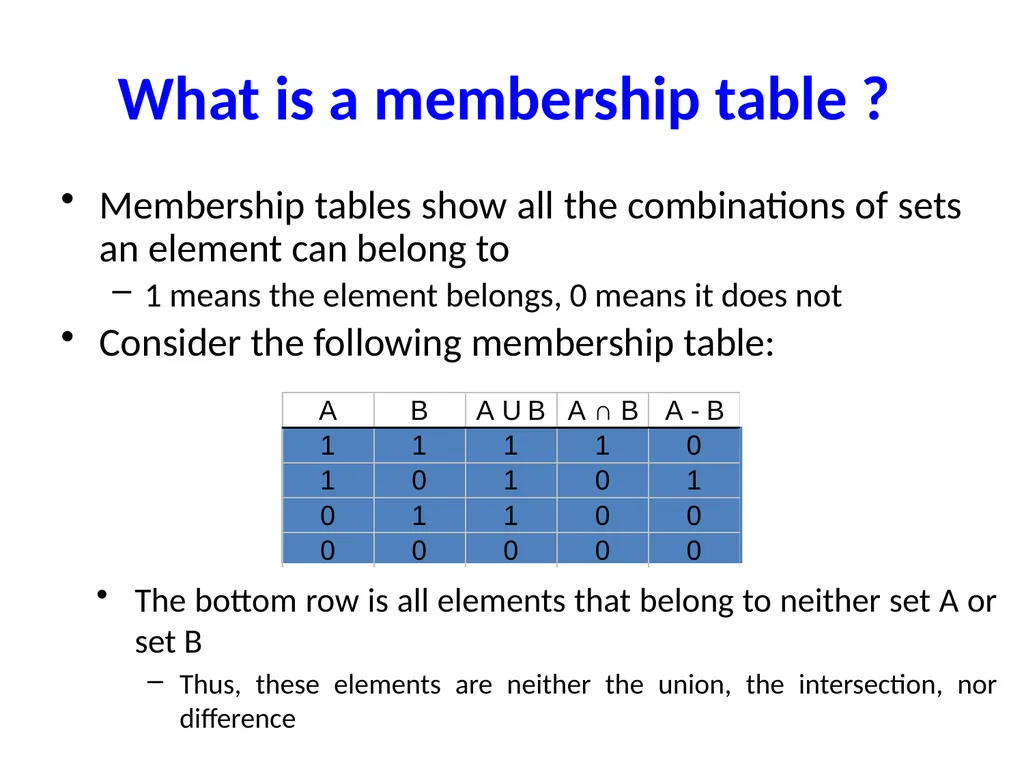
Consider the following membership table: The bottom row is all elements that belong to neither set A or set B
Thus, these elements are neither the union, the intersection, nor difference<br>
1 means the element belongs, 0 means it does not
Consider the following membership table: The bottom row is all elements that belong to neither set A or set B
Thus, these elements are neither the union, the intersection, nor difference<br>
51
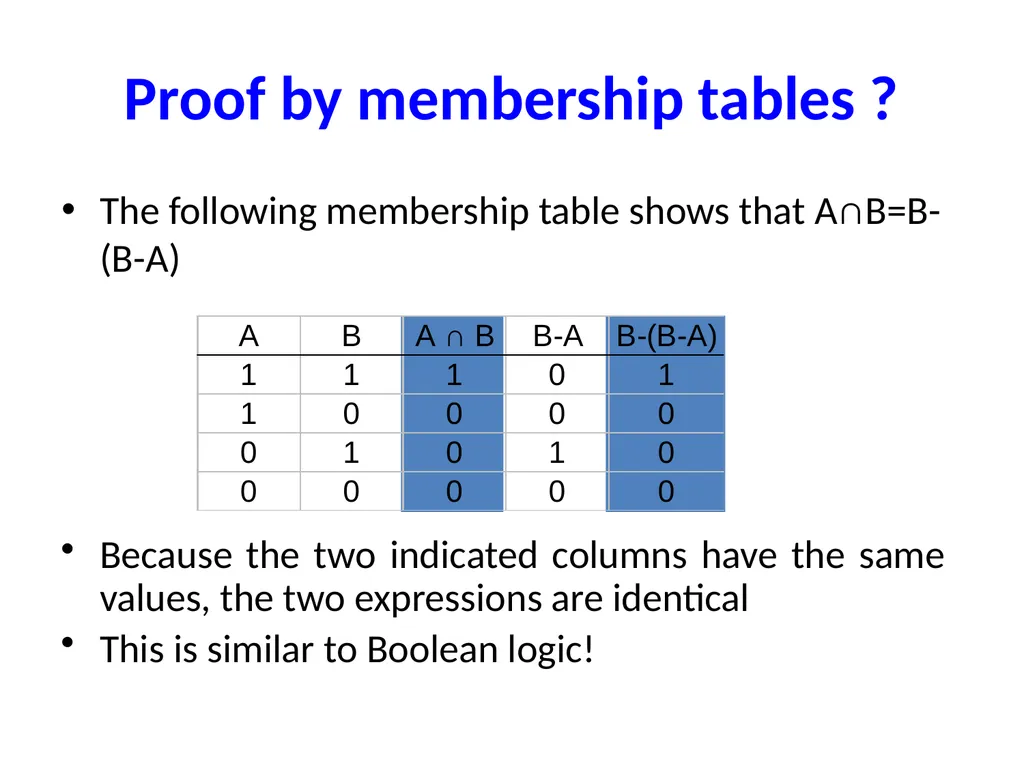
Proof by membership tables ? The following membership table shows that A∩B=B-(B-A) Because the two indicated columns have the same values, the two expressions are identical
This is similar to Boolean logic!<br>
This is similar to Boolean logic!<br>
52
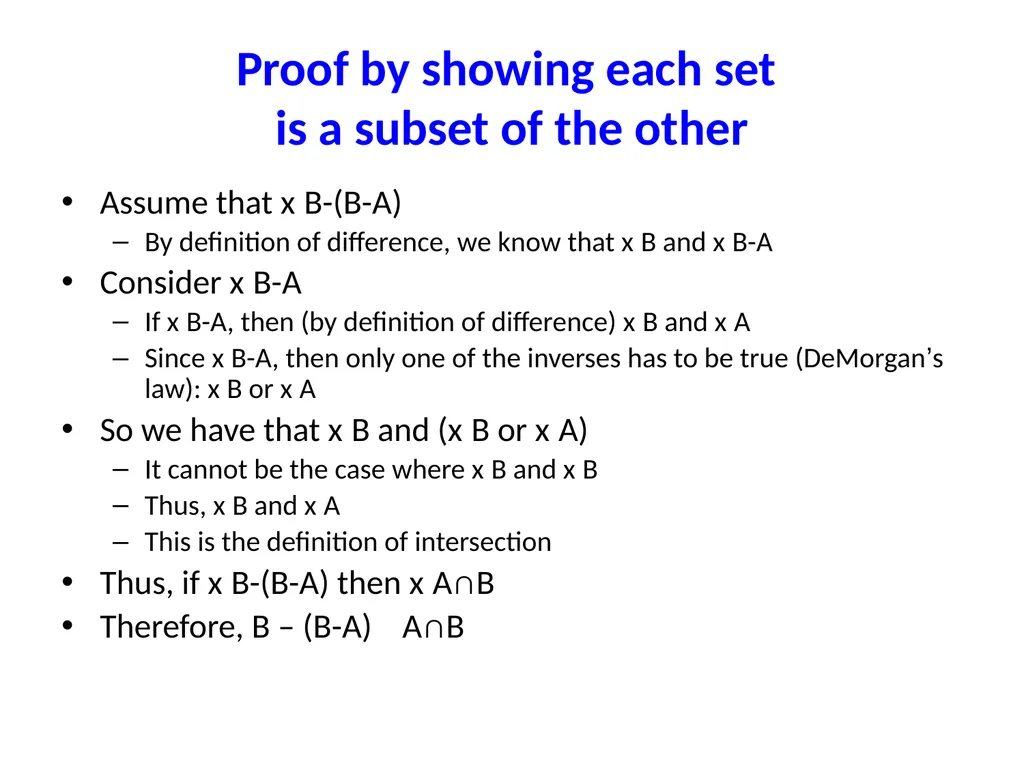
Proof by showing each set
is a subset of the other Assume that xB-(B-A)
By definition of difference, we know that xB and xB-A
Consider xB-A
If xB-A, then (by definition of difference) xB and xA
Since xB-A, then only one of the inverses has to be true (DeMorgan’s law): xB or xA
So we have that xB and (xB or xA)
It cannot be the case where xB and xB
Thus, xB and xA
This is the definition of intersection
Thus, if xB-(B-A) then xA∩B
Therefore, B – (B-A) A∩B<br>
By definition of difference, we know that xB and xB-A
Consider xB-A
If xB-A, then (by definition of difference) xB and xA
Since xB-A, then only one of the inverses has to be true (DeMorgan’s law): xB or xA
So we have that xB and (xB or xA)
It cannot be the case where xB and xB
Thus, xB and xA
This is the definition of intersection
Thus, if xB-(B-A) then xA∩B
Therefore, B – (B-A) A∩B<br>
53
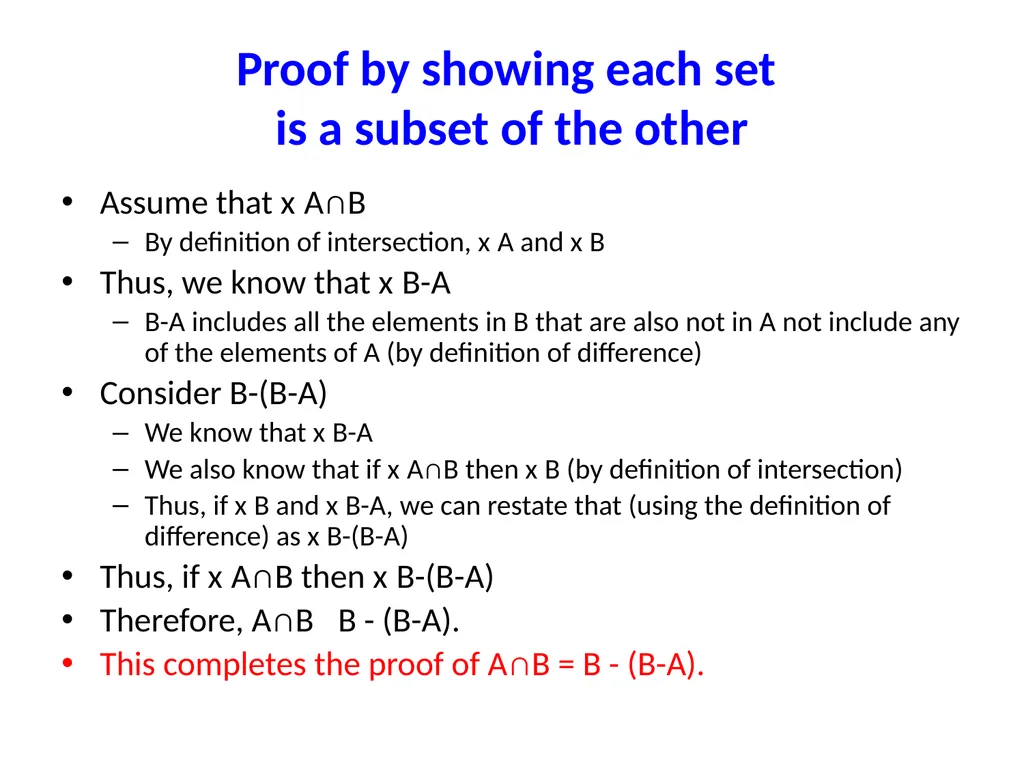
Proof by showing each set
is a subset of the other Assume that xA∩B
By definition of intersection, xA and xB
Thus, we know that xB-A
B-A includes all the elements in B that are also not in A not include any of the elements of A (by definition of difference)
Consider B-(B-A)
We know that xB-A
We also know that if xA∩B then xB (by definition of intersection)
Thus, if xB and xB-A, we can restate that (using the definition of difference) as xB-(B-A)
Thus, if xA∩B then xB-(B-A)
Therefore, A∩B B - (B-A).
This completes the proof of A∩B = B - (B-A).<br>
By definition of intersection, xA and xB
Thus, we know that xB-A
B-A includes all the elements in B that are also not in A not include any of the elements of A (by definition of difference)
Consider B-(B-A)
We know that xB-A
We also know that if xA∩B then xB (by definition of intersection)
Thus, if xB and xB-A, we can restate that (using the definition of difference) as xB-(B-A)
Thus, if xA∩B then xB-(B-A)
Therefore, A∩B B - (B-A).
This completes the proof of A∩B = B - (B-A).<br>
54
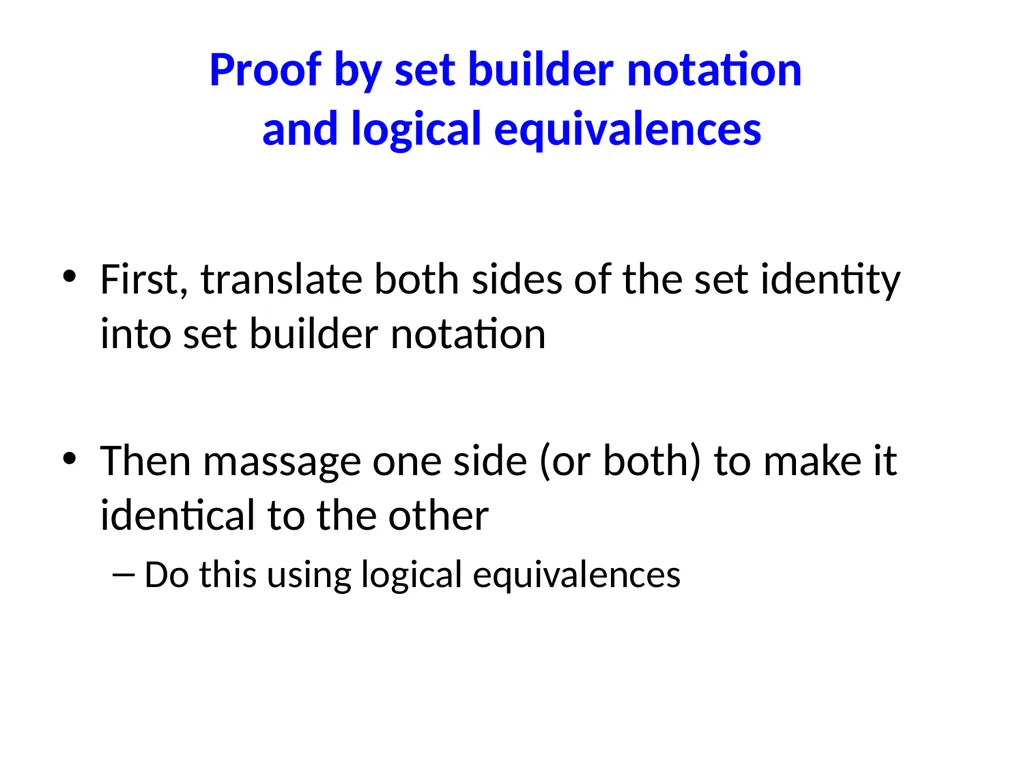
Proof by set builder notation
and logical equivalences First, translate both sides of the set identity into set builder notation
Then massage one side (or both) to make it identical to the other
Do this using logical equivalences<br>
Then massage one side (or both) to make it identical to the other
Do this using logical equivalences<br>
55
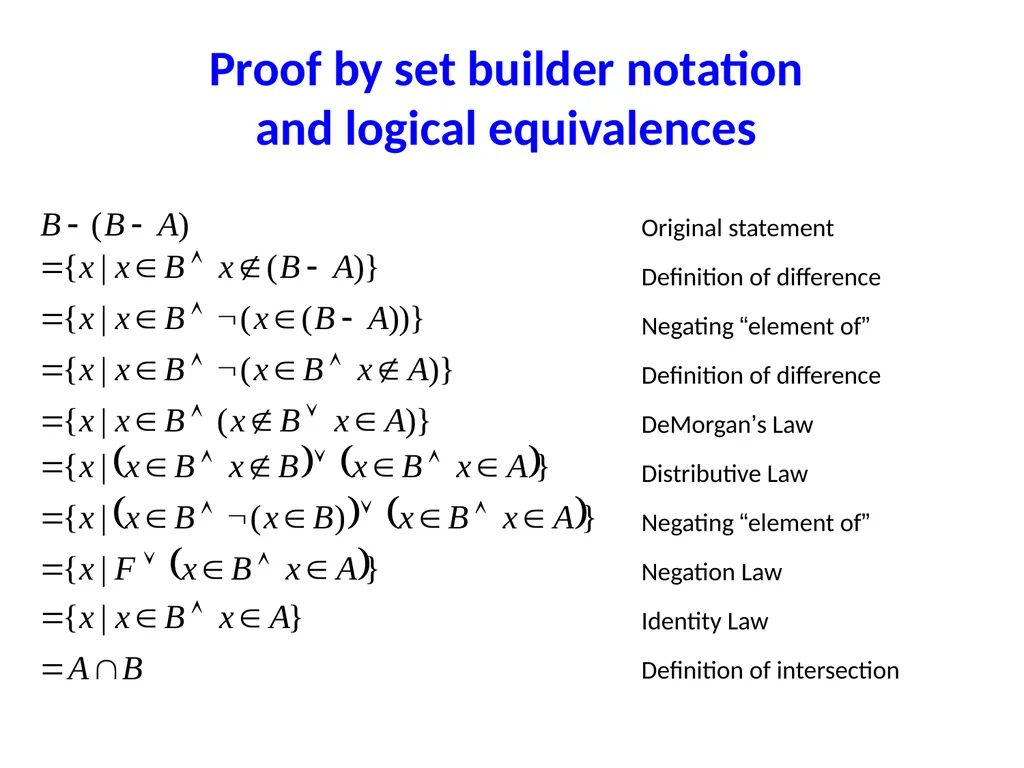
Proof by set builder notation
and logical equivalences Original statement
Definition of difference
Negating “element of”
Definition of difference
DeMorgan’s Law
Distributive Law
Negating “element of”
Negation Law
Identity Law
Definition of intersection<br>
Definition of difference
Negating “element of”
Definition of difference
DeMorgan’s Law
Distributive Law
Negating “element of”
Negation Law
Identity Law
Definition of intersection<br>
56
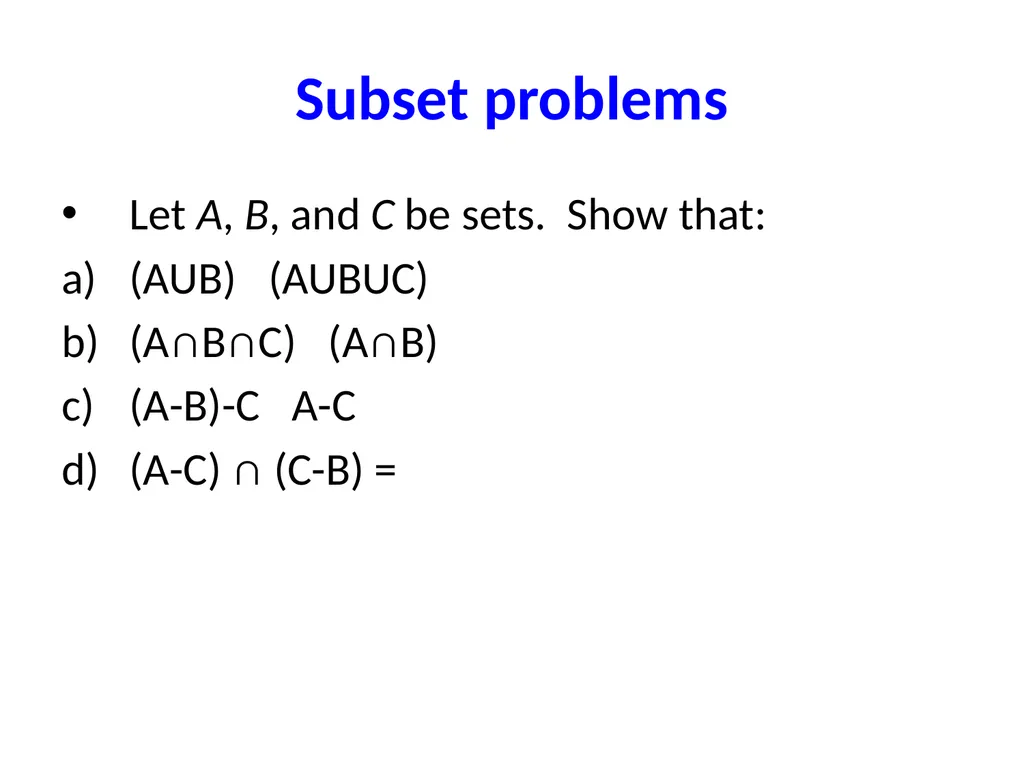
Subset problems Let A, B, and C be sets. Show that:
(AUB) (AUBUC)
(A∩B∩C) (A∩B)
(A-B)-C A-C
(A-C) ∩ (C-B) = <br>
(AUB) (AUBUC)
(A∩B∩C) (A∩B)
(A-B)-C A-C
(A-C) ∩ (C-B) = <br>
57
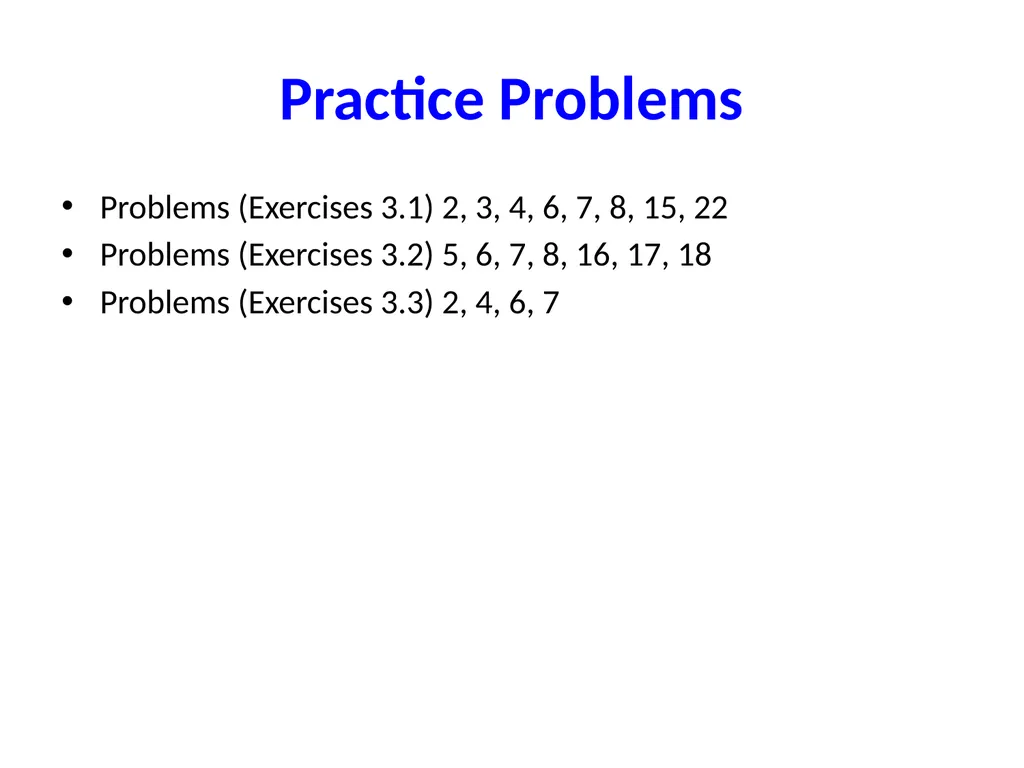
Practice Problems Problems (Exercises 3.1) 2, 3, 4, 6, 7, 8, 15, 22
Problems (Exercises 3.2) 5, 6, 7, 8, 16, 17, 18
Problems (Exercises 3.3) 2, 4, 6, 7<br>
Problems (Exercises 3.2) 5, 6, 7, 8, 16, 17, 18
Problems (Exercises 3.3) 2, 4, 6, 7<br>