
Setting Expectations and Managing Performance
LV
Published · 70 slides · 0 views
1 / 1


Description
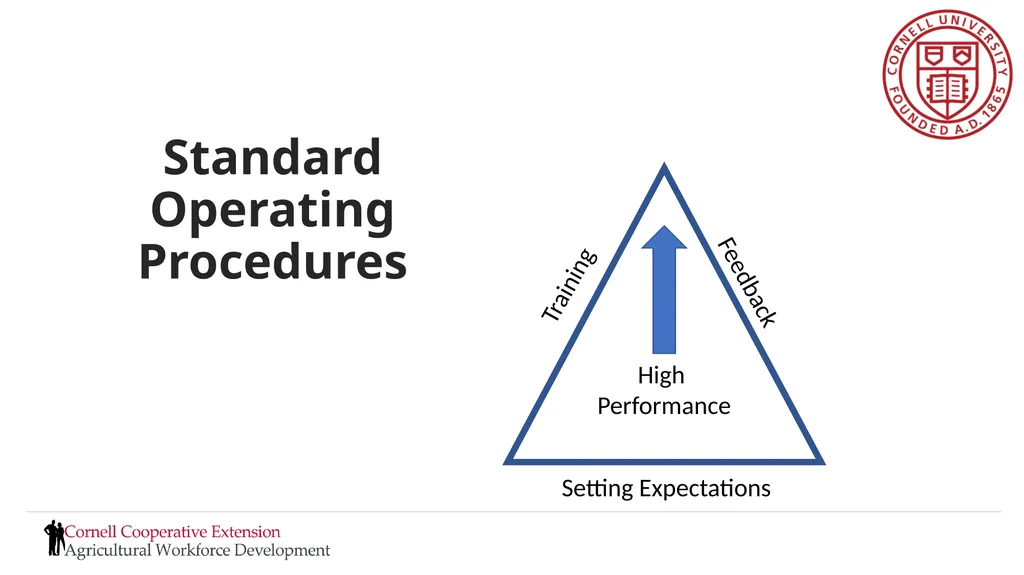
Setting Expectations and Managing Performance Richard Stup, Ph.D. Agricultural Workforce Specialist rstupcornell.edu agworkforce.cals.cornell.edu The Performance Triad Organization Structure Classic Hierarchy Communication Coordination
Related Topics
Share
Embed code
Download this presentation From Below
"Setting Expectations and Managing Performance" is the property of its rightful owner. Permission is granted to download and print the materials on this website for personal, non-commercial use only, and to display it on your personal computer provided you do not modify the materials and that you retain all copyright notices contained in the materials. By downloading content from our website, you accept the terms of this agreement.
Presentation Transcript
01
Setting Expectations and Managing Performance Richard Stup, Ph.D.
Agricultural Workforce Specialist
rstup@cornell.edu
agworkforce.cals.cornell.edu<br>
Agricultural Workforce Specialist
rstup@cornell.edu
agworkforce.cals.cornell.edu<br>
02
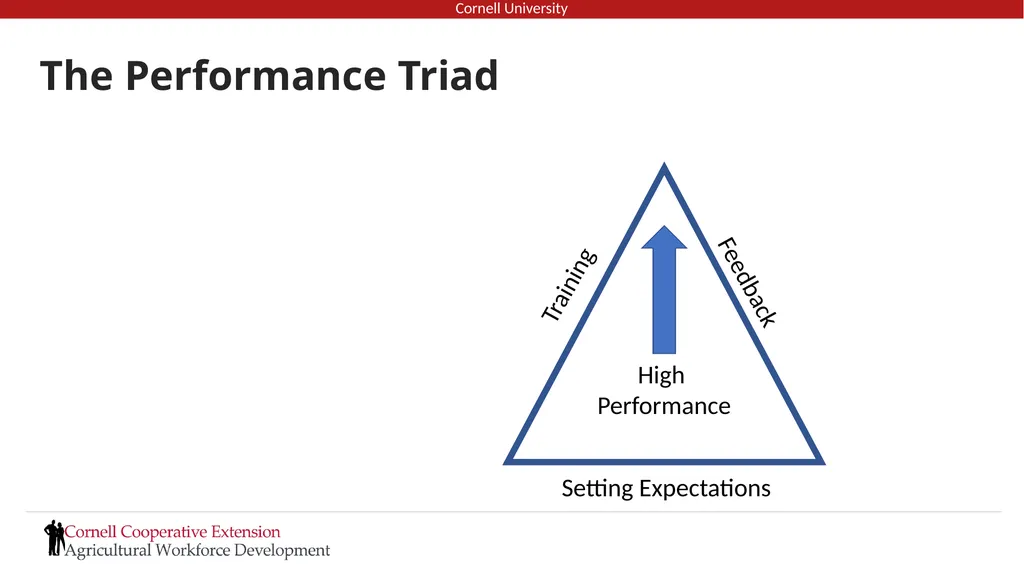
The Performance Triad<br>
03
Organization Structure<br>
04
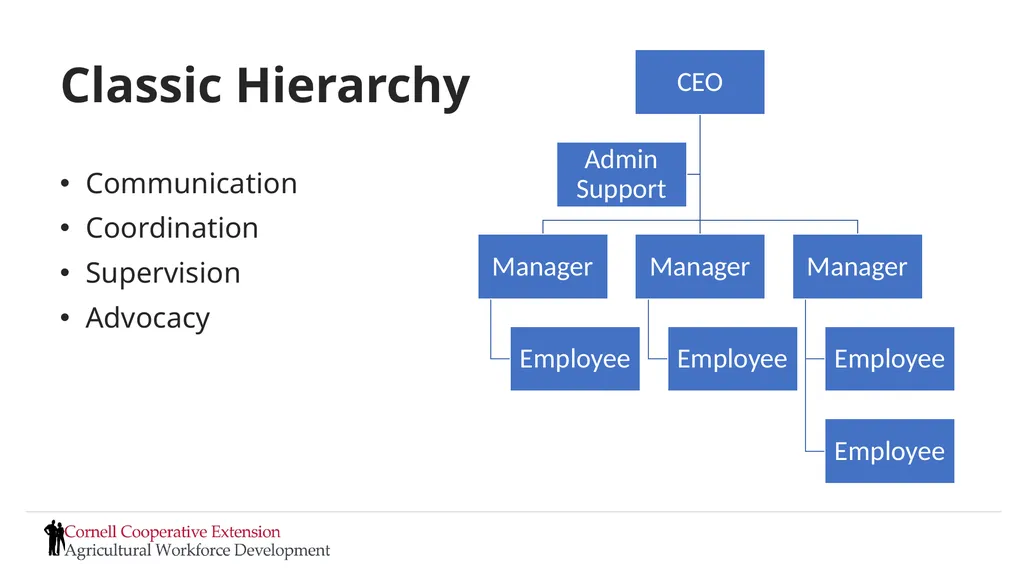
Classic Hierarchy Communication
Coordination
Supervision
Advocacy<br>
Coordination
Supervision
Advocacy<br>
05
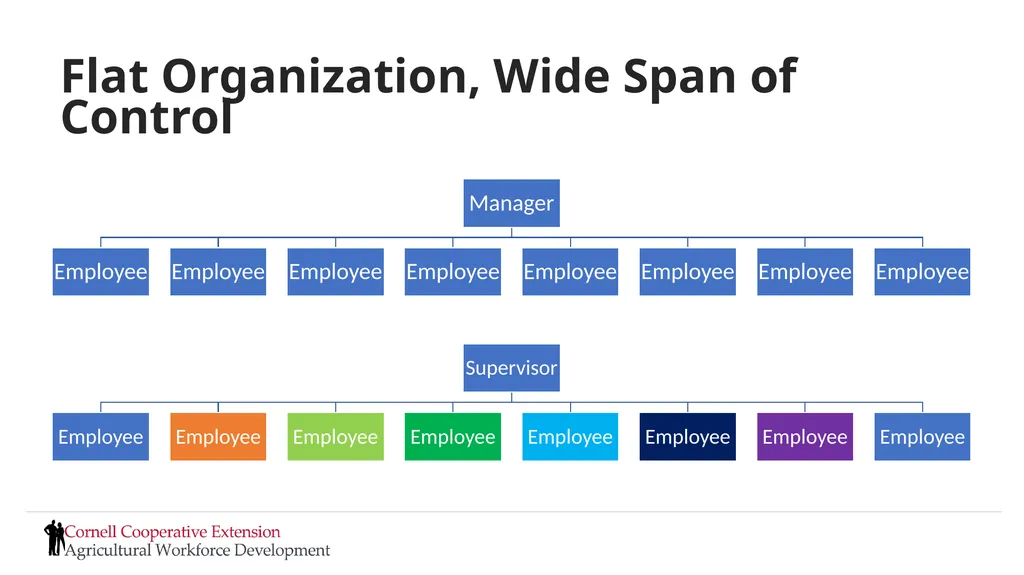
Flat Organization, Wide Span of Control<br>
06
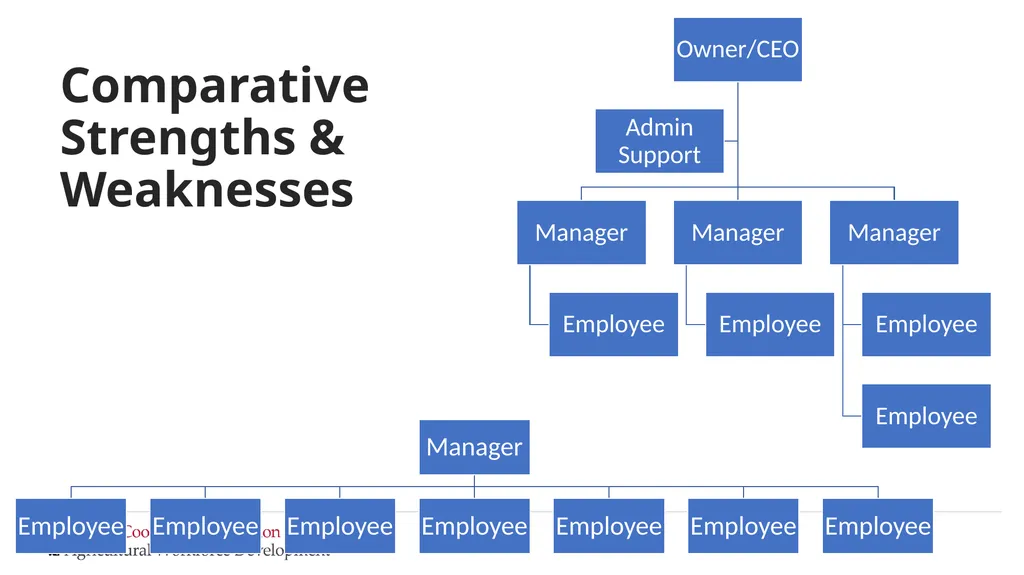
Comparative Strengths & Weaknesses<br>
07
Activity: Draw Your Organization Chart Sketch out your business organization chart.
Use position titles and names.
Does anyone appear in more than one position? Is that OK?<br>
Use position titles and names.
Does anyone appear in more than one position? Is that OK?<br>
08
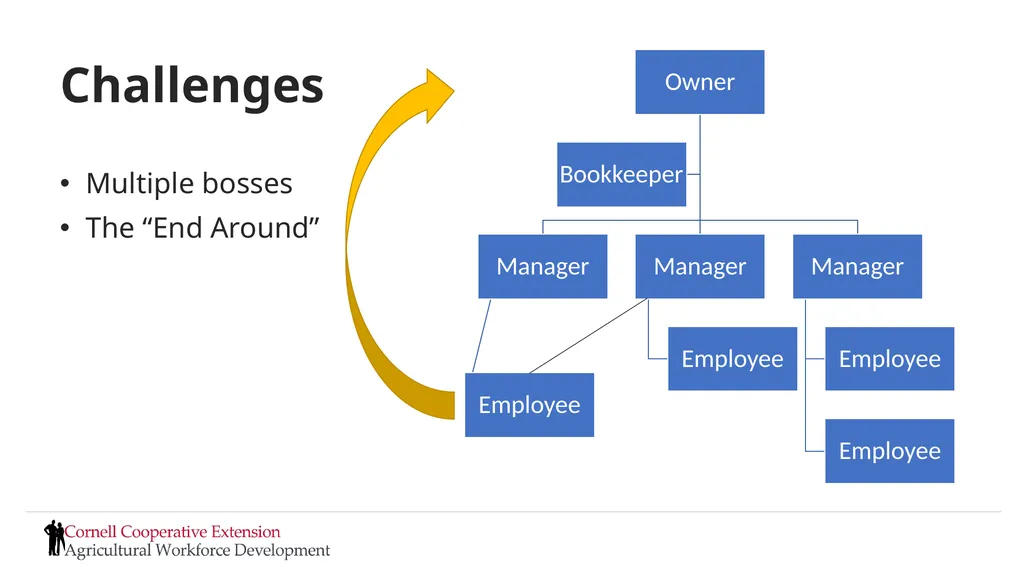
Challenges Multiple bosses
The “End Around”<br>
The “End Around”<br>
09
Job Descriptions As Tools For Communication<br>
10
“The purpose of a job description is to help an employee and his or her manager to reach mutual understanding about important details of a job.” So…why is it important for them to understand each other?<br>
11
Five Reasons For Job Descriptions Organization
Training
Recruitment
Evaluation/Feedback
Defense<br>
Training
Recruitment
Evaluation/Feedback
Defense<br>
12
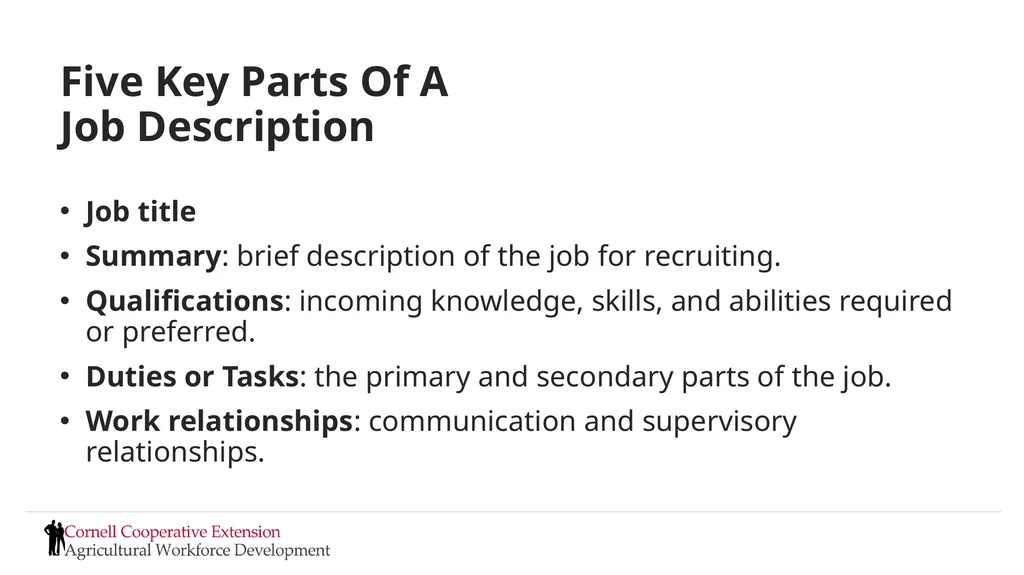
Five Key Parts Of A
Job Description Job title
Summary: brief description of the job for recruiting.
Qualifications: incoming knowledge, skills, and abilities required or preferred.
Duties or Tasks: the primary and secondary parts of the job.
Work relationships: communication and supervisory relationships.<br>
Summary: brief description of the job for recruiting.
Qualifications: incoming knowledge, skills, and abilities required or preferred.
Duties or Tasks: the primary and secondary parts of the job.
Work relationships: communication and supervisory relationships.<br>
13
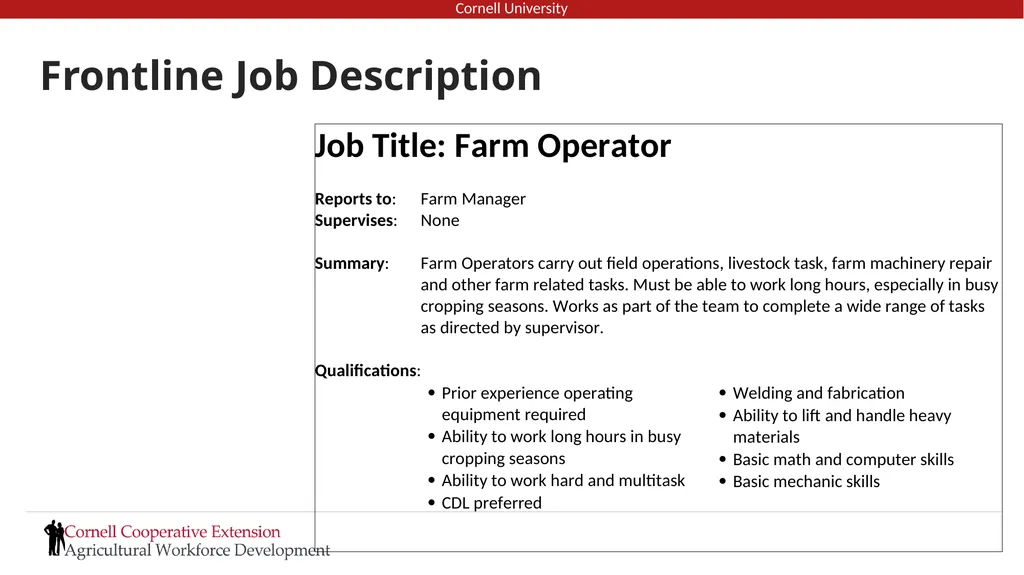
Frontline Job Description<br>
14
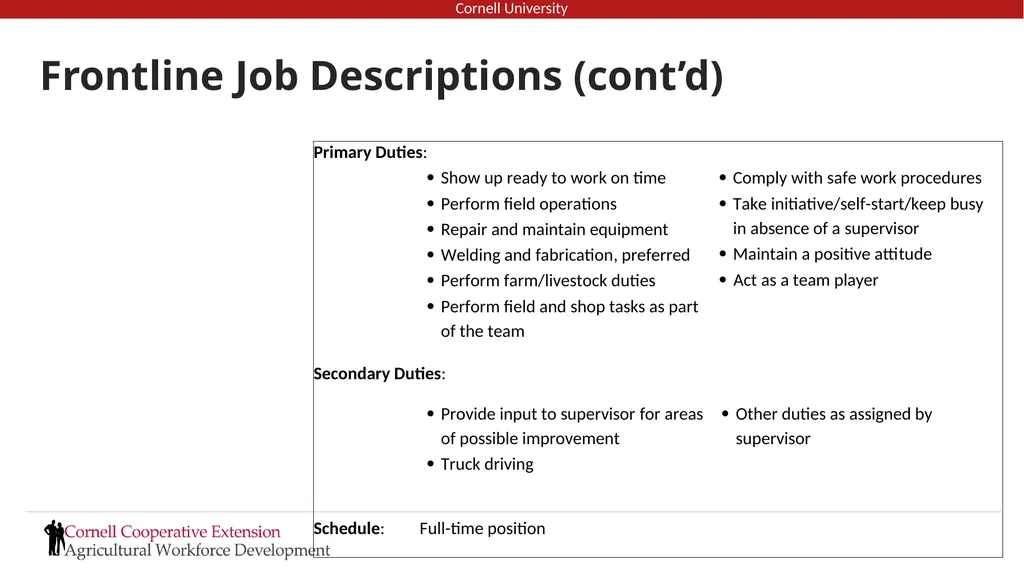
Frontline Job Descriptions (cont’d)<br>
15
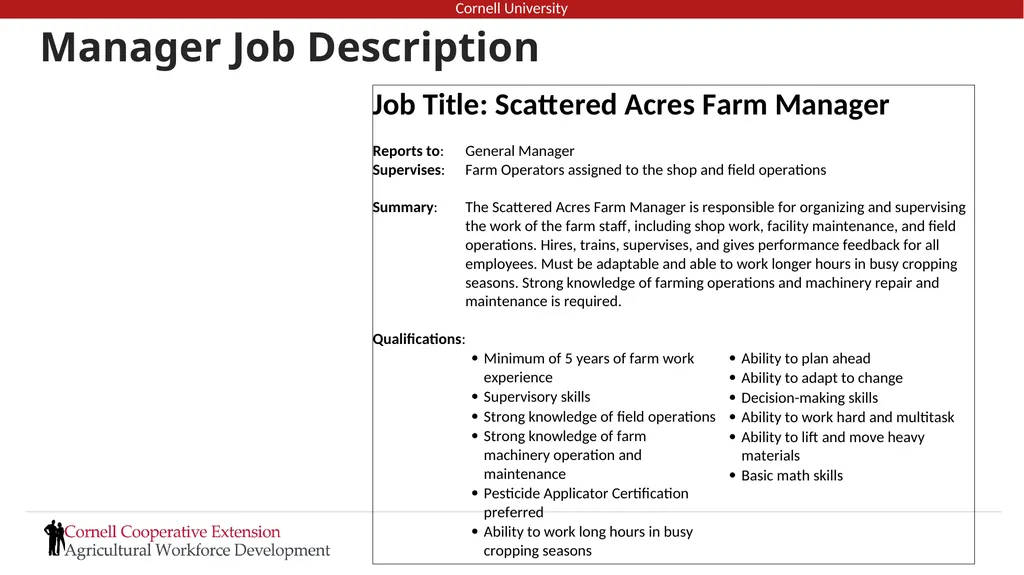
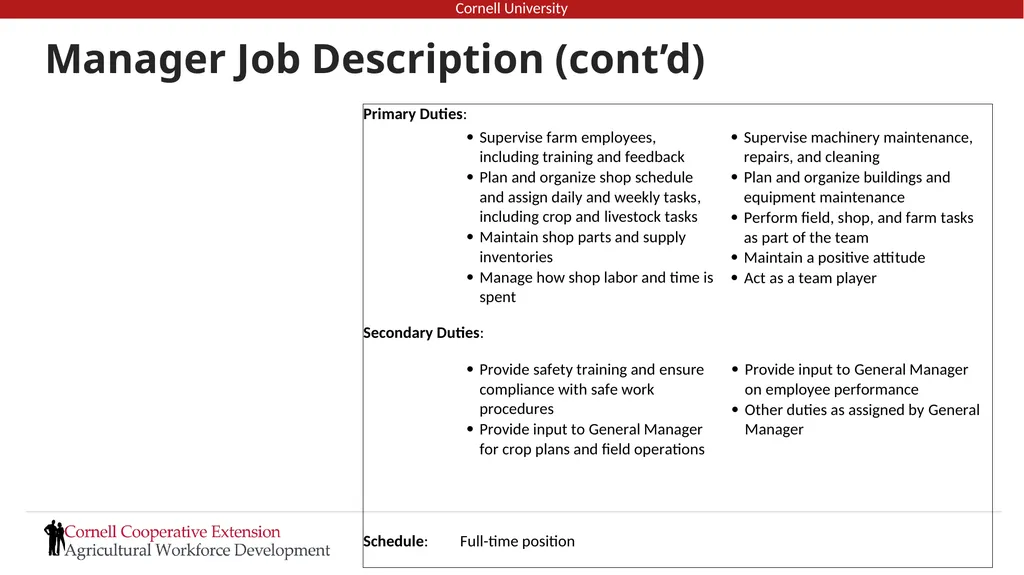
Manager Job Description<br>
16
Manager Job Description (cont’d)<br>
17
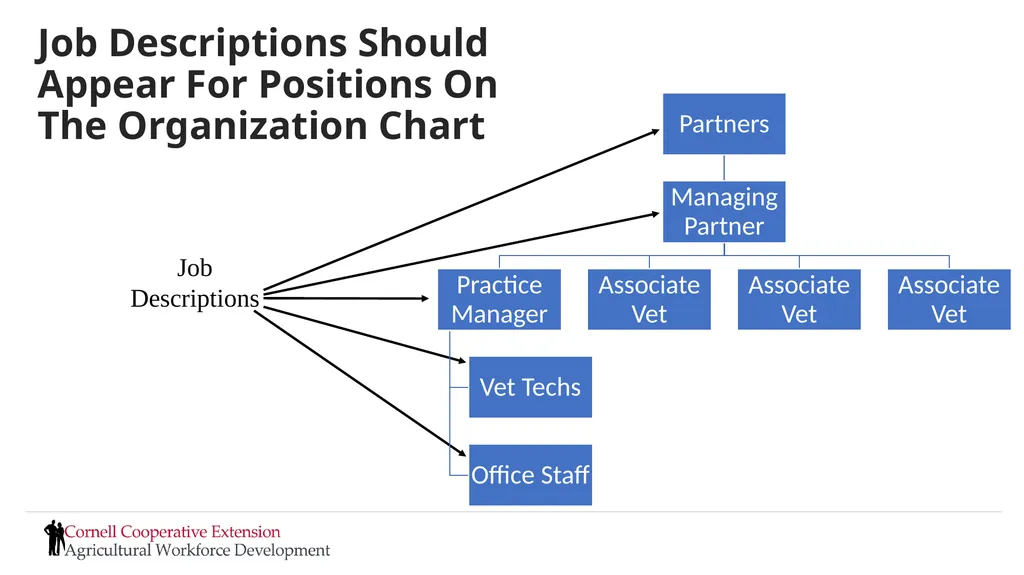
Job Descriptions Should Appear For Positions On The Organization Chart Job Descriptions<br>
18
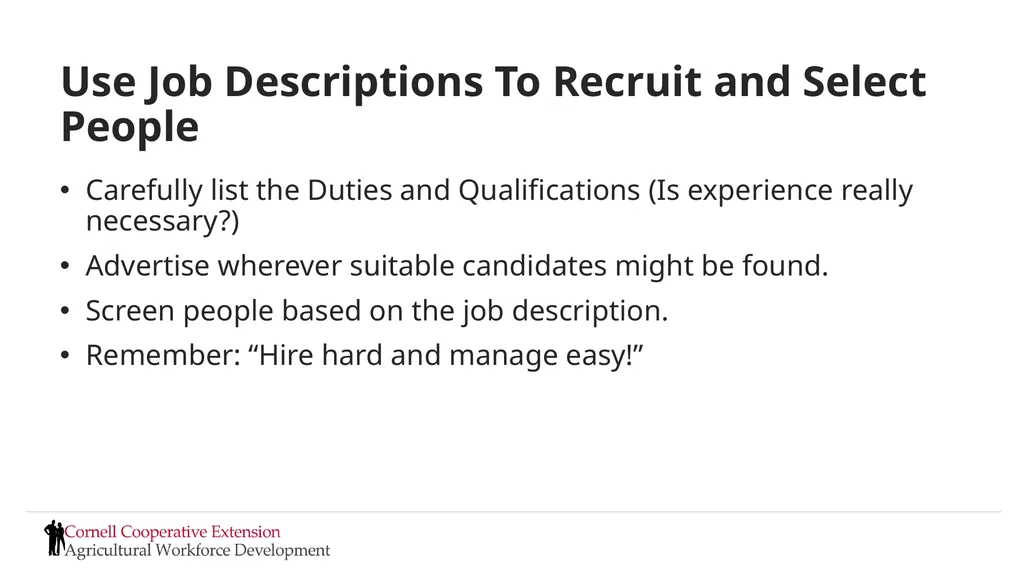
Use Job Descriptions To Recruit and Select People Carefully list the Duties and Qualifications (Is experience really necessary?)
Advertise wherever suitable candidates might be found.
Screen people based on the job description.
Remember: “Hire hard and manage easy!”<br>
Advertise wherever suitable candidates might be found.
Screen people based on the job description.
Remember: “Hire hard and manage easy!”<br>
19
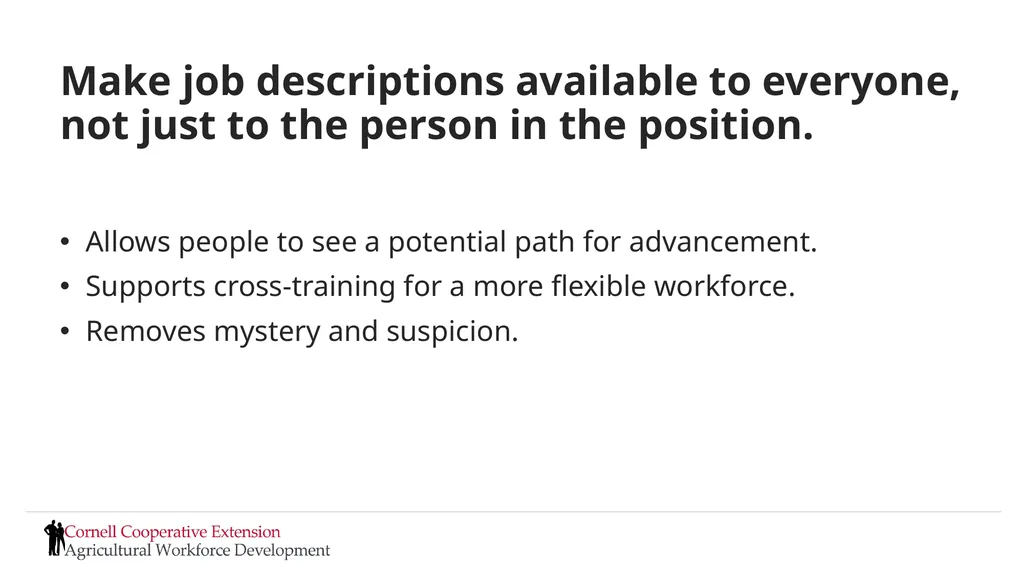
Make job descriptions available to everyone, not just to the person in the position. Allows people to see a potential path for advancement.
Supports cross-training for a more flexible workforce.
Removes mystery and suspicion.<br>
Supports cross-training for a more flexible workforce.
Removes mystery and suspicion.<br>
20
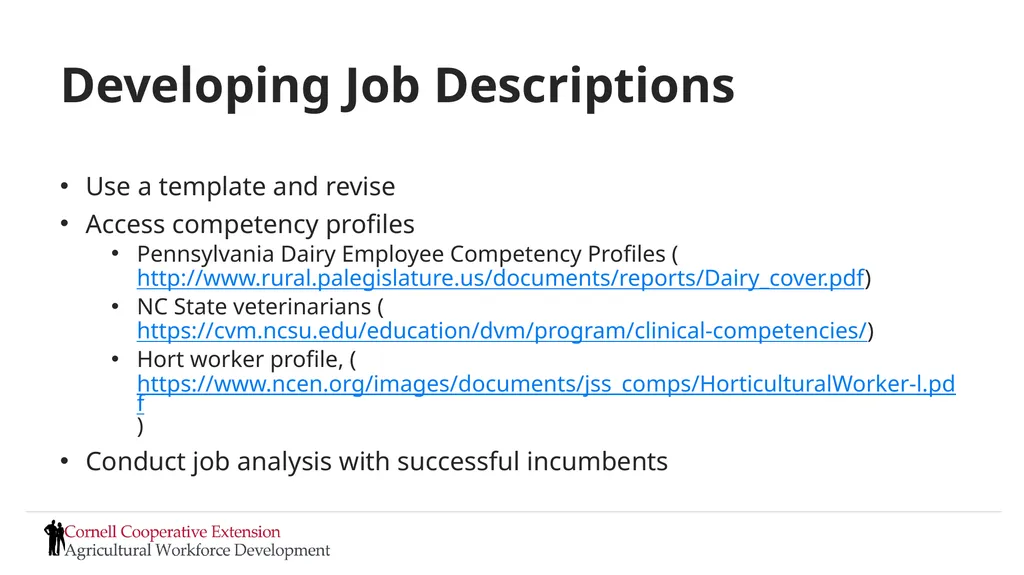
Developing Job Descriptions Use a template and revise
Access competency profiles
Pennsylvania Dairy Employee Competency Profiles (http://www.rural.palegislature.us/documents/reports/Dairy_cover.pdf)
NC State veterinarians (https://cvm.ncsu.edu/education/dvm/program/clinical-competencies/)
Hort worker profile, (https://www.ncen.org/images/documents/jss_comps/HorticulturalWorker-l.pdf)
Conduct job analysis with successful incumbents<br>
Access competency profiles
Pennsylvania Dairy Employee Competency Profiles (http://www.rural.palegislature.us/documents/reports/Dairy_cover.pdf)
NC State veterinarians (https://cvm.ncsu.edu/education/dvm/program/clinical-competencies/)
Hort worker profile, (https://www.ncen.org/images/documents/jss_comps/HorticulturalWorker-l.pdf)
Conduct job analysis with successful incumbents<br>
21
Activity: Write a job description Choose an important job in your business. (Consider a manager.)
Write some basic qualifications.
List the primary duties.
Are there any secondary duties?<br>
Write some basic qualifications.
List the primary duties.
Are there any secondary duties?<br>
22
Wrap Up Planning and organizing can avoid much confusion and many serious problems.
Take time every year to work on the business. Update job descriptions and structure.<br>
Take time every year to work on the business. Update job descriptions and structure.<br>
23
Communicating in a Multicultural Workforce<br>
24
Standard Operating Procedures<br>
25
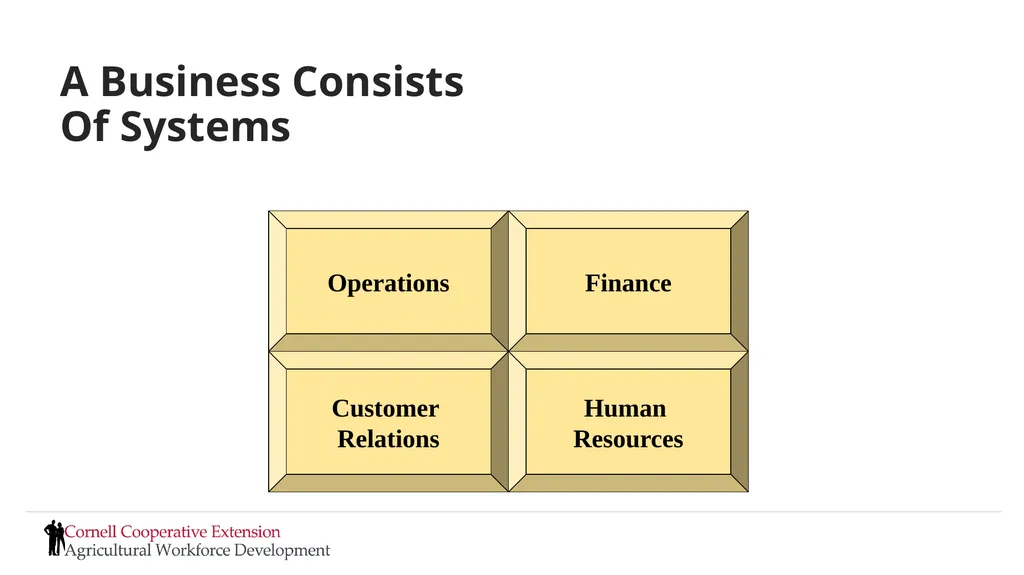
A Business Consists
Of Systems Operations Finance Customer
Relations Human
Resources<br>
Relations Human
Resources<br>
26
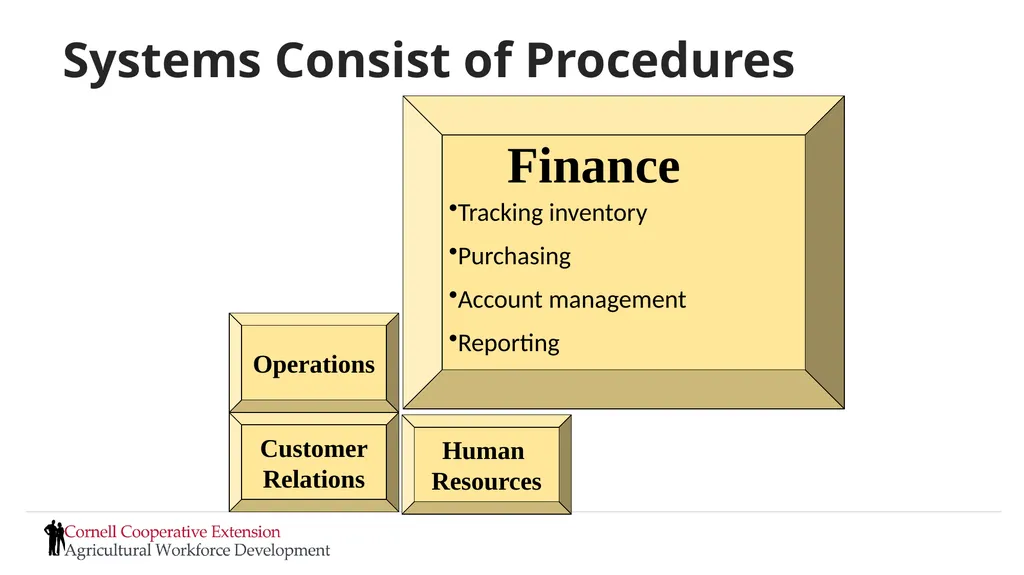
Operations Customer
Relations Human
Resources Finance Tracking inventory
Purchasing
Account management
Reporting Systems Consist of Procedures<br>
Relations Human
Resources Finance Tracking inventory
Purchasing
Account management
Reporting Systems Consist of Procedures<br>
27
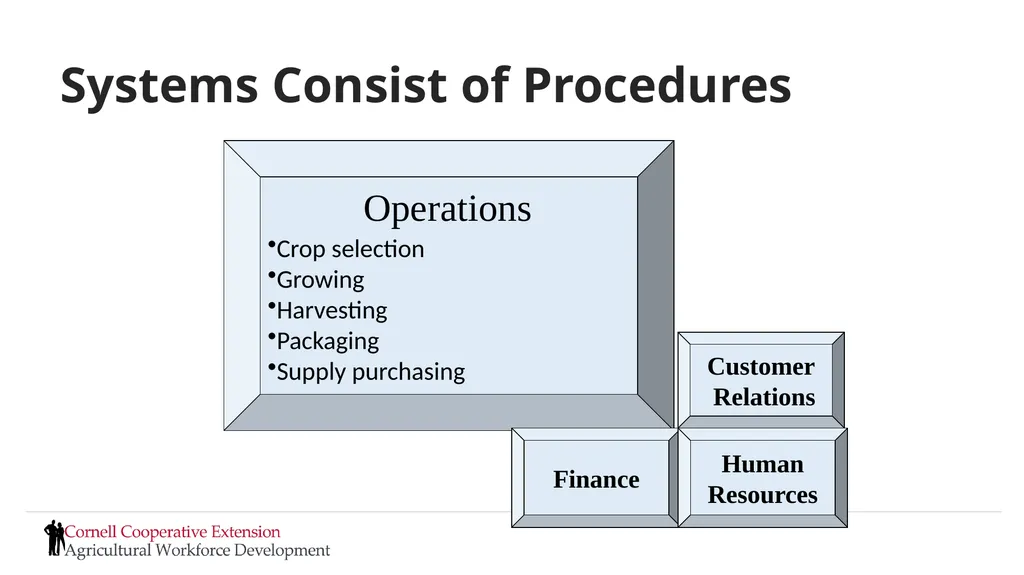
Systems Consist of Procedures Crop selection
Growing
Harvesting
Packaging
Supply purchasing Finance Human Resources Customer Relations Operations<br>
Growing
Harvesting
Packaging
Supply purchasing Finance Human Resources Customer Relations Operations<br>
28
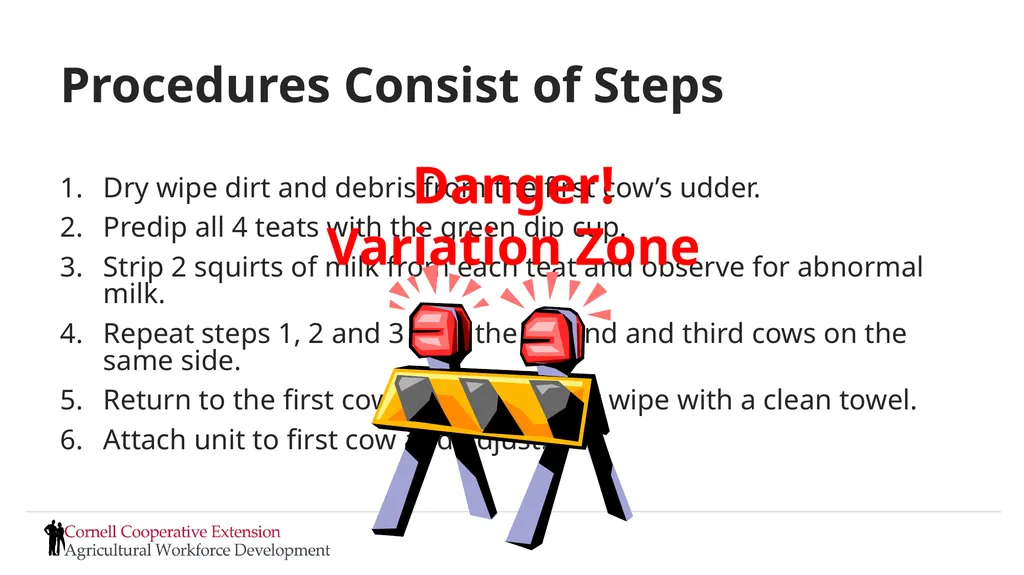
Procedures Consist of Steps Dry wipe dirt and debris from the first cow’s udder.
Predip all 4 teats with the green dip cup.
Strip 2 squirts of milk from each teat and observe for abnormal milk.
Repeat steps 1, 2 and 3 with the second and third cows on the same side.
Return to the first cow and thoroughly wipe with a clean towel.
Attach unit to first cow and adjust. Danger!
Variation Zone<br>
Predip all 4 teats with the green dip cup.
Strip 2 squirts of milk from each teat and observe for abnormal milk.
Repeat steps 1, 2 and 3 with the second and third cows on the same side.
Return to the first cow and thoroughly wipe with a clean towel.
Attach unit to first cow and adjust. Danger!
Variation Zone<br>
29
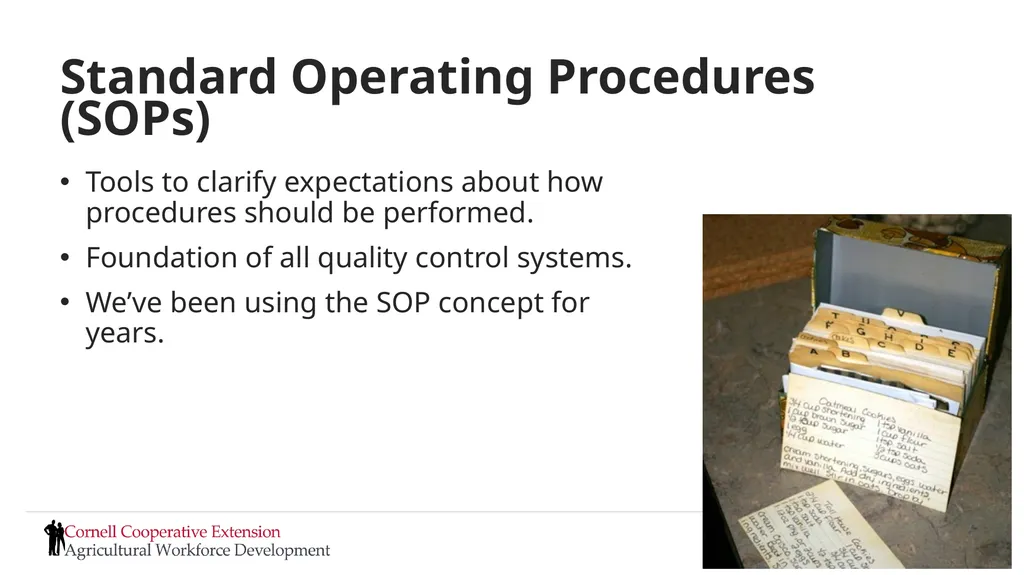
Standard Operating Procedures (SOPs) Tools to clarify expectations about how procedures should be performed.
Foundation of all quality control systems.
We’ve been using the SOP concept for years.<br>
Foundation of all quality control systems.
We’ve been using the SOP concept for years.<br>
30
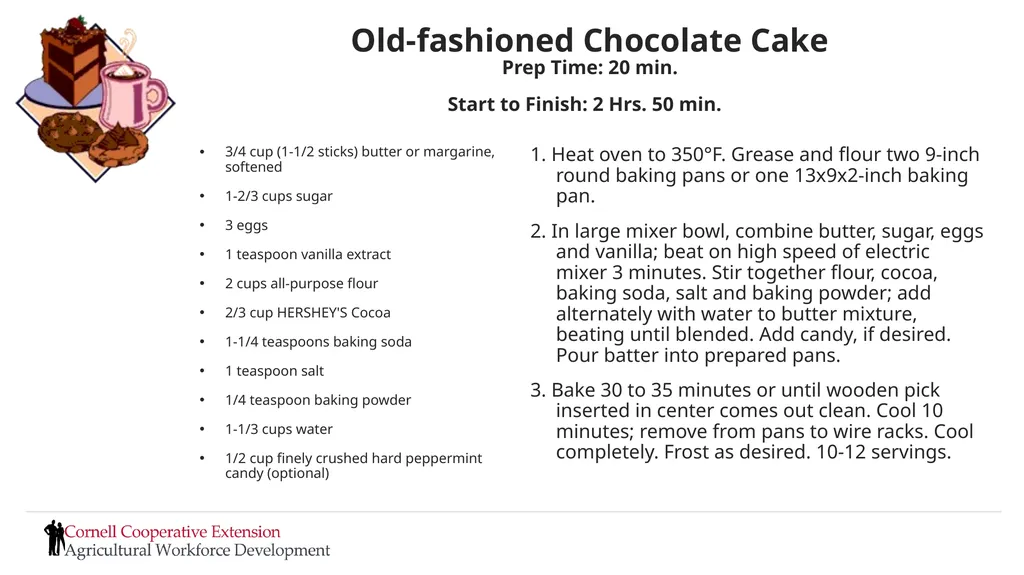
Old-fashioned Chocolate Cake
Prep Time: 20 min.
Start to Finish: 2 Hrs. 50 min. 3/4 cup (1-1/2 sticks) butter or margarine, softened
1-2/3 cups sugar
3 eggs
1 teaspoon vanilla extract
2 cups all-purpose flour
2/3 cup HERSHEY'S Cocoa
1-1/4 teaspoons baking soda
1 teaspoon salt
1/4 teaspoon baking powder
1-1/3 cups water
1/2 cup finely crushed hard peppermint candy (optional) 1. Heat oven to 350°F. Grease and flour two 9-inch round baking pans or one 13x9x2-inch baking pan.
2. In large mixer bowl, combine butter, sugar, eggs and vanilla; beat on high speed of electric mixer 3 minutes. Stir together flour, cocoa, baking soda, salt and baking powder; add alternately with water to butter mixture, beating until blended. Add candy, if desired. Pour batter into prepared pans.
3. Bake 30 to 35 minutes or until wooden pick inserted in center comes out clean. Cool 10 minutes; remove from pans to wire racks. Cool completely. Frost as desired. 10-12 servings.<br>
1-2/3 cups sugar
3 eggs
1 teaspoon vanilla extract
2 cups all-purpose flour
2/3 cup HERSHEY'S Cocoa
1-1/4 teaspoons baking soda
1 teaspoon salt
1/4 teaspoon baking powder
1-1/3 cups water
1/2 cup finely crushed hard peppermint candy (optional) 1. Heat oven to 350°F. Grease and flour two 9-inch round baking pans or one 13x9x2-inch baking pan.
2. In large mixer bowl, combine butter, sugar, eggs and vanilla; beat on high speed of electric mixer 3 minutes. Stir together flour, cocoa, baking soda, salt and baking powder; add alternately with water to butter mixture, beating until blended. Add candy, if desired. Pour batter into prepared pans.
3. Bake 30 to 35 minutes or until wooden pick inserted in center comes out clean. Cool 10 minutes; remove from pans to wire racks. Cool completely. Frost as desired. 10-12 servings.<br>
31
When can SOP’s help
improve a system? When variation must be controlled.
When safety risks are present.
When numerous people perform the same procedure.
When outside advisors’ input is needed.
When management wants to create a “culture of improvement.”
When objective feedback on performance is desired.
When steps and decisions can be standardized.<br>
When safety risks are present.
When numerous people perform the same procedure.
When outside advisors’ input is needed.
When management wants to create a “culture of improvement.”
When objective feedback on performance is desired.
When steps and decisions can be standardized.<br>
32
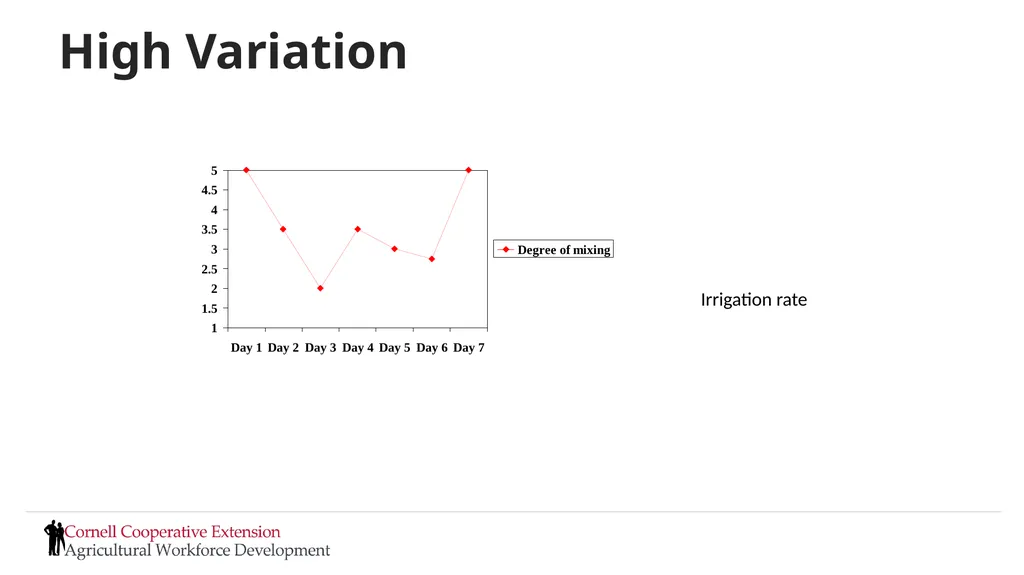
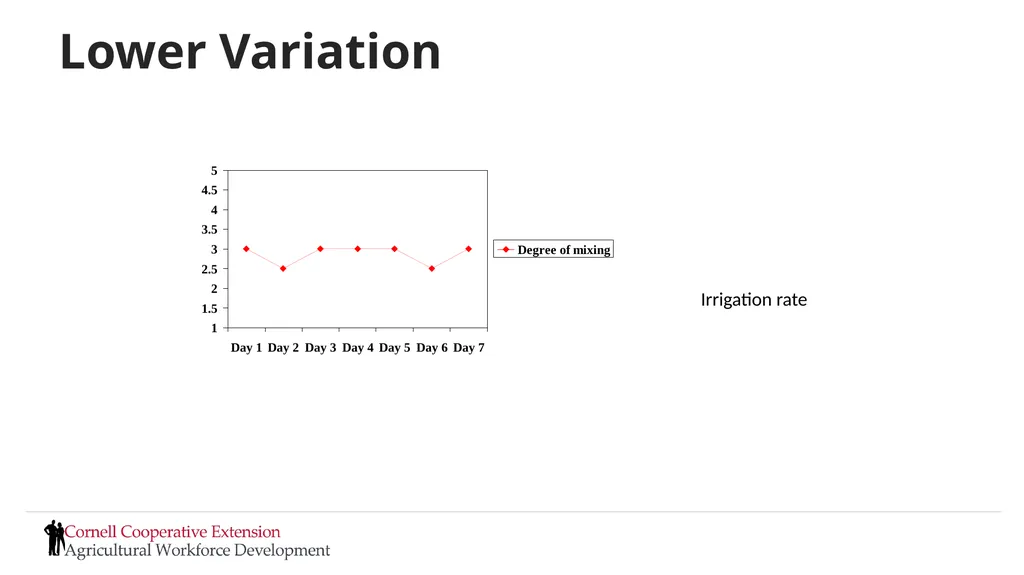
So what is the big problem with variation?<br>
33
High Variation Irrigation rate<br>
34
Lower Variation Irrigation rate<br>
35
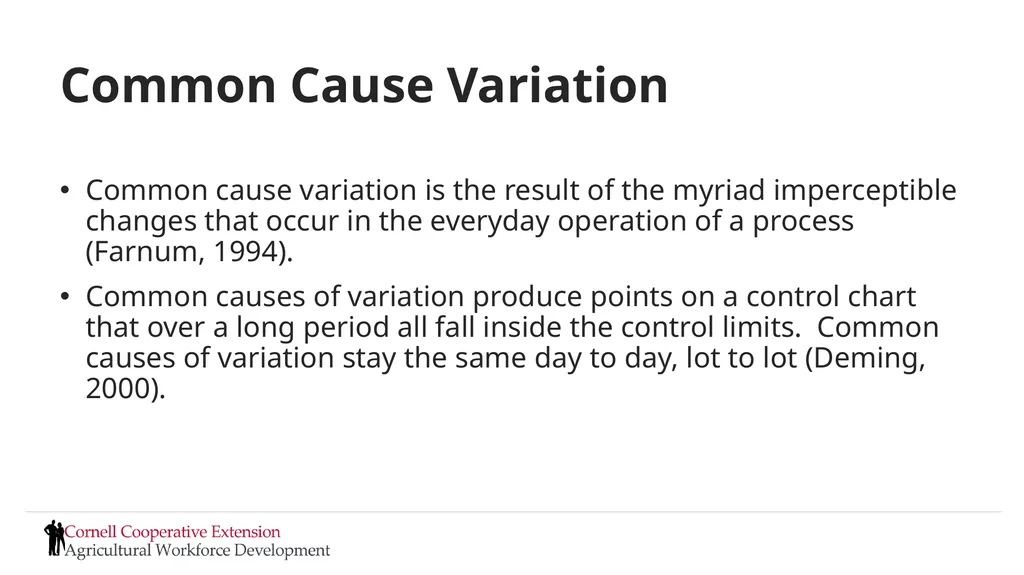
Common Cause Variation Common cause variation is the result of the myriad imperceptible changes that occur in the everyday operation of a process (Farnum, 1994).
Common causes of variation produce points on a control chart that over a long period all fall inside the control limits. Common causes of variation stay the same day to day, lot to lot (Deming, 2000).<br>
Common causes of variation produce points on a control chart that over a long period all fall inside the control limits. Common causes of variation stay the same day to day, lot to lot (Deming, 2000).<br>
36
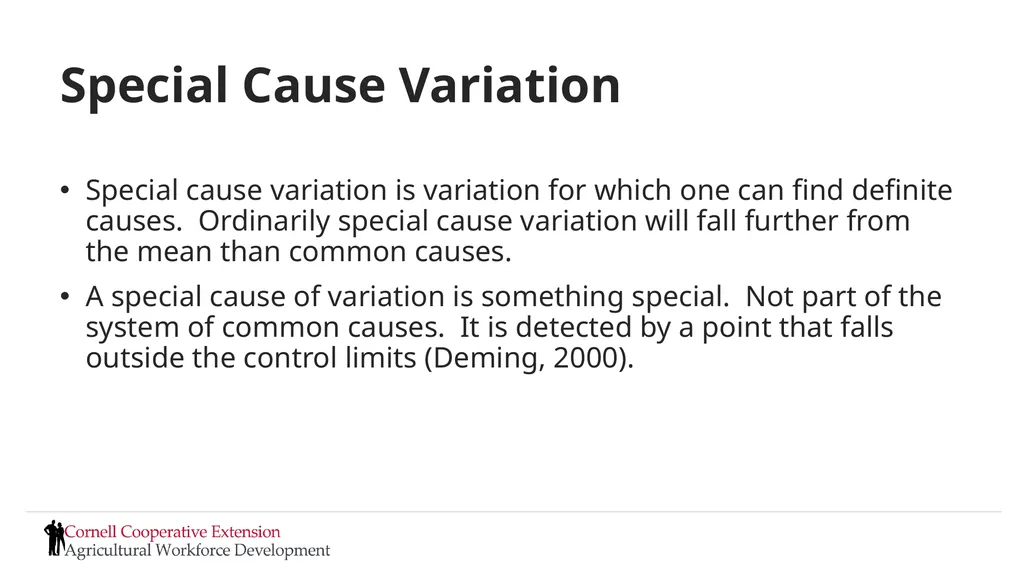
Special Cause Variation Special cause variation is variation for which one can find definite causes. Ordinarily special cause variation will fall further from the mean than common causes.
A special cause of variation is something special. Not part of the system of common causes. It is detected by a point that falls outside the control limits (Deming, 2000).<br>
A special cause of variation is something special. Not part of the system of common causes. It is detected by a point that falls outside the control limits (Deming, 2000).<br>
37
Variation Discussion What are the sources of variations in your business?
Which ones are common cause and which are special cause?
How can you tell?<br>
Which ones are common cause and which are special cause?
How can you tell?<br>
38
The purpose of SOPs is to control variation that people introduce into a system.<br>
39
Wipe dirt and debris from the first cow’s udder.
Pre-dip all 4 teats with the green dip cup.
Strip 2 squirts of milk from each teat and observe for abnormal milk.
Repeat steps 1, 2, and 3 with the second and third cows on the same side.
Return to the first cow and thoroughly wipe with a clean towel.
Attach unit to the first cow and adjust. Simple Steps<br>
Pre-dip all 4 teats with the green dip cup.
Strip 2 squirts of milk from each teat and observe for abnormal milk.
Repeat steps 1, 2, and 3 with the second and third cows on the same side.
Return to the first cow and thoroughly wipe with a clean towel.
Attach unit to the first cow and adjust. Simple Steps<br>
40
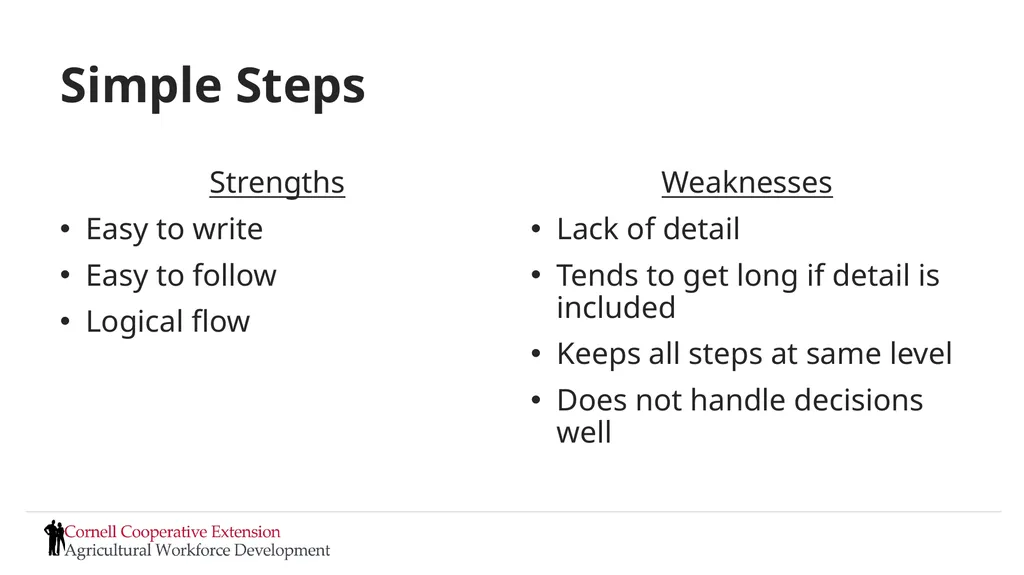
Simple Steps Strengths
Easy to write
Easy to follow
Logical flow Weaknesses
Lack of detail
Tends to get long if detail is included
Keeps all steps at same level
Does not handle decisions well<br>
Easy to write
Easy to follow
Logical flow Weaknesses
Lack of detail
Tends to get long if detail is included
Keeps all steps at same level
Does not handle decisions well<br>
41
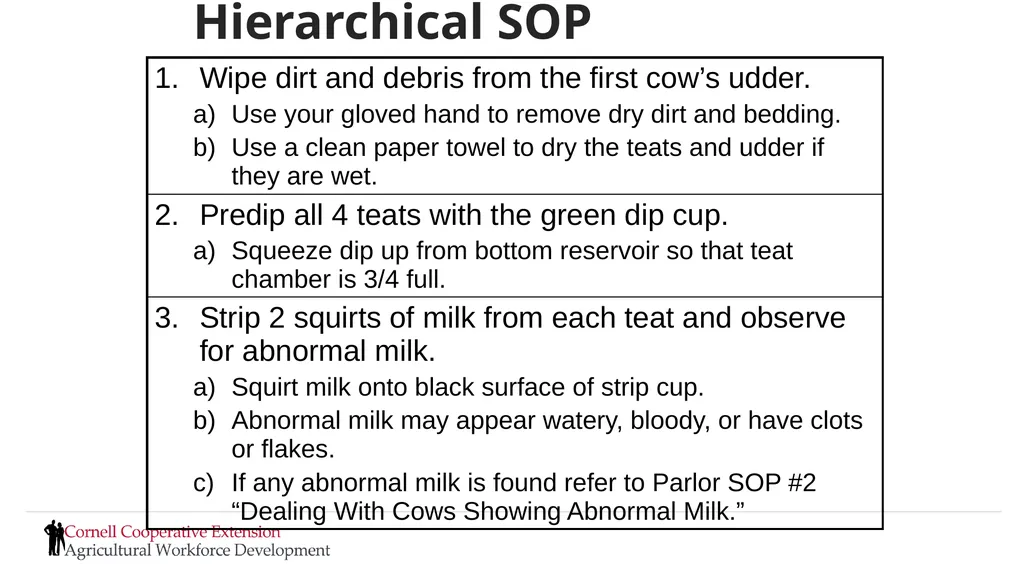
Hierarchical SOP<br>
42
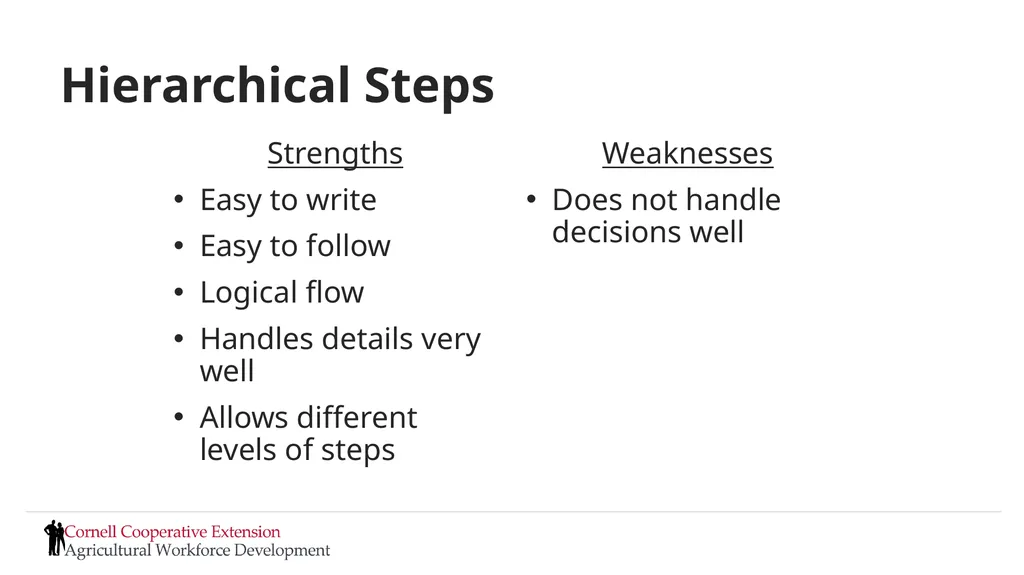
Hierarchical Steps Strengths
Easy to write
Easy to follow
Logical flow
Handles details very well
Allows different levels of steps Weaknesses
Does not handle decisions well<br>
Easy to write
Easy to follow
Logical flow
Handles details very well
Allows different levels of steps Weaknesses
Does not handle decisions well<br>
43
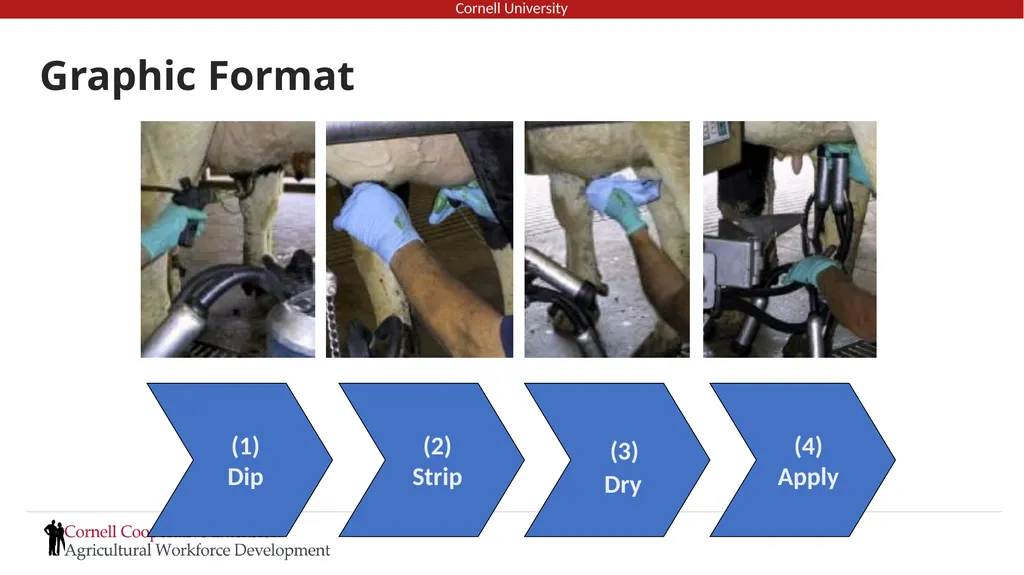
Graphic Format (1)
Dip (2)
Strip (3)
Dry (4)
Apply<br>
Dip (2)
Strip (3)
Dry (4)
Apply<br>
44
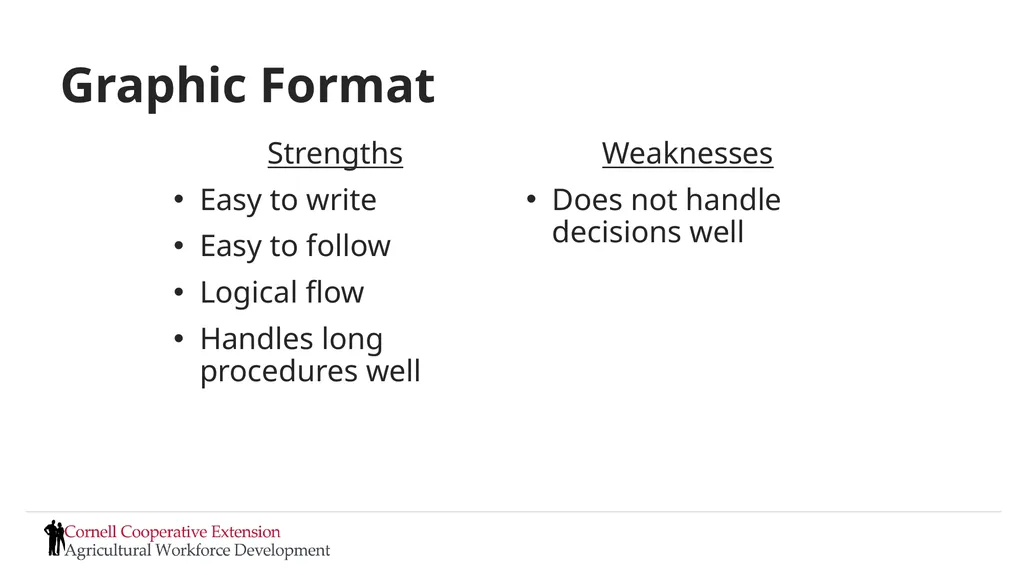
Graphic Format Strengths
Easy to write
Easy to follow
Logical flow
Handles long procedures well Weaknesses
Does not handle decisions well<br>
Easy to write
Easy to follow
Logical flow
Handles long procedures well Weaknesses
Does not handle decisions well<br>
45
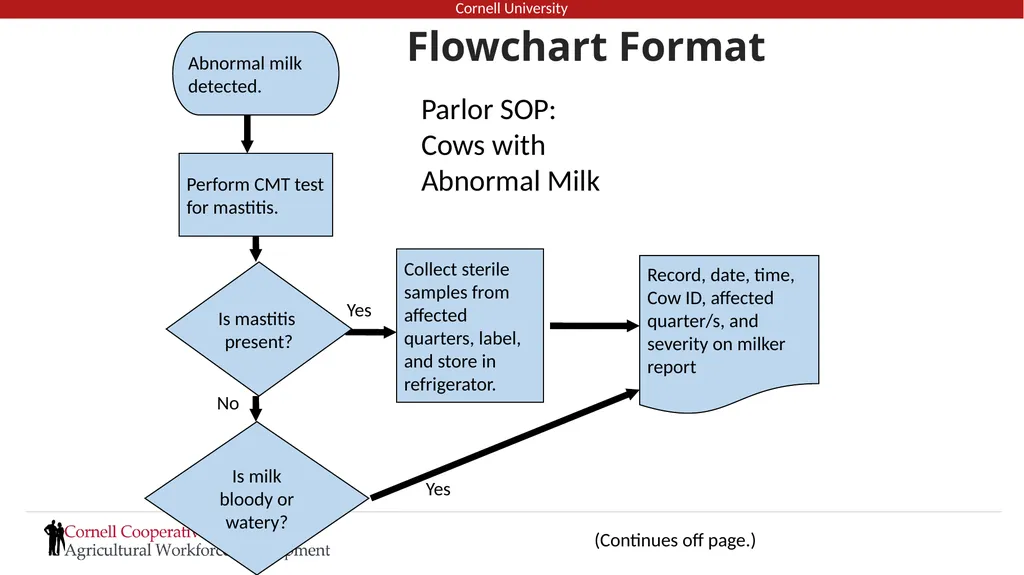
Flowchart Format Abnormal milk detected. Perform CMT test for mastitis. Record, date, time, Cow ID, affected quarter/s, and severity on milker report Collect sterile samples from affected quarters, label, and store in refrigerator. No Yes Yes (Continues off page.) Is milk bloody or watery? Is mastitis
present? Parlor SOP: Cows with Abnormal Milk<br>
present? Parlor SOP: Cows with Abnormal Milk<br>
46
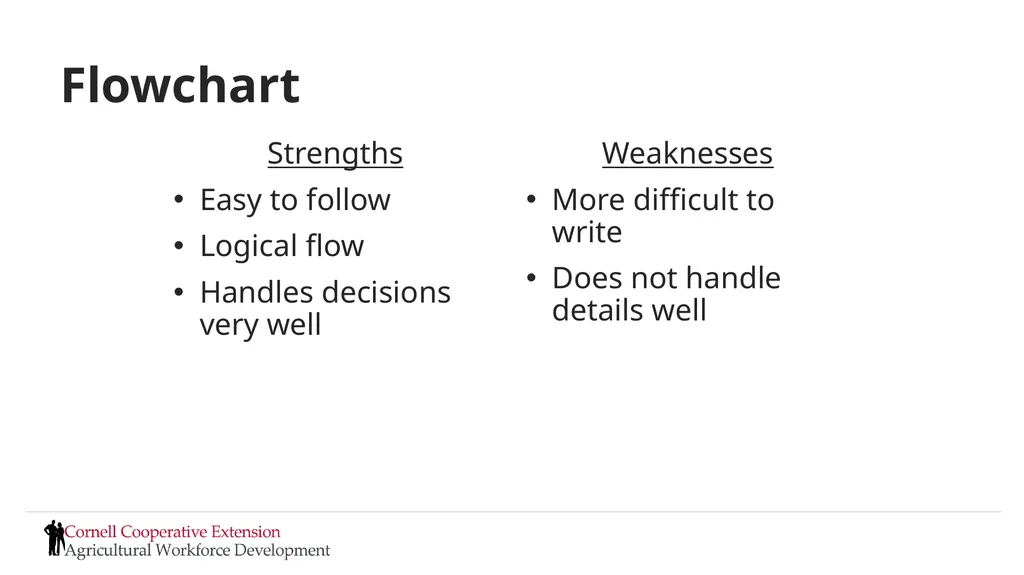
Flowchart Strengths
Easy to follow
Logical flow
Handles decisions very well Weaknesses
More difficult to write
Does not handle details well<br>
Easy to follow
Logical flow
Handles decisions very well Weaknesses
More difficult to write
Does not handle details well<br>
47
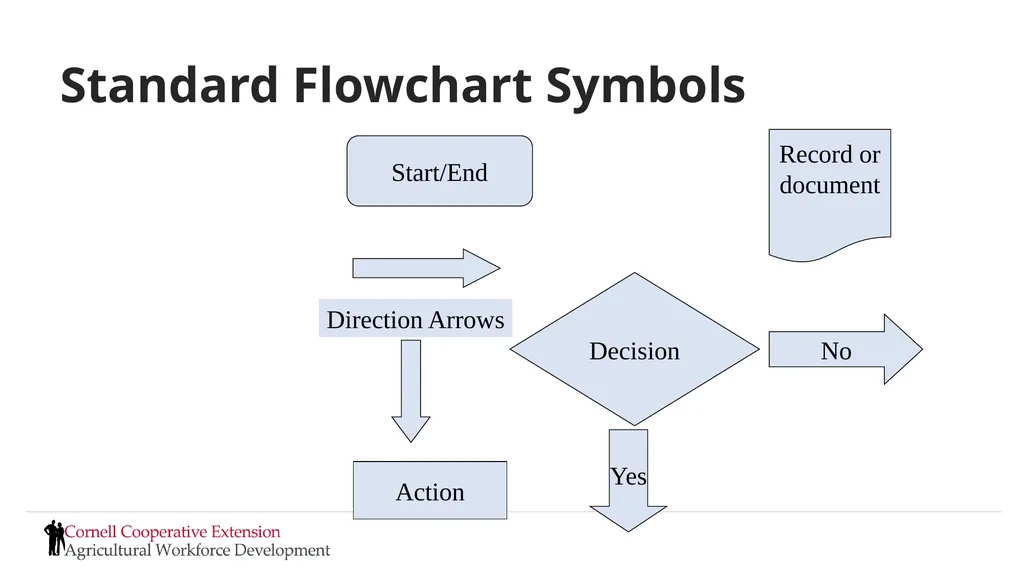
Standard Flowchart Symbols Decision Start/End Record or document Action Direction Arrows Yes No<br>
48
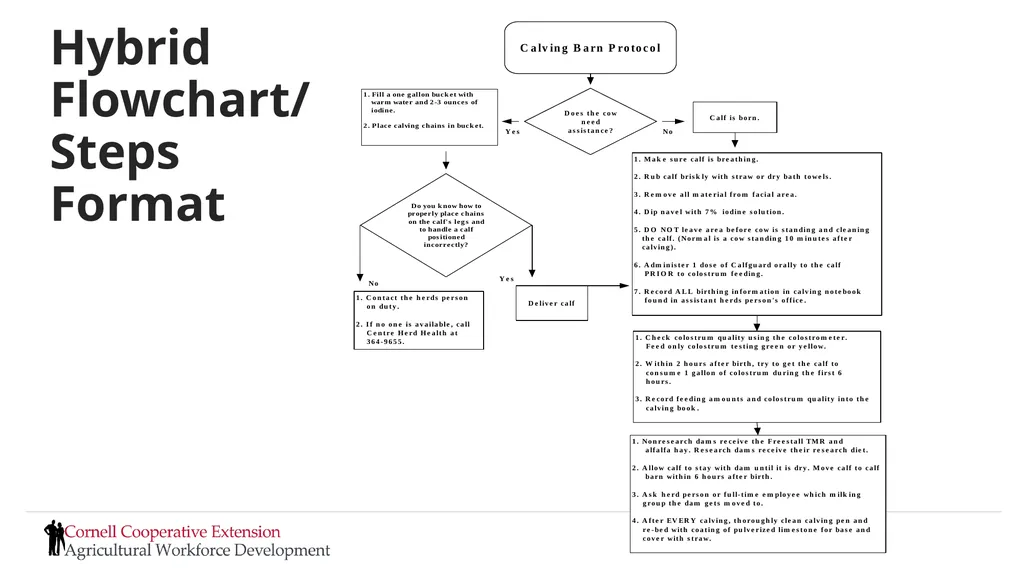
Hybrid Flowchart/
Steps Format<br>
49
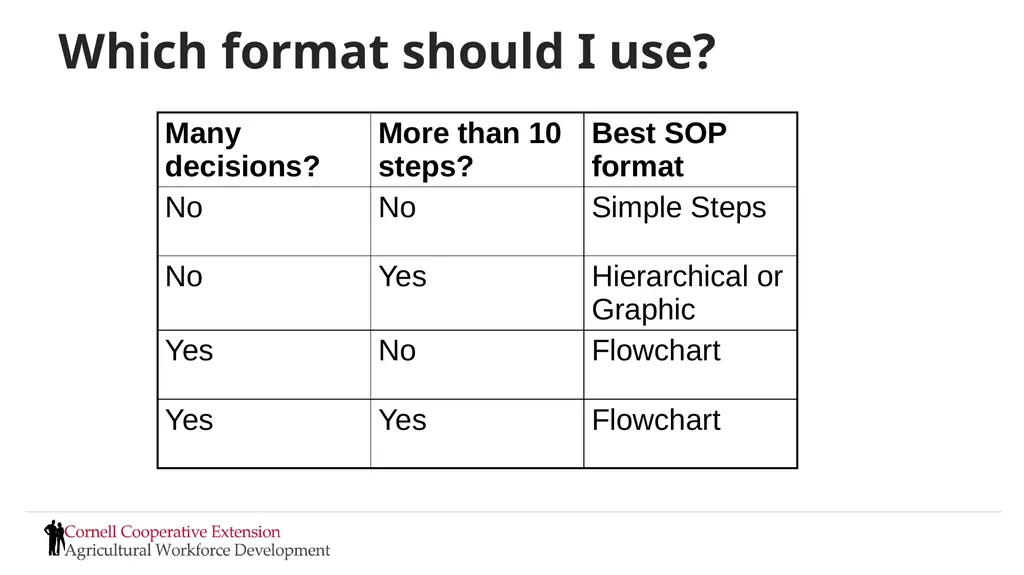
Which format should I use?<br>
50
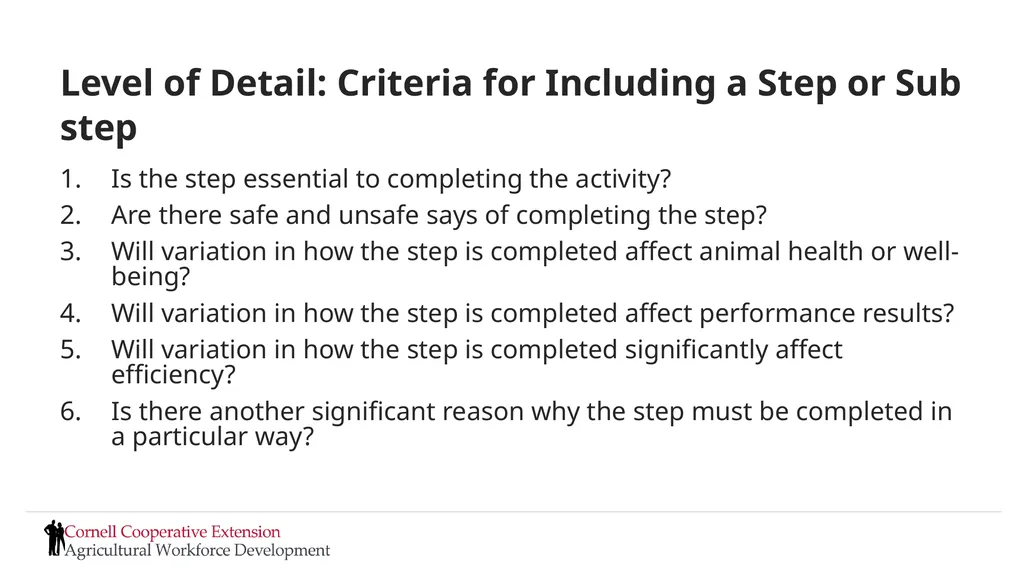
Level of Detail: Criteria for Including a Step or Sub step Is the step essential to completing the activity?
Are there safe and unsafe says of completing the step?
Will variation in how the step is completed affect animal health or well-being?
Will variation in how the step is completed affect performance results?
Will variation in how the step is completed significantly affect efficiency?
Is there another significant reason why the step must be completed in a particular way?<br>
Are there safe and unsafe says of completing the step?
Will variation in how the step is completed affect animal health or well-being?
Will variation in how the step is completed affect performance results?
Will variation in how the step is completed significantly affect efficiency?
Is there another significant reason why the step must be completed in a particular way?<br>
51
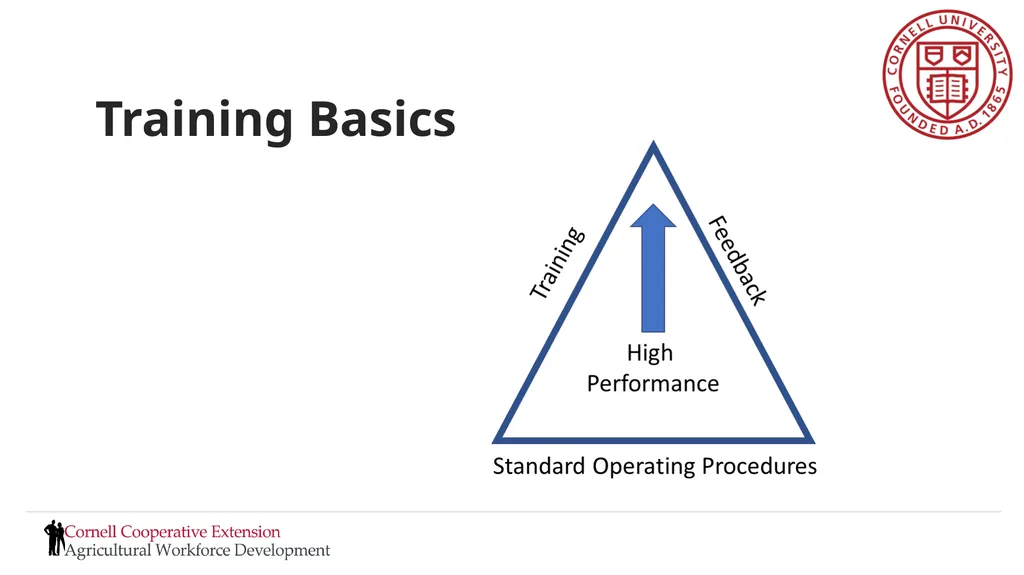
Training Basics<br>
52
Activity Divide up into teams of two.
Select a procedure and draft a simple steps or hierarchical steps SOP.
Select a procedure and draft an SOP in flowchart format.<br>
Select a procedure and draft a simple steps or hierarchical steps SOP.
Select a procedure and draft an SOP in flowchart format.<br>
53
Training Skills Just because you can do the job doesn’t mean you can teach someone else, not everyone is a trainer.
Ideally supervisors should train, next choice is designated, qualified and prepared peer trainers.
The Onboarding Project will include bilingual workshops to teach essential training skills for supervisors and peer trainers.<br>
Ideally supervisors should train, next choice is designated, qualified and prepared peer trainers.
The Onboarding Project will include bilingual workshops to teach essential training skills for supervisors and peer trainers.<br>
54
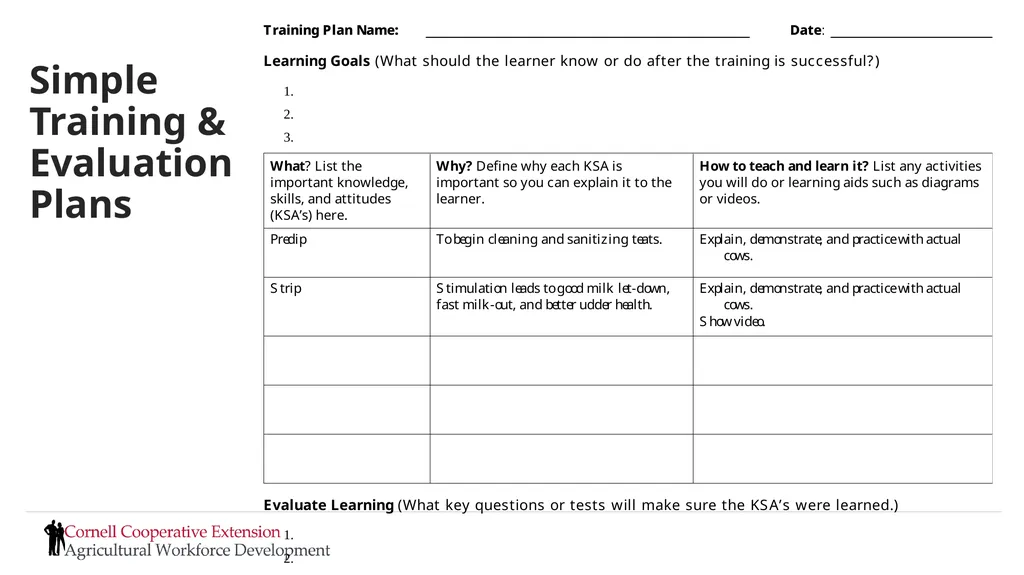
Simple
Training &
Evaluation
Plans<br>
55
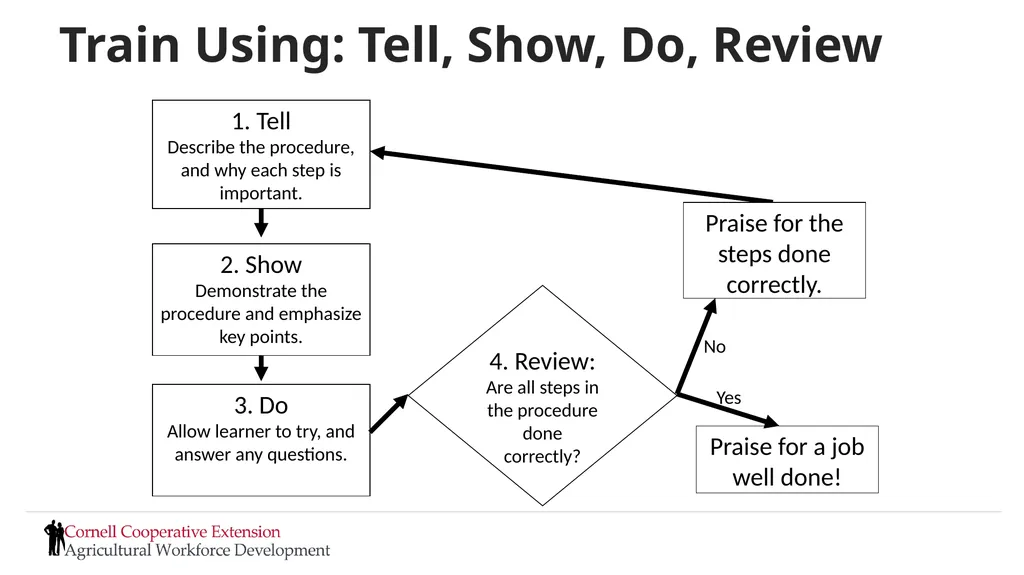
Train Using: Tell, Show, Do, Review 3. Do
Allow learner to try, and answer any questions. 4. Review:
Are all steps in the procedure done correctly? Praise for a job well done! No Yes 2. Show
Demonstrate the procedure and emphasize key points. Praise for the steps done correctly. 1. Tell
Describe the procedure, and why each step is important.<br>
Allow learner to try, and answer any questions. 4. Review:
Are all steps in the procedure done correctly? Praise for a job well done! No Yes 2. Show
Demonstrate the procedure and emphasize key points. Praise for the steps done correctly. 1. Tell
Describe the procedure, and why each step is important.<br>
56
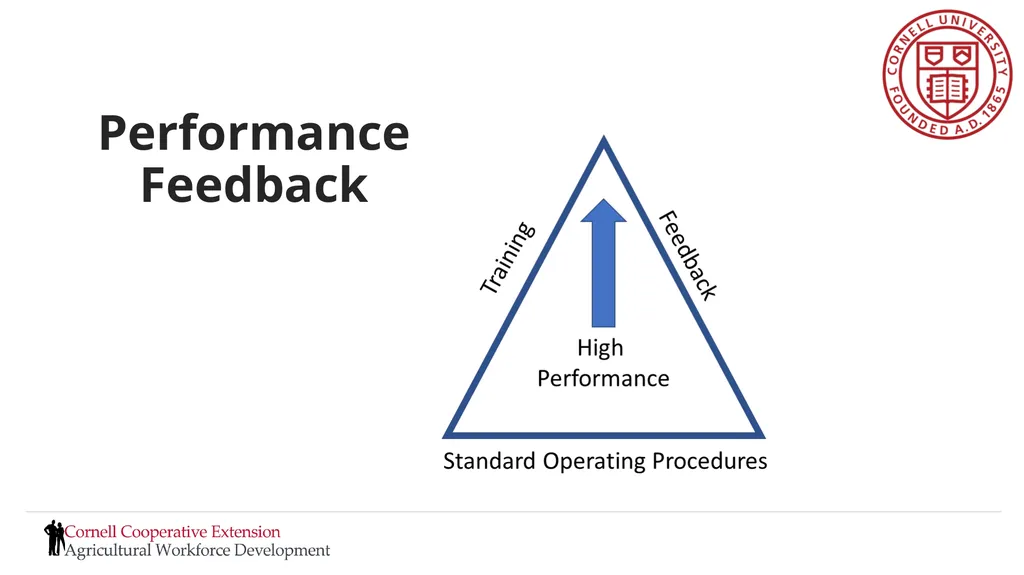
Performance Feedback<br>
57
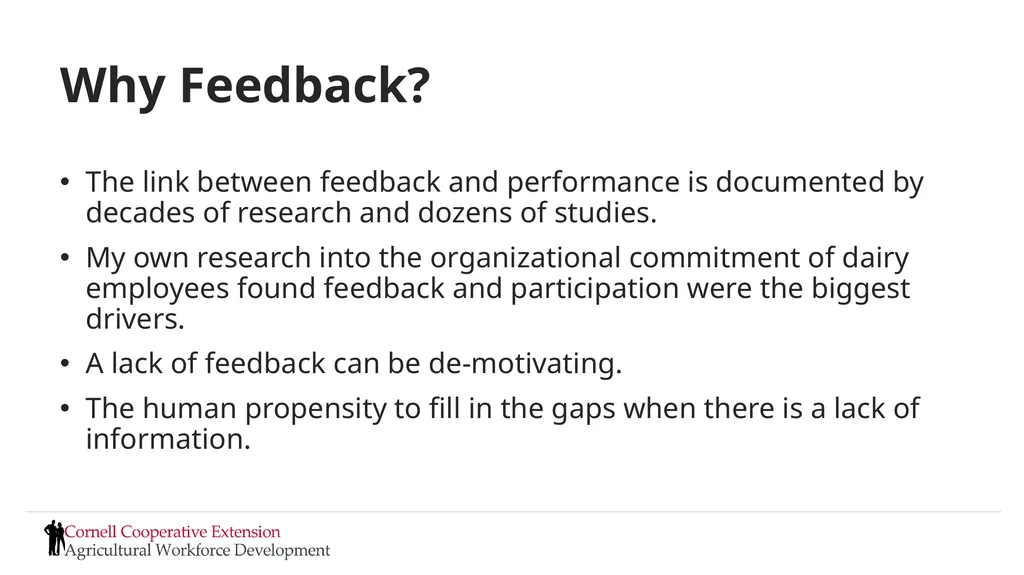
Why Feedback? The link between feedback and performance is documented by decades of research and dozens of studies.
My own research into the organizational commitment of dairy employees found feedback and participation were the biggest drivers.
A lack of feedback can be de-motivating.
The human propensity to fill in the gaps when there is a lack of information.<br>
My own research into the organizational commitment of dairy employees found feedback and participation were the biggest drivers.
A lack of feedback can be de-motivating.
The human propensity to fill in the gaps when there is a lack of information.<br>
58
Feedback and Coaching Catch people doing things right.
Continue providing deeper and more substantial information about why.
Encourage people to become “experts.”
Use coaching to develop and enhance skills.<br>
Continue providing deeper and more substantial information about why.
Encourage people to become “experts.”
Use coaching to develop and enhance skills.<br>
59
Forums for Feedback Individual
Specific activities/behaviors within the individual’s control
Activities that can be objectively observed or measured
Group
Regular numerical data about results of a group’s performance
Information about emerging trends (positive or negative) that the group can influence
Group recognition to build teamwork and recognize successes<br>
Specific activities/behaviors within the individual’s control
Activities that can be objectively observed or measured
Group
Regular numerical data about results of a group’s performance
Information about emerging trends (positive or negative) that the group can influence
Group recognition to build teamwork and recognize successes<br>
60
“There is virtually no feedback - either positive or negative. So you don't know whether you're doing a good job, or a lousy job. When we do get a pat on the back, it's in a meeting of mostly all farm workers and its just a general statement. And I know that a couple workers present don't do their jobs. So I don't know where I stand. I think I do a good job, but maybe they think they do too.”
-- New York Front-line Employee<br>
61
“Feedback usually only comes when I do something wrong - and it's never in person - it's always written to me on a dry-erase board.”
-- Supervisor in Ohio<br>
62
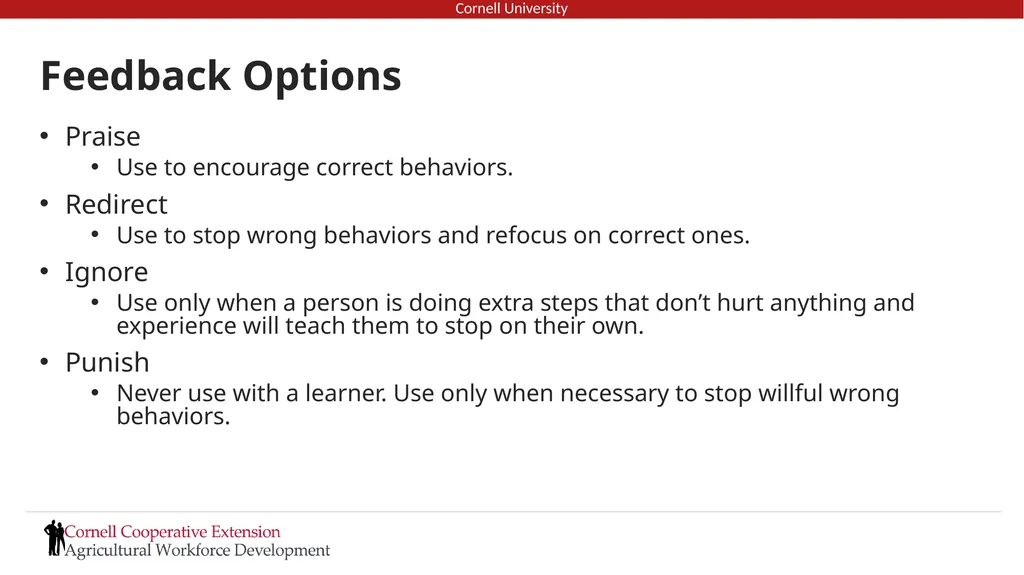
Praise
Use to encourage correct behaviors.
Redirect
Use to stop wrong behaviors and refocus on correct ones.
Ignore
Use only when a person is doing extra steps that don’t hurt anything and experience will teach them to stop on their own.
Punish
Never use with a learner. Use only when necessary to stop willful wrong behaviors. Feedback Options<br>
Use to encourage correct behaviors.
Redirect
Use to stop wrong behaviors and refocus on correct ones.
Ignore
Use only when a person is doing extra steps that don’t hurt anything and experience will teach them to stop on their own.
Punish
Never use with a learner. Use only when necessary to stop willful wrong behaviors. Feedback Options<br>
63
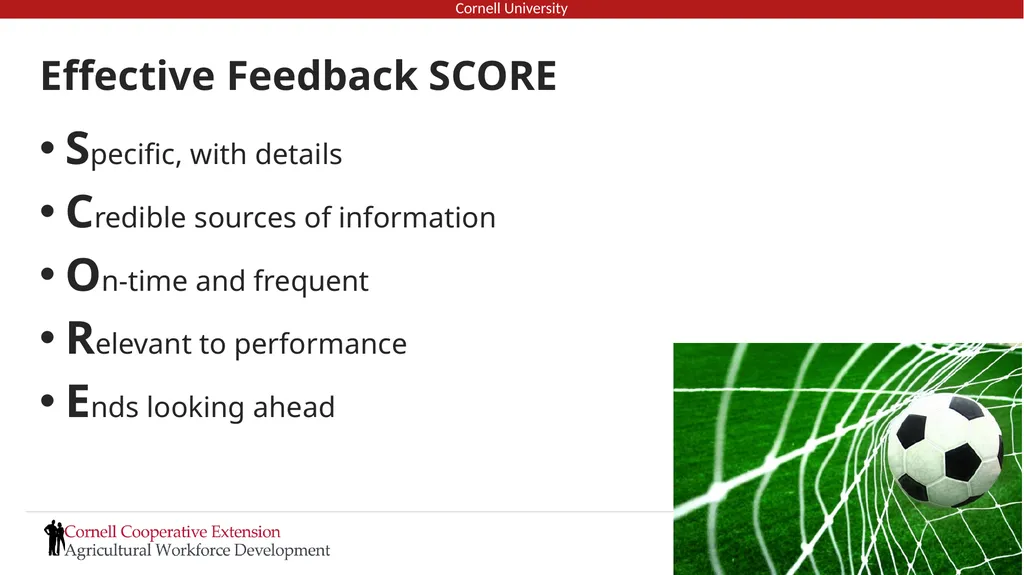
Specific, with details
Credible sources of information
On-time and frequent
Relevant to performance
Ends looking ahead Effective Feedback SCORE<br>
Credible sources of information
On-time and frequent
Relevant to performance
Ends looking ahead Effective Feedback SCORE<br>
64
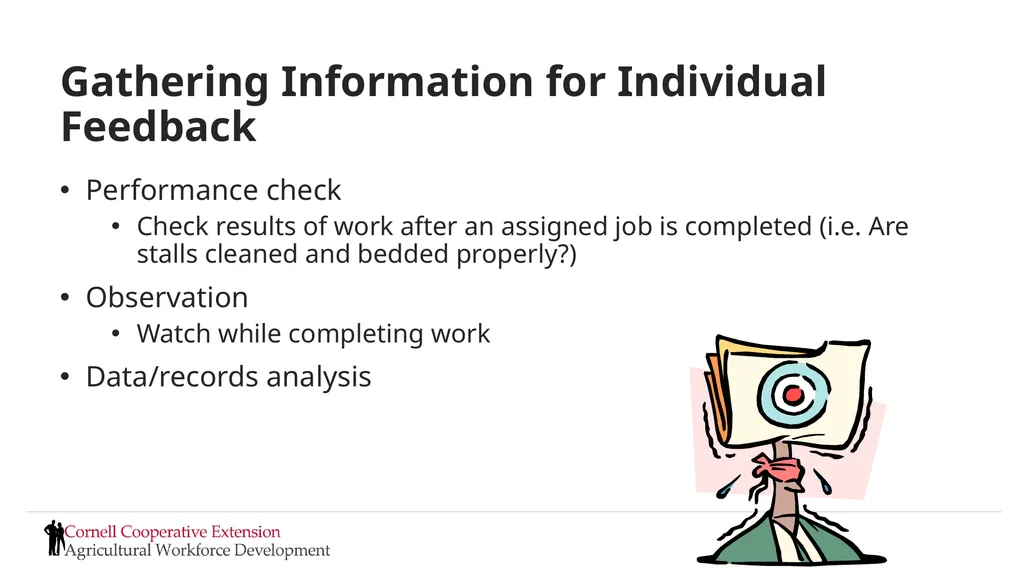
Gathering Information for Individual Feedback Performance check
Check results of work after an assigned job is completed (i.e. Are stalls cleaned and bedded properly?)
Observation
Watch while completing work
Data/records analysis<br>
Check results of work after an assigned job is completed (i.e. Are stalls cleaned and bedded properly?)
Observation
Watch while completing work
Data/records analysis<br>
65
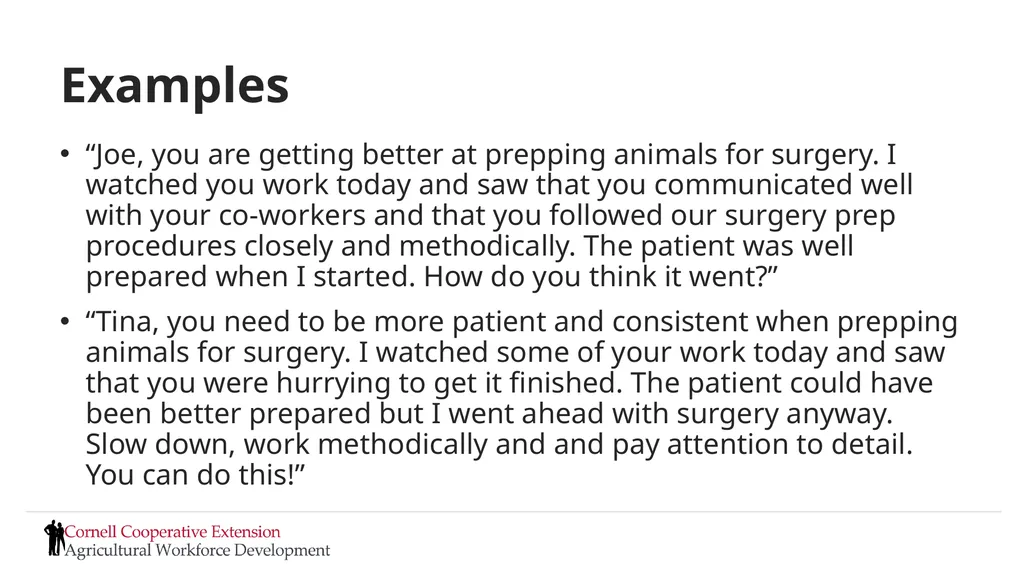
“Joe, you are getting better at prepping animals for surgery. I watched you work today and saw that you communicated well with your co-workers and that you followed our surgery prep procedures closely and methodically. The patient was well prepared when I started. How do you think it went?”
“Tina, you need to be more patient and consistent when prepping animals for surgery. I watched some of your work today and saw that you were hurrying to get it finished. The patient could have been better prepared but I went ahead with surgery anyway. Slow down, work methodically and and pay attention to detail. You can do this!” Examples<br>
“Tina, you need to be more patient and consistent when prepping animals for surgery. I watched some of your work today and saw that you were hurrying to get it finished. The patient could have been better prepared but I went ahead with surgery anyway. Slow down, work methodically and and pay attention to detail. You can do this!” Examples<br>
66
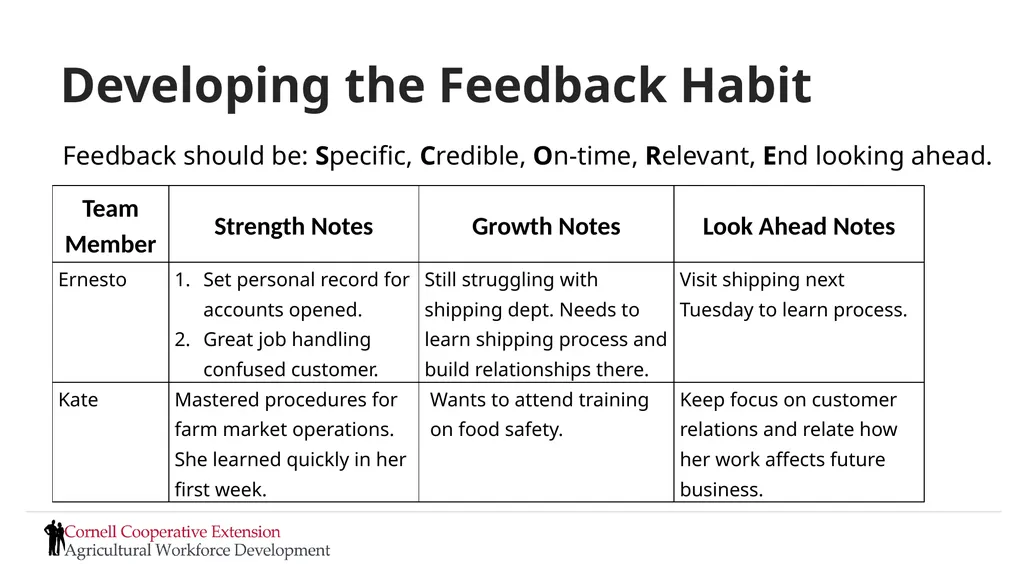
Feedback should be: Specific, Credible, On-time, Relevant, End looking ahead. Developing the Feedback Habit<br>
67
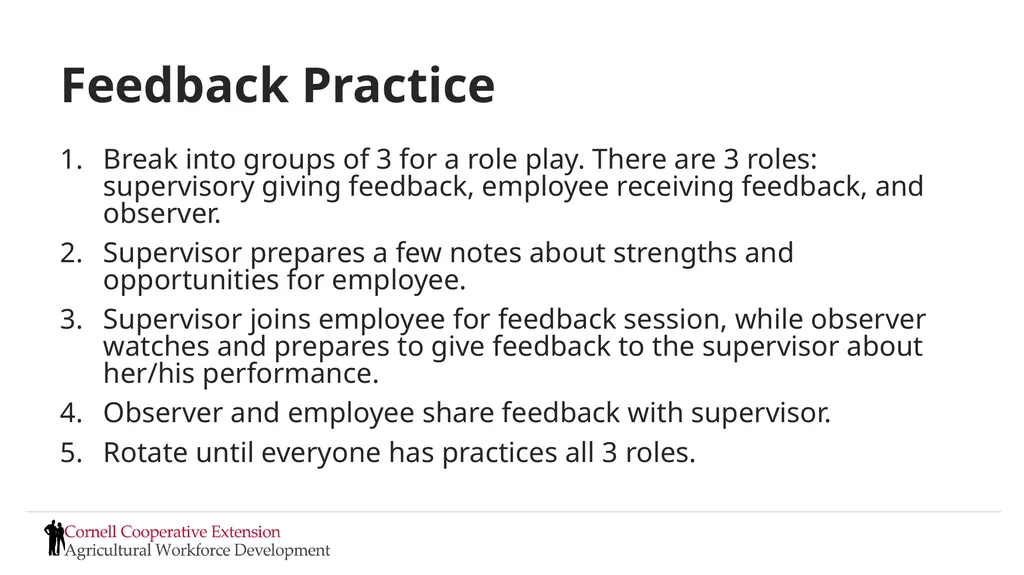
Feedback Practice Break into groups of 3 for a role play. There are 3 roles: supervisory giving feedback, employee receiving feedback, and observer.
Supervisor prepares a few notes about strengths and opportunities for employee.
Supervisor joins employee for feedback session, while observer watches and prepares to give feedback to the supervisor about her/his performance.
Observer and employee share feedback with supervisor.
Rotate until everyone has practices all 3 roles.<br>
Supervisor prepares a few notes about strengths and opportunities for employee.
Supervisor joins employee for feedback session, while observer watches and prepares to give feedback to the supervisor about her/his performance.
Observer and employee share feedback with supervisor.
Rotate until everyone has practices all 3 roles.<br>
68
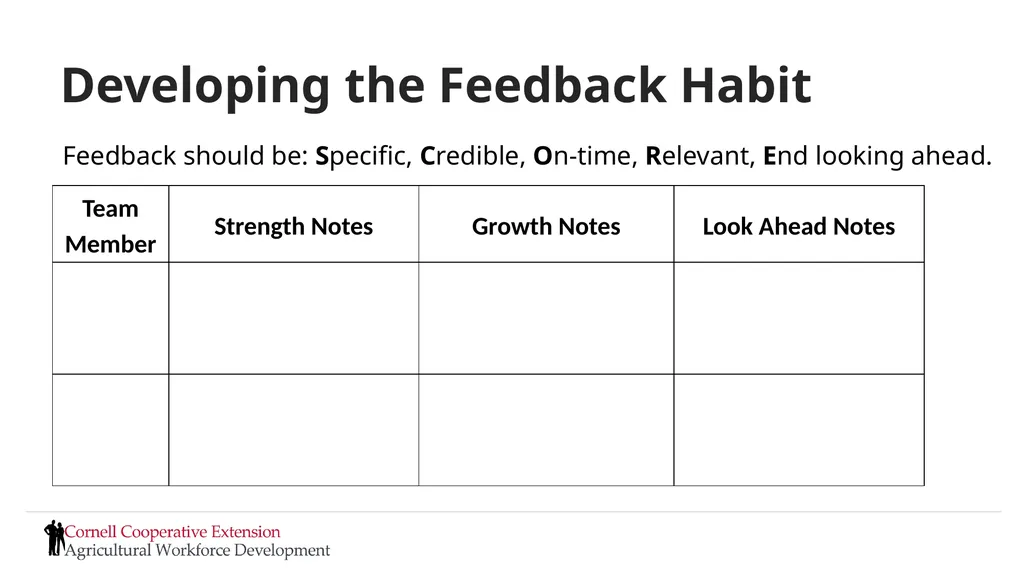
Feedback should be: Specific, Credible, On-time, Relevant, End looking ahead. Developing the Feedback Habit<br>
69
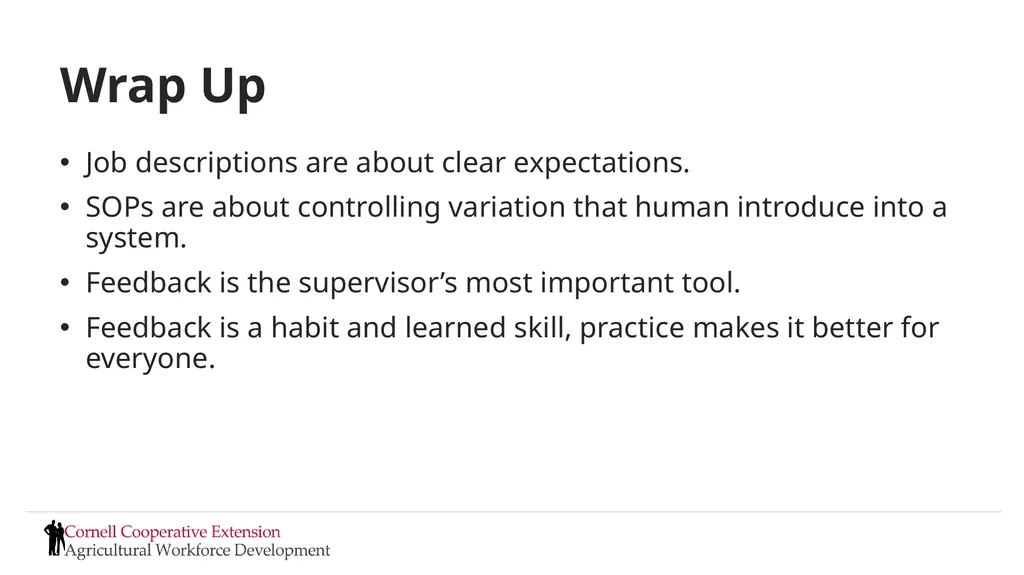
Wrap Up Job descriptions are about clear expectations.
SOPs are about controlling variation that human introduce into a system.
Feedback is the supervisor’s most important tool.
Feedback is a habit and learned skill, practice makes it better for everyone.<br>
SOPs are about controlling variation that human introduce into a system.
Feedback is the supervisor’s most important tool.
Feedback is a habit and learned skill, practice makes it better for everyone.<br>
70
Application and Take Home Share one strategy or practice that you’ve found works well in your role as a supervisor.
Share one key take home message that you’ve learned from this workshop, or one goal that you plan to work on.<br>
Share one key take home message that you’ve learned from this workshop, or one goal that you plan to work on.<br>