
Setting Standards for Global Health Costing Anna
EM
Published · 49 slides · 0 views

1 / 1



Description
Setting Standards for Global Health Costing Anna Vassall, LSHTM, on behalf the GHCC consortium Why set standards in costing? Improving the nature and extent of use of cost data: Systematic reviews of costs suggest a wide variety of costing
Related Topics
Share
Embed code
Download this presentation From Below
"Setting Standards for Global Health Costing Anna" is the property of its rightful owner. Permission is granted to download and print the materials on this website for personal, non-commercial use only, and to display it on your personal computer provided you do not modify the materials and that you retain all copyright notices contained in the materials. By downloading content from our website, you accept the terms of this agreement.
Presentation Transcript
01
Setting Standards for Global Health Costing Anna Vassall, LSHTM,
on behalf the GHCC consortium<br>
on behalf the GHCC consortium<br>
02
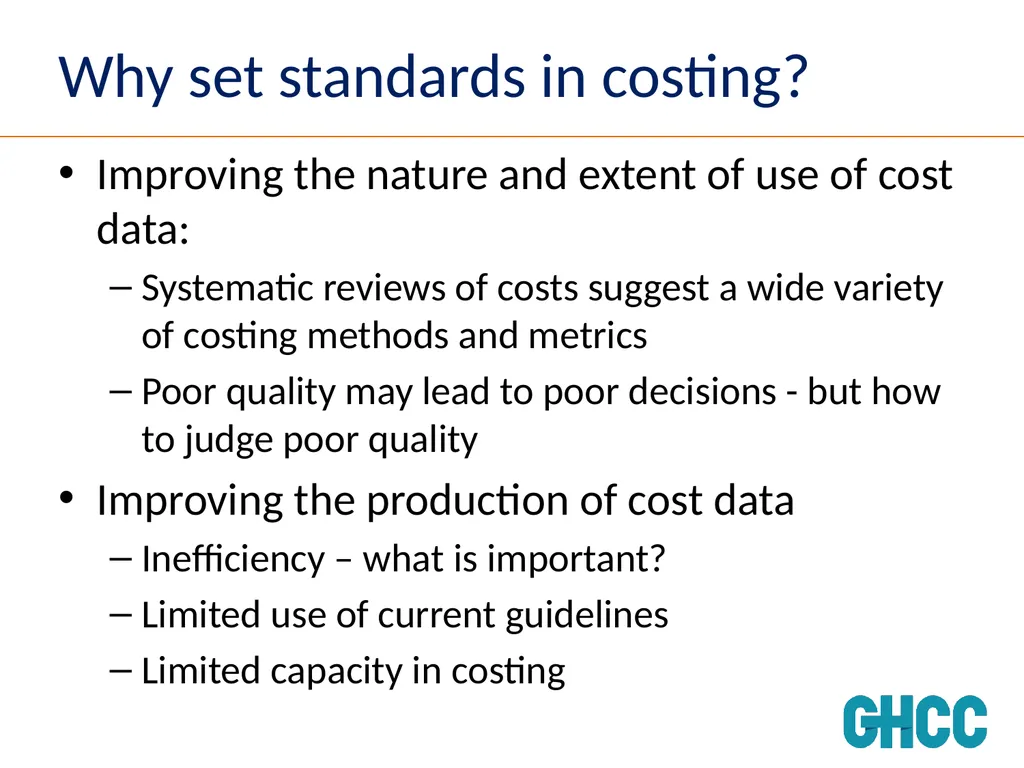
Why set standards in costing? Improving the nature and extent of use of cost data:
Systematic reviews of costs suggest a wide variety of costing methods and metrics
Poor quality may lead to poor decisions - but how to judge poor quality
Improving the production of cost data
Inefficiency – what is important?
Limited use of current guidelines
Limited capacity in costing<br>
Systematic reviews of costs suggest a wide variety of costing methods and metrics
Poor quality may lead to poor decisions - but how to judge poor quality
Improving the production of cost data
Inefficiency – what is important?
Limited use of current guidelines
Limited capacity in costing<br>
03
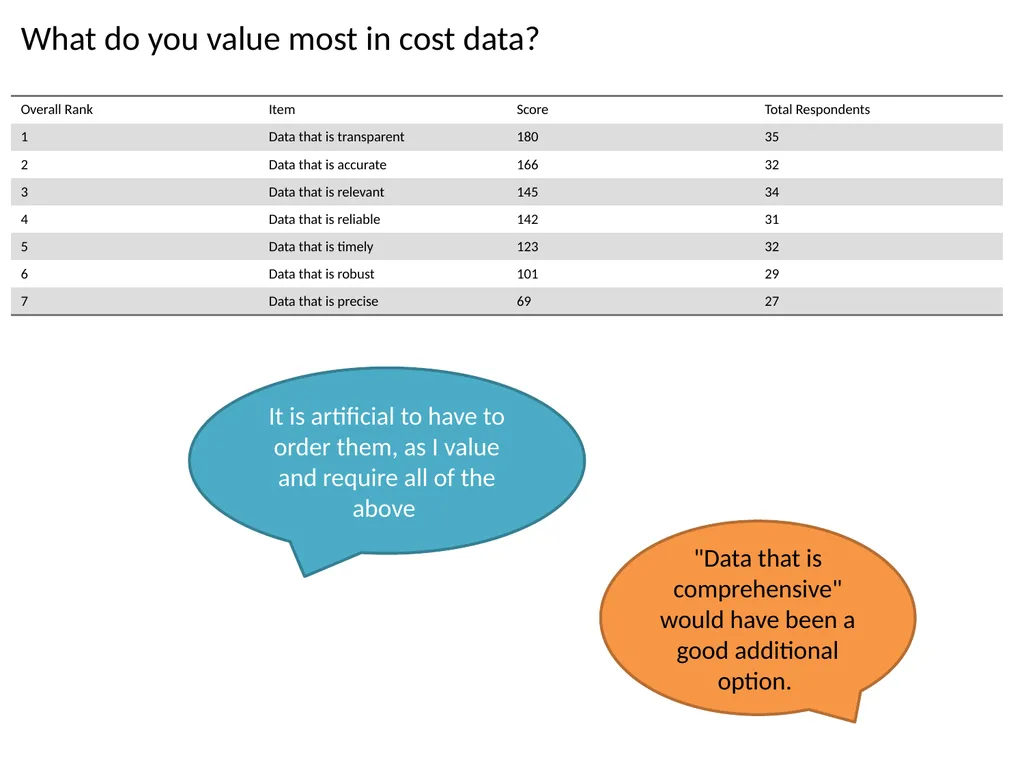
What do you value most in cost data? It is artificial to have to order them, as I value and require all of the above "Data that is comprehensive" would have been a good additional option.<br>
04
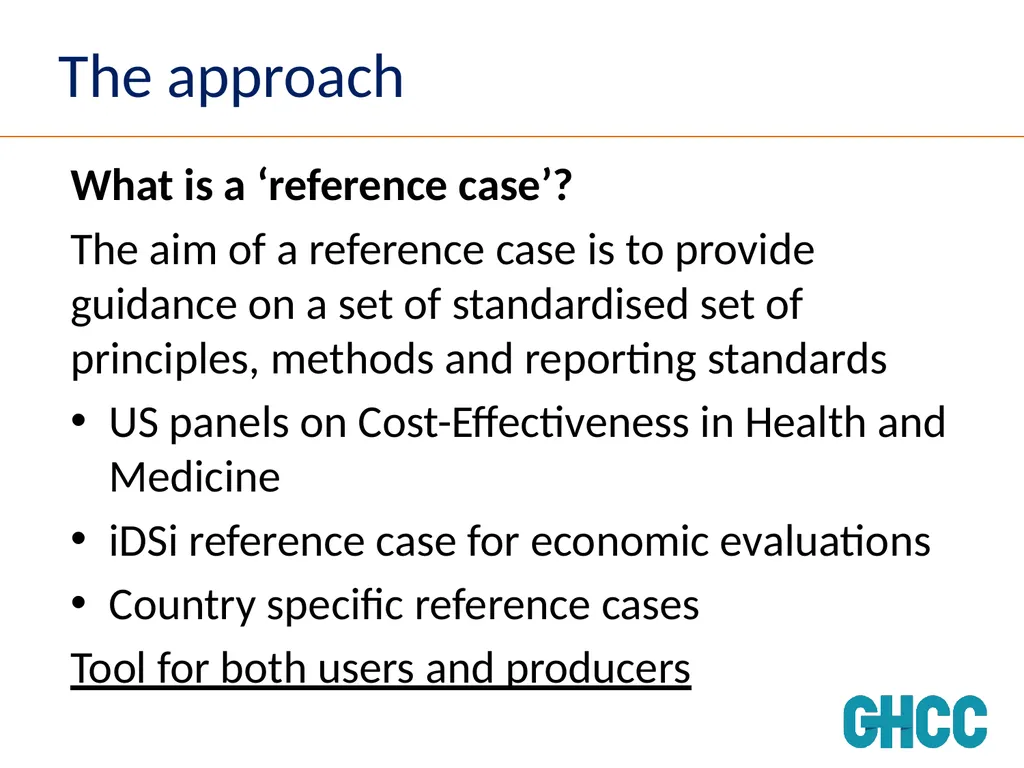
The approach What is a ‘reference case’?
The aim of a reference case is to provide guidance on a set of standardised set of principles, methods and reporting standards
US panels on Cost-Effectiveness in Health and Medicine
iDSi reference case for economic evaluations
Country specific reference cases
Tool for both users and producers<br>
The aim of a reference case is to provide guidance on a set of standardised set of principles, methods and reporting standards
US panels on Cost-Effectiveness in Health and Medicine
iDSi reference case for economic evaluations
Country specific reference cases
Tool for both users and producers<br>
05
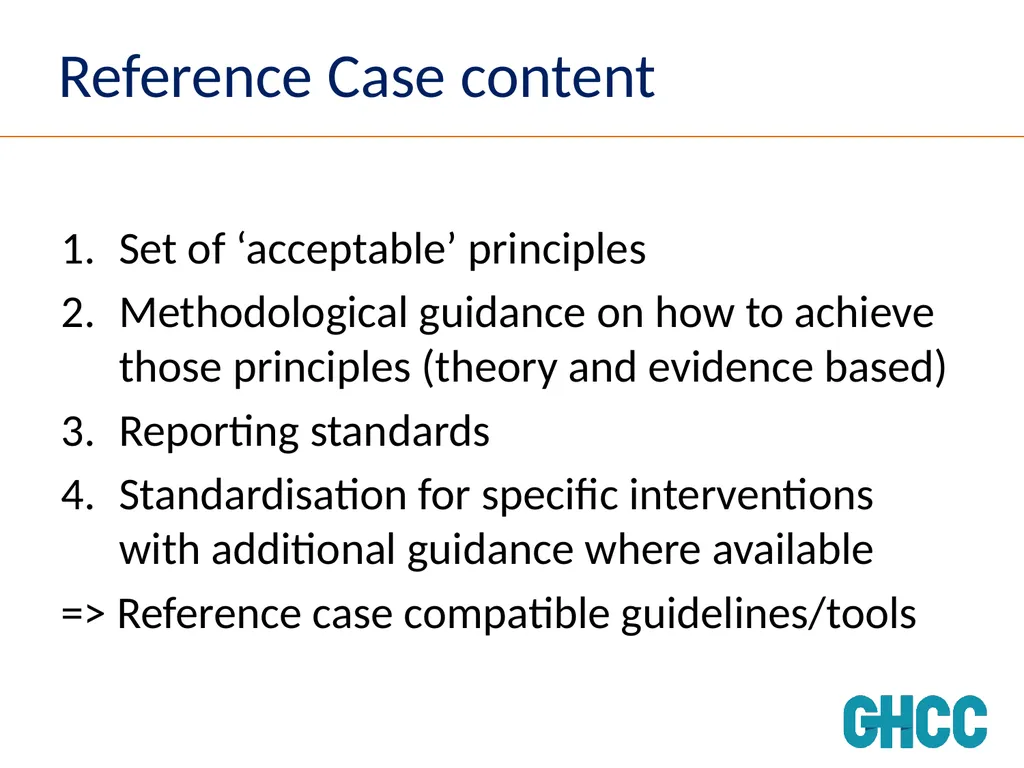
Reference Case content Set of ‘acceptable’ principles
Methodological guidance on how to achieve those principles (theory and evidence based)
Reporting standards
Standardisation for specific interventions with additional guidance where available
=> Reference case compatible guidelines/tools<br>
Methodological guidance on how to achieve those principles (theory and evidence based)
Reporting standards
Standardisation for specific interventions with additional guidance where available
=> Reference case compatible guidelines/tools<br>
06
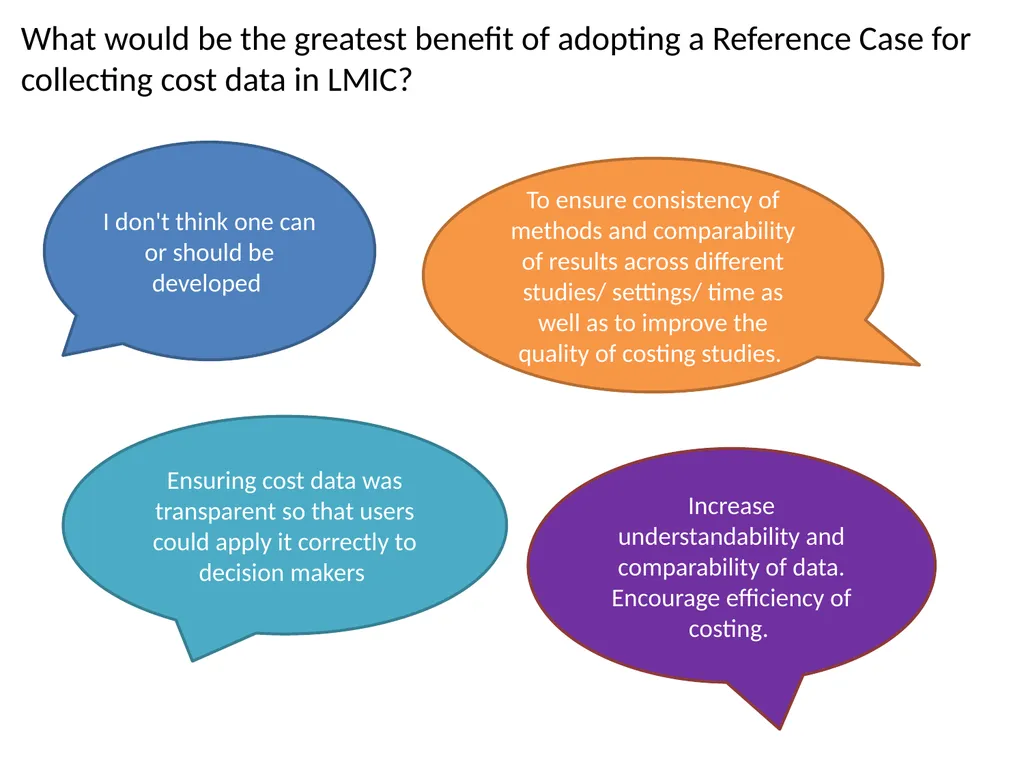
What would be the greatest benefit of adopting a Reference Case for collecting cost data in LMIC? I don't think one can or should be developed To ensure consistency of methods and comparability of results across different studies/ settings/ time as well as to improve the quality of costing studies. Ensuring cost data was transparent so that users could apply it correctly to decision makers Increase understandability and comparability of data. Encourage efficiency of costing.<br>
07
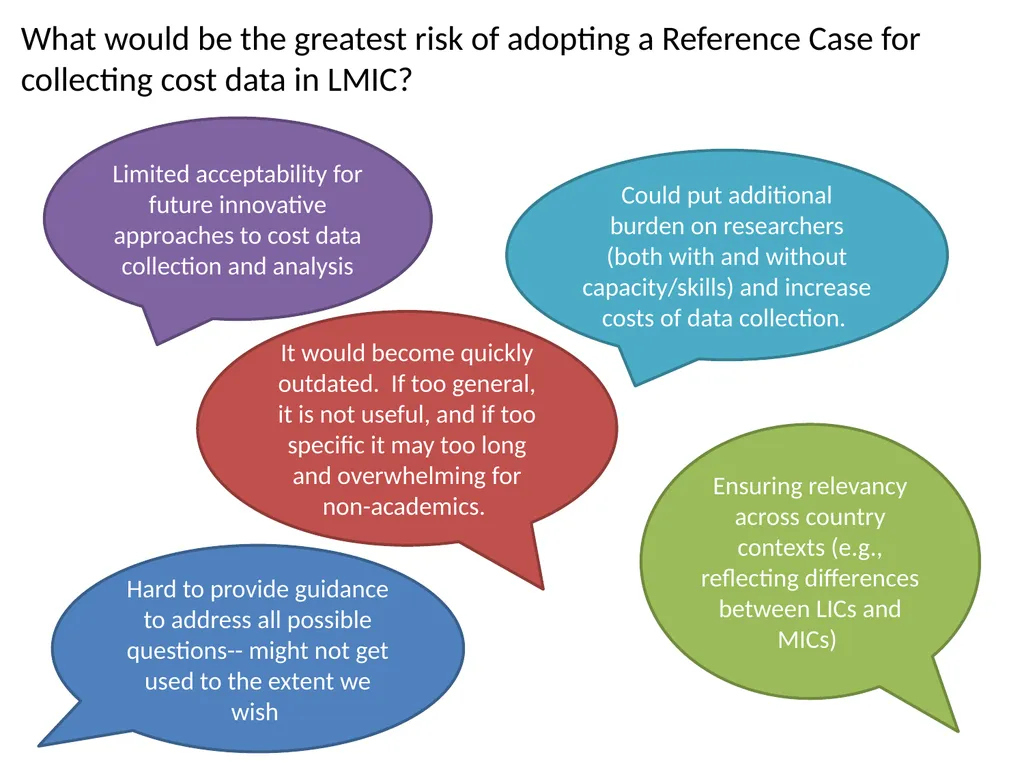
What would be the greatest risk of adopting a Reference Case for collecting cost data in LMIC? Limited acceptability for future innovative approaches to cost data collection and analysis Could put additional burden on researchers (both with and without capacity/skills) and increase costs of data collection. It would become quickly outdated. If too general, it is not useful, and if too specific it may too long and overwhelming for non-academics. Ensuring relevancy across country contexts (e.g., reflecting differences between LICs and MICs) Hard to provide guidance to address all possible questions-- might not get used to the extent we wish<br>
08
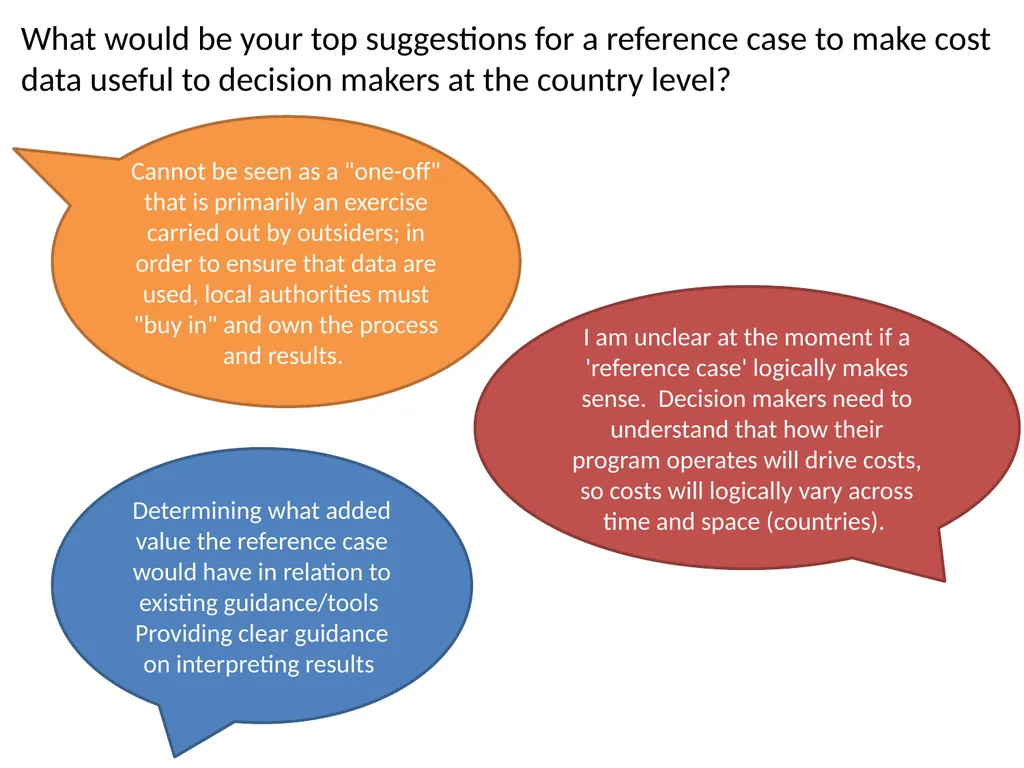
What would be your top suggestions for a reference case to make cost data useful to decision makers at the country level? Cannot be seen as a "one-off" that is primarily an exercise carried out by outsiders; in order to ensure that data are used, local authorities must "buy in" and own the process and results. I am unclear at the moment if a 'reference case' logically makes sense. Decision makers need to understand that how their program operates will drive costs, so costs will logically vary across time and space (countries). Determining what added value the reference case would have in relation to existing guidance/tools Providing clear guidance on interpreting results<br>
09
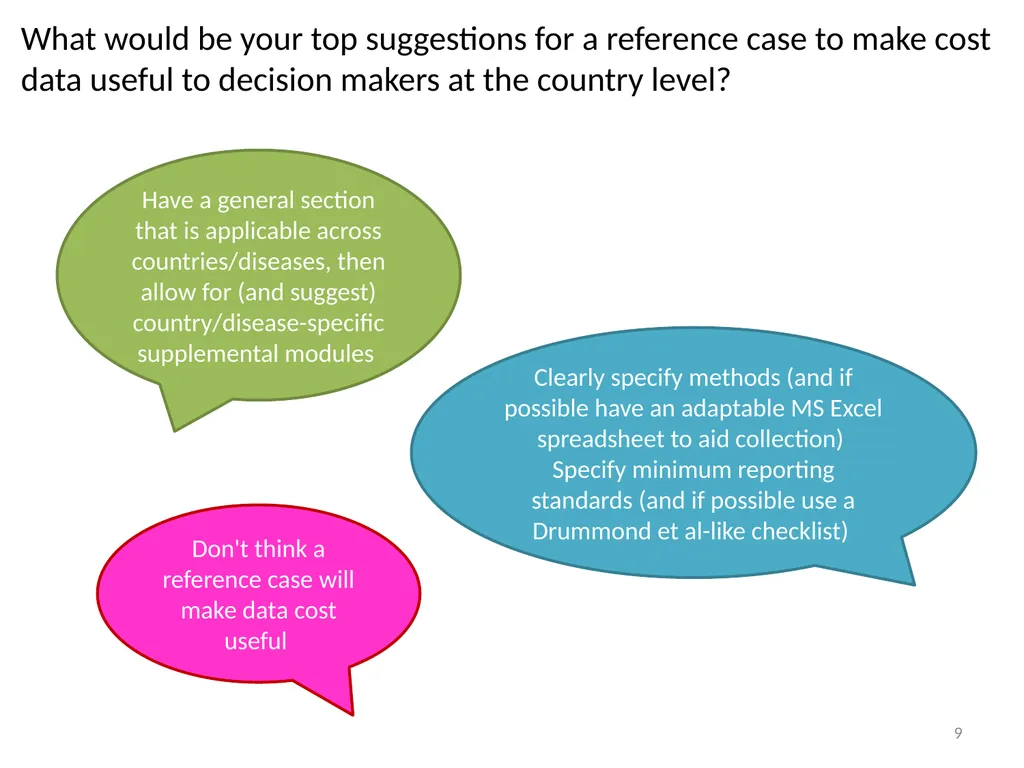
9 Have a general section that is applicable across countries/diseases, then allow for (and suggest) country/disease-specific supplemental modules Clearly specify methods (and if possible have an adaptable MS Excel spreadsheet to aid collection) Specify minimum reporting standards (and if possible use a Drummond et al-like checklist) Don't think a reference case will make data cost useful What would be your top suggestions for a reference case to make cost data useful to decision makers at the country level?<br>
10
What do we want to achieve? What is a ‘good enough’ standard in costing?
Costing is a process of estimation
Example characteristics of a good estimate:
Precision
Accuracy
But how accurate and precise is good enough?
Cost of getting it right compared to the cost of getting it wrong<br>
Costing is a process of estimation
Example characteristics of a good estimate:
Precision
Accuracy
But how accurate and precise is good enough?
Cost of getting it right compared to the cost of getting it wrong<br>
11
Other ‘desirable’ characteristics Generalisability
Can we apply the cost to other settings?
More important to be relevant to context?
Comparability and standardisation
Are cost estimates comparable with on another?
Innovation?
Reliablilty<br>
Can we apply the cost to other settings?
More important to be relevant to context?
Comparability and standardisation
Are cost estimates comparable with on another?
Innovation?
Reliablilty<br>
12
Our aim To improve the relevance, use and quality of cost estimates by:
Ensuring that the process of cost estimation is transparent, so that those using the data can apply estimates widely and appropriately
Framework for producers of cost data to consider how their methodological choices influence the quality and relevance of their estimates, and present data in way that maximises the extent of use<br>
Ensuring that the process of cost estimation is transparent, so that those using the data can apply estimates widely and appropriately
Framework for producers of cost data to consider how their methodological choices influence the quality and relevance of their estimates, and present data in way that maximises the extent of use<br>
13
Principles for purpose Many purposes
Economic evaluation and priority setting
Medium term planning
Budgeting
Price setting
Efficiency analyses
Study design and valuation methods differ
Tolerance for uncertainty may differ<br>
Economic evaluation and priority setting
Medium term planning
Budgeting
Price setting
Efficiency analyses
Study design and valuation methods differ
Tolerance for uncertainty may differ<br>
14
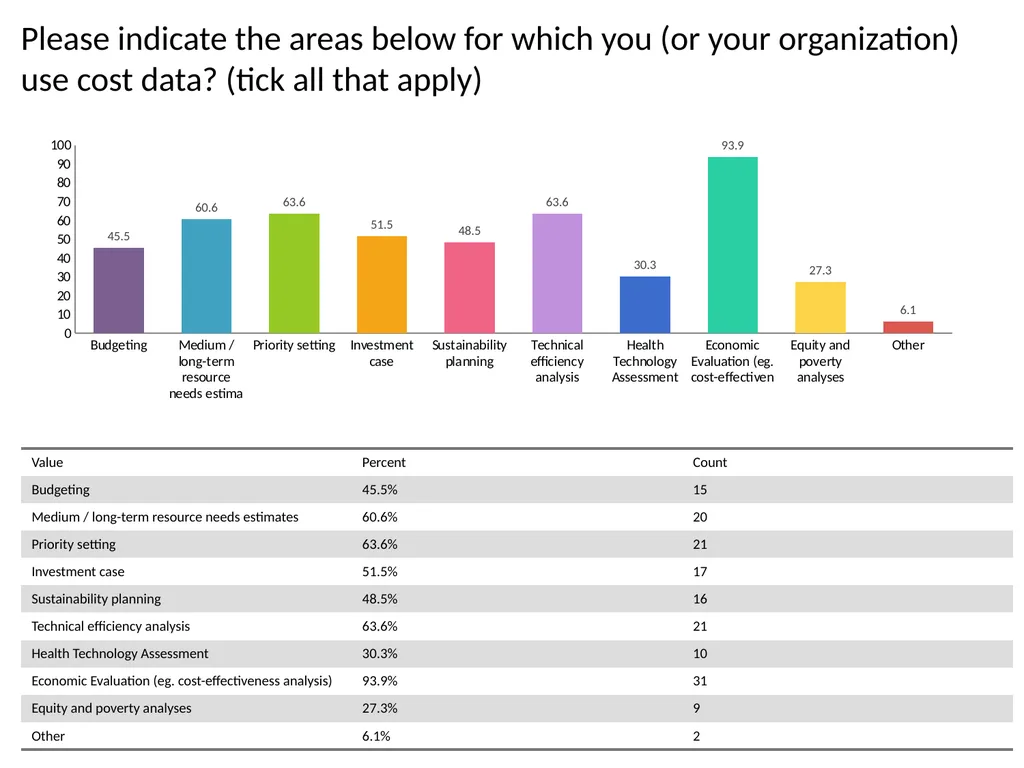
Please indicate the areas below for which you (or your organization) use cost data? (tick all that apply)<br>
15
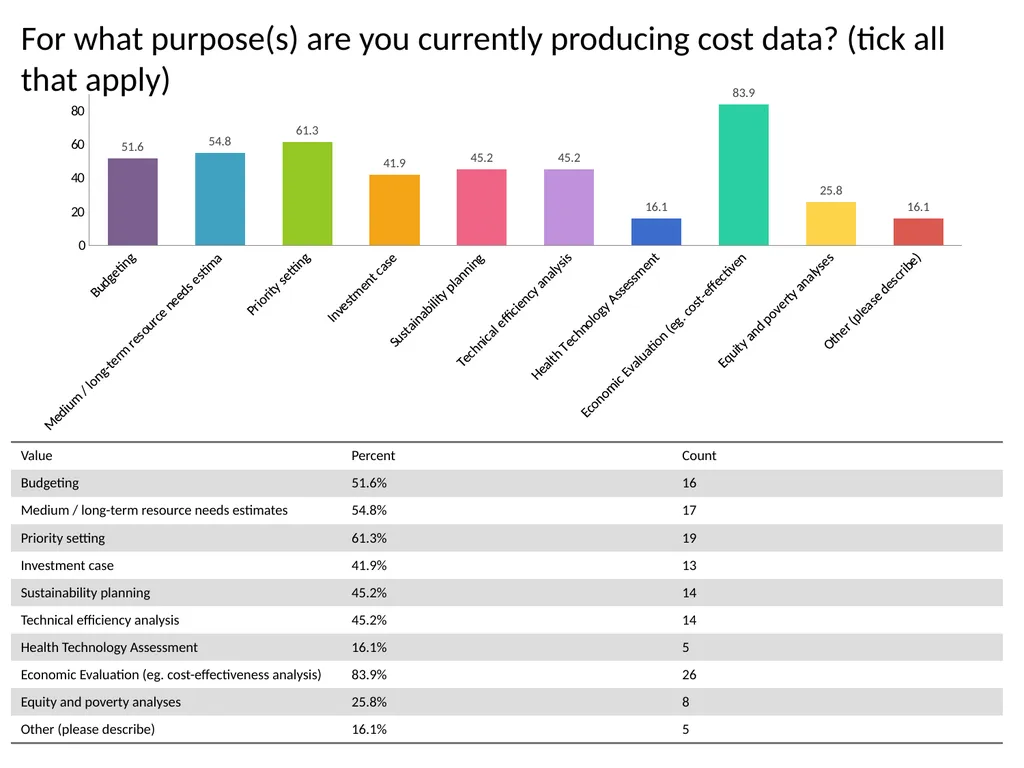
For what purpose(s) are you currently producing cost data? (tick all that apply)<br>
16
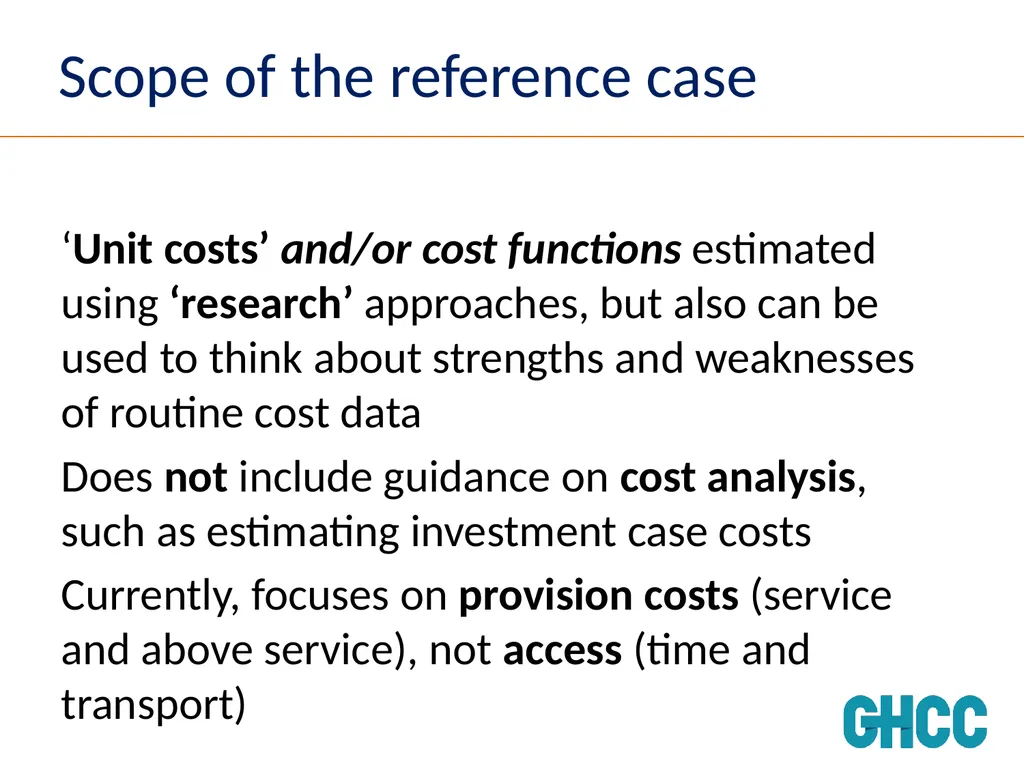
Scope of the reference case ‘Unit costs’ and/or cost functions estimated using ‘research’ approaches, but also can be used to think about strengths and weaknesses of routine cost data
Does not include guidance on cost analysis, such as estimating investment case costs
Currently, focuses on provision costs (service and above service), not access (time and transport)<br>
Does not include guidance on cost analysis, such as estimating investment case costs
Currently, focuses on provision costs (service and above service), not access (time and transport)<br>
17
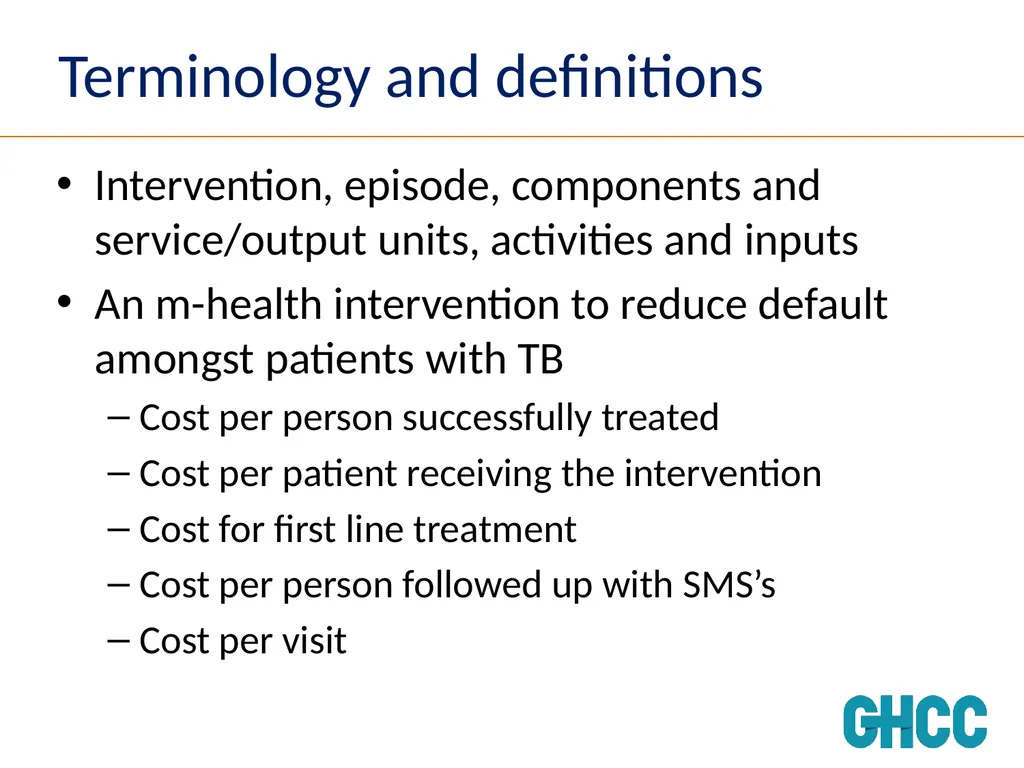
Terminology and definitions Intervention, episode, components and service/output units, activities and inputs
An m-health intervention to reduce default amongst patients with TB
Cost per person successfully treated
Cost per patient receiving the intervention
Cost for first line treatment
Cost per person followed up with SMS’s
Cost per visit<br>
An m-health intervention to reduce default amongst patients with TB
Cost per person successfully treated
Cost per patient receiving the intervention
Cost for first line treatment
Cost per person followed up with SMS’s
Cost per visit<br>
18
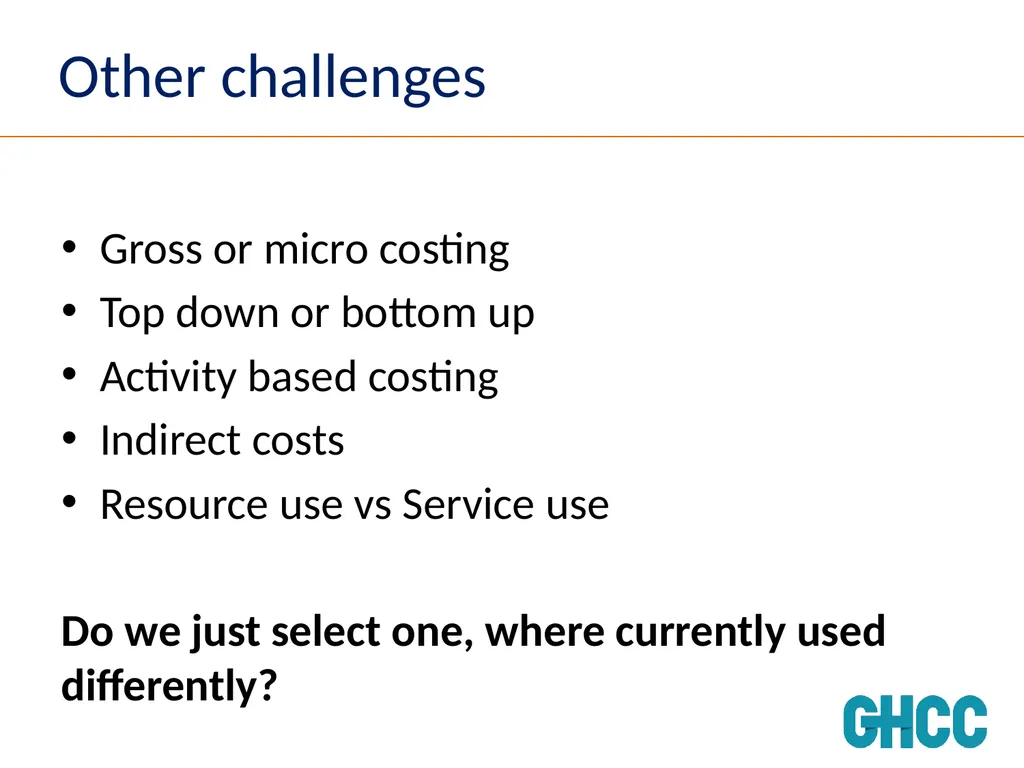
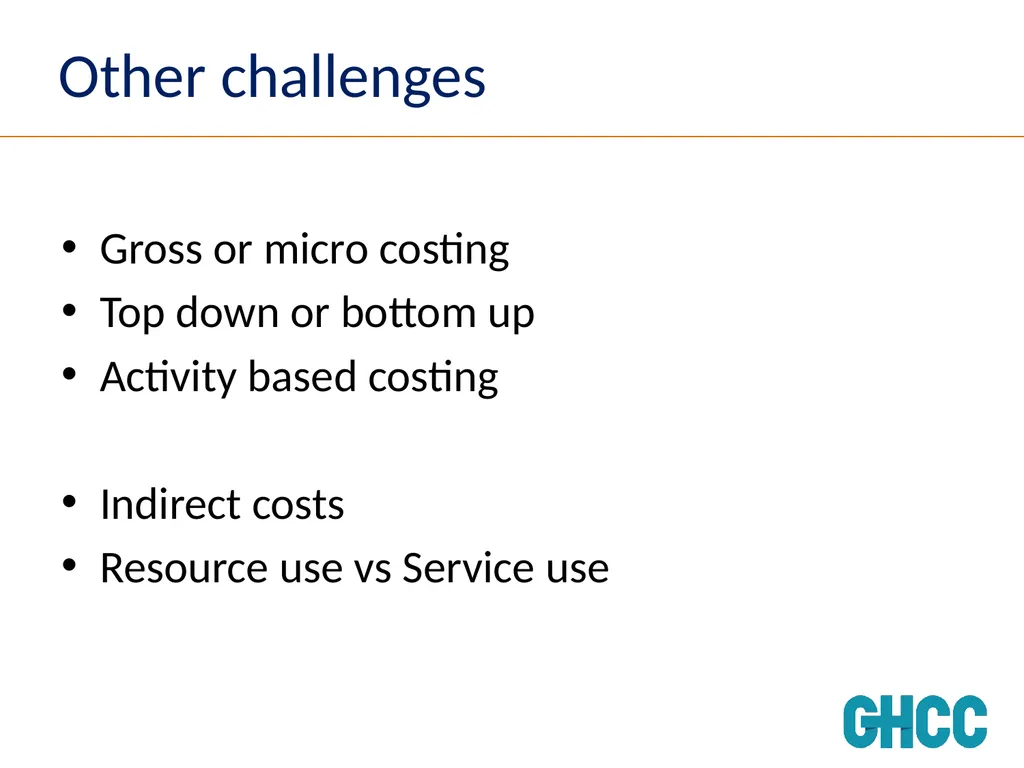
Other challenges Gross or micro costing
Top down or bottom up
Activity based costing
Indirect costs
Resource use vs Service use
Do we just select one, where currently used differently?<br>
Top down or bottom up
Activity based costing
Indirect costs
Resource use vs Service use
Do we just select one, where currently used differently?<br>
19
Questions How can the reference case best meet the needs of users and producers of cost data?
What would be its main benefits?
What are the main risks?<br>
What would be its main benefits?
What are the main risks?<br>
20
Questions Is the current scope sufficient?
Could the form be improved?
Process for tomorrow<br>
Could the form be improved?
Process for tomorrow<br>
21
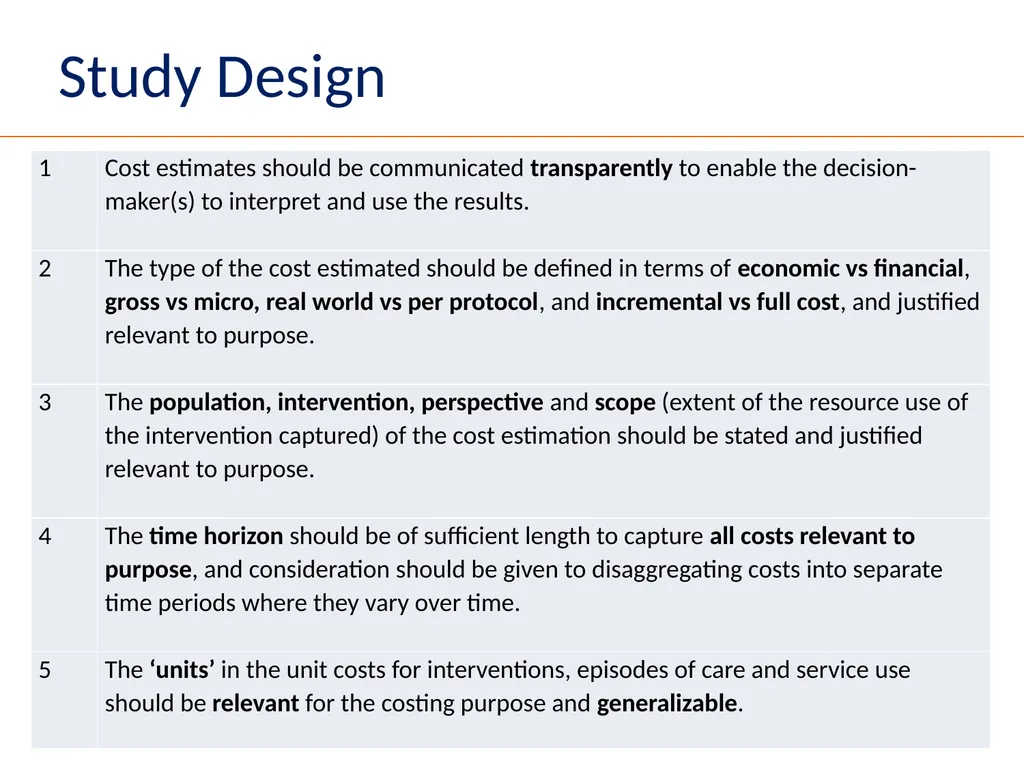
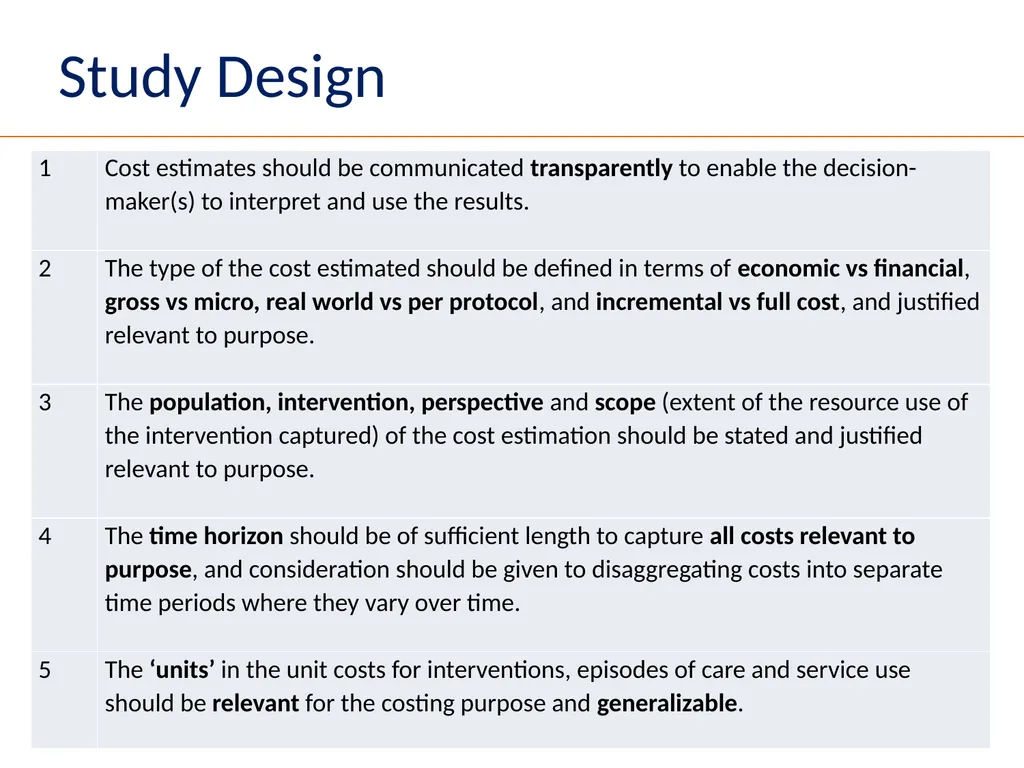
Study Design<br>
22
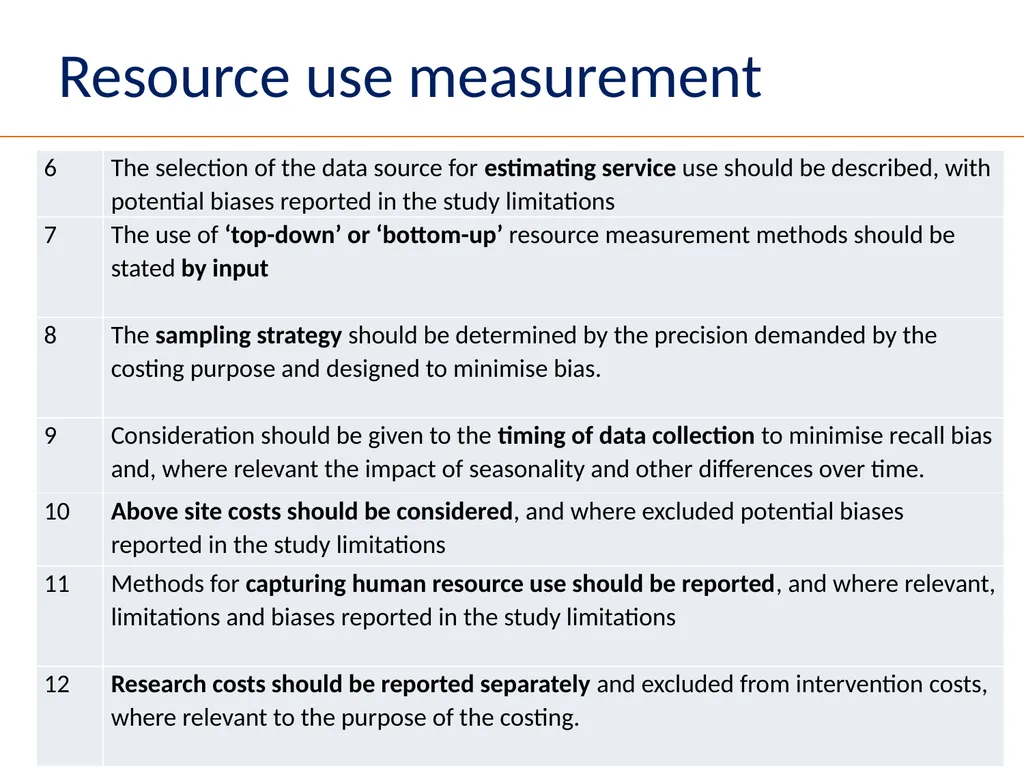
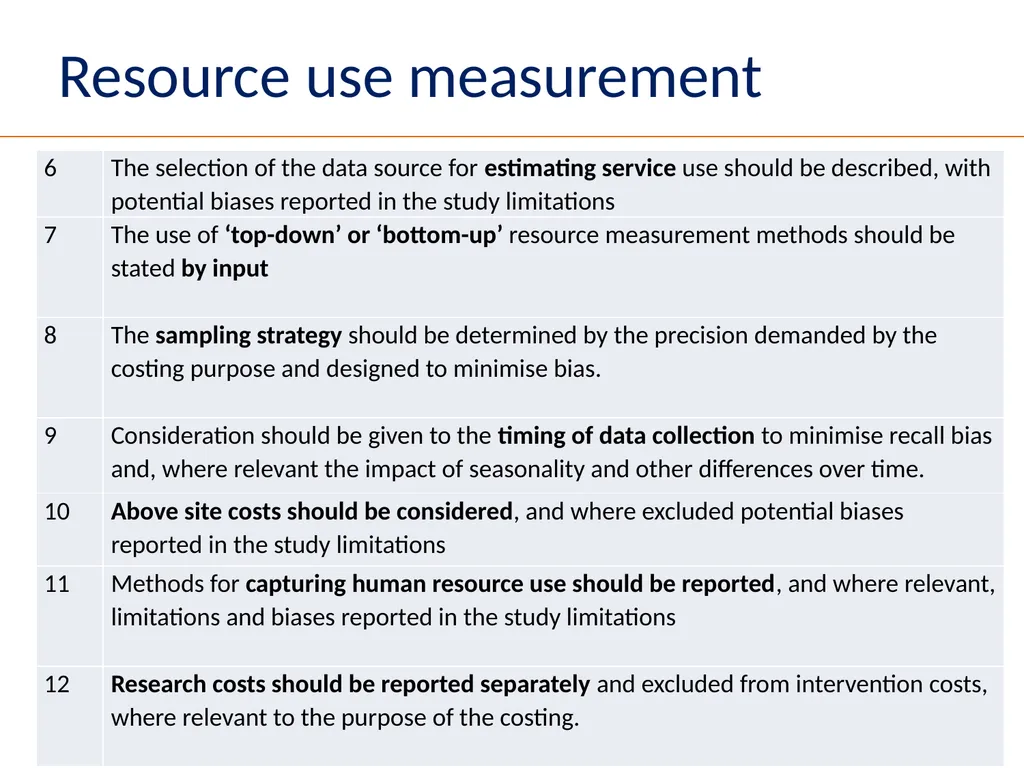
Resource use measurement<br>
23
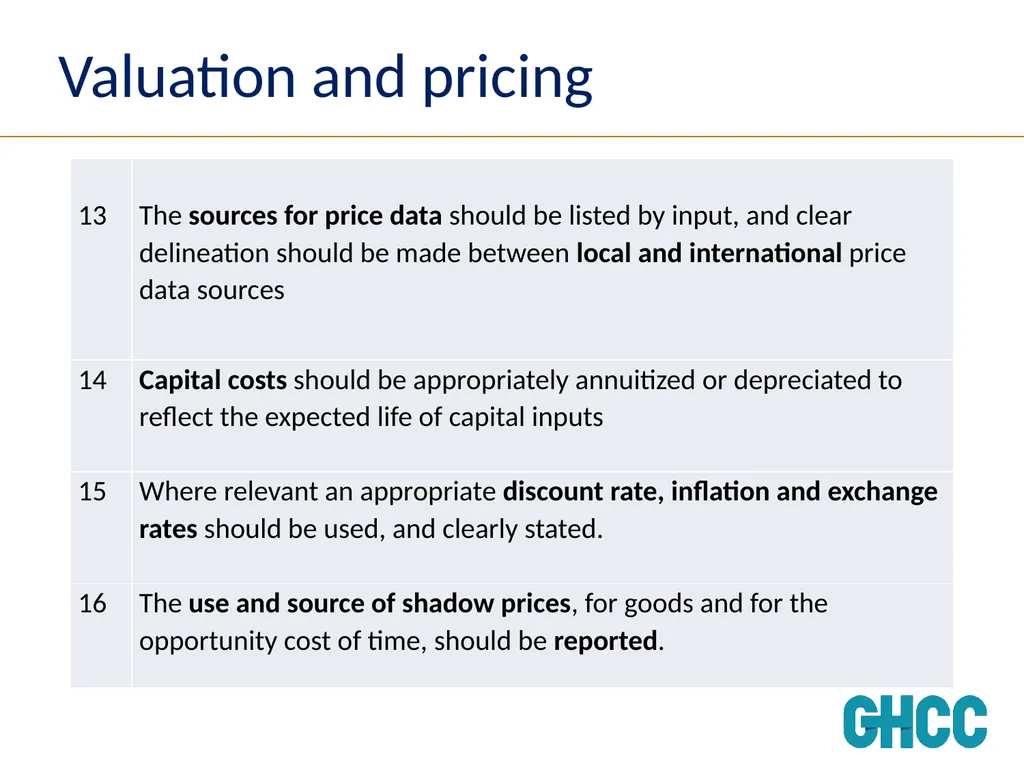
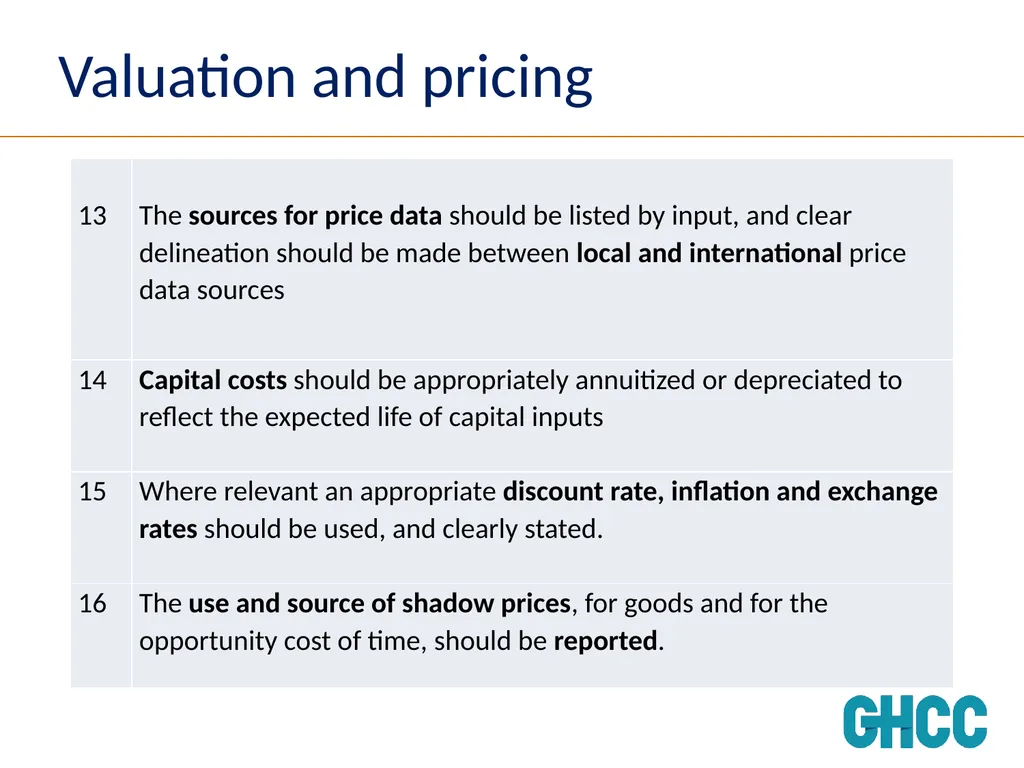
Valuation and pricing<br>
24
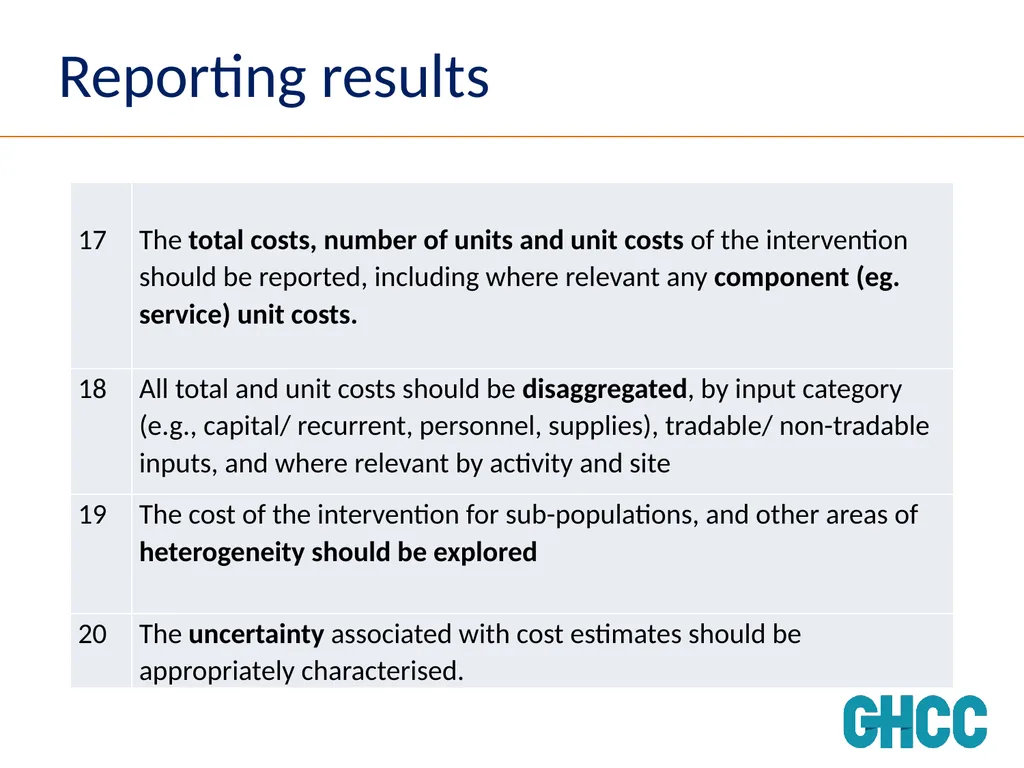
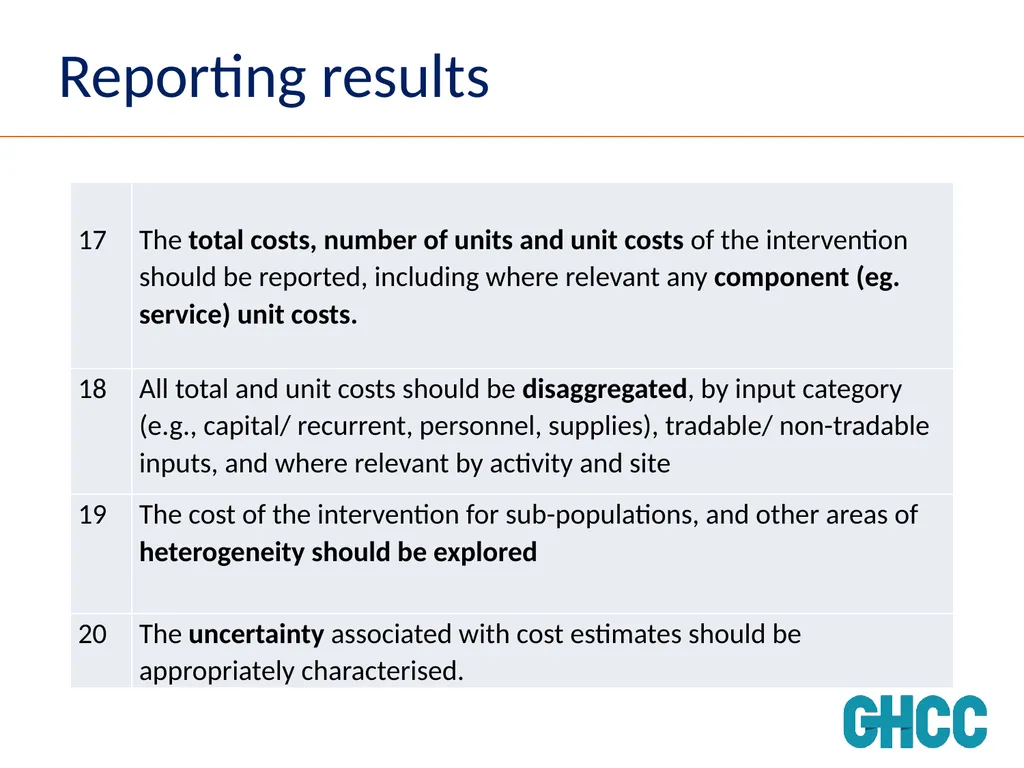
Reporting results<br>
25
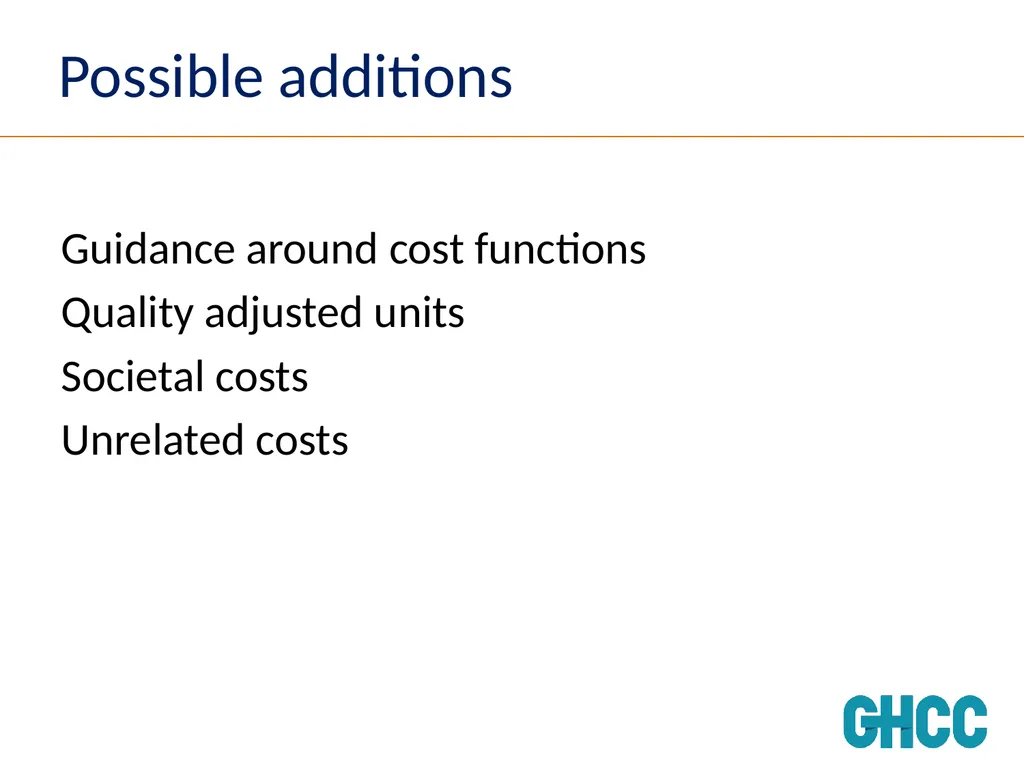
Possible additions Guidance around cost functions
Quality adjusted units
Societal costs
Unrelated costs<br>
Quality adjusted units
Societal costs
Unrelated costs<br>
26
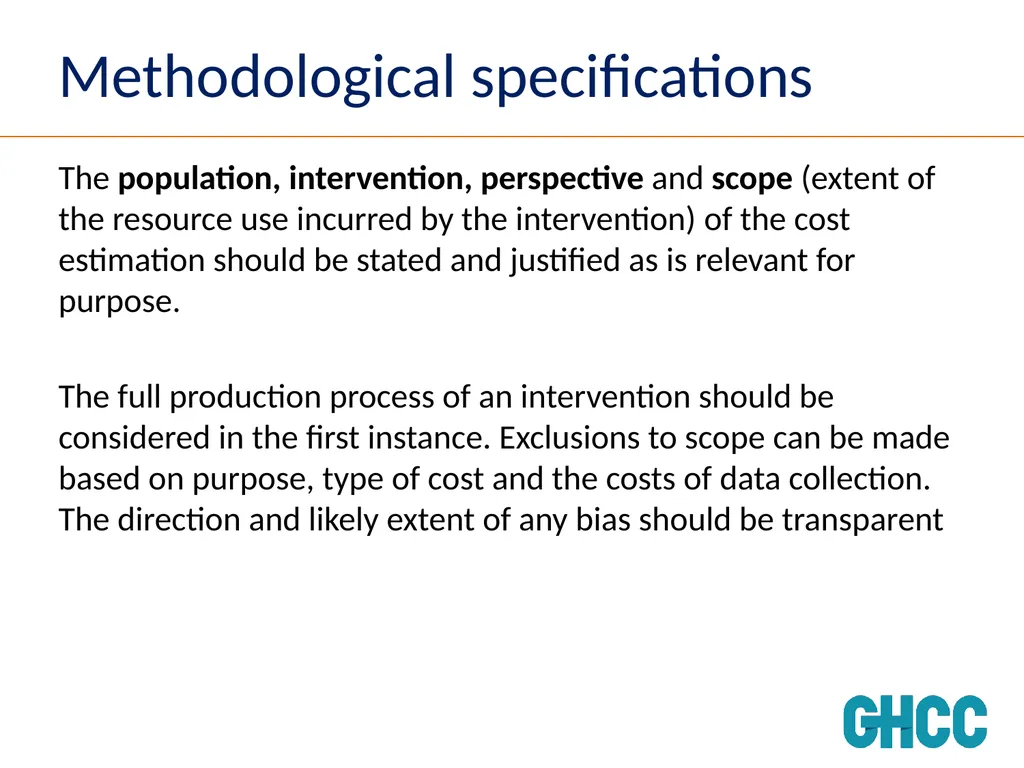
Methodological specifications The population, intervention, perspective and scope (extent of the resource use incurred by the intervention) of the cost estimation should be stated and justified as is relevant for purpose.
The full production process of an intervention should be considered in the first instance. Exclusions to scope can be made based on purpose, type of cost and the costs of data collection. The direction and likely extent of any bias should be transparent<br>
The full production process of an intervention should be considered in the first instance. Exclusions to scope can be made based on purpose, type of cost and the costs of data collection. The direction and likely extent of any bias should be transparent<br>
27
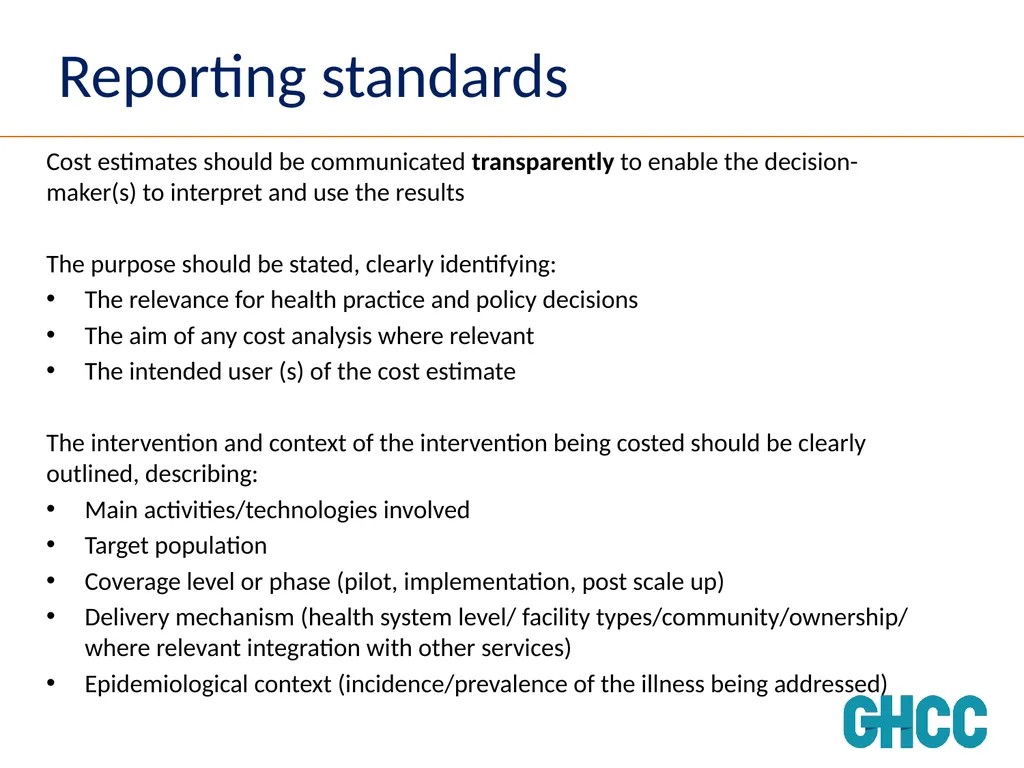
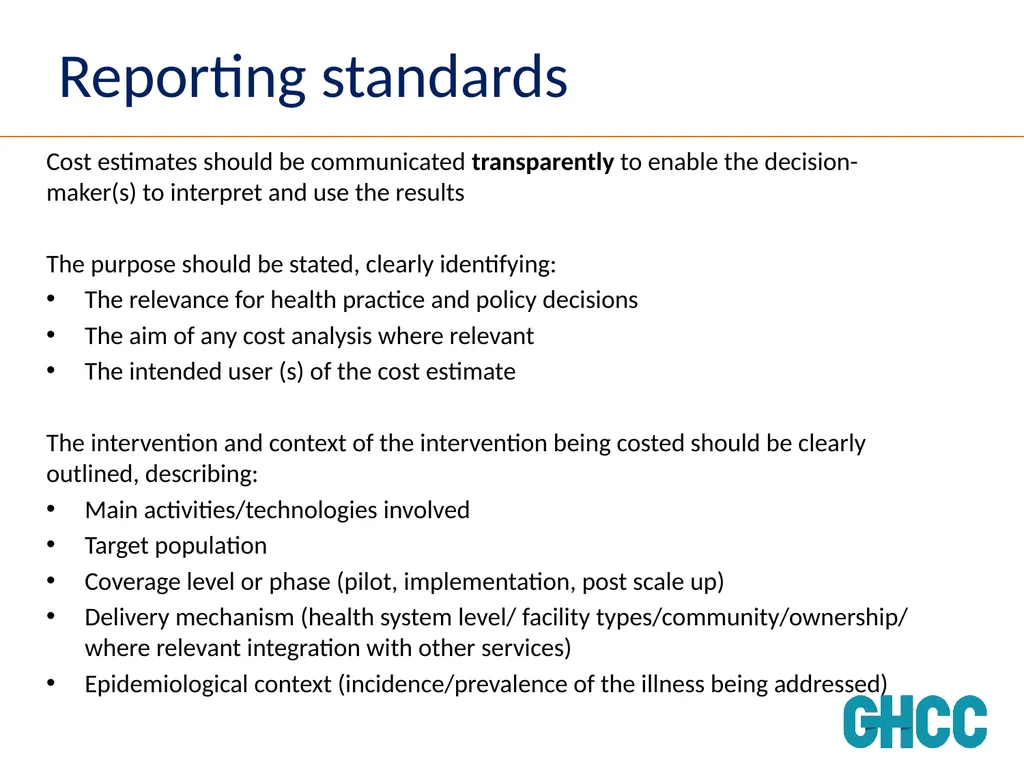
Reporting standards Cost estimates should be communicated transparently to enable the decision-maker(s) to interpret and use the results
The purpose should be stated, clearly identifying:
The relevance for health practice and policy decisions
The aim of any cost analysis where relevant
The intended user (s) of the cost estimate
The intervention and context of the intervention being costed should be clearly outlined, describing:
Main activities/technologies involved
Target population
Coverage level or phase (pilot, implementation, post scale up)
Delivery mechanism (health system level/ facility types/community/ownership/ where relevant integration with other services)
Epidemiological context (incidence/prevalence of the illness being addressed)<br>
The purpose should be stated, clearly identifying:
The relevance for health practice and policy decisions
The aim of any cost analysis where relevant
The intended user (s) of the cost estimate
The intervention and context of the intervention being costed should be clearly outlined, describing:
Main activities/technologies involved
Target population
Coverage level or phase (pilot, implementation, post scale up)
Delivery mechanism (health system level/ facility types/community/ownership/ where relevant integration with other services)
Epidemiological context (incidence/prevalence of the illness being addressed)<br>
28
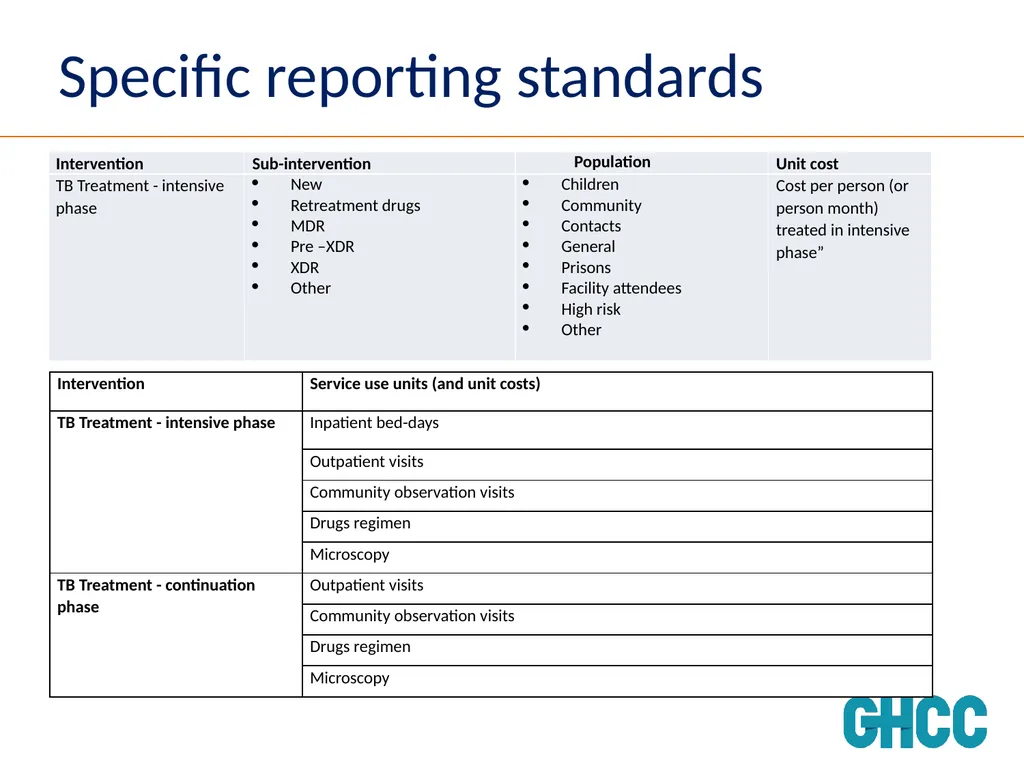
Specific reporting standards<br>
29
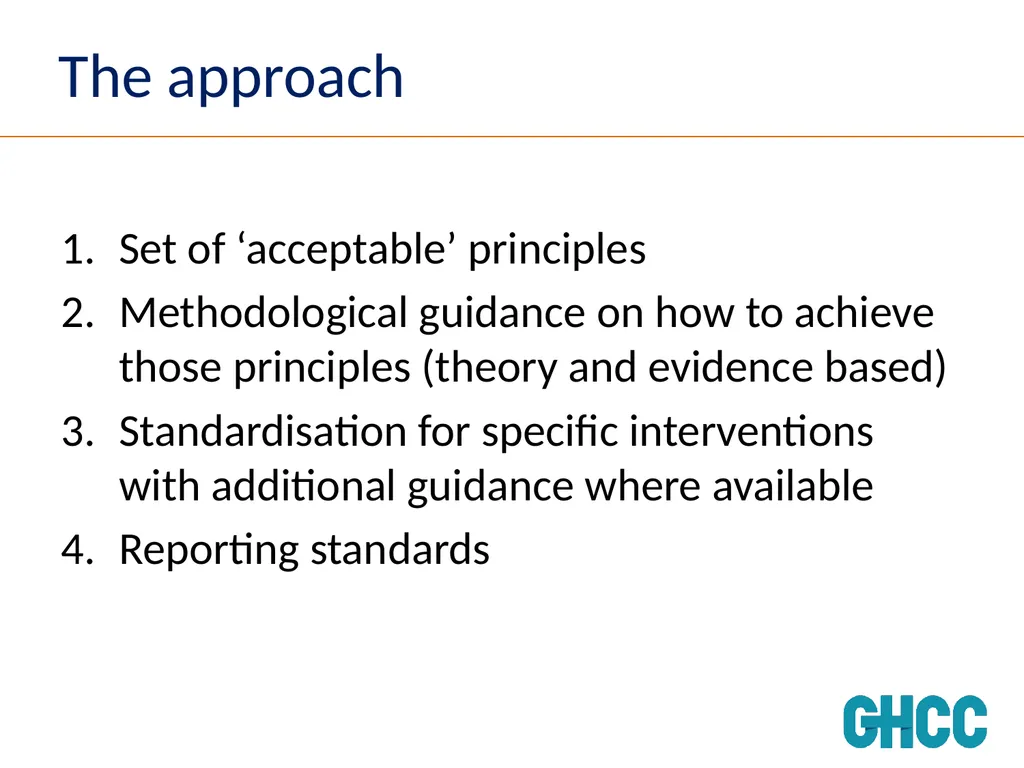
The approach Set of ‘acceptable’ principles
Methodological guidance on how to achieve those principles (theory and evidence based)
Standardisation for specific interventions with additional guidance where available
Reporting standards<br>
Methodological guidance on how to achieve those principles (theory and evidence based)
Standardisation for specific interventions with additional guidance where available
Reporting standards<br>
30
Process<br>
31
Scope of the reference case ‘Unit costs’ estimated using ‘research’ approaches, but also can be used to think about strengths and weaknesses of routine cost data
Does not include guidance on cost analysis, such as estimating investment case costs
Focuses on provider costs<br>
Does not include guidance on cost analysis, such as estimating investment case costs
Focuses on provider costs<br>
32
What do we want to achieve? Costing is a process of estimation
Two characteristics of a good estimate:
Precision
Accuracy
But how accurate and precise is good enough?
Depends on the decision to be made using the cost<br>
Two characteristics of a good estimate:
Precision
Accuracy
But how accurate and precise is good enough?
Depends on the decision to be made using the cost<br>
33
Other characteristics Generalisability
Can we apply the cost to other settings?
More important to be relevant to context?
Comparability
Are cost estimates comparable with on another?
Standards or standardisation?<br>
Can we apply the cost to other settings?
More important to be relevant to context?
Comparability
Are cost estimates comparable with on another?
Standards or standardisation?<br>
34
Cost functions vs unit costs<br>
35
Limited empricial validation of measurement tools/ approaches<br>
36
First challenge – cost for purpose a cost is not a cost First a caveat, principles for purpose
Economic evaluation and priority setting
Medium term planning
Budgeting
Price setting
Efficiency analyses
Study design and valuation methods differ<br>
Economic evaluation and priority setting
Medium term planning
Budgeting
Price setting
Efficiency analyses
Study design and valuation methods differ<br>
37
Common terminology and definitions Intervention, episode and service/output units – activities and inputs
An m-health intervention to reduce default amongst patients with TB
Cost per patient receiving the intervention
Cost for first line treatment
Cost per person followed up with SMS’s
Cost per visit<br>
An m-health intervention to reduce default amongst patients with TB
Cost per patient receiving the intervention
Cost for first line treatment
Cost per person followed up with SMS’s
Cost per visit<br>
38
Standardisation of interventions/ inputs Intervention, episode and service/output units – activities and inputs
An m-health intervention to reduce default amongst patients with TB
Cost per patient receiving the intervention
Cost for first line treatment
Cost per person followed up with SMS’s
Cost per visit<br>
An m-health intervention to reduce default amongst patients with TB
Cost per patient receiving the intervention
Cost for first line treatment
Cost per person followed up with SMS’s
Cost per visit<br>
39
Other challenges Gross or micro costing
Top down or bottom up
Activity based costing
Indirect costs
Resource use vs Service use<br>
Top down or bottom up
Activity based costing
Indirect costs
Resource use vs Service use<br>
40
Scope of costs<br>
41
Suv<br>
42
Study Design<br>
43
Resource use measurement<br>
44
Valuation and pricing<br>
45
Reporting results<br>
46
Reporting standards Cost estimates should be communicated transparently to enable the decision-maker(s) to interpret and use the results
The purpose should be stated, clearly identifying:
The relevance for health practice and policy decisions
The aim of any cost analysis where relevant
The intended user (s) of the cost estimate
The intervention and context of the intervention being costed should be clearly outlined, describing:
Main activities/technologies involved
Target population
Coverage level or phase (pilot, implementation, post scale up)
Delivery mechanism (health system level/ facility types/community/ownership/ where relevant integration with other services)
Epidemiological context (incidence/prevalence of the illness being addressed)<br>
The purpose should be stated, clearly identifying:
The relevance for health practice and policy decisions
The aim of any cost analysis where relevant
The intended user (s) of the cost estimate
The intervention and context of the intervention being costed should be clearly outlined, describing:
Main activities/technologies involved
Target population
Coverage level or phase (pilot, implementation, post scale up)
Delivery mechanism (health system level/ facility types/community/ownership/ where relevant integration with other services)
Epidemiological context (incidence/prevalence of the illness being addressed)<br>
47
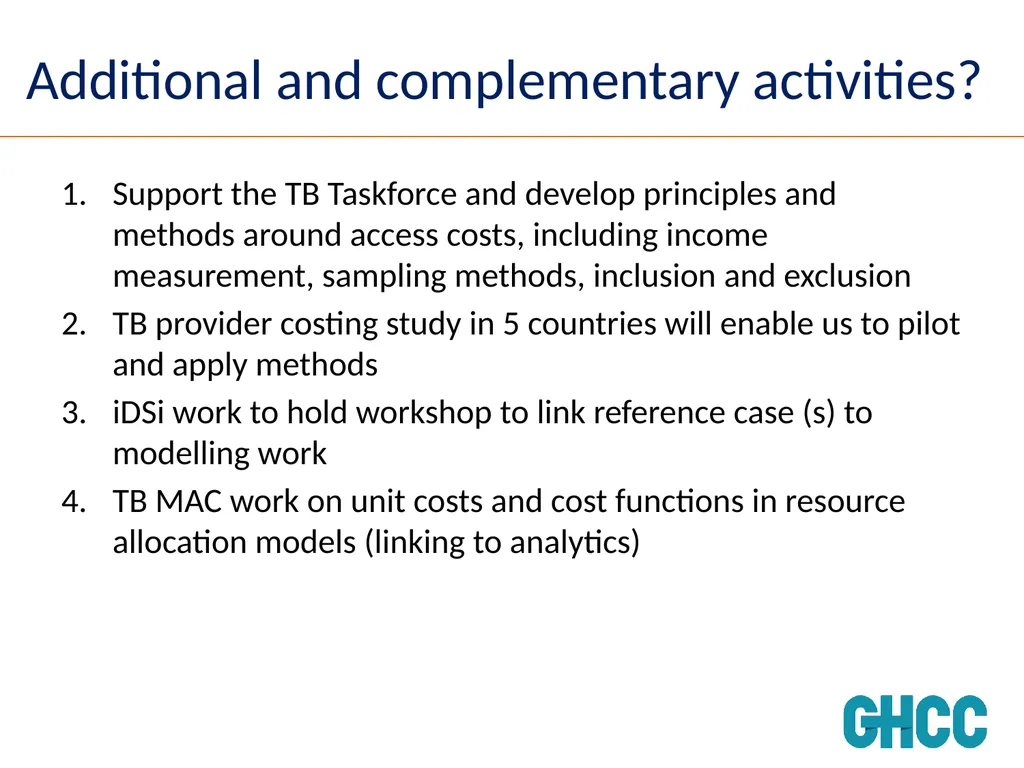
Additional and complementary activities? Support the TB Taskforce and develop principles and methods around access costs, including income measurement, sampling methods, inclusion and exclusion
TB provider costing study in 5 countries will enable us to pilot and apply methods
iDSi work to hold workshop to link reference case (s) to modelling work
TB MAC work on unit costs and cost functions in resource allocation models (linking to analytics)<br>
TB provider costing study in 5 countries will enable us to pilot and apply methods
iDSi work to hold workshop to link reference case (s) to modelling work
TB MAC work on unit costs and cost functions in resource allocation models (linking to analytics)<br>
48
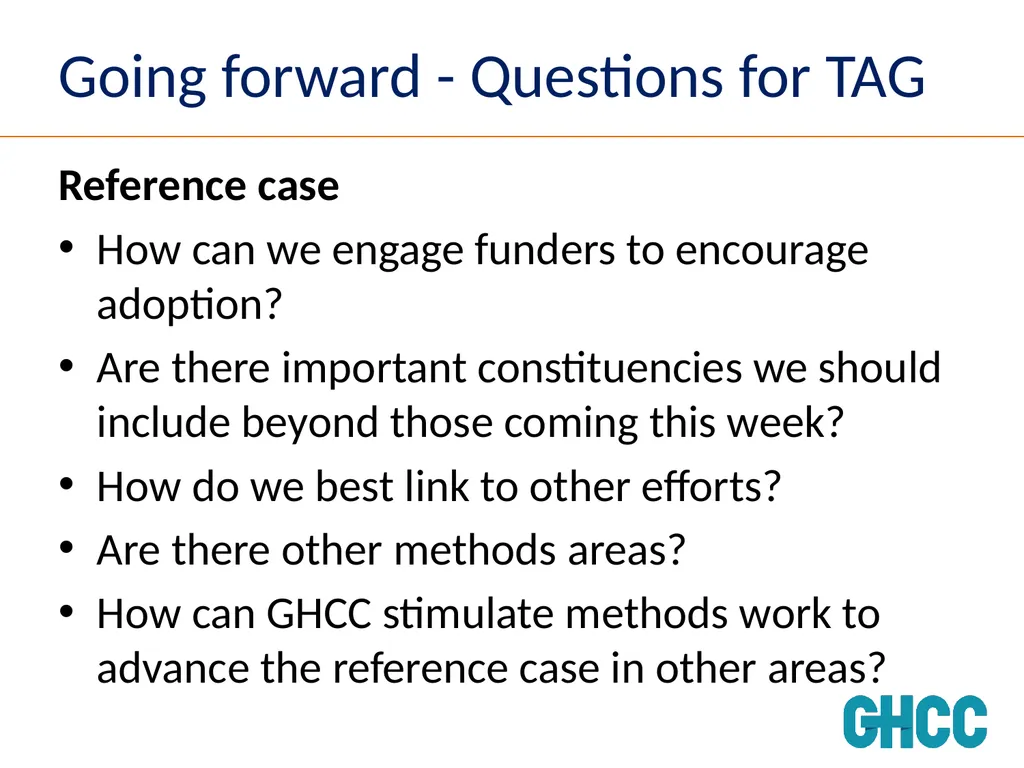
Going forward - Questions for TAG Reference case
How can we engage funders to encourage adoption?
Are there important constituencies we should include beyond those coming this week?
How do we best link to other efforts?
Are there other methods areas?
How can GHCC stimulate methods work to advance the reference case in other areas?<br>
How can we engage funders to encourage adoption?
Are there important constituencies we should include beyond those coming this week?
How do we best link to other efforts?
Are there other methods areas?
How can GHCC stimulate methods work to advance the reference case in other areas?<br>
49
Next steps<br>