
Seven types of intertextuality This article is a
SN
Published · 26 slides · 0 views

1 / 1

Description
Seven types of intertextuality This article is a part of Michele Marrapodis book Shakespeare, Italy and Intertextuality. In this article, Miola tries to outline the types of intertextual transactions evident in early modern literature,
Related Topics
Share
Embed code
Download this presentation From Below
"Seven types of intertextuality This article is a" is the property of its rightful owner. Permission is granted to download and print the materials on this website for personal, non-commercial use only, and to display it on your personal computer provided you do not modify the materials and that you retain all copyright notices contained in the materials. By downloading content from our website, you accept the terms of this agreement.
Presentation Transcript
01
Seven types of intertextuality<br>
02
This article is a part of Michele Marrapodi’s book “Shakespeare, Italy and Intertextuality”.
In this article, Miola tries to outline the types of intertextual transactions evident in early modern literature, especially Shakespeare.
Miola begins his argument by describing three variables he uses to organize his “types” and “categories” and explains why there are no clear cut divisions as well as some “overlapping” by saying:
«The distinctions between all these types and those between categories are not absolute and exclusive; rather these divisions all appear on a continuum with various nuance and intersections.» Introduction<br>
In this article, Miola tries to outline the types of intertextual transactions evident in early modern literature, especially Shakespeare.
Miola begins his argument by describing three variables he uses to organize his “types” and “categories” and explains why there are no clear cut divisions as well as some “overlapping” by saying:
«The distinctions between all these types and those between categories are not absolute and exclusive; rather these divisions all appear on a continuum with various nuance and intersections.» Introduction<br>
03
He distinguished seven types of intertextuality which divide in to three categories based on three variables:
First, the degree to which the trace of an earlier text is tagged by verbal echo;
Second, the degree to which its effect relies on audience recognition;
Third, the degree to which the appropriation is eristic.
These variables represent themselves in different
categories with varying amounts of influence.
Three broad categories of intertextual circulation: the direct process of authorial reading, wider literary traditions, and cultural modes of reading and interpretations. ?????<br>
First, the degree to which the trace of an earlier text is tagged by verbal echo;
Second, the degree to which its effect relies on audience recognition;
Third, the degree to which the appropriation is eristic.
These variables represent themselves in different
categories with varying amounts of influence.
Three broad categories of intertextual circulation: the direct process of authorial reading, wider literary traditions, and cultural modes of reading and interpretations. ?????<br>
04
Miola views these categories as “a continuum” that ranges from the “closest approximations” to “author-directed imitations," “all the way through to intertextualities that exist in discourses created by the reader”.
By viewing intertextuality as a continuum, Miola acknowledges the complexity of indirect sources and the varying degrees of influence they have on interpreting a text.
This spectrum also frees Miola from the absolutism of traditional forms of source study which require empirical evidence and leave little room for speculation.<br>
By viewing intertextuality as a continuum, Miola acknowledges the complexity of indirect sources and the varying degrees of influence they have on interpreting a text.
This spectrum also frees Miola from the absolutism of traditional forms of source study which require empirical evidence and leave little room for speculation.<br>
05
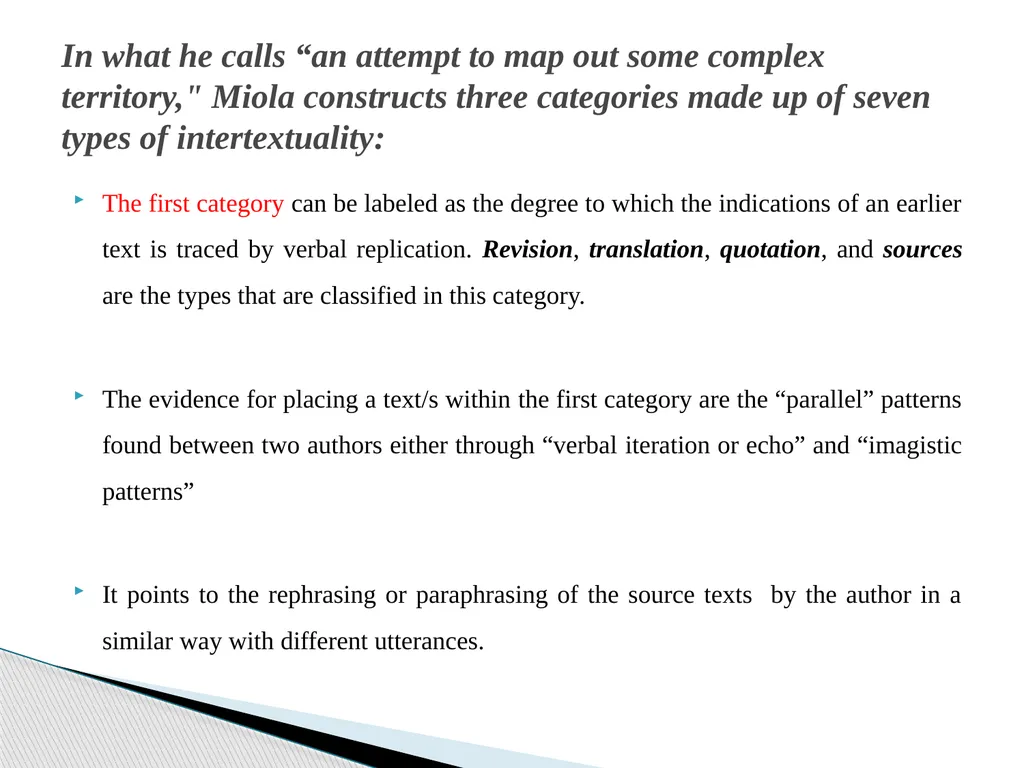
The first category can be labeled as the degree to which the indications of an earlier text is traced by verbal replication. Revision, translation, quotation, and sources are the types that are classified in this category.
The evidence for placing a text/s within the first category are the “parallel” patterns found between two authors either through “verbal iteration or echo” and “imagistic patterns”
It points to the rephrasing or paraphrasing of the source texts by the author in a similar way with different utterances. In what he calls “an attempt to map out some complex territory," Miola constructs three categories made up of seven types of intertextuality:<br>
The evidence for placing a text/s within the first category are the “parallel” patterns found between two authors either through “verbal iteration or echo” and “imagistic patterns”
It points to the rephrasing or paraphrasing of the source texts by the author in a similar way with different utterances. In what he calls “an attempt to map out some complex territory," Miola constructs three categories made up of seven types of intertextuality:<br>
06
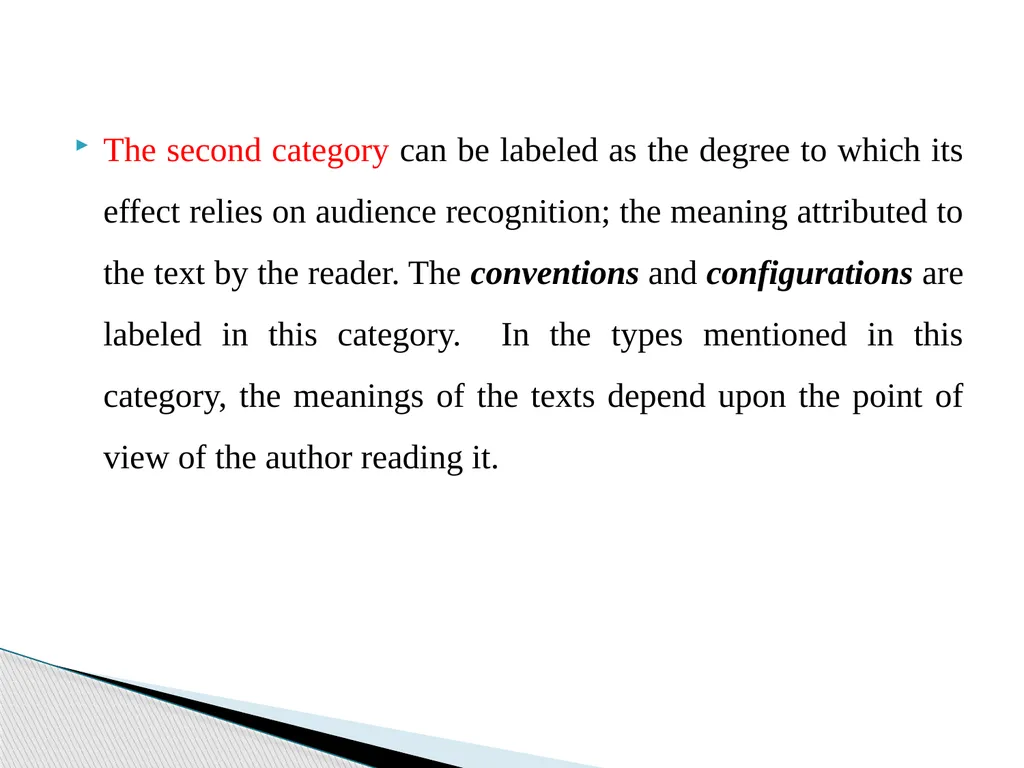
The second category can be labeled as the degree to which its effect relies on audience recognition; the meaning attributed to the text by the reader. The conventions and configurations are labeled in this category. In the types mentioned in this category, the meanings of the texts depend upon the point of view of the author reading it.<br>
07
AND, the third category is the degree to which the adoption or acceptance of the text is controversial.<br>
08
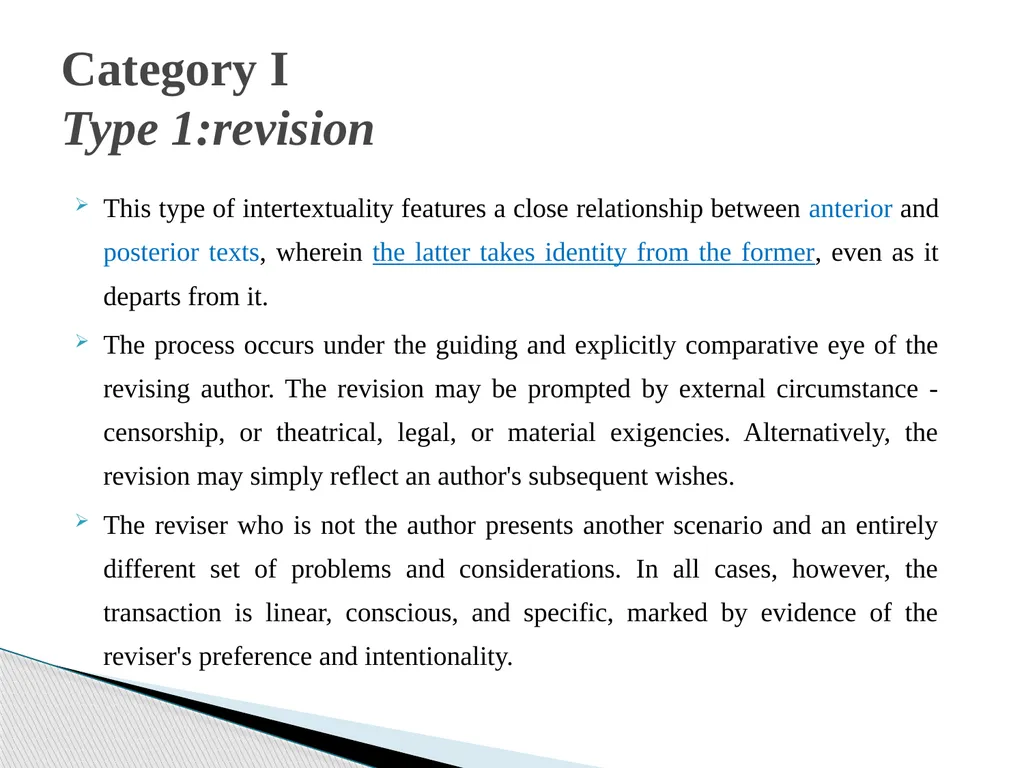
This type of intertextuality features a close relationship between anterior and posterior texts, wherein the latter takes identity from the former, even as it departs from it.
The process occurs under the guiding and explicitly comparative eye of the revising author. The revision may be prompted by external circumstance - censorship, or theatrical, legal, or material exigencies. Alternatively, the revision may simply reflect an author's subsequent wishes.
The reviser who is not the author presents another scenario and an entirely different set of problems and considerations. In all cases, however, the transaction is linear, conscious, and specific, marked by evidence of the reviser's preference and intentionality. Category I Type 1:revision<br>
The process occurs under the guiding and explicitly comparative eye of the revising author. The revision may be prompted by external circumstance - censorship, or theatrical, legal, or material exigencies. Alternatively, the revision may simply reflect an author's subsequent wishes.
The reviser who is not the author presents another scenario and an entirely different set of problems and considerations. In all cases, however, the transaction is linear, conscious, and specific, marked by evidence of the reviser's preference and intentionality. Category I Type 1:revision<br>
09
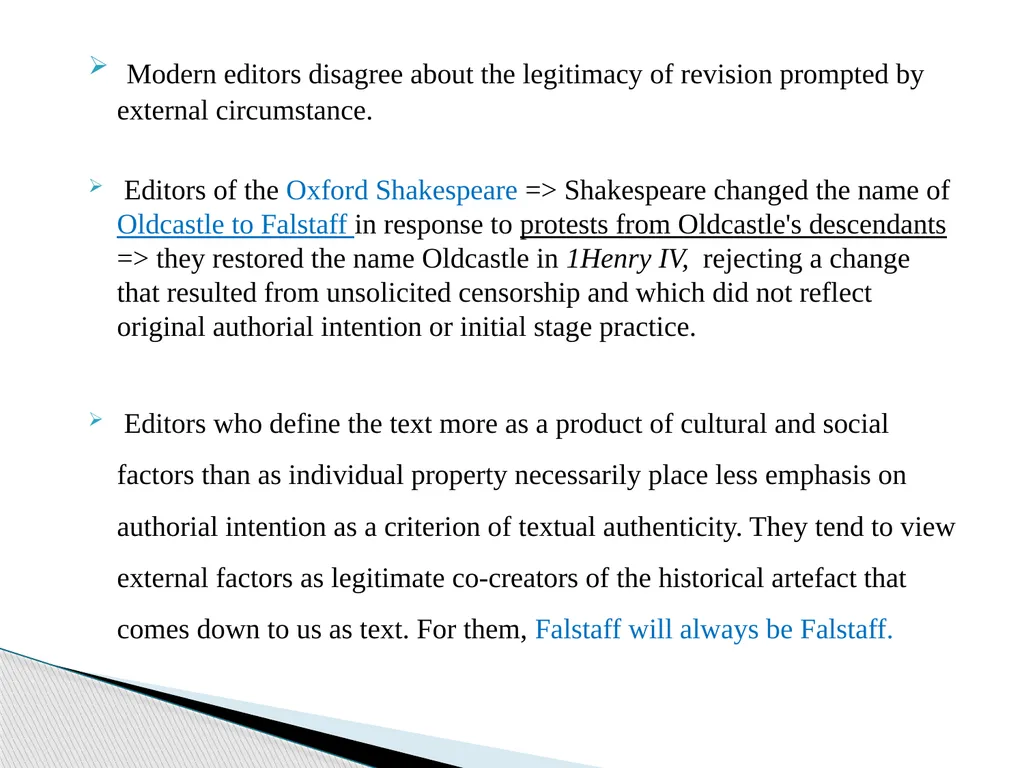
Modern editors disagree about the legitimacy of revision prompted by external circumstance.
Editors of the Oxford Shakespeare => Shakespeare changed the name of Oldcastle to Falstaff in response to protests from Oldcastle's descendants => they restored the name Oldcastle in 1Henry IV, rejecting a change that resulted from unsolicited censorship and which did not reflect original authorial intention or initial stage practice.
Editors who define the text more as a product of cultural and social factors than as individual property necessarily place less emphasis on authorial intention as a criterion of textual authenticity. They tend to view external factors as legitimate co-creators of the historical artefact that comes down to us as text. For them, Falstaff will always be Falstaff.<br>
Editors of the Oxford Shakespeare => Shakespeare changed the name of Oldcastle to Falstaff in response to protests from Oldcastle's descendants => they restored the name Oldcastle in 1Henry IV, rejecting a change that resulted from unsolicited censorship and which did not reflect original authorial intention or initial stage practice.
Editors who define the text more as a product of cultural and social factors than as individual property necessarily place less emphasis on authorial intention as a criterion of textual authenticity. They tend to view external factors as legitimate co-creators of the historical artefact that comes down to us as text. For them, Falstaff will always be Falstaff.<br>
10
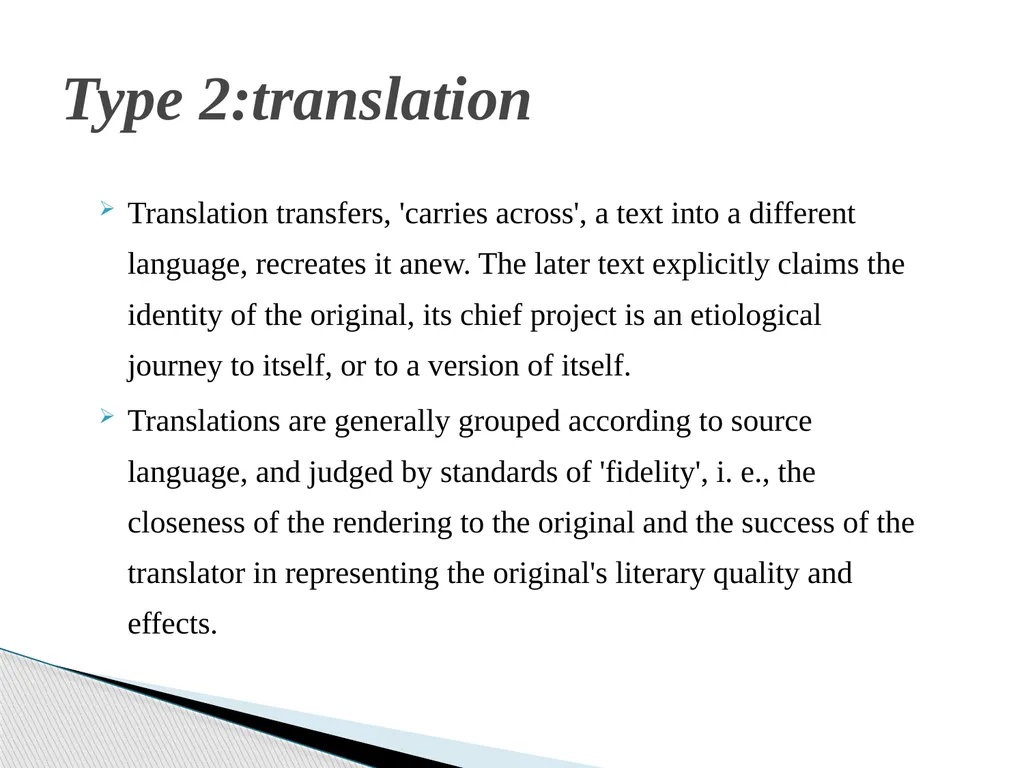
Translation transfers, 'carries across', a text into a different language, recreates it anew. The later text explicitly claims the identity of the original, its chief project is an etiological journey to itself, or to a version of itself.
Translations are generally grouped according to source language, and judged by standards of 'fidelity', i. e., the closeness of the rendering to the original and the success of the translator in representing the original's literary quality and effects. Type 2:translation<br>
Translations are generally grouped according to source language, and judged by standards of 'fidelity', i. e., the closeness of the rendering to the original and the success of the translator in representing the original's literary quality and effects. Type 2:translation<br>
11
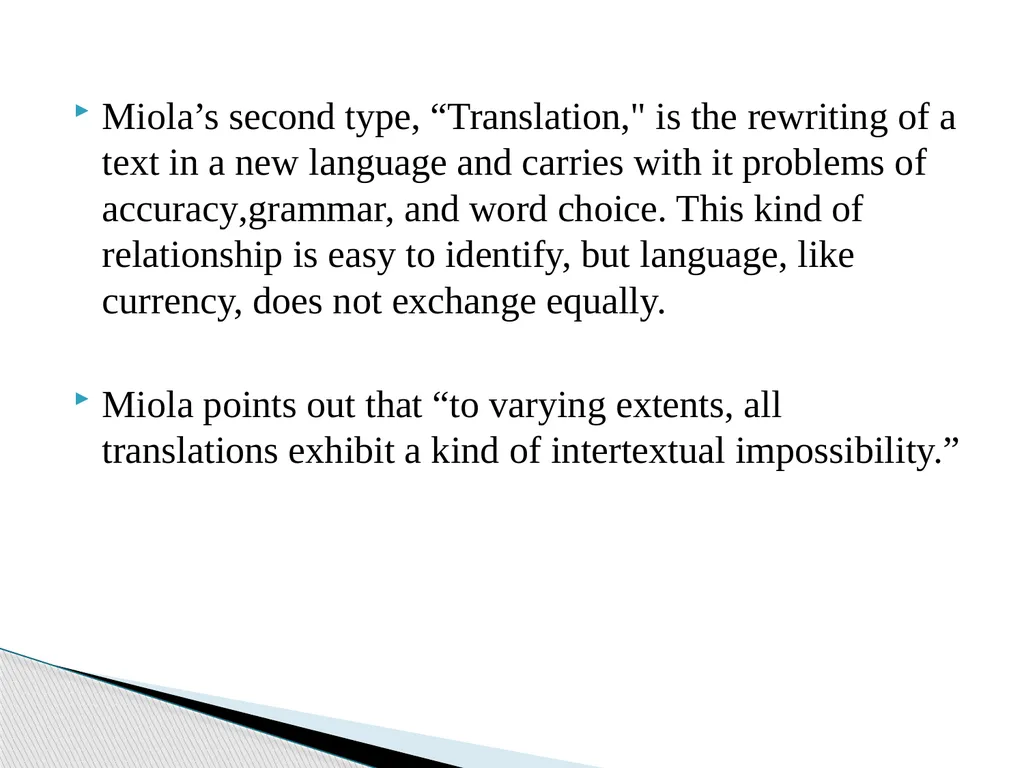
Miola’s second type, “Translation," is the rewriting of a text in a new language and carries with it problems of accuracy,grammar, and word choice. This kind of relationship is easy to identify, but language, like currency, does not exchange equally.
Miola points out that “to varying extents, all translations exhibit a kind of intertextual impossibility.”<br>
Miola points out that “to varying extents, all translations exhibit a kind of intertextual impossibility.”<br>
12
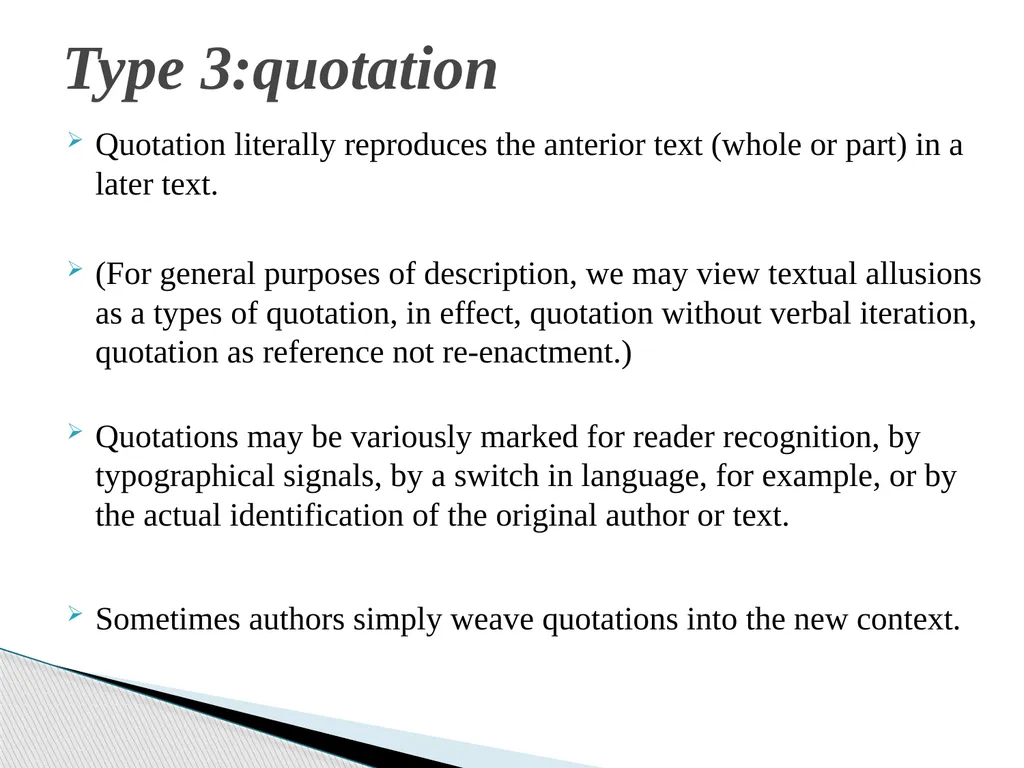
Quotation literally reproduces the anterior text (whole or part) in a later text.
(For general purposes of description, we may view textual allusions as a types of quotation, in effect, quotation without verbal iteration, quotation as reference not re-enactment.)
Quotations may be variously marked for reader recognition, by typographical signals, by a switch in language, for example, or by the actual identification of the original author or text.
Sometimes authors simply weave quotations into the new context. Type 3:quotation<br>
(For general purposes of description, we may view textual allusions as a types of quotation, in effect, quotation without verbal iteration, quotation as reference not re-enactment.)
Quotations may be variously marked for reader recognition, by typographical signals, by a switch in language, for example, or by the actual identification of the original author or text.
Sometimes authors simply weave quotations into the new context. Type 3:quotation<br>
13
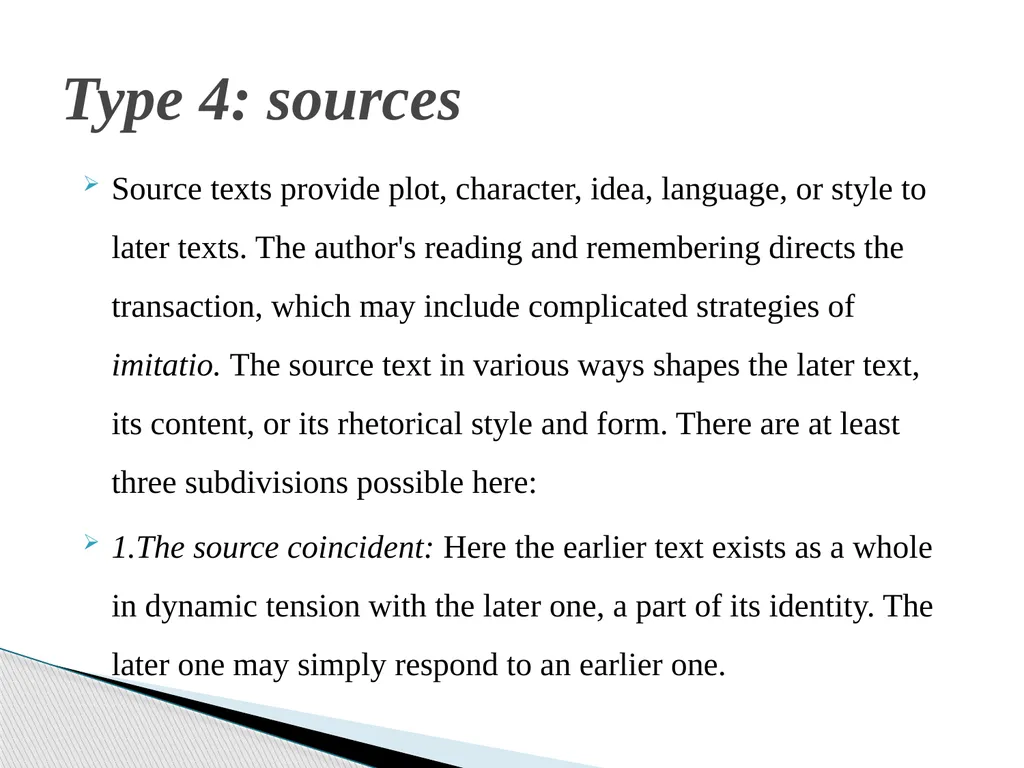
Source texts provide plot, character, idea, language, or style to later texts. The author's reading and remembering directs the transaction, which may include complicated strategies of imitatio. The source text in various ways shapes the later text, its content, or its rhetorical style and form. There are at least three subdivisions possible here:
1.The source coincident: Here the earlier text exists as a whole in dynamic tension with the later one, a part of its identity. The later one may simply respond to an earlier one. Type 4: sources<br>
1.The source coincident: Here the earlier text exists as a whole in dynamic tension with the later one, a part of its identity. The later one may simply respond to an earlier one. Type 4: sources<br>
14
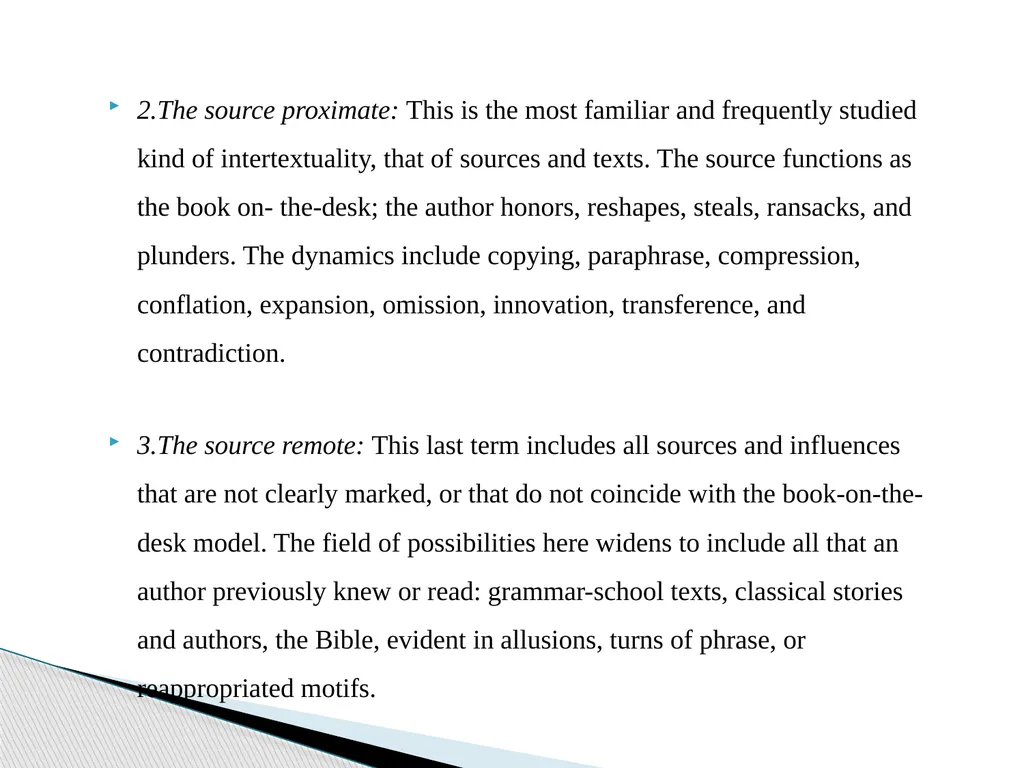
2.The source proximate: This is the most familiar and frequently studied kind of intertextuality, that of sources and texts. The source functions as the book on- the-desk; the author honors, reshapes, steals, ransacks, and plunders. The dynamics include copying, paraphrase, compression, conflation, expansion, omission, innovation, transference, and contradiction.
3.The source remote: This last term includes all sources and influences that are not clearly marked, or that do not coincide with the book-on-the-desk model. The field of possibilities here widens to include all that an author previously knew or read: grammar-school texts, classical stories and authors, the Bible, evident in allusions, turns of phrase, or reappropriated motifs.<br>
3.The source remote: This last term includes all sources and influences that are not clearly marked, or that do not coincide with the book-on-the-desk model. The field of possibilities here widens to include all that an author previously knew or read: grammar-school texts, classical stories and authors, the Bible, evident in allusions, turns of phrase, or reappropriated motifs.<br>
15
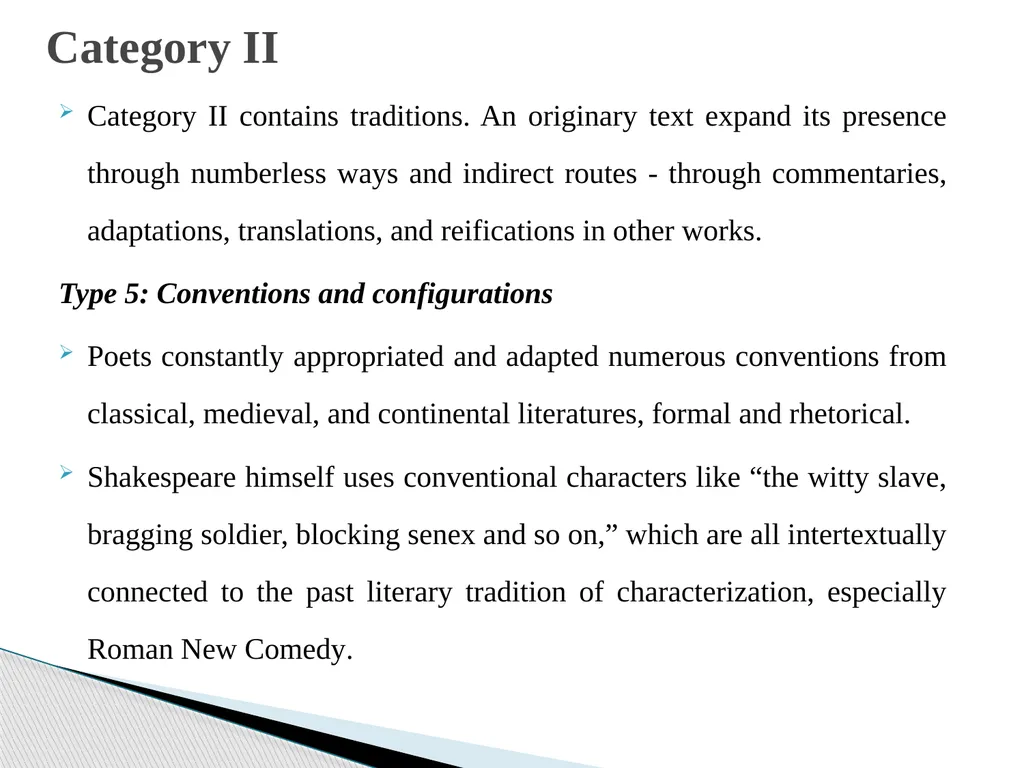
Category II contains traditions. An originary text expand its presence through numberless ways and indirect routes - through commentaries, adaptations, translations, and reifications in other works.
Type 5: Conventions and configurations
Poets constantly appropriated and adapted numerous conventions from classical, medieval, and continental literatures, formal and rhetorical.
Shakespeare himself uses conventional characters like “the witty slave, bragging soldier, blocking senex and so on,” which are all intertextually connected to the past literary tradition of characterization, especially Roman New Comedy. Category II<br>
Type 5: Conventions and configurations
Poets constantly appropriated and adapted numerous conventions from classical, medieval, and continental literatures, formal and rhetorical.
Shakespeare himself uses conventional characters like “the witty slave, bragging soldier, blocking senex and so on,” which are all intertextually connected to the past literary tradition of characterization, especially Roman New Comedy. Category II<br>
16
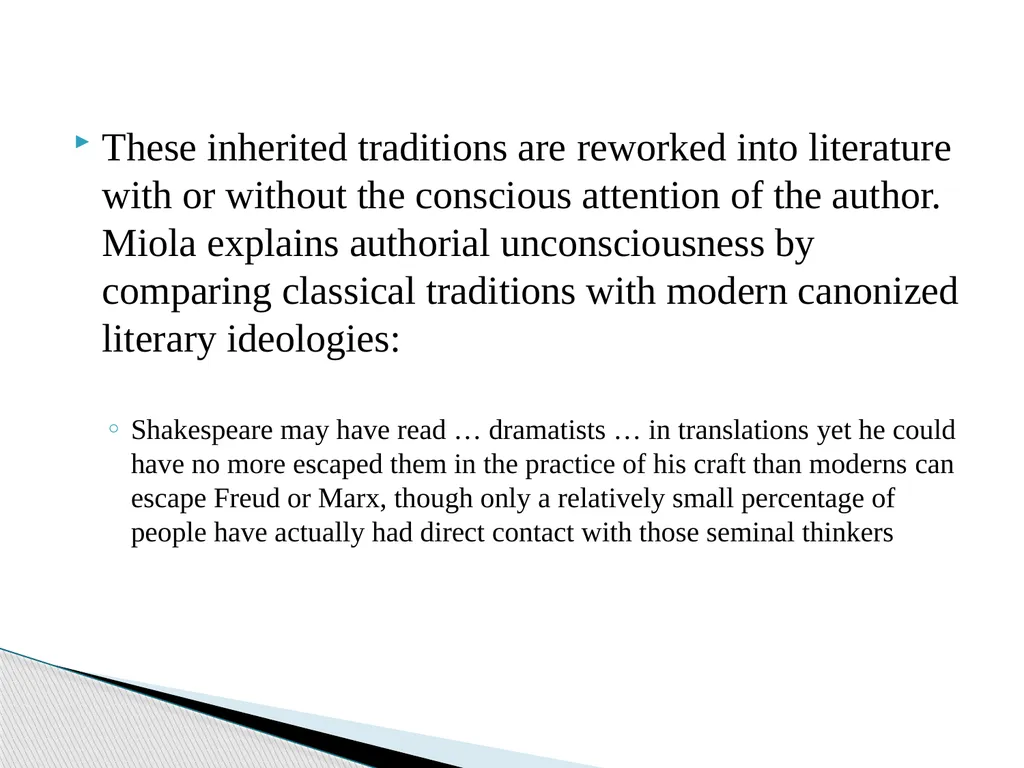
These inherited traditions are reworked into literature with or without the conscious attention of the author. Miola explains authorial unconsciousness by comparing classical traditions with modern canonized literary ideologies:
Shakespeare may have read … dramatists … in translations yet he could have no more escaped them in the practice of his craft than moderns can escape Freud or Marx, though only a relatively small percentage of people have actually had direct contact with those seminal thinkers<br>
Shakespeare may have read … dramatists … in translations yet he could have no more escaped them in the practice of his craft than moderns can escape Freud or Marx, though only a relatively small percentage of people have actually had direct contact with those seminal thinkers<br>
17
Miola’s sixth type of Intertextuality is Genres, which seeks to include “the wide range of linkings implicit and explicit in generic choices” in Category II
This type is comprised of the “individual signifiers” of a genre such as the “play-within-the-play of revenge tragedy” or the “singing shepherds in pastoral” Type 6: Genres<br>
This type is comprised of the “individual signifiers” of a genre such as the “play-within-the-play of revenge tragedy” or the “singing shepherds in pastoral” Type 6: Genres<br>
18
One Shakespearean example may demonstrate the subtlety and evocative power of generic intertextuality. No one has ever successfully proved that Shakespeare ever read a single line of Petrarch's Canzoniere. Yet any reader of Shakespeare's sonnet sequence or Love's Labour's Lost recognizes an intimate familiarity with the conventions and genre that Petrarch (along with Dante and others) originated.
One of the most famous Petrarchan images is the lover as a ship at sea:
‘My galley charged with forgetfulness
Thorough sharp seas in winter nights doth pass
Drowned is the reason that should me comfort,
And I remain despairing of the port.’
Romeo uses the same imagery:
Come, bitter conduct, come, unsavory guide,
Thou desperate pilot, now at once run on
The dashing rocks thy sea-sick weary bark!
(5.3.116-18)
Instead of the lover desiring a safe port from the seas of unrequited love and suffering, Romeo wants shipwreck.
Shakespeare does not transform a specific Petrarchan text or image; rather, he transforms the lyric genre giving it a new shape and name, harnessing Petrarchan energies in service of drama. Overgoing the Petrarchan lover, Romeo is absolute unto death. The lyric becomes subsumed in tragedy.<br>
One of the most famous Petrarchan images is the lover as a ship at sea:
‘My galley charged with forgetfulness
Thorough sharp seas in winter nights doth pass
Drowned is the reason that should me comfort,
And I remain despairing of the port.’
Romeo uses the same imagery:
Come, bitter conduct, come, unsavory guide,
Thou desperate pilot, now at once run on
The dashing rocks thy sea-sick weary bark!
(5.3.116-18)
Instead of the lover desiring a safe port from the seas of unrequited love and suffering, Romeo wants shipwreck.
Shakespeare does not transform a specific Petrarchan text or image; rather, he transforms the lyric genre giving it a new shape and name, harnessing Petrarchan energies in service of drama. Overgoing the Petrarchan lover, Romeo is absolute unto death. The lyric becomes subsumed in tragedy.<br>
19
Austen worked within the paradigms of the eighteenth-century romance novel for the most part, but she did evoke elements of the Gothic genre in Northanger Abbey to highlight the popularity of horror and mystery amongst young women in the eighteenth century Austen draws on Gothic conventions to illustrate the absurdity of early horror fiction and how it influenced society to disregard the novel as a valid form of literature. For example,<br>
20
In the age of intertextual écriture, this last category consists of what any audience brings to a text rather than what the author put in. The focus moves from texts and traditions to the circulation of cultural discourses.
Cesare Segre has called this kind of intertextuality, 'interdiscursivity', which he defines as the relationships that each text, oral and written, holds with all other utterances (or discourses) recorded in a corresponding culture and organized ideologically, according to registers and levels. Category III<br>
Cesare Segre has called this kind of intertextuality, 'interdiscursivity', which he defines as the relationships that each text, oral and written, holds with all other utterances (or discourses) recorded in a corresponding culture and organized ideologically, according to registers and levels. Category III<br>
21
This means in practice whatever the literary critic perceives as revelatory of cultural poetics; he or she, not the author, brings the text to the table.<br>
22
The third category includes the last type of Miola’s intertextuality called Paralogues and is a type meant to highlight the relationship of the audience and the text. A Paralogue is any text that seeks to provide information about the “intellectual, social, theological, or political meanings” in another text. Type 7: Paralogues<br>
23
These secondary sources are written as a response to the original author or text and have attached to the identity of the text itself. The readers and/or critics that write these paralogues bring all of their past knowledge, their ideological upbringing, as well as their own linguistic perceptions, and run the risk of creating “imprecise lines of filiation” or perceived connections.<br>
24
The new millennium will doubtless disclose new types of intertextuality to add to this preliminary listing. Some already clamor for attention. Onomastic intertextuality, for example, may include the range of allusion, reference, and significance evoked simply by a name, like Theseus or Helen.
Printing intertextuality can signify the accidental inclusion of one text in another during the printing process.<br>
Printing intertextuality can signify the accidental inclusion of one text in another during the printing process.<br>
25
Reception intertextuality may reverse the chronological axes entirely so that later texts can influence the reading and printing of earlier ones.
And, finally, we may consider forgery, as a kind of ghostly intertextuality, wherein an anterior text pretends to be an original. Forgery occupies a large role in the literary and cultural history of this period. In forgery; there is a complete assumption of identity that denies ontological difference. John Wolfe faked Italian imprints to boost the sale of his book.<br>
And, finally, we may consider forgery, as a kind of ghostly intertextuality, wherein an anterior text pretends to be an original. Forgery occupies a large role in the literary and cultural history of this period. In forgery; there is a complete assumption of identity that denies ontological difference. John Wolfe faked Italian imprints to boost the sale of his book.<br>