
SEX THERAPY MODULE 1 BASIC CERTIFICATION CLASS
TA
Published · 37 slides · 0 views

1 / 1


Description
SEX THERAPY MODULE 1 BASIC CERTIFICATION CLASS WHAT IS SEX THERAPY Sex therapy is a form of psychotherapy that is used to help individuals and couples address sexual problems. Sex therapy is talk therapy, not hands on therapy. In a sex
Related Topics
Download this presentation From Below
"SEX THERAPY MODULE 1 BASIC CERTIFICATION CLASS" is the property of its rightful owner. Permission is granted to download and print the materials on this website for personal, non-commercial use only, and to display it on your personal computer provided you do not modify the materials and that you retain all copyright notices contained in the materials. By downloading content from our website, you accept the terms of this agreement.
Share
Embed code
Presentation Transcript
01
SEX THERAPY MODULE 1 BASIC CERTIFICATION CLASS<br>
02
WHAT IS SEX THERAPY Sex therapy is a form of psychotherapy that is used to help individuals and couples address sexual problems. Sex therapy is talk therapy, not hands on therapy. In a sex therapy session, everyone in the room remains fully clothed, and there is no touching.
Sex therapy helps sexual difficulties, such as difficulties relating to Sexual desire, Arousal, Ability to orgasm, Sexual abuse/trauma, Sex addiction etc. The major treatment method is talk therapy, designed to help clients explore issues that may affect their sexuality.<br>
Sex therapy helps sexual difficulties, such as difficulties relating to Sexual desire, Arousal, Ability to orgasm, Sexual abuse/trauma, Sex addiction etc. The major treatment method is talk therapy, designed to help clients explore issues that may affect their sexuality.<br>
03
WHAT IS SEX THERAPY Current approaches to sex therapy is a 3 pronged approach, typically informed by a biopsychosocial framework, that is, a framework which recognises that biological/physiological causes (e.g. hormone levels), psychological (e.g. self esteem and body image) and sociocultural (dictates of social and cultural environment e.g. the degree of social acceptance of women playing an active role in sexual encounters) factors all influence an individual’s sexual functioning.
As such the various treatments which comprise sex therapy address biological, psychological and sociocultural factors which may underlie a particular sexual complaint.<br>
As such the various treatments which comprise sex therapy address biological, psychological and sociocultural factors which may underlie a particular sexual complaint.<br>
04
WHAT IS SEX THERAPY Sex therapy aims not only to help couples or individuals overcome difficulties relating to their sexual functioning but also to increase their pleasure, skill, comfort and confidence in sexual experiences.
Individual therapists will vary in their approach to sex therapy. However, as a group, sex therapists take a NON-JUDGMENTAL STANCE (they do not judge individuals because of their sexual desires or fetishes, but rather recognise that all individuals are different and will desire different sexual experiences).<br>
Individual therapists will vary in their approach to sex therapy. However, as a group, sex therapists take a NON-JUDGMENTAL STANCE (they do not judge individuals because of their sexual desires or fetishes, but rather recognise that all individuals are different and will desire different sexual experiences).<br>
05
WHAT IS SEX THERAPY The goal of sex therapy is to help people move past physical, psychological and emotional challenges to have a satisfying and pleasurable sex life.
Sex therapy is about bringing a sexual problem into the open but safe space of a therapy session and then beginning to deal with it. Often we don’t acknowledge our sexual difficulties to ourselves, let alone our partners. We internalise them. Sex therapy is about externalising them, taking a step back and asking: what can be done to improve things?<br>
Sex therapy is about bringing a sexual problem into the open but safe space of a therapy session and then beginning to deal with it. Often we don’t acknowledge our sexual difficulties to ourselves, let alone our partners. We internalise them. Sex therapy is about externalising them, taking a step back and asking: what can be done to improve things?<br>
06
WHAT IS SEX THERAPY Sex therapists are health professionals who have specialised training in helping people with difficulties relating to sex.
A well-qualified sex therapist has done intensive research on sexual problems and sexual dysfunction, and truly understands how to help individuals faced with these issues.<br>
A well-qualified sex therapist has done intensive research on sexual problems and sexual dysfunction, and truly understands how to help individuals faced with these issues.<br>
07
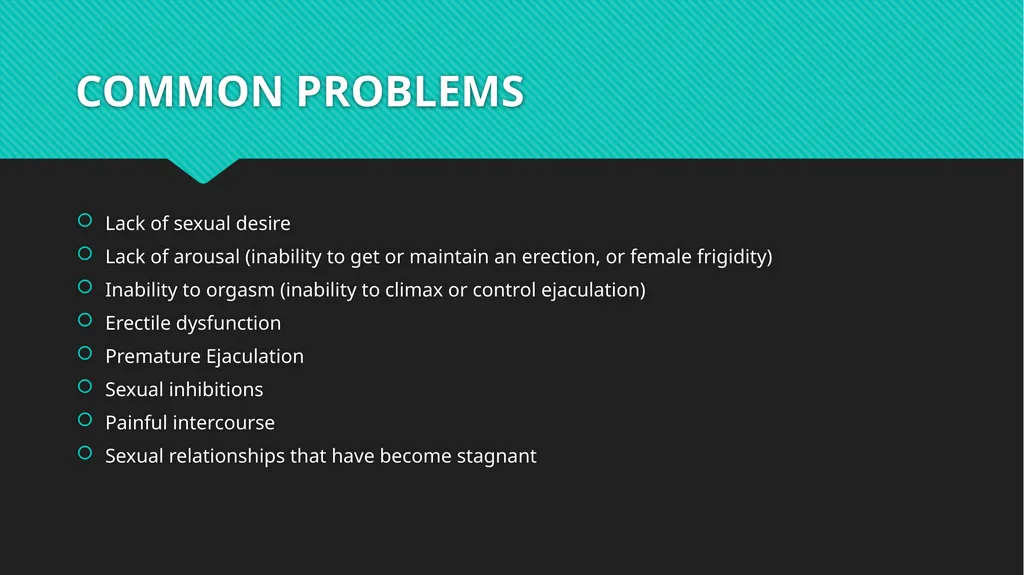
COMMON PROBLEMS Lack of sexual desire
Lack of arousal (inability to get or maintain an erection, or female frigidity)
Inability to orgasm (inability to climax or control ejaculation)
Erectile dysfunction
Premature Ejaculation
Sexual inhibitions
Painful intercourse
Sexual relationships that have become stagnant<br>
Lack of arousal (inability to get or maintain an erection, or female frigidity)
Inability to orgasm (inability to climax or control ejaculation)
Erectile dysfunction
Premature Ejaculation
Sexual inhibitions
Painful intercourse
Sexual relationships that have become stagnant<br>
08
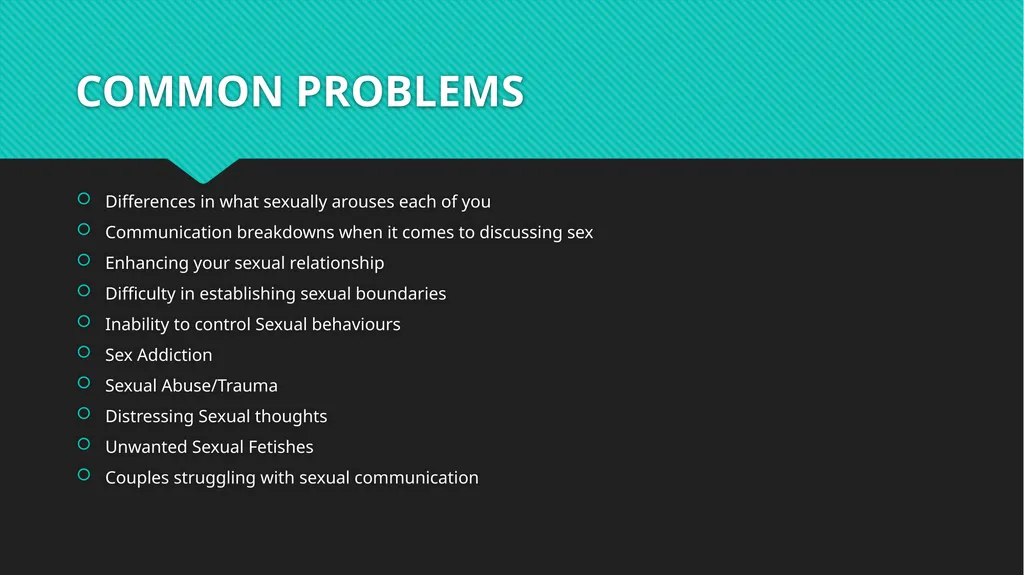
COMMON PROBLEMS Differences in what sexually arouses each of you
Communication breakdowns when it comes to discussing sex
Enhancing your sexual relationship
Difficulty in establishing sexual boundaries
Inability to control Sexual behaviours
Sex Addiction
Sexual Abuse/Trauma
Distressing Sexual thoughts
Unwanted Sexual Fetishes
Couples struggling with sexual communication<br>
Communication breakdowns when it comes to discussing sex
Enhancing your sexual relationship
Difficulty in establishing sexual boundaries
Inability to control Sexual behaviours
Sex Addiction
Sexual Abuse/Trauma
Distressing Sexual thoughts
Unwanted Sexual Fetishes
Couples struggling with sexual communication<br>
09
WHY DO YOU NEED SEX THERAPY A fulfilling sex life is healthy and natural. Physical and emotional intimacy are essential parts of your well-being. When sexual dysfunction occurs, having that fulfilling sex life can be difficult.
Many people may think that you must have severe sexual problems before seeking help from a sex therapist, but this isn’t so. Many sex therapists deal with couples with general sexual problems, such as lack of effective communication about sexual dynamics in their relationships. It's therefore not necessary to wait for a massive sexual issue to develop before seeking professional help.<br>
Many people may think that you must have severe sexual problems before seeking help from a sex therapist, but this isn’t so. Many sex therapists deal with couples with general sexual problems, such as lack of effective communication about sexual dynamics in their relationships. It's therefore not necessary to wait for a massive sexual issue to develop before seeking professional help.<br>
10
WHY DO YOU NEED SEX THERAPY A fulfilling sex life is healthy and natural. Physical and emotional intimacy are essential parts of your well-being. When sexual dysfunction occurs, having that fulfilling sex life can be difficult.
Many people may think that you must have severe sexual problems before seeking help from a sex therapist, but this isn’t so. Many sex therapists deal with couples with general sexual problems, such as lack of effective communication about sexual dynamics in their relationships. It's therefore not necessary to wait for a massive sexual issue to develop before seeking professional help.<br>
Many people may think that you must have severe sexual problems before seeking help from a sex therapist, but this isn’t so. Many sex therapists deal with couples with general sexual problems, such as lack of effective communication about sexual dynamics in their relationships. It's therefore not necessary to wait for a massive sexual issue to develop before seeking professional help.<br>
11
WHY DO YOU NEED SEX THERAPY Sex therapy helps to reframe sexual challenges, deal with a variety of physical and emotional issues that can interfere with sexual satisfaction, thereby improving sexual satisfaction and can help individuals and couples work through these issues in a supportive and educational environment.<br>
12
WHO NEEDS SEX THERAPY Individuals or couples who experience sexual difficulties might need sex therapy. There is no archetype for the person who will benefit from sex therapy. Instead, sex therapy can help individuals of various ages, cultural backgrounds, beliefs, sexual orientation and abilities.<br>
13
WHO NEEDS SEX THERAPY The sexual difficulties for which couples or individuals may seek sex therapy can be specifically identified as Sexual problems or Sexual dysfunctions.
Sexual dysfunctions are impairments, either physical or psychological, of one of the three phases of the sexual response cycle, i.e. desire, arousal and orgasm. Additionally, there are the pain disorders such as Dyspareunia, Vaginismus, Vulvodynia etc.
Aside from these dysfunctions, people experience a wide range of other sexual difficulties for which they may like to seek sexuality counselling. They are referred to as sexual problems and range from dissatisfaction with Sexual frequency, Sexual boredom, Sexual incompatibility with respect to sexual activity and lack of sexual fulfilment.<br>
Sexual dysfunctions are impairments, either physical or psychological, of one of the three phases of the sexual response cycle, i.e. desire, arousal and orgasm. Additionally, there are the pain disorders such as Dyspareunia, Vaginismus, Vulvodynia etc.
Aside from these dysfunctions, people experience a wide range of other sexual difficulties for which they may like to seek sexuality counselling. They are referred to as sexual problems and range from dissatisfaction with Sexual frequency, Sexual boredom, Sexual incompatibility with respect to sexual activity and lack of sexual fulfilment.<br>
14
HOW DOES SEX THERAPY WORK? Sex Therapy sessions can either be done online or physically.
Typically, Sex therapy will involve a number of sessions with a therapist to facilitate the disclosure and discussion of the sexual problems which have led the individual (or couple) to seek therapy.
In couples Sex Therapy, ideally, the couple are treated together although certain aspects of the treatment may involve only one member of the couple. In some instances individuals will also seek therapy and be treated as individuals.<br>
Typically, Sex therapy will involve a number of sessions with a therapist to facilitate the disclosure and discussion of the sexual problems which have led the individual (or couple) to seek therapy.
In couples Sex Therapy, ideally, the couple are treated together although certain aspects of the treatment may involve only one member of the couple. In some instances individuals will also seek therapy and be treated as individuals.<br>
15
HOW DOES SEX THERAPY WORK? Sex therapists are often involved in the ongoing treatment of sexual difficulties & dysfunction, particularly when treatment involves psychosocial (as opposed to medication-only) therapies.
In addition to assessing the situation, the therapist’s role is to help the client(s) come up with the motivation to change their sexual behaviours to achieve a more fulfilling Sex life.
A therapist also tries to help the client unravel the difficulties underlying their sexual difficulties and develop strategies which might help to overcome them. With the therapist’s assistance, client(s) engage in discussions about their sex life and sexuality and the factors which influence these.
Together with the therapist, client then works out coping mechanisms to help improve their responses in the future so that they can have a healthier sex life.<br>
In addition to assessing the situation, the therapist’s role is to help the client(s) come up with the motivation to change their sexual behaviours to achieve a more fulfilling Sex life.
A therapist also tries to help the client unravel the difficulties underlying their sexual difficulties and develop strategies which might help to overcome them. With the therapist’s assistance, client(s) engage in discussions about their sex life and sexuality and the factors which influence these.
Together with the therapist, client then works out coping mechanisms to help improve their responses in the future so that they can have a healthier sex life.<br>
16
HOW DOES SEX THERAPY WORK? They may also practice physical exercises often as “homework” tasks (for example sensual touching exercises).
The therapist may also recommend counselling for broader issues affecting sexual functioning (e.g. marital counselling for couples with marital difficulties).
If the therapist suspects the dysfunction experienced is the result of a physical sexual concern, they may refer client to a medical doctor.
The therapist and the doctor can consult about signs and symptoms and work to help find any physical concerns that may be contributing to greater sexual problems. However, Sex Therapist would not recommend medications or carry out physical examinations themselves.<br>
The therapist may also recommend counselling for broader issues affecting sexual functioning (e.g. marital counselling for couples with marital difficulties).
If the therapist suspects the dysfunction experienced is the result of a physical sexual concern, they may refer client to a medical doctor.
The therapist and the doctor can consult about signs and symptoms and work to help find any physical concerns that may be contributing to greater sexual problems. However, Sex Therapist would not recommend medications or carry out physical examinations themselves.<br>
17
HOW DOES SEX THERAPY WORK? Initial assessment
Initial assessment of a couple visiting a sex therapist or other health professional with complaints of sexual difficulties generally includes taking client's history (with a particular focus on the history of the sexual difficulty) and if required, physical examination. A diagnosis of the complaint will then usually be made.<br>
18
HOW DOES SEX THERAPY WORK? History taking
In order to assess the nature, severity and underlying causes of a sexual difficulty, a therapist or other health professional may ask the individual (or couple) questions regarding the:
- When they first became sexually active (or history of the relationship, if it's a couple's session)
- Onset of sexual difficulties;
- Nature of the sexual difficulties;
- Client’s explanation for why they are having sexual difficulties;<br>
19
HOW DOES SEX THERAPY WORK? History taking
- Attitudes towards sexuality; and
- Previous treatment for sexual difficulties and response to that treatment.
Discussing the sexuality may be a difficult process, as many individuals are not open to discussing such. They may experience a range of negative emotions including shame, guilt and anger.
Negative emotions will interfere with the treatment, and the sex therapist will therefore encourage couples to discuss events of the past and move on from them, leaving any negative emotions behind.<br>
Discussing the sexuality may be a difficult process, as many individuals are not open to discussing such. They may experience a range of negative emotions including shame, guilt and anger.
Negative emotions will interfere with the treatment, and the sex therapist will therefore encourage couples to discuss events of the past and move on from them, leaving any negative emotions behind.<br>
20
HOW DOES SEX THERAPY WORK? History taking
Therapists may also ask about childhood experiences which may be influencing their sexuality today, including questions regarding:
Their parents’ marriage, details of their parents’ level of intimacy, attitudes to sexuality, separations and extra-marital affairs; and childhood experience of incest or sexual abuse.<br>
Therapists may also ask about childhood experiences which may be influencing their sexuality today, including questions regarding:
Their parents’ marriage, details of their parents’ level of intimacy, attitudes to sexuality, separations and extra-marital affairs; and childhood experience of incest or sexual abuse.<br>
21
HOW DOES SEX THERAPY WORK? Physical examination
Physical examination also plays an important role in the assessment of a sexual difficulties. However, it is important to note that a physical examination cannot be conducted by a Sex Therapist who is not a GP, medical doctor, nurse or physiotherapist. A physical examination is generally considered essential in cases where the presenting complaint is: - A sexual pain disorder (e.g. vaginismus, dyspareunia); - Erectile dysfunction; or - Thought to be caused or influenced a neurological or physiological disorder.<br>
Physical examination also plays an important role in the assessment of a sexual difficulties. However, it is important to note that a physical examination cannot be conducted by a Sex Therapist who is not a GP, medical doctor, nurse or physiotherapist. A physical examination is generally considered essential in cases where the presenting complaint is: - A sexual pain disorder (e.g. vaginismus, dyspareunia); - Erectile dysfunction; or - Thought to be caused or influenced a neurological or physiological disorder.<br>
22
HOW DOES SEX THERAPY WORK? Physical examination
For other presenting complaints, while not essential, physical examination often provides important insights into the underlying causes or nature of a range of sexual difficulties. It can also assist the doctor to select the most appropriate laboratory tests and other investigations to assist with diagnosis. For example: - Degeneration of the genital tissues in women may indicate oestrogen deficiency or a connective tissue disorder; - Erectile dysfunction in men might indicate cardiovascular problems, diabetes or a lower urinary tract problem; and - The emotional or physical response to pelvic and/or genital examination of a man and woman, may provide insights regarding psychological issues underlying the sexual dysfunction.<br>
For other presenting complaints, while not essential, physical examination often provides important insights into the underlying causes or nature of a range of sexual difficulties. It can also assist the doctor to select the most appropriate laboratory tests and other investigations to assist with diagnosis. For example: - Degeneration of the genital tissues in women may indicate oestrogen deficiency or a connective tissue disorder; - Erectile dysfunction in men might indicate cardiovascular problems, diabetes or a lower urinary tract problem; and - The emotional or physical response to pelvic and/or genital examination of a man and woman, may provide insights regarding psychological issues underlying the sexual dysfunction.<br>
23
HOW DOES SEX THERAPY WORK? Investigations
Laboratory assessment of hormone levels is often performed in the assessment of sexual disorders although such tests are not essential.
For women, the hormones best known for influencing sexual functioning are testosterone (which affects sexual desire) and estrogen (which affects sexual arousal, in particular vaginal lubrication and elasticity).
Testosterone is also the key hormone affecting sexual desire and function in men. However, there is also evidence that psychosocial factors, in particular satisfaction with the relationship and partner, are more important determinants of sexual function than hormone levels.<br>
Laboratory assessment of hormone levels is often performed in the assessment of sexual disorders although such tests are not essential.
For women, the hormones best known for influencing sexual functioning are testosterone (which affects sexual desire) and estrogen (which affects sexual arousal, in particular vaginal lubrication and elasticity).
Testosterone is also the key hormone affecting sexual desire and function in men. However, there is also evidence that psychosocial factors, in particular satisfaction with the relationship and partner, are more important determinants of sexual function than hormone levels.<br>
24
HOW DOES SEX THERAPY WORK? Diagnosis
The information generated through history taking, examination and investigations is used to develop:
a preliminary diagnosis regarding the causes underlying the couple’s sexual difficulties (particularly a determination of whether the difficulties are primarily underpinned by biological or psychological factors);
a strategy for resolving the sexual difficulties based on the above diagnosis; and
a strategy for resolving any related problems which may influence sexual difficulties (e.g. Marriage or couples therapy to resolve relationship issues such as intimacy and trust).<br>
25
HOW DOES SEX THERAPY WORK? Treatment
In cases where medication alone is required to treat a sexual problem, it may be administered solely by a medical doctor.
If the sexual difficulty does not require any form of medication, a purely psychosocial approach is employed.
Combined approaches to sex therapy involve a combination of cognitive-behavioural and systemic interventions including: - Sexual education; - Sexual permissiveness training (teaching individuals or couples to freely express their sexual feelings and behave in ways which they may previously thought of as unusual);<br>
In cases where medication alone is required to treat a sexual problem, it may be administered solely by a medical doctor.
If the sexual difficulty does not require any form of medication, a purely psychosocial approach is employed.
Combined approaches to sex therapy involve a combination of cognitive-behavioural and systemic interventions including: - Sexual education; - Sexual permissiveness training (teaching individuals or couples to freely express their sexual feelings and behave in ways which they may previously thought of as unusual);<br>
26
HOW DOES SEX THERAPY WORK? TREATMENT
- Non demand pleasuring (sensual activities between a couple which occur for their own sake, not as a lead up to sexual intercourse); - Physical awareness and sensuality exercises; - Exploration of past traumatic events that may influence current sexual experience; - Treatment of psychological problems (e.g. depression); - Treatment of other health issues such as obesity and overweight, fatigue, eating disorders, self esteem and body image difficulties, sedentary lifestyle etc - Surgical interventions to rectify congenital or other abnormalities of the genitals which may underpin sexual difficulties. E.g In cases where a woman is unable to have sexual intercourse due to having an imperforate hymen.<br>
- Non demand pleasuring (sensual activities between a couple which occur for their own sake, not as a lead up to sexual intercourse); - Physical awareness and sensuality exercises; - Exploration of past traumatic events that may influence current sexual experience; - Treatment of psychological problems (e.g. depression); - Treatment of other health issues such as obesity and overweight, fatigue, eating disorders, self esteem and body image difficulties, sedentary lifestyle etc - Surgical interventions to rectify congenital or other abnormalities of the genitals which may underpin sexual difficulties. E.g In cases where a woman is unable to have sexual intercourse due to having an imperforate hymen.<br>
27
HOW DOES SEX THERAPY WORK? The exact combination of therapeutic measures will depend on the nature of the sexual difficulties and the individuals involved. Sex therapists will usually be familiar with many different treatment options and combine them to suit the particular needs of the couple being treated.
The Sex therapist also helps motivate and guide the couple throughout the treatment.
Typically sex therapy involves numerous visits to a therapist’s office, in which education and training are undertaken, issues discussed and response to medicines and other aspects of the treatment monitored.<br>
The Sex therapist also helps motivate and guide the couple throughout the treatment.
Typically sex therapy involves numerous visits to a therapist’s office, in which education and training are undertaken, issues discussed and response to medicines and other aspects of the treatment monitored.<br>
28
HOW DOES SEX THERAPY WORK? The couple may also be introduced to pleasuring exercises and asked to practice these as homework.
Such homework might include the following:
• Experimentation. Couples who feel they’re in a sexual rut may try different activities, such as role playing or using sex toys, to increase their desire. Other couples may need to adjust their sexual routine or positions, especially if one partner has a health condition that requires such changes.
• Sensual Exercises. This technique for couples is designed to build trust and intimacy while reducing anxiety. Couples progress through three stages, starting with nonsexual touching, progressing to genital touching, and, usually, ending with penetration.<br>
Such homework might include the following:
• Experimentation. Couples who feel they’re in a sexual rut may try different activities, such as role playing or using sex toys, to increase their desire. Other couples may need to adjust their sexual routine or positions, especially if one partner has a health condition that requires such changes.
• Sensual Exercises. This technique for couples is designed to build trust and intimacy while reducing anxiety. Couples progress through three stages, starting with nonsexual touching, progressing to genital touching, and, usually, ending with penetration.<br>
29
HOW DOES SEX THERAPY WORK? • Sexual Education. Sometimes, clients do not receive adequate sex education while they are growing up. As a result, they may not be aware of anatomy and how the body functions during sexual activity. Therapists might assign books or web content to read or videos to watch. They might also suggest that clients use a mirror to learn more about their body.
• Communication strategies. Clients may practice asking for what they want or need sexually or emotionally in a relationship.
Success with sex therapy often depends on how committed clients are to the process. If clients are willing to put in the effort, either alone or with a partner, they are more likely to reach their sexual goals.<br>
• Communication strategies. Clients may practice asking for what they want or need sexually or emotionally in a relationship.
Success with sex therapy often depends on how committed clients are to the process. If clients are willing to put in the effort, either alone or with a partner, they are more likely to reach their sexual goals.<br>
30
HOW DOES SEX THERAPY WORK? The frequency and duration of sex therapy sessions will vary depending on the couple being treated. However, to prevent the reoccurrence of sexual difficulties, it is recommended that sessions continue even after improvements in sexual functioning are seen.
Clients are also more likely to experience greater improvement if they continue with “homework” exercises after the conclusion of sex therapy sessions.<br>
Clients are also more likely to experience greater improvement if they continue with “homework” exercises after the conclusion of sex therapy sessions.<br>
31
HOW DOES SEX THERAPY WORK? Follow up to prevent relapse
Individuals who experience improved sexual functioning during sex therapy may still relapse into sexual difficulties once sex therapy sessions terminate.
Ensuring that sex therapy is comprehensive and effectively addresses the biological, physical, psychological and social factors underpinning sexual difficulties tends to reduce the potential for difficulties to re-arise once therapy stops.<br>
32
HOW DOES SEX THERAPY WORK? Follow up to prevent relapse
However, it is also important that the client :
Has realistic goals about their future sexual performance, for example that they do not expect to have “perfect” sex every time;
Is prepared to deal with sexual “failures”, that is, sexual experiences which were difficult or less than satisfactory than was hoped;
Continues to practice some of the techniques learnt during sex therapy, for example non-demand pleasuring sessions without intercourse and using alternative sexual scripts to consciously expand their sexual repertoire; and<br>
33
HOW DOES SEX THERAPY WORK? Follow up to prevent relapse
Has follow up visits with the sex therapist every six months for one to two years after the treatment is complete.
Additionally, resistance to treatment and relapse may be signs of other sexual dysfunctions in the individual or couple, problems with communication, or relationship conflict.<br>
34
ASSESSING THE OUTCOMES OF SEX THERAPY There are a number of approaches which can be taken to measure the effectiveness of a sex therapy program.
Evaluation typically focuses on objective, physical measures, such as achievement of orgasm or erection in an individual who previously had difficulty.
This is partly because it is more difficult to assess subjective measures in circumstances where same outcomes may indicate either success or failure, depending on the couple. For example, in some cases sex therapy may result in the realisation that the relationship is deeply troubled. In such a case ending the relationship may constitute a more successful treatment outcome than achieving sexual performance within it.<br>
Evaluation typically focuses on objective, physical measures, such as achievement of orgasm or erection in an individual who previously had difficulty.
This is partly because it is more difficult to assess subjective measures in circumstances where same outcomes may indicate either success or failure, depending on the couple. For example, in some cases sex therapy may result in the realisation that the relationship is deeply troubled. In such a case ending the relationship may constitute a more successful treatment outcome than achieving sexual performance within it.<br>
35
ASSESSING THE OUTCOMES OF SEX THERAPY It is generally recognised that the main measure on which the success of sex therapy should be measured is in terms of whether or not the therapy assisted the couple to achieve greater sexual satisfaction, regardless of whether, or in spite of the fact that, sexual performance actually changed.
Achieving an orgasm is not necessarily a success, unless the couple perceive that achievement to have enhanced their sex life.
In some cases expectations may change as a result of sex therapy rather than sexual performance. For example, sex therapy may teach couples not to expect “perfect” sexual performance at every encounter, and that imperfect sexual performance does not necessarily constitute unsatisfactory sex.<br>
Achieving an orgasm is not necessarily a success, unless the couple perceive that achievement to have enhanced their sex life.
In some cases expectations may change as a result of sex therapy rather than sexual performance. For example, sex therapy may teach couples not to expect “perfect” sexual performance at every encounter, and that imperfect sexual performance does not necessarily constitute unsatisfactory sex.<br>
36
ETHICAL PRINCIPLES OF SEX THERAPY Some people wonder if sex therapy entails talk therapy only or whether treatment will involve sexual contact with the therapist or even between the couple while in the therapist’s office.
NO SEXUAL CONTACT BETWEEN THERAPISTS AND THE COUPLE OR INDIVIDUAL IS PERMISSIBLE.
Although, couples or individuals are often given homework assignments to practice at home and then to discuss in the following session, it would be unethical to have couples engage in sexual activity or touching with the therapist present.
Additionally, issues such as integrity and confidentiality are non-negotiable in Sex therapy, as with other forms of Psychotherapy.<br>
NO SEXUAL CONTACT BETWEEN THERAPISTS AND THE COUPLE OR INDIVIDUAL IS PERMISSIBLE.
Although, couples or individuals are often given homework assignments to practice at home and then to discuss in the following session, it would be unethical to have couples engage in sexual activity or touching with the therapist present.
Additionally, issues such as integrity and confidentiality are non-negotiable in Sex therapy, as with other forms of Psychotherapy.<br>
37
END OF MODULE 1<br>