04
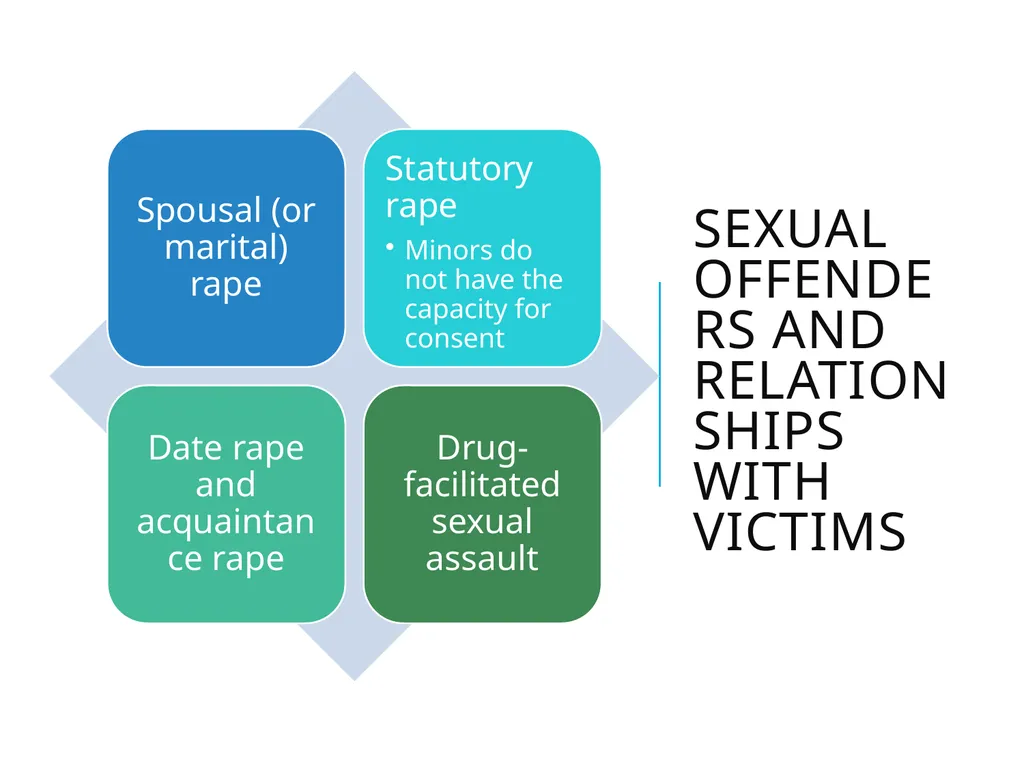
Sexual Offenders and �Relationships with Victims<br>
05
Date Rape Drugs Gamma-hydroxybutyric acid (GHB): Designer drug that causes amnesia.
Names include liquid ecstasy, salty water, scoop, homeboy.
Rohypnol (flunitrazepam): A potent benzodiazepine.
Is the “forget” drug.
Also called roofies, club drug, roachies, rophies, Mexican valium
Ketamine: An anesthetic more recently approved to treat depression/suicidal ideation.
Names include special K, K, vitamin K, bump, KitKat, purple, super C. 5<br>
06
Date Rape Drugs�(cont.) Date rape drugs clear from body fairly quickly. Detecting the drug in the emergency department (ED) is difficult.
Urine sample must be obtained within a certain period of time.
The most common drug used to facilitate the crime of rape is still alcohol. 6<br>
07
Case Study Indira, a 20-year-old woman, is brought to the ED by two friends, who say that Indira has been hurt by someone at a party they attended, but she won’t tell them who hurt her or what happened. She was willing to be brought to the ED, however.
One friend says, “We were at this party when these guys introduced themselves, and one asked Indira to dance with him. We tried to keep our eyes on each other, but we lost track of Indira somehow until we found her in a bedroom upstairs. She was all messed up and crying.”<br>
08
Epidemiology Rape victims: 19.3% of women and 1.7% of men
For females, the first rape experience happened:
before age 25 years in nearly 79%
before age 18 in 40%
Both males and females are more likely to be raped by a male.
The lifetime prevalence and 12-month prevalence of intimate partner rape is estimated at nearly 9% and around 1%, respectively.<br>
09
Sexual Violence is Underreported Majority of women do not report because they:
Think it might be their fault
Do not consider the incident a sexual assault
Do not want to report their abuser for fear of reprisal
Do not want to get their “friend” or “date” in trouble
Do not want others to know
Cannot remember clearly enough to feel they would be believed, especially if they had been drinking and/or taking drugs. 9<br>
10
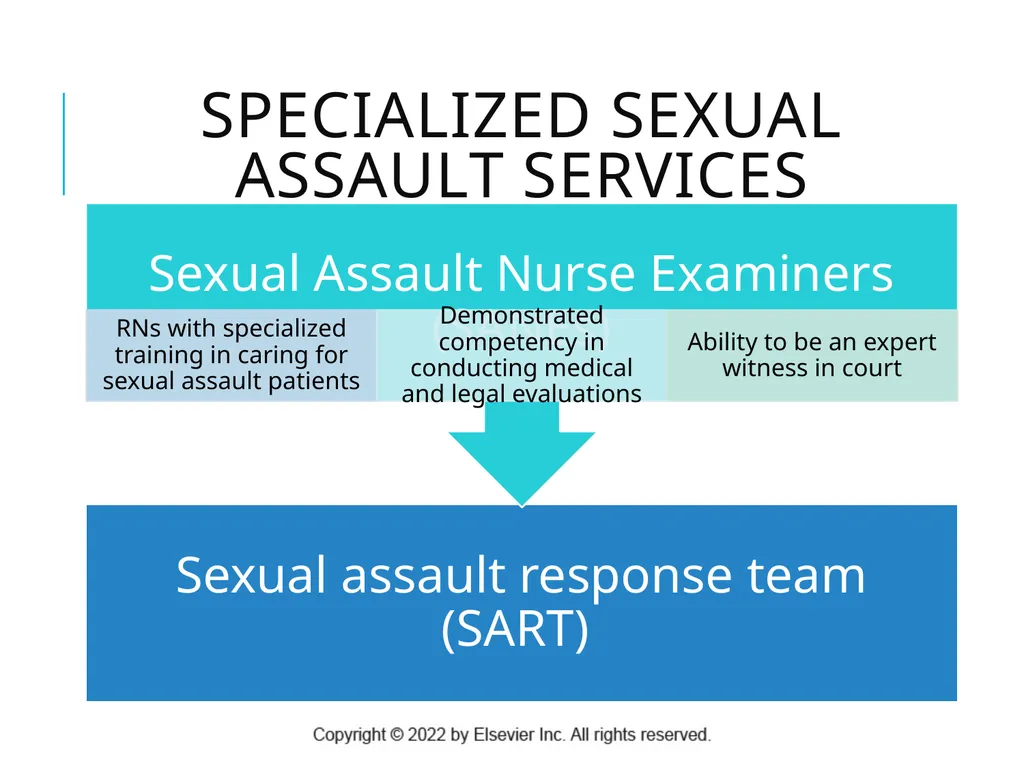
Specialized Sexual Assault Services<br>
11
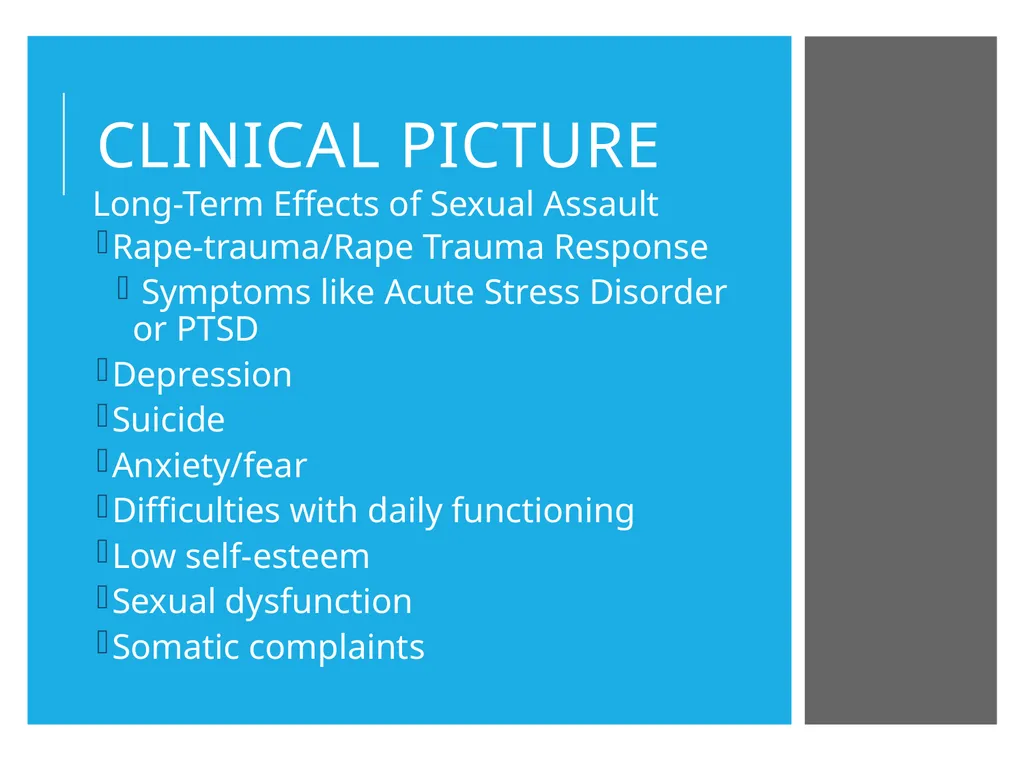
Clinical Picture Long-Term Effects of Sexual Assault
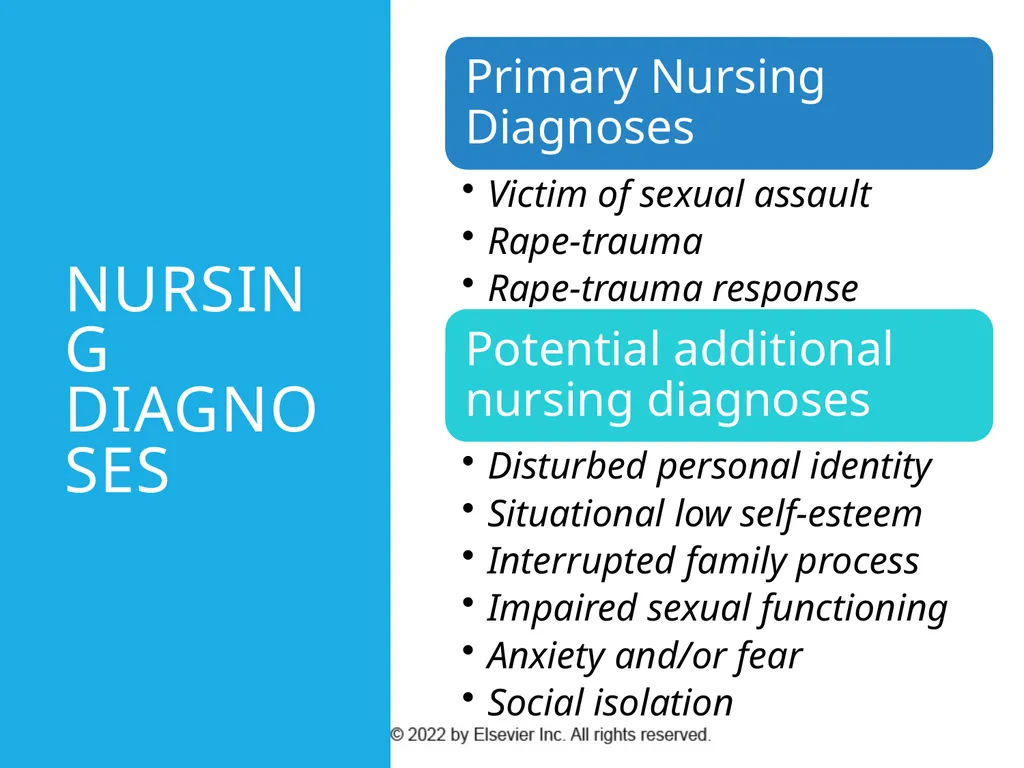
Rape-trauma/Rape Trauma Response
Symptoms like Acute Stress Disorder or PTSD
Depression
Suicide
Anxiety/fear
Difficulties with daily functioning
Low self-esteem
Sexual dysfunction
Somatic complaints<br>
12
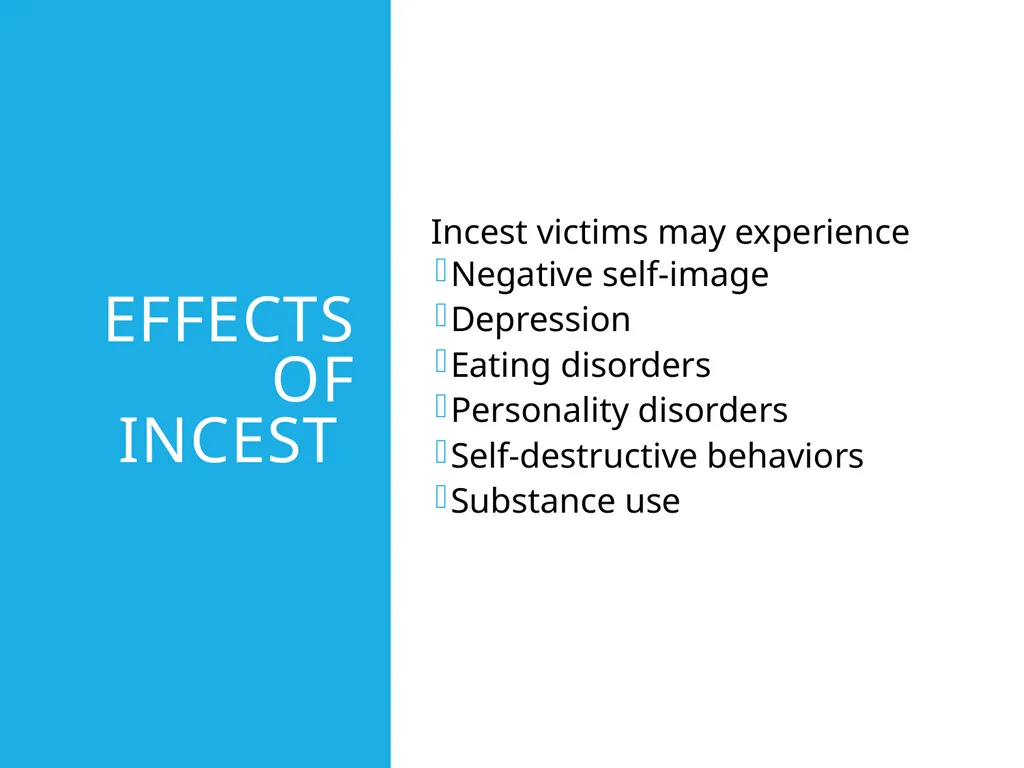
Effects of Incest Incest victims may experience
Negative self-image
Depression
Eating disorders
Personality disorders
Self-destructive behaviors
Substance use<br>
13
Application of the Nursing Process<br>
15
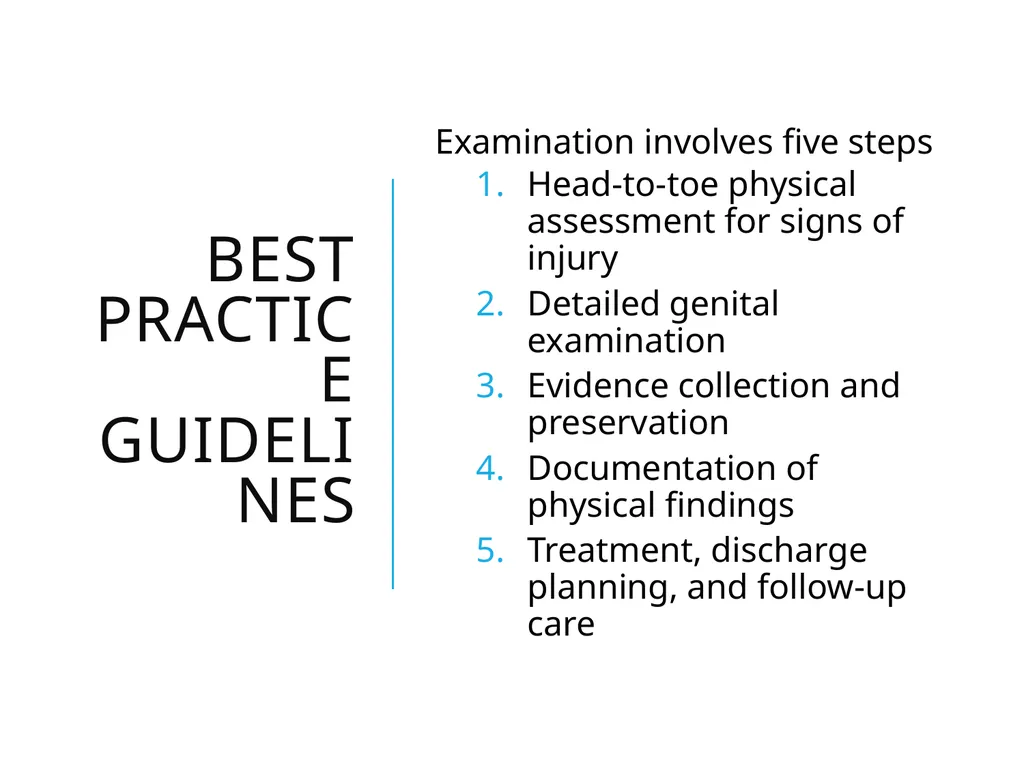
Best Practice Guidelines Examination involves five steps
Head-to-toe physical assessment for signs of injury
Detailed genital examination
Evidence collection and preservation
Documentation of physical findings
Treatment, discharge planning, and follow-up care<br>
16
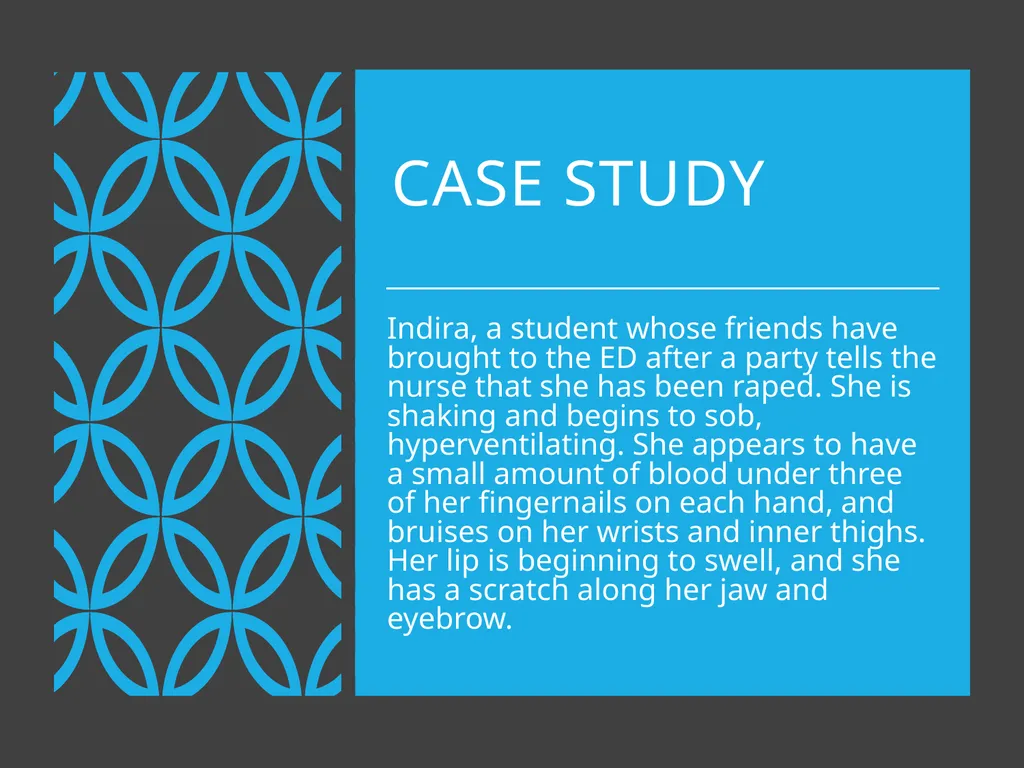
Case Study Indira, a student whose friends have brought to the ED after a party tells the nurse that she has been raped. She is shaking and begins to sob, hyperventilating. She appears to have a small amount of blood under three of her fingernails on each hand, and bruises on her wrists and inner thighs. Her lip is beginning to swell, and she has a scratch along her jaw and eyebrow.<br>
17
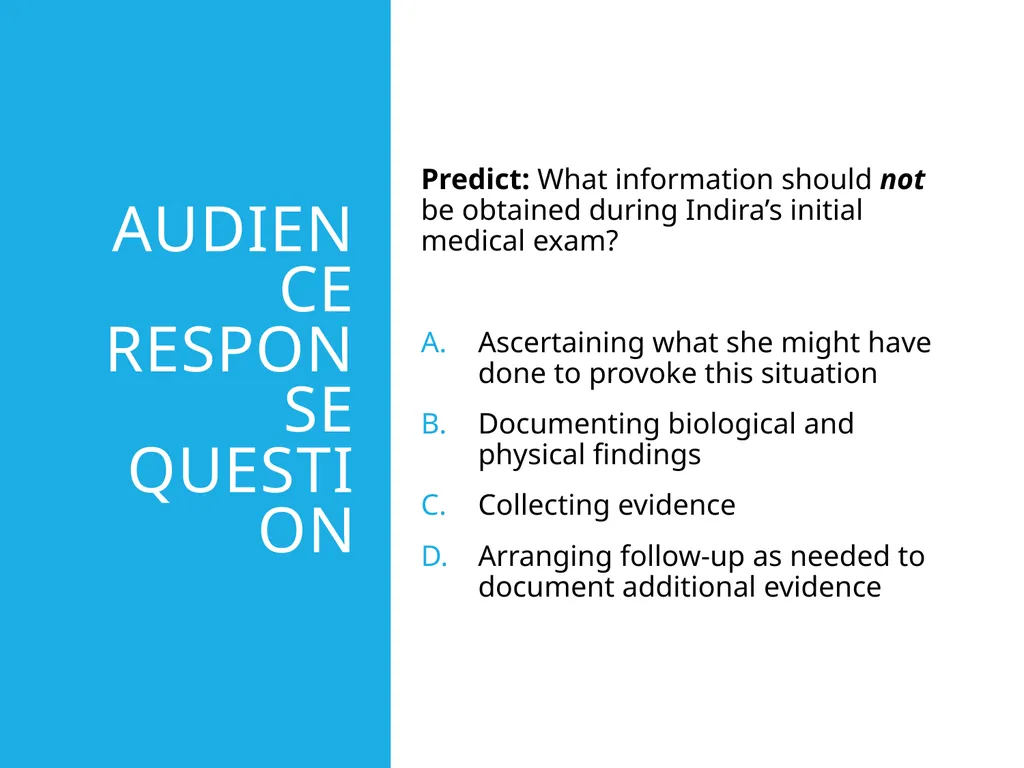
Audience Response Question Predict: What information should not be obtained during Indira’s initial medical exam?
Ascertaining what she might have done to provoke this situation
Documenting biological and physical findings
Collecting evidence
Arranging follow-up as needed to document additional evidence<br>
18
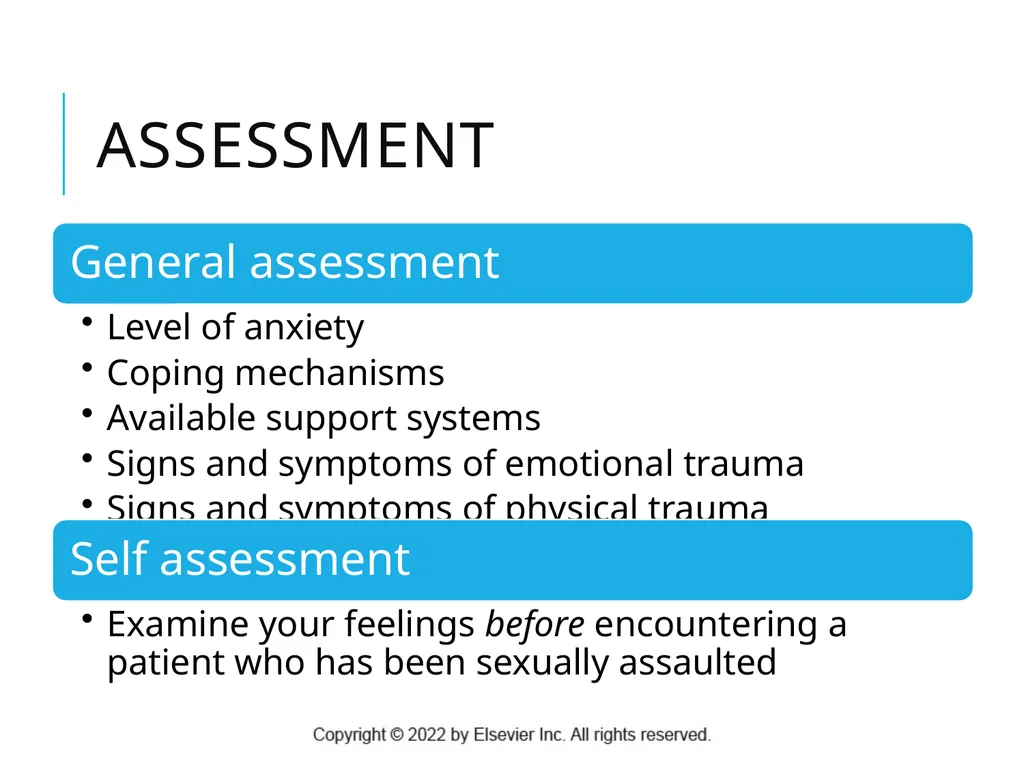
Case Study Discussion What areas should you include in your assessment of Indira?<br>
19
Case Study Discussion What would be some appropriate questions to ask Indira to determine her coping mechanisms?<br>
21
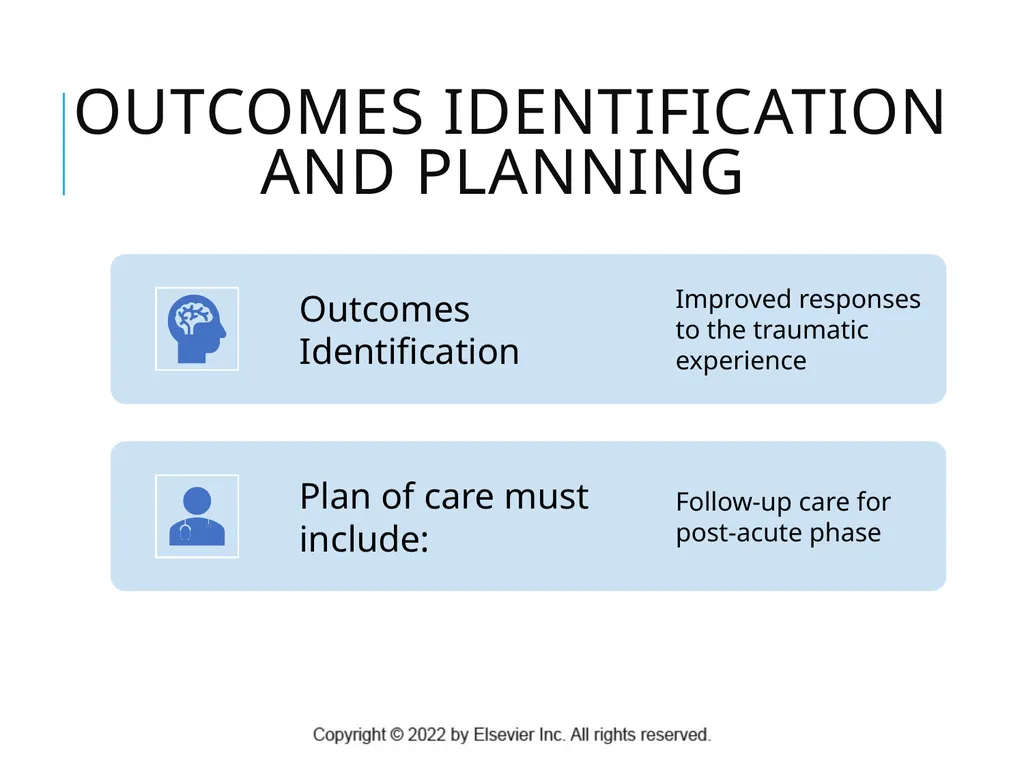
Outcomes Identification�and Planning<br>
22
Short-Term Outcomes The patient will have a support person.
The patient will have an understanding of the rape protocol.
The patient will have information about the legal procedures available.
The patient will have physical injuries treated.
The patient will begin to express emotional reactions and feelings before leaving the ER
The patient will have prophylactic medication available to prevent pregnancy and/or sexually transmitted disease.
The patient will have clear, written information about medication use, crisis support services, and rape advocacy programs. 22<br>
23
Long-Term Outcomes The patient will demonstrate positive interpersonal relationships.
The patient will demonstrate adequate social interaction
The patient will express comfort with body.
The patient will express a willingness to be sexual.
The patient will report increased psychological comfort 23<br>
24
Nursing Process (Cont.) Implementation
Counseling
Promotion of self-care activities
Provide detailed written information concerning referral and follow-up options
Case management
After initial evaluation:
Provide follow-up assessment within 24 to 48 hours
Provide follow-up visits at 2, 4, and 6 weeks<br>
25
Recommended Emergency Nursing Care Protocol<br>
26
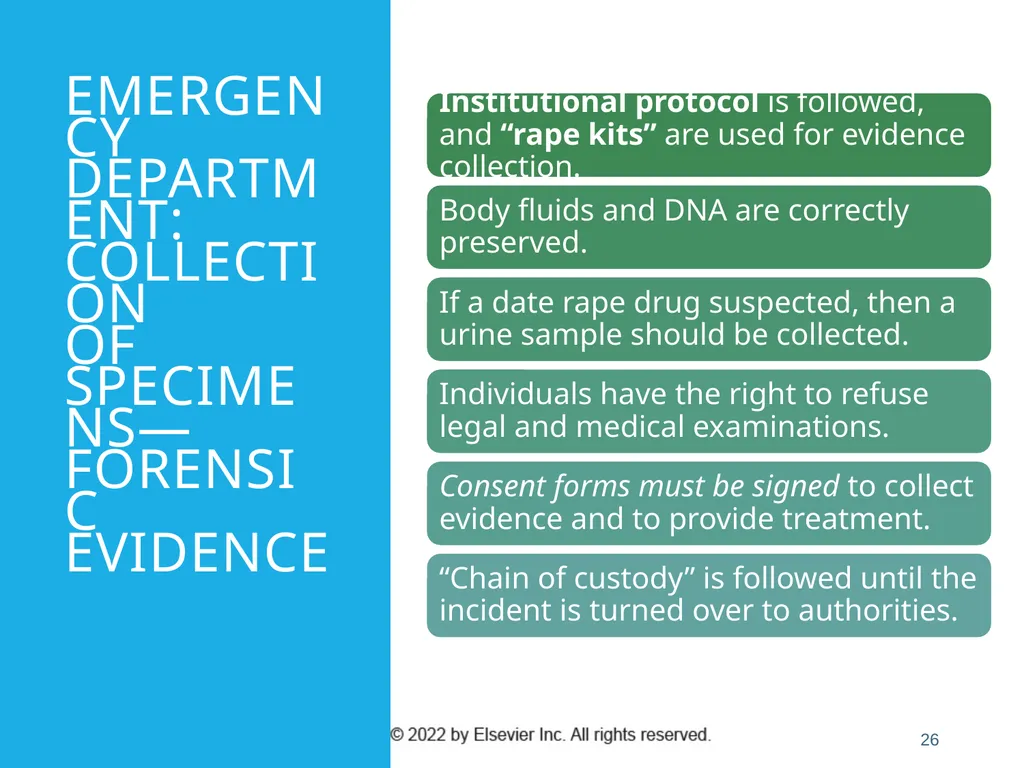
Emergency Department: Collection�of Specimens—Forensic Evidence 26<br>
27
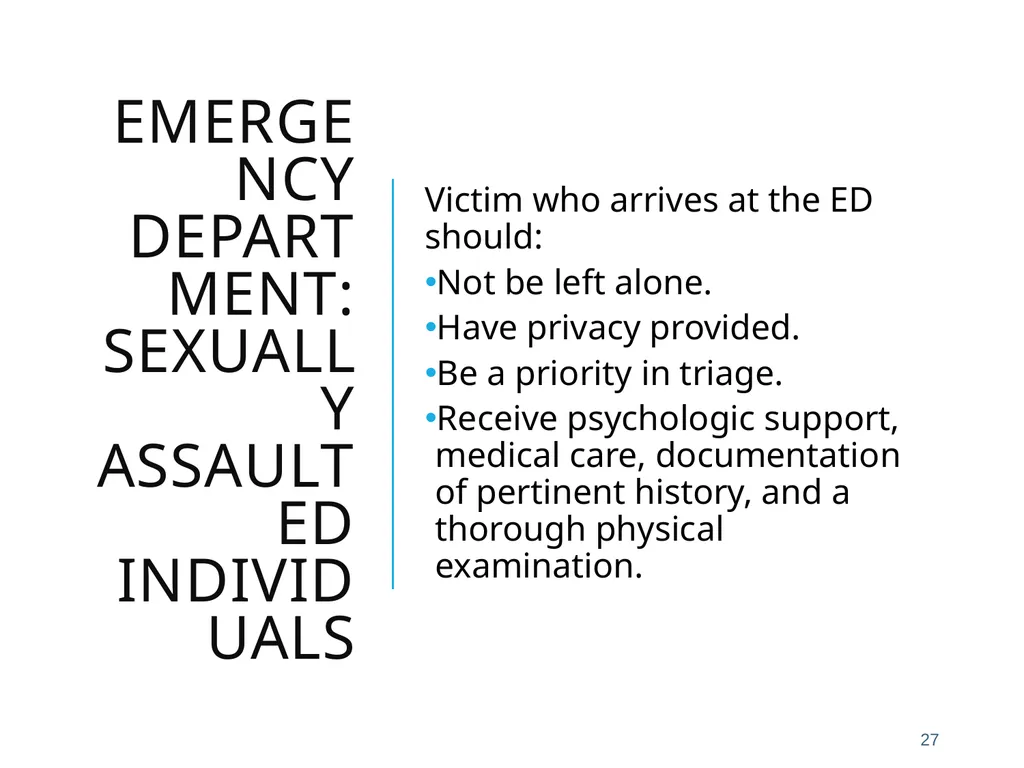
Emergency Department:�Sexually Assaulted Individuals Victim who arrives at the ED should:
Not be left alone.
Have privacy provided.
Be a priority in triage.
Receive psychologic support, medical care, documentation of pertinent history, and a thorough physical examination. 27<br>
28
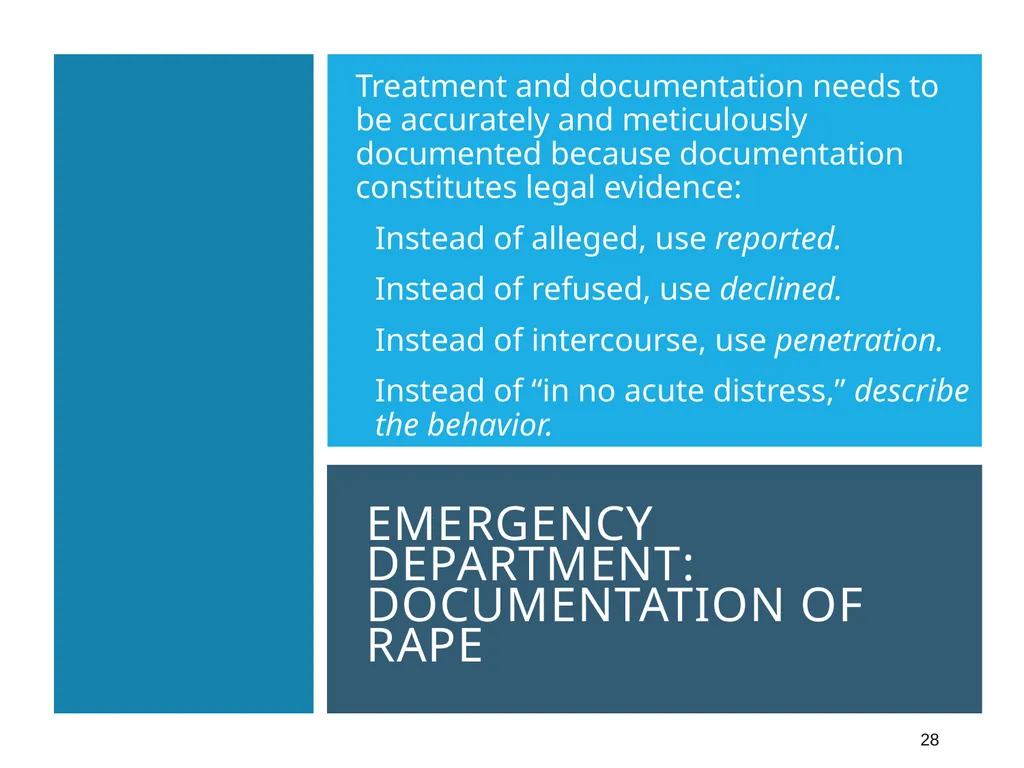
Emergency Department:�Documentation of Rape Treatment and documentation needs to be accurately and meticulously documented because documentation constitutes legal evidence:
Instead of alleged, use reported.
Instead of refused, use declined.
Instead of intercourse, use penetration.
Instead of “in no acute distress,” describe the behavior. 28<br>
29
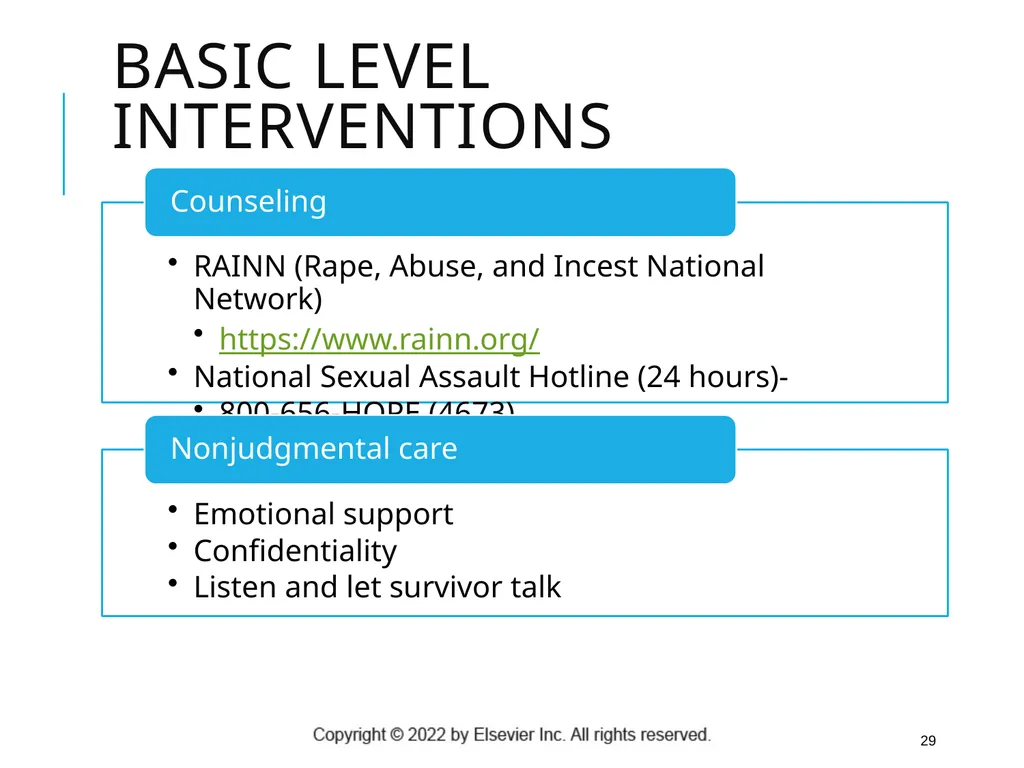
Basic Level Interventions 29<br>
30
Implementation For survivors to return to their previous level of functioning they must:
Fully mourn their losses
Experience anger
Work through their terrifying fears 30<br>
31
Case Study Indira, a student who was raped at a party accepted care in the ED and was referred to a nurse counselor afterward for help with recovery. Specific areas of concern for her were intrusive symptoms, including flashbacks, nightmares, and frequently interrupted sleep. At first she received private counseling, but later she joined a group session, which she found supportive and encouraging.<br>
32
Evaluation Criteria The patient will:
Sleep well with few nightmares or wake-ups
Eat as they did pre-rape
Retain normal levels of calm and relaxation
Get support from family and friends
Demonstrate positive self-regard
Experience little or no somatic reactions
Return to pre-rape sexual functioning and interest<br>
33
Survivor and Victim 33<br>
34
Evaluation Sexual assault survivors are considered to be in recovery if they are relatively free of any signs or symptoms of Rape Trauma or Rape Trauma Response.<br>
35
Treatment Modalities Psychological Therapies
Individual
Group
Survivors
Perpetrators<br>
36
Audience Response Question By virtue of the legal definition of the relationship, rape cannot occur within a marriage.
True
False<br>
37
Audience Response Question Indira’s flashbacks, frightening thoughts, recurrent memories, and nightmares are associated with which category of symptoms in PTSD?
Intrusive symptoms
Dissociative symptoms
Avoidance symptoms
Arousal symptoms<br>