
SHOCK Case Studies Margaret Avallone DNP RN
AS
Published · 60 slides · 0 views

1 / 1




Description
SHOCK Case Studies Margaret Avallone DNP RN CCRN-K, CNE Rutgers Complex Health and Illness Learning Outcomes By the end of the class, the student will be able to: Apply the concepts of shock pathophysiology and management to the care of
Related Topics
Share
Embed code
Download this presentation From Below
"SHOCK Case Studies Margaret Avallone DNP RN" is the property of its rightful owner. Permission is granted to download and print the materials on this website for personal, non-commercial use only, and to display it on your personal computer provided you do not modify the materials and that you retain all copyright notices contained in the materials. By downloading content from our website, you accept the terms of this agreement.
Presentation Transcript
01
SHOCK Case Studies Margaret Avallone DNP RN CCRN-K, CNE
Rutgers Complex Health and Illness<br>
Rutgers Complex Health and Illness<br>
02
Learning Outcomes By the end of the class, the student will be able to:
Apply the concepts of shock pathophysiology and management to the care of patients with hypovolemic, cardiogenic and septic shock using a case study approach.
Apply concepts of quality, safety, and patient-centered care to the care of selected patients and families in critical care environments.<br>
Apply the concepts of shock pathophysiology and management to the care of patients with hypovolemic, cardiogenic and septic shock using a case study approach.
Apply concepts of quality, safety, and patient-centered care to the care of selected patients and families in critical care environments.<br>
03
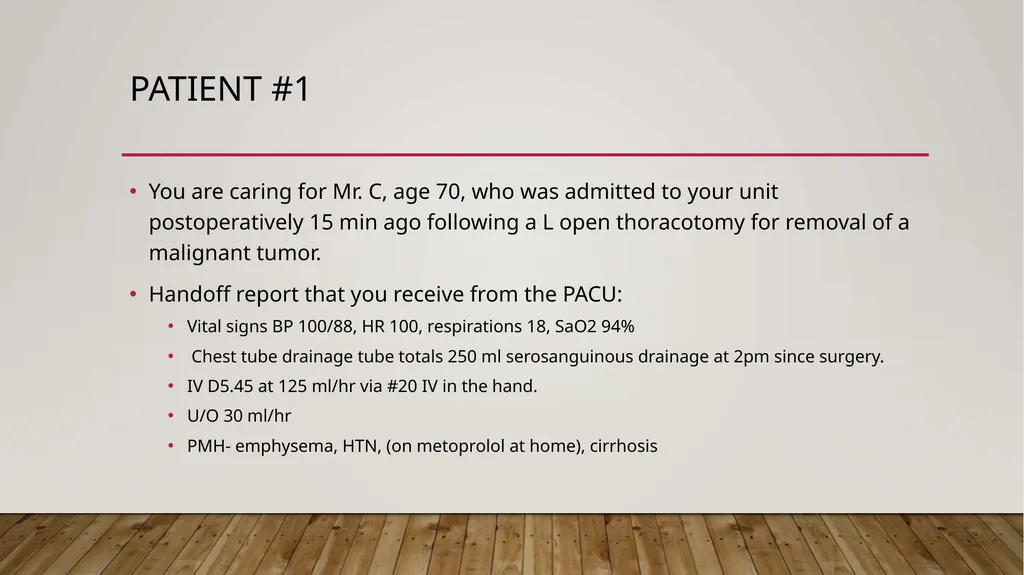
Patient #1 You are caring for Mr. C, age 70, who was admitted to your unit postoperatively 15 min ago following a L open thoracotomy for removal of a malignant tumor.
Handoff report that you receive from the PACU:
Vital signs BP 100/88, HR 100, respirations 18, SaO2 94%
Chest tube drainage tube totals 250 ml serosanguinous drainage at 2pm since surgery.
IV D5.45 at 125 ml/hr via #20 IV in the hand.
U/O 30 ml/hr
PMH- emphysema, HTN, (on metoprolol at home), cirrhosis<br>
Handoff report that you receive from the PACU:
Vital signs BP 100/88, HR 100, respirations 18, SaO2 94%
Chest tube drainage tube totals 250 ml serosanguinous drainage at 2pm since surgery.
IV D5.45 at 125 ml/hr via #20 IV in the hand.
U/O 30 ml/hr
PMH- emphysema, HTN, (on metoprolol at home), cirrhosis<br>
04
Think, Pair, Share What information in the patient’s PMH is important to note in this post-surgical patient?
Based on this handoff report, what are some key assessments that you will make when the patient arrives on the unit?<br>
Based on this handoff report, what are some key assessments that you will make when the patient arrives on the unit?<br>
05
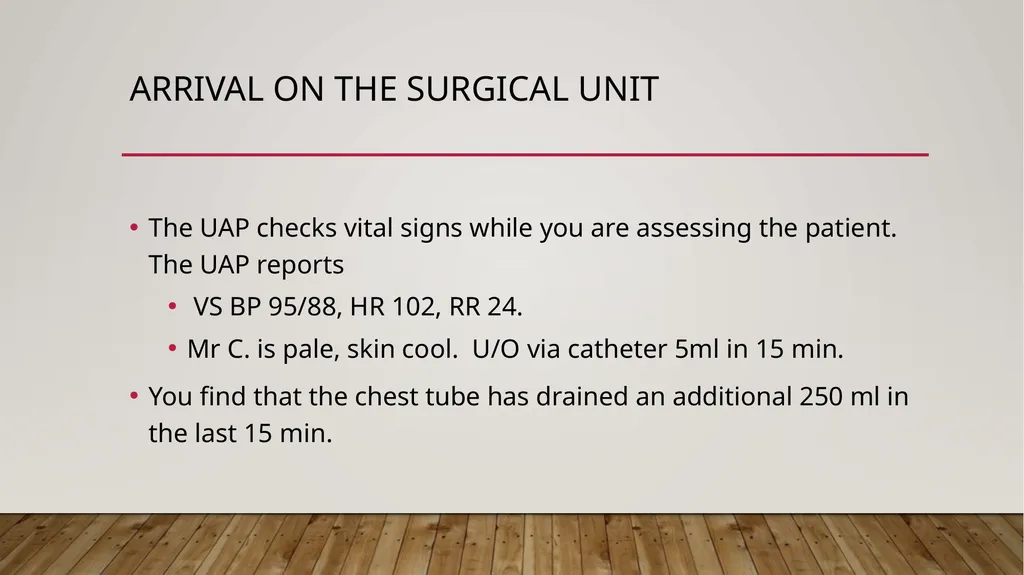
Arrival on the surgical unit The UAP checks vital signs while you are assessing the patient. The UAP reports
VS BP 95/88, HR 102, RR 24.
Mr C. is pale, skin cool. U/O via catheter 5ml in 15 min.
You find that the chest tube has drained an additional 250 ml in the last 15 min.<br>
VS BP 95/88, HR 102, RR 24.
Mr C. is pale, skin cool. U/O via catheter 5ml in 15 min.
You find that the chest tube has drained an additional 250 ml in the last 15 min.<br>
06
Think, pair, share What immediate assessments and interventions should you take? How are you going to prioritize your actions?
Assessments
Interventions
How might the patient’s prior medications affect the compensatory response?
How would report this change in the patient condition to the care provider?
SBAR<br>
Assessments
Interventions
How might the patient’s prior medications affect the compensatory response?
How would report this change in the patient condition to the care provider?
SBAR<br>
07
Hypovolemic Shock- Manifestations Anxiety, irritability, decreased LOC
Poor capillary refill
Pale, gray skin
Tachycardia
Hypotension
Flat neck veins
U/O decreased or absent Firstaidfor free.com<br>
Poor capillary refill
Pale, gray skin
Tachycardia
Hypotension
Flat neck veins
U/O decreased or absent Firstaidfor free.com<br>
08
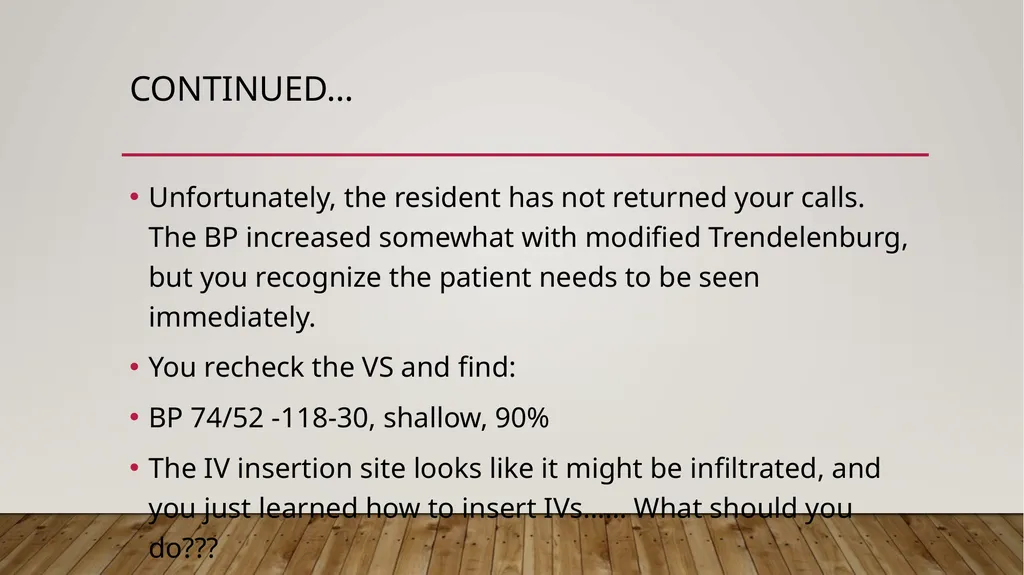
Continued… Unfortunately, the resident has not returned your calls. The BP increased somewhat with modified Trendelenburg, but you recognize the patient needs to be seen immediately.
You recheck the VS and find:
BP 74/52 -118-30, shallow, 90%
The IV insertion site looks like it might be infiltrated, and you just learned how to insert IVs…… What should you do???<br>
You recheck the VS and find:
BP 74/52 -118-30, shallow, 90%
The IV insertion site looks like it might be infiltrated, and you just learned how to insert IVs…… What should you do???<br>
09
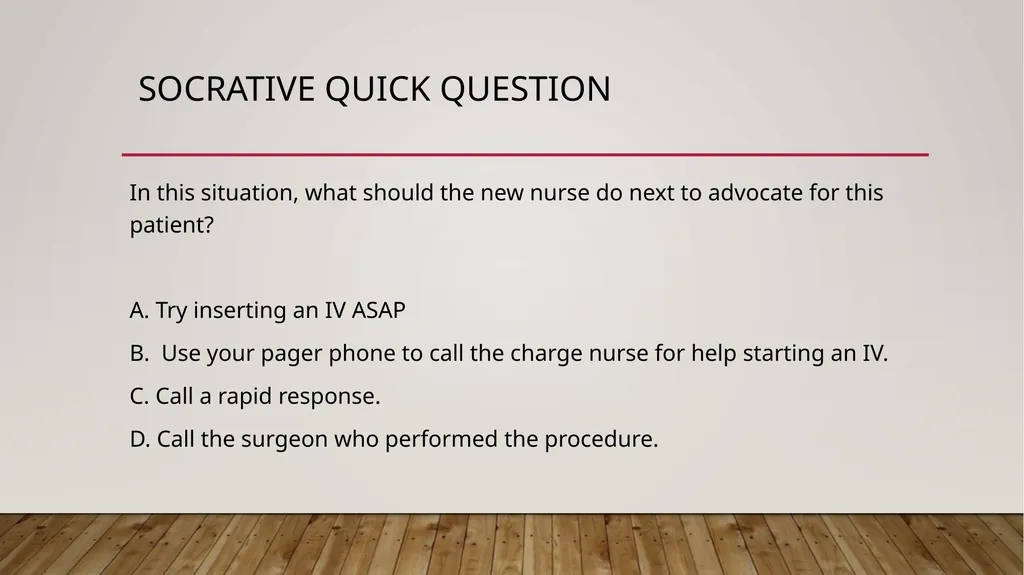
Socrative Quick Question In this situation, what should the new nurse do next to advocate for this patient?
A. Try inserting an IV ASAP
B. Use your pager phone to call the charge nurse for help starting an IV.
C. Call a rapid response.
D. Call the surgeon who performed the procedure.<br>
A. Try inserting an IV ASAP
B. Use your pager phone to call the charge nurse for help starting an IV.
C. Call a rapid response.
D. Call the surgeon who performed the procedure.<br>
10
IHI Early Warning Scoring System to initiate Rapid Response Team: Criteria Staff member is worried about the patient
Acute change in heart rate <40 or >130 bpm
Acute change in systolic BP <90 mmHg
Acute change in RR <8 or >28 per min or threatened airway
Acute change in saturation <90% despite O2
Acute change in conscious state
Acute change in UO to <50 ml in 4 hours IHI Early Warning System and Rapid Response<br>
Acute change in heart rate <40 or >130 bpm
Acute change in systolic BP <90 mmHg
Acute change in RR <8 or >28 per min or threatened airway
Acute change in saturation <90% despite O2
Acute change in conscious state
Acute change in UO to <50 ml in 4 hours IHI Early Warning System and Rapid Response<br>
11
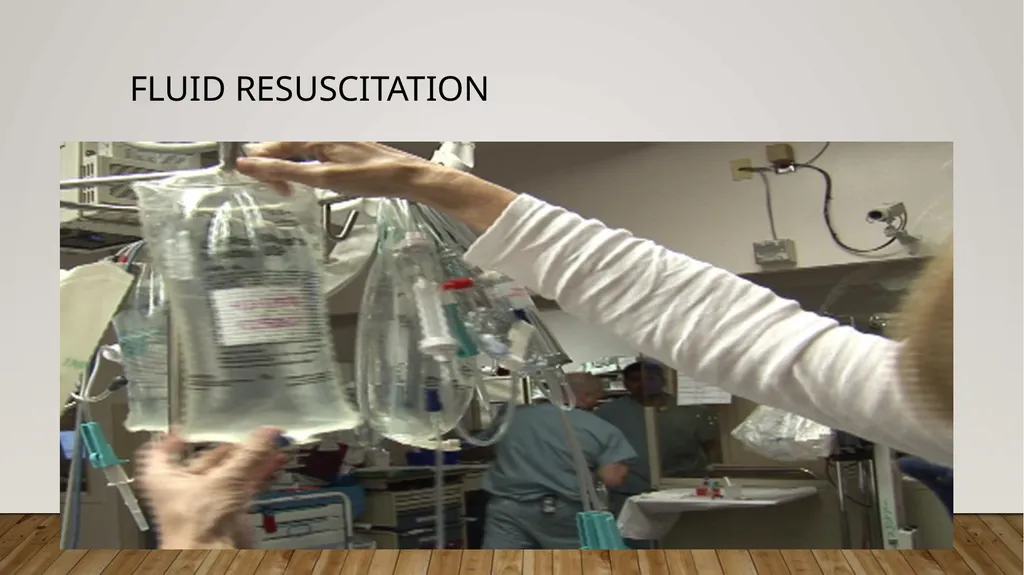
Fluid Resuscitation<br>
12
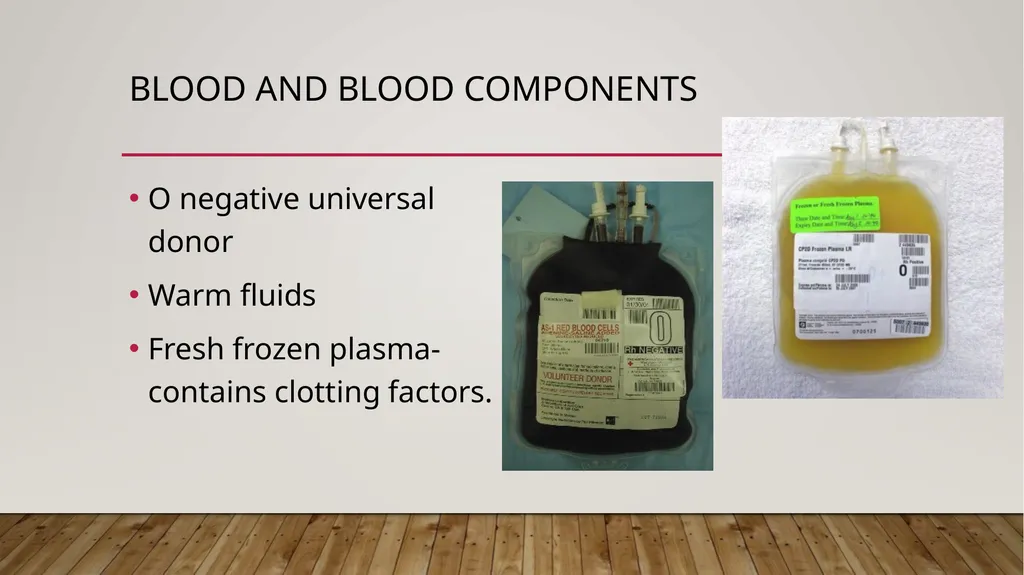
Blood and blood components O negative universal donor
Warm fluids
Fresh frozen plasma- contains clotting factors.<br>
Warm fluids
Fresh frozen plasma- contains clotting factors.<br>
13
Think, Pair, Share:
AACN Synergy Model Patient Characteristics Resiliency: In shock, what physiologic compensatory mechanisms are in place to help restore functioning?
In this specific patient, what are sources of vulnerability? (actual or potential stressors that may affect outcome).
Stability: Describe the patient’s stability Nurse Characteristics Clinical judgment: Integrate clinical reasoning/clinical skills, experience, and EBP.
Provide an example of clinical judgment.
Advocacy: working to represent the concerns of the patient and family.
Provide an example of advocacy<br>
In this specific patient, what are sources of vulnerability? (actual or potential stressors that may affect outcome).
Stability: Describe the patient’s stability Nurse Characteristics Clinical judgment: Integrate clinical reasoning/clinical skills, experience, and EBP.
Provide an example of clinical judgment.
Advocacy: working to represent the concerns of the patient and family.
Provide an example of advocacy<br>
14
Test your Understanding-
Socrative Quick question What is the best way to evaluate the adequacy of fluid resuscitation in a patient with hypovolemic shock?
A. Urine output
B. Blood pressure
C. IV site patency
D. Amount of IV intake<br>
A. Urine output
B. Blood pressure
C. IV site patency
D. Amount of IV intake<br>
15
Follow-up After receiving packed cells, fresh frozen plasma, and crystalloid IVs, the patient stabilized, VS became normal, and chest tube drainage gradually slowed.
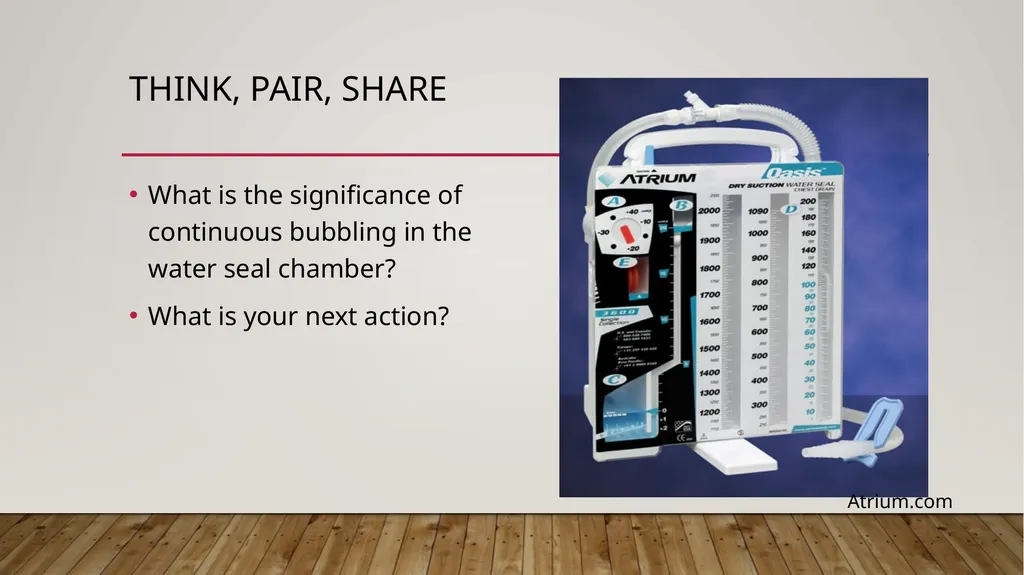
Several days later, you are assessing Mr. C’s chest tube and note continuous bubbling in the water seal chamber.<br>
Several days later, you are assessing Mr. C’s chest tube and note continuous bubbling in the water seal chamber.<br>
16
Think, Pair, Share What is the significance of continuous bubbling in the water seal chamber?
What is your next action? Atrium.com<br>
What is your next action? Atrium.com<br>
17
Discharging Mr. C Mr. C has progressed well, has had his chest tube removed, and is ready for discharge.
Prior to discharge, what are parameters to evaluate Mr. C’s safety and readiness to be discharged to home?
What discharge instructions would you provide to Mr. C and his significant other?<br>
Prior to discharge, what are parameters to evaluate Mr. C’s safety and readiness to be discharged to home?
What discharge instructions would you provide to Mr. C and his significant other?<br>
18
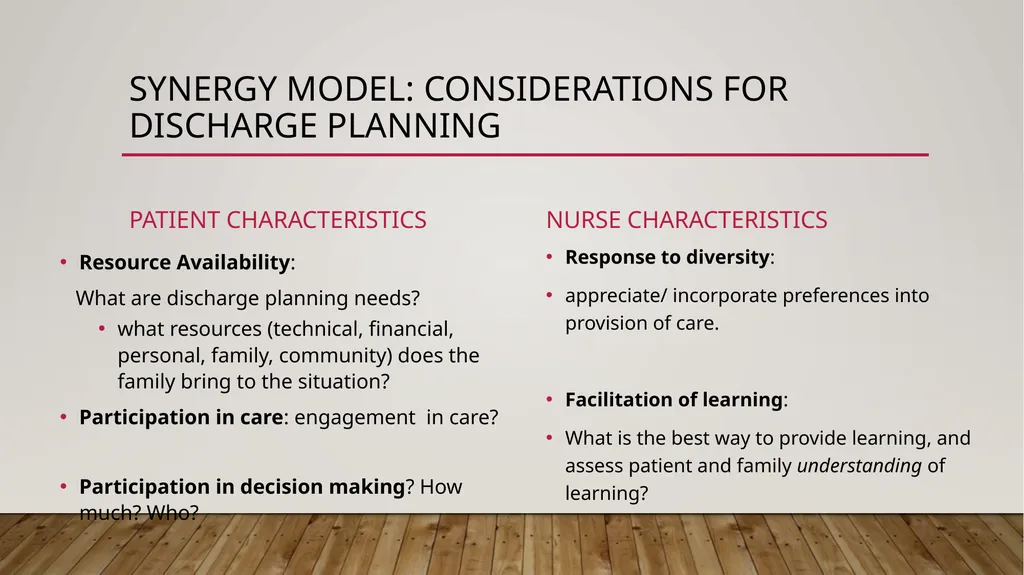
Synergy Model: Considerations for Discharge Planning Patient Characteristics Resource Availability:
What are discharge planning needs?
what resources (technical, financial, personal, family, community) does the family bring to the situation?
Participation in care: engagement in care?
Participation in decision making? How much? Who? Nurse Characteristics Response to diversity:
appreciate/ incorporate preferences into provision of care.
Facilitation of learning:
What is the best way to provide learning, and assess patient and family understanding of learning?<br>
What are discharge planning needs?
what resources (technical, financial, personal, family, community) does the family bring to the situation?
Participation in care: engagement in care?
Participation in decision making? How much? Who? Nurse Characteristics Response to diversity:
appreciate/ incorporate preferences into provision of care.
Facilitation of learning:
What is the best way to provide learning, and assess patient and family understanding of learning?<br>
19
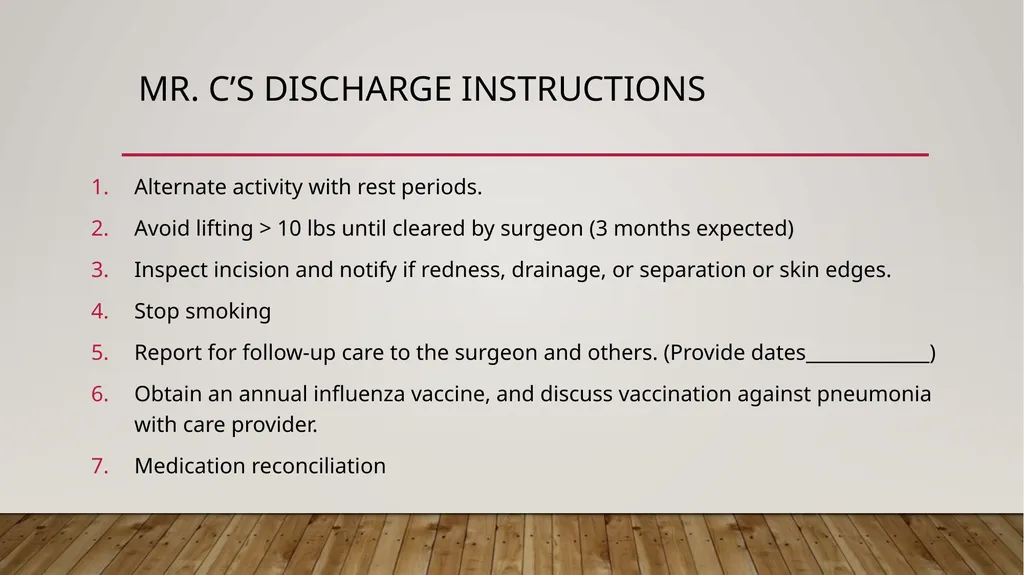
Mr. C’s discharge instructions Alternate activity with rest periods.
Avoid lifting > 10 lbs until cleared by surgeon (3 months expected)
Inspect incision and notify if redness, drainage, or separation or skin edges.
Stop smoking
Report for follow-up care to the surgeon and others. (Provide dates_____________)
Obtain an annual influenza vaccine, and discuss vaccination against pneumonia with care provider.
Medication reconciliation<br>
Avoid lifting > 10 lbs until cleared by surgeon (3 months expected)
Inspect incision and notify if redness, drainage, or separation or skin edges.
Stop smoking
Report for follow-up care to the surgeon and others. (Provide dates_____________)
Obtain an annual influenza vaccine, and discuss vaccination against pneumonia with care provider.
Medication reconciliation<br>
20
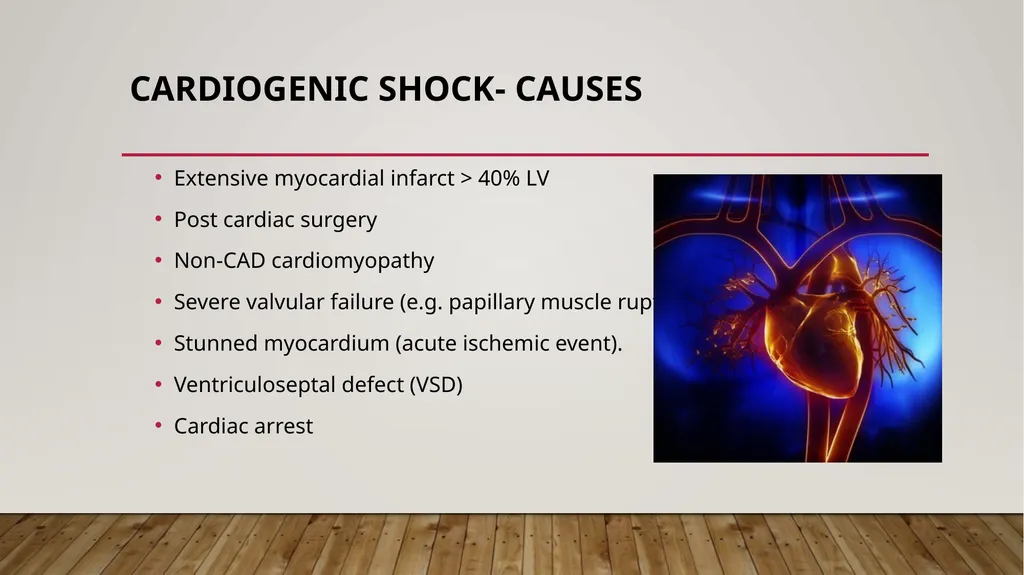
Cardiogenic shock- Causes Extensive myocardial infarct > 40% LV
Post cardiac surgery
Non-CAD cardiomyopathy
Severe valvular failure (e.g. papillary muscle rupture)
Stunned myocardium (acute ischemic event).
Ventriculoseptal defect (VSD)
Cardiac arrest<br>
Post cardiac surgery
Non-CAD cardiomyopathy
Severe valvular failure (e.g. papillary muscle rupture)
Stunned myocardium (acute ischemic event).
Ventriculoseptal defect (VSD)
Cardiac arrest<br>
21
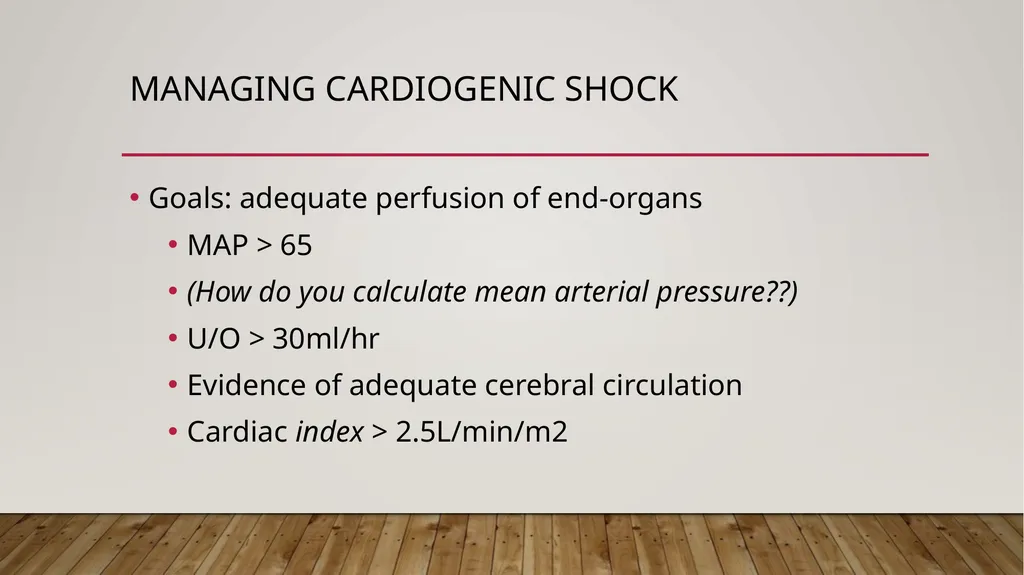
Managing Cardiogenic Shock Goals: adequate perfusion of end-organs
MAP > 65
(How do you calculate mean arterial pressure??)
U/O > 30ml/hr
Evidence of adequate cerebral circulation
Cardiac index > 2.5L/min/m2<br>
MAP > 65
(How do you calculate mean arterial pressure??)
U/O > 30ml/hr
Evidence of adequate cerebral circulation
Cardiac index > 2.5L/min/m2<br>
22
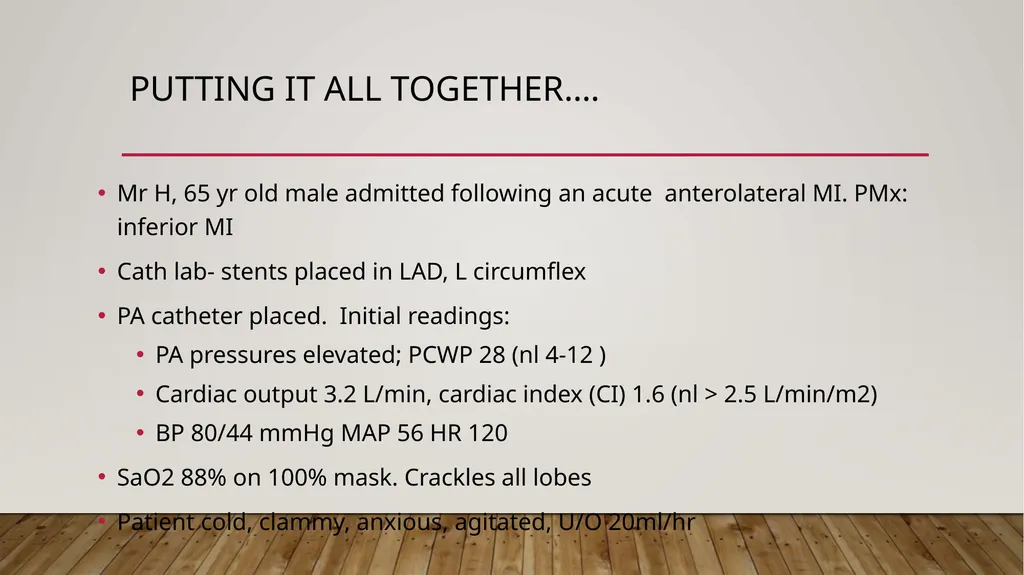
Putting it all together…. Mr H, 65 yr old male admitted following an acute anterolateral MI. PMx: inferior MI
Cath lab- stents placed in LAD, L circumflex
PA catheter placed. Initial readings:
PA pressures elevated; PCWP 28 (nl 4-12 )
Cardiac output 3.2 L/min, cardiac index (CI) 1.6 (nl > 2.5 L/min/m2)
BP 80/44 mmHg MAP 56 HR 120
SaO2 88% on 100% mask. Crackles all lobes
Patient cold, clammy, anxious, agitated, U/O 20ml/hr<br>
Cath lab- stents placed in LAD, L circumflex
PA catheter placed. Initial readings:
PA pressures elevated; PCWP 28 (nl 4-12 )
Cardiac output 3.2 L/min, cardiac index (CI) 1.6 (nl > 2.5 L/min/m2)
BP 80/44 mmHg MAP 56 HR 120
SaO2 88% on 100% mask. Crackles all lobes
Patient cold, clammy, anxious, agitated, U/O 20ml/hr<br>
23
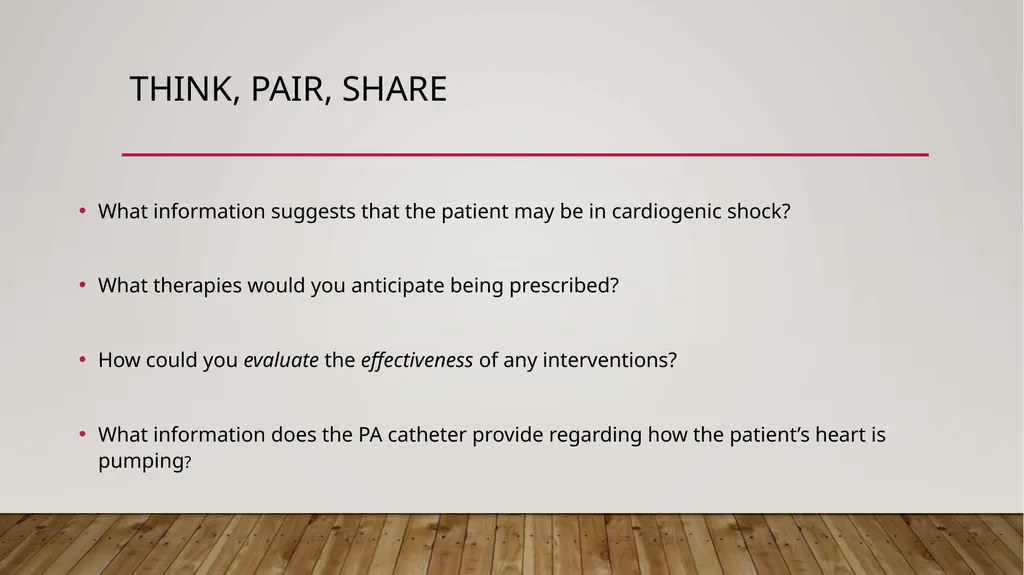
Think, Pair, Share What information suggests that the patient may be in cardiogenic shock?
What therapies would you anticipate being prescribed?
How could you evaluate the effectiveness of any interventions?
What information does the PA catheter provide regarding how the patient’s heart is pumping?<br>
What therapies would you anticipate being prescribed?
How could you evaluate the effectiveness of any interventions?
What information does the PA catheter provide regarding how the patient’s heart is pumping?<br>
24
Cardiogenic Shock
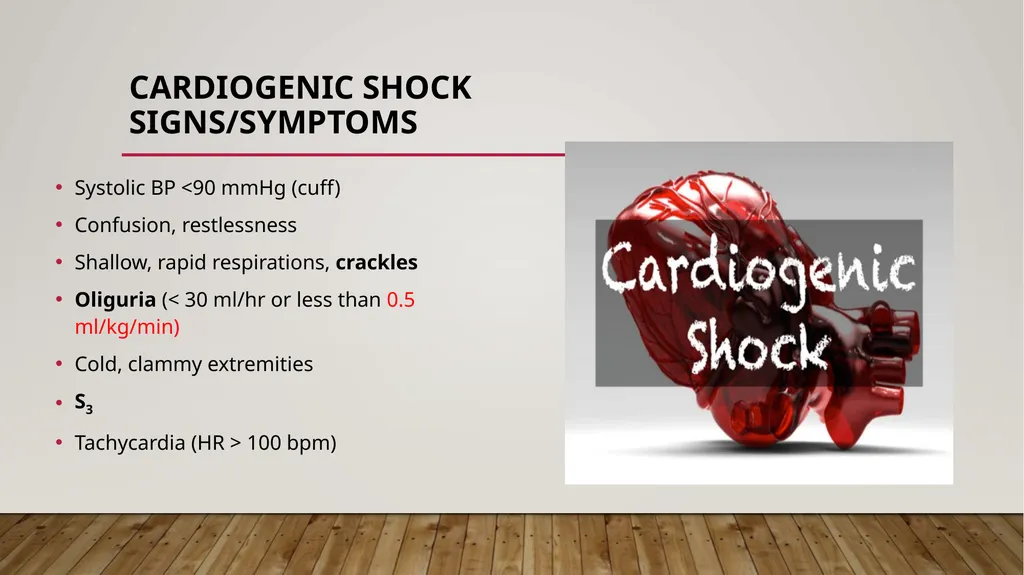
Signs/symptoms Systolic BP <90 mmHg (cuff)
Confusion, restlessness
Shallow, rapid respirations, crackles
Oliguria (< 30 ml/hr or less than 0.5 ml/kg/min)
Cold, clammy extremities
S3
Tachycardia (HR > 100 bpm)<br>
Confusion, restlessness
Shallow, rapid respirations, crackles
Oliguria (< 30 ml/hr or less than 0.5 ml/kg/min)
Cold, clammy extremities
S3
Tachycardia (HR > 100 bpm)<br>
25
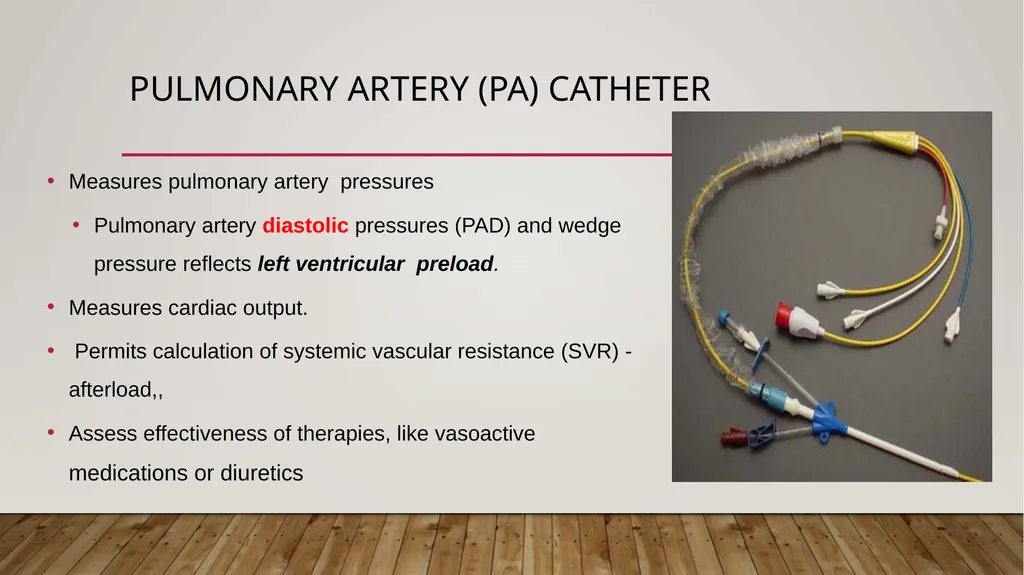
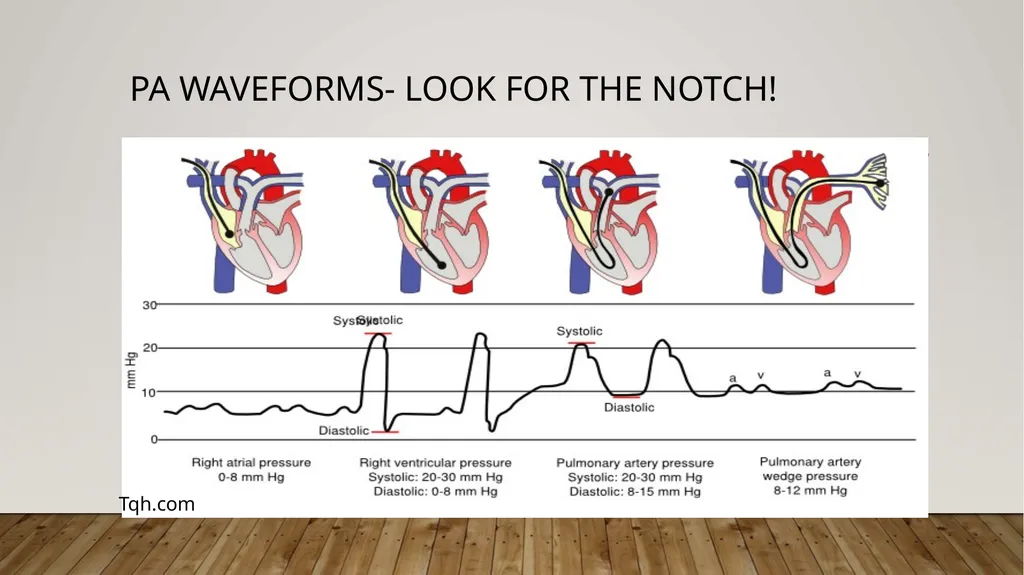
Pulmonary Artery (PA) Catheter Measures pulmonary artery pressures
Pulmonary artery diastolic pressures (PAD) and wedge pressure reflects left ventricular preload.
Measures cardiac output.
Permits calculation of systemic vascular resistance (SVR) - afterload,,
Assess effectiveness of therapies, like vasoactive medications or diuretics<br>
Pulmonary artery diastolic pressures (PAD) and wedge pressure reflects left ventricular preload.
Measures cardiac output.
Permits calculation of systemic vascular resistance (SVR) - afterload,,
Assess effectiveness of therapies, like vasoactive medications or diuretics<br>
26
PA Waveforms- look for the notch! Tqh.com<br>
27
Pulmonary artery catheter (Swan-Ganz catheter) Transducer converts intravascular pressures to electrical waveforms. Edwards.com<br>
28
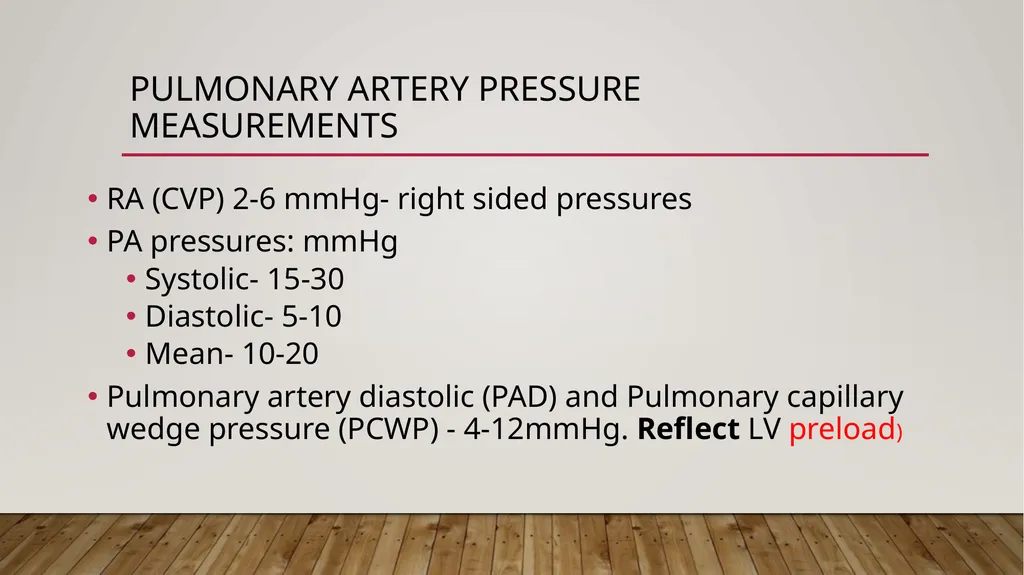
Pulmonary Artery pressure measurements RA (CVP) 2-6 mmHg- right sided pressures
PA pressures: mmHg
Systolic- 15-30
Diastolic- 5-10
Mean- 10-20
Pulmonary artery diastolic (PAD) and Pulmonary capillary wedge pressure (PCWP) - 4-12mmHg. Reflect LV preload)<br>
PA pressures: mmHg
Systolic- 15-30
Diastolic- 5-10
Mean- 10-20
Pulmonary artery diastolic (PAD) and Pulmonary capillary wedge pressure (PCWP) - 4-12mmHg. Reflect LV preload)<br>
29
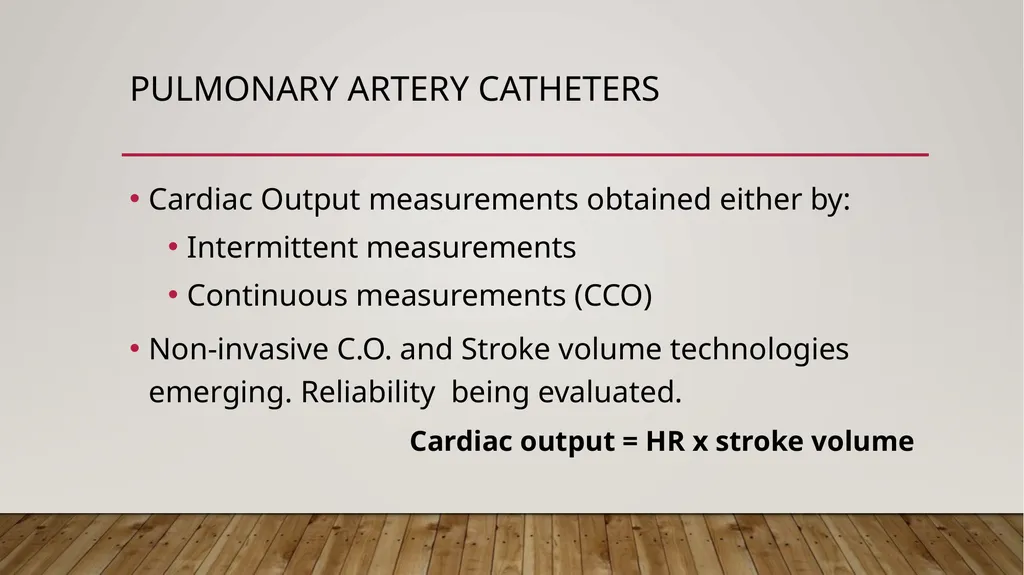
Pulmonary Artery Catheters Cardiac Output measurements obtained either by:
Intermittent measurements
Continuous measurements (CCO)
Non-invasive C.O. and Stroke volume technologies emerging. Reliability being evaluated. Cardiac output = HR x stroke volume<br>
Intermittent measurements
Continuous measurements (CCO)
Non-invasive C.O. and Stroke volume technologies emerging. Reliability being evaluated. Cardiac output = HR x stroke volume<br>
30
Cardiogenic Shock
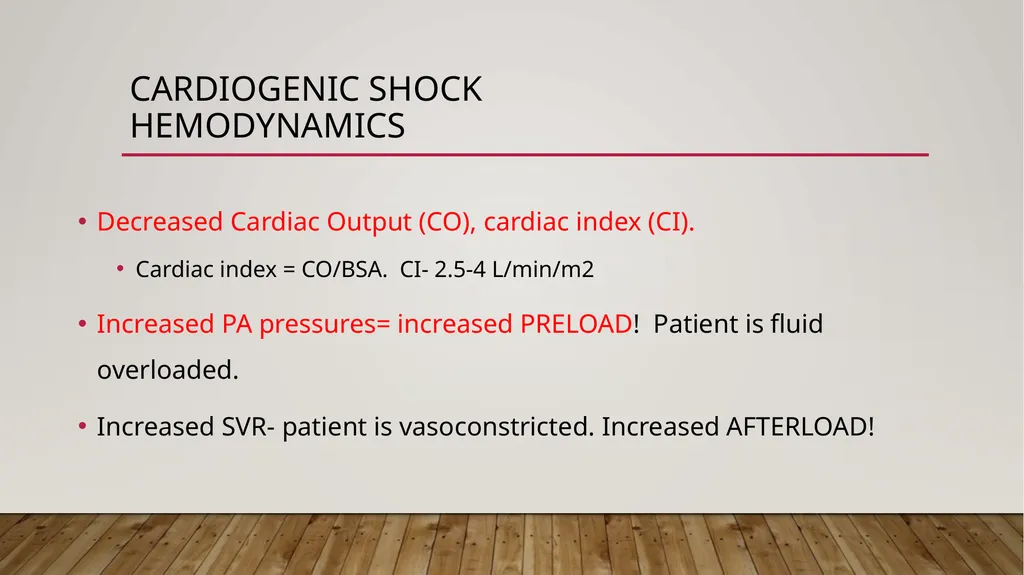
Hemodynamics Decreased Cardiac Output (CO), cardiac index (CI).
Cardiac index = CO/BSA. CI- 2.5-4 L/min/m2
Increased PA pressures= increased PRELOAD! Patient is fluid overloaded.
Increased SVR- patient is vasoconstricted. Increased AFTERLOAD!<br>
Cardiac index = CO/BSA. CI- 2.5-4 L/min/m2
Increased PA pressures= increased PRELOAD! Patient is fluid overloaded.
Increased SVR- patient is vasoconstricted. Increased AFTERLOAD!<br>
31
Managing Cardiogenic Shock Goals: adequate perfusion of organs- evidenced by:
Mean arterial pressure (MAP) > 65 mmHg
(How do you calculate mean arterial pressure??)
Urine output greater than 0.5 ml/kg/hr
Adequate cerebral circulation- (how would you evaluate?)
Cardiac index > 2.5L/min/m2<br>
Mean arterial pressure (MAP) > 65 mmHg
(How do you calculate mean arterial pressure??)
Urine output greater than 0.5 ml/kg/hr
Adequate cerebral circulation- (how would you evaluate?)
Cardiac index > 2.5L/min/m2<br>
32
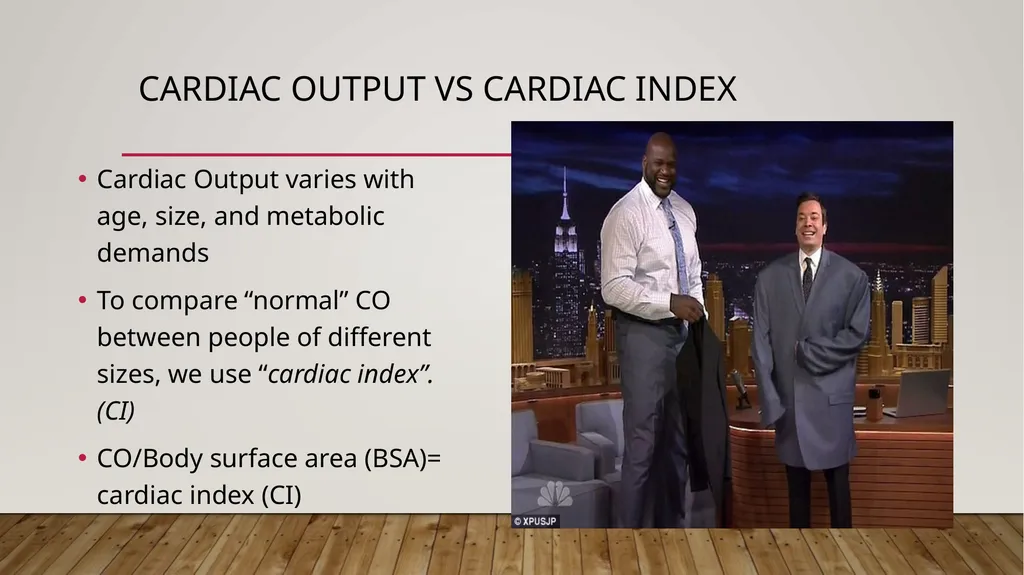
Cardiac Output vs Cardiac Index Cardiac Output varies with age, size, and metabolic demands
To compare “normal” CO between people of different sizes, we use “cardiac index”. (CI)
CO/Body surface area (BSA)= cardiac index (CI)<br>
To compare “normal” CO between people of different sizes, we use “cardiac index”. (CI)
CO/Body surface area (BSA)= cardiac index (CI)<br>
33
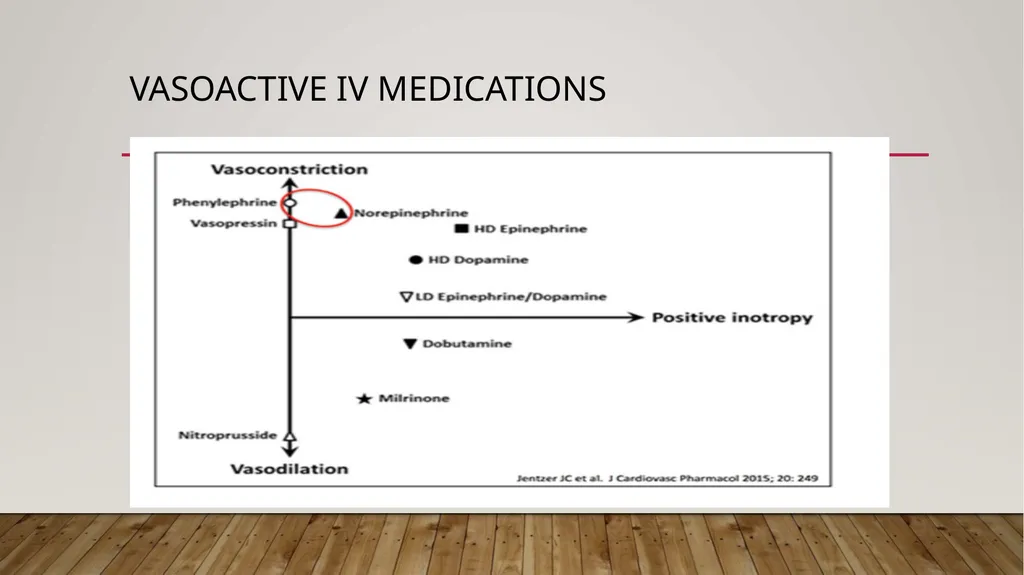
Pharmacologic therapy Vasoactive medications-aim is to increase cardiac output without increasing afterload
Common IV vasoactive medications include dopamine, dobutamine, milrinone (phosphodiesterase inhibitor), norepinephrine, epinephrine. Action depends on medication and dose.
Treat arrhythmias appropriately (KCl, MgSO4, amiodarone)
Diuretics if pulmonary edema present.<br>
Common IV vasoactive medications include dopamine, dobutamine, milrinone (phosphodiesterase inhibitor), norepinephrine, epinephrine. Action depends on medication and dose.
Treat arrhythmias appropriately (KCl, MgSO4, amiodarone)
Diuretics if pulmonary edema present.<br>
34
Vasoactive IV medications<br>
35
Patient Management on Vasoactive Medications VS frequently; q 15 min while titrating vasoactive meds or while unstable
Dosage titrated to patient response.
Titrated to BP or cardiac index goal
Administer via central line if possible
Extravasation may cause tissue damage
Use arterial line for monitoring BP.<br>
Dosage titrated to patient response.
Titrated to BP or cardiac index goal
Administer via central line if possible
Extravasation may cause tissue damage
Use arterial line for monitoring BP.<br>
36
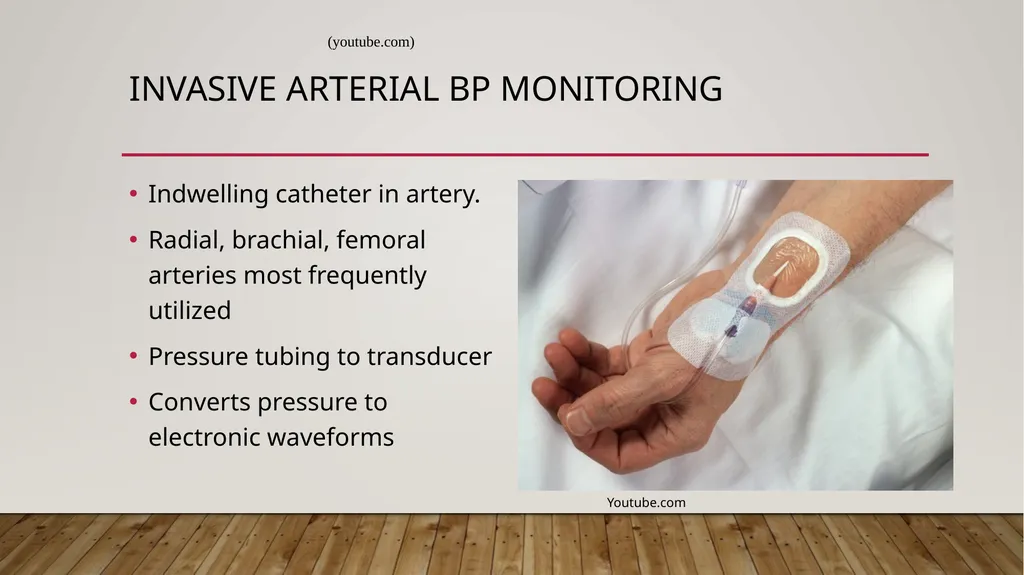
Invasive Arterial BP Monitoring Indwelling catheter in artery.
Radial, brachial, femoral arteries most frequently utilized
Pressure tubing to transducer
Converts pressure to electronic waveforms (youtube.com) Youtube.com<br>
Radial, brachial, femoral arteries most frequently utilized
Pressure tubing to transducer
Converts pressure to electronic waveforms (youtube.com) Youtube.com<br>
37
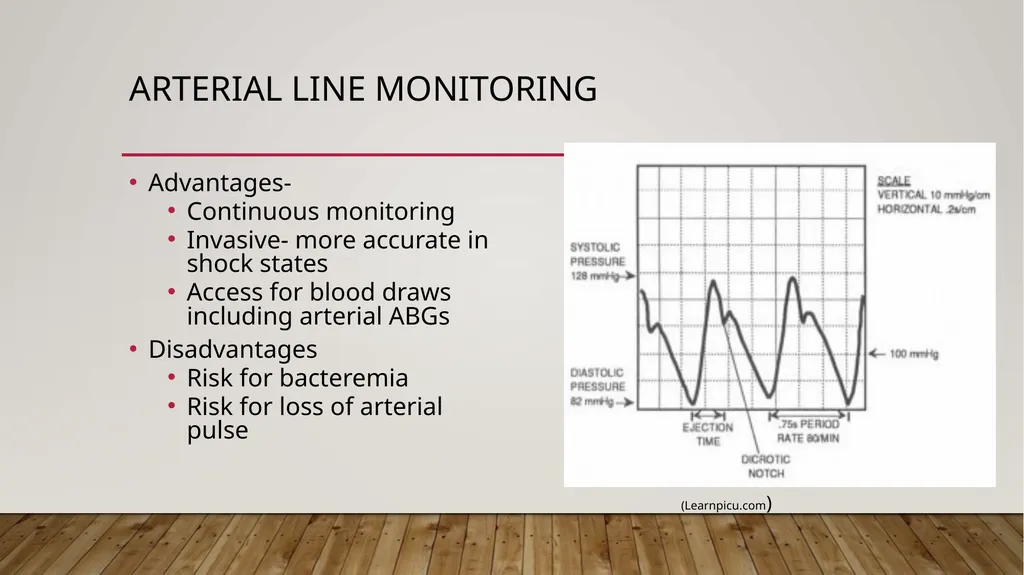
Arterial Line Monitoring Advantages-
Continuous monitoring
Invasive- more accurate in shock states
Access for blood draws including arterial ABGs
Disadvantages
Risk for bacteremia
Risk for loss of arterial pulse (Learnpicu.com)<br>
Continuous monitoring
Invasive- more accurate in shock states
Access for blood draws including arterial ABGs
Disadvantages
Risk for bacteremia
Risk for loss of arterial pulse (Learnpicu.com)<br>
38
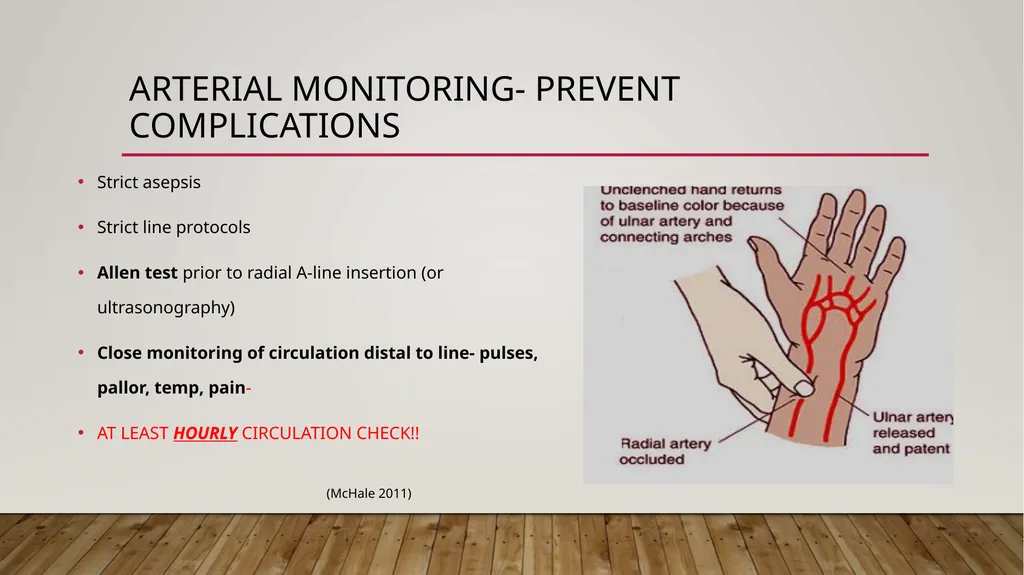
Arterial Monitoring- Prevent Complications Strict asepsis
Strict line protocols
Allen test prior to radial A-line insertion (or ultrasonography)
Close monitoring of circulation distal to line- pulses, pallor, temp, pain-
AT LEAST HOURLY CIRCULATION CHECK!!
(McHale 2011)<br>
Strict line protocols
Allen test prior to radial A-line insertion (or ultrasonography)
Close monitoring of circulation distal to line- pulses, pallor, temp, pain-
AT LEAST HOURLY CIRCULATION CHECK!!
(McHale 2011)<br>
39
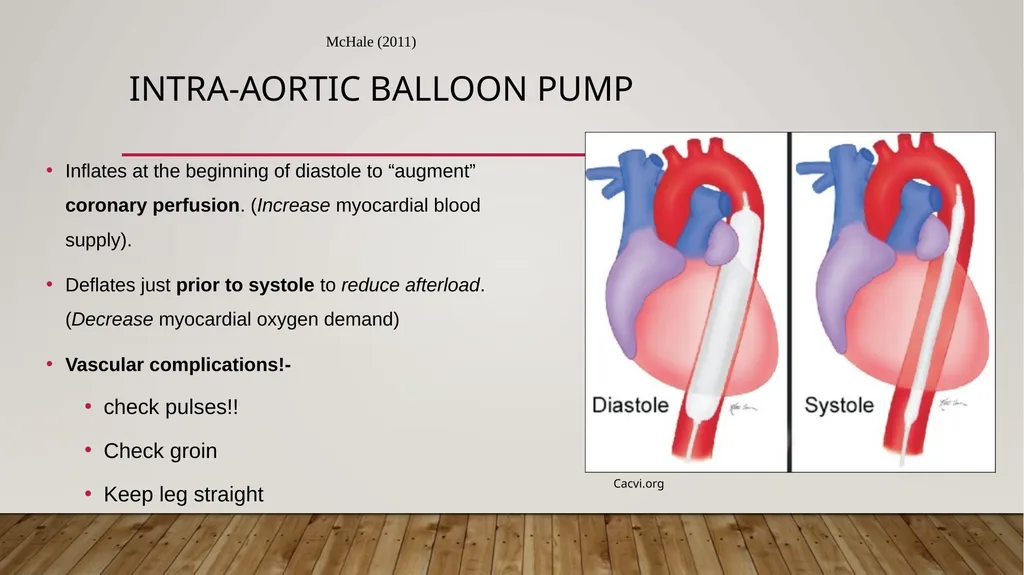
Intra-aortic Balloon Pump Inflates at the beginning of diastole to “augment” coronary perfusion. (Increase myocardial blood supply).
Deflates just prior to systole to reduce afterload. (Decrease myocardial oxygen demand)
Vascular complications!-
check pulses!!
Check groin
Keep leg straight McHale (2011) Cacvi.org<br>
Deflates just prior to systole to reduce afterload. (Decrease myocardial oxygen demand)
Vascular complications!-
check pulses!!
Check groin
Keep leg straight McHale (2011) Cacvi.org<br>
40
Putting it together (Cont.) IABP inserted
Patient intubated after BiPAP failed
Transferred to CCU
Dobutamine drip started and titrated to achieve CI >2.5 L/min/m2
Heparin drip at 12 units/kg/hr
Furosemide (Lasix) 60mg IV administered
Labs drawn-Comprehensive metabolic panel (CMP), cardiac enzymes, PTT, CBC, ABGs, serum lactate.<br>
Patient intubated after BiPAP failed
Transferred to CCU
Dobutamine drip started and titrated to achieve CI >2.5 L/min/m2
Heparin drip at 12 units/kg/hr
Furosemide (Lasix) 60mg IV administered
Labs drawn-Comprehensive metabolic panel (CMP), cardiac enzymes, PTT, CBC, ABGs, serum lactate.<br>
41
Follow-up in the CCU Describe the nursing care required when caring for a patient receiving dobutamine?
Medication-related
Interventions related to central line
You are ordered to start dobutamine at 4 mcg/kg/min. The drip is mixed 500 mg in 250 ml D5W. The pt weighs 75 kg. How many ml do you set on the pump? _______
List nursing priority assessments and interventions when the patient has an IABP?<br>
Medication-related
Interventions related to central line
You are ordered to start dobutamine at 4 mcg/kg/min. The drip is mixed 500 mg in 250 ml D5W. The pt weighs 75 kg. How many ml do you set on the pump? _______
List nursing priority assessments and interventions when the patient has an IABP?<br>
42
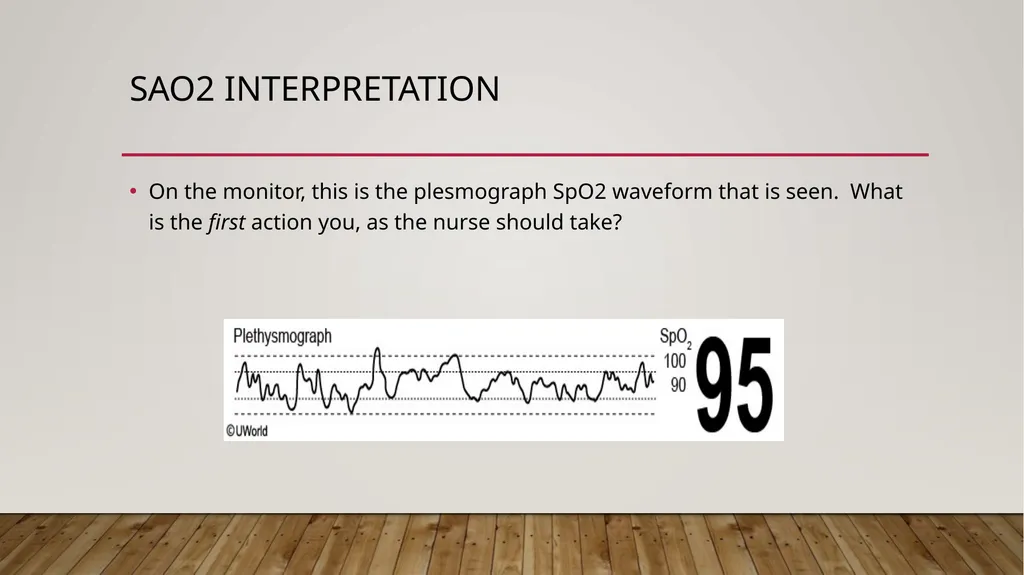
SaO2 interpretation On the monitor, this is the plesmograph SpO2 waveform that is seen. What is the first action you, as the nurse should take?<br>
43
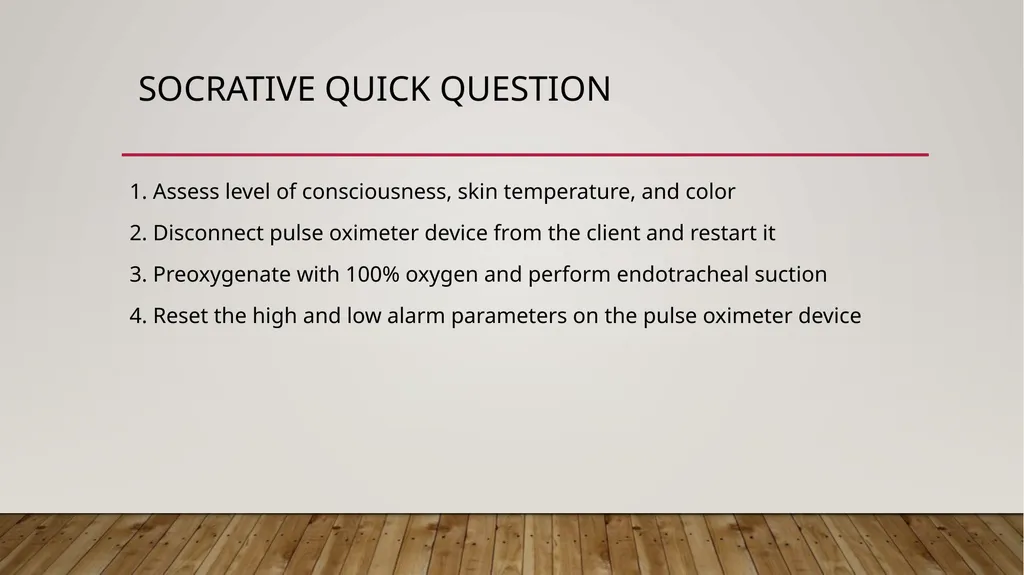
Socrative Quick Question 1. Assess level of consciousness, skin temperature, and color
2. Disconnect pulse oximeter device from the client and restart it
3. Preoxygenate with 100% oxygen and perform endotracheal suction
4. Reset the high and low alarm parameters on the pulse oximeter device<br>
2. Disconnect pulse oximeter device from the client and restart it
3. Preoxygenate with 100% oxygen and perform endotracheal suction
4. Reset the high and low alarm parameters on the pulse oximeter device<br>
44
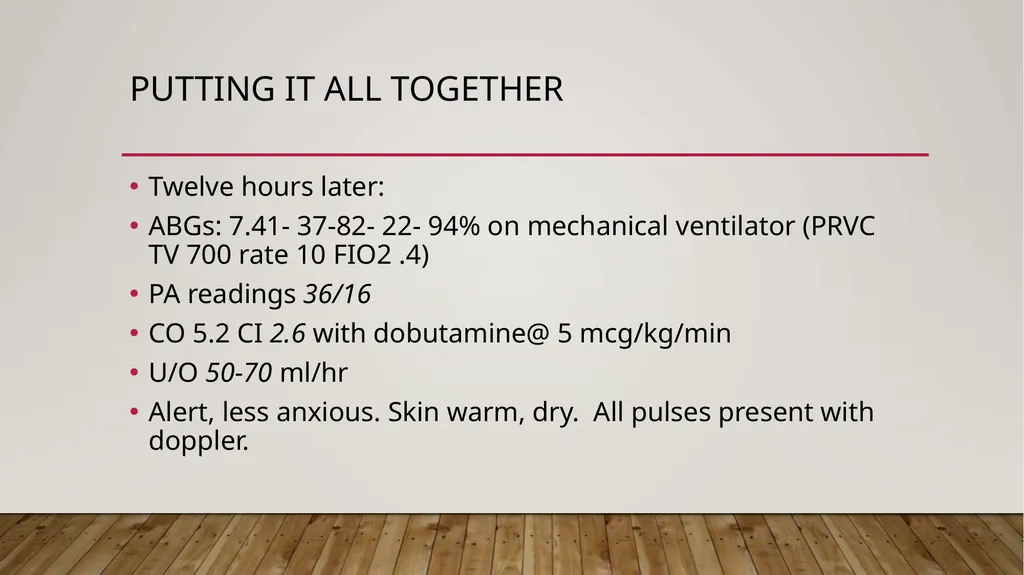
Putting it all Together Twelve hours later:
ABGs: 7.41- 37-82- 22- 94% on mechanical ventilator (PRVC TV 700 rate 10 FIO2 .4)
PA readings 36/16
CO 5.2 CI 2.6 with dobutamine@ 5 mcg/kg/min
U/O 50-70 ml/hr
Alert, less anxious. Skin warm, dry. All pulses present with doppler.<br>
ABGs: 7.41- 37-82- 22- 94% on mechanical ventilator (PRVC TV 700 rate 10 FIO2 .4)
PA readings 36/16
CO 5.2 CI 2.6 with dobutamine@ 5 mcg/kg/min
U/O 50-70 ml/hr
Alert, less anxious. Skin warm, dry. All pulses present with doppler.<br>
45
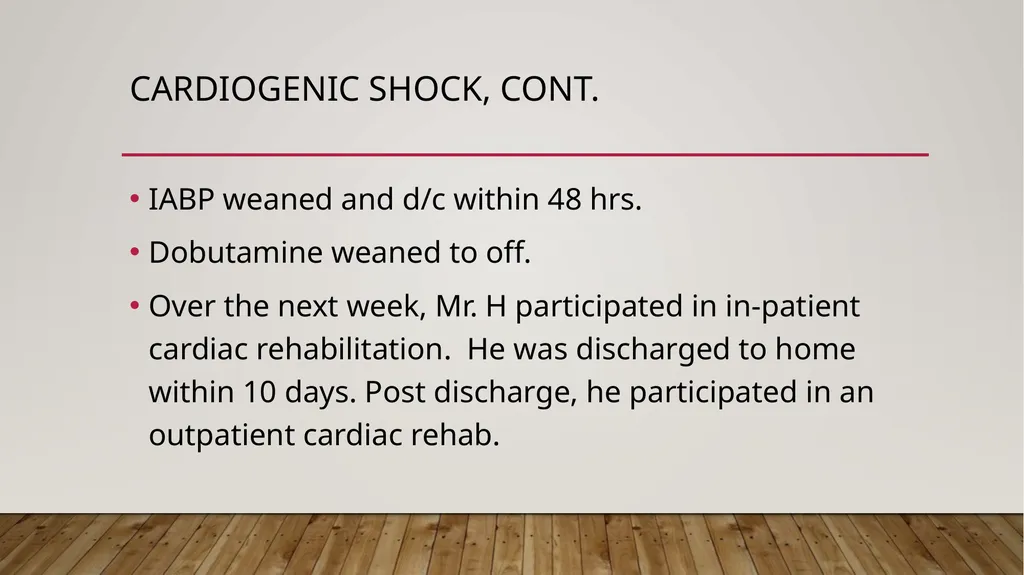
Cardiogenic Shock, cont. IABP weaned and d/c within 48 hrs.
Dobutamine weaned to off.
Over the next week, Mr. H participated in in-patient cardiac rehabilitation. He was discharged to home within 10 days. Post discharge, he participated in an outpatient cardiac rehab.<br>
Dobutamine weaned to off.
Over the next week, Mr. H participated in in-patient cardiac rehabilitation. He was discharged to home within 10 days. Post discharge, he participated in an outpatient cardiac rehab.<br>
46
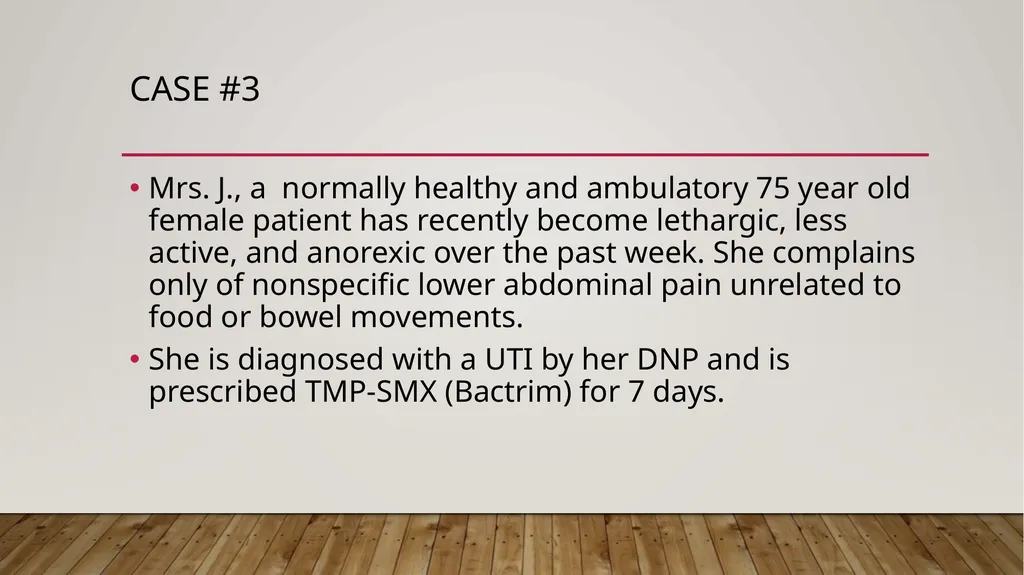
Case #3 Mrs. J., a normally healthy and ambulatory 75 year old female patient has recently become lethargic, less active, and anorexic over the past week. She complains only of nonspecific lower abdominal pain unrelated to food or bowel movements.
She is diagnosed with a UTI by her DNP and is prescribed TMP-SMX (Bactrim) for 7 days.<br>
She is diagnosed with a UTI by her DNP and is prescribed TMP-SMX (Bactrim) for 7 days.<br>
47
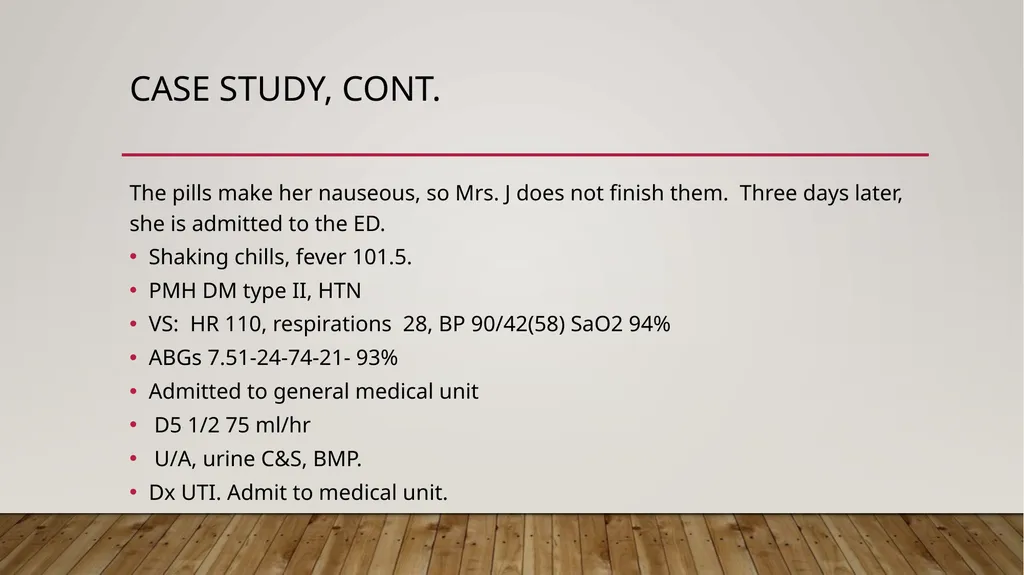
Case Study, Cont. The pills make her nauseous, so Mrs. J does not finish them. Three days later, she is admitted to the ED.
Shaking chills, fever 101.5.
PMH DM type II, HTN
VS: HR 110, respirations 28, BP 90/42(58) SaO2 94%
ABGs 7.51-24-74-21- 93%
Admitted to general medical unit
D5 1/2 75 ml/hr
U/A, urine C&S, BMP.
Dx UTI. Admit to medical unit.<br>
Shaking chills, fever 101.5.
PMH DM type II, HTN
VS: HR 110, respirations 28, BP 90/42(58) SaO2 94%
ABGs 7.51-24-74-21- 93%
Admitted to general medical unit
D5 1/2 75 ml/hr
U/A, urine C&S, BMP.
Dx UTI. Admit to medical unit.<br>
48
Meanwhile, on the medical unit….. The UAP takes VS on your new admission….
T 102.5 118 28 BP 84/40 (54)!!!
What do you do next?<br>
T 102.5 118 28 BP 84/40 (54)!!!
What do you do next?<br>
49
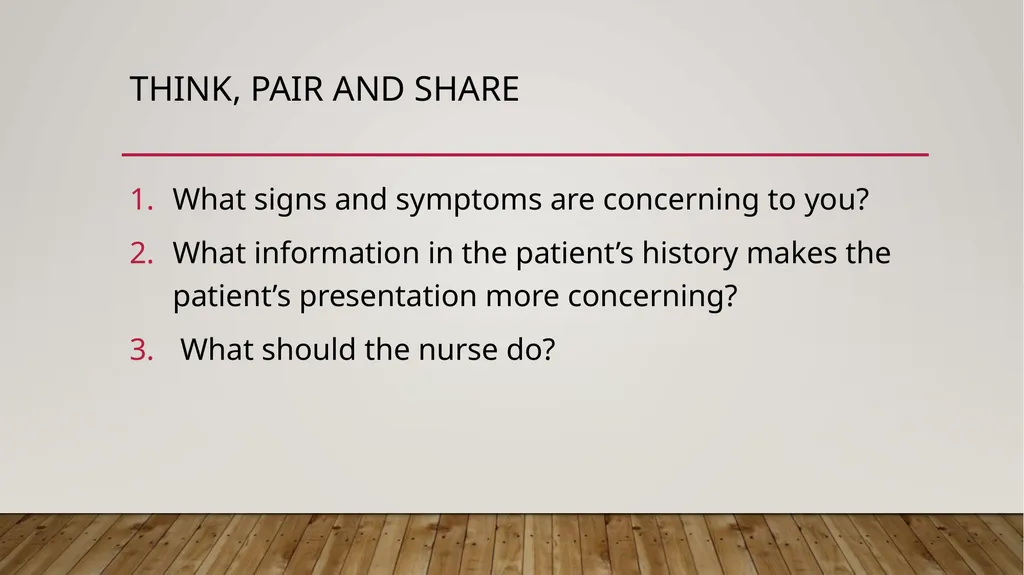
Think, Pair and Share What signs and symptoms are concerning to you?
What information in the patient’s history makes the patient’s presentation more concerning?
What should the nurse do?<br>
What information in the patient’s history makes the patient’s presentation more concerning?
What should the nurse do?<br>
50
Septic Shock: signs and symptoms Anxiety, restlessness, confusion, disorientation
Flushed, warm, dry skin. Elderly- pale, cool, mottled.
Tachypnea, dyspnea
Tachycardia (HR > 90 bpm)
BP < 90 systolic or fall of 40 mmHg from baseline
Temp > 100.4 or < 96.8, chills.
Hemodynamics:
Cardiac index > 3.5 L/min/m2 (hyperdynamic)
SVR < 900 (low)- vasodilated
PA pressures low<br>
Flushed, warm, dry skin. Elderly- pale, cool, mottled.
Tachypnea, dyspnea
Tachycardia (HR > 90 bpm)
BP < 90 systolic or fall of 40 mmHg from baseline
Temp > 100.4 or < 96.8, chills.
Hemodynamics:
Cardiac index > 3.5 L/min/m2 (hyperdynamic)
SVR < 900 (low)- vasodilated
PA pressures low<br>
51
Meanwhile In the ICU…..
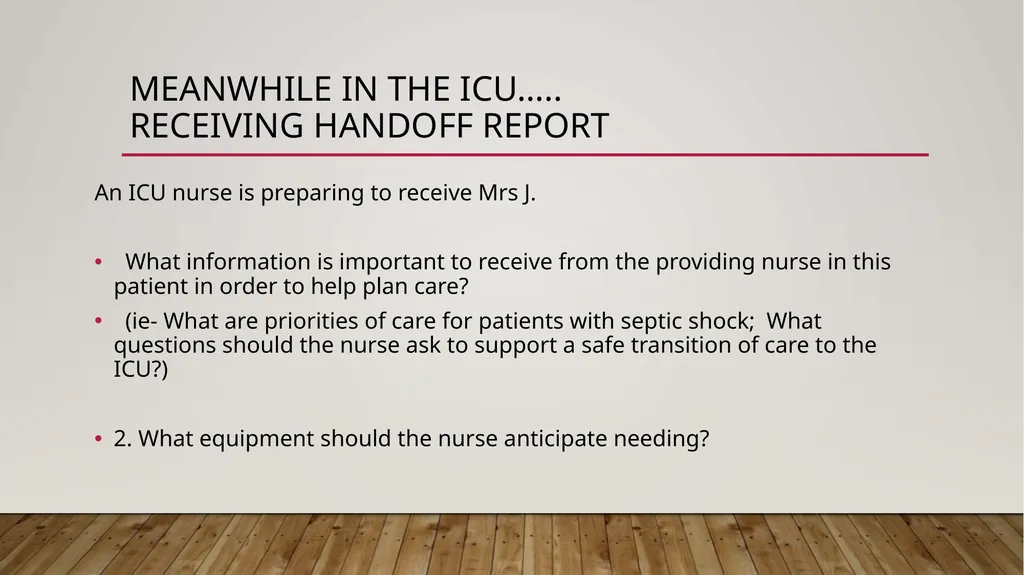
Receiving Handoff Report An ICU nurse is preparing to receive Mrs J.
What information is important to receive from the providing nurse in this patient in order to help plan care?
(ie- What are priorities of care for patients with septic shock; What questions should the nurse ask to support a safe transition of care to the ICU?)
2. What equipment should the nurse anticipate needing?<br>
What information is important to receive from the providing nurse in this patient in order to help plan care?
(ie- What are priorities of care for patients with septic shock; What questions should the nurse ask to support a safe transition of care to the ICU?)
2. What equipment should the nurse anticipate needing?<br>
52
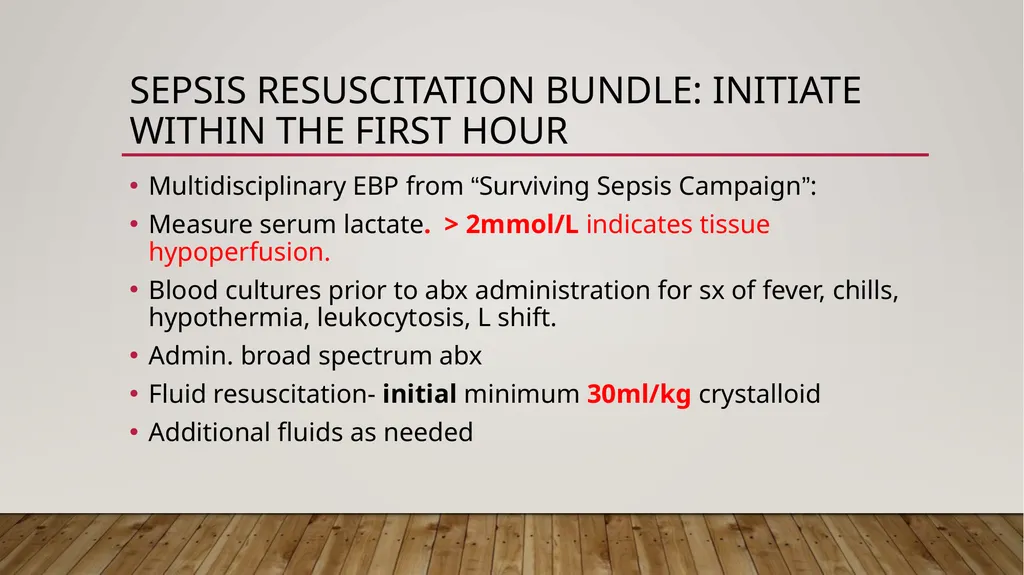
Sepsis Resuscitation Bundle: Initiate within the first hour Multidisciplinary EBP from “Surviving Sepsis Campaign”:
Measure serum lactate. > 2mmol/L indicates tissue hypoperfusion.
Blood cultures prior to abx administration for sx of fever, chills, hypothermia, leukocytosis, L shift.
Admin. broad spectrum abx
Fluid resuscitation- initial minimum 30ml/kg crystalloid
Additional fluids as needed<br>
Measure serum lactate. > 2mmol/L indicates tissue hypoperfusion.
Blood cultures prior to abx administration for sx of fever, chills, hypothermia, leukocytosis, L shift.
Admin. broad spectrum abx
Fluid resuscitation- initial minimum 30ml/kg crystalloid
Additional fluids as needed<br>
53
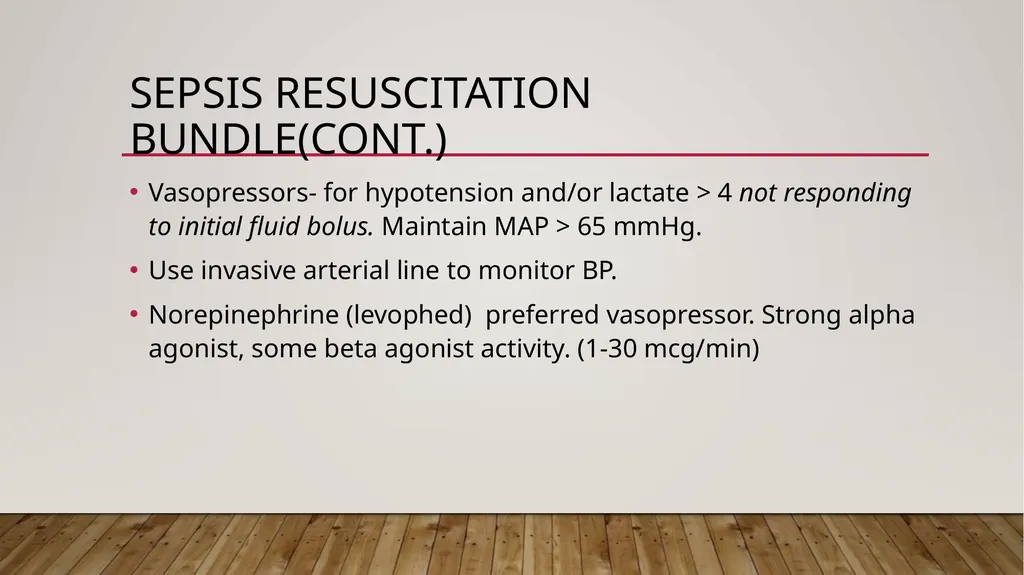
Sepsis Resuscitation Bundle(cont.) Vasopressors- for hypotension and/or lactate > 4 not responding to initial fluid bolus. Maintain MAP > 65 mmHg.
Use invasive arterial line to monitor BP.
Norepinephrine (levophed) preferred vasopressor. Strong alpha agonist, some beta agonist activity. (1-30 mcg/min)<br>
Use invasive arterial line to monitor BP.
Norepinephrine (levophed) preferred vasopressor. Strong alpha agonist, some beta agonist activity. (1-30 mcg/min)<br>
54
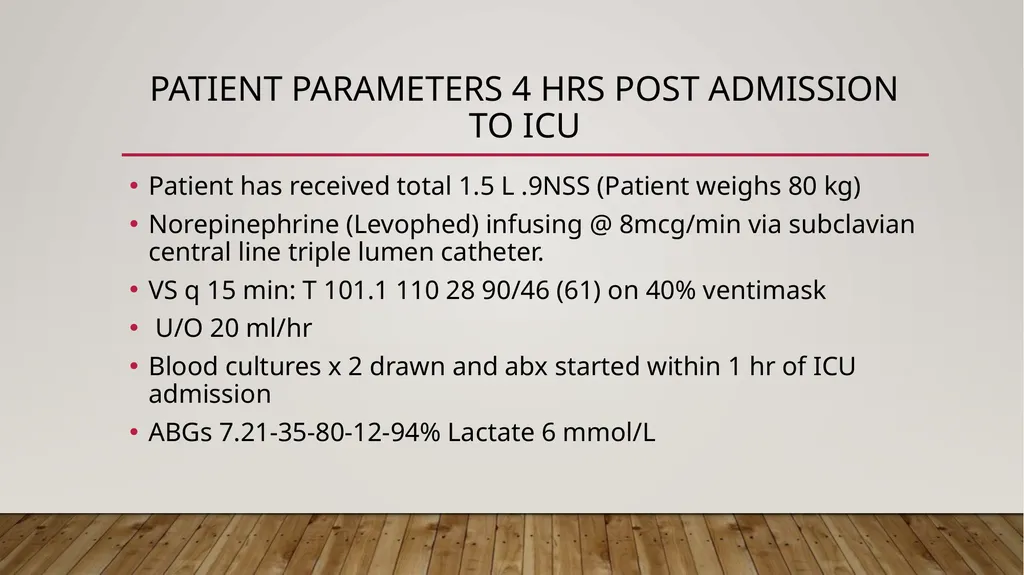
Patient Parameters 4 hrs post admission to ICU Patient has received total 1.5 L .9NSS (Patient weighs 80 kg)
Norepinephrine (Levophed) infusing @ 8mcg/min via subclavian central line triple lumen catheter.
VS q 15 min: T 101.1 110 28 90/46 (61) on 40% ventimask
U/O 20 ml/hr
Blood cultures x 2 drawn and abx started within 1 hr of ICU admission
ABGs 7.21-35-80-12-94% Lactate 6 mmol/L<br>
Norepinephrine (Levophed) infusing @ 8mcg/min via subclavian central line triple lumen catheter.
VS q 15 min: T 101.1 110 28 90/46 (61) on 40% ventimask
U/O 20 ml/hr
Blood cultures x 2 drawn and abx started within 1 hr of ICU admission
ABGs 7.21-35-80-12-94% Lactate 6 mmol/L<br>
55
Think, Pair, Share What are your thoughts about the patient’s tissue perfusion? Adequate or inadequate? What evidence supports your conclusions?
What therapies would you recommend in an SBAR format with the interprofessional team? Why?
3. What procedure may be imminent for which you must prepare?<br>
What therapies would you recommend in an SBAR format with the interprofessional team? Why?
3. What procedure may be imminent for which you must prepare?<br>
56
Think, Pair Share Mr. H., the husband, is very concerned about his wife and wants to remain with her in the ICU after 7pm. The visiting hours in the ICU are 15 min an hour, ending at 7pm.
What is the evidence concerning family visiting and patient safety and patient/family satisfaction in the ICU?<br>
What is the evidence concerning family visiting and patient safety and patient/family satisfaction in the ICU?<br>
57
Synergy Model Patient family characteristics Participation in care/Participation in decision making:
Assess to what extent family participates in care and decision making? Nurse Characteristics Advocacy- working to represent the concerns of the patients and family. Caring practices- responsiveness of caregivers to patient and family individualized needs.<br>
Assess to what extent family participates in care and decision making? Nurse Characteristics Advocacy- working to represent the concerns of the patients and family. Caring practices- responsiveness of caregivers to patient and family individualized needs.<br>
58
AACN Practice Alert: Recommendations Facilitate unrestricted access to a chosen support person 24 hrs/day unless contraindicated (other’s safety or rights, therapeutically or medically contraindicated).
Develop policies that allow support person to be at the bedside, according to the patient’s wishes.
Policies should prohibit discrimination of all kinds. AACN (2016) doi:http://dx.doi.org/10.4037/ccn2016677<br>
Develop policies that allow support person to be at the bedside, according to the patient’s wishes.
Policies should prohibit discrimination of all kinds. AACN (2016) doi:http://dx.doi.org/10.4037/ccn2016677<br>
59
Three Days Later… Patient extubated following implementation of awake and breathing trials. (ABCDE Bundle)
Pressors weaned off.
MAP 65-90 mmHg, U/O 50 ml/hr, Serum lactate 1.6 mmol/L
Continuing antibiotics to complete course.
Patient received aggressive inpatient rehabilitation prior to D/C.
Patient eventually d/c to home with home care, home PT/OT.
Discharge instructions include prevention of UTIs, when to call PCP, complete all antibiotics.<br>
Pressors weaned off.
MAP 65-90 mmHg, U/O 50 ml/hr, Serum lactate 1.6 mmol/L
Continuing antibiotics to complete course.
Patient received aggressive inpatient rehabilitation prior to D/C.
Patient eventually d/c to home with home care, home PT/OT.
Discharge instructions include prevention of UTIs, when to call PCP, complete all antibiotics.<br>
60
References AACN Practice Alert (2016). Family visitation in the Adult intensive care unit. Critical Care Nursing 36(1), doi:http://dx.doi.org/10.4037/ccn2016677
Dellinger RP, Levy MM, Rhodes A, et al.(2013) Surviving Sepsis Campaign: International guidelines for management of severe sepsis and septic shock: 2012. Critical Care Medicine;41(2):580-637.
Hinkle J, Cheever, K. (2018). Brunner & Suddarth’s Textbook of Medical-Surgical Nursing (14th ed.) Philadelphia, PA. Wolters Kluwer.
Levy M., Evans L., Rhodes A (2018). The surviving sepsis campaign bundle: 2018 update. Intensive Care Medicine 44, 925-928.
McHale-Weigand DL (2011). AACN Procedure Manual for Critical Care. St. Louis, MO. Elsevier.
Qureshi, S. H., et al. (2016). Meta-analysis of colloids versus crystalloids in critically ill, trauma, and surgical patients. British Journal of Surgery, 103(1), 14–26.
Society of Critical Care Medicine, European Society of Critical Care Medicine (2018). Surviving Sepsis Campaign One hour bundle. www.survingsepsis.org
Yarema, T. Yost, Spencer (2011) “Low-Dose Corticosteroids to Treat Septic Shock: A Critical Literature Review.” Critical Care Nurse. 31(6) 16-26.<br>
Dellinger RP, Levy MM, Rhodes A, et al.(2013) Surviving Sepsis Campaign: International guidelines for management of severe sepsis and septic shock: 2012. Critical Care Medicine;41(2):580-637.
Hinkle J, Cheever, K. (2018). Brunner & Suddarth’s Textbook of Medical-Surgical Nursing (14th ed.) Philadelphia, PA. Wolters Kluwer.
Levy M., Evans L., Rhodes A (2018). The surviving sepsis campaign bundle: 2018 update. Intensive Care Medicine 44, 925-928.
McHale-Weigand DL (2011). AACN Procedure Manual for Critical Care. St. Louis, MO. Elsevier.
Qureshi, S. H., et al. (2016). Meta-analysis of colloids versus crystalloids in critically ill, trauma, and surgical patients. British Journal of Surgery, 103(1), 14–26.
Society of Critical Care Medicine, European Society of Critical Care Medicine (2018). Surviving Sepsis Campaign One hour bundle. www.survingsepsis.org
Yarema, T. Yost, Spencer (2011) “Low-Dose Corticosteroids to Treat Septic Shock: A Critical Literature Review.” Critical Care Nurse. 31(6) 16-26.<br>